___P5-
/F77
POLICY
RESEARCH WORKING
PAPER
1977
Economic
Reforms
in Egypt
in addition to conventionalsources of increased costs of government intervention, the
Emerging Patterns and
declining popularity of Egypt'sTheir Possible Implications
domestic debt might raiseshort-term interest rates and increase the cost of servicing
Rania A. AI-Mashat
Dauid A. Grigorian newly issued debt This has
Dal id A. Grigorian the potential of increasing the fiscal burden and
undermining the crediDllry of the current fixed ex-hange rate regime
The World Bantk
Europe and Central Asia
Private and Financial Sectors Development Unit
Universitv of Maryland
H
Septem-ber 1998
Public Disclosure Authorized
Public Disclosure Authorized
Public Disclosure Authorized
POLICY RESEARCH WORKING PAPER 1977
Summary findings
Since Egypt's government introduced an economic of domnestic debt might increase the short-term interest reform and structural adjustment program in 1991, rate, thus increasing the cost of servicing newly issued Egypt's Central Bank has been engaged in massive debt.
sterilized interventions to support the fixed nominal The authors examine the possibility of an increased exchange rate regime. debt burden because of attempts to roll over outstanding
The result of this process, however, has been an debt and extend its maturity.
increasing fiscal burden, expressed in the volume of The authors explore the importance of measures outstanding treasury bills and the interest payments on involving interest rates in light of recent literature on the stock of outstanding debt. balance of payments crises. They also explain the
Al-Mashat and Grigorian present evidence of this and rationale behind the empirical assessment of the interest point out new channels for increased costs through (inflation) rate sensitivity of monetary aggregates.
further sterilization. In addition to conventional sources Finally, they offer estimates of an aggregate money of increased costs, such as differentials between foreign demand equation by introducing the contract-intensive and domestic real interest rates, the declining popularity money ratio as a measure of financial innovation.
This paper - a joint product of the Private and Financial Sectors Development Unit, Europe and Central Asia Region, and the University of Maryland- is part of a larger effort to study monetary and financial sector reforms in emerging markets. Copies of the paper are available free from the World Bank, 1818 H Street NW, Washington, DC 20433. Please contact Shirley Dy, room H6-372, telephone 202-473-2544, fax 202-522-0073, Internet address sdyCaworldbank.org. The authors may be contacted at [email protected] or [email protected]. September 1998. (21 pages)
The Policy Researcb Working Paper Series dbsseminates the findings of sork inr progress to encourage the exchange of ideas about development issues. An objective of tbeseriesq is to get the findings out quickly, even if the presentations are less than ftully polished. The papers carry the names of the authors and should be cited accordingly. The findir,gs, inte-rpretationls, and concl?tsions expressed in this paper are entirely those of the authors. They do not necessarily represent the vie:w of the World Bank, its Executive Directors, or the
Economic Reforms in Egypt
Emerging Patterns and Their Possible Implications
Rania A. Al-Mashat David A. Grigorian
Economic Reforms in Egypt: Emerging
]Patterns and Their Possible
][lmplications
Rania A. Al-Mashat and David A. Grigorian*
Abstract
Since the introduction of the Economic Reform and Structural Adjust-ment Program by the GovernAdjust-ment of the Arab Republic of Egypt in 1991, the Central Bank has been engaged in massive sterilized interventions to support the fixed nominal exchange rate regime. This process, however, was accompanied by increasing fiscal burden of sterilization expressed in the volume of outstanding T-Bills, and the interest payments on the stock of outstanding debt. We present some evidence of this and point to new channels for increased costs of further sterilizations. The paper explores the importance of interest rate associated policy measures in light of recent developments in the Balance of Payments Crisis literature and provides a rationale behind empirical assessment of the interest (inflation) rate sen-sitivity of monetary aggregates. We offer some estimates of an aggregate money demand equation by introducing the Contract Intensive Money, CIM, ratio as a measure of financial innovations.
1. Overview of Reforms
"Egypt is the investment jewel on the Nile"; this is how the Egyptian econ-omy is described today [10]. In the early nineties, Egypt launched a large scale economic reform program which had its goal of bringing down the country's dou-ble digit inflation, creating a sustained economic growth capadou-ble of absorbing 500,000 additional labor annually originated by the country's 2.5% population growth rate, increasing the foreign competitiveness of Egyptian products, etc.
* Economics Department, University of Maryland, College Park. David Grigorian is also
with the Private and Financial Sector Development Unit, Europe and Central Asia Region, The World Bank. Comments are welcome at [email protected] or [email protected]. 'We would like to thank Carmen Reinhart for her useful comments.
The program included a variety of measures concerning different aspects of economic life. Commodity prices have been liberalized, some privatization of public enterprises has been achieved and is still oIn its way and legislative acts were prepared and ratified favoring larger inflows o]f foreign investments into the country. Restructuring of the banking system made it attractive for foreign banks to be present in the Egyptian market and the removal of 2% capital gains tax is believed to be at least partly responsible for the rapidly growing stock market. There has been a strong commitment to fiscal restraints, the deficit fell from 1.3% of GDP in fiscal year 1994-95 to 1.1% of GDP in fiscal year 1996-97, external debt services equal 17% of annual exports which are among the lowest for similarly rated sovereigns, the strong external liquidity, the Central Bank of Egypt (CBE) has reserves that amount to around $19 billion today1.
In addition, the Egyptian authorities have employed the nominal exchange rate as an anchor, and have been so far successful in keeping it stable, although at the expense of some real appreciation. These, along with other facts that will be presented in the paper, can be seen as making Egypt a fertile ground for foreign capital inflows, a tendency that has been widely documented (e.g. [8] [11]).
1.1. Chronology of Events
Since mid 70's to mid 80's, Egypt has been undergoing swift economic growth stimulated by high oil prices, increased worker remittances, tourism revenues and substantial foreign borrowing. During this period, revenues were directed towards increased public expenditures in infrastructure and import substitution industries. But after a sharp decline in oil prices dluring 1985, macroeconomic disequilibria emerged and have remained ever since. The disequilibria, both in-ternal and exin-ternal, were related to (a) a persistent excess of public expenditures over public revenues which necessitated the transfer of foreign and domestic pri-vate savings to the public sector, (b) a deterioration in the trade account around US 6-8 billion dollars annually representing 12 % of GDP, (c) a bias against the production of tradable goods due to the lack of foreign competition and inability to compete internationally owing to poor technology, (d) significant rises in the inflation rates doubling from 8% in 1983 to 16% in 1985 and around 22% in 1991.
Such a shaky economic performance left policy makers with only one option, economic reform. The government implemented the first phase of a Comprehen-sive Economic Reform and Structural Adjustment P'rogram (ERSAP) from the
'The latest 'BBB-' long term, 'A-3' short term foreign currency credit ratings and 'A-' long term, 'A-i' short term local currency credit ratings, according to Standard & Poor's, reflect that the current political system supports the reform program and works on ensuring the broad implementation of the economic policies as planned.
s,pring of 1990 up until the winter of 1993 while a second phase of ERSAP started in July 1993. Following is a brief glance at both phases
The First Phase of Reforms (ERSAP-I)
The ERSAP advocated a shift from a centrally planned economy with a dom-inant public sector into a decentralized, market based and export oriented econ-omy in which the private sector plays a leading role. The first phase involved the removal of the price distortions as well as some of the key obstacles to trade and to investment. This first phase was supported by an IMF Stand-By Arrangement (SBA), a World Bank Structural Adjustment Loan (SAL) and debt/debt service relief (DDSR) 2, including an agreement with Paris Club Creditors.
The Second Phase of Reforms (ERSAP-II)
This phase focuses on macroeconomic stability and financial sector reforms. It is being supported by a Three Year Extended Arrangement (TYEA) by the IMF, 3a World Bank Structural Adjustment Monitoring Program (SAMP) and fiurther
(DDSR) granted by Paris Club Creditors3 . The main target of this phase is to combine the gains that were made during the first phase and generate further structural reforms to induce a strong and sustainable supply-side response from the private sector designed to bring about the desired growth level in the economy
[17].
When the GOE first launched its Economic Reform and Structural Adjust-ment Program, (a) eliminating the internal and external equilibria by decreasing subsidies, reforming tax rates and freezing the public sector investments, (b) lib-eralizing the financial and foreign exchange markets, (c) increasing efficiency of resource utilization by liberalizing trade and deregulating prices, (d) encouraging private enterprise reforms and privatization in order to promote competition and enhance efficiency, and, (e) designing a social package which aims at safeguard-ing the interests of the socially vulnerable segments in the population dursafeguard-ing the period of economic transition were among the targets.
2In May 1991, the Paris Club Creditors agreed to grant Egypt an immediate debt service relief, representing 15% of the net present value of debt service falling due and a permanent debt service relief over three years equal to 50% of the net present value of Egypt's eligible debt with the Paris Club Creditors [16].
3Under the Paris Club Agreement, the official creditors decreased the external public debt
from US $44billion in 1989/90 to US$33 billion in 1990/91. A further reduction to US$31 billion was achieved when countries in the Gulf abandoned their claims on Egypt after the 1990/91 Gulf War. There is a final agreement among the Paris Club Creditors to reduce Egypt's external debt by an additional US$4 billion to a projected US$ 29 billion currently, representing 40% of GDP [11].
1.2. PTmvatization
Privatizing nearly 300 non financial public enterprises (NFPE's) with an esti-mated value of US$ 13 billion is the cornerstone of the Adjustment Program and the IMF Standby Agreement. The plan was to privatize 30% of the net worth of all NFPEs in 1996/97 while offering another 30% of all NFPE's for sale in 1997/98. Shares of the sold companies are traded on the Cairo Stock Exchange. The government has already sold 17 companies, (hiring the first half of 1996/97 and plans to sell another 20 in the first quarter of 1997. If there are delays in the planned privatization schedule, one would expect savings and investments to remain low hence crippling the export oriented growth targeted and may risk Egypt's credit position, while, in the long run, the government's policy is to privatize all NFPE's including utilities representing 28% of 1996/97 GDP. Some privatization has occurred in the tourism and the agriculture sectors, but all the large public enterprise remain in the public sector including the enterprises in the Petroleum sector, the National Airline and the Suez Canal Authority (SCA).
The privatization program is essential for the development of the capital mar-ket as the expectations of increased fiuture earnings of these enterprises create sufficient signals which make considerations of the Egyptian Stocks necessary for all domestic, regional and international portfolio managers [11].
1.3. Financial Liberalization
On the other hand, the privatization of the Public Sector Banks has proven to be more problematic. Only the National Bank of Egypt (NBE) has been active and innovative in disposing its joint venture holdings but the three other state commercial banks, Banque Misr, Bank of Alexandria and Banque du Caire are more hesitant to do so. However, there has been a promise to privatize at least one of the four public sector commercial banks during 1997 [9].
Firm and serious steps were taken to liberalize the financial sector in order to help mobilize savings and allocate credit efficiently. Auctioning Treasury Bills since 1991 provided a new instrument to mobilize domestic saving. Lifting restric-tions on market entry and increased competition have stimulated the efficiency of bank intermediation. Measures to reform the financial sector are complemented by regulations governing the foreign exchange market.
The nominal interest rates were largely fixed by the CBE for over two decades [111. This, along with fixed nominal exchange rate regime introduced policy in-consistency, expressed in targeting two often conflicting objectives [17]. Discus-sions with the CBE officials, however, revealed that controls on interest rates have recently been lifted. This gave a boost to the public's confidence in the CBE's ability to safeguard the solely targeted fixed exchange rate regime.
1.4. Capital Inflows
There have been massive capital inflows into the Egyptian economy. In 1994, foreign investments amounted to $400 million. Foreign capital inflows play an important role in the growth process sought by the government. The targeted
growth rate of GDP of 5% in 1996/97 is still below the estimated 7% needed to absorb the new market entrants and keep unemployment rates below 17%. Because domestic savings and investments represent only 17% of GDP which is less than the 25% estimated threshold necessary to achieve sustained growth,
capital inflows are called for to fill in the gap. The inflows led the government to follow sterilization policies (more on this in Chapter 2). These policies of interventions, along with the issuance of TBs in financing the budget deficit, however, have resulted in an increase in the outstanding stock of domestic debt [16].
Finally, the International Finance Corporation (IFC) added Egypt to its daily index since September 1996. The index comprises 32 of the most actively traded stocks on the exchange. In 1997 Egypt is expected to be included in the IFC Global composite. This is anticipated to increase confidence in the financial environment and hence encourage more capital inflows[9].
2. Emerging Patterns
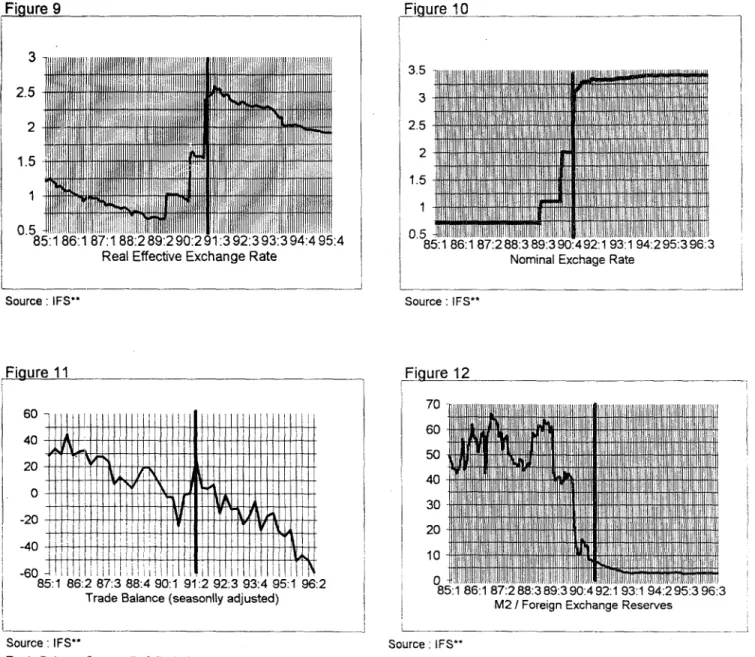
Aiming at keeping the nominal exchange rate as an anchor and maintaining financial stability and confidence in the currency, after a series of devaluations in late 80's and early 90's, the Egyptian authorities established the exchange rate at a virtually fixed level within a narrow band of about ±1% since 1992 (Figure 10). Backed with substantial foreign exchange reserves at the estimated level of 12 month imports at the end of 1996, authorities have been standing ready to exchange the pound for foreign currency. Inflation, as shown in Figure
S 8, responded to the instantaneous change in the nominal exchange rate, s , that took place at the very time of all three devaluations, by increasing abruptly and then falling as the exchange rates are revealed to stay constant (at least temporarily, a point that we will return to later). It is interesting to monitor the behavior of the real exchange rate as it has been appreciating under upward pressures on the price level in the economy, under all four periods corresponding to fixed nominal exchange rates.
Both the World Bank and the IMF were convinced that the Egyptian currency is overvalued by about 30% in 1996 and that the exchange rate policy undertaken by the CBE is directed towards fiurther trade account deterioration. At one
point, the disagreement was very critical and the IIF made devaluation a core requirement for fiirther borrowings. The rationale still given by the CBE is that most of the country's export bills come from tourism. Suez Canal revenues, and oil sales (all denominated in US dollars) and so will not be affected by local exchange rate movements. In addition to this, increasing confidence in the currency and hence securing inflow of capital from abroad is emphasized. Devaluation would therefore have little effect on foreign exchange earnings and would instead result in higher import prices, and be especially harmful given the importance of capital intensive imports for the growth in the economy, which are considered crucial. Moreover, higher costs of food subsidies (primarily wheat, which is imported from the US) will directly affect the fiscal side. The battle ended last year when the IMF backed down on this point [10]. Thus although there is evidence of significant expansion in export oriented sectors due to macro stabilization and policies aiming at the export growth, the trade account continues to worsen owing partly to the appreciated real exchange rate (see Figure 11).
2.1. Calvo-Vegh trap: A way out
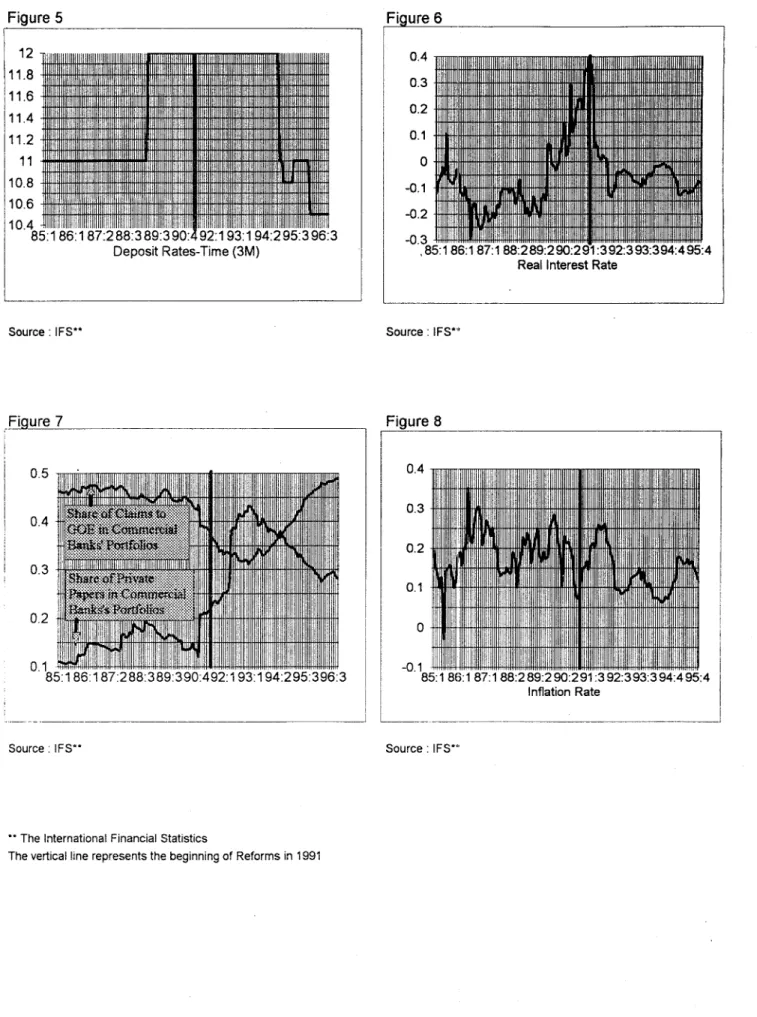
In light of the above it is fairly easy to see that the pattern before and after 1991 devaluation (the period that we focus on) fits Calvo (1989) framework of anticipated devaluations fairly closely. Since the reforms were followed by some-what lower tax rates and import tariffs [9], we might consider these to be ways to compensate against the future devaluation tax (in the spirit of 'compensated devaluation' literature e.g. Calvo (1989), Calvo, Reinhart and Vegh (1995), etc.), and look at the predictions of the model. Under the assumption of a compen-sated anticipated devaluation, Calvo (1989) predicts the initial current account deficit, with the latter turning into a surplus as the devaluation occurs, owing to the drop in consumption at the time of devaluation A very similar pattern can be seen in Figure 11 that suggests a jump in consumption (worsening the trade account) immediately before the devaluation takes place (i.e. to the left from the line) and a sudden reversal at the time of devaluation. Real interest rate can be shown to be raising (in the model) before the devaluation, and experiencing a decline after devaluation takes place, a pattern that is followed in Figure 6.
Looking at the 1991 devaluation from a point of view of being temporary, brings Us close to the Calvo and Vegh (1993) scenario. The temporariness as-sumption being a crucial one here (which, among other reasons, is attributed to the duration of current leadership, as a guarantor of reforms, in power), explains the increase of demand for traded and non-traded goods over their 'normal' lev-els, with the latter causing an increase in the domestic price level, and thus real exchange rate appreciation (see Figures 11 and 9). Inflation drops (from its peak value shown right after the line on Figure 8) as the nominal exchange rate
lev-els off, and then starts showing an upward trend from the 3rd quarter of 1993 (see Figure 8). A possible remedy in this case is an increase in the interest rate (possibly accompanied by some capital account restrictions) designed to dampen consumption, through increasing its effective price (making consumption today 'more expensive than consumption tomorrow), and money holdings, with the lat-ter being another channel affecting the former in a cash-in-advance framework. However, the increase in the interest rate is capable of generating the new cap-ital inflows, a point that may indervalue the use of interest rate as a remedy against the Calvo-Vegh trap when further capital inflows are not desirable. It is thus clear that using the interest rate as a tool has side effects, which could be minimized had the authorities been aware of the exact interest rate sensitivity
of money and did not increase the interest rate more than they were supposed
to in order to depress money holdings, henceforth, consumption. A skeptical reader might, however, argue that the Calvo-Vegh scenario in both no-response and interest-rate-remedy cases are similar in a sense that they both lead to cur-rent account deterioration, with the former achieving it directly because of the increase in demand for imports, while the latter creating a surplus on the capital account due to the inflows caused by higher interest rates, a part of which will end up financing a deficit on the current accotnt. Yet the cases differ because the latter allows for sterilized intervention (i.e. reserve accumulation, since there is no need to finance the current account), while the former implies full financing of the current account with no reserve accumulation whatsoever.
2.2. Krugman (1979) and Calvo (1995) scenarios
A strong commitment to fiscal balance represented by a declining deficit to GDP ratio suggests that financing fiscal deficit by printing money can hardly be advocated to be a major source of the Krugman-type crisis for Egypt nowadays4. Moreover the expected revenues from large scale privatization still to come will ease the problems in financing the social safety net, and thus decreasing the need for seignorage. At the same time a tremendous credit expansion seems to follow a relatively strict monetary policy held immediately after the beginning of reforms. Figure 3 demonstrates the dynamics of Domestic Credit to Nominal GDP ratio (see also the M2 multiplier in Figure 4). However the CBE officials in discussions expressed confidence in their ability to support the currency and avoid a BOP crises by pointing out to the stock of foreign exchange reserves essentially built up sincel991. The ratio of M2 over the Foreign Exchange Reserves (FER) has been drastically decreased and is kept stable at an essentially constant level of 3:1 since 1992 as shown in Figure 12. (Here, in constructing this measure we did not leave
4Another point against expansionary monetary policy is a resulting lower nominal interest
out the Foreign Currency Denominated Assets of commercial banks from M2, given a somewhat weak banking system, with a possibility of a bank run leaving the CBE liable for commercial banks' foreign exchange denominated liabilities). A constant targeted M2/FER ratio can be viewed as a signal of 'carefill' policy of credit expansion, with a balanced position of assets and potential liabilities in the case of a BOP crises. By the end of 1996, the amoumt of non-cash balances (i.e. M2-M1) reaches the level of 3/4 as a proportion of M2. This implies a ratio of MI to FER to be 3/4, which suggests that the most liquid finds (i.e. cash and demand deposits) are more than fiully covered by ]FER. Yet fuirther information about the average maturity of non-cash balances is needed to fully assess the vulnerability of the system, in the context of a simple BOP crises a la Krugman. It should be noted however that as long as the amount of quasi-liquid balances within M2 (i.e. MI plus short maturity and thus relatively liquid component of non-cash balances) is greater than FER, there is a space for a crises, which might perhaps be caused by political uncertainty within the country or by shifts in the international portfolio holdings ([3],[5]). One of the few tools available to policy makers here is again the interest rate, in this case designed to suppress the money demand and decrease the pressure on the reserves.
A different version of BOP crises presented in Calvo(1995), however, seems to be more fitting here. Calvo (1995) assumes that the Government pays its debt by issuing more debt. Individuals realize t:hat this situation cannot be sustained forever and the fixed exchange rate regime is deemed to be dismantled and followed by a pure float. Without going much into details of the model and considering only the (trivial) case when all the bonids are redeemed at the time of crises, we will note that the fixed regime will persist up until the point where the expected inflation at the time of crises will be just enough to drive a wedge between pre-and post-crises money demands capable of absorbing the entire stock of FER less outstanding debt redeemed at that time. It can be shown that the timing of the crises and post-crises rate of inflation depend on the amount of the outstanding bonds and the sensitivity of money demand to changes in the rate of
inflation. Although it can be argued that issuing clebt will postpone the crises,
in some cases this will lead to a higher post-crises rate of inflation.
The relevance of this analysis for our case is demonstrated by the fact that the GOE has been trying to roll over its debt by issuing longer maturity debt. This has an apparent potential of increasing interest payments on new issued bonds owing to the interest rate differential between short vs. long maturity debt. This, together with fiscal costs of sterilization, due to foreign and domestic real interest rate differentials and/or imperfect asset substitutability (see next section), will create a need to finance the increased burden by further issuing debt. In fact as an evidence of the growing burden of debt, despite the small fiscal deficits, the interest payments on the stock of domestic debt increased from 4.2 % of GDP in
fiscal year 1991 to 7% of GDP in fiscal year 19935. The reforming government is reluctant to raise funds by seignorage and instead aims at bringing inflation to single digits. This leaves issuing new debt the only possibility (unless government starts running surpluses on its account), and thus we are back to Calvo (1995) world.
2.3. Effect of Sterilized Interventions
As it was mentioned earlier, Egypt's fixed nominal exchange rate is backed by substantial increase in CBE's reserves holdings as shown in Figure 1. The exchange market interventions become a common practice since the beginning of
reforms and we offer some evidence of it. Figure 2 presents the foreign exchange reserves as a share of total assets in CBE's asset position vs. domestic credit, also shown as a share of total assets. Almost a classical textbook example of
,Central Bank's intervention, the graph shows a 1 to 1 decrease in CBE's holdings oDf domestic credit as a result of increases in foreign exchange reserves. At the same time Figure 12 comes to back up the hypothesis of planned interventions *by the CBE aiming at keeping M2 over FER at a constant level. Thus this leaves no doubts about continuing foreign capital inflows and sterilization through subsequent sales of domestic credit on the market. In their study on capital inflow management, Reinhart and Dunaway (1996) present a view that under the assumption (or in case) of Government bonds being not perfect substitutes for private securities and commercial banks' papers, there is a fair chance of increases in the short term interest rate as a result of sterilizations, which will attract further capital inflows. Another effect of this is the higher fiscal cost of sterilizations. In an attempt to evaluate the merit of this argument for Egypt, we constructed measures of (a) share of claims to the government in the commercial banks' portfolio, and (b) share of private papers in commercial banks' portfolio, both depicted in Figure 7. A very interesting pattern emerges here. Shortly before the reforms begun, the status quo had been abandoned and government papers become popular and the banks tended to increase their holdings of government bonds at the expense of their holdings of claims to the private sector. However, the pattern reverses itself completely. Soon after the reforms take off, commercial banks shift their portfolios towards private securities. The tendency seems to persist so far without any major changes. It is important to note in this regard that the shifts have not been caused by a sudden decline in the interest rate on T-Bills (known to be fixed at the same high level during both shifts), or by a 'magic' change in the productivity of enterprises, and thus higher returns on
5Since the introduction of the TB market in January 1991, the stock of outstanding TBs
reached LE 8.5 billion by end-December 1991, about LE 28 billion by end-December 1992, and LE 32 billion by end-March 1993 [16].
private paper holdings6. Leaving the essence of the regulation out of scope of this analysis, the potential outcomes of this should be emphasized.
First of all, attempts to sterilize capital inflows would, as it was pointed out by Reinhart and Dunaway (1996), be associated with a higher (short term) interest rate and thus bring about further capital inflows, mainly of short term character. Second, further interventions will increase the fiscal costs of sterilization and rolling over the existing debt, due to imperfect assets substitutability and interest rate differentials (on long vs. short term maturity debt) respectively, both having the effect of increasing the interest payments on the newly issued debt. These observations might limit the CBE's ability to intervene costlessly and have the potential to jeopardize the fixed exchange rate regime if sterilizations are no longer implemented. However if devaluation is to be avoided and severe capital account restrictions are among the least popular measures in the policy makers' tool box in the context of current reforms, sterilizations will continue to be a practice and the country will keep accumulating public debt for the reasons mentioned above. Hence issuing new debt to pay for the (increasing!) old one, will be among a few available options and thus we are back again to Calvo (1995), where the timing of the crisis is determined, among other things, by the stock of outstanding debt and estimates of money demand equation.
Thus it should be emphasized, that both Krugraan (1979) and Calvo (1995) type of scenarios, being highly relevant for the case of Egypt, address the impor-tance of interest (inflation) rate sensitivity of money demand, an issue that we will approach by using empirical analysis in the next chapter.
3. Empirical Estimation of Demand for Money
The most common specifications of utility based money demand equation in empirical literature specify the money demand equal;ion as some function (in lev-els or differences) of interest rate, emphasizing the opportunity cost aspect of it for real money holdings, consumption/income, capturing the transaction motive of money holdings, and some kind of proxy for other asset holdings, to account for the degree of substitutability between cash and various financial assets. Dif-ferent versions of this family of money demand equations can be summarized in a following formulation:
mt = 1'(yt, it, St) where bDy > O, (D < O, and s < 0. (3-1)
or in particular, by assuming a specific functional form:
6As it turns out to be, this was a result of a change in classification of assets innitiated by
mt = A ey/a e0it . e- st (3 - 2)
where mt is money holdings, yt scale variable (per capita income or consump-tion), it nominal interest rate, St a proxy for asset substituites, and A > 0, a > 0, ,z < 0, ay < 0 parameters. In their analysis of the demand for M2 balances, some
analysts also add proxies for the effects of foreign capital inflows by including foreign interest rates or country's gross international reserves (see, for instance, Calvo and Mendoza (1995)).
Recent research in this area, which focuses on estimating money demand equations for the developing countries, emphasizes the importance of innovations in the financial market as a determinant of the money holdings. One way to look at the link between innovations and money holdings would be to consider the former as a mean of decreasing the transaction costs associated with holding funds in an interest bearing bank account. Following the same logic suggests that the financial innovation will, in essence, be able to capture the substitutability of
assets and cash holdings by itself, with the latters being more easily substitutable as the financial market progresses. We will focus our analysis on estimating dLemand for MI, and so the estimable version of equation (3-2) becomes:
Inmlt = °ao±+a o.FIt+ a 2-it+ a 3 -Inyt±t (3-3)
where Inmlt is the (logarithm of) real per capita MI holdings, deflated by the Consumer Price Index (CPI), Flt is the proxy for financial innovations, it is nominal interest rate, Inyt is (logarithm of) real per capita gross domestic product, deflated by CPI, and et is the stochastic error component. Here, however,
d ue to the fact that the nominal interest rate has been largely regulated in Egypt fDr the last two decades, we will hereafter employ inflation rate 1Tt measured as
percentage change in the CPI, as the opportumity costs of holding money. Researchers differ in their ways of modeling progress in financial markets. Arrau, De Gregorio, Reinhart, and Wickham (1994), for example, use the time trend (and M2/M1 ratio under a different scenario) to capture the financial innovations. Thus, their version of equation (3-3) might be presented as follows:
lnmlt = ao +a c.t+ a2 * 7.t + 3 .lnyt+ct (3-4)
Siklos (1993) proxies those innovations by the ratio of nonbank financial assets to total financial assets. For our analysis we will employ the Contract Intensive Money (CIM) as a measure for financial innovations introduced by Clague, Keefer, Knack, and Olson (1995). Being defined as the proportion of non cash balances within M2, or
CIMt = M2t-Mlt 3-5
it was initially suggested as a mean of capturing the quality of institutions and contract enforcement, and so was meant to have its positive effect on the output
and growth rate. Although one might question the direction of causality when output (or the growth rate of output) is regressed on CIM (for a test against this argument see Clague et al (1995)), not only the above argument loses its strength when we try to proxy financial innovations by CIM:, but also it has a number of usefiil properties. The dominance of CIM over some alternatives measures of fi-nancial sophistication (e.g. time trend, M2/M1, Nonbank Fin. Assets/Total Fin. Assets, etc.), becomes apparent when one takes into account the boundedness of CIM, and thus its limited variance. The CIM ratio allows one not to control for inflation, as opposed to the cases when the measures of financial innovations are associated with inflationary pressures and thus inflation is to be accounted for. Clague et. al. (1995) also show that for their sample the CIM is positively correlated with independent measures of institutional quality, measures that have emerged because of the demand of foreign investors for accurate information on the riskiness of investment. Thus armed with the C][M ratio we altered the 'level' equation as (seasonal dummies are not shown):
lnmTlt = ao +a1
-CIMt+ar
2 -rt±+3-Inyt+Et (3-6)Using monthly data from International Financial Statistics databank (with GDP interpolated), we established that all variables, in the regression, except 7rt, were integrated of order one, i.e. follow I(1) processes. The choice of per capita
real GDP, Yt, over real per capita private consumption expenditures is justified by the overall dominant performance of the former throughout the analysis. To test for cointegration of the series on the right and left hand sides, following Engle and Granger (1987), we performed the Dickey-Fuller unit root test on the residuals from the above equation. The test failed to reject the no-cointegration hypothesis at any significance level, given three different specifications of the 'true process' in the error term inder Ho. To resolve the problem with noncointegrated series, namely the inconsistent estimates of coefficients by OLS, we employed a differenced version of equation (3-6). By taking the logarithms of equation ( 3-2) and differentiating with respect of time, one shoul(l be able to find the way to the following differenced version of equation (3-6):
Alnm1t = oO -
ACIMt +
a1l Alrt + °±2 -cnyt + Ut (3-7)ki k2 k3
A lnmlt =
aj
a3 ACIMt_j+Zj
A7rt_j+Zyj.Alnyt_j+wt (3-8)j=0 j=O j=O
where introducing lagged specification of order ki for ith regressor (for i =
1, 2,3) is designed to capture higher order dynamics and persistence of effects of independent variables. It might be argued at the intuitive level that the struc-ture of the type k1 > k3 > k2 will have the highest likelihood of happening. Not
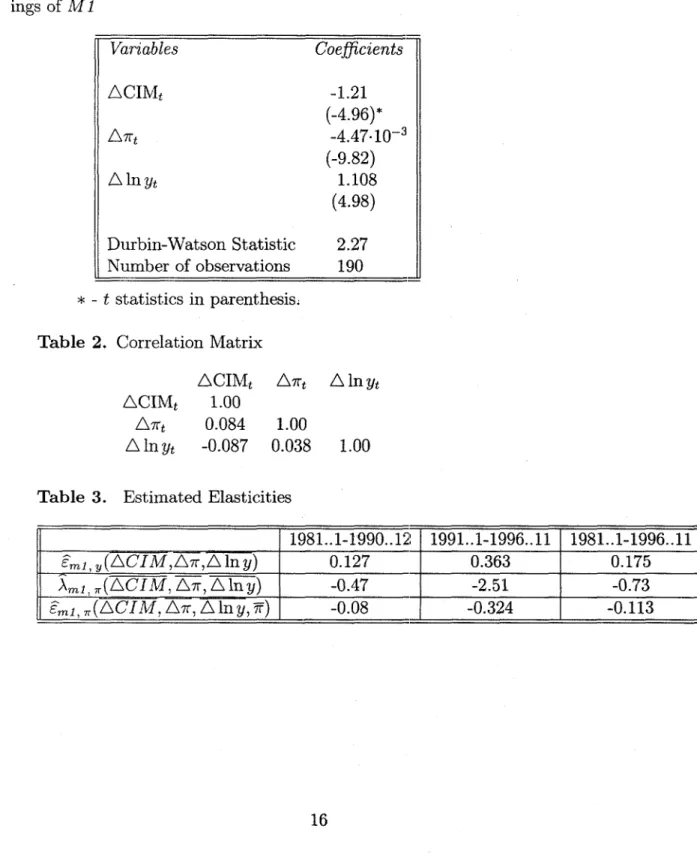
imposing the above inequality of the model and letting 'data decide' we spec-ified k to be 3 for all regressors. However, the joint hypothesis of no lags in the above specification cotfld not be rejected and thus (3-7) was picked up in favor of (3-8). All three estimated coefficients have the expected signs and are reported in Table 1. A test of structuiral change was performed by introducing a dummy variable that takes value of 0 for the period of 1981..1-1990..12, and 1 for 1991..1-1996..11. Although introducing the dummy by itself and interacted with regressors suggested some evidence of the structuiral break for the levels equation (3-6), the hypothesis of a structural change at the beginning of reforms was rejected for the differenced specification (3-7).
In an attempt to come up with the estimates of elasticities at means of in-dependent variables, the following transformations are used to calculate (a) the elasticity of money holdings with respect to real per capita income yt,
Cml, y = a( t n Ine-/zt + &el * A inrt + &2(39
and (b) semi-elasticity of money holdings with respect to the rate of inflation 71t,
dlnmlt Alnmlt ,_ ± 1+ * (3-10)
where bar on top of a variable indicates its mean. Noting that the rate of inflation is a stationary variable around its mean Xt, we construct the estimate of
t:he elasticity of money holdings with respect to inflation rate at the mean points of the regressors as:
d In 7rt = A3 mi,T * 7t t [0 * ,t + &1 + 2 * t ] (3-11)
Since estimates ao, &o and a2 are robust, i.e. are the same for the entire
period from 1981..1 to 1996..10 (they are assumed to be constant throughout the entire period), we reported our estimates of elasticities by using the means of regressors for (a) the pre-reform period of 1981..1-1990..12, (b) post-reform period of 1991..1-1996..11 and (c) the entire sample. The results are reported
in Table 3 and definitely worth paying attention to. The second row suggests that the money holding are more than twice as responsive to the changes in income (both in percentage terms) in the period after the reforms compared to those before the reforms started. The inflation rate sensitivity of money holdings, measured in our case as both semi-elasticity (percent change in mit caused by one point change in the rate of inflation, i.e. row 3) and elasticity, row 4, has increased over five times after the reforms. The fourth row demonstrates the results for the entire sample. Our findings of post-reform elasticities appear to be consistent with Arrau et. al.(1995) findings and are within the range of the income and inflation rate elasticities of money demand estimated for 10 countries and summarized in their paper.
To sum up, the results of this and similar exercises can be used for different purposes: (1) in predicting the timing of crises a 1a6 Calvo (1995) using computer simulation and assuming different values for parameters such as portion of bonds to be redeemed at the time of crises, rate of accumulation of domestic debt, rate of growth of foreign exchange reserves, etc., (2) in considering using interest rate as an attraction to avoid withdrawals in a simple Krugman (1979) type of scenario, (3) in using interest rate as a tool against Calvo-Vegh trap in dampening consumption through (a) increasing the cost of real money holdings, and (b) intertemporal substitution,etc.
4. Conclusion
The purpose of the current paper is (a) to give an overview of ongoing reforms in Egypt, (b) to reveal some emerging patterns associated with current account instability, exchange rate regime, monetary interventions, and accumulation of public debt, (c) to point out the possibility of using interest rate associated mea-sures as remedies in some cases, and (d) to provide an estimate of aggregate money demand equation which can be useful in assessing the degree of applica-bility of those measures.
We predict that in addition to conventional sources of increased cost of ster-ilizations such as foreign vs. domestic real interest rate differentials, there is a potential associated with decreased popularity of domestic debt that might lead to increases in the short term interest rate, and thus increased cost of servicing the newly issued debt. We also examine the possibility of increased burden of debt due to attempts to roll it over and thus extend the maturity of outstanding debt. Although this has a potential of postponing the crisis, by making less debt due at any point in time in the short run, paying for debt by issuing new debt has a potential of ending up in a crisis described in Calvo (1995). In this regard we advocated the importance of measures of interest (inflation) rate sensitivity of monetary aggregates, and presented some estimates of it.
Yet it remains to be seen if decreased popularity of government papers is going to become a major problem after the interest rate is let free.
Appendix
Table 1. Estimated Coefficients
Dependent Variable - First Difference of the logarithm of real per capita hold-ings of MI Variables Coefficients ACIMt -1.21 (-4.96)* Airt -4.47 10-3 (-9.82) Alnyt 1.108 (4.98) Durbin-Watson Statistic 2.27 Number of observations 190 * - t statistics in parenthesis.
Table 2. Correlation Matrix
ACIMIt Art A ln Yt ACIMt 1.00
A?rt 0.084 1.00
A ln yt -0.087 0.038 1.00
Table 3. Estimated Elasticities
._________________________ 1981..1-1990..12 1991-.1-1996..11 1981 .1-1996..11
F jmi,y(ACIM,A7r,Alny) 0.127 0.363 0.175
'ml, w(ACIM, A7r, Alnmy) -0.47 -2.51 -0.73
References
[1] Arrau, Patricio, Jose De Gregorio, Carmen Reinhart, and Peter Wickharn, "The Demand for Money in Developing Countries: Assessing the Role of Financial Innovation", Journal of Development Economics, Vol. 25, 1994, 320-335.
[2] Calvo, Guillermo A., "Anticipated Devaluations", International Economic
Review, Vol. 30., No.3, August 1989.
[3] Calvo, Guillermo A.,1995, "Varieties of Capital Market Crises", Center of
International Economics at the University of Maryland, Working Paper, No.
15, November 1995.
[4] Calvo, Guillermo, Carmen Reinhart, and Carlos Vegh, "Targeting the Real Exchange Rate: Theory and Evidence", Journal of Development Economics, Vol.47, 61-96, 1995.
[5] Calvo, Guillermo A. and Enrique G. Mendoza, "Reflections on Mexico's Balance of Payments Crisis: A Chronicle of Death Foretold ", Center of
International Economics at the University of Maryland, Draft, October 1995.
[6] Calvo, Guillermo A., and Carlos Vegh, "Exchange Rate Based Stabilization under Imperfect Credibility", in Open-Economy Macroeconomics, H.Frisch and A. W6rgotter eds., London, McMillan Press, 3-28, 1993.
[7] Clague, Christopher, Phillip Keefer, Stephen Knack, and Mansur Olson, "Contract Intensive Money: Contract Enforcement, Property Rights, and Economic Performance", Center for Institutional Reform and the Informal
Sector, University of Maryland, Working Paper No. 151, February, 1995.
[8] "Egypt: A Robust Commitment to Sound Fiscal Management, Ongoing Economic Reforms and Improved Growth Prospects Support Egypt's New Investment-Grade Rating", Standard & Poor's Creditweek, January 1996. [9] "Egypt: EIU Country Report", The Economist Intelligence Unit Limited,
4th quarter 1996.
10] "Egypt: Facing the Modern World", Euromoney, August 1996.
11] "Egypt: Increasing Its Integration With the World Economy", Salomon
Brothers, European Emerging Markets Research, Investment Strategy,
November 1996.
112] Engel, R.F., and C. Granger, "Co-integration and Error Correction: Repre-sentation, Estimation and Testing", Econometrica, Vol. 55, 251-276, 1987.
113]
Krugman, Paul R., "A Model of Balance of Payment Crises", Journal ofMoney, Credit and Banking, Vol. 11, 311-325, Augulst 1979.
[14] Reinhart, Carmen, and Steven Dunaway, "Dealing with Capital Inflows: Are There Any Lessons ?", UNU World Institute for Development Economics
[15] Siklos, P.L."Income Velocity and Institutional Change: Some New Time Series Evidence, 1870-1986", Journal of Money, Credit and Banking, 25, 377-392, 1993.
[16] World Bank, Arab Republic of Egypt: Public Sector Investment Review, Re-port No. 11064-EGT, Cotntry Department II Country Operations Division, MENA, Vol.1, Washington D.C., October 1993.
[17] World Bank, Egypt Into the Next Century, Report No. 14048, Washington D.C., May 1996.
Fiaure 1 Figure 2 18 . ... 16 1il 14 j 08l 12 Igg l 0.8 1 0 8 06 6 ~~~~~~~~~~~~~~~~0.4 4 2 0.2 0 85:1 86:1 87:1 88:2 89:2 90:291:392:393:394:495:4
Total Reserves Minus Gold (US$ bn.) 0 O
85:1 86: 872883 893 90 9:1 94.2953 963
Source: IFS- Source: IFS*'
Figure 3 Figure 4
F
l 1.6 - | 7 1lilililXlilililili ||| || ||||||| |.5 1.4-6.5 1.2-6 Kgm 1 5.5 0.8 -4.5 0.6-4 85:1 86:1 87:288:389:390:492:1 93:1 94:295:396:31985 JAN 987 OCT 1990 JUL 1993 APR M2 Multiplier
Ratio of Domestic Credit to GDP
Source: IFS** Source: IFS**
** The International Financial Statistics
Figure 5 Figure 6
~
12 - l 011 1M1 03 t11@ l ..4 .0 l 0.4
11A -11.8
m
E II:_DI t tl[ I DEIR X WllilZllElEIIIIII 0.31 II 1 I t|t02|. 0 11111.6-0.2 11.4-11.2 0.10 10.8 0.1-.10.6 10.4 6 -0.2 85-1 86:187: 288389:390: 9:93:1 94:295:396:3 -0~3 Deposit Rates-Time (3M) 85:1 86:1 87:1 88:289:290:291:392:393:394:495:4
Real Interest Rate
Source: IFS** Source:
IFS*-Fi ure 7 Figure 8 0.5 [ 0.4| 0.3 0.2 0.1 0.2 0 85:1 86:187:288:389:390:492:193:194:295:396:3 85:1 86:1 87:1 88:289:290:291:392:393:394:495:4 I l Inflation Rate
Source: IFS-- Source:
IFS-' The International Financial Statistics
Figure 9 Figure 10 3.5 2.5 2 253 M
2.5
ff2
14' l j ,il.5
-1.52 1.5-1 0.5 1 ;05 85 186 187:188:289:290:291:392:393:394:495:4 s85:18 6:1 87:288 389:390:492:1 93. 94:295:396.3Real Effective Exchange Rate Nominal Exchage Rate
Source: IFS- Source: lFS*
Figure 11 _ Figure 12
60 -7
60 40- 403tii1)l ]j; 11|1111 lll H1 111k60
I4Ml^l111111]11111 111111111111 Ill 50SLII1IIDI1I1L'ii -llilllii ilDiDlLDillllL1 llll50
20 +enl IAl!tgl^4 H !k5 ipl 1P1114 1 1 40
-i X
1
I
t
FW14'Yl
1
'k\II
`111,41Illliiillll
XI4I
il! -20X
l 1
!
I MM IT
I! I I
IV
01l, 1111 9I0BEWi0g 111M. Ill 1 1 20 10 -60-1 H .11 I I H I i 85:1 86:2 87:3 88:4 90:1 91:2 92:3 93:4 95:1 96:2 88 94Trd Baac (saoiy dutd 85:1 86:1 87:2 88:3 89:3 90:4 92:1 93:1 94:2 95:3 96:3 Trade Balance (seasonlly adjusted) | M2 / Foreign Exchange Reserves
Source: IFS*' Source: IFS-Trade Balance Seasonally Adjusted
' The International Financial Statistics and authors' calculations The vertical line represents the beginning of Reforms in 1991
Policy Research Working Paper Series
Contact
Title Author Date for paper
WPS1 952 Enterprise Isolation Programs in Simeon Djankov August 1998 R. Vo
Transition Economies 33722
WPS1lJ53 Trade Policies and Incentives in Garry Pursell August 1998 L. Tabada
Indian Agriculture: Methodology, 36896
Background Statistics and Protection, and Incentive Indicators,
1965-95-Background Paper 1, Sugar and Sugarcane
WPS1954 Politicians and Firms in Seven Stijn Claessens August 1998 R. Vo Central and Eastern European Simeon Djankov 33722
Countries
WPS1955 Appraising Workfare Programs Martin Ravallion August 1998 P. Sader
33902
WPS1956 Benefit Incidence and the Timing Peter Lanjouw August 1998 P. Sader of Program Capture Martin Ravallion 33902
WPS1957 Bidding for Concessions Michael Klein August 1998 J. Dytang 37161
WPS1958 Total Strangers or Soul Mates? J. Luis Guasch August 1998 J. Troncoso Antidumping and Competition Sarath Rajapatirana 37826 Policies in Latin America and the
Caribbean
WPS1959 Is There a Credit Crunch in Wei Ding August 1998 F. Fernandes
East Asia? Ilker Domag 80453
Giovanni Ferri
WPS1960 Calm After the Storms: Income Francisco H. G. Ferreira August 1998 G. Ilogon Distribution in Chile, 1987-94 Julie A. Litchfield 33732
WPS1961 Protecting the Environment and the Gunnar S. Eskeland August 1998 C. Bernardo Poor: A Public Goods Framework Chingying Kong 31148 Applied to Indonesia
WPS1962 The Political Economy of George R. G. Clarke August 1998 P. Sintim-Aboagye Privatization: An Empirical Analysis Robert Cull 38526
of Bank Privatization in Argentina
WPS1 963 Commodity Risk Management and Donald F. Larson August 1998 P. Kokila
Development Panos Varangis 33716
Nanae Yabuki
WPS1964 Public Investment and Economic Ulrich Lachler August 1998 C. Lazcano Growth in Mexico David Alan Aschauer 37776
Policy Research Working Paper Series
Contact
Title Author Date for paper
WPS1965 Manufacturing Firms in Developing James Tybout August 1998 L. Tabada
Countries: How Well Do They Do, 36869
and Why
WPS1966 Sulfur Dioxide Control by Electric Curtis Carlson August 1998 T. Tourougui
Utilities: What Are the Gains from Dallas Burtraw 87431
Trade? Maureen Cropper
Karen L. Palmer
WPS1967 Agriculture and the Macroeconomy Maurice Schiff August 1998 A. Vald6s
Alberto Valdes 35491
WPS1968 The Economics and Law of Rent Kaushik Basu August 1998 M. Mason
Control Patrick Emerson 30809
WPS1969 Protecting the Poor in Vietnam's Dominique van de Walle September 1998 C. Bernardo
Emerging Market Economy 31148
WPS1970 Trade Liberalization and Endogenous Thomas F. Rutherford September 1998 L. Tabada
Growth in a Small Open Economy: David G. Tarr 36896
A Quantitative Assessment
WPS1971 Promoting Better Logging Practices Marco Boscolo September 1998 T. Tourougui
in Tropical Forests Jeffrey R. Vincent 87431
WPS1972 Why Privatize? The Case of Geroge R. G. Clarkei September 1998 P. Sintim-Aboagye
Argentina's Public Provincial Banks Robert Cull 38526
WPS1973 The Economic Analysis of Sector Sethaput Suthiwart- September 1998 C. Bernardo
Investment Programs Narueput 31148
WPS1974 Volatility and the Welfare Costs Pierre-Richard Agenor September 1998 S. King-Watson
of Financial Market Integration Joshua Aizenman 33730
WPS1975 Acting Globally While Thinking Gunnar S. Eskeland September 1998 C. Bernardo
Locally: Is the Global Environment Jian Xie 31148
Protected by Transport Emission Control Programs
WPS1976 Capital Flows to Central and Stijn Claessens September 1998 R. Vo
Eastern Europe and the Former Daniel Oks 33722