Cape Peninsula University of Technology
Digital Knowledge
CPUT Theses & Dissertations
Theses & Dissertations
11-1-2006
Search engine optimisation elements effect on
website visibility : the Western Cape real estate
SMME sector
Eugéne Bourbon Visser
Cape Peninsula University of Technology
This Text is brought to you for free and open access by the Theses & Dissertations at Digital Knowledge. It has been accepted for inclusion in CPUT Theses & Dissertations by an authorized administrator of Digital Knowledge. For more information, please [email protected].
Recommended Citation
Visser, Eugéne Bourbon, "Search engine optimisation elements effect on website visibility : the Western Cape real estate SMME sector" (2006).CPUT Theses & Dissertations.Paper 80.
SEARCH ENGINE OPTIMISATION ELEMENTS’ EFFECT ON
WEBSITE VISIBILITY:
THE WESTERN CAPE REAL ESTATE SMME SECTOR
by
EUGéNE BOURBON VISSER
Thesis
submitted in fulfilment
of the requirements for the degree
Magister Technologiae
in
Information Technology
in the
Faculty of Informatics and Design
at the
CAPE PENINSULA UNIVERSITY OF TECHNOLOGY
Supervisor: Prof M. Weideman
DECLARATION
I, the undersigned, hereby declare that the work done towards this qualification has been my own work and that it has not been submitted to any other educational facility for assessment. In addition, all sources that have been used or quoted are indicated and acknowledged by means of complete references. Opinions expressed are my own and not necessarily those of the Cape Peninsula University of Technology.
Signature: ____________________
Date: ____________________
EB Visser
ACKNOWLEDGEMENTS
All Glory to my Creator for giving me the perseverance to complete this research project. Special thanks to my mother (Heléne Visser) and my godparents (Hal and Bettye Walker) for believing in me, and for their constant love, support and financial assistance. Prof M Weideman, my supervisor, is thanked for his guidance, patience, understanding and arranging financial support and Ms Strümpfer for providing support with the statistical analysis. I would like to thank Prof Van Aswegen, Prof Watkins, Tessa Visser and Ignitia Motjolopane, for their assistance in the proofreading of this document. For financial assistance, I thank the Cape Peninsula University of Technology and the National Research Foundation. In addition, I would like to thank Kevin Bretherton, owner of Kab Technologies, for providing technical support and hosting of all five optimised websites. The following five real estate companies are acknowledged and thanked for their participation in this research project: Atlantic, Cypress Projects, ERA Steer Blaauwberg, Realty1elk and Value Homes.
DEDICATION
In Honour of God
“I can do everything through Him who gives me strength.” (Phil 4:13)
“It is not reason which makes faith hard, but life.” - Jean Inglow
ABSTRACT
SEARCH ENGINE OPTIMISATION ELEMENTS’ EFFECT ON WEBSITE VISIBILITY: THE WESTERN CAPE REAL ESTATE SMME SECTOR
The primary objective of this research project was to determine whether search engine optimisation elements as specified in the Chambers model, affect real estate website visibility. In South Africa, real estate companies predominantly function as SMMEs and are therefore as vulnerable to failure as any other SMME in the country. In order for SMMEs to reduce the possibility of failure, they need to re-evaluate their use of the Internet, as it could assist in their survival. The traditional company structure is no longer sufficient to ensure market reward. The reality is that users are rapidly adapting to the technology available. The Internet is fast becoming a communication, commerce and marketing medium that is changing business globally.
Real estate SMMEs are unable to adapt to e-commerce in its purest form, however, they can make effective use of e-marketing. Static websites are used for that specific purpose. A marketing strategy is imperative to the survival of a company, whereby the firm is able to create and maintain a competitive advantage in a cluttered marketplace. Regrettably, hosting a website on the Internet is not enough. Searchers tend not to view search results beyond the second page - 30 results at the most. It becomes evident that companies should ensure that their own website ranks as high as possible on the search engine result page. This in turn should sufficiently market the company. Search engine optimisation involves designing or modifying websites in order to improve search engine result page ranking. The elements as specified in the Chambers model are extensively elaborated on in the literature analysis.
The methodology consisted of two stages - a questionnaire and empirical experiments. A quantitative research approach was adopted for both of these components. The primary objective of the questionnaire was to obtain search phrases from the public when searching for real estate online. The search phrases were then used in the experiments, testing the visibility of predetermined websites, which were based on a pre- post- test control group design methodology. In this instance, the before group consisted of five different websites from five different real estate companies which have been hosted on the Internet for a duration of no less than three months. The Chambers model was used in the development of five new optimised websites, one for each company. The new websites were hosted on the Internet for 27 days, in order to give search engines the opportunity to index them. The results documented were then compared in order to draw a conclusion.
A total of 121 key search phrases were obtained. The results from the old and new websites were applied to a process which produced a combination of results known as the ‘quality factor’. The quality factor indicated either a visibility improvement or visibility deterioration with regard to the old and new company’s website. In addition to this, this author compared
the optimised website which obtained the best visibility improvement with the website that obtained the highest deterioration in visibility. As a result, the elements specified in the Chambers model were re-evaluated whereby new elements that had not been specified in the original model were identified. Based on the new findings, this author developed a new search engine optimisation model as a secondary objective in this thesis.
RESEARCH OUTPUTS
The author has produced the following research outputs. Output
Type Authors Title
Institution / Event Status Journal Article Weideman, M., Visser, EB. Searching success for Ananzi users: the
effect of demographic features and the choice of keywords. Journal of electronic commerce research In December 2006 Book Weideman, M., Kritzinger, W., Visser, EB. (Editors)
ICT Research Forum No.2-2006 CPUT, Cape Town, South Africa. Published: August 2006, ISSN: 1814-9812 Conference Paper Visser, EB., Kritzinger, W., Weideman, M. An empirical study on the implementation of the Chambers model: search engine optimisation
elements and their effect on website
visibility.
8th Annual Conference on World Wide Web
Applications Published in Proceedings of WWW 2006 (http://www.zaw3.co.za) Poster Visser, EB., Weideman, M., Strümpfer, C. An empirical study on the effect demographic features and the choice of keywords
have on searching success for Ananzi
users South African Institute of Computer Scientists and Information Technologists (SAICSIT): Enablement Through Technology & 7th Annual Conference on World Wide Web
Applications Abstract published in Proceedings of SAICSIT 2005 (ISSN: 1-59593-258-5 p.287) & Abstract published in Proceedings of WWW 2005 (http://www.zaw3.co.za)
TABLE OF CONTENTS
DECLARATION ... ii
ACKNOWLEDGEMENTS ... iii
DEDICATION ... iv
ABSTRACT... v
RESEARCH OUTPUTS ... vii
CHAPTER 1 – BACKGROUND AND RESEARCH PROBLEM
1.1 INTRODUCTION ... 11.2 STATEMENT OF RESEARCH PROBLEM ... 2
1.3 BACKGROUND TO RESEARCH PROBLEM ... 2
1.3.1 Real estate SMMEs and their strategic marketing ... 3
1.3.2 Search engines ... 3
1.3.3 Website visibility ... 4
1.3.4 Summary ... 5
1.4 METHODOLOGY ... 5
1.5 RESULTS AND CONCLUSION ... 7
1.6 DELINEATION OF THE RESEARCH ... 7
1.7 CLOSURE ... 7
CHAPTER 2 – LITERATURE REVIEW AND ANALYSIS
2.1 INTRODUCTION ... 92.2 SMMEs ... 9
2.2.1 SMMEs and the economy ... 9
2.2.2 SMMEs and their strategies ... 11
2.2.3 The evolution of marketing ... 14
2.2.4 Real estate SMME marketing ... 18
2.3 INTERNET ... 20
2.3.1 Defining the Internet ... 20
2.3.2 Background and history of the Internet ... 22
2.4 SEARCH ENGINES ... 24
2.4.1 The evolution of search engines ... 24
2.4.2 Indexing ... 26
2.4.3 The visible and invisible Web ... 29
2.4.3.1 The visible Web ... 29
2.4.3.2 The invisible Web ... 29
2.4.4 Search services ... 31
2.4.4.2 Web directories (manual indexing) ... 32
2.4.5 Types of search services ... 34
2.4.5.1 Meta-search engines ... 34
2.4.5.2 Popularity-based analysis... 34
2.4.5.3 Natural language searching... 35
2.4.5.4 Link-based analysis ... 35
2.5 SEARCH ENGINE OPTIMISATION (SEO) ... 36
2.5.1 Factors affecting website visibility ... 37
2.5.1.1 User interaction, search engine and keywords ... 37
2.5.1.2 Frames ... 39
2.5.1.3 HyperText Markup Language (HTML) ... 40
2.5.1.4 Meta-tags ... 41
2.5.1.5 Links ... 49
2.5.1.6 Graphics, Flash and PDF files ... 50
2.5.1.7 JavaScript ... 53
2.5.1.8 Spamming... 54
2.5.1.9 Search engine registration... 56
2.6 CLOSURE ... 57
CHAPTER 3 – RESEARCH METHODOLOGY
3.1 INTRODUCTION ... 603.2 RESEARCH QUESTIONS ... 61
3.3 SAMPLE ENVIRONMENT ... 61
3.4 SPECIALISED SOFTWARE ... 62
3.5 RESEARCH METHODS ... 63
3.5.1 Quantitative research approach ... 63
3.5.1.1 Exploratory research ... 64
3.5.1.2 Descriptive research ... 64
3.5.1.3 Experimental and quasi-experimental research ... 65
3.5.1.4 Questionnaires ... 66
3.5.2 Qualitative research approach ... 67
3.5.2.1 Appreciative inquiry ... 68
3.5.2.2 Action research ... 68
3.5.2.3 Ethnography and participant observation ... 68
3.5.2.4 Focus group ... 68
3.5.2.5 Grounded theory ... 69
3.5.2.6 Hermeneutics ... 69
3.5.2.7 Semiotics ... 69
3.6 PHILOSOPHICAL INFLUENCES ... 69
3.7 RESEARCH DESIGN AND METHODOLOGY ... 70
3.7.1.1 Questionnaire layout ... 72
3.7.2 PHASE 2 & 3: INITIALISATION ... 72
3.7.3 PHASE 2: PRE-TEST AND PHASE 3: POST-TEST EXECUTION ... 74
3.7.4 PHASE 4: FINALISATION ... 75
3.8 CLOSURE ... 75
CHAPTER 4 – RESEARCH RESULTS AND ANALYSIS
4.1 INTRODUCTION ... 764.2 QUESTIONNAIRE RESULTS ... 76
4.2.1 Evidence that strategic online real estate marketing is necessary ... 77
4.3 THE EXPERIMENTS ... 80
4.3.1 Atlantic ... 82
4.3.1.1 Atlantic – results ... 82
4.3.1.2 Atlantic - analysis ... 85
4.3.2 Value Homes ... 87
4.3.2.1 Value Homes - results ... 87
4.3.2.2 Value Homes - analysis ... 90
4.3.3 Cypress Projects ... 92
4.3.3.1 Cypress Projects - results ... 92
4.3.3.2 Cypress Projects - analysis ... 95
4.3.4 ERA Steer Blaauwberg ... 97
4.3.4.1 ERA Steer Blaauwberg - results ... 97
4.3.4.2 ERA Steer Blaauwberg - analysis ... 100
4.3.5 Realty1elk ... 102 4.3.5.1 Realty1elk - results ... 102 4.3.5.2 Realty1elk - analysis ... 105 4.4 CLOSURE ... 106
CHAPTER 5 – CONCLUSION
5.1 INTRODUCTION ... 108 5.2 SUMMARY ... 1085.2.1 Literature review and analysis ... 108
5.2.2 Research methodology ... 110
5.2.3 Research results and analysis ... 110
5.3 FURTHER ANALYSIS ... 111
5.3.1 Buy ... 111
5.3.2 Sell ... 112
5.3.3 Rent ... 112
5.4.1 Value Homes real estate (old and new website) ... 114
5.4.1.1 Elements present in old website ... 114
5.4.1.2 Elements not present in old website ... 114
5.4.1.3 Elements present in new website ... 114
5.4.1.4 Elements not present in new website ... 114
5.4.2 ERA Steer Blaauwberg real estate (old and new website) ... 114
5.4.2.1 Elements present in old website ... 114
5.4.2.2 Elements not present in old website ... 115
5.4.2.3 Elements present in new website ... 115
5.4.2.4 Elements not present in new website ... 115
5.4.3 The similarities and differences between ERA Steer and Value Homes ... 115
5.5 SIGNIFICANCE OF THE STUDY... 116
5.6 FUTURE RESEARCH ... 116
5.7 FINAL CONCLUSION ... 117
REFERENCES
REFERENCES ... 120FIGURES
FIGURE 1.1 - Preliminary conceptual model of the literature review and analysis... 5FIGURE 2.1 - America’s top 100 organisations generating value by making use of the Internet ... 13
FIGURE 2.2 - Global Internet traffic between Web servers and browsers ... 21
FIGURE 2.3 - Trace route utility - Server hops between the remote computer and the destination www.Google.com ... 22
FIGURE 2.4 - The generation of dynamic webpages ... 30
FIGURE 2.5 - How search engines crawl webpages ... 32
FIGURE 2.6 - How Web directories evaluate websites ... 33
FIGURE 2.7 - Standard information access process model ... 38
FIGURE 2.8 - A Web browser window consisting of frames ... 40
FIGURE 2.9 - HTML and how it is viewed in a Web browser ... 41
FIGURE 2.10 - An example of meta-tags usage in a webpage ... 43
FIGURE 2.11 - Areas where the title tag will appear ... 44
FIGURE 2.12 - Appearance of description meta-tag in search engine results ... 45
FIGURE 2.13 - Example of a robot.txt file with file content explanations ... 47
FIGURE 2.14 - Example of two possible ways of using the robot tag ... 47
FIGURE 2.15 - HTML headers presented in relative sizes ... 48
FIGURE 2.16 - Hierarchical, looping and extensive interlinking structures ... 50
FIGURE 2.17 - JavaScript embedded in HTML ... 53
FIGURE 3.1 - An outline structure of the research project methodology ... 70
FIGURE 3.2 - Model presenting detailed processes involved in the research project ... 71
FIGURE 4.1 - Graphical representation of Table 4.2 ... 78
FIGURE 4.2 - Graphical representation of Table 4.3 ... 79
FIGURE 4.3 - Graphical representation of Table 4.4 ... 80
FIGURE 4.4 - Processes applied to old and new company websites within categories ... 81
FIGURE 4.5 - Graphical representation of Table 4.5 ... 82
FIGURE 4.6 - Graphical representation of Table 4.6 ... 83
FIGURE 4.7 - Graphical representation of Table 4.7 ... 84
FIGURE 4.8 - Graphical representation of Table 4.8 ... 85
FIGURE 4.9 - Graphical representation of Table 4.9 ... 87
FIGURE 4.10 - Graphical representation of Table 4.10 ... 88
FIGURE 4.11 - Graphical representation of Table 4.11 ... 89
FIGURE 4.12 - Graphical representation of Table 4.12 ... 90
FIGURE 4.13 - Graphical representation of Table 4.13 ... 92
FIGURE 4.14 - Graphical representation of Table 4.14 ... 93
FIGURE 4.15 - Graphical representation of Table 4.15 ... 94
FIGURE 4.16 - Graphical representation of Table 4.16 ... 95
FIGURE 4.17 - Graphical representation of Table 4.17 ... 97
FIGURE 4.18 - Graphical representation of Table 4.18 ... 98
FIGURE 4.19 - Graphical representation of Table 4.19 ... 99
FIGURE 4.20 - Graphical representation of Table 4.20 ... 100
FIGURE 4.21 - Graphical representation of Table 4.21 ... 102
FIGURE 4.22 - Graphical representation of Table 4.22 ... 103
FIGURE 4.23 - Graphical representation of Table 4.23 ... 104
FIGURE 4.24 - Graphical representation of Table 4.24 ... 105
FIGURE 5.1 - Graphical representation of Appendix I ... 111
FIGURE 5.2 - Graphical representation of Appendix J ... 112
FIGURE 5.3 - Graphical representation of Appendix K ... 112
FIGURE 5.4 - Graphical representation of Appendix L ... 113
FIGURE 5.5 - An improved model of website visibility elements ... 118
TABLES
TABLE 1.1 - Research problem and questions ... 6TABLE 2.1 - Reasons for enterprise failure ... 10
TABLE 2.2 - Online population and behaviour in Europe, Q2 2003 ... 12
TABLE 2.3 - World Internet usage and population statistics ... 24
TABLE 2.4 - Searching technologies through time ... 26
TABLE 2.6 - Differences between Web directories and search engines ... 31
TABLE 2.7 - File indexing by Google and Yahoo!... 52
TABLE 3.1 - Elements that improve website visibility ... 60
TABLE 3.2 - Search engines identified by the software ... 74
TABLE 3.3 - Each day for five days a single company’s old and new website was tested ... 74
TABLE 4.1 - Information obtained from the 58 usable results ... 77
TABLE 4.2 - Distribution of results obtained by respondents regarding Internet usage ... 78
TABLE 4.3 - Distribution of results obtained by respondents regarding future Internet usage ... 78
TABLE 4.4 - Distribution of results obtained by respondents regarding perception to search engine optimisation ... 79
TABLE 4.5 - Atlantic – ‘buy’ - Website visibility improvements or the lack thereof... 82
TABLE 4.6 - Atlantic – ‘sell’ - Website visibility improvements or the lack thereof ... 83
TABLE 4.7 - Atlantic – ‘rent’ - Website visibility improvements or the lack thereof ... 84
TABLE 4.8 - Atlantic – ‘agent’ - Website visibility improvements or the lack thereof .. 85
TABLE 4.9 - Value Homes – ‘buy’ - Website visibility improvements or the lack thereof ... 87
TABLE 4.10 - Value Homes – ‘sell’ - Website visibility improvements or the lack thereof ... 88
TABLE 4.11 - Value Homes – ‘rent’ - Website visibility improvements or the lack thereof ... 89
TABLE 4.12 - Value Homes – ‘agent’ - Website visibility improvements or the lack thereof ... 90
TABLE 4.13 - Cypress Projects – ‘buy’ - Website visibility improvements or the lack thereof ... 92
TABLE 4.14 - Cypress Projects – ‘sell’ - Website visibility improvements or the lack thereof ... 93
TABLE 4.15 - Cypress Projects – ‘rent’ - Website visibility improvements or the lack thereof ... 94
TABLE 4.16 - Cypress Projects – ‘agent’ - Website visibility improvements or the lack thereof ... 95
TABLE 4.17 - ERA Steer Blaauwberg – ‘buy’ - Website visibility improvements or the lack thereof ... 97
TABLE 4.18 - ERA Steer Blaauwberg – ‘sell’ - Website visibility improvements or the lack thereof ... 98
TABLE 4.19 - ERA Steer Blaauwberg – ‘rent’ - Website visibility improvements or the lack thereof ... 99
TABLE 4.20 - ERA Steer Blaauwberg – ‘agent’ - Website visibility improvements or the lack thereof ... 100
thereof ... 102
TABLE 4.22 - Realty1elk – ‘sell’ - Website visibility improvements or the lack thereof ... 103
TABLE 4.23 - Realty1elk – ‘rent’ - Website visibility improvements or the lack thereof ... 104
TABLE 4.24 - Realty1elk – ‘agent’ - Website visibility improvements or the lack thereof ... 105
APPENDICES
APPENDIX A- Online questionnaire ... 132APPENDIX B - Letter requesting company participation ... 134
APPENDIX B1 - Acceptance of participation by Atlantic real estate ... 135
APPENDIX B2 - Acceptance of participation by Value Homes real estate ... 136
APPENDIX B3 - Acceptance of participation by Cypress Projects real estate ... 137
APPENDIX B4 - Acceptance of participation by ERA Steer Blaauwberg real estate .. 138
APPENDIX B5 - Acceptance of participation by Realty1elk real estate ... 139
APPENDIX C1 - ‘Buy’ category search phrases for all five real estate companies .... 140
APPENDIX C2 - ‘Sell’ category search phrases for all five real estate companies ... 141
APPENDIX C3 - ‘Rent’ category search phrases for all five real estate companies ... 142
APPENDIX D1 - Old Atlantic website ... 143
APPENDIX D2 - ‘Agent’ category search phrases for Atlantic real estate ... 144
APPENDIX D3 - Experiment: Old Atlantic website with regard to ‘buy’ ... 145
APPENDIX D4 - Experiment: Old Atlantic website with regard to ‘sell’ ... 146
APPENDIX D5 - Experiment: Old Atlantic website with regard to ‘rent’ ... 147
APPENDIX D6 - Experiment: Old Atlantic website with regard to ‘agent’ ... 148
APPENDIX D7- New Atlantic website ... 149
APPENDIX D8 - Experiment: New Atlantic website with regard to ‘buy’ ... 150
APPENDIX D9 - Experiment: New Atlantic website with regard to ‘sell’ ... 151
APPENDIX D10 - Experiment: New Atlantic website with regard to ‘rent’ ... 152
APPENDIX D11 - Experiment: New Atlantic website with regard to ‘agent’ ... 153
APPENDIX E1- Old Value Homes website ... 154
APPENDIX E2 - ‘Agent’ category search phrases for Value Homes real estate ... 155
APPENDIX E3 - Experiment: Old Value Homes website with regard to ‘buy’ ... 156
APPENDIX E4 - Experiment: Old Value Homes website with regard to ‘sell’ ... 157
APPENDIX E5 - Experiment: Old Value Homes website with regard to ‘rent’ ... 158
APPENDIX E6 - Experiment: Old Value Homes website with regard to ‘agent’ ... 159
APPENDIX E7 - New Value Homes website ... 160
APPENDIX E8 - Experiment: New Value Homes website with regard to ‘buy’ ... 161
APPENDIX E9 - Experiment: New Value Homes website with regard to ‘sell’ ... 162
APPENDIX E10 - Experiment: New Value Homes website with regard to ‘rent’ ... 163
APPENDIX F1- Old Cypress Projectswebsite ... 165
APPENDIX F2 - ‘Agent’ category search phrases for Cypress Projects real estate ... 166
APPENDIX F3 - Experiment: Old Cypress Projects website with regard to ‘buy’ ... 167
APPENDIX F4 - Experiment: Old Cypress Projects website with regard to ‘sell’... 168
APPENDIX F5 - Experiment: Old Cypress Projects website with regard to ‘rent’ ... 169
APPENDIX F6 - Experiment: Old Cypress Projects website with regard to ‘agent’ .... 170
APPENDIX F7 - New Cypress Projects website ... 171
APPENDIX F8 - Experiment: New Cypress Projects website with regard to ‘buy’ ... 172
APPENDIX F9 - Experiment: New Cypress Projects website with regard to ‘sell’ ... 173
APPENDIX F10 - Experiment: New Cypress Projects website with regard to ‘rent’ ... 174
APPENDIX F11 - Experiment: New Cypress Projects website with regard to ‘agent’ ... 175
APPENDIX G1- Old ERA Steer Blaauwberg website ... 176
APPENDIX G2 - ‘Agent’ category search phrases for ERA Steer Blaauwberg real estate ... 177
APPENDIX G3 - Experiment: Old ERA Steer Blaauwberg website with regard to ‘buy’ ... 178
APPENDIX G4 - Experiment: Old ERA Steer Blaauwberg website with regard to ‘sell’ ... 179
APPENDIX G5 - Experiment: Old ERA Steer Blaauwberg website with regard to ‘rent’ ... 180
APPENDIX G6 - Experiment: Old ERA Steer Blaauwberg website with regard to ‘agent’ ... 181
APPENDIX G7 - New ERA Steer Blaauwberg website ... 182
APPENDIX G8 - Experiment: New ERA Steer Blaauwberg website with regard to ‘buy’ ... 183
APPENDIX G9 - Experiment: New ERA Steer Blaauwberg website with regard to ‘sell’ ... 184
APPENDIX G10 - Experiment: New ERA Steer Blaauwberg website with regard to ‘rent’ ... 185
APPENDIX G11 - Experiment: New ERA Steer Blaauwberg website with regard to ‘agent’ ... 186
APPENDIX H1- Old Realty1elk website ... 187
APPENDIX H2 - ‘Agent’ category search phrases for Realty1elk real estate ... 188
APPENDIX H3 - Experiment: Old Realty1elk website with regard to ‘buy’ ... 189
APPENDIX H4 - Experiment: Old Realty1elk website with regard to ‘sell’ ... 190
APPENDIX H5 - Experiment: Old Realty1elk website with regard to ‘rent’ ... 191
APPENDIX H6 - Experiment: Old Realty1elk website with regard to ‘agent’ ... 192
APPENDIX H7 - New Realty1elk website ... 193
APPENDIX H8 - Experiment: New Realty1elk website with regard to ‘buy’ ... 194
APPENDIX H10 - Experiment: New Realty1elk website with regard to ‘rent’ ... 196
APPENDIX H11 - Experiment: New Realty1elk website with regard to ‘agent’ ... 197
APPENDIX I - Quality factor and totals for all five companies with regard to ‘buy’ .... 198
APPENDIX J- Quality factor and totals for all five companies with regard to ’sell’ ... 199
APPENDIX K - Quality factor and totals for all five companies with regard to ‘rent’ .. 200
APPENDIX L- Quality factor and totals for all five companies with regard to ‘agent’ 201
GLOSSARY
CHAPTER 1
BACKGROUND AND RESEARCH PROBLEM
1.1 INTRODUCTION
A great deal of research has been done with regard to the Internet as a source of information, as well as in respect of search engines, websites and indexing by search engines. Chambers (2005:128) created a Search Engine Optimisation (SEO) model in order to improve the indexing of websites by search engines, which aims to improve website ranking. Chambers also suggested that research could be conducted by applying this model to websites whereby the researcher would be able to monitor the ranking of websites on search engines.
The aim of this research project was to extend the research of Chambers (2005) by applying the SEO model as well as elements identified in the literature review and analysis to the real estate Small, Medium and Micro Enterprise (SMME) sector of the Western Cape. The research indicated the extent to which real estate website visibility was affected.
In order to provide a holistic view of the approach adopted by the author with regard to this research project, three separate aspects were identified and elaborated on:
• The importance of SMMEs in South Africa
South Africa’s disappointing economic and social development since the 1980s may have been due to the politicians underestimating the significance of SMMEs in South Africa. According to South Africa’s National Treasury (2006:23), close to 60% of South Africa’s workforce is employed by SMMEs. According to the Department of Trade and Industry (2001), as cited by Baard and Van den Berg (2004), 98% of South Africa’s business population fall within the small businesses category.
• Strategic real estate marketing
Real estate companies predominantly function as SMMEs in South Africa. They are information based and therefore sell a service as opposed to a product by introducing a willing buyer to a willing seller of a property (Rowley 2005:217). Both the service of the company, as well as the property for sale, is marketed by the real estate company.
Many different ways to market real estate exist, one of which is to make use of the Internet. Strategic real estate marketing is done by using the potential Internet marketing options to increase business exposure, which in turn should increase revenue (Van Steenderen 2001).
• Website visibility
The correct use of search engines should assist users in identifying and assessing relevant information in the shortest time possible. For this process to be successful, the search query must be formulated correctly. This involves the selection of keywords, perceived by the user to be the most accurate in describing the information need (Debowski 2001:371). Furthermore, the way in which the website has been designed plays an important role. It should contain most of the SEO relevant HyperText Markup Language (HTML) tags which are available. This is not only to ensure that the website is indexed by search engines, but also to ensure that the website is ranked highly during a search (Constantinides 2002). The difficulty is that website designers do not know the detail of operation of search engine algorithms, or the searcher’s choice of keywords. Therefore the designer needs to make effective use of programming tools to achieve the objective of creating visible websites (Constantinides 2002).
Website visibility may also be affected by the intervention of intermediaries which ‘harvest’ information from the Internet and then re-publish it. It is for this reason that website visibility is important to real estate SMMEs, in order to ensure that potential and current customers visit their company websites. Potential customers should not be sent away to other sources of information.
1.2 STATEMENT OF RESEARCH PROBLEM
No empirical evidence could be found which confirms or rejects the value of website visibility optimisation in the real estate industry of South Africa. Weideman and Chambers (2005) suggest that website developers tend to spend too little or no time on optimising websites. Thus, real estate SMMEs may be at a marketing disadvantage, losing potential local and international customers, which in turn diminishes revenue if they do not optimise their websites. In addition, not many estate agencies have adopted the use of the Internet fully and therefore may not fully appreciate SEO as yet.
1.3 BACKGROUND TO RESEARCH PROBLEM
No other innovation has impacted communication between business and people the way the Internet has during the past decade. Integrating business and the Internet is a less expensive method to create an interactive environment by breaking traditional barriers and building strong international business relationships. At the same time, SMMEs aim to create a competitive advantage in the global marketplace competing with businesses of different sizes (Smith 2002). The business will thereby overcome geographical and cost barriers to new markets and will improve customer services, relationships, communication and sharing of important information (Simpande & Jakovljevic 2003). Owing to these reasons, SMMEs should integrate business and the Internet as soon as possible, to share information inside and outside the organisation (Simpande & Jakovljevic 2003).
1.3.1 Real estate SMMEs and their strategic marketing
The key role of real estate marketing is to publish details of properties available on the market (Rowley 2005:217). This objective can be met by advertising in magazines and newspapers, through pamphlets and window displays, on the Internet, etc. Most real estate agencies focus on their immediate area by advertising a property via their traditional window displays without excessive additional advertising costs. The disadvantage is that people living outside the area will not be exposed to the marketing of the property. According to Dermisi (2004:155), real estate companies have been using static brochure websites since the mid-1990s to increase business exposure.
Real estate companies using the Internet to market their properties have found the following to be advantages and disadvantages (Rowley 2005:219):
Advantages:
• Exposure of their business and properties to global, national and regional areas to
match properties to customers. For instance, potential international buyers looking for holiday properties can view and purchase on the Internet before they arrive in the country.
• Customers can view a wide range of properties available on the market within a
particular price range.
Disadvantages:
• Purchasing property is a major expense and customers might prefer to work with
agents who are knowledgeable and experienced.
• The general public is reluctant to provide credit cards or banking information over
the Internet owing to large amounts being required to purchase a property, bad service quality and lack of security (Lee & Johnson 2002:150).
The obvious analogy can be drawn that real estate companies who do not invest in a website are at a marketing disadvantage. On the other hand, real estate companies investing in a website are not necessarily at a marketing advantage, especially if that website is not visible to search engines.
1.3.2 Search engines
The Internet is a data repository of human knowledge. The Internet therefore provides electronic content via connectivity (Green 2000:130). During the early stages of Internet development, webpages were indexed manually and displayed on text-only browsers. In time, Web searching evolved, whereby search engines were designed with the intent to find websites currently available on the Internet by making use of automatic indexing of webpages. Web directories are similar to search engines with the difference that their indexes contain pre-determined websites, compiled by human editors and categorised according to topic (Green 2000:125).
Search engines are programs which run on servers and they perform four basic operations (Green 2000:126; Wells 2005).
• Search engine spiders: These are automated programmes sent out by search
engines all over the Web to search for webpages, keywords and links on those pages. The ‘spiders’ then match the indexed words to the Uniform Resource Locator (URL). These spiders are also referred to as bots (robots), crawlers or worms (De Wet 2002).
• Indexing of websites/webpages: Once the keywords have been acquired from
webpages, they need to be formatted and placed into the search engine database which makes up the search engine’s index.
• Interrogation processing: When search engine queries are made, the search
engine scrutinises its index to match the query made to keywords already indexed. The lists of results displayed are URLs from the index, pointing to the location of the webpage.
• Ranking search results: Most search engines apply an algorithm to results
obtained from the search engine’s index to calculate which results are the most relevant to the query. The results are then displayed in descending order of relevancy.
There are two types of webpages, namely, ‘static’ or visible and ‘dynamic’ or invisible. Static webpages do not change when accessed by users or indexed by crawlers. Change will only occur once the developer physically alters the webpage on the server. Dynamic pages, on the other hand, change depending on the user’s input. For example, purchasing a book at Amazon.com will require that the customer provides and submits personal details along with the book details on a webpage. Such a webpage is dynamic, as it changes to the unique information provided by the customer. This is a major problem for search engine crawlers as indexing can not take place on a webpage that does not exist at the time when the crawler is indexing that website (Green 2000:124-125; Van der Westhuizen 2001).
1.3.3 Website visibility
Market communication is the process whereby a product or service is promoted by ensuring that the particular product or service is visible to the market (Rowley 2001b:203). Creating a website that adequately advertises the product or service is not enough. That website must be visible to the potential customer. According to Alimohammadi (2003:238), about 85% of users use search engines during their searching process. It is therefore important to design a website that should be easily indexed by search engines and is preferably displayed on the first search engine result page (Weideman & Chambers 2005).
One particular method of increasing website visibility is making use of metatags in webpages. This may give the developer a degree of control over how the webpage would be indexed (Alimohammadi 2003:238; Alimohammadi 2005:229). However, careful control must
be exercised when using metatags, images and frames in the creation of websites as these elements could also obstruct website visibility (Weideman & Chambers 2005).
1.3.4 Summary
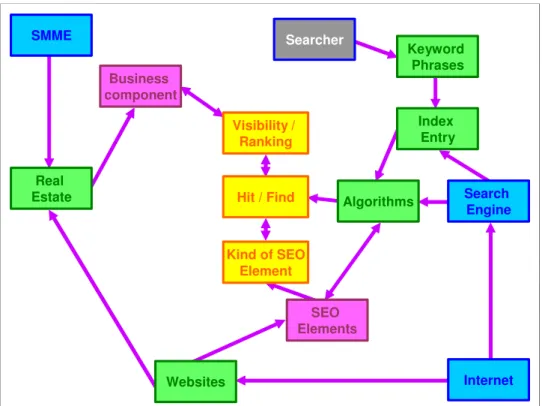
The author developed a preliminary conceptual model (See Figure 1.1) to follow during the literature review and analysis. The model represents a conceptual framework of the author’s understanding which changed on completion of the literature review and analysis. The model should be interpreting by starting with the three elements (SMME, Internet and search engine) and following the lines through the model to the centre, which illustrates a core component of the research project.
SMME Business component Real Estate Internet Visibility / Ranking Hit / Find Kind of SEO Element Searcher SEO Elements Websites Index Entry Keyword Phrases Search Engine Algorithms
FIGURE 1.1: Preliminary conceptual model of the literature review and analysis (Source: Own source).
1.4 METHODOLOGY
A questionnaire was designed and hosted by a local search engine (Ananzi) in order to obtain data on the following areas:
• Keywords from predominantly the South African community, to be used when
searching on search engines and web directories for a certain kind of website.
• Determining whether or not the community has made use and/or will make future
use of the Internet when doing real estate business.
• Obtaining the community’s perception of SEO.
• Furthermore, the author intended to create a profile of a typical online real estate
In addition, the author intended to co-operate with five real estate companies in the Western Cape, all with their own websites. Five subsequent websites were developed using the framework as specified in the Chambers model (refer to Table 3.1, Chapter 3, Paragraph 3.1), each one representing one of the five real estate companies. By means of specialised software, which would identify the necessary search engines, the keywords were used to search for all five companies (both old and new websites). The results were used to derive statistics, whereby the research questions, as reflected in Table 1.1, were answered.
TABLE 1.1: Research problem and questions (Source: Own source).
Research Problem No empirical evidence could be found which confirms or rejects the value of website visibility optimisation in the real estate industry of South Africa.
Research Question Will search engine optimisation elements improve the visibility of real estate SMME websites?
Research sub-question Research method(s) Objectives
Is strategic real estate e-marketing necessary?
Literature analysis To investigate real estate
marketing strategies, the importance thereof and the shift towards e-marketing
What search engine
optimisation elements exist?
Literature analysis To confirm that the
Chambers (2005) search engine optimisation model includes the most important elements. What types of search engines
exist and how do they operate?
Literature analysis and software
To identify the search engines to be used in the methodology.
How do search engine optimisation elements affect website ranking?
Literature analysis To investigate the search
engines’ indexing and ranking methods. What is the general perception
of the community regarding the use of keywords when
searching for real estate companies?
Host a questionnaire on a high-traffic South African website in order to acquire the perception from a sample of the community.
To determine which keywords should be used when applying the methodology.
Does the identified search engine optimisation model apply to the real estate industry?
This will be
determined by making use of a before and after test of five current real estate websites. To determine if search engine optimisation elements improve website visibility significantly, minimally or not at all.
1.5 RESULTS AND CONCLUSION
The questionnaire results returned 121 keyword phrases which could be used in the experiments. Furthermore, it also provided sufficient information to conclude that searchers have and will make use of the Internet when doing real estate business. This indicates from a participant’s perspective, that strategic real estate marketing is necessary. In addition, most of the participants indicated that they do understand the concept of SEO.
With regard to the experiments, some interesting results were revealed. Some of the websites indicated zero to moderate visibility improvements, whereby others demonstrated large improvements. One website illustrated a negative visibility improvement, indicating that the new optimised website was less visible than the original website. This provided the author with the opportunity to identify new elements and re-evaluate the current Chambers model for optimisation purposes due to the unique structure of results. It was found that SEO can improve real estate website visibility.
1.6 DELINEATION OF THE RESEARCH
The research has the following limitations:
• The main focus of the research is on real estate e-business, web marketing and the
visibility of their websites.
• To suitably delineate this study, only SMMEs from the southern sector of the
Western Cape will be used. This sector includes the follwing areas: Bloubergrant, Bloubergstrand, Bloubergsands, Bloubergrise, Big Bay, Flamingo Vlei, Milnerton, Parklands, Sunset Beach, Sunridge, Sunningdale, Sunset Links, Tableview, West Beach, Westriding and Waves Edge.
1.7 CLOSURE
The general perception is that users are rapidly adapting to technology and that the Internet is fast becoming the communication, commerce and marketing medium that could possibly change business globally. For real estate SMMEs, this may be an opportunity to explore the possibility of marketing their business on the Internet to such an extent that it could increase revenue. Real estate SMMEs go to great lengths to ensure that their advertisements are correct and provide funding accordingly. Regrettably, the perception is that they own a
website only because their competitors own a website. In retrospect, real estate companies could enhance the situation to ensure that their website becomes more visible than their competitor’s website. Very few real estate owners are aware of this and rely purely on the developer to make their website a success. Furthermore, developers are often incompetent when it comes to website visibility. From the results gleaned, the author was able to construct a new search engine optimisation framework, which could be used by real estate website developers to improve website visibility. In addition, real estate company owners can build their knowledge on the subject, identify poor development and address the problems before spending money on something that does not work.
CHAPTER 2
LITERATURE REVIEW AND ANALYSIS
2.1 INTRODUCTION
This literature review and analysis was based on journal articles, theses, conference papers, general media publications (newspapers, URLs, conference posters, interviews) and books in order to cover most of the literature available on the subject. SMMEs, the Internet and search engines are the three topics covered. The SMME aspect centres on business from an e-commerce and e-marketing perspective, with particular focus on the real estate industry. The Internet element is elaborated on in order to provide a fundamental understanding which evolves into the next element, namely search engines. Search engines as well as search engine optimisation elements are discussed in detail as this serves as the focus of the research project. The author will attempt to provide a clear understanding of not only how these three elements are juxtaposed, but also how search engine optimisation can potentially increase business revenue.
2.2 SMMEs
2.2.1 SMMEs and the economy
Man has always relied on trading of goods to satisfy some or other need. Today trading is essential for the survival of any economy in the world.
According to South Africa’s National Treasury (2006:27), promoting SMMEs in South Africa has been an objective since the mid twentieth century. In the past, a framework was used in promoting large enterprises, feeding the higher end of the market and thus leaving the lower end to low volume productions. This resulted in inferior goods which in turn caused the inevitable closing down of many SMMEs.
South Africa’s disappointing economic and social development in the 1980s may have been due to politicians underestimating the significance of SMMEs in South Africa. By the year 1990, entrepreneurship was presented as part of the business management curriculum in tertiary institutions. South Africa realised that entrepreneurs built small businesses which in turn created new job opportunities (Smit 2003:9). Generating new jobs had become a priority with the new government in order to solve the unemployment problem in South Africa. Nieman (2001:445) found that South Africa’s unemployment figures were estimated at 32% in 2001. As a result, entrepreneurs should be educated in order to create and sustain small businesses that will assist in achieving economic growth in South Africa (Nieman 2001:446; Brink, Cant & Ligthelm 2003:2; Boter & Lundström 2005:244). Marx, Van Rooyen, Bosch and Reynders (1998:731) support the view of Nieman (2001), and add that SMMEs are also
important to the economy with regard to pricing. SMMEs tend to adapt a lot quicker to consumer needs and therefore keep larger enterprises competitive.
According to South Africa’s National Treasury (2006:29), a successful economy requires the stability of macroeconomics and SMMEs. South Africa’s Department of Trade and Industry (2001), as cited by Baard and Van den Berg (2004), found that 98% of South Africa’s business population fall within the small businesses category. This is confirmed by South Africa’s National Treasury (2006:23-38), which estimates that 906 700 firms operate in South Africa, of which only 0.7% (6 000) are large enterprises. Furthermore, it was found that 60% of the South African workforce is employed by SMMEs. These estimates enforce the argument regarding the importance of SMMEs in the country’s economy.
Even though SMMEs are important to the economy, they often do not survive. More than 50% of SMMEs fail within three to five years of opening their doors. Research has shown
that SMMEs have a 70% to 80% failure rate (Brink et al. 2003:1; Baard & Van den Berg
2004). There are many different reasons why small enterprises fail, however, according to
Brink et al. (2003:1), the main causes are environmental, financial and managerial issues.
Marx et al. (1998:733) support the view of Brink et al. (2003), and add that economic factors,
lack of action, fraud and strategic factors could all contribute to the failure of small enterprises.
TABLE 2.1: Reasons for enterprise failure (Source: Marx et al. 1998:733).
Cause Percentage of failures
Economic factors 45.0% Financial factors 37.2% Management experience 10.5% Lack of action 3.1% Disaster 1.6% Fraud 1.4% Strategic factors 1.2% 100%
Baard and Van den Berg (2004) suggest that small businesses largely fail due to internal factors. These internal factors are referred to as bad management and/or lack of experience, as small businesses are often operated by a single owner/manager (Fillis, Johannson & Wagner 2004:180). As reflected in Table 2.1, external factors cannot be excluded as SMMEs are more vulnerable than large enterprises to price instability, interest rate fluctuations and foreign-exchange uncertainties. Business failures could also be the result of a combination of factors or could result from a third party. An example is the recent difficulties experienced by
As a result, most South Africans in the Western Cape experienced random power cuts. Consequently, SMMEs suffered and restaurants lost stock estimated to the value of R2 500
each time their power was shut down (Fourie 2006:1). The Cape Argus estimated a total
average loss during this period of R279 000 per company. Multiplying this figure by 20 000 registered companies, an estimate of approximately R5.9 billion was lost due to power interruptions (Quintal & Du Plessis 2006:1). This estimated figure gives a good indication of damages experienced by companies in the Western Cape. Owing to Eskom’s poor management, lack of action and the lack of forward thinking and planning, the affected SMMEs suffered the consequences and will not be compensated for their losses. As a result, these SMMEs may close down as their income is relevant to their turnover and their turnover had been negatively affected (Fourie 2006:1).
SMMEs are a fundamental building block of the economy and therefore every effort should be made to ensure their survival and development. Even though strategic factors appear to be insignificant as reflected in Table 2.1, they still play an important role as small businesses need to become more strategic when promoting their enterprises for survival and development purposes. According to Van Steenderen (2001), increasing business exposure should boost direct and indirect revenue which consequently should assist in the survival of SMMEs.
2.2.2 SMMEs and their strategies
Strategic management of an enterprise is typically very broad as it entails the
decision-making process with regard to the survival of the entire business (Marx et al.
1998:351). Channels are one particular part of strategic management which refers to how the enterprise connects to the customer. Should a channel disappear, the business would close down as there would be no way to reach or sell to the customer (Friedman 2002:22).
In the ever-changing world we live in, new opportunities appear, assisting in business growth. On the other hand, various traditional channels may become eroded, depending on the business (Wind 2005:866). Traditional channels include direct sales, indirect sales, fax orders and telephone sales (Friedman 2002:134, 157). Regrettably, the traditional company structure is no longer enough to ensure market reward. Businesses will find greater profitability when adapting their business processes in order to include e-commerce (Berman & McClellan 2002:32). In spite of this fact, the study of Motjolopane (2005:101) as well as Cloete (2002) revealed that the complete adoption of e-commerce in South African SMMEs is not occurring rapidly.
E-commerce is defined by South Africa’s Department of Communications (2000:16) as the following:
The use of electronic networks to exchange information, products, services and payment for commercial and communication purposes between individuals (consumers) and business, between business themselves, between individuals themselves, within government or between the public and government and, last, between business and government.
Customers are rapidly adapting to the technology available. The Internet is used to access relevant information anywhere and at any time, regardless of geographical location. Therefore it should be assumed that the Internet could influence customer buying decisions regarding products and retailers. As a result, the Internet is becoming a global shopping environment for super shoppers (Gagnon & Chu 2005:17).
TABLE 2.2: Online population and behaviour in Europe, Q2 2003
(Source: Gagnon & Chu 2005:18).
Country Population online Research online Shopping online
Sweden 73% 93% 48% The Netherlands 71% 94% 40% Germany 55% 90% 55% UK 57% 89% 62% Italy 45% 76% 17% France 40% 82% 33% Spain 28% 89% 16% Europe 49% 86% 42%
Even through the percentages in Table 2.2 appear to be relatively high, Gagnon and Chu (2005:17) are of the opinion that over a billion people will be online globally in the year 2010. The Internet is fast becoming a communication, commerce and marketing medium that is changing business globally (Singh 2003). During the past decade, no other innovation has impacted communication between business and people the way the Internet has. Singh (2002) found that the Internet took only seven years to reach 25% of market share as opposed to the cell phone that took 13 years; personal computers took 15 years and the telephone took 35 years.
According to the Impact of E-business (2000) as cited by Singh (2002), there are three types of businesses: businesses that currently make use of the Internet, those that are thinking about making use of it and those that are most probably going out of business (Friedman 2002:168). Radebe (2000), as cited by Singh (2002), is of the opinion that any enterprise that does not adapt to e-commerce will close down within three years. This statement may be true for most businesses but not for the ‘corner store’ in a low income suburb. Most of the low income community cannot afford to buy computers let alone connect and make effective use of the Internet, as 45% of South Africa’s population is illiterate (Singh 2002). In the
like, e.g., personal counselling, custom tailoring, tattoos and corporate legal services. Most of these require face-to-face interaction as it would be a waste of time for instance, to purchase a tattoo over the Internet and then drive to the tattoo company in order to get the tattoo. This defeats the purpose of using the Internet in order to make life easier. For this type of product and service, it would be suggested to not use the Internet as a sales channel, but rather use the medium as a marketing channel (Friedman 2002:51, 141).
SMMEs that realise the importance of a web presence are exposed to the benefits and the barriers when using the Web for commercial purposes. Integrating business and the Internet is a cheaper method to create an interactive environment by breaking traditional barriers and building strong international business relationships (Boyes & Irani 2004:191). At the same time SMMEs could create a competitive advantage in the global marketplace competing with businesses of different sizes (South Africa. Department of Communications, 2000:17; Smith 2002; Boyes & Irani 2004:192). The business will therefore overcome geographical and cost barriers to new markets and will be improving customer services, relationships, communication and sharing of important information (South Africa. Department of Communications, 2000:17; Simpande & Jakovljevic 2003; Singh 2003; Boyes & Irani 2004:192).
Singh (2002) found that new business opportunities are exposed when organisations make use of the Internet.
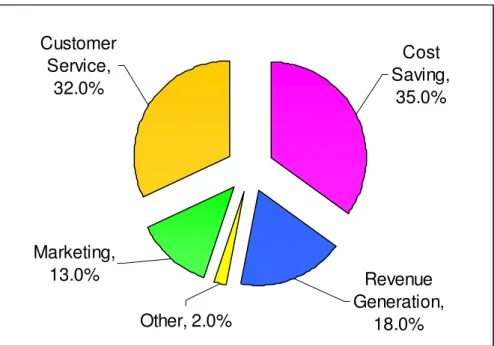
Revenue
Generation,
18.0%
Other, 2.0%
Marketing,
13.0%
Customer
Service,
32.0%
Cost
Saving,
35.0%
FIGURE 2.1: America’s top 100 organisations generating value by making use of the
Internet (Source: Singh 2002).
The driving force of most business owners is profit (Marx et al. 1998:701). In order to
increase profit, the business must reduce overheads and increase sales. One particular method used to increase sales and reduce cost is by means of marketing the business
product or service. Figure 2.1 reflects that top American businesses made use of the Internet for that purpose. As a result, those companies reduced costs by not producing brochures and making use of traditional media advertising. Conversely, the generation of revenue as depicted in Figure 2.1 appears to be relatively low; however this could be due to obstacles that prevent the business from flourishing in e-commerce.
SMMEs could experience many different obstacles and barriers when adapting to e-commerce. Creating a reliable web infrastructure is essential in effectively exploiting the Web for commercial purposes. SMMEs are sometimes unable to do this due to limited finances, physical resources and lack of knowledge, experience and expertise (Boyes & Irani 2004:192).
In spite of the problems that could occur when SMMEs adapt to e-commerce in South Africa, businesses are flourishing as consumers spent R2.7 billion on Internet purchasing during 1999 (Singh 2002). According to the Gartner Group as cited by Friedman (2002:167), it was estimated that $433 billion was generated globally through e-commerce in 2000. The research predicted that United States (US) business over the Internet will grow from $43 billion in 1998 to $2.7 trillion in 2004. This was also predicted by Rao’s (2002:249) research, which shows that business done over the Internet will nearly double annually. According to Singh (2002), it had been projected that the US would generate more than $6 trillion through on-line trading in 2005 alone.
Although South Africa’s on-line trading is much lower in value than that of the US, it is clear that there is an increase in e-commerce worldwide. It is for this reason that SMMEs need to integrate business and the Internet as soon as possible in order to market their product or service and ensure business exposure to potential customers (Simpande & Jakovljevic 2003).
2.2.3 The evolution of marketing
Marketing is viewed differently by different people, but from a holistic perspective, marketing is seen as advertising and selling of a product or service (Perreault & McCarthy 2002:4). These authors express the view that marketing consists of two parts: macro- and micro-marketing. Macro-marketing is very broad and focuses on the welfare of society in the economy as it refers to the creation and delivery of a standard of living. The basis of micro-marketing is the selling and advertising of a product or service (Perreault & McCarthy
2002:8). Marx et al. (1998:517) are of the opinion that marketing is the process of identifying
the wants and the needs of a target market and then satisfying them more efficiently than the competitor can (Scullin, Fjermestad & Romano 2004:412). Perreault and McCarthy (2002:9)
support the view of Marx et al. (1998:517), and add that micro-marketing is much more than
getting rid of the company’s manufactured product via advertising. The company sells its product or service by not only identifying the customer’s needs, but meeting those needs to
such an extent that the product will sell itself. Once this has been accomplished, persuading the customer to buy the product or service is a small part of the marketing process.
Defining a marketing strategy is crucial to the survival of a company as it assists the firm in creating and maintaining a competitive advantage in a cluttered marketplace (Dann & Dann 2004:22; Krishnamurthy 2006:51). Perreault and McCarthy (2002:46) are of the opinion that a marketing strategy consists of a target market and the marketing mix. The target market specifies the group of customers the company wishes to appeal to. The marketing mix is the controllable variables the company puts together in order to satisfy the target market. The way to put these two together is by viewing the target market (customers) as the centre of a circle. The marketing mix is the controllable variables that surround the customer (Perreault & McCarthy 2002:46). The variables that make up the marketing mix are Product, Place,
Promotion and Price, which are known as the four P’s (Marx et al. 1998:515; Constantinides
2002; Perreault & McCarthy 2002:48; Constantinides 2004:111; Dann & Dann 2004:20; Holm 2006:25).
• The function of the ‘product’ is to create the right product for the customer.
• The function of ‘place’ is the decision made to get the right product to the customer.
• ‘Promotion’ is concerned with informing the customer of the availability of the right
product.
• ‘Pricing’ must be right by taking into account the product, place, promotion as well as
competitors (Perreault & McCarthy 2002:48-50).
Perreault and McCarthy (2002:50) explain that all four P’s are needed in a marketing mix and should function together as they are all equally important. Constantinides (2002) describes the situation slightly differently and points out that the four P’s are focused on internal variables and therefore do not form a complete basis of marketing. Furthermore Constantinides suggests that the customer experiences the four P’s individually depending on the situation, time and even place.
There are two types of marketing, namely, traditional marketing and Internet marketing. The four P’s as described above reflect traditional marketing which can be differentiated from Internet marketing in three dimensions: access, competition and information (Song & Zahedi 2006:223). ‘Access’ refers to the location constraint traditional marketing experiences in terms of ‘place’ explained above as one of the four P’s.
‘Information’ and ‘competition’ function as one, for the lack of ‘competition’ in traditional marketing could affect pricing and quality as competitors tend to set standards. With regard to ‘information’, costs are associated in obtaining ‘information’ on a product and price. The high cost of such a search regarding traditional marketing, reduces the number of competitors that consumers search for, as they attempt to keep the costs as low as possible (Song & Zahedi 2006:223-224).
Pollock (n.d.) is of the opinion that traditional marketing is dead because of democracy, as civilisations want their privacy, values and humanity respected. The author further explains that everything people do is by choice and the choice is currently that businesses must stop marketing to people and start connecting to customers.
The marketing approach may be changing due to the Internet, but stating that traditional marketing is dead may be extreme. Sterne (2001:1) explains how this change could be perceived. Consider water to be the broadcasting medium. Spraying a crowd with a big hose hoping some would enjoy getting wet could be interpreted as ‘traditional marketing’. ‘Narrowcasting’ is using a smaller hose and spraying only at the people that show interest in getting wet. ‘Cybercasting’ (online marketing) is creating a pond of water in cyberspace, informing people and inviting them for a swim. The result is people can visit the pond anytime, stay as long as they want and dive as deep as they feel, depending on their personal interest.
Change in the marketing approach affects the marketing mix, which consists of the four P’s. Unlike the physical world, the virtual marketing mix variables are not detached from each other and are jointly experienced by the customer. The four P variables remain the same as the traditional marketing mix variables (product, price, promotion and place) but are redefined in terms of the virtual marketing mix (Constantinides 2002). Smith and Chaffey (2002:26, 33, 37) support the view of Constantinides (2002), and add that there are three additional P’s regarding Internet marketing namely, People, Processes and Physical evidence. ‘People’ refer to the individuals that are involved with the website; the ‘processes’ refer to things such as transactions and communication while ‘physical evidence’ is the cues and clues for reassurances the website can provide, e.g., guarantees and refund policies (Smith & Chaffey 2002:58-60). Constantinides (2004) broadly summarises these three additional P’s into a fifth element, namely, ‘web experience’.
• The ‘Product’ refers to the website as the primary online product. As a result
customers need to be persuaded to look for the company website before looking for the product offering of the company (Constantinides 2002). For this very reason, company websites must become more visible to search engines in order to increase website traffic (Sen 2005:9). Other key marketing issues also play a role regarding website design, e.g., the website access must be fast, interesting and useful (Sterne 2001:2).
• The ‘price’ refers to the cost of the product the company intends to sell. However,
customers consider other online cost elements such as connectivity, time and opportunity cost. Even though these costs may be much less than performing these activities physically, customers will compare online cost elements with other online competitors (Constantinides 2002).
• The medium used for ‘promotion’ is the website and its content, which should
only retain current online customers but also attract new customers (Constantinides 2002).
• The ‘place’ refers to where the customer is, as the website should be accessible
anywhere and at anytime depending on the customers and their connectivity. The website could contain all characteristics of a physical store, which include the counter (online transactions), helpdesk (support), delivery of digital products (music) and delivery of products through physical distributor (Constantinides 2002).
The four P’s in traditional and Internet marketing are but a tool to influence customer behaviour. With regard to Internet marketing, the fifth element is referred to as the web experience and extends beyond the four P’s. The web experience medium is represented by the website which forms the platform for interaction between the customer and the company (Constantinides 2002). The interaction could be online functionality, information, emotions, and products and/or services (Constantinides 2004:112). Companies constantly try to create new digital methods regarding interaction in order to increase revenue and/or productivity.
Adam, Mulye, Deans and Palihawadana (2002:244) cite five business functions (other than e-commerce) performed by people via the Internet, namely, acquiring company information, customer communication, supplier communication, marketing, and customer services. It is seemingly evident that Internet marketing is as important as electronic commerce.
Constantinides (2004:111) provides additional evidence and explains that the consumer’s behaviour, regarding purchasing products, is divided into five phases. Phase one is problem identification as customers have a need that must be satisfied. Phase two is information searching. Internet marketing plays a big role in this phase as customers trust renowned brands (Strauss & Frost 2001:3). Phase three comprises alternative evaluations whereby customers may consider factors such as customer services or brands. Internet marketing is as important in this phase as emphasised in Phase two. Phase four is the purchasing decision with regard to the customer’s choice of product. The final phase is the post-purchaser’s behaviour which refers to whether or not the customer will return, based on the customer’s web experience. In order to ensure this, the website must satisfy the customer in a way that no other media or channel could (Davis 2000:43).
When evaluating the consumer’s behaviour phases, it becomes evident that the customer is most important. People are training themselves in order to find information, products and virtually anything at any time and at any place (Strauss & Frost 2001:36). This is what Pollock (n.d.) tried to convey when stating that traditional marketing is ‘dead’. A power shift had occurred from sellers to buyer with regard to Internet marketing (Strauss & Frost 2001:4). The days of capturing a person’s attention for 30 seconds on a television screen are coming to an end and being replaced by the ‘click of a mouse’. This reinforces the argument regarding the importance of Internet marketing, as global competitors are but just a mouse click away (Strauss & Frost 2001:4,36). In addition to this, there are many advantages to