Food Technology & Knowledge
Transfer Strategy
Contents
Executive Summary 5
Context 6
Current Environment 7
Teagasc Response: A New Food Technology
and Knowledge Transfer Strategy 9
Food Technology and Knowledge
Transfer Action Plan 13
Strategic Objectives 15
Objective 1: Developing Best Practice in Food Technology Transfer 16 Objective 2: Mapping of Teagasc Technologies 17 Objective 3: Development of a Food Technology Portfolio 18 Objective 4: Fostering Key Collaborations and Strategic
Partnerships with Industry and State Agencies 19 Objective 5: Establishing a High Profile and Effective TTO 20 Objective 6: Measuring and Evaluating Key Performance
Indicators of Food Technology Transfer in Teagasc 21 Objective 7: Identifying Resources 22
There has been substantial public investment in food
research in Ireland over the past two decades, resulting in
the development of a very significant national capacity
across broad areas of food research and the creation of
some internationally-competitive centres of excellence.
The Teagasc Food Programme has built up a considerable international reputation in key areas and the organisation has invested in state-of-the-art research infrastructure and pilot plant facilities in the areas of food technology, foods for health and food safety. There are now considerable intellectual assets within the
programme for supporting innovation by our food companies. Furthermore, the critical mass and scientific depth available to contribute to the food innovation eco-system have been augmented through the development of key alliances, such as the Food
Innovation Alliance between Teagasc and UCC.
The results of this investment must now be more readily translated into helping Irish food companies to realise the very ambitious growth targets set in Food Harvest 2020. Achieving these targets depends on enhanced partnership between industry and public research and increased investment in research and development within Irish food companies. There is a requirement for the industry to develop a stronger culture of innovation in order to achieve desired growth and enhance employment opportunities within the sector.
Teagasc, as the national agriculture and food development authority, has the responsibility of supporting food companies in this drive. Teagasc has invested in developing a new strategy and has put in place new resources to more easily work with companies and ensure that the foundation of knowledge and technologies developed are
efficiently and effectively transferred to our industry so that it can realise the enormous opportunities which now exist in the global market place for high quality, safe food produced in a sustainable manner.
Our new Food Technology and Knowledge Transfer Strategy describes our plan to enable food companies to engage with us in various ways in order to support their own food innovation strategies. Developing partnerships and collaborations with industry is central to our strategy. I look forward to seeing the fruits of the implementation of this Strategy and to witness its contribution to enabling food companies to meet in part the targets set down in Food Harvest 2020.
Professor Gerry Boyle Director, Teagasc
Professor Gerry Boyle
Innovation is one of the key drivers of economic growth
and recovery. Our Food Technology and Knowledge
Transfer Strategy contains ambitious objectives and
focused activities which will allow Teagasc food scientists
and industry to engage in the innovation eco-system
simply and effectively.
It is recognised that innovative food companies are solution driven and continually seek new ways to increase market share or exploit opportunities. A core element of our Strategy is to understand the technical needs of food companies. Its implementation will ensure that our technologies are utilised and our capabilities are fully accessible to the industry.
To this end, we have published our Food Technology Portfolio which concisely describes all our current technologies, capabilities, services and expertise in one simple volume.
Our Strategy takes into account many different forms of technology and knowledge support channels by which food companies can engage with us. These include collaboration or contract research agreements, commercial service arrangements, training programmes and consultancy projects. Central to these mechanisms are
mutual trust, credibility, confidentiality, clear business objectives and high quality customer relationship management. Teagasc values its extensive industry interactions and has stringent polices regarding IP
management, contract agreements and confidentiality.
We look forward to assisting food companies to expand their innovation potential, to grow new markets and become more competitive through engagement with the Teagasc Food Programme.
Mr. Declan J. Troy
Assistant Director of Research and Head of Technology Transfer, Teagasc
Prof. Paul Ross
Head of Food Programme, Teagasc
Declan J Troy Assistant Director of Research and Head of Technology Transfer, Teagasc
Paul Ross Head of Food Programme, Teagasc
Food Harvest 2020 emphasised the need for the Irish Agri-Food Sector to embrace a “smart” approach and to take advantage of “green” opportunities in order to achieve sustainable growth. It concluded that the sector must prioritise research and development, foster creativity and maximise adoption of best practice. The new Teagasc Food Strategy for Technology and Knowledge Transfer will contribute to the attainment of these goals by developing an environment of effective food technology transfer built on partnerships with industry.
The new Strategy contains a number of key actions which will ensure that the formidable food research outputs, expertise and
infrastructure within Teagasc are fully utilised and exploited for the benefit of the Irish food and agriculture industries. The food industry is highly fragmented with varying levels of knowledge absorption capacity which presents both challenges and opportunities for Teagasc when promoting the development of the sector. Proactive and systematic engagement with the food sector is at the core of the Teagasc strategy. Teagasc will ensure best practice in managing, undertaking and measuring its food technology transfer activities. Teagasc will develop a culture of technology transfer and entrepreneurship and allocate adequate resources to this important activity.
Teagasc researchers will demonstrate leadership, flexibility and creativity when facilitating technology transfer. The Technology Transfer Office will develop and promote partnerships with industry while at the same time supporting researchers with protection of Intellectual Property, assessment of commercial potential and exploitation of market opportunities.
The Technology Transfer model proposed and the actions and resources necessary to achieve the strategy objectives are detailed in this document.
The main objectives are to:
1. Implement best practice in food technology and knowledge transfer.
2. Map Teagasc technologies.
3. Develop the Teagasc Technology Portfolio. 4. Foster key collaborations and strategic
partnerships with industry, state agencies and other stakeholders.
5. Establish a high-profile and effective Technology Transfer Office.
6. Measure and evaluate key performance indicators of technology transfer in Teagasc. 7. Identify and deliver the skills and resources
necessary for an effective technology transfer strategy.
Implementing our new Food Technology and Knowledge Transfer Strategy will allow food companies to engage with Teagasc more easily, to exploit opportunities arising from our research outputs and to utilise our know-how, expertise and infra-structure. This will accelerate the development of and add value to new food products and processes.
Executive Summary
Research and development and the exploitation of knowledge
are critical drivers of technical change, productivity growth and
profitability in the Irish Agri-Food Sector.
Teagasc has developed the FTKTS in order to ensure that it exceeds Government and food industry expectations and targets. In particular it is important that the potential use of
knowledge (generated by the Teagasc research programme), of capabilities (including state-of-the-art pilot plants at its research centres) and of know-how (from its highly experienced staff) are used for the benefit of the Irish economy to their maximum level. The process by which these facets are utilised and exploited, through a technology transfer system, must be highly efficient and effective.
Teagasc is a public research and development provider. It contributes to the national programme of innovation activities including the creation of commercially-applicable knowledge. It is acknowledged as an important source of expertise for food companies (over 250 food companies interacted with the Teagasc Food Programme in 2011). Teagasc also
contributes in a broader sense to the “innovation eco-system” by training skilled graduates, creating new know-how, assisting in increasing the capacity for technological problem solving and policy development. In many countries, the transfer of technology into valuable commercial activity is a key element of Government policy. The development of links and partnerships with industry is seen as a crucial component of this policy. Unfortunately the current investment in research and development by the Irish (and European) food industry is low (about 0.65% of sales) (3). Food Harvest 2020 proposes that the food industry doubles this figure by the year 2020 in order to meet the growth targets. A large proportion (95%) of this sector comprises SMEs. Typically they are not well-equipped to engage with the scientific community and this results in a low absorption of scientific and technical knowledge. This places a greater responsibility on Teagasc to engage in a meaningful way with the food sector and, particularly, to communicate and transfer knowledge in an effective manner.
Context
Food Harvest
2020 says
Food industry must prioritise investment in consumer focused innovation …Industry should double the level of resources
committed to R&D activities …
Focus on research and innovation …
R&D should be targeted on product areas with added value potential …
Teagasc, the Agricultural and Food Development Authority, has a clear mandate to provide science-based innovation support to the Irish agriculture and food sector. This mandate gives Teagasc an important responsibility for meeting the knowledge and technology needs of the entire food chain. It delivers such support through integrated research and knowledge transfer activities. This new Food Technology and Knowledge Transfer Strategy (FTKTS) sets out objectives and actions which will enable Teagasc to implement an effective technology transfer strategy for the benefit of the food industry. The FTKTS has been developed in line with the overall Government Strategy for Science, Technology and Innovation (SSTI) and it adheres to the important principle that excellence in research, coupled with increased innovation in the enterprise sector, will help to accelerate Ireland’s economic restructuring and growth.
Food Harvest 2020 (1) provides a robust roadmap for the potential growth of Ireland’s largest indigenous industry. It has set ambitious but realistic targets which, if they are to be achieved, will require very strong partnerships between the scientific community and the food industry. The development of the so-called smart economy is a foundation of current Government policy for economic recovery. Under this policy, new working relationships and the piloting of new product and process streams to facilitate access to new markets, are encouraged. To succeed, the Irish agri-food industry must invest in ideas, knowledge and skills and encourage innovation and creativity (2). In particular, increased research and development within food companies is needed, coupled with a greater partnership with the scientific community. Teagasc plays a critical role in enabling companies to meet the targets set out in Food Harvest 2020 by fostering science-based innovations in partnership with the food industry.
Teagasc Food
Programme
… Engages with over 300 food companies at our two research centres in Ashtown, Dublin and Moorepark, Cork … … publishes over 130 food related peer reviewed scientific publications per annum …… has state-of-the-art pilot plants, well-equipped and modern research laboratories … … employs 90 food scientists and 80 post graduate food students …
The Teagasc Food Programme encompasses many aspects of food science and technology including food processing and functionality, food quality and structure, foods for health and food safety. The programmes’ scientists work in collaboration with universities and research institutes in Ireland, the European Union and further afield. The research programme is underpinned by targeted studies of markets and consumer-led developments as well as the need for rigorous adherence to national and
international (European Food Safety Authority) regulations. The Programme is run from Teagasc Food Research Centres at Moorepark (Fermoy, Co. Cork) and at Ashtown (Dublin). Both are internationally-recognised sites of excellence. Teagasc Moorepark is located on a 110 hectare site in north Cork, with a dedicated Food Research Centre (including the Biotechnology Centre, separation/dehydration and ingredients facility and a small animal facility), an extensive animal and grassland research facility, a pig production development facility and Moorepark Technology Limited, a modern dairy processing pilot plant. The primary focus of the Teagasc Food Research Centre at Moorepark is dairy research and it has a history in the development of microbial cultures, new dairy ingredients and hybrid cheese varieties for dairy companies.
Teagasc Ashtown is on the outskirts of Dublin. The site extends to 30 hectares which includes a category 3 food safety facility, a pilot-scale abattoir, meat processing plant, product
development plant, a sensory analysis suite and a nutraceutical facility. The Teagasc Food Research Centre at Ashtown has an excellent track record in the research of meat and meat products, microbiological and chemical food safety, seafood, cereal and bakery products and has recently developed critical mass in nutraceutical discovery. It will also be the location for Teagasc horticultural research activities.
Engagement with and by the food industry is intense. Recently a number of food firms have signed collaboration and strategic partnerships with Teagasc. These firms are availing of Teagasc’s expertise in areas such as dairy ingredient technology, meat technology and food safety and exploiting the use of world class laboratory and pilot plant facilities and
infrastructure. An important objective of the FTKTS is to ensure that these resources are exploited to the fullest by the Irish food sector. The Irish food sector had a turnover of €24bn and €8.85bn worth of exports in 2011. Two thirds of the exports come from indigenous Irish-owned companies.
Pilot Plant Facilities
Meat Industry Development Centre at Ashtown including pilot-scale abattoir, processing, packing and cooking facilities.
Moorepark Technology Limited, a modern plant containing pilot-scale processing equipment for the dairy industry.
Food Process Development Centre at Ashtown incorporating industry-scale processing equipment for food product development and research.
Biofunctional Food Engineering Facility at Moorepark which is designed to support R&D associated with the Infant Milk Formula industry.
There are 135,000 people currently employed in the agri-food sector in Ireland, approximately 90,000 in primary production (agriculture, forestry and fishing) and another 45,000 in food and beverage manufacturing-related activities. Food Harvest 2020 has a target to increase employment by 7,500 in value-added food production (2). Although the sector is the largest net exporter of beef, lamb and dairy ingredients in Europe, it is fragmented and made up of a variety of sizes and types of firms, ranging from multinational foreign direct investment companies, large indigenous companies, small- and medium-sized enterprises (SMEs) and high potential start-ups to micro-enterprises. In Ireland there are about 580 food companies, 40 of which operate on a global scale; 93% of these enterprises are Irish owned. The meat sector consists of 139 enterprises and the dairy sector has about 53 enterprises. The main drivers of change in the food sector are changing consumer trends especially in the health and
wellness sector, food production sustainability, trade policy (especially in relation to the Common Agricultural Policy), the increasing power of the retailer and emerging technologies. In particular, the abolition of milk quotas and the increasing demand for protein-based foods on a global scale offer growth opportunities for the sector through development of added-value and innovative food products.
Business expenditure on research and development (BERD) in the Irish food sector is only about 0.6% of sales turnover. Food Harvest 2020 sets a target of 1.3%, in accordance with international standards. Already research and development expenditure by food companies is about 2.5% of turnover in the UK. It is
recognised that investment by food companies in acquiring or developing talent is crucial for successful technology transfer and in building absorption capacity i.e. the ability to recognise the value of new, external information, to assimilate it and apply it to commercial ends. A report from Forfás (2010) (4) highlighted that the barriers to business expenditure on research and development were: (a) a shortage of high quality industry-relevant skills, (b) the high cost of research and development and (c), the effectiveness of interactions between research institutions and enterprises, the core element of the FTKTS. The report went on to conclude that industrial engagements by the research community should be incentivised and used as an important criterion for recruitment and promotion. In relation to the food sector, the report stated that a fragmented approach by public bodies to supporting research and development in food companies existed and that this contributed to an over-complex system. This fragmentation and complexity prevents easy access by companies. Teagasc will
implement a simple and transparent technology transfer strategy designed to allow industry to easily access Teagasc researcher know-how and infrastructure.
Some of our Specialised Laboratory Facilities
The Nutraceutical Research Facility for extracting and purifying biologically-active components from natural resources, quantifying potential and chemically-characterising components via state-of-the-art instrumentation including a High Resolution NMR Suite and Quadrapole Time of Flight Mass Spectrometer.
The National Food Imaging Centre which provides state-of-the-art microscopes and an associated image management system to support analysis of food microstructure.
The Bioactive Protein Discovery Unit, for purifying antimicrobial peptides. The unit is used for peptide purification, identification, analysis and generation via ion exchange, reverse phase and size exclusion chromatography, mass spectrometry, peptide synthesis and amino acid analysis.
The Bioengineering Facility for carrying out structure-function analysis of bioactives and generating foodgrade derivatives of existing bioactives with a view to enhancing activity and stability.
The 454 DNA Sequencing Technology Platform for genomic and metagenomic studies.
The Flavour Chemistry Facility containing state-of-the-art GCMS equipment and a range of automated discrimination techniques (TD/ SPME/ITEX) to support industry in product development, flavour/ aroma characterisation, product matching and identification of off-flavours (aromas) or taints.
Given the targets set out in Food Harvest 2020 (1) public expenditure on the Teagasc Food Programme (including internal and external funding of its research and infrastructure) and the structure and needs of the Irish food industry, it is vital that an unambiguous technology transfer strategy is implemented. The Teagasc FTKTS entails a clear mission with seven key objectives. It takes into account some of the key features from reports on technology transfer systems worldwide.
Technology transfer is a “contact sport” – a complex type of communication. It requires skilled personnel, appropriate resources, organisation structures and formal recognition (or even an incentivised reward system). In many models five distinct phases of the technology transfer process are recognised (5). The knowledge phase describes when the technology is known to exist and is relevant to an organisation’s problems or opportunities. Key stakeholders are persuaded to examine the technology during the persuasive phase. During the decision phase stakeholders decide whether to use the innovation before embarking on the implementation phase. When the technology has been successfully adopted, the confirmation phase is complete. Clear communication is important between all parties during all phases. Teagasc scientists are fully committed to contributing to the technology transfer process and are cognisant of the overall context for carrying out this activity. The over-arching objective is to contribute to the economic development of the Irish food sector. However the process has many other advantages for a public research organisation such as Teagasc, including generating income, enhancing reputation among stakeholders and developing mutual trust between Teagasc and the Irish food sector. For companies, the technology transfer process can provide a solution to a problem, exploit an opportunity, diffuse new knowledge and skills within the company, establish the feasibility of a technology and create the market for a new product or process.
Understanding the needs of companies is vital to the technology transfer process. The most effective way to assess needs is through carefully planned direct contact with the companies at the appropriate level. It is
important that the company is highly-motivated and ambitious. Trust and previous experience with the company is important in elucidating their needs. Other facets of information such as market knowledge, consumer trends and empathy for the challenges faced by the company are important to maintain credibility and respect. Marketing of Teagasc capabilities, expertise and technologies increases the possibility of formal company engagement. The Teagasc Food Technology Portfolio (see later) presents an ideal opportunity to offer Teagasc capabilities to food companies and to develop meaningful partnerships.
Systematic and regular forms of communication are recommended in many technology transfer strategies. These range from direct contact with CEOs and technical managers, industry workshops, newsletters, best practice guides and technology updates. Making companies aware of available technologies and knowledge as contained in the Food Technology Portfolio must be an interactive and frequent process. Teagasc will shortly assign a number of staff as Customer Relationship Managers and will implement a number of methodologies that will allow the organisation to manage its
relationships with clients, with respect to the technology and knowledge transfer process, in a systematic way. Customer relationship
management (CRM) will allow Teagasc to identify and target food companies in order to form a more individualised relationship between the company and Teagasc. A deeper
understanding of customer needs and wants will be elucidated.
Equally, Teagasc will implement CRM tools such as web-based applications that will organise and align information between our research programmes and specific food company requirements.
Meaningful engagement with industry is critical. Research outputs including technology updates, commercialisation opportunities and general information about the Teagasc Food Programme will be issued in industry-friendly formats. It is recognised that industry must be able to find relevant information quickly and in the right format. Clear messages should be transferred to industry through publications, on websites, in presentations and through other forms of communication. Key contact
information must be clearly visible. Experience has shown that solution-focused or opportunity-driven dialogue attracts most attention by industry. Furthermore solutions and opportunities should be based on practical achievable activities.
Technology transfer tools are important in order to create awareness of The Food Technology Portfolio. These include personal visits, presentations, newsletters, trade press articles, web-based material and brokerage events. While many of these activities are currently ongoing within the Food Research Programme, a more structured and focused approach will be followed. Teagasc has a role in supporting the development of industry technical skills and does this by delivering training courses, practical workshops, demonstration events, transfer of personnel and by producing best practice guides.
A feature of the FTKTS is the development of networks of like-minded companies in co-operation with Enterprise Ireland (EI). Networking is one of the most successful and cost-effective activities in facilitating technology transfer, especially for SMEs. Teagasc food researchers already participate in EI developed networks such as Global Sectoral Teams. Member companies are assessed based on criteria including technology absorption capacity and the potential to develop radically innovative products.
Food Works is a new comprehensive training and development programme aimed at nurturing new food high potential start-ups. This collaborative programme brings together the capabilities of Teagasc, Bord Bia and Enterprise Ireland in driving the growth of new entrepreneurial food companies by combining their expertise in food research and
development, consumer needs, market demands and business development.
Industry-led research or networks contribute to and benefit from research and development carried out on their behalf. Results are accessible to a community of SMEs and other companies. Activities typically include proof of concept, exploring new techniques with high risk of failure and improvement of methods. The Teagasc Food Research Programme has the research and development skills and infrastructure to support such interactions. Often, placements of research staff in companies and/or industry staff in Teagasc research centres augments mutual understanding. Development of trusted partnerships between Teagasc and industry can be achieved through such interactions.
Currently, some industry technical staff are located at the Teagasc Food Research Centre in Moorepark and Ashtown. Graduate and post-graduate training of industry staff located within the Food Research Programme will be encouraged. Industry, based Ph.D and M.Sc programmes are being developed and assessed in terms of food industry demand.
Technology transfer is diverse and demands robust management structures, procedures and policies. It also requires clear objectives and staff commitment. Furthermore and most
and have the largest visibility to their key stakeholders.
importantly, external stakeholders must be able to assess the Teagasc technological strengths and scientific offers in an efficient manner. Teagasc scientific staff are committed to continuously communicating with industry in a business-like fashion with consistency, total credibility and trust. Tendering, managing and implementing industry-focused projects requires clear policies with respect to relations management, contract initiation, IP management, conflict of interests and other issues. Teagasc’s Technology Transfer Office (TTO) oversees the governance of these matters and has developed and continues to update robust policies and procedures to ensure that customer needs are fully addressed. These policies are communicated, understood and implemented by all staff. The TTO ensures that the development and implementation of appropriate policies does not act as a barrier but as a support to efficient transfer of technologies. The TTO has a customer-friendly approach and is clearly visible within the Teagasc Research Programme and to all its stakeholders.
The mission of the TTO is to facilitate, enhance and support the transfer of intellectual property (IP), resources and information between Teagasc and the business community and other
stakeholders. Unlike many TTOs in higher education institutes, the Teagasc TTO has a broader remit insofar as it collates and manages not only collaborative research and licensing arrangements based on Teagasc (or its shared) IP but also in regards to its commercial technical services. These services are primarily based on researcher know-how and existing infrastructure and are accessible on a fee-paying basis. The TTO has established policy documents on (a) Management of IP (b) Procedures for Formalising Client Interactions for research staff and (c) IP Management Strategy. These policies and guidelines are continually reviewed and updated in line with national and European recommendations. Teagasc is contributing to the ongoing study of industry engagement by Ireland’s research institutes. The study is being carried out by Forfás and the Department of Jobs, Enterprise and Innovation. This exercise aims to implement a user-friendly system so that industry and the public research sector can work together. It also aims to encourage
commercialisation of all forms of IP arising from research in the public sector. The FTKTS will incorporate its recommendations.
The TTO will be a major conduit for technology transfer by Teagasc to the food sector.
The Teagasc TTO is committed to the development of an articulated business plan, transparent policies, an entrepreneurial environment, customer-friendly relationships with internal and external stakeholders and strong links to potential industry partners. In order to fully achieve its potential, the TTO will be adequately resourced with access to professional, legal and commercial marketing services. Furthermore it maintains a systematic way of managing contracts and agreements. Continuing and practical training will be integral to the professional development of the TTO staff. A feature of the TTO will be building networks with the technology transfer and licensing community. Already Enterprise Ireland and the Irish Technology Transfer and
Innovation Group have assisted the TTO in policy development and networking. The latter is particularly important for providing guidance on assessment of technologies in terms of patents, market opportunities and potential licences. The Teagasc TTO is now also a full member of the European Union’s Technology Transfer Circle, which is a Joint Research Centre (JRC). Its aim is to share expertise and exchange best practices and to develop synergies at European level in the field of IP management and technology/knowledge transfer.
The TTO continues to use a variety of tools to ensure IP is protected and routes to markets are facilitated through collaborative and licensing arrangements with end-users. However, one of the key functions of our extended TTO will be to ensure that collaborations and strategic partnerships with industry are fostered while continuing to promote the important small-scale commercial service arrangements. An important feature will be the consistent tracking of researcher-to-client interactions (channels) at every level from commercial services to large-scale collaborative research agreements. The level and type of interaction varies on both a qualitative and quantitative basis according to
Technology
Transfer Support
Channels
Teagasc – Industry Partnerships Collaborative Research Contract Research Licence Agreements Staff or Student Placements Process Demonstrations Workshops and Seminars Training activities in-company and at Teagasc sites Pilot Plant andfacilities usage
Our TTO
Features
Clear Business Plan Transparent Policies Entrepreneurial Environment Customer Friendly Relationships Supportive Senior Management Endorsement Strong links to industry stakeholders Close collaboration with UCC Member of EU TTO Circle
the nature of the research. New technology transfer support channels will be examined. These will include hosting of technology brokerage events, showcasing of Teagasc technologies and a model to develop a
“T-Technology Association”. Companies in such an association would (depending on size, type of membership) have access to Teagasc resources (researcher, infrastructure, technologies) as fee-paying clients.
Technology and knowledge transfer happens through channels of interaction between Teagasc and its clients. Some well-established forms are listed below.
Collaborative research (joint input from both Teagasc and the company)
Contract research (company essentially commissions the research)
Licencing IP (patents, know-how)
Spin-out company formation
Commercial service arrangements
(incorporating training courses, consultancy provision, analysis and other services)
Network participation
Student secondment
Pilot Plant hire
Process demonstrations
Teagasc offers a variety of channels of technology and knowledge transfer which are aligned to its core mission i.e. the development of the Irish agri-food sector.
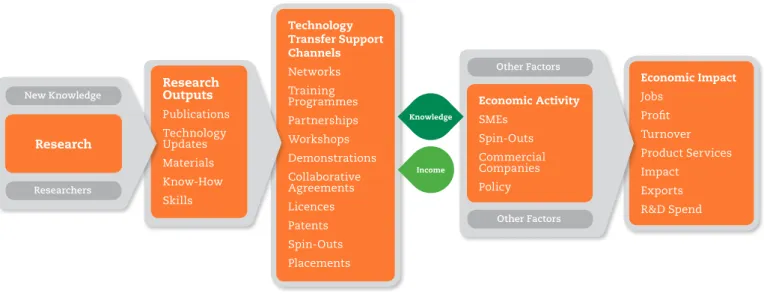
A model depicting the technology and knowledge transfer flow is given above.
In this model, research outputs lead to a variety of technology transfer activities in turn leading to economic activity and finally economic impact. The number of channels in the early stages of the chain give a reasonable indication of the expected level of outputs at the later stages. In public research organisations it is common to measure technology transfer metrics without making strong claims of value creation (6, 7). The Teagasc TTO will continue to examine new methods of measuring value (economic value) from technology transfer channels.
Profit Turnover Product Services Impact Exports R&D Spend Programmes Partnerships Workshops Demonstrations Collaborative Agreements Licences Patents Spin-Outs Placements Publications Technology Updates Materials Know-How Skills Economic Activity SMEs Spin-Outs Commercial Companies Policy Other Factors Research Researchers
Fig. 1: Modified Model of Technology Transfer in Teagasc
Knowledge
It is now well accepted that research and development and the exploitation of knowledge, will be a critical driver of the technical change, productivity growth and overall economic progress of the Irish agri-food sector.
Food Harvest 2020 emphasised the need for the Irish agri-food sector to embrace a “smart” approach and to take advantage of a “green” opportunity in order to achieve sustainable growth. In particular, it concluded that the sector must prioritise research and development, foster creativity and maximise adoption of best practice. A new Teagasc Strategy for Technology and Knowledge Transfer can contribute to the attainment of these goals by developing an environment of effective technology transfer focused on meaningful partnerships with industry.
The Strategic Imperative
The OECD Innovation Strategy (2009) (8) emphasised that economic recovery and growth will depend on having effective enabling mechanisms that can accelerate scientific and technological progress and diffuse innovation as widely as possible. Substantial competitive advantage can be gained from embracing innovation through lowering costs, increasing diversification, becoming a first mover or by improving overall industry structure. In particular, developing new ways to achieve higher quality and/or quantity of output of goods and services is a key driver of economic
performance. Increasing support for science-based innovation by Teagasc for Ireland’s large multinationals, foreign multinationals located in Ireland, established SMEs and start-ups and existing companies with high growth potential, will improve Ireland’s economic success. Even though the food industry is acknowledged as a major contributor to the Irish economy and has
significant potential for growth, R&D investment by companies is very low. This provides the rationale for Teagasc to prioritise technology and knowledge transfer within this sector. The report of the Innovation Taskforce (9) identified that the entrepreneur (and enterprise) must be central to the innovation ecosystem. Teagasc technology transfer activities will be central to meaningful interactions with agri-food enterprises.
Principles in the Teagasc Food Technology and Knowledge Transfer Strategy
In order to achieve the mission in terms of effective technology transfer, Teagasc is fully committed to implementing the technology transfer strategy under the following principles:
A culture of technology and knowledge transfer and an environment in which these can flourish will be established in Teagasc. This will be done through mechanisms such as appropriate promotion criteria and measuring key performance indicators (KPIs) as well as providing appropriate training and motivation programmes for staff.
A sustained commitment from Teagasc management will ensure appropriate resources are available to meet the objectives.
Researchers will demonstrate leadership, flexibility, entrepreneurial and other skills in order to deliver an effective, market-focused technology and knowledge transfer function in their area.
The Teagasc TTO will be fully supportive of the researcher teams; it will be well co-ordinated, efficient, consistent and transparent in its activities.
Transfer Action Plan
Overall Objective
“To implement a systematic, effective and flexible technology
transfer process which supports science-based innovation in
the agri-food sector, thereby turning knowledge into commercial
products and processes.”
“Innovation will
be one of the keys
to accelerating
the recovery and
putting countries
back on a path to
sustainable and
smarter growth.”
Strategic Objectives
Seven key strategic objectives have been identified for the Technology and Knowledge Transfer Strategy. These objectives and their related action programmes are designed to allow the Strategy to achieve its mission and will be delivered over the period 2011–2013.
Objective 1:
Developing best practice in food technology transfer.
Create a high performing environment to foster effective technology transfer.
Objective 2:
Mapping Teagasc technologies.
Develop a systematic process which allows for the constant collection of data on Teagasc technologies and engagement with industry.
Objective 3:
Developing the Teagasc Food Technology Portfolio.
Ensure that Teagasc technologies, capabilities and expertise are widely accessible and easily understood.
Objective 4:
Fostering key collaborations and strategic partnerships with industry, state agencies and other stakeholders.
Engage with external stakeholders to align Teagasc technologies and capabilities to solution-focused programmes and projects.
Objective 5:
Establishing a high profile and effective TTO.
Establish a fully functioning TTO which is adequately resourced and develop technology transfer policies in line with best practice.
Objective 6:
Measuring and evaluating key performance indicators of technology transfer in Teagasc.
Identify KPIs relevant to the technology transfer strategy which are equitable, measurable and in line with the strategic objectives. Ensure that accurate measurement and evaluation is possible, ideally through the TTO.
Objective 7:
Identifying key skills and resources necessary for an effective technology transfer strategy.
Ensure that Teagasc staff have adequate skills, knowledge and resources to foster a robust technology transfer culture.
Objective 1:
Developing Best Practice in Food Technology
Transfer
Technology transfer has received substantial attention from governments (and their
agencies), industry and research providers in the last number of years. It is important that Teagasc benchmarks its activities in these areas against global best practice.
Actions to be undertaken to achieve best practice will be:
Action 1.1– organising strategic meetings and developing formal relationships with individual leaders, institutes and networks in the area of technology and knowledge transfer at national and international level.
Action 1.2 – developing performance measurement criteria which are crucial to effective technology transfer systems. Action 1.3 – participating in national and international technology and knowledge transfer networks in order to keep abreast of best practice.
Action 1.4 – identifying exemplary cases from the agri-food sector and examining what determined their success both from a research producer, intermediary and research user viewpoint.
Food Innovation Alliance Ireland
This was established to cement mutual Teagasc and University College Cork Food Research activities within a joint strategic approach. The objectives of Food Innovation Alliance Ireland are to achieve critical mass and greater scientific depth in the areas of Food Science and Technology, Food and Health and Food and the Consumer. In addition, the Alliance makes possible a “one-stop-shop” for Industry interaction with the research institutions.
To implement an effective technology transfer strategy it is crucial that regular technology audits are carried out. These should measure the what, how and who of ongoing transfer to industry and ensure it is recorded. In particular, the nature of meaningful relations between Teagasc researchers and industry should be determined. This information will provide a very useful overview of the breadth and depth of current interactions. Furthermore it will contribute to ascertaining key technologies, key personnel and key capabilities for use in promoting Teagasc science-based support for innovation. The process of recognising potentially marketable technologies and preparing them for practical use is a complex task and requires input from various sources. Actions required to fully map current Teagasc technologies, capabilities and personnel: Action 2.1 – carrying out structured interviews with all key research staff to determine (a) the nature of their existing interactions with industry and potential interactions, (b) the key capabilities available (expertise and infrastructure) and (c) live technologies or technology updates likely to be in demand by industry.
Action 2.2 – developing a centralised system to record all commercial services and collaborative research programmes on an ongoing basis. The introduction of such a system will require:
a. Shared understanding and organisation-wide agreement of the definitions of the above.
b. All staff to be committed to the process and trained in understanding its implications. c. User-friendly processes for collection of
data.
The TTO has prepared policies and guidelines for drafting and signing off agreements with companies based on best practice.
Action 2.3 – issuing of reports when required on the following:
a. The number of commercial and collaborative research projects by researchers,
departments, programmes and companies. b. The IP portfolio and its status.
c. A list and status of potential applications.
Objective 2:
Technology marketing is a process by which owners of a technology create relationships between themselves and potential users. These relationships enable the technology to be developed and made more widely available through commercialisation, alliances or other methods. Central to this process is the ability of internal and external stakeholders to easily access the details of Teagasc technologies, services, capabilities and expertise. Therefore it is proposed to develop a Food Technology Portfolio detailing the above.
Actions to be taken to develop a Teagasc-branded Food Technology Portfolio:
Action 3.1 – Describing all available technology owned or part-owned by Teagasc that can be marketed to potential users in a clear format. These can then be formalised as T-Technology Offers which will be updated and amended regularly.
Action 3.2 – Summarising, in a standard format, the main findings of Teagasc research projects as T-Technology Updates. They describe key technologies at various stages of development articulating clearly the opportunities for further development, in partnership with external clients. All T-Technology Updates will be combined into a single searchable entity on a new website portal.
Action 3.3 – Describing T-Technology Services concisely in a user-friendly format.
T-Technology Offers many highly technical and specialist services to the food industry utilising its advanced equipment and facilities.
Action 3.4 – Our T-Technology Expertise will detail a vast array of modern pilot plant facilities that can be accessed by the food industry.
Action 3.5 – Preparing a concise profile of each Teagasc expert, their expertise and highlight the role they can play in providing solutions and/or opportunities for food companies. Technology transfer is all about person-to-person contact. It is important to Teagasc’s external clients that they are familiar with the key researchers and providers of food technology services.
Action 3.6 – Developing a totally revamped web portal with search engines to easily allow users to access the information they require on a timely basis in a clear, uncluttered manner. The internet and social media are a vital first contact with external clients.
Objective 3:
Development of a Food Technology Portfolio
Our physical centres of excellence in food science play a
powerful role in helping industry to develop new products
and to commercialise good ideas.
It is now widely recognised that fostering external relationships accelerates and enhances the innovation process.
This can be implemented using a number of methods. Central to the process are mutual trust, credibility, confidentiality, clear business objectives and confidence. A clear understanding of the issues and the thinking of the client are paramount in building such relationships. It is not sufficient to know what and to know how, it is vital to know who. This requires Teagasc to nurture and promote researcher and external client interaction systematically. In the food sector this is particularly important as a recent Forfás report (3) urgently recommended that the State support for R&D should be co-ordinated. Teagasc is articulating its role in this arena by enthusiastically fostering strategic partnerships with the industry.
Actions to be taken to foster partnerships and collaborations with external clients:
Action 4.1 – Measuring the current level of interaction between Teagasc researchers and industry. Through an audit, ascertain the level of the engagement and develop a plan to increase the amount and intensity where required. Furthermore, early involvement of potential users in the research planning phase helps ensure that research outputs respond to user needs. Action 4.2 – Ensuring that engagement with industry is seen as a key part of the new Teagasc Statement of Strategy (2012-2015) and that its senior staff will be responsible for such interaction. These engagements are being measured in a systematic manner and will be central to the new customer relationship management system.
Action 4.3 – Ensuring that all its stakeholders, particularly Irish and foreign direct investment (FDI) food companies, are fully aware of its technologies, expertise, capabilities and services. The Food Technology Portfolio and new web portal will ensure that Teagasc can communicate this information concisely to the industry.
However this must be done systematically and strategically. This will be achieved by senior management and researcher visits to companies, as well as arranging visits to Ashtown and Moorepark by CEOs, senior technical staff and marketing personnel of companies.
Action 4.4 – Examining innovative approaches to company engagement in the light of their suitability and business sense from a Teagasc point of view. Establishment of a Teagasc Food Industry Association or Club (“The T-
Technology Association”) whereby companies will be afforded restricted access to The Food Technology Portfolio depending on their level of membership (platinum, gold, silver or bronze) and/or size will be examined. This may have two major benefits: a significant revenue stream and closer partnerships with the food industry. Other instruments for consideration include the creation of a “Teagasc Alumni Community”, the setting up of a national one stop shop or virtual all-under-one-roof portal with Teagasc leading and coordinating its activities. Assessments of these and other instruments will be part of the results of the actions under Objective 1- developing best practice. The Teagasc-UCC Food Innovation Ireland Alliance will play a crucial role in the development of such entities. Action 4.5 – Showcasing Teagasc’s Food
Technology Portfolio through stand-alone events or as part of other larger national and
international exhibitions. The launch of the Portfolio will be held at an event in Dublin catering for Irish and FDI CEOs, research and development and marketing teams and relevant personnel from state agencies. Other events such as Technology Brokering or Techno Dating will be considered in which a targeted audience is selected to align specific groups of companies with a cluster of Teagasc technologies. Live demonstration events at Ashtown and Moorepark will also form part of promoting these
technologies. Finally, a dedicated website relating to engagement with industry will be launched to promote The Food Technology Portfolio.
Objective 4:
Fostering Key Collaborations and Strategic
Partnerships with Industry and State Agencies
Technology transfer is the process of converting scientific findings into useful products or services for society. Transferring knowledge and innovation from a public research organisation to the private sector for commercial application and public benefit requires a formal mechanism. Globally this function is managed by a Technology Transfer Office (TTO). A well functioning TTO can facilitate the commercialisation of research results, the building of closer ties to industry and the generation of income. The TTO requires a well articulated and unambiguous mission with transparent policies and procedures. It must be fit for purpose with a customer friendly approach. Furthermore it must be well supported by senior management and adequately resourced. The TTO must have strong and visible links to potential industry partners and have close relationships with the research community.
The mission of the Technology Transfer Office in Teagasc is to facilitate, enhance and support the transfer of intellectual property, resources and information between Teagasc and the business community and other stakeholders. This work has benefits of economic and social importance. Actions to be taken to establish a high profile and effective TTO:
Action 5.1 – Developing clear annual Business Plans for the TTO incorporating its mission, functions, KPIs, milestones and resources necessary to run an effective office. The plan will be aligned with Teagasc’s institutional and research objectives.
Objective 5:
Establishing a High Profile and Effective TTO
Action 5.2 –Resourcing adequately the Teagasc TTO with experienced and senior staff members. The TTO will have a core team of four: the Assistant Director of Research (Head), the IP Manager, the Head of Food Industry Development (FID department) and an IP support officer.Action 5.3 – Developing and communicating clear policies and agreed standard procedures on IP protection, drafting of collaborative research agreements, confidential disclosure agreements, material transfer agreements and invention disclosure policy. A portfolio of standard contracts and agreed templates will be established. Central to this process is the implementation of an electronic and systematic way of managing agreements and many other forms of data.
Action 5.4 – Providing in collaboration with other agencies (e.g., Enterprise Ireland) assistance in assessing new technology for patentability, market potential and potential licences. A “go, kill, hold, recycle” guideline for new technology will be developed.
Action 5.5 – Building linkages with networks in the technology transfer community (10) on a national basis (The Irish Technology Transfer and Innovation Group) and at European level (European TTO Circle, PROTON, ASTP, Praxis) focusing on up-skilling the TTO, joint marketing of technologies and implementing best practice in operating and benchmarking TTOs.
Action 5.6 – Establishing a business-like culture and operating at a level of understanding that meets the expectations of the researcher and business community.
In order to ensure that Teagasc technology transfer activities and engagement with industry are meaningful and result in real impact, it is important that key metrics are universally agreed by management and staff and then are capable of being assessed accurately and comprehensively. Metrics for engagement with industry will include the following: Collaborative Research Agreements, Contract Research Agreements, Licencing Agreements Executed and Commercial Services. These will be measured in numbers and associated value, as well as in terms of IP including number of invention reports, Patent Applications, Patent Grants and Licences. Other metrics will include degree of repeat contracts, client feedback and number of company interactions.
Actions to be taken to ensure that key metrics are agreed and measured:
Action 6.1 – Reviewing the recommended KPIs from the literature including those of the
European Community and those recommended at national level. Agree definitions with researchers and senior management to ensure mechanisms are in place to accurately measure these. Action 6.2 – Developing the TTO business plan to incorporate the agreed KPIs to measure Technology Transfer activities.
Objective 6:
Measuring and Evaluating Key Performance
Indicators of Food Technology Transfer
in Teagasc
Action 6.3 – Examining how the economic value of technology transfer activities is best
measured. Currently the systems available tend to measure on a quantitative basis. Development of TT networks nationally and internationally will ensure that the best practice for these measurements is taken into account by Teagasc. Action 6.4 – Implementing policies and procedures to allow measurement of such KPIs and use of an appropriate electronic system for continual collection, recording and reporting of the agreed metrics.
Objective 7:
Identifying Resources
The function of a TTO and the process oftechnology transfer are both complex and varied. Staff need to be highly motivated and skilled. Teagasc senior management will ensure that adequate training and resources are available to foster an effective technology transfer system. Actions to be taken to ensure that Teagasc staff (both within the TTO and researchers) have the necessary skills and resources to contribute to an effective TT system:
Action 7.1 – Undertaking a skills analysis, based on the scope and scale of activities, with a view to developing a skills development programme for TTO staff and researchers. Strong alignment with the Teagasc People Leadership Change programme will be an essential element of this. Particular attention will be paid to
commercialisation specialists with relevant business experience in marketing.
Action 7.2 – Procurement of and training in dedicated software for management of IP with contract management ability will assist in a number of functions of the TTO.
The Teagasc Food Programme will continue
to strengthen existing alliances and make new
partnerships to create an environment that
enables food innovation to flourish.
References
1. Food Harvest 2020: A Vision for Irish Agri-Food and Fisheries (2010) Dept Agriculture, Food and Marine.
2. Action Plan For Jobs (2012). Department of Jobs, Enterprise and Innovation. 3. Food Research Ireland (2011). Department of Agriculture, Food and the Marine 4. Maximising the Environment for Company Research and Development (2010). Forfás 5. Diffusion of Innovations. (2003). Rogers, E. M.,ed. The Free Press, New York.
6. Metrics for Knowledge Transfer from Public Research Organisations in Europe – Expert Group Report (2009). European Commission
7. Metrics for the Evaluation of Knowledge Transfer Activities at Universities (2010). www.libraryhome.net
8. Interim Report on the OECD Innovation Strategy (2009). www.oecd.org
9. Innovation Ireland (2010): Report of the Innovation Task Force Dept. Taoiseach, Dublin 10. University Collaboration on Technology Transfer: An All-Ireland Feasibility Study (2006).
Contact Details:
Teagasc Head Office Oak Park, Carlow Tel: +353 (0) 59 9170200 Fax: +353 (0) 59 9182097 Email: [email protected]Teagasc Food Research Centre Ashtown, Dublin 15
Tel: +353 (0)1 8059500 Fax: +353 (0)1 8059550 Email: [email protected]
Teagasc Food Research Centre Moorepark, Fermoy, Co. Cork Tel: +353 (0)25 42222 Fax: +353 (0)25 42340