Worcester Polytechnic Institute
Digital WPI
Doctoral Dissertations (All Dissertations, All Years) Electronic Theses and Dissertations
2009-08-28
Investigating Learning in an Intelligent Tutoring
System through Randomized Controlled
Experiments
Leena RazzaqWorcester Polytechnic Institute
Follow this and additional works at:https://digitalcommons.wpi.edu/etd-dissertations
This dissertation is brought to you for free and open access byDigital WPI. It has been accepted for inclusion in Doctoral Dissertations (All Dissertations, All Years) by an authorized administrator of Digital WPI. For more information, please [email protected].
Repository Citation
Razzaq, L. (2009).Investigating Learning in an Intelligent Tutoring System through Randomized Controlled Experiments. Retrieved from
Investigating Learning in an Intelligent Tutoring
System through Randomized Controlled Experiments
By
Leena Razzaq
A Dissertation Submitted to the Facultyof the
WORCESTER POLYTECHNIC INSTITUTE in Partial Fulfillment of the Requirements for the
Degree of Doctor of Philosophy in Computer Science by __________________________________________ August 2009 APPROVED: _____________________________ _____________________________
Dr. Neil T. Heffernan Dr. David C. Brown
Advisor Committee Member
_____________________________ _____________________________
Dr. Robert W. Lindeman Dr. Beverly Park Woolf
Committee Member Univ. of Massachusetts - Amherst
External Committee Member _____________________________
Dr. Michael A. Gennert Head of Department
Abstract
In the United States, many students are doing poorly on new high-stakes standards-based tests that are required by the No Child Left Behind Act of 2002. Teachers are expected to cover more material to address all of the topics covered in standardized tests, and instructional time is more precious than ever. Educators want to know that the interventions that they are using in their classrooms are effective for students of varying abilities.
Many educational technologies rely on tutored problem solving, which requires students to work through problems step-by-step while the system provides hints and feedback, to improve student learning. Intelligent tutoring researchers, education scientists and cognitive scientists are interested in knowing whether tutored problem solving is effective and for whom. Intelligent tutoring systems have the ability to adapt to individual students but need to know what types of feedback to present to individual students for the best and most efficient learning results.
This dissertation presents an evaluation of the ASSISTment System, an intelligent tutoring system for the domain of middle school mathematics. In general, students were found to learn when engaging in tutored problem solving in the ASSISTment System. Students using the ASSISTment System also learned more when compared to paper-and-pencil problem-solving.
This dissertation puts together a series of randomized controlled studies to build a comprehensive theory about when different types of tutoring feedback are more appropriate in an intelligent tutoring system. Data from these studies were used to analyze whether interactive tutored problem solving in an intelligent tutoring system is
more effective than less interactive methods of allowing students to solve problems. This dissertation is novel in that it presents a theory that designers of intelligent tutoring systems could use to better adapt their software to the needs of students. One of the interesting results showed is that the effectiveness of tutored problem solving in an intelligent tutoring system is dependent on the math proficiency of the students. Students with low math proficiency learned more when they engaged in interactive tutoring sessions where they worked on one step at a time, and students with high math proficiency learned more when they were given the whole solution at once. More interactive methods of tutoring take more time versus less interactive methods. The data showed that it is worth the extra time it takes for students with low math proficiency.
The main contribution of this dissertation is the development of a comprehensive theory of when educational technologies should use tutored problem solving to help students learn compared to other feedback mechanisms such as hints on demand, worked out solutions, worked examples and educational web pages.
Acknowledgements
There are many people that I would like to acknowledge in the completion of this dissertation. Over the course of working on this dissertation, Neil Heffernan contributed a significant amount of time advising me and I want to thank him for his generous support and patience. His energy, enthusiasm and valuable advice were a great help. He makes it easy to believe that ASSISTments will take the world by storm.
I would also like to thank my dissertation committee, David Brown, Rob Lindeman and Beverly Woolf. Their expertise and experience have all contributed valuable advice and support.
The ASSISTment team has been a great group of people to work with. Although the ASSISTment lab is small and crowded, I have always felt lucky to work with such smart and talented people. Ming, Zach, Jozsef, Mike, Cristina and so many others have been friends as well as colleagues.
Thanks to all of the family and friends who supported me. Finally, a special note of thanks to Muttasem, Fatima and Zane for their love and support during my time at WPI.
Table of Contents
Abstract ... ii
Acknowledgements ... iv
Table of Figures ... vii
1. Introduction ... 3
1.1 Motivation ... 3
1.2 The System... 5
1.3 Research Questions ... 5
1.4 Contributions... 6
1.4.1 Evaluate student learning in the ASSISTment System ... 6
1.4.2 Investigate the effectiveness of tutored problem solving ... 7
1.4.3 Designed tutoring content ... 8
1.5 Dissertation Outline ... 10
2. Background on Tutoring ... 11
2.1 Human Tutoring ... 11
2.2 Computer-based tutoring ... 13
2.2.1 Computer-Aided Instruction ... 13
2.2.2 Intelligent Tutoring Systems ... 14
2.2.3 Dialog-based Intelligent Tutors ... 17
2.2.4 Interactive Tutoring ... 19
3. The ASSISTment System ... 22
3.1 Structure of an ASSISTment ... 23
3.2 Skill mapping ... 27
3.3 Teacher Reports ... 28
3.4 Problem Sequences ... 29
4. Is the ASSISTment System an effective tutor? ... 31
4.1 ASSISTment development and usage ... 31
4.2 Are students learning from the ASSISTment system? ... 35
4.3 ASSISTments with tutoring/help vs. paper-and-pencil homework ... 37
4.3.1 Participants ... 40 4.3.2 Content ... 41 4.3.3 Experiment Design... 42 4.3.4 Procedure ... 43 4.3.5 Results ... 45 4.3.6 Discussion ... 46
4.4 ASSISTments with no tutoring vs. paper and pencil homework ... 46
4.4.1 Participants and Content ... 47
4.4.2 Experiment Design... 47
4.4.3 Results ... 48
4.4.4 Conclusion ... 49
5. Tutored Problem Solving vs. Hints on Demand ... 51
5.1 Participants ... 55
5.2 Results ... 55
5.3 Hints on demand vs. proactive hints ... 58
6. Tutored problem solving vs. worked examples ... 64 6.1 Participants ... 66 6.2 Materials ... 67 6.3 Procedure ... 67 6.4 Results ... 72 6.5 Conclusions ... 74
7. Tutored problem solving vs. worked out solutions ... 77
7.1 Experiment Design... 79
7.2 Results ... 81
7.3 Immediate vs. Delayed Feedback ... 84
7.3.1 Experiment Design... 85
7.3.2 Results ... 87
7.4 Conclusion ... 87
8. Tutored problem solving vs. educational web pages ... 89
8.1 Can students learn from viewing a web page of educational content? ... 89
8.2 Is Tutored Problem Solving superior to viewing educational web pages? ... 91
8.3 Conclusion ... 93
9. Is there a tradeoff between the value of interactive tutoring and the extra time it takes? ... 94
9.1 Experiment Design... 95
9.2 Results ... 98
9.3 Conclusions ... 100
10. Theory of the effectiveness of tutored problem solving ... 102
10.1 Is interactive tutored problem solving to help students solve math problems more effective than less interactive forms of help? ... 102
11. Conclusions ... 107
11.1 Implications... 108
11.2 Directions for future work ... 108
11.2.1 Switching between strategies for individual students ... 108
11.2.2 Examining other student characteristics ... 109
11.2.3 Conceptual versus procedural knowledge ... 109
11.2.4 Ranking educational web content ... 109
References ... 111 Appendix A: Materials for ASSISTments vs. Paper and Pencil Study
Appendix A.1 Pretests/Post-tests
Appendix A.2: Homework Problem Sets Appendix A.3: Sample ASSISTment Problems Appendix A.4: Sample Hints
Appendix B Materials for Experiment on Tutored Problem Solving vs. Worked Out Solutions
Appendix B.1 Pretest
Appendix B.2 Tutored Problem Solving Condition Appendix B.3 Hints on demand condition
Appendix B.4 Worked Solutions Condition Appendix B.5 Post-test
Table of Figures
Figure 1: The ASSISTment Builder and associated student screen ... 25
Figure 2: An item report tells teachers how students are doing on individual problems.. 29
Figure 3: A Problem Sequence that is designed as a randomized controlled experiment 30 Figure 4: Item #19 from the 2003 Massachusetts state math test for 8th grade ... 33
Figure 5: 8th grade problem sets targeting skills set by the state of Massachusetts ... 34
Figure 6: A perimeter and area learning opportunity pair ... 37
Figure 7: Students were given two attempts to enter the correct answer... 49
Figure 8: The tutored problem solving condition with three scaffolding questions is shown on the left. Four hints are shown on the right. Students ask for each hint by clicking on the hint button. ... 54
Figure 9: Results for average on post-test items by condition. ... 56
Figure 10: Results on the transfer item for the first pre-test item by condition ... 57
Figure 11: Hints on demand, students ask for each hint by clicking on a hint button ... 60
Figure 12: Proactive hints: hints are presented automatically when a student submits an incorrect answer ... 61
Figure 13: The worked example condition requires students to read the example and then try to answer the question again... 70
Figure 14: The tutored problem solving condition requires students to work through each step of the problem... 71
Figure 15: An ASSISTment item showing the tutored problem solving and hints on demand conditions. ... 78
Figure 16: The delayed feedback explanation ... 80
Figure 17: There are interactions between condition and math proficiency approaching significance. ... 83
Figure 18: The immediate feedback condition gave students the solution immediately while the delayed feedback condition gave the student the solution at the end of the assignment... 86
Figure 19: Students would be directed to a webpage on Venn Diagrams if they answered the problem incorrectly. ... 90
Figure 20: A symbolization problem shows the TPS approach on the left and the Solutions approach on the right. ... 97
Figure 21: Highly proficient students appeared to learn more by seeing Solutions, and students with low proficiency learned more by doing TPS. ... 100
1. Introduction
1.1 Motivation
In many states, students are doing poorly on new high-stakes standards-based tests that are required by the No Child Left Behind Act of 2002. For instance, Massachusetts has an assessment system, called Massachusetts Comprehensive Assessment System (MCAS), in which students take rigorous tests in English, Mathematics, History & Social Science and Science & Technology/Engineering in grades 3-12. Students must pass the Mathematics and English portions of the 10th grade MCAS test in order to get a high school diploma. In Massachusetts, which according to the National Assessment of Educational Progress (NAEP) was tied for first in 8th grade math performance, over 60% of 8th grade students did not reach the “Proficient” level in math in the Massachusetts state test in 2005-2006 according to the Massachusetts Department of Education. The problem is even more acute for minorities and those who come from low-income families. In the industrial city of Worcester, Massachusetts, 56% of 8th graders failed the Massachusetts state test in mathematics and 82% did not reach the Proficient level in 2005-2006.
In 2007, a full 10% of high school seniors were set to be denied a high school diploma due to having failed to pass the test on their fourth try. The failure rate for African Americans and Latinos was a disheartening 25% and 30%, respectively. Because students are more likely to fail the mathematics portion of the test, the state is focusing efforts on mathematics. The state of Massachusetts has singled out student performance
on the 8th grade math test as an area of highest need for improvement (MCAS Results - Massachusetts Comprehensive Assessment System).
The Worcester Public School District is representative of the many districts across the country that are struggling to address these problems. With new advances in educational technology and numerous studies showing varying degrees of its effectiveness, there are more choices for school administrators and teachers to make regarding which tools to use to help students learn and stay motivated. Complicating matters further, a study (Dynarski, Agodini, Heaviside, Novak, Carey, & Campuzano, 2007) commissioned by the U.S. Department of Education presented results that claimed that classrooms using selected math and reading educational software products did not differ significantly on standardized tests from classrooms that did not use the products. With the notoriety of this study, some have called into question the utility of education software.
The goal of this research is to use randomized controlled experiments to evaluate an intelligent tutoring system and to determine empirically-validated effective ways to interact with students via the computer. This will help inform the design of the tutoring strategies that can maximize learning results. This becomes more pertinent as teachers are expected to cover more material to address all of the topics covered in standardized tests, instructional time becomes more precious and teachers want to know that the interventions that they are using in their classrooms are effective for students of varying abilities.
1.2 The System
This research was carried out with the ASSISTment System (Razzaq et al., 2007), a web-based tutoring system that assesses students while it assists them in solving math and science problems. Assistance and assessment are integrated in the ASSISTment System which offers instruction to students while providing a detailed evaluation of their abilities to teachers. Each time students work on the website, the system “learns” more about the students’ abilities. The ASSISTment System is being built to identify the difficulties individual students – and the class as a whole – are having, and teachers will be able to use this detailed feedback to tailor their instruction to focus on those difficulties. Unlike other assessment systems, the ASSISTment system also provides students with intelligent tutoring assistance while assessment information is collected.
Over 3,000 students use the system as part of their regular math instruction. This work is mainly based on evaluations of middle school students using the ASSISTment System in Central Massachusetts.
1.3 Research Questions
This dissertation attempts to answer the following questions: 1. Is the ASSISTment System an effective tutor?
o Do students learn when using the ASSISTment System in the classroom?
o Can students learn more from using the ASSISTment System for homework compared to traditional paper and pencil homework? 2. Is the ASSISTment System’s method of interactive tutored problem solving to
help students solve math problems more effective than other forms of help? Such as:
o Tutored problem solving vs. hints on demand
o Tutored problem solving vs. worked examples
o Tutored problem solving vs. worked out solutions
o Tutored problem solving vs. educational web pages
3. Does a student’s math proficiency determine what form of help to provide? 4. Is there a tradeoff between the value of interactive tutoring and the extra time that
it takes?
1.4 Contributions
This dissertation makes three main contributions to the field of student learning in intelligent tutoring systems, as described in the following sections. The first contribution concerns designing and developing tutoring content for the ASSISTment System. The second contribution focuses on evaluation of learning in the ASSISTment System. Finally, the third contribution investigates the effectiveness of tutored problem solving.
1.4.1 Evaluate student learning in the ASSISTment System
Since the No Child Left Behind Act of 2002, which stresses accountability, educators are concerned with showing that their students are making Adequate Yearly Progress. Adequate Yearly Progress, or AYP, is a measurement defined by the U.S. government that helps to determine how public schools are performing academically according to their students’ results on standardized tests.
Intelligent tutoring systems have great potential to be effective learning tools that provide individualized instruction to students of different abilities and needs and help students to prepare for standardized tests. However, evaluations are needed to validate these systems. Are students learning when using the tutoring system? Do they learn more
from the tutoring system than they would from other more traditional approaches such as paper and pencil problem solving? What are the students’ attitudes about the system?
I have shown that students do learn significantly when they are using the ASSISTment System to solve math problems. Students also learn significantly more when they are tutored by the ASSISTment System than when they engage in paper and pencil problem solving (Mendicino, Razzaq, & Heffernan, 2009). Student surveys showed that 72% Strongly Agreed or Agreed Somewhat that the ASSISTment system helped them prepare for the MCAS.
The implication of this contribution is that educators can believe that the ASSISTment System is an effective educational technology that can help their students to learn.
1.4.2 Investigate the effectiveness of tutored problem solving
Many educational technologies depend on tutored problem solving to help students learn. The ASSISTment System forces students to engage in tutored problem solving when they cannot solve a problem correctly. While this method can be effective, it is time-consuming and students have complained about being forced to go through each step. Developers of intelligent tutoring systems would like to know how to adapt tutoring to individual students by being able to decide when to use tutored problem solving and for which students.
This dissertation used randomized controlled experiments with hundreds of students to compare tutored problem solving to five other interventions: paper and pencil homework, hints on demand, worked examples, worked solutions and educational web pages. Based on the results of these experiments, this dissertation has shown that tutored
problem solving is an effective method of helping students to learn how to solve math problems. The results also show that tutored problem solving is most effective when the material is difficult for students. For students who have higher math proficiency, tutored problem solving is not the most efficient method. These students benefit more from being shown a worked out solution and from finishing more problems in the same amount of time. Students who have lower math proficiency benefit from spending more time per problem while doing tutored problem solving.
The implication of this contribution is that tutoring system developers can use these guidelines to design systems that adapt to individual students resulting in better and more efficient learning results, perhaps helping to close the achievement gap that affects economically disadvantaged and minority students.
1.4.3 Designed tutoring content
Although intelligent tutors have been shown to produce significant learning gains in students (Koedinger, Anderson, Hadley, & Mark, 1997), few intelligent tutoring systems have become commercially successful. The high cost of building intelligent tutors may contribute to their scarcity and a significant part of that cost concerns content creation. Murray (1999) asked why there are not more intelligent tutoring systems and proposed that a major part of the problem was that there were few useful tools to support intelligent tutoring systems creation. Murray, Blessing, and Ainsworth (2003) reviewed 28 authoring systems for learning technologies. Unfortunately, they found that there were very few authoring systems that were of "release quality", let alone commercially available.
Koedinger et al. (2004) introduced example-tracing tutors which mimic cognitive tutors but are limited to the scope of a single problem. The ASSISTment System uses a further simplified example-tracing tutor, called an ASSISTment, where only a linear progression through a problem is supported which makes content creation easier and more accessible. The ASSISTment System’s approach is to allow users to create example-tracing tutors via the web to reduce the amount of time it takes to create content, thus reducing the cost.
The author has been part of the design team for the ASSISTment System since its start in 2003. She has helped to design the Builder which is used to build tutoring content in the ASSISTment System (Razzaq, et al., 2009).
The author has created close to 1,000 ASSISTments to provide tutoring in the ASSISTment System for problems taken from state math tests for grades 4 through 10. These ASSISTments can include scaffolding questions, hints, buggy messages, images, animations and tutoring strategies. These ASSISTments are used regularly by students in their regular math classes as well as for homework. Over 3,000 students use the ASSISTment System in central Massachusetts and Pittsburgh, Pennsylvania.
The author has organized hundreds of ASSISTments into problem sets based on the skills needed to solve the problems. Teachers can browse through the problem sets available for each grade level and assign materials to students based on what they are doing in class or based on what they would like to assess. The author has created problem sets to target the skills for 7th, 8th and 10th grade math as outlined by the Massachusetts Frameworks.
The implication of this contribution is that teachers can use this content to assign problems to their students to assess their progress on topics that are covered in the
Massachusetts state test. Students can use this tutoring content to be tutored on problems that they are having trouble solving. The large amount of tutoring content developed means that most students can use our system throughout the school year (generally used once a week in school) without running out of content.
1.5 Dissertation Outline
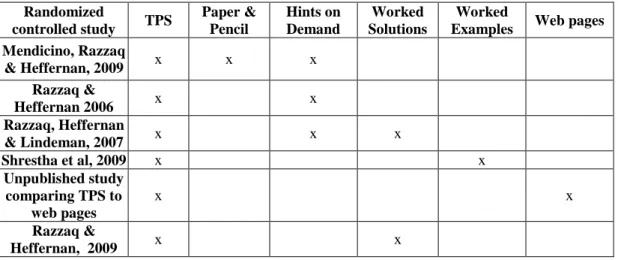
The rest of this dissertation is outlined as follows. Section 2 presents prior work on tutoring: both human and computer-based tutoring. Within computer-based tutoring, computer aided instruction, intelligent tutoring systems and dialog-based tutoring systems are discussed. Section 3 discusses the ASSISTment System which was used to carry out the experiments in this dissertation. Section 4 is focused on Research Question 1. Sections 5 through 8 focus on Research Questions 2 and 3. Table 1 shows a summary of the main experiments that will be discussed in these sections. Section 9 focuses on Research Question 4. Section 10 discusses the results of the experiments and develops the guidelines for using tutored problem solving. Section 11 concludes this dissertation.
Table 1: Summary of main experiments Randomized controlled study TPS Paper & Pencil Hints on Demand Worked Solutions Worked
Examples Web pages Mendicino, Razzaq & Heffernan, 2009 x x x Razzaq & Heffernan 2006 x x Razzaq, Heffernan & Lindeman, 2007 x x x Shrestha et al, 2009 x x Unpublished study comparing TPS to web pages x x Razzaq & Heffernan, 2009 x x
2. Background on Tutoring
This section describes prior work on human tutoring, computer aided tutoring and intelligent tutoring systems.
2.1 Human Tutoring
In education research, an effect size is used to indicate the number of standard deviation units between the result scores of treatment and control groups in a study. Thus, effect sizes can be used to describe the results of different studies on a uniform scale of effectiveness. For instance, an effect size of 0.5 standard deviations means that the average score in the experimental group is 0.5 standard deviations above the average score in the control group, or is higher than the scores of 49% of the control group. In education, results with effect sizes above 0.25 are considered large enough to be educationally meaningful (Cohen, 1969).
Studies indicate that human tutors provide the most effective form of instruction known (Bloom, 1984; Cohen, Kulik, & Kulik, 1982). They raise the mean performance about two standard deviations compared to students taught in classrooms. Intelligent tutoring systems offer excellent instruction, but not quite as good as human tutors. The best ones raise performance about one standard deviation above classroom instruction (Anderson, Corbett, Koedinger, & Pelletier, 1995). In other words, a human tutor can raise the student’s grade by about two letter grades (e.g., from C to A) while a tutoring
system can raise it by about one letter grade (e.g., from C to B). The challenge is to create tutoring systems that are as effective as human tutors.
In studying what makes a tutoring session successful, VanLehn, Siler and Murray (1998) identified two principles for effective teaching. First, tutors should not offer strong hints or solve problems themselves when students make mistakes. Students miss the opportunity to learn how to solve a problem when they are given an answer and are not allowed to reason for themselves. Secondly, a tutor may need to emphasize the rules needed to solve a problem differently based on what is causing the student to have difficulty. For instance, a tutor may need to generalize a rule or explain why a rule applies. On other occasions an explanation of why an error was made does not help with the learning (VanLehn, Siler, Murray, & Baggett, 1998). Furthermore, VanLehn, Siler, Murray, Yamauchi and Baggett (2003) did further research on this topic and suggested that students were more likely to learn when they reached an impasse than if the tutor had applied the correct action for them.
Merrill, Reiser, Ranney and Trafton (1992) compared the effectiveness of human tutors and intelligent tutoring systems. Their study indicated that a major reason that human tutors are more effective is that they let the students do most of the work in overcoming impasses, while at the same time provided as much assistance as necessary. Merrill, D., Reiser, Merrill, S., and Landes (1995) argue that the main thing human tutors do is to keep students on track and prevent them from following “garden paths” of reasoning that are unproductive and unlikely to lead to learning. Merrill et al. (1995) pointed to the large number of remarks made by tutors that helped keep students on track while learning Lisp programming. They argue that this was especially important in this
domain because of the hierarchical nature of computer programming where if a student does one step wrong then everything after that step is likely to be wrong.
Modeling, coaching, and scaffolding (demonstrating, overseeing and supporting a student’s learning) are described by Collins, Brown and Hollum (1991) as the heart of cognitive apprenticeship (a model of instruction that works to make thinking visible), which they claim “help students acquire an integrated set of skills through processes of observation and guided practice.” Tutors use modeling when they do a task in front of students to demonstrate how it is done, allowing the student to observe the processes needed. When students attempt problems themselves, tutors may coach them by giving some feedback designed to remind, hint or clarify. Scaffolding is when tutors do parts of a problem for students that they are struggling with and involves being able to assess a student’s proficiency at that point. An important part of scaffolding is fading, which entails progressively removing the support of scaffolding as the student demonstrates proficiency (Collins, Brown, & Holum, 1991).
2.2 Computer-based tutoring
2.2.1 Computer-Aided Instruction
The first computer-based tutoring systems appeared over thirty years ago with the goal of approaching the effectiveness of human tutors. According to Corbett & Trask (2000) these systems, called computer-assisted instruction (CAI) offered one advantage of human tutors: individualized interactive learning support. While these systems were interactive and provided explicit instruction in the form of long web pages or lectures they offered no dialog.
Studies demonstrated the effectiveness of CAI in mathematics at the elementary level (Burns & Bozeman, 1981; Kulik, Kulik, & Bangert-Drowns, 1985) secondary level (Kulik, Bangert-Drowns, & Williams, 1983) and college level (Kulik & Kulik, 1986). In a meta-analysis of 254 studies involving CAI, Kulik and Kulik (1991) found that CAI improved student achievement by an average effect size (a measure of the magnitude of the treatment effect) of 0.3 over students receiving conventional instruction. In another meta-analysis, Kulik (1994) summarized 97 studies from the 1980’s that compared classroom instruction to computer-based instruction and found an average effect size of 0.32 in favor of computer-based instruction. Kulik claimed that students learned more and learned faster in courses that involved computer-based instruction.
2.2.2 Intelligent Tutoring Systems
The next generation of computer-based tutoring systems moved beyond the simple presentation of pages of text or graphics. These new intelligent tutoring systems (ITS), called cognitive tutors, incorporated model-tracing technology, which is a cognitive model of student problem solving that captures students’ multiple strategies and common misconceptions. The cognitive tutor uses model-tracing to understand students’ input and to indicate when they have made a mistake. With model-tracing, cognitive tutors provide students individualized assistance that is just-in-time and sensitive to the students’ particular approach to a problem (Anderson, Corbett, Koedinger, & Pelletier, 1995). They also provide hint messages that get more explicit as students continue asking for help until the tutor is telling the student exactly what to do. The feedback is immediate and is structured so as to lead students step-by-step toward expert-like performance. The tutor
in dialog by asking new questions. Cognitive tutors also use knowledge-tracing technology that traces students’ knowledge growth across problem solving activities and uses this information to select problems and to adjust the pacing to adapt to individual student needs.
Although cognitive tutors do not engage students in dialog, they nonetheless have had a significant impact on student learning in a variety of domains. For example, Koedinger et al. (1997) compared a cognitive tutor, “Cognitive Tutor Algebra” to traditional algebra instruction. The Cognitive Tutor was built to support the Pittsburgh Urban Mathematics Project (PUMP) algebra curriculum that is centrally focused on mathematical analysis of real world situations and the use of computational tools. The study evaluated the effect of the PUMP curriculum and Cognitive Tutor use and found that students in the experimental classes outperformed control classes by 100% on assessments of the targeted problem solving and multiple representations. These results also translated into a one standard deviation effect size. Other studies comparing Cognitive Tutor and traditional algebra instruction, have found improvements in the 50-100% range thus replicating the previous results (Koedinger, Corbett, Ritter, & Shapiro, 2000). Approximately 375,000 students in over 1000 schools currently use this cognitive tutor.
Morgan and Ritter (2002) conducted a study comparing the Cognitive Tutor Algebra I course and a Traditional Algebra I Course, that used a different text, with students in their junior high school system. Dependent measures included the Education Testing Service (ETS) Algebra I end-of-course exam, course grades and a survey of attitudes towards mathematics. These measures certainly seem to have the benefit of not being defined by the experimenters themselves. When restricting the analysis to only
those teachers who taught both the Cognitive Tutor Algebra I course and the Traditional Algebra I Course, the researchers found statistically significant differences on all dependent measures in favor of the cognitive tutor. Morgan and Ritter state that the strongest components of teacher effects have to do with teacher education and professional development and only indirectly with their teaching practices. In their study the curriculum effect that they were examining had to do with teacher practices that would be expected to be relatively small. Therefore, they conclude that the effect size of 0.29 is impressive taken in this context.
Finally, VanLehn et al. (2005) evaluated Andes, an ITS developed to replace paper-and-pencil homework and to increase student learning in introductory college physics courses. Andes provides immediate feedback to student responses and also provides three kinds of help including: 1) pop up error messages when the error is probably due to lack of attention rather than lack of knowledge, 2) What’s Wrong Help
when the student is essentially asking what is wrong with that, and 3) Next Step Help if students are not sure what to do next. The What’s Wrong and Next Step Help end with a bottom-out hint which tells students exactly what to do.
Andes was evaluated from 1999 to 2003 and in all years Andes students scored higher than control students with effect sizes ranging from 0.21 to 0.92. VanLehn et al. (2005) compared their results to the results of the Koedinger et al. (1997) study that they suggest is the benchmark study with respect to tutoring systems. The Koedinger et al. study evaluated the “Cognitive Tutor” intelligent tutoring system and a novel curriculum (PUMP), which Carnegie Learning distributes as the Algebra I Cognitive Tutor.
analyzing the experimenter-designed tests, they found effect sizes of 1.2 and 0.7 and effect sizes of 0.3 while analyzing multiple-choice standardized tests. VanLehn et al. (2005) found very similar effect sizes (1.21 & 0.69) for their conceptual experimenter-written tests and similar effect sizes (0.29) for their multiple-choice standardized tests. Thus, both evaluations have similar tests and effect sizes. They both have impressive effect sizes for conceptual, experimenter-designed tests, and lower effect sizes on standardized, answer only tests.
The authors of the Andes study stated that their evaluation differed from the Koedinger et al. (1997) evaluation in a crucial way. The Andes evaluations manipulated only the way that students did their homework: on Andes vs. on paper. The evaluation of “Cognitive Tutor” was also an evaluation of the Pittsburgh Urban Mathematics Project curriculum (PUMP), which focused on analysis of real world situations and the use of computational tools such as spreadsheets and graphers. Therefore, how much gain was due to the tutoring system and how much was due to the new curriculum is not clear. Finally, VanLehn et al. (2005) stated that in their study, the curriculum was not reformed; therefore, the gains in their evaluation may be a better measure of the power of intelligent tutoring systems per se.
2.2.3 Dialog-based Intelligent Tutors
Both CAI and cognitive tutors have been shown to be more effective than traditional classroom instruction, yet neither has approached the effectiveness of human tutors. Perhaps they have not captured the features of human tutoring that account for its effectiveness. Researchers have recently developed ITS that incorporate dialog that is based on human tutors in specific domains. Preliminary results are promising.
The Tutoring Research Group at the University of Memphis has developed AutoTutor (Graesser, Person, & Harter, 2001), an ITS that helps students construct answers to computer literacy questions and qualitative physics problems by holding a conversation in natural language thus taking advantage of the interaction hypothesis (covered in Section 11). AutoTutor attempts to imitate a human tutor by reproducing the dialog patterns and strategies that were likely to be used by a human tutor. AutoTutor presents questions and problems from a curriculum script, attempts to comprehend learner contributions that are entered by keyboard, formulates dialog plans that are sensitive to the learner’s contributions and delivers the dialog moves with an animated talking head that simulates facial expressions and speech to give the impression of a discussion between the tutor and student. AutoTutor has produced gains of 0.4 to 1.5 standard deviations depending on the learning performance measure, the comparison condition, the subject matter, and the version of AutoTutor (Graesser, Moreno, Marineau, Adcock, Olney, & Person, 2003).
Rosé et al. (2001) integrated Atlas and the Andes system to compare a model-tracing ITS with an ITS incorporating dialog. Atlas facilitates incorporating tutorial dialog while Andes is a model-tracing ITS for quantitative physics that provides immediate feedback by highlighting each step attempted in either red or green to indicate a right or wrong answer. Andes also provides hint sequences for students asking for help. The researchers were able to compare student learning between the original Andes and the integrated Atlas-Andes with dialog. Atlas-Andes students scored significantly higher on post-test measures with a difference of 0.9 standard deviations.
symbolization. It models both student behavior and tutorial behavior by combining a cognitive model of student behavior with a tutorial model of tutoring strategies. The cognitive student model has a set of production rules that models symbolization skills and the tutorial model is based on the observation of an experienced human tutor. Heffernan (Heffernan & Croteau, 2004) found students using Ms. Lindquist completed only half as many problems as students in a control condition, but still showed learning gains over the control condition with an effect size of 0.5.
2.2.4 Interactive Tutoring
When tutoring a student, a tutor needs to decide whether to give a complete explanation on a topic or whether to draw out the explanation from the student through questions and interactive dialog. It is widely believed that interactive one-to-one dialog between students and tutors will result in more learning than reading text or listening to lectures. There are several arguments for stressing interactivity in tutoring. The tutor can identify misunderstandings or gaps in knowledge that the student may have and address them. Students must pay closer attention to the tutor when they are expected to participate and contribute to the tutoring session so they are less likely to daydream.
According to VanLehn et al. (2005), the interaction hypothesis is as follows “When one-on-one natural language tutoring, either by a human tutor or a computer tutor, is compared to a less interactive control condition that covers the same content, then the tutees will learn more than the nontutees.”
Several studies in the literature have found evidence in support of the interaction hypothesis with human tutors. In a comparison of Socratic and didactic tutoring strategies, Core, Moore and Zinn (2003) found that the more interactive (based on words
produced by students) Socratic tutorial dialogs had a greater correlation with learning. Also as expected according to the interaction hypothesis, Katz, Allbritton and Connelly (2003) found that students learned more when they participated in post practice dialogs with a tutor than students who did not. Chi, Siler, Jeong, Yamauchi and Hausmann (2001) found that students who engaged in a more interactive style of human tutoring were “able to transfer their knowledge better than the students in the didactic style of tutoring.” When Evens and Michaels (2006) compared expert human tutoring to reading a text book with the same material, they also found that the tutored students got significantly higher scores on a post-test.
Since the content covered in studies of these tutors can make a big difference to the results, studies of computer tutors have the advantage of being able to control the content better than studies with human tutors. Results that support the interaction hypothesis have also been found in studies of interactive ITS. Graesser, Moreno, Marineau, Adcock, Olney, & Person, (2003) did a comparison of natural language computer tutoring using AutoTutor and reading a textbook for a course on computer literacy. AutoTutor carried out dialog that was designed to imitate human tutor dialog with the result of the tutored students learning more than the control group.
It seems that a positive relationship between learning and tutor-student interaction exists, and we would expect students to learn more whenever they engage in interactive tutoring conditions than in less interactive conditions such as reading text. There is, however, evidence that this is not always the case. VanLehn, Graesser, Jackson, Jordan, Olney, & Rose (2005) reviewed several studies that hypothesize that the relationship between interactivity and learning exists, as well as a few studies that failed to find
material to be difficult, tutoring was more effective than having the students read an explanation of how to solve a problem. However, this was not the case when the students found the material to be at their level: there was no significant difference between interactive tutoring and reading text. Craig, Driscoll and Gholson (2004) also reported mixed results in experiments comparing interactive tutoring with a computer to watching a video of a tutor.
In this dissertation, we look at tutoring strategies that differ in the level of interactivity between the tutor and the student. We consider tutoring to be high interactivity when the student is required to input an answer to each step of solving a problem in order to proceed to the next step. This is compared to tutoring that is low interactivity which we consider less interactive because they involve at most, clicking a button to request a hint and reading the hint message. Students do not have to respond to hints or input answers to each step. There is a spectrum of tutor-student interactivity involved in the strategies compared in this dissertation that involve the amount and frequency of student input, system-initiation vs. user initiation, and amount of information presented. Table 2 shows some high vs. low interactive strategies.
Table 2: Interactive vs. non-interactive instruction
High interactivity Low interactivity
Tutored problem solving Non-tutored problem solving Self-explanations with feedback Explanations/ Examples Mixed user and system initiated System-initiated
3. The ASSISTment System
The ASSISTment System is joint research conducted by Worcester Polytechnic Institute and Carnegie Mellon University and is funded by grants from the U.S. Department of Education, the National Science Foundation, and the Office of Naval Research. The ASSISTment System’s goal is to provide assessment of students while providing tutoring assistance to students.
The ASSISTment System aims to assist students in learning the different skills needed for the MCAS test (or other state tests) while at the same time assessing student knowledge to provide teachers with fine-grained assessment of their students; it assists while it assesses. The system assists students in learning different skills through the use of scaffolding questions, hint messages, and messages that target incorrect answers known as buggy messages (Razzaq et al., 2007). Scaffolding questions, hint messages and buggy messages are described in the next section. Assessment of student performance is provided to teachers through real-time reports based on data from students using the system. Use of the web-based ASSISTment System is free and only requires registration on the website; no software need be installed. The system is primarily used by middle- and high-school teachers throughout Massachusetts who are preparing students for the MCAS tests. Currently, there are over 3,000 students and 50 teachers using the system as part of their regular math classes.
In addition to tutoring and assessing, the ASSISTment System attempts to support the full life cycle of content authoring with the tools available in the ASSISTment System. Teachers can create problems with tutoring, map each question to the skills
required to solve them (described in Section 3.2), bundle problems together in sequences that students work on, view reports on students’ work and use tools to maintain and refine their content over time. Over 30 teachers use the system to create content.
3.1 Structure of an ASSISTment
Koedinger et al. (2004) introduced example-tracing tutors. Example-tracing tutors behave like cognitive tutors but are limited to the scope of a single problem. The ASSISTment System uses a further simplified example-tracing tutor, which is called an ASSISTment, where only a linear progression through a problem is supported, which makes content creation easier and more accessible to a general audience.
An ASSISTment consists of a single main problem, or what we call the “original question.” For any given problem, assistance to students is available either in the form of a hint sequence or scaffolding questions. Hints are messages that provide insights and suggestions for solving a specific problem, and each hint sequence ends with a bottom-out hint which gives the student the answer. Scaffolding questions are designed to address specific skills needed to solve the original question. Students must answer each scaffolding question in order to proceed to the next scaffolding question. When students finish all of the scaffolding questions, they may be presented with the original question again to finish the problem. Each scaffolding question also has a hint sequence to help the students answer the question if they need extra help. Additionally, messages called buggy
messages are provided to students if certain anticipated incorrect answers are selected or entered. For problems without scaffolding, a student will remain in a problem until the problem is answered correctly and can ask for hints which are presented one at a time. If
scaffolding is available, the student will be programmatically advanced to the first scaffolding problems in the event of an incorrect answer on the original question.
Figure 1: The ASSISTment Builder and associated student screen
Hints, scaffolds, and buggy messages together help create ASSISTments that are structurally simple but can address complex student behavior. The structure and the supporting interface used to build ASSISTments are simple enough so that users with little or no computer science and cognitive psychology background can use.
Figure 1 shows an ASSISTment being built on the left and what the student sees is
shown on the right. Content authors can enter question text, hints and buggy messages by clicking on the appropriate field and typing; formatting tools are also provided for bolding, italicizing, etc. Images and animations can also be uploaded in any of these fields. In creating an environment that is easy for content creators to use, there is a tradeoff between ease of use and having a more flexible and complicated ASSISTment structure.
Figure 1 shows an example that involved understanding the skills of algebra,
perimeter, and congruence. If the student had answered correctly, she would have moved on to a new item, but she incorrectly typed 5, to which the system responded, “Sorry, that is incorrect. Let’s move on and figure out why.” The system then engaged the student to give her some scaffolding questions that would help isolate for which of the skills she had an error, and to give her tutoring so that she could learn the correct actions. The tutor began by asking a “scaffolding” question that isolated the step involving congruence. Eventually she will get the scaffolding question correct (i.e., by answering AC), and then will be given a question that tries to determine if she understood perimeter.
allowed to try to answer questions without showing every step. This differs from Cognitive Tutors (Anderson, Corbett, Koedinger, & Pelletier, 1995) and Andes (VanLehn, et al., 2005) which both ask the students to fill in many different steps in a typical problem. The ASSISTment System’s scaffolding pattern means that students get through items that they know faster and spend more time on items they need help on. It is not unusual for a single Cognitive Tutor Algebra word problem to take ten minutes to solve, while filling in a table of possibly dozens of sub-steps, including defining a variable, writing an equation, filling in known values, etc. To be sure, in circumstances where the student does not know these skills, this can be very useful. However, if the student already knows most of the steps this may not be pedagogically useful.
3.2 Skill mapping
The ASSISTment Builder also supports the mapping of skills, which are organized into sets (Razzaq, Heffernan, Feng, & Pardos, 2007). Skills are mapped to specific problems to indicate that a problem requires knowledge of that skill. The mapping between skills and problems allows the reporting system to track student knowledge over time using longitudinal data analysis techniques (Feng, Heffernan, & Koedinger, 2006).
In April of 2005, a subject-matter expert helped to identify skills and map all of the existing 8th grade MCAS items with these skills in a seven hour long “coding session”. Content authors who are building 8th grade items can then tag their problems with one of the skills for 8th grade using the ASSISTment Builder. Tagging an item with a skill typically takes 2-3 minutes. The cost of building a skill model can be high initially, but the cost of tagging items is low.
There are more than twenty skill models available in the system with up to 300 skills in each. Content authors can map skills to problems and to scaffolding questions as they are building content. The Builder will automatically map problems to any skills that its scaffolding questions are marked with and vice versa.
3.3 Teacher Reports
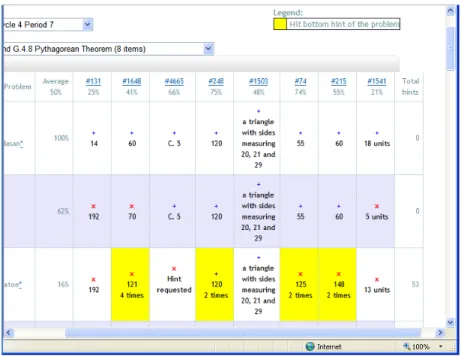
The various reports in the ASSISTment System that are available on students’ work are valuable tools for teachers. Teachers can see how their students are doing on individual problems or on complete assignments (an organized set of problems called a problem sequence). They can also see how their students are performing on each skill. These reports allow teachers to determine where students are having difficulties and they can adapt their instruction to the data found in the reports. For instance, Figure 2 shows an item report which shows teachers how students are doing on individual problems. Teachers can tell at a glance which students are asking for too many bottom-out hints (cells are colored in yellow). Teachers can also see what students have answered for each question, whether the answer was correct, what percent of the class got the answer correct and the percent correct for the whole problem set.
3.4 Problem Sequences
Problems can be arranged in problem sequences in the system. The sequence is composed of one or more sections, with each section containing problems or other sections. This recursive structure allows for a rich hierarchy of different types of sectionsand problems. The section component, is an abstraction for a particular ordering of problems. Currently, section types include “Linear” (problems or sub-sections are presented in linear order), “Random” (problems or sub-sections are presented in a pseudo-random order), and “Choose Condition” (a single problem or sub-section is selected pseudo-randomly from a list, the others are ignored).
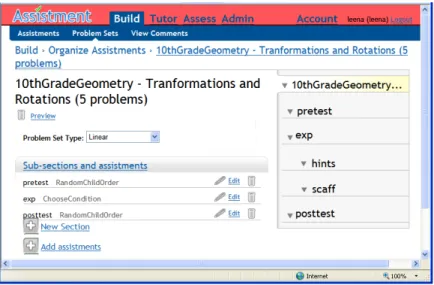
The ASSISTment System can be used to find the best ways to tutor students by running randomized controlled experiments. Figure 3 shows a problem sequence that has been designed to run an experiment that compares two conditions: giving students
Figure 2: An item report tells teachers how students are doing on individual problems.
scaffolding questions or allowing them to ask for hints. Three main sections are presented in linear order, a pre-test, experiment and post-test sections. Within the experiment section there are two sections (one for each condition) and students will randomly be presented with one of them.
Working with the ASSISTment system puts researchers in a unique position to be able to find out what works with intelligent tutoring systems, for whom, and under what circumstances. The ASSISTment project’s collaboration with the Worcester Public Schools in Worcester, Massachusetts makes it possible to test hypotheses with real students in an urban school district. There are many ways to tutor children using educational technology and it is difficult to determine the best tutoring practice without randomized controlled experiments and rigorous analysis of data.
Figure 3: A Problem Sequence that is designed as a randomized controlled experiment
4. Is the ASSISTment System an effective tutor?
This section describes work to create and evaluate ASSISTments. Section 4.1 describes the process of creating ASSISTments. Section 4.2 presents evidence that students are learning in the ASSISTment system. Section 4.3 describes a study to determine whether students can learn more from using the ASSISTment System to do their homework than from doing traditional paper-and-pencil homework. Section 4.4 describes a study to compare traditional paper-and-pencil homework to using the ASSISTment System with immediate feedback but no tutoring or help.
4.1 ASSISTment development and usage
In December of 2003, Neil Heffernan and the author met with the Superintendent of the Worcester Public Schools in Massachusetts, and were subsequently introduced to the three math department heads of three out of the four Worcester middle schools. The goal was to get these educators involved in the design process of the ASSISTment System at an early stage. The main activity done with these teachers was meeting about one hour a week to do “knowledge elicitation” interviews, whereby the teachers helped design the pedagogical content of the ASSISTment System.
The procedure for knowledge elicitation interviews was as follows. A teacher was shown a MCAS test item and asked how she would tutor a student to solve the problem. What kinds of questions would she ask the student? What hints would she give? What kinds of errors did she expect and what would she say when a student made an expected error? These interviews were videotaped. The interviewer took the videotape and filled out an “ASSISTment design form” from the knowledge gleaned from the teacher. The
ASSISTment was then implemented using the design form. The first draft of the ASSISTment was shown to the teacher to get her opinion and she was asked to edit it. Review sessions with the teachers were also videotaped and the design form revised as needed. When the teacher was satisfied, the ASSISTment was released for use by students. For instance, a teacher was shown a MCAS item on which her students did poorly, such as item number 19 from the year 2003, which is shown in Figure 4. About 15 hours of knowledge elicitation interviews were used to help guide the design of approximately 20 ASSISTments. Figure 1 shows an ASSISTment that was built for item 19 of 2003.
As mentioned in Section 3, each ASSISTment typically consists of an original question and a list of scaffolding questions (in the case of 2003’s item 19, 5 scaffolding questions). The first scaffolding question appears only if the student gets the item wrong. After an error, students are not allowed to try the item further, but instead must then answer a sequence of scaffolding questions (or “scaffolds”) presented one at a time. Students work through the scaffolding questions, possibly with hints, until they eventually get the problem correct. If the student presses the hint button while on the first scaffold, the first hint is displayed, which would have been the definition of congruence in this example. If the student clicks the hint button again, the hint describes how to apply congruence to this problem. If the student asks for another hint, the answer is given. Once the student gets the first scaffolding question correct (by choosing AC), the second scaffolding question appears.
Figure 4: Item #19 from the 2003 Massachusetts state math test for 8th grade
Since 2003, the author has created close to 1,000 ASSISTments to provide tutoring for problems taken from state math tests for grades 4 through 10. These ASSISTments can include scaffolding questions, hints, buggy messages, images, animations and tutoring strategies. These ASSISTments are used regularly by students in their regular math classes as well as for homework. Over 3,000 students use the ASSISTment System in central Massachusetts and Pittsburgh, Pennsylvania.
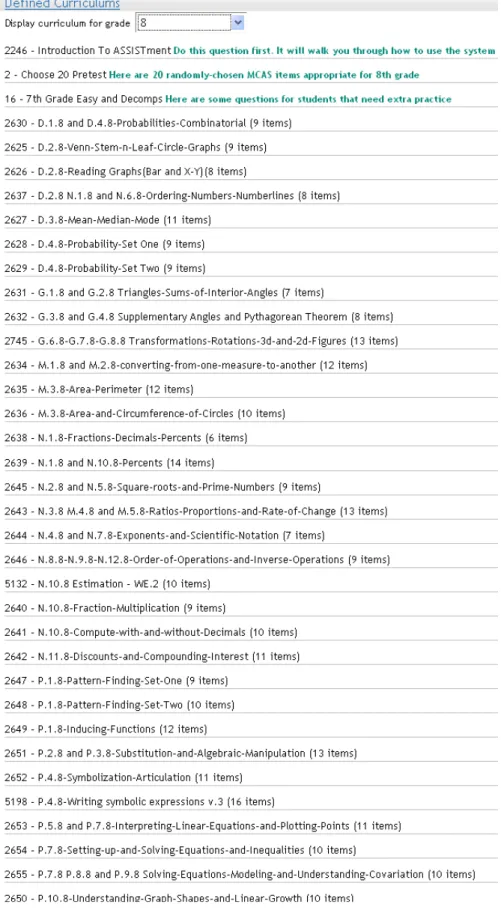
The author has organized thousands of ASSISTments into problem sets based on the skills needed to solve the problems. Teachers can easily browse through the problem sets available and assign materials to students based on what they are doing in class or based on what they would like to assess. For instance, Figure 5 shows the problem sets that were created to target the skills for 8th grade math as outlined by the Massachusetts Frameworks. Similar problem sets were created for 7th grade and 10th grade math based on the Massachusetts Frameworks.
The author has spent hundreds of hours observing the ASSISTment System use in classrooms. This time is used to work with teachers to try to improve content and to work with students to note any misunderstandings they sometimes bring to the content. For instance, if it is noted that several students are making similar errors that were not anticipated, the ASSISTment Builder can be logged into and a buggy message added that addresses the students’ misconception.
Time in classrooms is also spent helping teachers to use their students’ data to inform their instruction. For instance, teachers can determine which skills their students have mastered and which skills need to be reviewed in class from reports in the ASSISTment System. Teachers can also determine which misconceptions students have and which students are not taking their work seriously. For instance, while working with a teacher at Burncoat Middle School, the author was able to show, to the teacher’s surprise, that the majority of her students did not understand Venn Diagrams. She decided to spend more time on Venn Diagrams in class since this was a topic that regularly appeared on the state test every year.
4.2 Are students learning from the ASSISTment system?
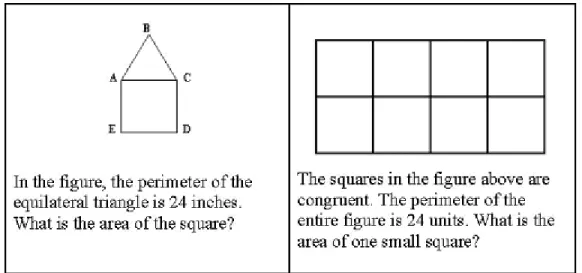
Razzaq et al. (2007) reported evidence that students were learning from using the ASSISTment system in their regular math classes. Students potentially saw 33 different problem pairs in random order. Each pair of ASSISTments included one based on an original MCAS item and a second “morph” intended to have different surface features, such as different numbers, but the same deep features or knowledge requirements, such as approximating square roots or finding the area of a figure given the perimeter (see Figure 6). Learning was assessed by comparing students’ performance the first time they
were given one of a pair with their performance when they were given the second of a pair. If students tend to perform better on the second of the pair, it indicates that they may have learned from the instructional assistance provided by the first of the pair.
Both a student-level analysis and an item-level analysis were done. The hypothesis was that when students worked on pairs of items that required similar skills and got the first item incorrect, they should show learning by getting the second item correct. The pairs of items that were chosen for this analysis had been completed by at least 20 students.
For the student-level analysis there were 742 students who contributed to the analysis by comparing how they did on the first opportunity versus the second opportunity on a similar skill. A gain score per item was calculated for each student by subtracting the student’s score (0 if they got the item wrong on their first attempt, and 1 if they got it correct) on their first opportunity from their score on the second opportunity. Then an average gain score for all of the sets of similar skills in which they participated was calculated. A student analysis was done on learning opportunity pairs seen on the same day by a student, and the t-test showed statistically significant learning (p = 0.0244). It should be noted that there may be a selection effect in this experiment in that better students are more likely to do more problems in a day and therefore are more likely to contribute to this analysis.
Figure 6: A perimeter and area learning opportunity pair
An item analysis was also done. There were 33 different sets of skills that met the criteria for this analysis. The five sets of skills that involved the most students were: Approximating Square Roots (6.8% gain), Pythagorean Theorem (3.03% gain), Supplementary Angles and Traversals of Parallel Lines (1.5% gain), Perimeter and Area (4.3% gain) and Probability (3.5% gain). A t-test was done and showed that the average gain scores per item were significantly different than zero (p = 0.04).
4.3 ASSISTments with tutoring/help vs. paper-and-pencil homework
Web-based systems that allow students to do their homework online such as Blackboard(www.blackboard.com), WebCT (www.webct.com), Homework Service
(hw.utexas.edu/bur/overview.html) and WeBWorK (webwork.rochester.edu) are becoming more widely used. At the K-12 level, systems such as Study Island (studyisland.com) and PowerSchool (powerschool.com) are gaining popularity among teachers. Some states, such as Maine, Indiana, Michigan and Virginia, have begun to implement one-to-one computing programs, where each child gets his/her own laptop to
use during school and occasionally to take home as well (Bonifaz & Zucker, 2004). In fact, the Maine Learning Technology Initiative (2002-2004) supplied every Maine seventh and eighth grade student and their teachers with laptop computers, with 40% of the middle schools allowing students to take their laptops home. There are few research studies on the effects of one-to-one computing on teaching and learning; however, teachers report that students in one-to-one computing programs were more engaged, motivated and interact better with teachers (Bebell, 2005; Silvernail & Lane, 2004). As the digital divide narrows and more states become committed to one-to-one computing, the opportunities for students to do their homework online increase. The important question is, do students learn more by using computers to do their homework than by doing traditional paper-and-pencil homework?
Advantages of homework assistance systems are immediate feedback to students and automatic grading for instructors. Automatic grading is helpful by a) saving time for teachers who do not have time to grade all of their students’ paper-and-pencil homework carefully by hand and b) by prompting students to take homework more seriously because they know it will be graded and the grade recorded. With these systems, students can get immediate feedback on their answers to problems and sometimes hints.
Although there are benefits to using these web-based homework assistance systems, there can be disadvantages, too. One disadvantage is that many of these systems require students to enter a single answer for each problem and do not take how the student arrived at the answer into consideration. Students may do less work on paper which can help them to be more organized and try to do more math in their heads instead. Teachers may spend less time looking at student work and figuring out exactly where
they are having difficulties. Because these systems often do not consider student work, cheating may be easier among students.
Research has shown positive results for using intelligent tutors instead of traditional paper and pencil homework. “MasteringPhysics” is a web-based physics homework tutor developed at MIT that uses mastery learning to help students reach mastery when solving physics homework problems. Students can request hints on problems and can receive feedback on common student errors. Some hints will ask a question which behaves similar to “scaffolding questions” in the ASSISTment system. Warnakulasooriya & Pritchard (2005) found that twice as many students were able to complete a set of problems in a given time with the help provided by MasteringPhysics when compared to students who worked on the problems without help (administered by MasteringPhysics but without hints or feedback).
Quantum Tutors (www.quantumsimulations.com/) is a web-based system that is commercially available for students to do homework in the sciences and math. Students can choose topics to work on, enter their own problems and choose from a list of questions they may have on particular problems. For instance, students working on percents can choose “I need to find the percentage one number is of another” and solve problems provided by the system or enter their own values to solve. They can also choose from a list of questions such as “Why would I want to convert a percent to a fraction?” In a press release, Quantum Tutors describes a week-long study done in 2005 (www.quantumsimulations.com/news15.html), where students using Quantum Tutors for homework in a high school chemistry course outperformed a control group that did paper-and-pencil homework on a post-test by just over a full letter grade. The difference between groups became larger as the problems increased in difficulty.
The Andes system is an intelligent tutoring system that can be used on the internet to provide support for problem-solving for physics homework. Andes requires students to complete whole derivations step-by-step and offers feedback after each step. Students can also ask for hints on each step to find out the nature of their error (What’s Wrong Help) or to get help on what the next step is (Next Step Help). Andes was used and evaluated in introductory physics classes from 1999 – 2003 at the U.S. Naval Academy. VanLehn et al. (2005) presented evidence that students who used Andes for homework got significantly higher exam scores than students in control groups who did pencil and paper homework. The Andes studies seem to be the most closely related to the following comparison of ASSISTments and paper-and-pencil homework (Mendicino, Razzaq, & Heffernan, 2009) which attempts to replicate Andes’ positive results.
4.3.1 Participants
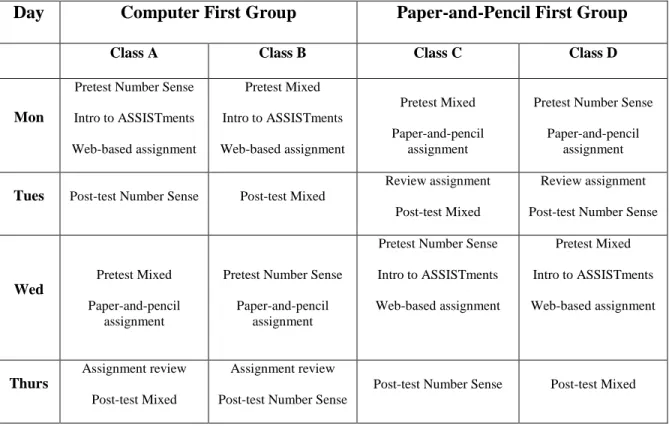
The setting for this study was four fifth grade classrooms and students’ home computers. The school was located in a small town in a rural county. Approximately 350 students were enrolled in the school at the time of the study with at least 50% receiving free or reduced lunch. All four classes were typical elementary classes with a mix of below average, average, and above average students. There were a total of 92 students, 54 with internet access at home. The breakdown of the participants is shown in Table 3.
Table 3: Participants
Class A Class B Class C Class D Total
Male students 13 12 9 12 46
Female students 10 13 13 10 46
Students with internet at home
4.3.2 Content
Two problem sets were used in both the web-based homework and the paper-and-pencil homework assignments each consisting of ten problems. One problem set consisted of number sense problems and the other was a mix of problems. The Number Sense problem set included problems for which students had to demonstrate understanding of numbers, ways of representing numbers, and relationships among numbers and number systems. The Mixed problem set included problems in the algebra, geometry, data analysis and probability domains.Students had to demonstrate understanding of patterns, relations, and functions, describe spatial relationships using coordinate geometry and other representational systems, develop and evaluate inferences and predictions that are based on models, and apply and demonstrate an understanding of basic concepts of probability (see Appendix A for the problems in both homework sets). Students in the classes had prior learning experience with the homework material during the course of the school year. However, since the experiment took place at the end of the school year, it was not recent experience and more of a review.
The worksheets that students completed for paper-and-pencil homework assignments were identical to the web-based homework assignment problems, with the same formats (i.e., multiple choice or short answer). This was possible because each class did the Number Sense or Mixed problem set for computer homework and the opposite problem set for paper-and-pencil homework. This will be explained in detail in the Experimental Design section below. The pre-test and post-test items were “morphs” of the Number Sense and Mixed problem sets and were designed to have different surface features such as names and numbers while keeping the same deep features or knowledge requirements such as analyzing patterns. Finally, the same hints used in the problem sets