Influence Quality Auditor's Report on Audit Fees
,Shaban Mohammadi1 Mahmoud Lari Dashtbayaz21.Department of Accounting, Hakim Nezami University, Quchan, Iran
2. Assistant Professor in Accounting, Qaenat Branch, Islamic Azad University, Qaen, Iran
Abstract
Various factors may affect the audit fee. some of these factors can be attributed to the quality of the audit report. the main question is whether the relationship between the quality of audit reports and audit fees there? For this purpose, data from this study of 100 firms of the Tehran Stock exchange, in the period 2002 to 2010 were collected. statistical methods used to test the hypotheses, multivariate regression is. 4 hypothesis of this study is that the relationship between earnings management, conditional clauses in the audit report, the auditor and the board with the audit fee, are explored. the results show that the four factors mentioned significant correlation with the audit fees.
Keywords: Audit fees, profit management, auditor, the clauses provided in the audit report.
Introduction
Pricing audit services is one of the favorite subjects of many researchers audit. according to the managers' incentives to manipulate earnings in a challenging relationship between earnings management and audit fees there. In competitive markets, the level of audit fees, audit and legal risk is largely reflect efforts. thus, a challenge to study the relationship between audit and management fee income due to the tendency of managers to there are overstated profits. profit incentives may be given to the management, manipulation occurs. contract management bonuses based on performance measures (including earnings), which may lead to opportunistic earnings management activities by the directors. Since contracts reward managers, mostly based on accounting numbers are reported, they may have to increase its prestige and rewards affect reported earnings. reward managers who have contracts are based on profit, tend to increase profit methods in order to maximize their own revenues. furthermore, managers sometimes use earnings management to increase the value of the company (Latridisand & Kadorinis, 2009). On the other hand, one of the regulatory standards of corporate governance, the board members are outside. From the perspective of agency theory, the presence of outside directors independent of the composition and function of corporate executives monitoring them as independent people, to reduce conflicts of interest between shareholders and managers will help. non-bound managers with professional and impartial approach to the management decision to sit as judges. thus, the board of directors of the company with the expertise, independence and legal powers necessary, a potential mechanism the company is considered capable of outside directors on the board is higher, it is more independence. independent board of directors, in order to protect their financial investment, to avoid legal liability, and protect the interests of shareholders, high-quality audit services are purchased. therefore, the Board of directors, in order to protect their interests and other stakeholders are seeking higher quality auditing (Leventis & Dimitropoulos, 2010). in less developed countries, audit fees based on the activity and specificity of the audit, the auditors determined and determinants of audit fees in most of these countries, the size of the company, complexity and volume of operations and the company's auditor to audit the financial statements have been reviewed. the independent auditors are faced with increasing pressure to control the decrease in audit fees. this has caused the auditor and the client to facilitate investigations relationship between audit fees and pay, factors affecting audit fees are divided into two groups. the first group and second group auditing firm characteristics, the characteristics of the client or firm that provides audit firm invited (Griffin et al., 2009). audit fees increased to compensate for the additional risk that the agency problems caused by free cash flow. (Myers, & Majluf, 1984), which is addressed in this study.
2. The theoretical basis and review of literature
The composition of the board of directors as a means of control in the company, the board of directors is crucial. the composition of the Board of directors, an important factor in explaining the ability of members to perform and help the performance of company. much of the literature on the impact of corporate governance and board composition or performance of the company. Non-assigned by the Board of directors measured. outside member of the board members in the company, not the executive. outside board members, and thus help to control executive actions will reduce agency costs. Independent board of directors in order to protect reputation capital, to avoid legal liability, and protect the interests of shareholders, high-quality audit services are purchased. as a result, high-quality board, looking for a higher quality audit (audit effort increased) in order to protect its interests and shareholders are (Leventis & Dimitropoulos, 2010). Since contracts reward managers, mostly based on accounting numbers are reported, they may have to increase its prestige and rewards affect reported earnings. Reward managers who have contracts are based on profit, tend to increase profit methods in order to maximize
their own revenues (Latridis &Kadorinis, 2009). Scott (2003) earnings management as a conscious action performed by management on how to report income, to achieve specific objectives in a way that is consistent with the accounting principles, defined. Auditors in order to maintain the credibility of the profession, its professional reputation and avoid litigation against auditors are looking for quality. The incentives for managers to impose their own interests in earnings quality, from reaching their goals are auditors. In contrast, auditors can increase the quality of auditing, management discovered the profits made by executives and managers to put profits in their management. state audit office in an auditing firm to audit professional services. the In comparison to other auditing institutions of higher volume clients. In addition, due to the state structure and natural selection, the organization of work and the acceptance of professional fees of border security is which has a special place in the competition with other non-governmental organizations to allocate. It is envisaged that the organization, as well as the four major accounting firm in the world that has a morphological comparison with other competitors in the international arena in professional service fees, audit services market in comparison to other competitors receive additional remuneration big difference in the effectiveness of audit firm to audit firm managers and auditors in reporting small conflict between motivation comes. When managers enough incentive to increase profits through the use of accounting methods to increase their profits, to maintain neutrality between the directors and auditors of the auditors on the result. Audit institutions in the prevention of the earnings of small business more effective (given the conflict between audit and management) are. comments on pricing audit and audit services is effective. Reports on the subject, need to collect a lot of evidence to achieve a desired level of confidence in the audit. In addition, the circumstances leading to adjustments in their audit reports may signal the need to increase the desired level of confidence that this is due to the increased risk of a reaction against the auditor (Palmrose, 1986). audit fees, reflect the economic costs of auditors is effective. according to the auditor, auditors seek to minimize the costs by aligning its resources cost (the cost of the audit work more) and further losses are due to legal liabilities. More audit effort, are likely to reduce debt losses suffered auditors and auditor the volume of audit work to minimize the total cost of the offer, will (Carcello et al., 2002). Machine (2011) the relationship between audit fees and non-discretionary accruals for 8187 the company between 2000 and 2006 examined. the results showed that non-discretionary accruals and audit fees and there is a significant positive relationship. the audit fee is negatively correlated with profitability. companies in weak financial condition (loss) expect to pay higher audit fees, this leads to increased risk of these companies and reduced profitability. audit services, the company's earnings quality and independence of the board of directors to 97, between 2000 and 2004 were examined. the results show that the positive relationship between auditor independence and audit services pricing there. the positive relationship between pricing and management accounting profit that is the result of very small companies. Griffin et al (2007) study of corporate governance and audit fees paid in US companies between 2000 and 2005. the results show that there is a better system of corporate governance in the company's cost accounting to reduce bulk. they believe that the relationship of this to the establishment of better corporate governance leads to better quality of financial statements and internal controls stronger this enables auditors and audit price risk and therefore reduce audit fees.
3. Research hypotheses
First hypothesis: profit management Is significantly associated with audit fees.
second hypothesis: the number of audit reports and audit fees paragraphs if there is a significant relationship. Third hypothesis: the auditor with the audit fee is a significant relationship.
fourth hypothesis: the Board has a significant relationship with audit fees.
4. Method research
Since this study is to investigate the relationship between independent variables earnings management, board of directors, type of audit and audit fees and the dependent variable is the number of paragraphs of the audit report, Methods for the study of the correlation. to examine the relationship between these variables, multiple linear regression model was used. In this study, sampling so that all member companies of Tehran Stock Exchange for companies that meet the following conditions, they have chosen. 1) Before 1382, the company is accepted. 2) the Company during the financial year does not change. 3) data about the company is available. 4) The company is the only member companies Tehran Stock Exchange.
5. Model study and its variables
Regression model used in this research is as follows:
Earnings management, the Board, the auditor and the audit report of the independent variables are qualification paragraphs.
6. Research results
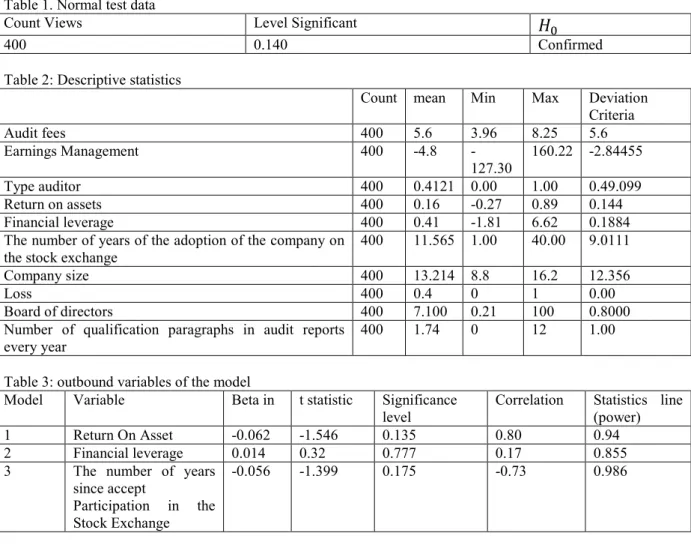
Table 1. Normal test data
Count Views Level Significant
400 0.140 Confirmed
Table 2: Descriptive statistics
Count mean Min Max Deviation Criteria Audit fees 400 5.6 3.96 8.25 5.6 Earnings Management 400 -4.8 -127.30 160.22 -2.84455 Type auditor 400 0.4121 0.00 1.00 0.49.099 Return on assets 400 0.16 -0.27 0.89 0.144 Financial leverage 400 0.41 -1.81 6.62 0.1884
The number of years of the adoption of the company on the stock exchange
400 11.565 1.00 40.00 9.0111
Company size 400 13.214 8.8 16.2 12.356
Loss 400 0.4 0 1 0.00
Board of directors 400 7.100 0.21 100 0.8000
Number of qualification paragraphs in audit reports every year
400 1.74 0 12 1.00
Table 3: outbound variables of the model
Model Variable Beta in t statistic Significance level
Correlation Statistics line (power)
1 Return On Asset -0.062 -1.546 0.135 0.80 0.94
2 Financial leverage 0.014 0.32 0.777 0.17 0.855
3 The number of years since accept
Participation in the Stock Exchange
-0.056 -1.399 0.175 -0.73 0.986
(A) Predictors: (constant variable), earnings management. (B) Predictors: (constant variable), earnings management, the auditor. (C) Predictors: (constant variable), earnings management, the auditor, the firm size. (D) Predictors: (constant variable), earnings management, the auditors, the company's board of directors. (E) Predictors: (constant variable), earnings management, the auditors, the company's board of directors, losses. (F) Predictors: (constant variable), earnings management, the auditors, the company's board of directors, losses, number of qualification paragraphs in audit reports every year .(G) the dependent variable: audit fees. The correlation coefficient must be said that this factor indicates the presence or absence of the relationship and the relationship between independent and dependent variables. Since it is a positive sign (the slope of the regression line), thus the variables and the dependent variable in the model was a positive and significant relationship exists. but the most important purpose of this table, provide a test for goodness of fit is measured. the work done by the coefficient of determination. Coefficient of determination, a benchmark for measuring the intensity of the relationship between x, y is the value specified in Table 4.Serial correlation between the mean residual effects on each other's views. according to a Watson statistic (1.952), the correlation between the data row does not exist. Regression analysis was performed to assess the appropriateness of the statistical analysis used Fisher. as Table 5 shows, a significant level of error of less than 0.05 is acceptable. Therefore, the regression model, the relationship between variables is significant and predictable. After the initial investigation and accepted the significance of the F model using statistical t-test to evaluate the significance calculated studied. table significance of regression coefficients mentioned, and hopes are as follows.
Table (4): Test Watson
Model Correlation coefficient of determination adjusted coefficient of determination estimated standard deviation Watson statistic 1 0.4460 0.199 0.197 0.597 2 0.549 0.301 0.299 0.559 3 0.615 0.368 0.359 0.542 4 0.648 0.425 0.420 0.512 5 0.668 0.451 445 0.504 6 0.688 0.459 0.452 0.495 1.952
Table (5): Test Befit Model
Model Total squares Degree of freedom Mean square Significance level F statistic
Regression 77.75 6 12.895 53.354 0.000
remaining posts 91.451 371 0.245
Total 167.294 377
Table (6): Table t-statistic values and the independent variables and audit fees
Regression Factor Variables Standard Deviation Beta t Statistics Level Significant VIF Fixed variable 3.477 0.305 11.44 0.000 Earnings Management 0.013 0.002 0.224 5.061 0.000 1.033 Type auditor 0.413 0.054 0.294 7.775 0.000 1.033 Company size 0.138 0.025 0.242 5.721 0.000 1.324
The composition of the Board of Directors
0.443 0.116 0.159 3.912 0.000 1.193
Loss -0.419 0.096
-0.181
-4.440 0.000 1.178 Number of qualification paragraphs
in audit reports every year
0.460 0.012 0.143 3.498 0.000 1.145
Table 7: Summary of statistical hypothesis test Consequently, Test Durbin-Watson P-VALUE Confirmed 1.952 0.000 0.460 0.043 -0.419 0.443 0.138 0.413 0.013 3.477 Conclusion
As the table (7) See, so we can say that there is a positive relationship between earnings management and audit fees are approved. It can be said that there is a positive relationship between the auditor and audit fees are approved. Positive relationship between the Board and audit fees, and assuming it is approved. At the end of each year the number of the clauses provided in audit reports and related audit fees Is approved. The results showed a significant positive correlation between earnings management and audit fees there.
References
Alali, F. (2011). "Audit fees and discretionary accruals: Compensation structure effect", Managerial Auditing Journal, Vol 26, No 2, pp. 90-113.
Carcello, J., D. Hermanson, T. Neal and R. Riley (2002). "Board characteristics and audit fees", Contemporary Accounting Research, Vol. 19, pp. 365-385.
Francis, J. R. LaFand, P. M. Olsson, and K. Schipper (2002). "The Market Pricing of Earnings Quality", Working Paper, Duke University, available on www.ssrn.com. Griffin, P. A.,
D. H. Lont, and Y. Sun (2007). "Corporate governance and audit fees: evidence of countervailing relations", Working Paper, Available on www.ssrn.com.
Griffin, A., and H. Lont & Yuan sun,2009 " Agency Problems and Audit fees: Further Tests of the Free Cash Flow Hypothesis", Journal of Finance Vol 1,pp: 1-35
Karim, W. A. ( 2010). "Audit Pricing, Audit Concentration and BiG4 Premium in Bangladesh", Working Paper, Saint Marys College of California, Available on www.ssrn.com.
Leventis S. and P. E. Dimitropoulos ( 2010). "Audit Pricing, quality of earning and board independence: The Cose of the Athens stock exchange", International Journal of Cardiology 26, pp. 325-332.
Latridis, G. and G. Kadorinis (2009). "Earnings management and firm financial motives: A financial investigation of UK lited firms", International Review of Financial Analysis, Vol 18, pp. 164-173. Myers, S., and N. Majluf, 1984, "Corporate financing and investment decisions when firms have information
that Investors do not have", Journal of Financial Economics 13,187-221.
Palmrose, Z. (1986). "Audit fees and auditor size: further evidence", Journal of Accounting Research, Vol. 24, pp. 97-110.
Ramdani, D. and A. V. Witteloostuijn (2010). "The Impact of Board Independence and CEO Duality on Firm Performance: A Quantile Regression Analysis for Indonesia, Malaysia, South Korea and Thailand", British Journal of Management, Vol. 21, pp. 607-626.