Enhancing Traditional Databases to
Support Broader Data Management
Applications
Yi Chen
Computer Science & Engineering
Arizona State University
What Is a Database System?
Of course, there are traditional relational
database management systems (RDBMS)
Was introduced in 1970 by Dr. E. F. Codd (of
IBM)
Commercial relational databases began to
appear in the 1980s
3
A Relational Database (RDBMS)
Row
(Tuple, Record)
Column (Attribute)
Table (Relation)
Name Skill
age
James Beginner
21
Bob Experienced
33
Climber
Name Route
Date
Duration
Bob
Last Tango 10/10/05 5
Bob
Last Tango 1/10/06
4.5
Climbs
A predefined data structure (schema) is required.
projection:
∏
Route = “Last
Tango”
selection:
σ
Name = “James”
Querying RDBMS: SQL
Name Skill
age
James Beginner
21
Bob Experienced
33
Climber
Name Route
Date
Duration
Bob
Last Tango 10/10/05 5
Bob
Last Tango 1/10/06
4.5
Climbs
Climber.name = climbs.name
Climbs
join:
Climber
Name
Skill
Age Route
Date
Duration
5
The Advantages of RDBMS
Good data organization
High efficiency for large datasets via indexing
and query optimization
But, 80% of the World’s Data is Not
in RDBMS!
Examples:
WWW, Emails
Personal data, documents of various format
Sensor data
A lot of scientific data (experimental data, large images,
documentation, etc)
¾
Why not?
¾
There are several assumptions in relational databases that
do not fit for handling this data.
7
Challenges for RDBMS (I)
RDBMS Assumption
: data conforms to a predefined
fixed schema, which is separated from the data itself
Reality:
Data may be collected from different sources on the
web, therefore has different schemas
Schema can change over time for a single source
Requirements:
We need to handle data of different
schemas and have the schemas tightly associated with
the data
XML as a Data Representation Format
XML has become a standard data format for
various applications, because of:
Flexibility in schemas -- semi-structured data
Self - describing feature
9
Yi Chen --- January 23, 2006
XML: the Standard for Web Data
Representation
PubMed
GenBank
BLAST
Internet
Web Service Requester
NCBI Web Service Publisher
...
XML Data
XML: Representing Phylogenetic Trees
From the Tree of the Life Website,
University of Arizona
11
Challenges for RDBMS (II)
RDBMS Assumption:
Data is clean and consistent.
Reality: real world data is dirty
Data collected from different sources may have
missing and conflicting information
Data that is obtained from data mining is often not
error-prone
Experimental data often contains random errors
Requirements:
we need to measure data quality and
Roadmap of This Talk
Managing XML by leveraging mature RDBMS
[Chen et al 04]
Introduction to XML
A generic and efficient XML-to-RDBMS mapping
)
Data mapping from trees to tables
)
Query translation from tree navigation queries
to SQL queries that are efficient
Handling imprecise and incomplete data in
13
Sample XML Data
<books>
<book>
<title>
The lord of the rings...
</title>
<section>
<title>
Locating middle-earth
</title> ...
</section> …
</book>
</books>
books
book
title
section
title
section
title
figure
description
“The lord
of the
rings …”
“Locating
middle-earth”
“A hall
fit for a
king”
“King Theoden's
golden hall”
...
...
...
...
Sample XML Queries
XML query languages are
based on hierarchical
structure navigation (e.g.
XPath)
Sample queries:
What are all the section
titles:
//section/title
books
book
title
section
title
section
title
figure
description
“The lord
of the
rings …”
“Locating
middle-earth”
“King Theoden's
golden hall”
...
...
“A hall
fit for a
king”
15
...
Sample XML Queries
XML query languages are
based on hierarchical
structure navigation (e.g.
XPath)
Sample queries:
What are all the section
titles:
//section/title
What are the titles of
sections that contain a
figure:
//section[/figure]/title
books
book
title
section
title
section
title
figure
description
“The lord
of the
rings …”
“Locating
middle-earth”
“King Theoden's
golden hall”
...
...
“A hall
fit for a
king”
Predicates
How to Query XML Data efficiently?
RDBMS have achieved high performance in
query evaluation.
Can we leverage RDBMS by encoding XML to
17
Analogy: Fourier Transforms
g * h =
∫∫
-
∞
g(u)h(u)du
G(f)H(f)
Complex
+
∞
Mapping XML Data to RDBMS
XPath
XML data
SQL
Query Translation
XML
fragments
Relational databases
Storage
Mapping
Challenge:
How to build the bridge
between hierarchies and
tables?
19
Data Mapping
ID
Tag
Value
Structural
Information
1
books
2
book
3
title
The...
4
section
5
title
Locating…
… …
…
…
T
(5)
books
book
title
section
title
section
title
figure
description
“Locating
middle-earth”
“A hall
fit for a
king”
“King Theoden's
golden hall”
(4)
(3)
(2)
(1)
“The lord of
the rings …”
Parent ID
Data Mapping
ID
Tag
Value
Structural
Information
1
books
2
book
3
title
The...
4
section
5
title
Locating…
… …
…
…
T
(5)
books
book
title
section
title
section
title
figure
description
“Locating
middle-earth”
“A hall
fit for a
king”
“King Theoden's
golden hall”
(4)
(3)
(2)
(1)
“The lord of
the rings …”
.
Design special labels
to encode node
21
Query Translator Architecture
How to choose XPath subqueries, such that:
they can be easily translated to SQL subqueries
the SQL subqueries can be efficiently evaluated
How to combine SQL subqueries to a complete one?
XPath
decomposition
XPath
Sub-query
translation
SQL sub-query
composition
Query Translator
Query Translator
Q: //book[//figure]/section/title
section
book
figure
title
23
Query Translator: (I) Decomposition to
Suffix Paths
Q: //book[//figure]/section/title
book
figure
section
title
book
(342000,343000)
σ
342000
≤
Plabel
≤
343000
T
Encoding Suffix Paths Using P-labeling
//book/section/title
books
book
title
section
title
section
title
figure
description
“The lord
of the
rings …”
“Locating
middle-earth”
“A hall
fit for a
king”
“King Theoden's
golden hall”
(1)
(2)
(3)
(4)
...
...
...
(100)
id
Plabel
1
100000
2
210000
3
321000
4
421000
5
342100
…
…
T
(5)
books
book
title
section
title
section
title
figure
description
“The lord
of the
rings …”
“Locating
middle-earth”
“A hall
fit for a
king”
“King Theoden's
golden hall”
(1)
(2)
(3)
(4)
...
...
...
(100)
Evaluating suffix paths
SQL selections on P-labels
25
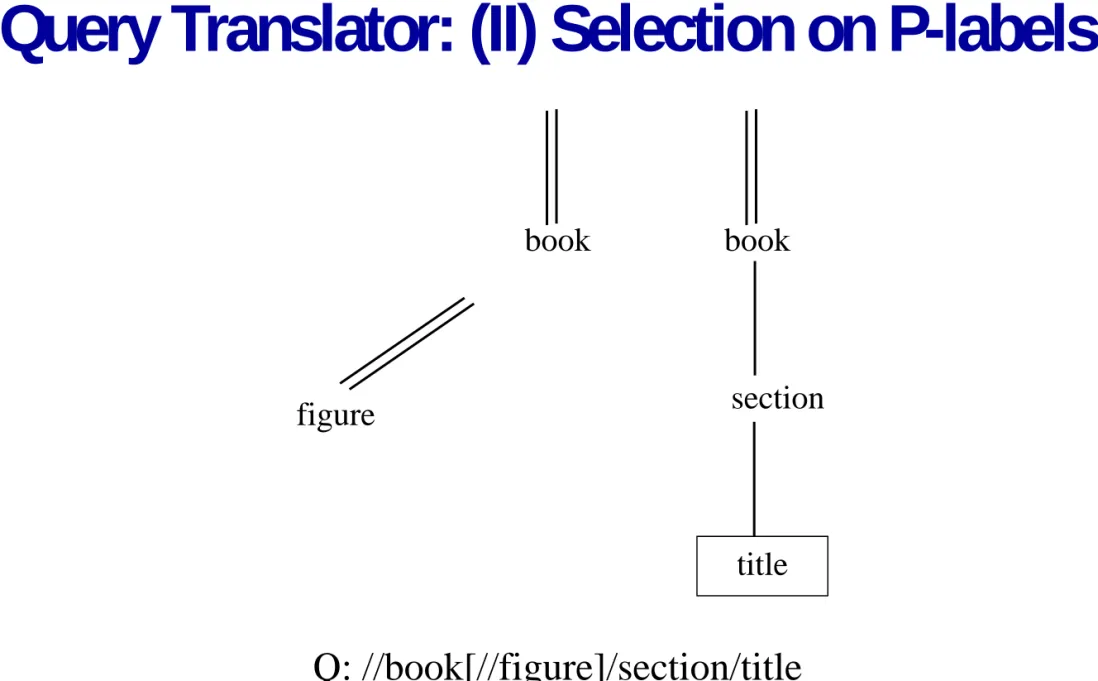
Query Translator: (II) Selection on P-labels
Q: //book[//figure]/section/title
book
figure
section
title
D-labeling Scheme
books
book
title
section
title
section
title
figure
description
“The lord
of the
rings …”
“Locating
middle-earth”
“A hall
fit for a
king”
“King Theoden's
golden hall”
(1, 20000, 1)
(6, 1200, 2)
(10,80,3)
(81, 250,3)
...
...
...
(100, 200,4)
• D-labeling is used to connect
suffix paths.
•
D-labels
(start, end, depth)
can be used to detect
ancestor-descendant
relationships between nodes
in a tree.
27
A Bi-labeling Based Query Translation
//book//figure
books
book
title
section
title
section
title
Figure (120, 160, 5)
description
“The lord
of the
rings …”
“Locating
middle-earth”
“A hall
fit for a
king”
“King Theoden's
golden hall”
(1, 20000, 1)
(6, 1200, 2)
(10,80,3)
(81, 250,3)
...
...
...
(100, 200,4)
(
σ
Plabel for “//book”
(
ρ
T
→
T’
))
T’.Start
≤
T.Start
∧
T’.End
≥
T.End
(
σ
Plabel for “//figure”
T )
Plabel Start End Depth Val
100000 1 20000 1 …
210000 6 1200
2 …
321000 10 80 3
…
421000 81 250 3
…
442100 100 200 4
…
554680 120 160 5
…
… …
…
…
…
T
Stitching suffix paths
SQL joins on D-labels
Query Translator: (III) Join on D-labels
Q: //book[//figure]/section/title
book
figure
section
title
book
29
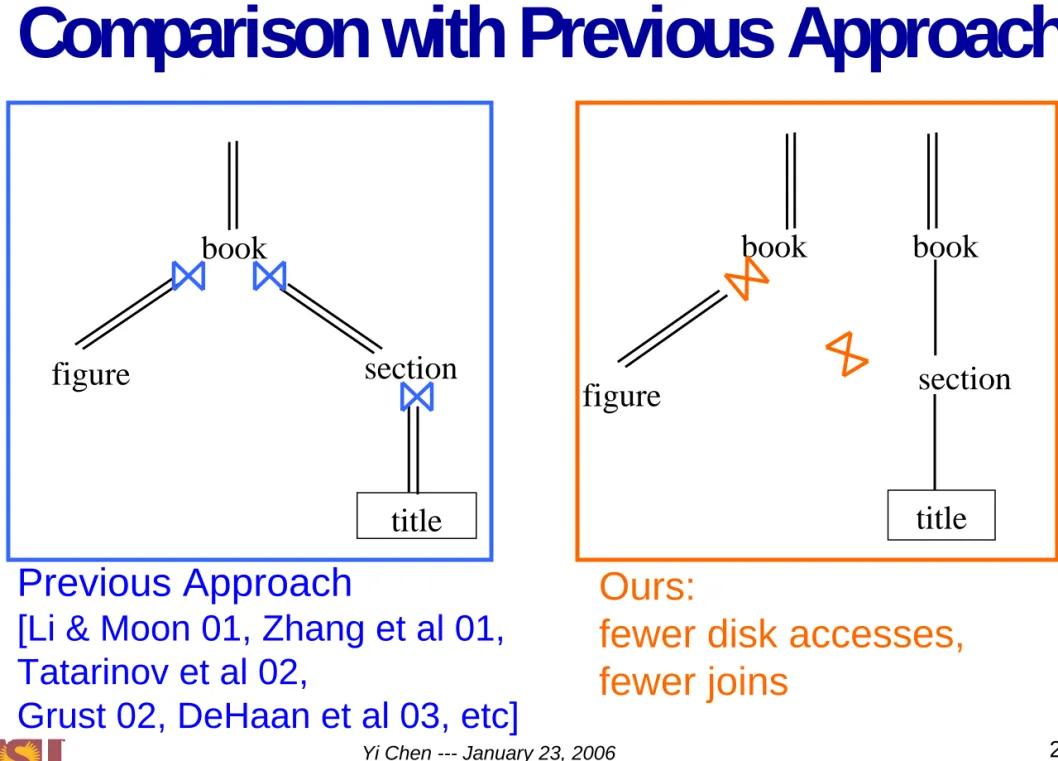
Comparison with Previous Approach
book
figure
section
title
book
Ours:
fewer disk accesses,
fewer joins
book
figure
section
title
Previous Approach
[Li & Moon 01, Zhang et al 01,
Tatarinov et al 02,
Compare our system (BLAS) with the previous
approach using D-labeling scheme only
Data sets
Query sets
)
Suffix path queries
)Path queries
)
XPath queries
)
Benchmark queries
Query Engines: DB2, TwigStack Join
[Bruno et al 02]
Experiment Setup
Data Set
Size(MB) Nodes(K) Tags Depth DTD
Protein 70 2277 66
7 Tree
Shakespeare 26
640
19
7
Acyclic
graph
31
Query Execution Time
Query Name:
A:Auction
P: Protein
S: Shakespeare
1: suffix path query
2: path query
3: XPath query
0%
10%
20%
30%
40%
50%
60%
70%
80%
90%
100%
QA1 QA2 QA3 QP1 QP2 QP3 QS1 QS2 QS3
Queries
Ti
m
e
0
2
4
6
8
10
12
14
35
70
105
139
174
File Size (MB)
Ti
m
e
(
s
e
c
onds
)
DLabeling
BLAS
Benchmark data, Benchmark query Q3
33
Summary of XML Data Management
We proposed a generic XML-to-RDB mapping,
based on a bi-labeling scheme.
It is more efficient compared with previous
approach, since it generates SQL queries that
require:
fewer disk accesses
fewer joins
fewer intermediate results
Roadmap of This Talk
Managing XML by leveraging mature RDBMS
[Chen et al 04]
Introduction to XML
A generic and efficient XML-to-RDBMS mapping
)
Data mapping from trees to tables
)
Query translation from tree navigation queries
to SQL queries that are efficient
Handling imprecise and incomplete data in
35
Probabilistic Databases:
Managing Imprecise Data
How to measure the imprecision of the data?
The simplest model: associate each tuple a
probability
Name Skill
age
Pr
James Beginner
21
p1
Bob Experienced
33
p2
Climber
Name Route
Date
Duration
Pr
Bob
Last Tango 10/10/05 5
q1
Bob
Last Tango 1/10/06
4.5
q2
Climbs
How Does This Affect Query
Evaluation?
[Fuhr&Roellke 97]
σ
v p
v p
v
1p
1v
1v
2p
1p
2v
2p
2Π
v
p
1v
p
2v
1-(1-p
1)(1-p
2)
37
Yi Chen --- January 23, 2006LT
1-(1-p2q1)(1- p2q2)
Π
LT 1-(1-q
1)(1-q
2)
Bob LT
p2(1-(1-q
1)(1-q
2))
Wrong !
Correct
Challenges: Correctness Depends on
Execution Order
[Suciu et al 05]
!
Name Skill
Pr
Bob Exp
p2
Name Route
Pr
Bob LT
q1
Bob LT
q2
Find distinct climb routes that have been climbed by an
experienced climber.
Name Route
Pr
Bob LT
q1
Bob LT
q2
Π
Name Skill
Pr
Bob
Exp p2
Bob
LT p2q1
Bob
LT p2q2
This can not be
convertible !
How to Handle Incomplete Data?
Seller Make Model
Body
Style Year Price
Mark BMW 325Cic
convertible
2006 36000
Alice Ford Taurus
2001 8000
Our techniques infer possible values with
probability by mining data statistics
39
Querying Incomplete Databases
Given missing value prediction
Querying incomplete databases
Querying probabilistic databases
What if we are not able to store the predicted
values? --- e.g. data integration applications
On-the-fly query rewriting
How should we handling imprecise and
incomplete XML Data?
Conclusions
Traditional RDBMS does not satisfy the requirements
in ever growing scientific and web applications
We have discussed two enhancement to RDBMS
Efficient XML data management
Handling imprecise and incomplete data