Studying and Detecting Log-related Issues
Mehran Hassani A Thesis in The Department ofComputer Science and Software Engineering
Presented in Partial Fulfillment of the Requirements For the Degree of (Computer Science) at
Concordia University Montréal, Québec, Canada
6 March 2018 c
Concordia University
School of Graduate Studies
This is to certify that the thesis prepared
By: Mehran Hassani
Entitled: Studying and Detecting Log-related Issues
and submitted in partial fulfillment of the requirements for the degree of
(Computer Science)
complies with the regulations of this University and meets the accepted standards with respect to originality and quality.
Signed by the final examining commitee:
Chair Dr. C. Poullis Examiner Dr. T.-H. Chen Examiner Dr. Y.-G. Gueheneuc Supervisor Dr. Weiyi Shang Co-supervisor Dr. Nikolaos Tsantalis Approved by
Dr Volker Haarslev, Graduate Program Director
15 March 2018
Dr Amir Asif, Dean
Abstract
Studying and Detecting Log-related Issues
Mehran Hassani
Logs capture valuable information throughout the execution of software systems. The rich knowl-edge conveyed in logs is leveraged by researchers and practitioners in performing various tasks, both in software development and its operation. Log-related issues, such as missing or having outdated information, may have a large impact on the users who depend on these logs. In this paper, we first perform an empirical study on log-related issues in two large-scale, open-source software systems. We found that the files with log-related issues have undergone statistically significantly more fre-quent prior changes, and bug fixes. We also found that developers fixing these log-related issues are often not the ones who introduced the logging statement nor the owner of the method containing the logging statement. Maintaining logs is more challenging without experts. Finally, we found that most of the defective logging statements remain unreported for a long period (median 320 days). Once reported, the issues are fixed quickly (median five days). Our empirical findings suggest the need for automated tools that can detect log-related issues promptly. We conducted a manual study and identified seven root-causes of the log-related issues. Based on these root causes, we developed an automated tool that detects four types of log-related issues. Our tool can detect 78 existing inap-propriate logging statements reported in 40 log-related issues. We also reported new issues found by our tool to developers and 38 previously unknown issues in the latest release of the subject systems were accepted by developers.
Acknowledgments
First and foremost, I want to express my deepest gratitude to my supervisors, Dr. Weiyi Shang and Dr. Nikolaos Tsantalis for their encouragement, supervision and guidance from the very beginning of this research work. This thesis would not have been possible without their continuous support.
Apart from my advisors, I would like to thank my thesis examiners, Drs. Peter Chen and Yann-Gaël Guéhéneuc, for their extremely valuable and constructive suggestions. Furthermore, I would like to acknowledge Dr. Emad Shihab for his valuable contribution and guidance in my research.
With a special mention to all my labmates and colleagues, Moiz Aref, Guilherme Padua, Sultan Wehaibi, Everton Maldonado, Jinfu Chen, Kundi Yao, Maxime Lamothe, Giancarlo Sierra, Armin Najafi, Mohammad Matin Mansoori, and everyone else. I learned many things from you and I am grateful for all the great memories throughout my time at Concordia.
I would also like to thank my brother-in-law, Dr. Davood Mazinanian for always being there for me as my friend, as my brother, as my colleague, and everything in between. Also, I would like to thank my sister, Mehrnoosh. Thanks for making the life apart from mom and dad easy for me. You were always had my back since I came to this world and I will always be grateful for all the love and support you gave me in my life.
It is almost impossible to express my feelings toward my parents. Mom and Dad, thanks for your unconditional love and support. You gave everything to me in life and gave up on your son to let him start his journey far away from you. I could never ask for more in my life. Thanks for being the best. Furthermore, I would like to thank my dear brother, Behnam for being the best elder brother. Thanks for being there for mom and dad.
Contents
List of Figures viii
List of Tables ix 1 Introduction 1 1.1 Motivation . . . 1 1.2 Problem Statement . . . 2 1.3 Contributions . . . 3 1.4 Thesis Organization . . . 4 1.5 Related Publication . . . 4 2 Related Work 5 2.1 Log analysis . . . 5
2.1.1 The importance of logs and log analysis . . . 5
2.1.2 Existing log analysis tools . . . 7
2.1.3 Summary . . . 8
2.2 Logging enhancement . . . 9
2.2.1 Chenet al.[CJ17] . . . 9
2.2.2 Yuanet al.[YPZ12a] . . . 10
2.2.3 Errlog (Yuanet al. [YPH+12]) . . . . 12
2.2.4 LogEnhancer (Yuanet al. [YZP+12]) . . . . 13
2.2.5 Yaoet al. [KY18] . . . 14
2.2.6 Log2(Dinget al. [DZL+15]) . . . . 15
2.2.7 Log20 (Zhaoet al.[ZRL+17]) . . . . 16
2.2.8 Fuet al. [FZH+14] . . . . 17
2.2.9 LogAdvisor (Zhuet al.[ZHF+15]) . . . . 18
2.2.11 Liet al.[LSZEH17] . . . 19 2.2.12 Liet al.[LCSH18] . . . 20 2.2.13 Kabinnaet al.[KBSH16] . . . 21 2.2.14 Kabinnaet al.[KSBH16] . . . 22 2.2.15 Summary . . . 23 3 Study Design 25 3.1 Subject systems . . . 25
3.2 Collecting log-related issues . . . 26
4 Empirical Study 28 4.1 RQ1: What are the characteristics of files with log-related issues? . . . 29
4.1.1 Motivation . . . 29
4.1.2 Approach . . . 29
4.1.3 Results . . . 30
4.2 RQ2: Who reports and fixes log-related issues? . . . 31
4.2.1 Motivation . . . 31
4.2.2 Approach . . . 34
4.2.3 Results . . . 34
4.3 RQ3: How quickly are log-related issues reported and fixed? . . . 35
4.3.1 Motivation . . . 35
4.3.2 Approach . . . 35
4.3.3 Results . . . 36
4.4 RQ4: What are the root-causes of log-related issues? . . . 38
4.4.1 Motivation . . . 38
4.4.2 Approach . . . 38
4.4.3 Results . . . 38
5 Automatic detection of inappropriate logging statements 45 5.1 Log level checker . . . 47
5.2 Catch block checker . . . 49
5.3 Log level guard checker . . . 50
5.4 Typo checker . . . 51
5.5 Results of applying the tool . . . 51
5.6 Impact of the threshold on our checkers . . . 53
5.6.2 Catch block checker refinement. . . 53
6 Threats to Validity 55
6.1 Internal Validity . . . 55 6.2 Construct Validity . . . 56 6.3 External Validity . . . 56
7 Conclusions and Future Work 57
7.1 Conclusion . . . 57 7.2 Future Work . . . 59
List of Figures
1 An overview of our approach to select the subject systems . . . 26
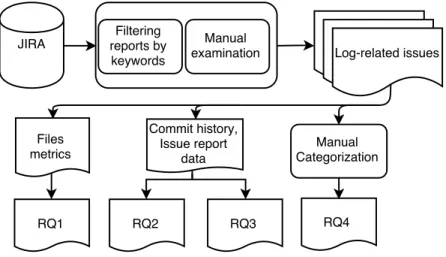
2 An overview of our approach to answer the research questions . . . 28
3 Lifetime of an example inappropriate logging statement . . . 36
4 Cumulative distribution of issue report time in days. Outliers that are greater than 1.5 time of the value of the third quartile of the data are not shown in this figure. . . 39
5 Cumulative distribution of issue fix time in days. Outliers that are greater than1.5 time of the value of the third quartile of the data are not shown in this figure. . . 40
6 An overview of log-related issue checker. . . 46
7 A patch to fix inappropriate logging level . . . 47
8 Using entropy to suggest appropriate logging level . . . 48
List of Tables
1 Comparing our work with prior research on logging suggestions and improvements . 24
2 The Number of Issues in Hadoop and Camel . . . 26
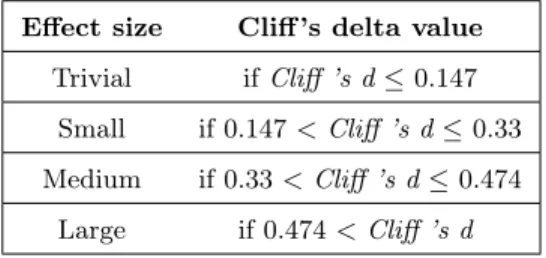
3 Cliff’s delta effect size interpretation. . . 30
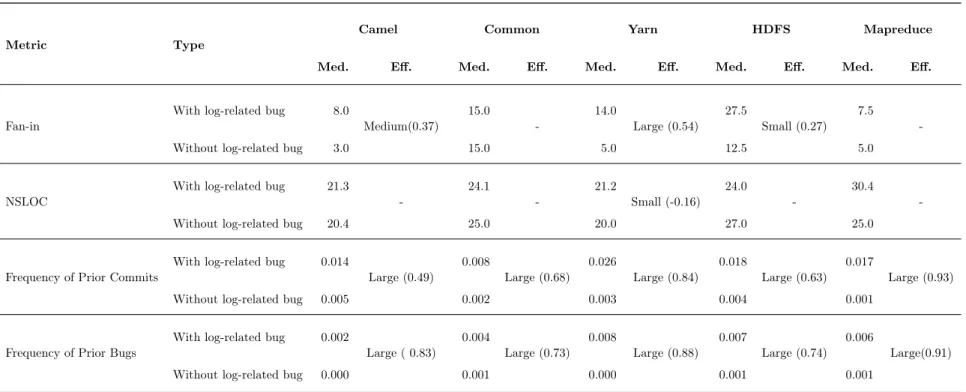
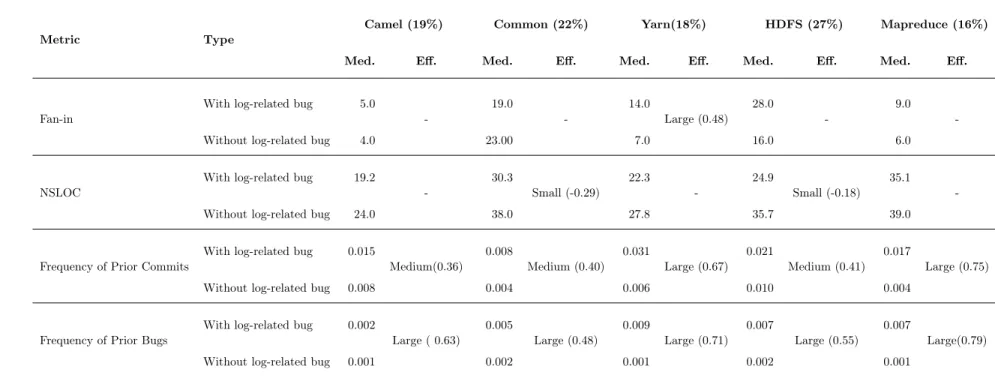
4 Medians (Med.) and effect sizes (Eff.) of the normalized process and product metrics for files with and without log-related issues. Effect sizes are not calculated if the difference between files with and without log-related issues is not statistically significant. 32 5 Medians (Med.) and effect sizes (Eff.) of the normalized process and product metrics for files with and without log-related issues. Files without logging statements are excluded. Effect sizes are not calculated if the difference between files with and without log-related issues is not statistically significant. The percentage of files with log-related bugs shown in front of each subject system. . . 33
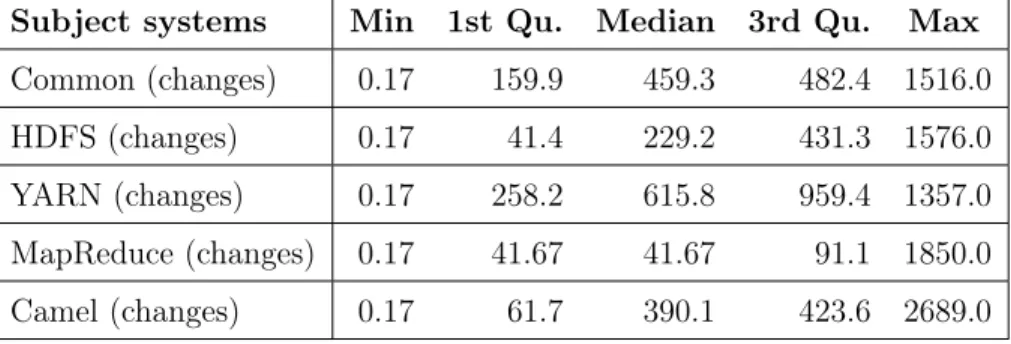
6 Number of days before an inappropriate logging statement being reported . . . 37
7 Number of changes before an inappropriate logging statement get fixed . . . 37
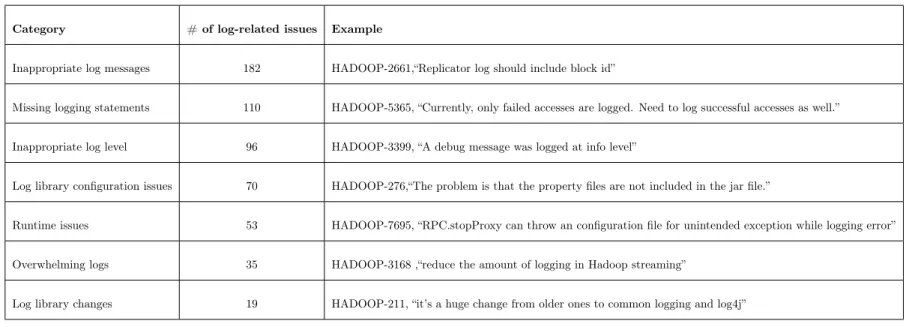
8 Categories of log-related issues . . . 41
9 Distribution of the root causes of log-related issues . . . 42
10 A five-number summary for the lowest entropy of the phrases in each logging statement 49 11 The results of our tool on known issues . . . 52
Chapter 1
Introduction
1.1
Motivation
Developers write logging statements in the source code to expose valuable information of runtime system behavior. A logging statement, e.g.,LOG.warn(“Cannot access storage directory ” + root-Path)1
, typically consists of a log level (e.g., trace/debug/info/warn/error/fatal), a logged event using a static text, and variables that are related to the event context. At runtime, the invocation of these logging statements generates logs that are often treated as the most important, sometimes only, source of information for debugging and maintenance of large software systems.
The importance of logs has been widely identified [KP99]. Logs are used during various software development activities such as bug fixing [XHF+09], anomaly detection [TPK+08], testing results analyses [MHH13], and system monitoring [YZP+
12, BKQ+
08]. The vast application and usefulness of the logs motivate developers to embed large amounts of logging statements in their source code. For example, the OpenSSH server contains 3,407 logging statements in its code base [YPZ12a]. Moreover, log processing infrastructures such as Splunk [Car12] and ELK stack [elk17] are developed for the ease of systematic log analyses.
To improve logging statements, similar to fixing bugs, developers report their issues with the logging statement and fix it by changing the source code or other artifacts (e.g., configuration) during development. For example, in an issue in ApacheHadoop-HDFS, HDFS-33262
, with the title “Append enabled log message uses the wrong variable”, developers replace the recorded variable in the logging statement to provide more meaningful information. We consider such issues that are fixed to improve logging statements aslog-related issues.
Prior empirical studies examine the characteristics of logging practices [YPZ12a] and the places 1
https://issues.apache.org/jira/browse/HDFS-4048 2
where developers embed logging statements [FZH+14]. Also, prior research aims to enhance log-ging statements by automatically including more information [YMX+
10, YZP+
12], and provide suggestions on where to log [ZHF+15]. However, these empirical results and the above-mentioned approaches do not help developers write an issue-free logging statement. In fact, there exist limited guidelines that developers can follow to write appropriate logging statements.
1.2
Problem Statement
The issues with logging statements have become one of the major concerns, due to the vast usage of logs in practice. Examples of such issues include missing to embed important logging statements3 have misleading text in logging statements4
, and generating overwhelming information5
. Logging statements with issues may significantly reduce usefulness of the logs and bring extra overhead to practitioners. For example, missing logging statements in the critical part of the source code may cause developers not to have enough knowledge about the system execution; the misleading textual description in logging statements may lead to wrong decisions made by system operators; and overwhelming information in logs would prevent practitioners from identifying the truly needed information [LSH17]. Recent research on Github projects claims that over half of the Java logging statements are “wrong” [Hen17]. Moreover, for automated log analyses, the issues may have an even larger impact by rather simple mistakes like a typo. For example, in the issue HADOOP-41906
with
Blocker priority, developers missed a dot in a logging statement, leading to failures in log analysis tools.
In this work, we conduct an empirical study on the real log-related issues from two large, open source software systems that extensively use logging statements, i.e., Hadoop and Camel. Studying log-related issues can lead us in devising an automated technique that will aid developers to improve logging statements. We extract 563 log-related issues from the JIRA issue tracking systems of the two subject systems and study these issue reports and their corresponding code changes. Our study aims to answer the following research questions:
RQ1 What are the characteristics of files with log-related issues?
Files with log-related issues have undergone, statistically significantly more frequent changes and more frequent bug fixes. Developers should prioritize their efforts on such files to identify logging statements with potential issues.
RQ2 Who reports and fixes log-related issues? 3 https://issues.apache.org/jira/browse/HDFS-3607 4 https://issues.apache.org/jira/browse/HDFS-1332 5 https://issues.apache.org/jira/browse/CAMEL-6551 6 https://issues.apache.org/jira/browse/HADOOP-4190
We found that in 78% the cases, logging statements are added and fixed by different people. There exists no systematic responsibility for developers to maintain logging statements in the subject systems. This may make it difficult to identify an expert to ensure whether a logging statement is appropriate.
RQ3 How quickly are log-related issues reported and fixed?
By examining the time between the introduction of logging statements, the report, and fixed time of the log-related issues, we find that log-related issues are often reported a long time (on a median of 320 days) after the logging statements were introduced into the source code. Once reported, however, the issues are fixed in a short time (on a median of five days). Therefore, practitioners may benefit from automated tools that detect such issues promptly.
RQ4 What are the root-causes of the log-related issues?
Through a manual analysis on log-related issues and their corresponding fixes, we identify seven root-causes of log-related issues, namely: inappropriate log messages, missing logging state-ments, inappropriate log level, log library configuration issues, runtime issues, overwhelming logs, and log library changes. Many root-causes (like typos in logs) of these issues are rather trivial, suggesting the opportunity of developing automated tools for detecting log-related issues.
Our empirical study results highlight the needs and opportunities for automated tooling support for detecting evident log-related issues. Therefore, we developed an automated tool7
to detect four types of log-related issues. Our tool detected 40 of the 133 known log-related issues. Moreover, we reported 78 detected potential log-related issues from the latest releases of the subject systems. Out of 78, 38 of them had been accepted by their development team through issue reports and the rest of them are still under review.
1.3
Contributions
Our most significant contributions are listed as follows:
• We perform a characteristic study on different aspects of log-related issues, namely the files that contain log-related issues, report and fix time, and developers’ involvement in the process.
• We manually identify seven root-causes of log-related issues.
• We propose an automated tool that can detect four different types of evident log-related issues from source code.
7
1.4
Thesis Organization
The rest of the study is organized as follows. Chapter 2 discusses the related works of our study in two categories of log analysis and logging enhancement. Chapter 3 presents the subject systems under study and our approach to identify and collect log-related issues. Chapter 4 explains the empirical study on different aspects of log-related issues. We motivate each research question and demonstrate our approach to perform our analysis. Then, we present and discuss the results of our study and its implications. Chapter 5 demonstrates our proposed tool and its approach to automatically detects log-related issues. We present how these checkers are designed and the issues that we were able to detect using these them. We also compare our approaches with the state of the art tools where ever the they were applicable. Chapter 6 discusses the potential threats to the validity of our study. Finally, Chapter 7 includes the conclusion of this study and suggestion for future works.
1.5
Related Publication
Earlier version of the work done in this thesis has been published in the following paper:
• Mehran Hassani, Weiyi Shang, Emad Shihab, Nikolaos Tsantalis. Studying and Detecting Log-Related Issues. Empirical Software Engineering.
Chapter 2
Related Work
In this chapter, we discuss the prior research which is related to the work conducted in this thesis. We have divided the related work into two categories, namely 1) the works concerninglog analysis, and 2) the studies that aim at devising techniques forimproving logs in the source code.
2.1
Log analysis
Logs are widely used in software development and operation to ensure the quality of large software systems. Valuable information is extracted from logs, including event correlations [NKN12, FRZ+12], component dependency [OA11], and causal paths [YZP+12]. In this section, we first review the works that discuss the importance of log analysis, and then list the related work that shows the status of log analysis research in the literature.
2.1.1
The importance of logs and log analysis
Barik et al. [BDDF16]
In a study at Microsoft, Barik et al.[BDDF16] performed a mixed-method study on how teams at Microsoft use event data, which also includes logs. The authors interviewed software engineers in various roles in the company, including software developers, program managers, operations engineers, content creators, data scientists, and managers. Interview participants are selected based on a recruitment survey from 1,897 randomly-selected employees at Microsoft. Doing so, they made sure that participants are familiar with event data and have already use it in the past to fulfill their daily tasks. The authors used grounded theory guidelines to analyze the interview data, and also performed a follow-up survey to increase the reliability of their qualitative findings.
Furthermore, the study found that software engineers share event data among different roles, since event data is by nature flexible and can be utilized for different purposes. For instance, one can use event data to find the root cause of a crash, while the other can use the same event data to rank the most used feature by users. Finally, the study revealed several challenges associated with using event data, including the complexity of combining data from different sources, the high amount of clerical work required, the length of time needed for the activities which are based on event data, and the presence of limited or difficult-to-use tools.
This study emphasizes the use of log data in various software engineering activities, and the challenges that software engineers face in their activities when using log data. In this thesis, we focus on identifying and fixing log-related issues, the presence of which can add even more complexity to the already-challenging activities performed by software engineers using logs.
Oliner et al. [OGX12]
Olineret al.[OGX12] discuss the most common applications of log analysis in practice, as summa-rized below:
• Debugging. Most logs are used to facilitate debugging. Developers commonly use simple approaches to use log information for debugging, like using grep to search for messages with specific pattern that may reveal useful information. For instance, if a server crashes because of network drop, developers might try to search for “connection dropped” message in the logs. However, in many scenarios, these simple approaches will not help users to solve their problem, since, among the other reasons, logs can become overwhelmingly large in practice. Thus, devel-opers and operators might use more sophisticated approaches, like PCA (principal component analysis) or SVM (support vector machines) to battle this complexity. Such approaches are especially helpful in networked or large-scale distributed systems, e.g., Hadoop.
• Performance. Log analysis also helps users in improving or debugging the performance of a software system. Logs can be used to find performance anomalies and pinpoint their root causes.
• Security. Olineret al. also discuss the use of logs in security applications. For example, users can analyze logs to find evidence for security breaches or misbehaviors. Furthermore, logs can be utilized to performpostmortem inspection of security incidents. Log messages are evidence of various events, such as the execution of a code block or the creation or destruction of an SSH session. Log analysts can aid to investigate logs in order to find out if an SSH connection constitutes a security breach or not.
• Prediction. Oliner et al. mention prediction as another usage for log analysis. Logs can be used to predict and plan for the future. Predicative models are widely used in workload management, scheduling, configuration optimization, and other tasks.
• Profiling and reporting. Another use for log analysis is profiling and reporting the resources’ or users’ behavior. Log analysts can employ a verity of statistical techniques for profiling and reporting activities on log data.
Consequently, issue-free logs – which is the focus of this study – will improve the results of log analysis tools, considering their wide use.
2.1.2
Existing log analysis tools
DISTALYZER (Nagaraj et al. [NKN12])
Nagarajet al.[NKN12] presented “DISTALYZER”, a tool used to analyze logs of distributed software systems to find the components that cause performance degradation. DISTALYZER compares two sets of logs, generated before and after the system exhibits degraded performance, and generates a summary showing the events that diverge the most across the sets of logs, and therefore, potentially affect the overall system’s performance. The tool uses machine learning techniques to automatically find the strongest associations between system components and performance. DISTALYZER also provides the ability to interact with the results and the exploration for extra analysis. The authors evaluated DISTALYZER on three large-scale distributed systems (namely TritonSort, HBase, and Transmission), and identified the root causes of six performance problems in these subject systems.
SherLog (Yuan et al. [YMX+10])
Yuan et al.[YMX+10] introduced SherLog, which is a postmortem error diagnosis tool that auto-matically infers what must or may have happened during a failed execution. SherLog takes the log output and the source code of the software system and tries to find the execution path that leads to the failure. To do so, SherLog first parses the log output. Then, using the information provided by logs, it statically walks through the execution path that leads to the failure. The authors used eight real-world failures from seven applications to evaluate their approach. They manually reproduced and diagnosed each failure and collocated the runtime logs. The authors then compared the results generated by SherLog with their manual diagnoses. If a subset of the information collected during the manual study is generated by SherLog, the authors consider it as useful. If all the essential information in the manual investigation is generated by SherLog, they consider it ascomplete. In all the experiments, SherLog generatedcomplete information. The results demonstrate that SherLog is
effective in zooming into the paths that are relevant to the failure. The authors also evaluated the performance of SherLog, and showed that the longest SherLog diagnostic took around 40 minutes.
LogMaster (Fu et al. [FRZ+12])
Fu et al. [FRZ+12] proposed a correlation mining system and an event prediction system called LogMaster. LogMaster parses the logs into event sequences and uses an algorithm, named Apriori-LIS that can mine event rules form these event sequences. They also designed an abstraction of the log events called Events Correlation Graphs (ECGs) to represent event rules, and used it for event prediction. They validated their approach on three logs of production cloud and HPC systems with average precisions of over 80%. The authors also showed that their approach needs significantly less time comparing to related studies.
Oliner et al. [OA11]
Olineret al.[OA11] proposed an online method for analyzing large software systems, which can detect the interactions among the components of the target system and identify unexpected behavior. The approach uses logs for its analysis. Logs have timestamps, i.e., they can be seen as time-varying
signals. In this approach, consequently, the authors exploit this fact for devising a technique for identifying unexpected system behavior. Logs are converted into real-valued functions of time, calledanomaly signals. In the first stage of the proposed approach, an online Principal Component Analysis (PCA) is employed to summarize these anomaly signals by finding correlated groups of signals. Then, the approach uses these compressed signals to identify time-delayed correlations (i.e., surprising behavior) in logs using an online approximation algorithm. The authors show that the results of their approach can be valuable for system administration tasks in real use cases from eight unmodified production systems.
2.1.3
Summary
The extensive usage of logs motivates our study, since quality logs are extremely important for the effectiveness of prior log analysis research. None of the mentioned works have looked into this issue specifically. The outcome of this thesis would help in reducing log-related issues, and hence improves the adoption of advanced log analysis techniques in practice.
2.2
Logging enhancement
2.2.1
Chen
et al.
[CJ17]
The closest recent research to this study is the work by Chen et al. [CJ17]. The authors studied the problem ofhow to log, by looking into anti-patterns in the logging code. They manually studied logging code changes in three popular open source software systems over the period of more than six years. The authors focused on changes that occurred independently of the feature code that contains the logging statement. In order to identify these changes, the authors extract the fine-grained code changes from source code repositories. Then, they used heuristics to automatically extract the code changes which contain logging code modifications. Finally, they used dependency analysis to categorize the logging code changes into 1) changes due to modifications on the feature code, and 2) independent logging code changes. After extracting the independent logging changes, they manually went through a statistically significant sample of the changes. The authors found, in total, nine reasons for independently changing the logging code, categorized into two groups: first, “what to log”, and second, “how to log”. In this study, the authors only focus on the rationales in the category of “how to log’. They found five rationales in this category, each corresponding to the different fixes to the anti-patterns in the logging code. Based on these five rationales, they describe five logging anti-patterns as follows:
1. Nullable Objects. Logging statements use variables to log the runtime information through-out the execution of the system. However, the objects used in the dynamic contents can be null. If not checked for, this would cause a NullPointerException and crash the system.
2. Explicit Casting. Explicit casting converts an object into a particular type. If the object is not convertible to the requested type, explicit casting will cause runtime type conversion errors and the system will crash.
3. Wrong verbosity level. Logging libraries useverbosity levelsto control the type and amount of information appeared in the log. Wrong verbosity level can hide important information from the users, or in contrast, it can result in flooded log output with unwanted logs.
4. Logging Code Smells. Code smells are symptoms of bad design and implementation choices [FB99]. In a similar fashion, the logging code smells are defined as poor design and implementation choices when developing logging code.
5. Malformed Output. Some objects do not have a human-readable format defined. If they are printed directly to the log output, the generated logs can be useless and pollute the output. For instance, printing a byte array in the logging statement.
To show the usefulness of identifying these anti-patterns, the authors also proposed a static analysis tool called LCAnalyzer. LCAnalyzer uses Eclipse’s Java Development Tools (JDT) to flag anti-patterns in the target source code’s ASTs. For instance, in order to findWrong Verbosity Level
anti-pattern, their checker extracts the static part of the logging statement in the logging code and compares it against its logging level: if developers explicitly mention, in the static part of the logging statement, that it is a debug-level logging statement, they check the logging level of the statement and if it doesn’t match the static part, they report it as an anti-pattern.
To evaluate LCAnalyzer, the authors conduct two case studies. First, they evaluated the perfor-mance of their tool using anoracle and reported the precision and recall. The overall average recall for LCAnalyzer in finding the mentioned anti-patterns is 95%. To calculate the precision, they man-ually examined the detected anti-patterns from the oracle. The average precision for LCAnalyzer is 60%.
The authors also applied their tool on the latest releases of ten different open source software systems. They found instances of the mentioned anti-patterns on various types of systems like clients, servers, and frameworks. They also found that there is a medium to strong correlation between the amount of logging code and the number of anti-pattern instances. Finally, the authors manually selected 64 representative instances of anti-patterns in the aforementioned ten open source systems and reported them as issues to the developers. Out of these, 46 instances (71.9%) were accepted by the developers.
Our study complements this work in many ways. Chen et al. explore anti-patterns in logging code by mining logging code changes in three open-source systems. In particular, they identified six anti-patterns and proposed static code checkers to detect these patterns. However, instead of detecting anti-patterns (like logging code smells [CJ17]) that have thepossibility to be an issue, we focus on thereported issues that are more certain. In fact, by comparing our study to the research by Chen et al., only one anti-pattern/root-cause (which is Wrong Log Level) overlaps across the two studies. The reason may be the different focus on anti-patterns and evident issues, and that we identify log-related issues from issue reports while Chenet al. leverage code changes to identify anti-patterns. Moreover, the results of our empirical study on log-related issues provide more in-sights on these issues.
2.2.2
Yuan
et al.
[YPZ12a]
Yuan et al. [YPZ12a] performed a characteristic study on log practices by mining the revision histories of four open-source software projects. This was the first attempt to study the practice of software logging. Based on their analysis on the historical data from four open-source software
projects. They provided several insights on logging:
• Logging is a pervasive practice during software development. On average, every 30 lines of code contains a logging statement.
• Logging is beneficial for failure diagnosis. Logging, on average, reduces diagnoses time of run-time failures on a median of 2.2X times.
• Developers actively maintain logging statements. The average churn rate of logging code is almost two times (1.8) compared to the entire code base.
• Logging code takes a significant part of software evolution. Despite relatively smaller density compared to the other parts of the code, a significant amount of commits (18%) modify logging code.
• Developers usually change logging statements since they do not write the appropriate logging statement in the first attempt. 36% of all logging statements are changed after they introduced to the system.
Furthermore, the authors studied code changes that occurred on logging code. They used simple heuristics to filter out code changes related to the feature changes in the commit history. The authors found that developers do not delete or move the logging statements unless they introduce serious problems: only 2% of the logging modifications are deletions. In contrast, 98% of modifications are done on the content of the log messages, such as their verbosity level, static text, and variables. Due to the large number of modifications occurred on the verbosity level of the logs (2,389 of the changes are only on the verbosity level), the authors also investigated these changes in more detail. The results showed that 72% of the verbosity level changes are due to the change of developers’ judgment about an error event. Thus, tools that automatically expose error conditions can help identifying logging behaviors. In other words, exposing code to different error conditions can help developers in making better decisions when selecting verbosity level for logs. Even for none-error logging statements, developers reconsider the trade-off between multiple verbosity levels. The au-thors propose thatadaptive logging verbosity can help to reduce problems regarding verbosity levels. In another finding, the authors show that more than one fourth of the logging modifications are related to variables in logs, suggesting that automatic approaches can help developers in choosing what variables should be logged. Finally, the authors show that more than one third (39%) of the changes to the static part of the logging statements are because of inconsistencies between logs and the execution information intended to be recorded, motivating tool support for automatically fixing such inconsistencies.
By identifying these manual efforts for modifying logging statements, the authors motivated opportunities for tools, compiler and programming language support to improve the current logging practices. The authors also built a simple checker that can help developers to write better logging statements. We looked into the changes in logging statements by examining log-related issues. We provided insights into the nature of the faulty logging statements and the source code that contains them. Furthermore, we built static analysis tools to help developers improve their logging statements.
2.2.3
Errlog (Yuan
et al.
[YPH
+12])
Yuan et al. [YPH+12] investigate a sample of 250 real-world failure reports from five large and widely used software systems (namely, Apache, squid, PostgreSQL, SVN, and Coreutils). Across each system, the authors manually extracted the log messages and their relation to the failure that was identified. The authors show that, under the default verbosity mode among the software systems, almost all (97%) logging statements are Error and Warning level messages, approving that Error/Warning are usually the only source of information in case of failures in the field. By comparing the duration of each report, the authors found that reports supported by log messages are fixed 2.2X faster on average. This confirms the hypothesis about the importance of appropriate logging. However, more than half (57%) of the failures do not have failure-related log messages. Furthermore, the programs themselves have caught early error-manifestations in the majority (61%) of the cases, meaning that programs decided to tolerate the errors incorrectly. Making it worse, in most of these cases (85%) developers did not log the incorrectly-tolerated error. These findings show the need for automated tools that inject logs to error handling logic of the programs. Driven by these findings, the authors introduced a tool called Errlog. Errlog analyzes the code for potential unlogged exceptions and inserts logging statements in them. To do so, Errlog looks for seven generic exception patterns, driven from the authors manual study on real-world failures. The tool then examines whether the exception check already exists, and whether it contains a log message. If there are no logging statements in the target exception, Errlog will insert appropriate code to log the exception. To provide more control to the users on the overhead of the logging inserted to the system, Errlog provides three logging modes that will control the overhead introduced by the tool.
The authors evaluated their proposed tool in two ways. First, they performed an in-lab experi-ment to see how many of the error logs proposed by the tool are also manually added by developers in the original source code. They show that, by configuring the tool to medium overhead mode, Errlog was able to automatically generate an average of 84% of existing log points across all the evaluated subjects. Even on the lowest overhead setting, 52% of the existing logs are generated by the tool with only 1% overhead. Second, they performed a controlled user study to measure the
effectiveness of Errlog. The authors asked 20 programmers with extensive and recent experience in C/C++ to fix five failures as best as they could. They provided half of the participants with the error-log-inserted programs and half of them with the original one. They show that, on average, programmers took 60.7% less time to diagnose failures when they where using the logs added by Errlog.
In this thesis, we also proposed an exception log message checker, similar to Errlog. However, we were not able to compare Errlog with our proposed tool since Errlog works on C/C++ code. Notwithstanding, we used a different approach to suggest enhancements for logging statements in the exception handling code: our tool uses the source code to find the instances of each exception type and provides a suggestion based on previous decisions from the developers of the system. This approach is specially helpful for the developers with less experience since it helps them to make decisions based on the well-reviewed and tested source code. Our proposed tool also can suggest improvements to already-existing logging statements in the code. Yet, our tool cannot provide any suggestion if the code has no previous logging statements while Errlog can be used to add logs to the systems with no logging statement in them. We will discuss about our tool in more details in Chapter 5.
2.2.4
LogEnhancer (Yuan
et al.
[YZP
+12])
The authors propose a tool, named LogEnhancer [YZP+12], to automatically detect valuable infor-mation from the source code and inject this inforinfor-mation to logging statements. In essence, LogEn-hancer is a enhancement tool that takes the existing source code as input and produces a newer version with improved logging statements. To accomplish this goal, LogEnhancer uses a three-step approach. In the first stage, it performs aUncertainty Identification analysis. At this stage, the tool starts from the log and works its way backward on the code and finds the conditions that needed to be satisfied in the control flow to allow the program to execute the log. In the second stage, the tool identifies the key values that will help in solving the uncertain paths leading to the logging statement. Finally, in the last stage, LogEnhancer inserts a procedure before each log to recorded the variable values that are identified in the previous step.
To evaluate LogEnhancer, the authors enhanced the logging statements in 8 different real-world applications. The authors performed three experiments to ensure the usefulness of LogEnhancer. In the first experiment, the authors compared the results of the tool with the variables selected manually by the developers of the subject systems. They found that, on average, 95% of the variables selected by developers are also recorded by LogEnhancer. Furthermore, the authors evaluated the diagnostic effectiveness of the tool by analyzing 15 real-world failures. They found that in all the 15 cases, the original logs were not helpful enough to diagnose the failure since they faced many uncertainties
in the path that caused the error. However, the variables added from LogEnhancer significantly reduced the uncertainty, leading to easier diagnosis of the failures.
Our exception checker tool proposed in this thesis also aims at enhancing logging statements by suggesting addition and deletion of variables in the logging statements. With our tool, we suggest developers adding the exception variable to a logging statement, if the thrown exception type always includes the exception variable in the logging statement all across the source code of the subject system. Even though we couldn’t run LogEnhancer, from the description of their approach, we can infer that LogEnhancer is guaranteed to solve the issues fixed by adding variables to the logging statements, as well as the issues with missing exception variables (28 log-related issues). However, LogEnhancer can potentially produce noise to the log output. In fact, seven log-related issues were fixed by removing variables from the logging statements,i.e.,LogEnhancer may result in worsening the issues. Zhuet al.[ZHF+
15], also mention that adding all variables to logging statement pollutes the log output and is not recommended by developers.
2.2.5
Yao
et al.
[KY18]
Yaoet al. [KY18] proposed an approach that recommends proper locations to place logging state-ments in order to improve performance monitoring on web-based software systems. In this approach, the authors use improvements of the explanatory power of statistical performance models as a heuris-tic to suggest logging statement placement. Their approach contains several steps. To reduce the performance overhead, the approach parses the existing web logs and identifies the web requests that have significantly higher performance impact on the system. Using the web logs, the authors built a statistical performance model and measured the significance of the log metrics on the model’s output. Since the log metrics represent the number of times each code block is executed, the authors used them as a proxy to identify the performance-influencing code. In the next step, they automatically injected logging statements into the beginning of the methods in the source code identified in the previous step. After injecting the logging statements, they rebuilt and re-run the performance tests. Then, they made a similar statistical model using both existing web logs and the newly-injected logs. In this step, they use the new model to remove the methods that do not have a significant impact on the performance. Afterwards, they injected logging statements to every basic block of the remaining methods. Finally, they used the logs injected in basic blocks as well as the previous logs to make a newer version of the statistical performance model. Using the impact of the log metrics on the model, they identified performance-influencing basic blocks and suggest adding logging statements to them.
The authors evaluated their approach on three different aspects of two open source and one enterprise software system as subject systems. First, they evaluated the statistical model proposed
by their approach. The authors measured the model fit to understand the quality of their statistical models. They showed that their models with R2 between 26.9% and 90.2% and can well explain the system performance. Second, they evaluated the performance influence of the recommended logging locations in the code. To measure the influence, they set all the metrics in the model to their mean value and computed the predicted performance. Then, they doubled the value of one metric while keeping all the other ones in their median value and computed the difference in the model’s output. They found that while their suggested logging locations have a significant influence on the performance, the impact can be positive or negative. Finally, the authors performed a manual study on the suggested locations to understand their characteristics. They found that the suggested locations are not in complex methods. Moreover, most of the suggested locations are not in the performance hotspots.
Our study finds that missing logging statements are one of the root-causes of log-related is-sues. However, the proposed approach by Yaoet al. is only suitable when considering performance monitoring.
2.2.6
Log
2(Ding
et al.
[DZL
+15])
Ding et al. [DZL+15] proposed a novel cost-aware logging mechanism called Log2. Ding et al. performed a preliminary survey on logging practices in Microsoft. They found that developers at Microsoft believe that the overhead of logging is not negligible. Furthermore, the majority of the developers are not satisfied with the existing approaches to control this overhead. In fact, 83% of the participants agreed that many log messages are redundant for diagnosing performance issues. Motivated by the results of their survey, the authors proposed Log2, a logging mechanism that allows the system to adjust logging dynamically to achieve the maximum effectiveness, given an overhead threshold. Log2 uses two filtering phases to achieve this goal, a local filter and a global filter. Each local filter is responsible to discard trivial logging requests. The usefulness of each logging request for performance diagnoses is determined by a dynamically-calculated utility score. Local filters discard logging requests with low utility score. Afterwards, global filter writes the top-ranked logging requests to the disk according to the global overhead threshold. The global threshold will be adjusted dynamically based on the environment dynamics.
To evaluateLog2, the authors performed a four-stage experiment on a popular open source blog-ging platform, namely BlogEngine. In the first step, they marked code regions with high potential to cause performance issues and instrument it withLog2. In the second step, the authors deployed BlogEngine and two other machines as clients. They used a tool name WebTest to simulate user behavior on BlogEngine. Using WebTest, they generated five typical usage scenarios, namely read blogs, write comments, search, download files and upload files. Then, in the third step, the authors
injected three performance issues, namelyupload an extremely large file,search a strange term,and exhaust CPU by another process. Finally, in the last step, the authors monitored the I/O throughput by counting the number of times thatLog2flushes the logs to disk in each time interval. They also measure other performance metrics, like CPU and memory overhead of theLog2. In this experiment, they comparedLog2with a baseline that included outputting all the logs executed. They found that, on average,Log2writes 104 logs per interval, while 3,800 logs are outputted in the baseline approach. Moreover, althoughLog2used slightly more memory comparing to the baseline approach, it offered less CPU usage since a large number of logs are excluded in the process. The authors also showed that with a budget size of 120 logs per interval, one can cover all the manually-identified useful logs form the baseline approach.
Log2 proposes a filtering mechanism to reduce the I/O consumption of the logs at runtime. It performs the filtering with having performance problem diagnoses as the main usage of the logs in mind. The approach is deeply integrated into the source code as an API to reduce the number of logs saved during the runtime. However, in this work, we aim to provide a recommender to help developers improve logging statements in their source code rather than introducing a new logging approach.
2.2.7
Log20 (Zhao
et al.
[ZRL
+17])
Zhaoet al. introduced a tool called Log20. Log20 is a performance-aware tool to inject new logging statements to the source code. It is also capable of adding variables to the injected logging statements without any domain knowledge. The authors introduced an approach to measure the informativeness of each added logging statement. They used informativeness to compute a near-optimal placement of logging statement given a specific performance overhead. The authors measured informativeness of each logging statement placement by its ability to differentiate different execution paths during runtime. Furthermore, they used Shannon’s information theory to measure the entropy of a pro-gram by considering all possible execution paths and their probability during runtime. Since each logging statement placement can reduce the entropy by disambiguating these execution paths, they calculated informativeness of logging statements by the reduction in the entropy of the program, given its placement. The authors used this setup to compute near-optimal placement of the logging statements given an overhead threshold. Their approach is rather dynamic and can react to different workloads during runtime.
Zhao et al. evaluated their approach on four widely used distributed systems namely HBase, HDFS, YARN, and ZooKeeper. They found that Log20 is considerably more efficient in disam-biguating execution paths compared to the existing standard logging libraries. By outputting 0.08 log enriches per request, Log20 was as informative as info level logs with 1.58 log entities per request.
They also compared their approach with Ball-Larus path profiling algorithm[BL96]. They found that Log20’s instrumentation is at least 3X more efficient than the Ball-Larus algorithm. Furthermore, Zhao et al. evaluated the usefulness of Log20 for debugging activities using 41 randomly selected user-reported HDFS failures. The authors found Log20 is helpful in debugging 68% (28/41) of the real-world failures while existing info level logging statements are helpful in 27 cases.
Log20 dynamically inject logging statements with variables to the byte-code of the program. In essence, they introduced a new logging mechanism. We focused on the existing logging practices. Especially, we studied the log-related issues and proposed static analysis tools to help developers improve their existing logging statements.
2.2.8
Fu
et al.
[FZH
+14]
Fuet al.[FZH+14] systematically studied the logging practices of developers in the industry, with a focus on where developers log. The authors investigated two large-scale industrial software systems from Microsoft. They first performed source code analysis to investigate logging characteristics of the subject systems. Based on a manual examination, they categorized logging statements into five groups, namely assertion-check logging, return-value-check logging, exception logging, logic-branch logging, and observing-point logging. The authors used the results of their manual examination to automatically group all the logging statements in the code. Moreover, they confirmed their identified categories by conducting a survey on developers’ opinions about their results. The results of their automatic classification showed that about half of the logged snippets belonged to the first three categories, as they logged due to the unexpected situations, while other half belongs to the next two categories where they logged in expected situations to log execution trace information.
Supported by their findings from the characteristic study, the authors trained a classifier based on contextual information and features of training code snippets to predict whether the tested code snippets need to be logged. They performed 10-fold cross-validation on their classifier to evaluate the accuracy of their results. They showed that, by using contextual information, their classifier can achieve 80.8% to 90.4% recall, while having 81.1% to 90.2% precision.
In this work, we also provide suggestions to the developers about whether they need to log exceptions or not, using our catch block checker tool. However, we were not able to compare the results of our tool to the Fuet al.’s, since they work on different programming languages. Our catch block checker tool also provides suggestions on whether developers need to log the exception trace as well as whether they need to add logging statements in the catch block. In this study, we focus on finding log-related issues. Thus, we emphasized on preventing developers to write faulty logging statements rather than giving a general recommendation on the code. Therefore, we evaluated our tool on the faulty logging statements in catch blocks rather than all the catch blocks in the source
code. Nevertheless, we were able to preserve high precision for our recommendations.
2.2.9
LogAdvisor (Zhu
et al.
[ZHF
+15])
Zhuet al.[ZHF+15] proposed a framework which helps in providing informative guidance on where to insert logging statements. The authors leveraged these guidelines to automatically learn the common logging practices using machine learning algorithms to suggest logging decisions for developers. Focusing on logging for error handling, the authors extracted code snippets from the source code of the subject systems code snippets with exception code, or return-value-check code, and used them as training data to learn logging practices. Then, they extracted code features, such as exception type, from the collected code snippets. If they found too many features, they removed redundant features using frequency and information gain thresholds. Moreover, they used noise detection approach proposed by Kim et al. [KZWG11] to eliminate data noises. They used the extracted features to train machine learning algorithms (e.g., Decision Tree) to learn common logging practices. This approach was implemented in a tool called LogAdvisor. LogAdvisor can provide online suggestions based on different features of the code snippet.
Zhu et al. evaluated their approach by conducting several experiments. The authors showed that their approach can achieve 84.6% to 93.4% precision when they performed a 10-fold cross-valuation. They also compared different machine learning algorithms while they trained on their data. They found that Decision Tree achieves the best overall accuracy. Furthermore, they evaluated the impact of their noise-handling approach by comparing the prediction results with and without noise handling. They found that most of their data (88%) has a noise degree value close to 0, revealing the quality of the data. Nevertheless, the noise-handling approach improves the prediction accuracy of their approach. Lastly, they performed cross-project validation by training and testing their algorithms on a different project. By utilizing this approach, they were able to achieve 81.5% accuracy, compared to 93.4% in within-project learning.
While LogAdvisor shows promising results, it is only usable for C# projects. Moreover, our checker has very little overhead comparing to their multi-step framework. Our checker only needs the information about the exception types. Although we have a lower recall, we still do not give wrong suggestions in any of the issues. Furthermore, we aim to find multiple patterns rather than focusing on one, as Zhuet al. did in their study.
2.2.10
Li
et al.
[LSH17]
Li et al.[LSH17] proposed an approach which helps developers in choosing the best log level when they are adding a new logging statement. They studied the logging levels among four open source software projects: Hadoop,Directory Server,Hama, andQpid. The authors extracted all the added
logging statements of the systems from the historical data and extracted process and product metrics related to them. They started with a preliminary empirical study on the use of log levels in the studied subject systems. They found that although each project has a different distribution of log levels, no single log level dominates other ones in any of the studied projects. Furthermore, different code blocks have different distribution of log levels. For instance, logging statements directly added to catch blocks tend to have less verbose logging levels than the logging statements added to try blocks. They also found that not all the logging statements added to catch blocks havewarn,error, or fatal level. These results demonstrate difficulties in suggesting logging levels. Inspired by their empirical study, they introduce a regression model to help developers choose appropriate log level for newly added logging statements. They used five sets of metrics to model the log levels, logging statement metrics, file metrics, change metrics, historical metrics, and containing block metrics. Furthermore, they re-encoded categorical metric to a quantitative variable, combined metrics with strong interaction, and removed strongly correlated metrics. Then, they build an ordinal regression model to suggest logging levels for a given logging statement.
They measured the performance of their model using multi-class Brier score and AUC metrics. Brier score is used to measure the accuracy of probabilistic predictions. AUC (area under the curve) is the area under the Receiver Operating Characteristic curve (i.e., the plot of the true positive rate against the false positive rate). The authors show that, while accounting for optimism, their ordinal regression model achieves a Brier score ranging from 0.44 to 0.66 and an AUC of 0.75 to 0.81. They also show that the characteristics of the containing block, the existing logging statements in the file, and the content of the newly-added log can play an important role in determining the appropriate logging level for the added logging statements.
As mentioned, we also proposed a log-level checker to help developers in identifying inappropriate log levels in their code. We demonstrate the comparison between our approach and the model introduced by Liet al. in Section 5.5.
2.2.11
Li
et al.
[LSZEH17]
Li et al. [LSZEH17] also provided a model to suggest just-in-time suggestions for code changes in logging statements occurring in each commit. The authors performed a manual study to investigate the rationales behind logging statement changes. They studied 32,480 logging statement changes from four open source subject systems. They sampled 380 log changes with 95% confidence level and±5% confidence interval. Furthermore, they manually investigated the log change, code change, commit message, and the issue report, in order to understand the reason for a log change. They categorized the changed logs into four groups. Logging statements changed because of code changes
in the containing block are marked asbock change. Log improvementcategory includes logging state-ments modified to achieve better logging practices. Another category includes logging statestate-ments which are changed because they depend on modifications on other code elements (e.g., variables in a log). Finally, logging statements changed because of the issues reported by users and developers constitute the fourth category of log changes.
Driven by this formative study, the authors designed Random Forest classifiers to provide just-in-time suggestions for log changes. For each code change, the classifiers provide a binary respond that shows the likelihood of a log change occurring in a commit. They reported that their Random Forest classifiers can tell whether a log change is required for a commit or not, with an average accuracy of 0.76 to 0.82 even when using commits from other projects as training data. Furthermore, the authors show that their classifier can reach a medium classification power using 192 commits on average.
They also examined the results of their classifier to find the most influential factors that best explain log changes. They found that change measures and product measures are among the most influential factors. In fact, the strong influence of change and product measures indicates that log changes are highly associated with other code changes, and furthermore, the current snapshot of the source code plays an important role in the logging decision for developers. Last but not least, the authors found that different projects follow different log change practices. For instance, catch clause measure is one of the most influential factors in Hadoop, Directory Server, and Qpid projects, while in HttpClient, it ranks the 7th most influential factor.
In this work, we have focused on thelog-related issues and studied their characteristics, while Li
et al. looked into the rationale behind log changes. We also proposed a set of tools to help developers in avoiding straightforward log-related issues.
2.2.12
Li
et al.
[LCSH18]
Li et al. performed a case study on six open source Java systems: Hadoop, Directory-Server, Qpid-Java,CloudStack,Camel andAiravatato investigate the relationship between logging decisions and the functionality of the source code. The authors used topics as a proxy for the functionality of the code. For each system, they first extracted the methods in the source code and filter them base on size. Then, they removed the logging statements from the method before performing topic modeling. Afterwards, they extracted linguistic data such as variable names and code comments and performed LDA to unigrams as well as bigrams in each method.
They found that a small set of the extracted topics are much more likely to be logged. In fact, most of the log heavy topics are related to communication between machines or interaction between threads. Furthermore, the authors found that studied systems share a portion (12% to 62%) of
their topics with each other. Meaning that developers can use other systems while making logging decisions or developing logging guidelines. Finally, the authors built regression models to study the relationship between the topics in a method and the likelihood of a method being logged. They found that adding topic-based metrics to baseline model result in improvements form 3% to 13% on AUC and 6% to 16% on Brier score. In fact, five to seven of the top ten important metrics for determining the likelihood of a method being logged were topic-based metrics. They showed that developers can use topically to predict the likelihood of a method being logged.
Li et al. suggest that there is a strong relationship between the topics of a code snippet and the likelihood of a code snippet containing logging statements. In essence, they focus on the problem of “where to log”. We take a more general approach to improve the quality of the logging statements by providing insights on log-related issues. We also proposed static analysis tools to help developers in different aspects of logging such as “where to log” and “what to log” as well as “how to log”. However, our tools focus on specific issues in the logging code rather than providing general solutions to these questions.
2.2.13
Kabinna
et al.
[KBSH16]
Kabinna et al. [KBSH16] studied the logging library migration in Apache Software Foundation (ASF) projects. The authors identified all the JIRA issues that attempt to migrate logging libraries. Then, they manually analyzed JIRA issues to find the rationales behind logging library migrations. They also collected churn metrics for the related commits as well as developers’ metrics from the repositories of the subject systems to identify the effort needed to perform the migrations. The authors found 49 attempts to migrate logging libraries in 33 among the 233 projects under study. They also reported that on median, each logging library migration took 26 days to complete and in the majority of them (66%) at least one top contributor was involved during the migration. The improvements offered by the new library often motivates developers to justify the effort needed to migrate the logging library. The developers mentioned flexibility, performance improvements, code maintenance, functionality, and dependencies as their drivers for migrating logging libraries. Interestingly, 14 attempts for logging library migrations were abandoned by developers. In six projects the developers failed to provide the patches needed for migration. Two of the projects delayed their migration for a better release of the targeted library. Moreover, two projects faced dependency issues during their migration.
Kabinna et al. also found that the performance improvement is one of the primary reasons for developers for logging library migrations. Thus, they measured the performance improvements observed after the migrations. They run performance tests before and after each migration in “Debug” and “Info” log levels. Afterwards, they used Mann-Whitney U test to find statistically
significant performance differences between pre- and post-migration tests. Furthermore, they also calculated the effect size to quantify the differences in performance. Two subject systems experienced 28-44% performance improvement while in two systems the improvements were negligible.
The authors found that 14% of the ASF projects had at least one logging library migration in their lifetime. They also showed that 70% the migrated projects had at least two issues related to the logging library migration. Although they provided useful insights for logging library migration, they do not propose an approach to automatically aid developers in the process.
Results of our study confirm the findings of Kabinna et al.’s. We showed that logging library migrations are one of the root causes of log-related issues. Furthermore, we found that logging library migrations introduce inconsistencies and new issues to the software systems. We also introduced a tool that can help developers in improving the performance of software systems by simply checking for the enabled logging level before executing the logging statement, while using specific logging libraries. Our checker can fix such common issues related to logging library configurations.
2.2.14
Kabinna
et al.
[KSBH16]
Kabinna et al. [KSBH16] also studied the stability of logging statements. First, they performed a preliminary study to find how often logging statements go under modifications in their lifetime. They used the historical data stored in the repositories of the subject systems to track the changes on logging statements. They performed their analysis on four open source projects namely ActiveMQ, Camel, Cloudstack, and Liferay. They found that 20% to 45% of the logging statements in the studied applications at least went through one modification. Furthermore, they observed that on median, logging statements change 17 times after they were introduced into the system. Motivated by the empirical results, the authors trained a Random Forest classifier based on metrics related to context, the content, and the developers of the logging statements to predict the likelihood of a log change in the future. Furthermore, the authors reported the performance of their classifier using precision, recall, AUC and Brier Score. They also calculated the optimism of their performance measures and reduced it from their evaluation results. The Random Forest classifier achieved 0.83 to 0.91 precision and 0.65 to 0.85 recall, leading to AUC of 0.94 to 0.95. They also achieved a Brier Score of 0.042 to 0.61 among the applications under study. Finally, the authors showed that developer experience, file ownership, SLOC, and log density are the most important metrics for predicting the stability of a logging statement.
Kabinna et al. focus on predicting the stability on the logging statement without considering the nature of the changes introduced. We aim to study faulty logging statements and provide useful insights on the characteristics of these logging statements and their surrounding code. Furthermore, we provided a set of tools to help developers to find and fix such issues.
2.2.15
Summary
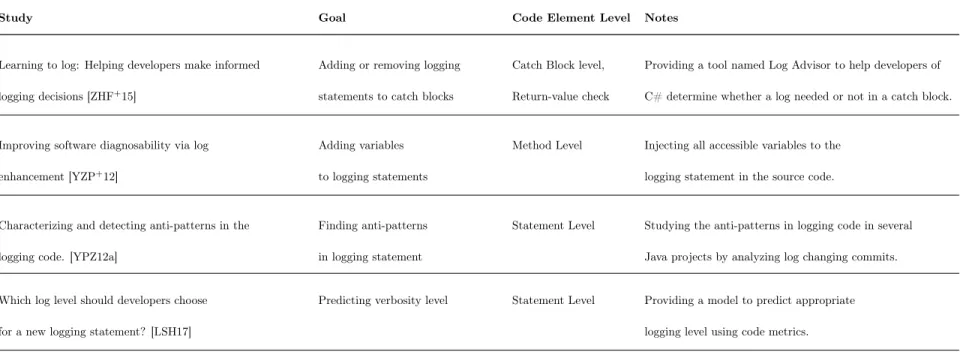
Previous researches mainly focused on suggesting and improving existing logging statements. We, on the other hand, focus on studying log-related issues and aim to improve the quality of the logging statements by automatically detecting these issues. We provide a comparison of related work that aim to improve logging code in Table 1.
Table 1: Comparing our work with prior research on logging suggestions and improvements
Study Goal Code Element Level Notes
Learning to log: Helping developers make informed Adding or removing logging Catch Block level, Providing a tool named Log Advisor to help developers of logging decisions [ZHF+
15] statements to catch blocks Return-value check C# determine whether a log needed or not in a catch block.
Improving software diagnosability via log Adding variables Method Level Injecting all accessible variables to the enhancement [YZP+
12] to logging statements logging statement in the source code.
Characterizing and detecting anti-patterns in the Finding anti-patterns Statement Level Studying the anti-patterns in logging code in several logging code. [YPZ12a] in logging statement Java projects by analyzing log changing commits.
Which log level should developers choose Predicting verbosity level Statement Level Providing a model to predict appropriate for a new logging statement? [LSH17] logging level using code metrics.
Towards just-in-time suggestions for log changes [LSZEH17] Predicting the need for log changes Commit level Built random forest classifiers using software measures to predicting the need of log change in each commit.
Studying and detecting log-related issues (This study) Detecting log-related issues Statement Level Studying characteristics of the log-related issues and providing a checker to detect evident errors in logging code.
Chapter 3
Study Design
In this section, we present our case study setup. In particular, we present the subject systems of our case study and their characteristics as well as our approach to select them. Furthermore, we explain our approach for collecting log-related issues.
3.1
Subject systems
Our case study focuses on two large-scale open-source software systems, namelyHadoopandCamel. To select our subject systems, we picked the top 1,000 most popular Java projects from Github based on the number of stars. Then, we cloned them and counted the number of logging statements in each project using the source code. To count the number of logging statements, we checked the types of the logger variables and whether their corresponding method calls (e.g., trace, debug, info, warn, error, fatal) are standard log librarie’s levels. Then, we picked the top two software systems as our subjects. Our approach to select the subject systems is depicted in Figure 1.
Hadoopis a well-known parallel computing platform that implements the MapReduce paradigm.
Hadoop has been widely adopted in practice. Hadoop is written in Java with around two million SLOC and nearly 33K issues stored in its issue tracking system for all of its sub-systems. Camel is an open-source integration framework based on known Enterprise Integration Patterns with Bean Integration containing more than 1.1 million SLOC and 10K issues in its issue tracking system. Like all other products of Apache, Hadoop and Camel use JIRA as their issue tracking system. Both subject systems have extensive logging statements in their code and logs are heavily used in their development and operation activities. In particular,Hadoophas more than 11K logging statements andCamel has more than 6K logging statements in their latest revision of source code.