Automatic Identification of Online Predators in Chat Logs by Anomaly
Detection and Deep Learning
Mohammadreza Ebrahimi
A Thesis
In the Department
of
Computer Science and Software Engineering
Presented in Partial Fulfillment of the Requirements
For the Degree of Master of Science (Computer Science) at
Concordia University
Montreal, Quebec, Canada
April 2016
iii
Abstract
Automatic Identification of Online Predators in Chat Logs by Anomaly Detection and Deep Learning
Mohammadreza Ebrahimi
Providing a safe environment for juveniles and children in online social networks is considered as a major factor in improving public safety. Due to the prevalence of the online conversations, mitigating the undesirable effects of juvenile abuse in cyberspace has become inevitable. Using automatic ways to address this kind of crime is challenging and demands efficient and scalable data mining techniques. The problem can be casted as a combination of textual preprocessing in data/text mining and binary classification in machine learning. This thesis proposes two machine learning approaches to deal with the following two issues in the domain of online predator identification: 1) The first problem is gathering a comprehensive set of negative training samples which is unrealistic due to the nature of the problem. This problem is addressed by applying an existing method for semi-supervised anomaly detection that allows the training process based on only one class label. The method was tested on two datasets; 2) The second issue is improving the performance of current binary classification methods in terms of classification accuracy and F1-score. In this regard, we have customized a deep learning approach called Convolutional Neural Network to be used in this domain. Using this approach, we show that the classification performance (F1-score) is improved by almost 1.7% compared to the classification method (Support Vector Machine). Two different datasets were used in the empirical experiments: PAN-2012 and SQ (Sûreté du Québec). The former is a large public dataset that has been used extensively in the literature and the latter is a small dataset collected from the Sûreté du Québec.
Keywords: Data Mining; Text Classification; Online Predator Identification; Chat Logs; Anomaly Detection; Deep Learning; Convolutional Neural Network; Vector Space Model; Naive Bayes; Neural Network; Support Vector Machines
iv
Acknowledgments
This research has been supported by the Natural Sciences and Engineering Research Council of Canada.
I would like to thank Dr. Ching Y. Suen and Dr. Olga Ormandjieva for their illuminating advice and compassionate guides during my academic journey.
I would like to thank sergeants Daniel Karneyeff-Bisson and Maxime Grenier in Sûreté du Québec for making the dataset available to this research and having illuminating discussions on the topic.
v
To My Lovely Family,
vi
Contributions of Authors
I hereby certify that all the materials in this thesis are entirely my own work and directly authored by me except about two pages of the “literature review” (sub sections 2.3.3 and 2.3.4) which are originally written by other authors in our co-authored in-press book chapter titled “Automated Identification of Child Abuse in Chat Rooms by Using Data Mining” in book “Data Mining Trends and Applications in Criminal Science and Investigations”, IGI-Global publications, 2015.
In addition, all the artworks and tables that have not been referenced in their captions have been created by me.
Dated: March 1, 2016
vii
Table of Contents
List of Figures ... x
List of Tables ... xii
Terms and Abbreviations ... xiii
CHAPTER 1 ... 1
1. Introduction ... 1
1.1. Domain Concepts ... 1
1.1.1. Legal Aspects ... 1
1.1.2. Psychological Aspects ... 2
1.2. OPI Problem Definition ... 2
1.3. Objective and Contribution ... 5
1.4. Research Questions and Hypotheses... 6
1.5. Research Methodology ... 6
1.6. Structure of this Dissertation ... 6
CHAPTER 2 ... 8
2. Background and Literature Review ... 8
2.1. Online Predator Identification ... 8
2.1.1. Criminal Network Analysis and Visualization ... 10
2.1.2. Successful Sample Tools ... 11
2.2. Preprocessing methods for chat logs ... 11
2.2.1. Chat Log’s Data Format ... 11
2.2.2. Noise Removal ... 12
2.2.3. Feature Selection and Dimensionality Reduction... 13
2.3. Feature Extraction ... 14
2.3.1. Lexical Features ... 15
2.3.2. Behavioral Features ... 16
2.3.3. Psychological and Linguistic Features ... 17
2.3.4. Sentiment-oriented Features ... 18
2.4. Learning Predatory Patterns ... 18
2.4.1. OPI Standard Classification Methods ... 19
2.4.2. Naïve Bayes ... 19
2.4.3. K-Nearest Neighbor ... 19
viii
2.4.5. Support Vector Machines ... 21
2.4.6. Neural Networks ... 22
2.4.7. Performance Measures ... 22
2.5. Anomaly Detection Literature Review ... 23
2.6. Deep Learning Literature Review ... 25
2.6.1. Convolutional Neural Networks for Texts ... 30
2.6.2. Deep Learning Tools and Frameworks ... 34
CHAPTER 3 ... 37
3. Anomaly Detection for OPI ... 37
3.1. Hypotheses statement ... 37
3.2. Our Contribution Revisited ... 37
3.3. Problem Definition ... 38
3.4. One-class SVM ... 40
3.5. Experiments ... 41
3.5.1. Dataset ... 41
3.5.2. Experimental Settings ... 43
3.5.3. Preprocessing and Feature Extraction ... 44
3.5.4. Feature Selection... 46
3.5.5. Pattern Classification Results ... 48
3.5.6. Parameter Optimization Remarks ... 51
3.6. Concluding Remarks ... 52
CHAPTER 4 ... 53
4. DEEP LEARNING FOR OPI ... 53
4.1. Hypothesis Statement ... 53
4.2. Our Contribution Revisited ... 53
4.3. Problem Definition ... 54 4.4. Solution: Applying CNNs ... 54 4.4.1. Proposed CNN Architecture ... 54 4.5. Experiments ... 56 4.5.1. Environmental Settings ... 56 4.5.2. Dataset ... 57 4.5.3. Experiments’ Settings ... 58
ix
4.5.5. Adding Extra Convolution Layers ... 61
4.6. Discussion and Concluding Remarks ... 62
CHAPTER 5 ... 64
5. RESOLUTE SOFTWARE ARCHITECTURE ... 64
5.1. User-level Goals ... 64
5.2. Software Design ... 64
5.2.1. Data Flow ... 64
5.2.2. General Architecture ... 65
5.2.3. Design Class Diagram ... 67
5.3. User Interface... 68
5.4. List of Features ... 69
CHAPTER 6 ... 71
6. CONCLUSION ... 71
6.1. Summary of Research Activities ... 71
6.2. Research questions and objectives revisited... 72
6.3. Future Research Directions ... 73
6.3.1. Performing Deeper Linguistic Analysis on Chat logs ... 73
6.3.2. Learning Deep Architectures ... 74
6.3.3. Web-based Dynamic Social Networks ... 74
REFERENCES ... 76
APPENDIX A. ... 82
APPENDIX B. ... 90
x
List of Figures
Figure 1. Relationship between OPI, Text mining, Pattern Classification and Criminal
Psychology ... 3
Figure 2. Major data mining techniques used in OPI and their interdependencies ... 3
Figure 3. Classification Granularity Levels and their corresponding classification problem in OPI (Ebrahimi, Suen et al., 2016) ... 5
Figure 4. Overview of the framework for mining criminal networks in chat logs (Iqbal et al., 2012) ... 10
Figure 5. A simple chat log in XML format with essential items for OPI ... 12
Figure 6. An example of showing the output of SVM for a binary classification as well as the margin and three support vectors. ... 21
Figure 7. Position of Semi-supervised and SVM-based techniques in the taxonomy of anomaly detection techniques ... 24
Figure 8. Taxonomy of deep learning architectures ... 26
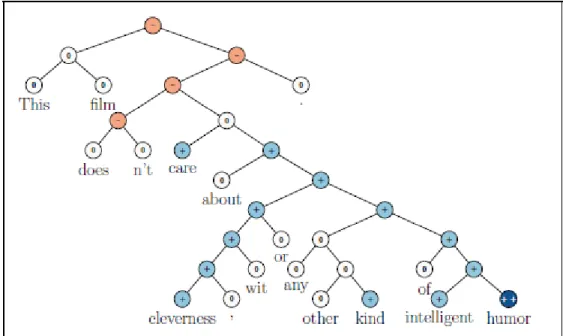
Figure 9. An example of fine-grained labeling and percolation of sentiments by using Recursive Neural Network (Socher et al., 2013) ... 28
Figure 10. Abstract architecture of a Recurrent Neural Network (Mikolov et al., 2010) ... 29
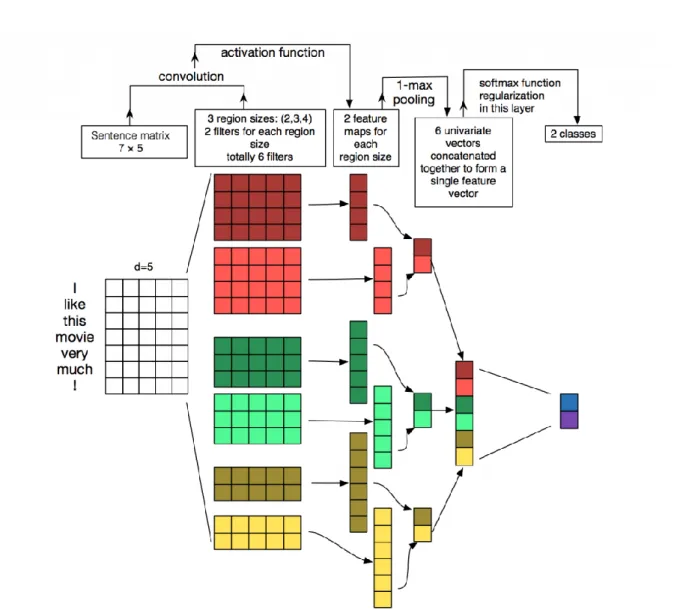
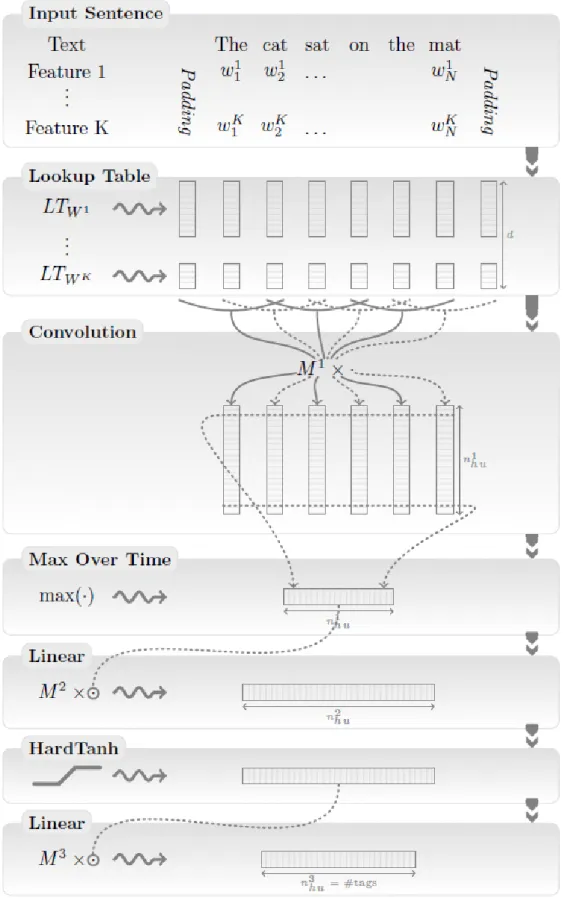
Figure 11. The general CNN’s architecture for sentence classification (Zhang & Wallace, 2015) ... 31
Figure 12. The sentence approach generic architecture proposed for sentence classification (Collobert et al., 2011) ... 32
Figure 13. CNN-based sentence classification model using Word2Vec embedding and max-pooling (Kim, 2014) ... 33
Figure 14. The performance of CNN compared to traditional classification approaches measured by F1-score (Dwyer, 2015) ... 34
Figure 15. Probabilistic view of anomaly detection in SPI setting (while predatory samples are considered anomalous) ... 39
Figure 16. Proposed Modular Process for Predator Identification ... 41
Figure 17. Data Schema of Conversations in PAN-2012’s Dataset ... 43
Figure 18. Labeling Conversations in Training Data ... 46
Figure 19. Changes of performance criteria versus number of features in PAN Dataset ... 47
Figure 20. Comparison of the anomaly detection approach with Naïve Bayes and SVM ... 50
Figure 21. The proposed CNN Architecture used for OPI ... 56
Figure 22. A sample snippet of a conversation... 58
Figure 23. Train and Test errors for 36 iterations of CNN with one convolution layer and real-valued bag-of-words features (experiment No.6). ... 61
Figure 24. Precision-Recall curves for showing the effect of extra convolution/hidden layers on CNN and NN... 62
Figure 25. The data flow of the implemented prototype ... 65
Figure 26. Abstract architectural design of Resolute ... 66
Figure 27. Design Class Diagram (DCD) of the Resolute prototype ... 67
xi
Figure 29. The prototype’s graphic user interface for applying the model on unsolved samples ... 69
xii
List of Tables
Table 1. Mapping of applications in OPI and corresponding data mining techniques ... 10
Table 2. Categorization of features used in OPI problem ... 15
Table 3.Typical examples of emoticon synsets (Hogenboom et al., 2013)... 18
Table 4. Sentiment Features (Bogdanova et al., 2014) ... 18
Table 5. Comparison of Deep Learning Frameworks ... 35
Table 6. No. of conversations in the PAN Dataset ... 42
Table 7. Characteristics of the SQ Dataset ... 42
Table 8. Different Experiments Conducted in this setting ... 44
Table 9. Different feature sets and their corresponding top-k selected features on the PAN dataset ... 47
Table 10. Results of training on Non-predatory samples (Experiment Train-NP-B) ... 48
Table 11. Results of training on predatory samples (Experiment Train-P-B) ... 48
Table 12. Results of testing on predatory samples (Experiment Test-P-B) ... 49
Table 13. Results of training on predatory samples after noise removal (Experiment Train-P-B-NR) ... 49
Table 14. Results of testing on predatory samples after noise removal (Experiment Test-P-B-NR) ... 50
Table 15. Results of training and evaluating through 2-fold cross validation on SQ dataset ... 51
Table 16. PAN-2012 dataset: Performance comparison for depth-1 CNN with baselines (Support Vector Machines (SVM) and traditional neural network (NN)) ... 60
xiii
Terms and Abbreviations
Age Disparity: The significant difference between the age of a predator adult and that of a minor (i.e., victim)
Conversation: A chat session that encompasses the messages exchanged between participants.
Clique: In the context of graph theory, a clique is a set of vertices whose corresponding subgraph is complete (i.e., fully connected). In the context of mining criminal networks, this definition can be simplified to be less mathematical. Specifically, in the context of chat logs, a clique might be defined as a set of persons who participate in a minimum number of chat sessions.
Luring Communication Theory: A communication theory that models the behavior of predators for approaching, entrapping, and establishing a predatory relationship with a minor. Maximum Entropy Principle: This principle states that the best probability distribution for a statistical model is the one that has the maximum entropy.
Minor: A Person under the age of 18 who is considered as the potential victim of predatory attack in cyber space.
Vector Space Model: The algebraic representation of documents based on their terms and the frequency of occurrence of each term.
Anomaly: Samples that do not conform to the underlying distribution or regular pattern of data.
OPI: Online Predator Identification SVM: Support Vector Machine KNN: K-Nearest Neighbor
ConvNets/CNNs: Convolutional Neural Networks
NNs/ANNs: Neural Networks/Artificial Neural Networks (original feed-forward Multi Layer Perceptron (MLP))
1
CHAPTER 1
1.
INTRODUCTION
The ease of access and anonymity of Internet users facilitate child exploitation and cyber sexual abuse. Due to the prevalence of the online conversations, mitigating the undesirable effects of juvenile abuse in cyber space has become critical. This has been a major concern in developed countries with a high rate of Internet access in which children are basically the most vulnerable Internet stakeholders. Providing a safe environment for juveniles and children in online social networks is considered one of the major factors in improving public safety. According to Kierkegaard (2008), sexual solicitations of 89% of youth are made in chat rooms. This highlights the vital need for mining large volumes of anonymous chat logs in order to address this kind of social crime.
Automated Online Predator Identification (OPI) is a proactive means to counteract the undesirable effects caused by the aforementioned crimes. Recently in the literature, this has also been known as Sexual Predator Identification (SPI) or Sexual Predator Detection (SPD). Although practical OPI involves dealing with textual data and images, textual data are considerably more convenient to be used for automation purposes rather than the imagery data. Accordingly, dealing with textual data is the main focus of this thesis, wherever the OPI is mentioned in general.
This chapter serves as a basis of problem understanding for the rest of chapters of the thesis. It highlights the importance of Online Predator Identification (OPI) as an effective action toward improving public safety in society. This is also known as Sexual Predator Identification (SPI) or Sexual Predator Detection (SPD). We will address the problem as OPI in the rest of this writing. This section also discusses the relationship between machine learning and OPI which is the focus of next chapters.
1.1.
Domain Concepts
This section contains the essential information about legal and psychological aspects of online predator identification.
1.1.1.
Legal Aspects
Although legislative and regulatory provisions regarding online child sexual abuse aim to combat and mitigate the impact of this threat, they may vary in different countries or even different jurisdictions in the same country. According to Kierkegaard (2008), “while virtual child porn using avatars is generally considered illegal in the European Union, it might not necessarily be treated as such in the United States” (p.44). Similarly, “images that are illegal to view in the USA may not be illegal to view in Germany” (p. 41). The same situation exists about the concept of age disparity between adults and minors. There have been countless writings on the legal aspects of child sexual abuse in online environments that go beyond the scope of this chapter.
2
1.1.2.
Psychological Aspects
The most effective and also simple psychological aspects of predatorhood might be those defined by Morris in his master of science thesis (Morris, 2013). The author defined predatorhood as having two major components: age disparity and inappropriate intimacy. The former relates to the psychological immaturity of the victim compared to that of predator (adult) which may differ in various countries by law. The latter corresponds to the attempt of adult to establish an intimate conversation that usually involves implicit or explicit sexual comments.
One of the most practical psychological theories which is widely used in online predator identification is known as luring communication theory (Olson, Daggs, Ellevold, & Rogers, 2007). The theory comprises three main phases needed for committing a predatory act:
1. Gaining access to the victim
2. Entrapping and grooming until the victim accepts sexual advances 3. Initiating and maintaining the abusive relationship
On the Internet, the most common way for gaining access is through online conversations in chat rooms.
The second stage can be distinguished by observation of the predator’s attempt to desensitize the child to the inappropriate intimacy.
Finally, the third step involves explicit sexual exploitation of the minor. At this point, a reliable OPI system can flag the conversation for the attention of law enforcement in order to prevent the predator from approaching the victim.
1.2.
OPI Problem Definition
During the past decade, automated Online Predator Identification (OPI) has become tractable by using text mining algorithms. These algorithms are capable of identifying likely predators for the attention of law enforcement. Using automatic ways to address this kind of crime is challenging and demands efficient and scalable data mining techniques which are able to handle large volumes of chat logs. There are two major OPI problems in which text mining plays an important role:
1. Detecting predators
2. Visualizing and analyzing predator criminal networks
The solution to the first problem, which is the main focus of this thesis, can be casted as a combination of textual preprocessing in data/text mining and pattern classification in machine learning and also criminal psychology (Figure 1). The solution to the second OPI problem is provided by extracting the underlying relationships and using graph mining techniques to analyze the resultant social networks.
3
Figure 1. Relationship between OPI, Text mining, Pattern Classification and Criminal Psychology
As illustrated in Figure 1, text mining and pattern classification techniques form the algorithmic foundations of OPI. A comprehensive but concise survey of text mining which incorporates the gist of text mining algorithms is provided in (Aggarwal, 2015). Pattern classification (also known as pattern recognition) encompasses the classification algorithms used in predator identification and goes hand in hand with machine learning techniques (Duda, Hart, & Stork, 2012).
Figure 2 illustrates the main data mining techniques used in OPI along with their relationships.
4
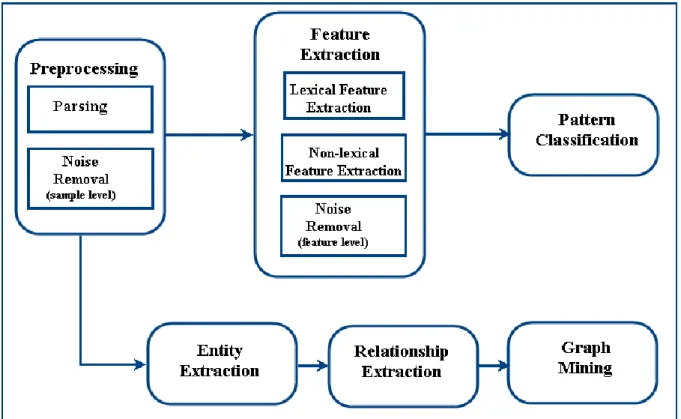
The first module is responsible for performing preprocessing tasks on the input text. The constituent of this module depends on the format of the data. Since in our domain we are mostly dealing with XML files, using an XML parser is necessary. After parsing, some documents may be chosen to be eliminated from further processing.
In the feature extraction module, prominent lexical features are extracted. Additionally, some behavioral and structural features are extracted based on the statistical and linguistic characteristics of the conversation. Afterwards, the low-quality features might be removed. The quality of a feature is usually defined to be proportional to the amount of contribution of the feature on the output (see Section 2-3). The pattern classification module performs the classification task and produces the final output (see Section 2-4).
There has been a dedicated competition for Sexual Predator Identification in PAN-2012 as part of the CLEF 2012 competition1 that expedited the movement of applying data mining techniques on chat logs in order to identify the likely predators. Several competitors from all over the world applied their data mining techniques on a relatively large volume of chat logs. The competition encompasses the following two tasks (Inches & Crestani, 2012):
1. Distinguishing the predators and victims.
2. Specifying predatory messages in predatory conversation.
Accomplishing the first task is of greater help to law enforcement in terms of narrowing down their search space significantly. According to Villatoro-Tello et al. (2012), this task can be performed in two consecutive steps:
1. Identifying the predatory conversations among all conversations.
2. Distinguishing the sexual predator and the victim among participants of predatory conversations.
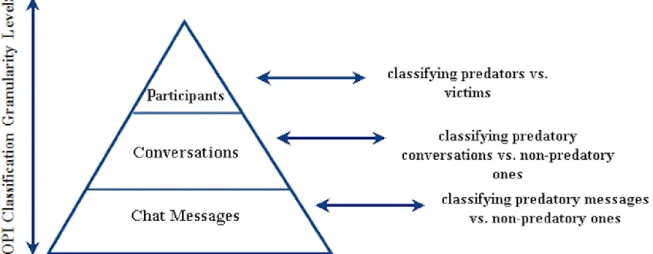
This thesis proposes an abstract taxonomy that encompasses different classification techniques that are used in the OPI field. There are three main granularity levels of analysis in dealing with online predator identification. These levels are shown in Figure 3.
1 http://pan.webis.de/
5
Figure 3. Classification Granularity Levels and their corresponding classification problem in OPI (Ebrahimi, Suen et al., 2016)
As seen in Figure 3, the most fine-grained level corresponds to direct analysis of messages
(also known as interventions) exchanged by participants in their conversation. This kind of analysis corresponds to the task of distinguishing the sexual predators in PAN-2012. The next level of granularity relates to the task of identifying predatory online conversations. Finally, distinguishing the predators among all of the participants in the entire corpus can be considered as the highest level of abstraction that might be the ultimate goal. All of these analyses are accomplished by utilizing the proper machine learning classification techniques. For a more cohesive and detailed introduction of these techniques, please refer to (Keyvanpour, Ebrahimi, et al. 2015) or the second chapter of this thesis.
1.3.
Objective and Contribution
This thesis aims to investigate and address two major problems in the domain of OPI and adapt machine learning techniques to address these problems. The objectives can be categorized as follows:
Objective 1: Eliminating the problem of gathering negative training instances while keeping the performance acceptable
In practice, finding enough negative (non-predatory) instances is tedious and sometimes unrealistic. This thesis proposes a semi-supervised anomaly detection approach that only utilizes one of the class labels in the training process rather than both labels.
Objective 2: Improving the classification performance in terms of F1-score compared to
traditional machine learning algorithms (SVM and ANN)
Binary classification methods that have been used in the OPI domain have a relatively lower classification performance than that of the deep learning method that is proposed in this thesis.
6
1.4.
Research Questions and Hypotheses
Aligned with the two main problems mentioned in the preceding section, the followings are main research questions:
1) Considering the OPI domain, how efficient will an anomaly detection model that only uses one of the class labels perform, as compared to binary classification models that use both positive and negative class labels?
Hypothesis 1: Predatory/Non-predatory conversations can be represented as anomalous conversations that do not conform to the underlying data distribution. The problem can be casted to a one-class classification problem. The performance would be comparable to that of binary classification which uses two class labels.
2) Is a deep learning architecture able to increase the classification performance and outperform the current state-of-the-art performance obtained in this domain?
Hypothesis 2: Learning deep architectures for classification of chat logs can outperform the state-of-the-art methods in terms of F1-score.
1.5.
Research Methodology
First, a comprehensive study was conducted on the literature and the extension points and problems are identified. Accordingly, this thesis stated two main hypotheses that are mainly related to alleviate current problems in the domain. Then, datasets are obtained and pre-processed. Afterwards, several empirical sets of experiments are designed to support or to reject each hypothesis. In parallel, a software prototype is designed and implemented in Java to support hypothesis 1. Finally, the results of the experiments are articulated and the related challenges are discussed. Additionally, a speculation of future research direction is presented based on the observations.
1.6.
Structure of this Dissertation
To answer the research questions and evaluating the stated hypotheses this dissertation has been organized as follows:
Chapter 2 contains a literature review covering preprocessing, feature extraction and classification techniques used in the OPI domain. It contains the background information on anomaly detection and deep learning required to understand the content of the remaining chapters.
Chapter 3 is dedicated to the usage of anomaly detection in our problem at hand. It describes the required adaptations and customizations; it also contains the description of the corresponding experiments and the analysis of the results. The goal of this chapter is to support hypothesis 1 stated above.
Chapter 4 covers the experiments and results of applying and customizing deep learning techniques on the domain of OPI. The goal of this chapter is to support hypothesis 2 stated above. Chapter 5 covers software engineering aspects of the prototype that was designed and
7
implemented as a proof of concept for supporting hypothesis 1. Chapter 6 has been devoted to draw conclusions, revisiting the objectives, and corresponding hypotheses, and the research schedule. Finally, Appendices A and B illustrate some samples of XML processes used in Chapter 3 and also several samples of bash scripts used in Chapter 4.
8
CHAPTER 2
2.
BACKGROUND AND LITERATURE REVIEW
This chapter covers the related work regarding the whole contribution of this thesis. It starts with describing general usage of machine learning in OPI and then moves along to the background review of anomaly detection techniques. Finally, a literature review of deep learning is discussed. The chapter describes the usage of preprocessing, feature extraction, and classification in various aspects of an OPI problem. Different methods of preprocessing that have been found to be useful for working on chat logs are discussed. These methods include the most popular data formats, noise removal procedure and dimensionality reduction. Then, feature extraction and the standard ways of feature enrichment in this application domain are described.
The chapter also covers the usage of sentiment features as a complimentary set of features that can improve the performance of classification. In addition, a brief basic tutorial about the classification algorithms that are used in the domain of automated predator identification is presented. These algorithms cover a wide range of classification algorithms, such as entropy-based classification, Naïve Bayes, Support Vector Machine, and Neural Networks. We have tried to refer the keen reader to the related resources about the fully-detailed theories behind these algorithms.
Finally, in the last part of the chapter we describe Social Network Analysis (SNA) as another area related to this field of study. We provide a high-level introduction to the usage of SNA and its relationship to the online predator identification.
2.1.
Online Predator Identification
As mentioned in the previous section, OPI has its root in text mining and pattern classification. With the rapid increase of available textual data in different domains including news, social media, and web pages, text mining has drawn the attention of researchers during the last decade. There has been a variety of algorithms and approaches including text clustering and classification, text summarization, topic modeling, and opinion mining. Opinion mining or sentiment analysis is an important discipline in Natural Language Processing (NLP) that extracts people’s opinion, attitudes and emotions toward entities, other people, events, and their attributes. The reader may refer to (Aggarwal, 2015; Irfan et al., 2015; Liu & Zhang, 2012) for comprehensive explanations of these algorithms and approaches. Here, we narrow down the focus of the chapter to the usage of these techniques in OPI and the related background.
One of the very first successful attempts for applying data mining to OPI problem was accomplished by Pendar (2007) who used a weighted K-NN classifier to distinguish predators from underage victims. In addition, the first empirical system with the capability of determining predatory messages in chat logs is ChatCoder1 (Kontostathis, 2009). Afterwards, ChatCoder2 (see Section 2) was developed on top of the previous version to improve its performance (Mcghee et al., 2011). The system used a rule based approach in conjunction with decision trees and instance-based learning methods (K-NN).
9
Michalopoulos and Mavridis (2011), and Escalante et al. (2013) have utilized Luring Communication Theory (described in Section 1-1-2), to combine psychological aspects of predation phenomenon with computer science and machine learning.
Recently, the PAN-2012 conference has acted as a boost for applying machine learning techniques to this area. Several machine learning algorithms have been used to address the OPI problem in this competition. These algorithms cover a wide range of classification algorithms such as Entropy-based Classification (Eriksson & Karlgren, 2012), K-Nearest Neighbor (Kang et al., 2012), Support Vector Machine (Morris, 2013) and Neural Networks (Villatoro-Tello et al., 2012). The team with the best performance in terms of F1-score (Villatoro-Tello et al., 2012), used a two-step binary classification approach called SCI (Suspicious Conversation Identification) and VFP (Victim From Predator Disclosure) using SVM and Neural Networks.
Escalante et al. (2013) proposed a novel method using chained-classifiers based on adapting a psychological hypothesis that underscores three stages employed by predators to approach the victim. Although this method could not outperform the approach used by Villatoro-Tello et al., it revealed that adopting psycho-linguistic hypotheses could improve the accuracy. Due to the inadequacy of bag-of-words models in reflecting deep semantic notions hidden in the conversations, Bogdanova et al. (2012b) tried to enrich the features by introducing sentiments and emotions to the original feature set. In another research (Bogdanova, Rosso, & Solorio, 2014), the authors improved their feature set by adding more high level features such as neuroticism and psychological aspects. We will cover these studies in more detail through the chapter.
The use of deeper linguistic features in this field were attempted by Forsyth & Martell (2007) in their research for creating an annotated chat corpus with both lexical and semantic tags to facilitate the application of data mining in this domain. As another linguistic analysis example, Bogdanova et al. (2012a) have worked on identifying fixated discourse on chat logs. Fixated discourse signifies on the strong intention of the predator to keep the focus of the conversation on sexual topics. Finally, a holistic approach has been presented by Cano et al. (2014) based on leveraging lexical features, sentiment features, content and psycho-linguistic features, and discourse patterns. They have used semantic frames, which incorporate the general aspects of a discourse, and added them as additional features to the original bag-of-word model.
In the remainder of the chapter, we discuss the methods mentioned above in greater detail and highlight their strengths and weaknesses. Table 1 shows a mapping between data mining techniques and their applications in predator identification problem as well as the reference to corresponding works that have been done in the domain.
10
Table 1. Mapping of applications in OPI and corresponding data mining techniques
Application Area in OPI Data Mining Technique(s) Previous works
Predator Detection Binary Classification • Approaches in PAN-2012 • (Morris, 2013) • (Cano et al., 2014) • (Pendar, 2007)
Latent Semantic Indexing • (Kontostathis et al, 2013) Rule-based Approach • (Mcghee et al., 2011) Anomaly Detection • (Ebrahimi et al., 2016) Criminal Network Analysis
Graph Mining • (Iqbal et al., 2012) Criminal Network
Visualization
2.1.1.
Criminal Network Analysis and Visualization
Another aspect of OPI deals with pedophile covert network analysis and visualization. Iqbal et al. (2012) have used the concept of criminal clique mining on chat logs to reveal the hidden relationship among criminals. Figure 4 depicts the main components of their framework.
Figure 4. Overview of the framework for mining criminal networks in chat logs (Iqbal et al., 2012)
To analyze a criminal social network we need to explore the communication structure and the patterns by which network communications evolve. Based on the work of Klerks (2003), criminal network investigation approaches can be categorized into three types: 1) manual approach, 2) graphic-based approach, and 3) social network analysis. Since the focus of this chapter is on the identification aspects rather than network visualization and analysis, we focus on the predator detection through the remaining sections.
11
2.1.2.
Successful Sample Tools
In order to introduce successful examples of automated online predator identification we briefly describe two software tools in which data mining techniques have been applied to this domain in a practical environment.
- ChatCoder 2: This tool was implemented at the Mathematics and Computer Science Department of Ursinus College in Pennsylvania in 2011 (Mcghee et al., 2011). The software uses a rule-based approach to classify the messages in forums into several categories including ‘exchange of personal information’, ‘grooming’, ‘approach’, and ‘none of the categories’. These categories have been chosen based on the different phases defined in communication theory described in Section 1.2.2. This software system could provide a 68% accuracy on a public dataset available by a non-profit organization called perverted justice. One of the success factors of the software is that the system outperformed the human labeling in some of the categories.
- Child Exploitation Tracking System (CETS): In 2003, Microsoft initiated a new tool called Child Exploitation Tracking System (CETS) through close collaboration with the Toronto Police Service to create an infrastructure for sharing the relevant documents and evidences among different investigators. According to the Royal Canadian Mounted Police (RCMP), the tool is still being extensively used in Canada as a cross-jurisdiction information sharing system between child exploitation
investigators (Toews, 2013). CETS can be construed as a reliable tool that is being effectively utilized for combating child exploitation.
2.2.
Preprocessing methods for chat logs
Many data mining processes require a domain specific data preprocessing task which is often a tedious and time consuming task. Preprocessing of chat logs includes different subtasks ranging from parsing the raw textual log files to removing noise and reducing dimensionality.
2.2.1.
Chat Log’s Data Format
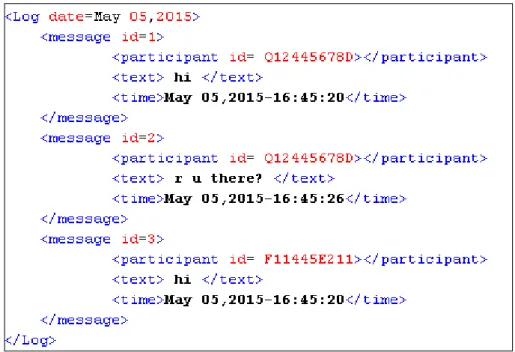
Since analyzing textual data is less expensive and more efficient than analyzing other media such as image and video, currently almost all of the approaches for OPI use solely textual data. Log’s format strongly depends on the software tool that is used for logging the conversations on the chat server. Although it can be any log format depending on the logging tool, usually the raw chat log data is gathered in a semi-structured textual format such as XML or JSON file. Various items can be stored in these logs among which the following three elements are essential for OPI analysis:
- Authors: participants who are usually identified by a unique identifier - Message text: the textual transferred message
- Time stamps: the date and time corresponding to each exchanged message Figure 5 depicts a sample template for a chat log in XML format.
12
Figure 5. A simple chat log in XML format with essential items for OPI
2.2.2.
Noise Removal
Noise removal procedure is done for the purpose of improving the performance of learning (in terms of precision, recall, and accuracy) and also reducing the training time. In OPI problems, noise removal procedure falls into one of the following categories (or a combination of both):
Removing noisy conversations: This category of noise removal procedure includes identifying and eliminating useless samples that do not affect the learning process. This includes removing the following items:
- Non-textual samples: Real-world chat logs may contain conversations with only non-textual data or a very tiny amount of textual information. These samples can be safely ignored.
- Conversations which include only one participant: This kind of conversations usually exists in a chat log corpus due to the fact that a participant may be unsuccessful in having a conversation with another participant.
- Extremely short messages (e.g., those which only contain a short greeting between two or more participants)
Removing noisy features: This category includes removal procedures for eliminating noise from features obtained during the feature extraction procedure (see Section 4). Feature extraction and its corresponding methods in OPI will be discussed in the next section. For now, features can be considered as the set of important terms in a conversation.
13
- Terms which are not in the proper encoding: This happens especially when there are multiple languages involved in the training corpus or there are other encodings than Unicode Transformation Format (UTF).
- Small images or emoticons transferred among a whole bunch of textual conversations are construed as noisy features depending on the approach: It should be noted that emoticons are considered as a valuable source of information especially for extracting sentiment features. In such cases, emoticons should not be treated as noise.
- Unintentional misspelled words throughout the conversation: It is worth mentioning that intentional misspelled words often play an important role in this application domain. As Villatoro-Tello et al. (2012) state: For example in the grooming phase the perpetrator may amend the relationship by an emphasized “soryyyyyyyyy” when the child felt threatening by any obtrusive language (p. 4).On the other hand, differentiation of intentional from unintentional spelling errors is not an easy task. Therefore, some researchers avoid the entire spell checking in the hope of gaining quality improvement.
2.2.3.
Feature Selection and Dimensionality Reduction
Let be a dataset with set of n terms denoted by N, and also let be the function which maps the conversations into in which P and NP represent the predatory instances and non-predatory instances respectively. The feature selection can be defined as the process of finding so that the performance of classifier is maximized. The performance of the classifier is typically defined by accuracy, precision, recall and F1-score. Forman describes a holistic introduction of feature selection techniques used in text classification (Forman, 2003).
Two common feature selection techniques are widely used in the OPI domain. One of them falls into the category of supervised feature selection techniques and the other one is an unsupervised technique:
- Unsupervised feature selection:
Document Frequency Thresholding: Let d(t) be the number of documents in which term t
occurs. Subset contains t if and only if , in which is an arbitrary threshold. As Yang and Pedersen (1997) state, document frequency thresholding is the simplest technique which scales well to large corpora.
- Supervised feature selection:
Information Gain: Supervised feature selection techniques measure each feature based on its contribution to the identification of the correct category (i.e., predatory or non-predatory). Information gain is a common supervised technique used for feature selection in text classification in the domain of OPI. The notation used by Forman (2003) for calculating information gain in a binary classification problem suits well in OPI. According to this notation, information gain for a specific term (feature) is defined as:
14 where:
(2) In addition, pos and neg represent the number of predatory and non-predatory cases, respectively. Also tp represents the number of predatory cases containing the term, fp is the number of non-predatory cases containing the term, fn is the number of predatory cases not containing the term and tn represents the number of negative cases not containing the term. P(t) is calculated as follows:
(3) There is a large variety of dimensionality reduction techniques used in data mining, but there is a text-specific dimensionality reduction technique called stemming, which is widely used in text mining. The purpose of doing this preprocessing step is to reduce, for instance, the terms ‘work’, ‘works’, ‘worker’ and ‘working’ into one dimension as ‘work’. This process usually has a desirable effect on the performance of text categorization, both in terms of quality and time efficiency.
However, unfortunately this technique may not provide the same desirable effect for the OPI problem domain due to the fact that it will distort the information pertaining to the writing style of predators in chat logs (Villatoro-Tello et al., 2012). Accordingly, the best results have been reported by other researchers in PAN-2012, while stemming has been avoided.
2.3.
Feature Extraction
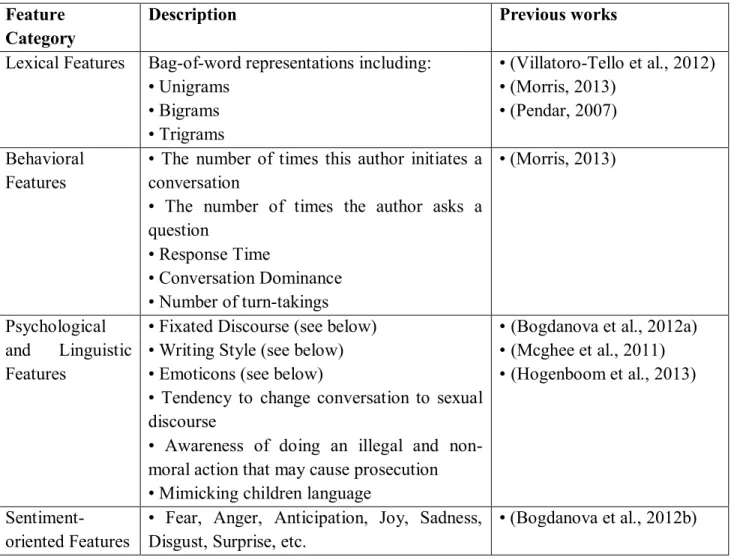
Table 2 categorizes the features that have been used in mining OPI problems along with corresponding previous works that have utilized these features.
15
Table 2. Categorization of features used in OPI problem
Feature Category
Description Previous works
Lexical Features Bag-of-word representations including: • Unigrams • Bigrams • Trigrams • (Villatoro-Tello et al., 2012) • (Morris, 2013) • (Pendar, 2007) Behavioral Features
• The number of times this author initiates a conversation
• The number of times the author asks a question • Response Time • Conversation Dominance • Number of turn-takings • (Morris, 2013) Psychological and Linguistic Features
• Fixated Discourse (see below) • Writing Style (see below) • Emoticons (see below)
• Tendency to change conversation to sexual discourse
• Awareness of doing an illegal and non-moral action that may cause prosecution • Mimicking children language
• (Bogdanova et al., 2012a) • (Mcghee et al., 2011) • (Hogenboom et al., 2013)
Sentiment-oriented Features
• Fear, Anger, Anticipation, Joy, Sadness, Disgust, Surprise, etc.
• (Bogdanova et al., 2012b)
In the rest of this section, the above feature extraction categories are described in greater detail.
2.3.1.
Lexical Features
Lexical features are word-related features that are directly extracted from the sentence. These words are used as candidate features in classification algorithms in order to determine the category to which chat logs belong.
One of the simplest approaches used in the OPI problem to extract features is the bag-of-words approach that treats a chat log as a bag of words. Each word that exists in a chat log is considered as a candidate feature and then these features are weighted in terms of their frequency of occurrence. Typically, the initial candidate feature set is built by extracting
n-grams (unin-grams, bin-grams, and trin-grams) from the training data. Usually words that have weak lexical meaning are known as stop words and are filtered out during the pre-processing in standard text categorization and Information Retrieval (IR) studies. However, because of the fact that chat logs have an informal writing style, the general list of stop words may not be adequate. That is why some researchers create their own list of stop words. As an example, the stop word list used by Pendar (2007) contained specifically 79 most frequent
16
words in the corpus. After filtering out the entire stop words successfully, the n-grams and their corresponding frequencies for each chat log (or for each chat participant) are extracted. Standard bag-of-words model has been shown to be robust in a wide variety of text classification problems. Term Frequency-Inverse Document Frequency (TFIDF) is the most common weighting approach that is extensively used for weighting the candidate features before performing any feature selection procedure. In this weighting scheme, the most important words tend to have higher weights. This is implicitly achieved by multiplying the frequency of term t by a magnitude that is inversely proportional to the occurrence of term t
in the whole corpus.
Generally speaking, building unigrams and bigrams (pairs of consecutive words) produce better results than higher n-grams. Depending on the characteristics and also the size of the training corpus, the use of bigrams may increase the performance at the expense of increasing the size of the feature-space. However, for a training problem it may turn out that unigram model produces a better performance.
Regardless of the classification performance, the size of the feature set for bigram representation is typically much larger than that of unigram model. The resultant feature set can also be enriched by adding domain-specific features. As an instance, in the work of Morris (2013), special tokens such as \SMILEY, \MALE.name, \FEMALE.name, \NUM and \PHONE.name were added to the lexical features in order to enrich the initial feature set. However, it was mentioned that these enhancements seemed to add an insignificant improvement.
Considering the inadequacy of bag-of-words models in reflecting deep semantic notions hidden in the conversations, one can alsoenrich the feature set with behavioral features which would be explained in detail below.
2.3.2.
Behavioral Features
In this section, we list the high-level behavioral features and their applicability in the detection of online predators. Behavioral features are characterized as features that capture the typical actions of a user within a conversation. Morris (2013) has classified behavioral features as: ‘Initiative’, ‘Attentiveness’ and ‘Conversation dominance’ for which the details are given accordingly:
- Initiative: This can be measured by number of initiations (i.e., number of times a specified participant starts the conversation), initiation rate (i.e., the ratio of number of initiations to the whole number of conversations), questions and question rate in order to understand the author’s tendency during the conversation.
- Attentiveness: This feature corresponds to the mean, median, and max response times for each author.
- Conversation dominance: A set of features such as ‘Message Ratio’, ‘Word Count Ratio’ that reflect the degree to which the focal author dominates the conversation. In order to successfully distinguish predators from victims, the above mentioned features are critical for ‘symmetry-breaking’ (Morris, 2013). That is, given the fact that two authors in a chat conversation use very similar languages, behavioral features are one of the significant identifiers or non-lexical aspects of the conversation which are able to differentiate predators from victims.
17
2.3.3.
Psychological and Linguistic Features
Psycho-linguistic features form another important aspect of feature extraction in OPI domain.
‘Fixated discourse’ is one of the most prominent psychological features used in OPI. Bogdanova et al. (2012a) defined fixated discourse as the unwillingness of the predator to change the topic. For instance, predators often ignore questions or interruptions of pseudo-victims and have the tendency to go back to a sex-related conversation. According to Bogdanova et al. (2012a), chat logs might include implicit and explicit sexual content as predators gradually alter the direction of conversation to sex by starting with some ordinary compliments. On the other hand, predators often are aware of the fact that what they do on chat rooms is not moral and they try to transfer the responsibility to the victim and often behave as children by copying the children’s linguistic style (Bogdanova et al., 2014).
The following analysis of chat logs identifies the important characteristics of predators’ psychological and linguistic features (Bogdanova et al., 2014)
- “Implicit/explicit content: Typically, pedophiles shift gradually to the sexual
conversation, starting with ordinary compliments and then they shift the conversation to make it overtly related to sex. They do not hide their intentions.
- Fixated discourse: Pedophiles are reluctant to step aside from the sexual conversation. In other words, pedophiles try to come back to the sex-related conversation when the victim steps outside of the topic.
- Offenders often understand that what they are doing is not moral. - They transfer responsibility to the victim.
- Offenders often behave as children, copying their linguistic style. Colloquialisms appear often in their messages.”
Mcghee et al. (2011) have proposed the following linguistic features which were denoted as ‘Writing Style’ in Table 2: Total number of words in a line, number of first-person pronouns, second-person pronouns or third-person pronouns, number of personal information nouns
(e.g., age, pic), number of relationship nouns (e.g., boyfriend, date), number of family nouns
(e.g., mom, sibling), number of communicative desensitization words (e.g., kiss, bra), number of approach verbs (e.g., meet, see, hotel).
Hogenboom et al. (2013) indicate that people were influenced by nonverbal cues and emoticons. These are widely used to express sentiments such as happiness, sadness, joy or anger, therefore emoticons could also be used to reveal the predators’ sentiments and their tendencies in order to be dominant in the conversation and also to copy children’s’ behavior as explained above. The following table shows the typical examples of emoticons and their sentimental interpretations (Hogenboom et al., 2013).
18
Table 3.Typical examples of emoticon synsets (Hogenboom et al., 2013)
Emoticon synset Emoticons
Happiness :-D, =D, xD, (^_^) Sadness :-(, =( Crying :’(, =’(, (;_;) Boredom -_-, -.-, (>_<) Love <3, (L) Embarrassment :-$, =$, >///<
2.3.4.
Sentiment-oriented Features
In addition to the emoticons explained earlier, the sentiment of chat logs can provide significant markers in terms of predator identification and unveil other important semantic dimensions. According to Bogdanova et al., (2012b), in general, predatory conversations contain more positive and less negative words.
The following sentiments and emotional markers were used as features in their experiments:
Table 4. Sentiment Features (Bogdanova et al., 2014)
Feature Example
Positive words Cute, pretty
Negative words Dangerous, annoying JOY words Happy, cheer
SADNESS words Bored, sad
ANGER words Annoying, furious SURPRISE words Astonished, wonder DISGUST words Yucky, nausea FEAR words Scared, panic
2.4.
Learning Predatory Patterns
First, we formally introduce the notion of binary classification which is used in the OPI problem.
Let dataset D be defined as where is the set of m
observation vectors , so that is the corresponding vector of ith observation containing n feature values . Also is the set of two class labels corresponding to predatory and non-predatory instances respectively. The classification task is defined as finding a mapping function such that is able to predict as accurately as possible.
As a typical approach, the data is split into training and testing sets. The classification model learns from the training set and is then applied to the test set to evaluate the performance of classification. A wide variety of learning algorithms for learning the function have been
19
proposed and utilized in data mining (Duda et al., 2012). In the following subsections the most common algorithms that have been used for solving OPI problems are introduced.
2.4.1.
OPI Standard Classification Methods
This section is dedicated to introducing concrete data mining classification algorithms which have been used in OPI problems. First, we describe a standard probabilistic model called Naïve Bayes which has been used for text classification since the last two decades. Then we discuss an intuitive algorithm which is usually used in information retrieval called K-NN. Then we proceed to more advanced algorithms such as Entropy-based classification, Support Vector Machines and Artificial Neural Networks.
2.4.2.
Naïve Bayes
This model is used extensively as a baseline in text classification studies. This means that researchers accept it as an efficient algorithm and aim to improve its performance through other novel algorithms. Although the reader can refer to Duda et al. (2012) for a thorough explanation of the algorithm, we present a brief description here.
Let D be the dataset defined in the previous section. Assuming that all discrete-valued features are conditionally independent given the class label (known as ‘Naive Bayes assumption’) we can simplify that is the conditional probability of observation vector given y as follows: (4)
Having calculated as above, one can predict the most likely class label ( ) by using the Bayes rule as follows:
(5)
Specifically in OPI problems, we deal with labels p and np and we can rewrite the above as: (6)
2.4.3.
K-Nearest Neighbor
Kang et al. (2012) have used K-Nearest Neighbor (also known as KNN) for online predator identification. They have used a weighted modification of classic KNN model. Although their result is not comparable with other methods, their approach is worth mentioning due to the interesting justification behind it.
20
The simplest version of the algorithm can be outlined as follows. More sophisticated explanation can be found in Duda et al., (2012).
Algorithm: KNN(D, , k, m) Input: Output:
y: predicted class label ‘p’ or ‘np’ (i.e., deciding whether the sample is predatory or not)
- Find k nearest neighbors to based on the distance measure and add them to neighbors set N.
- Add the corresponding class labels of found neighbors in N to labels set L. -
where the majority function simply calculates the majority of class labels among the k nearest neighbors.
There are also weighted versions of KNN which assign different weights to the neighbors based on their distance to the query point (i.e., ). The authors of (Kang et al., 2012) state that choosing a good value for k that can provide good results remains a challenge.
2.4.4.
Maximum Entropy Classification
The conditional independence assumption of Naive Bayes is not realistic at least when dealing with textual documents. Therefore, other statistical models have been proposed to consider the notion of dependent random variables.
A Maximum Entropy Classifier is a discriminative approach that tries to build a statistical model of conditional probability distribution . There is an infinite number of such models, but based on the maximum entropy principle, the best model is the one which maximizes the entropy H(P). Berger et al. (1996) formally state this as follows:
(7) In order to choose the best model from set C (the set of valid probability distributions), based on the maximum entropy selection, we have to solve the following optimization problem:
(8)
Note that the above optimization problem is a constrained one. Nevertheless, describing the complete theoretical background of Maximum Entropy Classifier is beyond the scope of this chapter. The keen reader may refer to the seminal paper by Berger's et al. (1996) about maximum entropy classifier for natural language processing.
21
Eriksson and Karlgren (2012), and Kern et al. (2012) used a Maximum Entropy Classifier in the OPI domain on the PAN-2012 dataset. Their results are comparable with the best performing approach in PAN-2012 and can be considered as a successful approach for addressing OPI problems.
2.4.5.
Support Vector Machines
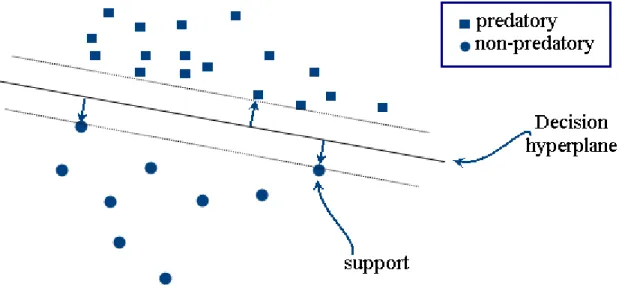
Currently, Support Vector Machines (SVMs) have shown the best results among all different classification algorithms which have been used for OPI problems (Villatoro-Tello et al., 2012). SVM was originally introduced by Vapnik, (1995) in his book entitled ‘The Nature of Statistical Learning Theory’. The goal of the SVM algorithm is to give a hyperplane that maximizes the margins between positive and negative instances (predatory and non-predatory samples in our case). The margin is defined as two times the distance from the decision hyperplane. Figure 6 illustrates the idea of SVM.
Figure 6. An example of showing the output of SVM for a binary classification as well as the margin and three support vectors.
Instances located on the margins are called ‘support vectors’. The main result of training an SVM model is to obtain these support vectors also known as supports. These instances are the only ones that are taken into consideration when a new instance needs to be classified by the model. The training procedure consists of solving a constrained optimization problem, which is usually solved by out-of-the-shelf quadratic programming tools. SVM has been used by Morris (2013), and Villatoro-Tello et al. (2012) and as already mentioned, SVMs have obtained the highest performance at PAN-2012. The reader may refer to Bishop (2006) for the mathematical background of support vector machines.
Note that besides the classification algorithm, the preprocessing methods and feature extraction methods described in Section 2.3 have a significant impact on the final performance of the classification.
22
2.4.6.
Neural Networks
Even though there are a large variety of neural network algorithms, the one that has been successfully utilized in OPI is the Multi Layer Perceptron (MLP). Villatoro-Tello et al., (2012) tested MLP for identifying predatory conversations in addition to identifying the likely predators and then compared their performance with that of Support Vector Machines. The results showed that the performance of the MLP and the SVM are comparable to each other. More specifically, the neural network outperformed SVM in identifying predators versus victims; while the SVM performed better in identifying the predatory conversations. Here, we introduce the key concepts of MLPs without a detailed description of algorithm. Units are considered as building blocks of MLPs. Each unit resembles a neuron that has a specific ‘activation function’ that generates the output of a neuron. At a higher level of abstraction, the network contains several layers of units including input, output and one or more hidden units. The units in a layer are not connected to each other, while usually all of the units in a previous layer are connected to the units in the next layer. A real number called
‘weights’ is assigned to each connection. The final output of a neuron located in the first hidden layer with M units is calculated as follows (Bishop, 2006):
(9)
where i denotes the index of the features in the input vector and j denotes the index of the neurons located in the first layer of the network. Also h is the activation function for the neurons in the hidden layer which is usually chosen to be a sigmoidal function. D is the number of features in the input sample. Finally, superscript (1) denotes the layer in which neuron is located. This process of linear transformations continues in a cascading manner from previous layers to the last hidden layer and eventually to the output layer, in which the final output of the network is generated.
The learning algorithm of an MLP with a specified structure finds the relatively optimal network weights via local optimization. The learning procedure encompasses a technique called ‘backpropagation’ and also an optimization technique called ‘gradient descent’. For a complete description of Neural Networks the reader may refer to Bishop's book (2006). There are several out-of-the-shelf libraries and tools for building and training neural networks. In terms of accuracy, precision, and recall rate (see Section 2.4.7), Support Vector Machines and Neural Networks (Multi-layer Perceptron) seem to outperform other classification methods for the task of OPI. However, it is worth to apply a simple approach such as Naïve Bayes to obtain a performance baseline so that if there is a problem with parameter tuning of the two mentioned algorithms, it will be revealed at the first stages of the analysis.
2.4.7.
Performance Measures
Precision and recall rate in addition to their harmonic mean (F1-score) are usually used as performance measures in classification. Let tp be the number of predatory conversations identified correctly (i.e., true positive), tn be the number of non-predatory conversations identified correctly (i.e., true negative), fp be the number of non-predatory conversations identified as non-predatory by mistake (i.e., false positive), and
23
finally let fn denote the number of predatory conversations identified as non-predatory by mistake (i.e., false negative). Then the precision is calculated as and the recall would be .
2.5.
Anomaly Detection Literature Review
The first successful attempt to use machine learning in OPI problem to distinguish predators from underage victims was done by Pendar by means of a weighted K-NN classifier (Pendar, 2007). To the best of our knowledge, the first empirical system with the capability of determining predatory messages in chat logs is ChatCoder1 (and Chatcoder2) implemented by Kontostathis and her colleagues (Kontostathis, 2009; Mcghee et al., 2011). The system uses a rule based approach in conjunction with decision trees and instance-based learning (KNN). It is worth mentioning that in (Tan, 2005) the author introduced a general approach for using a weighted version of the KNN algorithm to mitigate the problem of learning from imbalanced datasets in text categorization.
The PAN-2012 conference has acted as a boost for applying machine learning techniques to online sexual predator identification. The main strength of this conference is providing the first publicly available standard dataset which was specifically developed for the sexual predator identification task. Researchers tuned their proposed methods against the same training data and reported their performance on the official test data. Several machine learning algorithms have been used to address the OPI problem in this competition. These algorithms cover a wide range of classification algorithms such as maximum entropy-based classification (Eriksson & Karlgren, 2012), KNN (Kang et al., 2012), Support Vector Machine (Morris, 2013) and Neural Networks (Villatoro-Tello et al., 2012). The top team (Villatoro-Tello et al., 2012) has used a two-step binary classification approach called SCI (Suspicious Conversation Identification) and VFP (Victim From Predator Disclosure) using SVM and Neural Networks.
Inspired by the approach used by Villatoro-Tello (2012) we have used the SVM method to compare the performance of our anomaly detection approach. Escalante and his colleagues (Escalante et al., 2013) proposed a new method based on learning a chain of three local classifiers corresponding to three segments of each conversation but the approach could not outperform that of the top performing method in PAN-2012.
A related research has been done on cyber bullying by Kontostathis et al. (2013), which is very close to predator identification. They utilize a different supervised learning algorithm based on Latent Semantic Indexing (LSI) that is called Essential Dimensions for identifying cyber bullying. They built their own dataset using ‘formspring.me’, a question-and-answer popular website.
More recently, Cano et al., (2014) have proposed enriching the traditional bag-of-word approach by adding other feature types including sentiment features, psycho-linguistic features and discourse patterns. Eventually, they have used a binary classification for the actual predator identification task.
Generally, the algorithms used in PAN-2012 can be considered as the state of the art in sexual predator identification. However, in regard to anomaly detection, there is a wide variety of unsupervised, supervised, and semi-supervised models. A comprehensive survey of
24
anomaly detection has been done in (Chandola et al., 2009). The authors have categorized anomaly detection methods into six major categories: clustering based, classification based, nearest neighbor based (which includes density based methods), statistical, information theoretic and spectral methods.
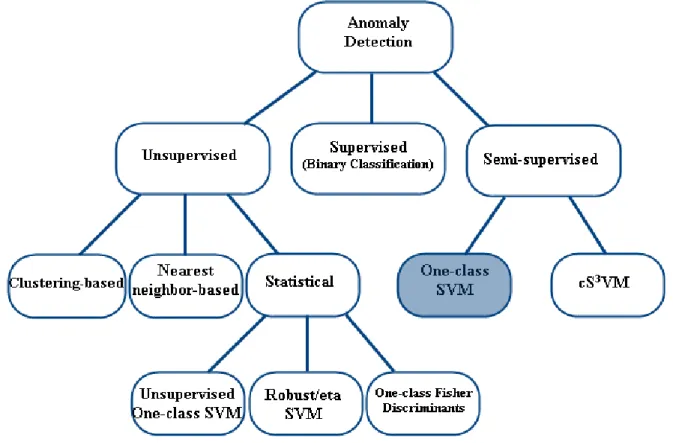
We use a slightly different taxonomy to show where our method stands with respect to the learning method that is used for anomaly detection. We avoid describing different methods and foundations of anomaly detection since it is beyond the scope of this thesis. Instead, we focus on the specific anomaly detection method (i.e., one-class SVM) that yielded the competitive results in this application domain based on our results. Figure 7 illustrates the taxonomy of the most common anomaly detection techniques as well as the position of semi-supervised techniques. One-class SVM has been highlighted in the figure. For the sake of completeness, the unsupervised SVM-based algorithms are shown as well. The corresponding leaf nodes of the taxonomy will be introduced in the next section.
Recently, several works have addressed the problem of anomaly detection in micro-blogs or short messages especially in Twitter (Anantharam et al., 2012), (Guzman & Poblete, 2013). (Kumaraswamy et al., 2015) et al. have used domain-specific features encoded as first order logic for textual anomaly detection. Anomaly detection methods have not been applied to the SPI problem.
Figure 7. Position of Semi-supervised and SVM-based techniques in the taxonomy of anomaly detection techniques
To our knowledge, anomaly detection has not been applied to the OPI domain. As a new area of application, we examined this approach on the PAN-2012 data and we discuss the results of this approach and compare it with other more commonly used two-class classification