Army Regulation 190–13
Military PoliceThe Army
Physical
Security
Program
HeadquartersDepartment of the Army Washington, DC
30 September 1993
SUMMARY of CHANGE
AR 190–13
The Army Physical Security Program
This
revision-o Crevision-onsrevision-olidates AR 190-13 and AR 15-15, Department revision-of the Army Physical Security
Review Board (DAPSRB), and incorporates policy on the purpose, function,
composition of the DAPSRB (chap 7).
o Addresses command responsibility for a crime prevention program (para 2-2).
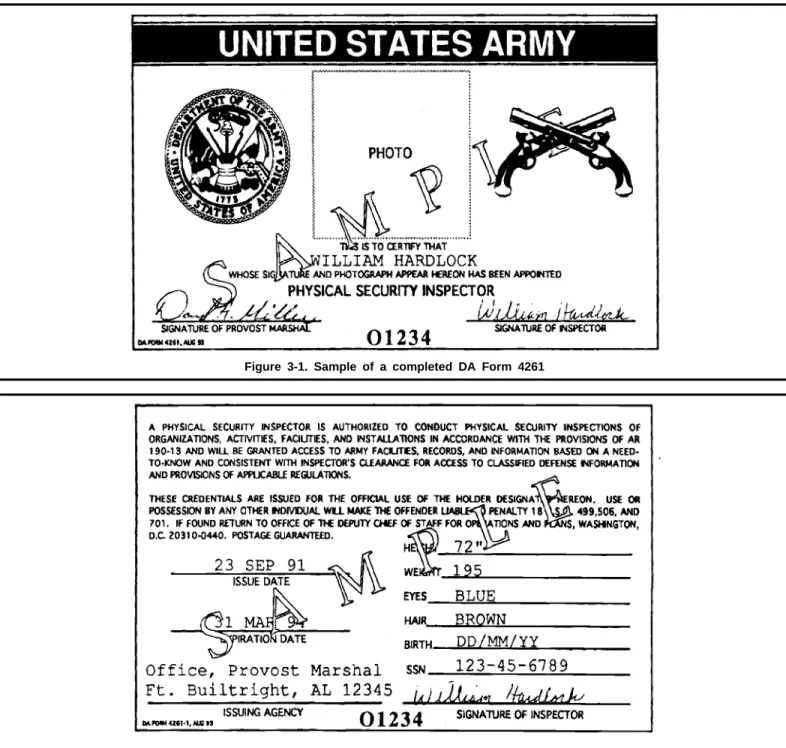
o Revises DA Form 4261 and DA Form 4261-1 (Physical Security Inspector
Identification Card) (paras 3-1 and 3-2).
o Redesignates site surveys as security engineering surveys. Modifies Physical
Security Equipment Management Program objectives (para 2-14).
o Identifies the establishment, purpose, functions, and composition of the
Department of the Army (DA) Physical Security Equipment Action Group (PSEAG)
(para 4-4).
o Redesignates the Product Manager for Physical Security Equipment (PM-PSE) to
the Physical Security Equipment Manager, Physical Security Equipment
Management Office (PSEMO) (para 4-5).
o Adds an outline of the establishment and specific functions of the Physical
Security Equipment Working Group (para 4-6).
o Addresses intrusion detection systems (IDS) by: revising the priority for
installation of IDS based on the level of security needed (para 4-9);
discussing planning for IDS (para 4-15); establishing new priorities and
priority codes for the IDS (table 4-1).
o Outlines security force procedures, inspections, and security patrol plans
(chap 8).
o Authorizes exact replication of any Department of the Army and Department of
Defense forms that are prescribed in this regulation and are generated by the
automated Military Police Management Information System in place of the
official printed version of the forms (app A).
Headquarters
Department of the Army Washington, DC
30 September 1993
Military Police
The Army Physical Security Program
*Army Regulation 190–13
Effective 30 October 1993
History. This UPDATE printing publishes a r e v i s i o n o f t h i s p u b l i c a t i o n . B e c a u s e t h e s t r u c t u r e o f t h e e n t i r e r e v i s e d t e x t h a s b e e n r e o r g a n i z e d , n o a t t e m p t h a s b e e n m a d e t o highlight changes from the earlier regulation dated 20 June 1985.
S u m m a r y . T h i s r e g u l a t i o n i m p l e m e n t s DOD 5200.8–R, Physical Security Program, and DODD 3224.3, Physical Security Equip-m e n t ( P S E ) : A s s i g n Equip-m e n t o f R e s p o n s i b i l i t y for Research, Development, Testing, Evalua-tion, ProducEvalua-tion, Procurement, Deployment, and Support and consolidates two regulations pertaining to physical security: AR 190–13 and AR 15–5. It prescribes policies, proce-dures, and guidance to plan and implement the Department of the Army Physical Secu-rity Program, to include the functions and membership of the Department of the Army
Physical Security Review Board, and the De-p a r t m e n t o f t h e A r m y P h y s i c a l S e c u r i t y Equipment Action Group. It provides general g u i d a n c e c o n c e r n i n g r e q u i r e m e n t s f o r a n d use of physical security equipment; the ap-pointment of physical security officers and i n s p e c t o r s ; p h y s i c a l s e c u r i t y c r e d e n t i a l s , i d e n t i f i c a t i o n c a r d s a n d b a d g e s ; r e s t r i c t e d areas; and security forces.
Applicability. This regulation applies to all units of the Active Army, the Army National Guard, the U.S. Army Reserve, and the Re-serve Officers’ Training Corps when in Fed-e r a l S Fed-e r v i c Fed-e t h a t c o n t r o l , m o v Fed-e , s t o r Fed-e , m a i n t a i n , o r s e c u r e A r m y m a t e r i e l , e q u i p -ment, and personal property unless exempted by other regulations. This publication applies during partial and full mobilization. P r o p o n e n t a n d e x c e p t i o n a u t h o r i t y . The proponent of this regulation is the Dep-uty Chief of Staff for Operations and Plans. The Deputy Chief of Staff for Operations and Plans has the authority to approve exceptions to this regulation that are consistent with con-trolling law and regulation. The Deputy Chief of Staff for Operations and Plans may dele-gate this authority in writing to a division chief within the proponent agency who holds a grade of colonel or the civilian equivalent. T h e a p p r o v a l a u t h o r i t y w i l l c o o r d i n a t e a l l questions regarding the scope of authority to approve exceptions with HQDA(DAJA–AL), WASH, DC 20310–0200.
A r m y m a n a g e m e n t c o n t r o l p r o c e s s . This regulation is subject to the requirements
of AR 11–2. It contains internal control pro-visions, but does not contain a checklist for c o n d u c t i n g i n t e r n a l c o n t r o l r e v i e w s . T h i s c h e c k l i s t i s c o n t a i n e d i n D A C i r c u l a r 11–89–2.
Supplementation. Supplementation of this r e g u l a t i o n a n d e s t a b l i s h m e n t o f c o m m a n d and local forms is prohibited without prior approval from HQDA(DAMO–ODL–S), 400 A R M Y P E N T A G O N , W A S H , D C 20310–0400.
Interim changes. Interim changes to this regulation are not official unless they are au-thenticated by the Administrative Assistant to the Secretary of the Army. Users will destroy interim changes on their expiration dates un-less sooner superseded or rescinded. Suggested Improvements. Users are in-vited to send comments and suggested im-p r o v e m e n t s o n D A F o r m 2 0 2 8 (Recommended Changes to Publications and B l a n k F o r m s ) d i r e c t l y t o HQDA(DAMO–ODL–S), 400 ARMY PEN-TAGON, WASH, DC 20310–0400. Distribution. Distribution of this publica-tion is made in accordance with the require-ments on DA Form 12–09–E, block 2568, intended for command levels A, B, C, D, and E for the Active Army and Army National Guard and the U.S. Army Reserve.
Contents (Listed by paragraph and page number)
Chapter 1 General, page 1 Section I Introduction, page 1 Purpose • 1–1, page 1 References • 1–2, page 1
Explanation of abbreviations and terms • 1–3, page 1
Section II
Responsibilities, page 1
Assistant Secretary of the Army (Installations, Logistics and Environment) (ASA(I,L&E)) • 1–4, page 1
Assistant Secretary of the Army (Research, Development, and Acquisition) (ASA(RDA)) • 1–5, page 1
Deputy Chief of Staff for Operations and Plans (DCSOPS) • 1–6,
page 1
Deputy Chief of Staff for Logistics (DCSLOG) • 1–7, page 1 Deputy Chief of Staff for Personnel (DCSPER) • 1–8, page 1 Deputy Chief of Staff for Intelligence (DCSINT) • 1–9, page 1 The Inspector General • 1–10, page 1
The Surgeon General • 1–11, page 1 The Auditor General • 1–12, page 1 Headquarters, USACE • 1–13, page 1 Chief of Engineers (COE) • 1–14, page 2 The Chief, Army Reserve • 1–15, page 2
The Chief, National Guard Bureau • 1–16, page 2 The CG, TRADOC • 1–17, page 2
CG, AMC • 1–18, page 2
CG, U.S. Army Information Systems Command (USAISC) • 1–19,
page 3
*This regulation supersedes AR 15–15, 8 February 1977, and AR 190–13, 20 June 1985.
Contents—Continued
Directors and supervisors of HQDA Staff agencies, commanders of field operating agencies (FOAs) not on military installations, and commanders of USAR and ARNG facilities • 1–20, page 3 Commanders of major Army commands (MACOMs) • 1–21,
page 3
The military commander in the chain of command • 1–22, page 3 Commanders of installation or activities • 1–23, page 3
Commanders of host and tenant activities • 1–24, page 4 The PM or physical security officer • 1–25, page 4 Installation engineer or master planner • 1–26, page 4 Exemptions • 1–27, page 4
Chapter 2
Department of the Army Physical Security Program, page 4
General • 2–1, page 4
Crime prevention • 2–2, page 5
Physical security program design • 2–3, page 5
Physical security program factor assessment • 2–4, page 5 Physical security planning considerations • 2–5, page 5 Coordination • 2–6, page 6
Contingency plans • 2–7, page 6 Security threat assessment • 2–8, page 6 Physical security plan format • 2–9, page 6
DA Form 2806–R (Physical Security Survey Report) (RCSCSGA–1672) • 2–10, page 6
DA Form 2806–1–R (Physical Security Inspection Report) (RCSCSGPA–1671) • 2–11, page 7
Reports of action taken • 2–12, page 7 Reports classification • 2–13, page 8 Security engineering surveys • 2–14, page 8 Chapter 3
Physical Security Personnel and Credentials, page 13
Physical security officers • 3–1, page 13 Physical security inspectors • 3–2, page 13
Additional skill identifier for military physical security inspectors • 3–3, page 13
Credentials • 3–4, page 14
Crime Records Center, USACIDC • 3–5, page 14 Uniforms • 3–6, page 14
Chapter 4
Physical Security Equipment, page 15
General • 4–1, page 15 DA policy • 4–2, page 15 Program objectives • 4–3, page 15
Department of the Army Physical Security Equipment Action Group (APSEAG) • 4–4, page 16
Composition • 4–5, page 16
Physical Security Equipment Working Group (PSEWG) • 4–6,
page 16
Program Management • 4–7, page 17 IDS equipment • 4–8, page 18
Priority of distribution and installation of IDS and related equipment • 4–9, page 18
IDS installation • 4–10, page 18
IDS procurement and installation • 4–11, page 19 New construction • 4–12, page 19
Maintenance of IDS • 4–13, page 19 Coordination • 4–14, page 19 Planning for IDS • 4–15, page 19 Funding • 4–16, page 20
Chapter 5
Security Identification Cards and Badges, page 20
General • 5–1, page 20
Specifications for security identification cards and badges • 5–2,
page 20
Control and storage of security identification cards and badges • 5–3, page 20
Replacement of security identification cards and badges • 5–4,
page 20
Chapter 6
Restricted Areas, page 20
General • 6–1, page 20
Authority (summarized) • 6–2, page 20 Designation of restricted areas • 6–3, page 21 Posting of restricted areas • 6–4, page 21 National defense areas • 6–5, page 21
Restricted area violation procedures • 6–6, page 21 Chapter 7
Department of the Army Physical Security Review Board,
page 21
General • 7–1, page 21
Function of the DAPSRB • 7–2, page 22 Composition • 7–3, page 22
Direction and control • 7–4, page 22 Correspondence • 7–5, page 22 Chapter 8
Security Forces, page 22
General • 8–1, page 22
Guard procedures • 8–2, page 22
Inspections and guard checks • 8–3, page 22 Security patrol plans • 8–4, page 22 Appendixes
A. References, page 23
B. DOD Directive 3224.3 (minus enclosures), page 24
C. Extract from Internal Security Act of 1950 (50 USC, Section 797), page 27
D. Authority of Military Commanders, page 27
E. Specifications for Intrusion Detection System Signs, page 28 Table List
Table 4–1: Priorities and priority codes, page 18 Table 4–2: Security levels, page 18
Figure List
Figure 2–1: Sample of a completed DA Form 2806–R, page 9 Figure 2–1: Sample of a completed DA Form 2806–R—Continued,
page 10
Figure 2–1: Sample of a completed DA Form 2806–R—Continued,
page 11
Figure 2–2: Sample of a completed DA Form 2806–1–R, page 12 Figure 3–1: Sample of a completed DA Form 4261, page 15 Figure 3–2: Sample of a completed DA Form 4261–1, page 15 Figure C–1: Extract from Internal Security Act of 1950, page 27
ii AR 190–13 • 30 September 1993
Contents—Continued
Security standards for AA&E shipments • 7–19, page 36 Chapter 8
Reports, Investigative Aids, and Disposition of Records, page 39 General • 8–1, page 39
Incident reports to components • 8–2, page 39 Investigative aids • 8–3, page 40
Disposition of records • 8–4, page 41 Appendixes
A. References, page 42
B. Sensitive Arms, Ammunition, and Explosives (AA&E) Security Risk Categorization, page 46 C. Physical Security Standards for Commercial Terminals (Extracted from DOD 5100.76–M), page 50 D. Physical Security Standards for Military Terminals (Extracted from 5100.76–M), page 51
E. Losses/Overages List for AR 15–6 Investigations, page 53 F. Specification for Intrusion Detection System Signs, page 55 G. Criteria for Facilities Storing Sensitive AA&E, page 56
H. Physical Security Standards for DOD AA&E at contractor-owned, contractor-operated (COCO) Facilities (Extracted from DOD 5100.76–M), page 58
I. Enhanced Transportation Security Measures During Terrorist Threat Conditions (Extracted from DOD 5100. 76–M), page 65
J. Arms, Ammunition, and Explosives Guidesheet, page 67
K. Joint–Serviees Interior Intrusion Detection System (J–SIIDS) Operational Checks, page 70 Table List
Table 4–1: Methods for rendering Small Arms inoperable, page 19 Table B–1: Decision Logic Formulas (DLFs), page 47
Table B–2: Risk Factors—Utility, page 48
Table B–3: Risk Factors—Casualty/Damage Effect, page 48 Table B–4: Risk Factors—Adaptability, page 48
Table B–5: Risk Factors—Portability, page 49
Table B–6: Computation of risk factor numerical values1, page 49
Table C–1: Physical Security Standard for Commercial Terminals, page 50 Figure List
Figure 2–1: Sample of a completed DA Form 3056, page 10 Figure F–1: Sample Intrusion Detection System Sign, page 55 Glossary
Index
Chapter 1
General
Section I Introduction 1–1. Purpose T h i s r e g u l a t i o n p r e s c r i b e s p o l i c y a n d a s s i g n s r e s p o n s i b i l i t y f o r d e v e l o p i n g a n d m a i n t a i n i n g p r a c t i c a l , e c o n o m i c a l , a n d e f f e c t i v e physical security programs.1–2. References
Required and related publications and prescribed and referenced forms are listed in appendix A.
1–3. Explanation of abbreviations and terms
Abbreviations and special terms used in this regulation are ex-plained in the consolidated glossary at the end of this Update. Section II
Responsibilities
1–4. Assistant Secretary of the Army (Installations, Logistics and Environment) (ASA(I,L&E))
The ASA(I,L&E) is responsible for overall physical security policy based on an analysis of the mission of the Army, and known or anticipated requirements and threats. The Department of the Army P h y s i c a l S e c u r i t y R e v i e w B o a r d ( D A P S R B ) w i l l r e p o r t t o t h e A S A ( I , L & E ) t h r o u g h t h e D e p u t y C h i e f o f S t a f f f o r O p e r a t i o n s (DCSOPS).
1–5. Assistant Secretary of the Army (Research, Development, and Acquisition) (ASA(RDA))
The ASA(RDA) is the Army Acquisition Executive and the Senior Procurement Officer within the Department of the Army responsible for administering Army RDA programs in accordance with policies and guidelines. For physical security equipment (PSE), these re-sponsibilities are delegated to the Army Executive Agent for PSE who will be provided by the Commanding General (CG), U.S. Army Materiel Command (AMC), per paragraph 1–18.
1–6. Deputy Chief of Staff for Operations and Plans (DCSOPS)
The DCSOPS will—
a. Provide overall staff responsibility for the physical security of
the Army. Develop and coordinate plans pertaining to force protec-tion that allow military forces to counter threats to Army security.
b. Under the DCSOPS, the Chief, Security, Force Protection, and
Law Enforcement Division (DAMO–ODL) will— (1) Approve physical security policy for DCSOPS.
( 2 ) D e v e l o p p o l i c i e s , p r o g r a m s , g o a l s , a n d o b j e c t i v e s f o r t h e Army Physical Security Program.
(3) Ensure the integration of physical security into Army Opera-tions Security (OPSEC) Programs per AR 530–1.
(4) Ensure physical security requirements are identified in the developmental stages of new equipment and new construction in coordination with the U.S. Army Training and Doctrine Command (TRADOC), the U.S. Army Corps of Engineers (USACE), and AMC.
( 5 ) P r o g r a m a n d b u d g e t f u n d s f o r O t h e r P r o c u r e m e n t , A r m y (OPA), Operations and Maintenance, Army (OMA), Operation and M a i n t e n a n c e , A r m y R e s e r v e ( O M A R ) a s r e l a t e d t o p h y s i c a l security.
(6) Chair the DAPSRB per paragraph 7–3.
(7) Provide one voting member (lieutenant colonel, major, or civilian equivalent) to the Army Physical Security Equipment Ac-tion Group (APSEAG) per paragraph 4–5.
(8) Coordinate with the Army Staff (ARSTAF) and major Army commands (MACOMs) to establish policies, procedures, and stand-ards pertaining to physical security.
(9) When funding shortfalls exist, establish priorities for the dis-tribution of funds for the procurement of PSE, such as intrusion detection systems (IDS).
(10) Analyze criminal information developed by staff agencies and MACOMs to determine which crimes should be subjects of special crime prevention initiatives.
(11) Ensure integration of physical security with Combating Ter-rorism Program.
c. Under the DCSOPS, the Chief, Surety and Management
Divi-sion (DAMO–SWS) will provide one voting member (lieutenant colonel (LTC), major (MAJ), or civilian equivalent) to the APSEAG per paragraph 4–5.
d. Under the DCSOPS, the Commander, U.S. Army Nuclear and
Chemical Agency will provide a nonvoting representative to the DAPSRB per paragraph 7–3.
1–7. Deputy Chief of Staff for Logistics (DCSLOG) The DCSLOG will—
a. Formulate and announce policy for the integrated logistics
support (ILS) program for Army programs (AR 700–127) and multi-–service programs (AR 700–129).
b. Provide inventory and accountability procedures input into the
physical security program for the administrative control of Army property.
c. Provide copies of the survey and inventory adjustments and
reports that indicate actual or possible criminal activities to–– (1) ODCSOPS, HQDA(DAMO–ODL–S).
(2) U.S. Army Criminal Investigation Command (USACIDC).
d. Provide one voting member (LTC, MAJ, or civilian
equiva-lent) to the DAPSRB, per paragraph 7–3.
e. Provide one voting member (LTC, MAJ, or civilian
equiva-lent) to the APSEAG per paragraph 4–5.
1–8. Deputy Chief of Staff for Personnel (DCSPER) The DCSPER will provide one voting member (LTC, MAJ, or civilian equivalent) to the DAPSRB, per paragraph 7–3.
1–9. Deputy Chief of Staff for Intelligence (DCSINT) The DCSINT will—
a. Be responsible for all intelligence and counterintelligence
as-pects of security programs and planning related to protection of Army personnel, materiel, facilities, and operations from espionage, sabotage, criminal subversion, terrorism, and sedition.
b. By fulfilling intelligence and counterintelligence functions
out-lined in para 1–9a above, identify threats that may increase physical security requirements.
c. Coordinate with HQUSACE to ensure that threat definition is
uniform and sufficiently specified to serve as a basis for design.
d. Provide one voting member (LTC, MAJ, or civilian
equiva-lent) to the DAPSRB, per paragraph 7–3. 1–10. The Inspector General
The Inspector General will provide one nonvoting representative to the DAPSRB per paragraph 7–3.
1–11. The Surgeon General
The Surgeon General will provide one voting member (LTC, MAJ, or civilian equivalent) to the DAPSRB, per paragraph 7–3. 1–12. The Auditor General
The Auditor General will provide one nonvoting representative to the DAPSRB per paragraph 7–3.
1–13. Headquarters, USACE Headquarters, USACE will—
a. Ensure proper planning, evaluation, application, design,
instal-lation, and construction of facility enhancements for all aspects of physical security and anti–terrorism related protective construction.
b. Provide criteria and guidance to ensure the proper design,
installation, and acceptance testing of all Army and commercial IDS military construction, Army (MCA) projects.
c. Provide the Physical Security Equipment Management Office
(PSEMO) (formerly the Product Manager, Physical Security Equip-ment) with information copies of all IDS engineering surveys per-formed by USACE. Inform the PSEMO if site designs require the use of nonstandard equipment.
d. Develop and maintain guidance and criteria documents, and
provide training for planning, evaluation, application, design, instal-lation, and construction of projects requiring physical security and anti–terrorism related protective construction and equipment.
e. Develop requirements and execute programs for research and
development efforts supporting physical security and anti–terrorism related protective construction, and PSE applications.
f. Identify problem areas that impact on the design and
installa-tion of IDS and other PSE.
g. Maintain centers of expertise for protective design and for IDS
to provide assistance to all Army elements on a reimbursable basis in physical security and IDS, respectively.
h. Coordinate security engineering surveys with MACOM
pro-vost marshals (PMs).
i. Be responsible for additional specific procedural tasks per
para-graphs 4–4 and 4–7.
j. Provide one voting member (lieutenant colonel, major, or
civil-ian equivalent) to the APSEAG per paragraph 4–5.
k. Under the HQUSACE—
(1) The Commander, USACE, Omaha District, will provide one advisory member (LTC, MAJ, or civilian equivalent) to the AP-SEAG per paragraph 4–5.
(2) The Commander, USACE, Huntsville Division, will provide one advisory member (LTC, MAJ, or civilian equivalent) to the APSEAG per paragraph 4–5.
1–14. Chief of Engineers (COE) The COE will—
a. Assure physical security design criteria are considered for
pro-posed MCA projects in compliance with Army military construction policy.
b. Maintain an overview of the physical security design program
and activities pertaining thereto.
c. Provide administrative and technical advice and assistance and
make recommendations on physical security construction matters to the ASA(I,L&E) and HQDA Staff Agencies.
d. Provide one voting member (LTC, MAJ, or civilian
equiva-lent) to the DAPSRB, per paragraph 7–3. 1–15. The Chief, Army Reserve The Chief, Army Reserve, will—
a. Provide one voting member (LTC, MAJ, or civilian
equiva-lent) to the DAPSRB, per paragraph 7–3.
b. Provide one advisory member (LTC, MAJ, or civilian
equiva-lent) to the APSEAG per paragraph 4–5. 1–16. The Chief, National Guard Bureau The Chief, National Guard Bureau, will—
a. Provide one voting member (LTC, MAJ, or civilian
equiva-lent) to the DAPSRB, per paragraph 7–3.
b. Provide one advisory member (LTC, MAJ, or civilian
equiva-lent) to the APSEAG per paragraph 4–5. 1–17. The CG, TRADOC
The CG, TRADOC, is principal Army combat developer, doctrine developer, trainer, and user representative. In this capacity, when research and development of PSE is required, the CG, TRADOC, will—
a. Formulate concepts, doctrine, organizational structure, materiel
objectives, and requirements to employ U.S. Army forces— (1) In a theater of operations.
(2) In control of civil disturbances. (3) To secure garrisons.
(4) To combat terrorism.
b. Develop physical security concepts and determine the actions
necessary to implement these concepts (doctrine, training, organiza-tion, and materiel). Establish an operational tester for all Army IDS and other PSE.
c. Provide training and doctrine support in developing physical
security procedures and measures.
d. Comply with AR 71–9 by ensuring the materiel, training,
per-sonnel, logistics, doctrine, tactics, and essential–related system re-q u i r e m e n t s f o r a n i t e m o f P S E a r e , t h r o u g h o u t t h e m a t e r i e l acquisition process— (1) Identified. (2) Integrated early. (3) Tested. (4) Refined.
e. Ensure the requirements in para 1–17d above are included in—
(1) Requirements documents. (2) Development contracts. (3) Tests.
(4) Evaluations.
(5) Other key actions in the acquisition of materiel systems.
f. Determine future Army user requirements for PSE.
g. Ensure, in conjunction with CG, AMC, and as an integral part
of the combat development process, that physical security require-ments and related subsystems, measures, and procedures are identi-fied in the developmental process for new materiel systems.
h. Evaluate physical security information (directives, ideas,
con-cepts, requested for assistance) that flow to HQ, TRADOC from many sources, to include HQDA, other services, other commands, and individuals.
i. In conjunction with the user representative for specified
physi-cal security requirements—
(1) Develop operational concepts and plans designed to improve the physical security posture of the Army; and, when appropriate, to i m p l e m e n t p h y s i c a l s e c u r i t y p o l i c y a s e s t a b l i s h e d b y HQDA(DAMO–ODL).
(2) Determine PSE research, development, test, and evaluation (RDT&E) requirements designed to correct for deficiencies; imple-ment approved physical security operational concepts and plans.
(3) Coordinate with other MACOMs to identify requirements for PSE; coordinate the preparation and staffing within the Army of requirements documents.
j. Designate a representative (MAJ or higher rank officer or
civil-ian equivalent) to the DOD Joint Requirements Working Group (JRWG).
k. Provide one voting member (LTC, MAJ, or civilian
equiva-lent) to the APSEAG per paragraph 4–5.
l. Under TRADOC, require the Commandant, U.S. Army
Mili-tary Police School (USAMPS), to provide one nonvoting representa-tive to the DAPSRB per paragraph 7–3.
1–18. CG, AMC
The CG, AMC, is responsible for providing an Army Executive Agent for PSE who will be the Army single point of contact and central manager for planning, acquisition, deployment, installation, and support of PSE, including conventional, nuclear, and chemical. AMC will require—
a. The Army Executive Agent for PSE to —
(1) Provide DA representation (general officer, or civilian equiv-alent) to the DOD PSE Steering Group.
(2) Provide one voting member (colonel (COL), LTC, or civilian equivalent) representing DA to the DOD Physical Security Equip-ment Action Group (PSEAG).
(3) Provide a chairman (COL, LTC, or civilian equivalent) to preside over the APSEAG.
b. The Project Manager for Nuclear Munitions (PM NUC) to
provide one voting member (LTC, MAJ, or civilian equivalent) to the APSEAG per paragraph 4–5.
c. The CG, U.S. Army Armament Research, Development and
Engineering Center (ARDEC), to provide one advisory member (LTC, MAJ, or civilian equivalent) to the APSEAG per paragraph 4–5.
one advisory member (LTC, MAJ, or civilian equivalent) to the APSEAG per paragraph 4–5.
e. The CG, U.S. Army Aviation and Troop Command (ATCOM),
as the supplier of Army developed interior IDS components, to— (1) Function as the materiel developer and readiness activity for physical security requirements as validated by the combat developer. ( 2 ) P r o v i d e f u n d i n g f o r M A C O M – a p p r o v e d r e q u i r e m e n t s f o r commercial IDS (interior or exterior).
(3) Provide funding for MACOM–approved requests for military standard IDS components.
(4) Provide one advisory member (LTC, MAJ, or civilian equiva-lent) to the APSEAG per paragraph 4–5.
f. The PSEMO to—
(1) Practice centralized RDA management of PSE for Army use, and for PSE developed by the Army for joint–Service applications in accordance with the assignment of responsibilities defined in DOD Directive 3224.3. (See appendix B.)
(2) Conduct market investigations and market surveys to assess t h e a b i l i t y o f c o m m e r c i a l p r o d u c t s o r n o n d e v e l o p m e n t a l i t e m s (NDI) to meet Army user requirements for PSE.
(3) Develop and acquire physical security systems in accordance with thresholds and requirements described in applicable or DA documents.
(4) Develop and manage an overall ILS program for all assigned PSE programs and systems.
(5) Ensure manpower and personnel integration is a primary con-cern in system design development.
( 6 ) M a n a g e r e s e a r c h , d e v e l o p m e n t , t e s t i n g a n d e v a l u a t i o n (RDT&E) projects and assigned tasks, product assurance, procure-ment appropriations, materiel, readiness manageprocure-ment functions, and other programs and tasks as assigned.
(7) Monitor, through testing and field validation, the PSE system reliability, availability, maintainability, and durability to ensure re-quirements are met and maintained throughout production and field operations.
(8) Ensure hazards associated with the design, production, test, operation, maintenance, servicing, support and disposal of the sys-tem are identified and resolved through the application of syssys-tem safety management and engineering.
( 9 ) M a i n t a i n t h e P r o o f – o f – P r i n c i p l e ( 6 . 3 ) , a n d P r o d u c t i o n Prove–Out (6.4) budget for PSE items satisfying validated Army and multi–Service requirements.
(10) Manage other program funds (OMA, OPA, and Stock Fund) supplied to the PSEMO to support assigned PSE projects, and man-age funds from other Federal man-agencies, as appropriate.
(11) Assist TRADOC with concept formulation plans as they pertain to PSE: developing cost, schedule, and logistical data, as required, to support Cost and Operational Effectiveness/Abbreviated Analyses.
(12) Serve as the Army PSE RDA focal point under the overall management oversight of the Army Executive Agent for PSE, and as delineated in Directive 3224.3 (see app B), receive and evaluate Navy, Air Force, and other Agency life cycle requirements for inclusion in assigned programs.
(13) Serve as the Army representative to the Joint Service Secu-rity Equipment Integration Working Group (SEIWG), and act as an observer to the PSEAG, the Joint Service Requirements Working Group (JRWG), and the Joint Test Advisory Group (JTAG).
(14) Provide one voting member (LTC, MAJ, or civilian equiva-lent) to the APSEAG per paragraph 4–5 and chair the Physical Security Equipment Working Group (PSEWG).
(15) Provide one voting member (LTC, MAJ, or civilian equiva-lent) to the DAPSRB per paragraph 7–3.
(16) Be responsible for additional specific procedural tasks per paragraphs 4–4 and 4–7.
(17) Establish a repository of information on system security engineering, and provide assistance to weapon system developers on security enhancement techniques and methodologies.
(18) Establish a PSE technical data base. Publish, update at least
annually, and distribute to MACOMs and other PSE users a DA Pamphlet detailing Army standard PSE and their application.
g. Under ATCOM, the Commander, Belvoir Research,
Develop-ment, and Engineering Center (BRDEC), to provide one advisory member (LTC, MAJ, or civilian equivalent) to the APSEAG per paragraph 4–5.
1–19. CG, U.S. Army Information Systems Command (USAISC)
The CG, USAISC, upon request, will—
a. Provide support in the design, acquisition, installation,
opera-t i o n , a n d m a i n opera-t e n a n c e o f c o m m u n i c a opera-t i o n s opera-t o s u p p o r opera-t opera-t h e A r m y Physical Security Program on a reimbursable basis.
b. Approve and implement the necessary telecommunications
re-quirement (including telecommunications for the installation of IDS) per AR 10–13 and AR 25–1.
1–20. Directors and supervisors of HQDA Staff agencies, commanders of field operating agencies (FOAs) not on military installations, and commanders of USAR and ARNG facilities
These commanders are responsible for physical security within their activities. Applicable portions of paragraph 1–22 below apply. 1–21. Commanders of major Army commands (MACOMs) These commanders will—
a. Appoint a command physical security officer who will
deter-mine command–wide physical security needs.
b. Establish a Physical Security Program to plan, formulate, and
coordinate physical security matters; ensure practical, effective, and common sense measures are used.
c . I d e n t i f y r e s o u r c e n e e d s f o r m e e t i n g p h y s i c a l s e c u r i t y
requirements.
d. Review for content and accuracy the threat statements
pre-pared by subordinate installations and activities.
e. Identify PSE performance requirements, and coordinate these
requirements with the PSE user representative (TRADOC) and the PSEMO.
f. Ensure engineers and physical security personnel coordinate in
the formulation of design criteria for new construction projects, and t h a t p h y s i c a l s e c u r i t y p e r s o n n e l r e v i e w a l l p l a n n i n g d o c u m e n t s , plans, and specifications at every step of the planning, design, and construction process.
g. Ensure Army forces deploying to overseas areas designate
personnel to carry out physical security responsibilities to safeguard Government personnel, facilities, equipment, operations, and mate-riel against hostile intelligence, terrorists, other criminal, dissident, or other disruptive activity.
h. Ensure the procedures outlined in paragraph 4–7 are followed
in the issue, purchase, lease, or lease renewal of PSE.
i. Be responsible for additional specific procedural tasks per
para-graphs 4–4 and 4–7.
j. Support TRADOC in the preparation and coordination of
re-quirements documents.
k. Provide one advisory member (LTC, MAJ, or civilian
equiva-lent) to the APSEAG per paragraph 4–5.
1–22. The military commander in the chain of command The commander immediately above installations or activities (see para 1–23 below) will issue regulations and orders pertaining to an installation or activity not headed by a military commander under the authority of the Internal Security Act of 1950. (see app C.) 1–23. Commanders of installation or activities
See AR 310–25 for definition of installation and AR 600–20 for a discussion of the selection of an installation commander.
a. Those commanders who are subject to jurisdiction or
adminis-tration, or in the custody of Defense agencies or separate operating activities, will issue the necessary regulations to protect and secure personnel, places, and property under their command, per the Inter-nal Security Act of 1950.
b . C o m m a n d i n g o f f i c e r s o f d e s i g n a t e d r e p r e s e n t a t i o n s , p o s t s ,
camps, stations, or installations subject to DA jurisdiction or admin-istration, or in DA custody, will also issue the necessary regulations to protect and secure personnel places and property under their command, per the Internal Security Act of 1950. They will—
(1) Appoint, in writing, an installation physical security officer who will report through channels to the commander or deputy com-mander on all matters related to physical security.
(2) Develop an installation local security threat statement in coor-dination with local intelligence and law enforcement support ele-ments, based on DA and MACOM threat statements.
(3) Develop an installation physical security plan.
(4) Ensure physical security is included as part of the OPSEC annex in all applicable orders and plans (see AR 530–1).
(5) Ensure supporting military intelligence elements are given all the data relating to the organization and its activities needed to support the force protection mission.
(6) Ensure the passing of threat information to all military activi-ties on/off the installation.
(7) Designate and approve restricted areas per paragraph 6–3. (8) Provide physical security support to tenant activities per AR 37–49 and AR 210–10.
(9) Ensure security programs provide for safeguarding of person-nel, facilities, equipment, operations, and materiel during mobiliza-tion and war.
(10) Designate, in writing, mission essential or vulnerable areas (MEVAs) under their control.
(11) Ensure all MEVAs under their control requiring inspection are inspected per paragraph 2–10.
(12) Ensure risk analyses are performed in accordance with DA Pam 190–51 for all facilities (new and existing) either designated or likely to be designated as MEVAs.
(13) Ensure engineers and physical security personnel coordinate in the formulation of design criteria for new construction projects, and that physical security personnel review all plans and specifica-tions at every step of the planning, design, and construction process.
c. The commander shall consider appointing, in writing, a
physi-cal security council, to assist the commander and the security officer in discharging their security duties.
1–24. Commanders of host and tenant activities
These commanders are responsible for physical security within their activities as follows:
a. The tenant commander will—
(1) Request physical security requirements or enhancements be-yond his or her means from the host commander.
(2) Inform the host commander of all physical security measures in effect.
(3) Defer to the authority of the installation commander on the issue of supplements to this regulation.
(4) Designate their MEVAs in writing, and forward this listing to the installation commander for inclusion in the installation physical security plan.
(5) Forward a copy of their physical security plan to the installa-tion commander, to be included as an annex to the installainstalla-tion physical security plan.
b. Host commanders will provide support to tenant activities in
the areas below, unless otherwise mutually agreed in writing. (1) Law enforcement patrols and security guards, as required to protect personnel and government assets.
(2) Installation and maintenance of Army IDS and other PSE. ( 3 ) M o n i t o r i n g a n d r e s p o n s e t o e l e c t r o n i c s e c u r i t y e q u i p m e n t when not within the tenant activity’s capability.
(4) Minimum essential physical security support (to include in-stallation of IDS when required) to those nonappropriated fund (NAF) income–producing tenant activities (for example, clubs and post exchanges) per NAF regulations.
(5) Inspections of tenant activities, and providing tenant com-manders with copies of the inspection reports.
(6) Support tenant commanders’ annual physical security training programs.
1–25. The PM or physical security officer The PM or physical security officer will—
a. Recommend to the commander those installation activities that
require special physical security considerations because of their mis-sion essential or critical status and vulnerability to—
(1) Hostile intelligence activities. (2) Terrorist acts.
(3) Criminal acts. (4) Dissidence.
(5) Other disruptive influences.
b. Assess installation physical security needs by conducting
phys-ical security surveys and inspections per paragraphs 2–9 and 2–10.
c. Recommend physical security considerations in the preparation
of installation engineer construction projects, including the design phase. Ensure security considerations are included in new construc-tion, renovaconstruc-tion, modification efforts, or lease acquisition.
d. Serve as the installation’s single point of contact (POC) for
PSE for units under control of and within the AR 5–9 area of responsibility of the installation commander. Ensure coordination of equipment requirements with user, facility engineer, logistics, and communication personnel.
e. In coordination with local intelligence and law enforcement
support elements, develop the installation threat statement.
f. Monitor resource management (dollars and personnel) of the
i n s t a l l a t i o n p h y s i c a l s e c u r i t y p r o g r a m . I n c o o r d i n a t i o n w i t h t h e comptroller, plan and program necessary resources for physical se-curity projects in the program budget cycle.
g. Monitor appropriate funding status of all physical security
program resource requirements.
h. Coordinate physical security efforts with the organization
OP-SEC Officer and terrorism counteraction (TC/A) POC.
i. Coordinate with the installation engineer during the planning,
d e s i g n , a n d c o n s t r u c t i o n o f a l l c o n s t r u c t i o n p r o j e c t s t o i d e n t i f y physical security and anti–terrorism requirements, and to ensure that such requirements are incorporated into the projects at the inception of the project planning.
j. Review planning documents and construction plans and
specifi-cations for construction projects at all stages of their development. 1–26. Installation engineer or master planner
The installation engineer or master planner will—
a. Coordinate with the PM or physical security officer during the
planning, design, and construction of all construction projects to ensure that physical security requirements are incorporated into the projects at the inception of the project planning.
b. Coordinate the review of all planning documents and
construc-tion plans and specificaconstruc-tions at all stages of their development with the PM or physical security officer.
1–27. Exemptions
Physical security requirements for nuclear and certain special intelli-gence activities, cryptological facilities, and all evidence deposito-ries are included in other regulations and are exempt from this regulation unless otherwise specified in those regulations. Upon declaration of war, commanders may suspend specific provisions of this regulation to account for local conditions, while ensuring maxi-mum security for Government personnel and property. The authority to suspend this regulation is granted to installation, division, and separate brigade commanders, and may be further delegated to com-manders in the rank of lieutenant colonel.
Chapter 2
Department of the Army Physical Security Program
2–1. GeneralThe DA Physical Security Program is a component of the force protection program. This chapter—
a. Describes the systematic approach that is the basis for the
design of physical security programs to ensure protection of all DA assets on the installations and other locations occupied by DA elements.
b. Includes responsibilities outlined in AR 5–9.
c. Includes the requirements for physical security threat
assess-ments, installation physical security plans, and physical security surveys and inspections.
2–2. Crime prevention
a. Crime prevention is a command responsibility. A successful
p r o g r a m n e e d s c o n t i n u i n g c o m m a n d e m p h a s i s ; c r i m i n a l a c t i v i t y should not be allowed to detract from mission accomplishment.
b. An effective crime prevention program will help maximize the
security of a military community in peace and war. Its goals are similar to (and support those of) the installation physical security and operational security (OPSEC) programs. Methods used to iden-tify and analyze crime problems complement each other.
c. A crime prevention program is designed to reduce crime by—
( 1 ) S t i m u l a t i n g a p p r o p r i a t e c r i m e p r e v e n t i o n a t t i t u d e s , p r o c e -dures, and behavior.
(2) Protecting potential victims or property from criminal acts by anticipating crime possibilities and eliminating or reducing opportu-nities for the acts to occur.
(3) Discouraging potential offenders from committing criminal acts.
2–3. Physical security program design
Installation physical security programs shall be designed to—
a. Ensure effective and efficient use of resources.
b. Meet the needs of the installation during peacetime to protect
against the traditional criminal, terrorist, and hostile intelligence operations.
c. Expand to allow for security measures that will include plans
for security of the installation to permit the rapid marshaling and deployment of forces and materiel during mobilization, and in times of national emergency or war.
2–4. Physical security program factor assessment To determine the type and extent of the commitment of resources toward installation physical security programs, commanders must assess those factors that will influence their program. The following should be taken into consideration—
a. The importance of the mission to the Army and installation. b. The local threat assessment (per paras 2–8 and 2–9). c . T h e d e f i n i t i o n a n d a n a l y s i s o f t h e a r e a t o b e p r o t e c t e d
including—
(1) The nature and arrangement of the activity. (2) The number of personnel involved.
(3) The monetary, tactical, or strategic value of materiel located in the protected area.
(4) The storage of classified information and equipment. ( 5 ) O t h e r s e c u r i t y c o n s i d e r a t i o n s , s u c h a s e x i s t i n g n a t u r a l o r man–made hazards.
d. When the protected area is designated as a MEVA. MEVAs
consist of information, equipment, property, and facilities recom-mended by the PM and approved by the installation commander as r e q u i r i n g a d d i t i o n a l p r o t e c t i o n t h r o u g h a p p l i c a t i o n o f i n c r e a s e d physical security measures, procedures, and equipment.
(1) A facility or area will be designated as a MEVA if it is—
(a) Essential to the accomplishment of the installation or
organi-zation mission.
(b) Vulnerable to a threat that is intent on destroying, damaging,
or tampering with property or equipment, including terrorism.
(c) Vulnerable to a threat that is intent on removing protected
items of equipment or property.
(2) A risk analysis per DA Pam 190–51 will be conducted for each MEVA.
(a) The risk analysis will be conducted by the PM with the
assistance of the personnel assigned to the unit or activity.
(b) The PM will rank the MEVAs according to the results of the
risk analyses, which include existing physical security measures and procedures.
(3) All MEVAs must be inspected.
(4) Example of activities that should be considered for designa-tion as MEVAs are listed below. The installadesigna-tion commander will approve those to be designated as MEVAs.
(a) Ammunition and explosive storage rooms, facilities, or areas. (b) Arms storage or manufacturing, rebuilding, or demilitarizing
facilities and areas.
(c) Airfields, aircraft parking, or aircraft maintenance areas. (d) Classified sites or locations.
(e) Command posts (main and alternate). (f) Communications facilities.
(g) Consolidated supply and storage operations. (h) Controlled drug narcotic vaults or storage areas. (i) Major data processing facilities.
(j) Field maintenance shops. (k) Finance offices.
(l) IDS monitor stations.
(m) Motor pools and maintenance activities.
( n ) P e t r o l e u m , o i l , l u b r i c a n t s ( P O L ) s t o r a g e a n d d i s p e n s i n g
points.
(o) Power supply transmission facilities (alternate and primary). (p) Water sources.
(q) Medical (Note R) storage areas.
e . T h e p o l i t i c a l , e c o n o m i c , l e g a l , t e r r a i n , w e a t h e r , a n d t h r e a t
climate.
f. The cost and availability of resources being protected,
includ-ing the personnel, materiel, equipment, and funds needed to provide minimum protection.
g. The status of the installation, including the possible expansion,
relocation, and other changes in operation, to include mobilization and transition to war.
2–5. Physical security planning considerations
The requirements below will be considered when developing physi-cal security plans.
a. During peacetime, the planning for mobilization and war, as
well as for current and contingency operations, must be accom-plished. Physical security requirements will be integrated into all plans to ensure conservation of physical security resources and ef-f e c t i v e p r o t e c t i o n o ef-f p e r s o n n e l , ef-f a c i l i t i e s , a n d e q u i p m e n t w i t h i n Army responsibility.
b. Peacetime planning considerations will be evaluated to permit
adjustments in physical security as the threat changes during mobili-zation and war. Physical security planning will be tied to the de-fense readiness condition system and the terrorist threat conditions (see AR 190–16 appendix B and AR 525–13) so that as the threat intensifies and readiness increases, equivalent levels of physical security measures and procedures are added.
c. Tactical defense plans will be developed for each installation
or activity, to include support installations and key facilities.
d. A plan to control the access to roads that enter and exit the
installation will be established. Road closure and restriction plans will be coordinated with local and state law enforcement agencies. Contingency road closings will be included in the installation physi-cal security plan. The plan will also include restricting movement w i t h i n s p e c i f i c a r e a s o f t h e i n s t a l l a t i o n , a s r e q u i r e d . ( S e e A R 210–10 for a discussion on the control of installation entry and exit.)
e. During unit training and operations that require security
pre-cautions, the application of physical security procedures should be tested to protect against—
(1) Hostile intelligence gathering operations (for example, satel-lites, offshore monitoring, human intelligence (HUMINT)).
(2) Paramilitary forces. (3) Terrorists or saboteurs. (4) Traditional criminal elements. (5) Protest groups.
(6) Disaffected persons.
f. Installations or organizations that expand upon mobilization
must identify buildings and facilities to be assigned to expanded activities (for example, hospital wards, USAR schools, logistics warehouses). Once the mobilization assignment has been made, buildings and facilities should be evaluated for physical security requirements. Within the means of the installations, reasonable ef-f o r t s s h o u l d b e m a d e t o c o r r e c t i d e n t i ef-f i e d p h y s i c a l s e c u r i t y deficiencies.
2–6. Coordination
a. In developing a security plan, coordination and close liaison
should be effected between the military commander and— (1) Adjacent installations or units.
(2) Federal agencies. (3) State and local agencies. (4) Similar host country agencies.
b. To the extent permissible, such interaction should allow for an
exchange of intelligence, information on security measures being employed, contingency plans, and any other information to enhance local security.
c. On an installation, the host activity shall assume responsibility
for coordinating physical security efforts of all tenants, regardless of the components represented, as outlined in the support agreements and the host activity security plan. Applicable provisions shall be included in, or be an appendix to, the support agreement. A formal agreement will contain definite assignment of physical security re-sponsibility for the items stored. The agreement should address—
(1) Maximum quantities to be stored. (2) Physical safeguards to be used.
(3) Frequency of, and responsibility for, physical inventories or reconciliation’s.
(4) Reporting of losses for investigation. (5) Lock and key control.
(6) Unit that has overall responsibility for the storage facility. (7) Procedures for authorization and identification of individuals to receipt for, and physically take custody of, Army property.
d. The purpose of such coordination is protection in depth.
Au-thority, jurisdiction, and responsibility must be set forth in a manner that ensures protection and avoids duplication of effort.
2–7. Contingency plans
In most instances it will be necessary to increase security for arms, ammunition and explosives (AA&E) and other sensitive property, and assets and facilities during periods of natural disasters, natural emergencies, or periods of increased threat from terrorist or criminal elements. Therefore, contingency plans should include provisions for increasing the physical security measures and procedures based on the local commander’s assessment of the situation. These provi-sions should be designed for early detection of an attempted intru-sion, theft, or interruption of normal security conditions. 2–8. Security threat assessment
a. Installations will develop a local threat statement. This
state-ment will identify local threats, and make full use of the investiga-tive resources available in the geographic area to anticipate criminal a n d i n t e l l i g e n c e a c t i v i t i e s t h a t t h r e a t e n t h e p h y s i c a l s e c u r i t y o f Army property and personnel. At a minimum, liaison shall be estab-lished with the following agencies:
(1) Local Federal Bureau of Investigation (FBI) field office. (2) Local law enforcement agencies.
( 3 ) I n t e l l i g e n c e a n d i n v e s t i g a t i v e a g e n c i e s o f t h e u n i f o r m e d services.
(4) Local Bureau of Alcohol, Tobacco, and Firearms field office. (5) Host country agencies, where applicable.
b. Installation threat statements will be disseminated to all
subor-dinate and tenant activities. The threat statement will be included in the installation physical security plan (see para 2–9).
2–9. Physical security plan format
The physical security plan per FM 19–30, appendix F, will be used as a guide in developing the installation physical security plan. Annexes to the plan may be separated for operational purposes as required; however, the location of the annexes will be listed in the plan. The physical security plan, including all annexes, shall be exercised at least once every two years in order to evaluate its effectiveness. As a minimum, annexes to the plan will include—
a. An installation threat statement per paragraph 2–8. b. A terrorism counteraction plan.
c. A bomb threat plan. As a minimum, the bomb threat plan
should provide guidance for— (1) Control of operation. (2) Evacuation.
(3) Search.
(4) Finding the bomb or suspected bomb. (5) Disposal.
(6) Detonation and damage control. (7) Control of publicity.
(8) After–action report.
d. An installation closure plan per paragraph 2–5d.
e. A natural disaster plan. This plan will be coordinated with
natural disaster plans of local jurisdictions. At a minimum, the natural disaster plan should provide guidance for—
(1) Control of operation. (2) Evacuation. (3) Communication. (4) Control of publicity. (5) Physical security. (6) After–action report.
f. A civil disturbance plan. It is the commander’s responsibility to
formulate a civil disturbance plan based on local threats. (For exam-ple, commanders of nuclear facilities should anticipate the need to d e v e l o p c r o w d c o n t r o l p r o c e d u r e s t o h a n d l e a n t i – n u c l e a r demonstrations.)
g. A resource plan to meet minimum essential physical security
needs for the installation or activity.
h. A communications plan. This plan is required to establish
communications with other federal agencies and local law enforce-ment agencies to share information about possible threats. The com-m u n i c a t i o n s p l a n s h o u l d a d d r e s s a l l c o com-m com-m u n i c a t i o n n e e d s f o r paragraphs b through f above.
i. A list of designated restricted areas in accordance with para
6–3.
j. A list of installation MEVAs.
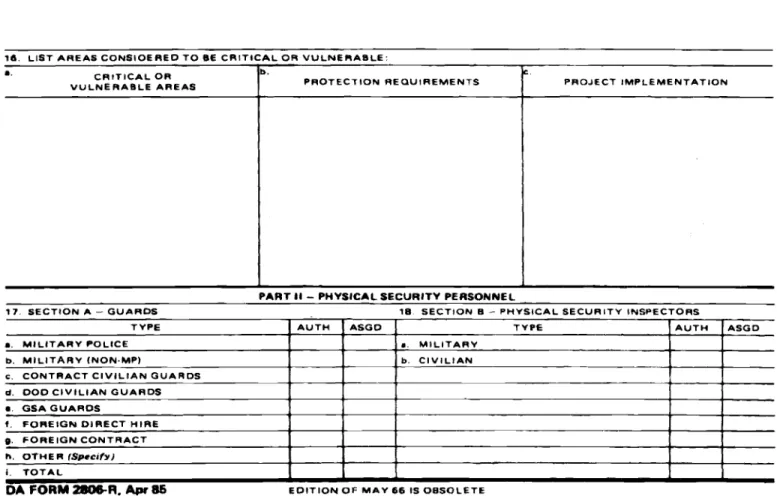
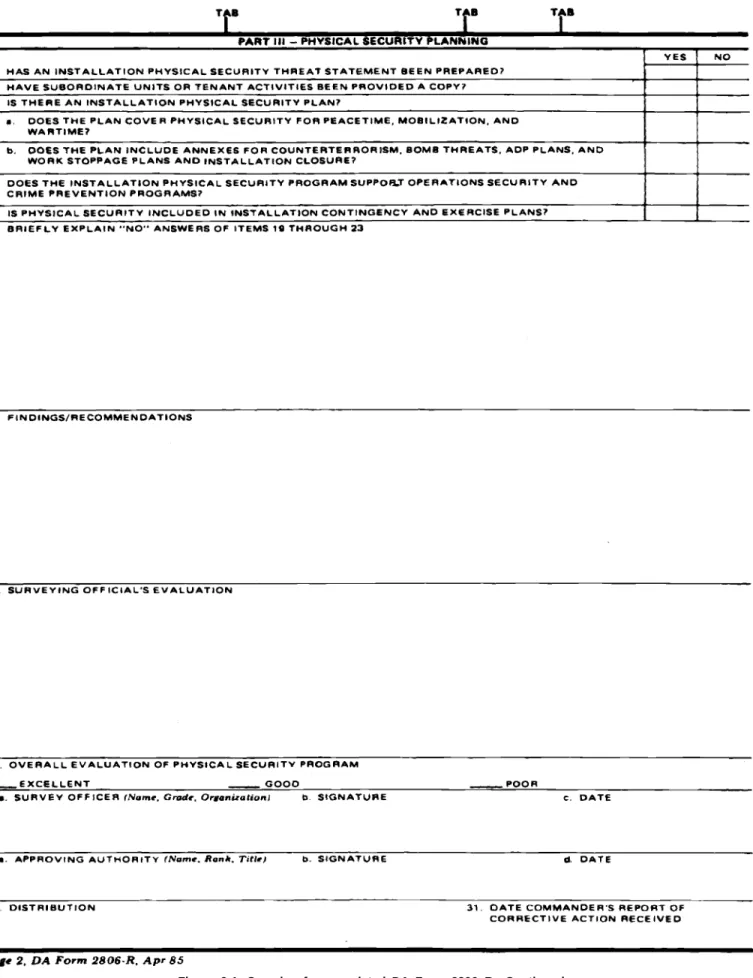
2–10. DA Form 2806–R (Physical Security Survey Report) (RCSCSGA–1672)
a. DA Form 2806–R (Physical Security Survey Report) is a
for-mal recorded assessment of an installation’s physical security pro-gram. It should provide the commander an assessment of the overall security posture of the installation, given the threat and mission, and advise the commander on the installation physical security pro-gram’s strengths and weaknesses. Specific procedures and measures evaluated include—
(1) Threat assessment procedures. (2) Types of security personnel assigned. (3) Control of visitors and packages. (4) Use of PSE.
(5) Identification of critical areas or facilities.
b. Physical security surveys will be conducted—
(1) When an installation is activated.
(2) When no record exists of a prior physical security survey. (3) Every 3 years.
(4) Exceptions are as follows:
(a) Those installations storing nuclear or chemical munitions will
(b) Critically sensitive multiple–customer automated data
proces-sing (ADP) service center activities or facilities will be surveyed every 18 months.
(c) Those installations storing conventional AA&E will be
sur-veyed every 24 months.
(d) Highly sensitive, sensitive, or nonsensitive multiple–customer
ADP service center activities or facilities will be surveyed every 24 months.
(e) Any facility or activity may be surveyed more frequently at
the discretion of MACOM commanders or major subordinate com-mand (MSC) comcom-manders.
c. Physical security surveys should be scheduled early in the
fiscal year so that resource requirements can be identified and in-cluded in the budget cycle.
d. DA Form 2806–R will be used to record physical security
survey findings. DA Form 2806–R may be locally reproduced on 81⁄2 – x 11–inch paper. A copy for reproduction purposes is located
at the back of this regulation. Attachments may be added to the form to clarify unique command requirements. Figure 2–1 shows a sample of a completed form.
(1) The survey should—
(a) Provide the commander with an assessment of the security
posture of the installation.
(b) State recommended actions for the application of resources in
a prioritized manner for the reduction of vulnerabilities.
(c) Include proper exhibits that would assist in clarifying findings
and recommendations, and an assessment as to their criticality and vulnerability. Photographs, sketches, graphs, and charts are exam-ples of such exhibits.
(2) The survey, including exhibits, will be forwarded to the in-stallation commander for information and corrective action.
(3) The commander’s report of corrective action taken will be retained on file until the next survey is completed.
(4) One copy of the completed installation physical security sur-vey report will be forwarded, through command channels, to the MACOM.
(a) The commander’s report of corrective action taken, less
ex-hibits, will be included.
(b) MACOMs will establish follow–up actions to ensure that
measures are being taken to correct discrepancies noted in installa-tion survey reports.
( 5 ) I n t h e c a s e o f t h e U . S . A r m y E u r o p e ( U S A R E U R ) , t h e USAREUR MSCs will receive survey reports and oversee follow up actions on those installations under their jurisdiction and control.
e. After completion of the survey, the installation PM or security
officer will reassess the installation’s physical security posture based on—
(1) A risk analysis per DA Pam 190–51. (2) Mission.
(3) Potential threat.
(4) Findings of the survey team.
(5) Comparison of findings from previously conducted surveys and inspections.
(6) Areas over or under protected.
f. Using the assessment, a physical security resource plan will be
developed recommending the prioritized allocation of resources and the revision of existing measures and procedures, or the develop-ment of necessary new measures and procedures. Highest priority will normally be given to activities considered essential or critical to mission accomplishment. This plan will be forwarded to the com-mander for approval, and will be included in the installation physi-cal security plan.
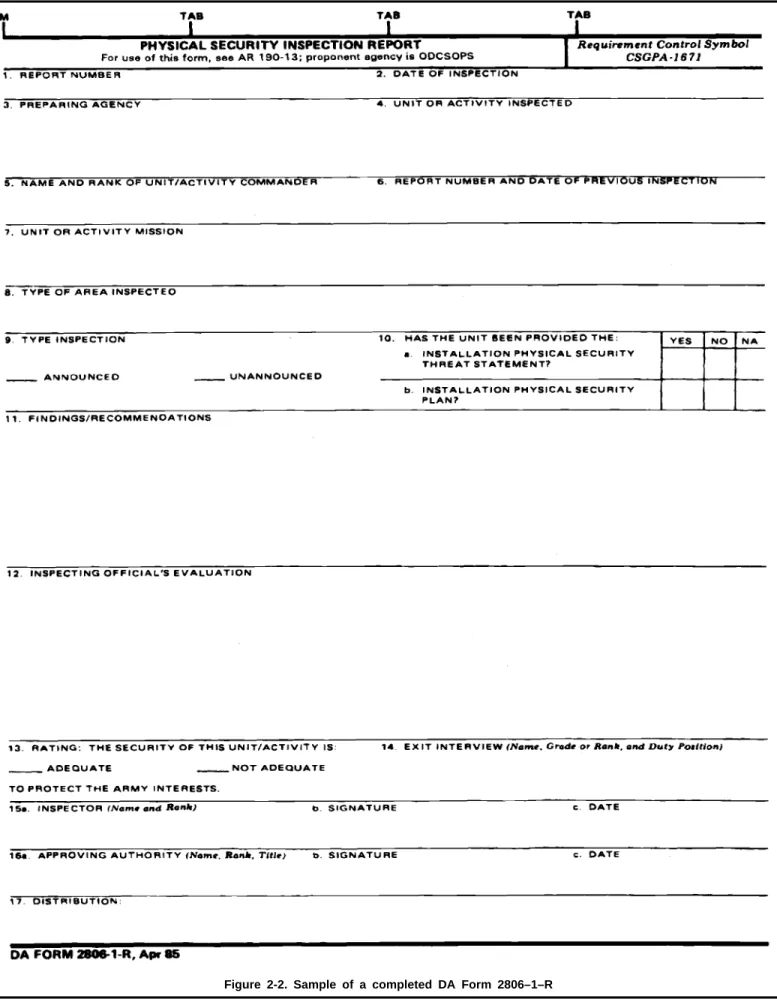
2–11. DA Form 2806–1–R (Physical Security Inspection Report) (RCSCSGPA–1671)
a. DA Form 2806–1–R (Physical Security Inspection Report) is a
formal, recorded assessment of physical security procedures and measures implemented by a unit or activity to protect its assets. Normally, the inspections are limited to those units or activities designated by the commander as MEVAs.
(1) A copy of the evaluation of the resource protection assess-ment conducted under the provisions of AR 11–2 should be pro-vided to the inspector.
(2) Inspectors shall not engage in illegal or dangerous conduct to demonstrate security deficiencies or weaknesses observed during the inspection.
( 3 ) I n s p e c t i o n s m a y b e c o n d u c t e d o n a n u n a n n o u n c e d b a s i s . However, before conducting unannounced inspections, inspectors should review unit training schedules to ensure that inspections do not interfere with training exercises.
b. Physical security inspections will be conducted—
(1) When a MEVA, unit, or activity is activated.
(2) When no record exists of a prior physical security inspection. (3) When there is a change in the unit or activity that may impact on existing physical security plans, and there is an indication or reported incident of significant or recurring criminal activity.
(4) Every 18 months for nuclear reactor and nuclear and chemi-cal storage units or activities, conventional arms, and ammunition storage activities.
(5) Every 18 months for critically sensitive multiple–customer ADP service center activities or facilities.
(6) Every two years for all other MEVAs.
(7) For other activities, as directed by the local commander. (8) Every two years for ROTC facilities storing only .22 caliber weapons. The biennial requirement to inspect ROTC facilities stor-ing only .22 caliber weapons is eliminated if facilities are inspected by applicable ROTC region physical security personnel during the annual formal inspection (AFI). ROTC facilities storing only demili-tarized weapons do not require an inspection. Demilidemili-tarized weap-ons will be stored and accounted for per AR 710–2.
(9) Every two years for highly sensitive, sensitive, or nonsensi-tive multiple–customer ADP service center activities or facilities. Inspections of all other ADP activities or facilities, not classified as critically sensitive, will be incorporated into scheduled physical se-curity inspections of the individual activity of facility.
( 1 0 ) W h e n t h e c o m m a n d e r d e t e r m i n e s g r e a t e r f r e q u e n c y i s required.
c. Physical security inspectors will be granted access to Army
facilities, records, and information on a need–to–know basis, consis-tent with the inspector’s clearance for access to classified defense information and provisions of applicable regulations.
d. DA Form 2806–1–R will be used to prepare all physical
secu-rity inspections. DA Form 2806–1–R may be locally reproduced on 8 1/2– x 11– inch paper. A copy for reproduction purposes is located at the back of this handbook. Attachments may be added to t h e f o r m t o c l a r i f y u n i q u e c o m m a n d r e q u i r e m e n t s . F i g u r e 2 – 2 shows a sample of a completed form.
e. Copies of physical security inspection reports will be provided
to the—
( 1 ) C o m m a n d e r o f t h e u n i t o r d i r e c t o r o f t h e o r g a n i z a t i o n inspected.
(2) Commander or director at the next higher level above the organization inspected.
(3) Installation physical security officer.
f . F i n d i n g s n o t e d o n p h y s i c a l s e c u r i t y s u r v e y o r i n s p e c t i o n
reports that are beyond the capabilities of the local commander to correct because of a lack of resources, will be reported to the next higher commander with a request for resource assistance.
( 1 ) F i n d i n g s n o t e d o n p h y s i c a l s e c u r i t y s u r v e y o r i n s p e c t i o n reports may be used for programming funds and requesting telecom-munication work orders.
(2) Submission of work order requests or requests for telecom-munications support do not resolve a report finding.
(a) Compensatory measures within available resources will be
placed in effect pending completion of work order requests.
(b) Recurring findings will be reported on future physical
secu-rity inspections until deficiency is corrected. 2–12. Reports of action taken
A report of action taken for both surveys and inspections will be required by the installation commander and attached as an exhibit to
the report. DA Form 2806–1–R will be filed with the survey report. These records will be maintained in the active files of the units or activities inspected, as outlined in 2–11e until the completion of the next physical security inspection, and then destroyed.
2–13. Reports classification
Reports of completed surveys or inspections will be classified and safeguarded per DOD 5200.1–R and AR 380–5, as appropriate. 2–14. Security engineering surveys
A security engineering survey is the process of identifying, by means of an on–site survey, engineering requirements associated with facility enhancements for physical security and anti–terrorism, including IDS installation. Security engineering surveys should be performed when planning any new construction or renovations or upgrades to existing facilities where there are likely to be physical security requirements. Security engineering surveys may also be requested by the PM or equivalent security officer to evaluate exist-ing security.
a. The scope of a security engineering survey is to—
(1) Identify the assets to be protected.
(2) Identify the threats to the assets and the levels of protection to which the assets should be protected against them.
(3) Identify protective measures, including IDS, to reduce the vulnerabilities of the assets to the threats.
(4) Determine the cost of proposed protective measures.
b. As a minimum, the following personnel or their
representa-tives should participate or provide input to the security engineering survey—
(1) Director or Engineering and Housing (DEH) or equivalent installation level engineer, to include the master planner.
(2) PM or equivalent security officer, to include the physical security officer. (3) Operations officer (G–3/S–3). (4) Intelligence officer (G–2/S–2). (5) Facility user. (6) Logistics officer. (7) Safety officer. (8) Communications officer. c . S e c u r i t y e n g i n e e r i n g s u r v e y s m a y b e p e r f o r m e d b y t h e
MACOM or by the installation engineer, within local capabilities. Security engineering surveys may also be requested on a reimbursa-ble basis from the USACE (Protective Design and/or Intrusion De-tection Systems Mandatory Centers of Expertise) by contacting the Commander, U.S. Army Engineer District, Omaha, ATTN: CEM-RO–ED–ST, 215 N. 17th Street, Omaha, NE 68102–4978, in ac-cordance with established MACOM procedures.