M
ETHOD
M
ANAGEMENT
M
ODEL
, M
ETHODOLOGY AND
E
NTERPRISE
A
RCHITECTURE
I
NTEGRATION
Peter Christian Rosina
D
ISSERTATION
for the degree of
Doctor of Natural Sciences (Dr. rer. nat.)
University of Augsburg
Institute of Computer Science
Supervisor: Prof. Dr. Bernhard Bauer, Institute of Computer Science, University of Augsburg, Germany
Advisor: Prof. Dr. Elisabeth André, Institute of Computer Science, University of Augsburg, Germany
Thesis Defense: February 15th, 2016
In order to face today’s challenges in product development, like product com-plexity, variability and a shortening of development cycles, for instance, in the automotive domain, the Product Development Process (PDP) tends to entail more and more virtual tasks instead of physical, conventional ones, for example, imple-mented by Computer Aidedx(CAx) technologies. The here introduced approach promotes this transformation by supporting the appropriate stakeholders in ac-quiring, formalizing, analyzing, assessing, comparing and hence selecting the most suitable methods, like physical and virtual design methods or CAx meth-ods, that are utilized to execute these tasks.
The introduced methodology demonstrates the acquisition and integration of relevant domain and business knowledge from diverse enterprise knowledge sources using Semantic Web Technologies (SWTs) which facilitates the manage-ment and execution of this knowledge, while considering customized individual views and vocabularies, and, as a result, enables a higher flexibility regarding and faster reaction to the ever-changing PDP by supporting stakeholders in their strategical and operational decisions. The separation of knowledge types by ap-plying SWTs, like ontologies, rules and queries, enables the appropriate roles to manage this knowledge independently and in their own way, because (concep-tual) domain knowledge, (operational) business rules and an implemented data model have different lifecycles, scopes and owners. Furthermore, this particular domain and business knowledge features interdependencies with remaining en-terprise knowledge, including business processes, organizational aspects and the IT architecture, which is usually modeled in an Enterprise Architecture (EA). Therefore, we showcase the implementation and integration of a method meta model, method contexts, like metrics and product knowledge, and an EA using SWTs to promote the transparency, interchange, interconnection, synchroniza-tion, sharing, reusability, re-deployment, up-to-dateness and maintenance of this particular knowledge and consequently analyses and assessments based on it. Thus, the use of SWTs increase the flexibility, quality and efficiency of the devel-opment process, allowing enterprises to meet the increasing market demand of product diversification, increasing functional complexity and regulatory require-ments, for instance, due to an improved integration of virtual development.
First and foremost, I am very grateful for the dedicated and continuous sup-port, encouragement, feedback and guidance by my supervisor Prof. Dr. Bern-hard Bauer during the course of this thesis. He helped me to structure my work, to focus on the important parts, urged me to publish my results while granting me great liberties during all phases of my doctoral studies. Besides, he responds to emails in a jiffy and always takes his time for discussions.
Furthermore, I want to thank my reviewer Prof. Dr. Elisabeth André for her su-pervision, effort and opinion.
Next to my professors at the University of Augsburg, Audi AG has been an im-portant sponsor and initiator of my dissertation. Therefore, I am grateful to the management for giving me the chance to participate in their doctoral candidate program and my colleagues there for fruitful discussions, feedback and collab-oration, predominately while developing and evaluating the case studies. Most important, Thomas Syldatke, my mentor at Audi during my time there, has al-ways been supportive, committed and promoted my ideas, for example, when defining the use cases, conducting the evaluation or explaining topics concerning the enterprise, method or product development. Through him, I could partici-pate in the ONTORULE project1, where I had the opportunity to meet, cooperate
with and learn from experts in the numerous applied disciplines in this thesis, for instance, ontologies, rules and knowledge acquisition.
A big thank you to my colleagues at the SMDS chair for their professional feed-back, companionship and lots of humor.
Last but not least, I am very grateful to my friends and family for their support and motivation.
1The ONTORULE project was an EU FP7 project, partially funded by the European
Com-mission under Grant Agreement n° 231875. http://ontorule-project.eu/; last accessed
I.
I
NTRODUCTION, B
ASICS ANDR
ELATEDW
ORK1
1. Introduction 3
1.1. Introduction and Motivation . . . 3
1.2. Challenges, Objectives and Approaches . . . 10
1.2.1. Challenges . . . 10 1.2.2. Objectives . . . 15 1.2.3. Approaches . . . 18 1.3. Publications . . . 24 1.4. Outline . . . 27 2. Basics 31 2.1. Knowledge Management . . . 31 2.2. Semantic Web . . . 34 2.3. Ontologies . . . 36 2.3.1. Foundations . . . 37 2.3.2. Description Logics . . . 40
2.3.3. Ontology Languages and Standards . . . 43
2.4. Rules . . . 49
2.4.1. Rule Languages and Standards . . . 52
2.4.2. Rule Engines and Management Software . . . 53
2.5. ONTORULE Methodology . . . 54
2.6. Virtual Product Development . . . 55
2.7. Enterprise Architecture Management . . . 59
2.7.1. Enterprise Architecture Frameworks . . . 62
2.7.2. The Open Group Architecture Framework . . . 63
2.7.3. ArchiMate . . . 65
3. Related Work 69 3.1. Synopsis . . . 69
3.2. Method Frameworks and Meta Models . . . 70
3.4. Modeling Standards . . . 78
3.5. Integrating method knowledge in an Enterprise Architecture . . . . 80
3.6. Views . . . 84
3.7. Method Selection, Analysis and Application . . . 84
3.8. Comparative Assessment . . . 89
II.
M
ETHODM
ETAM
ODEL, M
ETHODO
NTOLOGY, M
ETHOD-OLOGY AND
E
NTERPRISEA
RCHITECTUREI
NTEGRATION95
4. Method Meta Model and Ontology 97 4.1. Introduction . . . 974.2. Method Definition . . . 101
4.2.1. Definition . . . 103
4.2.2. Methods vs. Processes . . . 109
4.3. The Core Method Ontology . . . 113
4.3.1. The Ontology Concepts in Detail . . . 114
4.3.2. Representation Models of Methods . . . 116
4.4. Method Metrics . . . 119
4.4.1. Method Maturity . . . 119
4.4.2. Concrete vs. Abstract Methods . . . 122
4.4.3. Metrics Ontology . . . 124
4.5. Linking Enterprise Data . . . 126
4.5.1. Ontology Matching Strategies . . . 127
4.5.2. Using Rules for Ontology Alignment . . . 132
4.5.3. Integrating Databases . . . 134
4.6. Integrating the Method Ontologies . . . 137
4.6.1. Resources . . . 139
4.6.2. Method Description . . . 143
4.6.3. Using the Method Ontology as a Controlled Vocabulary . . . 145
4.7. Conclusion . . . 149
5. Methodology 153 5.1. Introduction . . . 153
5.2. Approach . . . 154
6. Enterprise Architecture Integration 161
6.1. Introduction . . . 161
6.2. Integration of the Method Model . . . 162
6.2.1. EA Ontology . . . 162
6.2.2. Mapping Techniques for the Integration of the EA and Me-thod Ontologies . . . 164
6.2.3. Mapping the EA and Core Method Ontologies . . . 166
6.2.4. Further Mappings . . . 168
6.3. Views and Roles . . . 170
6.3.1. Introduction . . . 170
6.3.2. Stakeholders . . . 172
6.3.3. Creating Views . . . 176
6.4. Method Analysis and Selection . . . 178
6.4.1. Method Classification . . . 179
6.4.2. Method Selection . . . 180
6.4.3. Method Architecture Artifacts . . . 183
6.4.4. Supported Business Goals . . . 192
6.5. Conclusion . . . 194
III. E
VALUATION ANDC
ONCLUSIONS197
7. Case Studies 199 7.1. Synopsis . . . 1997.2. Knowledge Management with a lexicalized ontology and rules . . 201
7.2.1. Introduction . . . 201
7.2.2. Use case background . . . 203
7.2.3. Expressing and linking the vocabulary . . . 204
7.2.4. Conclusion . . . 210
7.3. Semantic Integration of Bill of Materials . . . 212
7.3.1. Introduction . . . 212 7.3.2. Bill of Materials . . . 215 7.3.3. Approach . . . 218 7.3.4. Implementation . . . 224 7.3.5. Evaluation . . . 229 7.3.6. Conclusion . . . 231
7.5. Comparing Methods in Property-Driven Development . . . 238 7.5.1. Introduction . . . 238 7.5.2. Property-Driven Development . . . 240 7.5.3. Approach . . . 246 7.5.4. Implementation . . . 251 7.5.5. Evaluation . . . 259 7.5.6. Conclusion . . . 265 8. Conclusion 269 8.1. Contributions . . . 269 8.2. Outlook . . . 273
IV. A
NNEX277
Printed Sources 279 Online Sources 297 Glossary 303 List of Figures 309 List of Tables 313 Listings 315 A. BOM Mapping Case Study 317 A.1. Ontologies . . . 317A.2. Rules and Queries . . . 319
B. PDD Case Study 321 B.1. User Interface . . . 321
B.2. Rules and Queries . . . 325
I
NTRODUCTION
, B
ASICS AND
Lewis Carroll,Alice in Wonderland
1
Introduction
1.1. Introduction and Motivation
During the development of a new industrial product, for instance, a car, it is undergoing a multitude of different processes and process steps, e.g., product planning and design in different stages, before a manufacturer can finally start its production in series. Naturally, a multitude of different departments and dis-ciplines, for instance, physical tests and virtual simulations, have to collaborate, cooperate and interact during this Product Development Process (PDP) which en-tails the application of numerous technologies, tools and methods, for instance, Computer Aidedx(CAx) methods. A wide range of CAx methods, such as ver-ification methods, plausibility checks or Finite Element Methods (FEMs), are ap-plied or developed throughout the entire PDP. In many other disciplines, to pre-vent the loss of track about the already acquired knowledge and insights, the current status and the planned procedures, a plethora of monitoring, planning, information, knowledge and Product Data Management (PDM) systems are in operation. Among others, they can keep track of processes, finances, Information Technology (IT) or resources, like drawings or parts, because these domains are well understood and in many cases standardized.
However, an eagerly considered area in the Knowledge Management (KM) of car manufacturers has been the difficult exchange, analysis and sharing of CAx meth-ods and their contexts within and between the various Computer Aided (CA) disciplines. For example, CAx comprises the Computer Aided Design (CAD) that provides approaches for the virtual design and verification of products and their geometry, e.g., Digital MockUp (DMU) methods or parametric design meth-ods. Further involved disciplines are the Computer Aided Engineering (CAE) and Computer Aided Testing (CAT); the former provides methodologies for sim-ulating the behavior of a product and its functions, e.g., FEM for crash simulation, Computational Fluid Dynamics (CFD) for thermal management, and Multi Body Simulation (MBS) for driving dynamics; the latter for performing physical tests, e.g., vehicle management, job, testing control and test result analysis. The in-volved tools and methods range from mechanical test beds, through Hardware in the Loop (HiL) to DMU and other pure software applications.
Unfortunately, it is not possible to compare, interchange, share or consolidate these different methods innately, because they lack a consistent description, ter-minology and harmonized semantics. Even inside their respective CAx domain, their structure or vocabulary differs from each other dependent on the involved stakeholders, roles, departments, processes, IT applications or the data and re-sources they require or produce.
Besides, this challenge does not only affect CAx methods in the automotive de-velopment, but all the applied design methods during a PDP for complex and sophisticated products in various markets, such as aeronautical, mechanical and civil engineering or “traffic, energy, medicine, and the environment” (Meerkamm
2011). “The development of these products needs a well-balanced and integrated use of design methods and computer-supported [(CA)] tools. Therefore, bringing together both fields is a very important task, needing integration on a method-ological basis of methods with tools and tools with the process” (ibid.).
This challenge is aggravated by the fact that “globalization has increased com-petitive pressure on all companies, and time to market has become an essen-tial success factor” (Binz et al.2011). Furthermore, the entire development and its contexts become more complex, e.g., owing to internal factors like products, processes and organization or external ones like markets, norms and regulations (Ehrlenspiel and Meerkamm2013), which is another challenge to master for to-day’s industries. One reason for this complexity is the increased diversity of vari-ants which is partially justified due to more individualized products and systems.
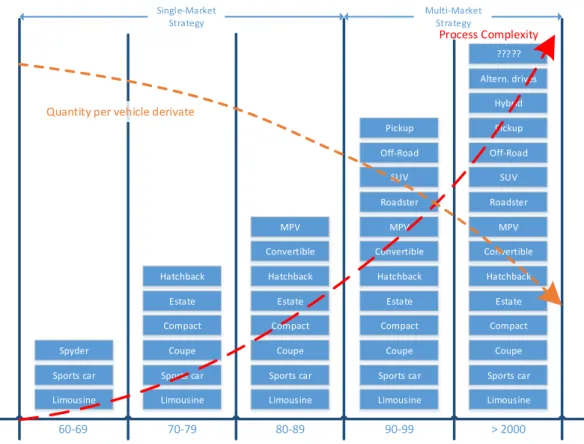
For example, the amount of different vehicle models regarding the top five brands in Germany has more than quadrupled (from 101 to 453) between 1990 and 2014 (Progrenium2015). In addition, the masses of possible features and feature com-binations a customer can choose from today has amplified manifoldly.
Limousine Sports car Spyder Limousine Sports car Coupe Compact Estate Hatchback Limousine Sports car Coupe Compact Estate Hatchback Convertible MPV Limousine Sports car Coupe Compact Estate Hatchback Convertible MPV Roadster SUV Off-Road Pickup Limousine Sports car Coupe Compact Estate Hatchback Convertible MPV Roadster SUV Off-Road Pickup Hybrid Altern. drives ????? 60-69 70-79 80-89 90-99 > 2000 Single-Market Strategy Multi-Market Strategy Process Complexity
Quantity per vehicle derivate
Figure 1.1.: Development of the product strategy in the automotive industry. Based on Pätzold, ProSTEP AG, 2002 (obtained from Eigner and Stelzer (2009a)).
The trend for a broader product range started several decades ago and is still increasing as depicted in Figure 1.1, especially when considerung multi-market demands, strategies and regulations. However, when looking at the German mar-ket and the top five brands again, the number of new registrations stagnates at about 3 million per year (ibid.). That implies, that on the one hand, the quan-tity per derivative is decreasing but on the other hand, the process complexity is rising. Moreover, car manufacturers expect the demand for passenger cars to rise worldwide by almost 60% over the next 15 years due to a global growth in prosperity (Stadler2011). “And the premium segment will even grow faster than
the market as a whole. [. . .] Admittedly these figures represent an enormous in-crease in complexity. And a major challenge for the entire organization” (Stadler
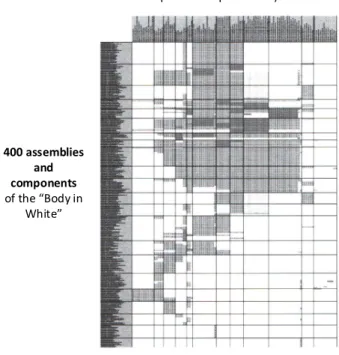
2011). This complexity of a car model is exemplified in Figure 1.2, representing the coherences between loading cases, for instance, crash, vibration comfort or pedestrian protection, and assemblies and components of the “Body in White” (Ehrlenspiel and Meerkamm2013) in the product development at the car manu-facturer Audi. The product development is a phase in the PDP which is again a part of the whole product lifecycle (Eigner and Stelzer2009c).
180 loading cases
(For example, crash, vibration comfort, pedestrian protection) 400 assemblies and components of the Body in White
Figure 1.2.: Numerous dependencies between body components and loading cases illustrating the complexity in product development. Based on Ehrlenspiel and Meerkamm (2013).
As illustrated, these complex coherences are hard to handle, visualize and hence, it is no simple task to analyze their interdependencies, especially when trying to imagine the relationships between further linked concepts, like methods that ap-ply these loading cases using components or assemblies as input and producing output resources, either virtually or physically, and, for instance, related process actions, involved user roles and their influence on organizational aspects, like the enterprise’ strategical orientation and requirements concerning the supporting IT.
Summarized, enterprises, especially in Research & Development (R&D), have to deal with growing product diversification, increasing functional complexity, changing market demands and tightening regulatory requirements, that have to be taken into account while maintaining a high quality and the costs of develop-ment and product as low as possible.
In order to cope with these challenges, the current competitive situation is charac-terized by shortening development and innovation cycles in addition to a higher innovation rate (Weigt2008, p. 29). As a consequence, development processes have to be streamlined, loops avoided and results, insights, methods and parts reused in other projects, i.e., “it is necessary to focus on the most promising projects and to take the ‘right’ decisions” (Binz et al.2011). However, the PDPs have “to become ‘better’ in terms of quality and reliability of the development results [because shortening] development times holds the risk of increasing fail-ures, as, for example, in the automotive industry in the past.” (ibid.). Besides, to-day’s customers demand higher quality products, e.g., they have to be ecofriendly, safe and secure at low cost, and thus, “it is not only necessary to do ‘the right things’, but also to do ‘things right’” (ibid.). Thereby, customer demands and innovation compulsion cause conflicting goals betweenlower costs,shortened time consumptionand a higher product quality(Weigt 2008, p. 29) which are the main success factors for products (Binz et al.2011). “Besides the quality of the [PDP], the performance of the applied design methods and tools is decisive in achieving good results” (ibid.).
However, the problem is not a lack of available methods. Instead, it is rather the selection of the most suitable method from a plethora of methods available to the designer (Ernzer and Birkhofer2002). For example, Domain Experts (DEs) often select popular methods instead of analyzing the real needs of the business
(ibid.). Furthermore, methods are not well accepted or regularly used in practice,
because the know-how, on how to integrate method knowledge into the PDP and the daily development practice is often not available (Albers, Reiß, Bursac, Ur-banec, et al.2014). Further hindrances are the unevenly distributed knowledge concerning methods, the unawareness of their availability and that only a portion of methods are widely and systematically used. On top of that, applied methods are often used with ad-hoc modifications, many DEs believe them only useful when there is an abundance of time available and they are abandoned after a while (López-Mesa2003). Nevertheless, if applied correctly, their utility has been demonstrated (Albers, Reiß, Bursac, Urbanec, et al.2014).
Nowadays, a method selection for a defined purpose, an analysis of the entirety of methods in a company and the method monitoring are mainly manual tasks, ever and anon assisted by basic IT documents, like spreadsheets. Method knowl-edge is seldom formalized which impedes an IT-supported analysis and thus a profound decision for the application or development of particular methods. Therefore, finding and selecting suitable methods is extremely complex and dif-ficult for designers and other DEs in practice (Badke-Schaub, Daalhuizen, and Roozenburg2011).
Furthermore, a targeted development, refactoring or shutdown of methods based on business information, like strategical goals or reuse in other processes, is com-plicated. Formalizing this knowledge would allow the involved roles to analyze methods along the PDP, e.g., for finding, designing and boosting the application of virtual replacements for physical tests. Virtual methods are usually less time-consuming and costly. Hence, they can be repeated many times in controlled environments, i.e., they promote the integration and application of virtual engi-neering at a maintainable or even superior quality, for example, in order to in-crease early product maturity.
Other roles, like enterprise architects, would benefit from such a formalization because it allows analyzing the relationships between methods, tools and the un-derlying IT infrastructure which is usually modeled in an Enterprise Architecture (EA) inside large-scale enterprises. The methodology of introducing, modeling and analyzing (meta) models describing the company’s business and IT is con-ducted in the discipline known as Enterprise Architecture Management (EAM). EA experts and DEs could benefit mutually by combining existing information with method knowledge, because new opportunities for the product, business and IT analysis would emerge. Managers in the enterprise can also benefit from modeled methods and analyses based on these models, because they can help to assess qualities, maturities and further Key Performance Indicators (KPIs) that are influenced by methods which in turn enables an instrument that supports governing and facilitates new strategic decision-making processes. Moreover, stakeholders, like business rules or legal experts, that own knowledge about mandatory regulations that have to be regarded in different markets concern-ing product tests and design methods could formalize their constraints which in turn influences the selection made by the product developing DEs that are a determining factor in a manufacturing enterprise. “Above all, their knowledge, expertise, competencies and skills are decisive in creating excellent products. For
this reason, it is extremely important to have the ‘right’ knowledge in a com-pany, to expand, preserve and transfer it to future generations and to make it easily accessible to everybody who needs it. Considering the ongoing explosion in knowledge, the significance of [KM] will increase” (Binz et al.2011).
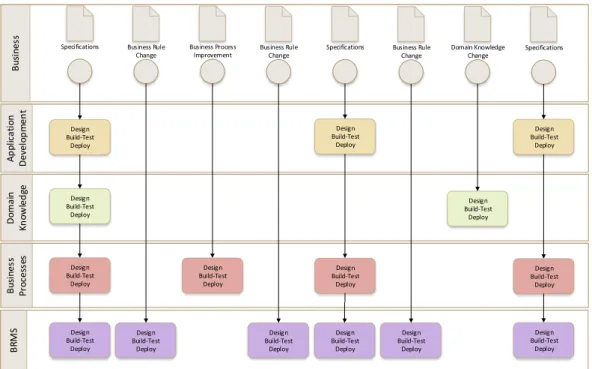
However, developing an IT application that is based on, provides and allows interacting with formalized knowledge is no simple task. First of all, the Knowl-edge Acquisition (KA) and KM in general have to be integrated into a methodol-ogy that allows the right roles to interact with and maintain their knowledge in-dependently. Business rules, conceptual domain knowledge, process knowledge and of course the application logic have different areas of competence, owners and lifecycles as exemplified in Figure 1.3. “Domain knowledge is typically long-lived and characterized by a slow evolution. It can be shared among organiza-tions, because it is not organization- or application-specific, but domain-specific. On the other side, operational rules are short-lived and evolve fast, and may be business-specific (e.g., regulations) or particular to an organization (e.g., price discount rules)” (Berrueta et al.2011).
B us in es s A p pl ic at io n D e ve lo p m e n t B us in es s P ro ce ss es B RM S D om ai n K n o w le d ge Specifications Design Build-Test Deploy Design Build-Test Deploy Design Build-Test Deploy Business Rule Change Design Build-Test Deploy Business Process Improvement Design Build-Test Deploy Business Rule Change Design Build-Test Deploy Specifications Design Build-Test Deploy Design Build-Test Deploy Design Build-Test Deploy Business Rule Change Design Build-Test Deploy Domain Knowledge Change Design Build-Test Deploy Specifications Design Build-Test Deploy Design Build-Test Deploy Design Build-Test Deploy Design Build-Test Deploy
Figure 1.3.: Lifecycle juxtaposition of business, domain knowledge, processes, rules and applications. Based on Businessrules.ch (2008).
Furthermore, applications need to be developed, maintained, redesigned and de-ployed in separate lifecycles. This way, the particular roles can react faster to
occurring changes, for example, when maintaining their business rules in a Busi-ness Rule Management System (BRMS).
Additionally, the different roles work most efficiently when presented with a cus-tomized view on their domain and area of competence, i.e., “in order to really cope with the current and future challenges, a conceptual model of the enterprise is needed that is coherent, comprehensive, consistent, and concise, and that only shows the essence of the operation of an enterprise model” (Dietz 2006). Next to explicating unstructured or implicit knowledge, such a KM methodology also needs to incorporate already available (semi-)formalized sources, e.g., databases, in order to reuse as much information as possible. Therefore, the procedure of mapping other Knowledge Bases (KBs) needs to be taken into account, as well.
1.2. Challenges, Objectives and Approaches
1.2.1. Challenges
Challenge 1:Method Integration
Because the method environment is very heterogeneous, for example, the differ-ent CAx disciplines, and numerous stakeholders are involved, it is a challenge to express the particular knowledge, structure, contexts and varying definitions in a harmonized way. Furthermore, the involved business units and stakeholders often use their own differing vocabulary for the description of the same entities. Therefore, it is difficult to share, interchange, consolidate, analyze or compare the various methods and their contexts. However, due to factors like a reduced time to market, globalization and an increased product variability these aspects become necessary. Especially the integration of methods and tools and the inte-gration of tools and processes on a methodological basis is a requirement for the successful partnership of Design Methodology and CAx tools (Meerkamm2011). That means, these concepts need to be clearly defined, because each involves in-put and outin-put resources and their connected entities model a control flow graph as in processes, tool or method chains.
Another challenge is the integration of various rules, for instance, business rules, into our model. Specific methods are executed to comply with prescribed
scenar-ios, including group, brand, national and international regulations. The knowl-edge about their mandatory and optional applicability has to be formalized and be compatible with the method meta model. Other rules express how various KPI can be inferred.
Additionally, the system and method information are very dynamic, because new methods are explored and developed all the time. The DEs must be able to enter, remove or modify this information themselves, without the need to bother an IT expert that would have to change application code, because releasing a new soft-ware version in a big company is usually a time-consuming process. Besides, the elaborated business knowledge and insights have to be preserved in a standard-ized format to foster their sustainability, so it can be reused in other projects. For that reason, an additional requirement for the applied modeling technique is the support for the separation of source code, domain and business knowl-edge. They have different life cycles and responsibilities, but are strongly inter-connected. However, all three aspects ought to be synchronized and act in concert efficiently.
Challenge 2:Methodology
Integrating the methods and their environment requires a methodology that sup-ports the KA, formalization, modeling and execution of the domain knowledge, extended with further KBs, business knowledge and logic. The resulting inte-grated model needs to depict this domain of methods, technologies, tools and processes in order to support stakeholders in their daily work.
A considerable amount of data is spread throughout the company, but it needs to be quickly accessible by the right people in a standardized way in order to be informative. Sometimes, knowledge about whole domains, regulations, methods or IT systems is written down in unstructured or semi-structured textual docu-ments in arbitrary locations. The KA, where present knowledge is formalized and captured from sundry unstructured sources, like documents, spreadsheets or presentations, is a first step into developing such a model. Yet even more pre-cise and extensive knowledge about a domain is only known to a handful of DEs, who are often occupied answering and discussing banalities (from their point of view) instead of doing the important research and development that pushes themselves and the company forward. Therefore, next to transforming knowl-edge from document-centric sources to model-centric formats, domain models also need to be created by interviewing and analyzing the DEs themselves, while
being as non-intrusive as possible. Finally, knowledge can also be acquired by reusing existing structured data, like databases or available ontologies and busi-ness rules (BRs). Besides capturing domain and world knowledge and mapping it into suitable structures, these structures have to be designed correctly and effi-ciently to guarantee its quality, reusability and performance.
As mentioned in the first challenge, an important obstacle in the collaboration is the use of role-specific terms for the concepts. This leads to difficulties and mis-understandings when two worlds try to discuss and exchange their knowledge. This is not only a problem when talking to each other, since the already formal-ized business knowledge that exists in databases or other arbitrary places also differs in its representation and scope. Next to the KA, the methodology needs to support knowledge authoring, i.e., the modeling itself, followed by the execution of knowledge.
In classical software engineering, for example, when using the waterfall model, specifying the application’s data model after the initial requirements analysis is a widely used procedure when developing a new software. This procedure, how-ever, can lead to negative consequences. On the one hand, the domain and se-mantic knowledge is part of the conceptual data model and parts cannot be trans-ferred to the logical data model which depends on the implementation (Polikoff
2011). On the other hand, the domain knowledge, that does not fit into the data model, is mixed up with the software’s operational rules. This impedes its reuse, sharing, maintenance and evolution. Among other things, because of different lifecycles and responsibilities. This way, an incorrect role, for instance, an IT spe-cialist, would be implementing and maintaining a DE’s knowledge.
Besides, different business roles, e.g., IT experts, DEs or managers, work most efficiently when presented with a customized view on the data. For example, the management’s view on the KB is a high level view with aggregated data and preferably an excerpt that displays only the important and urgent information. Therefore, the methodology needs to support presenting the logic, domain and business knowledge to the correct roles in their preferred way.
Challenge 3:Enterprise Architecture and Method Meta Model Integration
CAx and other design methods feature many dependencies toward existing busi-ness and IT information. On the one hand, they almost always require resources, like results from former analyses, physical parts, CAD drawings or assessments
by DEs. For example, the date of their availability is often noted in the company’s business processes. On the other hand, successfully performed methods also pro-duce resources like the previously mentioned ones and DEs know how long it takes to perform such a method, including its set-up time, the model creation, the analysis and the following assessment. These indicators allow estimating the time span when a specific method can and has to be performed, including its preceding or succeeding buffers. Furthermore, CA methods, especially virtual methods, heavily depend on software tools and the underlying IT infrastructure. From a business management perspective, the enterprise’s general method knowl-edge, the methods’ qualities, costs, time consumptions and maturity are influen-tial factors for the enterprises overall capability, maturity and further KPIs. Therefore, integrating the method meta model into an Enterprise Architecture Framework (EAF)’s meta model bears many advantages. First of all, the com-bined meta models allow stakeholders to perform novel kinds of analyses, like impact analyses or discovering business, method and IT relations. For example, the concern “Which system/application supports which methods?” or the re-sponsibility of the modeled actors and roles could be identified. Furthermore, a company benefits from such a mapping approach through a concerted and de-fined meaning of the modeled concepts and vocabulary.
Additionally, embedding the method meta model into an EA meta model, and therefore making use of existing EAM processes ensures their up-to-dateness and allows the monitoring and analysis in combination with the afore-mentioned business information. Another key aspect of EAM is the planning and migration from a baseline to a target EA which could also be a powerful device, when fos-tering a strategic method development or shutdown, related to the enterprise’s strategic goals. Besides, information about IT applications, processes, roles and organizational aspects can be combined with method knowledge which enables an even more powerful analysis.
Challenge 4:Method Analysis and Selection
Virtual methods are constantly evolving and getting more complex. Therefore, it is necessary to have a system that helps managers and DEs to assess the vir-tual methods concerning their maturity and purpose to help them decide for and select a suitable method or method combination. This approach has to be flexible enough to include information about nearly all kind of development
methods from the involved domains, such as automotive dynamics, acoustics, safety&security, energy management, aerodynamics, ‘Noise, Vibration, Harsh-ness’ (NVH), design or usability. For example, a topic that benefits a lot from such an approach is the introduction of Digital Prototypes (DPs) (Breitling, Groß-mann, and Zöller2009), a term that describes the shift from replaceable physical to virtual methods in the product development. The challenges the DPs have to overcome are congruent to a large part of possibilities that emerge from this the-sis’ challenges, such as an early assessment of innovations, a detection and han-dling of conflicting goals, an efficiency enhancement through the use of shared and structured knowledge, a shortening of the development time, a reduction of the development costs, an enhancement of the product quality, an efficient as-sessment of construction alternatives, a holistic and reliable asas-sessment, optimal fulfillment and optimizing of all calculable vehicle properties analogues to physi-cal prototypes and an increase of prototype maturity in early development stages (ibid.).
Although the trend in product development shifts to the use of more and more virtuality, some prototypes and measurements still have to be conducted physi-cally today. On the one hand, internal challenges hinder the implementation of virtual methods: some fields in the development are too complex to be solvable virtually, the assessment of a hypothetical virtual outcome too vacuous or the realizable shift too expensive. On the other hand, external demands, like legal regulations, stipulate physical experiments and developments, e.g., in order to satisfy the requirements for selected crash tests.
However, not only the methods themselves, i.e., their procedures, are getting more complex, but their relationships to their connected concepts, such as the involved resources, roles, tools, processes and further linked concepts. The rea-soning and inference needed to derive and hence to make a decision for a suitable selection for a task at hand is difficult, among other things, because of a plethora of existing methods which entails the unawareness of their availability which in turn leads to the use of just a partial quantity and unevenly distributed knowl-edge about them. Furthermore, the formalized knowlknowl-edge about those methods and their contexts has to be valid, complete and consistent in order to reason cor-rect inferences. Therefore, a benchmarking and selection based on adequate deci-sion criteria, such as time, maturity, quality and cost, is required and the method application in the processes has to be assessed, made comparable and available. For instance, depending on a CAx method’s execution date in the business
pro-cess, the execution and therefore the result of a method varies in quality, cost or execution length, because the input parameters, e.g., the applied models, vary in their maturity. Next to the aforementioned metrics, more complex analyses are necessary in order to identity method development and improvement needs (cf. Weigt2008).
Because the number of methods and the context information is increasing over time, we need a system that is on the one hand able to handle the complex analy-ses that include thousands of individuals efficiently and on the other hand is still usable with minimal effort and structured clearly for the respective user.
1.2.2. Objectives
Based on the challenges introduced in the previous subsection, the following ob-jectives have been derived:
Objective 1 (Method Integration)
Develop an integrated method meta model to harmonize method semantics and structure while preserving their original meaning. Furthermore, include the me-thod context, e.g., a meme-thod’s description, stakeholders, tools and processes, in order to control the complex method landscape.
This method meta model shall include a method definition that, among others, can be applied to the CAx domain in an automotive enterprise and thus consoli-date their descriptions. Thereby, it has to consider varying meaning, depending on the stakeholder, different vocabularies and the applicability of the methods, e.g., stated in regulations. The goal is a declarative description of methods across the entire development division and not a guideline on how to develop methods or meta methods. The resulting meta model will act as the basis for the commu-nication with other business divisions, partners, suppliers and group brands. In order to realize such a meta model, apply appropriate tools and suitable mod-eling languages that respect the separation of code, domain and business knowl-edge, such as rules, is powerful enough to express the business logic, is com-putable in reasonable time and is flexible and dynamic enough to cope with the fast-changing circumstances.
Furthermore, demonstrate how to integrate established standards, existing agree-ments and compromises and further enterprise models, like product models, Controlled Vocabularys (CVs) and metrics, like maturity and quality attributes. Because these information exist in various forms, show how to integrate and reuse existing data sources and meta models.
Objective 2 (Methodology)
Apply or develop a fitting methodology for developing, mapping, executing and maintaining the integrated meta model and according rules.
Demonstrate how domain and business knowledge can be leveraged by gather-ing and formalizgather-ing it with ontological domain models, rules and queries in the industrial product development. Thereby, consider implicit and explicit method knowledge, such as operational knowledge known by DEs and documents de-scribing method knowledge in natural language or structured form.
The formalized method knowledge, that now exists in a standardized way, needs to be authored, maintained and executed, i.e., showcase its user interaction. There-fore, apply a KM methodology that includes all the necessary procedures, be-ginning with KA, over knowledge authoring to knowledge execution, which in-cludes the coupling of operational and business knowledge. For example, show how new methods can be integrated into the meta model and how existing inter-nal and exterinter-nal knowledge can be reused.
Next to the formalization of slowly evolving, often static, method domain knowl-edge, support the formalization of (dynamic) shorter-lived rules, e.g., regarding regulations or organizational constraints and hence separate lifecycles of (con-ceptual) domain knowledge, rules and program code.
Objective 3 (Enterprise Architecture and Method Meta Model Integration)
Integrate the developed method meta model into an Enterprise Architecture, in order to benefit mutually from the additional knowledge available in an enter-prise.
The main objective is the mapping of method knowledge with an EA in the prod-uct development to exploit relationships and dependencies between methods, processes, such as a PDP, IT, business objects and the enterprise strategy. By
keeping the KBs separated, the input of strategic, business and IT decisions on methods and vice versa shall be inferred, while the knowledge can be maintained independently. Therefore, design analyses that query and evaluate the integrated method ontology and rules while considering different stakeholders, artifacts and views.
Objective 4 (Method Analysis)
Perform analyses based on the developed meta models to support stakeholders in their decision making, for example, the method selection.
Based on the previous objectives support stakeholders in their method decision and selection by designing suitable analyses concerning methods, method com-binations and the linked concepts, such as processes or resources. Besides, the assessment of these analyses will support the numerous stakeholders to mon-itor and hence control the method portfolio, to identify lacunae, redundancy, conflicts, increase quality, coverage, reusability and to promote a targeted de-velopment, consolidation, reuse or shutdown of methods. Existing low-quality, missing or expensive methods can be identified and compared to each other if applicable.
A prerequisite for these analyses is the implementation of suitable method met-rics that are the foundation for more abstract queries and the method assessment. Thereby, consider the various users’ requirements and views on the business and IT.
Objective 5 (Evaluation)
Evaluate the integration, meta models, methodology and analyses by implement-ing appropriate models and prototypes. The evaluation shall be conducted in the product development of a large enterprise.
The approaches that deal with the above listed objectives shall be evaluated with suitable stakeholders by developing prototypical applications and performing case studies following the presented methodology. The integration of methods shall be conducted along a PDP in real industry case studies.
1.2.3. Approaches
Integrating the heterogeneous Method Landscape using Semantic Web Technologies
For creating a concerted definition for our method meta model we first analyze, compare and demarcate state-of-the-art method and process definitions in suit-able literature. We then consolidate and customize an abstract method defini-tion that fits to the product development environment. Another source for vari-ous definitions will be the already existing sources in the company itself. Many departments have their own understanding, requirements and usages of meth-ods. We will survey these understandings and consolidate a semantic descrip-tion which allows the integradescrip-tion of numerous method definidescrip-tions, like virtual and physical ones, and the method context, such as tools and processes.
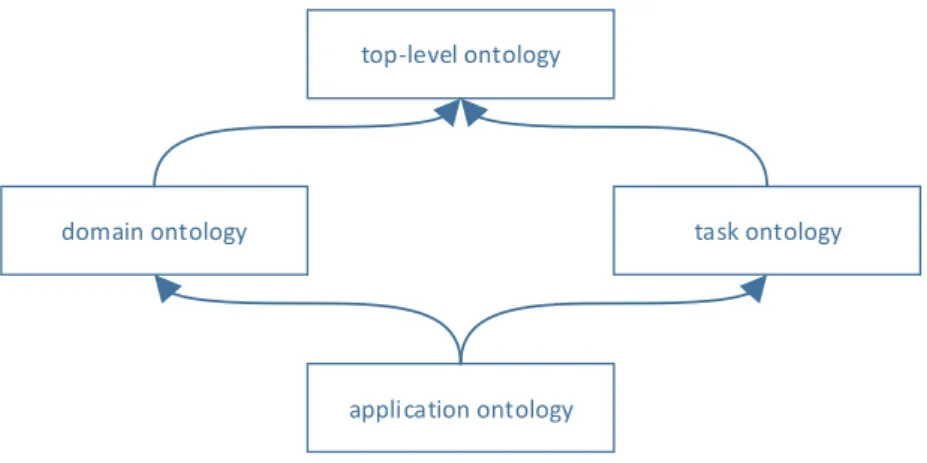
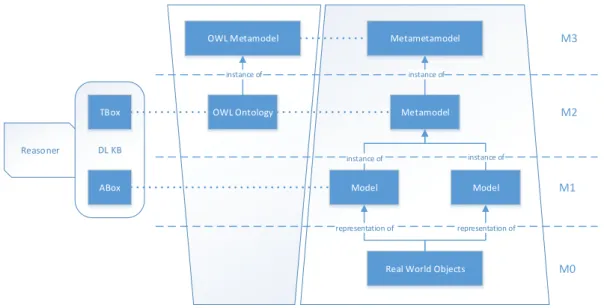
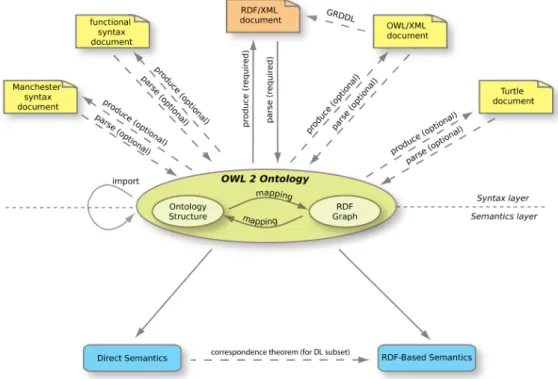
For the semantic description of our methods, we create a meta model, imple-mented using ontologies. Other technologies, like modern database management systems in combination with, e.g., process engines, could achieve similar results, but Semantic Web Technologies (SWTs) are predestined for distributed, often-changing models, rules and data. Ontologies allow an easy adaption and reuse of existing models and knowledge, for example, because the modeled entities feature a unique identifier, in addition to a flexibility in the syntax of the dif-ferent concepts and entities, i.e., the vocabulary. Besides, ontological reasoning allows checking the consistency of our KB and provides the ability to infer new knowledge. One paradigm when working with ontologies is the recommended limitation of the ontology’s scope to one single domain, though. That means that one monolithic ontology which covers all possible knowledge areas is not sug-gested. However, that does not mean that the different KBs cannot be linked to each other. In fact, having mappings between or integrating different domain on-tologies (DOs) into a global ontology is usually a wise and necessary procedure. Already existing data from sundry systems can be integrated by using Semantic Web middleware, e.g., triple stores or BRMS, with integrated built-ins, that sup-port connections with databases. Besides, modern Semantic Web (SW) middle-ware is highly scalable, which is a requirement for the computation of the inter-connected knowledge, including the integrated resources in our method model, in reasonable time.
DOs can be developed by different stakeholders, each one representing a sub-jective view on the same domain. When integrating these different ontology
modules, accumulated information can be computed or tailored views can be displayed. In combination with other SWTs, like query languages and rules, that offer another type of expressiveness, we can create an architecture that strictly separates business, domain and IT logic, i.e., the source code of our application and the business knowledge, including the vocabulary, all the semantic relations between the modeled entities and their instances. Thus, the software as well as standardized and formalized business and domain knowledge can be reused, integrated and maintained independently. Consequently, DEs can add and main-tain their knowledge themselves, which leads to a shorter information publish-ing process and thus more up-to-dateness. Furthermore, ontologies can be used as reference ontologies and CVs in order to organize the business knowledge which further improves communication and collaboration. Web Ontology Lan-guage (OWL), especially the extension Simple Knowledge Organization System (SKOS), supports the use of various labels, hence different vocabularies can be attached to the concepts, if required.
Another task for this thesis is the aforementioned integration of existing resources. We will examine mapping techniques that enable us to connect our ontological and rule-based model to already in place data, i.e., we demonstrate how to in-tegrate standards and further ontologies in the case studies with different tech-niques, e.g., by using mapping rules, to further concrete and make the method context information more comprehensive. As another case study, we will inte-grate different CAx Bill of Materials (BOMs) using ontologies and rules. Each CAx technology represents the actual technical content and configuration of a car in a CA-specific BOM. This allows us to compare the knowledge coverage of dif-ferent CAx disciplines and the detection and hence reduction of knowledge gaps. The DEs shall be able to modify the mapping rules and the data models indepen-dently from the prototype application, that will be implemented as well.
The method meta model is the foundation for linking already in place method, method context and enterprise information that are spread across various sys-tems, semantics and formats. Furthermore, the method metrics and analyses will be based on the integrated meta models.
Methodology for Semantic Web Technology-based Knowledge Management
We realize our meta models, KBs, prototypical applications, operational and busi-ness rules by following an SWT-based approach. Using SWTs bears many
ad-vantages: on the one hand, it enables a clear separation of domain and business knowledge, that can be extended and modified by domain and business experts. On the other hand, this knowledge can be implemented and managed indepen-dently from the applications that process it. Additional benefits and advantages have already been elaborated in the previous sections, though. Besides, SWTs’ ability to handle complex and extensive meta models and KBs in the automobile development, expressed by ontologies and rules, has been demonstrated (Syl-datke, Chen, et al.2007). For example, SWTs have been used to model, analyze and validate the data recorded during HiL tests for Electronic Control Unit (ECU) specification validation (ibid.). Another example is the modeling and analysis of matrices in the PDP, like the one presented in Figure 1.2, or the description and analysis of dependencies in multi-domain configurations, such as a CAx archi-tecture (Syldatke, Lutz, et al.2008).
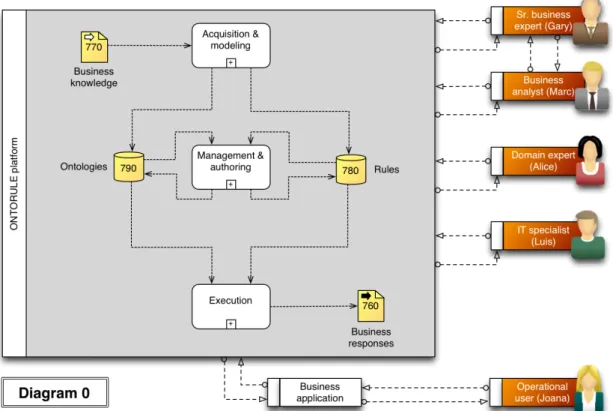
Creating applications and (meta) models that build on SWTs exhibits some sim-ilarities with software design in general. However, many aspects, like the sep-aration of business and domain knowledge, differ. Because establishing such a methodology by ourselves and from scratch would have been a daunting task, we participated in the EC-funded FP7 project ONTORULE which resulted in the ON-TORULE methodology for combining ontologies and rules and to “enable users, from business executives over business analysts to IT developers, to interact in their own way with the part of a business application that is relevant to them” (de Sainte Marie, Escudero, and Rosina2011). The project consortium included top research institutions and vendors of BRMSs and KB systems along with in-dustrial partners, such as Audi, that have been the test beds for the methodology. Building on the endeavors of the project, this methodology has been adapted, ap-plied, further customized and augmented for this dissertation, most notably the different phases KA, authoring and then executing and maintaining the KB, for creating our ontologies, rules and queries, either in the case studies or the main chapters. Supplementary, we have adopted and defined a set of stakeholders, their roles in various methodology phases and their requirements concerning the analyses and views in our considered domains.
Naturally, an enterprise already has an established IT landscape, e.g., databases or wikis, where they describe parts of their method knowledge. Additionally, a lot of insights and descriptions about proceedings are either not put down in writ-ing at all or just as office memoranda, though. Therefore, we examine different ways to acquire and reuse existing data and describe its integration. Aside from
conducting KA with business people, we also examine techniques like applying Natural Language Processing (NLP) to create ontologies or to extract candidate BRs from given regulations or any other textual descriptions of the relevant do-main, for instance, demonstrated by a case study about a lexicalized ontology to define business vocabulary in section 7.2.
Enterprise Architecture Integration
In the first objective we tackled the problem of creating an integrated SWT-based meta model, rules and queries for method information in product development. When we broaden our KB with even more enterprise information we are able to answer even more complex queries for numerous stakeholders and have a sound foundation for knowledge sharing. Therefore, we demonstrate how to integrate an EA meta model and consequently analyze it.
First of all, we create a meta model based on the EAF The Open Group Architec-ture Framework (TOGAF) (The Open Group2011) and the ArchiMate specifica-tion (The Open Group2013). We use these standards, because of their popularity and penetration of the market – according to Cameron and Mcmillan (2013), the absolute majority of companies use a hybrid framework approach. However, 82,2 % of the survey’s participants use elements from TOGAF for their hybrid EA-specific approach. When using a primary EAF, TOGAF is the leading frame-work, as well.
We implement our EA hybrid meta model as an ontology and demonstrate how to map the considered concepts to the method ontology (Rosina and Bauer2015). Furthermore, we show how to integrate further EA extensions, such as process and product extensions, and present supported business goals following from this approach. In the Property-Driven Development (PDD) case study from sec-tion 7.5, we showcase a prototypical applicasec-tion based on a customized business scenario, along with ontologies, rules and queries, that, among others, integrates and analyses process, method and IT concepts.
The fourth objective, the analysis of method knowledge, deals with the analysis of the integrated knowledge in general, along with method architecture artifacts, views and analyses based on method and EA concepts, such as roles, actors, soft-ware applications, IT infrastructure and business strategy.
Method Analysis
Using SWTs to express and integrate method information and EA elements is the foundation for lifting the domain and business knowledge to an abstraction layer that allows analyses and assessments in order to monitor, select, adapt, reuse, shutdown or develop new and existing design methods and their related con-cepts.
First, we collect and elaborate the requirements, focusing on the business anal-yses that help to select the appropriate method for a designated scenario. That means we create a catalog with questions, such as “Which role uses which me-thod?”, “How can the methods be compared?” or “Which is the best (considering quality, time, cost) method for a scenario?”. We will also consider questions re-garding the dependencies between IT systems and methods, and will connect the method information with the associated product information, e.g., CAD models, physical parts or tools as demonstrated in the PDD case study. When the orga-nizational and system prerequisites are met, we implement a set of queries to analyze the coherences between methods and their environment. The connected process information allows stating when a method can be executed at the earliest, the latest and what the buffer times are, considering metrics, such as the method’s set-up time and execution time or the availability of required resources. Besides, business capabilities, which are directly connected to the enterprise’s strategic layer will benefit from this enrichment of knowledge. New KPIs can be defined and strategical goals, e.g., the goal to increase the use of virtual methods, can be traced.
This is realized by the implementation of ontologies, rules and associated queries with languages like Frame Logic (F-Logic), ObjectLogic, OWL and SPARQL. Af-terwards, a demonstrator is evaluated in order to validate the previously gath-ered requirements.
Furthermore, we demonstrate how methods and tools can be selected, classified, analyzed and assessed in general. On the one hand, by matching method outputs and inputs, we can create method chains and their linked tool chains that support the realization of process actions. Method alliances, on the other hand, present alternatives for the realization of such a task. In order to propose the best suiting method combination for task, we consider metrics, such as time, quality and cost, and demonstrate how a metrics ontology can be implemented and matched to our method ontologies.
Furthermore, we define stakeholder roles, views based on these stakeholders and method architecture artifacts that represent conceptual method analysis results, such as catalogs, matrices and further diagrams, including queries regarding the data quality which support DEs, Knowledge Engineers (KEs) and managers to rise overall quality.
Summarized Approach
During the product development, numerous stakeholders are confronted with variousknowledge types, that can be partitioned into implementationand adminis-trationknowledge categories, as depicted in Figure 1.4. “The product knowledge includes all knowledge about an existing or planned product” (Roth, Binz, and Watty2010) and is a linkage between those two categories. Various characteris-tic properties can be connected to the regarded knowledge types, such as tacit or explicit, structured or unstructured and present or future. The assigned numbers for eachknowledge typesymbolize their respective significance within a particular PDP phase (ibid.).
Figure 1.4.: A theoretical model of the structure of knowledge in the product de-velopment (Roth, Binz, and Watty2010).
One aspect of this wide array ofknowledge typesis the method knowledge and the method contextsrequired to perform tasks in the PDP which can also be classified using the characters of knowledgepresented in Figure 1.4, i.e., we consider differ-ent forms of knowledge, like documdiffer-ents, data bases or non-written knowledge. This knowledge can be used to describe a baseline architecture (present), a target architecture (future) and it might bestaticordynamic.
Specializedand factual knowledgecan be stored using ontology languages or other vocabulary standards, such as OWL resp. Semantics of Business Vocabulary and Business Rules (SBVR). Next to ontologies, the business knowledge can be for-malized using rules and queries. Normative knowledge is tightly connected to a method’s goal which can in turn be linked to an enterprise’s strategical goal which is regarded in EAM. Likewise, we can match the remaining knowledge types roughly to the orchestrated KBs considered in this dissertation that have the purpose to support stakeholders by storing, inferring and providing informa-tion about areas, such asmethodical, expert, management, productorbusiness strat-egy knowledge. It is not possible to match unequivocally, though, because of the knowledge types’ vagueness. Besides, some types of knowledge, like talent, skill or experience are oftentacit, i.e., they can hardly be formalized.
This thesis showcases how various knowledge types in the product development can be acquired, formalized and integrated using SWTs which allows a concerted analysis and assessment of methods and the method contexts and dependencies, like processes, resources and elements, such as roles, tools and enterprise goals, that are partially modeled in an EA. As a consequence, the knowledge and logic will be separated using ontologies, rules and queries which allows the right roles to interact with their own knowledge in their preferred terminology, indepen-dently from the other KBs’ lifecycles and responsibilities.
The case studies and evaluations are conducted in the product development of a large automobile manufacturer.
1.3. Publications
The published work concerning this thesis is presented in this section. Arising thereby, my own contribution in the relevant publications is clarified and related to the parts of this dissertation.
• Peter Rosina and Bernhard Bauer (2015). “Enterprise Methods Management using Semantic Web Technologies”. In: Fifth International Symposium on Busi-ness Modeling and Software Design (BMSD). ed. by Boris Shishkov. Milan, Italy: Scitepress. ISBN: 979-989-758-111-3
This paper primarily describes parts of chapter 6, i.e., the mapping between an EA and method ontology introduced in chapter 4 on a meta model level and is my own work.
• Melanie Langermeier, Thomas Driessen, et al. (2014). “Change and Version Management in Variability Models for Modular Ontologies”. In: 16th Inter-national Conference on Enterprise Information Systems (ICEIS). Lisbon, Portugal • Melanie Langermeier, Peter Rosina, et al. (2013). “Management of Variabil-ity in Modular Ontology Development”. In: ServiceOriented Computing -ICSOC 2013 Workshops. Ed. by Alessio Lomuscio et al. Lecture Notes in Computer Science. Berlin, Germany: Springer, pp. 225–239
These two papers have been realized together with my colleagues at our chair. It deals with the mapping, merging, change and version management of ontology modules using feature models, covered in section 4.6. The described methodolo-gies have been a product of our common efforts. My own work in these papers mainly dealt with the technical realization, related work and the foundations. However, content-related, we produced all the chapters together, so it is impossi-ble to demarcate my own work on this level.
• Sonja Zillner et al. (2015). “Method of Composing an Integrated Ontology”. US20150081648A1
This patent emerged from our work in the just now presented paper “Langer-meier, Driessen, et al. (2014)”, hence, my contribution is congruent to the expla-nation above.
• Christian de Sainte Marie, Miguel Iglesias Escudero, and Peter Rosina (2011). “The ONTORULE Project : Where Ontology Meets Business Rules”. In: Web Reasoning and Rule Systems6902, pp. 24–29
This paper introduces the ONTORULE approach at a mid-term stage of the pro-ject. My participation is mainly the evaluation, i.e., the presented case study about CAx method integration which is influential throughout the whole the-sis.
• Nouha Omrane, Adeline Nazarenko, Peter Rosina, et al. (2011). “Lexicalized Ontology for a Business Rules Management Platform: An Automotive Use Case”. In: Rule - Based Modeling and Computing on the Semantic Web. Ed. by Frank Olken, Monica Palmirani, and Davide Soltara. Vol. 7018. Springer Berlin Heidelberg, pp. 179–192. DOI: 10.1007/978-3-642-24908-2_21
The first phase of our methodology deals with KA, presented in section 2.5 and chapter 5. In this work, we have evaluated and introduced an NLP-based ap-proach that allows extracting relevant text passages from written method and process descriptions, formalize them using SWTs and establish a traceability be-tween source documents and ontological entities. My contribution has been the industrial case study description, the context introduction, and support during its implementation. This paper is revisited in section 7.2 as a case study.
The following publications are deliverables realized during the ONTORULE project and have been released in this context.
• Peter Rosina and Thomas Syldatke (2011). D4.4 - Evaluation of the AUDI R&D Business Orchestration System. ONTORULE Project
This document has been classified as confidential, because it contains a compari-son with the company-internal requirements concerning the ONTORULE demon-strators that have been classified as confidential as well. Hence, our case studies in chapter 7 do not use these results and insights directly, but we mention them in a way more abstract and general way. However, the evaluation and the gath-ered experiences, feedback and insights have been very valuable, led to new and focused requirements and in turn influenced the whole thesis.
• Peter Rosina and Eva Maria Kiss (2011). D4.3 - AUDI R&D Business Orches-tration System. ONTORULE Project
In this deliverable, we mainly present the initial PDD case study described ex-plicitly in section 7.5, which is much more exhaustive, though. The modeling and technical realization of the SWT, the application and customization of the methodology and overall realization of the deliverable have been my own con-tribution. The initial business scenario behind the case study, viz., the PDD, re-quirements, domain and business knowledge and logic, arose from DEs at Audi. A second, alternative technical realization of the case study using OWL RL and the CommonKADS Methodology (Schreiber, Akkermans, et al. 2000) has been realized by my co-author as described in the document.
• Peter Rosina and Thomas Syldatke (2010). D4.2 - Semantic integration of BOMs - public demonstrator. ONTORULE Project
This deliverable deals with the integration of different CAx BOMs using SWTs described in section 7.3. My contribution is similar to the previously mentioned deliverable, i.e., model, and implementation of the SWTs and realization of the document itself. Co-workers at Audi, i.e., DEs, contributed the business case and requirements behind this work.
• Eva Maria Kiss et al. (2010). D8.4 - Market Intelligence Report. ONTORULE Project
My contribution to this deliverable is confined to the case study concerning the CAx integration using technologies and approach of the project which is used throughout the thesis.
• Roman Korf, Eva Maria Kiss, Patrick Albert, et al. (2009). D8.3 - Exploitation Plan. ONTORULE Project
My contribution to this deliverable is confined to exploitation opportunities con-cerning the ONTORULE approach and our case studies, i.e., the use case descrip-tions, the possible impact, performed acdescrip-tions, IP protection/licensing and their relevance in general.
1.4. Outline
The following illustration in Figure 1.5 depicts the structure of the thesis, includ-ing the covered topics. Based on the table of contents, the figure is divided into the three main thesis parts along with the containing chapter titles seen in blue on the left side. The white elements on the right express the topics covered by the respective chapters if they are not self-explanatory by the chapters’ titles.
In the first chapter of this dissertation, the thesis has been motivated and intro-duced, including the challenges to be tackled, the derived objectives and per-formed approach, followed by an overview of published work. The ensuing chapter 2 provides the conceptual and technical foundations for the main part, i.e., KM, SWTs (especially ontologies and rules), EAM, and the methodological approach. Furthermore, it delivers background explanations for the use cases
Part I: Introduction, Basics and Related Work
Part II: Method Meta Model, Method Ontology, Methodology and Enterprise Architecture Integration
Part III: Evaluation and Conclusions
Chapter 1: Introduction
Chapter 2: Basics
Chapter 4: Method Meta Model
Chapter 5: Methodology
Chapter 7: Case Studies
Chapter 8: Conclusion
Semantic Technologies Methodology Use Case Background
Enterprise Architecture Management
Method Ontology Semantic Integration
Enterprise Architecture Integration
Stakeholders and Views
Method Analysis
Semantic BOM Integration
Methods in Property-Driven Development Method Integration Knowledge Acquisition Outlook Approach
Chapter 3: Related Work
Chapter 6: EA Integration Metrics p ro vi des m o ti va tio n a n d fo un d ati on s fo r is e v al u a te d in in flu en ces Objectives Challenges
Figure 1.5.: Thesis structure.
and running examples that originate from the field of application of virtual prod-uct development. Part I of this dissertation is then completed by an overview about the related work (chapter 3) and a comparison with the approach concern-ing the succeedconcern-ing principal part II.
The main part II is divided into three chapters: The first one introduces the me-thod meta model in chapter 4, followed by the presented meme-thodology in chapter 5 and finally chapter 6 about the method meta model’s integration into an EA
meta model. Thereby, chapter 4 begins with a definition of the termmethodand its contexts, followed by the definition of a method ontology which realizes the meta model. Corresponding, the ontology’s extension with further ontologies that cover the areas of metrics and KPIs, like a method’s maturity or quality, is demonstrated. Next to this extension, the population of ontologies with exist-ing data sources, the mappexist-ing and matchexist-ing of ontologies by applyexist-ing various strategies and the integration and linking of enterprise data using SWTs in gen-eral, are illustrated. Likewise, the fields of application that cover the use cases, i.e., resources, products, documents, etc., need to be integrated which is presented in section 4.6. An advantage of using ontologies is the viable enrichment of the modeled entities with various labels for the creation of a CV which is described as well. The section about related work in chapter 4 introduces existing method frameworks, metrics and modeling approaches. Afterwards, the chapter is con-cluded. In chapter 5, the approach for KM and SW application development is described. The up to here presented foundation and approach is then extended in chapter 6. The integration of the method ontology into an EA ontology, while respecting the various involved roles and hence required and customized views, is presented here. Furthermore, queries and models for method analysis and se-lection are introduced. Finally, the chapter is concluded as well.
The final part III, begins with the evaluation in chapter 7 that has been performed with various case studies that originate from real industrial use cases. Besides evaluating minor case studies, the main contributions demonstrate the semantic integration of data in the form of BOMs and of course an industrial case study lo-cated in the PDP that exploits the thesis’ findings, i.e., the methodology, method ontologies, their integration, analyses and selection scenarios. These insights and outcomes of the evaluation have influenced our objectives in a subsequent itera-tion which in turn is reflected in the principal part II. Finally, chapter 8 concludes the thesis, summarizes the contributions and gives an outlook on the work. Part IV, the annex, which is not illustrated in Figure 1.5, contains the utilized and consulted online and printed sources, lists all depicted resources,viz., figures, ta-bles and listings, and comprises additional material concerning the case studies, i.e., ontologies, rules, queries and User Interface (UI) overviews.
Ikujir ¯o Nonaka
2
Basics
2.1. Knowledge Management
The knowledge of an enterprise comprises all the data and information that is ex-plicitly embodied in its computer systems or on paper and the implicit and tacit knowledge possessed by its stakeholders, i.e., “the valuable and highly subjective insights and intuitions that are difficult to capture and share because people carry them in their heads” (Nonaka2007). In order to help the enterprise keep track of the obtained knowledge and ongoing efforts, it is crucial to promote Knowledge Management (KM)about the business, the Information Technology (IT) and other supporting processes. Otherwise, a strategical orientation of the company and therefore the long-term competitiveness is impeded.
For already a long time, enterprise knowledge has been complex. Nevertheless, knowledge in the world of business and IT is still increasing in volume as well as complexity (Hoppenbrouwers, Nijssen, and Van Leeuwen2012). Humans have long since been unable to comprehend the abstruse coherences in detail. There-fore, a need to gather and formalize the knowledge has arisen in order to be made computable.
KM is an organizational approach that includes many sub-disciplines, beginning with Knowledge Acquisition (KA) – the elicitation, gathering, analysis, modeling