City, University of London Institutional Repository
Citation
:
Alessandretti, L., ElBahrawy, A., Aiello, L. M. & Baronchelli, A. (2018). Machine
Learning the Cryptocurrency Market.
This is the draft version of the paper.
This version of the publication may differ from the final published
version.
Permanent repository link:
http://openaccess.city.ac.uk/19829/
Link to published version
:
Copyright and reuse:
City Research Online aims to make research
outputs of City, University of London available to a wider audience.
Copyright and Moral Rights remain with the author(s) and/or copyright
holders. URLs from City Research Online may be freely distributed and
linked to.
City Research Online:
http://openaccess.city.ac.uk/
[email protected]
City Research Online
Machine Learning the Cryptocurrency Market
Laura Alessandretti
a,b, Abeer ElBahrawy
a, Luca Maria Aiello
c, and
Andrea Baronchelli
a,d,*aCity, University of London, Department of Mathematics, London EC1V 0HB, UK
b
Technical University of Denmark, DK-2800 Kgs. Lyngby, Denmark
c
Nokia Bell Labs, Cambridge CB3 0FA, UK
d
UCL Centre for Blockchain Technologies, University College London, UK
*Corresponding author: [email protected]
May 23, 2018
Abstract
Machine learning and AI-assisted trading have attracted growing interest for the past few years. Here, we use this approach to test the hypothesis that the inefficiency of the cryptocurrency market can be exploited to generate abnormal profits. We analyse daily data for 1,681 cryptocurrencies for the period between Nov. 2015 and Apr. 2018. We show that simple trading strategies assisted by state-of-the-art machine learning algorithms outperform standard benchmarks. Our results show that non-trivial, but ultimately simple, algorithmic mechanisms can help anticipate the short-term evolution of the cryptocurrency market.
Introduction
The popularity of cryptocurrencies has skyrocketed in 2017 due to several consecutive months of super-exponential growth of their market capitalisation [1]. Today, there are more than 1,500 actively traded cryptocurrencies capitalising over $300 billions, with a peak of the market capitalisation totalling more than $800 billions in Jan. 2018.
Between 2.9 and 5.8 millions of private as well as institutional investors are in the different transaction networks, according to a recent survey [2], and access to the market has become easier over time. Major cryptocurrencies can be bought using fiat currency in a number of online exchanges (e.g., Binance [3], Upbit [4], Kraken [5], etc) and then be used in their turn to buy less popular cryptocurrencies. The volume of daily exchanges is currently superior to $15 billions. Since 2017, over 170 hedge funds specialised in cryptocurrencies have emerged and bitcoin futures have been launched to address institutional demand for trading and hedging Bitcoin [6].
The market is diverse and provides investors with many different products. Just to mention a few, Bitcoin was expressly designed as a medium of exchange [7, 8]; Dash offers improved services on top of Bitcoin’s feature set, including instantaneous and private transactions [9]; Ethereum is a public, blockchain-based distributed computing platform featuring smart contract (scripting) functionality, and Ether is a cryptocurrency whose blockchain is generated by the Ethereum platform [10]; Ripple is a
real-time gross settlement system (RTGS), currency exchange and remittance network Ripple [11], and IOTA is focused on providing secure communications and payments between agents on the Internet of Things [12].
The emergence of a self-organised market of virtual currencies and/or assets whose value is generated primarily by social consensus [13] has naturally attracted interest from the scientific community [8,14–30]. Recent results have shown that the long-term properties of the cryptocurrency marked have remained stable between 2013 and 2017 and are compatible with a scenario in which investors simply sample the market and allocate their money according to the cryptocurrency’s market shares [1]. While this is true on average, various studies have focused on the analysis and forecasting of price fluctuations, using mostly traditional approaches for financial markets analysis and prediction [31–35].
The success of machine learning techniques for stock markets prediction [36–42], suggests that these methods could be effective also in predicting cryptocurrencies prices. However, the application of machine learning algorithms to the cryptocurrency market has been limited so far to the analysis of Bitcoin prices, using random forests [43], Bayesian neural network [44], long short-term memory neural network [45] and other algorithms [32, 46]. These studies were able to anticipate, to different degrees, the price fluctuations of Bitcoin, and revealed that best results were achieved by neural network based algorithms. Deep reinforcement learning was showed to beat the uniform buy and hold strategy [47] in predicting the prices of 12 cryptocurrencies over one year period [48].
Other attempts to use machine learning to predict the prices of cryptocurrencies other than Bit-coin come from non-academic sources [49–54]. Most of these analyses focused on a limited number of currencies and did not provide benchmark comparisons for their results.
Here, we test the performance of three models in predicting daily cryptocurrency price for 1,681 currencies. Two of the models are based on gradient boosting decision trees [55] and one is based on long short-term memory (LSTM) recurrent neural networks [56]. In all cases, we build investment portfolios based on the predictions and we compare their performance in terms of return on investment. We find that all of the three models perform better than a baseline ‘simple moving average’ model [57–60] where a currency’s price is predicted as the average price across the preceding days, and that the method based on long short-term memory recurrent neural networks systematically yields the best return on investment.
The article is structured as follows: In section Methods we describe the data (see Data description and pre-processing), the metrics characterizing cryptocurrencies that are used along the paper (see Metrics), the forecasting algorithms (see Forecasting algorithms), and the evaluation metrics (see Evaluation). In section Results, we present and compare the results obtained with the three forecasting algorithms and the baseline method. In section Discussion, we conclude and discuss results.
Methods
Data description and pre-processing
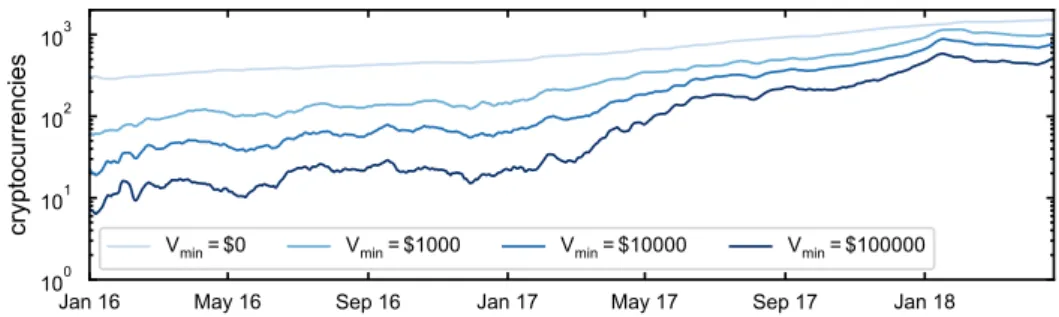
Cryptocurrency data was extracted from the website Coin Market Cap [61], collecting daily data from 300 exchange markets platforms starting in the period between November 11, 2015 and April 24, 2018. The dataset contains the daily price in U.S. dollars, the market capitalisation and the trading volume of 1104 cryptocurrencies, where the market capitalization is the product between price and circulating supply, and the volume is the number of coins exchanged in a day. The daily price is computed as the volume weighted average of all prices reported at each market. Fig. 1 shows the number of currencies
Jan 16 May 16 Sep 16 Jan 17 May 17 Sep 17 Jan 18 100 101 102 103
cryptocurrencies
Vmin= $0 Vmin= $1000 Vmin= $10000 Vmin= $100000
Figure 1: Number of cryptocurrencies. The cryptocurrencies with volume higher than Vmin as a
function of time, for different values of Vmin. For visualization purposes, curves are averaged over a
rolling window of 10 days.
with trading volume larger thanVmin over time, for different values of Vmin. In the following sections,
we consider that only currencies with daily trading volume higher than 105 USD can be traded at any
given day.
The website lists cryptocurrencies traded on public exchange markets that have existed for more than 30 days and for which an API as well as a public URL showing the total mined supply are available. Information on the market capitalization of cryptocurrencies that are not traded in the 6 hours preceding the weekly release of data is not included on the website. Cryptocurrencies inactive for 7 days are not included in the list released. These measures imply that some cryptocurrencies can disappear from the list to reappear later on. In this case, we consider the price to be the same as before disappearing. However, this choice does not affect results since only in 28 cases the currency has volume higher than 105USD right before disappearing (note that there are 124,328 entries in the dataset with volume larger
than 105USD).
Metrics
Cryptocurrencies are characterised over time by several metrics, namely
• Price, The exchange rate, determined by supply and demand dynamics.
• Market capitalization, The product of the circulating supply and the price.
• Market share, The market capitalization of a currency normalized by the total market
capitaliza-tion.
• Rank, Therank of currency based on its market capitalization.
• Volume, Coins traded in the last 24 hours.
• Age, Lifetime of the currency in days.
The profitability of a currencycover time can be quantified through thereturn on investment (ROI), measuring the return of an investment made at dayti relative to the cost [62]. The indexirolls across
days and it is included between 0 and 844, witht0= January 1, 2016, andt844= April 24, 2018. Since
we are interested in the short-term performance, we consider the return on investment after 1 day defined as
ROI(c, ti) =
price(c, ti)−price(c, ti−1)
Jan 16 May 16 Sep 16 Jan 17 May 17 Sep 17 Jan 18
day
0.05 0.00 0.05 0.10 0.15 0.20roi
cryptos with volume>105 mean=0.011
Bitcoin mean=0.005
Figure 2: Return on investment over time. The daily return on investment for Bitcoin (orange line)
and the average for currencies with volume larger thanVmin= 105USD (blue line). Their average value
across time (dashed lines) is larger than 0. For visualization purposes, curves are averaged over a rolling window of 10 days.
In Fig. 2, we show the evolution of the ROI over time for Bitcoin (orange line) and on average for
currencies whose volume is larger thanVmin = 105 USD atti−1 (blue line). In both case, the average
return on investment over the period considered is larger than 0, reflecting the overall growth of the market.
Forecasting algorithms
We test and compare three supervised methods for short-term price forecasting. The first two methods rely on XGboost [63], an open-source scalable machine learning system for tree boosting used in a number of winning Kaggle solutions (17/29 in 2015) [64]. The third method is based on the long short-term memory (LSTM) algorithm for recurrent neural networks [56] that have demonstrated to achieve state-of-the-art results in time-series forecasting [65].
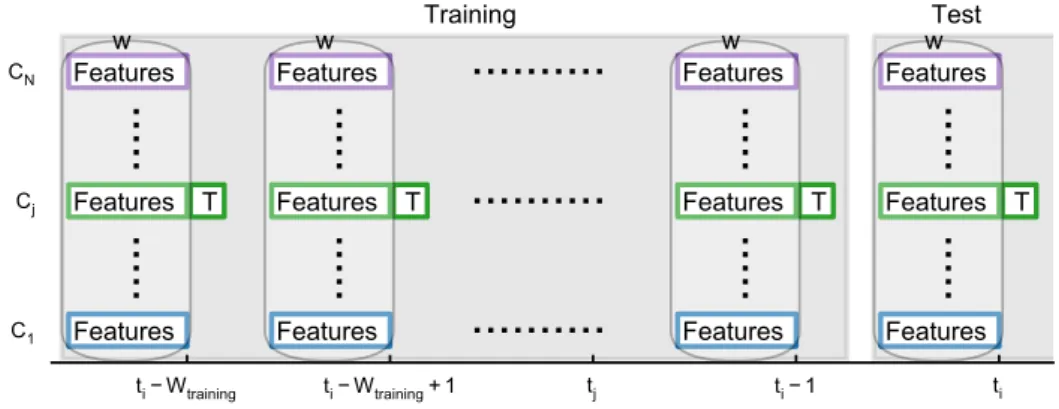
Method 1: The first method considers one single regression model to describe the change in price of all currencies (see Fig. 3). The model is an ensemble of regression trees built by the XGboost algorithm. The features of the model are characteristics of a currency between timetj−wandtj−1 and the target
is the ROI of the currency at time tj, where w is a parameter to be determined. The characteristics
considered for each currency are: price, market capitalization, market share, rank, volume and ROI (see equation Eq. (1)). The features for the regression are built across the window betweentj−wandtj−1
included (see Fig. 3). Specifically, we consider the average, the standard deviation, the median, the last value and the trend (e.g. the difference between last and first value) of the properties listed above. In the training phase, we include all currencies with volume larger than 105USD, andt
j betweenti−Wtraining
andti. In general, larger training windows do not necessarily lead to better results (see results section),
because the market evolves across time. In the prediction phase, we test on the set of existing currencies at day ti. This procedure is repeated for values of ti included between January 1, 2016 and April 24,
2018.
Method 2: Also the second method relies on XGboost, but now the algorithm is used to build a different regression model for each currencyci(see Fig. 4). The features of the model for currencyci are
the characteristics of all the currencies in the dataset betweentj−wandtj−1 included and the target
is the ROI of ci at day tj(i.e., now the algorithm learns to predict the price of the currency ibased on
the features of all the currencies in the system betweentj−wandtj−1). The features of the model are
the same used in Method 1 (e.g. the average, standard, deviation, median, last value, difference between last and first value of the following quantities: price, market capitalisation, market share, rank, volume
ti Wtraining ti Wtraining+ 1 tj ti 1 ti
C1
Cj CN
Features T
Features T
Features T
Features T
Features T
Features T
Features T
Features T
Features T
w
Features T
w
Features T
w
Features T
w
Training
Test
Figure 3: Schematic description of Method 1. The training set is composed of features and
tar-get (T) pairs, where features are various characteristics of a currencyci, computed across the w days
preceding time tj and the target T is the price of ci at tj. The features-target pairs are computed for
all currenciesci and all values of tj included between ti−Wtraining and ti−1. The test set includes
features-target pairs for all currencies with trading volume larger than 105 USD at t
i, where the target
is the price at timeti and features are computed in thewdays preceding ti.
ti Wtraining ti Wtraining+ 1 tj ti 1 ti
C1 Cj
CN
Features
Features
Features
Features
T
Features
Features
T
Features
T
Features
T
Features
w
Features
w
Features
w
Features
w
Training
Test
Figure 4: Schematic description of Method 2. The training set is composed of features and
tar-get (T) pairs, where features are various characteristics of all currencies, computed across the w days preceding time tj and the target T is the price of ci at tj. The features-target pairs include a single
currencyci, for all values oftj included betweenti−Wtraining andti−1. The test set contains a single
features-target pair: the characteristics of all currencies, computed across thewdays preceding time ti
and the price ofci atti.
and ROI) across a window of lengthw. The model for currencyci is trained with pairs features target
between timesti−Wtrainingandti−1. The prediction set include only one pair: the features (computed
betweenti−wandti−1) and the target (computed atti) of currencyci.
Method 3: The third method is based on Long Short Term Memory networks, a special kind of Recurrent Neural Networks, capable of learning long-term dependencies. As for Method 2, we build a different model for each currency. Each model predicts the ROI of a given currency at day ti based on
the values of the ROI of the same currency between daysti−wandti−1 included.
Baseline method: As baseline method, we adopt the simple moving average strategy (SMA) widely tested and used as a null model in stock market prediction [57–60]. It estimates the price of a currency at dayti as the average price of the same currency betweenti−wandti−1 included.
Evaluation
We compare the performance of various investment portfolios built based on the algorithms predictions. The investment portfolio is built at time ti−1 by equally splitting an initial capital among the top n
currencies predicted with positive return. Hence, the total return at timeti is:
R(ti) = 1 n n X c=1 ROI(c, ti).
The portfolios performance is evaluated by computing the Sharpe ratio and the geometric mean return. The Sharpe ratio is defined as:
S(ti) =
R sR
,
whereRis the average return on investment obtained between times 0 andti, andsR, the corresponding
standard deviation.
The geometric mean return is defined as:
G(ti) = T v u u t ti Y tj=1 1 +R(tj,
whereti corresponds to the total number of days considered. The cumulative return obtained atti after
investing and selling on the following day for the whole period is defined asG(ti)2.
The number of currenciesnto include in a portfolio is chosen attiby optimising either the geometric
meanG(ti−1) (geometric mean optimisation) or the Sharpe ratioS(ti−1) (Sharpe ratio optimisation)
over the possible choices ofn. The same approach is used to choose the parameters of Method 1 (wand
Wtraining), Method 2 (wandWtraining), and the baseline method (w).
Results
We predict the price of the currencies at dayti, for allti included between Jan, 1st 2016 and Apr 24th,
2018. The analysis considers all currencies whose age is larger than 50 days since their first appearance and whose volume is larger than $100000. To discount for the effect of the overall market movement (i.e., market growth, for most of the considered period), we consider cryptocurrencies prices expressed in Bitcoin. This implies that Bitcoin is excluded from our analysis.
Parameter setting
First, we choose the parameters for each method. Parameters include the number of currencies n to
include the portfolio as well as the parameters specific to each method. In most cases, at each dayti we
choose the parameters that maximise either the geometric meanG(ti−1) (geometric mean optimisation)
or the Sharpe ratioS(ti−1) (Sharpe ratio optimisation) computed between times 0 andti.
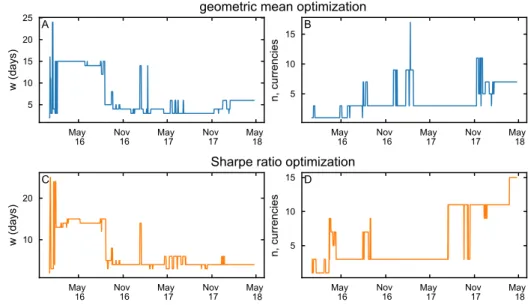
Baseline strategy: We test the performance of the baseline strategy for choices of window w≥2 (the minimal requirement for theROI to be different from 0) andw <30. We find that the value ofw
mazimising the geometric mean return (see Appendix Fig. A1-A) and the Sharpe Ratio (see Appendix Fig. A1-D) fluctuates especially before November 2016 and has median value 4 in both cases. The number of currencies included in the portfolio oscillates between 1 and 11 with median at 3, both for
the Sharpe Ratio (see Fig. A1-B) and the geometric mean return (see Fig. A1-E) optimisation.
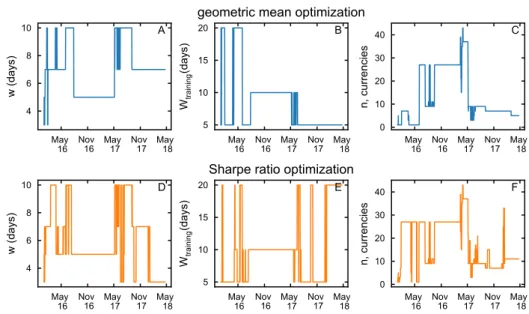
Method 1: We explore values of the windowwin{3,5,7,10}days and the training periodWtraining
in {5,10,20} days (see Appendix Fig. A2). We find that the median value of the selected window w
across time is 7 for both the Sharpe ratio and the geometric mean optimisation. The median value of
Wtraining is 5 under geometric mean optimisation and 10 under Sharpe ratio optimisation. The number
of currencies included in the portfolio oscillates between 1 and 43 with median at 15 for the Sharpe Ratio (see Appendix Fig. A2-A) and 9 for the geometric mean return (see Appendix Fig. A2-C) optimisations.
Method 2: We explore values of the windowwin{3,5,7,10}days and the training periodWtraining
in {5,10,20} days (see Appendix Fig. A3). The median value of the selected window wacross time is
3 for both the Sharpe ratio and the geometric mean optimisation. The median value ofWtraining is 10
under geometric mean and Sharpe ratio optimisation. The number of currencies included has median at 17 for the Sharpe Ratio and 7 for the geometric mean optimisation (see Appendix Fig. A3-A and C).
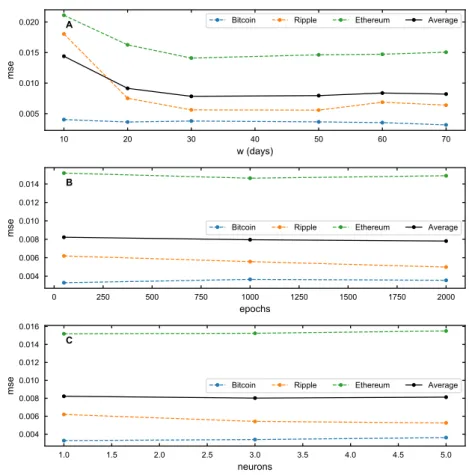
Method 3: The LSTM has three parameters: The number of epochs, or complete passes through the dataset during the training phase; the number of neurons in the neural network, and the length
of the window w. These parameters are chosen by optimising the price prediction of three currencies
(Bitcoin, Ripple, and Ethereum) that have on average the largest market share across time (excluding Bitcoin Cash that is a fork of Bitcoin). Results (see SI, Fig. A4) reveal that, in the range of parameters explored, the best results are achieved forw = 50. Results are not particularly affected by the choice of the number of neurones nor the number of epochs. We choose 1 neuron and 1000 epochs since the larger these two parameters, the larger the computational time. The number of currencies to include in the portfolio is optimised over time by mazimising the geometric mean return (see Appendix Fig. A5-A) and the Sharpe ratio (see Appendix Fig. A5-B). In both cases the median number of currencies included is 1.
Cumulative return
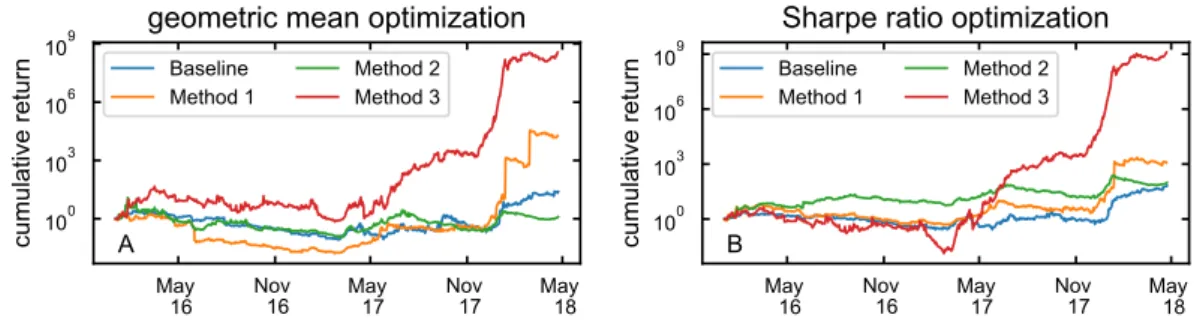
In Fig. 5, we show the cumulative return obtained using the 4 methods. The cumulative returns achieved
on April,24 under the Sharpe Ratio optimisation are ∼65 BTC (Baseline), ∼1.1·103 BTC (Method
1),∼95 BTC (Method 2),∼1.2·109BTC (Method 3). Under geometric mean optimisation we obtain
∼25 BTC (Baseline), ∼19·103 BTC (Method 1),∼1.25 BTC (Method 2),∼3.6·108 BTC (Method
3). While some of these figures appear exaggerated, it is worth noticing that (i) we run a theoretical exercise assuming that the availability of Bitcoin is not limited and (ii) under this assumption the upper bound to our strategy, corresponding to investing every day in the most performing currency results in a total cumulative return of 6·10123 BTC (see Appendix Fig. A6).
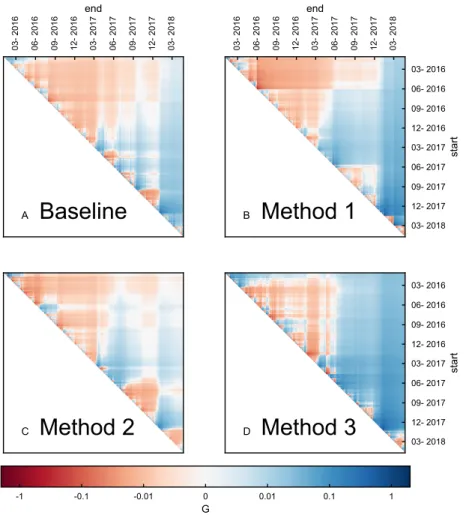
The cumulative return in Fig. 5 is obtained by investing between January 1st, 2016 and April 24th, 2018. We investigate the overall performance of the various methods by looking at the geometric mean return obtained in different periods (see Fig. 6). Results presented in Fig. 6 are obtained under Sharpe ratio optimisation for the baseline (Fig. 6-A), Method 1 (Fig. 6-B), Method 2 (Fig. 6-C), and Method 3 (Fig. 6-D). Note that, while in this case the investment can start after January 1st, 2016, we optimised the parameters by using data from that date on in all cases. Results are considerably better than those achieved using geometric mean return optimisation (see Appendix Fig. A7).
May
16 Nov 16 May 17 Nov 17 May 18 100
103 106 109
cumulative return
A
geometric mean optimization
Baseline Method 1
Method 2 Method 3
May
16 Nov 16 May 17 Nov 17 May 18 100
103 106 109
cumulative return
B
Sharpe ratio optimization
Baseline Method 1
Method 2 Method 3
Figure 5: Cumulative returns. The cumulative returns obtained under the Sharpe Ratio optimisation
(A) and the geometric mean optimisation (B) for the baseline (blue line), Method 1 (orange line), Method 2 (green line) and Method 3 (red line). Analyses are performed considering prices in BTC.
03- 2016 06- 2016 09- 2016 12- 2016 03- 2017 06- 2017 09- 2017 12- 2017 03- 2018 end
Baseline
A 03- 2016 06- 2016 09- 2016 12- 2016 03- 2017 06- 2017 09- 2017 12- 2017 03- 2018 end 03- 2016 06- 2016 09- 2016 12- 2016 03- 2017 06- 2017 09- 2017 12- 2017 03- 2018 startMethod 1
BMethod 2
C 03- 2016 06- 2016 09- 2016 12- 2016 03- 2017 06- 2017 09- 2017 12- 2017 03- 2018 startMethod 3
D -1 -0.1 -0.01 0 0.01 0.1 1 GFigure 6: Geometric mean return obtained within different periods of time. The geometric
mean return computed between time ”start” and ”end” using the Sharpe ratio optimisation for the baseline (A), Method 1 (B), Method 2 (C) and Method 3 (D). Shades of red refers to negative returns and shades of blue to positive ones (see colorbar).
Feature importance
price, mean ROI, last ROI, mean ROI, trend age, last ROI, std
volume, mean price, trend
price, std
volume, last volume, trend volume, std
rank, std
rank, trend price, last
market share, trend
rank, mean
market share, std market cap, trend market cap, std
rank, last
market share, mean market share, last
market cap, last
market cap, mean
0.00 0.02 0.04 0.06 0.08 0.10
feature importance
A
price, mean, Dash price, mean, Augur
price, mean, BitShares
price, mean, Ardor
price, mean, 0x
price, mean, Ethereum price, mean, Dogecoin
price, mean, Ethereum Classic
price, mean, Factom price, mean, Litecoin price, mean, ATBCoin
price, mean, MaidSafeCoin
price, mean, Aragon price, mean, AdEx price, mean, Achain price, std, Ethereum
price, mean, E-Dinar Coin
price, last, Ethereum
0.00 0.01 0.02 0.03 0.04 0.05
feature importance
B
Ethereum
price, mean, Dash price, mean, Augur
price, mean, BitShares
price, mean, 0x
price, mean, Dogecoin
price, mean, Ardor
price, mean, Ethereum price, mean, EDRCoin price, mean, Factom
price, mean, Ark
price, mean, MaidSafeCoin
price, mean, AdEx
price, mean, E-Dinar Coin
price, mean, Aragon price, mean, Litecoin price, mean, ATBCoin
price, mean, Ethereum Classic
price, std, Dash
feature importance
C
Ripple
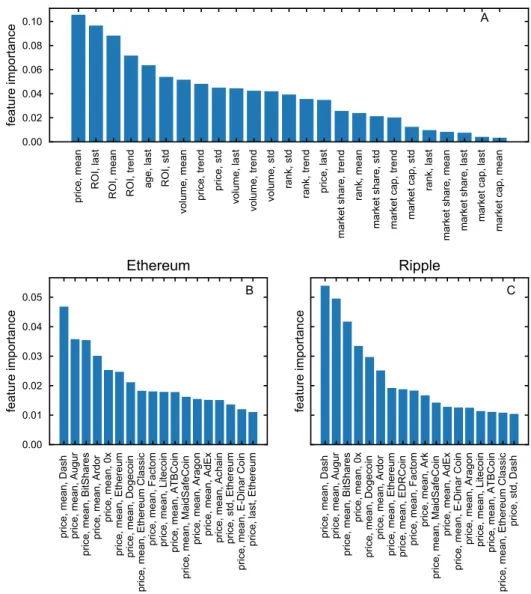
Figure 7: Feature importance for Methods 1 and 2. (A) The average importance of each feature
for the XGBoost regression model of Method 1. Results are shown for w = 7 and Wtraining = 10.
(B,C) Examples of average feature importance for the XGBoost regression model developed in Method
2. Results are shown for w = 3, Wtraining = 10, for Ethereum (B) and Ripple (C). For visualization
purposes, we show only the top features.
In Fig. 7, we illustrate the relative importance of the various features in Method 1 and Method 2. For Method 1, we show the average feature importance; For Method 2, we show the average feature importances for two sample currencies: Ethereum and Ripple.
Portfolio composition
The 10 most selected currencies under Sharpe Ratio optimisation are the following:
Baseline: Factom (91 days), E-Dinar Coin (89 days), Ripple (76 days), Ethereum (71 days), Steem (70 days), Lisk (70 days), MaidSafeCoin (69 days), Monero (58 days), BitShares (55 days), EDRCoin (52 days).
Method 1: Ethereum (154 days), Dash (128 days), Monero (111 days), Factom (104 days), Ripple (94 days), Litecoin (93 days), Dogecoin (92 days), Maid Safe Coin (86 days), BitShares (73 days), Tether (59 days)
Method 2: Ethereum (63 days), Monero (61 days), Factom (51 days), Ripple (42 days), Dash (40 days), Maid Safe Coin (40 days), Siacoin (30 days), NEM (26 days), NXT (26 days), Steem (23 days).
Method 3: Factom (48 days), Monero (46 days), Ethereum (39 days), Lisk (36 days), Maid Safe Coin (32 days), E-Dinar Coin (32 days), BitShares (26 days), B3 Coin (26 days), Dash (25 days), Cryptonite (22 days).
Discussion
We tested the performance of three forecasting models on daily cryptocurrency prices for 1,681 currencies. Two of them (Method 1 and Method 2) were based on gradient boosting decision trees and one is based on long short-term memory recurrent neural networks (Method 3). In Method 1, the same model was used to predict the return on investment of all currencies; in Method 2, we built a different model for each currency, that uses information on the behaviour of the whole market to make a prediction on that single currency; in Method 3, we used a different model for each currency, where the prediction is based on previous prices of the currency.
We built investment portfolios based on the predictions of the different method and compared their performance with that of a baseline represented by the well known simple moving average strategy. The parameters of each model were optimised for all but Method 3 on a daily basis, based on the outcome of each parameters choice in previous times. We used two evaluation metrics used for parameters opti-misation: The geometric mean return and the Sharpe ratio. To discount the effect of the overall market growth, cryptocurrencies prices were expressed in Bitcoin. All strategies, produced profit (expressed in Bitcoin) over the entire considered period and for a large set of shorter trading periods (different combinations of start and end dates for the trading activity).
The three methods performed better than the baseline strategy when the investment strategy was ran over the whole period considered. The optimisation of parameters based on the Sharpe ratio achieved larger returns. Methods based on gradient boosting decision trees (Method 1 and 2) worked best when predictions were based on term windows of 5/10 days, suggesting they exploit well mostly short-term dependencies. Instead, LSTM recurrent neural networks worked best when predictions were based
on ∼50 days of data, since they are able to capture also long-term dependencies and are very stable
against price volatility. Methods based on gradient boosting decision trees allow to better interpret results. We found that the prices and the returns of a currency in the last few days preceding the prediction were leading factors to anticipate its behaviour. Among the two methods based on random forests, the one considering a different model for each currency performed best (Method 2).
It is important to stress that our study has limitations. First, we did not consider any fees associated with market operations, which could limit the profits in a real world application of our method. Second, we did not attempt to exploit the existence of different prices on different exchanges, the consideration of which could open the way to significantly higher returns on investment. Third, we ignored intra-day price fluctuations and considered an average daily price. Finally, and crucially, we run a theoretical test in which the available supply of Bitcoin is unlimited and none of our trades influence the market. Notwithstanding these simplifying assumptions, the methods we presented were systematically and con-sistently able to identify outperforming currencies. Extending the current analysis by considering these
and other elements of the market is a direction for future work.
A different yet promising approach to the study cryptocurrencies consists in quantifying the impact of public opinion, as measured through social media traces, on the market behaviour, in the same spirit in which this was done for the stock market [66]. While it was shown that social media traces can be also effective predictors of Bitcoin [67–73] and other currencies [74] price fluctuations, our knowledge of their effects on the whole cryptocurrency market remain limited and is an interesting direction for future work.
References
[1] A. ElBahrawy, L. Alessandretti, A. Kandler, R. Pastor-Satorras, and A. Baronchelli, “Evolutionary dynamics of the cryptocurrency market,”Royal Society Open Science, vol. 4, no. 11, 2017. [Online]. Available: http://rsos.royalsocietypublishing.org/content/4/11/170623
[2] G. Hileman and M. Rauchs, Global Cryptocurrency Benchmarking Study. Cambridge Centre for
Alternative Finance, 2017.
[3] Binance.com. (2017) Binance. [Online]. Available: https://www.binance.com/ [4] Dunamu. (2017) Upbit. [Online]. Available: https://upbit.com/
[5] P. Inc. (2012) Kraken. [Online]. Available: https://www.kraken.com/
[6] S. Foley, J. Karlsen, and T. J. Putni, “Sex, drugs, and bitcoin: How much illegal activity is financed
through cryptocurrencies?” SSRN, p. https://ssrn.com/abstract=3102645, 2018.
[7] S. Nakamoto, “Bitcoin: A peer-to-peer electronic cash system,” 2008.
[8] R. Ali, J. Barrdear, R. Clews, and J. Southgate, “The economics of digital currencies,” 2014. [9] The Dash Network. (2018) Dash. [Online]. Available: https://www.dash.org
[10] Ethereum Foundation (Stiftung Ethereum). (2018) Ethereum. [Online]. Available: https:
//www.ethereum.org/
[11] Ripple. (2013) Ripple. [Online]. Available: https://ripple.com/ [12] (2018) Iota. [Online]. Available: https://iota.org/
[13] A. Baronchelli, “The emergence of consensus: a primer,”Royal Society Open Science, vol. 5, no. 2, 2018. [Online]. Available: http://rsos.royalsocietypublishing.org/content/5/2/172189
[14] G. P. Dwyer, “The economics of bitcoin and similar private digital currencies,”Journal of Financial Stability, vol. 17, pp. 81–91, 2015.
[15] R. B¨ohme, N. Christin, B. Edelman, and T. Moore, “Bitcoin: Economics, technology, and
gover-nance,”Journal of Economic Perspectives, vol. 29, no. 2, pp. 213–38, 2015.
[16] M. J. Casey and P. Vigna, “Bitcoin and the digital-currency revolution,”The Wall Street Journal, vol. 23, 2015.
[18] M. Iwamura, Y. Kitamura, and T. Matsumoto, “Is bitcoin the only cryptocurrency in the town? economics of cryptocurrency and friedrich a. hayek,” 2014.
[19] M. A. Cusumano, “The bitcoin ecosystem,”Communications of the ACM, vol. 57, no. 10, pp. 22–24,
2014.
[20] K. Wu, S. Wheatley, and D. Sornette, “Classification of crypto-coins and tokens from the dynamics of their power law capitalisation distributions,”arXiv preprint arXiv:1803.03088, 2018.
[21] A. Lamarche-Perrin, A. Orl´ean, and P. Jensen, “Coexistence of several currencies in presence of increasing returns to adoption,”Physica A: Statistical Mechanics and its Applications, 2018. [22] P. M. Krafft, N. Della Penna, and A. Pentland, “An experimental study of cryptocurrency market
dynamics,”arXiv preprint arXiv:1801.05831, 2018.
[23] A. Rogojanu, L. Badeaet al., “The issue of competing currencies. case study–bitcoin,”Theoretical and Applied Economics, vol. 21, no. 1, pp. 103–114, 2014.
[24] L. H. White, “The market for cryptocurrencies,”Cato J., vol. 35, p. 383, 2015. [25] P. Ceruleo, “Bitcoin: a rival to fiat money or a speculative financial asset?” 2014.
[26] M. N. Sayed and N. A. Abbas, “Impact of crypto-currency on emerging market focus on gulf countries,”Life Science Journal, vol. 15, no. 1, 2018.
[27] M. A. Javarone and C. S. Wright, “From bitcoin to bitcoin cash: a network analysis,”arXiv preprint arXiv:1804.02350, 2018.
[28] Y. Sovbetov, “Factors influencing cryptocurrency prices: Evidence from bitcoin, ethereum, dash, litcoin, and monero,” 2018.
[29] F. Parino, L. Gauvin, and M. G. Beiro, “Analysis of the bitcoin blockchain: Socio-economic factors behind the adoption,”arXiv preprint arXiv:1804.07657, 2018.
[30] S. Beguˇsi´c, Z. Kostanjˇcar, H. E. Stanley, and B. Podobnik, “Scaling properties of extreme price fluctuations in bitcoin markets,”arXiv preprint arXiv:1803.08405, 2018.
[31] P. Ciaian, M. Rajcaniova, and d. Kancs, “The economics of bitcoin price formation,”Applied
Eco-nomics, vol. 48, no. 19, pp. 1799–1815, 2016.
[32] T. Guo and N. Antulov-Fantulin, “Predicting short-term bitcoin price fluctuations from buy and sell orders,”arXiv preprint arXiv:1802.04065, 2018.
[33] G. Gajardo, W. D. Kristjanpoller, and M. Minutolo, “Does bitcoin exhibit the same asymmetric multifractal cross-correlations with crude oil, gold and djia as the euro, great british pound and yen?” Chaos, Solitons & Fractals, vol. 109, pp. 195–205, 2018.
[34] N. Gandal and H. Halaburda, “Can we predict the winner in a market with network effects? com-petition in cryptocurrency market,”Games, vol. 7, no. 3, p. 16, 2016.
[35] H. Elendner, S. Trimborn, B. Ong, T. M. Lee et al., “The cross-section of crypto-currencies as fi-nancial assets: An overview,” Sonderforschungsbereich 649, Humboldt University, Berlin, Germany, Tech. Rep., 2016.
[36] D. Enke and S. Thawornwong, “The use of data mining and neural networks for forecasting stock market returns,”Expert Systems with applications, vol. 29, no. 4, pp. 927–940, 2005.
[37] W. Huang, Y. Nakamori, and S.-Y. Wang, “Forecasting stock market movement direction with support vector machine,”Computers & Operations Research, vol. 32, no. 10, pp. 2513–2522, 2005. [38] P. Ou and H. Wang, “Prediction of stock market index movement by ten data mining techniques,”
Modern Applied Science, vol. 3, no. 12, p. 28, 2009.
[39] M. Gavrilov, D. Anguelov, P. Indyk, and R. Motwani, “Mining the stock market (extended abstract):
which measure is best?” in Proceedings of the sixth ACM SIGKDD international conference on
Knowledge discovery and data mining. ACM, 2000, pp. 487–496.
[40] K. S. Kannan, P. S. Sekar, M. M. Sathik, and P. Arumugam, “Financial stock market forecast
using data mining techniques,” in Proceedings of the International Multiconference of Engineers
and computer scientists, vol. 1, 2010, p. 4.
[41] A. F. Sheta, S. E. M. Ahmed, and H. Faris, “A comparison between regression, artificial neural networks and support vector machines for predicting stock market index,”Soft Computing, vol. 7, p. 8, 2015.
[42] P.-C. Chang, C.-H. Liu, C.-Y. Fan, J.-L. Lin, and C.-M. Lai, “An ensemble of neural networks for
stock trading decision making,”Emerging Intelligent Computing Technology and Applications. With
Aspects of Artificial Intelligence, pp. 1–10, 2009.
[43] I. Madan, S. Saluja, and A. Zhao, “Automated bitcoin trading via machine learning algorithms,” 2015.
[44] H. Jang and J. Lee, “An empirical study on modeling and prediction of bitcoin prices with bayesian neural networks based on blockchain information,”IEEE Access, vol. 6, pp. 5427–5437, 2018. [45] S. McNally, “Predicting the price of bitcoin using machine learning,” Ph.D. dissertation, Dublin,
National College of Ireland, 2016.
[46] K. HEGAZY and S. MUMFORD, “Comparitive automated bitcoin trading strategies.”
[47] A. G. Shilling, “Market timing: Better than a buy-and-hold strategy,”Financial Analysts Journal, vol. 48, no. 2, pp. 46–50, 1992.
[48] Z. Jiang and J. Liang, “Cryptocurrency portfolio management with deep reinforcement learning,” arXiv preprint arXiv:1612.01277, 2016.
[49] “Traderobot package,” https://github.com/owocki/pytrader, 2017, accessed: 5 December 2017. [50] “Cryptobot package,” https://github.com/AdeelMufti/CryptoBot, 2017, accessed: 5 December
2017.
[51] “Cryptocurrencytrader package,” https://github.com/llens/CryptoCurrencyTrader, 2017, accessed: 5 December 2017.
[52] “Btctrading package,” https://github.com/bukosabino/btctrading, 2017, accessed: 5 December 2017.
[53] “Bitpredict package,” https://github.com/cbyn/bitpredict, 2017, accessed: 5 December 2017. [54] “Bitcoin bubble burst,” https://bitcoinbubbleburst.github.io/, 2017, accessed: 5 December 2017. [55] J. H. Friedman, “Stochastic gradient boosting,”Computational Statistics & Data Analysis, vol. 38,
no. 4, pp. 367–378, 2002.
[56] S. Hochreiter and J. Schmidhuber, “Long short-term memory,” Neural computation, vol. 9, no. 8,
pp. 1735–1780, 1997.
[57] W. Brock, J. Lakonishok, and B. LeBaron, “Simple technical trading rules and the stochastic prop-erties of stock returns,”The Journal of finance, vol. 47, no. 5, pp. 1731–1764, 1992.
[58] T. Kilgallen, “Testing the simple moving average across commodities, global stock indices, and currencies,”The Journal of Wealth Management, vol. 15, no. 1, p. 82, 2012.
[59] B. LeBaron, “The stability of moving average technical trading rules on the dow jones index,”Deriv. Use Trad. Regul, vol. 5, pp. 324–338, 2000.
[60] C. A. Ellis and S. A. Parbery, “Is smarter better? a comparison of adaptive, and simple moving average trading strategies,” Research in International Business and Finance, vol. 19, no. 3, pp. 399–411, 2005.
[61] “coinmarketcap.com,” http:https://coinmarketcap.com/, 2013, accessed: 30 May 2017.
[62] G. T. Friedlob and F. J. Plewa Jr,Understanding return on investment. John Wiley & Sons, 1996.
[63] T. Chen and C. Guestrin, “Xgboost: A scalable tree boosting system,” in Proceedings of the 22nd
acm sigkdd international conference on knowledge discovery and data mining. ACM, 2016, pp. 785–794.
[64] K. Inc. (2018) Kaggle. [Online]. Available: https://www.kaggle.com/
[65] Z. C. Lipton, J. Berkowitz, and C. Elkan, “A critical review of recurrent neural networks for sequence learning,”arXiv preprint arXiv:1506.00019, 2015.
[66] H. S. Moat, C. Curme, A. Avakian, D. Y. Kenett, H. E. Stanley, and T. Preis, “Quantifying wikipedia usage patterns before stock market moves,”Scientific reports, vol. 3, p. 1801, 2013. [67] D. Kondor, I. Csabai, J. Sz¨ule, M. P´osfai, and G. Vattay, “Inferring the interplay between network
structure and market effects in bitcoin,”New Journal of Physics, vol. 16, no. 12, p. 125003, 2014. [68] L. Kristoufek, “What are the main drivers of the bitcoin price? evidence from wavelet coherence
analysis,”PloS one, vol. 10, no. 4, p. e0123923, 2015.
[69] D. Garcia and F. Schweitzer, “Social signals and algorithmic trading of bitcoin,” Royal Society
Open Science, vol. 2, no. 9, 2015. [Online]. Available: http://rsos.royalsocietypublishing.org/ content/2/9/150288
[70] L. Kristoufek, “Bitcoin meets google trends and wikipedia: Quantifying the relationship between phenomena of the internet era,”Scientific reports, vol. 3, p. 3415, 2013.
[71] A. Urquhart, “What causes the attention of bitcoin?” Economics Letters, vol. 166, pp. 40 – 44,
[72] D. Garcia, C. J. Tessone, P. Mavrodiev, and N. Perony, “The digital traces of bubbles: feedback cy-cles between socio-economic signals in the bitcoin economy,”Journal of the Royal Society Interface, vol. 11, no. 99, p. 20140623, 2014.
[73] S. Wang and J.-P. Vergne, “Buzz factor or innovation potential: What explains cryptocurrencies returns?” PloS one, vol. 12, no. 1, p. e0169556, 2017.
[74] T. R. Li, A. S. Chamrajnagar, X. R. Fong, N. R. Rizik, and F. Fu, “Sentiment-based prediction of alternative cryptocurrency price fluctuations using gradient boosting tree model,”arXiv preprint arXiv:1805.00558, 2018.
Appendix
A1
Parameters optimisation
In Fig. A1, we show the optimisation of the parametersw(A,C) andn(B,D) for the baseline strategy. In
Fig. A2, we show the optimisation of the parametersw(A,D),Wtraining(B,E), andn(C,F) for Method
1. In Fig. A3, we show the optimisation of the parameters w (A,D),Wtraining (B,E), and n(C,F) for
Method 2. In Fig. A4, we show the median squared error obtained under different training window choices (A), number of epochs (B) and number of neurons (C), for Ethereum, Bitcoin and Ripple. In
Fig. A5, we show the optimisation of the parametern(C,F) for Method 3.
0.0 0.2 0.4 0.6 0.8 1.0 0.0 0.2 0.4 0.6 0.8
1.0
geometric mean optimization
0.0 0.2 0.4 0.6 0.8 1.0 0.0 0.2 0.4 0.6 0.8
1.0
Sharpe ratio optimization
May
16 Nov 16 May 17 Nov 17 May 18 5 10 15 20 25 w (days) A May
16 Nov 16 May 17 Nov 17 May 18 5 10 15 n, c ur re nc ie s B May
16 Nov 16 May 17 Nov 17 May 18 10
20
w (days)
C
May
16 Nov 16 May 17 Nov 17 May 18 5 10 15 n, c ur re nc ie s D
Figure A1: Baseline strategy: parameters optimisation. The sliding window w (A,C) and the
number of currenciesn (B,D) chosen over time under the geometric mean (A,B) and the Sharpe Ratio
0.0 0.2 0.4 0.6 0.8 1.0 0.0 0.2 0.4 0.6 0.8
1.0
geometric mean optimization
0.0 0.2 0.4 0.6 0.8 1.0 0.0 0.2 0.4 0.6 0.8
1.0
Sharpe ratio optimization
May
16 Nov 16 May 17 Nov 17 May 18 4 6 8 10 w (days) A May
16 Nov 16 May 17 Nov 17 May 18 5 10 15 20 Wtra in in g (d ay s) B May
16 Nov 16 May 17 Nov 17 May 18 0 10 20 30 40 n, c ur re nc ie s C May
16 Nov 16 May 17 Nov 17 May 18 4 6 8 10 w (days) D May
16 Nov 16 May 17 Nov 17 May 18 5 10 15 20 Wtra in in g (d ay s) E May
16 Nov 16 May 17 Nov 17 May 18 0 10 20 30 40 n, c ur re nc ie s F
Figure A2: Method 1: Parameters optimisation. The sliding windoww(A,D), the training window
Wtraining (B,E) and the number of currencies n (C,F) chosen over time under the geometric mean
(A,B,C) and the Sharpe Ratio optimisation (D,E,F). Analyses are performed considering prices in BTC.
0.0 0.2 0.4 0.6 0.8 1.0 0.0 0.2 0.4 0.6 0.8
1.0
geometric mean optimization
0.0 0.2 0.4 0.6 0.8 1.0 0.0 0.2 0.4 0.6 0.8
1.0
Sharpe ratio optimization
May
16 Nov 16 May 17 Nov 17 May 18 3.0 3.5 4.0 4.5 5.0 w (days) A May
16 Nov 16 May 17 Nov 17 May 18 5 10 15 20 Wtra in in g (d ay s) B May
16 Nov 16 May 17 Nov 17 May 18 0 20 40 60 n, c ur re nc ie s C May
16 Nov 16 May 17 Nov 17 May 18 3.0 3.5 4.0 4.5 5.0 w (days) D May
16 Nov 16 May 17 Nov 17 May 18 5 10 15 20 Wtra in in g (d ay s) E May
16 Nov 16 May 17 Nov 17 May 18 0 50 100 150 n, c ur re nc ie s F
Figure A3: Method 2: Parameters optimisation. The sliding windoww(A,D), the training window
Wtraining (B,E) and the number of currencies n (C,F) chosen over time under the geometric mean
10 20 30 40 50 60 70 w (days) 0.005 0.010 0.015 0.020 mse
A Bitcoin Ripple Ethereum Average
0 250 500 750 1000 1250 1500 1750 2000 epochs 0.004 0.006 0.008 0.010 0.012 0.014 mse B
Bitcoin Ripple Ethereum Average
1.0 1.5 2.0 2.5 3.0 3.5 4.0 4.5 5.0 neurons 0.004 0.006 0.008 0.010 0.012 0.014 0.016 mse C
Bitcoin Ripple Ethereum Average
Figure A4: Method 3: Parameters optimisation. The median squared error of the ROI as a function
of the window size (A), the number of epochs (B) and the number of neurons (C). Results are shown considering prices in Bitcoin.
May
16 Nov 16 May 17 Nov 17 May 18 1 2 3 4 5 n, c ur re nc ie s A
geometric mean optimization
May
16 Nov 16 May 17 Nov 17 May 18
n, c ur re nc ie s B
Sharpe ratio optimization
Figure A5: Method 3: Parameters optimisation. The number of currencies n chosen over time
under the geometric mean (A) and the Sharpe Ratio optimisation (B). Analyses are performed considering prices in BTC.
A2
Return under full knowledge of the market evolution.
In Fig. A6, we show the cumulative return obtained by investing every day in the top currency, supposing one knows the prices of currencies on the following day.
May
16 Nov 16 May 17 Nov 17 May 18 109 1027 1045 1063 1081 1099 10117
cumulative return
Baseline Method 1 Method 2 Method 3 upper-boundFigure A6: Upper-bound for the cumulative return. The cumulative return obtained by investing
every day in the currency with highest return on the following day (black line). The cumulative return obtained with the baseline (blue line), Method 1 (orange line), Method 2 (green line), and Method 3 (red line). Results are shown in Bitcoin.
A3
Geometric mean optimisation
In Fig. A7, we show the geometric mean return obtained by between two arbitrary points in time under geometric mean return optimisation for the baseline (Fig. A7-A), Method 1 (Fig. A7-B), Method 2 (Fig. A7-C), and Method 3 (Fig. A7-D).
03- 2016 06- 2016 09- 2016 12- 2016 03- 2017 06- 2017 09- 2017 12- 2017 03- 2018 end
Baseline
A 03- 2016 06- 2016 09- 2016 12- 2016 03- 2017 06- 2017 09- 2017 12- 2017 03- 2018 end 03- 2016 06- 2016 09- 2016 12- 2016 03- 2017 06- 2017 09- 2017 12- 2017 03- 2018 startMethod 1
BMethod 2
C 03- 2016 06- 2016 09- 2016 12- 2016 03- 2017 06- 2017 09- 2017 12- 2017 03- 2018 startMethod 3
D -1 -0.1 -0.01 0 0.01 0.1 1 GFigure A7: Geometric mean return obtained within different periods of time. The geometric
mean return computed between time ”start” and ”end” using the Sharpe ratio optimisation for the baseline (A), Method 1 (B), Method 2 (C) and Method 3 (D). Shades of red refers to negative returns and shades of blue to positive ones (see colorbar).