• No results found

High-Performance Data Analysis with the Helmholtz Analytics Toolkit

N/A
N/A
Protected

Academic year: 2021

Share "High-Performance Data Analysis with the Helmholtz Analytics Toolkit"

Copied!
34
0
0

Loading.... (view fulltext now)

Full text

(1)

Martin Siggel, Debus Charlotte, Alexander Rüttgers, Kai Krajsek,

Philipp Knechtges, Markus Götz, Claudia Comito, Björn Hagemeier

German Aerospace Center (DLR)

High-Performance Computing

(2)
(3)

HeAT!

• HeAT

=

He

lmholtz

A

nalytics

T

oolkit

• Python framework for

parallel

,

distributed

data analytics and

machine learning

• Developed within the Helmholtz Analytics Framework

Project since 2018

• AIM: Bridge data analytics and

high-performance computing

• Open Source licensed, MIT

(4)

How we started HeAT:

The Helmholtz Analytics Framework (HAF) Project

• Joint project of all 6 Helmholtz centers

• Goal: foster data analytics methods and tools within Helmholtz federation.

• Scope:

• Development of domain-specific data analysis techniques

• Co-design between

domain scientists

and

information experts

(5)

Motivation: HAF applications

Aeronautics and Aerodynamics

Structural Biology

Research with Photons

Earth System Modelling

(6)

Motivation: HAF methods + algorithms

Clustering

k-means, mean shift clustering

Uncertainty quantification

Ensemble methods

Dimension reduction

Autoencoder, reduced order models

Feature learning

Image descriptors, autoencoder

Data assimilation

Kalman filter, 4Dvar, particle filter/smoother

Classification/Regression

Random forest, CNN, SVM

Modelling

Fiber tractography, point processes

Optimization techniques

L-BFGS, simulated annealing

Hyper-parameter optimization

Evidence framework, grid search

Interpolation

Radial basis function, Kriging

(7)

Greatest Common Denominator?

https://xkcd.com/1838/

Machine Learning

=

Data

+

(8)
(9)

Big Data/Deep Learning Libraries

(10)

Scope

Design

Facilitating applications of

HAF in their work

Bringing HPC and Machine

Learning / Data Analytics

closer together

Ease of use

k-means

SVM

mpi4py

Deep

Learning

Distributed Parallelism (MPI)

NumPy-like

interface

Automatic

Differentiation

Tensor Linear

Algebra

GPU support

And more machine

(11)

Which framework could be basis for HeAT?

Evaluation criteria

• Feature completeness

• Compute performance → Benchmarks required!

• Ease of development

(12)

Which technology stack to use?

Feature completeness

• Completeness: PyTorch and TensorFlow

• Ease of implementation and usage: PyTorch and MXNet

*Note: no support of distributed data in TensorFlow in 2018, but today there is first support!

Framework

GPU

MPI

AD

LA

nD Tensors

SVD

Dist. tens

PyTorch

X

X

X

X

X

X

-

TensorFlow

X

X

X

X

X

X

(X)*

MXNet

X

-

X

X

X

X

-

(13)

Which technology stack to use?

Compute performance

• Implemented 4 benchmark methods in all frameworks

(PyTorch, Tensorflow, MXNet, ArrayFire)

K-means

Self-Organizing Maps (SOM)

Artificial Neural Networks (ANN)

Support Vector Machines (SVM)

• Example: ResNet Batch Inference (32 Images) on

NVIDIA K80 GPU@JURECA

• Similar result for other ML Methods (e.g. k-means)

• Benchmarking is on-going effort:

(14)
(15)

NumPy

Data structure

ND-Tensor

Operations

Elementwise operations

Slicing

Matrix operations

Reduction

Runs on

(16)

PyTorch

Operations

Elementwise operations

Slicing

Matrix operations

Reduction

Automatic differentation

or

Data structure

ND-Tensor

Runs on

(17)

Operations

Elementwise operations

Slicing

Matrix operations

Reduction

Automatic differentation

or

MPI

Data structure

ND-Tensor

Runs on

HeAT

(18)

Data Distribution

Server#1

PyTorch

Tensor#1

Server#2

PyTorch

Tensor#2

Server#3

PyTorch

Tensor#3

HeAT Tensor

Example:

Server#1

[0, 1]

Server#2

[2, 3]

Server#3

[4, 5]

split=1

Server#1 PyTorch Tensor#1

Server#2 PyTorch Tensor#2

Server#3 PyTorch Tensor#3

HeAT Tensor

split=0

(19)

What has been done so far?

• The core technology has been identified

• Implementation of a distributed parallel tensor

core framework

• NumPy-compatible core functionality

• Some linear algebra routines

• Parallel data I/O via HDF 5 and NETCDF

• A first implementation of the k-means algorithm is available

𝑥0,0 … 𝑥0,𝑚 ⋮ ⋱ ⋮ 𝑥𝑛,0 … 𝑥𝑛,𝑚
𝑥

0,0

𝑥

0,𝑀

𝑥

𝑖𝑗

𝑥

𝑁,0

𝑥

𝑁,𝑀 𝑥𝑛+1,𝑚+1 … 𝑥𝑛+1,𝑚 ⋮ ⋱ ⋮ 𝑥2𝑛,𝑚+1 … 𝑥2𝑛,2𝑚 𝑥𝑟∙𝑛,𝑟∙𝑚 … 𝑥𝑟∙𝑛,𝑀 ⋮ ⋱ ⋮ 𝑥𝑁,𝑟∙𝑚 … 𝑥𝑁,𝑀

PyTorch tensor

Distributed tensor

(20)

Example: k-means

• Find k data clusters

• Minimization of

arg min

𝑐

𝑥 − 𝜇

𝑖

2

𝑥∈𝐶

𝑖

𝑘

𝑖=1

• NP-hard problem, many local minima!

Basic k-means algorithm (heuristic):

1.

Choose k initial centroids

𝜇

1

… 𝜇

𝑘

2.

For each point

𝑥

calculate Euclidean distance to

all centroids

3.

Assign each point to its

closest centroid

4.

Estimate new centroid as

mean

of points

5.

Go to 2. until

convergence

(21)

Example: k-means

Numpy vs. HeAT

2. For each point calculate distance to centroids

3. Assign point to

closest centroid

(22)

Example: k-means

Numpy vs. HeAT

(23)

Example: k-means

Numpy vs. HeAT

(24)

A real world example:

Rocket engine combustion analysis

Goal

: Cost reduction of rocket engines, be competitive with e.g. Space-X

Traditional rocket engine:

• 2 Pumps transporting fluid fuel and oxidizer at

very high pressure and flow

• Advantages

• Burning rate can be controlled precisely

• Disadvantages

• Pumps are mechanically very complex

• Expensive

(25)

A real world example:

Rocket engine combustion analysis

Goal

: Cost reduction of rocket engines, be competitive with e.g. Space-X

Solid propellant rocket engine

• Fuel and oxidizer are mixed in solid form

• Advantage

• Cheap

• Disadvantage

• Burning rate can not be varied during flight

(26)

A real world example:

Rocket engine combustion analysis

Goal

: Cost reduction of rocket engines, be competitive with e.g. Space-X

Hybrid rocket engine

• Pressurized fluid oxidizer

• Solid fuel

• A valve controls, how much oxidizer gets into

the combustion chamber

• Advantages

• Cheap

• Controllable

(27)

A real world example:

Rocket engine combustion analysis

Goal: Finding a good design for a hybrid rocket engine

• Hundreds of experiments

• Each experiment 3s video data, ~30000 images/ 8 GB data

• Clustering analysis of combustion experiments

• Identification of different burning phases

• Challenges:

• Number of clusters unknown a priori

• High memory consumption and computation demand

Use HeAT‘s k-means for distributed clustering

• Each image is a sample in a high-dimensional space

Rüttgers, A., Petrarolo, A., and Kobald, M. “Clustering of Paraffin-Based Hybrid

Rocket Fuels Combustion Data”,

submitted to Combustion and Flame

(28)

A real world example:

(29)

Time-dependency of centroids

Centroid 1

Centroid 5

Centroid 6

t = 0.5s

t = 1.5s

t = 3.2s

(30)

A real world example:

(31)

A real world example:

Computational Performance

• Hybrid shared memory + distributed memory setting

• CPU only

• Variation of 1 … 16 MPI total ranks

• Variation of 1 … 3 local threads per process

• Strong scaling analysis: How does the computing

time reduce with number of ranks?

• First results look promising, testing on larger

systems + GPU necessary

0

5

10

15

20

25

0

5

10

15

20

Spe

e

d

u

p

# MPI Ranks

Strong scaling

Linear Scaling

OMP_NUM_THREADS=1

OMP_NUM_THREADS=2

OMP_NUM_THREADS=3

(32)

• Completion of neural deep network support, including convolutions and automatic differentiation

• Support for sparse matrices

• In kernel methods (e.g. SVMs), linear system has to be solved with distance matrix

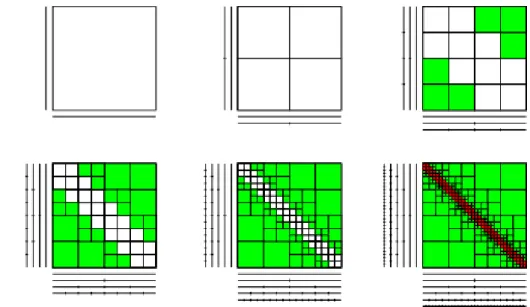
• The

never become zero, but can be arbitrarily close to zero.

• Could one not partially approximate the matrix with low-rank

matrices?

• Tensor decompositions to reduce computational complexity

Future Developments

Figure taken from Steffen Börm‘s lecture notes

„Numerical Methods for Non-Local Operators“

Hierarchical Matrices

(33)

Acknowledgments

This work is supported by the Helmholtz Association Initiative and Networking Fund

under project number ZT-I-0003.

https://github.com/

helmholtz-analytics

Dr. Martin Siggel

[email protected]

Dr. Charlotte Debus

Dr. Philipp Knechtges

Contact

(34)

Thanks for listening.

Questions?

Figure

Figure taken from Steffen Börm‘s lecture notes

References

Related documents

The purpose of this phenomenological study is to develop a better understanding of student perceptions as to why some middle school students lose their intrinsic motivation and

Tujuan penelitian ini adalah mengetahui hasil belajar fisika sebelum dan setelah penerapan kombinasi metode pembelajaran complete sentence dengan giving question

a policy with a leading insurance company, at his own expense, taking upon himself any exemptions and exclusions agreed upon with the insurer, an insurance against all risks,

First, since actors engaged in the transnational coalition pursued similar if not identi- cal political goals domestically, the degree of domestic conflict and differences over

- Partially Competence Board, affect the Cooperative Effect. But does not affect the competence of the supervisory cooperative effect, so with competence manager. -

In conclusion, for the studied Taiwanese population of diabetic patients undergoing hemodialysis, increased mortality rates are associated with higher average FPG levels at 1 and

The front line manager should use it as a tool to communicate the sales strategy and goals and motivate the sales staff to sell.. Here are some of the essential elements

Complete the sentence with the correct PERFECT past tense verb. My class had voted (vote) for the theme of our party