Verifiable Self-Aware Agent-Based
Autonomous Systems
Louise A. Dennis and Michael Fisher
Abstract
In this article we describe an approach to autonomous system construction that not only supports self-awareness but also formal verification. This is based on modular construction where the key autonomous decision-making is captured within a symbolically described ‘agent’. So this article lead us from traditional systems architectures, via agent-based computing, to explainability, reconfigurability, and verifiability, and on to applications in robotics, autonomous vehicles, and machine ethics.
Fundamentally, we consider self-awareness from an agent-based perspective. Agents are an important abstraction capturing autonomy and we are particularly concerned withIntentional, orRational, Agents that expose the ‘intentions’ of the autonomous system. Beyond being a useful abstract concept, agents also provide a practical engineering approach for building the core software in autonomous systems such as robots and vehicles. In a modular autonomous system architecture, agents of this form capture important making elements. Furthermore, this ability to transparently capture such decision-making processes, and especially being able to expose their intentions, within an agent allows us to apply strong (formal) agent verification techniques to these systems.
I. INTRODUCTION
Autonomous Systems, ranging from robots, unmanned vehicles, ‘smart’ technologies, and on to au-tonomous software, are increasingly popular. For example:
• “driverless cars” are being developed and even deployed on standard highways [1], for example Figure1a;
• robots are being developed for domestic duties, not just robotic vacuum cleaners [2] (Figure1b) but more complex robotic assistants [3], [4] (Figure 1c);
• unmanned air systems, or ‘drones’, are available with varying degrees of autonomous capability not just to large organisations and the military, but to the public (Figure1d);
• autonomic systems [5], combining autonomy and self-awareness in networks/communications struc-tures are common; and
• high-frequency or automated trading systems are available for markets with online access [6], again with varying degrees of autonomy.
There are many more examples, across industrial, financial, health-care, and domestic sectors. Yet most of these, particularly in safety-critical areas, remain essentially human-controlled: the responsibility for safety in a “driverless car” remains with the driver; the responsibility for safety in a remote-controlled ‘drone’ remains with the remote operator; and so on. Current regulations limit the amount of true autonomy that such systems can exhibit. For example, for air vehicles in the United Kingdom there are strict regulations [7] ensuring that drones of over 250g weight must be registered and the operator of such a drone must pass an appropriate test. Drones are also restricted inwherethey can fly, again often relating to their size. Similarly, there are a range of regulations constraining the use of “driverless cars”, though these may have local variations [8].
In what follows, we will describe how we can constructself-awareand increasingly autonomous systems. Work on self-awareness, particularly introspection and internal models, has been around for a very long time. Clearly Philosophy and Psychology have studied these aspects for centuries, but Logic has also developed (led by Philosophy) to provide a range of formalisms for capturing these aspects. Once we move on to computational systems, and in particular AI systems, then all of the above works become even more relevant. We would argue that self-awareness is, in fact, crucial for many aspects of safety, reliability, ethical behaviour, and ongoing verifiability. Any practical system will have a much clearer and more accurate view of its own capabilities and issues if it is self-aware. Furthermore, there are many aspects of verification, and particularly validation, that depend crucially on self-awareness. Providing explanations for actions or choices, as well as diagnosing and explaining errors or issues, will be vital to acceptability, trust, and, therefore, the widespread adoption of autonomous systems.
Work was funded by the UK’s Royal Academy of Engineering and through UKRI/EPSRC projects EP/L024845 (“Verifiable Autonomy”), EP/R026092 (“FAIR-SPACE”), EP/R026173 (“ORCA”), and EP/R026084 (“RAIN”).
(a) Waymo self-driving car. Source: Waymo. http://waymo.com
(b) Roomba vacuum cleaner. Source: iRobot. https://www.irobot.com/for-the-home/vacuuming/ roomba
(c) Care-o-Bot 4 robotic home assistant. Source: Fraunhofer IPA. http://www.care-o-bot.de/en/
(d) Parrot Bebop 2 drone http://www.parrot.com Figure 1: Examples of embodied autonomous systems currently available.
It is important to note that we are considering autonomous systems here, not just individual sub-symbolic components. An autonomous system, especially a modular one, will comprise a wide variety of components, not only image classifiers developed using machine learning techniques, but motor controls, sensors, planners, risk analysis modules, etc. All these components work together to create the overall autonomous behaviour. However, within the agent-based view it is the core agent/agents that captures/capture the essential autonomous decision-making (that used to be undertaken by humans). When we carry out verification and validation of autonomous systems there are a wide range of techniques used across the differing modular components. We might use physical testing for physical interactions, approximations for adaptive learning, and even formal verification for key software components [?]. Formally verifying the decision-making agent in such architectures does not require us to enumerate all possible environments/decisions but to verify the way decisions are made to ensure that decisions are always taken for the right reasons. In this way we can be confident of the decision-making process without know about every detailed situation.
In this article, we will provide an overview not only of how we can construct self-aware autonomous systems, but how we can potentially haveverifiable, self-aware behaviour. Throughout, we will provide pointers to papers providing much greater detail, but intend to highlight the key issues developed as part of this work. The key message here is that, by using such a modular agent-based approach, not only increased autonomy but increased self-awareness can be made available. Our formal agent verification techniques then allow us to precisely assess a range of key properties. We will begin, however, with a brief description of three aspects that converge in our work:autonomy;verification; andself-awareness. A. Automation, Adaptation, and Autonomy
While a dictionary definition of (human) autonomy involves independence, free will, and the ability to make ones own decisions, we can take a broad definition ofautonomy in computational systems as
the ability to make decisions, and potentially take actions, without direct human intervention. While rooted in philosophical views of autonomy [9], the development of autonomous computational systems has been taken up, expanding in the 1980s and 1990s, throughControl Systems[10] and
Agent-Based Systems[11]. This has led to a plethora of variations on autonomy, and we can refine the above general definition into further sub-categories describing where, and how, decisions are mode.
Automatic systems involve a number of fixed, and prescribed, activities and, while there may be options that can be taken, these are generally fixed in advance.
→ Such systems are typically deployed in environments that are either well-understood and tightly defined (for example, factory automation) or where the poorly understood or undefined parts of the environment are not important to system performance (for example, robot vacuum cleaners). Adaptivesystems typically match their activities (and performance) against a physical environment, often combining continuous sampling and optimisation throughfeedback control systems.
→ Here, while the precise nature of the environment may be unknown, we have a good under-standing of how the robot should detect changes in the environment and adapt to it in order to achieve system performance in a reactive fashion.
Autonomous systems are neither pre-scripted nor driven exclusively by feedback control, but can make their decisions based on a variety of dimensions including internal state and motivations.
→ These systems are intended for operating environments that might be complex and unknown, and so may require variable performance measures or utilising a range of adaptation methods depending upon context (and so, may themselves have to selecting new goals or modify initial goals).
In devising a range of practical systems and in working towards strong analysis such as formal verification, then distinguishingbetweenthese variations is often crucial in calibrating what analysis techniques should be used and how much confidence we can place in them.
Since the key new aspect ofautonomyis that the system, rather than any human user/operator/driver, now makes decisions (and potentially takes actions), it is important to consider where those decisions are taken. Generalising about the categories of system above we might describe how:
• inautomatic systems, the decisions are essentially pre-coded by the system developer and are not dramatically affected by developments or environments;
• in adaptive systems, the decisions are essentially made by the environment with tight feedback control driving the system through environmental interaction; while
• inautonomous systems, decisions are taken by the system software based on internal state (such as goals or motivations) and context, though informed by environmental interactions.
As we will see later, the varieties of verification we might use for each of these classes of system might be quite different.
Finally in this section, we note that there is another dimension regarding autonomy that concerns the level of human control. Many systems involve some aspect of human control, and how much of this control there is is often captured through “levels of autonomy”. Although there are quite a number of these different classifications, many being sector-specific, one of the earliest such taxonomies captures the spectrum ofvariable autonomy. This effort, called ‘PACT’ [12], was developed for aerospace scenarios and catalogues levels of autonomy from level 0 (direct human control) to level 5 (full autonomy), as follows [12].
Level 0: “No Autonomy”
→ Whole task is carried out by the human except for the actual operation Level 1: “Advice only if requested”
→ Human asks system to suggest options and then human makes selection Level 2: “Advice”
→ System suggests options to human Level 3: “Advice, and if authorised, action”
→ System suggests options and also proposes one of them Level 4: “Action unless revoked”
4a: System chooses an action and performs it if the human approves 4b: System chooses an action and performs it unless the human disapproves Level 5: “Full Autonomy”
5a: System chooses action, performs it, and informs the human 5b: System does everything autonomously
The ability to fulfill categorisations such as the above of course depends on the capabilities of the system. A fully autonomous system might be able to move between the above levels, whereas an adaptive or
automatic system might find “suggesting options” or “providing advice” quite challenging. An interesting aspect of this concerns the mechanism by which a system changes between these levels. Not only when can the operator/pilot/driver give the system more control, but when can the system relinquish some/all control back to the human? Work on suchvariable, shared or adjustable autonomy remains of strong relevance to practical systems [13]–[15].
B. Verification
The termVerificationcovers a range of techniques that aim to assess whether (and how well) a system meets its requirements. A particular subset, termedFormal Verification, carries out the analysis of precise, formal requirements, with this analysis comprising strong mathematical/logical techniques such asformal proof. This leads us to be able, in some cases, to prove that a system meets its requirements. Within the umbrella term “formal verification”, there are many different techniques. One particularly popular technique ismodel checking[16], [17], where the formally defined requirements are automatically checked againstallpossible executions of the system, as captured within a mathematical model. Model-checking is the variety of formal verification most widely used for safety critical systems, though its use for autonomous (robotic) systems is relatively recent [18].
As we will see later, we employ a variety of model-checking to formally verify the behaviour of our practical autonomous systems. In capturing the system’s core autonomous behaviour as a rational agent, we allow formal agent model-checking techniques to be used as a route to the verification of autonomous behaviour [19]. As we will see in SectionIV, the verification of autonomy should take into account not only what the agent does, butwhyit chooses to do it.
Since autonomous systems typically interact with a complex external environment, we must ensure that verification is extended to take this aspect into account. However, since it is impossible to precisely model the real-world in a finite way, especially with its uncertain and continuous dynamics, then exploration of allpossibilities through approaches such as model-checking is infeasible [20]. This leads us to several alternatives, such asusing abstractions,verification via testing, andruntime monitoring. In the first case, we may try toabstract from the complexity of the real world and provide a finite description of this abstraction that we can then use in formal verification; this abstraction is very likely to be incorrect in some way and will need subsequent refinement [21]. It is important to note that these abstractions of a complex, continuous “real-world” will necessarily never be correct. A practical alternative is to use sophisticated coverage-driven testing methods, appealing to Monte-Carlo techniques and dynamic test refinement in order to systematically “verify” a wide range of practical situations. Such model-based testing is a key technology but, as we move to more complex robot-human interactions, sophisticated extensions may be required [22], [23]. Again, testing only provides a partial verification of the system behaviour. In any realistic system, we cannot test all possible scenarios. Finally, while techniques such as abstraction and testing are typically used beforesystem deployment, it is also possible to verify the system as it executes. There are a range of techniques capturing run-time verification, dynamic fault monitoring, and compliance testing [24], [25] that provide mechanisms for assessing if the system has strayed (or is straying) outside its requirements.
As we will see later, our approach is to apply formal verification to the components of the system that we must be certain of (for example, the process of making decisions in unexpected situations) and carry out testing for components whose behaviour is tightly dependent on the (unknown) environment (for example, object recognition using reinforcement learning). Such “corroborative” verification, combining a variety of techniques for distinct components, is increasingly used in robotic systems [?].
C. Self-Awareness
Work on self-awareness, from Philosophy, Psychology, AI, and Logic came together in the 1970s and 1980s, for example with “mental models” from Cognitive Psychology [26], Logic [27], and Computa-tion [28], all helping start the field of ‘agents’. Similar activities occurred across Object-Based Systems in Computer Science (reflection, meta-objects, etc) and Control Systems in Engineering (hierarchical control, model-predictive control, etc). Since that time the field of agents, and multi-agent systems, has become vast linking (through Control Systems) to Robotics and (through Objects) to Computation, as well as back to Psychology and Philosophy. For example, robots with internal/self models are well established [29], [30] computational introspection (including reflection, awareness, etc) is often used [31], [32], and even hardware components may incorporate self-awareness [33]. A variation of this, specifically targeted at networks, has come through the development ofAutonomic Computingand then on to (so called) Self-* systems, most obviously described as computational self-awareness. Lewis et al [34] state the key idea
behind autonomic computing is that “... complexity leaves system managers neither able to respond sufficiently quickly and effectively at run-time, nor consider and design for all possible actions of and interactions between components at design time. Thus, in response, autonomic systems should instead manage themselves at run-time according to high level objectives” [attributed to Kephart and Chess [35]] In our overview of self-awareness from an agent point of view, we will revert to earlier work in Psychology where the study of self-awareness and introspection (in a human context) is a strong and persistent research field. Leading work by Duval and Wicklund [36] described how individuals could assess not only what they are doing and experiencing, but why they are doing these things and whether their goals are being achieved. Specifically, we might focus either on ourselves or on the environment in which we are situated. In the former, we can assess
1. what we are thinking? 2. what motives do we have?
3. what we are doing (or at least trying to do)? 4. why choose this?
We can also go further and, through introspection, assess our own health and capabilities. So, added to the above we might have
5. what affect this is having on the world? 6. how well we are achieving our goals? 7. how well are we functioning?
8. what current capabilities do we have?
In addition, as we live within a society that provides legal constraints and ethical norms, we also have 9. are we acting to legal standards
10. are we conforming with ethical/societal norms of behaviour?
There are many other psychological aspects that we are not concerned with here, for example emotions such as happiness or stress. However, the above elements provide a strong set of requirements for (human) self-awareness and introspection. These provide us with a framework to assess how we can design (artificial) autonomous systems that allow us to implement and expose any, most, or all of the above and, if so, how strongly can weverifythese aspects in our system?
In this article, we provide an overview of how we can construct self-aware autonomous systems so as to expose all the above elements. This will not only facilitate explicit self-awareness within the system, but will provide the opportunity for strong, specificallyformal, verification of these aspects. Combining these elements together, we can potentially have verifiable, self-aware behaviour. In the next section, we address the key aspect of our approach involving the architectural foundations of autonomous systems.
II. ARCHITECTURES
Architectures for autonomous systems, especially for those systems that have physical embodiment such as vehicles or robots, require many different functions and functionalities. They need to sense their environment and recognise objects, communicate with both other systems and people, move using some form of propulsion mechanism, and act on their environment for example through grippers, drills, loudspeakers, etc. In many complex autonomous systems it makes sense to have all of these aspects, such assensors,actuators, and communication as separate components in a modular architecture. The predominant modular middleware, at least in academic endeavours, is provided by theRobot Operating System (ROS) [37]. Each modular component, together with specific hardware (cameras, wheels, etc), will incorporate software to control (or interpret) the activity of the hardware. Consequently, software control systemsare very widely used to manage and monitor individual hardware components. Each of these (software controlled) components then forms part of an architectural scheme linking components together and providing whole system behaviour.
A most obvious architectural approach is to have very limited modularity and to implement large and complex monolithic control systems integrating multiple hardware devices. At this extreme we might, for example, provide a complex (and deep) neural network to controlall aspects of our system. While this avoids problems with modularity, it increases the complexity significantly, especially when we require explainability or verifiability. Such a monolithic approach is also difficult to engineer and maintain and so a more structured architecture, in terms ofhierarchical controlis very popular. Here, a particular control system ‘manages’ sub-systems, each with their own control algorithms. Each of the sub-systems might, in turn manage further sub-systems. Such a hierarchical tree-like structure provides natural organisation in terms of levels of abstraction, with the higher levels dealing with more abstract considerations, and
the lower control nodes dealing more directly with hardware/system control. This hierarchical type of approach is very popular within cyber-physical systems such as robots [38].
An alternative, but also hierarchical, approach uses symbolicAI techniques. For example a planning node within such an architecture utilises a symbolic world model and invokes symbolic planning to provide potential solutions. Being in symbolic form, often encoded via variations of formal logic, the representations of world, plan outcomes, and plan options are amenable to deductive reasoning and sophisticated analysis of various forms. While such approaches can benefit from analysis and reasoning, the techniques used are generally much slower than sub-symbolic algorithms such as provided by neural networks.
This leads on to an obvious compromise involving hybrid architectures. Developed within control systems engineering, hybrid architectures provide a mixture of (continuous) feedback control nodes, often at lower layers in a hierarchy, together with (discrete) nodes involving symbolic reasoning at higher levels. The feedback control nodes are fast and provide rapid interaction and local optimisation, while the discrete symbolic nodes manage activity across the the continuous nodes also providingdiscontinuous changes in behaviour that are difficult to produce using hierarchies of continuous controllers. Such hybrid architectures are efficient and flexible yet, in spite of the discrete nature of higher level nodes, are often opaque in terms of exposing the reasons for their decisions, etc.
In our work, we go one step further and ensure that the high-level symbolic nodes are themselves agents. An ‘agent’ is a key abstraction devised to capture the concept of “autonomous behaviour” [39], and an agent will typically make its own decisions about what to do and when to do it. Importantly, any high-level decision about what to do is encapsulated in the agent, corresponding to our earlier “fully autonomous” categorisation. We take this yet further and insist that any high-level agent (and there is often only one) in the architecture is arationalagent [40]. Alternatively termed as either an “intentional agent” or “cognitive agent”, this is an agent that not only makes its own decisions but also
must have explicit reasonsfor making the choices it does, and should be able to explain these if necessary.
These hybrid agent architectures provide flexibility and efficiency [41] whilst, as we will see later, retaining explainability and verifiability [19]. The agents themselves are symbolic, typically programmed in terms of so-called BDI principles [42], [43]: agents contain Beliefs about the state of the world (and themselves),Desires representing their long-term goals, andIntentions capturing the goals that the rational agent is committed to. As we will see later, these components are crucial in providing a range of self-aware elements within the autonomous system.
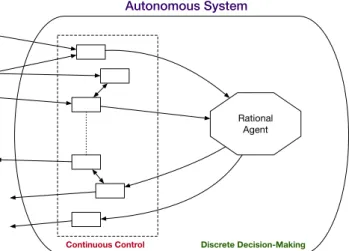
It is useful to note thatrationalagents in these hybrid agent architectures collate information from their sub-systems, representing them in terms of beliefs. Then based on current desires (long-term goals) and beliefs, they deliberate and decide what activity to undertake, and finally invoke activity again within their sub-systems. The agent is not driven solely by environmental interaction and can choose, for example based on its own motivations, to undertake very different activities. In such a hybrid approach, therational agent is responsible for high-level autonomous (discrete) decisions, while traditional feedback control systemsare responsible for low-level(continuous) interactions:
Autonomous System
Rational Agent
Continuous Control Discrete Decision-Making
Figure2aims to convey a typical structure for such a hybrid agent architecture. On the left, there are a range of feedback control modules, such as
• those integrating and assessing perceptions coming in to the system — for example, object recog-nition, sensing, planning, language understanding, etc, and
• those invoking actuation or communication undertaken by the system — for example, motor control, language generation, manipulation, etc.
Those modules dealing with perceptions process data/signals and provide symbolic knowledge to the rational agent. The agent then makes high-level decisions given what is has received, combined with its internal state and representation of context, and then sends actions/instructions to various control elements that will invoke the actuation and communication. While there are some cases where there may be a direct link from the perception elements to the actuation elements, for example in emergency situations requiring immediate reaction, the general process is to locate all high-level decisions in the rational agent. As indicated above, there will likely be very many feedback control components but typically only one rational agent per autonomous system. For example, a “driverless” car will have feedback control components for object recognition, learning, engine monitoring, etc, and will have further components controlling motor speed, lane-following, braking, communication, etc. The agent will, based on input received from the perception elements, make decisions about how to proceed and will then invoke various actuation components. For example, whether it is safe to turn, what to do if something unexpected happens, etc.
As we will see later, a key aspect of self-awareness is for the agent to be aware of the control modules within the architecture and to have a (hopefully reasonably accurate) view of the capabilities and reliability of each. For example if some sensor fusion module regularly produces incorrect results, the agent can take this reliability in to account when making decisions (especially critical decisions) when this node provides it with some input.
Example: Consider an unmanned air system, or ‘drone’, that is fully autonomous. There will be a variety of continuous control sub-systems such as those involved in object recognition, communication to authorities, fault detection, navigation, autopilot, etc. In very specific emergency cases, such as an imminent collision, we might have direct linkage between these sub-systems. For example within something like anAirborne Collision Avoidance System, object recognition might be connected directly to the autopilot. In general flight, however, the sensing/detection components pass information (such as “air vehicle detected at 2km distance, bearing 90◦”) to the agent. The agent then uses this, combined with its mission goals, safety requirements, etc, to decide what to do next. The “what to do next” will rarely be detailed, low-level controls but will typically be new destination instructions to the autopilot or an intention to keep monitoring the other air vehicle’s position. In such a way, the agent provides separation of the high-level decisions, from the low-level signals, reaction, and manipulation.
Work on architectures particularly for self-aware or autonomic systems are, as we might expect, derived from work on agent architectures. These were often, in turn, derived from psychological or philosophical interpretations of human decision-making. Consequently, change in high-level goals in computational systems can often be seen as analogous to (interpretations of) humans “changing their mind”. This work has led on to the development of a particular branch of “computationally self-aware” systems. For example, the collection [34] describes the work from a large EU project tackling self-aware systems, bringing together strands from multi-agent systems, autonomy, Philosophy, predictive control, planning, etc. The collection develops the notion of computational self-awareness, a development of introspective agents, but is particularly targeted at networks, as it says it “focusses on architectures and techniques for designing self-aware computing systems at the node and network levels”. As well as this traditional system focus, the techniques utilised are almost exclusively based on learning, typically online learning, reinforcement learning, and adaptivity in general. It is notable that, in this work, the route from Psychology and Philosophy through to computation follows a very similar path to that of agents and multi-agent systems and, to a lesser extent, general AI before that. While much of such work is focussed on learning, models built through learning, and adaptivity, reference is made to formal models (though limited to continuous envelopes), to higher-level discrete concepts such as ‘knowledge’ (though limited to ontologies), and to the self-models widespread across a range of disciplines. All of these aspects are relevant to us. However, as highlighted in the foreword to [34] “there is still a lack of formal frameworks for rigorously about the behaviour of such systems”.
III. SELF-AWARENESS INHYBRIDAGENTARCHITECTURES
We will now go through a range of the self-awareness attributes expected of humans (as described earlier) and assess how well we can capture these within autonomous systems built using the above hybrid agent approach. Several of the attributes or concepts will merge once we consider artificial, rather than human, systems but it is instructive to explore how (and if at all) artificial autonomous systems can provide what we might consider to be self-awareness.
Recall that the computational elements we are concerned with are typically termed rational (alter-natively, intentional or cognitive) agents [42], [44], [45]. The core aspect here are that, as they are autonomous, these agents should have some ‘motivation’ for acting in the way that they do. An agent is rational in the sense that the decisions it makes, often in unpredictable environments, should be both ‘reasonable’ and ‘justifiable’.
A. What is it ‘thinking’?
Can we expose the “reasoning” of the agent/system to show what options there are, where we are in the execution, and what agent is trying to do? In relation to human self-awareness this corresponds to asking:
1. what we are thinking? 2. what motives do we have?
3. what we are doing (or at least trying to do)?
Rao and Georgeff [43] developed a specific agent framework where agents comprise the “mental attitudes” of Beliefs, Desires and Intentions (BDI) that are used to describe, respectively, the informational, moti-vational, and deliberative states of the agent, and together effectively determine the high-level behaviour. Rational agents, particularly BDI agents have a “reasoning cycle” that captures the stages of reasoning that the agent will go through. The particular agent programming language we have developed and deployed, Gwendolen [46], [47], exhibits a reasoning cycle typical of many BDI languages:
1) Get external perceptions/messages — extract all the new information received, either from the environment or from other agents
2) Generate possible intentions — from the new inputs, combined with existing intentions, a new set of possibleintentionsis generated representing events (new beliefs) the agent needs to handle, goals the agent wants to achieve and (where an intention has an associated plan) the steps that the agent has chosen for pursuing the intention.
3) Select an intention— choose one from this set
4) Where there is no associated plan for handling the intention’s event or achieving its goal,generate plans for that intentionandselect one of these plansand associate it with the intention.
5) Executethe next step in the plan for the selected intention. 6) Go back to (1)
If, in (3) no intentions are available then the agent goes back to (1) to check its environment for updated perceptions and new messages, both of which may then generate new intentions.
In (3) there is an application specific function that selects one intention out of a set of intentions. By default, intentions are maintained in a FIFO (first in, first out) queue and selected in that order. Step (4) involves inspecting aplan libraryand finding plans that match the current intention. These check both the event (belief or goal) the intention needs to handle and that someplan specific context(a logical expression over the agent’s beliefs and goals) holds. As with intentions, application specific functions for selecting a plan from the set can be created but, by default, plans are selected in an order specified by the programmer. Plans specify a sequence of steps to be taken which can include adding or removing beliefs and goals and performing actions such as sending instructions to other parts of the autonomous system.
In this sense the options and motivations are symbolically represented and so can be used in expla-nations of what the agent (and, hence, system) is trying to do (see SectionVI-A). So, corresponding to human self-awareness, we can see agent/system self-awareness as follows.
1. what is it ‘thinking’?−→ where are we in the agent’s reasoning cycle (steps (1) to (6))? 2. what motives do we have?−→ what are the agent’s current goals/desires?
B. Why choose that?
As well as exposing the state of internal intentions, it is important to expose deliberative aspects, in particular the reasons for taking certain decisions. Why is one particular course of action chosen rather than another? What options are there, what reasons/motivations were used for selection, and what options were not chosen (and why)? Again, relating back to human self-awareness, we might ask:
2. what motives do we have?−→ what are the agent’s current goals/desires?
3. what we are doing (or at least trying to do)?−→what is the agent’s currently selected intention? 4. why choose this? −→why was this intention/plan/action selected?
As in the the previous section we can expose (and explain, if necessary) exactly what ‘motives’ (i.e. goals/intentions) the agent/system has, and so what it is ‘trying’ to do. Now we can also expose theplan selection mechanism (potentially also intention selection) in order to capture the reasons for choosing one plan to achieve some goal/intention, rather than another.
Abstractly, we might have a simple goal togo_to_shopand have two possible plans • go_to_shopby vehicle
• go_to_shopby walking
Without any further beliefs/motivations we might choose arbitrarily between these. But if we now add a goal/motivation to get to the shopquicklythen when we come to this choice again we will select the first option (assuming the vehicle is quicker than walking). On the other hand, if the agent has a belief that
vehicle_out_of_fuel is true then the selection would favour the second plan. In all these cases, the reasons for choosing one plan over another is explicit and symbolically represented.
Example:Consider a robot deployed in a search and rescue situation. It might have a number of roles includingmap_areaandclear_area. The robot might well be part of some ad hoc team of robots formed rapidly on the fly and its role (mapping or clearing) will have been assigned during team formation and transformed into a goal. We will represent a plan in the general form
Event: Context <- Action
wereEventis the event associated with the current intention (i.e., the addition or removal of a belief or goal),Contextis the plan specific context that needs to hold for the plan to be applicable andAction
is an action to be taken if the plan applies. We will useB pto indicate that some predicatepis a belief of the agent andG qto indicate that some predicateqis a goal of the agent.
In our example the robot therefore has two plans for what to do when it enters a location that contains rubble.
1) B contains_rubble(Location): G map_area
<- send_message(contains_rubble(Location))
Here, the recognition that a particular belief has become true (B contains_rubble(Location)) acts as atriggerfor the behaviour. However, there is a context requirement (orguard) that acts as a filter on triggered behaviour (G map_area). Then, if the trigger occurs and the guard is satisfied, the body of the plan can be invoked (send_message(contains_rubble(Location)). Consequently, the intuitive representation of the above is
If you believe the current location contains rubble and your goal is to map the area then send a message to the rest of the team informing them of the location of the rubble.
2) B contains_rubble(Location): G clear_area <- collect_rubble
This second plan corresponds to
If you believe the current location contains rubble and your goal is to clear the area then collect the rubble.
To extend the example the robot might also have a plan for how to react if it receives an urgent request for help (e.g., from a trapped person). In a situation where it both receives a call for help and perceives some rubble then itsintention selection mechanism can potentially prioritise handling the call for help.
In summary, in choosing what to do and how to do it, the agent will use its particular intention selection[48], [49] andplan selection[50], [51] mechanisms, both of which can be exposed to scrutiny. C. What can it do?
Systems take actions that impact on the real world. If we are to use a rational agent to reason about these actions and their effects, then we typically need to model these actions ascapabilities. Essentially,
capabilities simply extend actions with pre-conditions describing the state of the world in which the action will be invoked andpost-conditionsdescribing the (expected) change in the world affected by the action. These pre- and post-conditions are typically represented in symbolic logic, allowing the agent to reason about when the actions can be used and what outcomes from them might be expected.
A capability can thus only be executed when its pre-conditions are satisfied, and its post-conditions will be satisfied if the action/capability succeeds. This form of capability/action theory is widely used in planning systems as well as agent programming, and corresponds with classical STRIPS [52] or primitive operations [53], while BDI programming languages that explicitly deal with capabilities include 3APL [54] and GOAL [55]. Once we have such capabilities, the questions
5. what affect is this having on the world? 6. how well we are achieving our goals? 8. what current capabilities do we have?
become clearer. Certainly, the answer to (8) is clearly linked to the set of viable capabilities the agent has. The answer to (5) is potentially more complex and can involve combining a tree of capabilities so that the post-conditions of all these combined actions/capabilities describe all the possible ways in which the system can ‘impact ’ the real-world. Answering (6) requires the agent to monitor its progress towards its goals.
The inclusion of a perception step in the reasoning cycle of most BDI agents allows them to monitor the effect of their actions on the world. At its simplest, the concept of anachievement goalused in many BDI languages enables agents to continue attempting some action until some desired state of the world is achieved. For instance an agent could have a goal to clear an area of rubble and a simple plan:
G clear_area: {} <- select_and_remove_debris
Interpreted as:If your goal is to clear the area select and remove one piece of debris. Note that this plan has an empty context,{}, and so is always applicable if the agent still has a goal to clear the area.
This plan will continue executing until the goal is achieved (i.eclear_area is achieved), so the agent will continue selecting and removing pieces of debris until no more remain. More sophisticated plans could track progress towards achievement of the goal, for instance checking in the plan context that the amount of rubble in the area was reducing. If the amount of rubble was not reducing then the system could conclude that something was wrong with the debris removal capabilities and take appropriate action.
In principle, we can go beyond the straightforward modelling of actions and capabilities and bring in much stronger mechanisms topredictfuture behaviour. There are many works related to this area, such as in Control Engineering through aspects such as predictive control, but we just mention one stream of work that is very relevant to our model. This is work by Winfield and colleagues incorporating self-simulations within an autonomous system, particularly a robot. Inspired by the artificial theory of mind, this work provides (mobile) robots with simulation-based internal models that the robot can use for the prediction of outcomes. Thus, at significant moments the robot can simulate/predict whatmighthappen if it chooses various actions, and then can assess the outcomes. This has been shown to be very useful in predicting bothsafe[56] andethical[57] behaviour. Furthermore, this approach coincides with our work here when we consider the verification of ethical autonomy in [58] and later in Section V-B. Finally, while this self-simulation approach is very appealing it is also very costly since predicting all possibilities at every execution step is infeasible. However, just as we humans do, this approach need only be used at critical or important decision points, thus potentially limiting the overall cost.
D. How well is it working?
This ability to monitor the affect an agent is having on the world and, in particular, to reason about success and failure naturally leads us to consider the question:
7. how well are we functioning? and to a more refined view on
8. what current capabilities do we have?
The representation of capabilities in an explicit way has a practical benefit. Representing capabili-ties in terms of pre- and post-conditions allows us to compare the actual effect an action has in the world with its expected effect. For instance, in [59], we advocate representing capabilities as a tuple
hC, P re, P ost, φs, φf, φai, where C is an identifier for the capability, P re and P ost are pre- and
post-conditions, and φs, φf and φa are logical conditions for when the capability has “completed and
Conditions such as φs etc. can be inferred from the agent’s belief base and so checked after the
perception stage has occurred. This allows the agent to monitor the effect of the action on the environment and react as appropriate. Action monitoring and failure for BDI agents is an area of ongoing research.
If some capability is malfunctioning, for example due to failure of a software or hardware component, then it may be necessary to adapt the plans that use that capability. We might need to replace either the whole plan, or components within it, by alternative actions/capabilities. It is here that the awareness of the agent concerning what it is trying to do and what capabilities it has, provides benefits. The agent can reason about how to replace some plan elements by carrying out symbolic reasoning in order to assess whether the modified plan will achieve less, more, the same, or just different outcomes. Further work along these lines, involving a rational agent reasoning about its explicit capabilities, is given in [60]. As a simple example of capability representations, themoveaction of an autonomous vehicle is represented in [60] as
C={at(X), not(X =Y)}move(X, Y){not at(X), at(Y)}
where X is the current position of the vehicle and Y is the destination. The above capability, C, incorporates a pre-condition that the vehicle must beat(X)and a post-condition that (upon successful completion) the vehicle will beat(Y). We assume that this simple move capability works by calculating a plan of way-points to the desired location,Y, and then calculating the necessary wheel rotations to navigate between the way-points.
Now suppose we have a plan to perform some task (for instance some kind of inspection task) at a specific location. So we might have a plan:
B daily_inspection_time: B current_location(X) <- move(X, inspection_point); inspect
When it is the daily inspection time, move from the current location to the inspection point and perform the inspection.
If something has gone wrong with one of the motors or wheels on the robot then the calculations needed to navigate between way-points inmove(X, inspection_point)may no longer be accurate (for instance its movement calculations may always result in the robot slightly missing its target location) and this plan would start failing. An alternative movement strategy might be to use afeedback controller to fix on the desired final location and move there by orienting in that direction and then activating the motors to keep the robot always pointing the same way and moving forwards. This could be represented by the capability
C1={at(X), not(X =Y)}feedback(Y){not at(X), at(Y)}
It is easy to see that the new actionf eedback(Y), invoking a particular feedback controller, should be substitutable formove(X, Y)in the inspection plan.
Potentially it would also be possible to learn new post-conditions formove(X, Y) utilising work on the learning of action descriptions from the domain of AI planning [61], [62].
IV. FORMALVERIFICATION OFRATIONALAGENTS
Formal verification is essentially the process of assessing whether a precise specification, usually given in a formal logic, is satisfied on the system in question. For a property,A, given in the relevant logic there may be many different approaches to formal verification [63]–[65], fromdeductiveverification against a logical description of the systemS (i.e., a proof thatS impliesA) to thealgorithmicverification of the property against a formal model of the system,MS (i.e.,MS|=A, meaning thatAis true of all possible
routes throughMS). This algorithmic approach has been very successful in both academia and industry,
principally via the technique ofmodel checking [16]. This takes a precise, mathematical model of the system in question, defining all the system’s possible executions, and then checks the required logical property against this model (and, hence, against all possible executions).
While model checking involves assessing a logical formula against all executions of amodel of the system, an alternative approach is to check a logical formula directly against allactualexecutions of the system. Thisprogam model checkingapproach [66] depends centrally on being able to determine all true executions of the actual program. With languages such as Java, this is feasible since virtual machines are available that can be used to extract all program executions. Specifically, theJava Pathfinder (JPF) system carries out formal verification of Java programs following this approach by assessing all possible execution paths through the Java program [66]. While sometimes slower than traditional model-checking,
this approach avoids the need for an additional level of modelling (and therefore, justification) and ensures that the verification resultsdirectlyapply to the real code.
In examples discussed later, we utilise the MCAPL framework, which includes a model-checker for our agent programs built on top of JPF. As the MCAPL framework is described in detail in [67], we only provide a brief overview here. MCAPL has two main sub-components: the AIL-toolkit for implementing interpreters for belief-desire-intention (BDI) agent programming languages; and the AJPF model checker for verifying programs in those languages.
Interpreters for BDI programming languages are programmed by instantiating the Java-based AIL toolkit [68]. Essentially, an agent system can be programmed in the normal way for the programming language but then any program must run within the AIL interpreter, which in turn runs on top of the Java Pathfinder (JPF) virtual machine.
Agent JPF (AJPF) is a customisation of JPF that is specifically optimised for AIL-based language interpreters. Agents programmed in languages that are implemented using the AIL-toolkit can thus be formally verified via AJPF. The Gwendolen language we use throughout this article is just such a language and so AJPF provides a formal verification route for our rational agents. Furthermore, if agents run within an environment programmed in Java, then the whole agent-environment system can be model checked. Here, symbolic execution of the code is used to generate all executions, while the modified virtual machine allows backtracking over various executions generated.
Common to all language interpreters implemented using the AIL are the AIL-agent data structures for beliefs,intentions,goals, etc., which are subsequently accessed by the model checker and on which the logical modalities of a property specification language are defined.
Finally, in our case the base formal logic used is a temporal logic of belief, intention, and action. This combines standard (linear-time) operators such as as ‘’, meaning “always in the future” and ‘♦’, meaning “at some point in the future”, with operators capture the beliefs, intentions, or actions of various agents. For example, we use the formulae such as Bxdaytime to represent the statement that agent x
believes it isdaytime. Again, we will not provide detailed description here but point towards papers such as [67], [69].‘
V. VERIFICATION ANDSELF-AWARENESS
The ability to formally verify an agent’s behaviour and decision-making can lead us towards a range of additional questions concerning self-awareness and autonomous systems. We begin with a necessary step before any autonomous system can be deployed in practical scenarios.
A. Is it legal?
Once we can expose the high-level system decisions, we can match these against a range of ‘expected’ behaviours. In particular, we can match against legal requirements we might have. This comparison can be made before system deployment but, as the system is aware of its own decision-making, it can in principle carry out this analysis as it executes. While this may involve quite complex, and resource intensive, verification to be carried out it does provide increased flexibility in that the system is able to match its decision-making against new, previously unseen, legal expectations. In order to show how we might answer the question
9. are we acting to legal standards
we will consider one exemplar from the field of unmanned air systems. This work, from [70], [71] and particularly [72], shows how we might formally verify that an agent controlling an unmanned air system makes the same (high-level) decisions that a human pilot would (or at least should). The basic idea is that there are rules describing what a human pilot should do when in control of an air vehicle and, once we are replacing human control by a software agent, then the agent must at least abide by the same rules the human pilot should. Note that this does not concern low-level flying skills — the aircraft’sautopilot will take care of those — but addresses the high-level decision-making involved in issues such as what to do in traffic, what to do if there are problems, what to do with air traffic control instructions, etc.
Specifically, in [72] the “Rules of the Air” [73], are considered. Written for human pilots, these provide the required (legal) behaviour of the pilot responsible for the air vehicle. Any prospective human pilot is examined against these rules and so we at least wish to know that if we replace the pilot with a software agent, the agent will also adhere to the rules. In order to be truly confident in the autonomous system, the agent must at least be verified against all the “Rules of the Air”, no doubt with additional legal requirements. We will not consider these extra aspects, but just show how some of the “Rules of the Air”
can be formalised and then formally verified on the rational agent controlling a relevant air vehicle1 A typical rule (from the “Rules of the Air”) that we expect a human pilot to obey is
when two aircraft are approaching head-on ... and there is danger of a collision, each shall alter its course to the right. [73]
We would expect a trained pilot to adhere to this; once we have an autonomous system, it is our rational agent that is responsible for this.
As we wish to formally verify that the agent conforms to this ‘legal’ behaviour, we need several elements
1) the agent that is controlling the unmanned air vehicle, and
2) a formal description of the precise requirement, for example of the rule above.
The basic agent implemented in [72] is a Gwendolen agent comprising 36 plans capturing the different phases of the air mission, such as taxiing to the runway, interacting with air traffic control, taking off, following a particular route at selected altitude, emergency avoid, landing approach, landing, taxiing to parking position, etc. The agent’s plans interact with a range of subsystems, some providing input (such as sensors) others providing capabilities (such as directional change). As with other uses of agents in autonomous systems, the agent’s beliefs are formed from sensor readings. In principle, a BDI agent controlling the air vehicle might have some/all of the following.
Beliefs, for example concerning • being at the runway
• turning right (e.g. duringsense & avoid) ...
Desires, for example concerning • completing its mission
• avoiding collisions and near-misses ...
andIntentions, for example concerning • taxiing to runway
• turning right to avoid object approaching head-on ...
In addition to the agent, with its plans, beliefs, and decision-making, we also need a formal description of the rules to be checked. There are very many of these in the “Rules of the Air”, with many being ambiguous or imprecise (after all they are intended for human pilots) meaning that formalisation can be quite difficult. However, for illustration, we just choose a relatively simpledetect and avoidrequirement, as described above:
“When two aircraft are approaching head-on, or approximately so, in the air and there is a danger of collision, each shall alter its course to the right.”
This rule might be formalised in our temporal logic of belief and intention as
(Badetected_aircraft⇒♦Baengage(emergency_avoid))
ensuring thatemergency_avoid will be engaged. It is separate question, often delegated to non-formal verification techniques, of how effectiveemergency_avoidis in ensuring the aircraft turns to the right, but the expected decision is nevertheless captured by the above. (There are many more rules, and formulae derived from the rules, that complete this formalisation — we will not describe them all here, but see [72] for details.)
Now that we have a suitable Gwendolen agent that can control, at a high-level, the autonomous air vehicle together with formalisations of the legal requirements captured in the “Rules of the Air”, we can carry our formal verification using AJPF as described elsewhere. Verifying the above rule is relatively simple, but increasingly complex rules together with a more sophisticated agent, will lead to complex and time-consuming verification.
If such a verification is carried outbefore a mission, then we are likely to be unconcerned with the speed of verification. In such a case, we know that the unmanned air vehicle will conform to the legal requirements captured in the “Rules of the Air”. The agent is aware of its own decision-making and of the rules against which it has been verified. If the air vehicle moves to a different jurisdiction then as long as the agent has behaviour previously verified to conform to this new context, it can utilise these. If,
however, it comes across a new set of regulations/rules that it has not seen before, what should it do? Most likely ‘stop’, if it can. However, in the future we might foresee a situation where the regulations/rules for certain airspaces are available as formal (in our sense) requirements. Then there is the possibility that the agent might invoke formal verification techniques to assess its own plans/behaviour against these new rules, identifying and explaining where mismatches occur. This, of course, would require much more efficient formal verification techniques [74].
Finally, while we have concentrated on the rational agent part of the architecture, an unmanned air system comprises very many lower-level feedback control and sub-symbolic systems. These range across autopilot functions, visual recognition, stability management, navigation, system health monitoring, etc. B. Is it ethical?
While conforming to legal requirements may be sufficient for many autonomous systems, a further question, particularly for systems deployed in domestic settings is:
10. are we conforming with ethical/societal norms of behaviour?
In [75], Cointe et al. integrate BDI agents and ethical reasoning into a comprehensive framework in which agent reasoning determines sets of desirable, feasible and moral actions/plans and then uses context-sensitive ethical principles to select one action from these sets. Desirable actions are those which will advance the agent’s goals (as in the kinds of reasoning we have already discussed here), feasible actions are those which can be performed, and moral actions are those which conform to societal norms. At the intention/plan selection phase the agent can then consider these sets, selecting from their intersection (if such exists) or using mechanisms based on some ethical theory to select them.
In [58] we explore this idea further. We implemented BDI style reasoning in Python and used Asimov’s Laws of Robotics as a simple (and well known) example of an ethical theory that could be used to decide courses of action. In experiments a robot had a goal to move to a particular location, but through monitoring of its environment it became aware that a “human” (also represented by a robot) was moving towards a dangerous area. The robot could continue moving to its desired location (as ordered) or choose to intercept the human (and potentially in some situations could do both). Where the goal-based reasoning did not produce an ethically acceptable outcome (i.e., where harm befell the human) the moral decision-making could override the default choices and would select the option for intercepting the human.
In performing this reasoning the Python implementation used three comparison functions for its options:
task1≺hd task2 – meaningtask2places a human in more danger (hd) thantask1;
task1≺rotask2– meaningtask2places the robot further away from its ordered location (ro) than task1; and
task1≺rdtask2 – meaningtask2places the robot in more danger than task1 (rd).
In the case where two options, task1 andtask2, are available we were able to verify that our imple-mentation of Asimov’s laws were correct by verifying the properties:
((Ba(current_plan(task1))→ ¬P(task1≺hd task2) (1)
((Ba(current_plan(task1)) ∧P(task2≺rotask1)→P(task1≺hdtask2) (2) ((Ba(current_plan(task1))∧P(task2≺hdtask1)→
P(task1≺rotask2) ∨P(task1≺rdtask2) (3)
The three properties state that:
1) it is always the case that iftask1is believed to be the current task then Python has calculated that
task1 either does not place the human in significant danger or, if it does, thentask2 places the human in greater danger (property (1) – corresponding to Asimov’s first law);
2) it is always the case that if task1 is believed to be the current task and Python calculates that it places the robot further away from its (human specified) objective than task2 then Python has calculated that task2 places the human in more danger than task1 (property (2) – corresponding to Asimov’s second law); and lastly
3) that iftask1is believed to be the current task and Python calculates that it places the robot in more danger thantask2 then either task2 places the robot much further from its objective than task1 or it results in the human being in much closer to danger thantask1(property (3) – corresponding to Asimov’s third law).
Fundamental to this work was both the self-awareness involved in monitoring the robot’s environment and predicting the outcomes of its actions, and the explicit internal representation of Asimov’s laws that allowed it to pick the most ethically acceptable option.
We have also investigated the use of other theories to allow BDI agents to reason about the ethical acceptability of their actions. In [76] we considered a situation where ethical reasoning is only invoked when none of the systems existing plans apply, or a plan is being applied but is not achieving the robot’s goal – this follows from the agent having some self-awareness of the effectiveness of its actions and the options it has available. In this situation we considered an architecture where a route planning system is invoked to produce a wider range of options and they are annotated with the ethical consequences of selecting that option. We considered examples from the domain of unmanned air systems and an ethical theory based onprima facie duties in which the system has a preference order over its ethical duties (e.g., its duty to minimize casualties takes precedence over its duty to obey the laws of the air). In this system we were able to prove not only properties such as those in the Python based system (i.e., that the implementation correctly captured the ethical theory) but also “sanity checking” properties – so, for instance, in specific scenarios we could verify that the aircraft, if forced into an emergency landing, would always land in a field rather than on a road.
Clearly, this just “scratches the surface” of the realm of machine ethics. There is much work in Philosophy, AI, and robotics concerning all these aspects. However, the above shows, at least for some simple ethical views, that the combination of self-awareness (“what decisions are made, and why”) and formal verification (“are all decisions made in the right way”) gives us a mechanisms for exploring verifiable robot/machine ethics.
C. Awareness of acceptable boundaries
In order to formally verify the agents controlling our autonomous systems we have to supply them with all sequences of all possible incoming perception predicates. In systems of any complexity this rapidly becomes impractical and we are forced to make some assumptions about the behaviour of the environment in order to control the state space exploration of the verification technique (in our case, model-checking).
Consider, for example an intelligent cruise control agent in an autonomous vehicle, that can perceive the environmental predicatessafe, meaning that it is safe for the vehicle to accelerate,at_speed_limit, meaning that the vehicle reached its speed limit, driver_brakes and driver_accelerates, meaning that the driver is braking or accelerating.
The state space explosion problem, occurring when all executions need to be explored, can be addressed by making assumptions about the environment. For instance, we might assume that a car cannot both brake and accelerate at the same time: subsets of environmental predicates containing bothdriver_brakes
anddriver_acceleratestherefore need not be supplied to the agent during model-checking, as they do not correspond to situations that we believe likely (or even possible) in the actual environment. This structured abstractionof the world is grounded in assumptions that help prune the possible perceptions and hence control state space explosion.
However, these structured abstractions can be a problem if their assumptions are incorrect. Let us suppose that the cruise control system crashes if the driver is accelerating and braking at the same time. If the subsets of environmental predicates generated to formally verify it never contains both
driver_brakesanddriver_accelerates, then the static formal verification succeeds but if one real driver, for whatever reason, operates both the acceleration and brake pedals at the same time, the real system crashes!
In [77], [78] we investigated the use ofRuntime Verification in order to monitor whether the system was operating within the bounds where it had been verified. In particular we generate both the structured abstraction used in model-checking and aruntime monitor from the same specification (in a formalism known as trace expressions [79]). The runtime monitor is used by the agent to observe the perceptions coming into the system and check they fall within the bounds of the structured abstraction, if they do not then the agent can employ fail-safe procedures having recognised it is now operating outside its guaranteed safe envelope.
VI. EXPLAINABILITY
While verification is an important part of the development process of any safety-critical system, autonomous systems face an additional barrier to public acceptance, namely that their behaviour can often seem mysterious. Thus it is widely recognised that autonomous systems need to be explainable and self-aware, and agent-based approaches such as we have been discussing here, can help with this.
A. Can it explain itself?
Once we have the exposure of mental states such as beliefs and desires, possibilities and choices, we are able to modify the agent/system toexplain itself in more understandable natural language. In [80], we carry out such an extension, providing human-level explanations for the decisions taken. This effectively provides a “why did you do that?” button which allows a user to interrogate a robot about its actions.
Given the symbolic nature of the agent underlying the autonomous system, this involves utilising previous work on debugging cognitive agent programs and extending it to generate explanations from logs of key events in the program execution. These logs were represented as a sequence of numbered states.
In order to make the answers to why-questions comprehensible to end users, events must be abstracted from application-specific predicates. Dictionaries are employed in order to translate the first-order logic presentation of concepts within the agent program in natural language.
Typical sample output, from [80] is provided below
dropwas executed becausePlan 1: in response to the event: added the goal achieve rubble(2,2) do add the goal achieve “the robot is holding rubble” THEN move_to(2,2) THEN dropwas selected in state 13 because the event
added the goal achieve rubble(2,2) was posted in state 9
This is in contrast to autonomous systems built using more opaque, sub-symbolic AI, where explainability is much more challenging. In our approach, however, the fact that we already have explicit representations of beliefs, goals, selections and actions, provides a strong basis for a range of explainability options.
Furthermore, the combination of in-built self simulation (as outlined in SectionIII-C) together with the notion of explainability allows us to move beyond answering just “why did you do that” questions and on to “what will you do next, and why” questions.
B. Winfield and Jirotka’s “Ethical Black Box”
In addition to being able to explain its behaviour directly to users/clients, it will be important to provide a clear and precise record of its behaviour, not least for subsequent accident investigation or legal action. Winfield and Jirotka [81] suggest a mechanism analogous to the “flight data recorder” mandated for all passenger aircraft but now for robots and designed to record all the decisions made, options available, environmental context, etc. Once we are able to ensure that any robot can explain its decisions and options to humans, as in the previous section, then we simply do this at every (or at least every crucial) step but record the explanation in a log rather than (or possibly as well as) conveying it to the humans involved.
VII. CONCLUDINGREMARKS
In this article we have described a broad theme of work centred on agent-based architectures for autonomous systems. With the right type of agent, specifically arational agent[40], this not only provides strong self-awareness capabilities but allows for strong (and formal) verification [19]. And, from a system point of view, separating out low-level control and high-level decision-making in this way allows diverse verification techniques to be used and integrated [82].
The approach provides a range of self-awareness capabilities and capture a diverse range of aspects, from ethics [58] or self-certification [83] to self-reconfigurability [60] and explainability [80]. In addition to providing a range of capabilities, this approach is being applied to a range of practical autonomous systems, such as satellites [69], [84], unmanned air systems [70], [72], and road vehicle convoys [85]–[87]. Finally, in cases where a distinct agent is not available within the autonomous system’s architecture, we might instead add agovernoragent to the system to monitor and regulate actions/decisions the system makes [88], [89]. Here we can again use our agent verification techniques, but this time to prove that the governor agent always regulate the safety/ethics of decisions correctly [58].
REFERENCES
[1] “Waymo wins industry’s first approval to test driverless cars on public roads in California,” October 2018,https://www.cnbc. com/2018/10/30/waymo-can-now-test-driverless-cars-on-public-roads-in-california.html.
[2] “Roomba Vacuum Cleaning Robot,”http://www.irobot.com/uk/Roomba.
[3] E. Ackerman, “Care-O-bot 4 Is the Robot Servant We All Want but Probably Can’t Afford,”IEEE Spectrum, 2015,https: //spectrum.ieee.org/automaton/robotics/home-robots/care-o-bot-4-mobile-manipulator.
[4] “New modular Care-O-bot generation released: Care-O-bot 4,” http://www.ros.org/news/2015/01/ new-modular-care-o-bot-generation-released-care-o-bot-4.html.