Document Meta-Information as Weak Supervision
for Machine Translation
Inauguraldissertation zur Erlangung des akademischen Grades Doktor der Philosophie der Neuphilologischen Fakultät
der Ruprecht-Karls-Universität Heidelberg vorgelegt von
Laura Elisabeth Jehl 12. Dezember 2018
Erstgutachter: Prof. Dr. Stefan Riezler
Institut für Computerlinguistik, Universität Heidelberg Zweitgutachter: Prof. Dr. Michael Gertz
Institut für Informatik, Universität Heidelberg Datum der Disputation: 25. Februar 2019
Zusammenfassung
Datengetriebene maschinelle Übersetzungssysteme konnten seit den ersten bahnbrechen-den Arbeiten in bahnbrechen-den 1990-er Jahren enorm verbessert werbahnbrechen-den. Neuerdings werbahnbrechen-den Systeme vorgestellt, die isolierte Sätze ebenso gut übersetzen wie professionelle menschliche Über-setzer. Die Voraussetzung dafür sind ausreichend übersetzte Trainingssätze in der Zield-omäne, von denen ein System lernen kann. In Domänen, für die es keine übersetzten Sätze gibt, nimmt die Qualität dieser Systeme jedoch drastisch ab. Zudem beziehen maschinelle Übersetzungssysteme üblicherweise keinen Kontext über die Satzebene hinaus mit ein. Solches Kontextwissen kann jedoch notwendig sein, um einen Satz korrekt zu überset-zen. Die vorliegende Arbeit hat zum Ziel, einen Beitrag zur Lösung der oben genannten Probleme zu leisten, indem sie untersucht, wie Meta-Informationen auf Dokumentebene in Übersetzungssysteme integriert werden können. Beispiele für Meta-Informationen auf Dokumentebene sind Informationen zur inhaltlichen Kategorisierung und Urheberschaft des Dokuments oder explizite Verbindungen zwischen Dokumenten, zum Beispiel durch Hyperlinks oder Zitate. In vier kumulativ durchgeführten Fallstudien werden Methoden entwickelt und ausgewertet, mit denen solche Meta-Informationen als schwaches Train-ingssignal für die maschinelle Übersetzung nutzbar gemacht werden können. Dabei werden Meta-Informationen sowohl eingesetzt, um ein System auf eine Zieldomäne anzupassen, für die passende Trainingsdaten fehlen, als auch, um Trainingsdaten auf Satzebene mit Kontextinformation auf Dokumentebene anzureichern. In allen Fallstudien kann die Über-setzungsqualität verbessert werden.
Abstract
Data-driven machine translation has advanced considerably since the first pioneering work in the 1990s with recent systems claiming human parity on sentence translation for high-resource tasks. However, performance degrades for low-high-resource domains with no available sentence-parallel training data. Machine translation systems also rarely incorporate the document context beyond the sentence level, ignoring knowledge which is essential for some situations. In this thesis, we aim to address the two issues mentioned above by examining ways to incorporate document-level meta-information into data-driven machine translation. Examples of document meta-information include document authorship and categorization information, as well as cross-lingual correspondences between documents, such as hyperlinks or citations between documents. As this meta-information is much more coarse-grained than reference translations, it constitutes a source of weak supervision for machine translation. We present four cumulatively conducted case studies where we devise and evaluate methods to exploit these sources of weak supervision both in low-resource scenarios where no task-appropriate supervision from parallel data exists, and in a full supervision scenario where weak supervision from document meta-information is used to supplement supervision from sentence-level reference translations. All case studies show improved translation quality when incorporating document meta-information.
Contents
1 Introduction . . . 1
1.1 Research Question . . . 3
1.2 Chapter Overview . . . 4
2 Background . . . 9
2.1 Input and Output . . . 9
2.2 Statistical Machine Translation . . . 11
2.2.1 Generative Model . . . 11
2.2.2 Discriminative Model . . . 16
2.2.3 Decoding and Pipeline . . . 18
2.3 Neural Machine Translation . . . 20
2.3.1 Translation Model . . . 21
2.3.2 Training . . . 23
2.3.3 Decoding and Pipeline . . . 25
3 Exploiting Meta-Information for Task-Specific Parallel Data Mining . . . 27
3.1 Related Work . . . 29
3.2 Approach . . . 30
3.2.1 Pipeline Overview . . . 31
3.2.2 Database Generation and Cross-lingual Pairing of Tweets . . . 32
3.2.3 Candidate Consolidation Strategies . . . 34
3.3 Evaluation Data Construction . . . 36
3.4 Experiments . . . 38
3.4.1 Experimental Setup . . . 39
3.4.2 Experimental Results . . . 40
3.5 Analysis . . . 42
4 Simulating Task Loss Using Citation Information for Query Translation. . . 49
4.1 Related Work . . . 51
4.2 Creating a Crosslingual Patent Retrieval Corpus . . . 52
4.3 A Japanese-English Patent Translation System . . . 53
4.3.1 System Setup . . . 54
4.3.2 Preprocessing . . . 54
4.3.3 Tuning and Shared Task Results . . . 56
4.4 A Pairwise Ranking Framework for Retrieval-Optimized Translation . . . . 57
4.5 Experiments . . . 60
4.5.1 SMT and Retrieval Baselines . . . 60
4.5.2 Preliminary Analysis . . . 61
4.5.3 ROPE Training Setup and Hyperparameters . . . 67
4.5.4 Results . . . 67
5 Bipolar Ramp Loss for Learning from Weak and Negative Supervision . . . 71
5.1 Related Work . . . 73
5.2 Structured Ramp Loss . . . 74
5.2.1 Fully Supervised Setting . . . 75
5.2.2 Weakly Supervised Setting . . . 76
5.3 Experimental Setup and Data Analysis . . . 78
5.4 Exploring Relevance Levels and Combined Adaptation Methods for SMT . 82 5.4.1 Objective and Implementation . . . 82
5.4.2 Experimental Setup . . . 85
5.4.3 Experimental Results . . . 86
5.5 Exploring the Impact of Negative Supervision for Weakly Supervised NMT Adaptation . . . 89
5.5.1 Objectives . . . 89
5.5.2 Experimental Setup . . . 92
5.5.3 Experimental Results . . . 92
5.6 Comparing Structured Ramp Loss to Other Objectives for Fully Supervised NMT . . . 94
5.6.1 Objectives . . . 94
5.6.2 Experimental Setup . . . 95
Contents
6 Document Metadata as Side Constraints for Fully Supervised Translation . 99
6.1 Related Work . . . 101
6.2 Task . . . 102
6.2.1 General Task Definition . . . 102
6.2.2 Side Constraints from Patent Metadata . . . 102
6.2.3 Data . . . 104
6.3 Side Constraints for SMT . . . 104
6.3.1 Side Constraint Match Features . . . 105
6.3.2 Experimental Evaluation . . . 110
6.4 Side Constraints for NMT . . . 114
6.4.1 Sentence- and Word-attached Side Constraints . . . 114
6.4.2 Experimental Evaluation . . . 116
7 Summary and Concluding Remarks . . . .123
Bibliography. . . .127
CHAPTER
1
Introduction
Interest in machine translation has been apparent since the advent of electronic computers in the 1940s (Hutchins, 2007). Early approaches, focusing on extensive lexical and gram-matical rules based on formal linguistic theory, were successful in limited domains and computer-aided translation. In the 1990s, data-driven machine translation, which uses statistical methods to infer knowledge from large amounts of translated data, emerged as a strong competitor to these approaches. Starting with the IBM models by Brown, Della Pietra, Della Pietra, and Mercer (1993), phrase-based and hierarchical phrase-based systems (Chiang, 2005; Koehn, Och, & Marcu, 2003) received interest from Natural Lan-guage Processing (NLP) researchers and, increasingly, from companies. Since 2015, the phrase-based statistical machine translation (SMT) paradigm has been surpassed by neu-ral machine translation (NMT) models based on deep neuneu-ral networks (Bahdanau, Cho, & Bengio, 2015; Sutskever, Vinyals, & Le, 2014). These models have advanced the state-of-the-art considerably, leading to the first claims of human parity in 2018 (Linn, 2018). Despite this impressive progress, machine translation as a whole cannot be considered a solved problem. One issue for current systems is their reliance on large amounts of translated data. In fact, advances in machine translation have to a large extent been
fueled by regular, public evaluation campaigns.1 An important part of these evaluation
efforts has been compiling and distributing suitable data for training and evaluation. While such data is invaluable for progress in machine translation research, low-resource domains or languages still suffer a significant decay in translation quality. Another issue is the current focus on the sentence as the unit of translation. Even in a resource-rich scenario, some ambiguities in a sentence cannot be satisfactorily resolved without knowledge of a wider context. If no context is provided, even human translators will be unable to produce the correct translation.
Solving the two problems described above has been the target of recent research. To address the first issue, the reliance on translated data, previous work has either focused on cheaply expanding the amount and range of available data, for example by mining translations from multilingual sources (Munteanu & Marcu, 2005; Smith et al., 2013; Wołk & Marasek, 2015,inter alia) or by using crowdsourcing to produce translations for low-resource languages (Post, Callison-Burch, & Osborne, 2012; Zaidan & Callison-Burch, 2011b,inter alia). Recently, training methods for neural machine translation systems have been introduced, which are capable of being trained only from monolingual data in the source and target language (Artetxe, Labaka, Agirre, & Cho, 2018; Lample, Denoyer, & Ranzato, 2018). An extensive amount of work has also been conducted on the problem of domain adaptation - i.e., fitting an existing model to a new domain – (Axelrod, He, & Gao, 2011; B. Chen, Kuhn, & Foster, 2013; Eidelman, Boyd-Graber, & Resnik, 2012; Foster & Kuhn, 2007; Hasler, Haddow, & Koehn, 2014; Hewavitharana, Mehay, Ananthakrishnan, & Natarajan, 2013; Matsoukas, Rosti, & Zhang, 2009,inter alia) for SMT and (B. Chen, Cherry, Foster, & Larkin, 2017; B. Chen & Huang, 2016; Chu, Dabre, & Kurohashi, 2017; Freitag & Al-Onaizan, 2016; R. Wang, Utiyama, Liu, Chen, & Sumita, 2017; Zhang, Li, Way, & Liu, 2016, inter alia) for NMT. To address the second issue, the restriction to sentence-level translation, various approaches have been devised to include the document text beyond the sentence, e.g. by keeping a cache of previous translations (Grave, Joulin, & Usunier, 2017; Hardmeier, Nivre, & Tiedemann, 2012; Tiedemann, 2010,inter alia). Other approaches have targeted specific phenomena related to missing context information, such as anaphora resolution or dropped pronoun restoration (Hardmeier & Federico, 2010; L. Wang, Tu, Way, & Liu, 2018, inter alia).
This thesis complements the above-mentioned approaches by exploring the potential of a rarely tapped resource in the context of machine translation research: document meta-information, including metadata, document-level links, or other document characteristics. Where most of the approaches mentioned above only rely on the document text, this
1The most well-known campaigns are the Conference on Machine Translation, the International Workshop
1.1 Research Question
thesis focuses on the meta-information beyond the text. As most of the available data for machine translation is restricted to sentence-level plain text, this information can be easily overlooked. At the same time, it can be obtained for many data collections, which lack translated training data. This thesis sets out to devise and test methods for making use of this information in machine translation. In response to the first problem, we explore document meta-information as guidance for automatically extracting additional training data, and as a weak signal for supervised training. In response to the second problem, we include document information in the translation model as a source of knowledge about the document context.
1.1 Research Question
Before the contributions of this thesis are laid out in more detail, the core concepts and main research question are defined.
Machine Translation All the work presented in this thesis is concerned with improving machine translation. By machine translation we mean the automatic translation of text in language A to language B using a machine translation system. More specifically, we work on data-driven machine translation which uses statistical methods and large data sets, rather than expert knowledge, to model how to translate a sentence from languageA
to languageB. Section 2 provides a detailed overview of relevant theory and technology.
Document meta-information While there is a substantial body of literature on the ques-tion of what constitutes a document (Buckland, 2015), for this thesis it suffices to follow the “conventional, material view” of a document as a “graphic record, usually text” that is located on some medium, in our case a digital file (Buckland, 2015, p.7). We usedocument meta-informationas a broad blanket term to refer to any explicitly available information about a text document as a whole, beyond the surface text. Meta-information is normally stored in document metadata, which contains curated, structured information about a document. We also include document-level links within a larger document collection. Thirdly, we make use of other structural characteristics of a document derived e.g. from its medium, such as a character limit for Twitter messages, for example. In summary, this thesis focuses onexplicit,document level information, that exists outside of the text.
Weak supervision In fully supervised learning, the available supervision is strong enough to constitute a ground truth for the task. We distinguish these scenarios from weak su-pervision scenarios, where the available susu-pervision provides some guidance, but is not sufficient to establish a ground truth. The supervision could, for example, be too coarse-grained, unreliable or incomplete (categorization from Zhou (2017)). Hence, lower perfor-mance is expected compared to a full supervision scenario.
To combine the above concepts, this thesis aims to leverage weak supervision in the form of document metadata, document-level links or document characteristics to improve ma-chine translation. As document meta-information, unlike translated data, is insufficient to establish a ground truth for a translation task, this information can only constitute weak supervision for this task. Nevertheless, this information could provide helpful guidance in low-resource scenarios. Additionally, document meta-information might even contain contextual clues that are lacking from full sentence-level supervision due to the limited context. We examine these hypotheses in different case studies, identify available docu-ment meta-information and lay out, impledocu-ment and evaluate novel methods for employing this information to improve machine translation.
1.2 Chapter Overview
While all chapters relate to the central research goal formulated above, they can each be viewed as self-contained units and read selectively according to special interest. Most contributions have been published in peer-reviewed outlets. In this section, we summarize the main directions of each chapter, its relation to the overall goals, as well as its applica-bility in a broader context - concerning different machine translation paradigms, as well as different translation tasks.
InChapter 3, we use document meta-information in a topically constrained translation task, where in-domain supervision is not available. This chapter presents a solution that is specifically tailored to the considered task of topically constrained Arabic-English Twit-ter translation. Starting out from the observation that information and comments about events of global significance will dissipate on microblogging platforms like Twitter2
simul-taneously and multilingually, we present a method to construct a topically constrained Twitter translation system using automatically extracted pseudo-parallel in-domain data. Document meta-information in the form of user-generated annotations (hashtags), as well as information about the characteristics of Twitter messages is used to crawl and auto-matically pair Arabic and English Twitter messages concerning the aftermath of the Arab
1.2 Chapter Overview
Spring. The extracted messages are then used to extract an in-domain phrase-table. By combining this phrase-table with an out-of-domain phrase table in a phrase-based SMT system, substantial improvements are achieved over other domain adaptation methods. Most parts of this chapter are published in Jehl, Hieber, and Riezler (2012). The main contributions by the author of this thesis are:
• An end-to-end approach to building a topically constrained translation system for Twitter messages using pseudo-parallel data extracted by leveraging document meta-information (in cooperation with co-authors).
• Strategies for extracting an in-domain phrase table from candidate pairs of tweets.
• Construction of an in-domain evaluation set via crowdsourcing.
• Experimental evaluation of the proposed strategies.
• Extensive comparison to existing domain adaptation approaches which use mono-lingual data or a small development set.
• A detailed qualitative and quantitative analysis of the strength and weaknesses of the proposed approach.
InChapter 4 we use document meta-information to simulate a downstream task loss to optimize a query translation system. We start out from the observation that in patent prior art search query translation requires full text machine translation, but that search queries do not need to satisfy the same requirements as translations in a translation task. We again operate in a scenario of incomplete supervision, as we do not have references specifically for patent query translation. We approach the problem by leveraging patent citation information to construct a large-scale training set for cross-lingual patent retrieval, and by providing a tailored pairwise ranking approach to optimizing patent query translation in a phrase-based system using a downstream task loss for optimization. Our method shows promising trends according to several retrieval metrics. The baseline and data set of this task were also described in Sokolov, Jehl, Hieber, and Riezler (2013). The main contributions of this chapter are:
• A method to exploit the hierarchical structure of patent citations along with cross-lingual patent family relations for the generation of large-scale patent retrieval train-ing and evaluation data.
• A state-of-the-art patent translation system, which was ranked second among con-strained systems at the NTCIR10 shared task on patent translation (Simianer et al., 2013).
• A pairwise-ranking method for directly optimizing patent translation for patent re-trieval quality.
• Evaluation of our method on Japanese-English patent retrieval.
InChapter 5we again face a setup of incomplete supervision in a domain adaptation sce-nario, where no in-domain parallel data are available. We leverage cross-lingual document links directly as a weak supervision signal. As supervision from a relevant document pro-vides a very weak signal compared to a translation reference, we add negative supervision from irrelevant documents. A natural way to integrate positive and negative supervision is via a structured ramp loss objective, which deliberately selects ahope andfear output, which are then promoted (hope) or demoted (fear). We call objectives with this property “bipolar”. As the objective is agnostic of a specific translation paradigm, we explore it for both SMT and NMT paradigms. For SMT, we show that sparse lexical features weights can be learned successfully using weak supervision from document-level links with bipolar ramp loss. We also show improvements when using only weak links and when running our approach on top of other adaptation methods. For NMT, we focus on analyzing the performance of different ramp loss formulations and compare them to minimum risk train-ing objectives that also optimize sequence-level metrics. Of the proposed objectives, only the bipolar variants, which incorporate positive and negative supervision, show signifi-cant improvements over an unadapted baseline. We also study the performance of ramp loss on a fully supervised task, as this objective has not yet been studied for NMT, and confirm the superiority of bipolar ramp loss compared to other objectives.Our work on SMT is published in Jehl and Riezler (2016). The work on NMT is part of a submitted paper draft (Jehl, Lawrence, & Riezler, 2018). To summarize, we provide the following contributions:
• New bipolar ramp loss objectives for weakly supervised learning scenarios with pos-itive and negative supervision.
• Two new reward metrics, which can be incorporated into metric-augmented struc-tured prediction objectives for using document-level links as weak supervision for machine translation.
• Setup of a Wikipedia translation task to evaluate the method, including a small development and test set and an analysis of parallelism on Wikipedia.
1.2 Chapter Overview
• Evaluation of our objectives for tuning sparse lexicalized features of an SMT system and comparison to other adaptation methods.
• Evaluation of bipolar and non-bipolar ramp loss objectives for NMT and comparison to minimum risk training in weakly and fully supervised scenarios.
InChapter 6 we use document meta-information on top of a full supervision setup. We present ways of incorporating document metadata as side constraints on the source side of training and test data. We evaluate our approach on patent translation, where rich metadata is available and presents additional modeling challenges, but the methods could be applied to other collections with metadata. Our work starts out from the observation that information about patent classification or a patent’s author might provide clues for the correct word choice when translating individual sentences, as the frequencies of translation options vary across, e.g. patent classes. We provide different ways to pass metadata information to the translation model as side constraints at the phrase level (SMT) or at the sentence or word level (NMT) and evaluate our approaches on two patent translation tasks, showing significant improvements for both NMT task and for the Japanese-English SMT task. Most of this work has been published in Jehl and Riezler (2018). The main contributions are:
• General formulation of document meta-information as side constraints.
• Approaches to integrate document meta-information on the source side for SMT and NMT.
• Handling of multi-category and multi-value information.
• Extensive evaluation of the different strategies on two patent translation tasks.
Summary of contributions
This thesis investigates the use of document meta-information as weak supervision for statistical and neural machine translation. Four case studies are conducted where po-tentially useful document meta-information is identified in multilingual data collections. The scenarios include cases of incomplete supervision, as well as one case where document meta-information is used to complement full sentence-level supervision. Task-specific, as well as generally applicable, novel approaches to integrating weak supervision from docu-ment meta-information into these scenarios are laid out. Finally, the methods are applied
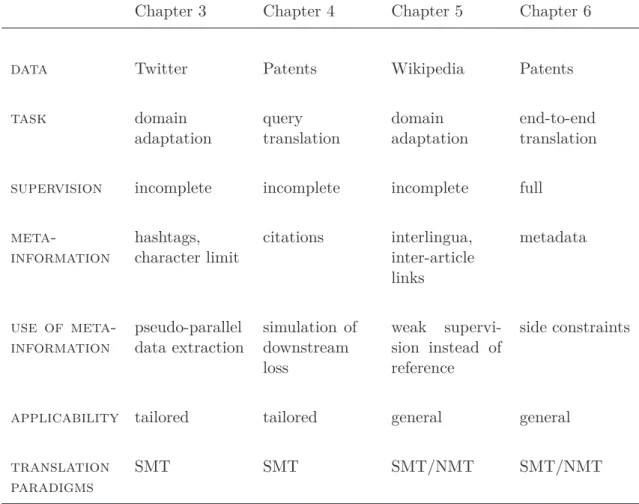
Chapter 3 Chapter 4 Chapter 5 Chapter 6
data Twitter Patents Wikipedia Patents
task domain adaptation query translation domain adaptation end-to-end translation
supervision incomplete incomplete incomplete full
meta-information hashtags, character limit citations interlingua, inter-article links metadata use of meta-information pseudo-parallel data extraction simulation of downstream loss weak supervi-sion instead of reference side constraints
applicability tailored tailored general general
translation paradigms
SMT SMT SMT/NMT SMT/NMT
Table 1.1 Overview of cases studied in this thesis.
not only to established benchmark tasks, but also to new domains, such as Twitter mes-sages or Wikipedia. Table 1.1 summarizes the different cases studied in this thesis, their use of meta-information, and their general applicability. The work for this thesis was con-ducted cumulatively, spanning the paradigm shift between statistical and neural machine translation. Mainly for this reason, Chapters 3 and 4 only include experiments using SMT systems. Both approaches are, however, easily transferable to the neural paradigm, as is discussed briefly at the end of the conclusion for each chapter. For each study, improve-ments over a system without meta-information are achieved. As each study presents a self-contained research project with a different task and different data, the results are not directly comparable. When looking at the magnitude of the gains achieved for each study, using document meta-information for pseudo-parallel data extraction is the most effective at the cost of generality, as this method needs to be tailored to the target data.
CHAPTER
2
Background
The following pages outline the fundamentals of data-driven machine translation technol-ogy, as relevant to the understanding of this thesis. Section 2.1 describes training data, data processing and evaluation. The subsequent sections describe two predominant ap-proaches to data-driven translation: phrase-basedStatistical Machine Translation (SMT) in Section 2.2 andNeural Machine Translation (NMT) in Section 2.3.
2.1 Input and Output
Data-driven machine translation systems are trained on millions ofparallel training sen-tences. Parallel text or bitext has been translated by proficient human translators into one or more languages and is collected in a parallel corpus. As it is infeasible in a non-commercial setting to produce this data, efforts have been directed at collecting bitext from existing sources. These include multilingual parliamentary proceedings, such as the Europarl (Koehn, 2005) and MultiUN corpora (Eisele & Chen, 2010; Ziemski, Junczys-Dowmunt, & Pouliquen, 2016), the Web Inventory of transcribed TED talks (Cettolo, Girardi, & Federico, 2012) and multilingual news outlets1 and the PatTR corpus
ing German, English and French patent text (Wäschle & Riezler, 2012a). Other parallel data sets, especially for non-European languages, have been provided as part of the NIST evaluation campaigns2. Assembling a parallel corpus is an involved process: After
ob-taining the text in digital form, the plain text is extracted and the data are aligned at the document level. As a machine translation system requires sentence-aligned data, the documents are broken down into sentences and aligned across languages. Both tasks are non-trivial, as end-of-sentence markers can be ambiguous and sentence boundaries can differ between languages. The need for heavy processing of parallel data could be viewed as one reason why document information has been disregarded in machine translation. The corpora rarely provide markup or annotation at the document level alongside the sentence-aligned text.
Due to the difficulty of obtaining bitext, only certain domains and genres are covered. Weaker sources of knowledge are provided bycomparable corporaandmonolingual corpora. A comparable corpus is a multilingual data set which does not contain direct translation, but whose contents are related across languages. Monolingual data do not contain knowl-edge about translational equivalence, but provide information about fluency and are easily available for many domains and languages. Especially in phrase-based SMT, monolingual target language data play an important role in language modeling.
Both SMT and NMT require data pre- and post-processing. Tokenization refers to split-ting sentences into words (tokens). This is done by splitting sentences on whitespace for whitespace- delimited languages. For non whitespace-delimited languages like Japanese, tokenization requires more sophisticated models. Tokenization is required for machine translation, as units smaller than sentences are necessary for collecting reliable statistics. Other pre-processing steps are often applied to reduce the vocabulary. Lowercasingor true-casing, which removes sentence-initial uppercase, can be applied to languages with Latin script. Splitting text intosubword units is another way to reduce vocabulary. This could be accomplished by splitting words at morpheme boundaries or by a purely count-based method such as byte-pair encoding (Sennrich, Haddow, & Birch, 2016c). Post-processing
is applied after translation to reverse the pre-processing. This involves merging subword units into words,detokenizationandre-casing. As all steps can introduce errors, this thesis applies minimal processing where possible. However, by applying special pre-processing steps, performance can improve significantly, as we show, for example, in Chapter 4. We evaluate all end-to-end translation experiments using the BLEU score (Papineni, Roukos, Ward, & Zhu, 2002). TheBLEU score computes the geometric mean of𝑛-gram precisions𝑝𝑛 up to a maximum order 𝑁 against one or more reference translations.3 An
2nist.gov/programs-projects/machine-translation 3𝑁 is usually set to 4.
2.2 Statistical Machine Translation
𝑛-gram is a contiguous span of𝑛 tokens. The𝑛-gram precision is modified toclipcounts for each 𝑛-gram at the maximum count observed in one of the references. This clipping avoids, for example, overproduction of function words. As a precision-based metric would favor short translations, the BLEU score also contains a brevity penalty term, which is defined as
BP=exp(min(0, 1 − |𝑌 | |𝑌∗|))
for a set of translations 𝑌 and a set of reference translations 𝑌∗.4 The BLEU score is
then computed as follows:
BLEU=BP⋅ ( 𝑁 ∏ 𝑛=1 𝑝𝑛) 1 𝑁
BLEU is corpus-based and aggregates sufficient statistics - 𝑛-gram counts and 𝑛-gram matches for each 𝑛, as well as output lengths for each sentence. As BLEU uses the geometric mean, it will automatically become 0, if 𝑝𝑛 = 0 for one or more 𝑛. However, some training approaches require a metric, which can be calculated for single translations. The easiest approach to defining a per-sentence approximation to BLEU is to calculate a smoothed 𝑛-gram precision by adding 1 or a smaller value 𝛼 to 𝑛-gram counts and matches. Problems with this simplistic approach and more sophisticated solutions on the sentence level have been put forward by Nakov, Guzman, and Vogel (2012).
2.2 Statistical Machine Translation
Statistical machine translation is used in all content chapters of this thesis (Chapters 3 -6). This section summarizes the basics of SMT, following descriptions in Koehn (2010) and a survey by Lopez (2008).
2.2.1 Generative Model
SMT casts translating as solving the following problem:Given an input sentence 𝑥 from a givensource language(𝑠𝑟𝑐), find the translation 𝑦̂in a given target language(𝑡𝑟𝑔) such that
̂
𝑦 =argmax 𝑦
𝑃 (𝑦|𝑥) . (2.1)
In order to model this distribution in a tractable way, SMT models introduce hidden variables. These hidden variables, denoted byℎ, define a process by which a translation𝑦
is created from an input sentence𝑥. Hidden variables, orderivations, can be marginalized out to obtain the probability over translations:
̂ 𝑦 =argmax 𝑦 ∑ ℎ 𝑃 (𝑦, ℎ|𝑥) . (2.2)
computing this sum is intractable in the translation formalisms applied in SMT. Therefore, an approximation is commonly made which replaces the sum over derivations with the highest scoring derivation:
̂
𝑦 =argmax 𝑦 maxℎ
𝑃 (𝑦, ℎ|𝑥) . (2.3)
In generative translation models,𝑃 (𝑦, ℎ|𝑥)is factorized using Bayes’ rule as
𝑃 (𝑦, ℎ|𝑥) = 𝑃 (𝑥, ℎ|𝑦) ⋅ 𝑃 (𝑦)
𝑃 (𝑥) . (2.4)
Given this factorization, the translation problem can re-written as
̂
𝑦 =argmax
𝑦 maxℎ 𝑃 (𝑥, ℎ|𝑦) ⋅ 𝑃 (𝑦) , (2.5)
where𝑃 (𝑥)can be ignored as it is constant. Factoring𝑃 (𝑦, ℎ|𝑥)into two separate models had been successfully applied to speech recognition before it was suggested for machine translation by Brown et al. (1993). The approach includes two independent knowledge sources: a translation model distribution 𝑃 (𝑥, ℎ|𝑦), and a language model distribution
𝑃 (𝑦). This factorization makes sense, as the translation model ensurestranslational ad-equacy, and the language model focuses on modeling target side fluency. Note, that the translation model direction is now reversed, conditioning on outputs rather than inputs. As the true distributions are unknown, they are approximated by models for which parame-ter estimation and inference are possible. This requires strong independence assumptions between the steps of the generative process. Below, two generative translation models, word alignment models and phrase-based models, are introduced, followed by an 𝑛-gram language model.
Word alignment The simplest translation models define the translation process via an
alignment function 𝑎(𝑗) from positions 𝑗 in 𝑥 to positions in 𝑡 in 𝑦.5 According to this
function, each token in 𝑦 corresponds to exactly one token in 𝑥 or to a special NULL token. The word alignment between a German source and an English target sentence is illustrated in Figure 2.1. A simple parametrization using alignment functions is IBM Model 1 (Brown et al., 1993). This model defines the probability of an output sentence
2.2 Statistical Machine Translation
so
y what happened here ? NULL
x was ist hier passiert ?
Figure 2.1 Word alignment
under alignment𝑎as the product of the individual aligned tokens and a uniform alignment probability: 𝑃 (𝑥, 𝑎|𝑦) ≈ 𝜖 (|𝑦| + 1)|𝑥| |𝑥| ∏ 𝑗=1 𝑝(𝑥𝑗|𝑦𝑎(𝑗)) , (2.6)
where 𝜖 is a placeholder for a uniform distribution over the possible length of 𝑥 (see Koehn (2010), page 86). The word alignment probabilities 𝑝(𝑥𝑗|𝑦𝑎(𝑗)) are the only pa-rameters in this model, as the model assumes independence between individual words. As there are usually no word-aligned corpora available, word alignments are inferred from sentence-aligned data in an unsupervised fashion using an expectation maximization (EM) algorithm (Dempster, Laird, & Rubin, 1977). The EM algorithm learns the word transla-tion probabilities that maximize the likelihood of the training corpus. IBM Model 1 and its refinements, IBM Models 2 through 5 (Brown et al., 1993), were quicky replaced by phrase-based translation formalisms for end-to-end translation systems. But they consti-tute an important step in the pipeline architecture of phrase-based models, as they are used to align training data at the word level, which is a pre-requisite for phrase extraction, as described below.
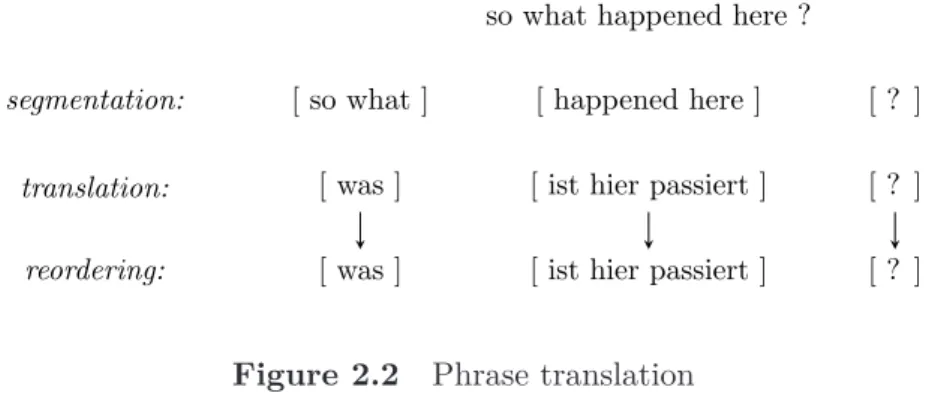
Phrase-based model The IBM models define only a uni-directional alignment function, allowing for one-to-many alignments, but not many-to-many. This makes the translation of non-decomposable phrases, such as idioms, difficult. Moreover, the word-based models do not easily capture the fact that larger chunks of a sentence often move their posi-tions together when translated. These phenomena can easily be captured byphrase-based translation formalisms, where the units of translation are contiguous segments of variable length, or phrases. Deriving a translation can be viewed as the process of first selecting a segmentation of the source into phrases, then selecting a translation for each phrase from aphrase translation table, and finally reorderingthe phrase translations. Figure 2.2 illustrates the process.
A simple parametrization of the phrase-based translation process was given by Koehn et al. (2003). In this parametrization, the translation model probability is factored into the
so what happened here ?
[ happened here ]
[ so what ] [ ? ]
segmentation:
[ was ] [ ist hier passiert ] [ ? ] translation:
[ was ] [ ist hier passiert ] [ ? ] reordering:
Figure 2.2 Phrase translation
phrase translation probabilities of all phrases participating in a derivation. Conditional independence is assumed between phrases. The full translation model is defined as
𝑃 (𝑥, ℎ|𝑦) ≈ 1 |Seg(𝑥)| 𝐼 ∏ 𝑖=1 𝑝( ̄𝑥𝑖| ̄𝑦𝑖) ⋅ 𝑑(𝑠𝑡𝑎𝑟𝑡𝑖− 𝑒𝑛𝑑𝑖−1− 1) . (2.7) In this model, 1
|Seg(𝑥)| is a uniform probability distribution over all possible segmentations
of𝑥. 𝑑(𝑠𝑡𝑎𝑟𝑡𝑖−𝑒𝑛𝑑𝑖−1−1)is a distance-based reordering model, which captures how much phrases are moving from there position in the input sentence. Assuming that we prefer less movement, distortion can be modeled by an exponentially decaying cost function𝑑(𝑧) = 𝛼𝑧
with 𝛼 ∈ [0, 1]. 𝜙( ̄𝑥𝑖| ̄𝑦𝑖) is the probability of translating the 𝑖-th phrase 𝑦𝑖̄ into its counterpart𝑥̄𝑖. The phrase translation probabilities are the parameters of this model, and are stored in aphrase table. A phrase table can be learned from word-aligned data using maximum likelihood estimation. Word alignment is run in both translation directions and the results are symmetrized. This symmetrization starts from the intersection of alignments and uses a heuristic method calledgrow-diag-final-andto add neighboring unidirectional alignment points (Koehn et al., 2003; Och & Ney, 2003). All phrases up to a maximum phrase length, which are consistent with the word alignment, are then extracted. A phrase pair is consistent with an alignment if and only if it contains at least one alignment link, and none of source or target words within the phrase are aligned to a word outside of the phrase. Phrase translation probabilities are then extracted using relative frequency counts:
𝑝( ̄𝑥| ̄𝑦) = 𝑐𝑜𝑢𝑛𝑡( ̄𝑦, ̄𝑥) 𝑐𝑜𝑢𝑛𝑡( ̄𝑥)
Hierarchical phrase-based model Phrase-based translation cannot capture the regular-ities of long-range dependencies between words, as phrases need to be contiguous. In our previous example,“happened” translates to the German “ist … passiert”. A phrase-based model has no way to capture this dependency. These problems can be fixed by moving to a more powerful formalism, namely a synchronous context-free grammar. In this
for-2.2 Statistical Machine Translation
malism, phrases are encoded as context-free grammar rules. A non-terminal symbol X is introduced to represent a gap which can be filled by another phrase of arbitrary length. A synchronous context-free grammar rule matching the example could be
X → happened X |ist X passiert
In this formalism, a translation is derived by synchronously parsing the source sentence and generating the target sentence. The process is parameterized as
𝑃 (𝑥, ℎ|𝑦) ≈ ∏ 𝑟∈ℎ
𝑝(𝑟) , (2.8)
where ℎ is a synchronous parse tree by which 𝑥 can be derived from 𝑦, and 𝑟 is a hi-erarchical translation rule participating in this tree. The parameters of this model are the probabilities of the translation rules,𝑟. These probabilities are again estimated using maximum likelihood estimation and stored in agrammar. Grammar extraction starts out from aphrase table. Hierarchical rules are generated by first adding all contiguous phrases as rules to the grammar. If a phrase pair contains another consistent phrase pair, the lo-cation of this smaller phrase pair can be replaced with agap marked by the non-terminal symbol. If there is more than one gap, the non-terminal symbols are annotated with a position marker. Extracting hierarchical phrases is computationally challenging, requiring specialized algorithms and data structures (Lopez, 2007). A set of heuristics is used to keep the number of phrases manageable, such as limiting the number of allowed gaps to 2 or limiting the maximum phrase length (Chiang, 2005).
Language Model The second part of the generative decomposition of 𝑃 (𝑦, ℎ|𝑥) is the
language model, which approximates the true distribution over target strings, 𝑃 (𝑦). As𝑦
is a string of tokens
𝑦 = 𝑦1, 𝑦2, 𝑦3, … 𝑦|𝑦|,
the chain rule of probability can be used to decompose𝑃 (𝑦)as follows:
𝑃 (𝑦) = 𝑃 (𝑦1) ⋅ 𝑃 (𝑦2|𝑦1) ⋅ 𝑃 (𝑦3|𝑦1, 𝑦2) ⋯ 𝑃 (𝑦|𝑦||𝑦1, 𝑦2, … , 𝑦|𝑦|−1)
In order to make the model tractable, conditional independence between a word and all but its 𝑛 − 1 preceding words assumed, leading to the following simplification and final parametrization of the model:
𝑃 (𝑦) ≈ |𝑦| ∏ 𝑡=1
In practice, the cases where 𝑡 < 𝑛 are handled by adding 𝑛 − 1 beginning-of-sentence markers to each string. The parameters of this model are the probabilities of individual
𝑛-grams. These probabilities are also estimated from training data using maximum likeli-hood estimation. For example, the probability of the 4-gram “was ist hier passiert” would be estimated as
𝑝(passiert|was, ist, hier) = 𝑐𝑜𝑢𝑛𝑡(was ist hier passiert) 𝑐𝑜𝑢𝑛𝑡(was ist hier) .
In Equation 2.9, an unseen𝑛-gram would be assigned a probability of zero, which would lead to the probability of the entire sequence being zero. In language models for SMT, unseen𝑛-grams are assigned a non-zero probability via smoothing (see Chapter 7 in Koehn (2010)).
2.2.2 Discriminative Model
While the generative model would be theoretically optimal if the true distributions
𝑃 (𝑥, ℎ|𝑦)and𝑃 (𝑦) were known, strong approximations have to be used in order to make it tractable, as has been described above. A much more flexible approach is given by using discriminative training, which directly optimizes the posterior distribution over outputs, 𝑃 (𝑦, ℎ|𝑥) (Ney, 1995). In SMT, the discriminative approach commonly models the posterior in a log-linear or maximum entropy model, first proposed by Och and Ney (2002):
𝑃 (𝑦, ℎ|𝑥) ≈ exp(w
⊤𝜙(𝑥, 𝑦, ℎ)) ∑𝑦′,ℎ′exp(w⊤𝜙(𝑥, 𝑦′, ℎ′))
, (2.10)
where 𝜙(𝑥, 𝑦, ℎ) is a vector of real-valued feature functions defined by the user and wis a weight vector, with one real-valued weight assigned to each feature. Inference in the log-linear model then becomes
̂
𝑦 ∶=argmax 𝑦 maxℎ
(w⊤𝜙(𝑥, 𝑦, ℎ)) . (2.11)
This model is more flexible than the generative model as it allows arbitrary components to be added in the form of additional feature functions.
In the linear model, the components of the generative model, the translation model log-probability, the language model log-probability, and the reordering cost, can be used as feature functions. Other feature functions include the reverse translation model log-probability, a word penalty(Och & Ney, 2002), which counts the number of produced output tokens, and lexical weighting features (Koehn et al., 2007), which consider the individual word translation probabilities within a phrase. Alexicalized reordering model (Tillmann, 2004)
2.2 Statistical Machine Translation
can capture reordering decisions more precisely. As the above features have non-zero values for most inputs, we refer to them as “dense features”. Other work has introduced so-called sparse features, which only take on a non-zero value in a few instances (Green, Cer, & Manning, 2014; Liang, Bouchard-Côté, Klein, & Taskar, 2006; Simianer, Riezler, & Dyer, 2012, inter alia). These features could, for example, be indicators that a certain
𝑛-gram has been observed on the source or target side or that a pair of source and target words have been observed together in a phrase.
The feature weightsware hyperparameters or meta-parameters of the translation model. Note that the generative components of the model, the phrase table and language model, are still trained generatively, and parameterized by phrase translation and 𝑛-gram prob-abilities. Meta-parameters are then trained discriminatively to assign weights to those models and other feature functions. By moving away from the generative model, these parameters can be optimized for an external error metric between a translation 𝑦 and a reference𝑦∗. The task of discriminatively optimizing meta-parameters for a specific
trans-lation quality (or error) metric is also calledtuning. While reasonable weights for a small number of dense feature functions can be set by hand through careful experimentation, there is no guarantee that these weights are optimal. Setting weights for large, sparse feature sets is impossible to do manually and requires automatic optimization.
Minimum Error Rate Training (MERT) (Och, 2003) can be used to directly optimize error on the training set𝑋, 𝑌∗.
𝐿error =err⎛⎜ ⎝ 𝑌∗, {argmax 𝑦,ℎ w⊤𝜙(𝑥, 𝑦, ℎ)} 𝑥∈𝑋 ⎞ ⎟ ⎠ , (2.12)
whereargmax𝑦maxℎis abbreviated as argmax𝑦,ℎ. For SMT, 1 −BLEU can be used to
measure error. MERT uses a specialized line search over the 𝑘-best outputs generated by the current model to iteratively optimize each weight 𝑤𝑖 ∈ w separately. As the objective contains an argmax operation and BLEU is not continuously differentiable, MERT has no guarantees for finding a globally optimal solution. The solution further depends on the initial values ofw. As MERT scales linearly with the number of features, it is computationally difficult to handle larger feature sets. Using larger feature sets with MERT is also prone to overfitting the training data, as the algorithm does not use any regularization. In this thesis, MERT is used for tuning dense feature sets in Chapters 3 and 4.
To counter the shortcomings of MERT, other tuning approaches have been suggested, which use different objectives. These objectives replace training set error with another loss function, which includes the error metric. The specific loss function is usually selected
because of its favourable mathematical properties such as smoothness or convexity, which allow for easier optimization and better extendability to large feature spaces. In this thesis we apply the pairwise ranking perceptron loss (Hopkins & May, 2011; Simianer et al., 2012) for tuning weights for large feature sets. Pairwise ranking losses conveniently reduce the optimization problem to classifying whether the ranking of any two translations
𝑦and𝑦′according to the model is identical to their ranking according to the error metric,
giving rise to the following criterion:
err(𝑦∗, 𝑦) <err(𝑦∗, 𝑦′) ⟺ w⊤𝜙(𝑥, 𝑦, ℎ) >w⊤𝜙(𝑥, 𝑦′, ℎ′) .
Based on this condition, the loss is written as
𝐿perc_rank = ∑
{𝑦,ℎ;𝑦′,ℎ′},err(𝑦′)>err(𝑦)
max(0, −w⊤Δ𝜙(𝑥, 𝑦, ℎ, 𝑦′, ℎ′)) , (2.13)
where
Δ𝜙(𝑥, 𝑦, ℎ, 𝑦′, ℎ′) ∶= 𝜙(𝑥, 𝑦, ℎ) − 𝜙(𝑥, 𝑦′, ℎ′)
Following Collobert and Bengio (2004), a margin term can also be included in the percep-tron loss for better generalization performance as
𝐿perc_rank = ∑
{𝑦,ℎ;𝑦′,ℎ′},err(𝑦′)>err(𝑦)
max(0, 1 −w⊤Δ𝜙(𝑥, 𝑦, ℎ, 𝑦′, ℎ′)) . (2.14)
The pairwise ranking perceptron is optimized using stochastic gradient descent. The pref-erence pairs 𝑦, 𝑦′ used to train the pairwise ranking perceptron are commonly generated
from the list of𝑘-best model outputs,𝒦(𝑥). As the number of possible pairs is quadratic in𝑘, pairwise ranking optimizers often use heuristics to select pairs rather than generating all pairs. Unless otherwise specified, we use Simianer et al. (2012)’s scheme, which selects pairs from the top and bottom 20 percent of the 𝑛-best list. The pairwise ranking per-ceptron has been used for tuning log-linear models with large feature spaces in Chapters 4 and 6.
2.2.3 Decoding and Pipeline
In phrase-based models, solving Equation 2.11 is a highly complex search, or decoding, problem. In the phrase-based model a beam search algorithm is used which builds the translation left-to-right, keeping track of input coverage and 𝑛-gram histories in partial hypothesis states (Koehn, 2004). As an exhaustive search of all possible translations under the model is normally computationally infeasible, the search space ispruned, for example by only keeping the 𝑛 hypotheses with the highest score for each number of input word
2.2 Statistical Machine Translation
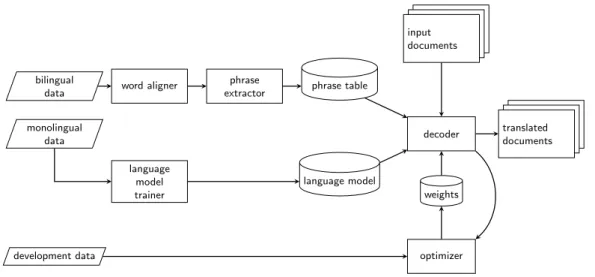
bilingual
data word aligner
language model trainer monolingual data phrase
extractor phrase table
language model decoder input documents translated documents weights optimizer development data
Figure 2.3 Phrase-based MT pipeline.
(Koehn, 2004). This approach is calledstack decoding. For decoding in the hierarchical phrase-based formalism, dynamic programming algorithms from parsing, such as the CKY algorithm, can be transferred to machine translation. These algorithms build tree struc-tures from the bottom up, covering larger input spans as they advance, in polynomial time. However, integrating𝑛-gram language models becomes more challenging, as the output is no longer built left-to-right. Cube pruning(Chiang, 2007), which lazily combines only the most promising partial parses, makes language model integration computationally feasible. Putting all steps together, one obtains a pipeline for phrase-based SMT systems. Figure 2.3 illustrates the data flows and steps necessary to build a complete phrase-based system. The translation model, a phrase table, or rule table in hierarchical phrase-based SMT, is trained by inferring word alignments from bilingual sentence-parallel data, and subse-quently extracting phrase pairs. In open-vocabulary, open-domain translation, millions of aligned sentence pairs are necessary for good translations. The language model collects
𝑛-gram counts from monolingual target language data. For good performance, again, mil-lions of sentences are required. When translation model and language model have been trained, feature weights of the log-linear model are learned to maximize performance on a small heldout data set of several thousand sentence pairs. This is accomplished using an iterative tuning process. Finally, input documents can be decoded using the trained mod-els and weights. Phrase-based or hierarchical phrase-based modmod-els are employed in every part of the thesis. In Chapters 5 and 6 they are compared to neural machine translation models, which are discussed below.
2.3 Neural Machine Translation
Neural machine translation (NMT) has surpassed the performance of statistical machine translation (Jean, Firat, Cho, Memisevic, & Bengio, 2015; M.-T. Luong & Manning, 2015). This approach to translation is called neural as translation is modeled by a non-linear artificial neural network.6 In this thesis we use the Nematus toolkit, which implements
a recurrent encoder-decoder model with attention as proposed for machine translation by Bahdanau et al. (2015). Below, we describe the model architecture.7 The exposition
follows tutorials by Goldberg (2015) and Neubig (2017), as well as the text book by Goodfellow et al. (2016).
The recurrent NMT model is based on recurrent neural language models (RNN-LMs) (Mikolov, Karafiát, Burget, Černockỳ, & Khudanpur, 2010). Unlike the 𝑛-gram models discussed in the previous section, RNN-LMs are able to condition on the entire history
of a word. Neural machine translation models extend the RNN-LM by also conditioning on the input sequence. By capturing the entire source context, as well as the complete target history, NMT models are better at capturing long-distance dependencies and pro-ducing long-range reordering than SMT models (Bentivogli, Bisazza, Cettolo, & Federico, 2016). In a recurrent NMT model, a translation 𝑦 = 𝑦1...𝑦|𝑦|, 𝑦𝑡 ∈ 𝑉𝑡𝑟𝑔 where 𝑉𝑡𝑟𝑔 is a fixed size output vocabulary, is generated from left to right, one token at a time.The generation stops once an end-of-sequence symbol is produced or a maximum number of generation steps have been completed. Each token𝑦𝑡 is conditioned on the input sentence
𝑥 = 𝑥1...𝑥|𝑥|, 𝑥𝑗∈ 𝑉𝑠𝑟𝑐where𝑉𝑠𝑟𝑐is a fixed sizeinput vocabulary, and all previously gen-erated output words𝑦1...𝑦𝑡−1. We abbreviate the output history by𝑦<𝑡. The posterior probability of the entire translation𝑦 given input𝑥 is modeled as:
𝑃 (𝑦|𝑥) ≈ |𝑦| ∏ 𝑡=1
𝑝𝑤(𝑦𝑡|𝑥, 𝑦<𝑡) (2.15)
𝑝𝑤(𝑦𝑡|𝑥, 𝑦<𝑡)is the output of a deep recurrent neural network. 𝑤represents the parameters of the network.
6An introduction to artificial neural networks and deep learning is beyond the scope of this thesis, but
the reader is referred to the textbook by Goodfellow, Bengio, and Courville (2016).
7Recently, the convolutional sequence to sequence model by Gehring, Auli, Grangier, Yarats, and Dauphin
(2017) and the transformer model by Vaswani et al. (2017) have emerged as successful alternatives to the architecture by Bahdanau et al. (2015), but we will focus on the models relevant for the work described in this thesis.
2.3 Neural Machine Translation
2.3.1 Translation Model
The core of the recurrent NMT model are two RNN-LMs, called anencoderand adecoder, which are trained jointly, and an attention mechanism, which connects the encoder and the decoder. The input is passed to the encoder via an additional input layer orembedding layer, and the distribution over the output vocabulary is generated by an output layer or
softmax layer.
The output layer is a linear transformation of the hidden decoder state followed by a
softmax operator which ensures that the outputs form a probability distribution over
𝑉𝑡𝑟𝑔:
𝑝𝑤(𝑦𝑡|𝑥, 𝑦<𝑡) =softmax(W𝑜𝑢𝑡h𝑑𝑒𝑐𝑡 +b𝑜𝑢𝑡)
where W𝑜𝑢𝑡 ∈ R|𝑉𝑡𝑟𝑔| × |ℎ𝑖𝑑𝑑𝑒𝑛| and b𝑜𝑢𝑡 ∈ R|𝑉𝑡𝑟𝑔| are parameters defining the output
layer of the decoder,|𝑉𝑡𝑟𝑔|is the target vocabulary size and |ℎ𝑖𝑑𝑑𝑒𝑛| is the hidden layer
dimension, which is a user-defined hyperparameter of the model. The vector vectorh𝑑𝑒𝑐𝑡 ∈ R|ℎ𝑖𝑑𝑑𝑒𝑛| is computed by the decoder.
The hidden decoder layer is a recursively defined function, taking as input the previous hidden decoder state h𝑑𝑒𝑐𝑡−1 and a vector representation y𝑡−1 ∈ R|𝑒𝑚𝑏| of the previous
output𝑦𝑡−1:
h𝑑𝑒𝑐𝑡 = 𝑓𝑑𝑒𝑐(y𝑡−1,h𝑑𝑒𝑐𝑡−1) ∶=tanh(U𝑑𝑒𝑐y𝑡−1+W𝑑𝑒𝑐h𝑑𝑒𝑐𝑡−1+b𝑑𝑒𝑐)
where W𝑑𝑒𝑐, U𝑑𝑒𝑐 and b𝑑𝑒𝑐 are the parameters of the hidden layer. The decoder is initialized using a context vectorc0 which is emitted by the input encoder.
The hidden encoder layer uses the same type of recursive function as the decoder, but with different inputs and parameters. A hidden input state⃗⃗⃗⃗⃗⃗⃗⃗⃗⃗⃗⃗⃗⃗⃗⃗⃗⃗h𝑒𝑛𝑐𝑗 is computed as
⃗⃗⃗⃗⃗⃗⃗⃗⃗⃗⃗⃗⃗⃗⃗⃗⃗⃗
h𝑒𝑛𝑐𝑗 = 𝑓𝑒𝑛𝑐(x
𝑗, ⃗⃗⃗⃗⃗⃗⃗⃗⃗⃗⃗⃗⃗⃗⃗⃗⃗⃗h𝑒𝑛𝑐𝑗−1) ∶=tanh(U𝑒𝑛𝑐x𝑗+W𝑒𝑛𝑐⃗⃗⃗⃗⃗⃗⃗⃗⃗⃗⃗⃗⃗⃗⃗⃗⃗⃗h𝑒𝑛𝑐𝑗−1 +b𝑒𝑛𝑐) with ⃗⃗⃗⃗⃗⃗⃗⃗⃗⃗⃗⃗⃗⃗⃗⃗⃗⃗h𝑒𝑛𝑐0 =0.
Like the hidden decoder layer, for each input position𝑗 ∈ 1...|𝑥|, the layer takes as input the previous hidden encoder state ⃗⃗⃗⃗⃗⃗⃗⃗⃗⃗⃗⃗⃗⃗⃗⃗⃗⃗h𝑒𝑛𝑐𝑗 ∈ R|ℎ𝑖𝑑𝑑𝑒𝑛| and a vector representation of the 𝑗-th input word x𝑗 ∈ R|𝑒𝑚𝑏|. The parameters of the hidden encoder layer are W𝑒𝑛𝑐 ∈ R|ℎ𝑖𝑑𝑑𝑒𝑛|×|𝑒𝑚𝑏|, U𝑒𝑛𝑐 ∈ R|ℎ𝑖𝑑𝑑𝑒𝑛|×|ℎ𝑖𝑑𝑑𝑒𝑛| and b𝑒𝑛𝑐 ∈ R|ℎ𝑖𝑑𝑑𝑒𝑛|. In a simple NMT
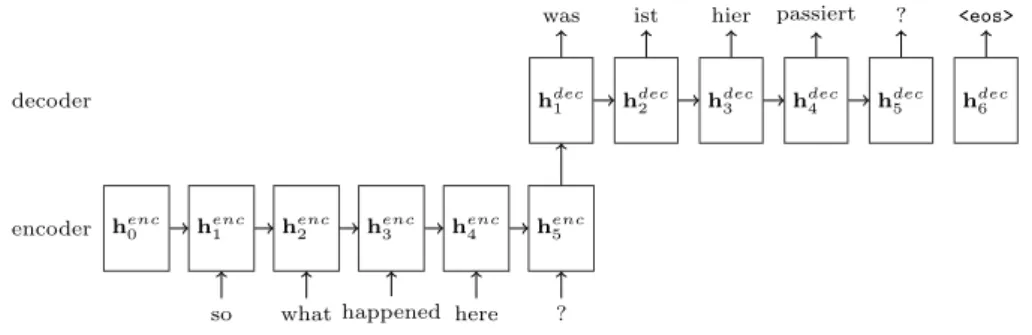
model without attention layer, the final encoder output ⃗⃗⃗⃗⃗⃗⃗⃗⃗⃗⃗⃗⃗⃗⃗⃗⃗⃗h𝑒𝑛𝑐𝐽 is used to initialize the encoder. A graphical representation of this simple model is shown in Figure 2.4.
henc
0 henc1 henc2 henc3 henc4 henc5 encoder
so what happened here ?
hdec
1 hdec2 hdec3 hdec4 hdec5 hdec6 decoder
was ist hier passiert ? <eos>
Figure 2.4 Recurrent sequence-to-sequence model.
𝑓𝑒𝑛𝑐 and𝑓𝑑𝑒𝑐can be replaced by Long-Short-Term Memory (LSTM) units (Hochreiter &
Schmidhuber, 1997) or Gated Recurrent Units (GRU) (Cho et al., 2014) in order to prevent the problem of vanishing gradients during training (Goodfellow et al., 2016, Section 10.10). These units are equipped with agating mechanismthat controls how much of the gradient is propagated to the next step. We use both types of units in our experiments and will specify the selected unit when describing the experimental setup.
The input and output vector representations, or embeddings, x𝑗 and y𝑡 are dense real-valued vectors with a dimensionality |𝑒𝑚𝑏| ≪ |𝑉 |. Embeddings can be computed by applying a linear transform to a one-hot input encodingr:
x𝑗=E r𝑗 where r𝑗∈ {0, 1}|𝑉 |, |𝑉 | ∑ 𝑖=1
r𝑗[𝑖] = 1 , (2.16)
where theembedding matrixE∈R|𝑒𝑚𝑏|×|𝑉 |is learned jointly with the other parameters of
the model. Asr𝑗is a one-hot encoding of the𝑚-th item in𝑉𝑠𝑟𝑐, Equation 2.16 corresponds
to looking up the𝑚-th column ofE.
In order to couple the beginning of the source and target sequence more closely, Sutskever et al. (2014) proposed to encode the input sentence in reverse order. The reverse hidden encoder states are computed as:
⃖⃖⃖⃖⃖⃖⃖⃖⃖⃖⃖⃖⃖⃖⃖⃖⃖⃖
h𝑒𝑛𝑐𝑗 = 𝑓(x𝑗, ⃖⃖⃖⃖⃖⃖⃖⃖⃖⃖⃖⃖⃖⃖⃖⃖⃖⃖h𝑒𝑛𝑐𝑗+1) =tanh(U𝑒𝑛𝑐x𝑗+W𝑒𝑛𝑐⃖⃖⃖⃖⃖⃖⃖⃖⃖⃖⃖⃖⃖⃖⃖⃖⃖⃖h𝑒𝑛𝑐𝑗+1 +b𝑒𝑛𝑐) .
This method has been extended further to abidirectional encoder, which performs both a left-to-right and a right-to-left pass over the input and concatenates both hidden states as
2.3 Neural Machine Translation
where[ ]represents vector concatenation.8 A closer coupling between encoder and decoder
can be achieved through an attention mechanism. This mechanism computes a context vector c𝑡 at each output step 𝑡 as a weighted sum over the hidden encoder states with attention weights𝛼𝑗,𝑡: c𝑡= 𝐽 ∑ 𝑗=1 𝛼𝑗,𝑡⋅h𝑒𝑛𝑐𝑗 with c𝑡 ∈R|ℎ𝑖𝑑𝑑𝑒𝑛|
The attention weight vector 𝛼𝑡 is computed by taking a softmax over unnormalized at-tention scores𝑎𝑗,𝑡. These are computed by applying an additional non-linear layer to the hidden encoder and decoder states9
𝑎𝑗,𝑡 = (w𝑎𝑡𝑡 ⊤tanh(W𝑎𝑡𝑡h𝑗𝑒𝑛𝑐+U𝑎𝑡𝑡h𝑑𝑒𝑐𝑡 +b𝑎𝑡𝑡)) ,
whereW𝑎𝑡𝑡,U𝑎𝑡𝑡∈R|ℎ𝑖𝑑𝑑𝑒𝑛|×|ℎ𝑖𝑑𝑑𝑒𝑛| and b𝑎𝑡𝑡,w𝑎𝑡𝑡∈R|ℎ𝑖𝑑𝑑𝑒𝑛|. Through an
atten-tion layer, the coupling between decoder and encoder now happens at every each time step. h𝑑𝑒𝑐𝑡 is now computed depending on the previous context vector:
h𝑑𝑒𝑐𝑡 = 𝑓𝑑𝑒𝑐(y𝑡−1,c𝑡−1,h𝑑𝑒𝑐𝑡−1)
The output layer then uses the current context vector:
𝑝(𝑦𝑡|𝑦<𝑡, 𝑥) =softmax(W𝑜𝑢𝑡h𝑑𝑒𝑐𝑡 +U𝑜𝑢𝑡c𝑡+b𝑜𝑢𝑡) .
2.3.2 Training
NMT models are standardly trained to minimize thecross entropyof the model prediction
̂
𝑦and a reference𝑦∗, which corresponds to maximum likelihood estimation. If we assume
that at each step𝑡the reference token𝑦∗
𝑡 has a probability of 1 and all other token in𝑉𝑡𝑟𝑔
have a probability of 0, minimizing cross entropy between this distribution and the model distribution amounts to minimizing the negative log-likelihood of the reference under the model: 𝐿𝑀𝐿𝐸(𝑦(𝑖)) = − 1 |𝑦∗| |𝑦∗| ∑ 𝑡=1 log(𝑝𝑤(𝑦∗ 𝑡 ∣ 𝑥, 𝑦∗<𝑡)) .
8Note that if a concatenation of hidden states is generated by the encoder, either the hidden layer
dimensionality|ℎ𝑖𝑑𝑑𝑒𝑛|needs to be adjusted in the decoder to match the hidden encoder dimension, or an additional transformation needs to be applied to the encoder output.
9This description follows the original description of attention in Bahdanau et al. (2015), which is
The model parameters 𝑤 are optimized using stochastic gradient descent (SGD). As an
online learning algorithm, SGD performs an update after one single training example, as opposed to batch algorithms, which only update after seeing the entire finite training set. Online algorithms are used to train NMT models, because the size of the training set precludes the application of a batch algorithm. However, a minibatchversion of SGD with minibatch size 𝑀 ∶ 1 < 𝑀 ≪ |𝑋| leads to more stable learning and allows to exploit hardware parallelism (see Goodfellow et al. (2016), Section 8.1.3). Algorithm 1 shows SGD in a minibatch version for the MLE objective. More advanced algorithms such as ADADELTA (Zeiler, 2012) or Adam (Kingma & Ba, 2015) compute a per-coordinate learning rate based on previous updates, allowing to control the rate at which each parameter is updated. This thesis uses both SGD and more complex optimizers.
Algorithm 1 SGD
Require: Learning rate𝜂, minibatch size 𝑀
Require: Initial parameters𝑤
1: while Stopping criterion is not reached do
2: Sample minibatch of 𝑀 examples(𝑥1, 𝑦1), ...(𝑥𝑀, 𝑦∗𝑀) 3: 𝑔 ← 𝑀1∇𝑤∑𝑀
𝑚=1𝐿𝑀𝐿𝐸(𝑦 ∗
𝑚) ▷ compute gradient estimate
4: 𝑤 ← 𝑤 − 𝜂𝑔 ▷ apply update
5: end while
6: return 𝑤
The gradients for a neural network with respect to each parameter are computed automat-ically using theback-propagation algorithm (Rumelhart, Hinton, & Williams, 1986). This algorithm provides a dynamic programming method for automatic differentiation with respect to the different parameters. It performs calculations by representing the neural network as acomputation graph. In this directed acyclic graph, each node represents a cal-culation, with the children of a node representing the arguments. The network is applied to an input by a forward pass over the computation graph. A backward pass computes the derivatives, given the forward computation. Building computation graphs and per-forming forward and backward passes can be easily done using libraries such astheano10, pytorch11 ortensorflow12. The training algorithms above can be applied to any neural
network architecture. In order to compute gradients for recurrent neural networks using back-propagation, the recursive node is unrolled over all time steps. The gradients are then computed backwards for each time step, a procedure calledback-propagation through time(BPTT). As propagating error through very deep networks can be subject to vanish-ing or explodvanish-ing gradient problems, we use LSTM or GRU layers and clip the gradients if their norm is larger than a given threshold (Pascanu, Mikolov, & Bengio, 2013).
10deeplearning.net/software/theano. Note that theano is no longer being developed, but has been
included as it has been used in parts of this dissertation.
11pytorch.org 12tensorflow.org
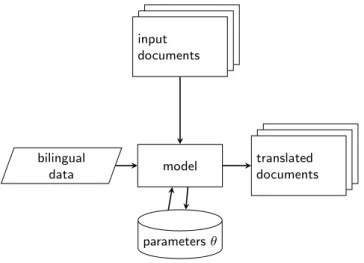
2.3 Neural Machine Translation bilingual data model input documents translated documents parametersθ
Figure 2.5 The NMT pipeline
2.3.3 Decoding and Pipeline
Decoding in an NMT model tries to find the sequence𝑦̂such that
̂ 𝑦 =argmax 𝑦 |𝑦| ∏ 𝑡=1 𝑝𝑤(𝑦𝑡|𝑥, 𝑦<𝑡) .
The output sequence is generated step-by-step until the end-of-sentence marker is gener-ated or a maximum step size is exhausted. The simplest, greedy approach to decoding, outputs the most likely word at each time step. Using beam search instead of greedy search allows the model to explore a larger search space or to generate the 𝑛most likely hypotheses, where𝑛is thebeam size. In this approach, at𝑡 + 1, the model expands each of the current hypotheses with the𝑛most probable words, but only keeps top𝑛hypotheses with the highest total score. By avoiding the limiting independence assumptions of the SMT models, NMT models have surpassed SMT in benchmark evaluations and become the state of the art at the time this thesis was written. Using a recurrent encoder-decoder architecture with attention allows for a much simpler training protocol compared to the SMT pipeline, as shown in Figure 2.5. A drawback of the NMT architecture is its high computational cost requiring specialized hardware (Graphical Processing Units) and its need for large training data to achieve good performance. These factors make SMT still an attractive choice for low-resource settings.
CHAPTER
3
Exploiting Meta-Information for Task-Specific Parallel Data Mining
In-domain supervision is crucial when adapting a translation model to a new, known do-main. But what if there is no full supervision available for the target domain? A known approach to this problem is to extract pseudo-parallel sentences or smaller fragments from weaker sources of supervision, such as comparable corpora. In this case, document meta-data or cross-lingual document-level links can play a crucial role in identifying candidate sentence pairs. This chapter studies translation of microblog messages as a previously unexplored task. We present a tailored approach to the topically constrained extrac-tion of pseudo-parallel microblog messages for an Arabic-English translaextrac-tion task using a cross-language information retrieval model. Document meta-information present in the messages is used to identify topically relevant messages and as an additional source of information in the retrieval model.
Our work starts out from the observation that information and comments about events of global significance will dissipate on public microblogging platforms like Twitter1
simul-taneously and multilingually. Being able to access content from different languages or to automatically make content available in different languages, could provide a valuable service to those involved in the event, as well as international organizations or aid work-ers. Twitter messages (tweets) are challenging to translate automatically, mainly because