Secure Attribute-Based Systems
Matthew Pirretti
∗, Patrick Traynor, and
Patrick McDaniel
†SIIS Laboratory, CSE, Pennsylvania State University
{
pirretti, traynor, mcdaniel
}
@cse.psu.edu
Brent Waters
‡SRI International
[email protected]
ABSTRACT
Attributes define, classify, or annotate the datum to which they are assigned. However, traditional attribute architec-tures and cryptosystems are ill-equipped to provide security in the face of diverse access requirements and environments. In this paper, we introduce a novel secure information man-agement architecture based on emerging attribute-based en-cryption (ABE) primitives. A policy system that meets the needs of complex policies is defined and illustrated. Based on the needs of those policies, we propose cryptographic op-timizations that vastly improve enforcement efficiency. We further explore the use of such policies in two example ap-plications: a HIPAA compliant distributed file system and a social network. A performance analysis of our ABE system and example applications demonstrates the ability to reduce cryptographic costs by as much as 98% over previously pro-posed constructions. Through this, we demonstrate that our attribute system is an efficient solution for securely manag-ing information in large, loosely-coupled, distributed sys-tems.
Categories and Subject Descriptors:K.6 Management of Computing and Information Systems: Security and Pro-tection
General Terms:Security, Performance
Keywords: Attribute-based encryption, secure systems, applied cryptography
1.
INTRODUCTION
Attributes define, classify, or annotate the datum to which they are assigned. The semantics of an attribute indicate some purpose or characteristic and, when used within larger ∗Matthew Pirretti was supported by NSF 0093085 and NSF 0202007
†Patrick Traynor and Patrick McDaniel were supported by NSF grant CCF-0524132, Cisco and Motorola
‡Brent Waters was supported by NSF
Permission to make digital or hard copies of all or part of this work for personal or classroom use is granted without fee provided that copies are not made or distributed for profit or commercial advantage and that copies bear this notice and the full citation on the first page. To copy otherwise, to republish, to post on servers or to redistribute to lists, requires prior specific permission and/or a fee.
CCS’06,October 30–November 3, 2006, Alexandria, Virginia, USA.
Copyright 2006 ACM 1-59593-518-5/06/0010 ...$5.00.
collections, enable efficient identification and classification of like objects. For example, individuals in enterprise systems are often segregated into groups of common interest or duty based on a given set of attributes [27], e.g., function, depart-ment, university. These attributes are then used to associate sets of permissions and tasks to the specified individuals. Existing systems principally rely on the assignment and sub-sequent enforcement of policies by trusted and often central-ized servers. However, these servers are acutely ill-equipped to deal with disconnected and asynchronous clients. Re-liance upon centralized servers further limits scalability and mandates a single point of trust.
Attribute-based encryption (ABE) [26], a generalization of identity-based cryptosystems, incorporates attributes as inputs to its cryptographic primitives. Objects are encrypted using a set of attributes describing the intended receiver. A principal possessing this subset as part of their pool of attributes can recover the original plaintext. More flexible requirements are achievable through the use of a thresholding primitive, for which onlyk-of-nattributes are necessary to perform decryption. Furthermore, decryp-tion under both the standard and threshold approaches is collusion-resistant as multiple parties are unable to mean-ingfully pool attributes. Such cryptographic mechanisms allow encryption to inextricably bind expressive, enforceable access policy to objects.
Attribute-based systems have enormous potential for pro-viding data security in distributed environments. Peer-to-peer systems are an example of one such beneficiary: indi-viduals may publish documents that implicitly target those users who are assigned the appropriate attributes. More-over, such publishing can be completely transparent to the peer-to-peer system. For example, a user Bob looking for employment in the field of secure systems engineering could place a copy of his r´esum´e in publicly accessible web space encrypted with the attributes “secure systems engineering” and “human resources manager”. Only potential employ-ers satisfying these attributes would be able to decrypt this information and contact Bob.
In this paper, we develop and evaluate a secure attribute system built on attribute-based encryption (ABE). A de-scriptive policy system is defined that predicates access on logical expressions over attributes. We show how these policies can be realized through applications of novel ABE constructions. We also demonstrate their semantic depth through their use in two applications: a HIPAA compliant distributed file system and a social network.
tai-lored for the rapid creation of attribute systems- the first known implementation and characterization of such crypto-graphic constructions. In an effort to aid development and subsequent system use, we perform an in-depth empirical analysis of the input parameter space. Our implementa-tion includes several novel optimizaimplementa-tions to the original ABE cryptosystem described by Sahai and Waters [26]. The ma-jor operations of the system, including system initialization, key generation, and the encryption and decryption of ob-jects are benchmarked. We then measure the cost of imple-menting complex attribute policies. Whereas past work has suggested that these constructions were too expensive for use in real systems [25], this analysis shows that such poli-cies are not only feasible, but can also be highly efficient. For instance, we demonstrate that the cost of key genera-tion and encrypgenera-tion can be reduced by more than 80% and 98%, respectively, by using constructions secure in the ran-dom oracle model.
The remainder of this paper is organized as follows: Sec-tion 2 presents an overview of the cryptographic mechanisms supporting ABE; Section 3 compares ABE systems to PKI systems; Section 4 introduces a descriptive policy system for use in ABE-based systems; Section 5 offers sample policies for two example applications; Section 6 gives the results of our performance analysis; Section 7 explores relevant related work; Section 8 offers concluding remarks.
2.
ATTRIBUTE-BASED ENCRYPTION
We now give an overview of Attribute-Based Encryption (ABE) algorithms. The Sahai-Waters [26] (ABE) cryptosys-tem as implemented in this paper is specifically detailed. We focus our efforts on providing the description of the scheme and intuition for its construction. For the proof of security see Sahai and Waters [26].
Attribute-Based Encryption can be viewed as a general-ization of Identity-Based Encryption (IBE) [5,9,30]. In IBE a user’s identity is a string such as “[email protected]”. A party in the system can encrypt a message to this partic-ular user with only the knowledge of the recipient’s identity and the system’s public parameters. In particular the en-cryption algorithm does not need to have access to a sepa-rate public key certificate of the recipient.
In Attribute-Based Encryption a user’s identity is com-posed of aset,S, of strings which serve as descriptive at-tributes of the user. For example, a user’s identity could consist of attributes describing their university, department, and job function. A party in the system can then specify another set of attributesS0 such that a receiver can only decrypt a message if his identityShas at leastkattributes in common with the setS0, wherek is a parameter set by the system. Like traditional Identity-Based Encryption, a party in an Attribute-Based Encryption system only needs to know the receiver’s description in order to determine their public key. However, the expressiveness of an ABE system is potentially much more powerful. For example, there could be several different recipients that are able to decrypt a mes-sage encrypted for a setS0.
ABE-based systems can also leverage “threshold construc-tions” where a user with identityS will be able to decrypt a message if it has at least k attributes that overlap with a setS0 chosen by the encryptor. Although there could in theory exist even more expressive ABE systems, the thresh-old constructions described and illustrated in the following
sections are sufficiently semantically deep that we can define complex and precise encryption policies.
2.1
ABE Algorithms
We now informally specify a threshold Attribute-Based Encryption system as a collection of four algorithms:
• Setup(k): The Setup algorithm is run by an authority in order to create a new ABE system. Setup takes as input a threshold value, k and outputs a master key MK and a set of public parameters PK.
• Key-Gen(S,MK): The authority executes the Key-Gen algorithm for the purpose of generating a new secret key SK. The algorithm takes as input the user’s identity, S, as a set of strings representing a user’s attributes and the master-key MK and outputs S’s secret key SK.
• Encrypt(M, S0,PK): The Encrypt algorithm is run by a user to encrypt a messageM, with a target setS0, and the public parameters. It outputs a ciphertext,C. • Decrypt(C, S0, S,SK): The Decrypt algorithm is run by a user with identitySand secret key SK to attempt to decrypt a ciphertextCthat has been encrypted with
S0. If the set overlap|S∩S0|is greater than or equal tokthe algorithm will output the decrypted message
M.
2.2
ABE Constructions
We have investigated the use of two separate ABE con-structions: the Sahai-Waters construction and a variant of the Sahai-Waters construction that we refer to as the ran-dom oracle construction. The Sahai-Waters construction is from the Sahai-Waters Large Universe system as described in Section 6 of [26]. A formal explanation of both construc-tions can be found in Appendix B.
Both constructions use elliptic curves to perform pairing-based cryptography. Bilinear maps (pairings)e:G1×G2→ GT upon elements of an elliptic curve are the basis for
pairing-based cryptosystems. In the Sahai-Waters construc-tion, decryption is possible by performing pairings between
kcomponents of a ciphertext andkprivate key components. We refer the reader to the IBE paper by Boneh-Franklin [5] for more details on pairing-based cryptosystems.
2.2.1
Sahai-Waters Construction
We note two observations about the Sahai-Waters con-struction, which have led us to design the random oracle construction. Both observations pertain to the use of fol-lowing function used in both the Key-Gen and Encrypt
algorithms: T(i) =gxi n+1 Y j=1 t∆j,N(i) j , (1)
whereN is the set{1, . . . , n+ 1}.
Our first observation is that because ofT, theSetup al-gorithm must take as input a ciphertext sizenin addition to the threshold valuek. Without the techniques proposed in Section 4.3, this construction mandates that each ciphertext must contain exactly n attributes and that the threshold must be a fixed valuekfor all ciphertexts.
Our second observation is based upon our experience in building an implementation of the Sahai-Waters construc-tion. We have found T requires a great deal of computa-tional effort. It is easily seen that the number of exponenti-ations required to solveT is equal ton+ 1.
Because of these two observations we have proposed the following modification to the Sahai-Waters construction.
2.2.2
Random Oracle Construction
We drastically reduce computational overhead in the key generation and encryption algorithms by replacingT with a hash function used as a random oracle [4]. A simple argu-ment shows that the random oracle can be “programmed” such that the security proof of Sahai and Waters still holds. We refer the reader to the literature [4, 8] for further discus-sion on the random oracle model.
ImplementingTas a random oracle has the following char-acteristics. First, ciphertexts can contain a variable number of attributes, rather than be required to contain n. Sec-ond, the n+ 1 exponentiations needed to solve T in the Sahai-Waters construction have been replaced with a single cryptographic hash.
However, using model that requires the random oracle heuristic results in a slightly weaker security model; the use of random oracles makes the security of the cryptosystem dependent upon the security of the hash function used to computeT. In Section 6, we experimentally compare imple-mentations of the original Sahai and Waters construction with our variant.
2.2.3
Decryption Optimization
Under both constructions, the dominant operations are pairings followed by exponentiations. Decryption as de-scribed by Sahai and Waters has the following form [26]:
M =E0Y i∈S „ e(di, Ei) e(Di, E00) «∆i,S(0) (2) whereedenotes a pairing operation. In the equation above, there are 2kpairings andkexponentiations. Decryption can be optimized to reduce the number of bilinear map opera-tions by bringing the Lagrange coefficients in:
M = E 0Q i∈Se(d ∆i,S(0) i , Ei) e(Q i∈SD ∆i,S(0) i , E00) (3) This optimization reduces the number of bilinear map op-erations from 2k to k+ 1 at the expense of increasing the number of exponentiations fromk to 2k. Because bilinear map operations are more computationally intensive than ex-ponentiations, this optimization increases the overall speed of decryption.
3.
ATTRIBUTE KEY INFRASTRUCTURE
ABE systems do not vouch for identity in the traditional sense, as users are represented by the summation of their at-tributes. Accordingly, as identities are no longer necessarily unique, there is no need to validate bindings between keys and users. This alleviates many of the managerial problems found in traditional PKI systems [12] (e.g., user name colli-sions, per-user revocation). However, new challenges arise. We briefly consider these issues, as well as their similarity to traditional PKI systems. Note that this work is not
in-tended to solve the problems of PKIs, but to apply available approaches where possible and invent others where needed. The process by which users are certified in an ABE system is analogous to certification in a PKI. Similar to a traditional PKI, a user presents the authority with a set of credentials that prove their right to fulfill an attribute. Instead of map-ping a user to an identity, certification establishes that the user fulfills the semantic of the attribute. Such semantics are specific to the supported community (e.g. job function in a business system, clubs belonged to in a social network). This process is repeated for all attributes appropriate to each user. Key distribution is significantly simplified in such a system, as public keys are simply the combination of the cryptosystem’s public parameters and attribute names.
The revocation process is significantly different in a ABE system as attributes, not users or keys, are revoked. In fact, there is no way to revoke a user, save revoking all of his attributes. Like traditional PKI systems, revocation can impact all users who either have or use an attribute. Un-like traditional PKI systems, however, the compromise of a particular attribute may not mandate its revocation. As Section 4 details, it is the specific application of multiple attributes that defines policy. The compromise of any sin-gle attribute may therefore be a necessary but not sufficient condition for its revocation. Consequently, it may be desir-able to revoke all, a subset or none of the compromised user attributes. Explored in depth in Section 6.3, we consider both online and offline revocation approaches.
A superficial reading of the above issues may lead one to falsely conclude that ABE systems must be online. The cre-ation of keys, certificcre-ation of users, and adding attributes are largely isomorphic to certification issuance operations present in current PKI. Revocation can also be handled of-fline (however, online approaches such as OCSP [24] are likely to be desirable in some environments). Hence, ABE systems can operate entirely offline in largely the same that current PKI systems do.
4.
ATTRIBUTE POLICY
We now informally define an expository system for de-scribing encryption policies in attribute-based systems. An attribute policy(or just policy throughout) is a specification of cryptographic operations carried out on a plaintext in the attribute-based system. Hence, through encryption, a party is able to embed expressive policies into objects themselves, allowing for the decentralized enforcement of such policies. Note that the following policy description is not particu-lar to the specific constructions of our implementation, and is appropriate for defining policy in any ABE system that supports threshold constructions.
4.1
Definition
There are two components central to the definition of policies: attributes and objects. Anattribute consists of a uniquely identifying string,N ame, and its hash,H(N ame). The semantics of the N ameidentifier are irrelevant to the policy itself and will be driven by the application it sup-ports (see Section 5 for examples). The hash is necessary for the ABE construction (see Appendix B), but plays no role in the formulation of policy. We broadly refer to all en-crypted or recovered data asobjects. For example, objects in a distributed file system would be the files that it stores. Conversely, objects in a social network may include a mix of
personal communiques (e.g. emails, instant messages, etc.), profile information, and pictures. We refer to the universe of all attributes as the setA = {a1, a2, . . . ax}, the set of
objectsO={o1, o2, . . . , oy}. Where meaning is obvious or
differentiation unnecessary, subscripts may be omitted. The attribute policy is a specification of the attributes and threshold used to encrypt an object. For example, consider a policyPthat mandates encryption using a single attribute
aunder a threshold of 1. We denote this policy:
P =T1(a) (4)
Of course, policies are of most interest when they are applied to objects. The application of the example attribute policy on an objectois denoted:
E(o, P) or equivalently E(o, T1(a)) (5)
which states thatohas been encrypted under attributea us-ing a 1-out-of-1 threshold encryption function. This object can therefore only be decrypted by a user possessing this attribute. Now consider the application of a similar pol-icy P0 ono that encrypts using 2-out-of-3 threshold using attributesa1,a2, anda3:
E(o, P0) or equivalently E(o, T2(a1, a2, a3)) (6)
Now consider the most general case. An arbitrary policyP00
is defined:
P00=Tk(S) | S⊆A, S6=∅, 1≤k≤ |S| (7)
which states that the following must be true for any legal policy,a) the set of attributes must be a nonempty subset ofA, andb) the threshold must at least 1 and no more than the total number of attributes.
Note that policies can be arbitrarily nested. Users can build complex expressions of attributes, thresholds, and log-ical operators. For example one may wish to combinePand
P0 overoabove to achieve,
E(E(o, P0), P) or equivalentlyE(E(o, T2(a1, a2, a3)), T1(a)
(8) which states that one must decrypt under policy P first, thenP0 to recovero. Explored more fully in the following section, logical conjunction and disjunction are expressible through attribute policy. For example, if Pi and Pj are
policies, then:
Pk= (Pi)∧(Pj) Pl= (Pi)∨(Pj) (9)
The semantics of these policies are straightforward. A log-ical ‘and’ policy states that one must be able to decrypt both under both policies to extract the plaintext. The logi-cal ‘or’ policy requires that one must be able decrypt under either or both of the policies to obtain the plaintext. Such constructions are examined in greater detail in Section 5.
The remainder of this paper explores how we build con-structions meeting the semantics of these policies and how they can be applied to build novel and interesting applica-tions.
4.2
Implementing Policy
Implementing singular attribute or threshold policies is straightforward using ABE constructions. An example of a threshold policy is depicted in Figure 1. This policy states that decryption is possible if the party performing decryp-tion possess at least three of the following attributes: a1,
P
1= T
3(a
1,a
2,a
3,a
4)
E
a
1a
2a
3a
4T
3o
1E(o
1,P
1)
Figure 1: Encryption using threshold policyP1. Object
o1 can only be decrypted by a principal in possession of
at least three of the requisite attributes.
P
2= T
4(a
1,a
2,a
3,a
4)
E
a
1a
2a
3a
4T
4o
2E(o
2,P
2)
Figure 2: Encryption using and policyP2. Objecto2can be decrypted by principals who possess all four requisite attributes.
a2, a3, a4. This is illustrated by the requisite attributes
being fed to the threshold operator T3. The output of the
threshold primitive is the desired policyP1, which can then
be used to define an encryption operation.
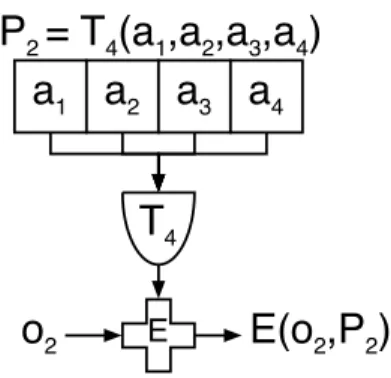
We refer to a policy where k out of k attributes are re-quired to decrypt an object as anand logicpolicy, and 1in
k attributes asor logic policy. These policies can be eas-ily implemented using the thresholding primitive, where the threshold isk in the case of and logicand 1 in or logic. Figure 2 illustrates an and policy. The policyP2 requires
that the party performing decryption must possess all four of the following attributes: a1, a2, a3, a4. P2is implemented
by giving the threshold operator T4 the four required
at-tributes. An orpolicy is trivially similar, and is thus not illustrated.
Expressing policy becomes somewhat more complex when the input policies are not subsets ofS, i.e., not expressions over atomic policies. Consider the case of anorpolicy span-ning three (possibly complex) policies P1, P2, and P3. In
this case, one need only encrypt each of the input objects under each policy and concatenate them together; anyone able to decrypt at least one of these objects should be able to recover the underlying object. Denoting concatenation as “·”, the ciphertext of an objectoiencrypted under a policy
P1∨P2∨P3 would beE(oi, P1)·E(oi, P2)·E(oi, P3).
Now consider the case of an and policy spanning three (possibly complex) policies P1, P2, and P3. One cannot
P
3= P
4P
5= T
2(a
1,a
2)
T
2(a
3,a
4)
Ea
1a
2a
3a
4T
3E(o
3,P
4)
ET
3E(o
3,P
5)
o
3Figure 3: Encryption operation using and-or
pol-icyP3. Principals who possess either attributesa1
anda2ora3anda4are capable of decrypting object
o3.
P
6= P
7P
8= T
1(a
1)
T
1(a
2)
T
1(a
3)
Ea
1a
2a
3T
1o
4T
1 ET
1 EE(o
4,P
6)
E(o4,P7) E(o4,P8)Figure 4: Encryption operation using or-and
pol-icy P4. A principal possessing attributea3 and
ei-thera1 or a2 may decrypt objecto4.
do not reflect a threshold over atomic attributes. Hence, another construction must be used. Observe that we can achieve and semantics by sequentially encrypting the ob-ject with each policy. Thus the policyP1∧P2∧P3 would
beE(E(E(oi, P1), P2), P3). This satisfies the policy
seman-tic because only principals which possess the underlying at-tributes satisfying all policies can recover the plaintext.
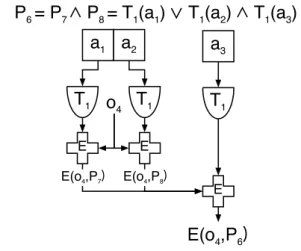
Conjunction and disjunction constructions can be nested arbitrarily. In Figures 3 and 4 we illustrate policies that use bothand logicand or logic. Specifically, in theand-or
policy, any party performing decryption must possess either the attributesa1 and a2 or the attributesa3 and a4. The
or-and policy requires the decrypting party possess a1 or
a2 in addition to attributea3.
Observe that the conjunction constructor has a weaker security model than the original ABE constructions, where the base objects are encrypted under attributes. Whereas ABE encryption prevents any collusion attack, it is possi-ble for adversaries to collude to recover the plaintext in this construction. To illustrate, in theor-andexample1 in
Fig-1
This policy expression could be optimized to reduce the
ure 4, two colluding parties satisfying P7 andP8
indepen-dently can recover the plaintext. The first adversary need decrypt the outer encryption using its a3 assignment, then
pass the innerE(o4, T1(A1)) ciphertext to the second
adver-sary who can then decrypt usinga1 to recover the original
plaintexto4. Work to improve this aspect of the associated
cryptographic constructions is currently under way. Until then, our constructions are no weaker than standard cryp-tographic methods e.g. public key cryptosystems.
4.3
Extending the Flexibility of ABE
ABE natively supports a k-of-n threshold primitive. However the cryptographic constructions discussed in Ap-pendix B mandate that k be a fixed constant across all ciphertext objects created by a given attribute system. Further, for the implementation without random oracles, the number of attributes in each ciphertext n, must also be fixed. These requirements greatly limit the liberty at which principals can draft policies; each policy must be created with a single type of threshold primitive. Thus, if
k = 4, n = 4, then all policies would have to be written using T4 threshold operators and each ciphertext would
have to contain exactly 4 attributes. As a result the policy
P10=T2(a1, a2, a3) could not be implemented.
Because we are interested in enabling the creation of highly expressive policies, we discuss three separate ap-proaches which circumvent the fixed n, k requirement for constructions without random oracles2. The first two ap-proaches were initially introduced by Sahai and Waters [26]. To better understand the difference between these three solutions it is helpful to introduce the following notation. Let (ki, ni) denote a valid pairing of k, n for a particular
system.
The first solution is to provide all principals in a system with “default attributes”, which act as placeholders and are devoid of semantic meaning (i.e. they are given to all users regardless of their attributes). The purpose of these at-tributes is to enable objects to contain any threshold oper-ator, Tk0 such that 1≤ k0 ≤k. To attain this end, each object must contain the maximum number of possible at-tributesn. The default attributes can then pad for any of the required n attributes. This scheme extends a system where only (k, n) is valid to a system where any of the fol-lowing are valid: (1, n−(k−1)),(2, n−(k−2)), . . . ,(k, n). Given k, n= 10, this method allows a single cryptosystem to express the tenand policies between (1,1) and (10,10); however, this example cryptosystem could not express any system in whichk, nwere not equal.
The second solution entails creatingnseparate cryptosys-tems, each with a different value ofk, enabling policy to use any of the following: (1, n),(2, n), . . . ,(n, n). Similar to the previous approach, this scheme extends policy expressive-ness, but requires a large number of systems to express a diverse set of policies.
required number of encryptions. Specifically, (a1∨a2)∧a3≡
(a1∧a3)∨(a2∧a3). This optimization would require two
encryptions with T2, as opposed to four encryptions with
T1. Such logic expression reductions have been thoroughly
studied by other works [17] and are therefore not the focus of this work.
2While this discussion focuses on circumventing the fixed
n, k in the constructions without random oracles, our ap-proaches can be extended to constructions with random or-acles, which is only limited by having a fixedk.
Figure 5: Example of our method for extending flexibil-ity of ABE. ABE constructions without random oracles
can only directly implement ak out of n policy wherek
andnare fixed. In this example we show how any
pos-sible pairing ofk≤nandn, given that no more than 10
attributes will be present in any ciphertext. To attain this end, 10 separate cryptosystems (denoted by stars)
are implemented. Arrows indicate the use of
semanti-cally void default attributes. These attributes can be
used on each of the 10 cryptosystems to attain anyk, n
pairing.
Our approach is a hybrid of the above two techniques. Specifically, this approach enables any policy that is ex-pressed with at most n attributes. More exactly, ∀nj ≤
nand∀ki ≤ nj,(ki, nj) are all valid pairings of k and n.
This scheme is implemented by creating n separate cryp-tosystems as described in the second solution. From these cryptosystems, default attributes can be used to attain all the desired policies. This is illustrated in Figure 5, where
n= 10. Each of these 10 cryptosystems are denoted with a “star,” giving the following (k, n) pairs: (1,10), (2,10),. . ., (10,10). The diagonal lines indicate the other pairings of (k, n) that are obtainable by using default attributes from within the 10 cryptosystems. Consider the (9,10) cryptosys-tem, in which default attributes allow for the expression of the policies (1,2),(2,3), . . . ,(9,10). Similar expressiveness is possible for the remaining cryptosystems.
This scheme can easily be extended to meet the needs of the target application. For instance, a system may opt to only create a subset of the possible cryptosystems (e.g. the values ofk for powers of 2 less than or equal ton). Sec-tion 6 explores the performance trade-offs associated with using such a sampling. Trade-offs between expressibility, performance and overhead must be carefully considered.
5.
APPLICATION OF POLICY
The threshold, conjunction and disjunction constructions discussed in Section 4 result in an expressive policy system. In this section we illustrate the use of policy in two separate applications: HIPAA compliant distributed storage systems and social networks.
5.1
Distributed File Systems
A content-addressablefile system enables users to locate files based on attributes or keywords describing their con-tents. Accordingly, data becomes searchable in a more meaningful fashion than the traditional approach of speci-fying file paths. To date, most work on content-addressable
Alexander Fleming Leonard McCoy Beverly Crusher Walt Whitman Arthur Miller Benedict Arnold Blue Cross Medicare A Medicare B ACME Medicare D Insurance Doctor Nurse Billing Pharmacist Drug Rep Job
Figure 6: Mapping of attributes to principals in HIPAA compliant medical system.
file systems has focused on automatically generating de-scriptions of a file’s contents [6, 14, 16]. The use of ABE strengthens the security properties of such systems. Be-cause the access control policy of every object is embedded within it,the enforcement of policy becomes an inseparable characteristic of the data itself. This is in direct contrast to most currently available systems, which rely directly upon a trusted host to mediate access and administer policy. As file systems become more distributed in nature and rely upon domains of varying trust to control access, traditional approaches no longer provide adequate guarantees.
Example systems include large multisite research efforts such as the Human Genome Project, which was formed in or-der to map the sequence of chemical building blocks compos-ing the human genome. While this multinational research effort requires a total of only 3 gigabytes of space to store the genome itself, the space estimated for additional anno-tations will sufficiently dwarf the initial sequence data in the system [2]. As this and other research projects begin to require petabytes of storage, the ability to securely store such information across multiple sites becomes increasingly critical.
5.1.1
Policy for HIPAA Compliant Medical Systems
We use a Health Insurance Portability and Accountability Act (HIPAA) compliant medical system as an example of a loosely-coupled, content-addressable file system with strict security requirements. HIPAA was designed to clearly enu-merate the security requirements and provide information flow control for electronically stored medical information such that patient privacy is maintained [32]. While the sys-tem below is by far not a comprehensive example of HIPAA requirements, it demonstrates the ease with which a fully compliant system could be constructed using ABE.In this example, a patienti’s medical information is com-posed of several fields. Patients define the following pri-vacy policies to best protect each component of their medi-cal information: currently used medications (Pi,M ed),
medi-cal history (Pi,Hist), contact information (Pi,CI), and
insur-ance information (Pi,Ins). A patient’s policy describes the
attributes that must be possessed by medical personnel in order to access their medical information. As illustrated in Figure 6, these attributes describe various job functions of medical personnel as well as the health insurance plans they accept.
A patient, Robert Oppenheimer, supplements his limited insurance coverage through the ACME Corporation with a “Medicare D” prescription plan. His policy therefore stipu-lates that only doctors (Dr) and nurses (Rn) supporting his insurance plan can view his full medical history, contact in-formation, and a listing of his current medications. Oppen-heimer’s policy also allows a pharmacist (Rx) in his plan to view the medications he is currently taking, so that he/she can ensure no conflicts between prescriptions exist. Fur-ther, a pharmacist is allowed access to contact information to notify him when prescriptions have been filled. Oppen-heimer’s policy also restricts the access of billing personnel (Bill) to his insurance and contact information such that charges can be filed with his insurance providers without danger of exposing private information. Lastly, without re-vealing his contact information, Oppenheimer allows the list of medications he is currently using to be made available to pharmaceutical representatives (Rep) analyzing the combi-nation of drugs with which their products are prescribed in concert. As described above, Oppenheimer’s policies are represented as follows:
PO,Hist = T1(Dr, Rn)∧T1(ACM E, M edicareD)
PO,CI = T1(Dr, Rn, Bill, Rx)
∧T1(ACM E, M edicareD)
PO,Ins = T1(Bill)∧T1(ACM E, M edicareD)
PO,M ed = (T1(Dr, Rn, Rx)∧T1(ACM E, M edicareD))
∨T1(Rep)
From the above policies, only Dr. Crusher and Nurse Whitman can access his medical history. Dr. Crusher, Nurse Whitman, Billing Secretary Arnold, and Pharmacist Flem-ing can access his contact information. BillFlem-ing Specialist Arnold can also access Oppenheimer’s insurance informa-tion. Dr. Crusher, Nurse Whitman, Pharmacist Fleming and Pharmaceutical Representative Miller are able to deter-mine Oppenheimer’s current regime of medication.
5.2
Social Networks and Online Communities
Social networks, such as orkut, Facebook and Friend-ster [1], are an online application which enable users to find other users with similar interests. To use these applications, users must reveal large quantities of personal information (e.g. name, age, address, personal interests, sexuality, etc.) into the public domain. Groups of people sharing similar attributes and friends are then automatically linked to each other. Currently, such systems provide only weak privacy guarantees; network membership allows access to the wealth of user information. Accordingly, user data can readily be mined and abused by undesirable parties.ABE-based systems are well suited to provide user controlled-privacy, as users in these communities are al-ready characterized by their attributes. In Friendster, for example, a user with the attribute “Anon U. Alumnus” is automatically enrolled in a group of the same name. Ac-cordingly, the creation of “white-lists” for communication immediately becomes possible without requiring enumer-ation of all user identities. Constructing a social network using ABE also provides scalability. Current social networks require a trusted central server to store all profile informa-tion and enforce policy. Because ABE-based systems do not require a trusted storage system, profile information could
Van Buren Coolidge Anderson Grant Kidman Jones Male Female Gender Thin Medium Overweight Weight Red Blonde Brown Black Hair Color Poor Medium Rich Wealth
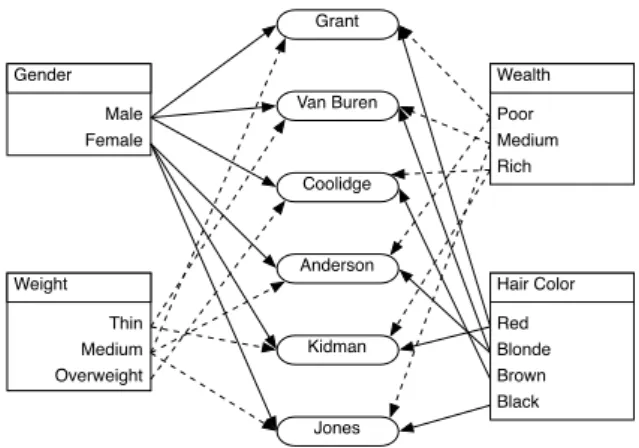
Figure 7: Mapping of attributes to principals in social network application.
be stored on untrusted servers, significantly decreasing the traffic and storage requirements incurred by a system. Further, in an ABE-based system, objects are embedded with policy, enabling distributed enforcement.
5.2.1
Policy in a Social Network
We now demonstrate policy in a social network through an application where the principals are users of an online dating service. Each user dictates their own policy in order to restrict access to their personal information.
Figure 7 illustrates a sample network. A principal’s pol-icy can be viewed as a description of attributes they find desirable in other principals. Possession of the attributes described in the policy is therefore a prerequisite to being able to access another principal’s personal information. We begin with a relatively simple policy. Van Buren is only in-terested in meeting women with black hair, medium wealth, and medium weight. His policy is represented as:
PV = T4(F emale∧BlackHair∧M edW ealth
∧M edW eight).
Of the above principals, only Jones can access Van Buren’s profile. This policy, which is equivalent to policyP2 as
de-picted in Figure 2, can be expressed using a single threshold primitiveT4. It is therefore possible to directly implement
PV with a single ABE encryption. Accordingly, data
en-crypted under this policy will be resistant to collusion. Grant’s policy, whereby only blonde or red haired women can access his profile information, is represented as:
PG = T1(F emale)∧(T1(Blonde)∨T1(Red)).
As such, only Anderson or Kidman can access his informa-tion. Notice that Grant’s policy is equivalent to policy P6
in Figure 4 and therefore cannot be implemented using a single threshold operator. Accordingly, PGis less resistant
to collusion thanPV.
Lastly, Anderson is interested in hearing from men who possess at least two of the following attributes: red hair, medium weight, overweight, or medium wealth. Her policy can be represented as:
PA = T1(M ale)∧T2(Red, M edW eight, Overweight,
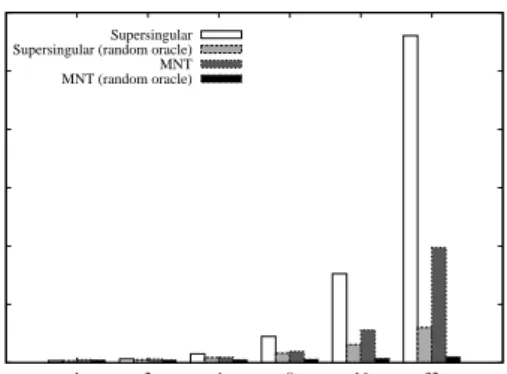
0.2 0.4 0.6 0.8 1 1.2 1.4 1.6 1.8 2 2.2 32 16 8 4 2 1 Time (sec) # Attributes Supersingular Supersingular (random oracle) MNT MNT (random oracle)
Figure 8: System Setup: As the number of attributes grows, MNT curves become more efficient.
0 5 10 15 20 25 30 32 16 8 4 2 1 Time (sec) # Attributes Supersingular Supersingular (random oracle) MNT MNT (random oracle)
Figure 9: Key Generation: Performance becomes nearly identical for systems using either type of curve with ran-dom oracles.
Given Anderson’s policy Coolidge and Grant can access her information. Notice, however, that a principal’s policy is not necessarily symmetric. For instance, of these two, only Grant has a policy that would allow Anderson to contact him.
6.
SYSTEM EVALUATION
The policies discussed in the previous section illustrate the potential expressibility of ABE-based systems. In this section, we characterize the performance of systems provid-ing such functionality. We begin by explorprovid-ing the cost of the base cryptographic constructions. We then determine the cost of implementing a selection of the previously de-fined policies. We finish by comparing the performance of an ABE-based system to a comparable system implemented with RSA cryptographic primitives.
As demonstrated by numerous others (e.g. [10]), the selec-tion of cryptographic parameters can have a drastic impact on system performance. In this section, we characterize the parameter space by profiling the performance of attribute systems under different input parameters. Such analysis is necessary to optimize the system for a particular application or environment. All experiments were carried out on a 2.0 GHz Apple Xserve G5 with 4GB memory running Mac OS X Server 10.3.9. All disk operations were performed on a 1.82TB RAID 5 disk array. All results are calculated from
0 2 4 6 8 10 12 32 16 8 4 2 1 Time (sec) # Attributes Supersingular Supersingular (random oracle) MNT MNT (random oracle)
Figure 10: Encryption: SS constructions are significantly slower than MNT constructions.
0 1 2 3 4 5 6 7 8 32 16 8 4 2 1 Time (sec) # Attributes Supersingular Supersingular (random oracle) MNT MNT (random oracle)
Figure 11: Decryption: SS constructions are significantly faster than MNT constructions.
an average of 500 iterations of the measured operation. We have implemented an ABE library upon which secure attribute systems can be constructed. This C library con-tains approximately 5,200 lines of code and has been tested on Solaris, OS X and Linux platforms. To our knowledge, we are the first to implement, measure, and characterize the theoretical mechanisms of attribute-based encryption. Ac-cordingly, we explore a wide range of potential inputs and settings system architects should consider when designing new secure attribute-based environments. For instance, sys-tems using our API can choose between the two most studied elliptic curve groups providing bilinear maps: supersingular elliptic curves(SS), which enable fast cryptographic pairing operations [22], and MNT elliptic curves, which are used to obtain small ciphertext sizes [23]. We use the Pairing-Based Crypto library [19] for the underlying implementation of these groups and OpenSSL [3] for providing a supporting Key Encapsulation Mechanism (KEM) [31].
The following analysis measures the four central func-tions of the attribute system as defined in Section 2:
Setup System,Key Generation,Encryption, andDecryption.
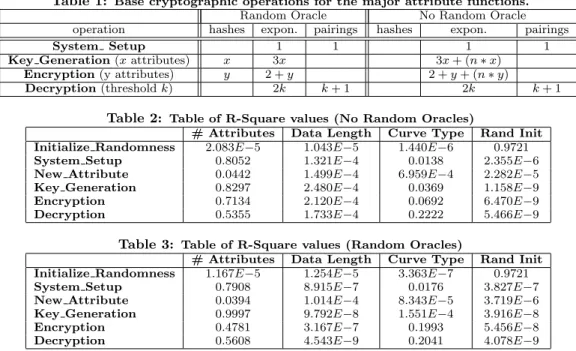
For reference, Table 1 provides an outline of the base cryp-tographic operations for each of the base operations. See Appendix A for greater detail on the use of these functions and the design of our attribute system API. All source code and documentation are available at:
Table 1: Base cryptographic operations for the major attribute functions.
Random Oracle No Random Oracle
operation hashes expon. pairings hashes expon. pairings
System Setup 1 1 1 1
Key Generation(xattributes) x 3x 3x+ (n∗x)
Encryption(y attributes) y 2 +y 2 +y+ (n∗y)
Decryption(thresholdk) 2k k+ 1 2k k+ 1
Table 2: Table of R-Square values (No Random Oracles)
# Attributes Data Length Curve Type Rand Init
Initialize Randomness 2.083E−5 1.043E−5 1.440E−6 0.9721 System Setup 0.8052 1.321E−4 0.0138 2.355E−6 New Attribute 0.0442 1.499E−4 6.959E−4 2.282E−5 Key Generation 0.8297 2.480E−4 0.0369 1.158E−9 Encryption 0.7134 2.120E−4 0.0692 6.470E−9 Decryption 0.5355 1.733E−4 0.2222 5.466E−9
Table 3: Table of R-Square values (Random Oracles)
# Attributes Data Length Curve Type Rand Init
Initialize Randomness 1.167E−5 1.254E−5 3.363E−7 0.9721 System Setup 0.7908 8.915E−7 0.0176 3.827E−7 New Attribute 0.0394 1.014E−4 8.343E−5 3.719E−6 Key Generation 0.9997 9.792E−8 1.551E−4 3.916E−8 Encryption 0.4781 3.167E−7 0.1993 5.456E−8 Decryption 0.5608 4.543E−9 0.2041 4.078E−9
These experiments indicate several important properties of the parameter space. Firstly, MNT is faster than SS for encryption whereas the opposite is true for decryption. Secondly, encryption costs are significantly improved by the use of random oracles. Hence, the curve selected should be a reflection of the relative number of encryptions and decryp-tions performed in the system, as well as the capabilities of the encryptor and the intended recipients. Lastly, the abil-ity to express complex policies with ABE allows for practical use of attribute-based systems.
6.1
Experimental Results
The first set of experiments measure the degree to which different system parameters affect performance: we vary the number of attributes, length of data, elliptic curve and ini-tialization of randomness parameters. We then perform an R-squared or coefficient of determination analysis over the measured results. This technique identifies the portion of observed variance in one variable that is directly attributable to a second. On a scale from zero to one, numbers closer to one represent a significant correlation between variables. For precision, we also include measurements for two addi-tional subfunctions: Initialize Randomnesspreloads ran-dom bytes from the local entropy pool andNew Attribute
allocates a new attribute to a principal.3 The results of
these tests reveal that the number of attributes followed by the elliptic curve used are the dominant factors, as shown in Tables 2 and 3. Lastly, to characterize the growth of execution time against the number of attributes, we run a regression analysis for the worst case and present our find-ings in the standard linear form, i.e.,y=mx+b.
Figure 8 shows the cost ofSystem Setupas a function of the number of attributes. Systems using a SS curve without random oracles average 0.366 seconds (σ= 0.049) and 2.141 seconds (σ= 0.133) for 1 and 32 attributes, respectively. A
3
In all tests in this section, Initialize Randomness
is included in measurements of System Setup, and
New Attributeis included byKey Generation.
system using the MNT elliptic curve without random ora-cles averages between 0.737 seconds (σ= 0.202) and 1.699 seconds (σ = 0.284) for the same range. Execution time for both curves scales linearly in the number of attributes (SS w/o random oracles: y= 0.572x+ 0.3126;r2= 0.9999). Random oracles have no role in system setup, and hence have no bearing on performance. System setup therefore poses no significant computational burden in real systems.
Figure 9 illustrates the cost of key generation, which is consistently cheaper for MNT curves. For a system using 32 attributes without random oracles, MNT curves require an average of 12.355 seconds (σ= 0.035) to generate a user key, compared to 25.05 seconds (σ = 0.052) for SS curves. Random oracle constructions are significantly faster - sys-tems built on SS and MNT curves perform similarly at all numbers of attributes, e.g., at 5.051 (σ= 0.017) and 4.927 (σ = 0.017) seconds, respectively for 32 attributes. Exe-cution time scales linearly for both curves with and with-out the use of random oracles (SS w/o random oracles:
y = 0.8003x−2.37;r2 = 0.9584). Note that key
genera-tion for each user is performed infrequently (likely once). If the user community is fairly static, such costs will be amor-tized by operations on data. Conversely, in environments where users may join frequently, it behooves the adminis-trator to select parameter choices that minimize these costs, e.g., MNT elliptic curves using random oracles.
As shown in Figure 10 for both SS and MNT elliptic curves, the construction without random oracles requires an average of 11.213 (σ = 0.031) and 3.946 (σ = 0.017) seconds to encrypt data using 32 attributes. Systems imple-menting the construction with random oracles experience dramatically improved encryption performance, i.e., 1.207 (σ = 0.009) and 0.204 (σ = 0.006) seconds, respectively. Here, MNT elliptic curves are approximately 65% to 85% faster than their SS counter-parts (in constructions with and without random oracles, respectively). Systems using MNT curves with random oracles are in fact 98% faster those using SS curves without random oracles. Both systems scale
lin-early in the number of attributes with and without random oracles (SS w/o random oracles: y= 0.3590x−1.148;r2 = 0.9487). Conversely, as illustrated in Figure 11, a system of 32 attributes with and without random oracles exhibits a decryption time of 1.452 (σ= 0.009) and 1.348 (σ= 0.044) for an SS construction and 7.341 (σ = 0.029) and 5.342 (σ= 0.841) seconds in MNT, respectively. Execution time for both systems scales linearly in the number of attributes with and without random oracles (MNT w/o random ora-cles: y= 0.2298x−0.103;r2 = 0.9999). Note the systems using SS curves experience approximately 80% faster per-formance than their MNT counterparts.
Lastly, we compare the performance of ABE against tra-ditional cryptographic techniques. From OpenSSL’s bench-marking tool [3], the platform used for ABE benchmark-ing is capable of performbenchmark-ing RSA public key encryption in 0.0003 and 0.00097 seconds for 1024 and 2048-bit keys, re-spectively. To offer similar semantic expressiveness and pre-vent the need for 2N−1 keys (there are 2N−1 nonempty sub-sets in a set of sizeN), we assume that each attribute in an ABE system has a corresponding RSA key pair. For simple policies, encryption under a single attribute/key is 300 and 93 times faster under RSA (0.0003 and 0.00097 vs 0.09 sec-onds). ABE’s thresholding primitive, however, allows much more efficient execution. For example, a policy requiring a threshold of 2 of 32 attributes has nearly identical execution times (0.1488 vs 0.2043 seconds) for both RSA-1024 and ABE with MNT curves and random oracles. RSA-2048 re-quires approximately 0.5 seconds to achieve the same ends. A system requiring 16 of 32 attributes would also require 0.2043 seconds for an ABE system; however, the equivalent RSA systems would require approximately 33.4 and 107.97 days, over 46.6 million times slower, to achieve the same. ABE’s inherent expressibility makes it a practical means of constructing real attribute systems.
6.1.1
HIPAA System Policy Analysis
We now determine the cost incurred for implementing ex-pressive policies. Encrypting with the policy PO,CI from
Section 5.1.1 requires an initial encryption of the principal Oppenheimer’s contact information usingT1(ACME,
Medi-care D), a process requiring E2 time to complete. This
ciphertext object is then independently re-encrypted with each of the following attributes: Dr, Rn, Billing, Rx. Each of these encryptions requires 1 attribute, and thus takes
E1 time to complete. This policy could alternatively be
implemented using two encryptions if the or construction is replaced with T1(Dr, Rn,Bill, Rx). Table 4 shows the
timing values for this optimized policy, noted as PO,CI =
E(E(CI, T1(ACME,Medicare D )), T1(Dr,Rn,Bill,Rx)).
Decrypting data encrypted underPO,CI requires two
op-erations. The first decryption occurs with any of the follow-ing attributes: Dr, Rn, Billfollow-ing, Rx. The second decryption, which enables recovery of the plaintext, requires decryption ofT1(ACME, Medicare D). Table 4 shows average execution
time.
6.1.2
Social Network Analysis
We now examine the cost of expressing policy as described in Section 5.2.1 for a social network application. Consider the time required to encrypt a message under Grant’s policy,
PG. Grant’s informationIGis first independently encrypted
under T1(Red Hair) and T1(Blonde). Both values, noted
Table 4: Average performance (sec) forPO,CI
No Rand Oracles Rand Oracles
SS MNT SS MNT E2 0.13 0.12 0.10 0.10 E4 0.31 0.18 0.18 0.10 D2 0.09 0.46 0.10 0.42 D4 0.18 0.91 0.18 0.75 E(PO,CI) 0.44 0.30 0.28 0.20 D(PO,CI) 0.27 1.37 0.28 1.17
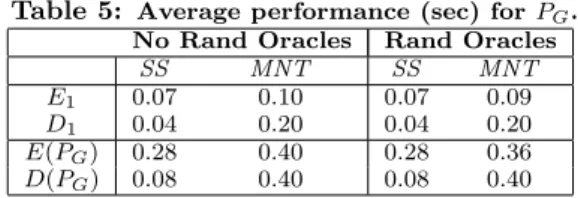
Table 5: Average performance (sec) forPG.
No Rand Oracles Rand Oracles
SS MNT SS MNT E1 0.07 0.10 0.07 0.09
D1 0.04 0.20 0.04 0.20
E(PG) 0.28 0.40 0.28 0.36
D(PG) 0.08 0.40 0.08 0.40
as IG0 = E(IG, T1(Red Hair)) and IG00 =E(IG,T1(Blonde))
respectively, are then encrypted underT1(Female), yielding
E(IG0, T1(Female)) and E(IG00, T1(Female)). Note that the
total number of encryptions can be halved if theorsemantic is equivalently implemented as T1(Red Hair, Blonde). The
total time to encryptPGis given byE(PG).
Table 5 details the time required to perform the unopti-mized operations required to formulate PG. These values
represent the encryption and decryption operations for SS and MNT elliptic curves with and without random oracles. In the case of decryption forPG, two decryptions are
re-quired. The decrypting party initially performs two decryp-tions with a3. From this, only a1 or a2 must be decrypted
in order to recover the original plaintext. The total time to decryptPGis given byD(PG).
6.2
Ciphertext Size and User Key Length
Ciphertext size and key length are important to some classes of applications, e.g., in high traffic volume or low bandwidth networks or on resource poor devices. Here, we briefly detail the size of ciphertexts and the size of a user’s private key. Specifically, we quantify ciphertext length and user key length as described in Appendix B. Because the focus of this paper is on attribute systems and ABE, we do not include structured data framing or data encrypted with symmetric cryptography in our treatment of ciphertext size. We shall first discuss a discrepancy between MNT curves and SS curves that is necessary to understand our analy-sis. Recall that the Sahai-Waters construction makes use of a bilinear group G to perform bilinear map operations:e : G×G → GT. This type of bilinear map is said have
symmetric groups. A bilinear map that is asymmetric has the following form: e:G1×G2 →GT,G1 6=G2. SS curves
are characterized by having symmetric bilinear groups. Both
G andGT require 512 bits to be represented. MNT curves
are characterized by having asymmetric bilinear groups. G1
is represented with 170 bits while G2,GT are represented
with 510 bits.
Each attributeipossessed by a principal corresponds to two private key componentsdi andDi. For SS curves both
of these components are members of G. For MNT curves
attributes):
Supersingular KeySize(n) = 2·n·512bits (10)
M N T KeySize(n) = (170 + 510)·nbits (11) A ciphertextCscales with the number of attributes it con-tains as follows. A ciphertext withnattributes is composed of C0, C00, and n elementsCi. For SS curves C00, Ci ∈ G
and C0 ∈ GT. For MNT curves C00 ∈ G2, C0 ∈ GT, and
Ci∈G1. This yields (for anattribute ciphertext):
Supersingular CT Len(n) = (n+ 2)·512 bits (12)
M N T CT Len(n) = 2·510 + 170nbits (13)
6.3
Attribute Revocation Issues
We now address some of the practical issues relevant to constructing ABE-based systems. An in-depth discussion of the implementation and the associated parameters is pro-vided in Appendix A.
Revocation of users and keys in systems is a well stud-ied but nontrivial problem [21]. Revocation is even more difficult in attribute systems, given that each attribute is conceivably possessed by multiple different users, whereas public/private key pairs are uniquely associated with a sin-gle principal. While an in-depth discussion of revocation is out of the scope of this paper, we give a brief overview of one method by which revocation could be implemented.
One revocation technique would require each attribute to contain a time frame within which it is valid. For instance, the attribute “Staff Member-December 31st 2006” denotes that the usefulness of the current attribute expires at the end of 2006. Affixing temporal information to each attribute necessitates the system administrator periodically releasing the latest version of attributes and periodically reissue user keying information. Removal of an attribute from this sys-tem would be accomplished by the administrator not releas-ing the latest version of the attribute. Similarly, revokreleas-ing an attribute from an individual requires the administrator to withdraw the updated attribute in the user’s private key. There are significant trade-offs between the load placed upon the administrator and the amount of time that can elapse before an attribute/user can be purged. We therefore leave more efficient solutions to future work.
7.
RELATED WORK
Securing the sharing of information between groups is a fundamental problem that arises in numerous applications. Such applications include multilevel security, secure multi-cast, collaborative online communities, and distributed file systems. The fundamental importance of the secure ex-change of information has resulted in a wide range of so-lutions.
Traditional access control mechanisms can be categorized into three groups: mandatory access control (MAC) [11], discretionary access control (DAC) [18, 28], and role-based access control (RBAC) [13, 27]. In MAC, an administrative mechanism enforces centralized access control on every ob-ject. Systems implementing DAC require the owner of an object to dictate policy. Under RBAC, a user’s role in an organization inherently dictates their ability to access and manipulate data. Each role in an RBAC system is associ-ated with a set of permissions required to carry out that role. While these mechanisms are highly effective at controlling access for systems under a single administrative authority,
they have been largely unsuccessful at providing the same for unconnected and distributed environments.
ABE can enforce access control policy in such environ-ments because it cryptographically binds objects to their policies. Only users possessing the requisite set of attributes are able to view and/or manipulate data. The ability to make policy portable through cryptography is not new. Sev-eral works have attempted to use a public key infrastructure (PKI) [15] or secure group communications mechanisms [7, 20] to provide similar access control mechanisms. The dif-ficulty with applying standard cryptographic techniques is they are designed to control access to single groups. In real systems, however, users are often members ofmultiple
groups. Unique keys must therefore be assigned or negoti-ated for each of the subgroups for which a user is a member. Such solutions do not scale for complex organizations with significant communication across groups. In contrast, users in ABE-based systems automatically belong to every possi-ble attribute subset group without the need for additional keying.
By using cryptographic mechanisms that are in and of themselves able to express complex policies, ABE-based sys-tems become a highly practical means of ensuring the effi-cient and secure exchange of information between groups.
8.
CONCLUSION
This paper has presented a novel secure information man-agement architecture and implementation. We extended ex-isting constructions for attribute-based encryption (ABE) and promoted them as a practical systems building block. The needs of complex attribute applications were met via the introduction of a policy system and an associated im-plementation for its enforcement. We illustrated the infras-tructure through the creation and performance evaluation of two applications: a HIPAA compliant distributed file sys-tem and a social network. A further empirical study shows that a careful selection of parameters and use of construc-tion optimizaconstruc-tions can lead to significant cost savings. These analyses demonstrate that our attribute approach is an at-tractive solution for securely managing information in large, loosely-coupled, distributed systems.
9.
REFERENCES
[1] Friendster. http://www.friendster.com, 2006. [2] The human genome project.
http://www.ornl.gov/sci/techresources/Human Genome/home.shtml, 2006.
[3] The OpenSSL project. http://www.openssl.org, 2006. [4] M. Bellare and P. Rogaway. Random oracles are practical: A
paradigm for designing efficient protocols. InACM Conference on Computer and Communications Security, pages 62–73, 1993.
[5] D. Boneh and M. K. Franklin. Identity-based encryption from the weil pairing. InProceedings of the 21st Annual
International Cryptology Conference on Advances in Cryptology, pages 213–229. Springer-Verlag, 2001. [6] M. Bowman, C. Dharap, M. Baruah, B. Camargo, and
S. Potti. A file system for information management. In Proceedings of the ISMM International Conference on Intelligent Information Management Systems, March 1994. [7] R. Canetti, J. Garay, G. Itkis, D. Micciancio, M. Naor, and
B. Pinkas. Multicast security: A taxonomy and some efficient constructions. InProceedings of IEEE INFOCOM’99, 1999. [8] R. Canetti, O. Goldreich, and S. Halevi. The random oracle
methodology, revisited (preliminary version). InSTOC, pages 209–218, 1998.
[9] C. Cocks. An identity based encryption scheme based on quadratic residues. InIMA Int. Conf., pages 360–363, 2001.
[10] E. Cronin, S. Jamin, T. Malkin, and P. McDaniel. On the Performance, Feasibility, and Use of Forward Secure Signatures. InProceedings of 10th ACM Conference on Computer and Communications Security (CCS), pages 131–144. ACM, October 2003. Washington, DC.
[11] D. E. Denning. A lattice model of secure information flow. Commun. ACM, 19(5):236–243, 1976.
[12] C. Ellison and B. Schneier. Ten Risks of PKI: What You’re Not Being Told About Public i Key Infrastructure.Computer Security Journal, 16(1):1–7, 2000.
[13] D. F. Ferraiolo, R. Sandhu, S. Gavrila, D. R. Kuhn, and R. Chandramouli. Proposed NIST standard for role-based access control.ACM Trans. Inf. Syst. Secur., 4(3):224–274, 2001.
[14] B. Gopal and U. Manber. Integrating content-based access mechanisms with hierarchical file systems. InOSDI ’99: Proceedings of the third symposium on Operating systems design and implementation, pages 265–278, Berkeley, CA, 1999. USENIX Association.
[15] T. Hardjono and B. Weis. The Multicast Group Security Architecture. RFC 3740 (Informational), Mar. 2004. [16] D. R. Hardy and M. F. Schwartz. Essence: A resource
discovery system based on semantic file indexing. In Proceedings of the USENIX Winter Conference, pages 361–374, Berkeley, CA, January 1993. USENIX Association. [17] F. J. Hill and G. R. Peterson.Computer aided logical design
with emphasis on VLSI. Wiley, 4 edition, 1993.
[18] B. Lampson. Protection. InProceedings of the 5th Annual Princeton Conference on Information Sciences and Systems, pages 437–443, Princeton University, 1971.
[19] B. Lynn. PBC library. http://rooster.stanford.edu/˜ben/pbc/, 2006.
[20] P. McDaniel, A. Prakash, and P. Honeyman. A flexible framework for secure group communication. InUSENIX Security Symposium, pages 99–114, 1999.
[21] P. McDaniel and A. D. Rubin. A response to “can we eliminate certificate revocation lists?”. InFC ’00: Proceedings of the 4th International Conference on Financial Cryptography, pages 245–258, London, UK, 2001. Springer-Verlag. [22] A. J. Menezes, T. Okamoto, and S. A. Vanstone. Reducing
elliptic curve logarithms to logarithms in a finite field.IEEE Transactions On Information Theory, 39(5):1639–1646, September 1993.
[23] A. Miyaji, M. Nakabayashi, and S. Takano. New explicit conditions of elliptic curve traces for FR-reduction.IEICE Transactions on Fundamentals, E84-A(5):1234–1243, 2001. [24] M. Myers, R. Ankney, A. Malpani, S. Galperin, and C. Adams.
X.509 Internet Public Key Infrastructure: Online Certificate Status Protocol - OCSP.http://www.ietf.org/rfc/rfc2560.txt, 1999.
[25] D. Nali, C. Adams, and A. Miri. Using threshold
attribute-based encryption for practical biometric-based access control. 1(3):173–182, November 2005.
[26] A. Sahai and B. Waters. Fuzzy identity based encryption. In Eurocrypt 2005, 2005.
[27] R. S. Sandhu, E. J. Coyne, H. L. Feinstein, and C. E. Youman. Role-based access control models.Computer, 29(2):38–47, 1996.
[28] R. S. Sandhu and P. Samarati. Access control: Principles and practice.IEEE Communications Magazine, 32(9):40–48, 1994. [29] A. Shamir. How to share a secret.Commun. ACM,
22(11):612–613, 1979.
[30] A. Shamir. Identity-based cryptosystems and signature schemes. InProceedings of CRYPTO 84 on Advances in cryptology, pages 47–53. Springer-Verlag New York, Inc., 1985. [31] V. Shoup. Using hash functions as a hedge against chosen
ciphertext attack. InEUROCRYPT, pages 275–288, 2000. [32] United States Department of Health and Human Services.
Health Insurance Portability and Accountability Act. http://aspe.hhs.gov/admnsimp/pl104191.htm, 1996.
APPENDIX
A.
ABE SYSTEMS DESIGN & ISSUES
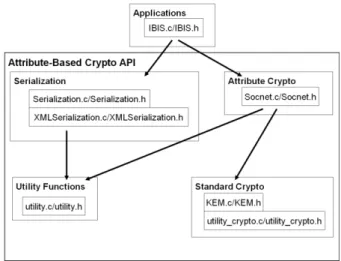
Figure 12 illustrates the architecture of ABE systems built using our ABE API. Specifically there are two main compo-nents: the ABE API and the application code.
Figure 12: Components of attribute-based cryp-tosystem API.
ABE API – We have created the ABE API to enable rapid development of systems and applications which use attribute-based cryptography. Our API uses the PBC li-brary [19] to implement our attribute-based cryptography. This C language API has been specifically designed to enable a programmer with no knowledge of ABE to quickly write applications; the complex cryptography inherent to ABE is entirely handled by the API.
For didactic purposes we present the API as four distinct modules: attribute-based cryptography, standard cryptog-raphy, serialization, and utility functions.
Attribute-based Cryptography – The majority of ap-plication level code interacts with the API through the attribute-based cryptography component. This module was specifically designed for ease of use, consisting of seven sim-ple functions: Setup System,Create User,New Attribute,
Give Attribute,Key Generation,Encryption, and
Decryption.
The Setup System function creates and initializes a
new attribute-based cryptosystem. Specifically, this instantiates two key structures: global params and
authority priv. global paramscontains global parameters
required to perform encryption and decryption operations.
authority privcontains the master secret, from which all
attribute keys are defined. authority priv must be kept secret in order to ensure the security of the system.
Setup System must be given pbc param file name, the
name of an XML file defining an elliptic curve from which all of the API’s ABE cryptography is formulated. Included with the API are two such parameter files, a param.xml
(Supersingular curve) and c159 param.xml (MNT curve). Supersingular curves are optimized for fast cryptographic pairings, and MNT curves are optimized to result in small cryptographic group elements.
The nature of ABE cryptography is such that every ci-phertext in a given cryptosystem is of a fixed lengthn. The user can specify what this length is by providing the API
withct len.
To increase the flexibility of the API,Setup System cre-ates several “default” attributes. The default attributes can be included in a ciphertext to take the place of non-default
attributes, enabling the user to create ciphertexts with less
thanct lenattributes.
The New Attribute function is used to add a new
at-tribute, whose name is specified byatt name, to the universe of attributes in the system. Upon completion of this func-tion the new attribute’s name and the hash of its name can be made publicly available. At this point the new attribute can be used for encryption operations.
TheCreate Userfunction adds a user nameduser idto
the system. This function instantiates user id, a struc-ture which stores the user’s name, the user’s default and non-default attribute information, and a polynomial. Each user is given a unique polynomial. Tieing each user’s per-attribute keying information to their polynomial prevents users from colluding in order to attain more attributes.
TheGive Attributefunction is used to give a user a new
attribute. Specifically this function is used to update the user’s attribute data structures and doesnotgenerate any keying information. TheKey Generationfunction is used to create a user’s keying information based on the attributes that they possess. Keeping key generation separate enables
theGive Attributefunction to be executed with fewer trust
assumptions than is needed to perform theKey Generation
function.
The Encryption function is used by a user to create a
new ciphertext,ciphertext. The user specifies,message, a string they would like to encrypt and,uid, a list of attributes that they would like to encrypt to. The user can encrypt with at mostct len attributes. The API will pad the ci-phertext with as many default attributes as is necessary to make the ciphertext contain a total ofct lenattributes. A list of the attributes used to perform encryption are included in each ciphertext in order for the party performing decryp-tion to know which attributes are required to decrypt the message.
Encryption is significantly more complicated than the API’s function calls would seem to indicate. Specifically, the ABE constructions mandate that a ciphertext’s pay-load must be a group element. To enable ABE to carry non-group element payloads we use the Key Encapsulation Mechanism(KEM). In our API, KEM takes a group element payload and uses SHA-1 to convert it into a HMAC key and an AES key. The AES key is then used to encrypt the user’s message.
Decryptiondecrypts a ciphertext encrypted by the
Encryption. This process begins with the decrypting party
verifying that they have the required attributes. The party performing decryption will then use their attributes to de-crypt the dede-crypt the ciphertext in order to obtain the AES and HMAC key. The party will then use the HMAC key to verify the ciphertext. If the ciphertext can be verified, then the AES key will be used to decrypt the actual payload.
Standard Cryptography– In addition to the attribute-based cryptography we have also used standard cryp-tographic tools. The implementation of these tools are contained in the crypto utility and KEM code. The
crypto utility code implements some of the low level
cryptographic operations required by ABE.KEMimplements all of the operations required to enable ABE to encrypt non-group member payloads.
Serialization– The serialization routines enable the API data structures to be written out to disk for long term storage. There are two different implementations of this
functionality. Serialization stores API data structures into byte-encoded files. XMLSerializationstores API data structures into XML files. XMLSerialization is human readable, has better platform independence, and is more fault tolerant. Serialization results in slightly less disk space.
Utility Functions– Theutilityfunctions are a group of functions that increase the ease of programming with the attribute-based cryptography API. Included in theutility
routines are functions that print API data structures and conversion routines.
B.
ATTRIBUTE-BASED ENCRYPTION
For our system we use a variant of the Sahai-Waters Large Universe system [26](Section 6) which we now describe.
In this construction we will make use of a bilinear group
Gof prime orderp. The group will have an efficiently
com-putable bilinear map e: G×G →GT that maps two
ele-ments from the bilinear group into an element of the “tar-get group”. The salient feature of these groups is that if
g is a generator of G then for all a, b ∈ Zp we have that
e(ga, gb) =e(g, g)ab. We refer the reader to the IBE paper
of Boneh-Franklin [5] for more details on bilinear groups. The Sahai-Waters construction works by computing a bi-linear map between k components of the ciphertext with corresponding pieces of the private key. The result of these are interpolated using the secret sharing method of Shamir (in the exponent). We first define the following Lagrangian coefficients, which we will use in our construction, as the following function overZp:
∆i,S(X) =
Y
j∈S,j6=i
x−j i−j.
Additionally, we will assume all systems will work in some predetermined bilinear groupGof appropriate size.
The cryptosystem follows:
Setup(k): The setup algorithms first chooses a random exponent y ∈ Zp and lets the public parameter be Y =
e(g, g)y and the threshold valuek. It keeps the public key and the secret exponentyas the master key.
Key-Gen(S,MK): LetH :{0,1}∗ →
Zp be a
collision-resistant hash function and let T :Zp → G be a function
that we will model as a random oracle [4]. First let Γ be the set defined as Γ =S
s∈SH(s). The set Γ
is essentially the set of the hash of all attributes. (Note that sinceHis collision-resistant Γ should contain|S|unique ele-ments ofZp.) Then the authority will choose a new random
degreek−1 polynomialq(x) overZpsuch thatq(0) =yand
for alli∈Γ the authority chooses a randomri. Then for all
i∈Γ the private keys components are:
Di=gq(i)T(i)ri, di=gri
Encrypt(M, S0,PK): The encryption algorithm first computes the set Γ0 = S
s∈S0H(s). Next, it chooses a random exponentt∈Zp. The ciphertext is output as:
C=`
C0=M Yt, C00=gt,{Ci=T(i)t:i∈Γ0}´.
Notice that both the size of the ciphertext and the en-cryption time grows linearly with the size of the setS.
Decrypt(C, S0, S,SK): The decryption algorithm first computes the sets Γ and Γ0 as before. If the size of the