E
lectronic
T
hesis &
D
issertation
(ETD) Guide
Summer 2011 graduates and after
NCSU Graduate School Guidelines and Requirements
for Master Theses and Doctoral Dissertations
The Graduate School Campus Mailbox #7102
Raleigh, NC 27695
ETD Website ♦ etd.ncsu.edu ETD Editor ♦ Email: [email protected]
Disclaimer
In order to keep the ETD Guide short for printing, this guide is NOT formatted
in Graduate School format. The content explains, defines, and exemplifies
Graduate School required format. Please follow the directions and details
provided within. Happy writing!
Table of Contents
INTRODUCTION ...1
RATIONALE FOR AND RELATIONSHIP OF THE THESIS AND DISSERTATION REQUIREMENT TO RESEARCH AND PUBLICATION ...1
HISTORY OF ETD AT NCSU ...1
BENEFITS OF ETDS ...2
ETD ACCESSIBILITY ...3
RESPONSIBILITY FOR PREPARATION AND EVALUATION OF THESES AND DISSERTATIONS ...3
RESPONSIBILITIES AND EVALUATION ...3
The Graduate Student's Responsibility ...3
The Advisory Committee's Responsibility ...4
The ETD Editor's Responsibility ...4
GENERAL PREPARATION AND ORGANIZATION ...4
SUGGESTED MANUALS OF STYLE ...5
GENERAL INFORMATION ...5
FILING FOR A PATENT ...5
BINDING OF PERSONAL COPIES ...5
UNIVERSITY GRADUATE STUDENT ASSOCIATION (UGSA) THESIS & DISSERTATION FUNDING ...6
ADDITIONAL SUGGESTIONS ...6
COPYRIGHTING AND MICROFILMING ...6
COPYRIGHTS ...6
Use of Copyrighted Material ...6
Copyright Ownership and Use...6
The NCSU the Copyright and Digital Scholarship Center ...7
Copyrighting the Thesis or Dissertation ...7
Copyright Registration...8
Copyright and Intellectual Property ...9
MICROFILMING DOCTORAL DISSERTATIONS ...9
DEADLINES ...10
ETD DEADLINES ...10
ETD WORKSHOPS ...11
WHEN TO BEGIN THE ETD PROCESS ...12
STEP-BY-STEP SUBMISSION PROCESS ...12
STEP 2: “ATTEND”…AN ETD WORKSHOP ...12
STEP 3: WRITE… THE THESIS OR DISSERTATION (ETD) ...13
STEP 4: SCHEDULE…THE FINAL ORAL EXAMINATION (DEFENSE) ...13
STEP 5: DEFEND… THE FINAL ORAL EXAM ...13
THE EXAM REPORT ...14
CONDITIONAL PASS ...14
24 HOUR CLOCK ...14
STEP 6: SUBMIT DRAFT ETD IN ETD SYSTEM... FOR ETD REVIEW ...14
EMBARGO (WITHHOLDING) ...15
EARLY EMBARGO RELEASE ...16
EMBARGO EXTENSION ...16
STEP 7: ETD REVIEW CONDUCTED BY ETD EDITOR ...16
STEP 8: MAKE CORRECTIONS TO ETD ...16
STEP 9: SUBMIT FINAL ETD FILE TO ETD EDITOR ...17
STEP 10: COMMITTEE FINAL APPROVAL ...17
STEP 11: GRADUATE! ...18
BOUND COPIES...18
ETD PROCESS FLOW CHART...18
DOCTORAL CANDIDATE REQUIRED FORMS AND FEE ...18
PRODUCTION REQUIREMENTS ...19 Paper Size ...19 Margins ...19 Page Numbering ...19 Landscape Pages ...20 Spacing ...20
Font or Type Face ...21
Including Published Work...21
Tables and Figures ...21
Numbering...22
Placement of Tables and Figures ...22
Tables Continued ...22
Figures Continued ...22
Floating Headers ...23
REQUIRED AND OPTIONAL SECTIONS OF A THESIS OR DISSERTATION ...23
ORDER OF THESIS / DISSERTATION ...23
Abstract (Required) ...24
Copyright Page (Optional) ...24
Title Page (Required) ...24
Dedication (Optional), Biography (Required) AND Acknowledgements (Optional) ...25
Dedication (Optional) ...25
Acknowledgements (Optional) ...26
Table of Contents (Required) ...26
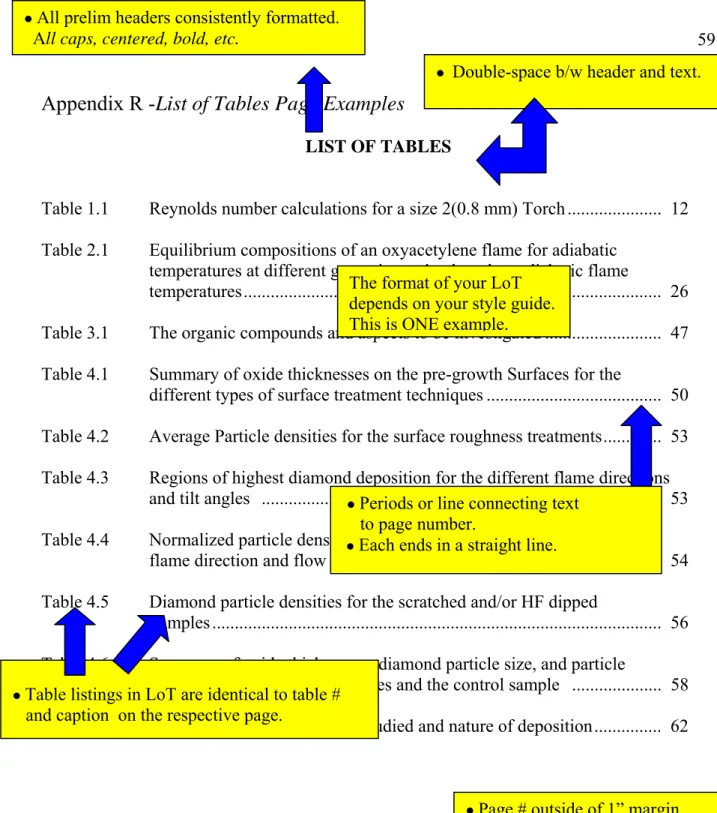
List of Tables (Required) and List of Figures (Required)...27
List of Symbols, Abbreviations or Nomenclature (Optional) ...27
Text (Required) ...27
List of References, Literature Cited or Bibliography (Required) ...28
Appendix / Appendices (Optional) ...28
APPPENDIX...29
APPENDIX A – ETD FORMATTING REQUIREMENTS CHECKLIST ...30
APPENDIX B– ETD FLOW CHART ...36
APPENDIX C – MARGIN FORMATTING REQUIREMENTS ...37
APPENDIX D– PAGE NUMBER FORMATTING REQUIREMENTS...38
APPENDIX E– CORRECT LANDSCAPE PAGE EXAMPLE FOR ETDS ...39
APPENDIX F – INCORRECT LANDSCAPE EXAMPLE FOR ETDS ...40
APPENDIX G – TABLES CONTINUED EXAMPLE ...41
APPENDIX H– FIGURES CONTINUED EXAMPLE ...42
APPENDIX I – FLOATING HEADER EXAMPLE ...43
APPENDIX J– ABSTRACT EXAMPLES ...44
APPENDIX K- COPYRIGHT PAGE EXAMPLE ...46
APPENDIX L- MASTER TITLE PAGE EXAMPLES ...47
APPENDIX M- DOCTORAL TITLE PAGE EXAMPLES ...49
APPENDIX N- DEDICATION PAGE EXAMPLES ...51
APPENDIX O- BIOGRAPHY PAGE EXAMPLES ...53
APPENDIX P- ACKNOWLEDGEMENT PAGE EXAMPLES ...55
APPENDIX Q- TABLE OF CONTENTS PAGE EXAMPLES ...57
APPENDIX R -LIST OF TABLES PAGE EXAMPLES ...59
APPENDIX S- LIST OF FIGURES PAGE EXAMPLES ...61
APPENDIX T- REFERENCES PAGE EXAMPLES ...63
INTRODUCTION
Rationale for and Relationship of the Thesis and Dissertation Requirement to Research and Publication
This guide for the preparation of electronic theses and dissertations at North Carolina State University (NCSU) is designed to assist graduate students, faculty, and staff in understanding the requirements and suggestions of the Graduate School for theses and dissertations. A written thesis is required for most Master of Art and Master of Science degrees and a written dissertation for all Doctor of Philosophy and Doctor of Education degrees at NCSU. The purpose of the thesis or dissertation is to provide an experience in scholarship which will be of enduring value to the student in understanding how new knowledge is acquired and communicated within his/her chosen field. Thus, the thesis or dissertation should provide tangible evidence of the student's development as a scholar and especially his/her capacity to discover and effectively communicate research findings. The thesis or dissertation should also enlarge the body of knowledge in the student's chosen field.
North Carolina State University is one of two Research I Universities of the sixteen
constituent institutions of the University of North Carolina. By virtue of this designation and its long-standing tradition of scholarship and research in agriculture and life sciences, design, education and psychology, engineering, natural resources, humanities and social sciences, management, physical and mathematical sciences, textiles, and veterinary medicine, a major mission of NCSU is the discovery and communication of knowledge. One significant means of achieving this important mission is the education of graduate students.
Preparing thesis or dissertation research directly for publication provides economic and educational advantages both to the student and to the department supporting the research. It is a long standing tradition in many departments at NCSU that the costs of producing a thesis are borne by the student but that the costs of producing manuscripts for publication are usually borne by the department supporting the research. In the interest of increasing their output of scholarly research, many departments are making computer, word processing, photographic, figure drafting and other manuscript preparation equipment and support services available to graduate students. The Graduate School applauds these efforts and encourages departments to develop policies and procedures for the support of research by graduate students which will (1) enhance the educational value of the thesis research
experience, (2) increase the quality and quantity of research published by the department and (3) insure that appropriate use is made of whatever resources are available within the
department for the support of scholarly research.
History of ETD at NCSU
In spring 1997, the NCSU Libraries, the Graduate School and the Information Technology division collaborated on a pilot project that allowed theses and dissertations to be submitted, approved and accessed electronically. The local effort was part of a larger project sponsored by the Southeastern Universities Research Association (SURA) and prototyped by Virginia
Polytechnic Institute and State University (Virginia Tech) to create a digital thesis and dissertation repository.
The interest in the ETD (Electronic Thesis and Dissertations) Initiative was overwhelming, and beginning fall 2002, the University required electronic submission of all theses and dissertations. Students submit their works to the Graduate School as Portable Document Format (PDF) files. Once reviewed and approved, they are transmitted to the Libraries for cataloging and then can be accessed via the Libraries’ Web server.
In 2007, the NCSU University Libraries and the The Graduate School partnered to create a new ETD Submission System to incorporate current technologies after 10 years of utilizing the original ETD Submission System. In spring 2010, the new ETD Submission System went live for summer 2010 graduates. The New ETD Submission System streamlined the submission process for students, incorporated student records for accuracy and increased the communication and archive capabilities for the university.
Benefits of ETDs
ETDs increase the availability of research to the academic community worldwide, increase the exposure to potential employers, improve student understanding of electronic publishing issues and reduce the need for library space. Technical innovations are changing the way we communicate and share information around the globe. ETDs offer a new generation of theses and dissertations that can include color diagrams, color images, hypertext links, audio, video, animations, spreadsheets, databases, simulations, and virtual reality worlds.
In addition to the multimedia aspects discussed above, the ETD will be given an address on the World Wide Web after it is publicly released so it can be accessible worldwide. In this way the ETD can answer other’s questions and inspire further research. Through the World Wide Web, people anywhere in the world can link directly to students’ ETDs or ETD collections at NC State and other universities. ETD is cost-effective for both student and university.
The student will save time and money by virtually eliminating the paper review by the advisory committees and ETD Editor as well as the high cost of printing multiple high-quality hard copies of the thesis or dissertation. By receiving them electronically, the university is allowed to fulfill its responsibilities of recording and archiving theses and
dissertations more economically. This is a key responsibility of the university, which is easier and less costly (in this time of tight budgets) to fulfill when the workflow involves electronic documents.
ETDs help in accelerating workflow within the university and library systems and make theses and dissertations more quickly available to outside audiences.
ETD Accessibility
NC State’s ETDs can be accessed via the World Wide Web. People can link directly to students’ ETDs or link to NC State’s ETD collection at
http://www.lib.ncsu.edu/guides/etds/known-ncsu.html People searching the NC State library catalog can also find a dissertation by subject and can link directly to an ETD from the search results. Commercial search engines also have access to released ETDs. The thesis or
dissertation may truly be accessible to everyone with internet access.
NC State is a member of the Networked Digital Library of Theses and Dissertations (NDLTD), which is at the forefront of the ETD movement. The ETD initiative is aimed at improving graduate education by ensuring that students learn about publication issues and about using digital libraries. At the same time, the ETD initiative is helping to develop an important digital library that ultimately will include millions of full-text or even hypermedial documents. Researchers can search and browse NC State’s ETD Collection, as well as the collections of other NDLTD members, on their Web site at http://www.ndltd.org
RESPONSIBILITY FOR PREPARATION AND EVALUATION OF
THESES AND DISSERTATIONS
Responsibilities and Evaluation
Preparing and evaluating each thesis is the joint responsibility of the graduate student, the graduate advisory committee and the Graduate School ETD Editor. Communication and interaction among all of these participants is the key to producing a thesis or dissertation of the highest possible quality. All theses and dissertations are to be written in English unless the advisory committee obtains explicit permission of the Dean of the Graduate School, certifies the competence to judge the quality of the thesis and demonstrates that a foreign language is more relevant than English for the purpose of the work.
The Graduate Student's Responsibility
The graduate student is responsible for all aspects of the preparation of the thesis or dissertation and publications based on the thesis or dissertation research, including the following:
1. preparation of manuscripts based on the thesis or dissertation research for publication in the scholarly literature of the appropriate field;
2. meeting the deadlines associated with final oral exam, ETD Review, final submission and graduation;
3. submitting the required forms and fee payments; 4. subject matter and content;
5. obtaining the necessary information for organization and approved or required format;
6. editorial, linguistic and bibliographic quality;
7. quality and accuracy of text, illustrations and duplication;
8. quality and accuracy of data, evidence and logical reasoning presented; 9. obtaining the necessary permissions for copyrighted information
The Advisory Committee's Responsibility
The chair/co-chair and, to a lesser extent, the other members of the advisory committee are responsible for the following aspects of the thesis or dissertation and the related or associated research experience:
1. approval of the subject matter and methodology of the thesis or dissertation research; 2. approval of the organization, content and format of the thesis or dissertation;
3. review of and comment on drafts of various sections of the thesis or dissertation, including (a) the quality of data and evidence, (b) logical reasoning (c) the editorial, linguistic and bibliographic quality and (d) accuracy of the information;
4. evaluation of the thesis or dissertation as a basis for certification that the student has fulfilled the requirements of the degree for which he or she is a candidate;
5. encouragement of and advice to the student and review of manuscripts based on the thesis or dissertation research for publication in the scholarly literature of his or her field.
6. Final approval for the university and cataloging. The ETD Editor's Responsibility
The Graduate School ETD Editor is responsible for the following:
1. providing counsel and advice upon request by students and members of advisory committees about the required NCSU Graduate School format aspects of thesis and dissertation preparation;
2. checking the draft file (at the ETD Review) once for each student and the final file (for Graduate School acceptance) of each thesis or dissertation to insure that it has been prepared in conformity with the requirements prescribed in this ETD Guide.
GENERAL PREPARATION AND ORGANIZATION
Although the Graduate School and the advisory committee are a part of the evaluation process, the ultimate responsibility for all aspects of thesis or dissertation preparation remains with the student. The general organization, specific subdivision of the text and the method of documentation must be determined by the student in consultation with the chair/co-chair and other members of the advisory committee. These matters should be
addressed in the early stages of the student's preparation. An early decision is especially vital concerning the style manual to be used as a model or guide in the preparation of the thesis. It may also be helpful for a student to look at other theses or dissertations that have been
prepared in the student's own program area within the last two to three years in order to gain a basic understanding of the best organization and placement of the various components.
Suggested Manuals of Style
The ETD Editor will not check the thesis to verify it is in conformity with the style guide used. The decision of what style guide to use is up to the discipline, the committee and the student. http://www.lib.ncsu.edu/guides/WritingResources/documentation.html
The following manuals of style are among those readily available to graduate students and advisory committees in the D.H. Hill Library:
MLA - Purdue Guide CBE - Bedfort / St. Martin’s Guide
MLA - Landmark Guide Chicago Manual of Style
APA - Purdue Guide Chicago - Bedford / St. Martin’s Guide APA - Landmark Guide NARA - Citing Records in the National CBE - Diana Hacker Guide Archives of the United States Students are also encouraged to utilize electronic citation management software such as RefWorks (free for NCSU Students, Staff and Faculty) and Endnote only to name two options.
GENERAL INFORMATION
Filing for a Patent
A thesis or dissertation containing disclosures of patentable discoveries may be embargoed (withheld from being viewed by anyone) by the Graduate School before microfilming and/or filing in D. H. Hill Library for a maximum period of one year after final committee approval. The embargo is granted upon the receipt of written request in the ETD Submission System to the ETD Editor, from the student, stating that a patent application is pending. This written request must be submitted before the final copy of the thesis or dissertation is accepted by the Graduate School to insure adequate review of the embargo request. The Dean of the
Graduate School is the only person that can approve a 1-year embargo. An embargo for a thesis until a patent application is filed will not prevent a student from graduating on time.
Binding of Personal Copies
Paper copies are not required no will be issued through the Graduate School or Library . Students interested in having personal copies of their thesis or dissertation hard-bound may do so at their own expense by contacting Wolf Xpress directly. Please visit the Wolf Xpress web site at http://www.fis.ncsu.edu/ncsubookstores/wolfxpress/ for thesis services.
University Graduate Student Association (UGSA) Thesis & Dissertation Funding
The UGSA helps defray the cost of creating copies of the thesis. The student must apply for a reimbursement of part of the cost of copying the thesis prior to the student’s official graduation date from NC State (while still a student at NC State). Read and fill out the following documents at the USGA Website to apply to receive reimbursement for the thesis expenses. http://ugsa.ncsu.edu/
Additional Suggestions
Students are strongly encouraged to retain a copy of the final version of the thesis or dissertation in the original format (MS Word, LaTeX, etc) for his/her own records and to protect against accidental loss or destruction of the thesis or dissertation. The University will only have the PDF file on record.
In addition, when a thesis or dissertation has been prepared using a word processor or computer, the student is strongly encouraged to make backup copies of those files and store them in several different places. I.e. thumb drive, Google docs, email, CD, etc.
The ETD Editor also recommends keeping one paper copy of the thesis or dissertation that will keep track of all corrections to the file incase the file is corrupted and the student has to start over.
COPYRIGHTING AND MICROFILMING
Copyrights
The Graduate School refers all copyright questions to the experts on campus in the Copyright and Digital Scholarship Center in the Library.
Use of Copyrighted Material
Before students submit doctoral dissertations to the Graduate School, they are advised to obtain permission from the author or publisher to quote any extensive portion from
copyrighted materials. Such permission usually is granted on the condition that appropriate acknowledgement is made. Students are responsible for any payment which may be required. Copyright Ownership and Use
Students are encouraged to become familiar with the S the Copyright and Digital Scholarship Center in D.H. Hill Library. As part of the NCSU Libraries Learning and Research Center for the Digital Age (LRCDA), the Copyright and Digital Scholarship Center supports the
university's research, teaching, and service mission by guiding both the Libraries and NC State's faculty, students, and staff in matters relating to the dissemination and use of
knowledge. We strongly encourage and support the role of the research library in the scholarly communication process, including the exercise of full rights under the fair use section of the copyright law.
The NCSU the Copyright and Digital Scholarship Center
Is staffed by an attorney and scholarly communication specialist;
Provides guidance to the library staff on fair use and other issues such as database licensing, user privacy, materials on reserve, interlibrary loan and document delivery services;
Serves as a resource to the NC State community on scholarly communication issues including copyright and fair use as they relate to library collections and services; and Provides workshops and presentations on fair use and other scholarly communication
topics.
A Copyright Tutorial, FAQs, contact information and other points of reference are available at http://www.lib.ncsu.edu/dspc/rights_retention.html
Copyrighting the Thesis or Dissertation
For general copyright information or questions relating to copyright registration view the website at http://www.copyright.gov/help/ or call (202) 707-5959. Recorded information is available twenty-four hours a day, seven days a week, and information specialists are on duty from 8:30 a.m. to 5:00 p.m., Monday through Friday except holidays.
The following information is exerted from the United States Copyright Office Website at
http://www.copyright.gov/
The use of a copyright notice is no longer required under U. S. law, although it is often beneficial. Because prior law did contain such a requirement, however, the use of notice is still relevant to the copyright status of older works. Notice was required under the 1976 Copyright Act. This requirement was eliminated when the United States adhered to the Berne Convention, effective March 1, 1989. Use of the notice may be important because it informs the public that the work is protected by
copyright, identifies the copyright owner, and shows the year of first publication. Furthermore, in the event that a work is infringed, if a proper notice of copyright appears on the published copy or copies to which a defendant in a copyright infringement suit had access, then no weight shall be given to such a defendant’s interposition of a defense based on innocent infringement in mitigation of actual or statutory damages, except as provided in section 504(c)(2) of the copyright law. Innocent infringement occurs when the infringer did not realize that the work was protected. The use of the copyright notice is the responsibility of the copyright owner and does not require advance permission from, or registration with, the Copyright Office. Form of Notice for Visually Perceptible Copies The notice for visually perceptible copies should contain all the following three elements: 1 the symbol ©
(the letter C in a circle), or the word “Copyright,” or the abbreviation “Copr.”; and 2 the year of first publication of the work. In the case of compilations or derivative works incorporating previously published material, the year date of first publication of the compilation or derivative work is sufficient. The year date may be omitted where a pictorial, graphic, or sculptural work, with accompanying textual matter, if any, is reproduced in or on greeting cards, postcards, stationery, jewelry, dolls, toys, or any useful article; and 3 The name of the owner of copyright in the work, or an abbreviation by which the name can be recognized, or a generally known alternative designation of the owner. Example: © 2008 John Doe The “C in a circle” notice is used only on “visually perceptible copies.” Certain kinds of works—for example, musical, dramatic, and literary works—may be fixed not in “copies” Copies of works published before March 1, 1989, that consist primarily of one or more works of the U. S. government should have a notice and the identifying statement.
Copyright Registration
A student desiring to register a copyright for a thesis or dissertation should deal directly with the United States Copyright Office of the Library of Congress (http://www.copyright.gov). The following information is exerted from the United States Copyright Office Website at
http://www.copyright.gov/.
In general, copyright registration is a legal formality intended to make a public record of the basic facts of a particular copyright. However, registration is not a condition of copyright protection. Even though registration is not a requirement for protection, the copyright law provides several inducements or advantages to encourage copyright owners to make registration.
Among these advantages are the following:
Registration establishes a public record of the copyright claim.
Before an infringement suit may be filed in court, registration is necessary for works of U. S. origin.
If made before or within five years of publication, registration will establish prima facie evidence in court of the validity of the copyright and of the facts stated in the certificate.
If registration is made within three months after publication of the work or prior to an infringement of the work, statutory damages and attorney’s fees will be available to the copyright owner in court actions. Otherwise, only an award of actual damages and profits is available to the copyright owner.
Registration allows the owner of the copyright to record the registration with the U. S. Customs Service for protection against the importation of infringing copies. For additional information, go to the U. S. Customs and Border Protection
website at
_trade/nafta/intellectual_prop_rights_lp.xmlClick on “Intellectual Property Rights.” Registration may be made at any time within the life of the copyright. Unlike the law before 1978, when a work has been registered in unpublished form, it is not necessary to make another registration when the work becomes published, although the copyright owner may register the published edition, if desired.
Copyright and Intellectual Property
In this rapidly changing environment for publishing, there is no uniform practice being followed by all publishers. There is a general trend toward more publishers being willing to consider articles and book manuscripts that are connected with ETDs, but differences exist between academic fields and even between journals and publishers within a single field. Also, it is important to bear in mind that the more revisions that have been made to differentiate an article from the chapter in the dissertation or a book from the whole dissertation, the more likely it is that a
publisher will be open to considering the work and will be less threatened by its prior publication as an ETD. The safest course to take is to ask publishers about their policies before the student decides whether to request a delay of the release of the ETD so that it will not hinder the ability to publish articles or books derived from the ETD. As for the rules of copyright, including what and how much the student may reproduce from other works as "fair use," the ultimate responsibility for learning the rules lies with the student, whether s/he is publishing research as an ETD, or later, in a revised form as a journal article or book. ProQuest Information and Learning formerly UMI (University Microfilms International). offers the service of checking dissertations that are submitted to it for potential copyright problems, but like all other publishers, ProQuest also asks the author to warrant that the dissertation does not infringe any copyright, or other rights (such as privacy and libel), so that the liability for any such infringement in the end resides with the author, not the
publisher. For a fee, ProQuest will also register the copyright with the U.S. Copyright Office – this would provide extra protection to an author whose work is later
infringed. The NC State Library website also offers detailed information about copyright . http://www.lib.ncsu.edu/dspc/rights_retention.html
Microfilming Doctoral Dissertations
North Carolina State University requires that all doctoral dissertations be microfilmed by ProQuest. The student is responsible for the charge assessed by ProQuest. The diploma will not be released and the statement of the award of the degree entered on the student's permanent record will not be made until the required arrangements for microfilming the dissertation have been completed. Abstracts of the thesis are published in Dissertation Abstracts International, a bimonthly journal. Reproductions of a dissertation, either in whole or in part, may be purchased from ProQuest Information and Learning, 300 North Zeeb
Road, Ann Arbor, Michigan, 48106. Publication in this form does not preclude publication in other outlets.
For doctoral dissertations, ProQuest Information and Learning requires the students to certify that any extensive use of copyrighted material in the manuscript has the written permission of the copyright owner. The purpose of this requirement is to "save and hold harmless"
ProQuest Information and Learning from damages that may arise from any copyright violations.
DEADLINES
Students are responsible to be aware of all deadlines, procedures and requirements. All Graduate School deadlines are listed on the Graduate School Website, Academic Calendar for all Graduate Students. There are no exceptions to Graduate School Deadlines.
ETD Deadlines
Every Master Thesis and Doctoral student has 3 ETD deadlines to meet:
THREE (3) ETD DEADLINES:
(1) ETD Review Deadline (A choice of 2 review deadlines to pick from; 1. No Registration Required or 2. Registration Required; See below.)
(2) Final Error Free ETD Deadline (For both No Registration Required and Registration Required)
(3) Final Committee Approval Deadline (For both No Registration Required and Registration Required)
CHOICE OF TWO (2) THESIS REVIEW DEADLINES:
There are 2 ETD Review Deadlines to choose from. The student is to choose ONE ETD Review
Deadline for the ETD review.
(1) No Registration Required ETD Deadline (2) Registration Required ETD Deadline
Deadline Definitions
NO REGISTRATION REQUIRED ETD REVIEW DEADLINE: Date by which a thesis
or dissertation student must unconditionally pass the final exam and have an ETD Review in order to avoid registering for the semester s/he is graduating in. Students meeting this
deadline will not be allowed to register in the same academic program for any subsequent semester. The final ETD file is due to the ETD Editor by the Final ETD Editorial Approval Deadline and committee approval must be completed by the Final ETD Committee Approval Deadline.
REGISTRATION REQUIRED ETD REVIEW DEADLINE: Date by which a thesis or
dissertation student must unconditionally pass the final exam and have an ETD Review while being registered for the semester s/he is graduating in. Students meeting this deadline will not be allowed to register in the same academic program for any subsequent semester. The final file is due to the ETD Editor by the Final ETD Editorial Approval Deadline and committee approval must be completed by the Final ETD Committee Approval deadline.
APPLY TO GRADUATE DEADLINE: Date by which all graduate students must apply to
graduate in a given semester. A student must apply to graduate in order to participate in the graduation exercises, have their transcript posted, and receive a diploma. Thesis and dissertation students must have also completed an ETD Review by this deadline; however, their graduation will still be contingent upon approval of the final ETD by the ETD Editor and Committee Approval by the respective deadlines.
Students may apply to graduate in MyPack Portal. Students are advised to apply to graduate when the defense is scheduled, but application can be submitted at any time up until 5:00 p.m. on the Apply to Graduate deadline.
FINAL ERROR FREE DEADLINE (FOR BOTH REGISTRATION REQUIRED and
NO REGISTRATION REQUIRED FINAL ETDS): Date by which a thesis or dissertation student must submit the final error free ETD to the ETD Editor in order to graduate at the end of the semester. Graduation will still be contingent upon approval of the final ETD by the student’s advisory committee before the expiration of the Final ETD Committee Approval Deadline.
FINAL COMMITTEE APPROVAL DEADLINE: Date by which a thesis or dissertation
student must submit and have the final ETD approved by the ETD Editor and all members of their advisory committee in order to graduate at the end of the semester.
GRADUATION DATE: The date degrees are conferred. For fall and spring graduations,
this is also the date of the graduation exercises (there are no summer exercises -- summer grads may participate in the fall ceremony).
All deadlines are on the Graduate School Calendar and the ETD Deadline link.
ETD WORKSHOPS
Two types of ETD Workshops are provided for students, faculty, and staff. 1. Asynchronous electronic online video workshops and 2. In-person workshops. The online videos are available 24-7-365 and in-person is held approximately once a month except during graduation months.
ETD Workshops are conducted by the Graduate School ETD Editor. The workshop is designed to review the information on the ETD Website for clarification. Prior to the
workshop the student should have read the ETD Guide and all information on the ETD Website and come to the workshop with questions prepared.
Workshop Objectives
By the end of the workshop, the student will be able to: (1) Find the resources on the ETD Website (2) Pinpoint your deadlines for graduation (3) Complete the ETD Submission Steps
(4) Format the file in the Graduate School Required Format
(5) Submit the draft file for the ETD Review and submit the final error free file for Graduate School Acceptance
WHEN TO BEGIN THE ETD PROCESS
Master students should begin the ETD process no later than the end of the first year. Doctoral students should begin the ETD process no later then when the prelim exam is passed.
STEP-BY-STEP SUBMISSION PROCESS
The ETD (Electronic Thesis and Dissertation) is similar to its paper predecessor, however, rather than printing a hard copy for submission to the Graduate School, the thesis or
dissertation is printed to a Portable Document Format (PDF) file for electronic submission to
the Graduate School. The submission is done electronically through the ETD Submission System. PDF files are suitable for machine archives and can be viewed on the World Wide
Web (WWW).
STEP 1: READ… THE ETD GUIDE & ALL INFORMATION ON THE ETD WEBSITE Read the requirements and policies in the Thesis and Dissertation Guide AND review all information on the ETD website. Review Graduate School specific deadline dates on the
Graduate School Calendar and Deadline link on the ETD Website. STEP 2: “ATTEND”…AN ETD WORKSHOP
Attend a Thesis & Dissertation / ETD Workshop either the asynchronous online videos or in-person. ETD Workshop dates, registration and directions can be found on the main ETD webpage at etd.ncsu.edu under the Workshop Registration link.
STEP 3: WRITE… THE THESIS OR DISSERTATION (ETD)
Write the thesis or dissertation beginning in the Graduate School required format. View
examples of all Graduate School required and optional sections in the Thesis and Dissertation Guide. **DO NOT follow another student’s work—Use only the current templates and examples from the ETD Website for all Graduate School Required Formatting**
A list of editors for hire is located on the ETD FAQ. The List of Editors for Hire is a list of faculty and graduate students at NC State University, as well as several professionals, who have expressed interest in proofreading for a fee. The Graduate School does NOT supervise, manage, recommend, or approve these services; we simply provide this list as a courtesy. All arrangements are made between the student and the hired editor. Please remember that it is your responsibility to abide by the student code of conduct at all times. Be sure to inquire about their rates when you contact them.
STEP 4: SCHEDULE…THE FINAL ORAL EXAMINATION (DEFENSE)
Register for the appropriate credits in the semester that the student takes the final oral
examination. Schedule the final oral exam. The exam is to be scheduled in conjunction with the advisory committee and the Graduate Services Coordinator. The exam is to be scheduled no less than 2 weeks before the exam date.
The student is to provide each committee member with a full copy of the thesis/dissertation that they are defending, at least two weeks in advance of the scheduled final oral exam date. This gives the committee members time to review the document and prepare for the final oral exam. The entire document begins with the abstract and ends with either the references or appendix—it includes ALL Graduate School required parts. The file that the student is defending is to be the same file that should be sent for the ETD Review --unless the student receives a conditional pass on the defense. Thus, it is routine to fulfill the 24-hour clock requirement.
STEP 5: DEFEND… THE FINAL ORAL EXAM
Take the final oral examination /defense. The committee will complete the exam report determining the final outcome of the final oral exam.
No original signed title page is required by the Graduate School. The student may have as many title pages signed as s/he wishes for personal keepsakes. Many students prefer to include original signed title pages in their bound copies. The Graduate School is 100% electronic and does not designate the type of paper that the title page is printed on. The student should ask the committee if there is a paper preference.
The Exam Report
At the conclusion of the final oral examination, the advisory committee members designate an outcome of the defense (unconditional pass, conditional pass, or fail) and they all will sign the Exam Report. An unconditional pass is required to begin the ETD Review process. The committee chair will return the completed report to the Graduate Services Coordinator. The Graduate Services Coordinator will submit the exam report to the Graduate School within 5 business days of the final oral exam.
Conditional Pass
If a conditional pass is received at the final oral examination, the ETD Review cannot take place until (1.) the conditions have been met (the final oral exam is now evaluated as an unconditional pass). (2.) the Graduate School College Liaison is notified in writing via email of the date the conditions were met. The 24-hour clock does not begin until the student has met the conditions and has an unconditional pass.
24 Hour Clock
The ETD Review is a format review. As such, it should be held within 24-hours (but before the deadline) of unconditionally passing the defense. The 24-hours is the same day or the immediate day after –this includes weekends. Content changes may continue until approval of the final error free file.
If a student receives a conditional pass on the defense, the 24 hour clock will not start until the student has met all conditions.
Reminder- The file that the student defended should be the same file sent for the ETD Review-- unless the student receives a conditional pass on the defense.
Students will not be able to proceed to Step 6 until s/he has an unconditional pass on the defense.
STEP 6: SUBMIT DRAFT ETD IN ETD SYSTEM... FOR ETD REVIEW
The ETD Editor reviews the ETD once for each student. Thus, each student is to submit a PDF ETD file to the ETD Editor two times only. The first ETD submission is for the ETD Review and the second ETD submission is to have the final error free file accepted by the Graduate School.
Reminder- The file that the student defended should be the same file sent for the ETD Review-- unless the student receives a conditional pass on the defense.
Be sure to complete the ETD Formatting Requirements Checklist (Appendix A) before the student converts the files to PDF for the ETD Review.
All ETD file submissions for the ETD Review are only accepted via the ETD Submission System. Emailed files are not accepted and can not be reviewed.
*Important* Files are always considered to be a draft until the student submits the final error free file via the Final Submission link in the ETD System.
The advisory committee checks the content, the ETD Editor checks Graduate School required format.
Within 24-hours (but before the deadline) of unconditionally passing the final oral exam, the student must submit the required pdf draft file via the ETD Submission System for the ETD
Review. No emailed files are accepted. All ETD Review submissions should be within
24-hours of the student unconditionally passing the defense (or met conditions). 24-24-hours is Monday through Sunday, 7-days a week—including weekends.
The ETD Review file requirement is:
PDF file draft.pdf Draft thesis/dissertation with all required Graduate School parts and in Graduate School required format Embargo (Withholding)
At the time of draft submission, the student will need to determine the availability of the ETD. All ETD files are to be immediately released unless there is a patent pending or a documented publication issue from the publication company. If an embargo (withholding) is needed, the student is to submit the embargo request via the ETD Submission System link with the explanation for the embargo. If there is a publication issue, the student is to provide documentation from the publishing company (stating that the file should not be released at this time) accompanying the embargo request. Once the ETD Editor receives all embargo request information, she will present the embargo request to the Dean of the Graduate School for a decision. Embargos are not for copyright registrations.
If an embargo is approved, the ETD will not appear on the web or in any search until the day the ETD Editor releases the embargo. The student is able to change the date of release up until the point of final submission. The embargo date will be either 3 months or 1 year from the final committee approval.
The current release options are:
1. immediate release to the World Wide Web
2. three-month embargo for patent or propriety issues 3. or a one-year embargo for patent or propriety issues
NOTE: Once an ETD is ACCEPTED it cannot be altered or recalled. This includes Embargoed/Withheld files.
Early Embargo Release
If the student selects an embargo and wishes to release the ETD prior to the embargo date expiring, an email from the student must be submitted to the ETD Editor requesting that the ETD be released early.
Embargo Extension
Embargo extensions are not common. If an embargo extension is needed, the student must email the ETD Editor a minimum of 2 weeks PRIOR to the ETD being released from the embargo. The extension request email must state: (1.) the reason that the ETD needs to be extended and (2.) the new proposed embargo date. The Dean of the Graduate School will review the information with the committee chair to make a decision. Embargos past 1-year are not common.
STEP 7: ETD REVIEW CONDUCTED BY ETD EDITOR
Each student will have the opportunity to have one ETD Review. The student will submit a total of 2 ETD Files in total into the ETD Submission System. The first ETD submission is the draft file for the ETD Review. The second ETD submission is the final error free file to be accepted by the Graduate School with all ETD Review corrections made.
The ETD Review is defined as “The date that the ETD Editor receives the complete draft file submitted in the ETD Submission System.” An ETD Review is NOT the date the ETD Editor reviews the file. The ETD Editor will send required corrections and information within 3-5 business days from draft submission, but the turnaround may take longer during deadline times.
The ETD Editor will electronically review each student’s draft file once. The ETD Editor will then electronically send corrections on the PDF draft file with a review checklist. The review checklist is a list of steps required from the review until graduation. ETD system date and time stamps all submissions so an accurate record of the ETD submission is recorded. STEP 8: MAKE CORRECTIONS TO ETD
The student will make any and all the corrections to the ETD. If any ETD Review corrections were not made and must be changed before it can be approved, the Graduate School ETD Editor will send the student and committee chair a notice via the ETD system, in the form of a brief message. Notices are posted in the ETD System and an acknowledgement of a new notice is delivered as e-mail messages to the student’s NCSU email address.
NOTE: ONCE AN ETD IS ACCEPTED, THERE CAN BE NO FURTHER CHANGES TO IT. (**Note- Accepted includes released and/ or embargoed) ONCE AN ETD IS
RELEASED, WE ARE UNABLE TO RECALL IT, ALTER IT, OR REPLACE IT.
FOR DOCTORAL CANDIDATES ONLY, before the ETD Editor can review and accept the
final ETD, the required forms and microfilm fee payment must be received. Information and forms are located on the ETD Website through the DOCTORAL REQUIRED FORMS link. All forms are electronic and may be submitted to the ETD Editor via email (scan then email). STEP 9: SUBMIT FINAL ETD FILE TO ETD EDITOR
Once the student has made all of the committee required changes, ETD Review corrections, hired editor corrections, etc, the student will submit the final file (etd.pdf). The final file can only be named etd.pdf in all lower-case letters.
When the ETD Editor receives the final file, she will only review the final ETD to make sure ETD Review corrections have been made. The ETD Editor does not re-review the ETD--the ETD Editor will only verify that all ETD Review corrections have been made. If all ETD Review corrections have been made, the ETD Editor will accept the final error free file and the file advances for Committee Approval.
If all ETD Review corrections have not been made, and/or if the ETD Editor sees new errors while checking the ETD Review corrections, the ETD Editor will add a notice in the ETD System. The student will then make the new correction(s), submit another final file for Graduate School acceptance.
STEP 10: COMMITTEE FINAL APPROVAL
Once the ETD Editor has approved the final ETD file, it advances to the ETD Committee for final approval. The entire ETD Committee will review the ETD. Once they accept the final file, it will be sent to the NCSU Library for cataloging.
If any of the committee members deny the final approval of the ETD, they will deny it in the Plan of Work in MyPack Portal with comments in regards to the denial. Communication will be required between the student and the committee. The student will make any corrections required, submit an updated ETD in the ETD System and then notify the committee via the Plan of Work that the updated ETD has been submitted. The committee will review the final file at this time. (Committees denying a final ETD is not common).
Upon acceptance of the thesis or dissertation by the Advisory Committee, the student will receive an automatic e-mail from the ETD System that the final ETD has been approved. The URL for the ETD will be noted on this email unless the ETD is embargoed because of
pending patents. The thesis or dissertation will be on the library server and in the online catalog within 48 hours.
STEP 11: GRADUATE!
As long as all transcripts, plans of work, grades, ETD Editor Final Approval and Committee Approval, etc., have been received, the student will be cleared for graduation by the student’s Graduate School College Liaison. If the student finishes all steps including acceptance of the final thesis by the committee, the respective liaison may issue the student a letter of
completion stating that the student has fulfilled all degree requirements. The request must come from the student in writing. The student may email the request to the liaison (the liaison's email address is provided on the review checklist) and it takes 48 hours for the letter to be prepared.
Jennifer Crumb COE [email protected],
Peggy Olive CALS, COT, CVM, CNR [email protected]
Dare Cook CED, COM [email protected]
Dorothy Thompson COD, CHASS, PAMS [email protected] BOUND COPIES
There will be no paper copies of a thesis/dissertation issued by the Graduate School. It is the student’s responsibility to determine if the committee and the department require a paper copy and to provide it. If bound copies are needed Wolf Xpress can produce them. Contact Wolf Xpress at 515-2131.
ETD PROCESS FLOW CHART
The ETD Flow Chart is provided to give a visual overview of the ETD Process from beginning to graduation.
ETD Flow Chart – Appendix B
DOCTORAL CANDIDATE REQUIRED FORMS AND FEE
The ETD Editor cannot accept the final error free ETD until each doctoral graduate student submits the required forms and fee. The forms and fee are submitted in order to fulfill graduation requirements. The Graduate School cannot authorize the release of the diploma or the inclusion of the statement of the award of a degree on the permanent record from which transcripts are made until these form and fee have been received. The required forms and fee are on the ETD Website under the Doctoral Required Forms link.
1. Survey of Earned Doctorate (SED) *PhD only* 2. Doctoral Dissertation Agreement Forms *2 pages* 3. Microfilm Fee
4. Doctoral Graduation Attendance Notification (DGAN) 5. Application to Graduate
All of the forms and fee are available online and submitted electronically to the ETD Editor via email.
PRODUCTION REQUIREMENTS
Paper Size
The standard 8 ½ x 11 size paper is to be used because it is suitable for binding and printing. Margins
Top, bottom and right margins on each page must be 1.0 inch wide. The left margin on each page must be 1.25 inches wide.
All tables, figures, and copies of reprints or manuscripts included in the thesis or dissertation must conform to these margin requirements; the margin requirements also pertain to any appendices. Figures and tables may be rotated landscape and/or shrunk to fit within the required margins. The viewer will be able to enlarge the screen view when viewing the ETD in Adobe Acrobat. Thus, shrinking tables and figures to fit within the margins is encouraged. Photographic reduction may be necessary for oversized tables, figures or reprints; or a smaller sized font may be used. Either a "justified" or a "ragged-right" type margin is acceptable, but the type of the margin must be consistent throughout the thesis or dissertation.
The student is strongly encouraged to set the correct margins beginning with the very first draft of the thesis or dissertation in order to avoid difficulties in reformatting at a later date.
Margins Example – Appendix C
Page Numbering
Pages may be numbered in one of these four locations only: (1) upper right hand corner – outside of the one-inch margin from the top and outside of the one-inch margin from the right edge, (2) lower right hand corner – outside of the one-inch margin from the bottom and outside the one-inch margin from the right edge, (3) top center – outside the one-inch margin from the top, and (4) bottom center- outside the one-inch margin from the bottom.
Lower-case Roman numerals are used for numbering the various preliminary pages beginning with the title page, which is understood to be "i" but remains unnumbered. The page directly following the title page will bear the lower-case Roman numeral "ii." This will either be the optional Dedication or required Biography. Roman numerals are used for the Dedication, Biography, Acknowledgments, Table of Contents, List of Tables, List of Figures, List of Symbols, List of Nomenclature, and List of Abbreviations (other lists as included).
Arabic numerals begin with the first page of the main body of the thesis or dissertation, which is understood to be "1" although traditionally no number appears on that page. Every page in the main body of the thesis or dissertation carries a page number, and the numbering is consecutive throughout the thesis or dissertation to the end, including any appendices. There is to be no punctuation with the numbers.
Wherever the page numbers are located, they must be consistent in location, whether they are Roman numerals or Arabic. There must be at least 2 double-spaces in-between the page number and the text on the page so the page number does not appear to be part of the text. When the page numbering occurs at the top of the paper, the text, headings and so forth begin two double spaces (four lines) beneath the page number. When the page numbering occurs
at the bottom of the paper, the text stops at least two double spaces (four lines) above the
page number. Use the provided templates or the ETD FAQ to format the page #s to meet both requirements.
Page Numbers Example – Appendix D
Landscape Pages
For any pages that have landscape text/tables/figures, the student must physically rotate the page to landscape orientation. When the page is rotated, the page number should
automatically rotate to the new location. If the page number does not automatically rotate, the student will need to manually rotate the page number location. Step-by-step instructions are on the ETD Frequently Asked Questions (FAQ) on the ETD website. This includes how to manually rotate the page and to manually rotate the page number.
CORRECT ETD Landscape page Example for ETD Submission – Appendix E INCORRECT ETD Landscape page Example (OK for paper binding) – Appendix F
Spacing
Text spacing is to be consistent for the entire document. The text should be either double-spaced or space-and-a-half. Certain sections, however, may be single-double-spaced-depending on style guide, including
long quotations;
table and figure captions, descriptions and footnotes;
list of references, literature cited, bibliography, etc. While these reference lists may be single-spaced, a double space should be added between each reference;
Font or Type Face
Use one size and type consistently. Changes in font style or type face are not permitted except for inclusion of illustrative or documentary materials such as computer printouts. Usually size 10 or 12 is acceptable but the student can use smaller type for tables, figures, and items included in appendices if necessary to fit margins. The student may also use larger type for headers, title page, etc.
For each preliminary page header, each header must be identical in font size, type face, location, bold, all caps, amount of space in-between the page header and first line of text, etc. Pick one style and make all of the preliminary page headers consistent.
Including Published Work
If a chapter has already been published, the student does not have to reformat the chapter. The student may have chapters that have been formatted in different ways—perhaps they were published in different journals. For instance, one chapter may be in columns and others not, etc.
However, for published chapters, the work still has 2 requirements: 1) shrink the pages to fit in our required margins (if needed)
2) add the appropriate page numbers (sequence and location). the old page numbers do not need to be deleted --just add new numbers for consistency)
Each reprint or manuscript should include the following information: 1) the chapter number (if applicable);
2) the title and authorship of the reprint or manuscript;
3) the name of the journal or book in which the reprint appeared or to which the manuscript has been published.
Tables and Figures
Many theses and dissertations include tables and figures either in the text and/or in the appendices or both. Since the specific purposes and organization of tables and figures may vary widely among the various disciplines, the student should consult the style manual recommended by the advisory committee or the scholarly journals and books in his/her field for guidance in design and organization.
Numbering
Each table and each figure must bear an identifying number. Tables and figures are
numbered in separate series. Each table and figure, including any in appendices, must bear a
number in its own series. When the decimal system is used, each series may be numbered consecutively within each section or chapter of the thesis. Each table and figure must bear a caption, which may consist of a descriptive title or a descriptive title plus explanatory notes. These captions may be single-spaced.
Placement of Tables and Figures
The placement of tables and figures in a thesis or dissertation may be handled in one of the following ways: each table or figure may be inserted in the text as near as practical following the first reference to it in the text; tables and figures may be grouped at the end of each chapter or manuscript; tables and figures may be grouped at the end of the thesis or dissertation.
Tables and figures may appear on the same page with the text, separated from the text, above and below, by triple spacing or together on the same page. Two or more tables and/or figures may be grouped together on a single page, provided that they fall within the required
margins.
Tables Continued
The term "Table" is used to designate tabulated data; this includes computer printout sheets. The number and caption for each table must be placed above the top line of the table. If any table continues to a following page, the line above the table as it continues on the subsequent page should read "Table 16 (continued)" without repeating the caption.
Tables Continued Example – Appendix G
Figures Continued
The term "Figure" is used to designate photographs, half-tone prints, charts, maps, graphs, plates, drawings, diagrams and other mainly nonverbal material. The number and caption for each figure must be placed below the figure. If the caption is too long to be placed below the figure, or the figure spans more than one page, it must be formatted as a figure continued. For a figure continued, the figure caption is centered on its own page, preceding the figure and the figure continues with no additional text added.
Floating Headers
A floating header occurs when a new section begins at the bottom of the page. To correct this error, there are two corrections options: bump the header to the next page or bring at least two lines of text up beneath the header.
FloatingHeader Example– Appendix I
REQUIRED AND OPTIONAL SECTIONS OF A THESIS OR
DISSERTATION
Order of Thesis / Dissertation
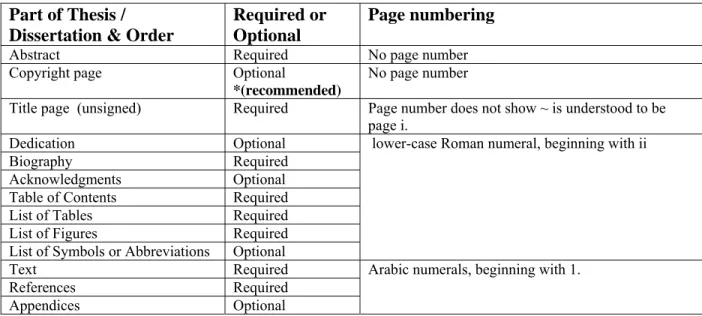
Generally, a thesis or dissertation consists of four major parts: the abstract, the preliminaries, the text and the reference materials. Some theses and dissertations also include appendices. Table 1 contains a list of all of the required and optional sections and the order of placement within the body of the thesis or dissertation.
Table 1. Thesis/Dissertation Required & Optional Sections and Required Order
Part of Thesis / Dissertation & Order
Required or Optional
Page numbering
Abstract Required No page number
Copyright page Optional
*(recommended)
No page number
Title page (unsigned) Required Page number does not show ~ is understood to be
page i.
Dedication Optional lower-case Roman numeral, beginning with ii
Biography Required Acknowledgments Optional
Table of Contents Required
List of Tables Required
List of Figures Required
List of Symbols or Abbreviations Optional
Text Required Arabic numerals, beginning with 1.
References Required Appendices Optional
The parts to be included in any given thesis or dissertation should be determined by the style guide and mutual agreement between the student and his/her advisory committee. Each required and optional sections of the thesis or dissertation are described briefly below.
Abstract (Required)
The abstract's purpose is to present the most important findings and methods of the thesis or dissertation research, thus providing a basis for readers to determine their interest in reading the full text. For these reasons it is important that the abstract be as explicit as possible about major findings and methods used. The abstract is the first page of a thesis or dissertation and is limited to 600 words maximum.
The abstract is to be formatted EXACTLY as shown on the Abstract example in the
appendix. NOTE ~ The name of the author must be typed as it appears on the student record in the Office of Registration and Records. Contact Registration and Records if a name change needs to be made.
Abstract Example– Appendix J
Copyright Page (Optional)
The following information is found on the United States Copyright Office Website at U.S. Copyright Office. The use of a copyright notice is no longer required under U. S. law, although it is often beneficial. Use of the notice may be important because it informs the public that the work is protected by copyright, identifies the copyright owner, and shows the year of first publication. Furthermore, in the event that a work is infringed, if a proper notice of copyright appears on the published copy or copies to which a defendant in a copyright infringement suit had access, then no weight shall be given to such a defendant’s
interposition of a defense based on innocent infringement in mitigation of actual or statutory damages, except as provided in section 504(c)(2) of the copyright law.
If a thesis or dissertation is to be copyrighted, the student should include in each copy, preceding the title page, an unnumbered page bearing (1) the symbol " © " or the word "Copyright" or the abbreviation "Copr.;" (2) the year of first publication; and (3) the full name of the owner of the copyright. An example would be " 2010 Erica Braman Cutchins." A copyright registration is effective on the date that the required application, fee and one complete copy of the entire work for which registration is being made are received in the U. S. Copyright Office.
Example Copyright Page - Appendix K
Title Page (Required)
In choosing a title, the author should try to include key words that accurately identify the unique or special aspects of the study and that distinguish it from other work; therefore, the use of such expressions as "A Study of" should be avoided. Clear titling is especially
the thesis or dissertation does not have to match the title submitted on the student's Plan of Graduate Work.
***Note Thesis is for Master and Dissertation is for Doctoral*** There are separate title pages for Master and Doctoral Students.
The title page is to be formatted EXACTLY as shown on title page example in the appendix. It is highly recommended that students use the template. The title page is the second page of a thesis or dissertation. There is no page number on the title page. The title page is
understood to be page i, but it does not show. The title on the abstract matches the title on the title page exactly. However, there is no period after the title on the title page.
The title page in the actual ETD file must not have signatures. The final error free file will not contain any signatures as the Microfilming Company and The Graduate School no longer permit signatures to be posted on the World Wide Web. The student may wish to have title pages signed at the defense to insert original signed title pages into bound copies
The individual members of the advisory committee must be indicated by the typed names beneath the individual signature lines on the title page. The committee chair or and/or co-chairs should be identified by adding "Chair of Advisory Committee" or "Co-chair of Advisory Committee" beneath the name under the signature line(s). The order of the
committee names is not designated by the Graduate School. The student is to check with the committee member to determine name order and name spelling.
Master Title Page Example– Appendix L Doctoral Title Page Example– Appendix M
Dedication (Optional), Biography (Required) AND Acknowledgements (Optional)
These sections are personal to the student and may contain any appropriate information which the student may wish to share with the reader. There are no length requirements or limitations. All information in these sections will not be able to be edited, removed, blacked out; etc after the final file is accepted by the Graduate School. Be positive that the
information listed is OK to share with the world. These sections may include pictures, quotes, poems, etc. and the student can be as creative as they wish to be.
Dedication (Optional)
The dedication is to be formatted EXACTLY as shown on the dedication example in the appendix. Use the template provided on the ETD Website. The Dedication thanks one person or a small group of people that had the greatest influence on the completion of this work. It is the person or persons the thesis/dissertation is dedicated to. If included, it will be the first page in the document with a page number. The page number will be lower-case Roman
numeral ii. The dedication is the only place where there can be foreign language. If there is foreign language, there must be an English translation located on the page.
Dedication Example– Appendix N
Biography (Required)
The biography is to be formatted EXACTLY as shown on the biography example in the appendix. Use the template provided on the ETD Website. The biography should contain appropriate professional, academic and personal information about the student. Please note that this information is readily available around the globe via the World Wide Web. Be cautious with the decision of what personal information to include. If the ETD does not contain a dedication, the biography will be the first page with a page number. Otherwise the biography has a lower-case Roman numeral page number following the page number preceding it.
Biography Example– Appendix O
Acknowledgements (Optional)
The acknowledgments are to be formatted EXACTLY as shown on the acknowledgments example in the appendix. Use the template provided on the ETD Website. The
Acknowledgements is where the student thanks everyone and anyone that had an influence on the completion of the graduate degree. It is also where grant funding is listed.
Acknowledgments have a lower-case Roman numeral page number following the page number preceding it.
Acknowledgements Example– Appendix P Table of Contents (Required)
The Table of Contents is to be formatted EXACTLY as shown on the Table of Contents example in the appendix with the exception of style guide organization. The style guide used will determine the organization of headings and the levels of headings provided. The Table of Contents is a topic outline of the thesis. It will list everything that appears after the Table of Contents. The Table of Contents does not list itself or anything that precedes it. The first entries will normally be the List of Tables and/or the List of Figures. All of the headings and subheadings are listed exactly as they appear in the body of the thesis. The Table of Contents is part of the preliminary section and the page number will be lower-case Roman numerals following the page number preceding it. It will include a bibliography or references and the appendices if they are included in the work.