Accreditation Results for Univer
sities’
Under
graduate Colleges
Second-cycle accreditations of four unive
rsities’
under
gradu
ate co
lleg
es were conduc
ted in 2002. Out of a m
axim
um possible scor
e of
500,
the highest score was 427.90 and the lowest
416.30. All evaluated univers
ities exceeded the m
inimum
required score of 350 and r
eceived
an accreditation valid for six years.
T
able 1a: Overall Resu
lts
Universit
ies
Evaluated
Universit
ies
Accr
edited
Remarks
Ch onb uk Nation al Un iv ersity Ch onn am Nati on al Un iv ersity C hu ngnam Nat ional Uni versi ty Pu san Nation al Un iv ersity Ch onb uk Nation al Un iv ersity Ch onn am Nati on al Un iv ersity C hu ngnam Nat ional Uni versi ty Pu san Nation al Un iv ersity All un iv ersities m et stan da rd s for accreditation in key eval uation indicies.Universities are recognized as “
good” if their evaluation scores
in specific categories m
eet or
exceed 90% of the total possibl
e po
ints.
T
able 1b: Results by C
ategory
Category Good
Ar
eas
Evaluated
Comprehensive University
Accreditation System
Accreditation Results, 2002
Ko
rea
n Co
unc
il fo
r Un
iversity Education
Center for University
Accreditat
(share of total ev aluation scor e in parenth eses)
(
≥
90%
)
Administra
tion / Finan
ces
(60) No ne y Adm ini st rat iv e st rat egi es a nd m anagem ent y In stitu tion al specializatio n y Fi nance s y Utilization of first-cycle accre ditation resultsGr
ow
th S
trategy / M
iss
ion
(50) Ch onb uk Nation al Un iv ersity Ch onn am Nati on al Un iv ersity C hu ngnam Nat ional Uni versi ty Pu san Nation al Un iv ersity y Lo ng -t erm goa ls an d st rat egi es y G ro w th strategy y Im pl em ent ati on pr og ramT
eaching & Curricula /
Community
Service
(120) No ne y Edu catio na l obj ectiv es y Curricula a nd teaching m ethods y Academ ic administration y Co mm un ity se rv iceResear
ch
Activ
ity /
Business-Educational Cooperation
(100) No ne y Research pe rform ance y Research environm ent y B usi ness -e duc at ional c oo pera tionSt
udent Ev
aluations /
Faculty-S
ta
ff Develop
m
ent
(90) No ne y St ude nt e val ua tions y Facu lty d ev elop m en t y St af f de vel opm entAcademic Support
Facilities & Pr
ograms
(80) No ne y St ude nt s upp or t pr og ram s y Edu catio na l sup por t pr ogr am s y Resear ch suppo rt p rog ra m s y In fo rm ational sup po rt pr og ra m sAccreditation Results for Universities’
Graduate Schools
Second-cycle accreditations of f
our universities’
graduate schools were conducte
d in 2002. Out of a m
axi
mum
possible score of 3
3
highest score was 250.50 and the
lowest 235.3. All evaluated univers
ities exceeded the m
ini
m
um
re
quired score of 210 and receiv
ed an
accred
itatio
n valid for s
ix years.
T
able 2a: Overall Resu
lts
Universities
Evaluated
Universities
Accr
edited
Remarks
Ch onb uk Nation al Un iv ersity Ch onn am Nati on al Un iv ersity C hu ngnam Nat ional Uni versi ty Pu san Nation al Un iv ersity Ch onb uk Nation al Un iv ersity Ch onn am Nati on al Un iv ersity C hu ngnam Nat ional Uni versi ty Pu san Nation al Un iv ersity All un iv ersities m et stan da rd s for accreditation in key eval uation indicies.Universities are recognized as “goo
d” if their graduate school ev
aluation scores in specific categor
ies m
eet or exceed 90% of t
he
tota
l
possible points.
T
able 2b: Results by C
ategory
Category
(share of total ev aluation scor e in parenth eses)Good
(
≥
90%
)
Ar
eas Evaluated
Gr
ow
th S
trategy / M
iss
ion
(35) No ne y Lo ng -t erm goa ls an d st rat egi es y Ad m in istrativ e strateg ies and im pl em en tatio n resu lts y In stitu tion al specializatio n y Fi nance s y Utilization of first-cycle accre ditation resultsT
eaching & Curricula
(60) No ne y Edu catio na l obj ectiv es y Curricula a nd teaching m ethods
Academic Administration
/
Disserta
tio
n Guidance
(55) No ne y Adm issions y Academ ic administration y R esearch in vol vem ent & di ss ert at ion gu id an ceRese ar ch Ac tivit y (60) No ne y Research pe rform ance y U se o f re se ar ch f und ing
St
udent Ev
aluations /
Faculty-S
ta
ff Develop
m
ent
(45) No ne y St ude nt e val ua tions y Facu lty d ev elop m en t y St af f de vel opm entAcademic S
u
pport
Facilities & Pr
ograms
(45) No ne y St ude nt s upp or t pr og ram s y Edu catio na l sup por t pr ogr am s y Resear ch suppo rt p rog ra m s y In fo rm ational sup po rt pr og ra m sAccreditation Results for Newly Established Universities
Accreditations of six ne
wly established
universities (two general, one industrial,
and three religious)
were conducted in 2002.
Out of a
m
axi
m
um possible score of 300, the highest score was 272.4 and the
lowest 21
1.5. All evaluated uni
versities exceeded the m
inimu
required sco
re of 210 and received an
accred
itation valid for six years.
T
able 1a: Overall Resu
lts
Universit
ies
Evaluated
Universit
ies
Accr
edited
Far East Un iv ersity Korea Po lytech ni c Un iv ersity Lu th er Un iv ersity Seou l Christian Un iv ersity Seou l Jan gs in Un iv ersity Ta m na Un iv ersity Far East Un iv ersity Korea Po lytech ni c Un iv ersity Lu th er Un iv ersity Seou l Christian Un iv ersity Seou l Jan gs in Un iv ersity Ta m na Un iv ersityNewly established universities are recognized
as “good” if their evaluation scores in
specific categories m
eet or exceed 90% of
the total
T
able 1b: Results by C
ategory
Category
(share of total ev aluation scor e in parenth eses)Good
(
≥
90%
)
Ar
eas Evaluated
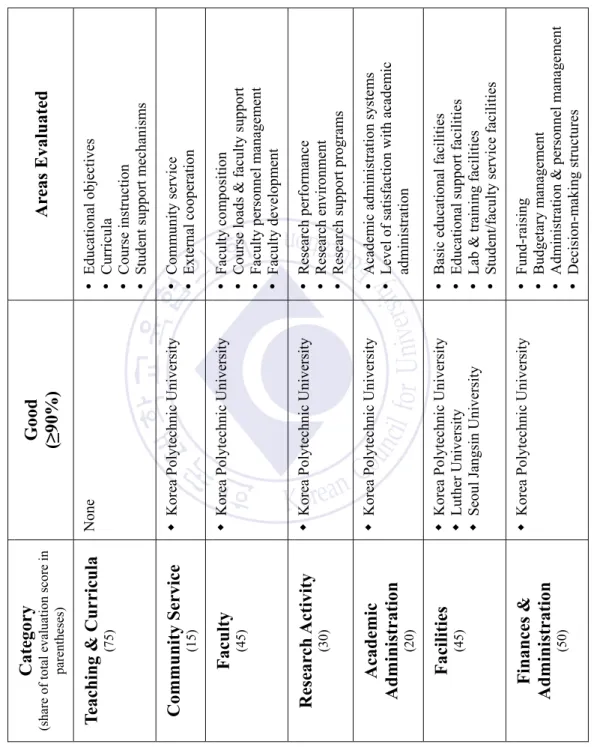
T
eaching & Curricula
(75) No ne y Edu catio na l obj ectiv es y Cu rricu la y Course i nstruction y St ude nt s upp or t m echani sm s