AIS Electronic Library (AISeL)
2015 Proceedings
SIGED: IAIM Conference
2015
Incorporating Analytics into a Business Process
Modelling Course
Swapna Gottipati
Singapore Management University, [email protected]
Venky Shankararaman
Singapore Management University, [email protected]
Follow this and additional works at:
http://aisel.aisnet.org/siged2015
This material is brought to you by the SIGED: IAIM Conference at AIS Electronic Library (AISeL). It has been accepted for inclusion in 2015
Recommended Citation
Gottipati, Swapna and Shankararaman, Venky, "Incorporating Analytics into a Business Process Modelling Course" (2015).2015 Proceedings. 16.
INCORPORATING ANALYTICS INTO A
BUSINESS PROCESS MODELLING COURSE
Swapna GOTTIPATI
School of Information Systems Singapore Management University
Venky SHANKARARAMAN School of Information Systems Singapore Management University
Abstract:
Embedding analytics is about integrating data analytics into operational systems that are part of an organization’s business processes. Currently, most organizations focus on automation business processes and enhancing productivity. However, going forward, in order to stay competitive, organizations have to go beyond automating their processes, by making them more intelligent, by embedding analytics into their processes and business applications. Therefore, there is need for enhancing the knowledge and skills of BPM professionals with know-how on improving a business process by embedding analytics into the workflow. In this paper contribution, the authors share their experience on how an existing process modelling, analysis and solution designing course was modified in order to incorporate the analytics component. The paper describes in detail the content, pedagogy, and lessons learned when introducing analytics into an existing business process modelling course. Thus providing one pathway for IS professors to adapt their current process modelling, enterprise systems and BPM courses to include analytics.
Keywords: Course Design, Pedagogy, Process Modelling and Analysis Course, BPM, Embedded Analytics
I. INTRODUCTION
Business Process Management (BPM) is a management practice that focusses on enabling and sustaining corporate success. It is a systematic methodology of making organization's business workflow more effective, more efficient and more capable of adapting to an ever-changing environment to achieve consistent, targeted results aligned with an organization’s strategic goals [ABPMP, 2009]. Several Universities around the world offer BPM courses that equip students with the necessary knowledge and skills to address an organization’s BPM needs [Recker & Rosemann, 2009], [Bandana et al., 2010], [Mathiesen et al., 2013]. This would typically include the areas of process modelling, process analysis, and technology to automate the process [Müller et al., 2014], [Van Looy et al., 2013].
However, having implemented BPM solutions, in order to stay competitive, organizations have to go beyond automating their processes, by making them more intelligent. According to Gartner, “Analytical process controlling (APC) enables an organization to investigate process execution realities, evaluate their business impact, and ultimately improve and optimize its business processes.” In particular, the combination of data analytics and business process workflow could provide cost-effective solutions for core business processes of a company [Davenport et al., 2010], [Rolf et al., 2013].
Business processes collect and record large volumes of data. The data is collected at various phases of a business process workflow; when an instance is triggered or when a cycle is completed or during a task execution in the workflow. For example, when an instance is created, data with respect to that instance, such as time, frequency, cost, cycle time etc., is recorded. Whereas, when an activity, for example “create sales record” is executed, the data of customer, product, location, time etc., is recorded, sometimes referred to as transactional data. Such raw data describes the facts and figures that a company processes every day. Currently, for
optimizing the processes, data about cost and time are widely used. However, the transactional data is not fully leveraged. The ability to analyse and act in real time in a business workflow, using historical transactional data is important to the decision making process.
Data analytics is the science of examining raw data with the purpose of drawing conclusions about that information. Data analytics is used in many industries such as healthcare, retail, government, banks etc., to allow companies and organization to make better business decisions [IBM, 2013]. Data analytics helps with the analysis of business data with a view to create new business process improvements and identify business opportunities in various industry sectors [LaValle et al., 2011]. Traditionally, organizations collect data through transaction systems, transfer this data to data warehouse, and then develop analytical applications to aid in decision making process. Increasingly, organizations are embedding data analytics into a business process in order to provide support for real-time decision making.
Embedding analytics is about integrating data analytics into operational systems that are part of an organization’s business processes. Business users or actors will be able to access historical data and perform analytics on this data while performing transaction in a process workflow [Davenport et al., 2010]. Gartner, for example, has published some thought-provoking articles on how in future, the combination of business analytics and a business process platform might be used to create an environment in which processes are self-configuring and driven by customer transactions [Gartner, 2015]. In order to build such an environment, there is need for enhancing the knowledge and skills of BPM professionals with know-how on how to improve a business process by embedding analytics into the workflow.
Consequently, curriculum designers of Information Systems (IS) program need to re-design their courses to incorporate the analytics content into the courses where there is a best fit. More importantly, courses related to data management, process modelling, and enterprise systems will need to be modified to include analytics component appropriate to their respective content. In this paper, we share our experience on how an existing business process modelling course was modified to incorporate analytics component.
Currently, on the one hand, many BPM curricula that offer business process modelling course focus on topics such as process modelling, simulation and analysis, process improvement recommendations, design and transformation, IT solution requirements, governance, enterprise modelling, and enterprise process architecture [Stewart et al., 2001], [Recker et al., 2009], [Bandara et al., 2010], [Perterson et al., 2013]. Usually, process modelling courses focus on three main objectives; modelling the current business processes in an organization, analysing the issues with the current as-is model and recommending a to-be model, and designing the IT solution for the to-be model. On the other hand, within the business school curriculum in the area of analytics, teach analytics for non-IS and IS students [Wang et al., 2011], [Wang, 2015]. In this context, the courses introduce students to enterprise products or tools and data analysis skills covering topics such as statistics, predictive models, data mining, visualization, etc. However, such curricula do not focus on integrating decisions within the business processes. When business analytics capabilities are integrated into business processes, decisions are more repeatable, scalable, traceable and accurate [Chandler et al., 2011], [Davenport et al., 2010]. This paper addresses the content and pedagogy aspects of introducing analytics into an existing business process modelling course. We describe our recent efforts in designing and developing analytics content for Process Modelling and Solution Blueprinting (PMSB) course in an undergraduate curriculum at the School of Information Systems, Singapore Management University. We describe the learning outcomes, content structure, lesson plan, delivery mode, and finally our experiences and lessons learnt in executing the modified business process modelling course. To better understand the enhancements to the course, we start with a description of the content and pedagogy for our original business process modelling course and then describe content and pedagogy for the new version with embedded analytics content.
The rest of the paper is structured as follows. Section II presents a literature review of related work. In Section III, process modelling course design and delivery aspects in SMU are described in detail. Section IV describes the changes that were made to the course in academic year 2014, to incorporate analytics into the process modelling course. Section V provides our observations, feedback, lessons learnt and recommendations, and we conclude in final section.
II. RELATED WORK
Business Process Modelling
The goal of a business process modelling course is to provide students with the knowledge & skills necessary to analyse, design, and model a business process that leverages new technologies to achieve desired operational efficiencies [Recker & Rosemann, 2009], [Bandara et al., 2010]. The course provides a common language to improve communication between business users and IT professionals during all phases of business process management projects. In particular, the course provides an introduction to the concepts of business process modelling, definition of process, characteristics of a process-oriented application, business process analysis, basic design patterns for process control flow used to assemble tasks, and standard graphical representations used to model a process. Content covers internal processes within organizations as well as external processes involving partners and other stakeholders. Some course designers include managerial aspects or process improvement standards such as foundational knowledge of understanding process compliance and risk management.
Process modelling course usually introduces concepts of business process modelling using an industry standard, Business Process Model and Notation (BPMN) [Zur & Recker, 2013]. Courses are designed based on BPMN to teach the concepts and language to describe and analyse business processes. Students will learn the elements of process models using BPMN notation, and BPMN tools such as Visio, Aris, Signavio Modeller, etc. [Recker, 2008]. Most of the technology depth courses offered for IS students aims at equipping students with the optimizing techniques by incorporating software tools. Students will learn the principles of business process management (BPM) by analysing tools and techniques to optimize business processes through simulations and apply them to real-world situations. Students will use tools such as IBM Websphere business process modeller, Oracle's Business Process Management Suite, TIBCO business process modeller, etc., to model, simulate, implement and measure a business process. Process modelling has been taught in IS curriculum across two main themes: Enterprise Systems and Business Process Management.
Enterprise Systems (ES)
Enterprise systems have significant impact on business organizations by providing an integrated platform for automating business processes across the various business units in an organization [Fedorowicz, et al., 2004], [Strong et al., 2006]. Fedorowicz et al. discussed the challenges and solutions and presented practical guidance for integrating enterprise systems into a business curriculum. Enterprise Systems curriculum is rich with attempts to teach enterprise software such as SAP ERP, as well as to integrate such software with other applications, to demonstrate how functions interact and how data flows through business processes. In this context, enterprise systems courses have included business process modelling and analysis as an important topic. For example, Wang and Hwang proposed that students learn ERP business process modelling using Accelerated SAP (ASAP) and business process diagrams as part of the enterprise systems curriculum [Wang & Hwang, 2011].
Strong et al. provided advice about teaching enterprise systems at the undergraduate and graduate levels within the IS curriculum, across management and engineering curricula, based on experience from five different institutions. Across all these different institutions, process modelling is taught as part of enterprise systems curriculum. At a minimum process modelling concepts is used to emphasize the difference between business processes with and without integrated system. In some institutions, an entire course is provided for the key topic of Business Process
Modelling, where students learn methodologies and tools for effective modelling and analysis. The focus is on getting students to appreciate various stages of enterprise systems lifecycle for selection, implementation, and benefits and how these phases are enabled through process modelling and management [Strong et al., 2006].
More recently, [Shankararaman et al., 2013] have mapped the evolution of enterprise systems from inflexible processes to agile collaborative processes. They identified four waves of evolution of enterprise systems and highlight importance of aligning the enterprise systems curriculum with the latest evolution of enterprise systems. For example, in 4th Wave, they identified three trends namely mobility, social networking and cloud computing that are bound to impact enterprise systems. Going forward, therefore, they have argued that what will be needed more are the architectural skills to design and then implement an efficient and cost effective solution that extend business processes to a wider user group, provide access to data from ERP on pervasive devices, integrate data from social media with ERP, and enable high performance real time analytics. This has implications to current enterprise systems curriculum, and more specifically for this paper, on the renewal of process modelling topic, which need to address real-time analytics as an integral part of a business process.
Business Process Management (BPM)
The importance of BPM in today’s business and the increasing scholarly interest in BPM as a relevant topic area for research [Bandara et al., 2010], [Mathiesen et al., 2013], many universities and industry training institutions have been teaching BPM and have devised a curriculum for BPM. These courses usually cover the concepts, methodologies technologies and practices for improving business processes. In some regards, the BPM courses can be considered as the key consulting and analysis tools to best utilize enterprise systems and integration technology.
Processes are at the core of all organizations which help in producing and delivering products or services that satisfy customer needs. Improving overall operating efficiency requires continuous improvement of processes. Therefore process modelling courses have become an integral part of BPM curriculum [Stewart et al., 2001], [Rosemann et al. 2008]. Mathiesen et al. provided content and an approach to design the content for BPM curriculum. They discussed the challenges and recommendations for BPM education in academia. For success of BPM curriculum, they propose topics namely fundamentals of process discovery, modelling and documentation which would lay foundations for process improvement, or redesign [Mathiesen et al., 2013].
Recker & Roseman highlighted the importance of asking students to conceptualize, analyse, and articulate real life process scenarios. They also recommended the need for covering methodological knowledge pertaining to conduct, management, and governance of process modelling. In order to perform this effectively, students require hands-on experience with modelling tools [Recker & Roseman, 2009]. Petersen & Krogstie have proposed that business process modelling courses should bring business perspective together with the IT perspective [Petersen & Krogstie, 2013].
Most of these process modelling courses emphasize the modelling and analysis of process, and process improvements in terms of removing bottlenecks, automating manual activities, optimising human and other resources. However, not much work has been done on evolving the process modelling courses to address emerging areas such as real-time analytics, where analytics is embedded into the process. In the next sub section, we review this topic.
Embedded Analytics
Embedded analytics provides information and insights to users to work proactively, and optimises business processes and performance [Wayne 2006]. The goal is to integrate analytics into the operational systems, for example, an ERP, that is part of organization’s business processes. Business users will be able to access historical data and perform analytics on this data while
performing transactions. Thus they can work more efficiently with the applications they use every day [Rayner, 2010].
Four styles have been proposed for embedding analytics into business processes [Herschel & Burton, 2006]. Intra-application and implicit; in this style, analytics is automated within the operational system without the business user having to explicitly perform analysis. For example, when a customer service representative receives a call from the customer, the system automatically presents a recommended list of cross-sell offers for the specific customer. Intra-application and explicit; in this style the business user performs analysis from within the operational application by selecting data, performing queries and examining the visualization generated by the query. For example, a bank’s marketing manager who has just launched a number of dining promotions for credit card customers, clicks through a dashboard to query and view visualizations of the data on which dining promotions have been most popular. Inter-application and implicit; this is similar to the first style, the analysis automatically performed and stored by another application rather than the operational system. Intra-application and explicit; in this style the business user performs the analysis in a different application outside the operational system. For example, the bank’s marketing manager may use a specialized text mining tool to score and rank dining promotions based on customer profile, and then imports the score and rank into the operational campaign management system to select suitable customers to launch new campaign.
Davenport et al. have described the importance of a structured approach to incorporate analytics into different business processes in an organization [Davenport et al., 2010]. In this context, they identified different degrees to which analytically enabled decisions should be automated, discussed IT's role in embedding analytics into business processes, and proposed solutions on overcoming sticking points to embedding analytics in an organization’s day-to-day business process operations.
There are a number of benefits of embedding analytics which actually makes business operations better [Leventhal & Langdell, 2013], [Davenport et al. 2010]. Firstly, as visuals are presented from various systems, business users do not need to log into separate applications for obtaining data and analytic reports needed for decision making. Secondly, it avoids the need to wait for a dedicated data warehouse specialist to provide insights on the current process performance. Thirdly, it ensures that insight and action is combined with the day to day operations, thus making analytics more widely used across the organization. Finally, embedding analytics into business processes and enterprise systems supports decision making related to a specific business activity within the process, thus making it context sensitive.
In order to gain these benefits, organizations must first analyse their business processes and examine where “data insights” can be useful to optimize the process, thus redesigning the business process. Therefore, process modelling courses must evolve to address how analytics can be embedded into a business process by looking at the three main components involved in the business process namely business opportunity, decision aspects and data. In subsequent sections we share our experience on how an existing business process modelling course was modified to incorporate analytics.
III. BUSINESS PROCESS MODELLING COURSE STRUCTURE AT SIS, SMU
At School of Information Systems (SIS), Singapore Management University (SMU), all IS students are required to do a compulsory core course titled “Process Modelling and Solutions Blueprinting” (PMSB). This course was originally introduced in 2005 and has undergone a number of revisions. Every year about 280 students take this core course. We present the course information in detail in following sub-sections.Course Learning Outcomes
1. Identify enterprise processes through business process models.
2. Model, simulate, analyse and re-design process workflow using industry tools.
3. Understand and execute a methodical approach to translate business process change requirements into IT solutions.
4. Develop and critique an appropriate concept solution architecture, by identifying business and system services.
Course Content
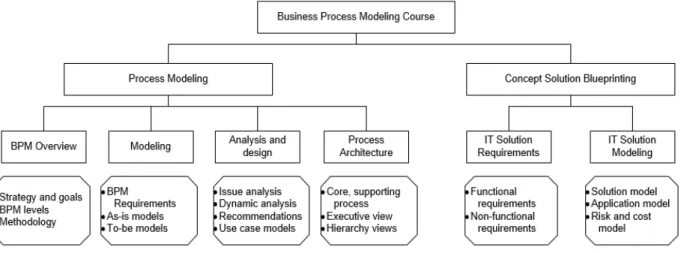
PMSB course is designed to cover two main phases related to business process and IT alignment namely process modelling and concept solution blueprinting. The course uses the text book, “Aligning IT Solutions with Business Processes: A Methodological Approach” [Shankararaman et al., 2005], and process modelling tool, “Signavio process editor” (www.signavio.com) for labs and project work. Figure 1 shows the content overview delivered in course.
Figure 1: Course content overview
Process Modelling: This phase comprises of a methodology for identifying business needs and
translating them into functional requirements of an IT solution. The methodology provides procedures and templates to help understand current business process and associated issues, analyse the process, and propose solutions to solve the issues. The final deliverables of the process modelling methodology are models such as collaboration diagrams, workflow diagrams, root cause impact and root cause recommendation reports, dynamic process analysis reports, and use case models.
Concept Solution Blueprinting: This phase comprises of an approach for building a concept
solution architecture that will satisfy the IT requirements (e.g. to-be business process workflow and use case models) identified in the previous phase. The final deliverables of this phase are solution models, application models, and risk and cost models. These deliverables help define a high level view of the proposed IT solution. In a real project, IT architecture team will further refine the high level IT solution to produce detailed IT solution architecture. However, this is not in the scope of our course.
Pedagogy
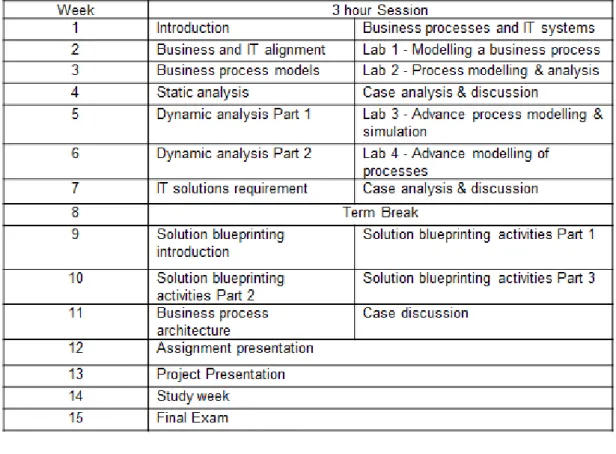
PMSB course is conducted as 3 hours per week in a seminar style engagement session over a period of 15 weeks as shown in Table 1. Students participate in various class room activities as follows:
1. Learning through discussions, short exercises, case study sessions and lectures.
2. Technical lab exercises in which they use tool for modelling, simulation and analysis activities. Currently, “Signavio” is the cloud based tool that is used in the course.
Table 1: Course plan
Assessments
To assess student learning, course comprises of various assessment components as shown in Table 2. Class participations are also graded, but not shown in the table.
IV. INCORPORATING ANALYTICS INTO THE BUSINESS PROCESS
MODELLING COURSE
Motivation
Gartner defines embedded analytics “as the use of reporting and analytic capabilities in transactional business applications”. There are two approaches to achieve this. Firstly, organizations have to analyse their business processes and examine where “data insights” can be useful to optimize the process, thus redesigning the business process. Secondly, embed analytical capability into the applications that are used to automate the business process. In particular, analytics should be embedded in an interactive activity, where a human performs the activity or automated activity, where the system performs the activity. The goal is to enable decision makers or business professionals to make informed decisions at the right time, when performing business activity. Davenport et al. have introduced a high level guide on how to embed analytics into business process [Davenport et al., 2010]. However, there are still some gaps on how analytics can be embedded in a systematic approach. Most importantly, there is a lack of a systematic methodological end-to-end approach to embed analytics into a business process. To achieve this we used the framework, Analytics Driven Business Process Improvement (ADBPI) Framework [Shankararaman & Gottipati, 2015]. Though this framework is still in its early version, it provides a structure along with templates for how an organization should examine its current business process and enhance this process by embedding analytics. The framework leverage the four analytics capabilities proposed by Kart et al., which map to the four decision types, namely descriptive, diagnostic, predictive and prescriptive [Kart et al 2006].
Content Design
In academic year starting in August 2014, we decided to introduce the topic of embedded analytics. For incorporating analytics into PMSB course, we defined the learning outcome, “Students will be able to gain an overview of analytics and how it enhances a business process”. To achieve this outcome, three sub-outcomes were defined. Firstly, students will be able to understand data analytics and its importance in decision making process. Secondly, students will be able to understand the ADBPI methodology. Lastly, students will be to apply the ADBPI methodology for a given business process case study. Due to space constraint, in this paper, we will not describe the case study and activities. It must also be noted that the students will not be using analytics tools. However, they are given an overview of descriptive, diagnostic, predictive and perspective types of analytics along with a short introduction to various techniques such as regression, cluster analysis and time series.
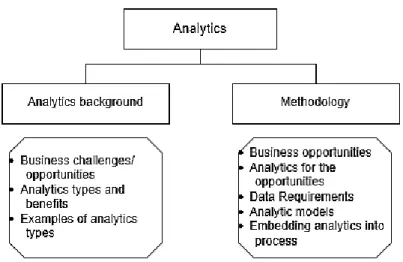
In order to achieve the above sub-outcomes, the content coverage is as shown in Figure 2. Content comprises the analytics background and methodology.
Analytics background: Provide basic information about analytics. It includes topics such as the
need for analytics from a business perspective, data collection and quality challenges, types of analytics and examples of analytics in various industries.
Methodology: Provide a systematic approach for embedding analytics into the business process
using the ADBPI framework. It takes the as-is workflow as an input and moves though five phases to develop a to-be process with embedded analytics.
Figure 2: Content for analytics
Embedded analytics topic was conducted as a 3 hours seminar style engagement session in week 10. To achieve this, we made changes to schedule shown in Table 1. For example, removed one case discussion, moved lab 4 as an out of class activity and made process architecture assignment as an in-class presentation activity. To aid students to better understand the ADBPI methodology, we developed a set of templates and students worked in small groups during the class session to apply the ADBPI methodology on a given business process. For assessing the students understanding of the methodology, we extended the project to include analytics component. The deliverables for the project were thus extended to include the following:
1. Identification and description of business opportunities for applying analytics within the to-be business process (e.g. cross-selling, fraud detection).
2. A set of analytics questions relevant to the process flow (descriptive, diagnostic, predictive, and prescriptive).
3. Data requirements - data about actors, activities and supporting data in the process. 4. Statistical measures aligned with the chosen analytics questions
5. Concept solution architecture of how the analytics components will be embedded into the to-be business process (e.g. business rules)
A new case study based analytics question was also introduced in the final exam to further assess the analytics topic.
Feedback
SMU utilizes an end-of-term, online survey called “FACETS” to gather students’ feedback. The survey comprises of quantitative questions and open-ended questions. Survey focuses on two main areas; course and faculty. The survey asks the students to assess learning experience, clarity of course objectives, quality of material, projects, relevance of the content, and faculty style and delivery related questions. The survey is on 7-point Likert scale. The survey for PMSB course was conducted and 99 students responded. Of 99 students, we had 54 males and 45 females. The open ended questions are about learning outcomes and course competencies development. The results for survey question, “I was able to develop and demonstrate the competencies that are specified for this course” are shown in Table 3.
Table 3: 7-Point scale-score frequency
Strongly Disagree Disagree Slightly Disagree Neutral Slightly Agree Agree Strongly Agree Students 0 0 2 10 11 56 20 Percentage 0% 0% 2% 10% 11% 57% 20%
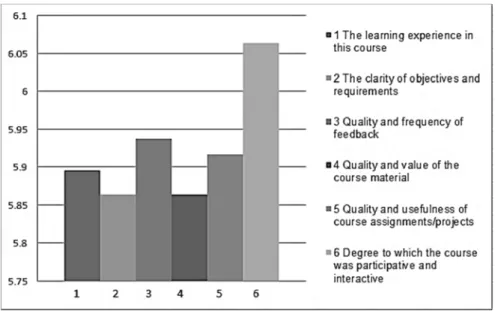
Overall the course average score on competency feedback is 5.887 with standard deviation of 0.852. Figure 3 shows average scores on content, learning and delivery style aspects of the course. Overall, the scores are above 5.85 and students’ perceived highest learning experience (SMU average is 5.79) compared to other aspects of course.
Figure 3: Course evaluation scores by 99 students on various aspects of the course
In addition to quantitative evaluations, qualitative feedback was sought from each student. Student comments received mostly provided positive feedback to analytics content and delivery mode. Specifically, the relevance of content to current market needs and the incorporation of latest advances in industry to keep up to date with current trends were well received by the students. Some comments like below are evidence of positive feedback.
“Course materials are practical and delivery approach is practical and participative which better facilitate students learning”
“Introducing data analytics in one of the topics is great. It provides great insights to how analytics trend can help to solve business problems in terms of utilising it to gain information to develop a better To-Be model”
“I liked that the course as it incorporates current market trends like analytics. “
Regarding weaknesses of the course, some of the feedback received pointed to the complexity of the analytics content covered, which was challenging for some students.
“Should not give data analytics as the last chapter as we are filled with a lot of work from software engineering course“
V. LESSONS LEARNED AND RECOMMENDATIONS
From the design and conduct of this course we draw a number of lessons learned.
Content design: Though there has been a lot of published material both books, case studies and
research papers on analytics, very little has been written about embedding analytics into a business process workflow. We could not find any material on a methodological approach to enhance a business process by embedding analytics into the workflow. This led us to develop the ADBPI methodology. As we were simultaneously developing the methodology and teaching the course, in the first iteration, the logic of the methodology and the template were not very intuitive.
This led to the fact that some students found it a bit overwhelming to apply the methodology. Since this course is the first time when students are exposed to analytics, we did anticipate this issue and therefore decided to introduce analytics as add on topic in Week 10, as a final task of business process improvement, rather than integrate it with the to-be process analysis covered in the earlier weeks. This worked well in terms of getting the stronger students to appreciate an emerging area with a minimum impact on the additional workload for the weaker students. However, some students expressed the fact that they could not fully appreciate how analytics integrated with other aspects of business process improvements such as removing manual tasks, reducing bottlenecks, optimizing resources. This is an issue we need to address in the next run of the course.
Classroom delivery: The course is taught by three professors and three instructors who assisted
with the hand-on labs for “Signavio” process modelling and analysis tool. Only one professor, the course designer had deep experience in the area of analytics. Therefore, it was necessary to train the other team members in order to prepare them for classroom delivery, and for supporting the student project teams. To achieve this, we sent some of the team members for a 3-day basic analytics training offered by SAS. After the basic training, a workshop session was conducted by the course designer, to provide training on the ADBPI methodology. This hindsight was very helpful. However, even with this, some of the team members expressed concern that they were not proficient enough to provide support for the student project. This led to the course designer spending more time on the project supervision.
Student learning: Though students displayed enthusiasm in learning analytics, many students
found it confusing and difficult to apply the ADBPI methodology for the given process workflow during the project work. We realised that there were two main reasons for this. Firstly, the content was newly designed and hence the flow was sometimes unclear and ambiguous. Secondly, as we bring in analytics as a final activity in process improvement, the students did not have sufficient time to digest the content and do a good job at applying the methodology in their project. To solve the first problem, we are seeking industry feedback and working on improving the methodology along with developing additional examples and cases where the methodology is applied. To solve the second problem, we intend to shuffle the content and move analytics topic one week early in the schedule.
VI. CONCLUSIONS
Analytics is a maturing discipline that is becoming increasingly critical to enhancing business processes. The demand for analytics in improving business processes and aiding the employees in decision making process has become a crucial need for several industries. Therefore, a need for IS professional with business process analytics skills is rapidly increasing, but sufficient education programs to support this demand does not exist. We believe that our experience in modifying an existing business process modelling course to embed analytics, provides one pathway for IS professors to adapt their current process modelling, enterprise systems and BPM courses to include analytics.
VI. REFERENCES
ABPMP (2009). Guide to the Business Process Management Common Body of Knowledge, ABPMP BPMCBOK, 2nd edition, Association of Business Process Management Professionals
Bandara, W., Chand, D.R., Chircu, A.M., Hintringer, S., Karagiannis, D., Recker, J.C., van Rensburg, Antonie, U.C. & Welke, R.J. (2010). Business process management education in academia: Status, challenges, and recommendations. Communications of the Association for Information Systems, pp743-776.
Chandler, N., Hostmann,B., Rayner,N. & Hersche, G. (2011). Gartner's Business Analytics Framework, Gartner Report G00219420, pp1-18.
Davenport, T. H., Harris, J. G. & Morison, R. (2010). Analytics at work: Smarter decisions, better results. Harvard Business School Press.
Fedorowicz, J.,Gelinas, U.J.Jr., Usoff, C. & Hachey, G. (2004). Twelve Tips for Successfully Integrating Enterprise Systems Across the Curriculum", Journal of Information Systems Education, 15(3), pp235–244.
Gareth Herschel and Betsy Burton. (2006) “The four styles of integrating analytics into business processes”, Gartner Report G00139727, 13 June 2006, pp1-9.
Gartner (2015). Gartner Magic Quadrant for Intelligent Business Process Management Suites Report. http://www.gartner.com/document/3009617
Herschel, G. & Burton, B. (2006). The four styles of integrating analytics into business processes, Gartner Report G00139727, pp1-9.
IBM (2013). Data Driven Healthcare Organizations Use Big Data Analytics for Big Gains, IBM Whitepaper, pp1-8.
LaValle, S., Lesser, E., Shockley, R., Hopkins, M.S. and Kruschwitz, N. (2011). Big data,analytics and the path from insights to value. MIT Sloan Management Review, 52, pp20–32. Leventhal, B & Langdell, S. (2013). Adding value to business applications with embedded
advanced analytics, Journal of Marketing Analytics 1.2, pp64-70.
L.Kart, A.Linden and W.R.Schulte, “Extend your portfolio of analytics capabilities”, September 2013, Gartner Report ID: G00254653.
Mathiesen, P., Bandara, W., Marjanovic, O. & Delavari, H. (2013). A critical analysis of business process management education and alignment with industry demand: an Australian Perspective, Communications of the Association for Information Systems, Volume 33, Article 27, pp463–484.
Müller, O., Schmiedel, T., Gorbacheva, E. and vom Brocke, J. (2014), Towards a typology of business process management professionals: identifying patterns of competences through latent semantic analysis, Enterprise Information Systems, Taylor & Francis, pp1– 31.
Petersen, S.A. & Krogstie, J. (2013). Experiences from teaching Enterprise Modelling to Students of Information Systems, CEUR Workshop Proceedings. vol. 1023, pp1-10.
Rayner, N. (2010). Embedded analytics will impact business application and BI strategy, Gartner Report G00208910, pp1-7.
Recker, Jan C. & Rosemann, M. (2009). Teaching business process modelling: experiences and recommendations, Communications of the Association for Information Systems, 25(32), pp379-394.
Recker, Jan C. (2008). BPMN Modelling – Who, Where, How and Why. BPTrends, 5(3), pp1-8. Rolf, R., Sutton,C. & Kuckuk, M. (2013). The Power of Combining Big Data Analytics with
Business Process Workflow, CGI Group.
Rosemann, M., Recker, J. & Flender, C. (2008). Contextualization of Business Processes, International Journal of Business Process Integration and Management(3)1, pp47–60. Seethamraju, R. (2007). Enterprise Systems (ES) Software in Business School Curriculum -
evaluation of Design and Delivery, Journal of Information Systems Education, Vol 18, Issue 1, pp69-83.
Shankararaman, V. & Gottipati, S. (2015). A Framework for Embedding Analytics in a Business Process. IEEE 17th Conference on Business Informatics, Lisbon, Portugal.
Shankararaman, V., Lum, E.K. & Dale, S. (2013). Integrating Enterprise System’s 3rd Wave Into IS Curriculum",Americas Conference on Information Systems, USA.
Shankararaman, V., Tan,K.W., Thonse,S., Gupta, M. & Deshmukh. N. (2007). Aligning IT Solutions with Business Processes: A Methodological Approach, Pearson Education: Prentice Hall, pp227
Stewart, G. and M. Rosemann. (2001). Process Modelling: A Teaching Approach for Developing Generic Skills in IT Students. Americas Conference on Information Systems Boston, Massachusetts, Association for Information Systems, pp20-27.
Strong, D., Fedorowicz, J., Sager, J., Stewart, G., & Watson, E.E. (2006). Teaching with Enterprise Systems, Communications of the Association for Information Systems: Vol.17, pp728-755.
Van Looy, A., De Backer, M., Poels, G. & Snoeck, M. (2013). Choosing the right business process maturity model, Information & Management, Vol. 50, pp466–488.
Wang, M & Hwang, D. (2011). An Innovative Framework of Integrating ERP into IS 2010 Model Curriculum. Communications of the IIMA, Volume 11, Issue 3, pp75-86.
Wang, Yichuan. (2015). Business Intelligence and Analytics Education: Hermeneutic Literature Review and Future Directions in IS Education, Proceeding of Twenty-First Americas Conference on Information Systems, pp1-10.
Wayne W. Eckerson. 2006 Embedded Analytics: Closing the Loop Between Operational and. Analytical Applications. May 2006. ftp://public.dhe.ibm.com/software/data/bi/alphablox-tdwi.pdf
Yang, L. & Xumin, L. (2013), Teaching Business Analytics, Frontiers in Education, IEEE Conference.
zur Muehlen, M., Recker, J. (2013). We Still Don’t Know How Much BPMN Is Enough, But We Are Getting Closer. Seminal Contributions to Information Systems Engineering: CAiSE. Springer, pp445-451.
ABOUT THE AUTHORS
Dr. Swapna Gottipati is an Assistant Professor of Information Systems (Education) at the School of Information Systems, Singapore Management University. Her research interests include text analytics, natural language processing, information extraction, opinion mining, machine learning and social networking. Her main focus is to enhance data mining models while she applies her research findings to software, education, security and mobile applications. Prior to joining SMU, she worked as a consultant for banking, financial, health and mobile projects, where she designed, developed and supported various software systems.
Dr. Venky Shankararaman is a Professor of Information Systems (Education) and Associate Dean (Education) at the School of Information Systems, Singapore Management University. He holds a PhD in Engineering from the University of Strathclyde, Glasgow, UK. His current areas of specialization include business process management and analytics, enterprise systems architecture and integration, and education pedagogy. He has over 25 years of experience in the IT industry in various capacities as a researcher, academic faculty member, IT professional and industry consultant. Venky has designed and delivered professional courses for government and industry in areas such as business process management and analytics, enterprise architecture, technical architecture, and enterprise integration. He has published over 65 papers in academic journals and conferences.