The 83rd Annual Conference of the Agricultural Economics Society Dublin
30th March to 1st April 2009
Innovation Behaviour At Farm Level – Selection And Identification
Johannes Sauer1and David Zilberman2
1
University of Kent and Imperial College at Wye, Wye, Ashford, Kent. TN25 5AH. UK
University of California, Berkeley and Giannini Foundation, Berkeley, USA
Copyright 2009 by Sauer and Zilberman. All rights reserved. Readers may make verbatim copies of this document for non-commercial purposes by any means, provided that this copyright notice appears on all such copies.
Abstract
Using a squential logit model and a mixed-effects logistic regression approach this empirical study investigates factors for the adoption of automatic milking technology (AMS) at the farm level accounting for problems of sequential sample selection and behaviour identification. The results suggest the importance of the farmer’s risk perception, significant effects of peer-group behaviour, and a positive impact of previous innovation experiences.
Keywords and JEL Codes
1. Introduction
The adoption of new technologies in primary agricultural production has been at the centre of traditional agricultural economic analysis for the last 50 years: One stream of studies empirically investigates technology adoption and diffusion taking into account farmers’ perceptions with respect to the risk of future yields. Others point to the importance of information gathering, learning by doing and resources’ accumulation for the adoption decision. An increasing number of studies model the adoption decision as a sample selection problem where the farms have to pass a first threshold to be selected into the sample of potential adopters. Depending on the technology to be adopted, the selection threshold refers either to size, network access or a certain level of human capital. Building on these findings our study aims to make a step forward by simultaneously modelling the effects of risk, social interaction, past innovation experiences and the sequential structure of adoption decisions. Different econometric models are applied to incorporate these potential factors and structural characteristics. A unique dataset on dairy producers in Northern Europe is used to empirically investigate the adoption of automatic milking systems (AMS).
2. Automatic Milking
Rising labor costs in the mid seventies were one of the main reasons for an increasing automation in the milking sector. Crucial steps were the development of a reliable cow identification system which could then be used for automatic concentrate feeders, the
development of automatic cluster removers, sensors to detect udder health problems, and finally the development of automatic teat cup attachment systems (Meijering et al. 2002, Kochan 2004). An entirely automated milking system (AMS) - also called robotic milking system (RMS) - was firstly developed in the Netherlands in the 1980s and the first commercial RMS was placed into production there in 1992. Until the mid of the 1990s about 250 farms worldwide used AM systems whereas the breakthrough of the AMS technology occurred at the end of the
1990s. Today AMS is in use on about 5,500 milk farms worldwide (Svennersten-Sjaunja and Pettersson 2008). More than 90% of all dairy farms using AMS are located in northwestern Europe where investments are driven by high labor costs, a continuous increase in the average herd-size and a dominance of the family farm structure (Meijering et al. 2002). Originally, AMS were targeted for small family farms with up to 150 cows, however, with continuous
technological progress and increased management skills, AMS is now also installed on larger farms with more than 500 cows per herd. In general there are two basic designs of automatic milking systems. The first is the single-stall system, in which one milking robot serves only one milking stall with approximately 60 cows. The second design is a multi-stall system, in which the robot travels along a rail between different stalls where each stall can service fewer than 60 cows (Hyde et al. 2007). Automatic milking relies on the cow’s motivation to enter the system voluntarily where the main motive is the supply of concentrate.
Previous studies on the economics of different milking systems revealed that a minimum herd size of about 60 cows is needed for an automatic milking system to work more profitable than traditional milking systems (see Rotz et al. 2003, Hyde and Engle 2002, DeKoning et al. 2002). On farm sizes well above this threshold multi-stall AMS show greater potential net return than the use of two or more single-stall units. The herd milk production level was found to have only a small effect on the economic difference between traditional and automatic milking systems with a greater difference at a higher level of production. The potential benefit of AMS is improved if a substantial increase in production is maintained through a greater milking
frequency. Studies showed that a large increase in the cost of labor can improve the net return of an automatic milking system over all herd sizes. Finally, farm net return with an AMS is
significantly reduced if the economic life of the automatic system is reduced to represent a more rapid depreciation than normally occurs with traditional milking systems (Rotz et al. 2003). Two great advantages with AMS include reducing the workload of milking and milking more often than twice daily without incurring extra labor costs (Dijkhuizen et al. 1997). On average, a 10%
reduction in total labor demand is reported compared with conventional milking systems with twice milkings per day (Schick et al. 2000, DeKoning et al. 2003). Furthermore, milking frequencies of more than twice daily can be reached under automatic milking which is desired for high-yielding cows as 3 milkings a day are expected to enhance lactation milk yield by 10 to 15% on average (Billon 2002, Svennersten-Sjaunja et al. 2000, Speroni et al. 2002, Wagner-Storch and Palmer 2003). Others stress the consistency of the milking process with automatic milking technology: In a working AM system, the animals are treated in the same way at each milking and the routines are predictable for the cows which increases milk production
(Samuelson et al. 1993). Different research projects have been conducted to understand the effect of AMS on milk quality including both compositional and hygienic aspects. A
comparison of conventional and automatic milking showed no differences between the milking systems for fat and protein contents (Svennersten-Sjaunja et al. 2000). However, others revealed an increased level of free-fatty acid concentration (FFA) in milk collected from farms that had introduced AMS (Justesen and Rasmussen 2000) or when compared with levels of milk FFA before automatic milking was introduced (DeKoning et al. 2003). With respect to milk hygiene, reports from the Netherlands and Denmark indicated that the total bacterial count (TBC)
increased in the bulk milk after introduction of automatic milking. Other studies, however, revelaed that after 6 months the TBC stabilized and after 1 year the level of TBC was almost the same as on farms with conventional milking (Klungel et al. 2000, Rasmussen et al. 2002). Initial studies concluding in an increased somatic cell count (SCC) after introduction of AMS (see e.g. Klungel et al. 2000) were followed by studies showing that automatic milking does not increase the incidence of udder infections and SCC (e.g. Berglund et al. 2002 or Svennersten-Sjaunja and Pettersson 2008). Finally, with respect to animal welfare, Hagen et al. (2005) note, that the cows kept in an AMS displayed an increased chronic stress (measured as heart rate variability)
compared with cows kept in a loose housing system. On the other side, such stress was not observed during milking corresponding to the findings by Gygax et al. (2006) who could not
confirm differences in milk cortisol between cows milked in an automatic vs such milked in an conventional system. It is clear from these previous studies that AMS is not only a new milking system, but rather a completely new management system. Mathijs (2004) as well as Hyde et al. (2007) stress that noneconomic factors such as lifestyle choices including avoiding labor
management are at least as important as economic factors for the decision to adopt an automatic milking system.
3. Adoption Literature Review
Since the seminal work by Griliches (1957) numerous studies have been produced investigating different aspects of technology adoption in agriculture. Feder and Umali (1993) as well as Sunding and Zilberman (2001) provide surveys on the general technological adoption literature. Putler and Zilberman (1988) examine computer and application ownership patterns in
Californian agriculture. Their analysis indicates that the size of the farming operation, education level, age level, and the ownership of a farm-related nonfarming business significantly influence the probability of computer ownership. Foltz and Chang (2002) study the adoption and
profitability of Recombinant bovine somatotropin (rbST) on dairy farms in Connecticut. Their research shows that larger farms with more productive technologies and with younger, more educated farmers are more likely to adopt rbST. Barham et al. (2004) investigate the dynamics of rbST adoption on dairy farms and examine the characteristics that distinguish among nonadopters, disadopters, as well as early and late adopters. Their results confirm previous findings showing that larger farms with complementary feeding technologies are more likely to adopt rbST whereas nonadopters appear quite unlikely to become adopters. Abdulai and
Huffman (2005) try to explain diffusion of crossbred-cow technology for a sample of Tanzanian farmers and conclude that the adoption of such technology positively depends on the proximity of the farm to other users, on his schooling, and on his access to credit as well as extension
services. So far, no research has been undertaken which investigates the adoption of automatic milking technology in favor of conventional milking systems.
Risk
One stream of studies empirically investigate technology adoption and diffusion taking into account farmers’ perceptions with respect to the risk of future yield. Yaron et al. (1992) attempt to analyze the effect of price uncertainty on the degree of innovation exhibited by family farms in Israel. Kim and Chavas (2003) investigate the dynamic effects of technological progress on risk exposure by using the conditional moments of the estimated yield and profit for corn farmers in Wisconsin. They conclude that technological progress significantly contributes to reducing the exposure to risk and downside risk over time. Koundouri et al. (2006) built on the framework suggested by Antle (1983, 1987) and followed by Kim and Chavas (2003) and develop a theoretical model to describe irrigation technology adoption by farmers facing production risk and incomplete information about new technology. The adoption decision is derived under the assumptions of farmers’ risk aversion and uncertainty because of random climatic conditions and future profit development. The estimated first four moments of the farmers’ profit distribution are incorporated in the technology adoption model as explaining factors. They found risk to play an essential role in farmers’ decision to adopt the new technology.
Learning, Network Externalities and Peer-Group Effects
Sunding and Zilberman (2001) point out that a complete analytical framework for investigating adoption decisions should include information gathering, learning by doing and resources’ accumulation. Rosenberg (1982) distinguishes between three different forms of learning: ‘learning by doing’, ‘learning by using’, and ‘traditional learning’. Learning by doing relates to the supply of the technology, hence does not provide an explanation for why a firm would be an early or late adopter (McWilliams and Zilberman, 1996). Learning by using describes the effect of the users of a given technology (i.e. the demand side) increasing their productivity over time
as they learn how to better use this new technology. Finally, traditional learning as the most commonly discussed form of learning which involves potential adopters gathering information about the performance of a new technology (i.e. its expected profit and variance). Firms or farms are uncertain about the value of the new technology and are thus hesitant to invest in the technology without having sufficient information on its performance. Such information may be obtained by observing and interacting with others adopting and using the technology (i.e. peer-group spillover effects, informational cascades), by talking to technology suppliers, or by experimenting with the new technology themselves. In the context of this paper learning by using as well as traditional learning will be of interest (see also Lindner et al. 1979, Stoneman 1981, Jensen 1982). Baerenklau (2005) points out, that traditional learning in the sense of ‘learning from others’ is more complicated as it may become rational for a forward-looking agent to postpone adoption (at least partially) until better information becomes available regarding the expected benefit of adoption. Such agents would tend to ‘wait and see’ what happens to their neighbors (i.e. free-riding on others’ technology experiences) before they assume the expected private costs of experimenting with a new technology themselves (i.e. an information or network externality). Foster and Rosenzweig (1995) as well as Besley and Case (1997) found that dynamic information externalities have only small observable effects on the less costly and reversible adoption of new seed varieties. For adoption decisions with respect to large, capital-intensive and irreversible decisions as examined in this study, a non-dynamic type of behavioural spillover – referred to as neighborhood effect or peer-group effect (Banerjee 1992) – may have greater relevance. Social scientists have examined such effects in several theoretical contributions (e.g. Coleman et al. 1966, Schelling 1971, for a recent overview see also Brock and Durlauf 2001). However, with respect to empirical modelling confounding identification problems have to be considered (Manski 1993): i) endogenous (peer-group or neighbourhood) effects refer to the phenomenon that the propensity of an agent to behave varies with the behaviour of his peer-group; ii) exogenous (contextual: time and space related, i.e.
fixed) effects describe the covariance between the propensity of an agent to behave and exogenous characteristics of the peer-group; and iii) correlated (unobservable influences, i.e. random) effects refer to the observation that agents in the same group tend to behave similarly because of similar individual characteristics or institutional constraints. Nevertheless, previous research on technology adoption behaviour has acknowledged the effect of such peer-group effects by noting the importance of network externalities as a function of the total number of technology users or by formulating the concepts of an informational cascade, first-movers based on signalling, and pure conformity preference. Brock and Durlauf (2001) found that nonlinear modeling can be used to identify these individual effects (see also An and Kiefer 1995 and Durlauf 2003), however, as Baerenklau (2005) notes, there remains a lack of empirical research that incorporates social interactions into behavioural models to explain technology adoption.
Selectivity, Sequential Decisions and Path-Dependent Behaviour
An increasing number of studies model the adoption decision as a sample selection problem where the adopting farms or firms have to pass a first threshold to be selected into the sample of potential adopters. Depending on the technology to be adopted, the selection threshold refers either to size, network access or a certain level of human capital. The modelling structure has then to correct for such sample selection bias. Asterbro (2003) uses a Heckman two-stage selection model to study how sunk costs and size affects the probability and depth of adoption (see also Smale et al. 1994, Dridi and Khanna 2005 or Abdulai et al. 2008). Smith et al. (2004) investigate the computer and internet use by Great Plains farmers by modelling the exposure to the technology as adoption threshold. Foltz and Chang (2002) note that the decision of a farmer to adopt rbST is based on each farmer’s self-selection instead of random assignment. Hence, their modelling approach consists of an index function model (i.e.probit) to endogenize the adoption decision with respect to yield and profit estimations. Different other contributions aim to tackle the phenomen that the adoption decision is not only subject to prior threshold criteria, moreover is part of a joint or sequential decision structure. Moreno and Sunding (2005) estimate
a nested logit model of joint technology and crop choices aiming to acccount for unobserved correlation among these decisions. The results support their modelling choice of a nested structure alternative to a standard multinomial logit approach. Khanna (2001) applies a double selectivity model based on bivariate sequential probits to study the sequential decision to adopt two site-specific technologies, soil testing and variable rate technology and the impact on nitrogen productivity. The results indicate that the factors for the two sequential adoption decisions differ significantly and that nitrogen productivity gains from adoption depend on the soil quality given. The experiences with the implementation of automatic milking systems reported in the previous section suggest that a relevant empirical adoption model should incorporate the following aspects: (i) individual risk preferences to account for the tendency of farmers to care about profit developments in the first years after AMS adoption, (ii) sample selection due to a minimum herd size threshold, (iii) sequential decisions with respect to an increase in herd size and the adoption of automatic milking, (iv) learning by using, peer-group effects and network externalities based on the social interaction of the farmers with others who have already adopted the technology as well as the dissemination of individual experiences with AMS, and (v) the potential relevance of earlier experiences with the successful adoption of other technologies (e.g. organic dairy farming practices).
4. Conceptual Framework
We assume that risk averse dairy farmers utilize a vector of inputsxto produce an output q through a technology described by a wellbehaved continuous and twice differentiable -production functionf(). The individual farmer is assumed to incur production risk as milk yield and quality might be affected not only by herd health but also by technology underperformance or failure. Such risk can be considered by a random variableεwith its distributionG()which is exogenously determined. Dairy farmers in our sample are assumed to be price-takers in both the input and output markets as our study area consists of a relatively small and homogenous
geographic area and hence factor price variability is low (Huffmann and Mercier 1991). Dairy farmers in Europe further face a minimum guaranteed milk price regulated by the dairy regime of the Common Agricultural Policy of the EU. As outlined in the previous section labor input (xl) is essential in the dairy farm production process. The efficiency of labor use critically
depends on the utilized milking technology and can be captured by incorporating a functionh()
in the milk production function q f h[ ( ) , ] xl x whereis a vector of heterogeneous farm and farmer characteristics. The risk averse dairy farmer maximises the expected utility of profit described by (1) (1)
, , max [ ( )] max [ ( , ( ) , ) ' ] ( ) l l l l l x E U x
U pf h x r x dG x x x r xwhereU()is the von Neumann-Morgenstern utility function, andpandras the non-random output and input prices respectively. The first-order condition for labor input choice is given by (2)ܧ[ݎܷ'] = ܧ ቄడ(ఌ,(ఈ)௫,ܠ) డ௫ ܷ'ቅ⟺ =ܧ ቄ డ(ఌ,(ఈ)௫,ܠ) డ௫ ቅ+ ୡ୭୴[ᇲ;డ(ఌ,(ఈ)௫,ܠ)/ப୶ౢ] ா[ᇲ]
withU' U( ) / and with the first term on the right-hand side denoting the expected
marginal product of the labor input, and the second term measuring deviations from risk-neutral behaviour in the case of assumed risk-aversion (Koundouri et al. 2006). The decision whether or not to adopt a more labor efficient milking technology can be modeled as a binary choice, where the farmer chooses to adopt (=1) or not (=0). In the case of adoption, labor use efficiency is increased:h1() > h0()for0<<1. The dairy farmer will adopt the new and more efficient milking technology if the expected utility with adoption (E[U1]) is greater than the expected utility without adoption (E[U0]): E[U1] - E[U0] > 0. Future profit flows after adopting the new milking technology are not known with certainty due either to ignorance of the exact technology performance or to the higher probability of technology failure as a consequence of errors in the use and maintenance of this technology. Furthermore, investing in the new milking technology entails sunk costs because of a fixed cost portion and the risk linked to a potential resale of the equipment. As Dixit and Pindyck (1994) point out, additional information on the
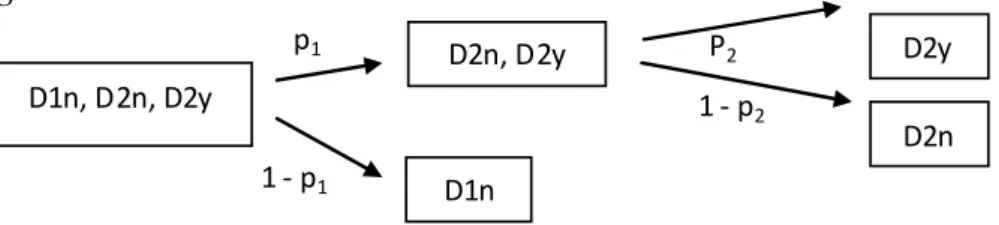
Figure 1 D1: herdsize decision D1n: no increase D1y: increase D2: ams adoption decision D2n: no adoption D2y: adoption
performance and risks of the new technology might possess a positive value for the individual farmer. Linked to such information is the case that some dairy farmers may prefer to delay the adoption until more information becomes available and consequently, an extra premium may enter the technology adoption decision: (E[U0]): E[U1] - E[U0] > InfV where InfV0 represents the value of new information for the individual dairy farmer.InfVcan be described as a function of the initial fixed costs of technology investment, the level of uncertainty related to the new technology (e.g. access to peer-group experiences, extension services), and the farmer’s own characteristics and experiences (e.g. age, farming experience, successful technology
innovations in the past).
Sequential Selection
A second layer of the model is related to the reported threshold for adopting automatic milking technology in terms of a required minimum herd size of about 60 cows.
This threshold can be conceptualized along the lines of a double selectivity sequential adoption problem: The decision to increase the scale of milk production by an increase in herdsize or not (D1) is followed by the decision to invest in the automatic milking technology or not (D2). If the farmer decides not to increase the herdsize (D1n) then the AMS adoption decision (D2) is not relevant (see figure 1). A rational farmer would increase the herdsize if the expected benefits ܷܦ∗1are greater than zero where
(5)ܷଵ∗ = ܷ(ܦ1ݕ)−ܷ(ܦ1݊) > 0
and correspondingly would adopt the new milking technology if the expected benefits ܷܦ∗2are greater than zero with
(6)ܷଶ∗ = ܷ(ܦ2ݕ)−ܷ(ܦ2݊) > 0.
The net beneftsܷଵ∗ andܷଶ∗ are latentvariables,assumed to be random functions of vectors of observed exogenous variablesZ1andZ2
(7)ܷଵ∗ =ܼଵߛଵ+ߝଵandܷଶ∗ =ܼଶߛଶ+ߝଶ
whereε1andε2are random error terms andγ1andγ2are vectors of unknown coefficients. The
observable choices of the dairy farmer are
(8)ܦଵ= ܦଵ௬ ݂݅ ܷଵ∗ > 0; ܦଵ= ܦଵ otherwiseand
(9)ܦଶ=ܦଶ௬ ݂݅ ܷଶ∗ > 0 andܦଵ=ܦଵ௬; ܦଶ= ܦଶ otherwise.
However, the selection equation (9) is defined only over the subsample whereܦ1=ܦ1ݕ(since ܦ1 =ܦ1݊ܽ݊݀ ܦ2 =ܦ2ݕis not observed). This three-way grouping leads to a bivariate
sequential model with the probabilities of the three outcomes (10)ܲݎଵ௬,ଶ௬ = Pr൫ܦଵ= ܦଵ௬;ܦଶ =ܦଶ௬൯= Φଶ(ܼଵߛଵ,ܼଶߛଶ,ߩ) (11)ܲݎଵ௬,ଶ = Pr൫ܦଵ= ܦଵ௬;ܦଶ=ܦଶ൯= Φ(ܼଵߛଵ,ߩ)−ܲݎଵ௬,ଶ௬ (12)ܲݎଵ,ଶ= Pr(ܦଵ=ܦଵ) = 1− Φ(ܼଵߛଵ)
where andΦ2are the cumulative distribution functions of the standard normal distribution and the standard bivariate normal distribution with correlation coefficientߩ, respectively.
Peer-Group/Neighboring Effetcs
A third component refers to the formalisation of effects based on the social interaction of the farmer with other members of the relevant peer-group (i.e. a non-dynamic type of behavioural spillover effect). Such network externalities and the dissemination of experiences based on learning by using the automatic milking technology in the ”neighborhood” can be approximated by a spatial diffusion measure for the new technology (see Brock and Durlauf 2001, Baerenklau 2005). Taking a certain time lag into account with respect to the manifestation of such social interaction or peer-group effectspgis defined as a weighted proxy for the diffusion of the AMS technology in the neighboring region(s):
(13)݃௧ =ቀேೌ ೞ ே ቁ௧ିଵ
wherei,tandcdenote farmi, timet, and region/countyc, respectively.ܰܿܽ݉ ݏas the number of farms in the county/region having adopted the AMS technology andܰܿas the total number of farms in the respective county/region.
Identification Problem
As outlined above, serious identification problems have to be considered with respect to the empirical modelling of factors for innovation behaviour based on social interaction. Endogenous effects, as e.g. peer-group or neighborhood based influences have to be distinguished from exogenous effects, as e.g. time and space related influences affecting the individual farmer and his peer-group in the same way. Finally, unobservable (i.e. random) effects refer to the notion that farmers belonging to the same ”group” tend to show similar behavioural patterns as a function of similar individual characteristics and/or structural and/or institutional constraints (e.g. similar past experiences with respect to core farming practices and innovation, similar structural farming conditions, similar exposure to policy/social events at the same point in time etc.) By applying a modelling approach that allows for the consideration of both fixed and random effects with respect to the AMS adoption decision an effort to empirically capture and probably identify these effects can be made. Exogenous and endogenous fixed effects are distinguished from random effects based on the grouping structure of the observations.
Previous Innovation Experiences
Previous innovation behaviour and experiences with the adoption of new technologies and farming practices as e.g. the adoption of organic farming can have a potential effect on the current adoption decision. If the concept of path dependency at the micro-level is broadly defined the effects of such historical innovation patterns and experiences have to be taken into account with respect to the explanation of current innovation behaviour. We follow Penrose (1959) and others who analysed how the growth of a firm's both organically and through acquisition is strongly influenced by the experience of its managers and the history of the firm's
development at any point in time. Hence, by incorporating proxies for the succesful adoption of organic farming practices as the major technology innovation for dairy farmers in preceeding years, and for potential cross-fertilization with other individual characteristics as e.g. experience, peer-group effects, risk behaviour we aim to account for such path dependency in terms of individual innovation behaviour (see also Foltz and Chang 2002, Baerenklau 2005).
5. Data and Econometric Modelling
More than 90% of all dairy farms using AMS are located in northwestern Europe where
investments are driven by high labor costs, a continuous increase in the average herd-size and a dominance of the family farm structure (Meijering et al., 2002). This study uses a unique dataset based on a pooled cross-section for 241 dairy farms in Denmark for the years 2002 to 2006. It includes information on farms which had just adopted the new milking technology, i.e.
information on the production situation at the time the decision to adopt/not to adopt was made. The farms were selected by a stratified random sampling procedure based on the farm accounts data base collected by the Danish Agricultural Advisory Services, Skejby, Denmark. The farms in the sample are located all over Denmark and the relevant “neighboring/peer-group region” were defined based on the Danish communal structure as in place before the communal reform in 2006. The average dairy farm in the sample produced with a herdsize of about 123 cows and the average farmer had about 15 years of dairy farming experience. Up to 40% of all
“neighboring or peer-group” dairy farms had experience with the adoption of AMS at the time the average farm adopted the new milking technology (a summary statistic can be obtained from the authors). The different econometric modelling steps are based on the conceptual framework outlined above.
Risk Proxies
The use of a moment-based approach for the estimation of production risk is based on a flexible representation (see Antle 1983). This avoids the problem of potential model misspecification
with respect to the probability function of farmers’ profit(∙), the distribution of riskG(∙), and farmers’ risk preferences as described by the utility functionU(∙)in (1). Hence, the sample moments of the profit distribution are estimated and subsequently used as explanatory variables for the farmers’ adoption decision. As our dataset contains information on the situation at the time the adoption decision was made, the estimated profit function has not yet been affected by the adoption decision. The estimated moments of the profit distribution can be assumed to be exogenous to farmers’ decision at the time of adoption. Hence, the first estimation step consists of estimating the profit function and then computing the moments of the profit distribution for each observation (i.e. farmitimet). Following the procedure outlined by Kim and Chavas (2003) based on Antle (1983) we first regress farm profit(profit per cow) on a vector of variable input pricesr(labor price, fodder price, concentrates price, veterinary price, cow price), milk output pricep, a vector of fixed inputsz(land, capital), and a vector of extra profit shifters c(farmer’s age, farmer’s experience, type of breed, yield per cow, off-farm income,
geographical location, climatic and soil conditions, and time) as well as an iid error termu: (14)߱௧= ߮(ܚ௧,୧୲,ܢ௧,܋௧;ߚ) +ݑ௧.
Assuming profit maximisation and applying a flexible translog functional form (14) is estimated by OLS providing consistent and efficient parameter estimates. Thejth central moment of profit conditional on input use is defined as
(15)ߤ(∙) =ܧ൛[߱(∙)−ߤଵ]ൟ
whereμ1denotes the mean of profit. Thus, the estimated errors from the mean effect regression
(ݑො=߱−߮(∙))are estimates of the first moment of the profit distribution. These are squared and
regressed on the set of explanatory variables from (14), which gives (16)ݑොଶ= ߴ(ܚ௧,୧୲,ܢ௧,܋௧;ߜ) +ߝ௧.
By using OLS on (16) we obtain consistent and efficient estimates of the variance (2ndmoment). This procedure is followed to estimate also the third (i.e. skewness) and fourth (i.e. kurtosis) central moments based on the estimated errors raised to the power of three and four,
Figure 2
D1n, D2n, D2y D1n D2n, D2y D2n D2y p1 1 - p1 1 - p2 P2respectively, used as dependent variables. The estimates obtained for the four moments are used as proxies for the individual farmer’s milk production risk by incorporating them into the subsequent models of AMS technology adoption along with a vector of other explanatory variables.
Adoption Model I: Robust Sequential Logit
If the adoption of the AMS technology is conceptualized as a sequential selectivity problem it can be estimated as a sequential logit model based on separate logistic regressions for each step, decision or transition (see Khanna 2001, Buis 2007 and 2009).
Such a model is known in the literature as a sequential response model (Maddala 1983) or a sequential logit model (Agresti 2002). Figure 2 shows the hypothetical process which is to be quantitatively described by using a sequential logit model. Corresponding to the three levelsD1n, D2n, D2ythe process consists of two transitions. The first transition refers to a choice between no
increase in herd size, i.e.D1n, on the one hand andD2nandD2yon the other. The second transition consists of a choice between an adoption of AMS, i.e.D2y, and no adoption of AMS,
i.e.D2n, but only for those that have chosenD2yandD2nin first transition. The sequential model aims to model the probabilities of passing these transitions by estimating a logistic regression for each transition on the sub-sample that is at risk. Corresponding to equation (10) above, the probabilitiesp1andp2in figure 2 can be approximated for farm i at time t as
(17)ଵ௧= Pr(ݕ௧߳൛Dଶ୬୧୲, Dଶ୷୧୲ൟหܠܑܜ) = ୣ୶୮(ఌభ)
(18)ଶ௧= Pr(ݕ௧߳൛Dଶ୷୧୲ൟหܠܑܜ,ݕ௧߳൛Dଶ୬୧୲, Dଶ୷୧୲ൟ) = ୣ୶୮(ఌమ)
ଵାୣ୶୮(ఌమ)(ࢽܢ௧)
wherexitandzitare vectors of regressors for farmiat timet(i.e. [i] farm size proxied by the
amount of milkquota; [ii] farmer characteristics as age and experience; [iii] farm characteristics: organic or conventional, debt of the farm, off-farm income, private consumption, subsidies received, hired labor; [iv] herd and production characteristics: type of breed, yield per cow, fodder expenses, veterinary expenses, labor per cow; [v] neighbouring/ peer-group effects; [vi] yearly effects; [vii] risk proxies: the estimated moments based on (14), cross effects between moments and farmers experience as well as moments and neighbouring/peer-group proxy)1. The term ୣ୶୮(ఌ)
ଵାୣ୶୮(ఌ)ensures that the predicted probability remains between 0 and 1 by modelling the
effects ofxitandzitas S-shaped curves. The coefficients can be interpreted as log odds ratios
and the likelihood function is given in Maddala (1983) or Buis (2009). The maximum likelihood estimates are obtained by maximizing the likelihood function with respect to the parameters by numerially approximating the integrals based on maximum simulated likelihood (Train 2003). The simulations involved need to be repeated for each observation and by using a drawing procedure based on a Halton sequence a more regular sequence of numbers can be generated (Drukker and Gates 2006. Theseqlogitpackage in Stata is used here, see Buis 2007). To address the likely problem of heteroscedasticity because of pooled cross-sectional data we first test for such heteroscedasticity and secondly estimate the robust covariance matrix using the Huber-White sandwich estimator (see Huber, 1967 and Huber-White, 1980). The latter provides consistent estimates of the covariance matrix for parameter estimates even when the fitted parametric model fails to hold because of misspecification or violation of the error related assumptions. Despite several cross variable terms are used in the model, the auxiliary regressions performed showed no severe collinearity in the explanatory variables. To examine the validity of the final model specification we test for a group wise insignificance of the parameters in (17) and/or (18)
1Possible endogeneity of the monetary variables ’debt of the farm’, ’off-farm income’, ’subsidies received’, and ’private consumption’ is
addressed by using the estimates for those variables based on a instrumental variables regression procedure (IV) as explanatory variables in the adoption model as outlined by (17) and (18).
by a generalized likelihood ratio testing procedure. A Runs test to test for possible serial correlation is applied (see Greene, 2000). Finally, several alternative pseudo-R2measures have been computed to judge on the overall model quality. The outlined sequential logit model is finally also estimated in a slightly modified specification by considering previous innovation experiences as outlined in the previous section. Hence,xitandzitare modified by incorporating
additional explanatory variables (i.e. [viii] organic farming practices adopted before or not, cross effects between organic technology and farming experience, between organic technology and peer-group effects, and between organic technology and the individual risk proxies).
Adoption Model II: Robust Probit and Mixed-Effects Logistic Regression
The preceeding model is designed to empirically capture the selectivity problem. However, these models are not able to capture the influences by random effects based on different groupings of dairy farms in the sample. To empirically identify such random effects beside obvious fixed effects we apply a two-stage estimation procedure: First, we estimate a binary probit model (i.e. selection model) and use the estimates to form the inverse Mills ratio to address the sample selection problem. Secondly, we estimate a mixed-effects logistic regression incorporating the estimates for the inverse Mills ratio as an additional regressor to control for selection bias. Following Maddala (1983) the probit model assumes that
(19)ܲ(ܮ= 1|ܼ=ݖ) =Φ(ݖᇱߛ)
whereLis a binary response variable,Zis a vector of regressors andФas the cumulative distribution function of the standard normal distribution. By using the concept of a latent variable model, the decision to increase the herdsize is generated as
(20)ܮ∗ଶ௧= ࢽܢ௧+ߝଶ௧
withܮ∗ଶ௧denotes the latent variable,zitis a vector of regressors for farmiat timetas outlined
above, andߝଶ∽ܰ(0,1).Las an indicator for whether the latent variable meets the herdsize thresholdHit, following
(21)ܮ௧=൜1݂݅ܮ∗ଶ௧>ܪ௧ 0ݐℎ݁ݎݓ݅ݏ݁
and taking the value 1 as the herdsize of the respective farmiis more than 60 cows, and the value 0 if it is below or equal to 60 cows at timet. The log-likelihood function to be maximised is given in Maddala (1983). Subsequently, the estimates obtained by (20) are used to generate the inverse Mill’s ratio as the ratio of the probability density function over the cumulative distribution function. This ratio is needed to account for possible sample selection bias in the second stage of the model (Heckman 1979). This stage (i.e. outcome model) consists of a mixed-effects logistic regression to estimate the technology adoption decision (see e.g. Agresti et al 2000, Hedecker 2003) by accounting for fixed and random effects. Hence, we are able to predict the discrete outcome variable even if observations might be correlated. Ifܮଵ௧descibes again the binary dependent variable based on the AMS adoption decision, realized for farmeri
at timetand part of a group of farmsjasl1ij, which takes the value of either 0 or 1, fori= 1,...,
M;j= 1,...,nij. Abstracting from time the stochastic component is described by a Bernoulli
distribution with mean vectornij
(22)ܮଵ~Bernoulli൫lଵ୧୨หπ୧୨൯=π୧୨୪భౠ(1− π୧୨)ଵି୪భౠ
whereߨ= Pr (ܮଵ= 1).The vector of random effects,bi, is restricted to be mean zero with a
symmentric positive semi-definite variance covariance matrix (see Hedecker 2003). The systematic component is
(23)ߨ= ଵ
ଵାୣ୶୮(ି൫ܠܑܒାܚܑܒ܊ܒ൯)
wherexijis the vector of known fixed effects explanatory variables for farmiin groupjas
outlined above,βas the vector of fixed effects coefficients to be estimated,rijis the vector of
known random effects explanatory variables andbias the vector of random effects for farmi
based on groupj(along the following factors as a consequence of [i] neighbouring/peer-group effects, [ii] farm group effects, [iii] time, and [iv] soil/climatic conditions). The likelihood function must marginalize over the random effects and is given in Hedeker (2003) or Bates (2007). It can not be evaluated exactly and thus the maximum-likelihood solution must be
approximated, e.g. based on Laplacian approximation (thextmelogitcommand contained in Stata is used here). The outlined two-stage probit and mixed-effects logistic regression model is also estimated in a slightly modified specification by considering previous innovation
experiences as outlined in the previous section. Finally different diagnosis tests and robust estimation procedures are applied as outlined for adoption model I.
6. Results and Discussion
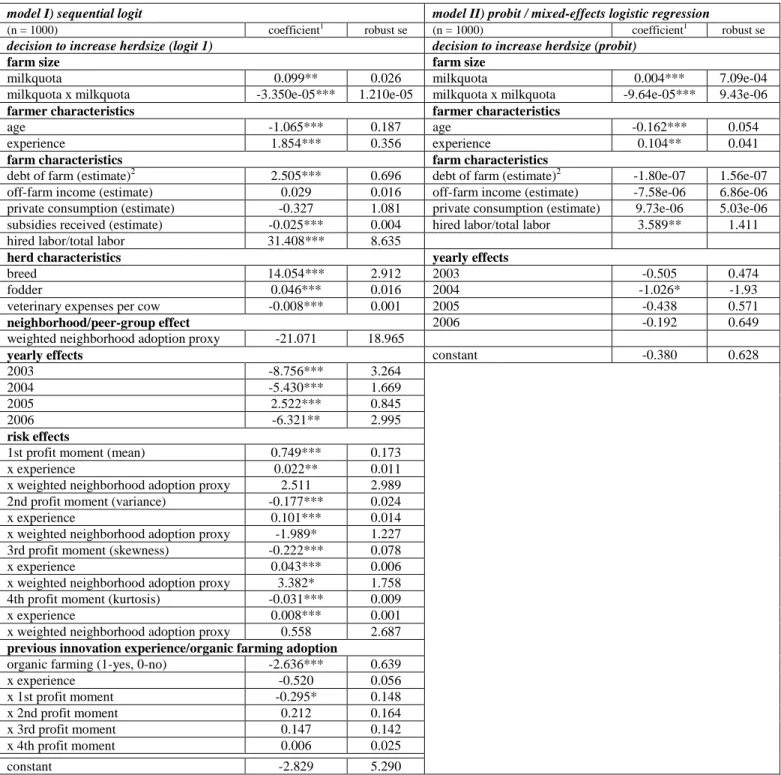
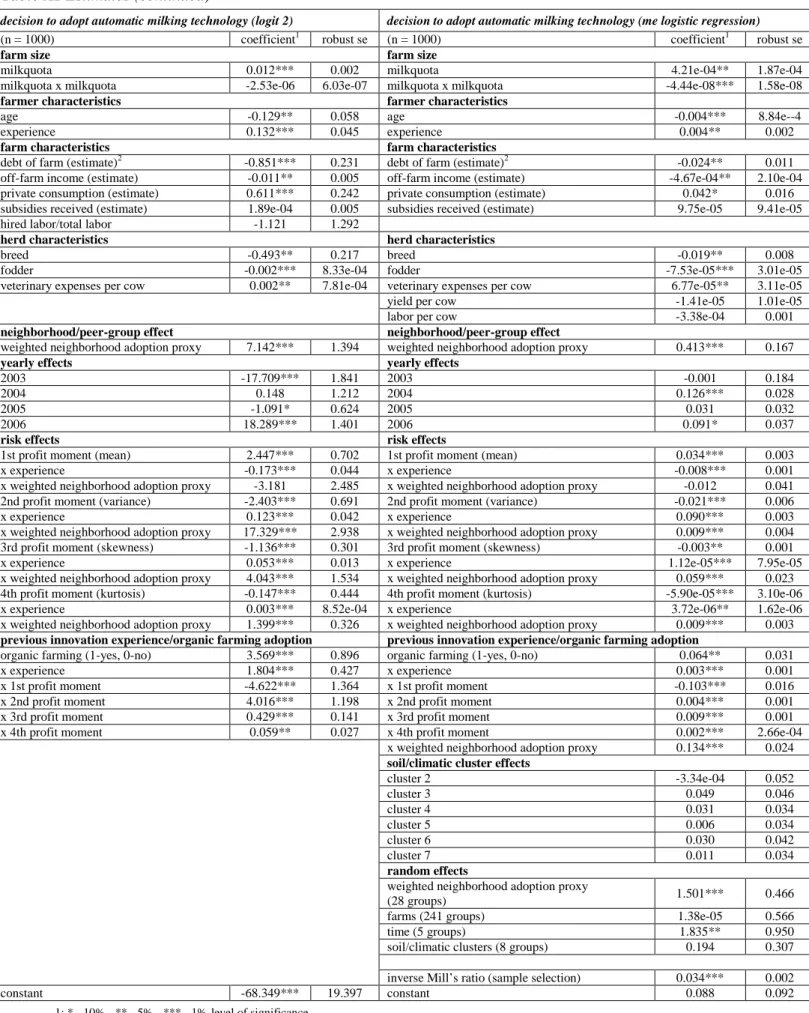
The overall quality of the four models estimated is largely satisfactory: The likelihood ratio and other diagnosis tests indicate no severe misspecification and the different alternative R-square measures show a high predictive power (due to space limitations only the estimates for the second version of the models are shown intable A1, other estimates can be obtained from the authors upon request). The models estimated show a high consistency with respect to the individual parameter coefficients and their significance which suggests robust empirical results. With respect to the decision to adopt the AMS technology all models show a positive and significant influence of the scale of milk production, a negative and significant effect of the farmer’s age but a positive significant effect of farming experience. With respect to farm characteristics the overall debt of the farm and the amount of off-farm income have a negative effect on the probablity of adopting the new milking technology. On the other hand, the amount of private consumption showed to have a significantly positive effect on the adoption
probability. With respect to herd characteristics, we found a negative and significant effect of the amount of fodder used but a positive and significant effect of veterinary expenses per cow. These results confirm earlier findings with respect to the scale of the production - larger dairy farms are more likely to adopt new technology - and the importance of the farmer’s age and education - younger and better educated dairy farmers are more likely to adopt new technology (see Putler and Zilberman 1988, Foltz and Chang 2002, Barham et al. 2004). However, the finding that farming experience influences the probability of AMS adoption is somehow
contradictory but could be explained by the measurement of the variable as the number of years operating the current farm. Hence, farmers tend to aquire a certain level of learning-by-doing with respect to the current milking technology before they decide to switch to a new milking technology. A soft budget constraint could explain the negative effect of the dairy farm’s off-farm income on the probability of adopting the AMS technology: the off-farm is able to operate with a less productive technology for a longer time span. Putler and Zilberman (1988) on the other hand stress the importance of nonfarming business for the adoption of new technology. Due to our findings farms at the negative as well as positive edge of financial risk management (i.e. high debt or high off-farm income) are less likely to adopt new technology. Dairy farms experiencing high veterinary costs per cow might consider a technology investment as a way to avoid sources of costly diseases by minimising the effects of human labor. In a working AM system, the animals are treated in the same way at each milking and the routines are predictable for the cows which increases milk production (Samuelson et al. 1993). This is consistent with findings that automatic milking does not increase the incidence of udder infections and SCC (Svennersten-Sjaunja and Pettersson 2008), findings that cow stress was not observed during automatic milking (Hagen et al. 2005), and findings that the milk cortisol level was not
increased in an automatic compared to a conventional system (Gygax et al. 2006). Contrary to prior reasoning by more technical studies on automatic milking (see e.g. DeKoning et al. 2003), the level of labor used per cow showed not to be of significance for the adoption decision. This could possibly be explained by the fact that farmers and other labor already operating on a relatively high level of labor productivity are those most interested in a further increase of their labor productivity by adopting such labor saving technology.
With respect to the farmers’ risk perceptions our analysis revelead the following: The first moment – expected profit – effects the technology adoption decision significantly positive, i.e. the higher the expected profit the higher the probability of AMS adoption. The second moment – profit variablility – showed to have a significant negative influence on the adoption
probability, i.e. the higher the probability of facing extreme profit gains or losses the lower the probability of AMS adoption. For the third moment – skewness of profit – again a significantly negative effect on the adoption decision has been found, i.e. the higher the downside profit risk the lower the probability of adopting the new milking technology. The fourth moment – kurtosis of profit – finally effects the probability of technology adoption also negative and this effect has been found to be significant. A higher kurtosis of the profit distribution means more of the variance is due to infrequent extreme deviations from the mean profit, as opposed to frequent modestly-sized milk profit deviations. These findings are generally in line with theoretical reasoning and previous empirical studies: Given the farmers’ general risk aversion and the uncertainty related to the profit developmeent after adoption Kim and Chavas (2003) and Koundori et al (2006) both conclude that the farmers’ decision to adopt a new technology is significantly effected by risk considerations. In addition to these results we found that the cross-effect of these risk proxies with farmers’ experience showed to significantly influence the farmers’ AMS adoption decision. We found that the experience of the farmer with the operation of the current business helped to adjust extreme profit expectations (first moment). This
confirms findings by Meijering et al. (2002) on the importance of realistic expectations with respet to AMS adoption. On the other hand, the farmer’s experience are found to decrease the farmer’s response to changes in the second to forth moment. These findings indicate that the more experienced the farmer is in terms of running the current milk business the less responsive he/she is to milk profit variance and infrequent milk profit deviations. Hence, the farmer’s probability of adopting a new milking technology to hedge against profit outlier activity increases (see also Koundori et al. 2006).
Time showed to have mixed but rather positive effects on the milking technology adoption decision for the farms in the sample. This could reflect the role of information accumulation and positive learning-by-doing effects in the relevant dairy farming community over time. The proxy for neighboring/peer-group effects showed to be positive and significant with respect to the
AMS adoption decision. In addition the cross effects with the risk proxis (second to fourth moment) were found to be also significantly positive, i.e. a decreasing negative effect of on farmer’s response to changes in milk profit variance, skewness and kurtosis. Hence, our results reveal that such social interaction effects decrease the individual farmer’s responsiveness to risk exposure and consequently increase the probability of new technology adoption. In our second modelling approach random effects were used to model unobservable factors related to such peer-group influences, but also to control for individual farm, time, or soil/climatic related effects. The estimates show a significant positive effect on the probability of adopting automatic milking technology by the neighbouring/peer-group based farm grouping and a significant positive effect by the time based farm grouping. Hence, we are able to empirically approximate such neighboring/peer-group effects based on social interaction and learning-by-doing in the wider peer-group. These findings are in line with, and even enforce, the findings by Baerenklau (2005) and others: Peer-group based spillover effects as well as “bandwagon” effects generated by early adopters have an impact on the individual adoption decision. Studies on AMS
concluded that automatic milking is not only a new milking system, but rather a completely new management system, noneconomic factors such as lifestyle choices are at least as important as economic factors for the decision to adopt an automatic milking system (Hyde et al. 2007). Neighborhood /Peer-group effects play an important role with respect to the social diffusion of such lifestyle changes which can be considered as “social network externalities” and as a function of the total number of technology users. Such effects can be also due to pure “conformity preferences” by the dairy farmers producing ancillary benefits from social
acceptance (Baerenklau 2005). Our findings correspond to these conclusions by adding current empirical evidence on the importance of such “soft” factors for the adoption decision.
Finally, previous innovation experiences proxied by the adoption of organic farming practices in previous years showed to have a significant positive influence on the probability of adopting AMS technology. Further the cross-effects of such previous adoption experiences with overall
milk farming experience as well as with neighboring/peer-group externalities showed to have a positive impact on the adoption probability in the sample. Such cross fertilization significantly increases the probability of adopting the new milking technology. Such a significant positive effect on the probability of adopting AMS has been finally also found for the cross-terms of previous innovation experiences and the different risk proxies in the form of profit moments: Previous experiences with a successful technology adoption lead to an additional adjustment of extreme profit expectations (first moment) and, on the other hand, to an additional decrease in responsiveness to milk profit variance and infrequent profit deviations (second to fourth moment). Hence, the farmer’s probability of adopting a new milking technology to hedge against profit outlier activity increases as he/she has previous experiences with a successful technology adoption. These results somehow confirm previous studies on other livestock and dairy related technologies concluding in a higher adoption probability for farms having adopted complementary technologies before (Barham et al. 2004). Such experiences likely contribute to realistic expectations with respect to the adoption of AMS named by Meijering et al. (2002) as a key factor for a successful implementation of this new milking technology.
7. Conclusions
Using different quality response models this empirical study investigates factors for the adoption of a new milking technology at the farm level accounting for problems of sequential selection and behaviour identification. The results suggest the importance of the farmer’s risk perception, significant effects of peer-group behaviour, and a positive impact of previous innovation
experiences. These findings are relevant for policy or technology suppliers aiming to efficiently set incentives for an effective technology adoption. Neglecting to account for these effects can change the estimated subjective beliefs of possible adopters and thus the incentive to adopt the technology, as well. On the other hand, using relevant peer-groups to spread adoption related information can induce a faster technology diffusion. In addition, policy makers should consider
the importance of the farmer’s risk perception when designing economic instruments to foster technology adoption in order to adequately reflect risk reducing benefits by adopting the technology. Future research should focus on disentangling such unobservable effects based on social interaction by using large balanced panels to track individual farm behaviour before and after technology adoption.
References
ABDULAI, A.ANDHUFFMAN, W. 2005. The Diffusion of new Agricultural Technologies: The
Case of Crossbred-Cow Technology in Tanzania.American Journal of Agricultural Economics, 87: 645-659.
ABDULAI, A., MONNIN, P.,ANDGERBER, J. 2008. Joint Estimation of Information Acquisition
and Adoption of New Technologies under Uncertainty.Journal of International Development. 20: 437-451.
AGRESTI, A. 2002.Categorical Data Analysis, 2nd edn, Wiley-Interscience, Hoboken, NJ.
AGRESTIA., BOOTH, J.G., HOBERT, J.P.,ANDCAFFO, B. 2000. Random-effects modeling of
categorical response data.Sociological Methodology, 30: 27-80.
AN, M.Y.,ANDKIEFER, N.M. 1995. Local Externalities and Societal Adoption of Technologies.
Journal of Evolutionary Economics, 10: 1432-1386.
ANTLE, J. 1983. Testing the Stochastic Structure of Production: A Flexible Moment-Based
Approach.Journal of Business and Economic Statistics, 1: 192-201.
ANTLE, J. 1987. Econometric Estimation of Producers’ Risk Attitudes.American Journal of
Agricultural Economics, 69: 509-522.
ASTERBRO, T. 2003. Sunk Costs and the Depth and Probability of Technology Adoption.
Manuscript.Version 4/2003.
BAERENKLAU, K.A. 2005. Toward an Understanding of Technology Adoption: Risk, Learning,
and Nieghborhood Effects.Land Economics, 81: 1-19.
BAERENKLAU, K.ANDKNAPP, K.C. 2007. Dynamics of Agricultural Technology Adoption: Age
Structure, Reversibility, and Uncertainty.American Journal of Agricultural Economics, 89: 190-201.
BANERJEE, A. 1992. A Simple Model of Herd Behaviour.Quarterly Journal of Economics, 107:
797-817.
BARHAM, L.B., FOLTZ, J.D., JACKSON-SMITH, D.,ANDMOON, S. 2004. The Dybamics of
Agricultural Biotechnology Adoption: Lessons from rBST Use in Wisconsin, 1994-2001.
American Journal of Agricultural Economics, 86: 61-72.
BATES, D. 2007. lme4: Fit linear and generalized linear mixed-effects models.Manusrcipt.
Version 2007.
BERGLUND, I., PETTERSSON, G.,ANDSVENNERSTEN-SJAUNJA, K. 2002. Automatic Milking:
Effects on Somatic Cell Count and Teat End Quality.Livestock Production Science, 78: 115-124.
BESLEY, T.ANDCASE, A. 1997. Diffusion as a Learning Process. Staff Paper, Woodrow Wilson
School of Public and International Affairs, Princeton, N.J.: Princeton University.
BILLON, P.,ANDTOURNAIRE, F. 2002. Impact of Automatic Milking Systems on Milk Quality
and Farm Management: The French Experience.Proc. 1stNorth American Conference on Robotic Milking. Toronto, Canada.
BROCK, W.ANDDURLAUF, S. 2001. Interactions-Based Models, in:Handbook of Econometrics, Vol. 5., ed. Heckman, J.J., and Leamer, E.E., Amsterdam: Elsevier Science.
BUIS, M. 2009. The Consequences of Unobserved Heterogeneity in a Sequential Model.
Manuscript.Version 7/1/2009.
COLEMAN, J., CAMPBELL, E., HOBSON, J., MCPARLAND, J., MOOD, A., WEINFELD, F.,ANDYORK,
R. 1966.Equality of Education Opportunity. Washington D.C.: US Government Printing Office.
DEKONING, K., VANDERVORST, Y.ANDMEIJERING, A. 2002. Automatic Milking Experience and
Development in Europe, Proc. 1stNorth American Conference on Robotic Milking. Toronto, Canada.
DEKONING, K., SLAGHUIS, B.,ANDVANDERVORST, Y. 2003. Robotic milking and milk quality:
effects on bacterial counts, somatic cell counts, freezing point and free fatty acids.Italian Journal of Animal Science, 2: 291-299.
DIJKHUIZEN, A.A., HUIRNE, R.B.M., HARSH, S.B.,ANDGARDNER, R.W. 1997. Economics of
Robotic Application.Computers and Electronics in Agriculture, 17: 111-121.
DIXIT, A.K.,ANDPINDYCK, R.S. 1994.Investment Under Uncertainty. Princeton, N.J.: Princeton
University Press.
DRIDI, C.,ANDKHANNA, M. 2005. Irrigation Technology Adoption and Gains from Water Trading under Asymmetric Information.American Journal of Agricultural Economics, 87: 289-301.
DRUKKER, D. M.ANDGATES, R. 2006. Generating Halton Sequences using Mata.The Stata
Journal, 6: 214–228.
DURLAUF, S. 2003. Neighborhood Effects, in:Handbook of Urban and Regional Economics,
Vol. 4, Eds. Henderson, J.V., and Thisse, J.-F. Elsevier.
FEDER, G.ANDUMALI, D.L. 1993. The Adoption of Agricultural Innovations: A Review.
Technological Forecasting and Social Change, 43: 215-239.
FOLTZ, J.D.ANDCHANG, H.-H. 2002. The Adoption and Profitability of rBST of Connecticut
Dairy Farms.American Journal of Agricultural Economics, 84: 1021-1032.
FOSTER, A.ANDROSENZWEIG, M. 1995. Learning by Doing and Learning from Others: Human
Capital and Technical Change in Agriculture.Journal of Political Economy, 103: 1176-1209.
GREENE, W. 2000.Econometric Analysis. 5thEdition, Prentice-Hall.
GRILICHES, Z. 1957. Hybrid Corn: An Exploration in the Economics of Technological Change.
Econometrics, 25: 501-523.
GYGAX, L., NEUFFER, I., KAUFMANN, C., HAUSER, R.,ANDWECHSLER, B. 2006. Milk Cortisol
Concentration in Automatic Milking Systems compared with Auto-Tandem Milking Parlors.
Journal of Dairy Science, 89: 3447-3454.
HAGEN, K., LANGBEIN, J., SCHMIED, C., LEXER, D.,ANDWAIBLINGER, S. 2005. Heart Rate
Variability in Dairy Cows – Influences of Breed and Milking Systems.Physiological Behaviour, 85: 195-204.
HECKMAN, J.J. 1979. Sample Selection Bias as a Specification Error.Econometrics, 47:
153-161.
HEDECKER, D. 2003. A Mixed-Effects Multinomial Logistic Regression Model.Statistics in
Medicine, 22: 1433-1446.
HUBER, P. J. 1967. The Behavior of Maximum Likelihood Estimates under Nonstandard
Conditions,Proceedings of the Fifth Berkeley Symposium on Mathematical Statistics and Probability, Vol. I: 221-33.
HUFFMANN, W.E.ANDMERCIER, S. 1991. Joint Adoption of Microcomputer Technologies: An
Analysis of Farmers’ Decision.Review of Economics and Statistics, 73: 541-546. HYDE, J.ANDENGLE, P. 2002. Investing in a Robotic Milking System: A Monte Carlo Simulation Analysis.Journal of Dairy Science, 85: 2207-2214.
HYDE, J., DUNN, J.W., STEWARD, A.,ANDHOLLABAUGH, E.R. 2007. Robots Don’t Get Sick or
Get Paid Overtime, but Are They a Profitable Option for Milking Cows?Review of Agricultural Economics, 29: 366-380.
JENSEN, R. 1982. Adoption and Diffusion of an Innovation of Uncertain Profitability.Journal of Economic Theory, 27: 182-192.
JUSTESEN, P.ANDRASMUSSEN, M.D. 2000. Improvements of Milk Quality by the Danish AMS
Self Monitoring Programme.Proc. Int. Symposium Robotic Milking. Lelystad, The Netherlands.
KHANNA, M. 2001. Sequential Adoption of Site-Specific Technologies and its Implications for
Nitrogen Productivity: A Double Selectivity Model.American Journal of Agricultural Economics, 83: 35-51.
KIM, K.ANDCHAVAS, J.-P. 2003. Technological Change and Risk Management: An Application
to the Economics of Corn Production.Agricultural Economics, 29: 125-142.
KLUNGEL, G.H., SLAGHUIS, B.A.,ANDHOGEVEEN, H. 2000. The Effect of the Introduction of
Automatic Milking Systems on Milk Quality.Journal of Dairy Science, 83: 1998-2003.
KOCHAN, A. 2004. Robots Provide 24/7 Milking Service for Cows.Industrial Robot: An
International Journal, 31: 396-400.
KOUNDOURI, P., NAUGES, C.,ANDTZOUVELEKAS, V. 2006. Technology Adoption under
Production Uncertainty: Theory and Application to Irrigation Technology.American Journal of Agricultural Economics, 88: 657-670.
LINDNER, R., FISCHER, A.,ANDPARDEY, P. 1979. The Time to Adopt.Economics Letters, 2:
187-190.
MANSKI, C. 1993. Identification of Endogenous Social Effects: The Reflection Problem.Review
of Economic Studies, 60: 531-542.
MATHIJS, E. 2004. Socio-Economic Aspects of Automatic Milking, in:Automatic Milking, eds.
Maijering, A., Hogeveen, H., and DeKoning, C.J.A.M., Wageningen, The Netherlands.
MCWILLIAMS, B.ANDZILBERMAN, D. 1996. Time of Technology Adoption and Learning by
Using.Economics of Innovation and New Technology. 4: 139-154.
MEIJERING, A., VONDERVORST, Y.,ANDDEKONING, K. 2002. Implications of the Introduction of
Automatic Milking on Dairy Farms,Proc. Int. Symposium Robotic Milking. Lelystad, The Netherlands.
MORENO, G.ANDSUNDING, D.L. 2005. Joint Estimation of Technology Adoption and Land
Allocation with Implications for the Design of Conservation Policy.American Journal of Agricultural Economics, 87: 1009-1019.
PENROSE, E.T. 1959.The Theory of the Growth of the Firm. New York: Wiley.
PUTLER, D.S.ANDZILBERMAN, D. 1988. Computer Use in Agriculture: Evidence from Tulare
County, California.American Journal of Agricultural Economics, 70: 790-802.
RASMUSSEN, M.D., BJERRING, M., JUSTESEN, P.,ANDJEPSEN, L. 2002. Milk Quality on Danish
Farms with Automatic Milking Systems.Journal of Dairy Science, 85: 2869-2878.
ROSENBERG, N. 1982.Inside the Black Box: Technology and Economics.Cambridge:
Cambridge University.
ROTZ, C.A., COINER, C.U.ANDSODER, K.J. 2003. Automatic Milking Systems, Farm Size, and Milk Production.Journal of Dairy Science, 86: 4167-4177.
SAMUELSSON, B., WAHLBERG, E.,ANDSVENNERSTEN, K. 1993. The Effect of Feeding during
Milking on Milk Production and Milk Flow.Swedish Journal of Agricultural Research. 23: 101-106.
SCHELLING, T. 1971. Dynamic Models of Segregation.Journal of Mathematical Sociology1:
143-186.
SCHICK, M., VOLET, M.-R.,ANDKAUFMANN, R. 2000. Modelling of time requirements and
milking capacity in
automatic milking systems with one or two milking stalls, in:Robotic milking. Eds. Hogeveen, H. and Meijering, A. Wageningen Pers, Wageningen, The Netherlands.
SMALE, M., JUST, R.E.,ANDLEATHERS, H.D. 1994. Land Allocation in HYV Adoption Models:
An Investigation of Alternative Explanations.American Journal of Agricultural Economics,76: 535-546.
SMITH, A., MORRISONPAUL, C.J., GOE, R.,ANDKENNEY, M. 2004. Computer and Internet Use by Great Plains Farmers. Working Paper No. 04-010, University of California at Davis, US.
SPERONI, M., PIRLO, G.,ANDLOLLI, S. 2002. Effect of Automatic Milking Systems on Milk
Yield in a Hot Environment.Journal of Dairy Science, 89: 4687-4693.
SUNDING, D.ANDZILBERMAN, D. 2001. The Agricultural Innovation Process: Research and
Technology Adoption in a Changing Agricultural Sector, in:Handbook of Agricultural Economics. Eds. Gardner, B.L., and Rausser, G. New York: Elsevier.
SVENNERSTEN-SJAUNJA, K.M.ANDPETTERSSON, G. 2008. Pros and Cons of Automatic Milking
in Europe.Journal of Animal Science, 86: 37-46.
SVENNERSTEN-SJAUNJA, K.M., BERGLUND, I.,ANDPETTERSSON, G. 2000. The Milking Process
in an Automated Milking System. Evaluation of Milk Yield, Teat Condition and Udder Heath.
Proc. Int. Symposium Robotic Milking. Lelystad, The Netherlands.
TRAIN, K.E. 2003.Discrete choice methods with simulation, Cambridge University Press,
Cambridge.
WAGNER-STORCH, A.M.,ANDPALMER, R.W. 2003. Feeding Behaviour, Milking Behaviour, and
Milk Yields of Cows Milked in a Parlor versus Automatic Milking Systems.Journal of Dairy Science, 86: 1494-1502.
WHITE, H. 1980. A Heteroscedasticity-Consistent Covariance Matrix Estimator and a Direct Test for Heteroscedasticity.Econometrica, 48: 817-838.
MCBRIDE, W. D., SHORT, S.,ANDEL-OSTA, H. 2004. The Adoption and Impact of Bovine
Somatotropin on U.S. Dairy Farms.Review of Agricultural Economics, 26: 472-488.
YARON, D., DINAR, A.,ANDVOET, D. 1992. Innovations on Family Farms: The Nazareth Region
in Israel.American Journal of Agricultural Economics,74: 361-370.
Acknowledgements
This research has been conducted when the first author was a visiting scholar in the ARE Department at UC Berkeley. Funding for this research was provided by the British Academy (SG-48134). The authors are grateful to Jakob Vesterlund Olsen, Landscentret, Skejby, Denmark for making the data available. Further we are grateful to Prof. Svend Rasmussen, Copenhagen, Denmark and Prof. Hartley Furtan, Saskatoon, Canada for initial discussions.
Appendix
Table A1 Estimates
1: * - 10%-, ** - 5%-, *** - 1%-level of significance.
2: due to likley endogeneity the estimates for those variables based on a instrumental variables regression procedure (IV) are used.
model I) sequential logit model II) probit / mixed-effects logistic regression
(n = 1000) coefficient1 robust se (n = 1000) coefficient1 robust se
decision to increase herdsize (logit 1) decision to increase herdsize (probit)
farm size farm size
milkquota 0.099** 0.026 milkquota 0.004*** 7.09e-04
milkquota x milkquota -3.350e-05*** 1.210e-05 milkquota x milkquota -9.64e-05*** 9.43e-06
farmer characteristics farmer characteristics
age -1.065*** 0.187 age -0.162*** 0.054
experience 1.854*** 0.356 experience 0.104** 0.041
farm characteristics farm characteristics
debt of farm (estimate)2 2.505*** 0.696 debt of farm (estimate)2 -1.80e-07 1.56e-07
off-farm income (estimate) 0.029 0.016 off-farm income (estimate) -7.58e-06 6.86e-06
private consumption (estimate) -0.327 1.081 private consumption (estimate) 9.73e-06 5.03e-06
subsidies received (estimate) -0.025*** 0.004 hired labor/total labor 3.589** 1.411
hired labor/total labor 31.408*** 8.635
herd characteristics yearly effects
breed 14.054*** 2.912 2003 -0.505 0.474
fodder 0.046*** 0.016 2004 -1.026* -1.93
veterinary expenses per cow -0.008*** 0.001 2005 -0.438 0.571
neighborhood/peer-group effect 2006 -0.192 0.649
weighted neighborhood adoption proxy -21.071 18.965
yearly effects constant -0.380 0.628
2003 -8.756*** 3.264
2004 -5.430*** 1.669
2005 2.522*** 0.845
2006 -6.321** 2.995
risk effects
1st profit moment (mean) 0.749*** 0.173
x experience 0.022** 0.011
x weighted neighborhood adoption proxy 2.511 2.989
2nd profit moment (variance) -0.177*** 0.024
x experience 0.101*** 0.014
x weighted neighborhood adoption proxy -1.989* 1.227
3rd profit moment (skewness) -0.222*** 0.078
x experience 0.043*** 0.006
x weighted neighborhood adoption proxy 3.382* 1.758
4th profit moment (kurtosis) -0.031*** 0.009
x experience 0.008*** 0.001
x weighted neighborhood adoption proxy 0.558 2.687
previous innovation experience/organic farming adoption
organic farming (1-yes, 0-no) -2.636*** 0.639
x experience -0.520 0.056 x 1st profit moment -0.295* 0.148 x 2nd profit moment 0.212 0.164 x 3rd profit moment 0.147 0.142 x 4th profit moment 0.006 0.025 constant -2.829 5.290
Table A1 Estimates (continued)
decision to adopt automatic milking technology (logit 2) decision to adopt automatic milking technology (me logistic regression)
(n = 1000) coefficient1 robust se (n = 1000) coefficient1 robust se
farm size farm size
milkquota 0.012*** 0.002 milkquota 4.21e-04** 1.87e-04
milkquota x milkquota -2.53e-06 6.03e-07 milkquota x milkquota -4.44e-08*** 1.58e-08 farmer characteristics farmer characteristics
age -0.129** 0.058 age -0.004*** 8.84e--4
experience 0.132*** 0.045 experience 0.004** 0.002
farm characteristics farm characteristics
debt of farm (estimate)2 -0.851*** 0.231 debt of farm (estimate)2 -0.024** 0.011
off-farm income (estimate) -0.011** 0.005 off-farm income (estimate) -4.67e-04** 2.10e-04 private consumption (estimate) 0.611*** 0.242 private consumption (estimate) 0.042* 0.016 subsidies received (estimate) 1.89e-04 0.005 subsidies received (estimate) 9.75e-05 9.41e-05 hired labor/total labor -1.121 1.292
herd characteristics herd characteristics
breed -0.493** 0.217 breed -0.019** 0.008
fodder -0.002*** 8.33e-04 fodder -7.53e-05*** 3.01e-05
veterinary expenses per cow 0.002** 7.81e-04 veterinary expenses per cow 6.77e-05** 3.11e-05 yield per cow -1.41e-05 1.01e-05 labor per cow -3.38e-04 0.001 neighborhood/peer-group effect neighborhood/peer-group effect
weighted neighborhood adoption proxy 7.142*** 1.394 weighted neighborhood adoption proxy 0.413*** 0.167
yearly effects yearly effects
2003 -17.709*** 1.841 2003 -0.001 0.184
2004 0.148 1.212 2004 0.126*** 0.028
2005 -1.091* 0.624 2005 0.031 0.032
2006 18.289*** 1.401 2006 0.091* 0.037
risk effects risk effects
1st profit moment (mean) 2.447*** 0.702 1st profit moment (mean) 0.034*** 0.003 x experience -0.173*** 0.044 x experience -0.008*** 0.001 x weighted neighborhood adoption proxy -3.181 2.485 x weighted neighborhood adoption proxy -0.012 0.041 2nd profit moment (variance) -2.403*** 0.691 2nd profit moment (variance) -0.021*** 0.006
x experience 0.123*** 0.042 x experience 0.090*** 0.003
x weighted neighborhood adoption proxy 17.329*** 2.938 x weighted neighborhood adoption proxy 0.009*** 0.004 3rd profit moment (skewness) -1.136*** 0.301 3rd profit moment (skewness) -0.003** 0.001 x experience 0.053*** 0.013 x experience 1.12e-05*** 7.95e-05 x weighted neighborhood adoption proxy 4.043*** 1.534 x weighted neighborhood adoption proxy 0.059*** 0.023 4th profit moment (kurtosis) -0.147*** 0.444 4th profit moment (kurtosis) -5.90e-05*** 3.10e-06 x experience 0.003*** 8.52e-04 x experience 3.72e-06** 1.62e-06 x weighted neighborhood adoption proxy 1.399*** 0.326 x weighted neighborhood adoption proxy 0.009*** 0.003 previous innovation experience/organic farming adoption previous innovation experience/organic farming adoption
organic farming (1-yes, 0-no) 3.569*** 0.896 organic farming (1-yes, 0-no) 0.064** 0.031
x experience 1.804*** 0.427 x experience 0.003*** 0.001
x 1st profit moment -4.622*** 1.364 x 1st profit moment -0.103*** 0.016 x 2nd profit moment 4.016*** 1.198 x 2nd profit moment 0.004*** 0.001 x 3rd profit moment 0.429*** 0.141 x 3rd profit moment 0.009*** 0.001 x 4th profit moment 0.059** 0.027 x 4th profit moment 0.002*** 2.66e-04
x weighted neighborhood adoption proxy 0.134*** 0.024 soil/climatic cluster effects
cluster 2 -3.34e-04 0.052 cluster 3 0.049 0.046 cluster 4 0.031 0.034 cluster 5 0.006 0.034 cluster 6 0.030 0.042 cluster 7 0.011 0.034 random effects
weighted neighborhood adoption proxy
(28 groups) 1.501*** 0.466
farms (241 groups) 1.38e-05 0.566 time (5 groups) 1.835** 0.950 soil/climatic clusters (8 groups) 0.194 0.307 inverse Mill’s ratio (sample selection) 0.034*** 0.002
constant -68.349*** 19.397 constant 0.088 0.092
1: * - 10%-, ** - 5%-, *** - 1%-level of significance.