Use and Non-Use of
Performance Information
in the Public Sector
Scratching beneath the surface
TOMI RAJALA
Tampere University Dissertations 343
TOMI RAJALA
Use and Non-Use of Performance Information
in the Public Sector
Scratching beneath the surface
ACADEMIC DISSERTATION To be presented, with the permission of the Faculty of Management and Business
of Tampere University,
for public discussion in the Paavo Koli auditorium of the Pinni A building, Kanslerinrinne 1, Tampere,
ACADEMIC DISSERTATION
Tampere University, Faculty of Management and Business Finland
Responsible Professor Jarmo Vakkuri
supervisor Tampere University
and Custos Finland
Pre-examiners Wouter Van Dooren Åge Johnsen
University of Antwerp Oslo Metropolitan University Belgium Norway
Opponent Wouter Van Dooren
University of Antwerp Belgium
The originality of this thesis has been checked using the Turnitin OriginalityCheck service.
Copyright ©2020 author
Cover design: Roihu Inc.
ISBN 978-952-03-1769-0 (print) ISBN 978-952-03-1770-6 (pdf) ISSN 2489-9860 (print) ISSN 2490-0028 (pdf)
Acknowledgements
Stories always have a starting point. The journey toward completion of this dissertation began in 2014 while I was at Statistics Finland. My phone rang, and I walked down the corridor to an empty conference room where time was frozen in the furniture that reflected the stylistic preferences of previous decades. I remember the situation, including the furniture, vividly, as it was a significant turning point in my life. That phone call initiated the dissertation process and my life as researcher. I would like to thank my supervisor, Jarmo Vakkuri, for that rather surprising call and the numerous conversations that followed, without which there would be no dissertation, and for lending me so many fascinating books that I may have sometimes forgotten to return in time. Thanks are also given to my pre-examiners, Wouter Van Dooren and Åge Johnsen, for their helpful comments that significantly helped to propel the work forward toward the end. Special thanks to Wouter for agreeing to act as an opponent in my thesis defense.
As a researcher, it became evident that writing a dissertation was a long and winding process. It was not always enjoyable, but sometimes the most painful moments afford the best life lessons. During moments of pain, individuals face questions such as “Who am I” and “What do I want to become?” When recalling warmer memories, the road to completion of my dissertation involved many “sunny moments” and beautiful sunsets as I tended to work in the evenings and night shifts. At best, conducting research transported me into a flow-like state where my excitement was mixed with an insatiable curiosity about the way in which the world worked. On some days, I rushed to my computer because I was so motivated to write down new thoughts. Now, when reflecting on the process, it seems that my writing operated as a gateway to humanity and my inner world. It invariably involved a rollercoaster of emotions. Ultimately, I learned the most about myself and my limits.
My new life as a researcher included meeting interesting members of the work community who helped me to familiarize myself with academic life and its practices. Various members of this community deserve my gratitude; they include Anna, Lotta-Maria, Eija, Lasse, Jaakko, Harri, Ulriika, Kirsi, Kristiina, and Anniina, and the friendly faces at the Faculty of Business and Management, such as Selene, Heli and Aino. Harri is thanked for organizing a dialogue project, which was both fun and productive; house band, JKK, is thanked for its seamless groove and Lotta-Maria for our mutual hobby of observing the behavior of local politicians in their natural surroundings.
pulled me out from the world of research to do something completely different from time to time; it promoted my well-being. I would also like to thank Paavo, Jussi, and Eero for long tennis court rallies over the years. Recognition must be given to Netu for its considerable team spirit over the years. I received great tips and enjoyed many jokes about municipalities from Erki, Hööki, Setä, Ylli, Jesse, and Eino. Having a laugh every now and then was extremely relaxing.
Maria, who walked with me in my journey to adulthood and academic life, deserves similar acknowledgement. Besides the importance of peer support, I learned about the importance of holistic well-being from Maria. I probably owe her forever as it is difficult to offer equally valuable advice in return. I hope she does not mind. Thanks to Viljo for his charming friendship, Hugo for reminding me of the value of time spent together, and Kirsti for her offer of a fantastic place to rest in beautiful scenery near Lake Näsijärvi. I would also like to thank Hessu, Jutta, and the Kirjavainen family for breaking bread with me on many occasions. As one cannot live solely on scientific knowledge, it was wonderful to eat delicious food in good company.
My older sister paved the way for my attendance at university, and I inherited my interest in municipal affairs from my grandfather, Arvo. I am very grateful for my sister for helping me out with my Bachelor’s and Master’s theses and for giving me invaluable tips on life at university. In many ways, she was a remarkable role model who showed me to how to take greater responsibilities. It was a pleasure to follow the growth of Ella and Linnea and see how their board game skills developed! Karri needs to be thanked for his tips on state-of art technology as they inspired me to adopt productive software applications for my academic work, and Kamu is thanked for waving his tail every time we met.
I am grateful to my mother who provided me with numerous opportunities to exercise my creativity. I do not take for granted that I had multiple opportunities to play different instruments at home because my mother encouraged me to do so. The pre-examiners stated that a strong point of my work was its creative approach. There is no doubt that my creativity was sourced in my musical practice sessions at home, years before I even dreamed of writing a dissertation. I would also like to thank my father for always helping me out in times of trouble and for introducing me to different hobbies when I was young. Taking part in those hobbies taught me invaluable lessons about team spirit and the “ups” and “downs” of life.
Inkeri’s family members have my gratitude for taking me into their lives. Lastly, I would like to thank Inkeri; your eyes are the sunshine in my life early in the morning and late at night. The warmth of your smile supported me throughout the writing process. Without doubt, your positivity is rare and intoxicating and is immeasurably invaluable to me.
As a final remark, I would like to dedicate this dissertation to those who are willing to learn lessons about the world from it. This work was written for you, wherever you may roam.
In Tampere, Tomi Rajala
Esipuhe
Tarinat alkavat aina jostakin. Tämän väitöskirjan tarina alkoi vuonna 2014 Tilastokes-kuksessa. Puhelimeni soi ja kävelin käytävältä tyhjillään olevaan neuvotteluhuoneeseen, jossa aika oli pysähtynyt kalusteiden perusteella menneille vuosikymmenille. Muistan ti-lanteen ehkä liiankin elävästi huonekaluja myöten, sillä se oli iso käännekohta elämässäni. Tuo puhelu aloitti prosessin kohti tämän väitöskirjan valmistumista. Tuon puhelun muka-na tuli tutkijan elämä, josta olen sittemmin huomannut pitäväni kovasti.
Aikoinaan tuon puhelun minulle soitti väitöskirjani ohjaaja Jarmo Vakkuri. Kiitokset tuosta yllättävästä puhelusta ja sen jälkeisistä lukuisista keskusteluista! Ilman niitä ei oltaisi tässä hetkessä laittamassa viimeistä pistettä väitöskirjaani. Ja kiitokset myös kiehtovista kirjoista, jotka olen saattanut toisinaan unohtaa palauttaa ajallaan takaisin. Väitöskirjan valmistumisesta on syytä lisäksi kiittää esitarkastajiani Wouter Van Doorenia ja Åge Johnsenia, jotka ovat avittaneet merkittävästi työn eteenpäin viemistä loppumetreillä. Erityiskiitokset Wouterille suostumuksesta toimia vastaväittäjänä.
Tutkijan elämän mukana tuli myös kiinnostava työyhteisö, joka on auttanut minua perehtymään monipuolisesti akateemisen maailman saloihin. Kiitokset tästä kuuluvat Annalle, Lotta-Marialle, Eijalle, Lasselle, Jan-Erikille, Jaakolle, Harrille, Ulriikalle, Kirsille, Kristiinalle, Anniinalle sekä muille ystävällisille kasvoille johtamisen ja talouden tiedekunnan henkilöstössä, kuten Selenelle, Helille ja Ainolle. Olen oppinut teiltä paljon tällä matkalla ja toivon mukaan tulen vielä oppimaankin paljon. Erityiskiitokset Harrille mukavasta ja naurun täyteisestä dialogihankkeesta ja JKK house bändille svengaavasta menosta. Lotta-Mariaa täytyy kiittää yhteisestä havainnointiharrastuksesta, jossa on bongailtu kunnanvaltuutettujen touhuja.
Mitä tulee itse tutkijan työhön, niin ainakin väitöskirjan tekeminen on ollut pitkä ja tuulinen matka. Aina ei ole ollut kivaa, mutta toisinaan kivuliaimmat hetket ovat parhaimpia oppitunteja elämästä. Noina hetkinä usein joutuu kysymään, kuka oikein on ja mitä elämältään haluaa. Käännettäessä katse mukavampiin muistoihin matkan varrelta tulvii mieleen aurinkoisia hetkiä ja hienoja auringonlaskuja ikuiselle ilta- ja yövuorolaiselle. Parhaimmillaan tutkimuksen tekeminen on ollut tiedehurmosta, jossa sekoittuu pienen ihmisen innostus ja kyltymätön uteliaisuus maailmanmenoa kohtaan. Olenpa joskus juossut töiden pariin ajatusten pakottaessa nopeasti kirjoittamaan. Nyt, kun katson ajassa taaksepäin prosessia kokonaisuutena, näyttäytyy kirjoitustyö tunteiden vuoristoratana, ikkunana ihmisyyteen ja peilinä ennen kaikkea omaan sisimpään. Pitkällä tutkimusmatkallani eniten taisin lopulta oppia itsestäni ja omista rajoistani.
Aikojen saatossa olen huomannut, että tieteellinen työni ei olisi puoliksikaan niin hyvää, ellei minulla olisi ollut ympärilläni niin hienoja ja omalaatuisia ihmisiä. Erityisen mukavaa on ollut, että Mikko, Joni ja Petri perheineen ovat aika ajoin vetäneet minut pois tutkimuksen syövereistä aivan muihin puuhiin. Se on ollut tervettä. Vuosikausia kestäneistä palloralleista on syytä muistaa kiittää Paavoa, Jussia sekä Eeroa. Netulle on syytä antaa tunnustusta hienosta joukkuehengestä vuosien varrelta. Parhaat kuntanaurut ja -vinkit on jo pitkään toimittanut Erki, Hööki, Setä, Ylli, Jesse ja Eino. Nauru tekee hyvää ihmiselle.
Marialle kumarran kiitokseksi yhteisestä taipaleesta aikuisuuteen ja akateemisuuteen. Tärkeän vertaistuen lisäksi omaksuin sinulta vaalimisen arvoisia ajatuksia siitä, mistä rakentuu ihmisen kokonaisvaltainen hyvinvointi elämässä. Noista opeista jäänen velkaa sinulle, ja en taida noin arvokkaita neuvoja pystyä koskaan maksamaan takaisin. Toivottavasti se ei haittaa. Kiitokset Viljolle valloittavasta kaveruudesta ja Hugolle ajan arvokkuuden oppitunnista. Kirstille iso kiitos hengähdyshetkistä kuvan kauniin Näsijärven rannalla ja Hessulle, Jutalle sekä Kirjavaisille yhteisistä leivänmurtamisen hetkistä. Pelkällä tieteellä ei elä, joten välillä on hyvä syödä eväitä hyvässä seurassa.
Isosiskoni Kati aurasi minulle tietä yliopistoon siinä missä Arvo-papalta taisi tulla verenperintönä kiinnostus kunta-asioihin. Olen hyvin kiitollinen siskolleni avusta opinnäytetöiden kanssa ja pelivinkeistä akateemiseen maailmaan. Olet ollut monella tapaa hyvä esikuva maailmalle ponnistamisessa. Ella ja Linnea, on ollut ilo seurata teidän kasvamistanne ja lautapelitaitojen kehittymistänne. Karrille kiitos aina ajankohtaisista teknologiavinkeistä, joiden takia olen innostunut käyttämään erilaisia varsin hyödyllisiä applikaatioita työssäni. Kamulle kiitos lukuisista hännän heilutuksista. Äitiäni haluan kiittää luovuuteni ruokkimisesta jo pienestä pitäen. Ei ole itsestäänselvyys, että saa soitella kaiken maailman soittimia aamusta iltaan saman katon alla. Arvioitsijoiden mukaan väitöskirjan luovuus oli yksi sen vahvoista puolista, joten erilaiset luovuusharjoitukset ovat selkeästi valmentaneet minua tätä väitöskirjaprosessia varten jo kauan ennen kuin se alkoikaan. Isääni kiitän siitä, että hän on aina auttanut minua ja vienyt minua nuorena tärkeisiin harrastuksiin, joissa on ollut oiva sauma oppia ihmiselon käänteitä ja joukkuepelaamista. Inkerin perhettä haluan kiittää heidän maailmansa avaamisesta minulle.
Viimeisenä haluan kiittää Inkeriä. Inkeri, sinun silmäsi ovat olleet päivänsäteeni aamuisin ja ilta-aurinkoni iltaisin. Hymysi lämpö on toivottanut minulle sekä hyvää yötä että huomenta pitkin tätä ajatus- ja kirjoitusprosessia. Positiivisuutesi on eittämättä harvinaista ja juovuttavaa eliksiiriä. Se on ollut mittaamattoman korvaamatonta minulle.
Näin lopuksi haluan todeta, että työni omistan niille, jotka haluavat antaa sille mahdollisuuden opettaa heille jotakin maailmasta. Kaikkia teitä varten tämä työ on kirjoitettu, missä sitten ikinä olettekaan.
Irjalan Karibialla
Abstract
Life in the information age includes encountering vast amounts of information. The era reflects how much time is being used for creating, processing, sharing, storing, and using information. In this flood of information, separating facts from fiction is not an easy task; neither is deciding what information should be used. Indeed, there is counter knowledge or fake news, and then there is knowledge that is either usable—or not. In the context of the public sector, fact checking and defining usable information is also part of everyday life, and problems in information use are as evident as they are in the surrounding society. The problematic nature of information use is the main source of inspiration for this thesis, which narrows its focus to the following research question: What reasons stimulate the use and non-use of public sector performance information?
This research question is not a new one, but it deserves revisiting because current theories of performance information use in the field of public management and administration are lacking in terms of coverage and cohesion. The coverage is lacking because the current research has largely neglected the non-use of performance information and the ambiguity associated with factors driving performance information use. Moreover, the studies have not dealt in depth with how intertwined these factors are. Therefore, this work attempts to broaden the current theory by examining the neglected research areas. Additionally, cohesion in the study field is lacking because there is no agreed-upon common theoretical ground for studies investigating performance information use in the public sector. Consequently, the researchers have adopted a wide variety of theories in a rather idiosyncratic manner, and this has created a disconnected stage where studies on performance information use do not have a common theoretical background that would be easy to identify. This disconnected stage affects the ability to aggregate the results and makes it difficult to see the big picture describing the current knowledge on performance information use in the public sector.
The thesis at hand is based on pragmatism, and it applies a mixed-method and interdisciplinary approach to construct a theoretical framework joining the disconnected studies. According to this framework, the reasons for performance information use relate to individual factors (i.e., demographic attributes, mental models, and power) and contextual factors (i.e., social pressures, information provider, information channel, and features of information). The four articles that are part of the thesis confirm the applicability of the framework and expanded the current theories of performance information use. As an implication, this thesis offers an archive of reasons that practitioners can use to understand and enhance performance information use. For scholars, the study opens new doors to expand the current theories of performance information use. These opportunities relate to
Tiivistelmä
Elämä tietoyhteiskunnassa pitää sisällään suurien tietomassojen parissa toimimista. Aikakautta kuvastaa se, että tiedon luomiseen, prosessointiin, jakamiseen, säilyttämiseen ja käyttöön uhrataan paljon aikaa. Tässä informaatiotulvassa faktojen ja fiktion erottaminen ei aina ole helppoa. Vaikeita ovat myös päätökset siitä, mitä tietoa tulisi käyttää. Vaihtoehtoiset faktat, valeuutiset ja vaikeudet erottaa hyödyllinen tieto hyödyttömästä hankaloittavat omalta osaltaan tiedonkäyttöä. Ei olekaan ihme, että julkisen sektorin toiminnassa faktojen tarkastuksesta sekä käyttökelpoisen tiedon määrittelystä on tullut osa arkea, kuten myös hankaluuksista määrittää hyödyllinen tieto. Tiedonkäytön hankaluudet ovat tämän väitöskirjan suurin inspiraationlähde, sillä työ keskittyy tarkastelemaan sitä, mitkä syyt motivoivat tulostietojen tiedonkäyttöä ja tiedon käyttämättä jättämistä julkisella sektorilla.
Tutkimuskysymys ei ole uusi kansainvälisessä tutkimuksessa, mutta siihen on hyvä palata, koska nykyteoriat aiheesta kärsivät sekä koheesion puutteesta että kattavuuden katvealueista. Koheesion puuttumisella viitataan siihen, että tuloksellisuuden johtamisen tutkimuskentässä ei ole selkeää yhteistä ja yleisesti hyväksyttyä teoriapohjaa, johon tehdyt tutkimukset voisivat kiinnittyä. Tutkimusten teoreettiset taustat ovatkin olleet idiosynkraattisia. Koheesion puute on heikentänyt tutkijoiden kykyä aggregoida ja integroida tutkimustuloksia, jolloin kokonaiskuva tuloksellisuustietojen käytöstä julkisella sektorilla on jäänyt pimentoon. Teorioiden kattavuudessa on parantamisen varaa, koska tiedon käyttämättä jättämisen syyt ovat saaneet liian vähän huomiota ja monitulkintaisuus sekä päällekkäisyys tiedonkäytön syissä on jäänyt suurelta osin tunnistamatta. Tämä tutkimus yrittää laajentaa tulostietojen käytön tutkimusta näiden laiminlyötyjen osa-alueiden tutkimisen avulla.
Väitöskirja on luonteeltaan poikkitieteellinen monimenetelmätutkimus, joka pohjautuu pragmatismiin tieteenfilosofisena suuntauksena. Työn tarkoituksena on luoda holistinen teoreettinen viitekehys tuloksellisuustietojen käytön ja käyttämättä jättämisen syistä. Tutkimuksessa luotu teoreettinen viitekehys ehdottaa tiedonkäytön tai käyttämättä jättämisen syiksi yhteen kietoutuneita yksilö- ja kontekstitekijöitä. Tarkemmin jaoteltuna yksilötekijät muodostuvat demografisista muuttujista, mentaalimalleista ja vallasta. Kontekstitekijät viittaavat sosiaaliseen paineeseen, informaation tuottajaan, informaatiokanavaan ja informaation ominaisuuksiin. Väitöskirja koostuu teoreettisen viitekehyksen luovasta johdannosta sekä neljästä artikkelista, jotka testaavat ja kehittävät luotua viitekehystä. Tutkimustulokset tarjoavat käytännöntoimijoille kattavan kokoelman
syitä, joiden avulla voidaan paremmin ymmärtää sekä edistää tulostietojen käyttöä julkisella sektorilla. Tutkijoille väitöskirja tarjoaa uusia tutkimuspolkuja, joita kulkemalla voi tulevaisuudessa pyrkiä laajentamaan ymmärrystämme tulostietojen käytöstä. Nämä tutkimuspolut liittyvät tiedon käyttämättä jättämisen arvoon sekä monitulkintaisuuteen tiedonkäytön syissä.
List of original publications
I Rajala T., Laihonen H., Vakkuri J. (2018) Shifting from Output to Outcome Measurement in Public Administration-Arguments Revisited. In: Borgonovi E., Anessi-Pessina E., Bianchi C. (eds) Outcome-Based Performance Management in the Public Sector. System Dynamics for Performance Management, vol 2. (pp. 2–23). Springer, Switzerland: Cham. https://doi.org/10.1007/978-3-319-57018-1_1 II Rajala, T., Laihonen, H. & Vakkuri, J. (2020) Exploring challenges of
boundary-crossing performance dialogues in hybrids. Journal of Management and Governance. 24, 799–820. https://doi.org/10.1007/s10997-019-09485-x
III Rajala, T. (2020) Blame avoidance strategies in governmental performance measurement. Financial Accountability & Management. 36, 278–299. https://doi. org/10.1111/faam.12225
IV Rajala, T. (2019), “Numerical performance information in presidential rhetoric: Comparing Estonia and Lithuania”, Journal of Accounting in Emerging Economies, 10 (3), 321–344. https://doi.org/10.1108/JAEE-10-2018-0119
Contents
1 Introduction ... 17
1.1 Setting the table for the dissertation ... 18
1.2 Structure of the thesis ... 23
2 Background for the thesis ... 24
2.1 Why performance information use became fashionable ... 25
2.2 Variations in use: A premise for studying reasons for use and non-use .... 31
2.2.1 Taxpayers, consumers of services, and other resource providers as performance information users ... 32
2.2.2 Public managers and employees of the public sector entity as performance information users ... 35
2.2.3 Elected officials and oversight bodies as performance information users ... 37
3 Why use or not use performance information: The question in different disciplines ... 40
3.1 Accounting studies and performance information use and non-use ... 41
3.2 Performance information use and non-use in economics ... 42
3.3 Perspectives of psychology on information use and non-use ... 45
3.4 Drivers of performance information use and non-use according to political science ... 46
3.5 Factors stimulating performance information use and non-use in public administration and management ... 47
3.6 Purposes of performance information use as competence-related mental models ... 53
4 Research method ... 55
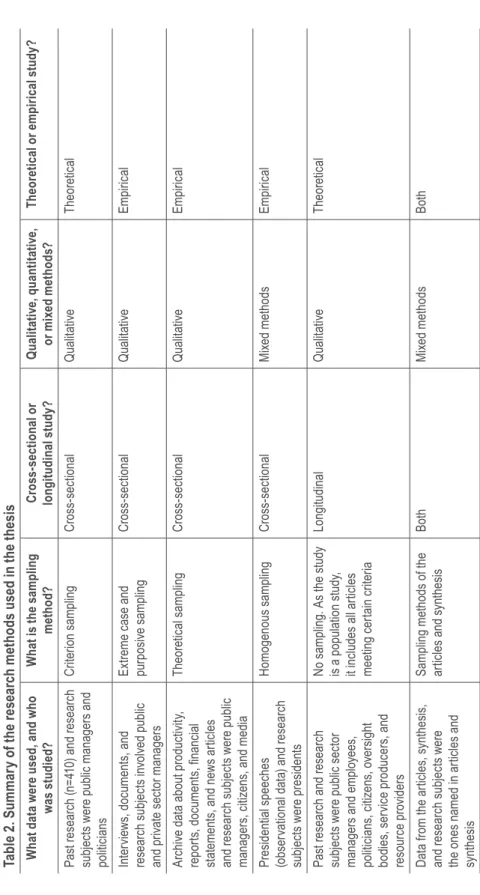
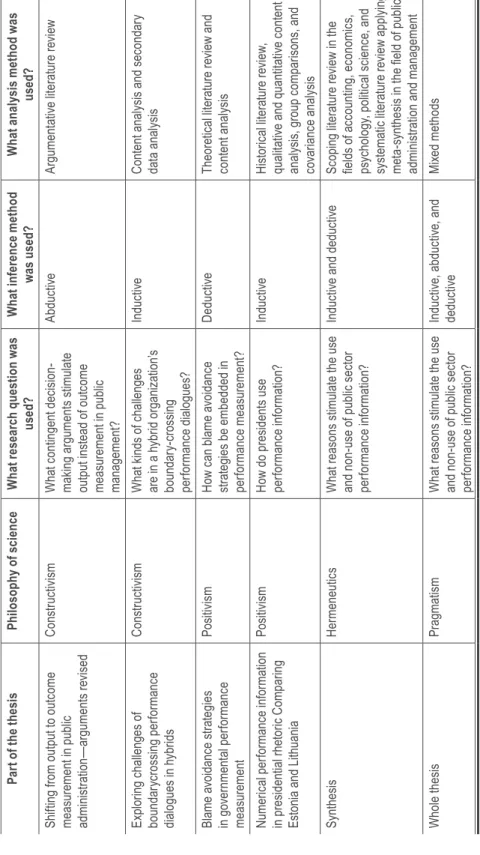
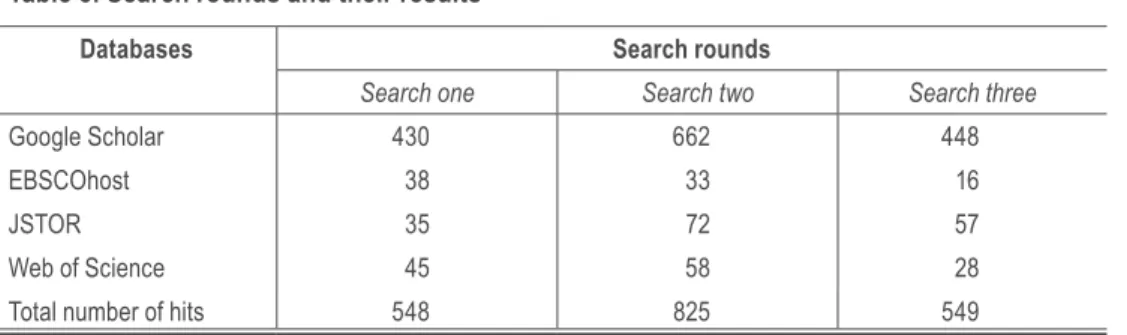
4.1 Research method in the synthesis ... 60
4.2 Research methods used in the articles ... 62
4.3 Justification for the chosen methods ... 67
5 Shifting from output to outcome measurement in public administration: Arguments revisited ... 69
6 Exploring the challenges of boundary-crossing performance dialogues ... 71
7 Blame avoidance strategies in governmental performance measurement ... 73
8 Numerical performance information in presidential rhetoric—comparing Estonia and Lithuania ... 76
9 Conclusion and discussion ... 79
9.1 The coverage of important factors ... 80
9.2 Ambiguity in factors driving performance information use ... 83
9.3 Conceptual relationships between reasons for performance information use and non-use ... 84
9.4 Theory of non-use ... 89
9.5 Limitations of the thesis ... 92
9.6 Where to go from here? Topics for future researchers ... 93
References ... 96
Appendices ... 121
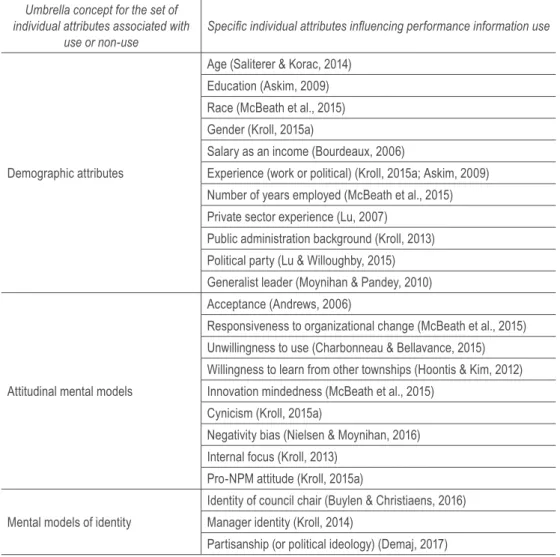
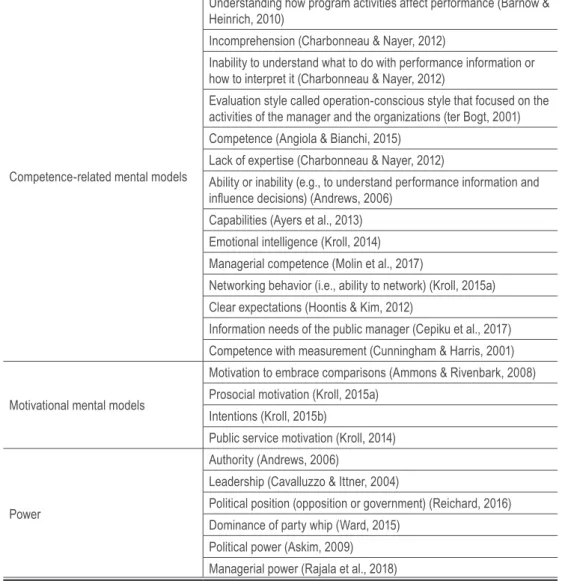
Appendix 1. Table 5. Individual attributes associated with performance information use 123 ... 123
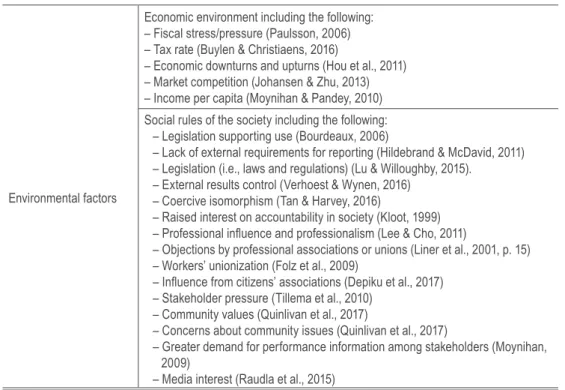
Appendix 2. Table 6. External environment factors as contextual factors associated with performance information use ... 125
Appendix 3. Table 7. Organizational structures as contextual factors associated with performance information use ... 127
Appendix 4. Table 8. Management structures and integration of organizational structures as contextual factors associated with performance information use ... 129
Appendix 5. Table 9. Reforms and legitimacy of organizational structures as contextual factors associated with performance information use ... 131
Appendix 6. Table 10. Organizational culture and performance capacity and results as contextual factors associated with performance information use ... 132
/LVWRI¿JXUHV
Figure 1. Individual and contextual factors associated with the use and non-use
of information ... 20
List of tables
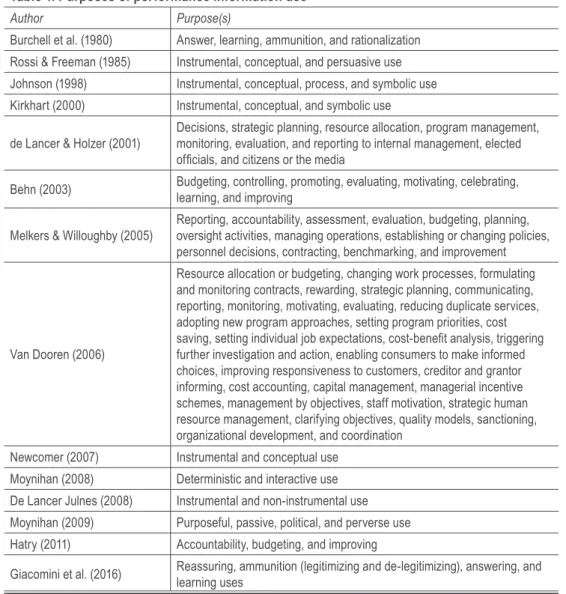
Table 1. Purposes of performance information use ... 54
Table 2. Summary of the research methods used in the thesis ... 58
Table 3. Search rounds and their results ... 61
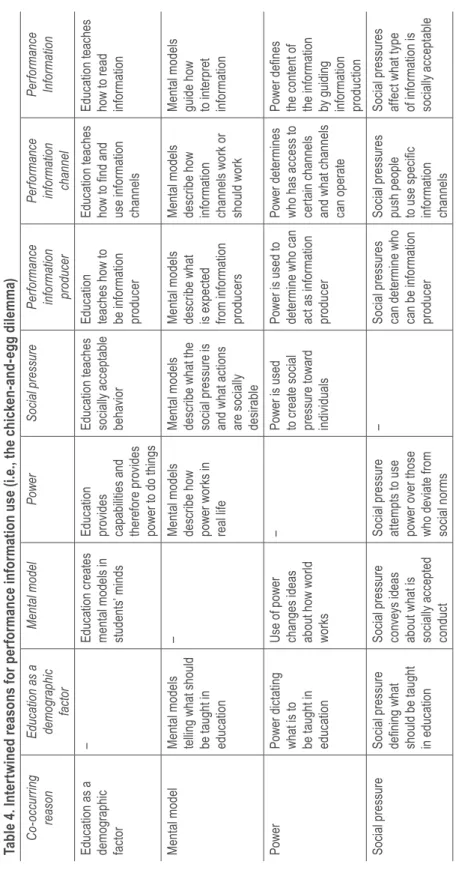
Table 4. Intertwined reasons for performance information use (i.e., the
chicken-and-egg dilemma) ... 87 Appendix 7.
Table 11. Information producer, information channel, and information as contextual factors associated with performance
information use ... 133 Original publications ... 135
1 Introduction
It has been argued that information is the most the valuable commodity in human life. Of course, some may rightfully disagree with this bold statement, but most individuals are likely to acknowledge the importance of information in modern day society, characterized as it is by high-technology solutions created to rapidly disseminate knowledge around the globe. With this in mind, the purpose of this thesis was to evaluate how the theory of performance information use and non-use in the public sector could be improved. The thesis reveals how issues relating to research methods and problems with conceptual and theoretical sophistication in the field of performance management justified the research objective. Different performance movements over the past century are described, along with the reasons why performance information use and non-use has been topical for over a hundred years and will continue to be so. Using a historical perspective, it was important to first construct a theoretical framework that took into account past research results as this would help with an understanding of current knowledge of drivers of use and non-use. The four articles included to this thesis provide multiple theoretical ideas on how to improve the theory of performance information use and non-use. The concluding remarks of the thesis summarize the theoretical contributions made and explain the implications of the results for academic communities and society.
If performance management is a type of performance in the public sector, then this dissertation provides performance information about performance management. The author of this dissertation hopes that people will use the information provided in this thesis. If they do not, the thesis will help the author to understand and learn why this is the case. I could teach this lesson to my students who are the public managers of the future. In this way, the tax money used to produce this thesis would not go to waste.
1.1 Setting the table for the dissertation
While denialism, misinformation, disinformation, and pseudoscience raise concerns currently, they make information use a hot topic. However, the topicality of information use is hardly surprising, considering that information has the power to change human history by shaping how we think. Consequently, it comes as no surprise that information has economic value (Stigler, 1961), and people have a strong desire for data and facts in general. This fascination with information can be seen clearly in the everyday operations of individuals. For example, employees in different companies use approximately 19% of their average work week on information searching and gathering (McKinsey & Company), while Google’s information search engine is the most used website today (Alexa, 2019). Simultaneously, we live in the post-truth era, where ignoring information has become fashionable to some extent. The use and non-use of information seems to be everywhere. The public sector makes no exception to this situation, as the use and non-use of performance information has raised many discussions among scholars and practitioners.
Systematically gathered, produced, and shared information on the public sector’s performance is considered useful, important, and valuable for myriad reasons (Behn, 2003; Johnsen, 2005). People demand public sector performance information because it describes the inputs, processes, workloads, outputs, outcomes, productivity, and cost-effectiveness of the public sector (Hatry, 2006), and performance information can be used for many things, such as learning, the rationalization of chosen actions, or performance improvement (Burchell et al., 1980; Moynihan, 2009). As information on the public sector’s performance can be important and valuable, many report the use of such information (Askim, 2007; Saliterer & Korac, 2013). At the same time, many researchers have provided evidence showing that this type of information is not valued highly and it is either underused or not used at all (Andrews, 2004; Pollitt, 2006; Van Helden et al., 2008; Schmidle, 2011; Raudla, 2012; Grossi et al., 2016). Talbot (2000) summarizes the problem with non-use in a theatrical manner by stating:
If much performance reporting has not, in practice, been meant to change anything why has it been done? If the audience is inattentive, the directors uninterested and the actors apathetic, what’s the point? In one sense, this can be seen as a classic “implementation failure.”
To understand the use of performance information better, this thesis attempts to answer the following research question: What reasons stimulate the use and non-use of public sector performance information? This research question is further divided into two sub-questions, as follows:
1. How does an interdisciplinary perspective help one to understand the reasons for performance information use in the field of public administration and performance management?
2. What would be the characteristics for a more holistic theory of performance information use and non-use in the field of public administration and management? The main research question adopted for this thesis is not new, considering that evidence-based policy making has addressed very similar questions from the 1960s to the present (see Wilensky, 1967; Weiss, 1979; 1983; Harries, Elliott, & Higgins, 1999; Sanderson, 2002; Cairney, 2016), and the New Public Management (NPM) movement has driven public management researchers to ask these same questions during recent decades (see Franklin & Carberry-George, 1999; de Lancer Julnes & Holzer, 2001; Kroll, 2015a).
Regrettably, regardless of the field of study, previous research has primarily been limited by a lack of attempts to conceptually understand the ways in which different factors identified in the literature have simultaneously contributed to the use and non-use of performance information because such factors are intertwined. Current studies mainly offer answers on performance information use and limitations to information use by highlighting a few important factors at a time while neglecting others (e.g., Raudla, 2012; Lu & Willoughby, 2015). Thus, the research has oversimplified reality, generated “tunnel vision” regarding the search for solutions improving the information base in decision-making (e.g., Ammons & Rivenbark, 2008), and enhancing what Mayston (1985) refers to as “decision relevance.” In addition, studies have neglected to consider how the factors are embedded in one another (see Lu et al., 2009; Kroll & Moynihan, 2015). For example, explaining the use of performance information with the existence of performance-based laws neglects the fact that laws are mental models rendered explicit, and laws as mental models create organizational structures and cultures driving performance information use and new laws. Thus, it is justifiable to question whether the mental model, law, organizational structure, or culture induce performance information use, regardless of the findings of statistical analysis. Unfortunately, statistical analysis or artificial categorization in qualitative studies cannot address problems pertaining to a conceptual understanding that arises from the mental models of people, be these people researchers or study responders. The literature talks about internal and external validity, but the point being made about conceptual understanding relates to construct validity, a topic that is rarely addressed in the field. With construct validity, the key question is whether, for example, the effects of social pressure are measured correctly in studies that evaluate performance information use.
What is also missing is a broad synthesis of the results attempting to comprehend how all the factors identified in the past literature can be summarized into a holistic theory of reasons for performance information use and non-use. This study argues that a more holistic theory would include factors seen in Figure 1, as these arise from the fields of accounting, economics, psychology, and political science, and these factors are umbrella concepts that can be used to categorize the results seen in public administration and management. More nuanced knowledge can be built upon the individual and contextual factors seen in Figure 1, and using this framework would provide a common point of reference for the disconnected theoretical approaches used in the current literature. The lack of synthesizing
research and in-depth analysis on intertwined factors in the current research justify the sub-questions stated. However, why has research been inadequate in understanding how intertwined the reasons for non-use and use are, and why has the coverage of reasons been limited? There are many reasons for this, which are described subsequently.
In studies addressing performance information use, the current trend is to use data collection and analysis methods that focus only on some factors, although these factors represent only part of the set of factors influencing performance information use (e.g., Kroll & Proeller, 2013; Askim, 2009; Andersen & Moynihan, 2016). This type of research approach to performance information use can cause omitted variable bias in both quantitative and qualitative studies. According to one of the arguments presented in this thesis, the risk relating to omitted variables has materialized in the field of public administration and management, as all the studies in the field focus on some factors in figure 1 while neglecting others (e.g., Bourdeaux, 2006; Raudla, 2012; Abdel-Maksoud et al., 2015). Because of the omitted variable bias, academics are to some extent unaware of the contribution of the important individual and contextual factors incentivizing the use of performance information as overlaps, dynamics, and relationships occurring between all the factors are being ignored. The article and book chapter formats with word limits may endorse this type of approach where some important incentives of use according to past results are being omitted. Meanwhile, ignoring the important factors associated with performance information use may prevent a holistic understanding of how the use and non-use of performance information occurs. It may also hamper the ability to comprehend the value of the use and non-use of performance information to users. Fortunately, the pitfall arising from word limits can be avoided, and the conclusion and discussion sections of this dissertation offer insights into how to achieve this.
In conclusion, the current literature teaches us disconnected lessons on how few variables associate with each other in performance information use, but the big picture remains rather blurred. The analysis habit of researchers to exclude some important factors associated with using has led to this situation, where a comprehensive theory on performance information use is underdeveloped. It is true that myriad reasons for performance information use have been investigated and the principle of parsimony has been applied (e.g., Kroll, 2015a).
Individual factors:
– Mental models – Attitudes – Motivation
– Demographic factors (age, education etc.) – Power
Contextual factors:
– Information provider – Information channel – Information
– Social pressure (political, professional, cultural or other social pressure) Figure 1. Individual and contextual factors associated with the use and non-use of information
However, the principle of parsimony has been used in a strange way in the theory building occurring in the field of public administration and management because it simplifies the measured phenomena by leaving out important factors driving use. In fact, the classic idea behind the principle of parsimony encourages researchers to describe all the reasons that are found to influence performance information use in the simplest way. The current version of parsimony seen in performance information use studies limits factors driving use while not considering how to cover past results in a holistic manner in their studies. A lack of holistic understanding has meant that the cohesion between past results and newer studies could have been better (e.g., Moynihan & Pandey, 2010; Hammerschmid et al., 2013; Lu & Willoughby, 2015). The currently used version of parsimony may have resulted from pressures to publish novel findings, which is difficult if one connects the new findings to past studies too closely so new ideas start to seem just like the old ones. Another possible reason for the selective approaches adopted by the researchers may be that no one has conducted an extensive literature review on the topic.
Besides the limited focus of researchers on some factors, there is another reason why past research has had problems in addressing all the relevant factors influencing performance information use. The research literature has examined causal relationships, but it has done so mostly by using surveys and experiments built into surveys (e.g., Saliterer & Korac, 2013; Nielsen & Moynihan, 2017). The problem with this approach is that surveys and experiments have a limited focus chosen by researchers and they report how respondents understand and conceptualize the world, not necessarily how the world actually is (e.g., Folz et al., 2009; Askim, 2009; Taylor, 2011). The limited focus chosen by the researcher may lead to situations where respondents report simplistic heuristics to use performance information because the survey format guides them to do so (e.g., Yang & Hsieh, 2007; Johansson & Siverbo, 2009; Moynihan & Landuyt, 2009). Survey responders may also conceptualize matters differently than the designers of the survey and overemphasize some relationships while neglecting others if these are, for example, latent ones that allow performance information use and make it possible, though these relationships are not seen as important use performance information in the current situation by the responders. As surveys and experiments used in the performance management field do not provide opportunities for the researcher to interact with informants, problems in respondents’ understanding and conceptualization remain unseen. Interviews do offer chances to explore respondent’s conceptualization in depth, but so far these opportunities have not been used.
If surveys or interviews are used to make claims about the world, it is assumed that the respondents can describe the world with the help of survey questions (e.g., Melkers & Willoughby, 2005; Moynihan, Pandey, & Wright, 2012). Otherwise, these studies would only report how the responders saw the factors driving performance information use, and they would not make any claims on what factors influence performance information use in reality. In the field of performance management, the researcher using interviews, surveys
and experiments usually seems to assume that respondents are capable of reporting the world as it is (e.g., Dull, 2009; Masal & Vogel, 2016). This thesis questions this assumption, which is held very dear among scholars studying performance information use and is not alone doing so (e.g., Van Helden, 2016). One of the main arguments of this thesis is that ambiguity in reasons and intertwined factors has been largely ignored in past studies, as scholars usually do not consider these issues. The thesis also argues that asking questions about limited set of drivers of use guides the respondent to simplistic answers that generate tunnel vision among scholars and practitioners. This tunnel vision jeopardizes our ability to see solutions to problems related to performance information use and non-use arising from intertwined factors incentivizing use.
In general, this thesis is not alone with its criticism of surveys and experiments based on surveys, as many economists have been skeptical of the survey-based techniques used extensively in behavioral economics. Some economists favor revealed preferences over stated preferences from surveys in the determination of economic value (Hirschey, 2008), and the common view is that experiments and surveys are at risk of strategic behavior and systemic biases (Furham, 1986). Thus, this thesis uses other methods than surveys to study performance information use. However, as respondents can bias interview results too, it is necessary to control the possible common source bias. Therefore, this study utilizes variety of empirical data taken from separate sources, and different qualitative and quantitative techniques to confirm the results.
In addition to limiting the studied factors, the past studies have mostly devoted their time to understanding how and why performance information is being used, not why performance information is not used (e.g., Moynihan et al., 2012; Kroll, 2015b; Sinervo & Haapala, 2019). The research questions used have mostly focused on the following research question: What motivates performance information use or is associated with it (e.g., Kroll, 2015a; Saliterer & Korac, 2014)? The chosen direction has meant that, currently, we know very little about the reasons used to justify the non-use of performance information (see Angiola & Bianchi, 2015). Thus, this thesis attempts to broaden the understanding of the field by studying what factors can provide reasons for the non-use of performance information.
In summary, non-use is under-examined topic and the simple heuristics used to understand what factors incentivize performance information use arise mainly from two things: the survey and interview methods focusing on only some factors while neglecting many others and the overly simplistic theoretical and conceptual views of the scholars and responders. Thus far, this introduction has been very critical of past studies on performance information use. However, not to make the matter black and white, the past results have also been very useful, as they have provided results describing what factors motivate performance information use. This is a fertile starting point for this research.
1.2 Structure of the thesis
The rest of this thesis is structured in the following way: The chapter Two explains why performance information as a topic is relevant to the field of public administration and management and why one should study more the reasons for use and non-use. After reviewing the background providing the justification for this study, the thesis moves into the theoretical section presented in chapter Three. By creating a conceptual system of reasons for performance information use in chapter Three, this theoretical segment attempts to generate a holistic theoretical framework describing factors affecting performance information use in the public sector. Here, studies on accounting, economics, psychology, and political science are used to create a theoretical framework to categorize the reasons for use and non-use seen in public administration and management. This theoretical framework is then modified later on in chapter Three based on the categorization exercise with the public administration and management literature. The research method is described in the chapter Four of the thesis. The results of research articles and their contributions to performance information use studies are presented in Chapters Five, Six, Seven and Eight. In Chapter Nine, the synthesis ends with a discussion and conclusion. Consideration is given to the theoretical processes and interdisciplinary perspectives required when devising a holistic theory of performance information use and non-use.
2 Background for the thesis
The concept of performance is central to performance information use studies. Traditionally, performance has been defined in two ways (van Dooren, Bouckaert, & Halligan 2010). According to the first way, performance is seen as the result of a production process whereby inputs are allocated to output production and used to generate outputs leading to desired outcomes. The process where inputs are transformed into outputs and outcomes is tracked by using the well-known 3 Es model that measures the economy, efficiency, and effectiveness of public sector service production. When performance refers to the 3 Es model, performance information uses then concentrate on information on economy, efficiency, and effectiveness. In the second way, the concept of performance refers to the realization of public values. However, there are two different interpretations of how the realization of public values occurs. The first interpretation comprehends performance
as a synonym for public value, while the second understands performance and values as two distinctive concepts (van Dooren, Bouckaert, & Halligan 2010). In the second interpretation, public values provide the point of reference against which performance is measured. Performance can mean not only Economy, Efficiency, and Effectiveness but also extensiveness, acceptability, equity, fairness, and many other concepts (Pollitt, 1986). Nonetheless, performance does not have to cover all these aspects. Indeed, performance information use can concentrate only on some public values or all of them. As a field of study, public administration is interested in knowing what performance information is being used and, thus, what public values are being monitored and pursued for.
Past studies have scrutinized whether performance information has been used and, if so, how and why it has been used and what have been the impacts of use (e.g., Askim, 2007; Raudla, 2012). Concepts such as soft and hard use, opportunistic use, demand- or supply-driven use, and formal and informal use describe how performance information has been used in the past (Van Dooren & Van de Walle, 2011). By demonstrating how performance information use varies in different contexts, studies investigating variations in use have also contributed to how dimensions of performance information use. Why performance
information is being used has listed purposes for use and identified factors associated with use (e.g., Kroll, 2015a; Lu & Willoughby, 2015). Research focusing on the impact of performance information use has reported whether performance information contributes to successful performance (e.g., Van Thiel & Leeuw, 2002). This thesis mostly contributes to the studies examining the why question, although some new knowledge is produced on whether performance information is being used and how it is used. However, the thesis does not study the effects of performance information use because this would require another type of theoretical framework describing the different impacts of performance information use. Moreover, due to the space restrictions in current article formats, combining all the research topics seen in the performance information use literature would not be possible in the research articles that are part of this thesis.
Next, the importance of the topic is described. First, a short overview is provided addressing the question of why performance information use has been a relevant research topic in recent history. Second, past studies are used to demonstrate why it is essential to study the reasons for performance information use and non-use.
2.1 Why performance information use became fashionable
The road leading to studies of performance information use in public administration could have started at different points in history. In this review, the focus is, however, limited to the twentieth and twenty-first century movements in administration relating to performance information use. Van Dooren (2008) adopted similar approach in his work and the review in this thesis is partly based on the one conducted by Van Dooren. However, some additions and extensions are added to the review which were not part of Van Dooren’s work indicating that more performance movements are identified in this thesis.
The social survey movement was one of the first movements of this type, and it was based on the notion that social reformers need information on social problems and quantified data on governments’ performance results (Bulmer, Bales, & Sklar, 1991). What sparked the social survey movement in the early parts of the twentieth century was Booth’s argument claiming that the debate on poverty was unsophisticated because it lacked facts about the poor and the reasons leading to poverty (Booth, 1988). According to Booth, one needs information about societal outcomes of government actions, and this information should be used in discussions addressing the poverty problem. The aim of the social survey movement sounds familiar when compared to current topics in the field of public administration and management addressing the outcome orientation of the government or the lack of this orientation (e.g., Ferlie et al., 2005). From Booth to the current debates on outcome orientation, the focus has remained on performance information use and non-use.
Besides the social survey movement, the scientific management and science of administration represented another type of effort driving the use of performance information in the early parts of the twentieth century (Van Dooren, 2008). This
movement relied heavily on the notion of a rational manager who has planned objectives and measures tracking organizational development and who is motivated to find the gold standard in operations and activities by using performance measures (Mosher, 1968). Scientific management and the science of administration as a movement aimed to turn administration into a profession and science based on the measurement and use of measured information (Van Dooren 2008). One of the assumptions driving the movement was that performance information is used in rational management (e.g., Wagner, 1991). This line of thinking is strongly still present in today’s public administration, as well as among scholars examining performance information use in the public sector.
The development of cost accounting has also provided a push toward performance information use in the public sector (e.g., Ansari & Euske, 1987). Cost accounting aims to improve the cost awareness of organizations by tracking, documenting, and evaluating costs. Simultaneously, cost accounting offers control and openness to the public sector (Previts & Merino, 1979). In the performance management literature, information about costs is known as input information, and it is used to monitor productivity and efficiency (i.e., the relationship between outputs and inputs) as well as cost effectiveness (i.e., the relationship between costs and outcomes) (Hatry, 2006). Although cost accounting has been around a while, it is not fully developed in the public sector and a lot needs to be done to improve the cost awareness of public organizations around the globe (e.g., Pollitt & Bouckaert, 2011). One main agenda driving cost accounting was to enhance input information use and, through it, the productivity and efficiency of public organizations. By producing and sharing cost information, the pressure to use such information usually increases. However, as the role of accounting information in societies seems to change over time or depending on the context and users; such information is not created solely to improve decision-making (Burchell et al., 1980).
To further increase performance information use in the government, performance-based budgeting approaches were adopted in several countries (Jones & McCaffery, 2010; Mauro, 2016). Interest in performance budgeting dates all the way back to the 1870s in the U.S. (e.g., in New York City); however, most significant developments in this area occurred in the 20th century (Jones & McCaffery, 2010, p. 43−67). As budgeting practice, performance-based budgeting relies on the measurement of performance, integrating performance measurement into budgeting, and using performance information during the budgeting process. The aim of performance-based budgeting is to improve the efficiency and effectiveness of public expenditures by linking the funding of public sector organizations to the results they deliver (Robinson & Last, 2009). These linkages between expenditures and results are achieved if performance information is being used systematically in the budgeting process. Thus, the performance-based budgeting movement highlights the importance of performance information use in the budgeting context so more rational and informed decisions can be made.
The performance budget movement facilitated the first wave of evaluations in the 1960s and 1970s. The evaluation movement used social science-based methods to assess the outputs and outcomes of policies (Wollmann, 2003). Group experiments were used to examine the most optimal means of achieving goals that would then be adopted by decision-makers (Vedung, 2010). According to Vedung (2010), scientific evaluation lost momentum in the 1970s, and evaluation practices started to utilize participatory and non-experimental methods that incorporated different stakeholders participating in dialogue about performance. During the neo-liberal evaluation wave, deregulation, privatization, contracting out, efficiency, and customer influence became key concepts, and evaluation served accountability, customer satisfaction, and, most importantly, value for money. The latest evidence-based evaluation wave seems to be a scientific experimentation-based renaissance (Vedung, 2010). The series of evaluation waves is an example of the promotion of the use of performance data in the public sector as it has been argued that evaluation is a form of non-recurring performance measurement.
Parallel to the already mentioned performance initiatives, the social indicator movement attempted to gain momentum in societies (Innes, 1990). Problems in economic growth alongside the creation of the welfare state incentivized the demand for social data (Dowrick & Quiggin, 1998) and provided justification for the social indicator movement (e.g., Rose & Miller, 2008). Governments started to collect more statistics on social phenomena, and this increased the supply of governments’ outcome information in societies (Innes, 1990). The aim of the movement was to capture more comprehensively the characteristics of the population by developing measures tracking health, education, leisure activities, social security, wealth, and crime, to name a few. Social indicators make matters more governable through the provision of information that can be used in decision-making. Performance information use was a central part of the social indicator movement as it allowed control over societies and boosted governmentality (e.g., Rose & Miller, 2008).
Whereas the social indicator movement focused on outcomes, total quality management was interested in both the internal world of organizations and their external operating environments. Indeed, total quality management concentrated on customer satisfaction and input, process, and output quality (Reddy, 2012). In general, performance data played a central role in total quality management (Kaufman, 1992) because the quality of inputs, processes, and outputs can be improved by using performance data (Sinclair & Zairi, 2000). Once again, the idea that performance information should be used was restated, as performance information use was embedded into the quality management movement.
The performance movement that truly kickstarted performance information use studies in the field of public administration was the New Public Management reform, as this reform highlighted the need to change performance information use practices in the public sector. Because performance information use studies are linked so closely with the adoption of New Public Management reform, this reform is dealt with here in more depth than the other performance initiatives promoting performance information use.
The roots of New Public Management are in the criticism faced by the traditional model of bureaucracy (e.g., Osborne & Gaebler, 1992). The model of public administration known as traditional bureaucracy (Hughes, 1998) was based on classical public administration (Wilson, 1887) and Weberian bureaucratic principles. In traditional bureaucracy, politics are separated from administration; there exists a hierarchical command and centralized bureaucracy that utilizes central planning and requires compliance with rules. According to the critics, the problem with traditional bureaucracy was that it could not be used to address today’s problems (Mauro, 2016). The criticisms of traditional bureaucracy opened doors for novel reforms, such as New Public Management (Hood, 1991). Essentially, New Public Management was a mixture of reforms affected by several theories, including the public choice theory, classical and neo-classical public administration theory, principal agent theory, and management theory (Gruening, 2001). Although different countries applied New Public Management differently, the main agendas of New Public Management were quite universal and included the following:
1. Add managerial elements, such as performance management (and performance information use with it), from private sector management models to the public sector governance mode to provide more focus on results.
2. Redefine the boundaries of government by using privatization. 3. Change the structure of the public sector to a more decentralized one.
Many managerial reforms have been adopted around the globe to make the public sector more businesslike and results-oriented (Jansen, 2008). Simultaneously, NPM has both increased and decreased the “publicness” of organizations in society. According to Bozeman (1987, p. xi), “publicness refers to the degree to which [an] organization is affected by political authority”. On the one hand, privatization has increased the politicians’ political influence on companies that provide public sector services. Performance measurement and information use have also offered opportunities to increase political control over service production in the public sector through the promotion of transparency. On the other hand, the political influence on organizations that provide public services is sometimes weakened because companies may opt to use commercial confidentiality to protect their information concerning the production of public services.
Performance information use as managerial practice has been in the center stage of this movement from traditional bureaucracy to private sector practices (e.g., Van Dooren & Van de Walle, 2011). In New Public Management reform, the rational manager measures performance to see how goals are achieved and uses this measurement information to steer the organization toward goal achievement. Because New Public Management has advocated performance management consisting of performance measurement and performance information use, performance measurement itself cannot guarantee effective performance management. Here, the activities designed to quantify and categorize performance refer to performance measurement (e.g., Modell, 2004; Hatry, 2006), and
these measurement activities should be used in management practices if these measures are to add value to the operations of the public sector. The use dimension is, therefore, an important step in performance management practices. When evaluating the success or failure of a performance initiative emphasized by the New Public Management movement, it is necessary to examine performance information use (van Dooren, 2008) because real performance management cannot occur without performance information use (Vakkuri, 2010).
Of course, public managers’ performance information use requires one to determine what the concept of performance means. Therefore, the New Public Management movement promoted the adoption of the concept of performance as a managerial innovation important to the reform. Although each wave of the New Public Management reform has had particular themes and specific tools, performance has been a vital part of every one of these waves (Talbot, 2005). As a concept, performance is an old term that is multi-dimensional, multifaceted, and ambiguous at best (Vakkuri, 2010). Moreover, performance can even be “the great unknown” (van Dooren, Bouckaert, & Halligan, 2010, p. 16). The conceptual nature of performance complicates performance information use and can make New Public Management reform unsuccessful in making the public sector more results oriented. Sometimes, performance information has failed due to the conceptual ambiguities associated with the concept of performance. Besides emphasizing performance information use, the possible complications in the public sector performance information use arising from the New Public Management reform generate demand for studies that investigate use and non-use.
Performance measurement also creates pressures to use information and study this use. Of course, performance measurement is nothing novel, but its role has been emphasized in the New Public Management movement (Cavalluzzo & Ittner, 2004; van Helden, Johnsen, & Vakkuri, 2008). Because of New Public Management, performance measurement has been adopted on an international and government-wide scale, and in all management functions (van Dooren, 2008), and measurement has developed into its own industry (Johnsen, 2005). The result orientation in New Public Management has also meant a shift from inputs to results, and this shift increased performance information, changed the data produced in public administration, and altered the type of evidence used in public management (Kristensen, Groszyk, & Buhler, 2002, p. 10).
Increased data production and changes in the information used to govern the public sector create the need to study public sector performance information use because additional information and renewed management practices based on performance information use should make the public sector more efficient. However, the more efficient public sector is not guaranteed, as there are difficulties in both measurement and the use of measured results (e.g., Smith, 1995; 1996). For instance, the different ways to define performance make performance measurement difficult. Performance can be defined differently in various levels of administration, such as macro (i.e., government-wide performance), meso (policy
sector, a network, or a chain of events), and micro-level (individual organizations), which complicates measurement (Bouckaert & Halligan, 2008). The produced performance information can also cause perverse behavior and adverse information use, leading to inefficient operations in the administration. Problems in performance measurement and information use provide interesting starting points for researchers investigating performance information use.
The results concerning the success of performance management in the public sector were divided in practice. On one hand, New Public Management and its assumptions about performance information use have received criticism, as the public sector is not identical to the private sector. These differences between the two sectors mean that the adoption of private sector practices in the public sector context can create symbolic managerial practices (Lapsley, 1999). In reality, the ideas presented by the New Public Management movement have suffered from poor implementation (Arnaboldi, Lapsley, & Steccolini, 2015). Hence, New Public Management has lost much of its support (Lynn, 1998). On the other hand, successful performance management practices based on performance information use have generated benefits to the public sector. The divided results on the success of performance management have motivated more studies that aim to understand why performance information use as management practice succeeds or fails.
In addition to New Public Management, evidence-based policymaking (Sanderson, 2002; Cairney, 2016) and knowledge management in the public sector context are among the most recent developments that attempt to increase performance information use in the public sector (Laihonen & Mäntylä, 2018; Lönnqvist, Käpylä, Salonius, & Yigitcanlar, 2014). Evidence-based policymaking promoted information use in policy making because societies should be improved in the name of utilitarianism (Solesbury, 2001). Most typically, knowledge management is described as the process of creating, sharing, using, and managing the knowledge and information in an organizational context. Basic questions addressed in knowledge management ask what type of performance information should be used in management and how we gather, share, and use this information in the most beneficial way (Syed-Ikhsan & Rowland, 2004). These questions show that knowledge management is one of the latest attempts to understand and generate performance information use in the public sector.
The performance movements seen in recent history have inspired governments to generate their own performance models to promote information use. The “New Zealand model” (Boston et al., 1996), the Canadian “La Relève” model (Bourgon, 1998), the Belgian “Copernicus” model, and the German “slim state” model are examples of performance models created by the governments (Pollitt & Bouckaert, 2011). Besides these models, the academic community has also implemented various performance frameworks, including the Neo-Weberian State model (Drechsler & Kattel, 2008), the French model (Bartoli, 2008), Napoleonic model (Ongaro, 2009), Nordic model (Veggeland, 2007), and the digital
era governance model (Dunlevy et al., 2006) and new public governance model (Osbourne, 2010).
Despite various efforts, different performance movements and models have faced challenges achieving regular performance information use, and the research results concerning the usefulness of performance information use are mixed. Consequently, the factors stimulating performance information use are the focus of the present study. A great amount of research has focused on performance information use and drivers of such use in the fields of public administration and performance management (de Lancer Julnes & Holzer, 2001; Jansen, 2008; Taylor, 2009; Moynihan & Pandey, 2010; Liguori, Sicilia, & Steccolini, 2012; Saliterer & Korac, 2013; Grossi, Reichard, & Ruggiero, 2016). However, there is a lack of theoretical work that attempts to theorize the factors driving performance information use and non-use into holistic theory. The theoretical section of this thesis aims to synthesize and theorize the past results describing the use and non-use of performance information.
2.2 Variations in use: A premise for studying reasons for use and non-use
Reviewing the past literature on performance information users around the globe and variations in their performance information use demonstrates the international need to understand the factors driving performance information use. The main problem with the current research is that models explaining performance information use have not been compared and analyzed concerning conceptual overlap and missing aspects. Because this type of comparison has not been conducted, there is no established theory of performance information use covering all the performance information use models and the factors included in these models. By showing that scholars have used limited and selective theoretical approaches previously in disparate parts of the world, this section examining the performance information use habits of diverse user groups reveals the research gap that this thesis is attempting to cover. Knowing the research gap and what generates it provides justification for this thesis, which attempts to generate comprehensive theory on the factors driving the non-use and use of performance information.In the literature, there are several performance information user categories identified (e.g., Mayston, 1985; van Dooren & Van de Walle, 2011; van Helden & Reichard, 2019). One of the most comprehensive identifications was conducted by Mack (2004), who identified ratepayers (i.e., taxpayers), consumers of goods or services, other resource providers (i.e., suppliers of goods and services, suppliers of finances, donors of funds or voluntary donors of time), representatives or employees of another public sector entity, oversight bodies (i.e., members of oversight bodies, regulators, or auditors), management (i.e., public administrators and managers), and elected officials (i.e., local politicians, state legislators, and members of parliament or congressional representatives). Although performance information user groups could be defined differently based on, for example,
their age, education, or work background, this thesis uses Mack’s categorization to structure the literature review on the results of the studies addressing public sector performance information use.
2.2.1 Taxpayers, consumers of services, and other resource
providers as performance information users
According to research, taxpayers have been shown to use input, process, output, outcome, efficiency, and cost-effectiveness information. However, the use seems to vary depending on individual attributes and the context (e.g., Lu, 2011; Baekgaard, 2015; Brusca & Montesinos, 2016; Chen, 2017). In these studies, the taxpayers have dual roles, as they also usually act as consumers of public goods and services (e.g., James, 2011; Kool & Bekkers, 2016). Therefore, the results regarding taxpayers often describe how consumers of public sector goods and services use performance information. Here, taxpayers are also understood as consumers of services.
Studies investigating citizens as performance information users have been conducted in Sweden (Murray, 2002), Hong Kong and Singapore (Taylor, 2006), Spain and Italy (Brusca & Montesinos, 2016), the United States of America (Charbonneau & Van Ryzin, 2015), England (James, 2011), China (Lam & Wang, 2014), Denmark (Baekgaard, 2015), and the Netherlands (Kool & Bekkers, 2016). Geographically, studies from Africa and South America are missing while most studies have been conducted in United States. The studies concentrating on the performance information use of citizens have focused on three levels of governance: local (e.g., Baekgaard, 2015; James, 2011), state (Lu, 2011), and central government (Joyce & Levy, 2008). Therefore, there are no studies focusing on how citizens use performance information relating to international relations. Variations in performance information use have been found in local (Charbonneau & Van Ryzin, 2015), state (Lu, 2011), and central government (Taylor, 2006) and in different countries. These reported variations in assorted countries and government levels emphasize the need to understand the factors driving performance information use.
Unfortunately, studies examining citizens as performance information users have only considered some factors associated with performance information use while neglecting other important factors (e.g., Taylor, 2006; James, 2011; Kool & Bekkers, 2016). In fact, studies have been intentionally limited, as this directs focus on novel matters that have not been studied before. This has been the case regardless of what country has been investigated. For example, Baekgaard (2015) investigated whether information content affects attitude formation. Nevertheless, he did not examine how, for example, educational or work background and information channels affect such use. Baekgaard (2015) reported that randomized survey experiments are often used to address problems related to endogeneity (i.e., omitted variables, such as work background and information channels). Nobel prize