Although its role is often overlooked, the WTO has in recent years emerged as a key player in IT governance, primarily through the application of the rules-based trading system. This role can be traced at least back to 1995, and has continued through the most recent (and difficult) Doha round of negotiations. The purpose of this book is to offer a detailed and comprehensive picture of how the WTO relates to one of the most crucial (yet often least understood) areas of IT governance. The approach taken helps lift the veil on the WTO's often highly technical work. It can therefore be seen as a contribution to ensuring a wider discussion on an area of the WTO's work that is of particular relevance to existing and emerging technologies that will underpin and drive much of the global economy. Sacha Wunsch-Vincent - Economist at the Informations and Communications Policy Division of the OECD (Paris) and Visiting Fellow at the Institute for International Economics (Washington D.C.).
Joanna McIntosh - at the time of writing - General Counsel of the G8 Summit Planning Organization and Managing Director at Markle Foundation.
Secretariat of the United Nations ICT Task Force One UN Plaza, New York, NY 10017
Web site: http://www.unicttaskforce.org
Cover designed by the Graphic Design Unit Outreach Division
United Nations Department of Public Information 38836—June 2005—1,000
ISBN 92-1-104542-3 Sales No. 05.II.A.6
From the Uruguay Round through the
Doha Development Agenda
A Report to the UN ICT Task Force
By
Sacha Wunsch-Vincent
Edited by
Joanna McIntosh
Copyright © 2005 United Nations ICT Task Force
All rights reserved. Except for use in a review, the reproduction or utilization of this work or part of it in any form or by electronics, or other means now known or hereafter invented, including xerography, photocopying, recording, and in any information storage, transmission or retrieval system, including CD-ROM, online or via the Internet, is forbidden without the written permission
of the publishers.
The views expressed in this book are those of their individual authors and do not necessarily reflect the views or positions of the United Nations ICT Task Force, the United Nations itself, any of its
organs or agencies, nor of any other organizations or institutions mentioned or discussed in this book, including the organizations to which the authors are affiliated.
Published by
The United Nations Information and Communication Technologies Task Force One United Nations Plaza
New York, NY 10017 [email protected]
About the Author
Sacha Wunsch-Vincent∗ is Economist at the Informations and Communications Policy Division of the OECD (Paris) and Visiting Fellow at the Institute for International Economics (Washington D.C.). Previously Sacha was Swiss National Science Fellow and visiting fellow of the Berkeley Centre for Law & Technology (University of California). He holds a Masters of International Economics (University of Maastricht) and completed a PhD on the "The WTO, the Internet and Digital Products: EC-US Perspectives" (University of St. Gallen, Oxford: Hart Publishing, www.hartpub.co.uk).
About the Editor
Joanna McIntosh* , at the time of writing, is General Counsel of the G8 Summit Planning
Organization, which prepared for the 2004 G8 Summit in Sea Island, Georgia. Previously, Joanna was at the Markle Foundation as Managing Director of one of the foundation's major program areas. Joanna has spent fifteen years working at the intersection of trade and technology policy issues. As a lawyer at the Office of the United States Trade Representative during the 1990s, she worked extensively on the Uruguay Round negotiations, enforcement of WTO Agreements, and the Geneva Ministerial Declaration on e-commerce that helped to launch the WTO's work in this important area.
∗ This book - including the selection of topics, the treatment of issues, and the expression of opinion - reflects
the independent views of the author and the editor and should not be attributed to their employers / the institutions they work for.
The Markle Foundation
Emerging information and communication technologies possess enormous potential to improve people's lives. The Markle Foundation works to realize this potential and to accelerate the use of these technologies to address critical public needs in the areas of health care and national security.
The United Nations ICT Task Force
The United Nations Information and Communication Technologies (ICT) Task Force was formally launched on 20 November 2001 by Secretary General Kofi Annan, with the mandate of promoting awareness, inclusive policies and innovative technological and business models, while also building public-private-civil society partnerships that would contribute to the realization of development goals through the application of ICT. While not being an operational, implementing or funding agency, the Task Force serves as a catalyst with a facilitating and advisory role designed to promote synergy and better coordination, partnerships and initiatives, and a focal point for establishing strategic direction, policy coherence and advocacy for the common goal of a global ICT-based development agenda. To avoid duplicating other efforts, the Task Force has been collaborating closely with other global initiatives. To fully implement its objectives the Task Force has created Working Groups to address specific themes within the ICT-for-Development agenda and Regional Nodes to tackle the needs of different areas of the world. The unique key to the Task Force is its truly global platform for placing ICT at the service of all the world’s citizens.
i
TABLE OF CONTENTS
Foreword vii Executive Summary ix PART ONE I. Introduction 1II. The WTO’s Work on E-commerce and IT Trade 3
A. History of the WTO Work Programme on Electronic Commerce 4 1. Phase I: Geneva Ministerial Conference – Seattle Ministerial
Conference 4
2. Phase II: Seattle Ministerial Conference – Doha Ministerial
Conference 7
3. Phase III: Doha Ministerial Conference – Cancun Ministerial
Conference 9
4. Phase IV: Cancun Ministerial Conference 12
5. Work Programme Participation and Accomplishments 14
B. Doha Development Agenda 17
III. Developing Country Interests in E-Commerce and IT Trade 19
A. Overview of the CTD’s Work on E-commerce 19
B. Barriers to E-commerce for Developing Countries 22
1. Physical Infrastructure 22
2. Human and Legal Infrastructure 22
3. Other Barriers 23
4. Expanding Export Opportunities for Developing Countries 24 C. Special and Differential Treatment for Developing Countries 25
1. Background on S&D Treatment 26
2. S&D Provisions Relevant to E-commerce in the WTO
Agreements and the Doha Declaration 28
D. Conclusion 30
PART TWO
IV. Information Technology Goods – Basket I 33
A. Information Technology Agreement 33
1. History of the ITA 33
2. Enlarging ITA Participation 36
3. Expanding ITA Coverage 37
4. Eliminating Non-Tariff Measures 39
5. Resolving Classification Divergences 42
B. Doha Negotiations 43
1. Modalities 44
2. Eliminating Tariff Barriers 44
3. Eliminating Non-Tariff Barriers 46
4. S&D Provisions 48
ii
PART THREE
V. Services 53
A. Introduction to GATS 54
1. Scope of the Agreement 54
2. Structure of the Agreement 56
3. General Obligations and Disciplines 57
4. Specific Commitments 59
B. Services Negotiations 61
1. Unfinished Business/Built-In Agenda 62
2. Negotiations Guidelines and Procedures 63
3. Status of the Services Negotiations 64
4. Initial Request-Offer Process 67
5. Developing Country Participation in the Services Negotiations 69
6. E-commerce in the Services Negotiations 71
C. Addressing Questions from the WTO Work Programme on
E-commerce in the Services Negotiations 75
1. Applicability of Specific Commitments to Electronically
Delivered Services 76
2. Classification of Electronically Delivered Services as Mode 1 or
Mode 2 77
3. Likeness 79
4. Increasing the Participation of Developing Countries in
E-commerce/World Services Trade 79
5. Regulations Affecting E-commerce 79
6. Customs Duties 82
7. New Services 83
D. Conclusion 83
VI. Internet Infrastructure Services – Basket II 84
A. Telecommunication Services 84
1. Scheduling Telecommunications Services 85
2. Uruguay Round Negotiations and Telecommunications
Services 86
3. Doha Development Agenda and Telecommunications Services 88
a. Improving Specific Commitments 89
b. Clarifying the Scope and Coverage of Telecommunications
Services Commitments 92
c. Developing Disciplines on the Regulation of
Telecommunications Services 99
d. Development-Related Negotiations Issues 101
B. Conclusion 101
C. Computer and Related Services 102
1. Uruguay Round Negotiations on Computer and Related
iii 2. The Doha Development Agenda and Computer and Related
Services 102
a. Improving Specific Commitments 104
b. Classification of Computer and Related Services 106
c. Development-Related Issues 109
D. Conclusion 109
VII. Electronically Traded Services – Basket III 110
A. Negotiations on Electronically Traded Services 110
B. Business Process Outsourcing (BPO) Services 114
1. Understanding BPO Services 114
2. The BPO Phenomenon 115
3. Scheduling BPO Services Commitments 119
C. Conclusion 122
PART FOUR
VIII.Digital Products – Basket IV 127
A. Introduction 127
B. Market Access for Digital Products 128
1. Duty-Free Moratorium on Electronic Transmissions 129
2. Limiting Tariffs on Digital Products 130
3. Classifying Digital Products: Goods or Services? 134
4. Doha Negotiations 138
C. Intellectual Property Right Protection for Digital Products 138
1. The TRIPS Agreement 139
2. WTO Work Programme on Electronic Commerce 140
3. The Copyright Challenge For Digital Products 142
4. The Doha Negotiations 145
D. Conclusion 148
Concluding Remarks 149
Bibliography
By Subject Matter 153
v
List of Tables
1. E-commerce Work Programme Responsibilities p. 5
2. Cross-Sectoral Issues 10
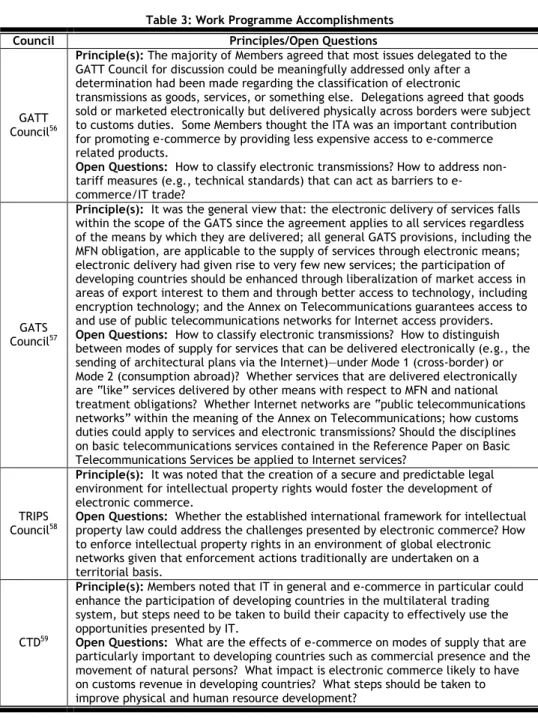
3. Work Programme Accomplishments 16
4. Applying the Doha Mandate for E-commerce and IT Negotiations 19
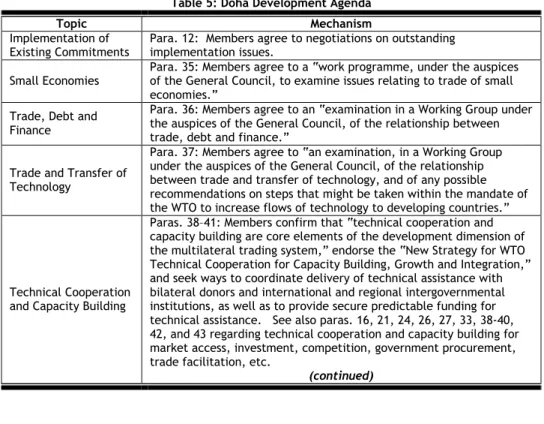
5. Doha Development Agenda 25
6. S&D Provisions in WTO Agreements and the Doha Declaration 28
7. ITA Participants 35
8. NTMs on IT Products 42
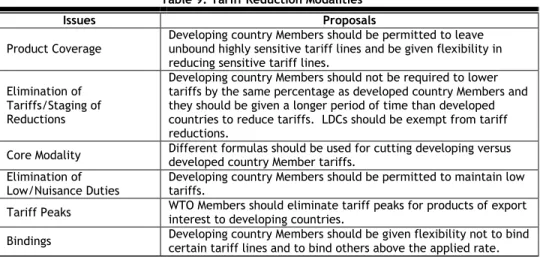
9. Tariff Reduction Modalities 49
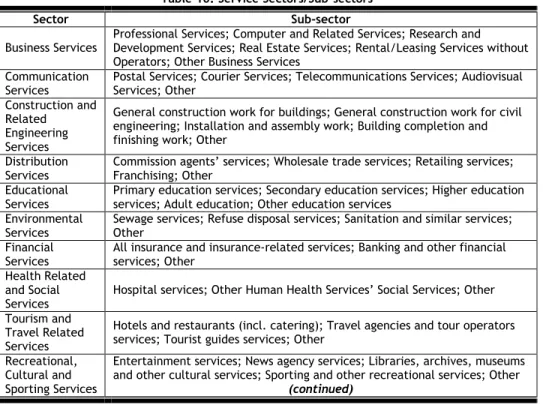
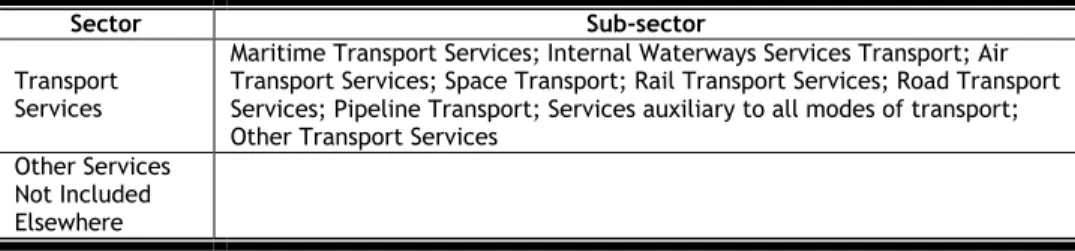
10. Service Sectors/Sub-sectors 55
11. Modes of Supply 56
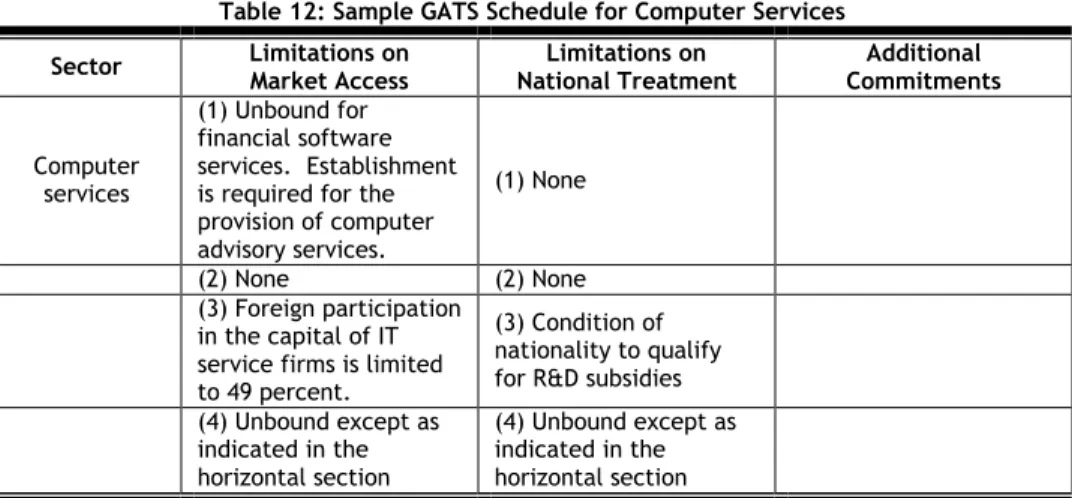
12. Sample GATS Schedule for Computer Services 61
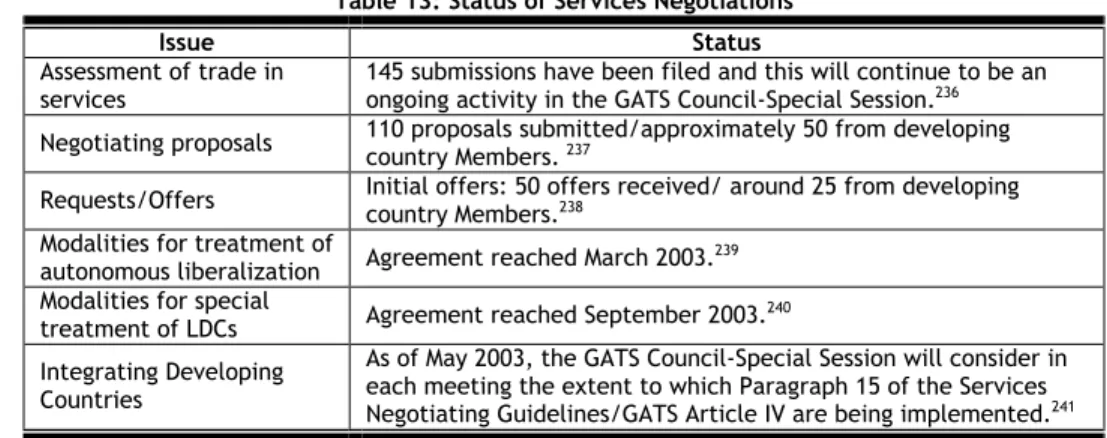
13. Status of Services Negotiations 65
14. Examples of Services Negotiations Submissions Discussing E-commerce 73
15. Examples of Services-related Barriers to E-commerce 74
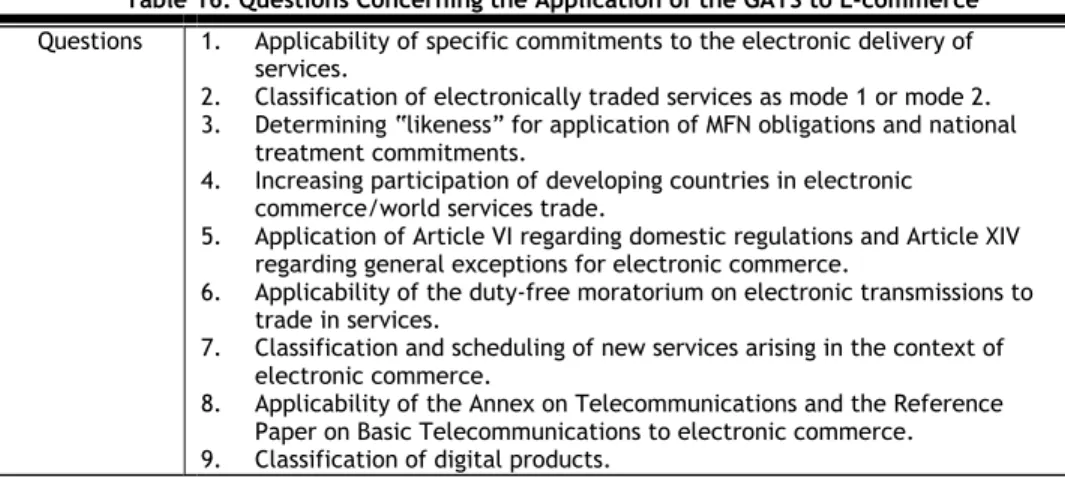
16. Questions Concerning the Application of the GATS to E-commerce 76 17. Current and Future Disciplines on Domestic Regulations 80
18. Classification of Telecommunications Services 85
19. GATS Annex on Telecommunications 87
20. Reference Paper on Basic Telecommunications 88
21. Commitments for Selected Telecommunications Services 90
22. Comparison of W/120 and Central Product Classification Lists 96 23. W/120 Classification of Computer and Related Services 103
24. Commitments for Computer and Related Services 105
25. EC Proposal for An “Understanding” on the Scope of CPC 84 108
26. Taiwan’s Proposal for a “Value Chain” 108
27. Mode 1 Commitments on Selected Electronically Traded Services 111 28. Distribution of Commitments on Selected Electronically Traded Services 112 29. Full Market Access Commitments on Selected Electronically Traded
Services 113
30. Information Technology and Business Process Outsourcing Services 114 31. Regional Distribution of Other Business Services Exports 116 32. Average Growth Rate of Exports of Other Business Services 117
33. Model Schedule for Selected IT and BPO Services 120
34. Selected Sectors and Sub-sectors Relevant to BPO (CPC 87) 121 35. Decision on Valuation of Carrier Media Bearing Software for Data
Processing Equipment. 131
36. Levying Duties/Customs Valuation in Offline and Online Transactions 133
37. Comparison of GATT and GATS Agreements 136
38. TRIPS Art. 71: Review and Amendment 145
vi
List of Acronyms
Acronym Definition
CTD Committee on Trade and Development
EC European Communities
EMC Electromagnetic Compatibility EMI Electromagnetic Interference
GATS General Agreement on Trade in Services GATT General Agreement on Tariffs and Trade IT or ICT Information and Communications Technology ITA Information Technology Agreement
ITC International Trade Center
ITU International Telecommunications Union
LDC Least-Developed Country
MFN Most Favored Nation
NAMA Non-agricultural Market Access Negotiations NGMA Negotiating Group on Market Access
NTB Non-Tariff Barrier
NTM Non-Tariff Measure
OECD Organization of Economic Co-Operation and Development S&D Special and Differential (as in, treatment or provisions) SME Small-and-Medium-Sized Enterprise
TNC Trade Negotiations Committee
TRIPS Trade Related Aspects of Intellectual Property Rights UNCTAD United Nations Council on Trade and Development
WCO World Customs Organization
WIPO World Intellectual Property Organization
Foreword | vii
FOREWORD
This book is an overview of one of the most important processes today determining the governance of information technology (IT): the growing role of the World Trade Organization (WTO), based in Geneva. Although its role is often overlooked, the WTO has in recent years emerged as a key player in IT governance, primarily through the application of the rules-based trading system to e-commerce. This role can be traced at least back to 1995, and has continued through the most recent (and difficult) Doha round of negotiations. The Markle Foundation has been working on issues of Internet governance, with special emphasis on developing nations, for some time now. Recently, it has had the privilege of serving as a Member of the United Nations Information and Communication Technology Task Force and as chairman of its Working Group I, which focuses on IT governance and policy. The purpose in commissioning this book is to offer a detailed and comprehensive picture of how WTO relates to one of the most crucial (yet often least understood) areas of IT governance. This task is important for several reasons.
First, the narrative presented here is important because the WTO’s role is often overlooked, lost in the sea of bodies and institutions that are more explicitly involved in IT governance (e.g., ICANN). As this book shows, however, the WTO is in fact deeply involved in IT governance and policy. To be sure, the WTO does not “regulate” e-commerce per se: it does not tell users what sites they can surf on the Internet; it does not tell ISPs how they must protect the privacy of their customers; and it does not tell governments that they have to regulate prices for Internet services. But the application of the WTO’s rules-based trading system to the goods, services, and intellectual property that facilitate e-commerce, or that are traded via e-commerce, has a clear impact on the policies adopted by WTO Members to promote the development of the physical, human, and legal infrastructure for e-commerce. In this sense, the WTO can be understood as indirectly regulating IT by establishing a broad policy framework for its member states.
Second, the detailed narrative in this book is also important because, even for those who already know of the WTO’s involvement, its precise role is often unclear. This lack of clarity makes it difficult for interested parties—and in particular developing nations and civil society groups—to participate as informed actors in the ongoing debate over IT governance. It is therefore essential that all stakeholders, and developing countries in particular, have a better understanding of the issues at stake. Those issues include physical, institutional and financial barriers to participation in global e-commerce; the special and differential provisions applied to developing countries through the Doha negotiations; and the work done by the Committee on Trade and Development (CTD), which plays an important role in bringing together the many players involved in IT governance (including UNCTAD, the ITU and WIPO). This book does a valuable service—not just to developing countries, but also to all countries that have a stake in the global trading system—by explaining and clarifying such issues.
When studying the WTO, it is easy to get lost in the details, and in the back-and-forth momentum of agreements and disagreements that take place within committees. However,
viii | WTO, E-commerce and Information Technologies
the approach taken by this book helps lift the veil on the WTO’s often highly technical work. By grouping IT goods and services into five baskets, the author highlights the specific issue at stake for IT governance. The book thus allows us to move beyond the nitty gritty of committee work and into the broader topic of IT governance. It allows us to focus on what matters even while presenting a detailed picture of the background.
We know now, following the failure of the Cancun talks and the subsequent hope instilled by the framework agreement in July 2004, that we are at a critical moment in the WTO’s work. Decisions made today will impact IT governance (and, more generally, the global economy) for generations to come. We believe that it is essential for these decisions to include as wide a variety of actors and sectors as possible: only such an inclusive approach can ensure the legitimacy (and, ultimately, survival) of the multilateral trading system. But in order for a greater variety of actors to be truly included, they need to be informed. Only information and knowledge will give all stakeholders a voice at the table of IT governance. This book can therefore be seen as a contribution to ensuring a wider discussion on an area of the WTO’s work that is of particular relevance to our future. Our hope is that it will stimulate further understanding of the WTO’s role in Internet governance—and, in doing so, lead to a more efficient, and ultimately equitable, system of governance for existing and emerging technologies that will underpin and drive much of the global economy. Zoë Baird President Markle Foundation Sarbuland Khan Executive Coordinator
Executive Summary | ix
EXECUTIVE SUMMARY
Although much of the early Internet hype has faded, e-commerce continues to grow and spread around the world. In recent years, the potential and importance of e-commerce to the economies and industries of the developing world has become particularly evident. Yet as e-commerce develops into a global phenomenon, the need for rules and principles facilitating e-commerce has become increasingly evident, too.
The search for these rules and principles is taking place in a number of different places, including the World Trade Organization (WTO). The WTO is the exclusive forum for negotiating and enforcing global rules governing cross-border trade in goods and services. The WTO does not aim to directly “regulate” e-commerce. But the application of its rules-based trading system to goods, services, and intellectual property facilitate and determine the physical, human, and legal infrastructure for e-commerce to a large extent.
Many conversations and debates have already taken place in the WTO about e-commerce and trade in information and communications technologies (IT). Many issues remain outstanding, particularly those regarding the involvement and interests of developing nations. As with trade rules in general, the search for a global set of principles to manage e-commerce has proven difficult, and often contentious. The needs and demands of developing and developed nations are often at odds. In many cases, the difficulties and disagreements can be attributed to the difficulty of the issues involved.
The purpose of this book is in large part to take stock and explain most of the IT- and e-commerce-related WTO issues. It provides a historical overview of the WTO’s role with regard to e-commerce and IT trade between 1995 and 2003. It provides contextual background of and a detailed insight into the complex set of existing rules, categories and debates. Its aim is to inform the representatives of developing nations, civil society, and others who want or need to understand more about the WTO’s role in Information Technology governance and policy.
Three key questions are addressed throughout the book:
1. How has the WTO approached e-commerce so far, and what results have been achieved?
2. How can e-commerce be deconstructed into “baskets” of IT goods and services to clarify the issues at stake?
3. How are the interests of developing nations included and addressed in the WTO’s current approach to e-commerce?
Three Forums of Debate
To some extent, the evolution of e-commerce rules and policies within the WTO is a fragmented process, taking place in different Councils and Committees using different
x | WTO, E-commerce and Information Technologies
perspectives. The book identifies within broad parameters three ways that rules for e-commerce trade are being negotiated and formulated:
1. The WTO Work Programme on Electronic Commerce: Established in 1998, the Work Programme is largely an exploratory process through which WTO members examine questions about the application of WTO agreements to e-commerce. Although the discussions have covered a wide range of issues, they have stalled on two key issues: (1) whether digital products (e.g., music or e-books) should be classified as goods or services; and (2) whether the existing moratorium on customs duties on electronic transmissions should be extended.
2. Information Technology Agreement (ITA): Another way in which the WTO is addressing e-commerce trade is through the ITA, open to WTO Members and non-members, through which the participants commit to eliminate tariffs on a defined list of IT products. Currently, the ITA covers ninety-five percent of trade in IT products, such as computers, software, and IT equipment (it does not, however, cover electronic services). Nonetheless, two-thirds of WTO members are not ITA participants, and virtually all of these are developing countries, which harbor several reservations about the agreement. One of the key tasks confronting the WTO—among others outlined in the book—is thus to widen the scope of ITA membership to accommodate developing-country considerations.
3. Doha Development Agenda: The Doha Declaration, issued in 2001, committed to addressing the problems facing developing countries. It provides another opportunity for the consideration of e-commerce issues within the WTO. Although the Doha negotiations are not specifically designed to cover e-commerce, trade in electronic goods and services could nonetheless be included in negotiations on market access for non-agricultural products and services covered by the GATS. Thus, Doha offers an opportunity for a new vehicle to overcome some of the obstacles confronting the Work Programme.
A Basket Approach
To order the discussion of issues, this book introduces “baskets” corresponding to different categories of IT goods and services, each of which represents a different facet of trade in e-commerce. This innovative basket approach helps clarify the issues at stake, and is intended to make the book more accessible to non-WTO experts. The four “baskets,” which are analyzed in detail throughout the book, include:
Basket I – IT Goods: Information technology goods include semiconductors and computers and other high tech goods that are part of the physical infrastructure needed to access the Internet/intranets and to conduct e-commerce. Many of these goods are covered under the ITA.
Basket II – Internet Infrastructure Services: There are several services that are part of the virtual infrastructure needed to access the Internet/intranets and to conduct e-commerce. These include basic telecommunications services, value-added telecommunications services, and computer and related services.
Executive Summary | xi Basket III – Electronically Traded Services: Many services can be traded electronically, including audiovisual services, business services, financial services, travel and tourism services, and various professional services. Although the WTO already addresses trade in services, a number of new—and challenging—issues arise with respect to electronic services. Basket IV – Digital Products: These are “content” products like software, books, music, movies, and games that can be traded in a physical form on a carrier medium like video tape or CDs, but are now traded electronically via the Internet. The increasing ubiquity of such products poses several challenges to existing trade agreements. In particular, the WTO has had to confront substantial disagreement over whether such products should be classified as goods or services (a decision which has substantial consequences for tariffs, among other issues).
Developing Nations
As should be clear from the above discussion, the importance and difficulties pertaining to trade in e-commerce are by no means limited to developing nations. Indeed, it would be fair to say that developing countries’ concerns have constituted only a fraction of the WTO’s work in this area. Yet developing nations do have substantial—and often specific— concerns regarding trade in electronic goods and services. This book addresses many of these concerns, and suggests some possible remedies. Some issues of specific relevance to developing countries include:
Barriers: Several barriers exist to participation by developing countries in global e-commerce. These include physical infrastructure barriers, human and legal capacity barriers, and other non-tariff barriers. The book discusses these barriers briefly, and suggests that it is crucial that any e-commerce framework developed under the auspices of the WTO take account of them.
S&D Provisions: The Doha Ministerial Declaration identifies three types of special and differential treatment that should be accorded to developing and least-developed countries in the Doha negotiations. These include provisions related to full tariff reductions for developing-country products, allowances for less than full reciprocity in certain cases, and general capacity building measures. The book discusses the relevance of these S&D provisions to the emerging framework for trade in e-commerce.
CTD’s work: The Committee on Trade and Development (CTD) plays a pivotal role in defining the developmental potential of e-commerce. In doing so, CTD has highlighted the need for a comprehensive approach towards e-commerce within the WTO. CDT also provides for important convening and consensus building capabilities among the various regional and international bodies that are relevant to e-commerce and development such as the United Nations Commission on Trade and Development (UNCTAD), the International Trade Center (ITC), the International Telecommunications Unions (ITU), and the World Intellectual Property Organization (WIPO). This book explains the CTD’s work on e-commerce.
The book suggests five ways to address the barriers and concerns of developing country Members:
xii | WTO, E-commerce and Information Technologies
First, WTO Members need to ensure that those barriers that fall clearly within the WTO’s responsibility are addressed through the Doha negotiations. This would include barriers to the development of physical, legal, and human infrastructure within developing countries that can be addressed through the WTO, but also those barriers in developed countries that impede exports from developing countries.
Second, international and regional organizations such as the ITC, UNCTAD, the Organization of Economic Development (OECD), the World Bank and other regional development banks, and bilateral donor agencies should continue their efforts to increase and coordinate the technical assistance they provide to developing countries to assess their economic/trade opportunities in e-commerce and to participate in the negotiations. Third, the WTO should continue its work to provide a forum for its Members to exchange ideas about e-commerce policy and governance.
Fourth, WTO Members should continue their efforts to define specific applications of S&D treatment provisions to promote e-commerce and IT trade for developing countries. And, fifth, the current attempts by WTO Members to analyze and recommend measures to increase flows of technology to developing countries should consider special opportunities for the inclusion of e-commerce- and IT-relevant themes.
Concluding Remarks
The analysis of the WTO’s work on e-commerce and IT issues is complex. The issues are difficult, WTO Members have different priorities and positions, and multiple WTO Councils and Committees share jurisdiction over the issues. This study aims to clarify some of these issues by dividing IT goods and services into four baskets, explaining the WTO’s work as it relates to each basket, and highlighting the specific interests of developing nations with respect to each basket. Despite being a snapshot of an evolving field of international rule and policy making, we hope the book contributes to improved insight and informed participation by all stakeholders.
Part One | 1
I. INTRODUCTION
Although much of the hype about e-commerce has faded, from the governance perspective, e-commerce1 is still a relatively new phenomenon, particularly when viewed through the lens
of international trade. Consequently, there is a need to foster a global trade framework for e-commerce and information and communications technologies (IT or ICT) that is predictable, robust, and adaptable to future technological developments and changes in the marketplace. The World Trade Organization (WTO) has taken several steps to define how the multilateral, rules-based trading system should be applied in the online world, but its work is really just beginning.
In 1995, WTO Members implemented the Uruguay Round agreements which liberalized trade in value-added telecommunications and computer and related services and guaranteed non-discriminatory access to telecommunications networks. In 1996, WTO Members completed negotiations on the Reference Paper for Basic Telecommunications Services. In 1997, WTO Members completed negotiations on the Information Technology Agreement (ITA) to eliminate tariffs on a number of information technology products. In 1998, WTO Members agreed to continue their practice of not imposing customs duties on electronic transmissions and established a work programme to examine comprehensively all trade-related issues relating to e-commerce. And in 2001, WTO Members launched the Doha Development Agenda, which includes negotiations that may help to define further how the rules-based trading system is applied to e-commerce and IT.
This book reviews the history of the WTO’s work on e-commerce and IT and provides a current look reaching to January 2004 at how WTO Members may further apply the rules-based trading system to e-commerce/IT through the Doha Development Agenda. Its purpose is to provide non-WTO experts who are interested in the trade dimensions of e-commerce/IT and developing countries’ participation in global IT governance with a reference tool that will explain both the scope and importance of the WTO’s work on e-commerce/IT.
The analysis of the WTO’s work on e-commerce and IT issues is complex. To assist the reader, this book introduces the concept of “baskets” as a way to organize the many e-commerce issues.
§ Basket I – IT Goods: This basket refers to the high-tech goods—including semiconductors and computers—that are part of the physical infrastructure needed to access the Internet/intranets and to conduct e-commerce. Market access for these goods is affected by a number of WTO agreements, including the Information Technology Agreement (ITA).
1 The term “e-commerce” is used here the same way that it is used within the WTO to refer to the production,
distribution, marketing, sale, or delivery of goods and services by electronic means. General Council, Work Programme on Electronic Commerce: Adopted by General Council on 25 September 1998, WT/L/274 (30 Sept. 1998) [General Council Work Programme on Electronic Commerce] at para. 1.3. Note, all WTO documents referenced in this paper can be found on the WTO’s website by searching for the document number in the “Documents Online Search Facility” at www.wto.org/english/into_e/search_e.htm.
2 | WTO, E-commerce and Information Technologies
§ Basket II – Internet Infrastructure Services: This basket refers to the several services that are part of the virtual infrastructure needed to access the Internet/intranets and to conduct e-commerce. These include basic telecommunications services, value-added telecommunications services, and computer and related services.2 Trade in these services are governed by the WTO’s
General Agreement on Trade in Services (GATS).
§ Basket III – Electronically Traded Services: Many services can be traded electronically, including audiovisual services, business services, financial services, travel and tourism services, and various professional services (e.g., architecture). Trade in these services is governed by the GATS.
§ Basket IV – Digital Products: These are “content” products like software, books, music, movies, and games that can be traded in a physical form on a carrier medium like video tape or CDs, but are now traded electronically via the Internet. WTO Members are addressing whether these products should be treated as goods or services.
This book is subdivided into four parts to ensure that the readers have sufficient background to understand the issues arising under each of the baskets.
§ Part One: The first part includes this Introduction (Section I), a history of the WTO’s work programme on e-commerce and a description of the scope of the Doha negotiations (Section II), and an explanation of the mechanisms that the WTO may use to focus on the development aspects of e-commerce (Section III).
§ Part Two: The second part of this book (Section IV) explores the history of the Information Technology Agreement and its coverage of IT Goods (Basket I), issues arising under the agreement (i.e., enlargement, expansion, non-tariff measures, and classification), and how the WTO Work Programme on E-commerce and Doha negotiations may address these issues.
§ Part Three: In the third part of the book, Section V provides a primer on the General Agreement on Trade in Services and explains the history of the negotiations to bring services under the WTO’s jurisdiction. Section VI covers Internet infrastructure services (Basket II) and Section VII covers electronically traded services (Basket III), including business processing services that are creating a “new” services-based (versus manufacturing-based) development model.
2 This paper uses the “Internet Infrastructure Services” basket as a way to bundle together a select group of
services (basic telecommunications services, value added telecommunications services, and computer and related services) that raise a similar set of issues with respect to both the trade-related and development-related aspects of e-commerce. These services could be classified in other baskets: basic and value-added
telecommunications services are traded electronically and could be included in Basket III; computer and related services are traded electronically as content or software and could be included in either Basket III or IV. By classifying these services in Basket II, however, the authors hope to sharpen the analysis of specific issues that arise with respect to these services in a rapidly converging technological landscape.
Part One | 3 § Part Four: The fourth part (Section VIII) explores the very significant question of how to classify digitized products (Basket IV) (i.e., as goods or services), the ramifications of classification, protection of intellectual property (IP) in the online world, and how the WTO work programme and Doha negotiations may address these issues.
For each basket the book provides information on: the negotiating history of relevant WTO agreements; how e-commerce issues related to that basket have been addressed in the WTO’s Work Programme on E-commerce and may be addressed in the Doha negotiations; and specific developing country concerns and interests.
II. THE WTO’S WORK ON E-COMMERCE AND IT TRADE
There are three ways that the WTO is addressing e-commerce and IT trade:
§ through the Work Programme on Electronic Commerce, which began in 1998;
§ through negotiations under the Doha Development Agenda, which began in 2002; and
§ through the Information Technology Agreement (ITA), which entered into force in 1998.
The work programme is largely an exploratory process through which WTO Members examine questions about the application of WTO agreements to e-commerce. The Doha negotiations provide a vehicle for making new commitments and drafting new obligations to facilitate e-commerce and IT trade. The ITA is a “plurilateral”3 agreement through which
the participants commit to eliminate tariffs on a defined list of IT products. The purpose of this section of the book is to:
§ familiarize the reader with the history and scope of the WTO’s Work Programme on Electronic Commerce (see Section II.A below); and
§ introduce the reader to the Doha Development Agenda and how it may address issues relevant to e-commerce and IT trade (see Section II.B below).
The history, scope, and significance of the ITA will be addressed in Section IV.
3 A “plurilateral” agreement is signed by less than all WTO Members, but the benefits of the agreement are
4 | WTO, E-commerce and Information Technologies
A. History of the WTO Work Programme on Electronic Commerce 1. Phase I: Geneva Ministerial Conference - Seattle Ministerial Conference
In May 1998 at the Geneva Ministerial Conference, the WTO Members issued a declaration on global electronic commerce:
§ establishing a “comprehensive work programme to examine all trade-related issues relating to global electronic commerce, taking into account the economic, financial, and development needs of developing countries;” and
§ requiring a report on the progress of the work at the next Ministerial Conference in 1999.4
The E-commerce Declaration includes a political statement calling upon members to “continue their current practice of not imposing customs duties on electronic transmissions.”5 The declaration also instructed that “[w]hen reporting to our third session,
the General Council will review this declaration, the extension of which will be decided by consensus, taking into account the progress of the work programme.”6
The WTO Secretariat then prepared a background note discussing how WTO agreements relate to electronic commerce.7 The General Council subsequently established the
framework for the work programme, committed to “play a central role” in the process, and added the work programme to its agenda as a standing item.8 The General Council defined
“electronic commerce” as “the production, distribution, marketing, sale or delivery of goods and services by electronic means.”9 It asked four “subsidiary bodies” 10—the Council for
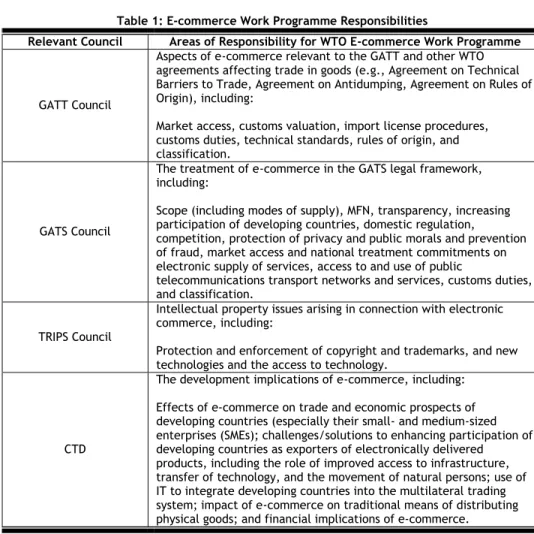
Trade in Goods (GATT Council), Council for Trade in Services (GATS Council), Council for Trade Related Aspects of Intellectual Property (TRIPS Council), and the Committee on Trade and Development (CTD)—to explore the relationship between existing WTO agreements and e-commerce, and identified the following illustrative list of issues that each body should examine.11 (See Table 1 below for a description of the subsidiary bodies’ work
programme responsibilities).
4 WTO, The Geneva Ministerial Declaration on Global Electronic Commerce, WT/MIN(98)/DEC/2 (20 May
1998) [The E-commerce Declaration].
5Id. 6Id.
7 General Council, WTO Agreements and Electronic Commerce, WT/GC/W/90 (14 July 1998). 8 General Council, Work Programme on Electronic Commerce, WT/L/274 (30 Sept. 1998). 9
Id.
10 A “subsidiary body” refers to any of the WTO councils or committees that reports to the WTO General
Council.
Part One | 5
Table 1: E-commerce Work Programme Responsibilities
Relevant Council Areas of Responsibility for WTO E-commerce Work Programme
GATT Council
Aspects of e-commerce relevant to the GATT and other WTO agreements affecting trade in goods (e.g., Agreement on Technical Barriers to Trade, Agreement on Antidumping, Agreement on Rules of Origin), including:
Market access, customs valuation, import license procedures, customs duties, technical standards, rules of origin, and classification.
GATS Council
The treatment of e-commerce in the GATS legal framework, including:
Scope (including modes of supply), MFN, transparency, increasing participation of developing countries, domestic regulation,
competition, protection of privacy and public morals and prevention of fraud, market access and national treatment commitments on electronic supply of services, access to and use of public
telecommunications transport networks and services, customs duties, and classification.
TRIPS Council
Intellectual property issues arising in connection with electronic commerce, including:
Protection and enforcement of copyright and trademarks, and new technologies and the access to technology.
CTD
The development implications of e-commerce, including: Effects of e-commerce on trade and economic prospects of developing countries (especially their small- and medium-sized enterprises (SMEs); challenges/solutions to enhancing participation of developing countries as exporters of electronically delivered products, including the role of improved access to infrastructure, transfer of technology, and the movement of natural persons; use of IT to integrate developing countries into the multilateral trading system; impact of e-commerce on traditional means of distributing physical goods; and financial implications of e-commerce.
Source: General Council, Work Programme on Electronic Commerce, WT/L/274 (30 Sept. 1998) and Hauser & Wunsch (2002) at p. 62.
The WTO Secretariat for each of the four subsidiary bodies prepared background papers on the issues to be considered.12 WTO Members also submitted papers.13 The four subsidiary
bodies met numerous times to discuss the issues and reported to the General Council on the progress of their work in July 1999.14 The General Council considered these reports in
12 GATT Council, Background Note by the Secretariat, Work Programme on Electronic Commerce, G/C/W/128
(5 Nov. 1998); GATS Council, Note by Secretariat, Work Programme on Electronic Commerce, S/C/W/68 (16 Nov. 1998); CTD, Note by the Secretariat, Development Implications of Electronic Commerce,
WT/COMTD/W/51 (23 Nov. 1998); TRIPS Council, Background Note by the Secretariat, The Work Programme on Electronic Commerce, IP/C/W/128 (10 Feb. 1999).
13 Contributions from developing countries include: CTD, Communication from the Delegation of Egypt,
Electronic Commerce in Goods and Services, WT/COMTD/W/38 (3 Mar. 1998); TRIPS Council, Communication from India, Work Programme on Electronic Commerce, IP/C/W/147 (13 July 1999).
14
GATS Council, Interim Report to the General Council, Work Programme on Electronic Commerce, S/C/8 (31 Mar. 1999); General Council, Communication from the Chairman of the CTD, Interim Review of Progress in the Implementation of the Work Programme on Electronic Commerce, WT/GC/23 (9 Apr. 1999); General Council, Communication from the GATT Council Chairman, Interim Review of Progress in the
6 | WTO, E-commerce and Information Technologies
October 1999, forwarded the reports to the Seattle Ministerial Conference,15 and agreed to
return to the matter of e-commerce as early as possible in the year 2000.16
The General Council was unable to make its own report or recommendations to the Seattle Ministerial Conference because the Members could not agree on three issues: (1) classifying “digital products as goods or services; (2) extending the moratorium on imposing customs duties on electronic transmissions; and (3) the “institutional arrangements”17 for continuing
the work programme.18
§ Classifying “digital products” as goods or services.
Digital products are computer programs, text, video, images, sound recordings, and other products that are digitally encoded and that—before the rise of the Internet—were traditionally traded as part of a physical carrier medium such as a compact disc, book, or tape. These products were classified as goods, and for tariff purposes, their valuation was based on the value of the carrier medium.
Some WTO Members think these products should continue to be classified as goods when traded electronically. Others think they should be classified as services. This is an important issue because the classification of digital products determines which set of WTO obligations and commitments governs trade in these products—GATT or GATS — and thus determines the kinds of trade barriers and limitations they can be subjected to. (See Section VIII below for a complete discussion of the “classification issue”).
§ Extending the moratorium on imposing customs duties on electronic transmissions.
Some developing country Members opposed an extension of the moratorium because they were wary of the potential loss of tariff revenues19 as well as the
absence of a similar discipline on taxes, on which developed countries are more likely to rely for revenue. Other Members questioned the scope of the
Implementations of the Work Programme on Electronic Commerce, WT/GC/24 (12 Apr. 1999); CTD,
Communication by the Chairperson, Contribution by the Committee on Trade and Development to the WTO Work Programme on Electronic Commerce, WT/COMTD/19 (15 July 1999) [CTD E-commerce Report]; GATT Council, Information Provided to the General Council, Work Programme on Electronic Commerce, G/C/W/158 (26 July 1999) [GATT Council E-commerce Report]; GATS Council, Progress Report to the General Council, Work Programme on Electronic Commerce, S/L/74 (27 July 1999) [GATS Council E-commerce Report]; and TRIPS Council, Progress Report to the General Council, Work Programme on Electronic Commerce, IP/C/18 (30 July 1999) [TRIPS Council E-commerce Report].
15 General Council, Communication from the Chairman of the Council for Trade in Goods, Draft Annual
Report, WT/GC/W/345 (26 Oct. 1999) at para. 13.
16 General Council, Minutes of Meeting: Held 3 & 8 May 2000, WT/GC/M/55 (16 June 2000) at para. 222. 17 The term “institutional arrangements” refers to the question of whether the work programme should continue
under the four subsidiary bodies or some other horizontal body such as the General Council.
18See generally, General Council, Minutes of Meeting: Held 15 June 1999, WT/GC/M/40/Add.3 (5 July 1999)
at section 3; General Council, Minutes of Meeting: Held 15 June 1999, WT/GC/M/45 (2 Aug. 1999) at section 5; and General Council, Minutes of Meeting Held: 6 Oct. 1999, WT/GC/M/48 (27 Oct. 1999) at section 5.
19See UNCTAD (2002a) and Mattoo and Schuknecht (2001) on the potential tariff loss that developing
Part One | 7 moratorium20 or did not want an agreement extending the moratorium to pre-judge
other aspects of the work programme, including the question of how digital products should be classified (i.e., as goods or services). And some countries simply may have been withholding agreement as negotiating leverage to achieve other objectives (e.g., liberalization of agricultural trade). (See Section VIII below for the “moratorium issue”).
§ Continuing the work programme under the four subsidiary bodies or under the General Council or some other “horizontal” group.
Some Members favored institutional arrangements that would place the work programme exclusively under the General Council or some other horizontal group to reduce the number of meetings taking place on e-commerce and to facilitate the consideration of “cross-sectoral” issues,21 such as the classification of digital
products.
In preparation for the November 1999 Ministerial Conference in Seattle, a number of delegations, including developing countries, submitted recommendations for language on e-commerce to be included in the Seattle Ministerial Declaration.22 The overall failure of the
Seattle Ministerial Conference precluded any specific action on e-commerce and called into question the status of the work programme as well as the moratorium on imposing customs duties on electronic transmissions. Thus, Phase I of the work programme ended with no concrete accomplishments and uncertainty about future work.
2. Phase II: Seattle Ministerial Conference - Doha Ministerial Conference
In July 2000, the General Council agreed to: (1) reinvigorate the WTO’s work on e-commerce; (2) ask the GATT, GATS, and TRIPS Councils and the CTD to resume their work, identify cross-cutting sectoral issues, and report back to the General Council in December 2000; and (3) consider how best to organize the Council’s work, including the
20 The meaning of the language in the E-commerce Declaration not to impose “customs duties on electronic
transmissions” is not clear. Members agree that goods ordered online but delivered offline are not covered by the declaration. But there is disagreement on how the declaration applies to digital products like software or music that were treated as goods subject to tariffs when traded on a physical carrier medium such as a CD. See
General Council, Communication from the Chairman of the GATS Council, Interim Review of Progress in the Implementation of the Work Programme on Electronic Commerce, WT/GC/24 (12 Apr. 1999) at para. 4.2.
21 “Cross-sectoral” or “horizontal” issues are those that cut across the jurisdiction of an individual WTO
Council.
22 General Council, Communication from Australia, Work Programme on Electronic Commerce: Objectives for
Treatment of Electronic Commerce, WT/GC/25 (5 July 1999); General Council, Communication from Indonesia and Singapore, Preparations for the 1999 Ministerial Conference: Work Programme on Electronic Commerce, WT/GC/W/247 (9 July 1999); General Council, Communication from Japan, Preparations for the 1999 Ministerial Conference: Electronic Commerce, WT/GC/W/253 (9 July 1999); General Council, Communication from the European Communities and their Member States, Preparations for the 1999 Ministerial Conference: WTO Work Programme on Electronic Commerce, WT/GC/W/306 (9 Aug. 1999); General Council, Communication from Canada, Preparations for the 1999 Ministerial Conference: Electronic Commerce, WT/GC/W/339 (23 Sept.1999); General Council, Communication from Australia, Preparations for the 1999 Ministerial Conference: Electronic Commerce Draft Text for Ministerial Declaration, WT/GC/W/367 (12 Oct. 1999); General Council, Communication from Venezuela, Proposal on Electronic Commerce, WT/GC/W/376 (19 Oct. 1999); General Council, Communication from Cuba, Preparations for the 1999 Ministerial Conference: WTO Work Programme on Electronic Commerce, WT/GC/W/380 (27 Oct. 1999).
8 | WTO, E-commerce and Information Technologies
creation of an “ad hoc task force” to assist in consideration of subsidiary body reports and cross-sectoral issues.23 Each of the bodies reported back to the General Council as invited,
generally reaffirming their support for the WTO’s continued work on e-commerce and their July 1999 reports to the General Council.24
At the December 2000 General Council meeting, the Chairman, Ambassador Kare Byrn of Norway, commented that Members appeared to agree that:
First, . . . [a]ll the subsidiary bodies concluded that further clarification and educative work was needed. Second, the work to date demonstrated that electronic commerce fell within the scope of existing WTO agreements. While e-commerce was a fairly new development, it did not appear in need of new WTO rules. There were some areas that had been identified as needing additional clarification as to how current rules should be applied in particular circumstances, but these were limited. Third, Members had all become aware . . . of the tremendous potential of e-commerce and the Internet to contribute to infrastructure capacity building and market access, particularly for developing countries.25
However, because there was no agreement among Members on the process for continuing the work programme, i.e., in the subsidiary bodies or in a horizontal group, the work programme stagnated. Accordingly, the Chairman expressed his hope that the Members would select a procedure for organizing the General Council’s work on electronic commerce “in order to prepare for the next Ministerial Conference.”26
In May 2001, the General Council Chairman, Ambassador Stuart Harbinson of Hong Kong, announced a plan to reinvigorate the work programme by:
§ asking the four subsidiary bodies to deepen their work in specific areas relevant to their respective areas of competence and to report back to the General Council;
§ considering cross-cutting issues in the General Council;
23 General Council, Minutes of Meeting: Held on 17 & 19 July 2000, WT/GC/M/57 (14 Sept. 2000) at section
11.
24 CTD, Report by the Chairman, Work Programme on Electronic Commerce: Contribution by the CTD,
WT/COMTD/26 (13 Nov. 2000); GATT Council, Chairman’s Factual Progress Report to the General Council on the Work Programme on Electronic Commerce, G/L/421 (24 Nov. 2000); TRIPS Council, Progress Report by the Chairman to the General Council, Work Programme on Electronic Commerce, IP/C/20 (4 Dec. 2000); GATS Council, Oral Report by the Chairman of the Council for Trade in Services to the General Council, WTO Programme on Electronic Commerce, S/C/13 (6 Dec. 2000).
25 General Council, Minutes of Meeting: Held 7, 8, 11 & 15 Dec. 2000, WT/GC/M/61 (7 Feb. 2001) at para.
106. Note that a number of developing country Members questioned the extent to which e-commerce falls within the scope of the WTO rules, including: Brazil (para. 113); India (para. 122); Malaysia (para. 127); Sri Lanka (para. 129); Nigeria (para. 134). Other developing country Members, however, concurred that e-commerce fell within WTO rules and/or on the need to avoid restrictive measures on e-e-commerce: Colombia (para. 108); Cuba (para. 114); Costa Rica (para. 116); Hungary (para. 120); Hong-Kong China (para. 127); Albania (para. 124); Korea (para. 130); Slovak Republic (para. 132); Pakistan (para. 137); Lesotho (para. 143); Turkey (para. 152).
26Id. See also General Council, Minutes of Meeting: Held 8 & 9 Feb. 2001, WT/GC/M/63 (2 Mar. 2001) at
Part One | 9 § holding dedicated discussions of the General Council on e-commerce to give
Members adequate time to address cross-cutting issues; and
§ considering how e-commerce would be addressed at the Fourth Ministerial Conference as part of the Ministerial preparations.27
The Chairman’s plan was inspired by a contribution from MERCOSUR (Argentina, Brazil, Paraguay, and Uruguay) identifying sectoral versus cross-sectoral or horizontal issues.28 The
plan was implemented over the summer of 2001 and its first three points were validated by the Doha Ministerial Declaration, which addressed electronic commerce as follows:
We take note of the work which has been done in the General Council and other relevant bodies since the Ministerial Declaration of 20 May 1998 and agree to continue the Work Programme on Electronic Commerce. The work to date demonstrates that electronic commerce creates new challenges and opportunities for trade for Members at all stages of development, and we recognize the importance of creating and maintaining an environment which is favorable to the future development of electronic commerce. We instruct the General Council to consider the most appropriate institutional arrangements for handling the work programme, and to report on further progress to the Fifth Session of the Ministerial Conference. We declare that Members will maintain their current practice of not imposing customs duties on electronic transmissions until the Fifth Session.29
Thus, Phase II of the work programme ended with a concrete decision to extend the work programme and the moratorium.
3. Phase III: Doha Ministerial Conference - Cancun Ministerial Conference
Responding to the Doha Ministerial Declaration instructions regarding institutional arrangements for the work programme, Ambassador Harbinson in December 2001 proposed a second dedicated discussion on cross-cutting issues, continued oversight over the four subsidiary bodies’ work on e-commerce, and further consultations with delegations.30 The subsequent Chairman of the General Council, Ambassador Sergio Marchi
of Canada, reported in October 2002 that the results of these consultations confirmed that through the Fifth Ministerial Conference, in Cancun September 2003, the institutional arrangements for the work programme would be as follows:
§ the General Council would play a central role in the process, keeping the work programme under continuous review and considering any trade-related issues of a cross-cutting nature;
27 General Council, Minutes of Meeting: Held 8 & 9 May 2001, WT/GC/M/65 (18 June 2001) at para. 128. 28
General Council, Communication from MERCOSUR, Electronic Commerce: Horizontal and Sectoral Issues Which Require Further Analysis, WT/GC/W/434 (7 May 2001).
29 WTO, Doha Ministerial Declaration, WT/MIN(01)/DEC/1 (14 Nov. 2001) at para. 34 [Doha Declaration]. 30 General Council, Minutes of Meeting: Held 19-20 Dec. 2001, WT/GC/M/72 (6 Feb. 2002) at section 4.
10 | WTO, E-commerce and Information Technologies
§ further dedicated discussions on cross-cutting issues would be held in October 2002, December 2002, February 2003, and May-June 2003; and
§ the four subsidiary bodies would examine and report to the General Council on aspects of electronic commerce relevant to their respective areas of competence.31
Throughout 2001-2003, the General Council has maintained the Work Programme on Electronic Commerce as a standing item on its agenda. Discussions at these meetings have focused on further consideration of the institutional arrangements regarding the General Council’s work on e-commerce as well as reviewing the work being done in the subsidiary bodies and in the Dedicated Discussions. 32
There have been five Dedicated Discussions on cross-sectoral e-commerce issues. For the first discussion, the WTO Secretariat prepared a list of cross-sectoral issues that had been previously identified by the subsidiary bodies as a guide for deciding which issues should be addressed. (See Table 2 below for a description of the cross-sectoral issues).
Table 2: Cross-Sectoral Issues Cross-Sectoral Issues
Classification of content of certain electronic transmissions: Definition of “e-commerce;” concept of technological neutrality; issue of likeness.
Development related issues: Participation of developing countries in e-commerce; access to infrastructure and technology; transfer of technology; capacity-building; technical assistance; access to developed and developing countries’ markets for developing countries’ producers and suppliers; promoting use of information technology; ensuring that e-commerce benefits developed and developing countries; movement of natural persons.
Fiscal implications of e-commerce/Imposition of customs duties on electronic commerce. Relationship and possible substitution effect between e-commerce and traditional forms of commerce.
Competition: Constraints on development of e-commerce due to the concentration of market power; competition and domestic regulations; competition and intellectual property rights; jurisdiction and applicable laws/other legal issues.
Other.
Source: General Council, Summary by the Secretariat of the Issues Raised, Dedicated Discussion on Electronic Commerce Under the Auspices of the General Council on 15 June 2001, WT/GC/W/436 (6 July 2001) [First Dedicated Discussion Summary].
The agenda for the first discussion, held in June 2001, listed the following topics: classification of content of certain electronic transmissions; development-related issues; fiscal implications of e-commerce, and jurisdiction.33 Many Members concluded that the
classification issue needed to be resolved quickly, and virtually all members seemed to agree
31
General Council, Minutes of Meeting: Held 15 Oct. 2002, WT/GC/M/76 (5 Nov. 2002) at section 6.
32 General Council, Minutes of Meeting: Held 18 & 19 July 2001, WT/GC/M/66 (10 Aug. 2001); General
Council, Minutes of Meeting: Held 10 Oct. 2001, WT/GC/M/69 (26 Oct. 2001); General Council, Minutes of Meeting: Held 19 & 20 Dec. 2001, WT/GC/M/72 (6 Feb. 2002); General Council, Minutes of Meeting: Held 13 & 14 May 2002, WT/GC/M/74 (1 July 2002); General Council, Minutes of Meeting: Held 8 & 31 July 2002, WT/GC/M/75 (27 Sept. 2002); General Council, Minutes of Meeting: Held 15 Oct. 2002, WT/GC/M/76 (5 Nov. 2002); General Council, Minutes of Meeting: Held 10 – 12 and 20 Dec. 2002, WT/GC/M/77 (13 Feb. 2003); General Council, Minutes of Meeting: Held 10 Feb. 2003, WT/GC/M/78 (7 Mar. 2003).
Part One | 11 that classification, development, and the imposition of customs duties were the three most important cross-sectoral issues.34
The agenda for the second Dedicated Discussion in May 2002 was the same as the first discussion, but the majority of the discussion focused on the classification issue.35 The third
and fourth Dedicated Discussions, held in October 2002 and February 2003, focused on the classification issue and the fiscal implications of e-commerce.36 The fifth Dedicated
Discussion, held on 16 May and 11 July 2003, addressed three issues: classification of the context of certain electronic transmissions; general objectives to be applied to the consideration of e-commerce; and the report to be submitted to the next meeting of the General Council.37
In the fifth Dedicated Discussion, the classification discussion centered on a submission filed by the European Communities (EC) explaining why digital products should be classified as services covered by the GATS.38 The discussion on general objectives was
prompted by a submission filed by the United States proposing that the Members agree to five objectives at the Cancun Ministerial:
§ adhering to a liberal and open trade environment through the application of existing WTO agreements to e-commerce;
§ committing to greater market access and national treatment for the products and services that can be traded via e-commerce;
§ minimizing domestic regulations that affect e-commerce;
§ making permanent on an Most Favored Nation (MFN) basis the moratorium on imposing customs duties on electronic transmissions; and
§ providing technical assistance and capacity building to make e-commerce accessible to developing countries.39
34Minutes of the 18 & 19 July 2001 General Council Meeting, WT/GC/M/66 at section 10. 35Minutes of the 13 - 14 May 2001 General Council Meeting, WT/GC/M/74 at section 13. 36
General Council, Summary by the Secretariat of the Issues Raised, Second Dedicated Discussion on Electronic Commerce under the Auspices of the General Council on 6 May 2002, WT/GC/W/475 (20 June 2002) General Council, Summary by the Secretariat of the Issues Raised, Third Dedicated Discussion of Electronic Commerce Under the Auspices of the General Council on 25 October 2002, WT/GC/W/486 (4 Dec. 2002); General Council, Summary by the Secretariat of the Issues Raised, Fourth Dedicated Discussion on Electronic Commerce Under the Auspices of the General Council on 27 February 2003, WT/GC/W/492 (8 Apr. 2003).
37 General Council, Summary by the Secretariat of Issues Raised, Fifth Dedicated Discussion on Electronic
Commerce Under the Auspices of the General Council on 16 May and 11 July 2003, WT/GC/W/509 (31 July 2003).
38
General Council, Submission from the European Communities, Classification Issues and the Work Programme on Electronic Commerce, WT/GC/W/497 (9 May 2003).
39 General Council, Submission from the United States, Work Programme on Electronic Commerce,
12 | WTO, E-commerce and Information Technologies
With respect to the other cross-sectoral issues, the development-related issues were addressed primarily in the CTD. Substitution, competition, and jurisdiction received almost no consideration during the course of the work programme.
During the 2001-2003 period, the Committee on Trade and Development was the only body to engage substantively on the work programme. In December 2001, the CTD approved the following approach to its work on e-commerce:
§ establish e-commerce as a standing item on CTD agendas;
§ respond to requests from the General Council;
§ hold approximately one seminar per year on development-specific aspects of e-commerce, such as revenue implications of e-commerce for developing countries, developing country competitiveness in e-commerce, the physical infrastructure needs for e-commerce, and human infrastructure needs;
§ showcase country experiences and success stories; and
§ provide a forum for delegations to receive information on activities related to e-commerce and development in other multilateral agencies.40
The CTD held two seminars,41 showcased Panama’s and Costa Rica’s experiences with
e-commerce,42 and provided the opportunity for United Nations Council on Trade and
Development (UNCTAD) to discuss its E-commerce and Development Report 2001.43 The WTO
Secretariat produced a background note this year which summarizes the CTD’s work on e-commerce since 1998.44 (See Section III.A below for a further explanation of the CTD’s
work on e-commerce.)
4. Phase IV: Cancun Ministerial Conference
In preparation for the Cancun Ministerial in September 2003:
§ The GATT Council advised the General Council that it had not undertaken any discussion on the work programme because it had gone as far as it could go on technical goods matters given the “unresolved horizontal issues” that remained
40 CTD, Note on the Meeting of 26 Nov. 2001, WT/COMTD/M/36 (14 Jan. 2002); CTD, Work Programme on
Electronic Commerce in the CTD, WT/COMTD/35 (19 Dec. 2001).
41 CTD, Report by the Chairman, Seminar on “Government Facilitation of E-commerce for Development,”
Attachment, Note of the Meeting of 8 October 2001, WT/COMTD/M/35 (31 Oct. 2001); CTD, Report by the Chairperson, Seminar on “Revenue Implications of E-commerce, WTO, Geneva, Monday, 22 April 2002,”
Annex II, Note of the Meeting on 25 April 2002, WT/COMTD/M/40 (26 June 2002).
42 Presentation by C. E. Thayer, National Experience of Panama in the Field of Electronic Commerce, Annex,
Note of the Meeting of 26 Nov. 2001, WT/COMTD/M/36 (14 Jan. 2002); Presentation by Costa Rica, Costa Rica’s Experience in Electronic Commerce, Annex 1, Note on the Meeting of 14 Feb. 2002, WT/COMTD/M/38 (10 July 2002).
43 CTD, Thirty-Sixth Session, Note of the Meeting of 26 Nov. 2001, WT/COMTD/M/36 (14 January, 2002). 44 CTD, Background Note by the Secretariat, Work on Electronic Commerce in the CTD, WT/COMTD/W/100