University of Nebraska - Lincoln
DigitalCommons@University of Nebraska - Lincoln
Faculty Publications: Department of Entomology
Entomology, Department of
2014
A negative effect of a pathogen on its vector? A
plant pathogen increases the vulnerability of its
vector to attack by natural enemies
Camila F. de Oliveira
University of Nebraska-Lincoln, [email protected]
Elizabeth Y. Long
University of Missouri, [email protected]
Deborah L. Finke
University of Missouri, [email protected]
Follow this and additional works at:
http://digitalcommons.unl.edu/entomologyfacpub
Part of the
Entomology Commons
This Article is brought to you for free and open access by the Entomology, Department of at DigitalCommons@University of Nebraska - Lincoln. It has been accepted for inclusion in Faculty Publications: Department of Entomology by an authorized administrator of DigitalCommons@University of Nebraska - Lincoln.
de Oliveira, Camila F.; Long, Elizabeth Y.; and Finke, Deborah L., "A negative effect of a pathogen on its vector? A plant pathogen increases the vulnerability of its vector to attack by natural enemies" (2014).Faculty Publications: Department of Entomology. 475. http://digitalcommons.unl.edu/entomologyfacpub/475
DOI 10.1007/s00442-013-2854-x Used by Permission.
A negative effect of a pathogen on its vector? A plant pathogen
in-creases the vulnerability of its vector to attack by natural enemies
Camila F. de Oliveira, Elizabeth Y. Long, Deborah L. Finke
Abstract
Plant pathogens that are dependent on arthropod vectors for transmission from host to host may enhance their own success by promoting vector survival and/or performance. The effect of pathogens on vectors may be direct or indi-rect, with indirect effects mediated by increases in host quality or reductions in the vulnerability of vectors to natural enemies. We investigated whether the bird cherry-oat aphid Rhopalosiphum padi, a vector of cereal yellow dwarf virus (CYDV) in wheat, experiences a reduction in rates of attack by the parasitoid wasp Aphidius colemani when actively harboring the plant pathogen. We manipulated the vector status of aphids (virus carrying or virus free) and evaluated the impact on the rate of attack by wasps. We found that vector status did not influence the survival or fecundity of aphids in the absence of parasitoids. However, virus-carrying aphids experienced higher rates of parasit-ism and greater overall population suppression by parasitoid wasps than virus-free aphids. Moreover, virus-carrying aphids were accepted as hosts by wasps more often than virus-free aphids, with a greater number of wasps sting-ing virus-carrysting-ing aphids followsting-ing assessment by antennal palpations than virus-free aphids. Therefore, counter to the prevailing idea that persistent vector-borne pathogens enhance the performance of their vectors, we found that infectious aphids actively carrying a plant pathogen experience greater vulnerability to natural enemies. Our results suggest that parasitoids may contribute to the successful biological control of CYDV by disproportionately impacting
virus-carrying vectors, and thus reducing the proportion of vectors in the population that are infectious.
Keywords: Vector-borne pathogen, Barley yellow dwarf, Rhopalosiphum padi, Aphidius colemani, Indirect effect
1
digitalcommons.unl.edu
Introduction
Increasing evidence suggests that vector-borne plant pathogens are capable of manipulating the performance and behavior of arthropod vectors to promote their own successful transmission (Desbiez et al. 2011). The impact of pathogens may be direct, with vectors experiencing physiological benefits from being an active carrier of a pathogen (Belliure et al. 2005; Miller and Coon 1964). Or pathogens can indirectly influence aspects of vector per-formance on, and preference for, infected hosts by alter-ing plant nutritional quality. Vector growth rate, repro-duction, and longevity are often improved on infected host plants, and pathogen- induced symptoms such as yellow or mottled leaves and altered volatile emissions can increase the attractiveness of infected plants to vec-tors (Belliure et al. 2005; Bosque-Pérez and Eigenbrode 2011; Eigenbrode et al. 2002; Hodge et al. 2011; Jiménez-Martínez et al. 2004; Ogada et al. 2012; Shapiro et al. 2012).
Neutral and negative effects of pathogens on fitness traits of their vector organisms have also been found (Donaldson and Gratton 2007; Mauck et al. 2010; Mc-Menemy et al. 2012), with some of this variation attribut-able to the identity of the herbivore (Kluth et al. 2002), the identity and developmental stage of the infected host
plant (Hodge and Powell 2010), and the intimacy of the interaction between the vector and pathogen (Castle and Berger 1993; Mauck et al. 2012). For example, persis-tently transmitted pathogens, for which extended feed-ing bouts on infected plants are required for vectors to successfully acquire a pathogen and become infectious, may benefit by improving host plant quality for vectors (Belliure et al. 2005; Hodge and Powell 2010; Ogada et al. 2012). In contrast, non-persistent or mechanically transmitted pathogens, for which transmission efficien-cy is greatest when vectors briefly probe infected plants and decreases with sustained feeding, may benefit by providing a sub-optimal resource to vectors and thus stimulating their dispersal (Purcell and Almeida 2005). Non-persistent pathogens have indeed been shown to manipulate vector behavior to their own advantage by inducing deceptive visual or chemical cues to attract vec-tors to inferior-quality host plants from which vecvec-tors rapidly disperse following an initial exploratory probe (Mauck et al. 2010). The same deceptive signaling strat-egy may also be employed by semi-persistent pathogens, for which the period of infectivity of the vector is limited (McMenemy et al. 2012).
Up to this point, we have only considered the poten-tial for pathogen impacts on vector populations in the
2 Oliviera etal.
context of the host-pathogen-vector interaction. From a community perspective, we know that vector behavior, performance, and population dynamics are not only a function of the quality of their host plants, but also their susceptibility to natural enemies (Denno et al. 2002; Hunter and Price 1992). Plants often defend themselves against herbivores by facilitating the action of natural enemies (Price et al. 1980). By derailing this indirect de-fense of plants, pathogens may benefit vector organisms and thus promote their own proliferation. For example, for vectors that are at greater risk of attack when small, pathogen-induced increases in plant nutritional quality that speed up vector development may enable vectors to escape attack by natural enemies by narrowing their window of susceptibility (Benrey and Denno 1997). Bel-liure et al. (2008) found reduced predation risk of thrips vectors when they fed on pepper plants infected with tomato spotted wilt virus. An increase in thrips develop-ment rate on infected host plants translated into a de-crease in the risk of predation by predatory mites, since large thrips larvae are invulnerable to mites. Infection of host plants did not, however, impact the risk of attack by a predatory bug, which is capable of consuming thrips larvae of all sizes (Belliure et al. 2008).
When the natural enemy of a vector is a parasitoid, the potential for even more complicated interactions exists. Parasitoids co-occur with pathogens in the same host/vector environment for an extended period of time, which sets up the possibility for direct interactions like resource competition and interference between parasit-oid larvae and pathogens (Brodeur and Rosenheim 2000; Hodge and Powell 2008; Moya-Raygoza et al. 2006). For example, the larval development of the parasitoid wasp, Aphidius ervi, is delayed and mortality is higher in ce-real aphids (Sitobion avenae) that have acquired barley yellow dwarf virus (BYDV) (Christiansen-Weniger et al. 1998). Furthermore, adult female A. ervi wasps will dis-criminate among hosts and avoid depositing eggs within infectious aphids (Christiansen- Weniger et al. 1998). Based on these results we can predict that the ultimate outcome may be an overall reduction in the percent of the infectious cereal aphid population that is parasitized, which may indirectly benefit pathogen spread and pro-liferation.
Aphid-borne BYDVs and cereal yellow dwarf virus (CYDV) are some of the most prevalent plant viruses in the world, attacking more than 150 species of grasses, and causing significant yield losses to cereals worldwide (Irwin and Thresh 1990). The BYDV/CYDV pathosystem comprises a group of Luteoviruses, including several strains of BYDV (BYDV-PAV , -MAV , -SGV, and -RMV), and a single Polerovirus, CYDV (CYDV-RPV), that are transmitted by at least 25 aphid vector species (Halbert and Voegtlin 1995). Here we focus on the CYDV (CYDV-RPV isolate) transmitted by the bird cherry-oat aphid Rhopalosiphum padi feeding on soft red winter wheat
(Triticum aestivum). This pathogen is transmitted in a persistent circulative manner, i.e., virions circulate in the hemolymph of an aphid before being transported into the aphid accessory salivary glands where they can be secreted into the phloem of a healthy plant. The virus does not reproduce in the vector, nor is it transmitted transovarially from parent to offspring (Sylvester 1980). The optimal feeding time for a vector to acquire the virus from an infected host plant and become viruliferous, or capable of transmitting the virus, is ~24– 48 h (Power and Gray 1995). Bird cherry-oat aphids are susceptible to par-asitism by the braconid wasp Aphidius colemani, with parasitism most likely in the fourth (and final) aphid in-star (Ode et al. 2005). Female wasps insert their oviposi-tor into the body of a living aphid to deposit an egg in the aphid hemolymph. A larva hatches from the egg and feeds internally on the aphid until its eventual pupation (i.e., mummy formation) at which point the aphid dies. Following pupation, a single adult wasp emerges from the aphid corpse. Given the co-occurrence of the virus and the parasitoid within the aphid hemolymph, the op-portunity exists for direct interactions between them.
Our objective was to investigate whether parasitism of the bird cherry-oat aphid by the wasp A. colemani is reduced in the presence of the aphid-vectored CYDV. We were specifically interested in the potential for direct ef-fects of the pathogen on the parasitoid that arise when virus-carrying (i.e., viruliferous) aphids are attacked by parasitoids, rather than any indirect effects of the gen on parasitoid success that may result from patho-gen-induced changes in host plant quality. To do this, we compared parasitism rates of non-viruliferous and viru-liferous aphids on virus-free host plants. We further ex-amined whether any differences in the susceptibility of aphids to parasitoids was the result of pathogen-induced changes in aphid performance or the attractiveness and acceptability of aphid hosts to searching parasitoid fe-males. This work was motivated by the rationale that pathogens that are dependent on vectors for movement from host to host could enhance their own transmission by protecting their vector organism from attack by natu-ral enemies. Understanding the direct impacts of patho-gens on their vectors and how these direct impacts fur-ther influence vector interactions with ofur-ther organisms in the environment, like natural enemies, can contribute to the development of vector-borne disease management programs.
Materials and methods
Effect of pathogen acquisition on the susceptibility of aphid vectors to natural enemies
We compared the susceptibility of non-viruliferous and viruliferous aphid vectors to parasitoid wasps in labo-ratory arenas (16-h light: 8-h dark cycle, 25–28 °C). To
eliminate any confounding effects of pathogen-induced changes in host plant quality, we ensured that host plants did not become infected during the time frame of the ex-periment by using a cultivar of soft red winter wheat, T. aestivum cv. Roane, which is unique in that it possesses a resistance mechanism that reduces the incidence and/or development of BYDV. In testing for registration, Roane had an average disease score of 1.3 out of 9, with 1 in-dicating no disease (Griffey et al. 2001). In our previous experiments, we were unable to detect the presence of the virus in replicated plots of Roane wheat that had ex-perienced prior feeding by viruliferous aphids, whereas the presence of the virus was detected in 100 % of Coker cultivar wheat plots (n = 36, Long 2013).
Each laboratory arena contained three 10-day-old uninfected Roane wheat plants grown in 15-cm-high X 15-cm-diameter plastic pots and enclosed in a 30-cmhigh X 12-cm-diameter plastic tube cage sunk into the soil and topped with an organdy mesh cover. We released 30 early instar bird cherry-oat aphids into each of 20 arenas, with half of the cages receiving non-viruliferous aphids and half receiving viruliferous aphids. Viruliferous aphids acquired the virus prior to the start of the experiment as first or second instars by feeding on CYDV-RPV-infected plant tissue (T. aestivum cv. Coker) in Petri dishes left in the dark at 20 °C for 48 h. Non-viruliferous aphids were also left in Petri dishes for 48 h, but with uninfected leaf material. Leaf material was obtained from virus-positive and virus-negative stock plants that were maintained free of aphids under greenhouse conditions (16-h light:8-h dark cycle, 26–38 °C). All stock plants were confirmed to be positive or negative for CYDV-RPV via reverse-transcription polymerase chain reaction prior to their use in experiments.
After the acquisition (or mock-acquisition) period, aphids were released into experimental arenas. Aphids fed undisturbed on the host plants for 1 week, until the majority of aphids had reached the fourth instar. Aphids did not reproduce during this time; however, we con-ducted a pre-count to verify initial aphid abundance for each cage (average initial abundance = 30.55 + 1.43 aphids) before introducing three parasitoid wasps (two females and one male). Adult wasps were allowed access to the fourth instar aphids for 24 h and then removed. Following the removal of the parasitoids, the cages re-mained undisturbed for an additional 10 days to allow development of parasitoid offspring. Aphids matured and began to reproduce clonally during this time. After 10 days, we counted the number of living aphids and parasitoid pupae (“aphid mummies”) present and moni-tored aphid mummies for the successful emergence of adult wasps.
The experimental design was a randomized complete block, with 20 replications of each treatment blocked across two time periods (ten replicates per block). We compared rates of parasitism of fourth instar aphids
(number of mummies/initial number of aphids) and adult wasp emergence (number of emerged adults/ number of mummies) between non-viruliferous and vir-uliferous aphid vectors using one-way ANOVA with the block included as a random effect in the model (PROC MIXED, SAS version 9.3).
Effects of pathogen acquisition on the performance of aphid vectors
We investigated whether pathogen acquisition influenc-es the longevity or fecundity of aphid vectors by plac-ing individual 4-day-old non-viruliferous or viruliferous aphids on healthy wheat leaf tissue and monitoring (1) the number of days to aphid death, and (2) the number of nymphs produced per aphid. All aphids experienced an acquisition (or mock-acquisition) period prior to the start of the experiment as described previously. During the experimental period, aphids were maintained in Petri dishes with wheat leaf clippings ~5 cm in length (16-h light:8-h dark cycle, 25–28 °C). Leaf material was replaced and aphid nymphs were counted and removed daily until aphid death. We conducted ten replicates of each treatment for a total of 20 experimental units. In a separate experiment, we compared the body mass of non-viruliferous and non-viruliferous aphids by rearing groups of 20 aphids for 1 week on potted wheat plants that were either healthy or infected with virus (7 replicates each). After 1 week, we determined average aphid biomass by = dividing the combined wet weight of all aphids within an experimental unit by the total number of aphids pres-ent. We compared the number of days that an individual aphid was alive (longevity), the cumulative number of offspring produced per aphid (fecundity), and the av-erage individual body mass between nonviruliferous and viruliferous aphids using one-way ANOVA (PROC MIXED, SAS version 9.3). The response variables longev-ity and fecundlongev-ity were log10 transformed to meet the as-sumptions of ANOVA .
Behavioral response of parasitoids to non‑viruliferous and viruliferous aphids
Host location
We examined whether pathogen acquisition by aphid vectors influences the ability of parasitoid wasps to lo-cate aphids and whether parasitoid wasps exhibit a pref-erence for non-viruliferous versus viruliferous aphids in laboratory choice tests (25–28 °C). Treatment samples were randomly placed in opposite ends of a sterilized glass Y-tube with an internal diameter of 2.4 cm, arms 25 cm long, and uniform airflow over the samples (OLFM-YT-2425F; Analytical Research Systems, Gainesville, FL). The Y-tube was located on a slight incline (~30°) with a light source at the distal end. The experimental period began when a single mated female parasitoid was
re-4 Oliviera etal.
leased into the base of the tube. A positive response was recorded if the parasitoid traveled at least 3 cm down one of the treatment arms. If the parasitoid made no clear choice after 10 min, then the parasitoid was consid-ered “unresponsive.” The effect of pathogen acquisition by aphids on the ability of parasitoids to locate aphids was determined by comparing the parasitoid response when offered (1) three non-viruliferous aphids on un-infected wheat tissue versus unun-infected leaf tissue with no aphids, and (2) three viruliferous aphids on unin-fected wheat tissue versus uninunin-fected leaf tissue with no aphids. The preference of parasitoids for non virulifer-ous or virulifervirulifer-ous aphids was determined by offering parasitoids a choice of three non viruliferous aphids on uninfected wheat tissue versus three viruliferous aphids on uninfected wheat tissue. We conducted 30 replicates of each paired treatment combination. A different indi-vidual female parasitoid was used for each replicate of each treatment combination for a total of 90 parasitoids. We determined the effect of pathogen acquisition on parasitoid attraction to and preference for aphid vectors using χ2-tests (PROC FREQ, SAS version 9.3).
Host acceptance
We conducted behavioral observations to compare the acceptability of non-viruliferous and viruliferous aphids as hosts for parasitoid wasps in the laboratory (25–28 °C). In a Petri dish, we offered five non-viruliferous or five viruliferous aphids on healthy plant tissue to a sin-gle mated parasitoid female. During a 10-min observa-tion period, we noted (1) the number of times the para-sitoid engaged in antennal palpation of an aphid; (2) the number of times a parasitoid successfully stung an aphid (i.e., inserted its ovipositor without interruption); and (3) the duration of time the parasitoid spent walking/for-aging using event-recording software (Observer XT 8.0; Noldus Information Technology, Leesburg, VA ; Desneux et al. 2009). We determined the effect of virus acquisi-tion by aphids on the number of antennal palpaacquisi-tions, the number of stings, the number of stings per antennation, and the total time spent walking/ foraging by parasit-oids using one-way ANOVA (PROC MIXED, SAS ver-sion 9.3). In all cases, the response variables were log10 transformed to meet the assumptions of ANOVA .
Results
Effect of pathogen acquisition on the susceptibility of aphid vectors to natural enemies
When feeding on healthy host plants, viruliferous aphids experienced higher rates of parasitism by wasps than nonviruliferous populations of aphids (Fig. 1a; F1, 36 = 5.43, p = 0.026). Since the rate of parasitism is a propor-tion, and thus a function of both the number of mum-mies formed and the initial number of aphids present, an
increase in the rate of parasitism could reflect an increase in successful parasitoid attacks on viruliferous aphids and/or a direct negative effect of virus acquisition on the survival of the aphid. However, the initial number of aphids present prior to the release of parasitoids did not differ between non-viruliferous and viruliferous aphids (31.10 + 2.07 and 30.00 + 2.07 aphids, respectively; F = 0.20, p = 0.66), indicating that the larger proportion of viruliferous aphids parasitized was in fact due to a great-er risk of attack by parasitoids (significant diffgreat-erence in the total number of mummies formed: F 1,36 = 4.88, p = 0.034). Although a greater proportion of viruliferous aphids were mummified by wasps, there was no dif-ference in the likelihood that a new adult wasp would successfully complete development and emerge from a pupa found in either a non-viruliferous or viruliferous aphid host (Fig. 1b; F1,3 3 = 0.04, p = 0.85). Therefore, the acquisition status of a vector influenced its susceptibility to parasitoid attack, perhaps by reducing the likelihood of oviposition or diminishing parasitoid egg survival, but it did not affect the performance of the parasitoid once the wasp had reached pupation.
Effects of pathogen acquisition on the performance of aphid vectors
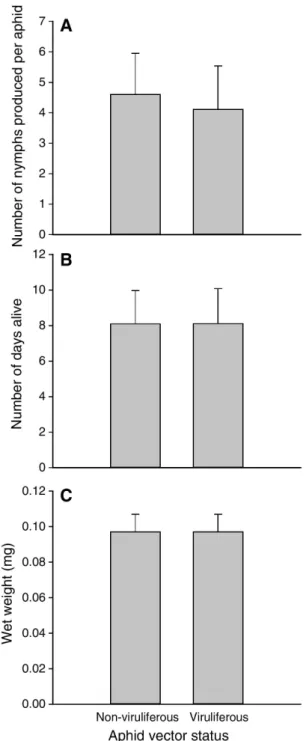
We found no evidence that acquisition of the virus di-rectly affected the performance of individual aphid vec-tors. In the absence of parasitoid wasps, the number of offspring produced per aphid (Fig. 2a), the number of days aphids survived on healthy wheat plants (Fig. 2b), and the mass of individual aphids (Fig. 2c) did not differ between non-viruliferous and viruliferous aphids (F1,17 = 0.02, p = 0.89; F1,17 = 0.001, p = 0.99; and F1,12 = 0.001, p = 0.99; respectively).
Behavioral response of parasitoids to non‑viruliferous and viruliferous aphids
Host location
In Y-tube choice tests, female parasitoid wasps did not demonstrate long-range attraction to their aphid prey (Fig. 3a, b). Wasps were equally likely to orient towards control leaf material as to leaf material with aphids pres-ent, whether aphids were non-viruliferous or virulifer-ous (X2 = 0.15, p = 0.84 and X2 = 0.47, p = 0.83, respec-tively). Parasitoids also showed no preference for aphids that had or had not previously acquired the virus (X2 = 0.00, p = 1.0). When given a choice, an equal number of parasitoids oriented towards nonviruliferous aphids as viruliferous aphids (Fig. 3c).
Host acceptance
The foraging behaviors of parasitoids associated with the location and assessment of host aphids did not vary
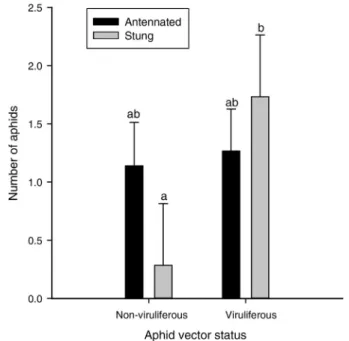
in response to the acquisition status of aphids, but the decision of parasitoids to accept aphids as potential hosts did. Parasitoids spent an equal proportion of their time walking in the local vicinity of non-viruliferous and vir-uliferous aphids (0.81 + 0.071 and 0.77 + 0.071, respec-tively; F1,27 = 0.14, p = 0.71) and engaged in antennal palpation of the same number of non-viruliferous and viruliferous aphids (Fig. 4; F1,27 = 0.06, p = 0.81). How-ever, parasitoids chose to insert their ovipositors into a greater number of viruliferous than non-viruliferous aphids following antennation (Fig. 4; F1,27 = 4.33, p = 0.047).
Discussion
For pathogens that are dependent on vectors for move-ment from host to host, selective pressure on the patho-gen to ensure the success and persistence of the vector organism likely exists (Desbiez et al. 2011). In fact, there is increasing evidence that vector-borne plant pathogens can increase the survival and performance of their vec-tors by enhancing host plant quality and/or decreasing the vulnerability of vectors to their natural enemies (Bell
hiure et al. 2005, y BYDVs and CYDV. Therefore, we con-clude that the greater susceptibility to attack of virulif-erous aphids occurred because pathogen acquisition by aphids directly altered aphid physiology or behavior in such a way that their acceptability and/or suitability as hosts for parasitoids increased.
Host selection by adult female parasitoids is a multi-step process involving the location of hosts in the habitat, the recognition and acceptance of the host, and the suitability of the host for parasitoid development
Fig. 2 The effect of virus acquisition on the performance of individual bird cherry-oat aphids feeding on healthy host plants. a Aphid fecundity, b aphid longevity, and c aphid size. LS means + 1 SEM shown
Fig. 1 The effect of virus acquisition on the susceptibility of bird cherry-oat aphids to Aphidius colemani parasitoid wasps. a The rate of aphid parasitism by wasps. b The percentage of adult wasps successfully emerging from pupae (i.e., mummies). Least square (LS) means + 1 SEM with different letters are significantly different at p < 0.05
6 Oliviera etal.
(Vinson 1976). The acquisition of a plant pathogen by insect vectors that are also hosts of parasitoids could influence this host-selection process in a variety of ways. Long-range cues exploited by parasitoids for host location often involve volatile chemicals associated with the host, the host’s food plant, or a combination of these factors (Bilu et al. 2006; Hatano et al. 2008; Storeck et al. 2000; Vet and Groenewold 1990). By altering the volatile cues produced by vectors or their host plants, plant pathogens could mediate the ability of parasitoids to successfully locate hosts/vectors in the environment. We examined the possibility that pathogen acquisition by the aphid vector influenced volatile production by the aphid itself, rendering the aphid more apparent to foraging parasitoid wasps and thus increasing the rate of parasitism. However, we found no evidence that parasitoids were any more or less likely to locate non-viruliferous or non-viruliferous aphids in the habitat using both choice and no-choice tests (Fig. 3). Therefore, it appears unlikely that acquisition of CYDV changed the amount or identity of volatile chemicals produced directly by aphids that are exploited by parasitoids for host location. We did not explore the possibility that host-plant-associated volatiles may have been altered.
We found greater support for the idea that acquisi-tion of CYDV by aphid vectors enhanced the recogniacquisi-tion and acceptance of aphids as hosts for parasitoids. After locating a potential host aphid, braconid parasitoids de-termine the acceptability of the host for attack by (1) as-sessing contact chemicals on the aphid cuticle through antennal palpation, and (2) evaluating the quality of
the internal host environment through ovipositor prob-ing (Hatano et al. 2008). Receptors on the surface of the ovipositor enable parasitoids to investigate the internal chemistry of the aphid hemolymph before depositing an egg. Host acceptance by the parasitoid occurs when ovi-position takes place and the female parasitoid deposits an egg. We found no difference in the number of non-viruliferous and non-viruliferous aphids that were evaluated by antennal palpation following location by parasitoids; however, a greater number of parasitoids inserted their ovipositors into the body of viruliferous aphids follow-ing antennation (Fig. 4). The greater number of stfollow-ings by parasitoids following antennation implies that previous feeding on infected plants enhanced the acceptability of aphids as hosts for parasitoid offspring. However, we were unable to confirm whether stings by parasitoids resulted in the actual deposition of an egg, since our at-tempts to locate parasitoid eggs through aphid dissec-tion were unsuccessful. It is interesting to note that the seemingly greater recognition and acceptability of viru-liferous aphids by parasitoids emerged despite the fact that our experimental design may have biased parasitoid preference towards non-viruliferous hosts. Host choice by parasitoids is often influenced by the conditioning of the female to the cues associated with the host on which she developed (Bilu et al. 2006; Storeck et al. 2000; Vet and Groenewold 1990). The parasitoids in this study were maintained in colony on virus-free aphids prior to use, which may have created an oviposition preference for the non-viruliferous aphids. Despite this potential bias, we still found that parasitoids stung viruliferous
Fig. 3 The effect of virus acquisition by bird cherry-oat aphids on the ability of A. colemani parasitoid wasps to locate aphids and the preference of wasps for non-viruliferous versus viruliferous aphids. The number of parasitoid females in Y-tube trials choosing healthy control plant material with no aphids vs.’ healthy plant material with non-viruliferous aphids (A), healthy control plant material with no aphids vs. healthy plant material with viruliferous aphids (B), and healthy plant material with viruliferous aphids vs. healthy plant material with non-viruliferous aphids (C). The number of unresponsive females, those that did not make a decision during the 10-min trial period, is shown to the right (n = 30 for each comparison)
Fig. 4 The effect of virus acquisition by bird cherry-oat aphids on the number of aphids (out of five) antennated by A. colemani parasitoids and the number of aphids in which a parasitoid inserted its ovipositor. LS means +1 SEM with different letters are significantly different at the
aphids following antennation at a higher rate than non-viruliferous aphids, suggesting greater acceptance of these aphids as hosts.
Acceptance of aphids by female parasitoids is expect-ed to be positively relatexpect-ed to the performance of the par-asitoid offspring that develop on these hosts (Desneux et al. 2009; Ode et al. 2005). Therefore, the fact that A. cole-mani parasitoids differentiate between non-viruliferous and viruliferous bird cherry-oat aphids suggests that the suitability of these aphids for parasitoid development also varies (Vinson 1980). It has been reported previously that parasitoids can discriminate among hosts based on the presence of a pathogen and that host choice corre-lates with the suitability of hosts for the development of parasitoid offspring. For example, Christiansen-Weniger et al. (1998) found that acquisition of BYDV by the aphid Sitobion avenae decreased the suitability of the aphid as a host for the parasitoid A. ervi due to greater aphid mor-tality and delayed parasitoid development. As a result, A. ervi parasitoids discriminated among hosts, deposit-ing fewer eggs in viruliferous S. avenae aphids. On the other hand, Hodge and Powell (2008) found that Aphid-ius ervi failed to discriminate among Acyrthosiphon pisum aphids that had or had not acquired pea enation mosaic virus, but this was not surprising given that the pathogen had no effect on aphid performance, and thus was not assumed to impact host suitability for the para-sitoid. In our system, we found evidence that parasitoids do discriminate among potential aphid hosts based on the presence of the pathogen, but this behavior did not correlate with any of our measures of aphid performance. Aphid survival, body size, and the proportion of adult parasitoids emerging from pupae were all unaffected by acquisition of the pathogen (Figs. 1, 2). Instead, we hy-pothesize that the acquisition of CYDV may increase the suitability of aphids as hosts by compromising the aphid immune response to parasitoids.
Virus acquisition by aphids may influence the aphid immune response by altering the nutritional budget of the aphid. Virtually all aphids contain the obligate bac-terial symbiont Buchnera, which synthesizes essential amino acids for the aphid that are not available in the aphid diet (Douglas 1998). Buchnera also produce a pro-tein called symbionin, which is thought to function as a storage protein for the nitrogen-limited aphids (Ishikawa 1989; Ishikawa and Yamaji 1985). However, symbionin may also play a critical role in vector-virus interactions by binding to virus particles in the aphid hemolymph, potentially enabling the virus to evade detection by the aphid immune system or facilitating the movement of the virus from the aphid hemolymph into the accessory salivary gland (Gray and Gildow 2003; van den Heuvel et al. 1994). If the binding of virions to symbionin lim-its the availability of this important source of nutrition to the aphid, the ability of aphids to mount an effective immune response to parasitoids may be compromised.
Exactly how this immune response may function is not clear, as our knowledge of the mechanisms involved in aphid immunity against parasitoids is incomplete (Strand and Pech 1995). Unlike other insects, which com-monly encapsulate developing parasitoids through the adhesion of hemocytes to parasitoid eggs or larvae, en-capsulation appears to be relatively rare and/or less ef-fective in aphids (Pennacchio and Strand 2006; Schmitz et al. 2012; Smilanich et al. 2009). Furthermore, aphids appear to be missing key genes present in the genomes of other insects that are thought to play a critical role in the recognition, signaling, and killing of invaders (Gerardo et al. 2010). One factor that does appear to play an impor-tant role in aphid immunity is the presence of facultative bacterial symbionts (i.e., secondary symbionts). There is accumulating evidence that aphids harbor a variety of defensive secondary symbionts that confer resistance against parasitoids (Oliver et al. 2003) and that parasit-oids are capable of distinguishing among aphids based on the presence of these defensive symbionts (Oliver et al. 2012). Data suggest that supporting defensive second-ary symbionts may come at a cost to aphid performance (Oliver et al. 2008), and we speculate that this cost may be further compounded if the binding of virions to sym-bionin limits the availability of nutritional resources to the aphid.
We originally predicted that the vector-borne CYDV would benefit its aphid vector as a result of selective pres-sure to promote its own transmission. Instead we found that the presence of the plant pathogen negatively af-fected the survival of its vector by increasing the vector’s vulnerability to natural enemies. This outcome reveals the complex evolutionary and ecological interactions occurring among pathogens, arthropod vectors, plant hosts, and natural enemies, with all players under selec-tion to enhance their own proliferaselec-tion. For example, it would likely be advantageous to the plant to manipulate the susceptibility of viruliferous aphids to parasitoids.
Although not directly investigated here, our work sug-gests that parasitoids may contribute to the suppression of CYDV in the field by disproportionately impacting viruscarrying vectors, thus reducing the overall abun-dance and the proportion of vectors in the population that are infectious (Sisterson 2009). However, parasitoids not only influence vectors by attacking and consuming them; they may also trigger greater movement of vectors from plant to plant (Roitberg et al. 1979; Weisser et al. 1999). By stimulating vector escape behaviors, parasit-oids may elevate disease risk in a host plant population, despite overall reductions in vector abundance (Hodge and Powell 2008; Smyrnioudis et al. 2001). Furthermore, pathogen-induced changes in host plant quality may also indirectly impact the vulnerability of vectors to natural enemies and influence the movement of vectors across the landscape (Belliure et al. 2008; Mauck et al. 2012). Therefore, our results are encouraging in the
con-8 Oliviera etal.
text of disease management, because they suggest that parasitoids in agro-ecosystems may contribute to the successful biological control of vectors of CYDV. How-ever, predicting the ultimate impact of parasitoids on the prevalence of CYDV will require knowledge of a variety of complex and potentially counter- acting forces (Finke 2012; Mauck et al. 2012; Smyrnioudis et al. 2001).
Acknowledgments
We thank Ben Puttler, Lauren Diepenbrock, Andrew Fill, and Kathryn Ingerslew for providing experimental advice and comments on the manuscript. Three anony-mous reviewers provided insightful comments on a pre-vious version of the manuscript. This research was sup-ported by the Agriculture and Food Research Initiative of the USDA National Institute of Food and Agriculture, grant no. 2009-02083 and the University of Missouri Re-search Board. Triticum aestivum cv. Coker seeds were generously provided by Syngenta.
References
Belliure B, Janssen A, Maris PC, Peters DPC, Sabelis MW (2005) Herbivore arthropods benefit from vectoring plant viruses. Ecol Lett 8:70–79
Belliure B, Janssen A, Sabelis MW (2008) Herbivore benefits from vectoring plant virus through reduction in period of vulnerability to predation. Oecologia 156:797–806
Benrey B, Denno RF (1997) The slow growth-high mortal-ity hypothesis: a test using the cabbage butterfly. Ecology 78:987–999
Bilu E, Hopper KR, Coll M (2006) Host choice by Aphidius cole-mani: effects of plants, plant-aphid combinations and the presence of intra-guild predators. Ecol Entomol 31:331–336 Bosque-Pérez NA , Eigenbrode SD (2011) The influence of
vi-rusinduced changes in plants on aphid vectors: insights from luteovirus pathosystems. Virus Res 159:201–205 Brodeur J, Rosenheim JA (2000) Intraguild interactions in aphid
parasitoids. Entomol Exp Appl 97:93–108
Castle SJ, Berger PH (1993) Rates of growth and increase of My-zus persicae on virus-infected potatoes according to type of virusvector relationship. Entomol Exp Appl 69:51–60 Christiansen-Weniger P, Powell G, Hardie J (1998) Plant virus
and parasitoid interactions in a shared insect vector/host. Entomol Exp Appl 86:205–213
Denno RF, Gratton C, Peterson MA, Langellotto GA, Finke DL, Huberty AF (2002) Bottom-up forces mediate
naturalen-emy impact in a phytophagous insect community. Ecology 83:1443–1458
Desbiez C, Moury B, Lecoq H (2011) The hallmarks of “green” viruses: do plant viruses evolve differently from others? In-fect Genet Evol 11:812–824
Desneux N, Barta RJ, Hoelmer KA, Hopper KR, Heimpel GE (2009) Multifaceted determinants of host specificity in an aphid parasitoid. Oecologia 160:387–398
Donaldson JR, Gratton C (2007) Antagonistic effects of soybean viruses on soybean aphid performance. Environ Entomol 36:918–925
Douglas AE (1998) Nutritional interactions in insect-microbial symbioses: aphids and their symbiotic bacteria Buchnera. Annu Rev Entomol 43:17–37
Eigenbrode SD, Ding H, Shiel P, Berger PH (2002) Volatiles from potato plants infected with potato leafroll virus attract and arrest the virus vector, Myzus persicae (Homoptera: Aphididae). Proc Biol Sci 269:455–460
Finke DL (2012) Contrasting the consumptive and non-con-sumptive cascading effects of natural enemies on vector-borne pathogens. Entomol Exp Appl 144:45–55
Gerardo N et al (2010) Immunity and other defenses in pea aphids, Acyrthosiphon pisum. Genome Biol 11:R21
Gray SM, Gildow FE (2003) Luteovirus-aphid interactions. Annu Rev Phytopathol 41:539–566
Griffey CA et al (2001) Registration of ‘Roane’ wheat. Crop Sci 41:1359–1360
Halbert S, Voegtlin D (1995) Biology and taxonomy of vectors of barley yellow dwarf viruses. In: D’Arcy CJ, Burnett PA (eds) Barley yellow dwarf: 40 years of progress. The Ameri-can Phytopathological Society, St. Paul, pp 217–258
Hatano E, Kunert G, Michaud JP, Weisser WW (2008) Chemi-cal cues mediating aphid location by natural enemies. Eur J Entomol 105:797–806
Hodge S, Powell G (2008) Complex interactions between a plant pathogen and insect parasitoid via the shared vec-tor-host: consequences for host plant infection. Oecologia 157:387–397
Hodge S, Powell G (2010) Conditional facilitation of an aphid vector, Acyrthosiphon pisum, by the plant pathogen, pea enation mosaic virus. J Insect Sci 10:155
Hodge S, Hardie J, Powell G (2011) Parasitoids aid dispersal of a
nonpersistently transmitted plant virus by disturbing the aphid vector. Agric For Entomol 13:83–88
Hunter MD, Price PW (1992) Playing chutes and ladders: heterogeneity and the relative roles of bottom-up and top-down forces in natural communities. Ecology 73:724–732 Irwin ME, Thresh JM (1990) Epidemiology of barley yellow
dwarf: a study in ecological complexity. Annu Rev Phyto-pathol 28:393–424
Ishikawa H (1989) Biochemical and molecular aspects of endo-symbiosis in insects. Int Rev Cytol 116:1–45
Ishikawa H, Yamaji M (1985) Symbionin, an aphid endosym-biontspecific protein—1: production of insects deficient in symbiont. Insect Biochem 15:155–163
Jiménez-Martínez ES, Bosque-Pérez NA , Berger PH, Zemetra RS, Ding H, Eigenbrode SD (2004) Volatile cues influence the response of Rhopalosiphum padi (Homoptera: Aphididae) to Barley yellow dwarf virus-infected transgenic and un-transformed wheat. Environ Entomol 33:1207–1216
Kluth S, Kruess A, Tscharntke T (2002) Insects as vectors of plant pathogens: mutualistic and antagonistic interactions. Oecologia 133:193–199
Long EY (2013) Predator diversity impacts herbivore abun-dance and behavior with cascading effects on the prevalence of a vectorborne plant pathogen. Doctoral Dissertation, Di-vision of Plant Sciences. University of Missouri, Columbia Mauck K, de Moraes CM, Mescher MC (2010) Deceptive
chemi-cal signals induced by a plant virus attract insect vectors to inferior hosts. Proc Natl Acad Sci USA 107:3600–3605 Mauck K, Bosque-Pérez NA , Eigenbrode SD, De Moraes CM,
patho-gen effects on host-vector interactions: evidence from plant viruses. Funct Ecol 26:1162–1175
McMenemy LS, Hartley SE, MacFarlane SA, Karley AJ, Shep-herd T, Johnson SN (2012) Raspberry viruses manipulate the behavior of their insect vectors. Entomol Exp Appl 144:56–68 Miller J, Coon BF (1964) The effect of barley yellow dwarf virus
on the biology of its vector. J Econ Entomol 57:970–974 Moya-Raygoza G, Palomera-Avalos V, Chacon-Torres NM,
Becerra- Chiron IM (2006) The parasitoid Gonatopus bartlet-ti reduces presence of plant-pathogenic Spiroplasma kun-kelii within the leafhopper vector Dalbulus maidis. Entomol Exp Appl 119:189–196
Ode PJ, Hopper KR, Coll M (2005) Oviposition vs. offspring fit-ness in Aphidius colemani parasitizing different aphid spe-cies. Entomol Exp Appl 115:303–310
Ogada PA, Maiss E, Poehling H-M (2012) Influence of tomato spotted wilt virus on performance and behaviour of western flower thrips (Frankliniella occidentalis). J Appl Entomol 137:488–498
Oliver KM, Russell JA, Moran NA , Hunter MS (2003) Faculta-tive bacterial symbionts in aphids confer resistance to para-sitoid wasps. Proc Natl Acad Sci USA 100:1803–1807 Oliver KM, Campos JM, Moran NA , Hunter MS (2008)
Popula-tion dynamics of defensive symbionts in aphids. Proc Biol Sci 275:293–299
Oliver KM, Noge K, Huang EM, Campos JM, Becerra JX, Hunt-er MS (2012) Parasitic wasp responses to symbiont-based defense in aphids. BMC Biol 10:11
Pennacchio F, Strand MR (2006) Evolution of developmental strategies in parasitic hymenoptera. Annu Rev Entomol 51:233–258
Power AG , Gray SM (1995) Aphid transmission of barley yel-low dwarf viruses: Interactions between viruses, vectors, and host plants. In: D’Arcy CJ, Burnett PA (eds) Barley yel-low dwarf: 40 years of progress. The American Phytopatho-logical Society, St. Paul, pp 259–292
Price PW, Bouton CE, Gross P, McPheron BA, Thompson ON, Weis AE (1980) Interactions among three trophic levels: in-fluence of plants on interactions between insect herbivores and natural enemies. Annu Rev Ecol Syst 11:41–65
Purcell AH, Almeida RPP (2005) Insects as vectors of disease agents. Encyclopedia of plant and crop science. Taylor & Francis, London
Roitberg BD, Myers JH, Frazer BD (1979) The influence of predators on the movement of apterous pea aphids between plants. J Anim Ecol 48:111–122
Schmitz A et al (2012) The cellular immune response of the pea aphid to foreign intrusion and symbiotic challenge. PLoS One 7:e42114
Shapiro L, de Moraes CM, Stephenson AG , Mescher MC (2012) Pathogen effects on vegetative and floral odours mediate vector attraction and host exposure in a complex pathosys-tem. Ecol Lett 15:1430–1438
Sisterson MS (2009) Transmission of insect-vectored pathogens: effects of vector fitness as a function of infectivity status. En-viron Entomol 38:345–355
Smilanich AM, Dyer LA, Gentry GL (2009) The insect immune response and other putative defenses as effective predictors of parasitism. Ecology 90:1434–1440
Smyrnioudis I, Harrington R, Clark S, Katis N (2001) The effect
of natural enemies on the spread of barley yellow dwarf vi-rus (BYDV) by Rhopalosiphum padi (Hemiptera: Aphidae). Bull Entomol Res 91:301–306
Storeck A, Poppy GM, van Emden HF, Powell W (2000) The role of plant chemical cues in determining host preference in the generalist aphid parasitoid Aphidius colemani. Entomol Exp Appl 97:41–46
Strand MR, Pech Ll (1995) Immunological compatibility in parasitoid- host relationships. Annu Rev Entomol 40:31–56 Sylvester ES (1980) Circulative and propagative virus
transmis-sion by aphids. Annu Rev Entomol 25:257–286
van den Heuvel JFJM, Verbeek M, van der Wilk F (1994) En-dosymbiotic bacteria associated with circulative transmis-sion of potato leafroll virus by Myzus persicae. J Gen Virol 75:2559–2565
Vet LEM, Groenewold AW (1990) Semiochemicals and learning in parasitoids. J Chem Ecol 16:3119–3135
Vinson BS (1976) Host selection by insect parasitoids. Annu Rev Entomol 21:109–133
Vinson BS (1980) Host suitability for insect parasitoids. Annu Rev Entomol 25:397–419
Weisser WW, Braendle C, Minoretti N (1999) Predator-induced morphological shift in the pea aphid. Proc Biol Sci 266:1175– 1181