2016
Identity theft education: Comparison of text-based
and game-based learning
Susan Helser Iowa State University
Follow this and additional works at:https://lib.dr.iastate.edu/etd
Part of theEngineering Commons,Instructional Media Design Commons, and thePolitical Science Commons
This Dissertation is brought to you for free and open access by the Iowa State University Capstones, Theses and Dissertations at Iowa State University Digital Repository. It has been accepted for inclusion in Graduate Theses and Dissertations by an authorized administrator of Iowa State University Digital Repository. For more information, please [email protected].
Recommended Citation
Helser, Susan, "Identity theft education: Comparison of text-based and game-based learning" (2016).Graduate Theses and Dissertations. 15930.
Identity theft education: Comparison of text-based and game-based learning
by
Susan Gail Helser
A dissertation submitted to the graduate faculty in partial fulfillment for the degree of
DOCTOR OF PHILOSOPHY
Major: Electrical and Computer Engineering
Program of Study Committee: Doug Jacobson, Major Professor
Thomas Daniels Stephen Gilbert Jennifer Newman
Steffen Schmidt
Iowa State University Ames, Iowa
2016
DEDICATION
This dissertation is dedicated to my parents, Claudia A. and David C. Helser. They valued education and the goodness and benefit that it brings. Their love and support made this work possible.
TABLE OF CONTENTS Page DEDICATION……….... ii LIST OF FIGURES ... v LIST OF TABLES ... vi NOMENCLATURE ... vii ACKNOWLEDGMENTS ... viii ABSTRACT………. ... ix
CHAPTER 1 INTRODUCTION: THESIS FORMATTING ... 10
CHAPTER 2 CHAPTER 2 DESIGNING AND DEVELOPING AN EDUCATIONAL METHOD TO COMBAT IDENTITY THEFT 63
Section I Another Direction ... 63
Section II Games and Educational Games ... 64
Section III Learning Foundations ... 65
Section IV Assessment ... 75
Section V Research Design ... 79
Section VI Research Development ... 85
CHAPTER 3 RESEARCH RESULTS ... 88
Section I Text-Based and Game-Based Results... 88
CHAPTER 4 SUMMARY AND CONCLUSIONS ... 104
Summary ... 104
Conclusions ... 105
REFERENCES ... 119
APPENDIX A INSTITUTIONAL REVIEW BOARD DOCUMENTS ... 135
APPENDIX B FIGHT IDENTITY THEFT (FIT) INTRODUCTION PANEL ... 141
APPENDIX D SURVEY 1 AND SURVEY 2 QUESTIONS ... 143
APPENDIX E FIT INFORMATION... 144
APPENDIX F PARTICIPANT FEEDBACK PANEL... 153
APPENDIX G FIT SCREEN SHOTS... 154
APPENDIX H FIT APPLICATION FLOW CHART ... 161
APPENDIX I FIT SURVEY RESPONSE SCORING SYSTEM ... 162
APPENDIX J SUMMARY STATISITCS ... 163
APPENDIX K SUMMARY SCORES, TIME, AGE, TECH, EDUCATION ... 164
APPENDIX L SUMMARY SCORES, TIME, BENEFIT, ENJOYMENT ... 167
APPENDIX M CHANGE IN PARTICIPANTS’ SCORES ON SURVEYS ... 171
APPENDIX N CALCULATED SCORES, FREQUENCIES AND PERCENTS .... 174
APPENDIX O GROUPED QUESTIONS RESULTS 127, 368, 459 ... 176
LIST OF FIGURES
Page
Figure 1 Sample Online Resumes ... 24
Figure 2 Phishing Activity Trends During Q1: 2016 ... 27
Figure 3 Q 4 2015: Most-Targeted Sectors ... 29
Figure 4 Port 80 Continues to be the one Most-Targeted for Phishing ... 32
Figure 5 Unique Phishing Sites Detected by Month from January 2015 through March 2016 ... 35
Figure 6 Phishing Reports Received by Month for January 2015 through March 2016 ... 35
Figure 7 Smith and Jones Nevada Licenses ... 38
Figure 8 Learning Theories and Principles ... 69
Figure 9 Relationship between Skills and Challenges ... 74
Figure 10 FIT Screen Shots ... 154
Figure 11 Fight Identity Theft (FIT) Application Flow ... 161
Figure 12 Frequency Score vs. Benefit ... 170
Figure 13 Frequency Score vs. Enjoyment ... 170
LIST OF TABLES
Page Table 1 US Sentencing Commission Identity Theft: Final Report,
December 15, 1999 ………….………39
Table 2 Possible Survey 1 and Survey 2 Responses ...…95
Table 3 Scoring System to Assess Movement between Survey 1 (S1) and Survey 2 (S2) ... 161
Table 4 through Table 7 Appendix J ... 163
Table 8 through Table 17 Appendix K ... 164
Table 18 through 27 Appendix L ... 167
Table 28 through 37 Appendix M ... 171
Table 38 Appendix N ... 174
Table 39 Appendix O ... 176
NOMENCLATURE
gbm game-based module
ACKNOWLEDGMENTS
I would like to thank my committee chair, Doug Jacobson, and my committee members, Thomas Daniels, Stephen Gilbert, Jennifer Newman, and Steffen Schmidt, for their guidance and support throughout the course of this research.
In addition, I would like to thank my friends, colleagues, the department faculty, and the staff for helping to make my time at Iowa State University a rewarding experience. Also, I would like to express my appreciation to those who were willing to participate in my surveys and observations, without whom, this thesis would not have been possible.
ABSTRACT
Identity theft continues to grow. It drains a host of valuable resources from Society. Trust is affected. Identity theft can upend an individual’s life and well-being. In the business sector financial losses consume profit and jeopardize the stability of industry. New and complementary approaches to combat the crime are needed.
This research examines two educational methods, one text-based and the other game-based, designed to present information about identity theft. For this purpose I developed Fight Identity Theft (FIT) software. In addition to collecting demographic information, pre- and post-survey responses and feedback data, FIT provides two educational modules. The program randomly selects the text- or game-based method of delivery. The hypothesis, that game-based learning would be more effective, was confirmed. Participants who received the game-based educational module performed better. Their feedback reflected greater satisfaction with the learning environment. They remained longer in the application.
Digital game-based learning is evolving. Its application to combat identity theft can make a difference.
CHAPTER I
INTRODUCTION: THESIS FORMATTING
Section I Overview
The focus of this research is to examine an educational method to mitigate the fast exploding and devastating crime of identity theft. The exponentially growing number of victims reflects the artful, deceptive and adaptive nature of the fraudsters who commit the crime. The increasing numbers of affected people equate to enormous losses of resources such as time and money. [4] [9] [10] [20] [21] [27] [79] [103] [144] [176]. Ranjit Bose states that, “Identity theft is the fastest growing crime in America; 9.9 million victims were reported last year, according to a Federal Trade Commission survey.” [27]
A myriad of ways exist to perpetrate identity theft. Methods range from the uncomplicated to sophisticated, but share one common factor. They can provide the identity thief with substantial profit coupled with often little consequence. Detection and prevention strategies have experienced mixed results. Identity theft provides challenges for law enforcement and the general public due to the variety of scamming methods in play and use of distributed techniques to launch an attack.
An individual can become a victim of identity theft through direct or indirect contact with an identity thief. In the case of the former, the attacker perpetrates a fraud designed to glean and collect identity information from the unknowing person. In the latter case, a victim’s identity information is compromised from a third party such as a place of employment, retailer or the government[2] [29] [43] [52] [54] [55] [56] [58] [59] [60] [71] [74] [89] [103] [107] [110] [113] [116] [123] [137] [143] [149] [150] [151] [152] [162]
[163] [168] [169] [170] [171] [172] [173] [174] [179]. The magnitude of the crimes is reflected in these articles. Consider, for example, that in July 2014 the medical community estimated that the number of Americans whose identities had been stolen and then used to perpetrate fraud in the health industry to be 1.5 million. The average cost per case was determined to be $20,663. A quick calculation reveals an amount of $30,994,500,000 [89]. This value is associated with fraud only in the medical field. The relative values combined from across various industries place the value of loss in the hundreds of billions of dollars, enough to undermine the economy.
At the personal level following an identity theft event, the victim’s life is changed forever. The effect can be immediate and cause an individual’s world to be flipped on end or can lead to a scenario in which the person continually waits for a “shoe to drop”. In either case, there are long-term consequences that affect the victim. Significant resources in the way of time and money are necessary to repair an individual’s maligned identity. The process is costly [40] [72] [79] [103] [132] [176].
Researchers Shingo Orihara, Yukio Tsuruoka and Kenji Takahashi state, “In the digital world, protecting a user’s identity is important and ID Theft is becoming a serious social problem, for example, causing an enormous loss in the financial industry. If an attacker steals a user’s identity, the attacker can easily impersonate the user and do anything as if he/she were the valid user.” [124] The White House laid out the very serious issues related to identity theft [53] [57]. The Federal Trade Commission (FTC) website for identity theft has detailed information about the crime [82].
In order to develop a strategy to help to combat identity theft, it is imperative to understand issues related to the crime. To this end, several fundamental areas will be
examined that include a definition of identity theft; targets who are vulnerable; methods employed to execute identity fraud; and existing countermeasures developed to oppose the crime. After the summary of the introductory issues, detailed information regarding the study follows and includes a description of the design and development of the research to address the problem; analysis and reporting of the results; and concluding remarks.
This paper consists of four chapters. It is structured in the following way. Chapter 1 contains eight sections. Section 1 provides an overview and an introduction of the topic and other related issues. Second 2 discusses definitions of identity and identity theft. Section 3 explores vulnerable targets and perpetrators of the fraud. Section 4 examines causes that support the crime and strategies that are used. Section 5 discusses awareness of the issue. Section 6 reports alarming statistics and economic concerns. Section 7 addresses attempts to fight identity theft. Section 8 focuses on the related issues of privacy and security.
Chapter 2 contains two sections. Section 1 discusses the foundations of game-based learning. Section 2 outlines the design and development of the project.
Chapter 3 contains one section that reports the analysis of the study. Text-based and game-based statistics are discussed. Included are results for the three grouped areas under consideration, information regarding responses to individual survey questions, and demographic material and benefit levels measured in the research. Descriptions of the tables listed in the appendices are outlined as well.
Chapter 4 contains one section, the conclusion. Included are a summary of the research findings, suggestions from participants for changes to the application, and a discussion of additional directions to explore. Recommendations from participants and ideas that developed during the study provide opportunities for future work.
References are listed in one section. Appendices consist of A through P. Documents required by the Institutional Review Board (IRB), research results, and other tables are included in the appendix indicated in the body of this work.
Section II Introduction
To better comprehend the consequences of identity theft, it is important to first understand the nature of the crime, challenges that it presents, and its affect on society and the individual. A cascade of devastating events can occur as a result of identity theft. They can set off a series of crises that embroil the victim in seemingly endless personal and professional turmoil that compromise the individual’s credibility. In the end, the major net loss of trust negatively impacts the local and global economies. [3] [28] [29] [65] [92] [105] [110].
As a result of the symbiotic relationship that exists between society and the Internet, we take for granted distributed resources. Education, communication, healthcare, investing, shopping, and the workplace represent a few of the many areas that have been transformed by the expansion of computer networks. Viable authentication is imperative to ensure trust [42] [92] [141]. In order to develop a method to combat identity theft, it is important to determine faults in the system that provide attack vectors for identity thieves to exploit and to consider people who are at risk of becoming victims [6] [41] [44] [72] [84] [109] [115] [118] [122] [154] [155]. This information will provide the foundation and ground work for later decisions that concern how and where to begin in design and development process of a solution.
Understanding the attacker and contributory factors that promote the crime are essential. Identity thieves are creative. They recycle old exploits and continue to develop new ways to bilk victims in order to expand their horizons. A compromised identity provides the would-be assailant with all of the benefits and privileges afforded to the actual individual. For example, financial services line of credit of credit options such as student loans, mortgages or credit cards represent abundantly attractive resources to the identity thief. Detection and prevention strategies designed to mitigate identity theft run the gamut. During the course of this study these methods will be examined to learn which ones represent effective techniques that can be integrated into a solution [19] [22] [23] [27] [39] [40] [61] [62] [67] [85] [86] [87] [88] [103] [111] [112] [117] [121] [124] [130] [132] [136] [161] [176] [183] [187]. A study that focuses on identity theft must also consider the ramifications related to issues of privacy versus security [32] [46] [87] [88] [93] [108] [118] [142] [154] [165].
Identity theft is increasing. The Anti-Phishing Working Group reports on the countries hosting the greatest number of phishing based keyloggers and Trojan downloaders. In the 1st Quarter of 2016 the United States ranked number one in the world with 74.54% of these sites [9]. This has been the case for several years. Documentation is available from the Anti-Phishing Working Group (www.apwg.org). According to the same source, the Netherlands has the distinction of being in second place at 2.72% while Canada is in thirteenth place at 0.21%. To understand the magnitude of this problem and to put it into perspective Robert McMillan of the IDG News Service reported on February 21, 2008 in 17 Arrested in Canadian Hack Quebec provincial police and Royal Canadian Mounted Police forces working in collaboration had broken a major cybercrime organization in Canada that
had infected more than 100,000 computers in 100 countries with botnet phishing and spamming software [106]. The automated programs were used to steal confidential information from users then forward it back to the botmasters in Canada. After collecting the information, identity thieves then used it for their own nefarious purposes. The removal of a network of this size and the international scope of the crime coupled with the estimated Canadian $45,000,000 (US $43,000,000) in damages to computer systems around the world is unprecedented in Canada. Clearly, since Canada’s contribution to the worldwide epidemic of identity theft is relatively small, the impact of this crime is significant.
Irrespective of the identity thief’s main financial objective, the first step that is necessary for any compromise to be of benefit to the fraudster is that an individual’s identity must be stolen. Reasons vary from the direct unauthorized use of the identity to perpetrate crime in the victim’s name or for use as a quick return commodity to resell for financial gain. An identity thief can use a compromised identity to mask himself or herself in order to engage in fraud in the victim’s name. Once the crime has been committed, the fraudster moves on leaving a wake of trouble behind for the unknowing victim to straighten out. If the identity thief opts to sell or trade the victim’s identity information via underground markets, the fraudster realizes a direct gain from the transfer of the resource [65].
Identity theft consists of a multifaceted and evolving set of frauds. They range in scope from those that are very simple to others that are increasingly complex and sophisticated. Many ruses compromise ordinary systems and structures from routine events. Scamming strategies exploit available resources and often combine the use of technology and social engineering. The recognized fraudsters turned security specialists Frank Abagnale
and Kevin Mitnick relate numerous methods that incorporate social engineering in [3] [4] [109].
Other identity related fraud attacks are common. A group of scams that are easily implemented via the Internet are collectively known as phishing [9] [41] [42] [44] [62] [67] [84] [85] [111] [112] [115] [130] [136] [187]. They continue to evolve as well. While Federal guidelines regulate commerce over telephone networks and fraud using phone systems is illegal and carries severe penalties, phone fraud has increased dramatically and presents a serious threat [128]. It works in much the same was as a phishing attack, only rather than the potential victim receiving an email that urges the individual to respond, a direct communication over the telephone is initiated. In some cases an actual human calls the unsuspecting target and attempts to get the person to reveal confidential information, while others are completely automated and begin with a computer that dials phone numbers followed by a sophisticated audio system that sounds like a human being.
The scam in the case of phishing or phone fraud is the same. Specifically, some wonderful or terrible event has occurred that demands the immediate attention of the potential victim. For example, phishing attacks can appear to come from an unknown benefactor who requires the victim’s bank account information in order to make a generous deposit or seem to be a warning from a known retailer with a message about an account compromise that requires confidential information from the targeted individual. Current cons over the telephone include “too good to be true offers” to reduce or eliminate student loan debt, communications from “law enforcement” that claim a complaint that must be addressed immediately has been filed against the person who receives the call, or that Microsoft is
calling to report concerns that the home computer is sending spam mail and that it must be stopped. Of course, the caller makes it clear that he or she can assist with these alerts [24].
“Identity theft topped the list of consumer complaints about fraud, according to the U.S. Federal Trade Commission’s annual report for 2005, accounting for 255,000 of the more than 686,000 complaints filed with the agency in 2005 (www.ftc.gov/opa/2006/01/toptenhtm). A prepared statement by the FTC to the U.S. House of Representatives March 30, 2006 … said identity theft victimizes nearly 10 million Americans, with costs to businesses and consumers of almost $53 billion in 2003, a 79% increase over 2002….” [42]. Prior to moving to the discussion of who is vulnerable, it is important to first define identity and identity theft.
Section III Identity Defined
The concept of self or identity represents a basic understanding of who we are across disciplines through our life. Identity is a building block and is fundamental factor in our development. Consequential pieces of information and documents such as a social security number or passport provide a person with the means to extend her or his identity in a host of directions. This information, unique to a particular individual, is known as personally identifiable information or PII [70]. Given an established and credible identity, an individual can move in a multitude of paths [144]. Everyday people participate in events throughout communities. It is possible to do so, because they have been awarded access or privileges based on their identity. A few examples of activities that are possible due to identity include securing a job, driving, attending school, donating blood, borrowing books and other materials from a library, acquiring credit to be used for purchases such as home mortgages and other loans, writing checks, travelling to many countries, and pursuing in a wide array of
other interests. An individual establishes and develops an identity as a result of the choices and actions he or she makes over time. Community members, friends, and colleagues recognize the individual’s physical appearance, voice and behavior. Technical means can be used to validate an identity as well. People and technology can be used in combination to vouch for an individual. The one-to-one correspondence of identity information with the actual individual that it represents is critical. Once the direct relationship that exists between the person and his or her identity information is compromised or broken, lack of trust becomes an issue and can set into motion serious consequences. After an individual learns that his or her identity information has been stolen, it is important to take immediate action to help to counter the damage. Multiple researchers have defined identity [23] [88] [165].
Identity and digital identity, electronically stored data associated with an individual or an organization, are related. An individual’s digital identity is an extension of the person’s identity. Information unique to a particular individual that include items such as username and password, biometric data, and unusual or specific attributes are used to authenticate a person on computer networks. The need for viable methods of authentication is growing exponentially due, in part, to the ever greater number of mobile devices and expansion of electronic communication. The consequences of a stolen digital identity can be far reaching, long lasting, and devastating. Because of the speed in which electronic data transfer can occur, a compromise requires little time and can go unnoticed until after the event is over and when it is too late to prevent the incident from happening. Digital identity has been defined as the electronic extension of identity [14] [88].
Section IV Identity Theft Defined
Deliberate deceptive practices have been in place for ages. The explosion of digital devices has made it possible to conduct technology dependent fraud over great distances. Cybercrime includes many types of criminal acts that integrate the use of computer systems into scams. In Cyberethics Morality and Law in Cyberspace, 3rd Ed. on page 186 Richard Spinello states, “We define cybercrime as a special category of criminal acts that is typically executed through the utilization of computer network technologies.” [155] Fraudsters who depend on technology based resources to commit crime, exploit the fact that they are able to access desired resources and exit a system quickly. Generally, there exists little personal risk to the attacker. Sometimes the only clue to indicate that a compromise has occurred is a small fragment of computer code that points in the direction of a particular hacker or syndicate.
Heather Morton’s definition of identity theft is, “The use of a person's personally identifying information—a name. Social Security number, credit card number or other financial information - without permission, to commit fraud, theft or other crimes.” [112] Fraudulent activity can incorporate the adoption of some other identity that is perhaps entirely fictitious or that is associated with another person without the individual’s knowledge. Similar possibilities exist for fraudsters to assume and exploit resources granted to other entities such as businesses whether they are fictional or real. While it is often difficult to prosecute, convict and bring those individuals involved in identity theft related crimes to justice, accounts exist where disciplinary action was possible [3] [4] [79] [83] [109] [176].
Identity assumption can occur in several ways that include account take-over of an actual person’s or entity’s identity, application fraud or true name fraud, or the complete work-up of a non-existent person for the express purpose to perpetrate fraud. The first two are examples of identity theft. In the case of account take-over, the thief assumes the identity of the victim to exploit existing resources such as writing checks against the individual’s account or using a stolen credit card number to purchase goods in the person’s name. In the second case, the fraudster uses the victim’s PII to extend the person’s identity to acquire resources unknown to the individual such as applying for new credit cards or loans in the individual’s name. These methods provide the identity thief with access to resources afforded to the victim and do not require the establishment and construction of a completely new identity. They represent an advantage to the fraudster, because less work is necessary prior to exploitation since the person already exists. It is for this reason that these frauds present much greater challenges to law enforcement, since countless legitimate records are associated with the individual. The problem becomes one of determining what identity information is true.
The consequences of either offense can be long-term, severe, and can go unnoticed for years. For example, at some future time when an unsuspecting victim attempts to acquire credit in his or her name it may be impossible or exceedingly difficult. If credit can be arrange, interest rates may be extremely high, because of unknown and unpaid bills racked up in the victim’s name by the thief. The problem for the victim whose identity was compromised then becomes one of cleaning up the mess. This involves proving what he or she is responsible for in relation to the numerous unknown events propagated in his or her
name. Numerous detections of identity theft exist [10] [27] [103] [137] [144] [183]. Two provided by United States government agencies follow.
The Federal Trade Commission document Deter, Detect, Defend, Avoid Theft states, “Identity theft is a serious crime. It occurs when your personal information is stolen and used without your knowledge to commit fraud or other crimes. Identity theft can cost you time and money. It can destroy your credit and ruin your good name.” [40] The United States General Accountability Office document Policy Papers March 2002, Identity theft: Prevalence and Cost Appear to be Growing indicates on page 48, “… the Secret Service defined ‘identity theft’ as any case related to the investigation of false, fraudulent, or counterfeit identification; stolen, counterfeit, or altered checks or Treasury securities; stolen, altered, or counterfeit credit cards; or financial institution fraud.” [79]
Section V Who is Vulnerable?
“Who is at risk of becoming a victim of identity theft?” is straightforward, since everyone is a potential target. Identity thieves do not discriminate. All genders, age groups, citizens, and non-citizens are possible victims of identity theft. Unfortunately, people all too often do not believe that the crime can happen to them. This belief and a lack of awareness of the pervasiveness of identity theft are factors that promote the likelihood of becoming a victim. Individuals who are proactive in protecting their identities are at risk as well, due to the potential for the compromise of personal data stored on computers [142].
Social engineering is a productive method of securing and exploiting the trust of an unsuspecting target. Its success has been well documented [3] [4] [109]. Also, the ownership of personal information varies greatly and is dependent on the country where it
exists. For example, in some European countries identity information strictly belongs to an individual or entity that it relates to in the physical world. Laws protect the person or entity and grant exclusive rights to the identity information, regardless of where the information is located or stored. Significant penalties can be levied on offenders. If institutions do not comply with the privacy laws and are determined to be guilty, the judiciary has the ability to punish the responsible parties. A major problem associated with this model is that on average it requires approximately 10 years to enact the necessary legislation in the court system while identity thieves continue to move freely and transfer data over the Internet in a few months [154].
In the United States the laws and regulations are entirely different. PII, once collected and stored on a computer, becomes the property of the owner of the technology where it is located. At this point, the person who the information initially was related to has no legal claim to it. Conversely, the owner of the technology can use the information in whatever way he, she or it sees fit. For example, identity information can be shared over extensive computer networks with parties that the technology owner has a relationship. Also, possible hacking opens the door for the unsuspecting person who provided PII to be at risk of identity theft. Countless examples of breached computer systems have been reported in government, healthcare and retail disciplines. [64, 65, 66] Because data can be transferred efficiently, it is possible for it to be stolen without the victim’s knowledge. In Markets and Privacy Kenneth Laudon reports on the establishment of clearing houses for the express purpose to buy, sell and trade bundles of standardized PII [93]. In recent U.S. legislation the owner of the technology where identity information is stored is accountable. In 1998 The Identity Theft and Assumption Deterrence Act was enacted to assist in protecting people from
identity theft [175] [176]. The law was established to punish thieves and to hold institutions accountable for failing to prevent data breaches that put individuals at risk of identity theft. Subsequent legislation requires that the owner of the technology where the data breach occurred must notify potential victims in writing [70].
Another readily available and significant pool of resources, tailor-made for identity thieves, are professionals’ vitae posted on the Internet [161]. In order to expedite job-prospects individuals will at times include PII in online resumes. Latanya Sweeney researched and reported on this issue [161]. Sweeney collected PII during a two year period by using a web-crawler that searched for regular expressions that matched key items such as social security number, date of birth or telephone number. She refers to the information collected in the two consecutive years as DBA and DBB, respectively. A summary of the results of the study is illustrative.
“Of the 150 resumes in the DBA, 140 (or 93%) had complete nine-digit SSNs, whereas 10 had partial, invalid or some other country’s number. All of the 75 resumes in DBB had nine-digit SSNs.” [161]
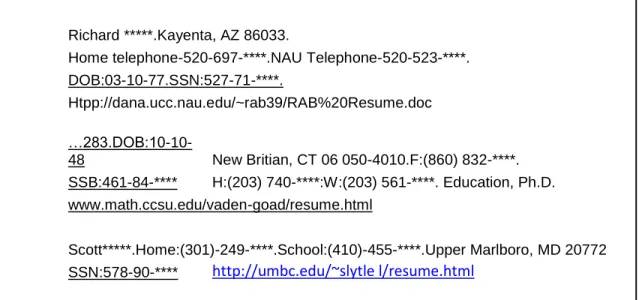
The statistics are troubling and revealing. Sweeney’s report included a sample of the information gathered by a web crawler. To protect the individuals’ privacy, a number of data items were not revealed in the publication. However, Sweeney noted at the time that the information could be obtained online. The items in Figure 1 appear in Sweeney’s article and suggest that the Internet represents a rich space to obtain PII. The URLs listed in Sweeney’s research are no longer valid. At the time the data was posted on the Internet it was available to the public, so social engineering was not required; physical trespassing was unnecessary to
gain access to the PII; and hacking of a computer’s security features was not needed. In these instances, an identity thief was able to view PII on the Internet without issue. Sweeney continues work in this area and is an active researcher with a project known as the Data Privacy Lab, SOS Social Security Number Watch which is a program administered through the IQSS at Harvard University [160].
Richard *****.Kayenta, AZ 86033.
Home telephone-520-697-****.NAU Telephone-520-523-****.
DOB:03-10-77.SSN:527-71-****. Htpp://dana.ucc.nau.edu/~rab39/RAB%20Resume.doc …283.DOB:10-10-48 New Britian, CT 06 050-4010.F:(860) 832-****. SSB:461-84-**** H:(203) 740-****:W:(203) 561-****. Education, Ph.D. www.math.ccsu.edu/vaden-goad/resume.html Scott*****.Home:(301)-249-****.School:(410)-455-****.Upper Marlboro, MD 20772 SSN:578-90-**** http://umbc.edu/~slytle l/resume.html
Figure 1: Sample Online Resumes
Young people and adolescents are inclined at times take part in risky behavior often due to a lack of understanding of issues that can affect them. Internet Safety 101 provides information about a variety of technology-based crimes and includes areas that specifically address issues related to young people [82]. Research shows that PII that belongs to young adults and adolescents can be obtained in chat rooms and on websites [84]. Adults are susceptible to posting PII as well. This behavior can be triggered and encouraged by the promise of a free gift such as a cruise, weekend getaway or camera. The ignorance of clear warning signs and the failure to accept the possibility of risk exists. Elderly people tend to accept the written word. Once information enters the home through the Internet via email or
a website application, low cost goods and services appear to be legitimate and are appealing to seniors. Reports reveal that a substantial amount of the population continues to take part in risky choices regardless of age, gender or clear warning signs [106]. Studies show that the same behavior persists in relation to e-commerce practices as well with the same result [6] [44] [85] [154].
Prior to discussing who initiates identity theft, results compiled from two informal polls of 30 people are instructive. The data provides insight into the need for education about identity theft. The first poll was conducted in 2006. The second was taken 10 years later in 2016. Three questions were asked that relate to identity theft. The first set of results from 2016 show that individuals in the group did not comprehend the problem.
Q: Have you heard of identity theft? A: 10 responded affirmatively Q: Have you heard of phishing? A: 5 responded affirmatively Q: Have you heard of LifeLock? A: 3 responded affirmatively
Ten years later in 2016 a second group of 30 people were asked the same three questions with the results that follow.
Q: Have you heard of identity theft? A: 30 responded affirmatively Q: Have you heard of phishing? A: 22 responded affirmatively Q: Have you heard of LifeLock? A: 10 responded affirmatively
The government, the news media, businesses and others have been at work to educate the public about identity theft. However, more must be done.
Section VI Who Perpetrates Identity Theft
Advances and the reduction in the cost of technology have provided numerous and far-reaching benefits for society. The communication industry has moved from strictly audio
signals to allow for large data sets so that images and video files can be transferred in near real-time. At the same time, developments have made it possible to provide healthcare or financial services to remote locations, this technology has given rise to evolving and costly scams that are more challenging to detect and prevent.
The creativity and motivation of identity thieves or fraudsters is well-established. Their goal is to acquire PII for personal gain by committing a crime in the victim’s name or by selling the identity information in underground black-market organizations [65]. Research confirms the growing rate of stolen identity information. Valid social security numbers have a value of approximately $25. Other pieces of identity information such as date of birth, credit card numbers and medical insurance documentation range in cost and do not exceed $20. Bank account numbers for accounts with $70,000 to $150,000 are worth around $300. Complete identity packets are available for around $1200 [8] [37] [146] [175].
In the early days of hacking, the perpetrator considered breaching a security system as a form of entertainment or as a “game”. Often these individuals were adolescents with an excess of time available to locate weaknesses in security protocols and then figure out ways around them. Accolades received from fellow hackers and boasting rights were their reward. For example, as a result of compromising a computer system teens were able to alter electronically stored records at a school. This type of “chicanery” has been replaced by technology dependent crime such as corporate or international espionage and identity theft. The stakes are higher [183].
Phishing and related scams such as spear phishing are methods employed to steal PII to commit identity theft [29] [110] [127] [153]. In the case of phishing, these schemes can be understood quite literally as casting out a giant net with the expectation of hauling in a
collection of personal information from unsuspecting victims. The idea is that a percentage of individuals will respond to the bait contained in an email. The con is a popular exploit in the identity thief’s tool-box and is effective. For example, if 10% of 1000 people are hooked, 100 sets of identity information are obtained by the fraudster. Profit to the thief is considerable and requires little effort or risk. Targeted individuals unknowingly participate by providing PII, often through a web-based application that appears to be legitimate, but that is linked to an untrustworthy server. The victim’s PII is spirited away to a system controlled by an identity thief then sold, traded or used by the fraudster.
Phishing sites used to promote identity theft can exist in any country, because computer networks are an integral component of the fraud. The 15 counties hosting the greatest number of phishing sites are represented in Figure 2.
Figure 2: Phishing Activity Trends During Q1: 2016 (APWG - www.antiphishing.org)
The United States continues to hold the “Top Spot” with 77.54%. The values for the remaining countries drop dramatically. Starting with the second highest to lowest the countries include the Netherlands (2.72%), Germany (2.17%), China (1.87%), the United
Kingdom (1.69%), Belize (1.6%), Belgium (1.21%), Hong Kong (1.02%), Russian Federation (0.87%), Australia (0.64%), France (0.39%), Italy (0.25%), Canada (0.21%), Kazakhstan (0.19%), and Chile (0.17%) [9].The circle graph in Figure 2 represents this information.
According to Sujata Garera, Niels Provos, Monica Chew and Aviel Rubin, phishing software is readily available on the Internet. They report that:
“… anyone surfing the web can now get their hands on these kits and launch their own phishing attack. These kits are supposed to contain all the graphics, web code and text required to construct bogus web sites designed to have the same look-and-feel as legitimate online banking sites. They also include spamming software which
enables potential fraudsters to send out hundreds of thousands of phishing emails as bait to potential victims. “[67]
Section VII Why Perpetrate Identity Theft
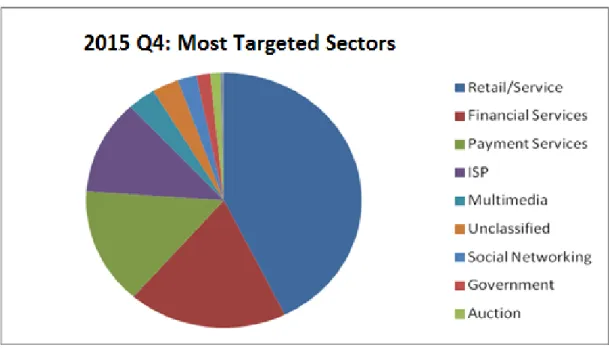
Economic gain constitutes the major reason why fraudsters engage in identity theft. In the report of Most-Targeted Industry Sectors in the 4th Quarter of 2015 the APWG lists Retail/Services as the sector as the most desirable target at 42.71%. Financial (18.67%) and Payment (14.74%) Services constitute significant sectors of interest to identity thieves as well. The remaining 23.88% is divided between ISPs (12.01%), Multimedia (3.30%), Unclassified (3.13%), Social Networking (2.22%), Government (1.64%), Auction (1.20%), Gaming (0.16%), Classifieds (0.14%), Delivery Services (0.07%) and Education (0.01%) [9].The circle graph in Figure 3 represents this information. Incurred losses to the individual and business community are overwhelming and threaten to weaken and subvert the world economy [9] [20] [41] [42] [79] [85] [103] [105] [106] [108] [117] [130] [176]
[183]. It is possible for an individual to lose tens of thousands of dollars. At the national level countries such as the United States can sustain losses in the billions of dollars.
Figure 3: Q 4 2015: Most-Targeted Sectors
The direct financial impact is perilous and contributes to the related and detrimental issue of lack of trust. In turn, credit and the cost of goods are affected. Interest rates and prices for commodities are set at higher levels to cover losses.
Another benefit enjoyed by the identity thief that is as valuable as financial reward is the anonymity provided by the use of a victim’s identity. Crime perpetrated in another individual’s name sends law enforcement in the wrong direction. If careful to cover his or her tracks after committing a crime using an assumed identity, the fraudster can walk away from the event undetected. On the other hand, the unfortunate and often unaware victim is left to deal with cleaning up the mess. To make matters worse, a criminal act can go unnoticed for a significant length of time until the individual whose identity was stolen attempts to do to something such as get a prescription filled, apply for a credit card or write a check. The ramifications become apparent when services are withheld or law enforcement
is notified of the whereabouts of the person who is only going about his or her actual business. By this time the identity thief has moved on, likely to another assumed identity, to commit crime in someone else’s name. The person whose identity was compromised must prove that he or she did not engage in the unlawful acts. Recovery from these events is costly in terms of time and money.
Frank Abagnale discusses the increase in value of identities over time [4]. This is particularly true for young people, adolescents and college students whose ability to acquire credit often grows with their age. For example, hacked university databases provide a plethora of student record information. Consider the potential for committing fraud given a host of graduate student records. As professionals in their chosen and respective fields, these individuals will presumably move steadily upward in their careers. As they do so, their salaries and lines of credit increase. For this reason, these identities hold significant promise and potential to be used for major gain by an identity thief. In this case, rather than selling or trading the stolen identities for immediate profit the fraudster exhibits restraint with the intention of drawing on the valued resources at some point in the future. Because no clear impact is observed following the compromise, an individual can proceed through life for years prior to the advent of any unusual, unwarranted or unauthorized activity that signals that he or she is a victim of identity theft.
Section VIII Assessing Vulnerabilities
Regarding spam mail also known as spam, the name implies that mail, or rather email, represents an integral component. This is, in fact, the case. The generation of spam results in hundreds or perhaps thousands of email messages that can carry an unwholesome
payload. It is highly likely that the true sender opts to conceal his or her identity. A variety of methods exist that make it possible to do so such as hijacking a computer connected to the Internet via malware which are programs that consist of harmful computer code designed to benefit the creator and exploit the victim. The infected computer becomes the tool of the fraudster. Messages sent from the compromised system retain the host computer’s email address and, therefore, do not appear to present a threat to unsuspecting individuals included within the scope of the network associated with the true owner of the infected machine. By obfuscating his or her identity, the fraudster can present a positive known image that appears to be helpful. The seriousness of this problem cannot be understated. Spam represents a direct and substantive challenge, because of the possibility that contains nefarious content as well as the potential impact it can have on system resources. The latter is a known attack, denial of service (DoS) that consumes the band width that is available to address normal activity. It is a highly effective method.
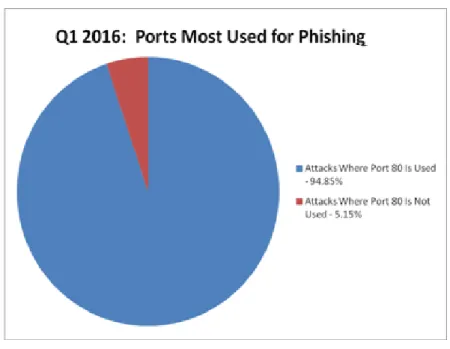
Phishing depends heavily on Internet technologies. The main target of exploitation that hosts web services continues to be Port 80. Figure 4 indicates the relative percent of usage for Port 80 and other ports used to run phishing attacks over the Internet.
Other research shows that a significant number of Internet users are ignorant of security features that are in place for their protection [6] [41] [44] [84] [154]. For example, users are unfamiliar with security certificates issued by certificate authorities. Some users who are aware of the existence of security certificates do not know how to check their validity or know the correct location of a lock icon on the web browser. Research shows that a majority of study participants did not understand that the presence of a lock icon in a particular area is for their protection. A related issue is that some users thought that a lock
icon anywhere on the screen indicates a secure site. Another false belief understood by study participants is that if a friend sends a message, then the information is safe to open and to examine.
Figure 4: Port 80 Continues to be the one Most-Targeted for Phishing
The malleability of PII once it is available in electronic form and on Internet represents a serious vulnerability for the victim and great temptation for the identity thief [3] [4] [20] [29] [109] [110]. Frank Abagnale discusses his experience with check fraud and related issues of identity assumption that are possible, in part, due to the use of digitally stored data [3] [4]. Kevin Mitnick relates similar information [109]. Adrian Cristian Moise examines problems in this area as well [110]. A recent trend reported by Hal Berghel involves documents that he identifies fungible credentials. Using these documents the fraudster constructs what appears to be an authentic identity assembled around as little as one bogus piece of identification such as a fraudulently acquired passport. The passport
could be a complete fake or stolen. Items such as these are known as a breeder documents which are, in turn, used to attain true identification information [20].
Section IX Strategies Used to Perpetrate Identity Theft
Fraudsters exploit common events to create vulnerabilities inherent within a system. They observe weaknesses or perhaps normal routines that can be modified or manipulated in such a way as to provide a useful and productive advantage. Spam mail, phishing, social engineering and fungible credentials represent several directions. It is important to understand how the identity thief is able to alter trusted activities or items with devastating consequences.
Spam mail or spam represents a strategic attack vector for the fraudster and can be employed in a host of scams. It can be generated by advertisers or other institutions that have no interest in perpetrating fraud. However, these sources are responsible for other unfortunate issues unrelated to identity theft. In either case, bulk email is sent from a networked device with the intent of reaching as many targets as possible. In the case of identity theft, there exists a connection between spam and phishing. Text-based phishing exploits rely on the use of email systems. Infected devices can allow the user’s address book to be compromised which, in turn, provides access to email addresses contained in it. The affected system becomes a tool of the attacker. Depending on the event, the compromise can go unnoticed by the device’s owner for a period of time. Phishing scams utilize this window of opportunity. Identity thieves understand that individuals are more likely to respond to an email and provide information to someone they know and trust rather than to an unfamiliar sender. Text included in a phishing email appears genuine. Its purpose is to hook the unsuspecting victim. In truth, the bogus email contains a hidden and deceptive payload. An
embedded link, invisible to the victim, points to an undisclosed destination and misdirects the user to a path designed to benefit the fraudster [65] [84] [111]. Fraudulently sent phishing messages deliberately created to look like they come from established financial institutions or retailers and claim to report a problem with the potential victim’s account represent examples of frequently used ploys.
Other related scams involve a sequence of compromised host devices used in combination to obscure the origin of the attacker. A collection of infected systems behave as a stepping stones and is the source of the name for the stepping stone attack [119].
Phishing continues to be a productive method used by identity thieves. Numerous resources address phishing [9] [41] [42] [44] [61] [62] [65] [67] [84] [85] [115] [111] [130] [136] [187]. In addition to text materials that discuss these issues businesses such as LifeLock (www.lifelock.com) that provide identity theft protection, broadcast infomercials and commercials over communication networks. Also, programs that appeal to adolescents such as The Inspectors (cbsdreamteam.com/the-inspectors) relate the strategies that are used by fraudsters and subsequent problems that can result. More work must be done in this area to inform the public of the relative easy and pervasiveness of identity theft. Research indicates that possible victims of identity theft constitute a majority. Rachna Dhamija, J.D. Tygar and Marti Hearst discussed findings from their study that examined phishing success.
“Good phishing websites fooled 90% of participants.
Existing anti-phishing browsing cues are ineffective. 23% of participants in our study did not look at the address bar, status bar, or security indicators. On average, our participant group made mistakes on our test 40% of the time. Popup warnings about fraudulent certificates were ineffective. 15 out of 22
participants proceeded without hesitation when presented with warnings.
Participants proved vulnerable across the board to phishing attacks. In our study, neither [the subject’s] education, age, sex, previous experience, nor hours of computer use showed a statistically significant correlation with vulnerability to phishing.” [41]
Figures 5 and 6 show data reported by the Anti-Phishing Working Group. Phishing constitutes a major threat and represents a substantial component of Internet-based fraud [7] [9] [119]. The number of sites and reports are displayed.
Figure 5: Unique Phishing Sites Detected by Month from January 2015 through March 2016
Social engineering is another method effectively employed by identity thieves. The name social engineering is descriptive of the events perpetrated by the thief. The strategy requires that the fraudster gain the trust of the victim or possibly his or her subordinates or colleagues prior to running the scam. The identity thief performs reconnaissance on the intended victim or perhaps on the “weak links” in the chain. Generally, the ruse develops over a period of time that can span several days or longer. Once the interloper’s work is done gaining trust, conducting the fraud is relatively simple, because individuals “on the inside” take part in the process. Pieces of information gathered by identity thief can be combined and manipulated so that the fraudster is sufficiently cloaked to access the desired resource [4] [10] [14] [29] [109] [110] [118] [144] [155]. This scam often depends on the social engineer exploiting a victim’s expected behavior or possibly those around him or her. A receptionist, whose job it is to provide `service, might be targeted. For example, during a series of what appear to be routine telephone calls a fraudster could ask the receptionist to provide details about his or her supervisors’ schedule such as when he or she is unable to take a phone call or meet in person due to prior commitments. The fraudster then uses this information to set the con at an optimal time, say when the person of interest in a decision-making position is unavailable. Because the social engineer has determined usual events that include regular business hours, times when people are in meetings on break or at lunch, this is precisely when the fraudster calls again. As is the case with the receptionist who is normally on duty, a substitute’s job is to be helpful. When the social engineer calls he or she claims to be someone of importance. Using the knowledge acquired earlier, the fraudster is able to spin a creative story that seems plausible. The unsuspecting substitute responds to the caller’s request. The information that can be provided includes data that is within the
receptionist’s access such as employee identification or health insurance policy numbers. Once information has been collected through social engineering, it can be used by the fraudster directly, sold or traded, or combined with other breeder documents to construct an identity. Social engineering can be used to steal information such as in corporate espionage [109].
Hal Berghel discussed fungible credentials which is a topic related to social engineering and the creation of false documents used to develop an identity [21]. In this scenario, once the thief obtains a piece of identity information, it is used as a seed to construct a highly useful and important identity document such as a fake passport. The false piece of documentation known as a breeder document, in turn, is used to generate additional PII such as a driver’s license or social security number. Identities created in this way present law enforcement with significant challenges. The new identity and its offspring are present in a host of databases. Records exist for the identity in legitimate organizations and, because of the identity thief’s attention to detail and the complexity of the fraud, can be verified. If someone becomes suspicious and attempts to check whether the person in question is who he or she claims to be, the fraudster’s identity appears in numerous places which makes it appear to be authentic. Investigating the multiple false documents can require a significant amount of resources and creates a variety of related problems. Figure 7 shows Nevada licenses for Smith and Jones and is an example of this fraud.
Figure 7: Smith and Jones Nevada Licenses
Section X Awareness
Public officials in other countries and the United States have been aware of the problem of identity theft for some time. In 1998 the U.S. Government passed the Identity Theft and Assumption Deterrence Act of 1998 [175]. Its purpose was to expand, to clarify, and to codify legislation to deal with transgressions to the United States Code that relate specifically to identity theft and identity assumption [7]. “The United States Code is the codification by subject matter of the general and permanent laws of the United States.”[177]
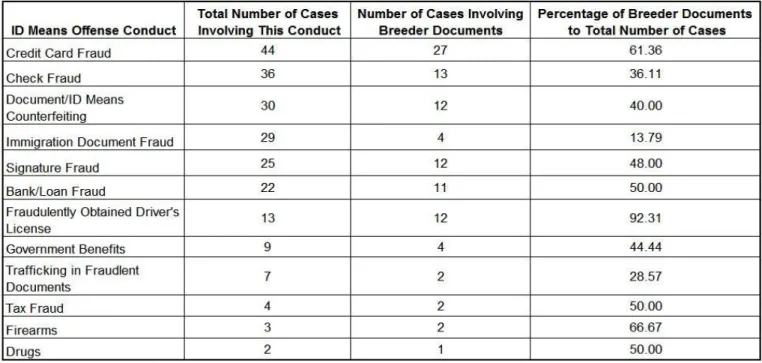
The information in Table 1 reveals the predominance of the use of breeder documents in identity theft related crime. Material in columns one through three appears in the U.S. Sentencing Commission’s Identity Theft: Final Report of December 15, 1999. Statistics in the rightmost column reveal the relative percentage of breeder documents used for each offense with respect to the total number of the sample. The data shows that breeder documents contribute in a significant way to identity theft related crime.
Table 1: US Sentencing Commission Identity Theft: Final Report, December 15, 1999
Appendix F from the U.S. Sentencing Commission’s Identity Theft: Final Report of December 15, 1999 contains a dozen illustrative summary examples of cases that highlight types of identity dependent fraud. Exploitations identified in the report included fictitious aliases, passport fraud, social security fraud, false statements, possession of another individual’s PII such as birth certificate, driver’s license or learner’s permit certificate, misdirection and delay of mail delivery, opening mail, misuse of the telecommunications system, check, credit card and debit card fraud, securities fraud, stolen PIN numbers, hotel and automobile rental fraud, fictitious children, fraudulent loans, breeder documents, false employment and education verification, burglarizing homes and automobiles, conspiracy, and cellular phone fraud. A number of scams spanned extended periods of time, for example, as much as 18 years. Dumpster diving was a method used in some cases that did not require the unauthorized access of account information or a premises. Several thieves
were illegal aliens or had a criminal history that extended back in time several years time. Each example includes the number of offenses. In one case, 2300 fraudulent incidents of credit card, check and false identification were uncovered. Due to the number of compromises, no victims were contacted by law enforcement. In another case, the fraudster was in possession of more than 5,000 credit card numbers on hotel and car rental receipts. A small percentage of the thieves were imprisoned for their crimes. Sentences did not exceed 71 months. The majority of criminals received probation [176].
The U.S. Sentencing Commission posts updates regarding sentencing by region and other important material on its website. In 2009 the Commission produced An Overview of Loss in USSG §2B1.1. The document was designed to assist with sentencing guidelines and contains a number of definitions that include loss, actual loss and intended loss. In the document loss is defined to be the greater of actual loss or intended loss [174]. The term loss is used in the sentencing of identity theft related crimes.
Section XI Alarming Statistics
Research shows identity theft takes many forms, is increasing and that anyone can become a victim [14] [16]. Identity thieves are clever. They continue to reuse methods that they deem to be effective and to develop new strategies. The level of deception and the means that identity thieves use to obscure their involvement in the suite of interdependent crimes make combating fraud particularly challenging for law enforcement. As reports reveal, the penalties that identity thieves receive are, generally, light. On the other hand, the profit that they derive is substantial. The crime is lucrative and relatively simple to perpetrate. Identity thieves learn the vulnerabilities of their targets and are proficient in risk assessment. Statistics related to identity theft are staggering.
Latanya Sweeney reports:
“The US Federal Trade Commission’s (FTC’s) report on identity theft shows a rapid growth in victim complaints. Victims reported more than 86,000 incidents in 2001; this number grew to 162,000 cases in 2002, and rose to 246, 570 in 2004. More than a quarter (28 percent) of reported complaints involved credit- card fraud. Of the credit-card complaints, the report identified that
approximately half (or 17 percent of all thefts) involved new accounts, making acquisition of new credit cards the major identity theft problem …” [161].
Wenjie Wang, Yufei Yuan and Norm Archer state that:
“In the US, the number of identity theft cases reported to the US Federal Trade Commission (FTC; www.ftc.gov) grew from 161,836 in 2002 to 214, 905 in 2003, an annual increase of 33 percent.
(www.consumer.gov/sentinel/pubs/Top10Fraud2003.pdf.) Some estimates in 2002 put the number of American identity theft victims close to 10 million, an 81 percent rise from 2001 and at a cost of nearly US $53billion. Phonebusters, (www.phonebusters.com), a Canadian identity theft-reporting agency, reported that more than 14,599 Canadians became identity theft victims in 2003
(compared with 8, 209 in 2002) and at a cost of roughly $21.8 million (compared with $11.8 million in 2002;
www.phonebusters.Com/English/statistics_E03.html). A major reason for the dramatic rise in identity theft cases is the explosive growth in Internet
applications, making identity information more widely used and thus an easy target for criminals. Although identity theft has become one of the top legal concerns of the information age, the more dangerous aspect is how terrorists can use it to breach national security.” [183]
Identity theft continues to grow. Recent statistics suggest that the rate has not declined and that the crime has branched into many directions [31] [89] [102] [114] [145] [158].
Many crimes associated with identity theft such as credit card, insurance, or mortgage fraud to name a few are not reported, because the victim is possibly unaware that an event has occurred, is complacent, or is perhaps ashamed and feels in part responsible. Under reporting of crime that involves identity theft is a worldwide concern [9] [14] [15] [16] [106]. April 23, 2008 the BBC reported that the banking industry claimed 290,500,000 pounds in losses in 2007, but that their investigation revealed that identity thieves had been successful to the tune of 500,000,000 pounds, a figure that was nearly double what the banking industry had stated.
Another story that the BBC reported on the same day as the banking piece was about the underground market in stolen identity information sold or traded to be used for identity theft dependent fraud. The report highlighted a case of credit card information stolen near Christmas from hackers based in Pakistan. The piece revealed that compromised credit card numbers are typically used to buy high value easy to sell small electronic devices. Fraudsters purchase these items illegally and then quickly sell them for cash. In some cases funds are used to promote terrorism. The preponderance of cash transactions causes difficult conditions in subsequent follow-up and investigative work. Andrew Goodwill, fraud expert from The 3rd Man software company was quoted from The Web Trade in Credit Card Details that identity theft is “out of control”. It was, also, reported in the article that law enforcement in the U.K. is far behind many European countries and the United States in addressing identity theft related crime. The primary reason is due to the authorities not wanting to become involved, because of the overwhelming number of incidents. For this reason, the U.K. represents a desirable and fertile field to work in for identity thieves. The lack of investigations and prosecutions are good incentives for fraudsters.
For example, the BBC reported on April 21, 2008 that a terrorist ring with access to stolen credit card numbers, committed fraud using a number acquired from a 70 year old woman. Her information was taken from an ATM machine without her permission by the identity thieves. In this case, authorities said the fraud resembled an earlier scam that involved a group of terrorists who were associated with the Sri Lankan Tamil Tigers. Funds gained from fraudulent activity were used to promote terrorism [14]. Not all identity theft related crime is engineered to fund terrorism. Financial and non-financial identity theft may have no relation to terrorism. Other reasons include personal gain to steal funds or acquire a job in the victim’s name to conceal a criminal past [31]. All cases are costly. On the side of business the need to absorb the cost of stolen goods that result from fraud is substantial. A 2011 report estimated that the average cost per identity theft ranged between $2,800 and $5,100 [130]. In 2014 an estimated 17.6 million people’s identities were stolen in the United States [158]. This suggests annual losses on the order of 100 billion dollars. The crime continues to grow in popularity with devastating consequences [14] [15] [41] [79] [85] [105] [106] [108] [117] [176] [183]. It is worth examining the economic impact on the individual and on industry in more detail. In addition, understanding the relationships with e-commerce is important.
Section XII Individual, Business and Government
The passing of The Identity Theft Assumption and Deterrence Act of 1998 had far-reaching and significant impact that benefited individuals who were victims of identity theft. In the case of an individual, until the enactment of The Identity Theft Assumption and Deterrence Act of 1998, a person had no protection under the law [175]. While weakened