NBER WORKING PAPER SERIES DO TAXPAYERS BUNCH AT KINK POINTS? Emmanuel Saez Working Paper 7366 http://www.nber.org/papers/w7366
NATIONAL BUREAU OF ECONOMIC RESEARCH 1050 Massachusetts Avenue
Cambridge, MA 02138 September 1999
I am very grateful to Dan Feenberg for his help with the tax returns data. I thank Peter Diamond, Esther Duflo, Jon Gruber, Roger Guesnerie, James Poterba and Todd Sinai for helpful comments and discussions. Financial support from the Alfred P. Sloan Foundation is thankfully acknowledged. The views expressed herein are those of the authors and not necessarily those of the National Bureau of Economic Research.
be quoted without explicit permission provided that full credit, including © notice, is given to the source.
Do Taxpayers Bunch at Kink Points? Emmanuel Saez
NBER Working Paper No. 7366 September 1999
JEL No. H31
ABSTRACT
This paper investigates whether taxpayers bunch at the kink points of the US income tax schedule (i.e. where marginal rates jump) using tax returns data. Clear evidence of bunching is found only at the first kink point (where marginal rates jump from 0 to 15%). Evidence for other kink points is weak or null. Evidence of bunching is stronger for itemizers than for non-itemizers. Theoretical models of behavioral responses to taxation show that bunching is proportional to the compensated elasticity of income with respect to tax rates. These models are used to perform simulations of bunching and calibrate the key parameters (the behavioral elasticity and the extent to which taxpayers control their income) to the empirical income distributions. Except for low income earners, the behavioral elasticity consistent with the empirical results is small. Emmanuel Saez Harvard University Department of Economics Littauer Cambridge, MA 02138 and NBER [email protected]
1 Introduction
Most empirical studies about labor supply and the behavioral responses to income taxation use the classical static micro-economic model where agents choose to supply eort until the marginal disutility becomes equal to marginal benets. This usual model predicts that if indierence curves are well behaved and preferences are smoothly distributed, we should observe bunching at convex kink points of the budget set. Taxes and government transfers are a good example of institutions introducing kink points in budget sets. For example, the federal income tax imposes a piecewise-linear schedule by the use of constant marginal rates between brackets. The payroll tax in the Social Security system likewise generates a (concave) kinked schedule because the marginal rate drops to zero above a certain earnings maximum. Many government transfer programs also introduce piecewise-linear constraints because transfer benets are progressively \taxed" away as income rises until the point where an individual or household loses eligibility for the benet altogether. A strand of the empirical labor supply literature has explicitly taken into account the predictions of economic theory in the case of kinky budget constraints in order to improve estimation of labor supply behavior. This method, known as the non-linear budget set estimation method, reckons explicitly that maximizing utility agents must be either on a linear part of the budget set or at a convex kink point. This method was rst developed by Burtless and Hausman (1978) to study the Negative Income Tax experiments. Hausman (1981) then applied this method for the rst time to study the eect of the federal income tax on labor supply. Afterwards, this method has been applied to many government transfer programs. Mot (1990) provides a non-technical presentation of the non-linear budget set method and a survey of applications. However, the bunching issue has not attracted much interest even in this type of studies because, in most cases, a casual look at the data does not reveal evidence of bunching at the kink points. Heckman (1982) early criticized Hausman's studies of the eect of the income tax on labor supply arguing that no evidence of bunching could be found in the data. As Hausman (1982) replied however, this does not necessarily invalidate that approach because measurement error is
present in the data and is modeled by adding an error term to the labor supply equation. As a result, there are few studies that document the evidence of bunching of agents at the kink points generated by taxes or transfer programs. Burtless and Mot (1984) and Friedberg (1998) observed bunching behavior in the case of elderly who receive social security benets but are still working. Social security benets are taxed away when earned income exceeds an exemption amount. Tax rates vary from 33% to 50% and thus generate big kinks in the budget set of the elderly. Liebman (1998) looked at the income distribution of Earned Income Tax Credit recipients but found no evidence of bunching at the kink points generated by this program. No study has carefully examined the evidence of bunching at the kink points of the income tax schedule. This is striking for two reasons. First, such a study could give an indirect proof of the existence of behavioral responses to taxation which is the object of a very controversial debate in the public economics literature. Second, studying bunching is relatively straightforward and only requires micro-economic data on taxable income.
The rst goal of the present paper is thus to investigate whether there is evidence of bunching at the kink points of the US income tax from 1979 to 1994. This study uses the large cross-sections of tax returns provided annually by the Internal Revenue Service. This data is perfectly suited because it gives information about the precise location of taxpayers on the tax schedule.1
Theoretically, the size of bunching around kink points depends critically on the com-pensated elasticity of income with respect to marginal taxes. Unsurprisingly, high elastic-ities should lead to high levels of clustering. The compensated elasticity is one of the key parameters to devise an optimal income tax policy. However, estimates vary considerably from very low estimates in the classical labor supply literature (see Pencavel (1986) for a survey) to very high estimates in recent literature looking directly at taxable income
1The most widely used datasets such as the PSID or the CPS do not provide the precise location
of taxpayers on the tax schedule because all sources of income or deductions are not reported precisely enough. This may partly explain why the issue of bunching has remained under-investigated for so long.
(see Lindsey (1987) and Feldstein (1995)). Therefore, it is potentially very interesting to try to estimate this elasticity using the size of bunching. These indirect estimates, as in Lindsey's and Feldstein's studies, are based directly on taxable income and thus could provide additional evidence on this controversial issue in public economics.
Of course, perfect bunching at the kink points of the tax schedule is not observed in the data because taxpayers cannot perfectly ne-tune their labor supply nor control perfectly all their sources of income. Therefore, the second part of this paper develops theoretical models to try to understand how this uncertainty element aects bunching. If taxpayers can control their incomes only imperfectly, a kink in the tax schedule should generate a hump in the income distribution. The better taxpayers control their incomes, the closer the hump is clustered around the kink point. It is dicult, using micro longitudinal data on income, to estimate to what extent agents can control their incomes because it is not possible to distinguish variations in income due to a voluntary choice from those due to random and uncontrolled factors. This issue is especially important in consumption theory where it is very important to tell apart transitory (random) income shocks from voluntary income changes (see e.g. Deaton (1992), Chapter 3). Sharp clustering around the kink points would be evidence that the random factor is small whereas at clustering would suggest that random factors are important. Thus, the study of bunching is also interesting because it provides an indirect way to measure to what extent taxpayers can control the process generating their incomes.
The remaining of the paper is organized as follows. Section 2 presents the data and the tax schedules of the period 1979 to 1994. Section 3 displays the empirical results. The distributions of taxable income are estimated using non parametric kernel density methods. Section 4 presents a simple theoretical model to investigate how the size of bunching is related to the elasticity and the extent to which taxpayers control their income. Section 5 presents simulations of income distributions using this theoretical model. I calibrate the key parameters that reproduce the evidence of bunching found in empirical distributions. Section 6 provides a brief conclusion and discusses methodological and
policy implications.
2 Data and Tax Schedules
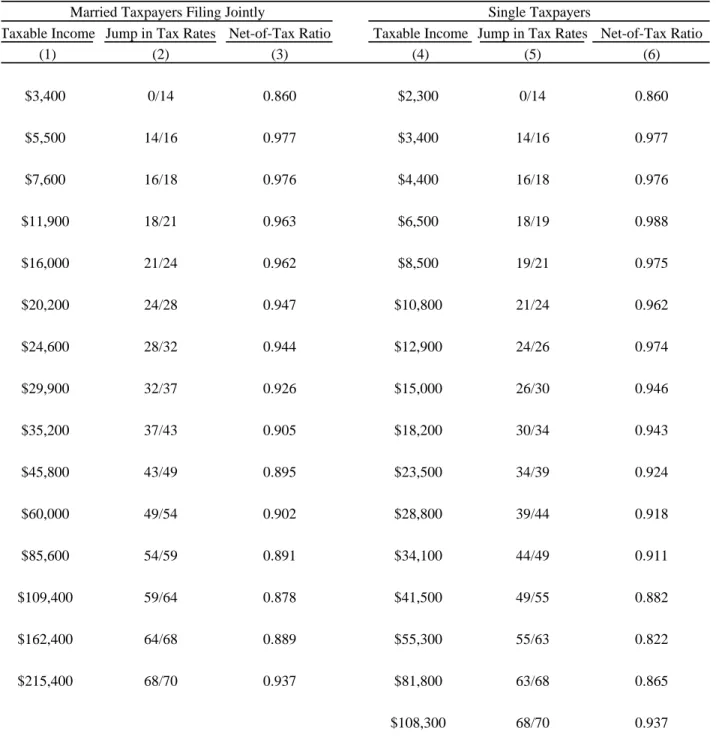
According to the usual micro-economic model, taxpayers increase their income until the marginal utility of the last dollar earned less the marginal tax rate paid on this last dollar is equal to the marginal cost that is spent to earn this last dollar. Therefore, the key parameter in the income equation is one minus the marginal tax rate which I call the net-of-tax rate. Thus a given kink point produced by a jump in marginal rates from
t 1 to t 2 ( t 1 < t
2) generates high levels of bunching if the ratio the two net-of-tax rates
(1;t 2)
=(1;t
1) is signicantly smaller than one. In another words, a jump from 0 to
10% in marginal rates should have the same eect than a jump from 90% to 91%. From now on, I call this key ratio the net-of-tax ratio.
I use tax returns data constructed by the Internal Revenue Service (IRS), and known as the Individual Public Use Tax File, to carry out this study. The data are annual cross-sections available from 1960 to 1994 but I focus only on years 1979 to 1994 because before 1979, the number of brackets in the tax schedule was very large and thus the size of the jumps was small. The average number of observations per year is slightly above 100,000. The annual cross sections are stratied random samples with high sampling rates for wealthy taxpayers. Taxpayers pay taxes on taxable income which is equal to total income less personal exemptions and other additional deductions. Taxes are computed directly from a piece-wise linear tax schedule as a function of taxable income. Therefore, taxable income is the relevant variable for the present study. Tax schedules dier according to marital status which can be either Married, Single or Head of household. As more than 90% of returns are lled by Married or Single taxpayers, I restrict my study to these two marital status only.
I now review the main characteristics and changes in the US tax schedule from 1979 to 1994.
From 1979 to 1981, the number of brackets was fairly high (around 14). The rates went as high as 70% but the part of capital gains subject to tax was limited to 40% and the maximum tax rate on earned income was equal to 50%. The size of the jumps in the tax schedule was around 4-7% (see Table I). There was one big jump at the rst kink point where marginal rates jumped from 0 to 14% at a very low level of income. The tax schedule was not indexed for ination. Ination was high (around 10%) from 1979 to 1981 and thus this increased substantially the burden of the income tax.
In 1981, the Economic Recovery Tax Act (ERTA) decreased marginal rates in three years from 1982 to 1984. The top-rate was reduced to 50% and the tax brackets were extended. The location of kink points did not change, but the corresponding marginal rates were decreased (see Table II). Moreover, from 1984 on, the tax schedule became indexed to ination. In 1986, the Tax Reform Act (TRA) introduced the largest changes in the income tax since World War II. The number of brackets was drastically reduced and the top-rate was further reduced to 28%. There were basically two jumps in marginal rates left: a rst jump from 0 to 15% and a second jump from 15 to 28%. The TRA also extended the tax base in order to be a broadly revenue neutral tax reform. The former exclusion of 60% of capital gains was suppressed. In 1990, an additional bracket was included, increasing the top rate from 28% to 31%. However, the top rate on capital gains was left unchanged at 28%. Last, in 1993, the OmniBus Reconciliation Act (OBRA) added two more brackets at high incomes: one bracket with a marginal rate of 36% and a top-bracket with marginal rate of 39.6% (see Table II).2
Tax schedules for married taxpayers and singles for years 1979, 1984 and 1994 are displayed in Tables I and II. I report the location of the jumps in marginal rates in current dollars on column (1) for Married taxpayers and in column (4) for Singles. In column (2) for Married taxpayers and column (5) for Singles, I present the marginal rates corresponding to the jump. Last, in column (3) (for Married taxpayers) and column (6) (for Singles), I report the corresponding net-of-tax ratios (i.e. the values (1;t
2) =(1;t
1)). 2The top-rate on capital gains was also left unchanged at 28%.
From 1979 to 1994, there has always been a big jump at the end of the rst bracket: from 0 to about 11-15% (depending on the years). This kink point is particular because not only does the marginal rate jump but also because people do not owe any taxes if they do not reach that income level. From now on, I will call this kink point the rst kink point.
I divide the data into two periods. One period for years before the TRA of 1986 (years 1979 to 1986). In that period, there were many kink points besides the rst kink point. The second period is for years after the TRA (years 1988 to 1994). In that later period, there were essentially two kink points: the rst kink point and an additional jump from 15 to 28%. Year 1987 is excluded because it is a transition year.3
3 Empirical Results
I rst test whether there are atoms of taxpayers at the kink points of the tax schedule. This would be case as soon as a non negligible set of taxpayers could control nearly perfectly their incomes4 (I come back in more detail to this point in Section 4). The best
way to check this hypothesis is to draw a histogram of the income distribution with small bandwidth. If there were an atom (even if small) at a given kink point then this should appear on the histogram when the size of the bandwidth decreases. As evidenced on Figure 3.1 for years 1979 to 1981, looking at the kink points does not reveal such atoms. The loci of the kink points are represented by vertical dashed lines. Other years or other portions of the income distribution would not reveal anymore evidence of bunching. Therefore, we can reject the hypothesis of the existence of a non-negligible number of taxpayers controlling perfectly their taxable income.
If we assume that taxpayers do not control perfectly their income then they will not be
3The tax changes of the TRA were not fully phased in until 1988. The number of brackets in 1987
was intermediate between the pre TRA and post TRA periods.
4Note that taxpayers should control not only their incomes but also their possibly numerous deductions
and adjustments that are subtracted from gross income to compute taxable income.
able to bunch perfectly at the kink points but will tend to cluster around these points. The better taxpayers control their incomes, the sharper the humps. As I now look for humps in the distribution that could be generated by kink points, it is no longer appropriate to rely on histograms. Thus, income densities will be estimated using the kernel density method which is described in appendix. All kernel estimates are plotted along with 95% point-wise condence intervals.
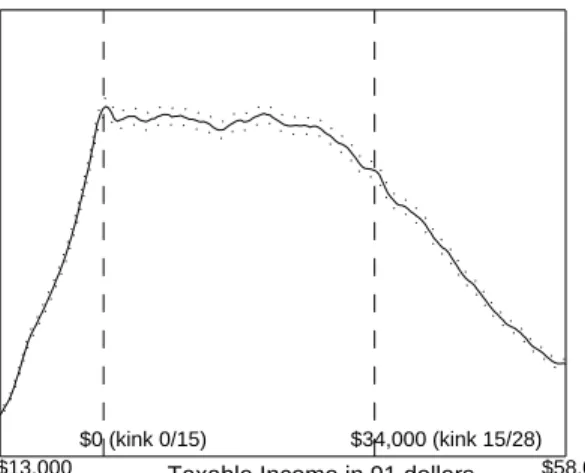
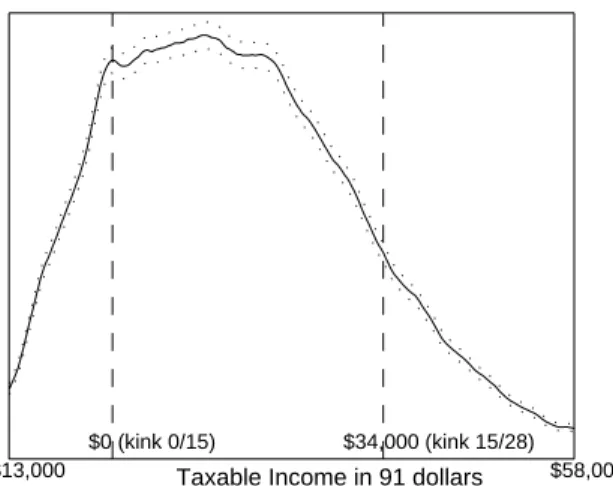
Results are presented in Figures 3.2 to 3.17. Year, marital status, number of obser-vations and the bandwidth used in the density estimation are reported in the title. The dashed vertical lines represent the kink points. The jump in tax rates and the level of taxable income corresponding to the kink points are reported on the Figures.5
3.1 Low and middle incomes
Estimates for married taxpayers are given on Figures 3.2 to 3.5. The density estimate for years6 before the TRA is reported on Figure 3.2 and on Figure 3.3 for years after TRA.7
The rst striking point to notice is that income distributions display an irregularity around the rst kink point. The distributions present a clear kink around that income level. The TRA shifted the location of the rst kink point to the right because the standard deduction and the personal exemptions were increased.8 I can test whether
taxpayers adapted slowly or not to these changes by comparing year 1988 (rst year in which the tax reforms of the TRA were fully phased in) and year 1994 (the most recent year available). The estimates are reported on Figures 3.4 and 3.5. The results show clearly that bunching is much more important in 1994 than in 1988. The deformation of
5Before the TRA of 1986, there are in fact more kink points than represented because I omit to
represent kinks corresponding to jumps smaller than 3 percentage points.
6I explain in appendix the procedure I use to produce income densities merged over several years. 7Note that the location of the rst kink point shifts to 0 after the TRA. This is due to the change in
the denition of taxable income. The standard deduction is no longer included in taxable income after TRA.
8The TRA reduced signicantly the number of households liable for the federal income tax.
the income distribution is much more important in 1994 than in 1988. Therefore, this conrms the presumption that taxpayers cannot adapt immediately their behavior to the tax schedule.
The second striking fact is the absence of any clear humps around the other kink points. This could be understandable before the TRA because the other jumps are not very big and the tax rates not high at those incomes (implying that the net-of-taxes ratios are close to one as shown in Tables I and II). However, more surprisingly, nothing is distinguishable around the second kink point (jump 15/28) after the TRA86. Moreover, there is no more evidence of bunching in 1994 than in 1988 (see Figures 3.4 and 3.5). Therefore even in 1994, i.e. seven years after the TRA was implemented, taxpayers do not cluster around the second kink point. This implies that either low income and middle income earners do not behave in the same way or that the rst kink point is perceived dierently from the other kink points. At this early stage, we can presume that either middle income earners control less accurately their income or that their elasticity with respect to marginal rates is lower. The argument will be made more precise in the following sections.
The same estimates for singles are reported on Figures 3.6 to 3.9.9 The general shape
of the income distribution of single taxpayers is dierent from the distribution of married taxpayers because the mode of the distribution is sharper and the top tail is thinner. In fact the mode was lower than the rst kink point before the TRA86 and then became almost centered on the rst kink point after 1986. Before 1986, the distribution density is quickly decreasing around the rst kink point making the hump around that kink point less discernible everything else being equal. We can nevertheless see a small hump around the rst kink point on Figure 3.6. After 1986 (Figure 3.7), the rst kink corresponds exactly to the mode of the distribution and thus it is hard to tell apart what is really due
9I have excluded from the data taxpayers claimed as dependents because special rules apply for them
and this tends to create articial bunching around the rst kink point. Dependent taxpayers have a smaller standard deduction but can deduct earned income up to a certain amount. As a result, many of them have taxable income articially close to 0.
to bunching behavior. Figures 3.8 and 3.9 (for years 1988 and 1994) give an interesting insight about the dynamics of bunching. The mode is on the right of the kink point on Figure 3.8 and there is no clear evidence of bunching for year 1988. Figure 3.9 is completely dierent: the mode is centered exactly on the kink point and is sharper. Estimates for each year between 1988 and 1994 would show a progressive pattern toward more and more bunching. Thus, it is plausible to think that the deformation of the distribution around the mode between 1988 and 1994 is due to taxpayers' responses to marginal rates. Bunching is increasing over time as taxpayers adapt slowly their behavior to the new tax schedule. The evidence concerning the second kink after the TRA of 1986 reveals no more bunching than for married taxpayers. Once again, there is no more evidence of bunching in 1994 than in 1988.
A technical objection about the special result for the rst kink point could be raised. There is a threshold gross income level under which people are not required to ll a return. This threshold varies with the marital status and is equal to the basic personal exemptions (two for married taxpayers and one for singles) plus the standard deduction.10 As a result,
it may be possible that the shape of the distribution is articially kinky around the rst kink point because non-lers are missing on the left of the kink point. Fortunately, the fact that, in the US tax-system, a large part of taxes are withheld allows to test whether this objection is relevant. When somebody expects a refund from the IRS, he has to ll a return to get it. Therefore, people expecting a refund have good incentives to ll. Moreover, withholding is rarely perfect and thus most taxpayers either expect a refund or have to pay an additional amount to the IRS.11 Therefore there should be no articial
irregularity around the rst kink point for people expecting a refund. Around the rst
10The threshold does not take into account additional personal exemptions for dependents. For
exam-ple, a married household claiming children exemptions may be required to ll even if its income is less than the sum of all its exemptions plus the standard deduction.
11As evidenced from Figure 3.6, before TRA, the mode of the income distribution for singles is on
the left of the rst kink point, implying that many low income people ll tax returns in order to obtain refunds though they their nal tax liability is zero.
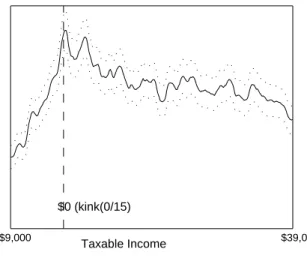
kink point, the distributions of taxable income for people expecting a refund are almost the same as the full distributions. This is displayed on Figures 3.10 and 3.11. Figure 3.10 represents the full distribution of incomes for year 1993 and Figure 3.11 represents the distribution of incomes for taxpayers expecting a refund. This similarity is due to the fact that a vast majority of low income earners expect a return from the IRS. Evidence of bunching is not reduced for people expecting a refund; therefore the irregularity around the rst kink point is not due to missing taxpayers.
An alternative way of testing this objection is to estimate the density of gross incomes and check whether there is an irregularity around the threshold level of ling requirement. These estimations do not reveal anything irregular conrming the fact that low incomes ll returns to get refunds even though they are not legally required to do so.
3.2 High income earners
Before TRA86, the tax schedule had a much more progressive structure with many kink points at the high end of the income distribution which could generate bunching behavior.12 Nevertheless, I could nd no humps at any other kink points for married
taxpayers for years 1979 to 1986. Humps around kink points are either absent or not robust across years. Estimates aggregated over several years do not show bunching. An estimation for the kink 43/49 at income level 45,800 dollars for years 1979 to 1986 is pre-sented on Figure 3.12.13 It does not show any evidence of bunching, though the number
of observations is very large (nearly 100;000). The tax schedule for singles for years 1979
to 1981 presented a very big jump from 55 to 63%. The estimate obtained merging the three years reveals slight evidence of bunching: there is a small hump around the kink point (see Figure 3.13). This is the only high bracket kink point that presented some
12Note also that two new kink points were introduced in 1993: from 31 to 36% and from 36 to 39.6%.
These kinks did not reveal bunching in 1993 or 1994. This can obviously be explained by the fact that taxpayers take time to adapt their behavior.
13In fact, the jump was 43/49 only for years 1979 to 1981. After 1981, there remained a kink exactly
at that income level but the marginal rates changed (the new jump was 33/38).
evidence of bunching.
Three facts can partly explain these negative results. First, before the TRA86, tax-payers could use the average income schedule to reduce their tax liabilities if they had experienced a substantial increase in taxable income. The tax schedule depended then not only on current income but also on taxable income in previous years and therefore the location of kinks varied across taxpayers. The proportion of taxpayers using the av-erage income schedule becomes higher and higher as taxable income increases. Second, before 1982, the rule of the 50% percent maximum tax on earned income creates an ad-ditional problem. Taxpayers claiming earned income followed a dierent tax rule when their income reached the level at which they would normally have faced marginal rates above 50%. This may aect bunching for the highest kinks. Discarding, however, those taxpayers did not reveal clearer evidence of bunching. Last, the tax schedule was xed in nominal terms for years 1979 to 1981 while ination was still high (around 10%). There-fore, the location of the kinks changed in real terms year after year and so it may have been more dicult for taxpayers to adapt to the kinks.
3.3 Itemizers versus non-itemizers
Not all sources of income are controlled to the same extent. As the dataset describes precisely all the dierent sources of income, it is possible to study whether taxpayers bunch more or less according to the type of income they receive. In particular, the types of incomes which are underreported are likely to reveal more bunching because taxpayers may underreport part of these incomes in order to avoid entering high brackets. Itemized deductions are likely to be overstated for the same reasons. Capital gains may or may not also be realized in order to avoid paying high marginal taxes. I explore various cases in this subsection.
Self employment income is a source of income commonly underreported. However, looking at taxpayers reporting self employment income around the second kink point after the TRA does not reveal any more bunching (I do not reproduce the estimates).
Similarly, no evidence of bunching could be found around the second kink point for tax-payers reporting capital gains after the TRA.
As explained above, in the US income tax system, taxpayers can either choose a standard deduction of a given amount (depending on marital status) or choose to itemize deductions (such as medical expenses or work related expenses) if these deductions exceed the standard deduction. Dividing taxpayers between itemizers and non-itemizers reveals more interesting patterns. The estimates are plotted on Figures 3.13 and 3.14 for married taxpayers and on Figures 3.15 and 3.16 for singles. I have reproduced only the estimates for years after TRA. The estimates for itemizers are represented on the left panels and those for non-itemizers on the right panels. For married taxpayers, the distribution for itemizers is very dierent from the general one because most low income earners do not itemize. Therefore the mode for itemizers is located farther on the right. There is a clear hump around the rst kink point for itemizers. The picture for single taxpayers is even more striking. The peak at the kink point on Figure 3.15 is very large whereas the peak Figure 3.16 is much smoother than the peak for the whole sample (compare with Figure 3.7). Estimates are also interesting around the second kink point. For non-itemizers there is no bunching at all. However, the distribution for married itemizers reveals some bunching.14
It is possible to extend this kind of study to most sources of income such as interest income, dividends, business income, pensions. However, looking at distributions for tax-payers reporting these particular types of income did not reveal more evidence of bunching than the full distribution.
4 Theoretical Models
The aim of this Section is to construct a simple theoretical model of taxation to understand the phenomenon of bunching. I will particularly examine how the quantity of bunching
14The evidence is much less clear around the second kink for singles.
depends on relevant parameters of the model. This model will later allow us to simulate income distributions in order to compare them with real empirical distributions. I present a very simple model of taxation similar to the model of optimal taxation of Mirrlees (1971).
4.1 Certainty case
Assume that there is a kink in budget set at income level z
and that marginal tax rates
jumps from t to t+dt at z
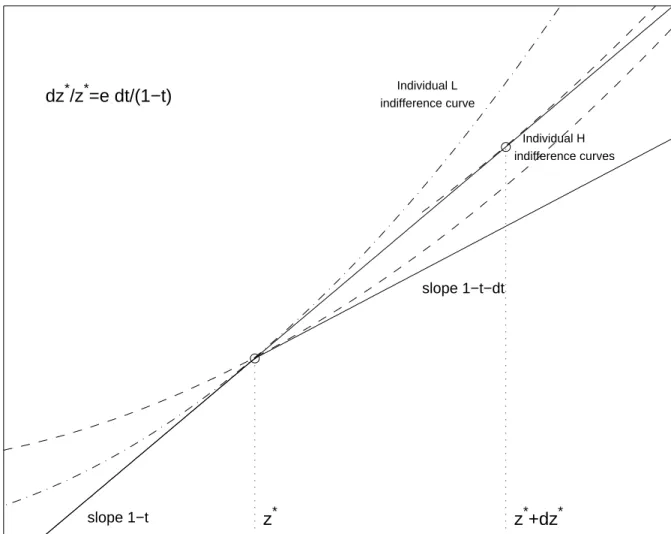
as displayed on Figure 4.1. We would like to construct a
measure of bunching at z
to assess how many taxpayers bunch at z
as a function of dt and the characteristics of the taxpayers. As displayed on Figure 4.1, all taxpayers,
whose indierence curve crossing the point (z
;z
;T(z
)) remains above the budget set,
bunch at the kink. The indierence curve of the the lowest ability individual (denoted individual L) who bunches at the kink is tangent to the budget set segment on the left of the kink (slope 1;t). The indierence curve of the the highest ability individual (denoted
individual H) who bunches at the kink is tangent to the budget set segment on the right of the kink (slope 1;t;dt).
In the absence of kink, the budget set would have a constant slope 1;t. In that case,
individual L would still choose income level z
. Individual H, however, would have a tax
rate reduced by dt, and thus would choose a income level z + dz such that, dz z = e dt 1;t (1) where e represents the compensated elasticity of income with respect to marginal tax
rates. When the kink is introduced, all taxpayers whose incomes are between z and z
+ dz
in the no kink case, start bunching at the kink z
. Thus the total number of
taxpayers bunching at z is simply h(z ) dz where h(z
) is the density of incomes at z
when there is no kink point and dz
is given by equation (1). This derivation shows
that bunching is proportional to the compensated elasticitye and to the net-of-tax ratio dt=(1;t).
15
15In the case of large jumps (high
dt=(1;t)), income eects should be introduced, the elasticity e
Let us consider a simple analytical example to illustrate previous calculations. As in Mirrlees (1971), I assume that all taxpayers share the same utility functionU(c;l) wherec
represent after-tax income available for consumption andlrepresents eort. I assume that U represents convex preferences and is increasing incand decreasing in l. Each taxpayer
is characterized by a skill (or wage rate) n. When a taxpayer with skilln chooses eortl,
he gets income z =nl. The skill parameter n is distributed in the population according
to the density function g(n). I note T(z) the real tax schedule. Consider the following
utility function, U(c;l) =c; l k+1 k+ 1 (2) The elasticity of income with respect to one minus the marginal tax rate (denoted by e)
is constant and equal to 1=k. In this simple case, there are no income eects and thus,
compensated and uncompensated elasticities are the same. Assume that z
is an income
level at which marginal rates jump fromt 1 to t 2, ( t 1 <t 2 and thus dt= t 2 ;t 1) then all
taxpayers whose skill lies in [n 1 ;n 2] will bunch at z , where n 1 and n
2 are dened such
that:16 n 1(1 ;t 1) = ( z =n 1) k (3) n 2(1 ;t 2) = ( z =n 2) k (4)
Taking the ratio of these two equations, we obtain,
n 2 n 1 = 1;t 1 1;t 2 1 k +1 (5)
would no longer be a pure compensated elasticity but a mix of compensated elasticity and uncompensated elasticity. However, as long asdt=(1;t) is relatively small, which is always the case with the empirical
kinks considered in Section 3, these income eects can be safely neglected.
16The individual with skill n
1 is individual L and the individual with skill n
2 is individual H of Figure
4.1.
As above, I note z +
dz
the income level that individual with skill n
2 would obtain if
the tax rate were equal to t
1. Thus, z + dz = n 1+k 2 (1 ;t 1) k and z = n 1+k 1 (1 ;t 1) k.
Therefore, using (5), I obtain,
z + dz z = 1;t 1 1;t 2 e (6) where e = 1=k is the elasticity of income with respect to tax rates. For t
2 = t
1 + dt,
this equation is exactly equivalent to equation (1). Equation (6) takes this simple form, whatever the size of the jump in rates, because the elasticity is constant and there are no income eects. Equation (6) shows that the size of bunching depends on the behavioral elasticitye and on the net-of-tax ratio (1;t
2)
=(1;t 1).
4.2 Adding uncertainty
The model presented is too simple because income is not perfectly controllable. The simple model in which atoms of taxpayers perfectly bunch at the kink points is rejected in the data. Therefore, we now assume that taxpayers cannot choose with certainty their income level as in the previous model.
Assume that the before tax income z of taxpayers is a random variable function of X = nl. For example, z = nl + where is a random shock out of control of the
taxpayer.17 Precise economic examples generating uncertainty could be a wage bonus
which is received at the end of the year and which is random ex-ante or dividends and capital gains from mutual funds which are received on January of the following year and thus are unknown when the labor supply decisions are taken.
Let us note f(zjX) the distribution ofz conditional on X and assume that the
expec-tation ofz given X is equal to X, i.e. R
zf(zjX)dz =X. Thus we assume that taxpayers
can control the mean of the process of incomes. For simplicity, I assume that the utility
17Mirrlees (1980) considers the problem of optimal social insurance in a model of intended labor supply
close to the one presented here.
functionU(c;l) =u(c);v(l) is separable in consumption and leisure. The expected utility
of the taxpayer is given by:
U = Z
u(z;T(z))f(zjnl)dz;v(l)
We can dene implicitly an eective tax schedule ^T in the following way: u(X;T^(X)) =
Z
u(z;T(z))f(zjX)dz (7)
Each taxpayer chooses l to maximize:
U =u(nl;T^(nl));v(l)
Therefore this model is equivalent to a certainty model from the point of view of the taxpayer with the eective tax schedule ^T replacing the real tax schedule T. If the
distribution f is smooth, then the kink of the tax schedule is smoothed. There is no
longer an atom at the kink point but rather a hump in the distribution of expected incomes nlaround the kink point.
Risk Neutrality
Let us rst look at the risk neutral case (i.e. u(c) = c). In this case, equation (7)
implies,
^
T(X) = Z
T(z)f(zjX)dz (8)
The eective tax level is a weighted average of real tax levels. Assume that the distribution
f takes the simple form f(zjX) =f(z;X). This is the case for example if z = X+
withN(0;
2) distributed. Dierentiation of (8) with respect to
X and integration by
parts leads to, ^ T 0( X) = Z T(z) @f @X (z;X)dz = Z T 0( z)f(z;X)dz (9)
So the eective marginal rate is also a weighted average of true marginal tax rates. If we assume as before that there is a kink atz
(jump from t
1 to t
2), then formula (9) can
be approximately computed (noting F the cdf of f):
^ T 0( X) =t 1 F(z ;X) +t 2[1 ;F(z ;X)]
This formula is accurate if there are no other kink points nearz
or if the distribution is
very concentrated around X. It is easy to see that the eective marginal rate increases
fromt 1 to
t
2 and presents a point of inection exactly at the kink point if f
0(0) = 0.
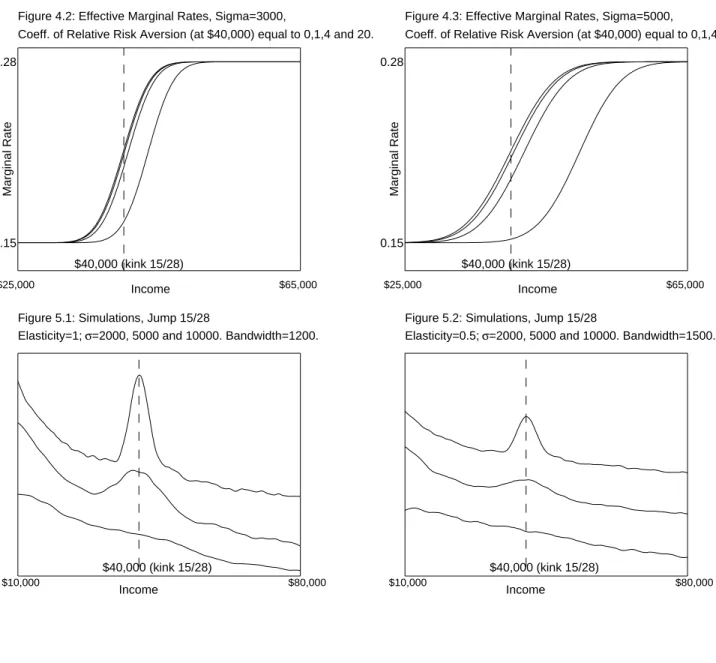
All these features are represented on Figures 4.2 and 4.3 in the special case of a jump from 15 to 28% at income equal to 40,000 dollars and assuming that z = X + with N(0;
2). The curve corresponding to the risk neutral case in each panel is the one on
the left. It presents a point of inection exactly at the kink point. This means that under reasonable assumptions about the distribution of noise, we should expect to see the hump of bunching exactly at the kink point. Comparing Figure 4.2 ( = 3;000) and Figure 4.3
(= 5;000), we see that the smaller , the sharper the increase in marginal rates.
Risk Aversion
Let us now turn to the more complicated case with risk aversion. Using (7), the eective tax schedule is given by,
X;T^(X) =u ;1 Z u(z;T(z))f(zjX)dz (10) We can dierentiate this expression with respect to X to derive the eective marginal
tax rate (assuming again that f(zjX) = f(z;X)),
1;T^ 0( X) = Z (1;T 0( z)) u 0( z;T(z)) u 0( X;T^(X)) f(z;X)dz (11)
The eective net-of-tax rate is a weighted sum of real net-of-tax rates. However, in this case, the weights are not simply f(z ;X) but are multiplied by an additional factor u
0(
z;T(z))=u 0(
X ;T^(X)). If we assume realistically that u
0 is convex18 then applying 18This is the case if taxpayers are prudent
Jensen's inequality to the convex functionu 0
u
;1 and using (10), we get, u 0( X;T^(X))< Z u 0( z;T(z))f(z;X)dz
imlying that the weights in (11) sum to a value bigger than 1. Therefore 1;T^ 0(
X) is
bigger than a weighted average of 1;T 0(
z). Moreover these weights are heavier on low z incomes (because of risk aversion,u
0 is declining) and thus 1 ;T
0(
z) is overweighed for z small. This means that low tax rates are overweighed in the case of a progressive tax
schedule. These two eects go in the same direction to lead to an eective marginal tax rate that is smaller than the eective tax rate when there is no risk aversion. As a result, the eective marginal tax rate curve is shifted to the right.
I have performed simulations with simple functional forms to quantify this shifting eect. I have assumed thatzjX is distributed N(X;
2) and that the utility function is:19 U(c;l) =;
e
;[c;v(l )]
When = 0, we are back to the risk neutral case. I consider, as before, a single jump at z
(from t
1 to t
2) in the real tax schedule. In both Figures 4.2 and 4.3, curves of eective
marginal rates are plotted for 4 dierent values of ( = 0; 2:510 ;5
; 10
;4 and 5 10
;4).
These values correspond to relative risk aversion parameters equal to 0, 1, 4 and 20 at the kink point level of income. As increases, we see indeed that the curves are shifted to
the right. This eect can be very important as and increase. For a given, this eect
is larger, the larger is . However for reasonable values of risk aversion, that is to say,
relative risk aversion being around unity, the shift to the right is very small and becomes signicant only for very large values of . Therefore risk aversion should theoretically
shift the humps to the right but for reasonable parameter values this eect is likely to be negligible. In fact, when evidence of bunching was found in the Section 3, the hump seemed to be centered almost exactly around the kink point.
19This utility function is not additively separable but multiplicatively separable; however all the results
derived above remain true.
We have studied the eect of uncertainty on the expected distribution of incomes (nl(n)) but we are interested in the features of real income distributions. For a given
income nl, the realized income z is a random variable distributed according to f(zjnl)
and thus the humps in the distribution of realized incomes are further smoothed. As a result, simulations of distributions of realized incomes z show that the variance of the
hump in the income distribution is about twice as large as the variance
2 of the random
process f(zjX).
4.3 Other models
The model with uncertainty analyzed previously does not capture all the features of the eort supply decision. Many taxpayers cannot control perfectly the mean of their income and probably face a limited menu of possible eort levels, each of these corresponding to a dierent type of job. For example, a Ph.D. graduate in economics can decide to take a post-doc position or to become assistant professor or to become a consultant. Though it is often possible to mix dierent type of jobs, perfect ne tuning of eort is impossible in most cases. Low income earners who change jobs more frequently may adapt more easily their work eort than high or middle income earners who stick to a given job for at least one year once they have chosen an occupation.
A simple way to model this fact would be to assume that taxpayers face each year a random menu of possible eort levelsl, and that they choose in this limited menu the eort
level maximizing their utility. We can assume that taxpayers face each year independent menus or more realistically that they can stick to the eort level of the previous year or choose between new oers. In the later case, if the tax schedule does not change over time, taxpayers are able to improve their utility as new oers appear year after year. In the long run, each taxpayer will be able to reach his optimum level of eort. However, even with the assumption of completely new menus each year, bunching appears in the simulated income distributions as soon as the elasticity and the number of choices are not too small. I present simulations using this model in Section 5.
Investment in human capital (along the lines of Becker (1975)) could also play an important role: a bigger eort now not only increases my expected income today but may also increase my ability level n in the subsequent periods. For example, young
consultants may have interest in working very hard not so much to increase their current compensation but rather to increase their odds of being promoted and getting higher wages in later periods. It is easy to see theoretically that if a biggerl has a positive eect
on n next period then bunching is reduced. Again, this investment feature is likely to
be more relevant for young high income earners rather than workers near retirement or low income earners who change jobs frequently and never get tenure. This could explain the dierence in the results of low and middle-high income earners. Career concerns are weaker in the case of low incomes and especially elderly getting social security benets and still working.20
5 Simulations
Qualitatively the theoretical models predict bunching, but we do not know yet what quantity of bunching is to be found when realistic parameters are chosen. I address this issue in this section. I rst present the model, then a range of simulations results and nally I try to calibrate the parameters of the model to the true empirical income distributions.
5.1 The Model
I have chosen very simple functional forms to make simulations. The basic utility function chosen was introduced in Section 4.
U(c;l) =c; l
k+1 k+ 1
20That could also explain why Friedberg (1998) found clear evidence of bunching in that case.
This functional form is useful, because it allows explicit calculations. Moreover, the utility is dened even for negative after tax incomes and so allows the use of normal distributions for the random income eect. I use only utility functions with no risk aversion because we have seen that the risk aversion eect is negligible for reasonable parameter values. The noise in incomes is modeled using normal distributions. I assume thatzjX follows a
law N(X;
2). There are two key parameters in this simple behavioral model.
1)e=k
;1represents the elasticity of income with respect to marginal net-of-tax rates.
Section 4 has shown that the amount of bunching is proportional to this elasticity. 2) is the standard deviation of the stochastic process generating eective incomes.
For a given expected income X, the eective income lies with probability 0:95 in the
interval (X ;1:96;X+ 1:96). In other words, measures to what extent taxpayers
control their income.
In all simulations, these parameters are assumed to be constant in the population. This is clearly unrealistic, but, once simulations are made for a range of parameters, we could easily merge the simulated distributions to display cases where agents have heterogeneous parameters. In order to make simulations, the eective tax schedule ^T
0
must be computed. In the simple setting I consider, explicit formulas can be derived. I then solve for the optimal eort. I can thus get a function which gives for every skill
n the corresponding expected income nl(n). It is then easy to draw the distribution of n according to an underlying distributiong(n) and compute real realizations of incomes z =nl+N(0;
2). Finally, I plot the distribution of incomes
zusing kernel density methods
as in Section 3. I can freely choose the size of the sample, thus I can get estimates close to the asymptotic distribution. Therefore, I do not report asymptotic condence intervals.
5.2 Simulation results
In this subsection, I present some simulations to examine how the size of bunching depends on the parameters previously described. For simplicity, I consider one single
jump in marginal rates from t 1 to
t
2. In this subsection, I rst consider a jump from 15
to 28% at the level of 40,000 dollars. and I assume that the distribution of n is uniform
around the kink point. This produces an income distribution comparable to the empirical income distributions around the second kink point after the TRA. Simulated distributions are represented on Figures 5.1 and 5.2. Simulations are plotted for elasticities equal to 1 (Figure 5.1) and 0.5 (Figure 5.2). I have performed simulations with 3 dierent values of
: = 2000; 5000 and 10000 dollars. As was expected from our ndings in Section 4,
the smaller and the larger the elasticity, the sharper the humps. When the elasticity is
equal to one, even when is equal to 10;000, a at hump is still discernible. When the
elasticity decreases, smaller values of are sucient to eliminate completely the hump.
However, for reasonable values of, which should be less than 5;000 for many taxpayers
earning about 40;000 dollars, the elasticity must be lower than 0.2-0.3 to make the hump
completely disappear. This implies that elasticities for middle income earners compatible with the empirical results are much smaller than those derived by the studies of Lindsey (1987) and Feldstein (1995). My results are consistent with the small elasticity results found in the labor supply literature.
Evidence of bunching was found for married taxpayers at the rst kink point where the marginal rate jumps from 0 to 15 percent. At that point the density of income distribution is still increasing and thus the assumption of n uniform is inaccurate. I
simulate a distribution of incomes closer to the real one using instead a normal distribution for n. This produces a single peaked distribution for simulated incomes that matches
roughly the true empirical distribution of post 1986 years for married. The case of a at tax equal to 15% is shown on Figure 5.3.
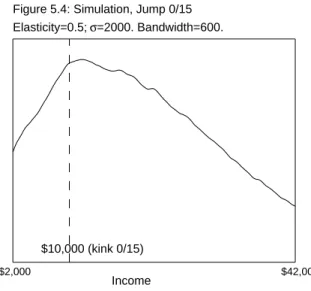
Let us now introduce a kink point at the level of 10;000 dollars where the marginal rate
jumps from 0 to 15% (as in the post TRA86 tax schedules). Figure 5.4 presents a simulated distribution of incomes which matches the empirical bunching, the elasticity parameter is equal to 0.5 and = $2000. The kink point produces a deformation in the distribution
of incomes which is very similar to what is observed in the true empirical distributions. 23
Many low income earners probably can control their incomes pretty accurately, therefore the assumption = $2000 is reasonable. Lower values of or higher elasticities would
produce humps bigger than in the empirical distribution. Therefore, these simulations suggest that an elasticity equal to 0.5 is a reasonable upper bound for low income earners. Table III (Panel A) summarizes those ndings. The Table displays for the rst and second kink point and for a range of elasticities, the corresponding values ofthat are required to
reproduce the evidence of bunching found in the empirical distributions. The number are, of course, only indicative. They illustrate, however, clearly the fact that high elasticities cannot be consistent with the empirical facts unless is very large.
5.3 Model with limited menu of eort
An alternative theoretical model in which taxpayers can only choose their eort level l
from a limited random menu was presented in Section 4. In this subsection, I present a few simulations to examine the quantitative properties of bunching in this model. I consider the case of a single jump from 15 to 28% occurring at 40,000 dollars.
I assume that each taxpayer has to choose l in a random menu (l 1
;::;l
d). The l
i are
independent. For convenience, I assume that each l
i is distributed uniformly around a
fairly broad interval centered around the optimal eort level [(1;)n]
1=k.21 Once l is
chosen, income is given by nl. e=k
;1 represents the elasticity in the limiting case when d is large. Fordnite, the true elasticity may not be exactlyk
;1 but is closely related to
that value.
Simulation results are given on Figure 5.5 for e= 1 and on Figure 5.6 fore= 0:5. For
both values of e, I present simulations for d = 2;4;6;8. It appears clearly that bunching
increases with d and the elasticity e. For d = 2 bunching is hardly discernible (even
for e = 1), however bunching clearly appears once d 4. Bunching is very sharp for d = 8. As discussed in Section 4, it is reasonable to think that d increases overtime as
new oers appear while taxpayers can stick to their previous eort level. Therefore, we
21More precisely, this interval is (0 :5n
1=k ;1:7n
1=k).
would expect d to be quite large after a few years. Thus again, this model is compatible
with empirical observations for middle income earners only if the elasticities of income are small. It could well be possible that bunching is not discernible empirically because there is both randomness of income realization and limited choice of l. However, even
in this mixed case, it would be dicult to reconcile empirical results with high income elasticities (elasticities bigger than 0.5). Table III (Panel B) displays the values ofd that
are compatible with the empirical evidence for several values of the elasticity parameter.
5.4 Income Dynamics
The IRS has also built a panel of tax returns available from 1979 to 1990. It is of interest to use it to have a more precise idea of income dynamics and get a rough idea of the size of . I have plotted distributions of dierences in real taxable income for years 1987 to
1990 (post TRA) and dierent portions of the income distribution.
In the model of taxation with uncertainty and stable preferences, taxpayers would choose each year the same eort and thus dierences in taxable income across two con-secutive years would allow us to estimate . For simplicity, if we assume as above that z t = nl+ t with t N(0;
2) and independent across time, then z t ;z t;1 N(0;2 2).
Distributions of dierences in taxable income (z t
;z
t;1) are displayed on Figures 5.7 to
5.10. They are presented for two dierent ranges of incomes (corresponding to the kinks 0/15 and 15/28 after 1986) for married and single taxpayers.22
From these density estimates, it is possible to estimate . Table IV displays the
estimated values of , computed as the standard deviation of the distribution z t
;z t;1
(divided by p
2). The estimation of would be upward biased if preferences are not
constant over time; uctuations of income due to pure luck are likely to be smaller than
22I have computed dierences in taxable income for two consecutive years and then merged the
dif-ferences corresponding to 1990-89, 1989-88 and 1988-87. Incomes have been normalized in 1991 dol-lars. For example, Figure 5.7 represents the distribution of dierences in incomesz
t ;z t;1for incomes z t;1 2(;10000;10000). 25
real uctuations. On the other hand, people may try to adapt their eort to smooth income revenues, producing a downward bias in the estimate of . The former eect is
likely to be stronger than the later and thus the estimation of in Table IV are probably
biased upward.
As evidenced on Figures 5.7 to 5.10, many taxpayers experience small changes of income across years. I have plotted on the Figures the income levels such that 50% of taxpayers experience changes in income z
t ;z
t;1 smaller than this level from year to
year. For example in Figure 5.7, 50% of taxpayers experience changes in income smaller than 2,700 dollars. These levels are not very large and therefore we can think that many taxpayers are able to control pretty accurately there incomes, therefore the absence of bunching in the empirical distribution is more likely to be the consequence of small elasticities than inability of taxpayers to control income.
The assumption of normality in the random component of incomes is inaccurate be-cause the distributions on Figures 5.7 to 5.10 display too sharp a mode. This may mean that the distribution ofis not homogeneous and that some taxpayers are able to control
very accurately their incomes. The model of limited choice of eorts may also have some relevance. We would then expect a very sharp mode because of people who stick to the same level of eort. A mixed model of limited menu of eort with uncertainty could well produce densities similar to the real ones.
6 Conclusion
This study has revealed clear evidence of bunching only at the rst kink point. The evidence for other kink points is either weak or null. These empirical results can be explained within our theoretical framework in two ways. First, a large uncertainty in the process generating incomes could make the humps around the kink points very at and thus hard to observe in the data. Second, a small elasticity of income with respect to tax rates for middle and high incomes earners would lead to small humps and therefore, no
clear evidence of clustering around the kink points in the data would be observed. Large uncertainty of incomes is rejected by panel data evidence. Even if taxpayers cannot choose freely their income target and have to select a job from a fairly limited menu of oers, empirical income distribution should display clustering around the kinks if elasticities are high.
Therefore, it is hard to reconcile these results with the very high elasticities estimated by authors who looked directly at the eects of tax changes on taxable income (Feldstein (1995) and Lindsey (1987)). These authors found elasticities bigger than 1 and sometimes as high as 3. In all our models, such elasticities would produce large humps at kink points for reasonable values of the remaining parameters. Moreover, those authors nd higher elasticities for high income earners than for low income earners. The present study sug-gests the opposite. Elasticities seem to be signicant only for low income earners around the rst kink point. The present results are consistent with the small elasticity estimates found in the traditional labor supply literature (see Pencavel (1986) for a survey). These studies commonly nd compensated elasticities around 0.2 which would not produce dis-cernible bunching in the models I consider. However, the present study considers taxable income and thus should capture all the dimensions of eort (as in Feldstein's and Lindsey's studies) and not only hours of work. One reason could explain this discrepency. Lindsey and Feldstein are not able to control for time eects in a fully convincing way: they rely on the fact that high incomes have increased faster than low incomes between 1981 and 1985 (Lindsey) and between 1985 and 1988 (Feldstein) and relate this fact to the decrease in tax rates during both periods. But it is generally acknowledged that this increase in inequalities could have other sources. For example, Murphy and Welch (1992) and Katz and Murphy (1992) found that the returns to human capital or education increased as a result of increased demand for skilled labor. The approach used here does not suer from this problem. However, my results are essentially qualitative and it is beyond the scope of this paper to provide precise estimates. Several recent studies have estimated elastic-ities of taxable income using other tax changes or better datasets than the ones used by
Feldstein and Lindsey. These new studies ( Auten-Carroll (1997), Goolsbee (1997), Saez (1997) among others) are able to control for underlying increases in inequality and nd much smaller elasticities (below 0.6) which are consistent with the results presented in this study.
This study also casts some doubts on the relevance of the approach of non-linear budget sets to estimate the eects of taxes on labor supply (Hausman (1981)). Uncertainty smoothes the kinks of the budget set and therefore it is not correct to add an error term in the labor supply equation (see Section 1) without modifying the shape of the budget set. Therefore, it would be very interesting to reconsider the non-linear budget set methodology with a smoothed budget set and see whether this aects the results. MaCurdy, Green and Paarsch (1990) already used a smoothed budget set in this type of study but mainly to simplify calculations. It should be possible to choose a smoothed budget set consistent with the variance of the error term in order to test the relevance of the nonlinear-budget set methodology.
The results of this paper suggest other directions for future research. First, it would be interesting to replicate the empirical estimations presented here to income tax sched-ules of other countries. Some countries have very progressive tax schedsched-ules generating big jumps in marginal rates23 and therefore looking at taxable income distributions for
these countries may bring additional evidence about bunching behavior. Second, welfare programs in the US generate big kinks in the budget set.24 The beneciaries are mostly
low income earners. Therefore it would be interesting to estimate the distribution of in-comes of recipients of these programs and see whether there is evidence of bunching at kink points.25 These programs sometimes introduce even discontinuities in the budget 23France, for example, has an income tax schedule with only seven brackets with top marginal rate
equal to 56%.
24Usually the benets are taxed away at very high rates above an exemption level.
25Kane (1998) has looked for bunching in the case of a program of saving incentives for higher education.
The schedule of benets induces a large kink in the budget set of participants. However, Kane was not able to nd any evidence of bunching.
set (known as notches) which should generate even more clustering. For example, the study of the Medicaid Notch (Yelowitz (1995)) could be enriched by application of non-parametric methods. This could corroborate our result of signicant elasticities for low income earners.
Appendix
Econometric Methodology
The data set is a stratied sample, so each observation (taxable incomex
i) is associated
with a weight (denoted w
i). The weights are normalized to sum to one. Assume that the
sample is of size N, the usual kernel density formula is given by:
^ f h( x) = 1 h N X i=1 K( x;x i h )w i
where h is the bandwidth and K is the kernel function. For all the estimations, I used
the Epanechnikov kernel function:
K(u) = 34(1;u 2)
I(juj<1)
The choice of the kernel function does not change the shape of the estimates, that is why I stick to this simple kernel function. Let us assume that the underlying true density distribution is given by f and that f is at least twice continuously dierentiable. The
expectation of ^f h(
x) in the case of Epanechnikov functions can be approximated by: E[ ^f h( x)] = f(x) + 110h 2 f 00( x) +o(h 2) The variance of ^f h(
x) can be approximated by: Var[ ^f h( x)] = 3 5N h f(x) +o( 1 N h ) with N = ( P N i=1 w 2 i) ;1 ( N =
N when all the weights are equal
26). So when h ! 0, E[ ^f h( x)] ! 0 and when N h ! 1, Var[ ^f h(
x)] ! 0. Thus theoretically, if f is smooth
enough, the kernel estimate has good properties of convergence. From those results, it is easy to derive the asymptotic distribution of the kernel estimate: when h ! 0 and N
h!1
26In general, the weights in the sample are such that N is about 3 4 N. 30
p N h( ^f h( x);f(x))!N(0; 3 5f(x))
A 95% asymptotic point-wise condence interval is given by:
0 B @f^ h( x);1:96 " 3 ^f h( x) 5N h # 1 2 ; ^f h( x) + 1:96 " 3 ^f h( x) 5N h # 1 2 1 C A (12)
Note that this condence interval is accurate only asymptotically. All the condence intervals plotted with the curve estimates are 95 % asymptotic condence intervals com-puted using formula (12). All these derivations are presented in more detail in Hardle (1990).
Data Aggregation
In some cases, estimates merging several years are presented. The aim is to improve the accuracy of the estimates by increasing the number of observations.
Years from 1988 to 1994 are merged so as to superpose exactly the two relevant kink points: jump from 0 to 15% at taxable income 0, and jump from 15 to 28%. As the tax schedule was indexed to ination during those years, taxable income is simply deated. The estimates are normalized in year 1991 dollars.
Years 1979,1980 and 1981 are merged directly because tax schedules were not indexed and therefore the kinks remain at the same location in nominal terms. For years 1982 to 1986, we have proceeded as follows. From year 1982 to 1984, the loci of the kink point did not change, but tax rates have decreased: the same kink points do not correspond to the same jumps in marginal taxes. Therefore, we have merged these years directly with years 1979 to 1981. Years 1985 and 1986 tax schedules are indexed by a simple multiplicative factor; therefore, by dividing incomes by these multiplicative factors, we can make all the kink points match. Results for these years are normalized in year 1984 dollars.
References
[1] Auten, Gerald and Robert Carroll. \The Eect of Income Taxes on Household Be-havior." Oce of Tax Analysis, U.S. Department of the Treasury, mimeo 1997, forth-coming Review of Economics and Statistics.
[2] Becker, Gary. Human Capital, Chigago University Press, 1975.
[3] Burtless, Gary and Jerry Hausman, \The Eect of Taxation on Labor Supply: Eval-uating the Gary Income Maintenance Experiment," Journal of Political Economy, 1978, 86, pp. 1103-1130.
[4] Burtless, Gary and Robert Mot, \The Eect of Social Security Benets on the Labor Supply of the Aged." In Aaron, H. and G. Burtless, eds., Retirement and Economic Behavior. Washington: Brookings Institution, 1984.
[5] Deaton, Angus. Understanding Consumption Oxford University Press, 1992.
[6] Feldstein, Martin. \The Eect of Marginal Tax Rates on Taxable Income: A Panel Study of the 1986 Tax Reform Act" Journal of Political Economy, 1995, 103(3) pp. 551-572.
[7] Friedberg, Leora. \The Social Security Earnings Test and Labor Supply of Older Men." in Tax Policy and the Economy, vol. 12, ed. J. Poterba. Cambridge: MIT Press, 1998.
[8] Goolsbee, Austan. \What Happens When You Tax the Rich? Evidence from Exec-utive Compensation.", NBER Working Paper, No. 6333, 1997.
[9] Hardle, Wolfgang. Applied non-parametric regression, Cambridge University Press, 1990.
[10] Hausman, Jerry. \Labor Supply", in How Taxes Aect Economic Behavior, ed. Henry J. Aaron and Joseph A. Pechman. Washington, D.C.: Brookings Institution, 1981.
[11] Hausman, Jerry. \Stochastic Problems in the Simulation of Labor Supply". in M. Feldstein, ed., Behavioral Simulations in Tax Policy Analysis, University of Chicago Press, 1982, pp. 41-69.
[12] Heckman, James. \Comment". in M. Feldstein, ed., Behavioral Simulations in Tax Policy Analysis University of Chicago Press, 1982, pp. 70-82.
[13] Kane, Thomas. \Saving Incentives for Higher Education." National Tax Journal, 1998, 51(3), pp. 609-20.
[14] Katz, Lawrence and Kevin Murphy. \Changes in Relative Wages, 1963-1987: Supply and Demand Factors." Quarterly Journal of Economics, 1992, 107, pp. 35-78. [15] Liebman, Jerey. \The Impact of the Earned Income Tax Credit on Incentives and
Income Distribution.", in Tax Policy and the Economy, vol. 12, ed. J. Poterba. Cam-bridge: MIT Press, 1998.
[16] Lindsey, Lawrence. \Individual Taxpayer Response to Tax Cuts: 1982-1984, with Implications for the Revenue Maximizing Tax Rate." Journal of Public Economics, 1987, (33), pp. 173-206.
[17] MaCurdy, Thomas, David Green and Harry Paarsch. \Assessing Empirical Ap-proaches for Analyzing Taxes and Labor Supply." The Journal of Human Resources, Fall 1990, pp. 415-490.
[18] Mirrlees, James. \An Exploration in the Theory of Optimal Income Taxation" Review of Economic studies, 1971, 38, pp. 175-208.
[19] Mirrlees, James. \Untended Labor Supply." Mimeo Nueld College, 1980.
[20] Mot Robert, \The Econometrics of Kinked Budget Constraints." Journal of Eco-nomic Perspectives, 1990, 4(2), pp. 119-139.
[21] Murphy, Kevin and Finis Welch. \The Structure of Wages." Quarterly Journal of Economics, 1992, 107(1), pp. 285-326.
[22] Pencavel, John. \Labor Supply of Men." in O. Ashenfelter and R. Layard (eds.), Handbook of Labor Economics, 1986, Amsterdam: North-Holland, pp. 3-102.
[23] Saez, Emmanuel. \The Eect of Marginal Tax Rates on Income: A Panel Study of `Bracket Creep'.", MIT mimeograph, 1997.
[24] Yelowitz, Aaron. \The Medicaid Notch, Labor Supply and Welfare Participation: Evidence from Eligibility Expansions" Quaterly Journal of Economics, 1995, 105, pp. 909-940.
Figure 3.1 −$3,000 $38,000 $3,400 (kink 0/14) $29,900 (kink 32/37) $24,600 (kink 28/32) $35,200 (kink 37/43) (kink 24/28) $20,200 $16,000 (kink 21/24) Taxable Income
Histogram for Married Taxpayers. Years 1979 to 1981. 196,518 observations. 150 bins. Dashed lines represent kink point income levels.
−$3,000 $38,000 $3,400 (kink 0/14) $29,900 (kink 32/37) $24,600 (kink 28/32) $35,200 (kink 37/43) (kink 24/28) $20,200 $16,000 (kink 21/24) Taxable Income Figure 3.2: Married Taxpayers
Years 1979 to 1986. 317,804 observations. Bandwidth=1000.
−$13,000 $58,000 $0 (kink 0/15) $34,000 (kink 15/28)
Taxable Income in 91 dollars
Years 1988 to 1994. 194,186 observations. Bandwidth=1500. Figure 3.3: Married Taxpayers
−$13,000 $58,000 $0 (kink 0/15) $34,000 (kink 15/28)
Taxable Income in 91 dollars Year 1988. 23,659 observations. Bandwidth=2300. Figure 3.4: Married Taxpayers
−$13,000 $58,000 $0 (kink 0/15) $34,000 (kink 15/28)
Taxable Income in 91 dollars
Year 1994. 27,000 observations. Bandwidth=2300. Figure 3.5: Married Taxpayers
−$3,000 $28,000 $2,300 (kink 0/14) $10,800 (kink 21/24) $15000 (kink 26/30) $18,200 (kink 30/34) $23,500 (kink 34/39) Taxable Income Figure 3.6: Single Taxpayers.
Years 1979 to 1986. 149,284 observations. Bandwidth=700.
−$8,000 $38,000 $0 (kink 0/15) $20,350 (kink 15/28)
Taxable Income in 91 dollars Figure 3.7: Single Taxpayers
Years 1988 to 1994. 101,194 observations. Bandwidth=1200.
−$8,000 $38,000 $0 (kink 0/15) $20,350 (kink 15/28)
Taxable Income in 91 dollars Figure 3.8: Single Taxpayers
Year 1988. 13,745 observations. Bandwidth=1600.
−$8,000 $38,000 $0 (kink 0/15) $20,350 (kink 15/28)
Taxable Income in 91 dollars Figure 3.9: Single Taxpayers
−$9,000 $39,000
$0 (kink(0/15)
Taxable Income
Figure 3.10: Married Taxpayers: all observations Year 1993. 20,096 observations. Bandwidth=1000.
−$9,000 $39,000
$0 (kink(0/15)
Taxable Income
Figure 3.11: Married Taxpayers Expecting Refund Year 1993. 12,534 observations. Bandwidth=1000.
$37,000 $59,000
$45,800 (kink(43/49)
Taxable Income Figure 3.12: Married Taxpayers
Years 1979 to 1986. 94,725 observations. Bandwidth=600.
$46,000 $64,000
$55,300 (kink(55/63)
Taxable Income Figure 3.13: Single Taxpayers
−$13,000 $58,000 $0 (kink 0/15) $34,000 (kink 15/28)
Taxable Income in 91 dollars
Years 1987 to 1994. 123,684 observations. Bandwidth=1800. Figure 3.14: Married Taxpayers. Itemizers
−$13,000 $58,000 $0 (kink 0/15) $34,000 (kink 15/28)
Taxable Income in 91 dollars
Years 87 to 94. 70,502 observations. Bandwidth=2000. Figure 3.15: Married Taxpayers. Non−Itemizers
−$8,000 $38,000 $0 (kink 0/15) $20,350 (kink 15/28)
Taxable Income in 91 dollars Figure 3.16: Single Taxpayers. Itemizers
Years 1988 to 1994. 39,629 observations. Bandwidth=1500.
−$8,000 $38,000 $0 (kink 0/15) $20,350 (kink 15/28)
Taxable Income in 91 dollars Figure 3.17: Single Taxpayers. Non−Itemizers
Before Tax Income
After Tax Income
Figure 4.1: Theoretical Bunching
z* z*+dz* slope 1−t−dt Individual L indifference curve slope 1−t Individual H indifference curves dz*/z*=e dt/(1−t)
Marginal Rate $25,000 $65,000 0.15 0.28 $40,000 (kink 15/28) Income
Coeff. of Relative Risk Aversion (at $40,000) equal to 0,1,4 and 20. Figure 4.2: Effective Marginal Rates, Sigma=3000,
Marginal Rate $25,000 $65,000 0.15 0.28 $40,000 (kink 15/28) Income
Coeff. of Relative Risk Aversion (at $40,000) equal to 0,1,4 and 20. Figure 4.3: Effective Marginal Rates, Sigma=5000,
$10,000 $80,000
$40,000 (kink 15/28) Income
Elasticity=1; σ=2000, 5000 and 10000. Bandwidth=1200. Figure 5.1: Simulations, Jump 15/28
$10,000 $80,000
$40,000 (kink 15/28) Income
Elasticity=0.5; σ=2000, 5000 and 10000. Bandwidth=1500. Figure 5.2: Simulations, Jump 15/28
$10,000 (no kink)
$42,000 $2,000
Income
Elasticity=0.5; σ=2000. Bandwidth=600. Figure 5.3: Simulation, Flat Tax 15%
$10,000 (kink 0/15)
$42,000 $2,000
Income
Elasticity=0.5; σ=2000. Bandwidth=600. Figure 5.4: Simulation, Jump 0/15
$12,000 $58,000 $34,000 (kink 15/28) Income d=2 d=4 d=6 d=8
Elasticity=1, Number of Choices: d=2, 4, 6 and 8. 35,000 obs. Figure 5.5: Limited Choice of Effort Model
$12,000 $58,000 $34,000 (kink 15/28) Income d=2 d=4 d=6 d=8
Elasticity=0.5; Number of Choices: d=2, 4, 6 and 8. 35,000 obs. Figure 5.6: Limited Choice of Effort Model
−$18,000 $18,000 $0
−$2,700 $2,700
Figure 5.7: Married Taxpayers, Incomes between −$10,000 and $10,000, Diffs. in Taxable Income (years 87 to 90). 6,854 observations. Bandwidth=700.
−$30,000 $30,000 $0
−$4,300 $4,300
Figure 5.8: Married Taxpayers Incomes between $24,000 and $44,000, Diffs. in Taxable Income (years 87 to 90). 7,364 observations. Bandwidth=700.
−$14,000 $14,000 $0
−$2,100 $2,100
Figure 5.9: Single Taxpayers, Incomes between −$5,000 and $5,000, Diffs. in Taxable Income (years 87 to 90). 6,083 observations. Bandwidth=500.
In all four figures, the straight vertical lines cut the distributions such that exactly 50% of observations are inside the two lines.
−$19,000 $19,000 $0
−$2,400 $2,400
Figure 5.10: Single Taxpayers, Incomes between $13,000 and $27,000, Diffs. in Taxable Income (years 87 to 90). 4,695 observations. Bandwidth=800.