F
TransportInfrastructure and Urban Development Department
The World Bank October 1992
WPS 986
The Administration
of Road User Taxes
in Developing
Countries
Roy Bahl
The causes of tax avoidance, of tax evasion, and of the failure to reach full revenue potential from road user taxes lie within tax - structures and administrations - and those are the areas that
need reform.
PoicyR=chWoingPspdmaniunthefindingsofwo*inprogtessandcogetheexchngeofidesasmwgBankstaffsnd
a1 othdirsited in devc:opment issam These papers cay th names of the authon. ndlect oaly their views, and should be used and cied acoordinly. TbefindiYs. inteqeuatioas, nd conclusions aretheautbora' own Thy should not be attibuted tothe World Bank, it Board of Direcx, its managwAt, or ny f its mbe counties.
Public Disclosure Authorized
Public Disclosure Authorized
Public Disclosure Authorized
Transport WPS 986
This paper- a product of the Transport Division, Infrastructure and Urban Development Department-is part of a larger departmental projeet on pricing, cost recovery, and efficient resource use in the road sub-sector. The report is based on a series of case studies carried out in Argentina, Bolivia, Ghana, India, and Yugoslavia - drawing also on studies carried out in Indonesia, Nepal, and Tanzania. Copies of this paper are available free from the World Bank, 1818 H Street NW, Washington DC 20433. Please contact Jemifer Francis-O'Conmor, room S10-063, extension 35205 (46 pages).
After studying the problems of administering adminritration narrows the possibility for
road user taxes in 19 developing countries, Bahl successful evasion, the result may be an increase reports the following, among other things: in avoidance.
* There is no single, correct structure for * The four main types of road user charges road user taxation since the various charges may are (1) fuel tax, (2) sales tax, excise tax, and play different roles in different national revenue import duty, (3) annual license and vehicle systems. registration charges, and (4) tolls.
* All effective tax administration requires * Action should be taken under all four a solid, uncomplicated tax structure. main reform options (1) to keep rate levels as
* The substantial revenue potential of road low as possible, (2) to broaden the tax base, limit user taxation rests on a growing tax base. De- exemptions, and move toward a single uniform spite this, road user taxation remains an tax rate, (3) to simplify taxes to minimize underused source of public finance in developing ambiguity, ease administration, reduce adminis-countries. trative cost, and lower the compliance cost, and
* Tax evasion and avoidance narrow the (4) to improve tax enforcement by improving tax tax base, cost governments revenue, and compro- collection, record-keeping, liability assessment, mise the efficiency and redistribution objectives and identification of those liable to pay the tax. of a tax system. Evasion may occur by * Transport fuel pricing needs to be better nonfiling, underreporting, or smuggling. It coordinated, and rate structures - especially for generally increases with the tax rates (particu- sales tax, excise tax, and import duty - could be lady the marginal tax rates) and decreases with a lowered and made more uniform. In some greater probability of detection and with a more countries there is scope for raising fuel tax and severe penalty. Avoidance is the result of the annual license tax, provided it is accompa-loopholes in a tax system that enable a taxpayer nied by better enforcement. Evidence found in to reduce liability by adjusting the consumption the case studies for this paper have not supported or composition of received income, or by making an incentives argument: that taxpayers will be different investment or production choices. more inclined to pay if they see a direct benefit
* The problems of evasion and avoidance between tax and spending. must be approached simultanteously. If a tax
The Policy Research Working Paper Series disseminates the findings of work under way in theBank. Anobjectiveof the series is to get these findings out qicklcy, even if presentations are less than fully polished. The fmdings, interpretations, and conclusions in these papers do not necessarily represent official Bank policy.
OF ROAD USER TAXATION
IN DEVELOPING COUNTRIES
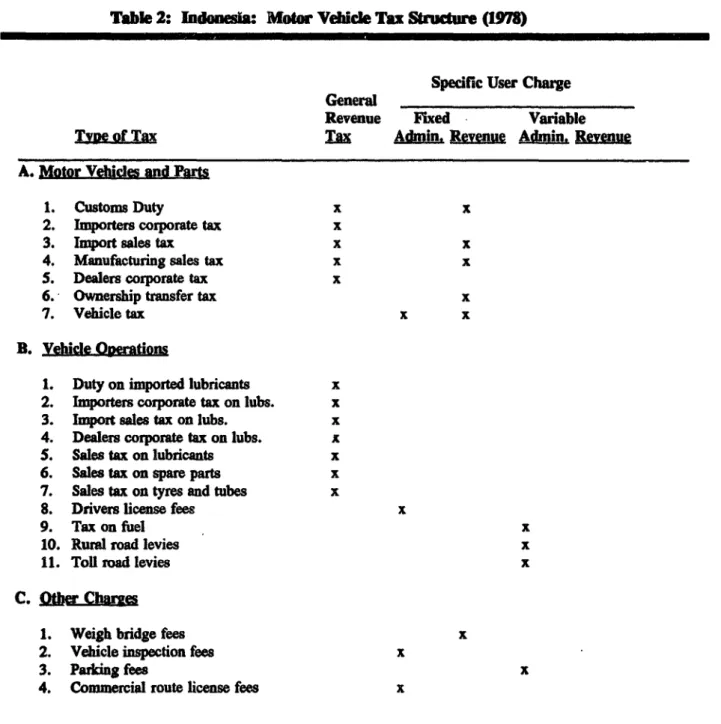
Table of Contents
ExcutiveSummary ... i
I. INTRODLTCTION ... I H. TIE PROBLEM ... I ... 4
Fiscal Problems in LDCs ... 4
Avoidance and Evasion ... 5
m. ROAD TRANSPORTTAXATION ... 8
Defming Road Transport Taxation ... 8
Motor Fuels ... 10
Purchase Taxation: Duty and Sales Tax ... 18
The Annual License and Motor Vehicle Registration Charges ... 27
Tax on the Movement of Goods and Passengers ... 29
Tolls ... 33
IV. REFORM OPTIONS ... 35
Tax Rate Levels ... 355... Tax Treatment Uniformity .. ... 37
Tax Structure Simplification .... ... 38
Do ncentives Matter? . . ... 39
Compliance Cost ... 40
Enforcement and Penalty ... 41
Intergovernmental Relations .... ... 42
Table 1 Motor Fuel and Total Transport Tax in Nineteen Developing Countries. 3 Table 2 Indonesia: Motor Vehicle Tax Structure (1978). 9 Table 3 Revenue from Customs Duty, Sales Taxes and Excises oll Motor Vehicles and Motor Vehicle Parts . 18 Table 4 Revenue Yield from Registration and Annual Taxes on Motor Vehicles ... 27
Figure I Tax Avoidance: Vehicle Import Duty ... ... 23
REENC1ES .... 44
This report was prepared as part of a project on pricing, cost recovery, and efficient resource use in transport under the overall direction of Ian G. Heggie. The report was prepared by Professor Roy Bahl (Consultant), based on a series of case studies carried out in Argentina, Bolivia, Ghana, India, and Yugoslavia. Roy Bahl is a Professor of Economics and Director of the Policy Research Program, Georgia State University, Atlanta, Georgia. The case studies
were carried out by R. Carruthers (Consultant), K. L. Luthra (Consultant), and D. Walker (Consultant). Material also was used from other studies carried out in Indonesia, Nepal, and Tanzana.
The author would like to thank Ian Heggie for many helpful comments on this manuscript and for calling attention to much of the literature that underlies this research. The author also is indebted to Jim Furis, Sonya Gadoly, and Jim Reteneker for helping prepare the manuscript.
c.i.f. cost, insurance, and freight
GDP Gross Domestic Product, the
GNP Gross National Product, hie
LDC Less Developed Country
OECD Organizaion for Economic Cooperation and Development
RUT Road User Taxation
i. The following chapters are based on research into the problems ;1f road usor tax
administration In 19 developing countries. The introduction posits three concepts that underlie the work. First, there is no single, correct structure for road user taxation since the various charges may play different roles in any national revenue system. Second, all effective tax administration requires a solid, uncomplicated tax structure. Third, the revenue potential of road user taxation is not only substantial, but rests on a growing tax base. In spite of this, road user taxation remains an under-used source of public finance in less developed countries.
General Background
ii. Parts I and II place road user taxation in the context of the broader fiscal problems facing developing countries. These problems include debt burdens, high inflation, budgetary imbalances, deficient public services, high marginal tax rates, and varying rates of economic growth. Contributing to these are tax evasion and tax avoidance. The most frequent response to revenue shortfalls in developing countries is to use increased customs duties, higher sales and excise tax rates, and highly progressive income tax structures. All of these are thought to have a negative economic impact and to incite non-compliance with the tax system.
iin. Evasion and avoidance narrow the tax base, cost govermments revenue, and compromise the efficiency and redistribution objectives of a tax system. Evasion may occur by non-filing, under-reporting, or smuggling. It generally increases with the tax rates (particularly the marginal tax rates), and decreases with a greater probability of detection and with a more severe penalty. Avoidance is the result of loopholes in a tax system that enable a taxpayer to reduce liability by adjusting the consumption or composition of received income, or by maling different investment or production choices.
iv. The problems of evasion and avoidance need to be approached simultaneously. If a
tax administration greatly narrows the possibility for successful evasion, the result may be an increase in avoidance. Strategies to improve tax administration and reduce evasion and avoidance center on: (1) lowering marginal tax rates; (2) broadening tax bases by eliminating exemptions and many preferential treatments; (3) increasing the transaction cost for using legal loopholes; (4) tightening the control of the tax authority and monitoring questionable cases;
(5) discouraging under-reporting by using presumptive assessments and regular audits;
(6) preparing a full tax roil and reducing compliance cost; and (7) increasing penalty rates, discouraging negotiated settlements and tax amnesties, and increasing (government) willingness to prosecute.
Road Transport Taxation
v. Transport taxes are divided into two broad categories - general revenue taxes and
road user charges. The former are levied on transport related activities as part of national revenue policy, while the latter are differentially higher taxes levied on the transport sector. Part m focuses on the four main sets of road user charges: (1) fuel tax; (2) sales tax, excise
each of these are many types of specific levies.
vi. Fuel tax. Fiel tax is the dominant source of revenue received from the transport sector, often accounting for half of all transport related revenues. The attraction of fuel tax is that it has a large tax base that grows in propoidon to GDP, is relatively price inelastic in demand, and is easily administered with relatively few distributors and few points of distributeJn (fuel tax may be income elastic if a specific (per gallon) tax rate is not levied and if governments do not allow the taxable price to increase with the market price)). The taxpayer is aily identified, compliance is easily monitored, and levels of evasion and avoW ince are low. Fuel tax, however, is not usually designed as a proportional benefits levy. The relationship between total collection and total road expenditure varies widely. Fuel is taxed in several ways. Imported petroleum is subject to customs duty; domestic refineries are subject to excise tax; the state monopoly on petroleum products may be taxed on its retained earnings; retail sales tax may be imposed on the pump price; and the pump price may be set above (below) production cost, implying a tax (subsidy). Some countries use one of these tax forms and others use a comoination. The aim of fuel rate differentiation centers on income distribution, subsidizing public transportation, keeping prices for non-transport fuel use low, and encouraging industrial development. However, differential fuel prices between contiguous countries and alternative transport fuels will encourage evasion and avoidance. Gasoline users avoid paying high tax by switching to diesel-engined vehicles, or adulterating fuel with a cheaper substitute. They evade paying tax by illegally misclassifying their use under an exempt category (such as agriculture), or smuggling fuel to/from other countries.
vii. Sales tax, excise tax, and hnport duty. Motor vehicles and motor vehicle parts may be taxed at point of sale, at point of manufacture, and at point of import. Most countries use all three stages. Tax rate, base size, and the extent of preferential treatment vary greatly between countries. Revenue from these taxes is rarely earmarked for expenditure on transportation services, but contributes to general revenue and general economic policy.
viii. General sales tax is among the most difficult to administer. The system is complicated and the tax rate is often high. Of the large number of potential taxpayers, many fail to register. Loopholes, ambiguities, and a high tax rate encourage avoidance. Taxpayers look for an opportunity to shift their purchase or production to an exempt activity, or to one subject to a lower tax rate. They may submit exaggerated refund claims, make unrecorded cash sales, claim ineligible credits, and under-report sales.
ix. Import duty may be the most difficult to administer. The rate structure is usually complex, rates are high, compliance cost may be high, and administration is often weak. The result is considerable scope for undervaluation and misclassification (into lower rate categories). Discretionary exemptions and a low probability of detection aid avoidance. Customs staff are not fidly trained, do not use proper procedures, and often are responsible for making clatsification decisions. Contact between customs officers and taxpayers encourages corruption and negotiated settlements.
(excise tax is due when goods are moved), and to the physical control of goods at the manufacturing site, making monitoring and enforcement easier.
xi. Annual license and vehicle regtration charges. Vehicles are subject to a
registration charge when purchased, and an annual tax thereafter. Revenue from these charges varies fromi insignificant in most of the countries studied here, to about one-fifth of transport sector revenue in India. The annual license tax is difficult to administer. It reaches a broad and growing base, but usually with a low specific rate, The structure is complex, record keeping is poor, enforcement is lax, and penalty is low. 'he compliance cost is usually high, often requiring documented proof of compliance with numerous other regulations before the license tax may be paid.
xii. Tols. Toll charges are easy to administer, but costly to collect. Monitoring is difficult, compliance cost is high, and toll-booth operators are easily corrupted. In most countries, tolls are a minor revenue source, usually related to a specitic project. Electronic toll collection systems could reduce some evasion and are now relatively inexpensive to install. Reform Options
xiii. The realiation of greater revenue potential from transport sector taxation requires a combination of administrative and policy changes. Many of the present systems were developed
to satisfy a variety of macrceconomic and political objectives, only one of which might be the improvement of road transport services. A choice to strengthen transport sector taxation may require a tradeoff with other objectives. Two themes must underpin any reform plans. First, the tax structure must be set right before the administration can be redesigned. Second, governmenits should think in terms of policies that reduce the incentives to non-compliance and policies that increase the expected cost of evasion. Part IV focuses on four interrelated elements of tax reform.
xiv. Rate levels. Rate levels, particularly maga tax rate levels, should be kept as low as possible to reduce the incentive for evasion, for avoidance, and for changing consumption patterns. However, high rates are not a major cause for the failure of transport tax to realize full revenue potential. Motor fuel, the most important base, is probably under-taxed in most countries, and a rate increase could Likely be absorbed with litle, if any, loss in collection efficiency. Stricter etiforcement, rather than increased rates, is the better approach.
xv. Uniformity. Tax reform should concentrate on broadening the tax base, limiting exemptions, and moving toward a single uniform tax rate. Rate differentiation should be limited. The lower price and the lower ta rate on diesel do not clearly result in cost equity for the poorer consumers - they bring a revenue loss and subsidize the largest beneficiary of road
minimize ambiguity, to ease administration, to reduce administrative cost, and to lower compliance cost. A tax structure with only a few rates and classifications would increase the probability of detection for importers undervaluing goods, and reduce the avenues for goods
reclassification. Sales taxation could be simplified by using the value-added tax or the retail sales tax. Several suggestions have been made to simplify the annual license tax, but none of those tried is sufficient on its own and several have drawbacks.
xvii. Enforcement and penalty. These are the keys to better tax administration. Taxpayers will not respond to lower rates and a simpler rate structure alone. Improving enforcement requires improving four steps in the administration of any tax: collection, record-keeping, assessment of tax liability, and identification of those liable to pay the tax.
Transport Taxation Reform
xviii. Better admini' Ation of road user taxes requires action under all four of the above headings. In particular, transport fuel pricing needs to be better coordinated, and rate structures
- especially for sales tax, excise tax, and import duty - could be lowered and made more
uniform. In some countries there is scope for raising fuel tax and the annual license tax, provided it is accompanied by better enforcement. An incentives argument that taxpayers will be more inclined to pay if they see a direct benefit between tax and expenditure has not shown itself in the case studies for this paper to be viable. The causes of avoidance, of evasion, and of the failure to reach full revenue potential are within tax structures and administrations. Here is where reforms must be made.
1. Road User Taxation (RUT) is an underutilized source of public financing in developing countries. The base of the tax (motor fuel consumption and the number and value of motor vehicles) is growing. The general view is that road users can pay more tax, that to charge them on the basis of vehicle size or gasoline consumption is fair, that higher transport tax reduces congestion and pollution, and that motor fuel tax is easily administered.
2. Despite meeting all of these maxims, RUT is rarely a mainstay of tax systems in developing countries. Some of the reasons for this include political opposition, fear that increased transport tax might cripple economic development, assessment and collection difficulties with the non-fuel components of RUT, and problems with the rate and base structure. This paper deals principally with the latter two constraints, and about the policy and administration options open to move RUT toward full realization of its revenue potential. 3. Three questions underlie this work. First, do successful country practice and normative
rinciples tell us there is arght way tQ structure RUT? No. These taxes and charges play many different roles in national revenue systems. In one country, the objective of RUT may be rationing road use, in another it may be financing construction and maintenance of the highway network, and in others it may be general revenue support. To complicate matters further, taxes on the transport sector may be driven by macroeconomic policies, such as the need to conserve
foreign exchange or protect domestic industry.
4. Second, are there generic rules that lead to better administration of KIW Yes. A key rule is that effective administration requires a solid tax structure. On the basis of the case studies reviewed here, there are correctable problems in all areas of tax administration: assessment, collection, record keeping, and identification of tax bases.
5. Third, what is the revenue potential of RK? Though statistics are not always available (governments tend to collect revenue data by type of tax rather than by object), the comparisons in Table 1 suggest an 11 percent share in total taxes is not unusual; a share in the neighborhood of 19 percent, as in India and Costa Rica, is possible. Five countries, in this sample of 19, tax the transport sector at a rate greater than 2 percent of GDP. Using these benchmarks, and recognizing that even these higher numbers do not take into account evasion and avoidance, one concludes that many less developed countries (LDCs) have a substantial capacity to expand RUT.
6. The next section examines the general setting for evaluating tax administration in the transport sector. The topics covered include the nature oe -he evasion/avoidance problem for LDC taxes in general, the standard remedies for non-compliance, and the directions in which tax policy has turned in recent years. Those interested in transport tax system reform would do well to start here. A general model of tax evasion/avoidance is summarized in Section m and presented in more detail in Annex A.
7. The present practice of transport sector taxation is described in some detail in Section IV, with reference to eight case studies prepared for this Project.A' These cases show wide variatiorns in compliance, revenue performance, administrative practice, the use of tax instruments, and rate and base structure. The final section looks at policy and administrative reform. Has the LDC experience with tax administration in general, and transport tax in particular, taught us how best to structure and administer a system of taxes and charges on motor vehicles and roadways?
8. Some caveats should be mentioned. This report discusses transport tax, but is primarily concerned with motor vehicles and road use. Airports are mentioned only in passing, and railroads and seaports are not discussed. Heavy reliance is placed on the results from a small number of case studies that may or may not be representative. Where possible, the results from other country studies are reviewed, but these are neither comparable in u.e sense of the questions asked, nor are they presented in the same level of detail. Finally, in some of the discussion the terms tax and charge are loosely used. This is partly a shorthand convenience and partly because the traditional distinctions are blurred among several of the commonly used instruments of transport taxation. Where the distinction is important it is clearly made.
Table 1: Motor Fuel and Total Tllsport Tax In Nrin Developing Coumtries
Percentage of Road Expenditurl collected
Road Motor User Fuet Tax on Motor Fuel Total Transoort Tax ES I
Percent Percent Per Perct Perent Per
of of Capita of of Capita Country Year Total Tax GOP (S US) Total Tax GOP (S US)
1. Atgeria 1984 0.0 0.7 0.0 1.2 155.2 148.0 2. Argentina 1987 6.6 1.7 41.0 11.4 3.0 70.9 190.9 158.4 3. Sol-vla 1988 O.S 3.3 0.6 3.9 4. Cotombia 1986 2.3 0.2 3.0 6.4 0.7 8.4 89.4 32.1 S. Costa Rlca 1986 16.7 3.1 53.9 18.8 3.5 60.8 148.1 131.4 6. Ethiopia 1985 2.4 0.4 0.5 5.2 0.9 1.0 71.7 32.7 . Chana 1988 1.3 0.2 0.7 A/ 0.0 0.0 0.0 1987 4.5 0.6 2.0 4.8 0.6 2.1 34.2 32.3 8. Guatemala 1988 7.9 0.9 6.8 16.1 1.7 13.8 9. India 1988 7.9 0.9 0.1 19.0 2.1 0.2 10. Indoreiaf 1986 4.0 0.6 2.5 7.4 1.2 4.7 62.6 II. Jamaica 1984 7.5 1.7 0.1 3.0 162.0 98.6 12. mepal 1985 4.3 0.3 0.5 13.4 1.0 1.4 13. Pakistan 1985 5.2 0.6 2.0 16.0 1.8 6.2 239.4 78.0 14. Phitippines 1986 9.1 1.0 5.1 11.6 1.2 6.5
IS. Sri Lanka 1985 7.8 1.4 5.5 12.9 2.4 9.1 448.1 270.0 16. Tanuania 1986 3.4 0.4 0.9 13.1 1.7 3.6 1987 0.6 0.9 1.8 2.5 176.1 64.4 17. Thatland 1985 9.0 1.3 9.4 13.5 1.9 14.0 198.4 132.6 18. Tunisia 198S 2.7 0.7 7.6 4.9 1.2 ¶3.7 153.7 85.1 19. Zaire 1985 7.1 1.2 1.7 7.3 1.2 1.7 57.3 56.2 Medin 6.6 0.6 2.0 11.6 1.7 4.7 155.2 78.0 ean 6.1 0.9 7.4 10.1 1.5 11.3 163.4 98.7
IH. THE PROBLEM
9. This report tries to answer the following questions on the use of transport tax and the problems of evasion and avoidance:
* How urgent is the need to improve tax effort in developing countries?
* What is the magnitude of tax evasion in the transport sector, and are there significant gains to be had from better enforcement?
* What policy instruments are currently used for dealing with compliance and what role can they play as part of an agenda for improving enforcement of transport tax?
* How can policy makers reconcile the revenue raising and resource allocation objectives of transport tax?
iWA Problems in LDCs
10. The 1988 World Development Report (World Bank, p. 182), describes the poor conduct
of fiscal policy in developing countries as leading to "... heavy foreign borrowing, high inflation, and stagnant private investment". The economic patterns and fiscal problems facing low-income countries vary and in each produce a different response, making generalizations difficult. However, some fiscal situations occur repeatedly in many countries.
11. One is that govemment expenditure drives the problems of budgetary imbalance in low income countries. In most cases, the ratio of tax to GNP is remarkably stable, but the expenditure share may increase dramatically over short periods of time. This creates short run (in some cases long run), situations of substantial deficit and inflationary financing. The following common situations explaining the inability of governments to control spending are observed in LDCs:
* Public services are deficient, and pressure to upgrade and fill the most severe gaps is intense. In response, governments often spend for capital improvements even when their forecasted tax revenue will not support the expenditures. Governments borrow without the capacity to repay, do not adequately maintain existing capital stock, and do not operate some facilities to proper standards.
* Central govemment budgets are squeezed by public employee compensation
demands, demands to increase transfers to local governments, and the increasing price of non-labor inputs (utilities, asphalt, gasoline, and so on). Inflation exacerbates these pressures.
* Debt repayment exerts a fixed and often substantial claim on available resources. * Govemment budgets are politicized and tend to expand during elections. Often public employment rolls are "padded" as governments take on the role of
employer of last resort.
* Inefficient service delivery adds to the burden.
12. Some governments are unwilling to exert a tax effort to close the public services gap. The Philippines and Guatemala are countries whose tax burden is inordinately low by world standards. A normal tax effort in either of these countries would all but eliminate the budget defiJ0t In other cases the average tax rate, relative to GDP, is not low, but the gap persists. This could be due to one or both of the following reasons: First, the deficit is primarily a problem of overspending relative to revenue intake; second, the high (or even normal), average tax rate translates into a high marginal rate because only a narrow segment of economic activity is taxed.
&oidance and Evasion
13. Individuals and companies reduce their tax liabilities by a variety of legal and illegal means. Avoiding or evading taxes hinders the public sector's revenue generation. This is especially true in developing countries where tax enforcement is weak and where the informal sector of the economy is hard to taxY The revenue loss from noncompliance exacerbates a serious problem resulting from deficient infrastructure, low taxable capacity, inadequate public services, and substantial debt repayment obligations. Developing countries often respond to the revenue shortfall by raisitig sales and excise taxes, increasing customs duty, and enforcing highly progressive income tax structures. However, high marginal rates of taxation are thought to discourage some productive activities, to distort some economic decisions, and to provide furither incentive for noncompliance. As a way out of this dilemma, virtually every fiscal reform program for developing and developed countries recommends base expansion, removing exemptions, lowering tax rates, and improving tax administration.
14. EZ=gmjtins. Under personal income tax, it is not uncommon for interest income from bank deposits to be tax free. Other commonly exempted items are capital gains and income f-om fringe benefits. In most countries the income tax base from companies is eroded by tax
V The United States faces much the same situation.
a/ Thorough statements of developing country fiscal and tax administration problems can be found in Richard Ooode (1984), Richard Bird (1983), and G. K. Shaw (1981).
incentives that grant several forms of preferential treatment to qualifying firms in an attempt to increase economic development.
15. The indirect tax base is also diluted by exemptions and preferential tax treatment. A variety of imports are duty-free, or are taxed at preferential rates. The value-added tax (VAI) in most LDCs exempts a good part of the service sector, zero rates many commodities, and either does not tax smaller firms, or taxes them at nominal rates.
16. A key problem in designing tax reform - particularly income tax reform - is the poorly
understood relationship betwoen tax structure and tax compliance. An examination of the role that the income tax structure of developing counties plays in tax compliance may provide lessons that could be applied to the transport tax structure.
17. A formal model, presented in Annex A, makes several propositions about the deerminants of tax evasion and tax avoidance. The rate of evasion will increase with the rate of tax. A greater probability of detection, a more severe penalty if caught, and the enforced loss of benefits accrued by claiming tax payment, can reduce evasion. Tax avoidance, on the other hand, is the legal exploiation of loopholes in the system. Loopholes or exemptions enable a
taxpayer to reduce liability by adjusting the consumption or the composition of received income, or by making different investment or production choices. A policy to reduce tax avoidance must include lower maginal tax rates, broader tax bases to eliminate preferential treatment of certain activities, increased transaction costs to taxpayers who use legal loopholes, and stricter monitoring of questionable cases.
18. The problems of evasion and avoidance must be approached simultaneously. Other things being equal, a reducdon in the rate of tax evasion can increase the rate of tax avoidance, and vice versa. For example, if the price of evasion becomes too high, taxpayers will seek other ways to reduce their burden. Commensurately,, in the absence of tighter enforcement, closing loopholes to reduce tax avoidance will increase tax evasion.
19. High marginal tax rates increase the rewards for evasion and avoidance. At lower marginal tax rates, individuals or businesses are less willing to risk being caught and punished for tax evasion. Avoidance at lower rates may also be less attractive, since there are costs involved in using exemptions and deductions. For example, time is needed for accountants and lawyers to prepare the case; there are administrative costs for changing the compensation package of employees toward non-taxable fringe benefits; there are transaction costs for reallocating an investment portfolio; and there are costs for shiftng production activities into catgories given preferential tax treatent.
20. There are two qualifiers to the proposition that rate reduction will improve compliance. First, the incre in compliance may not be large without a simultaneous increase in enforcement. If an evader feels there is little probability of detection, he may not be drawn in,
regardless of a rate reduction. An evader might feel that, because of the lower rate, the government will be even more lax in pursuing evaders. Second, rate reduction should not imply any reduction in the provision of public services. Rather, the aim is to reduce rates while increasing the size of the base. In other words, a revenue neutral adjustment is sought. Otherwise, rate reduction may be perceived as a reduction in the benefits from taxes paid. Other things being equal, such a reduction in benefits would increae resistance to paying tax. 21. The probability of detection may be increased in many ways, most of which are within the capabilities of tax administrations in LDCs. The identification of a full tax roll is the most promising. The registration of all individuals, businesses, and properties subject to taxation may be accomplished by door-to-door surveys, by using third party information (import licenses, property transfers, utility connections, motor vehicle registrations, and many other sources), and by integrating all tax records. This requires a unique taxpayer numbering system, which many low-income countries do not have.
22. Detecting under-reporting is as important as detecting non-filing. Under-declaration may be detected by developing a presumptive assessment system for the hard-to-tax and for the self-employed. A strong audit program is another important protection against under-reporting. Measures for increasing revenue from customs and excise duty include better inspection procedures and the use of an up-to-date import valuation data system. Underlying these proposals should be a stronger training program, computerization, and better advancement possibilities for the tax administration staff.
23. These detection methods will also reduce tax avoidance as taxpayers note the increased probability that border line cases will be rejected. The added cost of preparing an adequate case will also discourage avoidance.
24. An increase in the use of penalties is essential to reducing evasion. In too many low-income countries the penalty is nominal, or rarely applied. The interest penalty on the underpayment of tax can be below market rates, penalty on under-declaration of imported goods is often minimal, and, though property tax delinquency may be penalized with the seizure of property, this rarely occurs. In some countries court delays create further incentives. The problem is compounded where tax amnesties are common, or where non-compliance is settled out of court.
25. The key to better enforcement is government resolve to impose severe penalties on those who do not pay. In most instances laws are adequate - the problem is with enforcement. One
way to cope with court delays is to make the taxpayer remit the assessed amount pending the legal decision. Another approach is to publicly announce the names of delinquents.
III. ROAD TRANSPORT TAXATION
26. A road transport tax has no clear-cut definition. If RUT is evaluated as tax on a sector, the evaluation might include whether tax matches the benefits from roadway expenditure; whether revenue collection is in step with growth in the potential transport tax base; whether the various types of RUT are having the desired allocative effects; and whether the right RUT "tax handlesw are being used to make administration efficient and fair. The following pages outline the use of each form of transport tax and charge. The discussion focuses on administrative procedures, experiences with evasion and avoidance, RUT revenue - ld and elasticity, the definition of rate and base, the revent-e split between central and local government, and problems with the structure and adminisLation of the tax.
Defini Road T_port Taxation
27. In the eight case studies on which this paper is based, the scope of transport tax includes charges related to the ownership and operation of motor vehicles, and charges related to road use. By this general classification, RUT can be divided into the following categories:
* motor fuel tax;
- excise tax, sales tax, and import duty;
* annual licenses and vehicle registration charges;
D vehicle tolls and tax on the movement of goods;
3 income tax on transport-related activities.
28. Within these categores, many types of levies are used. A road transport study in Indonesia, prepared by consultants in 1982, identified 22 types of RUT in the revenue structure (Table 2). Still, ambiguities persist about what counts as a tax on the transport sector. For example, should income tax on companies involved in the production and sale of motor vehicles and transport services be included? Some argue that this is a general tax on income earned by any business meeting the exemption test, and is not specific to any sector. A similar study of India, prepared as background for this report, does not count company income tax on road transport operators as a road user charge because it "is not a tax levied on inputs or outputs of die road transport industry". The Indonesia study, by contrast, does count corporate income tax on importers or domestic assemblers as transport tax.
29. Some studies view the separation of general taxes from those related to the use of roads as necessary. The Indonesia study separates transport tax into the broad categories of general revenue taxes and road user charges. The former are levied on the transport sector as part of national revenue policy, while the latter are differentially higher taxes levied on the transport sector. For example, the general rate of customs duty on
Table 2: Indon:e Motor Vehide Tax Sture (1978)
Specific User Charge
General _,.
Revenue Fxed Variable
TIIofax Ta Admin. Revenue Admin, Revenue
A. Motor Vehicies and Parts
1. Customs Duty x x
2. Importers corporate tax x
3. Import sales tax x x 4. Manuftcturing sales tax x x 5. Dealers corporate tax x
6. Ownership transfer tax x
7. vehicle tax x x
B|. Vehidle Oprations
1. Duty on imported lubricants x 2. Importers corporate tax on lubs. x 3. Import sales tax on lubs. x 4. Dealers corporate tax on lubs. x
S. Sales tax on lubricants x 6. Sales tax on spare parts x 7. Sales tax on tyres and tubes x
8. Drivers license fees x
9. Tax on fuel x
10. Rural road levies x
11. Tol road levies x
C.
1. Weigh bridge fees x 2. Vehicle inspection fees x
3. Paddng fees x
an automobile, or the general rate of value added tax on an automobile part, comes under the heading of general revenue tax. Any differentially higher rate of duty or VAT would be classified as a specific road user charge. Specific road user charges are further subdivided into fixed charges, vehicle sales tax, an initial registration fee - or taxes levied periodically, such
as import duty - and taxes that vary with vehicle use, such as fuel tax.
Motor Fuel
30. Motor fuel tax is the dominant source of revenue from the transport sector. In the percentage comparisons between developing countries, it commonly accounts for half of all transport tax revenue. Percentages for the eight countries studied are:
Argentina (1988) 56 percent Bolivia (1988) 62 percent Ghana (1988) 90 percent Guatemala (1988) 49 percent India (1988) 47 percent Nepal (1985) 37 percent Tanzania (1986) 32 percent Yugoslavia (1988) 63 percent
The evidence presented in Table 1 suggests that motor fuel tax accounts for about 6 percent, on average, of total national tax and is equivalent to around 1 percent of GDP. The reliance can be greater. In Costa Rica, motor fuel tax accounts for more than 16 percent of total national tax and 3 percent of GDP.
31. Revenue performance. The potential base of motor fuel taxation is broad enough to yield significant revenue at modest rates. Yet the ceiling for rates depends on political constraints and the need to avoid placing an undue tax burden on non-road users of petroleum products.
32. The revenue performance of a tax might also be evaluated by its income elasticity, in this case whether automatic growth in motor fuel revenue is more or less in proportion to GDP. Most observers believe that revenue from tax on motor fuel is buoyant, that is, it automatically increases, at least in proportion to GNP. This assumes that the monetary value of petroleum
consumption over the long-run will increase faster than GNP. However, motor fuel tax is not always income elastic. For example, income elasticity of motor fuel tax in Guatemala between 1984 and 1989 was less than 0.9 percent. In real per capita terms, motor fuel revenue was 30 percent lower in 1989 than 1986. In Jamaica between 1978 and 1983 (Smith, 1984), there was a decline in the real value of tax on a gallon of gasoline. Why is this? Consider that revenue income elasticity of motor fuel tax has three components, as described below:
IdT =.AI* dTB * d
dY dTB dB dY
where dT = percentage change in motor fuel tax revenue;
dY = percentage change in GDP;
dTB = percentage change in the taxable base;
dB = percentage change in the true market value base;
Buoyancy from the first component
[
dT | is derived from the rate structure of motor fueldTBJ
tax. Under a flat rate ad valorem tax, rate elasticity would be unity. One reason for inelasticity of motor fuel tax observed in many LDCs, is that a specific (per gallon) tax rate is levied; hence, periodic discretionary adjustments are required for revenue to keep pace with the rising price of imported petroleum.y Such adjustments are politicaUy difficult, and failure to make them frequently staUs the revenue growth of motor vehicle tax. For example, in Yugoslavia, failing to adequately index the tax rate reduced road user tax revenue by about one-half between January 1987 and March 1988. This problem has led Yugoslavia, and also Argentina, to adopt ad valorem tax rates in recent years.
33. The second component in this simple formula is taxable base elasticity - that
is, the extent to which the taxable value of motor fu consumption proportionately increases with the market value of motor fuel consumed. This is, potentially, another source of revenue inelasticity. In most LDCs, the central government fixes gasoline prices, detennining the size of taxable base elasticity. Taxable base elasticity is less than unity in most LDCs if the government does not let the taxable price increase with the market price. In Indonesia, for example, one nationally owned oil company (Pertamina), is responsible for all production, but the price of motor fuel is set by Presidental decree. In practice, the gas tax (subsidy) is set by
V If a specific tx rate (t ents pr allon) is levied, then revenue from a tax at the pump will inres by tdG
wher dG - chage in gallons of consumption
no matter what the value ineas of the potential taxable base (ftG) where P is the pump price.
Since tdG < dfG) in most cas, the rate claslicity will be less fn unity for any given
|T = tG
-g-the difference between -g-the administered retail price of motor fuel and -g-the production cost. The same is true in Atgentina, where the government sets the gas tax as the difference between the motor fuel retail price and the retention price for the oil company. The central governments of all the countries in this sample, set and regulate the price of fuel.
34. The third component of this formula C dy] is base elasticity of motor fuel tax- that is, the ratio of the percent increase in the m value of motor fuel consumed to the percent increase in GNP. Two factors effect this component - changes in the market price of motor fuel, and changes in the amount of fuel consumed. The fall in average fuel consumption during the past 18 years (largely due to fuel economy measures) has dampened b. se elasticity.
35. Economic justifiation. Three justifications are commonly given for the heavy use of motor fuel tax in less developed countries. First is a straightforward revenue argument. Fuel consumption is a large tax base,, is relatively price inelastic in demand, and is easily administered at the point of importation or at the refinery. Second is that, since most countries are oil importers, a high petroleum tax is supported on balance of payments grounds. Third is efficiency: Gasoline tax is a rough charge for the use of transport services, especially highways.1Y The benefits justification contains important weaknesses, which are magnified in LDCs. Despite the rhetoric, in most LDCs the tax on motor fuel is not usually designed as a benefits levy.
36. A true benefits levy would approximate the following conditions:§'
- Nonpayment would mean exclusion from the benefits of highway services;
* Consumers of highway services would pay according to the benefits they derived; * Proceeds of the tax/charge would be spent primarily on highway services;
* Demand for more or less highway service would be expressed through public
willingness to consume the service at the price set by the authorities.
37. In LDCs all of these principles are usually violated. First, not all who benefit from the business use of improved transport services share the gas tax burden. Nonpaying beneficiaries are those whose business profits, property values, and general quality of life are improved by
I/ In the United States, total highway expenditure at all levels of government is approximately equal to total gsoe
tax collection (Musgrav¢ and Musgrave, pp. 230-231).
better access to highway services. Inequity from the use of gas tax as a benefits charge occurs in developing and developed countries alike.
38. Second, the gasoline tax does not recognize that different users of highway services impose different costs on the highway system. Among the variables not usually accounted for are different speeds of travel, different levels of congestion, different vehicle weights and different road surfaces. Third, all gasoline tax revenue is not always designated for the road fund. For example, in Ghana, only about 20 percent of the specific levy on gasoline is earmarked as a charge for highway services. This implies that the remainder is considered a general revenue tax and/or a penalty for luxury consumption. Using only part of the gasoline tax for the road fund suggests in some countries that the tax is levied primarily to conserve' foreign exchange, or to promote macroeconomic or industrial policy objectives.2' The relationship between total collection from motor fuel tax and total road expenditure varies widely, as may be seen from the right column of Table 1. Of the countries surveyed for this comparison, the median share is about 80 percent.
39. Finally, the benefits levy is not set by, nor does it signify, demand for more, less or different transport services. If road users want improved or changed services, they must act through the political process. If they want lower gasoline prices (the pressure more likely brought to bear on the political process), they may threaten to strike, boycott, or even publicly protest. Despite low levels of automobile ownership and gasoline tax, the public in developing countries is sensitive to sharp increases in gasoline prices. The principal users of the transport system - automobile owners and taxi drivers, mini-van owners, and their customers - are
usually educated and often politically vocal and influential (see also Due, 1988, Chapter 4). 40. The motor fuel tax must serve several functions; policy makers see it as a way to improve resource allocation, to redress an unequal distribution of income, and to raise revenue. in most countries fuel tax gives preferential treatment for some activities and penalizes others. Ease of administration encourages reliance on motor fuel tax, but preferential treatment and the political problems inherent in raising gasoline tax imposes constraints on its use.
41. Rate nd base. Motor fuel is taxed in several ways. Imported petroleum is subject to a customs duty; domestic refineries are subject to an excise tax; the state monopoly on petroleum products may be taxed retained earnings; a retail sales tax may be imposed on the pump price; and the pump price may be set above (below), production cost.
V/ Not a*1 industrial countries cannark the gasoline tax for the tmnsporatation service. Tait and Morgan (1980) note that of 10 (Organization for Economic Cooperation and Development (OECD) countries studied, only six devoted
42. Some countries use only one of these tax forms and others use a combination. For example, Bolivia taxes domestic production and use of motor fuel through a production tax, a value-added tax, a transaction tax, a royalty, and the transfer to the government of a share of state oil monopoly profits. Indonesian law provides for a 10 percent excise tax and a 10 percent sales tax on motor fuel consumed, but in practice neither is levied. Instead, the Indonesian government sets the tax (subsidy) rate as the differential between production cost and retail pAce.
43. In most countries, the tax rate on motor fuel is specific rather than ad valorem. As noted above, the problem with a specific rate is that it must be indexed to the base price to maintain revenue elasticity. If this is not done, the government must make periodic, unpopular, tax hikes. For countries deriving gasoline revenue from a tax rather than from the profits of the state monopoly, the solution to the elasticity problem has been an ad valorem rate. Assessment under a value-based tax need not be more complicated. Petroleum prices are fixed, and physical methods of control may be used, but revenue growth becomes automatic.
44. Though a specific rate is still widely used, there is a trend toward establishing ad valorem rate structures. Of the eight countries covered here, the adoption of ad valorem in Yugoslavia and Argentina has been mentioned; Nepal has established a percent rate sales tax on motor fuel (but not import duty); and Indonesia has an ad valorem rate in theory, if not practice.
45. Some argue that with an ad valorem rate structure, revenue faUs when petroleum prices fall, and inflation is stimulated when petroleum prices rise. The stability argument has been proven. However, there is less evidence that fuel tax increases drive up general consumer prices. Hughes (1987), has compared the price effects of revenue neutral increases in fuel tax and a general consumption tax in Tunisia, Indonesia, and Thailand. His results are partly based on input-output tables for those countries, taking into account direct and indirect effects. The results show that a general consumption tax leads to a larger price rise than does an equal tax yield on gasoline. Thus, factor income rather than consumption carries a majority of the fuel tax increase burden. Repeating the experiment using the various fuel taxes, Hughes finds that only kerosene yields a significant price effect.
46. Rate structures in LDCs tend to be differentiated according to type of fuelY The usual practice ignores road use efficiency maintaining a higher petrol tax rate than the rate on diesel fuel (and fuel used for non-road purposes). Diesel-powered vehicles tend to be heavier, impose a greater road maintenance cost, and travel greater distances per gallon of gasline consumed. This suggests that diesel consumers should carry the greater tax burden. Either way, the introduction of a differential rate structure immediately complicates tax administration. At
ftI This is differat fiom the practice in most indusrlized countries, which tax both at the same nrt. Singapore, however, has not taxed die fuel sicer 1979.
present, it encourages users to sw,tch to diesel-driven vehicles, and opens the door for unintended preferential treatment.
47. In the face of these problems, why do governments differentiate between fuel rates? Three reasons are often cited. First concerns income distribution - lower diesel rates subsidize
public transportation, which is mainly used by the poor, and higher gasoline tax rates are borne disproportionately by higher income people who are most likely to own and operate vehicles. Second, the present system leaves private transportation underpriced. The short run marginal costs imposed by motor vehicles on roadways are not covered by existing user charges. Therefore, a reduction in the price of public transportation through lower diesel cost aims to keep the relative fuel prices socially balanced.
48. The third reason governments differentiate is to give favored treatment to non-transport diesel (including home heating fuel) use. The aim is to protect low income families and avoid compromising industrial development. The counter-argument is that a blanket subsidy to diesel fuel is a subsidy to road haulers and shippers, and to beneficiaries of these services. Different fuel prices also distort transportation choices against altematives such as rail, and they may distort location choices for production facilities by lowering transportation costs. Finding an equitable rate structure is difficult. For example, instituting the correct policy of lower rates for off-highway diesel use (farming, industry, railroads, electricity generation, and so on), creates complex administrative problems (Due 1988, pp. 78-79).
49. Exemptions are another departure from the broad base, flat rate maxim that characterizes efficient taxation. No pattern or general rule appears for motor fuel tax exemptions. For example, Yugoslavia exempts use by the army, by the marines, and use for agricultural purposes; Nepal exempts only diplomatic use; and Ghana provides no exemptions. For the case study countries, no data are available on how much the tax base is compromised by exemptions.
50. Inmental sharing. For many sound reasons, motor fuel tax is levied by
central government in most developing countries. Gas prices are politically sensitive and motor fuel taxation is too big a national revenue source to tum over to local government control. Allowing local govemment to affect prices, even at the margin, can be dangerous. If inter-local variations in gas prices were large enough, fuel carrying would result.
51. This said, in some countries local government does benefit from motor fuel tax. In Argentina, Guatemala, Indonesia, and India, a portion of receipts is distributed to the state and local government sectors. Allocation and distribution formulas vary among countries. In Argentina, an excess profit on motor fuel is defined as one-half the difference between retention price and government-defined market price. The former is roughly a breakeven figure. Approximately 9 percent of the excess profit is distributed to the provinces as their share of the fuel fund. Guatemalan municipalities share 2 cents per gallon of the gasoline tax.
52. Some local/provincial governments are given power to tax motor fuel and retain the revenue. In Indonesia, provincial government is, in theory, allowed to levy fuel tax, but this power is not used. Bahl and Linn (forthcoming) surveyed the local government use of motor fuel tax in the 1970s and 1980s. They found fuel tax was levied by a few large urban governments in LDCs.
53. A . A major attraction of motor fuel taxation is ease of administration.
Since there are relatively few distribution points, and few distributors, the liable taxpayer is easily identified and policed. In Indonesia, for example, the nationally owned oil company (Pertamina), assesses and collects all domestic tax on motor fuel. The situation is similar in Nepal. Tax on motor fuel in Ghana is paid by a small number of distributors. The tax is based on their supply from the National Petroleum Company, which is the sole importer. In Yugoslavia, the tax is administered by a few petrol companies, that own and operate petrol 'tations. Input and output prices remain centrally determined. Fuel price is centrally regulated in Indch, where the government collects the tax at its source as part of import or ex-factory prices. Siace input and output prices are usually fixed, collection cost is borne by distributors or factories. As the compliance controls are straightforward, collection cost is not high. Due
(1988, p. 79), notes that inspectors at refineries are not necessary. In Bolivia, collection cost is estimated to be less than 1 percent of collected fuel tax revenue.
54. Evasion. avoidance and revenue potential. Problems with evasion or avoidance of motor fuel tax in the eight sample countries are rare - all report a collection rate of 100
percent.2' But a 100 percent collection rate means only that the total billed amount is collected.
This implies that as far as tax collection is concerned, evasion is not a problem. Neither is assessment a problem, since taxpayers and petroleum suppliers are easily identified, and assessment methods are straightforward.
55. The bigger issues in transport tax administration are whether the fuel tax base is assessed fully and whether legal tax avoidance occurs. The evasion of motor fuel tax through smuggling is discussed later.
56. The first gap between revenue potential and revenue collection lies within the legal definition of the tax base, that is, the level at which market price is defined. Among LDCs, any commonality of practice in fuel pricing is the placement of diesel and kerosene below border prices and the placement of gasoline at a higher level. One recent World Bank study in Tanzania estimates that, on average, diesel and kerosene are set at 25 to 40 percent below international border prices, and that gasoline, on average, is set at 50 percent above. The ideal
2/ An inteeting exception is Chad where the government failed to pay for its deliveries and the oil companies
is a motor fuel tax with a large enough yield to cover state monopoly losses and contribute to the general budget or to transportation network financing.
57. When the net-of-tax economic price for fuel is above the net-of-tax administered price, the financial tax levied may be partially or fully offset by subsidy. The result may be a net transport sector subsidy, rather than a road use tax. In Indonesia, a 9 percent subsidy to petrol and a 67 percent subsidy to diesel were only partially offset by gas tax and led to real revenue loss from motor fuel taxation. In Ghana too, all categories of fuel appear to be subsidized. This results in motor fuel taxation far below its economic potential in most LDCs. This taxation dilemma is part of what led governments to subsidize gasoline prices.0
58. Tax avoidance is the other cause for fuel tax falling short of revenue potential. The tax structure allows users to reduce motor fuel tax liability by altering business practices; for example, claiming exemption, or using cheaper fuel or different transportation modes. Fuel carrying is another example. By driving to a rural area, motor fuel may be purchased cheaper. There is no evidence of rural-urban fuel carrying in the cases examined here. Bahl and Linn (forthcoming), argue that the high cost and low return on fuel carrying make differentially higher urban fuel prices quite feasible. Other ways of avoiding paying higher motor fuel tax such as purchasing small vehicles, and making greater use of public transportation, are thought to be in the government's interest.
59. Some features of the motor fuel tax in LDCs provide incentive for evasion. Complicated administration increases evaders' probability of success. For example, exemption for certain classes of fuel users encourages reclassifying activities to exempt categories. In Yugoslavia, anry, marine, agricultural, and pizblic bus operators are partally, totally, or fully exempt from fuel tax. By comparison with fully taxed use of fuel, marine use is 47 percent cheaper, agricultural use is 40 percent cheaper, and bus use is 39 percent cheaper. The incentive for illegally classifying other private sector activities as exempt, or engaging in some form of transfer pricing, is strong. However, in Yugoslavia, it is argued that little or no evasion occurs because the penalties are said to be severe enough to be an effective deterrent.
60. Differential prices for diesel, kerosene, premium and regular gasoline, open another door for evasion. The differentials are often large, inciting petroleum adulteration. One approach for dealing with this problem, taken by the government of Ghana, imposes a differentially higher excise on regular gasoline to equalize wholesale prices. Other, more administrative approaches are coloring types of fuel for easier identification, using additives to discourage improper blending, or restricting the quantity sold at any one time.
IQ/ Low fuel prices also give rise to other problems. For example, in Tanzania the combination of a low fuel price and a low margin to cover transport cost discourages the hauling of fuel to inland locations.
61. Smuggling due to fuel price differentials between countries is another problem. The price of gasoline in Tanzania is well below that of neighboring Kenya. Fuel is smuggled between the two. The problem in Tanzania was complicated in 1987 by an overvalued exchange rate. As one World Bank study noted, "...fuel is imported into Tanzania, jaid for in foreign currency, and then resold over the border for local currency." The cost to the Tanzanian government is a revenue loss, assuming that motor fuel is set below market price. Fuel prices in Ghana are also relatively low. This leads to fuel carrying from Ghana to neighboring Ivory Coast. It is estimated that such leakage is around 1 percent of total domestic sales with a concentration on kerosene. Thus, rather than undercollecting the Govemnment of Ghana is modestly overcollecting. However, with Ghana's ex-refinery prices well below world prices, it is doubtful if the tax revenue collected on illegally exported fuels compensates for the subsidy lost.
Purchase Taxation: Duty and Sales Tax
62. Tax on the sale and purchase of motor vehicles and parts are collected in four different forms: import duty, general sales tax, excise on domestic production, and income tax on manufacturers and dealers. Though the motor vehicle share of these tax bases is significant, it may not be meeting full revenue potential. To determine the extent of revenue potential reached, the tax base definitions and rate structures in various countries must be reviewed and
matched against modem norms for a good tax. An evaluation of administrative practice, and an exploration of divisions of responsibility for these taxes among central and subnational governments is also required. Lastly, we take up the reduction of avoidance and evasion. 63. Revenue importance. The revenue importance of sales and production taxes, as a share of GNP and as a share of total transport tax, is described for a small sample of countries in Table 3. Based on this small sample, one-third of all revenue collected from transportation activity seems a feasible level.
Table 3: Revenue from Customs Duty, Sales Taxes and Excises
on Motor Vehicles and Motor Vehicle Parts
Percent Percent of Total
Country Year of GDP Transport Taxes
1. Argentina 1987 0.7 22.4 2. Nepal 1985 0.3 33.7 3. Tanzania 1986 1.1 64.6 4. India 1988 0.4 19.2 5. Guatemala 1988 0.6 32.2 6. Indonesia 1980 0.4 n.a. 7. Jamaica 1984 1.0 33.0
64. Revenue from these taxes is rarely earmarked for expenditure on transportation services.
The evaluation of practices in this area centers on the contribution of these transport taxes to general revenue, and to increasing their contribution through improved administration.
Ba_e d rate struCau. There are three points at which the value of motor vehicles and motor vehicle parts can be taxed: at point of sale, at point of import, and at point of manufacture. Nearly all countries make use of all three stages. Beyond this, however, it is difficult to describe a common pattern for taxing the purchase and production of motor vehicles and parts. Every country develops an approach consistent with its economic goals, with its existing tax structure, with its foreign exchange position, with the skills of its tax administration, and with the degree to which it is trying to protect domestic manufacture or assembly of motor vehicles. The degree of rate and base variations is evident from a summary review of practices followed in several of the case study countries. Indonesia takes the broadest approach, levying the following taxes on the purchase and production of motor vehicles:
* customs duty;
* income tax on importers; * sales tax on imports;
* manufacturer's sales tax;
* income tax on dealers;
* owner-hip transfer tax.
Indonesia also may tax the narrowest base in that many motor vehicle purchases are subject to preferential treatment. Most importandy, all commercial vehicles (all pickups) and all govemment purchases are exempt from sales tax and from customs duty. Parts imported for assembly (completely knocked down units) also are exempt from customs duty. The rate
suctures for customs duty and for sales tax are complicated, but generally favorable to the tansport sector. Completely knocked down units are given a preferential sales tax rate. The highest rate is levied on completely built-up units - twice the rate on unassembled units.
65. India uses a combination of excise duty, sales tax, and customs duty to tax the production and purchase of motor vehicles and motor vehicle parts. The Indian system is the most complicated of those considered. The entral government levies customs duty on all imported vehicles and parts, and levies excise duty on the domestic manufacture of motor vehicles and parts. A credit is allowed vehicle manufacturers for certain taxes paid on inputs - excise duty,
special excise duty, and additional customs duty. There are several restrictions on the use of this credit. For example, credit is valid for a manufacturing site rather than for a firm, and the inputs must be included in an identifiable output unit. This involves complicated recordkeeping and classification. The rates of customs duty and excise duty vary according to the component being imported or produced, with the highest rate for imported, assembled vehicles.
66. Sales tax in India is levied at the wholesale and/or retail level by state governments and central government. State governments may set their own sales tax rate, restricted only in that (1) the tax rate may not exceed 4 percent on interstate transactions, and (2) the tax may not discdminate against goods produced outside the state. Commodities are the tax base and most
services (including transport), are exempt. Central sales tax is levied on interstate trade at a rate of 4 percent, or at the level applied in the state where the sale takes place, whichever rate is lowest.
67. Three taxes are levied on vehicles and parts purchases in Tanzania. In theory, import duty is payable on all motor vehicles, but discretionary relief is granted. The result is that about half the tax due on imports is collected. The rate structure varies, depending on the import, but the duty is 100 percent for vehicles with large engines. Sales tax, collected at the import stage, has the same rate as customs duty, except for the tax on spare parts, which is twice the customs duty rate. Sales tax on vehicle transfers is based on a schedule, with rate graduated according to vehicle age, weight, and engine size.
68. Nepal derives about one-third of its tax on the transport sector from motor vehicles and parts. Three levies are involved: sales tax, import duty, and import license tax. Customs duty is levied on vehicles, spare parts, and tires at a high rate relative to the other sample countries
- except for imports from India, which are taxed at a lower rate. Also, for qualified imports,
Indian excise duty legally may be refunded. Import license fees are sold at three rates: 5 percent of cost, insurance, and freight (c.i.f.) value (trucks and buses), 10 percent of c.i.f. value (eeps and motorcycles), and 25 percent of c.i.f. value (automobiles). Vehicles and parts purchased by government or by privileged educational and social organizations are exempt from duty, license fee, and sales tax. Sales tax base is the sum of c.i.f. value, customs duty, and a markup on c.i.f. plus customs. For most vehicles the markup is 100 percent, for Indian imports it is 15 percent, and for government and government corporations, there is no markup. Sales tax rate varies from 20 percent on cars to 15 percent on trucks and buses, and to 10 percent on tires and spare parts.
69. In Ghana, taxation on motor vehicle purchases is light, and in recent years import duty has been reduced or abolished. There is no duty on trucks, buses, small-engine cars, or commercial vehicles. Large-engine cars are subject to a 15 percent or 25 percent rate, depending on engine size. Spare parts are subject to a 10 percent rate. All vehicles more than five years old are subject to import duty at ascending rates reaching 100 percent for vehicles more than 10 years old. Import duty rates on vehicles are in line with those levied on other imported commodities. Vehicles or parts subject to import duty are also subject to a sales tax of 10 percent of c.i.f. value (or selling price, if domestically produced).
70. In Yugos!avia, the main objective of import duty is to protect domestic industry. Import duty rates range between 25 percent for automobiles and 20 percent for buses, trucks, parts, and tires. An equalization tax of 10 percent and a special tax of 4.8 percent are additionally applied to duty-paid value. Sales tax is levied at the retail level, except for direct sales from manufacturers, with whom liability for collection resides. Sales to commercial enterprises are