Unconditionally Secure Computation with Reduced
Interaction
Ivan Damg˚ard1, Jesper Buus Nielsen1, Rafail Ostrovsky2, and Adi Ros´en3
1
Dept. of Computer Science, Aarhus University
2
UCLA
3 CNRS & Universit´e Paris Diderot
Abstract. We study the question of how much interaction is needed for un-conditionally secure multiparty computation. We first consider the number of messages that need to be sent to compute a Boolean function with semi-honest security, where alln parties learn the result. We consider two classes of functions called t-difficult andt-very difficult functions, where trefers to the number of corrupted players. For instance, the AND of an input bit from each player is t-very difficult while the XOR ist-difficult but not t-very dif-ficult. We show lower bounds on the message complexity of both types of functions, considering two notions of message complexity called conservative and liberal, where conservative is the more standard one. In all cases the bounds areΩ(nt). We also show (almost) matching upper bounds for t= 1 and functions in a rich class P SMeff including non-deterministic log-space, as well as a stronger upper bound for the XOR function. In particular, we find that the conservative message complexity of 1-very difficult functions in P SMeff is 2n, while the conservative message complexity for XOR (and
t = 1) is 2n−1. Next, we consider round complexity. It is a long-standing open problem to determine whether all efficiently computable functions can also be efficiently computed in constant-round with unconditional security. Motivated by this, we consider the question of whether we can compute any function securely, while minimizing the interaction of some of the players? And if so, how many players can this apply to? Note that we still want the standard security guarantees (correctness, privacy, termination) and we con-sider the standard communication model with secure point-to-point channels. We answer the questions as follows: for passive security, withn= 2t+ 1 play-ers andtcorruptions, up totplayers can have minimal interaction, i.e., they send 1 message in the first round to each of thet+ 1 remaining players and receive one message from each of them in the last round. Using our result on message complexity, we show that this is (unconditionally) optimal. For malicious security withn= 3t+ 1 players andtcorruptions, up totplayers can have minimal interaction, and we show that this is also optimal.
1 Introduction
In Multiparty Computationnplayers want to compute an agreed-upon func-tion on privately held inputs, such that the desired result is correctly com-puted and is the only new information released. This should hold even if t players have been actively or passively corrupted by an adversary.
1.[BGW88,CCD87] If we assume a broadcast channel and accept a small er-ror probability,n≥2t+ 1 is sufficient to get active security [RB89].
The protocols behind these results require a number of communication rounds that is proportional to the depth of an (arithmetic) circuit computing the function. One would of course like to compute any function with uncondi-tional security, in constant rounds, and efficiently in terms of the circuit size of the function. This is however a long-standing open problem (note that this is indeed possible if one makes computational assumptions).
This is not only a theoretical question: the methods we typically use in information theoretically secure protocols tend to be computationally much more efficient than the cryptographic machinery we need for computational security. So unconditionally secure protocols are very attractive from a prac-tical point of view, except for the fact that they seem to require a lot of interaction.
It is therefore very natural to ask whether this state of affairs is inherent. How much interaction do we actually need for unconditional security, and can we reduce the interaction needed compared to existing protocols? This type of question was studied in [FKN94,DPP14b] in a specific 3-party model where 2 parties have input and a third gets the output. We further detail below some previous work on secure addition, but in general very little is known on this question.
In this paper, we make some progress with respect to two related but different measures of interaction: message complexity and round complexity, in the context of synchronous networks.
Message complexity seems like a very simple measure at first sight: simply count how many messages are sent in the protocol. However, a moment’s thought will show that things are a bit more tricky. For instance, what if the protocol varies its communication pattern, so thatPi sometimes (but not always) sends a message toPj in a certain round? One way to handle this is to declare that the absence of a message is also a signal. This leads to what we callconservative message complexity, i.e., we say that if Pi sometimes sends a message to Pj in a certain round, then we consider it to be the case that
Pi always sends a message to Pj in this round. This way, we force protocols to have a fixed communication pattern.
Our results are as follows: We consider n players and t semi-honest and static corruptions. We look at statistically secure computation of Boolean functions, where all parties learn the output. We assume secure point to point channels that leak the length of the message sent to the adversary (as any implementation using crypto would do). The ideal functionality for computing the function leaks the output to the adversary only if some party is corrupted, so essentially we ask that the adversary cannot learn anything by doing only traffic analysis.
We consider two classes of functions, called t-very difficult and a larger class calledt-difficult. The AND of an input bit from each player, and more generally threshold functions aret-very difficult, whereas the XOR ist-difficult but nott-very difficult.
We show lower bounds for all 4 cases that arise naturally. In all cases the bounds areΩ(nt). Results are summarized in Figure 1.
Liberal Conservative
t-very difficult dn(t+1)−1 2 e+
n
2 d
n(t+1)−1 2 e+n t-difficult dn(t+1)2 −1e+n−21 dn(t+1)2 −1e+n−1
Fig. 1.Lower Bounds.
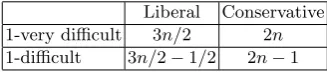
For the case of t = 1 we also show upper bounds using perfectly secure protocols, for all functions in a class we call P SMeff which includes non-deterministic log-space and more (see Definition 1 below), as well as a stronger upper bound for the XOR function. Figures 2 and 3 show the lower bounds for t = 1 and the upper bounds. We see that we have obtained the exact conservative message complexity for all 1-very difficult functions inP SMeff. This includes, for instance, the AND and thresholds functions in general. We have also obtained the exact conservative and liberal message complexity for XOR (when t = 1). Finally we have characterised the liberal message complexity of 1-very difficult functions in P SMeff up to 1/2 message, the exact characterization is left as an open problem.
Liberal Conservative 1-very difficult 3n/2 2n
1-difficult 3n/2−1/2 2n−1
Fig. 2.Lower Bounds fort= 1.
Liberal Conservative
P SMeff 3n/2 + 1/2 2n XOR 3n/2−1/2 2n−1
Fig. 3.Upper Bounds fort= 1.
for static corruptions, but not for adaptive corruptions). If one is happy with statistical, static, semi-honest security for a large number of parties, then this type of trick can be used to compute simple operations with a poly-log (in n) number of messages. If the communication pattern is fixed, than a quadratic number of messages is required for addition protocols [CK93]. Note that our bounds hold regardless of the number of parties if adaptive security or perfect security is required (and our upper bounds yield perfect security). Therefore the only way to circumvent our lower bounds is to settle for static and statistical security and let the number of parties grow with the secu-rity parameter (for adaptive adversary with setup assumptions, see further discussion in [CCG+15]).
Next, we consider round complexity: As mentioned, computing any func-tion with uncondifunc-tional security, in constant rounds and efficiently in the circuit size of the function is an open problem4, and providing a positive an-swer seems to require completely new ideas for protocol design. Motivated by this, we consider the question of whether we can minimize the interaction of
some ofthe players? And if so, how many players can this apply to? Note that we still want the standard security guarantees (correctness, privacy, termina-tion). We answer this question as follows: for passive security, withn= 2t+ 1 players andt corruptions, up to t players can have minimal interaction, i.e., they send 1 message in the first round to each of thet+ 1 remaining players and receive one message from each of them in the last round. Using our result on message complexity, we show that this is (unconditionally) optimal. For malicious security with n= 3t+ 1 players and tcorruptions, up to tplayers can have minimal interaction, and we show that this is also optimal.
For the purpose of proving the positive result for malicious security, we show a result of independent interest: For the casen= 3t+ 1 andtmalicious corruptions, we design a broadcast protocol of the following special form: we can select any subset oft players, who only need to send one message to the othern−tplayers. After this point, we can do broadcast among the remaining n−tplayers. Note that we are not guaranteed that we have at most a third corruptions among then−tplayers, so we cannot do broadcast from scratch in this set. We find it slightly surprising that we need so little involvement from thetselected players. In particular, they might all be corrupt and hence send completely inconsistent setup values – then, of course, we are saved by
4
the fact that the remaining players are all honest (but they do not know this yet).
2 Preliminaries
We use N to denote the non-negative integers. For n ∈ N we let [n] =
{1, . . . , n}.
We prove security in the model from [Can00] with unconditional security and a static adversary. We consider a synchronous model with point-to-point perfectly secure channels between each pair of parties, where the length of each message sent is leaked to the adversary. In one round, all parties may send messages to each other. We consider function evaluation between n parties
P1, . . . ,Pn with inputs x1, . . . , xn and common outputy =f(x1, . . . , xn) for
a poly-time n-party function f. In the ideal model, we assume that nothing is leaked to the adversary in case no one is corrupted. We refer to [Can00] for the details of the model.
We say that a protocol has perfect correctness if it always computes the correct result when all parties follow the protocol. We say that a protocol has perfect privacy against t semi-honest corruptions if the ideal world and the real world models have the same distributions even when t parties are passively corrupted, i.e., they follow the protocol but might pool their views of the protocol to learn more than they should. We say that a protocol has statistical privacy against t semi-honest corruptions if the view of the cor-rupted parties in the ideal world and the real world models have distributions that are statistically close in some security parameter seven if t parties are passively corrupted. We say that a protocol has perfect privacy againstt ma-licious corruptions if the view of the corrupted parties in the ideal world and the real world models have the same distributions even whentparties might deviated from the protocol in a coordinated manner. If the distributions are only statistically close we talk about statistical security against t malicious corruptions.
As is well known, it is possible to implement secure function evaluation of any poly-time n-party function with perfect correctness and perfect privacy againsttsemi-honest corruptions whenn≥2t+ 1. It is possible to implement secure function evaluation of any poly-time n-party function with perfect correctness and perfect privacy against t malicious corruptions when n ≥
3t+ 1, see [BGW88,CCD87].
We also use protocols for the private simultaneous message (PSM) model. For this model ann-party protocol for ann-party functionf is given by
(R, M1, . . . , Mn, g) ,
where R is a distribution with finite support, each Mi is a function, called the message function of party i, and g is function called the reconstruction function.
By perfect correctness of a PSM protocol for an n-party function f we mean that for all r in the support of R and all inputs (x1, . . . , xn) for f it
holds thatf(x1, . . . , xn) =g(M1(x1, r), . . . , Mn(xn, r)).
By -privacy of a PSM we mean that there exists a poly-time simula-tor S such that for all inputs (x1, . . . , xn) for f, y = f(x1, . . . , xn) and a random sample r ← R it holds that (M1(x1, r), . . . , Mn(xn, r)) and S(y) have statistical distance at most . If = 0, then we talk about perfect privacy. If is negligible we talk about statistical security. Privacy ensures that a party seeing (M1(x1, r), . . . , Mn(xn, r)) learns nothing extra to y = g(M1(x1, r), . . . , Mn(xn, r)).
The PSM model is a generalization of [FKN94] and is defined in [IK97], where they also gave perfectly secure and efficient (poly-time) PSM pro-tocols for a large class of functions including non-deterministic log-space, modpL and ]L. In [IK97] privacy is not formulated via poly-time simula-tion: the notion only asks that (M1(x1, d1), . . . , Mn(xn, dn)) depends only on f(x1, . . . , xn). We need the simulation based notion here, as we prove secu-rity in [Can00], which is phrased via efficient simulation. We note that if for a given function f it is possible to compute in poly-time, from an output y=f(x1, . . . , xn), an input (x01, . . . , x0n) such thaty=f(x01, . . . , x0n) then the notions are equivalent forf. The simulator will simply compute (x01, . . . , x0n), sample r ← R and output (M1(x1, r), . . . , Mn(xn, r)). Of course, if inputs are single bits and the number of parties is considered to be constant, such inversion can be done in constant time by trying all possibilities.
In the following, when using PSM protocols, we will consider such effi-ciently invertible functionsf that also have an efficient PSM protocol:
Definition 1. We will use P SMeff to denote the class of functions that are efficiently invertible as described above and can be computed by a polynomial time PSM protocol.
We also use additive secret sharing of bits stringsx∈ {0,1}m. An additive secret sharings ofxbetweenP1, . . . ,Pnconsists of sampling sharess1, . . . , sn∈ ({0,1}m)n uniformly at random under the only restriction that x =⊕n
i=1si, where⊕denote bit-wise exclusive or. It is easy to show that the distribution of any n−1 of the shares is the uniform one on ({0,1}m)n−1 and hence
3 Message Complexity
Defining the message complexity of a protocol for the synchronous model with secure channels appropriately is slightly more tricky than one might expect at first, so we address this issue in its own section.
We will first of all need to allow parties to not send a message to some party in a given round. Since all parties send messages to all parties in all rounds in [Can00], we need to hack the model a bit for this. We will say that if a party sends the empty string then this counts as not having sent a message. Think of receiving the empty string from Pi as meaning ”no message was received fromPi in this round”.
This builds up to a subtler point that we demonstrate by an example. Consider the problem where a dealerDis to deal an additive secret sharing of a bitdbetweennpartiesP1, . . . ,Pn. What is the average message complexity of this problem? It turns out that if we ignore security for a second, then it is at most n/2 if one is not careful. The dealer samples a secret sharing d=d1⊕ · · · ⊕dn. Then fori= 1, . . . , n, ifdi= 0 he does not send a message toPi. Ifdi= 1, then he sends 1 toPi. Sincedi is uniformly random it follows from linearity of expectation that he sends an expectedn/2 messages.
If we consider security, the bound changes. It is the case in [Can00] that the adversary can see the length of a message sent securely. This in particular means that in our setting here, the adversary can see if a message was sent or not between any two parties—it can see the communication pattern. This is a reasonable model, as hiding the presence of a communication is not practical, in particular when we actually do not want to transmit anything when there is no message to be sent.
Of course seeing the communication pattern of the above protocol renders it insecure, but this kind of contrived example shows that in some cases, if we want a very precise measure of message complexity we need to consider protocols with fixed communication patterns, i.e., if P1 sometimes sends a
message toP2 in round 1, then we consider it the case that P1 always sends a message toP2 in round 1, as the absence of the message is a signal.
On the other hand, considering only this measure seems to be not entirely satisfying. We should be intrigued whether or not using tricks as above will allow more efficient protocols, so it makes sense to also consider a notion where we only count messages that areexplicitly sent.
This will mean that the number of messages may not be the same in all runs of the protocol. When we prove lower bounds it will therefore not be meaningful to consider conservative message complexity. For example, if we can prove that all protocols must with some probability 2−s, where s is the security parameter, send 240n message but that they in all other cases
ins. We call this liberal communication complexity. Another way to relax the conservative notion is to still only count messages explicitly sent but look at the worst case number over the randomness of the parties. We call this worst case communication complexity. It is obviously in between the conservative and liberal notions and we will at some point only be able to prove an upper bound for the worst case notion (as opposed to the conservative one).
We therefore define three measures of message complexity, a conservative one, a liberal one and a worst case one:
Definition 2 (Conservative Message Complexity). Letπ be ann-party protocol for a synchronous network. LetR be random tapes of all players. By
Msgcon(π) we denote the conservative message complexity ofπ. For allr ∈N
and all i ∈[n] and all j ∈[n]\ {i} we define cr,i,j to be 1 if there exists an
inputx for π and randomness R such that whenπ is run with that input and that randomness, Pi will send a message to Pj in round r. We let cr,i,j = 0
otherwise. We let
Msgcon(π) =X r,i,j
cr,i,j .
Note that in the conservative message complexity, even if some player flips a fair coin and sends a message that is independent of it’s input, say ”hello” to player one if the coin is zero and ”hello” to player two, three and four if the coin is one, the conservative message complexity counts this as four messages. A more liberal way to count messages in any specific protocol run and then take expectation or worst case over the random tapes of the parties. We call this liberal message complexity respectively worst case complexity. In the above example, the liberal message complexity of the “hello” messages is two messages and the worst case complexity is three message.
Definition 3 (Liberal Average/Worst-case Message Complexity).Let
π be an n-party protocol for a synchronous network. For a given run of π on inputx and some fixed random tapes R of the parties we define cr,i,j to be 1
if Pi sent a message to Pj in round r. We letcr,i,j = 0 otherwise. We let
Msg(π,x, R) =X r,i,j
cr,i,j
and
Msglib(π) = max
x ER[Msg(π,x,R)] .
Msgwor(π) = max
x,R[Msg(π,x,R)] .
It is easy to see that it is always the case that Msglib(π) ≤ Msgwor(π) ≤ Msgcon(π).
defined. If this limit is not defined, we define the message complexity to be
∞.
We extend the notion of message complexity to a given function f by
Msglib(f) = minπMsglib(π), where the minimum is taken over allπ securely computing f. Similarly for Msgcon and Msgwor.
Another model of communication complexity was proposed in [DPP14a]. In [DPP14a] in each round and for each communication link, the sender and receiver must agree on a (possibly adaptively chosen) prefix-free code and the message sent must be from that code. The communication complex-ity is then the total length of the messages sent. Notice that a prefix-free code allows to send the empty string if and only if the code is the trivial code being the singleton set consisting of the empty string. The message complexity is therefore the number of times parties agree on a non-trivial code. This way of counting messages can in principle be applied to each of the above three measures, giving rise to a total of three new notions with
Msgprelib(π) ≤Msgprewor(π) ≤Msgprecon(π). If a protocol is on the required prefix-free-code form, then clearlyMsglib(π) =Msgprelib(π),Msgwor(π) =Msgprewor(π), and Msgcon(π) =Msgpre
con(π). Therefore
Msglib(f)≤Msgprelib(f), Msgwor(f)≤Msgpre
wor(f) and Msgcon(f)≤Msgprecon(f)
for all functionsf. Hence lower bounds for liberal message complexity trans-late to the model in [DPP14a]. It can furthermore be seen thatMsgcon(f) =
Msgprecon(f). Namely, take a secure protocol π for f. If it is not on the prefix-free-code form then for each given round and each given link (Pi,Pj), if it ever happens thatPisends a message toPj in that round, then always use for that round and that link the prefix-free code which sends a messagemby sending 1|m|0m. Otherwise always use the trivial code for that link in that round. Call this protocolπ0. Clearly π0 is still secure andMsgcon(π) =Msgpre
con(π0). Hence
upper bounds for conservative message complexity also translate to the model in [DPP14a].
4 Lower Bounds
We now proceed to present and prove our lower bounds. We first prove a lower bound on the message complexity of secure function evaluation in the face of semi-honest corruptions. Then we give a lower bound on the individual round complexity in the face of t semi-honest corruptions and then a lower bound on the individual round complexity in the face oftmalicious corruptions.
4.1 Message Complexity
First some clarifications: even though we have defined two different ways to count messages, where an empty message counts in one notion and not in the other, in the following, when we say that a message is sent or received, or messages are exchanged, we always refer to non-empty messages.
Very roughly, the intuition we will formalize is as follows: A player whose input matters to the result must somehow communicate his input to the rest of players, in order to enable correct computation of the result by all players. The input cannot be encoded in the communication pattern which is public, so it must follow from the content of messages this player exchanges with other players. On the other hand, a player whose inputs matters has to exchange messages with at leastt+1 parties before his input becomes determined. Oth-erwise he may have talked to only corrupted parties and the protocol would not be private. This already indicates a lower bound of n(t+ 1)/2 messages (we need to divide by 2 since a message counts as communication for both sender and receiver). But we can do more: we show thatafter the inputs have been fixed, all players must receive information allowing them to determine the result of the computation. Under the liberal message complexity notion, this does not necessarily mean that all players must receive another message, but we can show that in expectation most players must receive a message half the time. So this indicates a lower bound of n(t+ 2)/2 messages, which is (approximately) what we obtain.
We start with some notation: For an input vector x= (x1, . . . , xn) and a
subsetD⊆ {1, . . . , n} and inputs xD ={(j, x0j)}j∈D for the parties in Dwe usex[xD] to denote the vectorx withxj replaced by x0j forj∈D.
Definition 4. We say that a function f is t-difficult forPi if the following
holds:
influence There exists two inputs xi,0 and xi,1 such that xi,j0 =xi,j1 for all
Pj 6=Pi and such that f(xi,0)6=f(xi,1).
uncertainty There exists an inputx?i such that for all subsetsC⊂ {P1, . . . ,Pn}\
{Pi} with|C|=t andD={P1, . . . ,Pn} \({Pi} ∪C) and all inputs x for f there existsxD ={x0j}j∈D such that f(x[(i, x?i)]) =f(x[xD]).
We say that f is t-difficult if f ist-difficult for all Pi.
Note that the order of quantification in this definition is such that we require that for all Pi, there exist inputs with certain properties. Note also that the notion of a difficult function, specifically the notion of influence, is related to (but not the same as) the notion of sensitivity of a function from [Nis91].
may think, for instance of the AND function: if Pi has input 0, the output is 0, but the adversary cannot know if this is because Pi or another honest party has a 0.
As examples of t-difficult functions consider the functions where each party has as input a bit and where the output is the AND or the XOR of thesenbits. Other examples are general threshold functions, which output 1 iff at least some 0< t0 < nparties have input 1.
For a run of a protocol π and a given party Pi and a given point in the protocol we keep track of a setNiwhich can be thought of as the parties that
Pi has exchanged messages with, but it is defined with a slight twist. From the beginning we set allNi =∅. WheneverPi sends a message, we updateNi to be the set of partiesPi has sent a message to or received a message from so far in the protocol. The definition is important so let us elaborate:
1. The setNi is not updated at the time a message is received. 2. The setNi is updated at the time a message is sent.
3. When Ni is updated we add all the messages that were received since the last time is was updated and we also add the outgoing message that triggered the update.
We say that a protocol has t-floating input for Pi if at each point in the protocol where |Ni| ≤t it holds that Pi still did not read its input xi. More formally, if we model Pi as an interactive Turing machine, it means that Pi did not access its input tape. We say that π has t-floating input if it has t-floating input for all parties.
For any run of a protocol we define arevelation messageto be the message (if it exists) where before the message is sent it holds for at least onePi that
|Ni| ≤tand after the message is received it holds for allPi that |Ni| ≥t+ 1. Notice that this implies that it is the size of the set Ni of the sender of the revelation message that crosses the threshold t, as Ni is not updated in response to receiving a message.
The communication pattern of an executionπ(x;R) with input vector x and random tape vector R is the transcript seen by the adversary when no parties are corrupted, i.e., who sent a message to whom at which time and the length of those messages, but no contents of the messages and no input or output of any party. We assume that a communication pattern is encoded as a bit string. LetQ:{0,1}∗→ {0,1}∗ be a function on communication patterns. We useQ(π(x)) to denote the random variable obtained by runningπ on the input distributionxand uniformly randomRand applyingQto the resulting communication pattern and then outputting the output ofQ.
converted to a floating input protocol with the same message complexity. This is the most complicated part and uses in an essential way that the function is difficult and the assumption in our model that the number of parties does not grow with the security parameter.
Lemma 1 (input-independent communication pattern). Ifπ securely implementsf with statistical security fort semi-honest corruptions for some
t≥0, then it holds for any two input distributionsx0andx1and all functions
Q on communication patterns that Q(π(x0)) and Q(π(x1)) are statistically
indistinguishable.
Proof. This follows from the fact that when no parties are corrupted, the adversary still sees the communication pattern ofπ(x0) andπ(x1) and hence
can compute and outputQ(π(x0)) respectivelyQ(π(x1)). However, when no
parties are corrupted the simulator has the same view whenx0 orx1 is used.
The claim then follows from security against 0 semi-honest corruptions. ut
Corollary 1 (input-independent communication complexity). If π
securely implements f with statistical security for t semi-honest corruptions for some t ≥0, then it holds for any two input distributions x0 and x1 that Msg(x0) and Msg(x1) are statistically indistinguishable. Here, Msg(x) is the
random variable that selects an input according to x, runs the protocol and outputs the number of non-empty messages sent.
Proof. Consider the function on communication patterns outputting the num-ber of non-empty messages sent and then apply Lemma 1. ut
Lemma 2 (revelation message). If π has t-floating input and securely implements f with statistical security for t semi-honest corruptions and f is
t-difficult, then it holds for all input distributions x thatπ has at-revelation message except with negligible probability.
Proof. Ifπ does not have at-revelation message for input distributionx, then there exist a partyPi such that with non-negligible probabilityPi exchanges messages with at most tparties in π(x). From Lemma 1 it then follows that it holds for the input distributionsxi,0andxi,1 from the definition off being t-difficult that with non-negligible probability Pi exchanges messages with at most t parties in π(xi,0) and also in π(xi,1). But since π has t-floating inputs, this implies that with non-negligible probability π(xi,0) = π(xi,1) as the output cannot depend on the input of Pi when Pi did not read its input, and all other parties have the same inputs inxi,0 and xi,1. However, by assumptionf(xi,0)6=f(xi,1) and we have a contradiction with correctness
ofπ. ut
and all pairs of distinct partiesPj andPkthat in a random run ofπ(x)it holds
except with negligible probability that when Pk is the sender of the revelation
message, then the probability that Pj receives another message after Pk sent
the revelation message is at least 12.
Proof. Assume for the sake of contradiction that there exist x and Pk and
Pj 6= Pk such that it happens with non-negligible probability that Pk is the sender of the revelation message and that when this happens Pj will receive another message after the revelation message is sent (but not received) with probability at most 12 −c, where c is non-negligible. It is a predicate of the communication pattern whetherPk sends the revelation message. It is also a predicate of the communication pattern whetherPj receives another message after the revelation message. Therefore it follows from Lemma 1 that it holds for any input distribution x with non-negligible probability that Pk is the sender of the revelation message and that when this happens then Pj will receive another message after the revelation message is sent (but not received) with probability at most 12 −c0, where c0 =c−negl is non-negligible as c is non-negligible.
Consider now the particular input distribution which is xk,b for a uni-formly random bitb, wherexk,0,xk,1 are the input vectors guaranteed by the definition of f beingt-difficult (Pk has influence). In this case the output of all parties allow to determine the bit b, except with negligible probability. Assume without loss of generality that f(xi,b) = b. Let y be the distribu-tion of the output of Pj in a random run on xi,b conditioned on Pj not receiving another message after the revelation message. Notice that y can be sampled by Pj at the time right before the revelation message is sent, by simply assuming that no more messages will be received by Pj. However, at the point before the revelation message is sent Pk did not read its input xk yet in the protocol, so y is perfectly independent of b. From this it fol-lows that Pr[y = 0|b = 0] = Pr[y = 0|b = 1] = 1 −Pr[y = 1|b = 1], so either Pr[y = 0|b = 0] ≤ 12 or Pr[y = 1|b = 1] ≤ 12. Assume that Pr[y= 0|b= 0]≤ 1
2. Since b= 0 with probability 1
2 and Pj receives another
message with probability 12−cit happens with non-negligible probability that b= 0 and at the same time Pj does not receive another message and hence outputs according to distributiony, which implies that it happens with non-negligible probability thatPj does not outputb, contradicting the correctness of the protocol. If we assume that Pr[y = 1|b = 1]≤ 12, then a violation of correctness is reached using a symmetric argument. This concludes the proof.
u t
Proof. We prove the lemma by constructing π0 fromπ. We prove the lemma for the weaker case where we constructπ0 where onlyP1 hast-floating input.
We can then obtain the general case by symmetry and hybrid arguments. All parties inπ0 run as inπexceptP1 who runs as follows. Initially, run as
inπ but with inputβ1=x1? and a uniformly random tape ρ1. Here, x?1 is the
input value that a exists sincefist-difficult (the uncertainty condition forP1).
If about to send a message which would result in|N1| ≥t+ 1, then first apply
the following input patching procedure: Read the input x1 and replace ρ1
with a new random tape r1 consistent with input x1 and the communication
so far. Specifically, sample r1 using rejection sample as follows. Sample r1
uniformly at random. Let T be the list of messages sent and received by P1
so far, including who the message was exchanged with and in which round. Run the code of P1 from π with input x1 and random tape r1 and feed P1
the incoming message from T in the round in which they occurred. If this makes P1 send the same messages as in T to the same parties and in the
same rounds, then acceptr1, otherwise try again. Use r1=⊥to denote that
no acceptable r1 exists. We now prove that if π is secure, then π0 is secure.
We will actually prove something stronger, which implies that the correct-ness and the distribution of the communication pattern is also maintained. Namely we will prove that for all input distributions x it holds that the following distributions D0 and D1 are statistically indistinguishable: D0 is
obtained by sampling a random run of π on a random input sampled from x and then outputting ((x1, r1),(x2, r2), . . . ,(xn, rn)), where xi is the input of Pi and ri is the random tape used by Pi. D1 is obtained by sampling a
random run of π0 on a random input sampled from x and then outputting ((x1, r1),(x2, r2), . . . ,(xn, rn)), where fori= 2, . . . , nthe valuexi is the input of Pi and ri is the random tape used by Pi and where x1 is the input of P1
and r1 is the random tape sampled in the input patching procedure. From
this it clearly follows that if π is correct, then π0 is correct and it follows for all t0 ≤n that if π is secure against t0 corruptions then π0 is also secure againstt0 corruptions. Notice that to prove the claim for all distributions on xit is sufficient to prove that it holds for all fixed input vectors x, so in the following we assume thatxis a fixed value.
Let x = (x1, x2, . . . , xn). If x1 = x?i, then the input patching procedure simply resamples r1 with the same distribution as β1 and hence D0 and D1
are identical. So, assume that x1 6= x?1 and that D0 and D1 are not
sta-tistically close. We show how to use this to break the t-security of π. Let x0 = (x?1, x2, . . . , xn) and x1 = (x1, x2, . . . , xn) = x. We break the analysis
into two cases. In case I we assume thatf(x1?, x2, . . . , xn) =f(x1, x2, . . . , xn). To avoid confusion, note that the proof of case II in fact implies the result for case I. However, it is instructive to first see the proof of case I as a mental warm-up.
In case I we will run π on x0 or x1 and show how to distinguish with
non-negligible advantage by corrupting just t parties which do not include
the same inputs and outputs in f(x0) and f(x1) as only the input of P1
differs and becausef(x0) =f(x1). So, assume that we attack a run ofxb for uniformly randomb. The adversary will observe the communication pattern of the protocol. Consider the point where P1 sends a message that would make |N1| > t for the first time, and note that P1 has communicated with
at most t parties up to now, call this set of parties C. At this point the adversary corrupts the players in C5. Note that all messages sent by P1 so far was sent to one of these parties. UseDto denote the set of parties which is not in {P1} ∪C. Now use rejection sampling to sample a random tape
r1 consistent with the communication between P1 and the parties in C and
input xi to P1. Note that if b = 1, this samples a string having the same
distribution as the random tape used by P1 in the protocol π(x). If b = 0,
then it samples a string having the same distribution as the random tape r1
sampled by the input fixing procedure in π0(x). Note that the parties in D have not communicated withP1, so all the communication leaving the group
D is with C. This means that the adversary knows all message going in or out of the groupD. It can therefore use rejection sampling to sample a set of uniformly random tapes {(j, rj)}j∈D for the parties in Dconsistent with the communication betweenC sandD and Pj forj ∈D having inputxj (where xj is taken from x). This perfectly reconstructs the distribution of the state of the parties inD. Then output ((x1, r1),(x2, r2), . . . ,(xn, rn)). Ifb= 0, this is exactlyD0 and ifb= 1 it is exactly D1. But we assumed thatD0 and D1
are not statistically close so we arrive at a contradiction with t-security of π: since the output is the same in the two cases, a simulator would see no difference betweenb= 0 and b= 1.
That brings us to case II. In this case, we can prove as above that if D0
andD1 can be distinguished, then we can also distinguish betweenπ(x0) and
π(x1) by just corruptingtparties at a point where|N1| ≤t. The challenge is
thatf(x0)6=f(x1), so it does not follow easily from the definition of security
that an adversary shouldnotbe able to distinguish with just this information. We now argue this in a more indirect way.
Consider the following experiment, which is parameterized by an (in-finitely powerful) adversaryA that outputs one bit:
1. Sampleb uniformly at random.
2. Run π(xb) until the point where it is about to happen that |N1| > t. If
this point does not occur, then perform the following at the end of the execution of the protocol.
3. Let C be the set of at most t parties defined as in case I above. A cor-rupts the parties in C. Let V be the joint view of these parties (their inputs, random tapes and messages received). Output A(C, V) (here we abuse notation slightly by using A to denote both the adversary and the (arbitrary) function it calculates on the views).
5 when we get to the actual proof in case II, we will construct a static adversary that
We now claim that for any A, Pr[A(C, V) = b]− 12 is negligible. This will imply what we want: Note that one possible choice of A is as follows: use rejection sampling to produce a sample ofDb, exactly as we described in case I above. Then output the best guess at whether the sample came from D0 or from D1. Since the claim holds for this particular A,D0 and D1 are
statistically close.
So assume for the sake of contradiction that there exists A such that Pr[A(C, V) =b]−1
2 is non-negligible.
Note that C may not be the same set in all runs of the protocol. Consid-eringC as a random variable, we have that
Pr[A(C, V) =b]−1
2
=X
C0
Pr[C=C0] Pr[A(C, V) =b|C =C0]− X
C0
Pr[C =C0]
!
1 2
=X
C0
Pr[C=C0]
Pr[A(C, V) =b|C=C0]− 1
2
.
Since the number of subsets of the parties is constant as a function of the security parameter, it now follows that we can find a fixed set C0 of size at most t such that Pr[C = C0] is non-negligible and such that Pr[A(C0, V) = b|C=C0]−1
2 is non-negligible.
We can then construct a new adversaryA0 which always corruptsC0 and still guessesbwith non-negligible advantage: If the setCactually occurring in the protocol equalsC0, it outputsA(C0, V), otherwise it outputs a uniformly random bit. Note thatA0 makes its guess at a point in time where N1 ⊆C.
A0’s advantage is non-negligible because Pr[A0(C0, V) = b|C 6= C0]− 12 is negligible — we can only claim negligible here and not 0 as there might be a difference between Pr[C6=C0|b= 0] and Pr[C6=C0|b= 1]. This difference, however, is negligible by Lemma 1.
We now want to show that such A0 does not exist. To avoid ugly notation in the following, we will now useCto denote the set thatA0 always corrupts. We start with some notation. LetDbe the set of parties not in C∪ {P1}. Let x01 = x?1 and x11 = x1 let x1D be the inputs of the parties in D in x. Let x0
D be the inputs xD for the parties in D given by the definition of P1
having uncertainty. We therefore have have by definition thatf(x01, xC, x1D) = f(x11, xC, x0D).
In this notation we have thatx0 = (x01, xC, x1D) andx1 =x= (x11, xC, x1D). Therefore our job is to prove that A0 cannot distinguish π(x11, xC, x1D) from π(x01, xC, x1D). In the following, for a subsetS of the parties, we use [b, d]S to denote the view of the partiesS in an execution ofπ(xb
1, xC, xdD). To complete the proof we have to show that at any point in the protocol whereN1 ⊆C it
holds that [0,1]C ≈[1,1]C.
Obviously [0,1]0C ≈[1,1]0C, since before C communicated with any party the view of players inC is just their own inputs and random tapes. We now prove by induction that [0,1]cC ≈[1,1]cC for all constantsc, as long asN1⊆C.
The latter condition is extremely important because it implies that in all cases we consider, there is no communication between P1 andD.
We assume that [0,1]cC ≈[1,1]cC and prove that [0,1]cC+1 ≈[1,1]cC+1. From the communication pattern being known by the adversary and being indis-tinguishable in [0,1]cC and [1,1]cC by Lemma 1 we can assume that we know which partyPj sends a message toC in round c+ 1.
Assume first that Pj 6= P1. Let RD be the procedure which gets input [b,1]cC, and then from the view of the communication between C and D in [b,1]C samples a joint state of all parties in D consistent with inputs x1D and that communication and appends this state to [b,1]C. We have that RD([b,1]cC) = [b,1]cC,D by construction and it follows from the induction hy-pothesis [0,1]c
C ≈[1,1]cC thatRD([0,1]cC)≈RD([1,1]cC). So we conclude that in this case (where Pj ∈ D) [0,1]cC,D ≈ [1,1]cC,D. Put another way, given the state of C one can perfectly simulate the state of the parties in Dsince one knows their inputs and all communication going in and out of D. From the state of the parties inD in [b,1]cC,D one can then sample a random run consistent with Pj being the next party to send a message to a party in C. This gives a sample from [b,1]cC,D+1. Since computation (in this case of the next message function) maintains statistical indistinguishability it fol-lows from [0,1]cC,D≈[1,1]cC,D that [0,1]cC,D+1 ≈[1,1]cC,D+1. It clearly follows from [0,1]cC,D+1 ≈[1,1]cC,D+1 that [0,1]cC+1≈[1,1]cC+1.
Assume then that Pj = P1. Again, by induction hypothesis we have [0,1]cC ≈ [1,1]cC. It follows from the security of the protocol that [0,1]C ≈ [1,0]C as the inputs and outputs of the parties inC are the same in the two executions considered and|C| ≤t. So in particular we have [0,1]cC ≈[1,0]cC. So we conclude by transitivity that [1,0]cC ≈[1,1]cC.
Since the next message comes from P1 we can argue [1,0]cC+1 ≈ [1,1]cC+1 as we did for the above case, by sampling the state of P1 from its known input and communication. As we noticed above we have [0,1]C ≈ [1,0]C and therefore in particular [0,1]cC+1 ≈ [1,0]cC+1. Combining these two we get
[0,1]cC+1 ≈[1,1]cC+1 as desired. ut
Theorem 1. Letπ be then-party function which securely implements a func-tion f which is t-difficult, with statistical correctness and statistical privacy againstt semi-honest corruptions. Then
Msglib(π)≥ d(n(t+ 1)−1)/2e+n/2−1
2
and
Msgcon(π)≥ d(n(t+ 1)−1)/2e+n−1 .
then get that π has a revelation message for all input distributions, except with negligible probability. We now want to count the number of send and receive operations that have been executed just before the revelation message is sent. Since |Nj| ≥ t+ 1 for all Pj after the revelation message is sent, it follows that after it is sent
n
X
i=1
|Ni| ≥n(t+ 1).
Notice that in this sum the revelation message is counted only once, but all other messages might be counted twice. Hence at least (n(t+ 1)−1)/2 + 1 messages were sent after the revelation message was sent. Therefore at least (n(t+ 1)−1)/2 messages were sent before the revelation message was sent. Since the number of messages sent is an integer, it follows that at least
d(n(t+ 1)−1)/2emessages were sent. By Lemma 3, after the point where the revelation message is sent by some Pk each other party receives at least one more message with probability at least 12 −negl. By linearity of expectation, this gives at least an expected (n−1)(12−negl(s)) more messages. Sincenis a constant inswe have thatnnegl(s) = negl(s), so lims→∞(n−1)(12−negl(s)) =
(n−1)12 =n/2−12. It is easy to see that for conservative message complexity we get to addn−1 instead of (n−1)/2: when we consider conservative message complexity, receiving a message with probability 12 counts as 1 towards the
message complexity. ut
We say that a functionf ist-very difficult if it ist-difficult and in addition for Pi there exists Pj such that Pi and Pj has an embedded AND in the following sense: There exists an input vector x and inputs x1i and x0i for Pi and inputs x1
j and x0j forPj such that if we set yb,c =f(x[(i, xbi),(j, xcj)] for b, c∈ {0,1}, theny0,0 6=y1,1andy0,0 =y0,1=y1,0. We note that the notion of
an embedded AND (or, equivalently, an embedded OR) has been extensively studied in other settings, see [KKMO00] and references therein.) Iff ist-very difficult we can improve the lower bound by 12 message.
Theorem 2. Letπ be then-party function which securely implements a func-tion f which ist-very difficult, with statistical correctness and statistical pri-vacy againstt semi-honest corruptions. Then
Msglib(π)≥ d(n(t+ 1)−1)/2e+n/2
and
Msgcon(π)≥ d(n(t+ 1)−1)/2e+n .
another message with probability at least 12. To see this, note that if this was not the case, then it holds for all input distributions, by Lemma 1. LetPkbe the sender of the revelation message and let Pj be the party with which Pk has an embedded AND. Denote an execution ofπ(x[(j, xbj),(j, xck)]) by [b, c]. Assume thatPk receives a message after sending the revelation message with probability less than 12.
In [b,0] it holds that the view of Pk is independent of b even at the end of the execution as the output and input of Pk are the same in the two executions. That implies that until Pk sends the revelation message it also holds in [b,1] that the view of Pk is independent of b, as [b,0] and [b,1] are perfectly indistinguishable toPkuntilPkactually reads its input. From this it follows that it also holds in [b,1] that the view ofPkis independent of bafter
sending the revelation message, as reading the input xcj = 1 cannot change that dependence on b as 1 is a constant and in particular independent of b and the view of Pk so far. But in [b,1] the output of Pk must be b by the correctness ofπ. Going from a situation where the view ofPk is independent ofbto learningbrequires thatPkreceives a message with probability at least
1
2. When we consider conservative message complexity, receiving a message
with probability 12 counts as 1 towards the message complexity. ut
Lower bounds for Perfect Security and Adaptive Corruption. Our model as-sume that the number of parties is constant as a function of the security parameter. The only place in our lower bound proofs where we used this assumption is in the proof of Lemma 4. If we consider perfect security, the proof simplifies greatly, and we can easily prove the lemma for any number of parties. Alternatively, if we consider adaptive security, note that the proof first constructs an adaptive adversary that breaks the protocol if our result is false and then converts it to an static adversary using the assumption on a constant number of parties. Therefore it is immediate that the lemma also holds for any number of parties and adaptive security. We conclude that all our lower bounds for this section hold for any number of parties, if we consider perfect or adaptive security.
4.2 Individual Round Complexity
Consider now ann-player protocol π that is executed on a synchronous net-work. We can define a (possibly empty) set Mπ of players with minimal
in-teraction, consisting of players whose only communication is to each send a message to a subset of the parties not in Mπ and then later, after all parties inMπ have sent all their messages, each receive a message from a subset of the parties not inMπ.
Theorem 3. Assume n = 2t+ 1 parties, where each party Pi holds input
bit bi. A protocol π that computes b1 ∧ · · · ∧bn with perfect correctness and
Proof. Assume for contradiction thatMπhas sizet+1. Then we can construct from π a 3-party protocol for playersA,B and C, where player A emulates thet players not in Mπ, B emulates tof the players in Mπ, andC emulates the last player in Mπ. Each party will have a single bit as input and will use that bit as input to each of the parties it is emulating. If π is secure, then clearly the 3-party protocol securely computes the AND of the inputs from the 3 players, provided at most 1 is passively corrupt, as corrupting any of A, B and C will corrupt at most t emulated parties. Moreover, the 3 party protocol will have only 4 messages. Namely, the one party fromMπ emulated by C will send one message to Aand later receive exactly one message from A, asA emulated exactly the parties not in Mπ. The same is true for all the emulated players inB, they will all send exactly one message to a player inA and receive back one message from a player inA. Furthermore, since they all send their messages to the players inAbefore they received any messages from A, we can letBsend all the messages as one message. In the same way we can letAreturn all the messages as one message. Since there is no communication between parties inMπ, there is no communication betweenB and C. Hence all other communication takes place inside A. However, communicating just 4 message is in contradiction to Theorem 2, which says that 6 messages are required.
Theorem 4. Assumen= 3t+ 1 parties, where each partyPi holds input bit bi. A protocol π that computes b1 ∧ · · · ∧bn with statistical correctness and
statistical privacy against t malicious corruptions must have|Mπ| ≤t.
5 Upper Bounds
In this section we give four constructive upper bounds, one for individual round complexity of secure function evaluation in the face of semi-honest corruptions, then one for individual round complexity of broadcast in the face of malicious corruptions, one for individual round complexity of secure functional evaluation in the face of malicious corruptions, and finally one for message complexity in the face of semi-honest corruptions.
5.1 Individual Round Complexity, Semi-honest Security
We first give a construction with minimal individual round complexity for a group oft < n/2 parties in the face of semi-honest corruption.
Theorem 5. For every poly-timen-party functionf, there exists a poly-time function evaluation protocol computingf between n= 2t+ 1parties with per-fect correctness and perper-fect privacy againsttsemi-honest corruptions, wheret
parties have round complexity two. Specifically, thesetparties first in parallel each send one message to the n−tother parties and then later each receives one message from the same n−t parties.
Proof. We design a protocol where it is the parties I = {Pn−t+1, . . . ,Pn} which have round complexity two. We denote each of thetparties inI gener-ically by Pi and we denote the parties in J = {P1, . . . ,Pn−t} generically by
Pj.
UseDto denote the pre-processing distribution of a secure function eval-uation protocol for the pre-processing model withn0 =t+ 1 parties and up to t semi-honest corruptions. Let (D, πpre−pro) be a protocol for this model
with perfect correctness and perfect privacy fort semi-honest corruptions.
Letπhon−majbe a secure function evaluation protocol for the functionf for
a model withn= 2t+1 parties and assume that it has perfect correctness and perfect privacy againstt semi-honest corruptions. Assume that πhon−maj has
round complexity `. We can assume that πhon−maj runs as follows in round
r: first each party sends one message to each other party which adds this message to its state. Then it applies a round function Ri,r which computes the new state of partyPi. The initial state of a party is just its inputxi.
Our protocol π proceeds as follows. First each Pi will additively secret share its input xi among the parties Pj, i.e., it samples uniformly random sharesxi,j for which xi =xi,1⊕ · · · ⊕xi,n−t and securely sends xi,j toPj. At the same time it will for r = 1, . . . , ` sample (di,r1 , . . . , di,rn−t) ← D and send di,rj toPj. Notice that at this point the initial state of eachPi is secret shared among the parties inJ. We will keep the invariant that at each round in the protocolπhon−majthe state ofPiinπhon−majis secret shared among the parties
inJ. Each round inπhon−maj is emulated as follows.
2. If Pj ∈ J is to send a message m to Pi ∈ I, then it additively secret shares m among the parties J and this secret sharing is added to the secret shared state ofPi.
3. If Pi ∈ I is to send a message m to Pk ∈ I, then m is by the invariant already additively secret shared among the partiesJ. The parties inJ can therefore just add this secret sharing to the secret shared state ofPk.
4. If Pi ∈ I is to send a message m to Pj ∈ J, then m is additively secret shared among the parties J as part of the secret shared state of Pi. The parties in J can therefore reconstruct this message towardsPj.
5. If Pj ∈J is to apply the round function Rj,r, then it simply applies it to its state.
6. IfPi ∈I is to apply the round functionRi,r, then the parties inJ uses the the preprocessed values (di,r1 , . . . , di,rn−t) to do secure function evaluation of the augmented round function ¯Ri,r which reconstructs the state of Pi from the secret sharing of the state held by the parties inJ, then applies Ri,r and outputs an additive secret sharing of the new state.
After all `rounds of πhon−maj have been emulated, the secret-shared state of
Pi contains its outputyi. The parties in J reconstructs thisyi towardsPi. At this point allnparties received their outputs.
It should be clear that this protocol has perfect correctness, as πpre−pro
and πhon−maj both have perfect correctness.
As for perfect privacy, note that if at most t parties are corrupted, then the additive secret sharings among the t parties in J leaks no information, and can indeed be efficiently simulated by just giving all corrupted parties uniformly random shares.
Furthermore, if Pi ∈ I is honest, then the emulation of Pi in πhon−maj is
perfectly private, as Pi is perfectly acting as the trusted third party of the preprocessing model. We can in particular replace the emulation ofPi by an ideal function evaluation of the augmented round function.
Since the additive secret sharing of the inputs and outputs of the aug-mented round function can be efficiently simulated towards the t corrupted parties without knowing the inputs or outputs, we can replace the ideal eval-uation of the augmented round function by an ideal evaleval-uation of the actual round function on the actual state of Pi and then just simulate the secret sharing of the inputs and outputs using uniformly random shares. But having an ideal evaluation of the round function of an honestPi is exactly the same as just havingPi participate in the protocol. So at this point we have arrived at the protocol πhon−maj. Since there are at most t corrupted parties we can
then appeal to the security ofπhon−maj.
Constructing an explicit simulator of π from the simulators of πpre−pro
and πhon−maj along the lines of the above sketch is straight forward and we
5.2 Individual Round Complexity, Broadcast
We now turn our attention to the individual round complexity of secure broad-cast. Secure broadcast from Pi to the parties P1, . . . ,Pn is defined to be the secure function evaluation of the function xi = f(x1, . . . , xn) in the face of malicious corruptions, i.e.,Pi communicatesxi to all parties and it is guaran-teed that all parties receive the same xi even if Pi and/or some of the other parties are malicious. By secure broadcast we mean a protocol which allows any of the nparties to broadcast to all the other parties.
It is possible to implement broadcast securely againstt < n/3 maliciously corrupted parties in a synchronous network with authenticated channels (note that secure channels are not needed for broadcast). It is furthermore possible to do so using a protocol where the honest parties are deterministic. See for instance [BDGK91].
The above protocol is for the setting with t < n/3 maliciously corrupted parties. We later need to do broadcast in a setting with t < n/2 maliciously corrupted parties. It is actually known that broadcast is impossible in such a setting. We can, however, implement broadcast if we assumet < n/3 for just the first round. To show this we need the following lemma.
Lemma 5. Consider any protocol π for n parties which is perfectly correct and has statistical privacy againsttmaliciously corrupted parties computing a functionf. Assume thatPn−t+1, . . . ,Pn have no inputs, i.e., f(x1, . . . , xn) = g(x1, . . . , xn−t). Assume also that these parties are not to receive outputs.
As-sume furthermore that the protocol remains secure even if all messages sent and received by Pn−t+1, . . . ,Pn are given to the adversary and assume that
these parties are deterministic. Then there also exists a protocol π0 which is statistically correct and has statistical privacy againstt maliciously corrupted parties computing the function f in which Pn−t+1, . . . ,Pn each sends a
mes-sage to each of the parties P1, . . . ,Pn−t in the first round and then sends or
receives no further messages.
Proof. The parties I = {P1, . . . ,Pn−t} will simply emulate the parties J =
{Pn−t+1, . . . ,Pn}. Each Pi ∈I will run a copy of each Pj ∈ J. Since Pj has no input, the partiesPi will agree on the initial states of allPj. WheneverPj wants to send a message, all Pi will know this message and the appropriate receiver will just take that message as if having been sent byPj. If the receiver is a partyPj ∈J allPi∈I will input the message to their local copy ofPj. In each round all parties Pi ∈I apply the deterministic round function of each
Pj to their own local copy. This maintains agreement on the state of all the emulatedPj.
we do not have a broadcast channel. We will therefore letPj create one using pre-processing. This will be done using the one round of messages that Pj sends in the first round, as detailed now.
It is shown in [PW92] that there exists a protocol (P, π) for the pre-processing model which implements broadcast betweenn0parties secure against tmalicious corruptions for anyt < n0. We can therefore let each Pj ∈J sam-ple (pj,1, . . . , pj,n0) ← P and send pj,i securely to Pi. Whenever Pi ∈ I is to send m to all parties in I, the parties run π on the pre-processed values (pj,1, . . . , pj,n0) and with Pi having input m. Note that each Pj ∈ J prepro-cessed his own broadcast channel. This is the broadcast channel that is to be used when message are sent to Pj in the emulated protocol. If Pj is honest, the pre-processing is computed as it should, and thus the broadcast protocol will indeed ensure that m is delivered consistently, and hence the emulated
Pj will be run correctly and consistently by all honest parties in I. If Pj is corrupted, it might deliver incorrect pre-processed values. In that case the broadcast might not work correctly. In that case the parties in I might get inconsistent views of Pj and might therefore later see inconsistent values of what Pj is sending. This, however, is no worse than the emulated Pj being corrupted and this case only happens when the actualPj is maliciously
cor-rupted, so the emulated protocol can tolerate this. ut
If we plug the protocol from [BDGK91] into the above lemma we get this corollary.
Corollary 2. There exists a protocolπbroad fornparties which is statistically
correct and which allows any party Pi (with i ≤ n−t) to broadcast to the
parties P1, . . . ,Pn−t. It is secure against t malicious corruptions fort < n/3.
The parties Pn−t+1, . . . ,Pn each sends one message to each of the parties
P1, . . . ,Pn−t in the first round and otherwise has no communication.
5.3 Individual Round Complexity, Secure Function Evaluation
We now turn our attention to secure function evaluation in the face of mali-cious corruptions.
Theorem 6. For every poly-timen-party functionf, there exists a poly-time function evaluation protocol computing f between n = 3t+ 1 parties with statistical correctness and statistical privacy against t maliciously corrupted parties, wheretparties have round complexity two. Specifically, thesetparties first each sends one message to the n−t other parties in parallel and then later each receives one message from the same n−t parties.
setting with secure point-to-point channels plus a broadcast channel allowing any party to broadcast to the othern0parties. Denote this protocol byπRB. Set
n0=n−t. We are going to let the partiesI runπRB to compute a particular
function g derived from f. In doing that they will implement the broadcast channel using πbroad from Corollary 2 with the parties in J providing the
pre-processing.
We will use a robust secret sharing scheme (sha,rec) for n0 parties and t < n/2 corruptions to let the parties in J provide inputs. Such a scheme is trivial to derive from, e.g., the verifiable secret sharing scheme constructed in [RB89], and has the following properties:
Privacy The joined distribution of any t positions from a random sample (v1, . . . , vn0)←sha(v) does not depend on the valuev.
Robustness Sample (v1, . . . , vn0) ← sha(v) for a value v chosen by the ad-versary. Now give tof the positions vi to the adversary and let it replace them by v0i. The positions are chosen by the adversary. For the remain-ing n0 −t positions, let v0i = vi. Then rec(v01, . . . , v0n0) = v, except with probability 2−s, wheresis the statistical security parameter.
The function g takes n−t inputs, g(X1, . . . , Xn−t), where each Xi is of the form (xi, xn−t+1,i, . . . , xn,i). It outputs
f(x1, . . . , xn−t,rec(xn−t+1,1, . . . , xn−t+1,n−t), . . . ,rec(xn,1, . . . , xn,n−t)) . The overall protocol then runs as follows.
1. EachPj ∈J sends the pre-processing needed forπbroadto the parties inI
and at the same time samples (xj,1, . . . , xj,n−t)← sha(xj) and sends xj,i toPi∈I.
2. Each Pi ∈I computes Xi= (xi, xn−t+1,i, . . . , xn,i).
3. The parties in I use the pre-processing provided in Step 1 to run πbroad
and use the emulated broadcast channel to runπRB(X1, . . . , Xn−t). 4. When Pi ∈ I learns the output y = πRB(X1, . . . , Xn−t) it sends y to all
parties in J.
5. Each party Pj ∈ J receives an output yi from each Pi ∈ I and outputs the value y which occurs most often in the list (y1, . . . , yn−t).
It follows directly from the security of (sha,rec), πbroad and πRB that the
protocol is private and that the honest parties in I learn the correct output y, except with negligible probability. Since there are n0 ≥ 2t+ 1 parties in I and at most t corrupted parties in I, it follows that there is a majority of honest parties in I. Hence, the honest parties inJ will also learn the correct
outputy. ut
5.4 Message Complexity, Semi-Honest Security
with n parties which are perfectly secure against t semi-honest corruptions. We present an optimal construction for t = 1 for computing functions in P SMeff as defined in Definition 1.
Theorem 7. For every poly-timen-party function f in P SMeff, there exists a poly-time function evaluation protocolπ computingf betweennparties with perfect correctness and perfect privacy againstt= 1 semi-honest corruptions, for whichMsglib(π) = (3n+1)/2,Msgwor(π)≤ d(3n+1)/2e, andMsgcon(π) = 2n.
Proof. We first look at the restricted setting where Pn has no input and is the only player to learn the output, i.e., we look at secure function evalu-ation of (, . . . , , y) = f(x1, . . . , xn), where is the empty string and y =
h(x1, . . . , xn−1) for an (n−1)-party function h.
Let (R, M1, . . . , Mn−1) be a PSM protocol forhand consider the following
protocolπ1.
1. P1 samplesr ←R.
2. P1 sends r toPi fori= 2, . . . , n−1.
3. For i= 1, . . . , n−1, party Pi sends mi =Mi(xi, r) to Pn. 4. Pn outputsy=g(m1, . . . , mn−1).
Assume thatPn is corrupted. The view of Pn in the real world is
(M1(x1, r), . . . , Mn−1(xn−1, r))
for a random sampler ←R. The view ofPn in the ideal model is
y=f(x1, . . . , xn) =h(x1, . . . , xn−1) =g(M1(x1, r), . . . , Mn−1(xn−1, r)) .
Privacy then follows from the security of the PSM protocol.
Assume that Pi 6= Pn is corrupted. The view of Pi in the real world is (xi, r). The view ofPiin the ideal model isxi. We can simulate the real world view from the ideal view simply by sampling r ← R and then outputting (xi, r).
We now extend the above protocol to a protocolπ2which allowsPnto have an input and where all parties get the output, i.e., we look at secure function evaluation ofy=f(x1, . . . , xn). We first present and analyze a simple solution
and then later modify it slightly to reduce the number of messages sent. The simple solution is to let Pn additively secret share xn as xn = s1⊕s2 and
sends1 toP1 and send s2 toP2. Then apply protocol π1 to the function
h0((x1, s1),(x2, s2), x3, . . . , xn−1) =f(x1, . . . , xn−1, s1⊕s2)
in the ideal model. OnlyP1,P2 and Pn have any further extra values in the view. The extra values of Pn ares1 and s2 such thatxn=s1⊕s2. These are
easy to simulate from the view of Pn in the ideal model which includes xn: simply sample an additive secret sharing of xn. The extra value of P1 is s1.
This value is uniformly random and independent ofxn, so it can be simulated by just sampling it uniformly at random. Similarly forP2.
Since s1 is uniformly random and independent of xn, we can save one
message in the protocol by letting P1 pick s1 uniformly at random and send
it to Pn along with the message that it already sends to Pn. The view of all parties will be the same in the modified protocol. The only difference is that the direction of one message was flipped. This gives the following secure protocol.
Let (R, M1, . . . , Mn−1) be a PSM protocol for the function h0 described
above.
1. P1 samplesr ←R.
2. P1 sends m1 =M1(x1, r) to Pn along with a uniformly random shares1.
3. Pn sendss2 =xn⊕s1 toP2.
4. P1 sends r toPi fori= 2, . . . , n−1.
5. For i= 2, . . . , n−1, party Pi sends mi =Mi(xi, r) to Pn. 6. Pn sendsy =g(m1, . . . , mn−1) to P1, . . . ,Pn−1.
To further reduce the message complexity, we will now apply two additional message-reduction tricks. Using the first one we reduce the 2(n−2) messages in Steps 4 and 5 to just n−1 messages: Instead of having all parties send to Pn, we will let P1 send his “PSM-contribution” to P2, who appends his contribution and sends a message toP3, etc. until Pn receives everything. In order to make sure that onlyPnlearns all the contributions,P1 will sendn−1 one-time pads toPnand also pass them on to the other players who can use them to one-time pad encrypt their contributions.
With the second trick we reduce the number of messages in Step 6 fromn−
1 tod(n−1)/2e. We letP1choose a random bitwwhich will be sent to all other players appended to the “PSM-contributions”, thus not requiring additional message(s). Now,Pncan communicate the result,y, to the other players in the following way: ify⊕w= 0 thenPnsends a bit 0 to playersP1, . . . , Pd(n−1)/2e
and does not send any message to the playersPd(n−1)/2e+1, . . . Pn−1; otherwise
(ify⊕w= 1) thenPn sends a message 0 to the playersPd(n−1)/2e+1, . . . Pn−1
and does not send any message to the playersP1, . . . , Pd(n−1)/2e. Observe that
all players can retrieve the computed valuey, and that the number of messages sent during that stage is at mostd(n−1)/2e. Both tricks can be implemented as follows. We replace steps 4, 5 and 6 by the following procedure:
1. P1 samples uniformly random bit strings p2, . . . , pn−1 where pi has the same length as mi. He also samples a uniformly distributed bit w. Then
P1 sends (p2, . . . , pn−1), w to Pn. This can be done in Step 2 above and therefore does not add another message.
3. Then fori= 2, . . . , n−1 partyPireceives (r, c2, . . . , ci−1, pi, pi+1, . . . , pn−1), w
from Pi−1 and then sends (r, c2, . . . , ci−1, ci, pi+1, . . . , pn−1), w to Pi+1,
where ci=Mi(xi, r)⊕pi, except that Pn−1 does not send r toPn.
4. ThenPnreceives (c2, . . . , cn−1) fromPr−1and fori= 2, . . . , n−1 computes
mi=ci⊕pi.
5. Pn computes the result y using the PSM protocol. Now, if y⊕w = 0 then it sends 0 to all of players P1, . . . , Pd(n−1)/2e (and no message to
the other players). Otherwise (if f ⊕w = 1) it sends 0 to all of players Pd(n−1)/2e+1, . . . Pn−1 (and no message to the other players). Each Pi will observes if a message was received from Pn, and, using its index and w, computes y.
It is easy to see that this is perfectly correct. As for perfect security against one semi-honest corruption, consider the values ci seen by Pj for i < j < n. Since Pj does not know pi, ci is a one-time pad encryption of mi. All other values seen by a single party clearly leak no information on the input other than what is implied byy. For a given input, the average number of messages sent by Pn in Stage 5 is (1/2)(d(n−1)/2e +b(n−1)/2c) = n/2 −1/2. (Whatever the value of w is, at most d(n−1)/2e ≤ n/2 messages are sent by Pn at Step 5.) The average number of messages sent by the protocol is thereforen+ 1 +n/2−1/2 = 3n/2 + 1/2 (and in the worst case the number of message sent isn+ 1 +d(n−1)/2e ≤3n/2 + 1, ifnis even.) However, since all parties except Pn may potentially receive a message in the last step, the
conservative message complexity is 2n. ut
If we sett= 1 in our previous lower bound for liberal message complexity, we get 3n/2, matching the upper bound of Theorem 7 except for 1/2 a mes-sage. The conservative message complexity of the protocol in Theorem 7 is clearly 2nwhich matches the lower bound for conservative message complex-ity of 1-very difficult functions. So we have matching upper and lower bounds for the conservative message complexities of 1-very difficult functions in non-deterministic log space. We leave it as an open problem to find matching bounds for any t >1.
Finally, we consider computing the XOR of one input bit from each player. This is the primary example of a function that is t-difficult but not t-very difficult. We can construct a protocol for this function, secure fort= 1 from the proof of Theorem 7: We observe that there is no need for Pn to secret share his input, instead we use the PSM protocol to letPnlearnb1⊕· · ·⊕bn−1.
This is secure because this value would anyway follow from the output and