Developing Schools as
Learning Communities
Towards a Way of Understanding School
Organisation, School Development, and
Learning
*
Lawrence Julian Stern
*
Institute of Education
University of London
*
Abstract
Grounded in philosophy, organisations theories and ideas of learning, three themes are developed in this thesis. First, seeing schools as systems (more specifically as communities), implying a need for the research to discover evidence of this systematic nature and how it might change. Second,
investigating the nature of hierarchy in schools (and how this relates to schools as developing systems), again, implying a need for the research to discover evidence for and explore the nature of hierarchies. Third, trying to understand learning in schools (learning by individuals and groups in schools, including student teachers, and how this learning is related to school development), implying a need for the research to explore the use of the views of school
participants in a dynamic, changing, system. These three themes came together in the work on schools as distinctive types of communities, as learning
communities.
From a concern with therapeutic models, developed a number of methodological approaches including the use of 'real' and 'ideal' understandings, and the use of 'sincerity' in research. In this context, three sets of primarily qualitative school based and university based studies were completed, in order to:
*
*
develop and pilot techniques for discovering the views of members of the school community (including student teachers), as ways of exploring the nature of school organisation and exploring school and individual
development;
investigate the use of the views of members of a school community, to contribute to the development of schools and individuals.
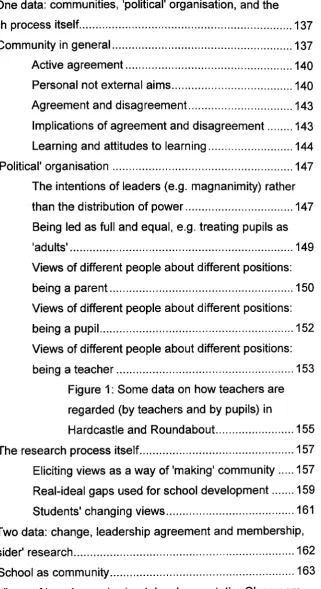
Table of Contents
Chapter I: Introduction ... 10
The structure of this thesis ... 10
The development of a teacher researcher ... 12
Five puzzles ... 12
Addressing the puzzles ... 13
Three themes ... 15
Key groups within a school ... 16
Developing key concepts ... 16
Research and professional teaching ... 19
Chapter II: Literature Review: Schools as Organisations ... 21
I ntrod uction ... 21
Philosophical foundations ... 22
Social organisation and hierarchy in Aristotle ... 23
Social organisation and hierarchy since Aristotle ... 25
John Macmurray on community and schooling ... 27
Organisations, hierarchies, and schools ... 35
Social organisations and schools ... 35
Schools as distinctive organisations ... 41
Unity, diversity, and hierarchy in schools ... 43
Learning schools '" ... 50
Change in organisations and schools ... 50
Learning ... 56
Learning teachers ... 61
Student teachers, boundaries, and the purpose of schools 65 Conclusion ... 68
Chapter III: Methodology ... 69
Broad aims ... 69
Research in context ... 70
Truth and sincerity ... 72
Community based research ... 76
I nsider research ... 81
Pupil and teacher views ... 83
Research tools ... 86
Research tools not used ... 88
Outline schedule of methods for each Stage ... 91
Stage One contexts: schools, students, and the researcher ... 92
The research context ... 92
Position of the researcher ... ; ... 92
School contexts ... 96
Hardcastle School ... 99
Roundabout School ... 101
Inspection data and research data ... 102
Student teachers ... 103
Stage One methods ... 106
Stage Two contexts: the school and the researcher ... 117
The research context ... 117
Position of the researcher ... 120
The school context.. ... 121
Stage Two methods ... 126
Stage Three contexts: the university, students and the researcher ... 127
The research context ... 127
Position of the researcher and the student teachers ... 128
Stage Three methods ... 130
Chapter IV: School Based Studies of School Organisation and Development ... 133
Introduction ... 133
Stage One research in Westside Borough: a diagnosis of school organisation ... 133
Stage Two research in Battle Bridge School: an insider using research in school development.. ... 134
Stage Three research in the Institute of Education: student teachers define themselves and their schools ... 135
Stage One data: communities, 'political' organisation, and the
research process itself ... 137
Community in general ... 137
Active agreement ... 140
Personal not external aims ... 140
Agreement and disagreement.. ... 143
Implications of agreement and disagreement ... 143
Learning and attitudes to learning ... 144
'Political' organisation ... 147
The intentions of leaders (e.g. magnanimity) rather than the distribution of power ... 147
Being led as full and equal, e.g. treating pupils as 'adults' ... 149
Views of different people about different positions: being a parent ... 150
Views of different people about different positions: being a pupil ... 152
Views of different people about different positions: being a teacher ... 153
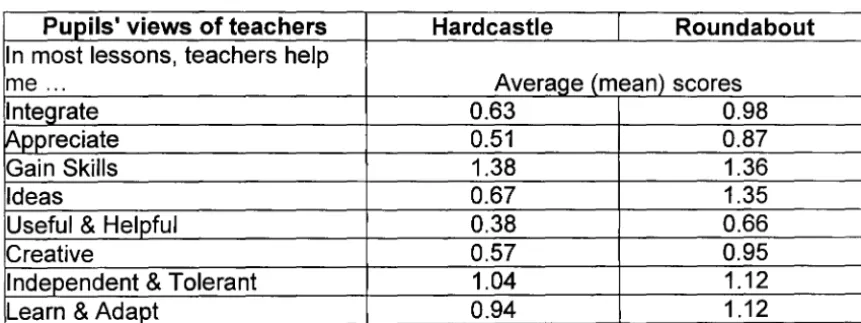
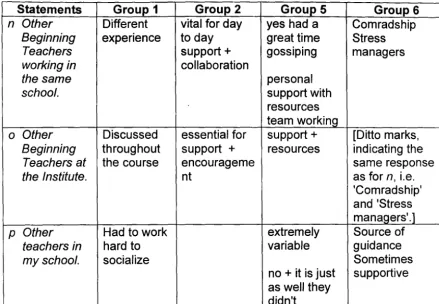
Figure 1: Some data on how teachers are regarded (by teachers and by pupils) in Hardcastle and Roundabout.. ... 155
The research process itself.. ... 157
Eliciting views as a way of 'making' community ... 157
Real-ideal gaps used for school development ... 159
Students' changing views ... 161
Stage Two data: change, leadership agreement and membership, and 'insider' research ... 162
School as community ... 163
Views of learning and school development: the Classroom Code ... 165
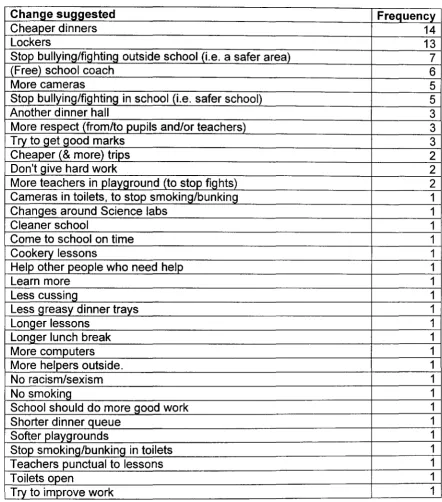
Figure 2: Some data on how pupils in Battle Bridge regard the Classroom Code ... 165
Membership ... 170
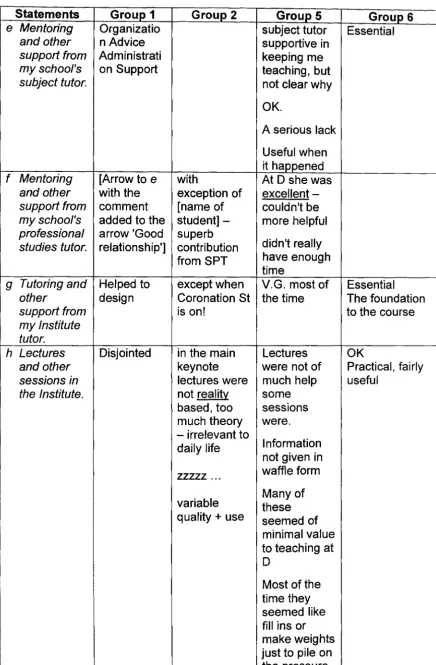
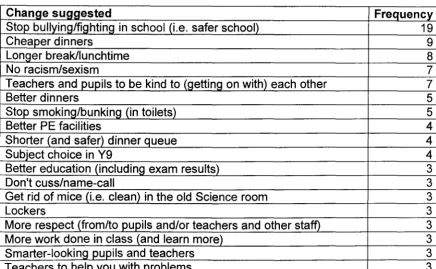
Figure 3: Comments attached by students to statements referring to factors influencing students' work in school ... 173
Apprenticeship and learning ... 177
Apprenticeship ... 177
Learning by individuals ... 179
Learning by schools ... 181
Leadership and followership ... 183
Aristotelian models of leadership and followership 184 Models of support ... 185
Sincerity ... 189
Sincerity and Stage One, Two and Three approaches ... 189
What students 'really' believe ... 191
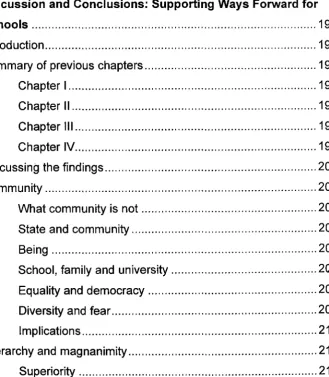
Chapter V: Discussion and Conclusions: Supporting Ways Forward for Schools ... 193
I ntrod uction ... 193
Summary of previous chapters ... 195
Chapter I ... 195
Chapter II ... 195
Chapter III ... 196
Chapter IV ... 197
Discussing the findings ... 201
Community ... 202
What community is not ... 202
State and community ... 203
Being ... 204
School, family and university ... 205
Equality and democracy ... 206
Diversity and fear ... 208
Implications ... 21 0 Hierarchy and magnanimity ... 210
Fatherlessness ... 211
Implications ... 212
Learning and 'reality' ... 214
Curriculum ... 214
'Real' schools ... 215
Immanence ... 218
Less real pupils and schools ... 218
Implications ... 220
Teacher training ... 221
Student teachers ... 221
Stage One students ... 221
Stage Three students ... 222
Implications ... 225
School based research and 'school therapy' ... 226
Research and therapy ... 226
Real and ideal in the individual and the school. ... 227
Research and school learning ... 228
Consultancy and therapy ... 230
School, family, therapy and alienation ... 231
Implications ... 232
Reconsidering the aims of the research ... 233
Bibliography and Appendices ... 236
Bibliography ... 236
Research Tools and Data ... 248
Appendix 1: Questionnaire for Student Teachers-September 1993 - After Preliminary School Experience ... 249
Appendix 2: Questionnaire for Student Teachers -October 1993 - After Trail ... · 250
Appendix 3: Questionnaire for Student Teachers-November 1993 ... ··· 252
Appendix 4: Questionnaire for Student Teachers and Teachers - February-April 1994 ... 254
Appendix 6: Interview Schedule for Interviews with
Teachers - March-April 1994 ... 258
Appendix 7: Questionnaire for Pupils in Battle Bridge
-November 1994-January 1995 ... 259
Appendix 8: Battle Bridge School - Classroom Code and
Classroom Code Monitoring Sheet - Autumn 1994 to
Spring 1995 ... 262
Appendix 9: Responses to Questionnaire for Student
Teachers - September 1993 - After Preliminary School
Experience ... 268
Appendix 10: Analysis of Responses to Questionnaire for
Student Teachers - September 1993 - After Preliminary
School Experience ... 272
Appendix 11: Responses to Questionnaire for Student
Teachers - October 1993 - After Trail ... 273
Appendix 12: Analysis of Responses to Questionnaire for
Student Teachers - October 1993 - After Trail ... 274
Appendix 13: Responses to Questionnaire for Student
Teachers - November 1993 ... 275
Appendix 14: Analysis of Responses to Questionnaire for
Student Teachers - November 1993 ... 279
Appendix 15: Responses to Questionnaire for Student
Teachers - March-April 1994 ... 280
Appendix 16: Analysis of Responses to Questionnaire for
Student Teachers - March-April 1994 ... 284
Appendix 17: Responses to Questionnaire for Hardcastle
Teachers - February-April 1994 ... 285
Appendix 18: Responses to Questionnaire for Roundabout
Teachers - February-April 1994 ... 289
Appendix 19: Analysis of Responses to Questionnaire for
Teachers in Hardcastle and Roundabout - February-April
1994 ... 292
Appendix 20: Responses to Interviews with Hardcastle
and Roundabout Teachers - March-April 1994 ... 295
Hardcastle and Roundabout - March-April 1994 ... 317
Appendix 22: Analysis of Responses to Questionnaire for
Pupils in Hardcastle and Roundabout - March-April 1994 ... 337
Appendix 23: Responses to Questionnaire for Pupils in
Battle Bridge - November 1994-January 1995 ... 340
Appendix 24: Analysis of Responses to Questionnaire for
Pupils in Battle Bridge - November 1994-January 1995 ... 368
Appendix 25: Responses by Student Teachers to Sorting
Tasks - June 1997 ... 372
Chapter I: Introduction
'what are called advanced ideas are really in great part but the latest fashion in definition - a more accurate expression, by words in logy and ism, of sensations
which men and women have vaguely grasped for centuries' (Thomas Hardy in Tess of the d'Urbervilles)
The structure of this thesis
The thesis is in six chapters. In the introduction, key aims are set, and there is an
account of the personal and professional development of the researcher,
explaining something of the origin of themes and concepts developed in the
research. New themes and concepts developed along with the research itself,
but two key aims can be identified here, aims that the whole process of the
research attempts to meet, towards a way of understanding school organisation,
school development, and learning:
*
*
To develop and pilot techniques for discovering the views of members of
the school community, as ways of exploring the nature of an individual
school organisation and exploring school and individual development.
To investigate the use of the views of members of a school community, to
contribute to the development of schools and individuals.
The second chapter is a critical review of the literature on or relevant to school
organisation, drawing on work in several fields - both within and beyond
education. This review provided the basis for exploring school organisation, and
for the project1, but the review continued throughout the period of the research,
and itself was informed by the outcomes of the project. Sub-sections of this
chapter address the nature of schools as systems (including what makes schools
as organisations different from other types of organisations, and the nature of
hierarchy in schools), and school and individual development - also described as
learning.
In the third chapter, the methodology of the project is described. Some key
aspects of methodology were common to each stage of the research, and are
described early in the chapter. Yet the methodology of each of the three project
stages was in some ways distinct, especially with respect to the relationship of
the researcher to the subjects of the research, so there are separate
methodology sections for each of the stages.
The fourth chapter describes each of the three stages of the project, i.e. the
school based studies that formed the heart of the research. In the first stage, two
parallel studies were completed and these were primarily intended to develop
and pilot techniques for discovering the views of members of the school
community, as ways of exploring the nature of school organisation. It was in
these school based studies that the work arising from the literature review was
tested or proved (in the older sense of that word), and they in turn informed the
continuing process of the literature review. The second stage of the research
comprised a single school based study, in which the techniques developed in the
earlier studies were used as part of a school development project. This was
therefore a way of exploring the theme of school development, using the views of
members of the school community. The development of individuals, and how this
relates to matters of school organisation, was explored in the third stage of the
research, a study of a small group of student teachers. How these individuals
described their situations also of course helped clarify issues raised in the
previous school based studies, of for example the 'community' nature of schools,
and forms of support and hierarchy.
The discussion and conclusions, making up the fifth chapter, pull together
elements of the literature review and the school based studies to attempt to
develop a way of understanding school organisation, incorporating issues of
school development and the development of individuals, within a framework of
schools as learning communities.
Finally, there is a section of bibliographical and appendix material comprising
research information to complement the rest of the work, research tools, extracts
The development of a teacher researcher
Elsewhere in the thesis the phrase 'the researcher' is generally used, but here I
have written in the first person, as the account is a personal one, exploring why
and how I came to the research.
Five puzzles
I worked in school teaching for fourteen years, and came across a range of
puzzles, professional and (with hindsight) academic. I started teaching because I
found learning exciting and wanted to share that experience. The first puzzle
was that, despite my expectations, teaching was not to be simply telling pupils things. While still in training, I was annoyed when my teacher-training tutor
preferred the lesson in which the pupils were working, while I wandered around
helping them, to the lesson in which I did a lively presentation using all my
'performance' skills. It took a few years to appreciate his wisdom: teachers telling
pupils things, however entertainingly, was less important than pupils being
enabled to learn2 .
After I was appointed to my first post, a second puzzle emerged. However much
I knew, I never seemed to know enough. Not only did pupils' learning matter
more than the performance of the teacher, but a teacher's knowledge, I gradually
realised, was less important than the teacher's skill in increasing pupils'
knowledge and understanding.
A third puzzle arose when I went on a counselling course, and found work on
listening skills more useful than any other piece of teacher training I had received.
My skills as a listener now appeared more important than those of a talker.
The management of teachers and pupils provided the fourth puzzle. The Head3
2 Later, I noted the stronger views of writers such as Wenger, who complains bitterly that 'institutions ... are largely based on the assumption that learning ... is best separated from the rest of our activities, and that it is the result of teaching' (Wenger 1998: 3).
of one school came to see my tutor group, to introduce himself, and started his
talk by saying 'Mr Stern has been working for me for ... '. The simple-enough
remark by a well-meaning-enough Head, then, puzzled me, as it seems to have
puzzled others before4: I had thought his job was to work for me, not mine to
work for him. Management involved working for the people 'beneath', I had
thought, just as teaching involved working for the pupils. If managers thought as
this Head did (i.e. that management meant the people 'beneath' worked for
them), then the people in the middle (myself, a teacher, at that time) would be
pulled in two directions. The 'middle' people would be working for the people
'above' them in the hierarchy (i.e. managers), and also for the people below them
in the hierarchy (Le. pupils). This seemed unreasonable: it made little sense
intellectually, and it felt unfair to me, in the middle.
Moving from job to job, I never found a slowing-down in the need to learn, but
formal research did not start again until I became involved in teacher training
(after ten years of teaching), and then only half-heartedly, hoping for a
qualification-based promotion. 'Supportive schooling' was the topic I chose, with
my interest in how teachers supported learning and how managers did or could
support teachers. A fifth puzzle, then, was that there seemed to be few books on
the topic (which seemed so central to teaching), and yet that, however many
books I read, there was no apparent reduction in the number of books left still to
read. There was no single mountain of more or less important books on
education, with the 'peak' books to be read first, but rather a full mountain range,
stretching far into the distance, with each set of books having its own 'peak'.
Addressing the puzzles
The research I did started generating some solutions to the puzzles. It suggested
that the 'insiders', teachers and pupils and managers, might be able to find
common ground, and seemed to find it surprisingly easy to work out what could
organisation. Some Heads, including some in this study, refer to themselves by other titles (such as 'Principal'), but 'Head' is used throughout, for the sake of clarity.
be improved in the school, whilst 'outsiders' (like consultants, governments,
authors) had a great deal of difficulty having any influence. The 'insider' views,
however, were rarely used: student teachers' views were marginalised, teachers'
and pupils' views were ignored, often enough, and managers seemed to want to
impose their views more than understand the views of others. It seemed to be a
characteristic of schools that 'listening to insiders' was rarely done, and yet it
might help the schools more than 'listening to outsiders'.
I could only really carry on researching 'insiders' views of schools by becoming
an outsider, working at the University of London Institute of Education and more
recently at Brunei University. Here, gradually, I found more writings that
addressed my puzzles, or writings from the vantage pOint of which I could see
across the 'mountain range' of disciplines. On the nature of communities, and
schools as communities, John Macmurray wrote with great subtlety. His work
gave me confidence that philosophical investigations into 'human nature' and
society might have a direct bearing on forms of school organisation, and that
schooling was itself a 'special' kind of social organisation. On hierarchies,
Aristotle wrote about 'paternalism' and about 'magnanimity' (or being 'big
hearted'), within political systems. 'Paternalism' was an approach within
monarchy, with monarchical government preferred to democracy. In this context,
'paternalistic' leaders looked after the led in the ways a good father would look
after a child - that is, they would think about how they could help the led. Despite
its obvious bias towards men and male children, this understanding, if 'unsexed',
could become, I believed, a positive version of what good Heads (and maybe
good parents) could do. This also seemed preferable to a defence of the
'democracy' that Heads often aspired to but rarely exhibited. On learning, some
Vygotskian views tied together individual learning and the development of social
groups. This seemed to make the link between social organisation, the process
of learning, and the nature of humanity.
The three sets of writings, on community, hierarchy and learning, together
supported and further encouraged my research, and there were several other
encouraging developments during the period of the research. 'Leadership', rather
than 'management', became in the 1990s a popular way of describing the work of
than 'democratic'5, might be expected to be more popular. In the late 1990s,
there were political moves to devolve even more of 'school improvement' work to
schools themselves, with reduced intervention from LEAs or governments.
Macmurray's reported influence on the thinking of Tony Blair, Prime Minister from
1997, and political initiatives on social exclusion, also seemed serendipitous. I
felt that my work, on school self-development and on models of hierarchies, was
therefore becoming more central to policy-led research. This encouraged my
research, focusing on particular themes, groups, and concepts, within a
professional teaching and research context.
Three themes
In response to my reading and my research, the three themes were developing,
and each of these had methodological implications. First, seeing schools as
systems (perhaps communities), implying a need for the research to discover evidence of this systematic nature and how it might change. Second,
investigating the purpose and uses of hierarchy in schools (and how this relates
to schools as developing systems), again, implying a need for the research to
discover evidence for and explore the uses of hierarchies. Third, trying to
understand learning in schools (learning by individuals and groups in schools,
including student teachers, and how this learning is related to school
development), implying a need for the research to explore the use of the views of
school participants in a dynamic, changing, system. These three themes came
together in the work on schools as distinctive types of communities, as learning
communities.
The Stage One school based studies looked in particular at the perspectives of
the different people in the schools, and the relationship of these to school
organisation, learning and hierarchies in schools. The Stage Two school based
study looked at this and more: it looked in particular at school development as a
learning process, using the views of participants to support change in the school.
In Stage Three, the focus was more narrowly on student teachers, for example
looking at the ways in which they marked boundaries - as relatively peripheral
members of school communities.
Key groups within
a
schoolThe different groups within the school community each had distinct
characteristics, informing the research. Student teachers appeared to be the
most 'ambiguous' of participants in the school, and were therefore especially
interesting. They were explicitly both teachers and learners; they had
characteristics of both outsiders and insiders (and therefore helped define the
boundaries of organisations); they were often in a position to challenge existing
perceptions or roles in a school. Their learning, then, could be difficult to
manage, but could open the school up to positive external influences. Pupils
appeared to be the most 'ignored' of groups, and the group with the lowest status,
in several ways. Their views, and the uses to which the views were put, were
therefore vital in creating a 'community' of a school, or supporting change out of
the diversity of views in a school. Teachers appeared to be pivotal in the school
hierarchy: it was the relationships between them and the managers 'above' them
and the pupils 'below' them, that determined much of the hierarchical structure of
the school. Where teachers were able to be learners, or reflective practitioners,
this might enable the whole school to develop and support change. Managers in
the school appeared, like student teachers, to be under enormous pressure to
change themselves - as they were in positions controlling development plans,
preparation for and responses to inspection, relationships to outside bodies, and
so on. Where managers differed from both student teachers and teachers,
seemed to be in their responsibility for their own change and for changing the
school. They might be expected to learn 'for' the school (this is central to much
management training), and if they can build this in to the work of all groups in the
school, the school might be able to become a 'learning organisation'.
Developing key concepts
The concept that marked the start of my research was 'support'. For my first
interview for a teacher training post, I had considered what a teacher trainer
work a teacher-colleague of mine had recently done on self-concept development
in children and teachers, and it also complemented my reading of Marland's book
on being a head of department (Marland 1971) which stressed (as I remembered
it) the role of the head of department as a supporter of the people who, in most
pictures of hierarchies, are generally placed beneath them.
Apparently there was an important choice to be made by people working in
hierarchies. 'Lower' could be seen as supporting 'higher', or 'higher' could be
seen as supporting 'lower'. Too many people, I thought, were obsessed with the
'upward-pointing triangle' (Le. with 'lower' supporting 'higher'), and they were
perhaps seduced by the sense of power implied by it. The 'downward-pointing
triangle' (Le. with 'higher' supporting 'lower'), on the other hand, was much more
attractive to me - seduced as I was, in turn, by the (good) sense of purpose it
gave to teaching. Teaching could be seen as working for, or supporting, the
pupils, not working for or supporting the school's managers or for the LEA or the
Government.
There was a problem of defining support. If you want to support someone, do
you do what you think is best for them, or do you do what they want?6 Around
the end of 1985, I started training for and then doing some counselling myself,
and the meaning of support was tested (in the broad sense) over and over.
Creative, effective, counselling involved listening - and listening in ways that
brought out thoughts the talker may not even have known they had. Good
listening had to acknowledge the real feelings of the talker, rather than the
feelings they are persuaded they 'should' have. Good listening must also avoid
the imposition on the talker of the views of the listener, however subtly this is
done. People who needed or wanted support, needed or wanted their different,
complex, contradictory, ambiguous feelings or thoughts to be brought out in the
open, so that they could be rearranged in a more comfortable or productive way.
Support here involved working out what was wanted (or what was really wanted,
or what was most wanted) and how, if at all, it could be achieved. 'What is
wanted' may include satisfying diverse and contradictory feelings, and helping
6 It is an old dilemma. For example, two hundred years ago, Friedrich von Schiller wrote in his
Aesthetic Letters 'Work for your contemporaries; but create what they need, not what they praise'
create a more unified or integrated whole person. Support, recognising unity and
diversity, is needed for development or change to take place.
In a school, a Head, or a head of department, or a teacher, cannot of course act
in the way a counsellor would act. Teachers have a professional, contractual,
framework within which they must work. However, the insights of counselling
could be valuable in school teaching. The most important insight I got from
counselling was that people (including, especially, troubled people) had, within
them, means of helping themselves. Often an apparent 'problem' was itself a
means of helping oneself. The example that sprang to mind was the cutting off of
feelings (e.g. in the form of depression) exhibited by people when they are not
able to accept their perhaps 'unpleasant' or 'socially unacceptable' feelings.
Recognising and then exploring what the problem 'really' was, allowed some
people to feel better, and a counsellor could help them in this. Work on support,
in counselling contexts, suggested to me that there were important choices to be
made in hierarchical institutions. Those with power should see their roles to be
supporting those over whom they have power. And they should look for
'immanent', rather than 'transcendent', improvements - i.e. characteristics of the
person that allowed for change, improvement, re-sorting, and so on.
In the 1990s, I had opportunities to work in a variety of schools (as teacher,
teacher trainer, INSET provider, and consultant/researcher), and became more
aware of the characteristics of whole schools that affected the work of all within
them. Part of the definition of any institution, of course, included the boundaries
of that institution. What I was becoming more sensitive to were the ways in which
the characteristics of the whole school were determined, and could be changed
or developed. Again, the role of management was highlighted, for me, as being a
whole-school 'support' activity. The school as an identifiable community,
essentially separable from the 'outside world', also became more apparent.
If 'support' was the first key concept, then, this soon led to consideration of forms
of social organisation and 'hierarchy' (as hierarchies might be described as
'support structures') within schools. 'Hierarchy' in turn led to the nature of schools
as separate organisations, or, as was to emerge, 'communities'. Identifying the
From a concern with therapeutic models and 'listening' developed a number of
methodological approaches including the key methodological concept of
'sincerity' (developed in Chapter III, below).
Research and professional teaching
At the start of my research, then, its purpose was to investigate within schools the
possibility of using a downward-pointing triangle model of management (including
the management of pupils) to analyse the possibilities of helping pupils (and
teachers, and schools, and so on) to develop and improve (i.e. 'learn'), by
building on their own (perhaps hidden) feelings, intentions and beliefs. The three
themes emerged (as described above), and for a year and a half (from January
1993 to July 1994), the research continued alongside my professional teaching
work, in school and on secondment two days a week to train teachers for the
University of London Institute of Education. I had considerable access to the
schools in which my students were placed, and opportunities to work with several
other schools. After work in the Institute library, doing a literature search and an
MPhil proposal, my research got off the ground working with the student teachers
I had for the academic year 1993-4. Two of the schools in which my students
were placed became the focus of further research, on the views of pupils,
teachers and managers, and this became Stage One of the project. I reported to
both Stage One schools, in July 1994, and by then had finished my Institute
secondment, and had started doing the next stage of research at the school
where I had worked from September 1991 to April 1996. The school was
interested in the research work I proposed in the Spring and Summer terms of
1993-4, and eventually offered me a 0.2 release from teaching, to complete
Stage Two of my research. The centrepiece of my work for this school was to
help develop the school's 'Classroom Code', a behaviour and work code for use
in lessons, and this provided much material for use within the research project.
My own combination of teaching, teacher-training, research and development,
and writing, was itself significant for my research. Learning was as important for
me as a teacher, just as for pupils, students and full-time researchers.
Supporting others, I had come to realise, involved more listening than talking
teaching, to be able to continue research, writing and university teaching. This
was a difficult decision: university work was and continues to be much less
secure than school work. More importantly, my research was itself
demonstrating to me the advantages of school based research and development
work, completed by 'insiders'; yet, to continue that work, I had to give up working
in schools. In 1997, I started working full time in Brunei University, running a
national project on improving religious education and school effectiveness. This
new project allowed me to make use of some of the insights provided by the
research, in setting up school based development projects around the country.
Throughout my work in teaching, teacher training and research, the concept of
'community' became increasingly important. In later stages of the present
research, and the work at Brunei University, 'community' remained a key concept
linking the relationships between managers and teachers, to the relationship
between teachers and pupils, and to the relationship between individuals and the
whole school. 'Learning' might happen in any context (for example, with or
without the presence of 'teaching' or schools), but a 'learning community' seemed
to capture something essential about how schools might work. Hence, the title of
Chapter II: Literature Review: Schools as Organisations
'things can become really comprehensible ... only ambulando'"
(Dunne 1997: 170)
Introduction
This literature review includes texts from a wide range of traditions. In particular,
there are several important philosophical texts, and a number of texts using
sociological and psychological approaches. The philosophical texts in general
explore the nature of people in society, education and schools through the
analysis of arguments and theories of (for example) human nature. Sociological
and psychological approaches may make use of these techniques, but are also
likely to refer to systematic empirical research to support particular arguments
and theories. Although it remains a matter of debate, how far the more 'empirical'
studies actually derive their conclusions from empirical data, this literature review separates out some of the key philosophical texts. In this way, the
distinctiveness of the arguments and conclusions of authors from different
traditions is not ignored.
Philosophical foundations are therefore described in the first substantive section
of this review. This focuses on issues well beyond the current schooling system,
and complements the more empirical work cited, which, whilst drawing on work
on organisations and education in general, also investigates current systems of
schooling. The more empirical work starts with an analysis of schools as
distinctive types of organisations - reflecting the philosophical (never mind
sociological and psychological) need for 'rootedness', as promoted by Dewey:
Philosophy proclaims its devotion to the universal. But as the profession of cosmopolitan philanthropy which is not rooted in neighborly friendliness is suspect, so I distrust the universals that are not reached by way of profound respect for the significant features and outcomes of human experience as found in human institutions, traditions, impelling interests, and occupations. A universal which has its home exclusively or
predominantly in philosophy is a sure sign of isolation and artificiality. (John Dewey, Context and Thought, quoted in Dunne 1997: 29.)
7 That is, by 'walking about'. One could compare this with the title of Frase & Hetzel 1990: School
Work on schools as organisations suggests a need for work 'looking outward' and
'looking inward': investigating the boundaries between schools and the wider
world, and looking at the relationships of individuals in the school to each other
and to the school as a whole. Individuals and groups within a school may have
diverse roles within, and understandings of, the school, and yet there are features
that may unify all the individuals - not least the fact of membership of the school
itself. Following work on schools as organisations, and unity and diversity within
them, learning can be considered in more detail: learning of schools (i.e. school
development) and learning within schools. The distinctive learning function of
schools is a feature that may unify individual members and schools as
organisations, and helps explain in particular the dynamics of change within
schools. A view of schools as learning organisations can also be used to help
explain the nature of hierarchies within schools. This literature review therefore
moves from analysis of schools as organisations to schools as learning
communities.
Philosophical foundations
The two philosophers considered in most detail are Aristotle and John
Macmurray. Both have worked on education, yet the work referred to here is not
primarily their narrowly educational work. The influence of these and other
philosophers is often rather obscured in more empirical work on education. In
empirical work, theories of social organisation, and the nature of people and of
learning, are often either unstated, implicit, or stated as being derived from more
recent and similarly empirical work - without possible links to philosophical
theories being made clear. This literature review does not claim to outline a
history of ideas, and the philosophers cited are certainly not the only ones whose
work could have influenced, directly or indirectly, the work of other authors.
However, they have influenced this work, and are exemplary in their own ways,
so philosophical foundations of the arguments in this whole project are worth
Social organisation and hierarchy in Aristotle
When studying social organisation, writers often draw on the description of
Aristotle of 'man' being a 'social animal' and social groups being 'unions' not
merely 'aggregates'. Hence, from the Ethics,
It is a generally accepted view that the perfect good is self-sufficient. By self-sufficient we mean not what is sufficient for oneself alone living a solitary life, but something that includes parents, wife and children, friends and fellow-citizens in general; for man is by nature a social being.
(Aristotle 1976: 748.)
The Politics says that 'man is by nature a political animal; it is his nature to live in
a state' (Aristotle 1962: 28). And 'it is not simply a matter of cooperation, for
obviously man is a political animal in a sense in which a bee is not, or any
gregarious animal' (Aristotle 1962: 28), because
humans alone have perception of good and evil, right and wrong, just and unjust. And it is the sharing of a common view in these matters that makes a household or a city. (Aristotle 1962: 29.)
The 'political' nature of people is more than just a 'being together': a 'citizen is one
of a community, as a sailor is one of a crew' (Aristotle 1962: 107), and 'a state is
not a chance agglomeration but, we repeat, a body of men aiming at a
self-sufficient life' (Aristotle 1962: 272). Aristotle also deals at some length with the
differences between being a 'good man' and a 'good citizen' (Aristotle 1962: 107),
suggesting a more complex relationship between individual and society than
might have been expected of the Greek tradition, with 'the lesser degree of unity
'" to be preferred to the greater' (Aristotle 1962: 58, and see also Howie 1968: 22
on Aristotle's rejection of excessive unity in the state). It is the nature of
organisations, broadly based on Aristotle's idea of 'man' being social, that is
outlined throughout this literature review.
8 The quotation (Le. 1tOAtnK6v ~r06V avepomo~ from 1097b of the Nicomachean Ethics, here in the Thomson translation) ends 'for man is born for citizenship' in the Ross translation; in the Chase translation, 'for man is by nature adapted to a social existence'. (See also 'man is a social creature and naturally constituted to live in company', Aristotle 1976: 304.) This could be
On more 'practical' issues of social organisation, Aristotle wrote a great deal
about the ways in which social groups might be organised, internally and in their
relationships with other social groups. For example, he wrote of the need for city
walls, to help delineate and maintain sufficient unity within a relatively
self-sufficient state (Aristotle 1962: 279-280). He also provided a detailed account of
the nature of leadership and 'followership', in a way that may suit models of
schools today. A citizen
is one of a community, as a sailor is one of a crew; and although each member of the crew has his own function and a name to fit it - rower, helmsman, look-out, and the rest - and has therefore his goodness at that particular job, there is also a type of goodness which all the crew must have, a function in which they all playa part - the safe conduct of the voyage; for each member of the crew aims at securing that. Similarly the aim of all the citizens, however dissimilar they may be, is the safety of the community, that is, the constitution of which they are citizens. Therefore the goodness of the citizen must be goodness in relation to constitution ... On the other hand we do say that the good man is good in virtue of one single perfect goodness. Clearly then it is possible to be a good and serious citizen without having that goodness which makes a good man good. (Aristotle 1962: 107.)
Leaders, for Aristotle, should properly lead in such a way as to help those lower
in the hierarchy.
The association of a father with his sons has the form of monarchy, because he is concerned for the welfare of his children. . .. [I]n a tyranny there is little or no friendship. For where there is nothing in common between ruler and ruled there is no friendship either, just as there is no justice. Their relation is like that ... of master to slave. (Aristotle 1976: 278-279.)
It is therefore the intentions of leaders, more than simply the distribution of power
between leaders and followers (e.g. 'monarchical' versus 'democratic' forms), that
concern Aristotle here. Given an inequality in power between teachers and
pupils, and between school leaders and teachers, based on contractual
distinctions, this approach, more than 'distributive' approaches, might help
illuminate school leadership and power relations in school9 .
Aristotle's work on 'magnanimity', too, might apply with some adjustment to
Headteachers or to a teacher in the classroom. The word is a translation of
megalopsuchia, described in the Penguin edition as 'magnanimity, proper pride,
self-respect - there is no real English equivalent for this very upper-class Greek
virtue' (Aristotle 1976: 153). In Stern-Gillet 1995, ho megalopsychos is translated
as 'great-SOUled man'. Seeing magnanimity as essentially 'upper-class' is rather
misleading, though it would be fair to say it refers to those in more powerful
positions. Work on magnanimity may be central to understanding
hierarchically-organised institutions, like schools, with its stress on 'leadership' and implications
for the 'led'. One might see Aristotle, in summary, as recommending leadership
as being carried out for the good of the led, and characterised by a sufficient
'magnanimity'; that being 'led' (at least to the extent of being a citizen, rather than
a slave) may include qualities of being a 'good citizen' (aiding the aims of the
whole state insofar as this is required by the 'social' nature of a person) and/or of
being a 'good man'. 'Agreeing' on the aim of the state (though not, for Aristotle,
necessarily an act of agreement, but rather having consensus over the overall
aim or intention), brings us to the nature of agreement in schools, which is
addressed again later in this literature review.
Social organisation and hierarchy since Aristotle
There is a great deal by authors such as Machiavelli or Spinoza, on how to be a
'citizen' (as for example Machiavelli 1970: discourses 16-18, or Spinoza 1951:
chapter XX: 257 ff). Both these authors (in common with Aristotle) have written
guidance for 'real' leaders, rather than theoretical texts for academics alone. As
a consequence, perhaps, both have at times been accused of rationalised
political pragmatism verging on cynicism - Machiavelli by a huge number of
commentators, Spinoza by commentators such as Yovel. Machiavelli, for
example, suggests that a prince 'should appear a man of compassion, a man of
good faith, a man of integrity, a kind and a religious man', as '[m]en in general
judge by their eyes rather than by their hands' (Machiavelli 1975: 101). Yovel
comments on Spinoza's approach to the 'multitude', who should be fed 'false'
views, for the benefit of themselves and society. Hence, 'purified religion and the
rationalized state are ... designed to engender in the multitude the same conduct
that the rational model requires, even though it will be motivated by nonrational
powers and by inadequate ideas' (YoveI1989a: 130). Machiavelli's advice has
been adopted by modern consultants on management and leadership, as in V
(1996), entitled The Mafia Manager: a guide to the corporate Machiavelli, or
McAlpine (1998), subtitled the art of politics in business. However, few in recent
years have developed the work, done by authors such as Aristotle, Machiavelli
and Spinoza, on being a follower - a 'citizen' or one of the 'multitude' - despite
the distinct roles for 'followers' being given in the earlier work. This may in part
be a result of embarrassment with the account of followers as incapable of
understanding or acting on the theories that might inform leaders10.
Whereas writers on organisations theory in general have made use of insights
developed by philosophers such as Machiavelli, writers on education have made
less explicit use of these pragmatic 'political' authors, rather concentrating on
organisational theories of early sociologists such as Tennies or Durkheim.
However, the 'rationality' of actions, a key issue for both Machiavelli and Spinoza,
is also at the heart of Tennies' distinction between Gemeinschaft (usually
translated as 'community') and Gesellschaft (usually translated as 'society'), with
the latter underpinned by KOrwille (,rational will') rather than Wesenwille (,natural
will') (see for example the entry for Tonnies in the Encyclopredia Britannica: \
Britannica CD, Version 1998).
Tennies's distinctions, developed in the context of rapid social (and
organisational) change, seem to have influenced a great deal of subsequent
organisations literature, and Durkheim's distinction between mechanical and
organic solidarity may have influenced some of the terminology used, and may,
more indirectly, help us to link earlier philosophical traditions with modern writing
on education. Durkheim's mechanical-organic distinction is based in part on the
move from an enforced moral consensus within mechanical solidarity, to the
possibility of 'human fraternity' based on a division of labour fulfilling a social end
within organic solidarity (see for example Durkheim 1973: 143), in which the
individual has a more important (because distinctive) role (see for example
Bellah's introduction to Durkheim 1973: xxiii-xxiv). Durkheim's writings on the
distinction between those societies or social organisations exhibiting 'mechanical'
and 'organic' solidarity (as described in Lukes 1973: 147-8) is useful in
illuminating the nature of a social institution exhibiting a division of labour (as is
apparent in secondary schools, investigated in this project), and also in clarifying
the nature of 'agreement' within and 'membership' of such institutions. Work on
anomie and the ways in which individuals may fail to 'fit' the society in which they
live, may also be helpful when considering ways of interpreting 'disaffection' of
school pupils. On education itself, Durkheim gave schooling a key strategic role
in society - and this no doubt links the social changes providing the context for
his whole opus, to the emergence of mass education (as mass schooling) in
those societies. According to Giddens, '[t]he formal educational system,
Durkheim believed, has to playa vital role in the inculcation of the moral attitudes
and capacities required in a society oriented towards ... secular ideals' (Giddens
1978: 71). 'Education', broadly speaking, 'is the influence exercised by adult
generations on those that are not yet ready for social life' (Giddens 1978: 71,
quoting Durkheim's Moral Education), in order to 'create sympathy and
understanding for others, a capacity to accept change, and an awareness of the
potentialities of mankind' (Giddens 1978: 78). The French 19th century historical
context of Durkheim's work is one in which the development of 'individualism' and
mass education appears to be connected to the development of large scale,
industrial, society11. However, the history of schooling and society is beyond the
scope of this thesis, which focuses instead on some of the fundamental principles
underlying school organisation - principles expressed over many centuries,
applying to a range of organisations.
John Macmurray on community and schooling
The work of Durkheim, influenced by a scientific, rationalist, approach to
understanding people in society, with an appreciation of social psychology, could
be said to be related to that of the Scottish philosopher John Macmurray.
~
s~the
apparent increase in individualism and what might nowbe called 'social exclusion' - forms of anomie or alienation from community or
society. Both Durkheim and Macmurray placed school education at the centre of
their concerns for developing communities and societies in which people might
flourish. However, Macmurray rejected the sense of society as an organism,
especially Durkheim's strong sense that 'society is a being, a person' (Durkheim
1973: xx). Cornford notes Macmurray's rejection of both 'mechanistic' and
'organic' interpretations of society, popular from the 1 yth to the 19th centuries and
from the 19th to the 20th centuries, respectively (introduction to Macmurray 1996b:
21). In this way, Macmurray could be thought of as moving beyond Durkheim's
approach to social science, although he shares a general concern with education,
schooling, and society. Work on the broader issue of the role of schooling in
society is not central to this project, although such work has implications for some
of the 'boundary' work (as described below). However, work on the link between
the purpose of the organisation and the most appropriate metaphor or theoretical
framework used in describing it, is indeed a central concern. On this latter issue,
Macmurray says that 'the state depends upon society and society depends upon
community' (Macmurray 1991: 192). 'Religion, on the one hand, and education
on the other are the primary needs: the one is the business of the family, to hand
on the customary way of life from one generation to the next; the other is the
means of extending the spirit of the family beyond its boundaries to the society as
a whole' (Macmurray 1991: 192).
Macmurray is centrally concerned with education as provided in schools. Like
Aristotle, his views are based on a strong theory of human nature as essentially
social. Hence,
We are not individuals in our own right; and in ourselves we have no value at all, since we are meaningless. Our human Being is our relations to other human beings and our value lies in the quality of these relations. (Macmurray 1995a: 72.)
In this way Macmurray, like David Hay more recently (as in Hay 1998), builds a
case for a 'communal' or 'relational' view of what makes a person. 'It is the life of
the individual that is the
common
life' (Macmurray 1993: 9), 'it is the sharing of acommon life which constitutes individual personality' (Macmurray 1993: 37),
human life has an 'inherent sociality' (Macmurray 1993: 31), 'the personal is
one term in a relation of persons' (Macmurray 1968: 149)12. Macmurray's
approach makes persons-in-relation so central as to avoid the perception that a
person is a Cartesian 'individual, autonomous self for whom even "recognising
the existence of others" is a problem' (Thatcher in Astley and Francis 1996: 123).
When it comes to schools, these do indeed allow for a 'common life'. They are,
for Macmurray, best seen as examples of 'communities', a form of organisation
that is positive and personal, in contrast to 'societies' that are negative and
impersonal. The 'unity' characteristic of 'community' is different to the 'unity'
characteristic of 'societies'. Hence
And
[W]e should use the term 'society' to refer to those forms of human association in which the bond of unity is negative or impersonal; and to reserve for the contrasted forms of association which have a positive personal relation as their bond, the term 'community'. A community then rests upon a positive apperception by its members of the relation which unites them as a group. It is a personal, not an impersonal unity of persons. (Macmurray 1991: 147.)
Like a society, a community is a group which acts together; but unlike a mere society its members are in communion with one another; they constitute a fellowship. A society whose members act together without forming a fellowship can only be constituted by a common purpose. They co-operate to achieve a purpose which each of them, in his [sic] own interest, desires to achieve, and which can only be achieved by co-operation. The relations of its members are functional; each plays his allotted part in the achievement of the common end. The society then has an organic form: it is an organization of functions; and each member is a function of the group. A community, however, is a unity of persons as persons. (Macmurray 1996b: 166.)
Macmurray's views on schools as specific examples of 'communities' (in his
sense), generated by his philosophical work as well as work with schools, are
expressed in unpublished papers. His biographer, Jack Costello, points out that
The almost complete victories of technology and capitalism in the West and the reduction of education from learning as full personal formation in cultural life to the mere acquisition of discrete "skills" and "tools" for a work
life affect him deeply. In 1968 [aged 77], he notes in his correspondence that he is attempting to write an essay entitled "Education for a Stupid Society". (Costello 1998b: 24.)
For Macmurray himself,
the school is a community; and we learn to live in community only by living in a community. (Macmurray 1968: 149-150.)
And a school's
first principle is that it must be a real community. Not because community is a good thing - I would underline this - but because this is the condition of success in its educational function. Only in a community can a living culture be developed. (Macmurray 1968: 35.)
The possibility of schools being communities is not an 'ideal' for Macmurray. As
when we try to teach, we must deal with living human beings. We, the teachers, are persons. Those whom we would teach are persons. We must meet them face to face, in a personal intercourse. This is the primary fact about education. It is one of the forms of personal relationship. It is a continuing personal exchange between two
generations. To assert this is by no means to define an ideal, but to state a fact. It declares not what education ought to be, but what it is - and is inescapably. We may ignore this fact; we may imagine that our task is of a different order; but this will make no difference to what is actually taking place. We may act as though we were teaching arithmetic or history. In fact we are teaching people. The arithmetic or the history is merely a medium through which a personal intercourse is established and maintained. (Macmurray 1968: 5.)
It is not, then, that schools simply 'might' be communities, but rather that they
'must' be communities, and this is central to their educational role. However, the
distinctiveness of schools as organisations is already implied by the possible
absence (or lack of primacy or redundancy) of any 'external' function of a school,
and the sense in which members of the school community are present 'as
persons'. Hence, groups such as butchers, midwives or non-drinking alcoholics
(three of the groups described in Lave and Wenger 1991: chapter 3, or Wenger
1998: chapter 2, described below), would be considered 'associations' not
'communities', as they each have a narrow function. Membership is not of
'persons-as-persons' (Macmurray 1996b: 166), but people joining together for an
Macmurray, may be fully 'communities', like families, which themselves are small
communities. Hence 'education ... is the means of extending the spirit of the
family beyond its boundaries to the society as a whole' (Macmurray 1991: 192),
as
[t]his school community stands between family and the wider community and looks back to the first and forward to the second. For long periods it has to take the place of the family for its pupils: and also it has to mediate between the family and the larger world of adult life. It is able to do this, and to combine in miniature the conditions of each of these, because unlike either of them it has one concern to which everything else is directed - the education of young persons who are entrusted to it. (Macmurray 1968: 35-36.)
It could be noted, too, that the legal position of teachers as being in loco parentis
strengthens the idea of the school being a 'broadened' family. (See for example
Britannica CD, Version 1998: Teaching: General characteristics of teaching:
Function and roles of teachers: The doctrine of in loco parentis.) Using ideas of
the family in the study of larger social organisations is of course common to many
writers, including (in this review) Aristotle on political 'paternalism'. From a
psychoanalytical perspective, Mitscherlich notes the problem in the modern
world, including the modern education systems, of failure to acknowledge
authority, writing of Society Without the Father, and consequent 'sibling rivalry'
(Mitscherlich 1993: 13-14, title, and 274-275 respectively)13.
The possible or actual 'familial' nature of schools is described by Macmurray in
terms of 'community' (as opposed to 'association'), and in particular the intentions
of members of the community14. 'Any human society is a unity of persons. This
means that its unity as a society is not merely matter of fact, but matter of
intention' (Macmurray 1991: 127). 'Its continuity is a continuity of action, not of
process. Any human society, however primitive, is maintained by the intention of
its members to maintain it' (Macmurray 1991: 128). Hence,
13 In contrast, a similarly Freudian, if more philosophical than psychoanalytical, approach opposes 'patriarchy' and 'rational education' (Stern 1969: 109). (As Mitscherlich and ~t~rn - not the present researcher - were cousins, perhaps this is an example of some form of Sibling rivalry.)
[t]he exact difference between society and community and the proper relation between them are best recognised by reference to the intentions involved. The intention involved in society lies beyond the nexus of relations which it establishes. In community it does not. (Macmurray 1968: 58.)
In further contrasting societies with communities, Macmurray notes the
connection between intentions and 'equality', such that members of a community
are
related as equals. This does not mean that they have, as a matter of fact, equal abilities, equal rights, equal functions or any other kind of de facto equality. The equality is intentional: it is an aspect of the mutuality of the relation. If it were not an equal relation, the motivation would be negative; a relation in which one was using the other as a means to his own end. (Macmurray 1991: 158.)
This view might be related to the views of John Stuart Mill, that 'the only school of
genuine moral sentiment is a society between equals' (quoted by Anderson in
Rorty 1998: 333, from Mill's The Subjection of Women), and could be contrasted
with the views of Rudolf Steiner. For Steiner, teaching is 'the art in which we are
given ... living human beings, incomplete and imperfect, whom we are to
transform' (Steiner 1996: 15), suggesting a fundamental inequality. This
inequality is also suggested by Steiner's 'hierarchy of gratitude', the process by
which pupils are expected not only to love their teachers (which is 'a relationship
of real mutual love', Steiner 1996: 68), but also to be grateful to them:
In the same way that you have learned, tried hard to learn to love your teachers, now learn to feel firmly in your heart that you are grateful to your teachers, so that when you ask yourselves, "Am I grateful to my
teachers?" you can honestly and heartily say, "Yes, I am grateful.'" (Steiner 1996: 53.)
There is no suggestion by Steiner of any corresponding gratitude of teachers for
their pupils, hence the apparent contrast with Macmurray's 'equality' of
relationships in schools. Macmurray's insistence on equality, based on intentions
rather than formal 'political' equality, again takes us back to Durkheim. For
Durkheim, a division of labour, in which different people have quite distinct roles,
can yet be compatible with (organic) solidarity.
SOciety has consecrated the individual and made him pre-eminently worthy of respect. His progressive emancipation does not imply a weakening but a transformation of the social bonds. The individual does not tear himself from society but is joined to it in a new manner, and this is because society sees him in a new manner and wishes this change to take place. (Durkheim 1973: xxiv, quoted from Sociology and Philosophy.)
In a similar way, Macmurray identifies the way in which membership of a
community, including a family, simultaneously involves an assertion of difference
- allowing for unity and diversity to coexist. Hence,
we at once assert ourselves as constituent members of the society while opposing it to ourselves as the "other-than-I." So the child discovers himself as an individual by contrasting himself, and indeed by wilfully opposing himself to the family to which he belongs. (Macmurray 1996b: 129.)
It may be possible to see in this view of Macmurray an acknowledgement of the
German Idealist tradition, as in Holderlin's poem The Root of All Evil, which says that 'Being at one is god-like and good, but human, too human, the mania
II
Which insists there is only the One, one country, one truth and one way'
(Holderlin 1990: 139).
When it comes to power and democracy, Macmurray insists on justice being
'moral' (hence, we have 'a moral obligation to maintain the law as the necessary
means to justice', Macmurray 1991: 196), whilst political institutions are
essentially technological devices. He warns that
the destruction of personal values ... is likely to be swift and catastrophic. The root of the error is to be found in the illusions of the romantic
movement, and it consists in assigning religious functions to the State; in looking to political organization to create community amongst men. "Liberty, equality and fraternity" do, as we have recognized, constitute community. For this very reason they cannot be achieved by organization; yet the democratic revolutions proclaimed them as the goal of politics. To create community is to make friendship the form of all personal relations. This is a religious task, which can only be performed through the
transformation of the motives of our behaviour (Macmurray 1991: 198.)
and ascribe to it an intrinsic value, is, in fact, to value efficiency for its own sake. It is to make power the supreme good, and personal life a struggle for power. This is the height of unreason. For power is merely a general term for the means of action .... The accumulation of wealth, the
accumulation of knowledge, the accumulation of territory and many other general means of action can be pursued for their own sake, simply by postponing the question of the use to be made of them in the long run. But if the question is not postponed but ignored, there arises a conception of power as an absolute end, and corresponding to it a way of life which consists in the exploitation of power for its own sake. (Macmurray 1991: 198-199.)
The 'politics' of a community or organisation, i.e. the distribution of power, is not
the key issue, then, for Macmurray. Even with respect to the state, intention is more important than who has power, and whenever the state takes over the role
or control of communities, it goes beyond its proper function. For schools, if they
are communities, there is therefore likely to be less concern with the distribution
of power, and more with the intention of members of the school. This requires
the elimination of fear or anxiety from the personal relations of all members of the staff, and so of aggressiveness and submissiveness which are expressions of anxiety. The master-servant relation must disappear. [Yet t]his is quite compatible with an organised difference of functions in which one person has to make decisions and another to carry them out. Indeed it is the key to smooth and harmonious functioning of the system of co-operation. (Macmurray 1968: 37.)
This is echoed in the advice of Barth, who says that the
biggest problem besetting schools is the primitive quality of human
relationships among children, parents, teachers, and administrators. Many schools perpetuate infantilism. . .. This leads to children and adults who frequently behave like infants, complying with authority from fear or dependence (Barth 1990: 36.)
The view could also be compared with the statement of educational psychologists
Newton and Tarrant that
Looking after somebody also means looking after oneself. Unhappy, stressed workaholics are not good role models for young people and are unlikely to retain the good humour and positive attitudes required. There is no merit in any occupation in allowing it to damage you or others. (Newton and Tarrant 1992: 194.)