Lossy And Lossless Image Compression Using
Multilevel Discrete Wavelet Transform
Mohammad Zoheb Siddiqui1
1, Dr. Archana Sharma
2, Prof. Saima Khan
3M. Tech. Scholar, Dept.of Electronics and Communication, TIT (Excellence), Bhopal, India1 AssociateProfessor, Dept.of Electronics and Communication, TIT (Excellence), Bhopal, India2 AssistantProfessor, Dept.of Electronics and Communication, TIT (Excellence), Bhopal, India3
ABSTRACT: A similar report are diverse sorts of discrete wavelet change (DWT) engineering is exhibited in the paper. DWT is give great goals in both time and recurrence. Numerous kinds of method are planned into DWT engineering. In the present era of multimedia, the requirement of image/video storage and transmission for video conferencing, image and video retrieval, video playback, etc. are increasing exponentially. As a result, the need for better compression technology is always in demand. Modern applications, in addition to high compression ratio, also demand for efficient encoding and decoding processes, so that computational constraint of many real-time applications is satisfied. Two widely used spatial domain compression techniques are discrete wavelet transform and multi- level block truncation coding (BTC). DWT method is used to stationary and non-stationary images and applied to all average pixel value of image. Muli-level BTC is a type of lossy image compression technique for greyscale images.
KEYWORDS: Discrete wavelet transform (DWT), Gray Scale Image, Color Image, Block Truncation Code
I.INTRODUCTION
The point of executing a correspondence chip is to manage the usefulness, throughput and dormancy of the hidden standard utilizing minimal measure of intensity and zone cost (Gemmeke, 2004). A Majority of the basic procedures that are utilized to lessen power or territory (as a prevailing proportion of expense) are engineering. In any case, these strategies have been fundamentally heuristic and they are without a built up precise path for exchanging off throughput, power and territory. Innovation scaling helps the fashioners to have more options for supply voltages and transistor limits, other than an assortment of circuit structure systems like the utilization of rest modes (Yamada, 2006). Every one of these procedures present a little power-execution tradeoff, making engineering choice be progressively unpredictable and draw more consideration. In this way, it is meant to build up a strategy that is equipped for limiting force and region in the meantime, exposed to given throughput and dormancy limitations [8].
II. DIRECTWAVELETTRANSFORM
The idea of discrete wavelet change is presented here [9]. Through the discrete wavelet change examination, the entire information esteem ought to be investigated and further given to the procedure. The information ought to be as time space. The DWT is utilized to change the information from a period area into a recurrence space. The recurrence areas have numerous highlights and by the utilization of recurrence space it can without much of a stretch distinguish the sound flag [12]. From the above advances subtleties of DWT is known and now the consistent wavelet change is examined. Here, the discrete wavelet change is transmitted by a consistent wavelet change thus a dialog on the constant wavelet change and its highlights must be made. The constant wavelet change is a moved form of the wavelet work Ȍ, and the fundamental capacity of CWT is utilized to separate a ceaseless wavelet capacities into a little wavelet.
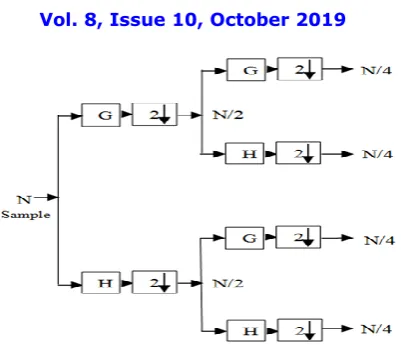
The demonstrate utilized in [9] to actualize the tree structure of Direct Wavelet Packet Transform (DWPT) depends on the separating procedure. Figure 1 portrayed a total 3-level Direct WPT. In this figure G and H is the high pass and low pass channel individually [10].
Calculation period is the wide assortment of the information cycles for one time creates yield tests. In stylish, the calculation length is M= for a j-level DWPT. The span of the 3-arrange calculation is eight. perceive 1, The Sub band Coding set of guidelines for instance, accept that the genuine sign X[n] has N-design focuses, traversing a recurrence band of 0 to π rad/s. At the primary deterioration level, the sign surpassed through the high pass and low detour channels, finished subsampling by means of 2.
Fig. 2: Block Diagram of 2-D DWT
The yield of the high pass sift through has N/2-test factors (subsequently 50% of the time goals) anyway it handiest traverses the frequencies π/2 to π rad/s (thus twofold the recurrence choice) [4].
The yield of the low-sidestep filer also has N/2-test focuses, yet it traverses the contrary portion of the recurrence band, frequencies from 0 to π/2 rad/s. again low and over the top pass channel yield passed by means of the indistinguishable low skip and extreme pass channels for also disintegration [2].
The yield of the second one low jump get out pursued by method for sub inspecting has N/4 tests traversing a recurrence band of zero to π/4 rad/s, and the yield of the second high detour sift through seen by utilizing sub examining has N/4 tests crossing a recurrence band of π/four to π/2 rad/s. the second one over the top detour sifted sign comprises the second phase of DWPT coefficients. This sign has half of the time goals, however multiple times the recurrence choice of the main dimension sign. This procedure proceeds till two examples are left. For this particular occasion there would be three scopes of disintegration, each having half of the scope of tests of the first degree. From the above advances subtleties of DWT is known and now the persistent wavelet change is examined. Here, the discrete wavelet change is transmitted by a constant wavelet change thus a discourse on the persistent wavelet change and its highlights must be made. The persistent wavelet change is a moved form of the wavelet work Ȍ, and the principle capacity of CWT is utilized to partition a constant wavelet capacities into a little wavelet.
The DWT of the first flag is then gotten by linking all coefficients beginning from the last dimension of deterioration (staying two examples, for this situation). The DWT will at that point have indistinguishable number of coefficients from the first flag [5].
III. LITERATUREREVIEW
and reshapes the satellite image. The satellite image is divided into various sub-blocks. After calculate mean values, all number of pixel in sub-block are compared to the mean and according to the mean all pixel value is replaced by binary number. Finally MSE, PSNR and compression ratio are calculated for the Enhance block truncation code for satellite image.
Sunwoong Kim et al. [2016], with the continuing growth of modern communication technologies, demand for image
data compression is increasing rapidly. Systems for accomplishing information pressure can be partitioned into two fundamental methodologies: spatial coding and Transform coding. This examination paper shows a proposed strategy for the pressure of computerized pictures utilizing crossover pressure technique dependent on Block Truncation Coding (BTC) and Walsh Hadamard Transform (WHT). The target of this cross breed approach is to accomplish higher pressure proportion by applying BTC and WHT. A few grayscale test pictures are utilized to assess the coding efficency and execution of the half breed strategy and contrasted and the BTC and WHT individually. It is for the most part demonstrated that the proposed technique gives better outcomes. Preparing reliance in the traditional calculation is expelled by dividing the information picture and changing neighboring reference pixel setup. Trial results demonstrate that the parallel execution definitely lessen preparing time by 6~7 occasions with critical visual quality enhancement.
C. Senthil kumar et al. [2016], In this paper, image compression plays vital role in saving memory storage space and saving time while transmission
images over network. The color and multispectral image is considered as input image for the image compression. The proposed technique with Enhanced Block Truncation Coding [EBTC] is applied on component of color and multispectral image. The component image is divided into various sub blocks. After evaluating mean values, the number of bits can be reduced by Enhanced Block Truncation Coding. Finally, compression ratio table is generated using the parameters such as MSE, SNR and PSNR. The proposed method is implemented through standard color and multispectral images using MATLAB Version 8.1 R2013a.
IV. PROPOSEDMETHODOLOGY
Transmission and storage of raw images require huge quantity of disk space. Hence, there is an urgent need to reduce the size of image before sending or storing.
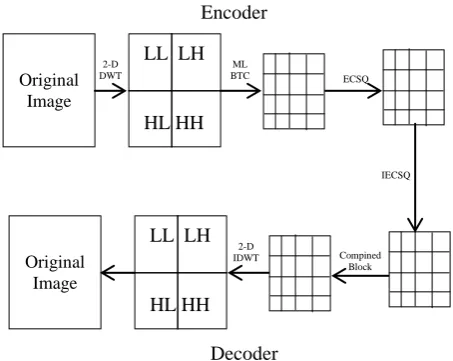
Fig. 3: Proposed Methodology
The best possible solution to the problem is to use compression methods where the compression of data on digital images are made to reduce irrelevance and redundancy of the image data to be able to efficiently store or transmit data.
Encoder
IECSQ
Original Image
2-D IDWT
LL LH
HL HH
Compined Block 2-D
DWT
Original Image
ML BTC
LL LH
HL HH
ECSQ
The greater part of the current pressure strategies utilized have their negatives and an improved method which is quicker, viable and memory proficient can fulfill the necessities of the client.
Discrete Wavelet Transform
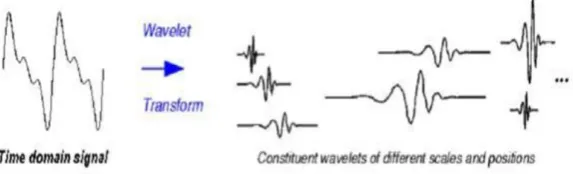
Wavelets are signals which are nearby in time and scale and by and large have a sporadic shape. A wavelet is a waveform of viably restricted length that has a normal estimation of zero. The term 'wavelet' originates from the way that they incorporate to zero; they wave here and there over the hub. Numerous wavelets likewise show a property perfect for minimal flag portrayal: symmetry. This property guarantees that information isn't over spoken to. A flag can be disintegrated into many moved and scaled portrayals of the first mother wavelet. A wavelet change can be utilized to break down a flag into segment wavelets. When this is done the coefficients of the wavelets can be demolished to expel a portion of the subtleties. Wavelets have the extraordinary preferred standpoint of having the capacity to isolate the fine subtleties in a flag. Exceptionally little wavelets can be utilized to separate extremely fine subtleties in a flag, while expansive wavelets can distinguish coarse subtleties. What's more, there are a wide range of wavelets to look over. Various types of wavelets are: Morlet, Daubechies, etc. [6].
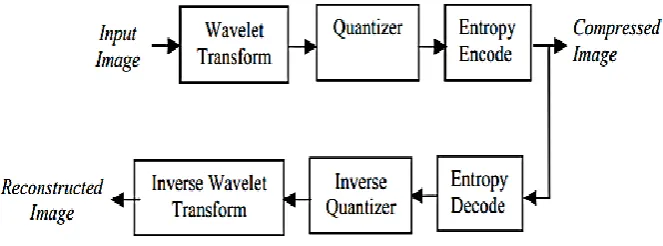
This technique first decomposes an image into coefficients called sub-bands and then the resulting coefficients are compared with a threshold. Coefficients below the threshold are set to zero. At last, the coefficients over the limit esteem are encoded with a misfortune less pressure method. The pressure highlights of a given wavelet premise are basically connected to the general scarceness of the wavelet space portrayal for the flag. The idea behind pressure depends on the idea that the ordinary flag part can be precisely approximated utilizing the accompanying components: few guess coefficients (at an appropriately picked dimension) and a portion of the detail coefficients.
Fig. 4: The structure of the wavelet transform based compression.
The steps of compression algorithm based on DWT are described below:
I. Decompose Choose a wavelet; choose a level N. Compute the wavelet. Decompose the signals at level N. II. Threshold detail coefficients For each level from 1 to N, a threshold is selected and hard thresholding is applied
to the detail coefficients.
III. Reconstruct Compute wavelet reconstruction using the original approximation coefficients of level N and the modified detail coefficients of levels from 1 to N.
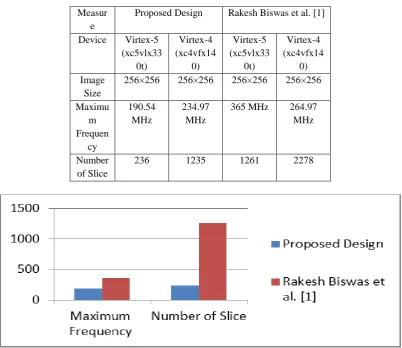
Figure 6 and figure 7 shows the graphical illustration of the performance of proposed method discussed in this research work in term of maximum frequency and number of slice. From the above graphical representation it can be inferred that the proposed algorithm gives the best performance as compared with previous algorithm.
Table I: Comparison of Result with Previous 2-D DWT Implementation
Measur e
Proposed Design Rakesh Biswas et al. [1]
Device Virtex-5 (xc5vlx33
0t)
Virtex-4 (xc4vfx14
0)
Virtex-5 (xc5vlx33
0t)
Virtex-4 (xc4vfx14
0) Image
Size
256×256 256×256 256×256 256×256
Maximu m Frequen
cy
190.54 MHz
234.97 MHz
365 MHz 264.97
MHz
Number of Slice
236 1235 1261 2278
Figure 6: Bar graph of the 5/3 2-D DWT for Vertix-5 device family
VI. CONCLUSION
Such method is suitable in situations where image or image is compressed once but decoded frequently. It is clear that the decoding time due to spatial domain based compression is much less than that of the sub-band compression techniques. In his paper the study of discrete wavelet transform, mult-level block truncation code and error-compensated scalar quantization technique. Further work of this paper is to implement proposed algorithm in MATLAB software and compare result in base paper.
REFERENCES
[1] Rakesh Biswas, Siddarth Reddy Malreddy and Swapna Banerjee, “A High Precision-Low Area Unified Architecture for Lossy and Lossless 3D Multi-Level Discrete Wavelet Transform”, Transactions on Circuits and Systems for Video Technology, Vol. 45, No. 5, May 2017. [2] Shih-Lun Chen and Guei-Shian Wu, “A Cost and Power Efficient Image Compressor VLSI Design with Fuzzy Decision and Block Partition
[3] Sunwoong Kim and Hyuk-Jae Lee, “RGBW Image Compression by Low-Complexity Adaptive Multi-Level Block Truncation Coding”, IEEE Transactions on Consumer Electronics, Vol. 62, No. 4, November 2016.
[4] C. Senthil kumar, “Color and Multispectral Image Compression using Enhanced Block Truncation Coding [E-BTC] Scheme”, accepted to be presented at the IEEE WiSPNET, PP. 01-06, 2016 IEEE.
[5] Jing-Ming Guo, Senior Member, IEEE, and Yun-Fu Liu, Member, IEEE, “Improved Block Truncation Coding Using Optimized Dot Diffusion”, IEEE Transactions on Image Processing, Vol. 23, No. 3, March 2014.
[6] Jayamol Mathews, Madhu S. Nair, “Modified BTC Algorithm for Gray Scale Images using max-min Quantizer”, 978-1-4673-5090-7/13/$31.00 ©2013 IEEE.
[7] M. Brunig and W. Niehsen. Fast full search block matching. IEEE Transactions on Circuits and Systems for Video Technology, 11:241 – 247, 2001.
[8] K. W. Chan and K. L. Chan. Optimisation of multi-level block truncation coding. Signal Processing: Image Communication, 16:445 – 459, 2001.
[9] Ki-Won Oh and Kang-Sun Choi, “Parallel Implementation of Hybrid Vector Quantizerbased Block Truncation Coding for Mobile Display Stream Compression”, IEEE ISCE 2014 1569954165.