
Adaptively Single-key Secure Constrained PRFs for
NC
1 Nuttapong Attrapadung1, Takahiro Matsuda1, Ryo Nishimaki2,Shota Yamada1, Takashi Yamakawa2
1National Institute of Advanced Industrial Science and Technology (AIST), Tokyo, Japan
{n.attrapadung,t-matsuda,yamada-shota}@aist.go.jp
2NTT Secure Platform Laboratories, Tokyo, Japan
{ryo.nishimaki.zk,takashi.yamakawa.ga}@hco.ntt.co.jp
April 3, 2019
Abstract
We present a construction of an adaptively single-key secure constrained PRF (CPRF) for NC1 assuming the existence of indistinguishability obfuscation (IO) and the subgroup hiding assumption over a (pairing-free) composite order group. This is the first construction of such a CPRF in the standard model without relying on a complexity leveraging argument.
Contents
1 Introduction 1
1.1 Background . . . 1
1.2 Our Contribution . . . 2
1.3 Design Idea and Technical Overview . . . 2
1.4 Discussion . . . 6
1.5 Other Related Work . . . 7
2 Preliminaries 7 2.1 Composite Order Group . . . 8
2.2 Balanced Admissible Hash Functions and Related Facts . . . 9
2.3 Constrained Pseudorandom Functions . . . 10
2.4 Indistinguishability Obfuscation . . . 12
3 Partitionable Constrained Pseudorandom Function 13 3.1 Definition . . . 13
3.2 Construction . . . 14
3.3 Security of Our Partitionable CPRF . . . 16
4 Adaptively Single-key Secure CPRF 27 4.1 Construction . . . 27
1
Introduction
1.1 Background
Constrained pseudorandom function (CPRF) [BW13]1is a PRF with an additional functionality to “constrain” the ability of a secret key. A constrained key associated with a boolean functionf enables us to compute a
PRF value on inputsxsuch thatf(x) = 0.2 Security of CPRF roughly requires that for a “challenge input”x∗
such thatf(x∗) = 1, the PRF value onx∗remains pseudorandom givenskf. There are many applications of
CPRFs including broadcast encryption [BW13], attribute-based encryption (ABE) [AMN+18], identity-based
non-interactive key exchange [BW13], and policy-based key distribution [BW13].
Since the proposal of the concept of CPRF, there have been significant progresses in constructing CPRFs [BW13, KPTZ13, BGI14, BZ14, BFP+15, BV15, DKW16, AFP16, Bit17, GHKW17, BLW17, BKM17,
CC17b,BTVW17,PS18,AMN+18]. However, most known collusion-resistant3CPRFs (e.g., [BW13]) only
satisfy weaker security called “selective-challenge” security, where an adversary must declare a challenge input at the beginning of the security game. In the single-key setting where an adversary is given only one constrained key (e.g., [BV15]), we often consider “selective-constraint” security where an adversary must declare a constraint for which it obtains a constrained key at the beginning of the security game whereas it is allowed to choose a challenge input later.4 In a realistic scenario, adversaries should be able to choose a constraint and a challenge input in an arbitrary order. We call such security “adaptive security”.
An easy way to obtain an adaptively secure CPRF is converting selective-challenge secure one into adaptively secure one by guessing a challenge input with a standard technique typically called complexity leveraging. However, this incurs an exponential security loss, and thus we have to rely on sub-exponential assumptions. We would like to avoid this to achieve better security. In the random oracle model, Hofheinz, Kamath, Koppula, and Waters [HKKW19] constructed an adaptively secure collusion-resistant CPRF for all circuits without relying on complexity leveraging based on indistinguishability obfuscation (IO) [BGI+12,
GGH+16], and Attrapadung et al. [AMN+18] constructed an adaptively single-key secure CPRF forNC1on
pairing-free groups. However, the random oracle model has been recognized to be problematic [CGH04]. There are a few number of adaptively secure CPRFs in the standard model. Hohenberger, Koppula, and Waters [HKW15] constructed an adaptively secure puncturable PRF based on IO and the subgroup hiding assumption on a composite order group.5 Very recently, Davidson et al. [DKNY18] constructed an adaptively secure CPRF for bit-fixing functions secure against a constant number of collusion based on one-way functions. However, these schemes only support puncturing functions or bit-fixing functions which are very limited functionalities, and there is no known construction of adaptively secure CPRF for a sufficiently expressive function class (e.g.,NC1or all polynomial-size circuits) even in the single-key setting and even with IO.
1It is also known as delegatable PRF [KPTZ13] and functional PRF [BGI14].
2We note that the role of the constraining functionfis “reversed” from the definition by Boneh and Waters [BW13], in the sense
that the evaluation by a constrained keyskfis possible for inputsxwithf(x) = 1in their definition, while it is possible for inputsx
forf(x) = 0in our paper. Our treatment is the same as Brakerski and Vaikuntanathan [BV15].
3A CPRF is called collusion-resistant if it remains secure even if adversaries are given polynomially many constrained keys. 4In previous works, both selective-challenge and selective-constraint security are simply called selective security. We use different names for them for clarity.
5More precisely, they also generalized their construction to obtain a CPRF fort-puncturing functions, which puncture the input
1.2 Our Contribution
In this study, we achieve an adaptively single-key secure CPRF forNC1assuming the existence of IO and the
subgroup hiding assumption over a (pairing-free) composite order group. This is the first construction of such a CPRF in the standard model without relying on the complexity leveraging technique.
We emphasize that using IO isnot an easy solutionto achieve adaptive security even in the single-key
setting, although IO is a strong cryptographic tool (a.k.a. “heavy hammer”). All CPRFs for a sufficiently expressive class based on IO in the standard model do not achieve adaptive security if we do not rely on complexity leveraging [BZ14,BLW17,AFP16,DKW16,DDM17].
1.3 Design Idea and Technical Overview
In this section, we give an overview of our design idea and technique.
Toward adaptive security: partitioning technique. Our construction is based on a technique called the
partitioning technique, which has been widely used to achieve adaptive security in the context of signature, identity-based encryption, verifiable random function etc. [BB04,Wat05,CHKP12,Jag15,Yam17]. Roughly speaking, in the partitioning technique, a reduction algorithm partitions the input space into two disjoint spaces, the challenge space and the simulation space, so that it can compute PRF values on all inputs in the simulation space whereas it cannot compute it on any input in the challenge space. More specifically, the input space is partitioned via an admissible hash functiondenoted by h : {0,1}n → {0,1}m and a
partitioning policyu∈ {0,1,⊥}mwhere{0,1}nis the input space.6 We partition the input space{0,1}nso
thatx∈ {0,1}nis in the challenge space ifP
u(h(x)) = 0and it is in the simulation space ifPu(h(x)) = 1,
wherePuis defined by
Pu(y) =
(
0 If for alli∈[m], ui =⊥ ∨ yi =ui
1 Otherwise ,
where yi and ui are the i-th bit of y and u, respectively. If we chooseu according to an appropriate
distribution (depending on the number of evaluation queries), the probability that all evaluation queries fall in the simulation space and a challenge query falls in the challenge space is noticeable, in which case, a reduction algorithm works well. The crucial feature of this technique is that a reduction algorithm need not know a challenge query at the beginning of its simulation.
Though it may seem easy to construct adaptively secure CPRFs based on the above idea, it is not the case because we also have to simulate constrained keys in security proofs of CPRFs. Indeed, Hofheinz et al. [HKKW19] observed that the partitioning technique does not seem to work for constructing collusion-resistant CPRFs. Nonetheless, we show that it works in the case of single-key secure CPRFs by using apartitionable CPRFwhich we introduce in this study.
Partitionable CPRF. Intuitively, a partitionable CPRF is a CPRF with an additional functionality that
enables us to generate a “merged” key from two independent master keys and a partitioning policyu. The
behavior of a merged key depends on whether an input is in the challenge space or in the simulation space. Namely, if we mergemsk0andmsk1with a partitioning policyuto generate a merged keyk[msk0,msk1, u],
then it works similarly tomsk0for inputsxin the challenge space, andmsk1 for inputsxin the simulation
master secret key used in actual constructions and the latter is an artificial key that only appears in security proofs.
For a partitionable CPRF, we require two properties. First, we require that it satisfy selective-constraint no-evaluation security as a CPRF, where an adversary must declare its unique constraining query at the beginning of the security game and does not make any evaluation queries. Here, it is important that in this security notion, an adversary is allowed toadaptivelychoose a challenge query. Second, we require
a property called the partition-hiding, which means thatk[msk0,msk1, u]does not revealu. In particular, k[msk0,msk1,⊥m], which works exactly the same as msk0, is computationally indistinguishable from k[msk0,msk1, u].
Adaptively secure CPRF from partitionable CPRF. Now, we take a closer look at how we construct an
adaptively single-key secure CPRF based on a partitionable CPRF and IO. Master secret keys and PRF values of the CPRF are defined to be exactly the same as those of the underlying partitionable CPRF. The only difference between them is the way of generating constrained keys. In the proposed CPRF, a constrained key for a functionf is an obfuscated program that computes PRF values on all inputsxsuch thatf(x) = 0with a
real master secret key.
The security proof proceeds as follows. First, we remark that if a challenge query is made before the constraining query, then the proof is easy by the standard puncturing technique [SW14,BZ14]. Thus, in the following, we assume that a challenge query is made after the constraining query. First, we modify the security game so that we usek[msk0,msk1,⊥m]instead ofmsk0wheremsk1is a “shadow” master secret
key that is independent frommsk0. This modification causes a negligible difference by the security of
IO becausek[msk0,msk1,⊥m]works exactly the same asmsk0. Then we replacek[msk0,msk1,⊥m]with k[msk0,msk1, u]for a partitioning policyuchosen from an appropriate distribution. This modification causes
a negligible difference by the partition-hiding of the underlying partitionable CPRF. Here, suppose that all evaluation queries are in the simulation space, and the challenge queryx∗is in the challenge space. Such an
event occurs with noticeable probability by the way we chooseu. In this case, all evaluation queries can be
simulated by using the shadow master secret keymsk1whereas a challenge value is computed by using the
real secret keymsk0. Then we modify a constrained keyskf associated with a functionfso that we hardwire
skrealf , which is a constrained key associated with the function f derived frommsk0 by the constraining
algorithm of the underlying partitionable CPRF, instead ofmsk0. This modification causes a negligible
difference by the security of IO sinceskrealf andmsk0work similarly on inputsxsuch thatf(x) = 0. At this
point, a PRF value onx∗ such thatf(x∗) = 1is pseudorandom by the selective-constraint no-evaluation
security of the underlying partitionable CPRF (Recall thatmsk0 is not used for simulating the evaluation
oracle now). This completes the proof of the adaptive single-key security of the CPRF.
Partitionable CPRF for puncturing [HKW15]. What is left is a construction of a partitionable CPRF.
First, we observe that the construction of adaptively secure puncturable PRF by Hohenberger et al. [HKW15] can be seen as a construction of a partitionable CPRF for puncturing functions. Their construction is a variant of the Naor-Reingold PRF [NR04] on a composite order groupG=Gp×Gqof an orderN =pq. Namely, a
master secret keymskhkw consists ofsi,b∈ZN fori∈[m]andb∈ {0,1}, and their PRFFhkw is defined as
Fhkw(mskhkw, x) :=g
Qm i=1si,yi.
Here,gis a generator ofGandyiis thei-th bit ofy := h(x), wherehis an admissible hash function. A
x 6=x∗. They implicitly proved that the above construction is a partitionable CPRF for puncturing if we
definek[msk0,msk1, u]to be an obfuscation of a program that computesFhkw(mskPu(x), x)on an inputx. We remark that we cannot directly reduce the partition-hiding property to the security of IO because the functionality ofk[msk0,msk1,⊥m]andk[msk0,msk1, u]differ on exponentially many inputs. They overcome
this problem by sophisticated use of the subgroup hiding assumption on a composite order group. Namely, we can prove that this construction satisfies the partition-hiding under the security of IO and the subgroup hiding assumption, which claims that random elements ofGpandGare computationally indistinguishable. Then if we can prove the above construction is a selective-constraint no-evaluation secure CPRF for a function classF, then we obtain an adaptively single-key secure CPRF for the function classFas discussed in the previous paragraph. One may think that it is easy to prove that the above construction is selective-constraint no-evaluation secure for all circuits by using the standard puncturing technique with IO [SW14, BZ14]. However, it is not the case because the selective-constraint security requires security against an adversary that makes a challenge query after making a constraining query. Though IO is quite powerful when considering selective-challenge security where an adversary declares a challenge query at the beginning, it is almost useless for selective-constraint security where an adversary may adaptively choose a challenge query. For the case of puncturable PRF, a challenge input is automatically determined when a constraining query is made, and thus selective-constraint security is equivalent to selective-challenge security. This is why they achieved adaptive security only for a puncturable PRF.
Partitionable CPRF for NC1. Finally, we explain how to construct a partitionable CPRF forNC1. Our
idea is to combine Hohenberger et al.’s construction as described above and the selective-constraint no-evaluation secure CPRF forNC1recently proposed by Attrapadung et al. [AMN+18]. The construction of
Attrapadung et al.’s CPRFFamnyy (instantiated on a composite order groupG=Gp×Gq) is described as
follows.
Famnyy(mskamnyy, x) =gU(~b,x)/α
wheremskamnyy = (~b∈Zz
N, α∈ZN)is a master secret key andU(·)is a polynomial that works as a universal
circuit forNC1. We omit a description of constrained keys for this CPRF since this is not important in this
overview (See Section3.2for details). They proved thatFamnyysatisfies selective-constraint no-evaluation
security under theL-DDHI assumption7, which can be reduced to the subgroup hiding assumption (See
Lemma2.3). An important fact is that their CPRF is secure against adversaries that adaptively make a challenge query as long as a constraining query is declared at the beginning and they do not make any evaluation queries.
Then we combineFamnyyandFhkw to defineFoursas follows:
Fours(mskours, x) =g(
Qm
i=1si,yi)·U(~b,x)/α,
where x is an input, yi is the i-th bit of h(x), h is an admissible hash function, and mskours =
(~b, α,{si,b}i∈[m],b∈{0,1})is a master secret key. A constrained key for a predicatef consists of that ofFamnyy
and{si,b}i∈[m],b∈{0,1}. It is easy to see that this constrained key can be used to evaluateFours(mskours, x)for
allxsuch thatf(x) = 0since we have
Fours(mskours, x) =Famnyy(mskamnyy, x)
Qm i=1si,yi
7It assumes that{(G, g,(gβi)
i∈[L], g1/β)} ≈c{(G, g,(gβ i
)i∈[L], ψ1)}holds, whereG= (N,G,Gp,Gq, g1, g2),G,Gp, and
Gqare groups of orderN,p, andq, respectively,g,g1, andg2are generators ofG,Gp, andGq, respectively, andψ1
R
wheremskamnyy := (~b, α). By this equation, it is also easy to see that the selective-constraint no-evaluation
security ofFours can be reduced to that of Famnyy. A merged key is an obfuscated circuit that computes Eval(mskPu(h(x)), x)wheremsk0 = (~b, α,{si,b}i∈[m],b∈{0,1})andmsk1 = (
ˆ
~b,α,ˆ {sˆi,b}i∈[m],b∈{0,1})are two
independent master secret keys anduis a partitioning policy embedded into the merged key.
Now, we look at why the construction satisfies partition-hiding. Intuitively, a partitioning policyuis
hidden because it is hardwired in an obfuscated circuit. However, since the functionality ofk[msk0,msk1,⊥m]
andk[msk0,msk1, u]differ on exponentially many inputs, we cannot directly argue indistinguishability of
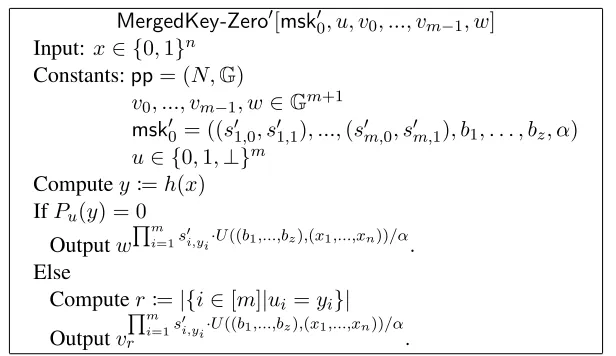
them based on the security of IO. In the following, we explain how to prove it relying on the subgroup hiding assumption. Roughly speaking, this consists of two parts. In the first part, we modify the way of computing PRF values inside a merged key (which is an obfuscated program) so that it uses a different way to compute them on inputs in the challenge space and on those in the simulation space. In the second step, we make a shadow copy of the real master key by using the Chinese remainder theorem.
First, to modify the way of computing PRF values inside a merged key, we use the (m−1)-DDH
assumption, which claims that we have{(G, g,(gβi)
i∈[m−1], gβ
m
)} ≈c {(G, g,(gβ
i
)i∈[m−1], ψ1)}, where
G = (N,G,Gp,Gq, g1, g2),G,Gp, andGqare groups of orderN,p, andq, respectively,g,g1, andg2 are
generators ofG,Gp, andGq, respectively, andψ1
R
←G. As shown in Lemma2.3, this assumption can be reduced to the subgroup hiding assumption. Recall that the partitioning policyPu(y)outputs0(i.e.,xis
in the challenge space) if for alli,ui =yi∨ui =⊥. Here, we setsi,η := βs0i,η ∈ ZN for all(i, η)such
thatui =⊥orη =ui, wheres0i,η is a uniformly random andβ comes from the (m−1)-DDH instance.
The distributions of si,η set as above are statistically close to the original ones. Now, a merged key uses
the(m−1)-DDH challengew∈G(which isgβm or random) for simulating a PRF value on an inputxin
the challenge space. That is, it computes the PRF value onxasw(
Qm i=1s
0
i,yi)·U(~b,x)/α. On the other hand, on inputsxin the simulation space, it uses the values(g, gβ, . . . , gβm−1) in the(m−1)-DDH problem
instances as (gβr)(
Qm i=1s
0
i,yi)·U(~b,x)/α, wherer := |{i ∈ [m] |ui = yi}| ≤ m−1. If w = gβm, then a merged key as modified above correctly computes PRF values on all inputs. Thus, this modification causes a negligible difference by the security of IO. Then we can replacewwith a random element inGby using the
(m−1)-DDH assumption.
Now, we use the subgroup hiding assumption to make a shadow copy of the real master key. By the subgroup hiding assumption, we can replacew ∈ Gandg ∈Gwithw ∈ Gp andg ∈ Gq, respectively,
where G (resp. Gp, Gq) is a group of order N = pq (resp. p, q) and p, q are primes.8. Then, we
can set msk0 := {s0i,bmodp}i,b and msk1 := {s0i,bmodq}i,b. Since w ∈ Gp and gβ
j
∈ Gq where j∈ {1, . . . , m−1}, it holds that
w(
Q
s0i,yi)·U(~b,x)/α
=w((
Q
s0i,yi)·U(~b,x)/αmodp)
(gβj)(
Qs0
i,yi)·U(~b,x)/α= (gβj)((
Qs0
i,yi)·U(~b,x)/αmodq)
and this change is indistinguishable due to the security of IO. Lastly, by the Chinese remainder theorem,msk0
andmsk1are independently and uniformly random (that is,msk1can be changed into{sˆi,bmodq}i,b where
ˆ
si,bare independent ofs0i,band uniformly random). Now, the shadow master secret key is used for evaluating
PRF values on inputs in the challenge space whereas the real master secret key is used for evaluating those on inputs in the simulation space as desired.
By these techniques, we can obtain a partitionable CPRF forNC1based on IO and the subgroup hiding
assumption in pairing-free groups though we omit many details for simplicity in this overview.
In summary, we can obtain an adaptively single-key secure CPRF forNC1 by combining the above
partitionable CPRF forNC1 based on IO and the subgroup hiding assumption with the transformation from a
partitionable CPRF into an adaptively secure CPRF explained in the paragraph of “Adaptively secure CPRF from partitionable CPRF”.
1.4 Discussion
Why subgroup-hiding needed? One may wonder why we need the subgroup hiding assumption as an extra
assumption though we rely on IO, which is already a significantly strong assumption. We give two reasons for this below. The first reason is that we do not know how to construct a CPRF withselective-constraint
security (even in the single-key setting) from IO though we can construct collusion-resistant CRPF with
selective-challengesecurity from IO [BZ14]. In the CPRF based on IO, a constrained key is an obfuscated
program that evaluates the PRF on inputs that satisfy the constraint. In the security proof, we puncture the obfuscated program on the challenge input by using the security of IO. This argument is crucially based on the fact that the challenge is given before all constraining queries, and cannot be used in the selective-constraint setting where the challenge is chosen after a constrained key is given. Since our security definition of partitionable CPRF requires selective-constraint security, it seems difficult to construct it from IO. We note that selective-constraint security (rather than selective-challenge security) of partitionable CPRF is crucial to prove the adaptive security of our final CPRF. The second reason is specific to the security proof of our partitionable CPRF. Namely, in the proof of the partition-hiding property of our partitionable CPRF, we have to modify outputs of an obfuscated circuit (which is a constrained key) on exponentially many inputs. Since the security of IO only enables us to modify an obfuscated circuit only on one input, it would need an exponential number of hybrids to modify outputs on exponentially many inputs if we just use the security of IO. We overcome this issue by sophisticated use of the subgroup hiding assumption in a similar way to the work by Hohenberger et al. [HKW15]. We note that in this technique, the Chinese remainder theorem is essential, and we cannot replace the assumption with the decisional linear (DLIN) assumption on a prime-order group, though there are some known prime-to-composite-order conversions in some settings [Fre10,SC12,Lew12,HHH+14].
Why single-key security for NC1? One may wonder why our adaptive CPRF only achieves single-key
security rather than collusion-resistance and supportsNC1 rather than all polynomial-size circuits (P/poly)
though there seems to be no obvious attack against our CPRF even if an adversary is given multiple constrained keys for constraints possibly outsideNC1.9 In fact, we can prove that our CPRF is collusion-resistant and
supportsP/polyin the selective-challenge setting by the puncturing technique similarly to [BZ14]. However,
in the security of adaptive security, we crucially rely on the selective-constraint security of the underlying partitionable CPRF, which stems from the CPRF by Attrapadung et al. [AMN+18]. Since their CPRF
only achieves single-key security and supports NC1, our CPRF inherits them. Possible alternatives to
their CPRF are lattice-based CPRFs [BV15,BTVW17,PS18] which satisfy selective-constraint single-key security and supportsP/poly. If we could use these CPRFs instead of Attrapadung et al.’s scheme, we would
obtain adaptively single-key secure CPRFs for P/poly. However, since we use techniques based on the
subgroup-hiding assumption in the proof of the partition-hiding property of our partitionable CPRF, we have to rely on group-based CPRFs for compatibility to the technique, and this is the reason why we cannot use lattice-based CPRFs.
9We note that even if the underlying partitionable CPRF only supportsNC1, we can naturally define a constrained key for a
function outsideNC1in the CPRF given in Section4because a function class supported by the partitionable CPRF matters only in
Relation with private CPRF. Partitionable CPRF and private CPRF [BLW17] share a similarity that
both enable one to modify functionality of a PRF key without revealing inputs on which outputs were manipulated. Actually, a partitionable CPRF can be seen as a private CPRF for the “admissible hash friendly” functionality [GHKW17]. On the other hand, the inverse is not true. Private CPRF does not put any restriction on behaviors of a constrained key on inputs that do not satisfy the constraint except that they look random. On the other hand, partitionable CPRF requires behaviors on these inputs should be consistent in the sense that they are PRF values evaluated on another master secret key. This difference makes it more difficult to construct a partitionable CPRF than constructing a private CPRF.
1.5 Other Related Work
Here, we discuss two additional related works that are relevant to adaptively secure CPRFs.
Fuchsbauer, Konstantinov, Pietrazk, and Rao [FKPR14] proved that the classical GGM PRF [GGM86] is an adaptively secure puncturable PRF if the underlying PRG is quasi-polynomially secure. We note that quasi-polynomially-secure PRG is a super-polynomial hardness assumption.
Canetti and Chen [CC17a] proposed a lattice-based construction of (constraint-hiding) single-key secure CPRF for NC1 that achieves a weaker form of adaptive security where adversaries are allowed to send logarithmicallymany evaluation queries before a constraining query as long as it correctly declares if the
evaluation query satisfies the constraint to be queried as a constraining query. We note that in the proceedings version [CC17b], they claimed security against adversaries that make an unbounded number of evaluation queries before a constraining query, but they retracted the claim [CC17a, footnotes 1 and 2]. We remark that the adaptive security defined in this paper does not put any restriction on the number of evaluation queries before a constraining query nor require adversaries to declare if the evaluation query satisfies the constraint to be queried as a constraining query.
Organization. The rest of the paper is organized as follows. After introducing notations, security
definitions, and building blocks in Section2, we present the definition of partitionable CPRF, our construction of partitionable CPRF forNC1, and its security proofs in Section3, and our adaptively single-key secure
CPRFs forNC1and its security proofs in Section4.
2
Preliminaries
In this section, we review the basic notation and the definitions for complexity assumptions, tools, and cryptographic primitives.
Basic notation. We denote byNthe set of all natural numbers. If n ∈ N, then “[n]” denotes the set {1, . . . , n}. We denote by “x:=y” thatyis deterministically assigned tox. IfSis a finite set, then “x←R S”
denotes thatxis chosen uniformly at random fromS. IfDandD0are distributions (over some set), then “x ← DR ” denotes thatxis chosen according to the distributionD, and “D ≈c D0” denotes that the two
distributions are computationally indistinguishable. Ifxandyare bit-strings, then we denote by “xky” the
concatenation ofxandy, and “(x =? y)” is defined to be1ifx = y and0otherwise. “PPT” stands for probabilistic polynomial time. IfAis a probabilistic algorithm, then “y← AR (x)” denotes thatAcomputes and outputsyby takingxas input and using an internal randomness that is chosen uniformly at random. If
functionf(·) :N→[0,1]is said to benegligibleif for all polynomialsp(·)and all sufficiently largeλ∈N, we have f(λ) <1/p(λ). The functionf isnoticeablewhen there exists a polynomialp(·) such that we
havef(λ) ≥ |1/p(λ)|for all sufficiently largeλ. Throughout the paper, we use “λ” to denote a security
parameter (which is given to algorithms always in the unary form1λ). We denote by “poly(·)” an unspecified
integer-valued positive polynomial ofλand by “negl(λ)” an unspecified negligible function ofλ. For setsD andR, “Func(D,R)” denotes the set of all functions with domainDand rangeR.
2.1 Composite Order Group
In this paper, in a similar manner to Hohenberger et al. [HKW15], we will use a group of composite order in which the subgroup hiding assumption holds. We recall it here.
LetGGenbe a PPT algorithm (called thegroup generator) that takes a security parameter1λ as input,
and outputs(N, p, q,G,Gp,Gq, g1, g2), wherep, q∈Ω(2λ),N =pq,Gis a cyclic group of orderN,Gp
andGq are the subgroups ofGof orderspandqrespectively, andg1 andg2 are generators ofGp andGq
respectively. The subgroup hiding assumption with respect toGGenis defined as follows:
Definition 2.1 (Subgroup Hiding Assumption).LetGGenbe a group generator. We say that thesubgroup
hidingassumption holds with respect toGGen, if for all PPT adversariesA, the advantageAdvsghGGen,A(λ) defined below is negligible:
AdvsghGGen,A(λ) :=
Pr[A(G, ψ0) = 1]−Pr[A(G, ψ1) = 1] ,
where(N, p, q,G,Gp,Gq, g1, g2)
R
←GGen(1λ),G:= (N,G,Gp,Gq, g1, g2),ψ0
R
←G, andψ1
R ←Gp.
For our purpose in this paper, it is convenient to introduce the following L-DDH10 and L-DDHI
assumptions with respect toGGen. These are not additional assumptions since they are implied by the
subgroup hiding assumption. For completeness, we give a proof sketch of the implications (using a reduction shown by Hohenberger et al. [HKW14]).
Definition 2.2 (L-DDH &L-DDHI Assumptions).LetGGenbe a group generator andL=L(λ) = poly(λ). We say that theL-decisional Diffie-Hellman (L-DDH)assumption holds with respect toGGen, if for all PPT adversariesA, the advantageAdvLGGen-ddh,A(λ)defined below is negligible:
AdvLGGen-ddh,A(λ) :=
Pr[A(G, g,(g
αi
)i∈[L], ψ0) = 1]−Pr[A(G, g,(gα
i
)i∈[L], ψ1) = 1]
,
where (N, p, q,G,Gp,Gq, g1, g2)
R
← GGen(1λ), G := (N,G,Gp,Gq, g1, g2), g
R
← G, α ←R Z∗
N, ψ0 :=
gαL+1, andψ1
R ←G.
TheL-decisional Diffie-Hellman inversion (L-DDHI)assumption with respect toGGenis defined in the same way as the above, except that “ψ0:=gα
L+1
” is replaced with “ψ0 :=g1/α”.
Lemma 2.3.LetGGenbe a group generator. If the subgroup hiding assumption holds with respect toGGen, then theL-DDH andL-DDHI assumptions hold with respect toGGenfor all polynomialsL=L(λ).
Proof Sketch of Lemma2.3. Let GGen be a group generator. Firstly, it was shown by Hohenberger et
al. [HKW14, Theorem B.1] that the subgroup hiding assumption implies theL-DDH assumption for all
polynomialsL=L(λ).
Secondly, it is straightforward to see that for all L = L(λ) = poly(λ), the L-DDH assumption
and theL-DDHI assumption are equivalent. Specifically, given an instance of theL-DDHI assumption (G, g,(gαi)i∈[L], ψ)whereψis eitherg1/αor a random element inG, leth:=gα
L
andβ:= 1/α. Then, we
have the correspondencehβi =gαL−i for everyi∈[L+ 1]. Thus,(G, g,(gαi)i∈[L], ψ)can be rearranged
as(G, h,(hβi)i∈[L], ψ)with an appropriate reordering, which is distributed identically to an instance of the
L-DDH assumption. Note thatψequals tog1/αor a random group element, and we haveψ=hβL+1 if the
former is the case. Hence, an adversary that can break theL-DDHI assumption can be directly used as an
adversary that can break theL-DDH assumption. The opposite implication can be established in a similar
way.
Hence, combining the above two arguments, we can conclude that the subgroup hiding assumption implies theL-DDH andL-DDHI assumptions for allL=L(λ) = poly(λ).
2.2 Balanced Admissible Hash Functions and Related Facts
Here, we describe the definition of a balanced admissible hash function (AHF) introduced by Jager [Jag15]. A balanced AHF is an extension of an ordinary AHF [BB04,CHKP12], but with some more properties. Similarly to an ordinary AHF, it partitions the input space in a security proof so that the simulation is possible with a noticeable probability. The reason why we use a balanced AHF instead of an ordinary AHF is that the former simplifies our security proof. We note that the following formalization of a balanced AHF is slightly different from that by Jager [Jag15] and corresponds to a special case of the general notion of “a partitioning function" introduced by Yamada [Yam17].
Definition 2.4 ([Jag15,Yam17]).Letn(λ)andm(λ)be polynomials. Furthermore, foru∈ {0,1,⊥}m, let
Pu:{0,1}m → {0,1}be defined as
Pu(y) =
(
0 If for alli∈[m], ui =⊥ ∨ yi =ui
1 Otherwise ,
whereyi andui are thei-th bit ofy andu, respectively. We say that an efficiently computable function
h:{0,1}n→ {0,1}mis a balanced admissible hash function (balanced AHF), if there exists an efficient
algorithmAdmSample(1λ, Q, δ), which takes as input(Q, δ)whereQ=Q(λ)∈Nis polynomially bounded andδ=δ(λ)∈(0,1]is noticeable, and outputsu∈ {0,1,⊥}msuch that:
1. There existsλ0∈Nsuch that
Prhu←R AdmSample(1λ, Q(λ), δ(λ)) : u∈ {0,1}mi= 1
for allλ > λ0. Here,λ0may depend on functionsQ(λ)andδ(λ).
2. Forλ > λ0 (defined in Item1), there existγmax(λ)andγmin(λ)that depend onQ(λ)andδ(λ)such that for allx1, ..., xQ, x∗∈ {0,1}nwithx∗6∈ {x1, ..., xQ},
γmax(λ)≥Pr [Pu(h(x1)) =...=Pu(h(xQ)) = 1∧Pu(h(x∗)) = 0]≥γmin(λ)
whereγmax(λ)andγmin(λ)satisfy that the functionτ(λ)defined as
τ(λ) =γmin(λ)·δ(λ)−
γmax(λ)−γmin(λ) 2
Remark2.5. The termτ(λ)defined above may appear very specific. However, as discussed by Jager [Jag15],
such a term appears typically in security analyses that follow the approach of Bellare and Ristenpart [BR09]. See also Lemma2.6below.
As shown by Jager [Jag15], who extended previous works that gave simple constructions of AHF [Lys02,FHPS13], a family of codesh:{0,1}n→ {0,1}mwith minimal distancemcfor a constantcis a
balanced AHF. Explicit constructions of such codes are known [SS96,Zém01,Gol08]. The following lemma is adapted from Lemma 8 in the paper by Katsumata et al. [KY16] (see also Lemma 28 in the full version of the paper by Agrawal et al. [ABB10]), and is implicit in many previous works [BR09,Jag15,Yam16]. The lemma encapsulates the change of the advantage of an adversary when there is an abort in the security proof. Note that although the lemma is shown only in the specific case of IBE in the paper by Katsumata et al. [KY16], the same proof works in the following slightly generalized setting as well.
Lemma 2.6.Let us consider a random variablecoin← {R 0,1}and a random distributionDthat takes as input a bitb∈ {0,1}and outputs(X,coin)d such thatX∈ X andcoind ∈ {0,1}, whereX is some domain.
ForD, we define0as
0 :=
Prhcoin← {R 0,1},(X,coin)d R
← D(coin) : coind =coin i
− 1
2
Let us define a map γ that maps an element inX to a real value in[0,1]. We then further consider the following modified distributionD0 that takes as input a bitb ∈ {0,1}and outputs(X,coin). To sampled
fromD0(b), we first sample (X,coin)d R
← D(b). Then, with probability 1−γ(X), we re-sample coind as
d
coin← {R 0,1}. With probabilityγ(X), the value ofcoind is unchanged. The final output ofD0(b)is(X,coin).d
Then, the following holds.
Prhcoin← {R 0,1},(X,coin)d R
← D0(coin) : coind =coin i
−1
2
≥γmin·0−
γmax−γmin 2
whereγminandγmaxare the maximum and the minimum ofγ(X)taken over all possibleX ∈ X, respectively.
2.3 Constrained Pseudorandom Functions
Here, we recall the syntax and security definitions for a CPRF. We use the same definitions as Attrapadung et al. [AMN+18].
Syntax. LetF ={Fλ,k}λ,k∈Nbe a class of functions11where eachFλ,kis a set of functions with domain
{0,1}kand range{0,1}, and the description size (when represented by a circuit) of every function inF λ,kis
bounded bypoly(λ, k).
A CPRF for F consists of the five PPT algorithms(Setup,KeyGen,Eval,Constrain,CEval) with the
following interfaces:
Setup(1λ)→R pp: This is the setup algorithm that takes a security parameter 1λ as input, and outputs
a public parameterpp,12 where ppspecifies the descriptions of the key spaceK, the input-length n=n(λ) = poly(λ)(that defines the domain{0,1}n), and the rangeR.
11In this paper, a “class of functions” is a set of “sets of functions”. EachFλ,kinFconsidered for a CPRF is a set of functions
parameterized by a security parameterλand an input-lengthk.
KeyGen(pp)→R msk: This is the key generation algorithm that takes a public parameterppas input, and
outputs a master secret keymsk∈ K.
Eval(pp,msk, x) =:y: This is the deterministic evaluation algorithm that takes a public parameterpp, a
master secret keymsk∈ K, and an elementx∈ {0,1}nas input, and outputs an elementy∈ R.
Constrain(pp,msk, f)→R skf: This is the constraining algorithm that takes as input a public parameterpp,
a master secret keymsk, and a functionf ∈ Fλ,n, wheren =n(λ) = poly(λ)is the input-length
specified bypp. Then, it outputs a constrained keyskf.
CEval(pp,skf, x) =:y: This is the deterministic constrained evaluation algorithm that takes a public
parameterpp, a constrained keyskf, and an elementx ∈ {0,1}nas input, and outputs an element
y∈ R.
Whenever clear from the context, we will dropppfrom the inputs ofEval,Constrain, andCEval, and the
executions of them are denoted as “Eval(msk, x)”, “Constrain(msk, f)”, and “CEval(skf, x)”, respectively.
Correctness. For correctness of a CPRF for a function classF = {Fλ,k}λ,k∈N, we require that for all λ ∈ N, pp ←R Setup(1λ) (which specifies the input lengthn = n(λ) = poly(λ)),msk ←R KeyGen(pp),
functionsf ∈ Fλ,n, and inputsx∈ {0,1}nsatisfyingf(x) = 0, we have
CEvalConstrain(msk, f), x=Eval(msk, x).
We stress that a constrained keyskf can compute the PRF iff(x) = 0. (This treatment is reversed from the
original definition by Boneh and Waters [BW13].)
Security. Here, we give the security definitions for a CPRF. We only consider CPRFs that are secure in the
presence of a single constrained key, for which we consider two flavors of security: adaptive single-key security
andselective-constraint no-evaluation security.13 The former notion captures security against adversaries
Athat may decide the constraining functionf any time during the experiment. (That is,Acan specify the constraining functionf even after seeing some evaluation results of the CPRF.) In contrast, the latter notion
captures security against adversaries that declare a constraining query at the beginning of the security game and have no access to the evaluation oracle. The definition below reflects these differences.
Formally, for a CPRFCPRF= (Setup,KeyGen,Eval,Constrain,CEval)(with input-lengthn=n(λ))
for a function classF ={Fλ,k}λ,k∈Nand an adversaryA= (A1,A2), we define the single-key security
experimentExptcprfCPRF,F,A(λ)as described in Figure1.
In the security experiment, the adversaryA’s single constraining query is captured by the functionf
included in the first-stage algorithmA1’s output. Furthermore,A1 andA2 have access to thechallenge
oracleOChal(·)and theevaluationoracleEval(msk,·), where the former oracle takesx∗ ∈ {0,1}nas input,
and returns either the actual evaluation resultEval(msk, x∗)or the output RF(x∗)of a random function,
depending on the challenge bitcoin∈ {0,1}.
We say that an adversaryA= (A1,A2)in the experimentExptCPRFcprf ,F,A(λ)isadmissibleifA1andA2
are PPT and respect the following restrictions: • f ∈ Fλ,n.
ExptcprfCPRF,F,A(λ) : coin← {R 0,1}
pp←R Setup(1λ)
msk←R KeyGen(pp) RF(·)←R Func({0,1}n,R)
OChal(·) :=
(
Eval(msk,·) ifcoin= 1 RF(·) ifcoin= 0
(f,stA)← AR 1OChal(·),Eval(msk,·)(pp)
skf
R
←Constrain(msk, f)
d
coin← AR OChal(·),Eval(msk,·)
2 (skf,stA)
Return(coind
? =coin).
Figure 1: The experiment for defining single-key security for a CPRF.
• A1andA2never make the same query twice.
• All challenge queriesx∗ made byA1 and A2 satisfyf(x∗) = 1, and are distinct from any of the
evaluation queriesxthat they submit to the evaluation oracleEval(msk,·).
Furthermore, we say thatAis aselective-constraint no-evaluation adversaryifA1 andA2 are PPT, and they do not make any queries, except thatA2 is allowed to make only a single challenge queryx∗such that f(x∗) = 1.
Definition 2.7 (Single-Key Security of CPRF).We say that a CPRF CPRF for a function class F is
adaptively single-key secure, if for all admissible adversaries A, the advantage AdvcprfCPRF,F,A(λ) := 2· |Pr[ExptcprfCPRF,F,A(λ) = 1]−1/2|is negligible.
We defineselective-constraint no-evaluation securityofCPRFanalogously, by replacing the phrase “all admissible adversariesA” in the above definition with “all selective-constraint no-evaluation adversaries
A”.
Remark2.8. As noted by Boneh and Waters [BW13], without loss of generality we can assume thatAmakes a challenge query only once, because security for a single challenge query can be shown to imply security for multiple challenge queries via a standard hybrid argument. Hence, in the rest of the paper we only use the security experiment with a single challenge query for simplicity.
2.4 Indistinguishability Obfuscation
Here, we recall the definition of indistinguishability obfuscation (iO) (for all circuits) [BGI+12,GGH+16].
Definition 2.9 (Indistinguishability Obfuscation).We say that a PPT algorithm iOis a secure
indistin-guishability obfuscator(iO), if it satisfies the following properties:
Functionality: iOtakes a security parameter1λ and a circuitCas input, and outputs an obfuscated circuit
b
Security: For all PPT adversaries A = (A1,A2), the advantage function AdvioiO,A(λ) defined below is negligible:
AdvioiO,A(λ) := 2·
Pr
"
(C0, C1,st)
R
← A1(1λ); coin← {0,1};
b
C←R iO(1λ, Cb); coind R
← A2(st,Cb)
:coind =coin #
− 1
2
.
where it is required thatC0andC1compute the same function and have the same description size.
3
Partitionable Constrained Pseudorandom Function
In this section, we introduce a concept of Partitionable Constrained Pseudorandom Function (PCPRF), which is used as a building block for constructing our adaptively single-key secure CPRF. Then we construct a PCPRF forNC1based on iO and the subgroup hiding assumption.
3.1 Definition
A PCPRF for F w.r.t. a function h : {0,1}n → {0,1}m consists of (Setup,KeyGen,Eval,Constrain,
CEval,Merge,MEval)where(Setup,KeyGen,Eval,Constrain,CEval)forms a CPRF forF. Two additional algorithmsMergeandMEvalwork as follows.
Merge(msk0,msk1, u): This is the merging algorithm that takes two master keys (msk0,msk1) and a
partitioning policyu∈ {0,1,⊥}m, and outputs a merged keyk[msk
0,msk1, u].
MEval(k[msk0,msk1, u], x): This is the evaluation algorithm that takes a merged keyk[msk0,msk1, u]and
x∈ {0,1}nas input, and outputsy.
Correctness. In addition to the correctness as a CPRF, we require the following. For all λ ∈ N,
pp ←R Setup(1λ) (which specifies the input length n = n(λ) = poly(λ)),msk0,msk1
R
← KeyGen(pp), u∈ {0,1,⊥}m,k[msk
0,msk1, u]
R
←Merge(msk0,msk1, u)and inputsx∈ {0,1}nwe have
MEval(k[msk0,msk1, u], x) =Eval(mskPu(h(x)), x)
where we recall thatPuis as defined in Definition2.4.
Security. We define two security requirements for PCPRFs. The first one is the security as a CPRF, and
the second one is partition-hiding, which roughly means that a merged key hides the partition policyuwith
which the merged key is generated.
CPRF security. We say that a PCPRF is selective-constraint no-evaluation secure if (Setup,KeyGen, Eval,Constrain,CEval)is selective-constraint no-evaluation secure as a CPRF.14
Partition-hiding. For all PPT adversariesA= (A1,A2), the advantageAdvphPCPRF,A(λ)defined below is
negligible:
AdvphPCPRF,A(λ) :=
2· Pr
pp←R Setup(1λ);msk0,msk1
R
←KeyGen(pp); (u,st)← AR 1(pp);
k0
R
←Merge(msk0,msk1,⊥m); k1
R
←Merge(msk0,msk1, u); coin← {0,1};coind
R
← A2(st,kcoin)
:coind =coin −1 2 .
We note thatk0 generated byMerge(msk0,msk1,⊥m)works completely identically tomsk0, albeit
in the sense that MEval(k0, x) = Eval(msk0, x). This is since we have P⊥m(h(x)) = 0 for all x∈ {0,1}n.
3.2 Construction
Here, we construct a partition-hiding and selective-constraint no-evaluation secure PCPRF forNC1based
on iO and the subgroup hiding assumption. Before describing our scheme, we prepare some notations and describe class of functions our scheme supports. Since the function class our scheme supports is exactly the same as that of [AMN+18], the following two paragraphs are taken from [AMN+18].
Notations.
In the following, we will sometimes abuse notation and evaluate a boolean circuitC(·) :{0,1}`→ {0,1}
on input y ∈ R` for some ring
R. The evaluation is done by regarding C(·) as the arithmetic circuit whose AND gates(y1, y2) 7→ y1∧y2 being changed to the multiplication gates (y1, y2) 7→ y1y2, NOT
gatesy 7→ ¬ychanged to the gatesy 7→1−y, and the OR gates(y1, y2)7→y1∨y2 changed to the gates (y1, y2) 7→ y1 +y2 −y1y2. It is easy to observe that if the input is confined within{0,1}` ⊆ R`, the evaluation of the arithmetized version ofC(·)equals to that of the binary version. (Here, we identify ring
elements0,1∈Rwith the binary bit.) In that way, we can regardC(·)as an`-variate polynomial overR. The degree ofC(·)is defined as the maximum of the total degree of all the polynomials that appear during
the computation.
Class of Functions.
Letn= poly(λ),z(n) = poly(n), andd(n) =O(logn)be parameters. The function class that will be dealt
with by the scheme is denoted byFNC1
={FNC1
λ,n(λ)}λ∈N, whereF NC1
λ,n consists of (Boolean) circuitsf whose
input size isn(λ), the description size isz(n), and the depth isd(n). We can set the parameters arbitrarily
large as long as they do not violate the asymptotic bounds above, and thus the function class corresponds to
NC1circuits with bounded size. The following lemma will be helpful when describing our scheme.
Lemma 3.1.([CH85,AMN+18]) Letn= poly(λ). There exists a family of universal circuit{Un}n∈Nof
degreeD(λ) = poly(λ)such thatUn(f, x) =f(x)for anyf ∈ FNC
1
Construction.
Let FNC1 = {FNC1
λ,n }λ,n∈N be the family of the circuit defined as above and {Un}n∈N be the family of the universal circuit defined in Lemma3.1. Let the parameterD(λ)be the degree of the universal circuit
(chosen as specified in Lemma3.1). Since we will fixnin the construction, we drop the subscripts and just
denoteFNC1 andU in the following. Leth:{0,1}n→ {0,1}mbe any efficiently computable function.15
The description of our PCPRFPCPRF= (Setup,KeyGen,Eval,Constrain,CEval,Merge,MEval)is given
below.
Setup(1λ): It obtains the group descriptionG = (N, p, q,
G,Gp,Gq, g1, g2)by runningG
R
←GGen(1λ). It
then outputs the public parameterpp:= (N,G).
KeyGen(pp): It choosesg←R G,(s1,0, s1,1), ...,(sm,0, sm,1)
R ←Z2
N, and(b1, ..., bz)
R ←Zz
N,α
R ←Z∗
N.16 It
outputsmsk:= (g,(s1,0, s1,1), ...,(sm,0, sm,1), b1, . . . , bz, α).
Eval(msk, x): Given inputx∈ {0,1}n, it computesy :=h(x)and outputs
X:=gQ m
i=1si,yi·U((b1,...,bz),(x1,...,xn))/α.
Constrain(msk, f): It first parses(g,(s1,0, s1,1), ...,(sm,0, sm,1), b1, . . . , bz, α)←msk. Then it sets
b0i := (bi−fi)α−1 mod N fori∈[z]
wherefi is thei-th bit of the binary representation off. It then outputs
skf := ((s1,0, s1,1), ...,(sm,0, sm,1), f, b01, . . . , b
0
z, g, gα, . . . , gα
D−1
).
CEval(skf, x): It parses((s1,0, s1,1), ...,(sn,0, sn,1), f, b01, . . . , b0z, g, gα, . . . , gα
D−1
)←skf. It can be shown
that, from(b01, ..., b0z),f andx, it is possible to efficiently compute{ci}i∈[D]that satisfies
U((b1, . . . , bz),(x1, . . . , xn)) =f(x) + D
X
j=1
cjαj. (1)
(We state this as Lemma3.2below.)
Iff(x) = 0, it computesy=h(x)andX:= (QD
j=1(gα
j−1
)cj) Qm
i=1si,yi and outputsX. Otherwise it outputs⊥.
Merge(msk0,msk1, u): LetMergedKey[msk0,msk1, u]be a program as described in Figure2. It computes
and outputs
k[msk0,msk1, u]
R
←iO(MergedKey[msk0,msk1, u]).
MEval(k[msk0,msk1, u], x): It computes and outputsy:=k[msk0,msk1, u](x).
15The construction will be partition-hiding with respect toh. Looking ahead, we will show that PCPRF that is partition-hiding
with respect to a balanced AHF is adaptively single-key secure in Section4. There, we will sethto be a balanced AHF. However, in
this section,hcan be any efficiently computable function.
16This can be done by sampling inZN; if it is not inZ∗N, sampling again until it is. This will succeed with an overwhelming
MergedKey[msk0,msk1, u]
Input:x∈ {0,1}n
Constants:pp= (N,G)
msk0= (g,(s1,0, s1,1), ...,(sm,0, sm,1), b1, . . . , bz, α)
msk1= (g,b (sb1,0,sb1,1), ...,(sbm,0,sbm,1),bb1, . . . ,bbz,αb)
u∈ {0,1,⊥}m
OutputEval(mskPu(h(x)), x)
Figure 2: Description of ProgramMergedKey[msk0,msk1, u]
Correctness.
Here, we prove the correctness of our PCPRF given in Section3. Correctness ofMEvalis easy to see. In the
following, we prove the correctness ofCEval. For proving the correctness, we rely on the following lemma.
Though this can be proven similarly to [AMN+18, Lemma 2], we include the proof for completeness.
Lemma 3.2.(Variant of [AMN+18, Lemma 2]) Given(b10, ..., b0z), f and x, one can efficiently compute
{ci}i∈[D]satisfying Equation(1).
Proof. The algorithm evaluates the circuitU(·) on input(b01Z+f1, . . . , b0zZ+fz, x1, . . . , xn) to obtain
{ci}i∈{0,1,...,D}such that
U(b01Z+f1, . . . , b0zZ+fz, x1, . . . , xn) =c0+
X
i∈[D]
ciZi (2)
whereZdenotes the indeterminant of the polynomial ringZN[Z]. Note that the computation is done over
the ringZN[Z]and can be efficiently performed, since we have D = poly(λ). We prove that {ci}i∈[D]
actually satisfies Equation (1). To see this, we first observe that by settingZ = 0 in Equation (2), we
obtainc0 =U(f1, . . . , fz, x1. . . , xn) =f(x). To conclude, we further observe that by settingZ= αin
Equation (2), we recover Equation (1), since we havebj =bj0α+fjby the definition ofb0j. This completes
the proof of the lemma.
Suppose that we have Equation (1) andf(x) = 0. Then we have
(
D
Y
j=1
(gαj−1)cj)Q m
i=1si,yi = (g PD
j=1cjα j−1
)Q
m i=1si,yi
=gQmi=1si,yi·U((b1,...,bz),(x1,...,xn))/α.
ThereforeCEvalcorrectly evaluate the PRF iff(x) = 0.
Theorem 3.3.IfiOis a secure indistinguishability obfuscator and the subgroup hiding assumption holds forGGen, thenPCPRFis selective-constraint no-evaluation secure PCPRF forF and partition-hiding with respect toh.
3.3 Security of Our Partitionable CPRF
Proof sketch of Theorem3.3. We have to prove that the construction satisfies the selective-constraint
no-evaluation security and partition-hiding. From high level, the selective-constraint no-no-evaluation security is proven similarly to [AMN+18], and the partition-hiding is proven similarly to [HKW15].
CPRF security. Here, we provePCPRF is selective-constraint no-evaluation secure. Namely, what we
have to prove is that(Setup,KeyGen,Eval,Constrain,CEval) is selective-constraint no-evaluation secure
CPRF forF. The proof is very similar to the proof for selective-constraint no-evaluation secure CPRF in [AMN+18]. We note that we only use(D−1)-DDHI assumption, which holds under the subgroup hiding
assumption, in this part,iOis irrelevant.
Proof. Let A = (A1,A2) be any constraint no-evaluation adversary that attacks the
selective-constraint no-evaluation security ofPCPRF. We prove the above theorem by considering the following
sequence of games.
Game0: This is the real single-key security experimentExptcprf
PCPRF,FNC1,A(λ)against the selective-constraint
no-evaluation adversaryA= (A1,A2). Namely, coin← {R 0,1}
pp←R Setup(1λ) msk←R KeyGen(pp) X∗←R G
(f,stA)← AR 1(pp) skf
R
←Constrain(msk, f)
d
coin← AR OChal(·)
2 (skf,stA)
Return(coind
? =coin)
where the challenge oracle OChal(·) is described
below.
OChal(x∗): Givenx∗∈ {0,1}nas input, it returns
Eval(msk, x∗)ifcoin= 1andX∗ifcoin= 0.
We recall that OChal(·) is queried at most once
during the game.
Game1: In this game, we change the wayskfis sampled. In particular, we change the way of choosing{bi}i∈[z]
and{b0i}i∈[z]. Namely, given the constraining queryf fromA1, the game picks(b01, . . . , b0z)
R ←Zz
N,
α←R Z∗
N, and setsbi :=b0iα+fi modN fori∈[z].
Game2 In this game, we change the challenge oracleOChal(·)as follows:
OChal(x∗): Given x∗ ∈ {0,1}nas input, ifcoin= 1, then it does the following. It first computes
{ci}i∈[D]that satisfies
U((b1, . . . , bz),(x∗1, . . . , x
∗
n)) = 1 + D
X
j=1
cjαj
from (b01, ..., b0z), f andx by using Lemma 3.2, and returns(g1/α·QD
j=1(gα
j−1
)cj) Qm
i=1si,y∗ i wherey∗ =h(x∗). Ifcoin= 0, then it returnsX∗.
Game3: In this game, the challenge oracle use a uniformly randomψ ←R Ginstead ofg1/α. Namely, it works as follows.
OChal(x∗): Given x∗ ∈ {0,1}nas input, ifcoin= 1, then it does the following. It first computes
{ci}i∈[D]as in the previous game, picksψ
R
←Gand returns(ψ·QDj=1(gα
j−1
)cj) Qm
i=1si,y∗ i where
Game4 In this game, the oracle is changed as follows.
OChal(x∗): Givenx∗ ∈ {0,1}nas input, it returnsX∗regardless of the value ofcoin.
LetTi be the event thatGameireturns1.
Lemma 3.4.Pr[T1] = Pr[T0]
Proof. It can be seen that the distributions ofskf are exactly the same in these games. Since the change is
only conceptual, the lemma follows.
Lemma 3.5.Pr[T2] = Pr[T1]
Proof. We have
(g1/α
D
Y
j=1
(gαj−1)cj)Qmi=1si,yi = (g1/α+ PD
j=1cjα j−1
)Qmi=1si,yi
=gQ m
i=1si,yi·U((b1,...,bz),(x1,...,xn))/α.
Therefore outputs byOChalinGame1andGame2are identical. Thus the change is only conceptual and thus
the lemma follows.
Lemma 3.6.If the(D−1)-DDHI assumption holds, then|Pr[T3]−Pr[T2]|= negl(λ).
Proof. For the sake of the contradiction, let us assume that|Pr[T3]−Pr[T2]|is non-negligible. We then
construct an adversaryBthat breaks the(D−1)-DDHI assumption usingA= (A1,A2).
B((G, N), g, gα, gα2, ..., gαD−1, ψ): Given the problem instance,Bfirst gives the group descriptionpp:=
(G, N) to A1. Then, A1 outputs a constraining query f along with its state stA. Then, the
adversaryBpickscoin← {R 0,1},(s1,0, s1,1), ...,(sm,0, sm,1)
R ←Z2m
N ,(b 0
1, . . . , b0z)←ZzN, and gives
skf := ((s1,0, s1,1), ...,(sm,0, sm,1), f, b01, . . . , b0z, g, gα, . . . , gα
D−1
)and the statestA toA2. When
A2makes a challenge queryx∗forOChal(·),Bthen returns(ψ·QDj=1(gα
j−1
)cj) Qm
i=1si,y∗
i ifcoin= 1 where{ci}i∈[D]is computed as inGame2and3andy∗ =h(x∗), andX∗ifcoin= 0toA2. Finally,
A2outputs its guesscoind. Bthen outputs(coin
?
=coin)d as its guess.
It can easily be seen that B simulates Game2 if ψ = g1/α andGame3 if ψ
R
← G. The lemma readily follows.
Lemma 3.7.Pr[T3] = Pr[T4]
Proof. InGame3, the response to the challenge query is a random group element ofGregardless of the
value ofcoin. Therefore, the change is only conceptual.
Lemma 3.8.We have|Pr[T4]−1/2|= 0.
Proof. InGame4everythingAsees is independent fromcoin, and thus there is no way to guess it with
non-zero advantage.
Therefore, the advantage ofAis2· |Pr[T0]−1/2|= negl(λ). Finally, we complete the proof by noting
![Figure 2: Description of Program Me r ge d K e y [ m s k 0 , m s k 1 , u ]](https://thumb-us.123doks.com/thumbv2/123dok_us/7970920.1321847/18.612.146.463.69.172/figure-description-program-ge-k-k-k-u.webp)
![Figure 3: Description of Program� Me r ge d K e yZ e r o -[ m s k 0 ]](https://thumb-us.123doks.com/thumbv2/123dok_us/7970920.1321847/21.612.151.463.70.166/figure-description-program-r-ge-d-k-yz.webp)
![Figure 7: Description of Program C on s t r a i n e d K e y [ m s k , f ]](https://thumb-us.123doks.com/thumbv2/123dok_us/7970920.1321847/29.612.238.371.69.167/figure-description-of-program-c-on-k-f.webp)
![Figure 8: Description of Program C on s t r a i n e d K e y A l t [ C , f ]](https://thumb-us.123doks.com/thumbv2/123dok_us/7970920.1321847/31.612.225.387.201.323/figure-description-of-program-c-on-k-c.webp)
