Scholarship@Western
Scholarship@Western
Electronic Thesis and Dissertation Repository
12-13-2013 12:00 AM
Performance Comparison of 3D Sinc Interpolation for fMRI
Performance Comparison of 3D Sinc Interpolation for fMRI
Motion Correction by Language of Implementation and Hardware
Motion Correction by Language of Implementation and Hardware
Platform
Platform
Andrew B. Kope
The University of Western Ontario
Supervisor Mark Daley
The University of Western Ontario Graduate Program in Computer Science
A thesis submitted in partial fulfillment of the requirements for the degree in Master of Science © Andrew B. Kope 2013
Follow this and additional works at: https://ir.lib.uwo.ca/etd
Part of the Computer Sciences Commons
Recommended Citation Recommended Citation
Kope, Andrew B., "Performance Comparison of 3D Sinc Interpolation for fMRI Motion Correction by Language of Implementation and Hardware Platform" (2013). Electronic Thesis and Dissertation Repository. 1836.
https://ir.lib.uwo.ca/etd/1836
This Dissertation/Thesis is brought to you for free and open access by Scholarship@Western. It has been accepted for inclusion in Electronic Thesis and Dissertation Repository by an authorized administrator of
LANGUAGE OF IMPLEMENTATION AND HARDWARE PLATFORM
by
Andrew Kope
Graduate Program in Computer Science
A thesis submitted in partial fulfillment of the requirements for the degree of
Master of Science
The School of Graduate and Postdoctoral Studies The University of Western Ontario
London, Ontario, Canada
ii
Abstract
Substantial effort is devoted to improving neuroimaging data processing; this effort however,
is typically from the algorithmic perspective only. I demonstrate that substantive running
time performance improvements to neuroscientific data processing algorithms can be realized
by considering their implementation. Focusing specifically on 3D sinc interpolation, an
algorithm used for processing functional magnetic resonance imaging (fMRI) data, I compare
the performance of Python, C and OpenCL implementations of this algorithm across multiple
hardware platforms. I also benchmark the performance of a novel implementation of 3D sinc
interpolation on a field programmable gate array (FPGA). Together, these comparisons
demonstrate that the performance of a neuroimaging data processing algorithm is
significantly impacted by its implementation. I also present a case study demonstrating the
practical benefits of improving a neuroscientific data processing algorithm's implementation,
then conclude by addressing threats to the validity of the study and discussing future
directions.
Keywords
Functional Magnetic Resonance Imaging, 3D Sinc Interpolation, Benchmarking, Parallel
Programming, OpenCL, Graphics Processing Unit, Field Programmable Gate Array, Motion
iii
Acknowledgments
I would like to thank my supervisor Mark Daley for his guidance and feedback throughout
my master’s degree, and acknowledge Conor Wild for his assistance with the evaluation of
my implementations of 3D sinc interpolation in the context of a practical motion correction
iv
Table of Contents
Abstract ... ii
Acknowledgments... iii
Table of Contents ... iv
List of Tables ... vii
List of Figures ... viii
List of Appendices ... x
Preface... xi
Chapter 1 ... 1
1 Functional Magnetic Resonance Imaging ... 1
1.1 Magnetic Resonance Imaging Physics ... 1
1.2 fMRI Motion Correction: Overview ... 3
1.3 fMRI Motion Correction: General Algorithm ... 4
Chapter 2 ... 7
2 Interpolation Methods in fMRI Motion Correction ... 7
2.1 Trilinear Interpolation ... 7
2.1.1 Algorithm ... 7
2.1.2 AIR Software Package ... 8
2.2 Spline Interpolation ... 10
2.2.1 Algorithm ... 11
2.2.2 SPM2 Software Package ... 12
2.3 Fourier Interpolation ... 13
2.3.1 Algorithm ... 14
2.3.2 AFNI Software Package ... 14
v
2.4.1 Algorithm ... 17
2.4.2 FSL MCFLIRT Software Package... 17
2.5 Other Motion Correction Techniques ... 20
Chapter 3 ... 21
3 Three Dimensional Sinc Interpolation ... 21
3.1 Algorithm ... 21
3.2 Serial Implementation ... 24
3.3 Parallel Implementation ... 26
Chapter 4 ... 29
4 Performance Benchmarking ... 29
4.1 Experimental Setup ... 29
4.2 Test Beds ... 30
4.3 Python ... 31
4.4 C ... 33
4.5 OpenCL ... 35
4.5.1 OpenCL for CPU ... 35
4.5.2 OpenCL for GPU ... 38
4.6 Overall Results ... 39
Chapter 5 ... 42
5 The Field Programmable Gate Array ... 42
5.1 Hardware Platform ... 42
5.2 Implementation ... 43
5.3 Performance Benchmarking... 44
5.4 Power Considerations ... 46
vi
6.1 Algorithm ... 47
6.2 Performance Benchmarking... 49
Chapter 7 ... 51
7 Conclusions ... 51
7.1 Threats to Validity ... 52
7.2 Future Directions ... 53
References ... 54
Appendices ... 59
vii
List of Tables
Table 1: Workstation desktop test bed specifications. ... 30
Table 2: Laboratory desktop test bed specifications. ... 31
Table 3: Rack-mount server test bed specifications. ... 31
Table 4: Legacy laptop test bed specifications. ... 31
viii
List of Figures
Figure 1: MRI brain image. ... 2
Figure 2: Trilinear interpolation (Wikipedia). ... 8
Figure 3: AIR registration algorithm (Woods et al., 1998)... 9
Figure 4: 1D Polynomial interpolation (Wikipedia). ... 11
Figure 5: 3D Cubic spline interpolation (GNU Octave). ... 12
Figure 6: PACE flowchart (Thesen, Heid, Mueller & Schad, 2000). ... 16
Figure 7: FSL global-local optimization ... 18
Figure 8: Illustration of a 4 x 4 x 4 sinc kernel. ... 23
Figure 9: Amdahl's Law for 50%, 75%, 90% and 95% parallelized algorithms. ... 26
Figure 10: Python implementation running time comparison across test beds. ... 32
Figure 11: C implementation running time comparison across test beds. ... 33
Figure 12: OpenCL CPU implementation running time comparison across enabled processor cores. ... 35
Figure 13: Running time as a function of enabled processor cores. ... 36
Figure 14: OpenCL CPU implementation running time comparison across enabled processor cores with single-core C implementation. ... 37
Figure 15: OpenCL GPU implementation running time performance. ... 39
Figure 16: 3D sinc interpolation running time across programming language and hardware platform within test bed 1. ... 40
ix
kernel size 13 x 13 x 13. ... 44
Figure 19: 3D sinc interpolation running time across programming language and hardware
platform within test bed 1, including the FPGA dynamic sinc kernel. ... 45
Figure 20: Wild and Cusack's robust motion correction algorithm flowchart. ... 48
Figure 21: RMC robust motion correction algorithm performance comparison within test bed
x
List of Appendices
Appendix A: List of software packages and version numbers. ... 59
Appendix B: 3D sinc interpolation mean running time across programming language and
hardware platform within test bed 1 data table. ... 60
Appendix C: Python implementation mean running time comparison across hardware
architecture data table. ... 61
Appendix D: C implementation mean running time comparison across hardware architecture
data table. ... 62
Appendix E: OpenCL CPU implementation mean running time comparison across enabled
processor cores data table. ... 63
Appendix F: OpenCL GPU implementation mean running time performance data table. ... 64
Appendix G: FPGA sinc interpolation mean running time raw data table for static and
xi
Preface
Within neuroscience, there is substantial effort devoted by researchers to the improvement of
neuroimaging data processing. This effort however, is typically only from the algorithmic
perspective with little attention paid to the hardware platform or programming language used
for the implementation of any particular algorithm. In my thesis, I demonstrate that
substantive improvements to the running time performance of a neuroscientific data
processing algorithm can be realized by giving consideration to its implementation.
I begin in Chapter 1 with a review of the physics underlying the functional magnetic
resonance imaging (fMRI) technique, followed by an overview of fMRI motion correction.
Motion correction is a preprocessing algorithm used to correct errors in fMRI data caused by
motion in the subject of the scan.
In Chapter 2, I provide a survey of several different interpolation methods used in the
performance of fMRI motion correction. For each interpolation method, I provide an
example of a popular software package which employs it in its motion correction utility.
In Chapter 3, I focus my discussion on the 3D sinc interpolation method, providing a detailed
description of the algorithm alongside a discussion of both serial and parallel
conceptualizations of it. 3D sinc interpolation provides highly accurate interpolations of
fMRI data, however its substantial running time limits its applicability; for these reasons, I
chose 3D sinc interpolation for my demonstration of the performance improvements which
can be realized by considering the hardware platform and programming language used to
implement an algorithm.
In Chapter 4, I quantify these improvements by benchmarking the performance of the 3D
sinc interpolation algorithm in Python, C, OpenCL (Open Computing Language) for
CPU/GPU across several different test bed hardware platforms. The benchmarking results
demonstrate that parallel implementations can greatly improve the running time performance
of the 3D sinc interpolation algorithm.
In Chapter 5, I describe a novel implementation of 3D sinc interpolation on a field
xii
performance improvements by showing the corresponding decrease in running time of an
algorithm for robust fMRI motion correction developed by my collaborators. I first explain
their algorithm in detail and then show the results of performance benchmarking
demonstrating these benefits.
In Chapter 7 I conclude by addressing threats to the validity of my results and discussing
Chapter 1
1
Functional Magnetic Resonance Imaging
Functional Magnetic Resonance Imaging (fMRI) is one of the foremost neuroscientific
imaging modalities in use today. This imaging technique uses the natural magnetic
properties of the human body to capture both structural images of the brain's anatomy and
functional images of its activity. fMRI is however vulnerable to errors introduced by even
slight motion in the subject of the scan; as such, motion correction algorithms have been
developed to correct for these errors. In this chapter a brief explanation of the physics
behind Magnetic Resonance Imaging is provided alongside an outline of the structure of
a general motion correction algorithm and an explanation of related concepts and
terminology.
1.1 Magnetic Resonance Imaging Physics
Magnetic resonance imaging (MRI) is a medical imaging technique which works by
taking advantage of the nuclear magnetic resonance (NMR) of the Hydrogen atoms inside
the human body. During an MRI scan, the subject of the scan is placed into a very strong
magnetic field imposed by a superconducting electromagnet which aligns the
magnetization of the Hydrogen nuclei (protons) in the water molecules within her body.
Secondary magnetic fields are then repeatedly applied to the subject by the scanner's
magnetic gradient coils, combined with strong radio frequency (RF) pulses which alter
the alignment of these magnetized protons; when the protons in the subject's tissues
return to their previous alignment a response radio frequency signal detectable by the
scanner's RF receivers is produced. These raw RF data recorded by the scanner’s
receivers are in k-space. k-space data exist in the spatial frequency domain and so are not
readily human readable. These data are converted into image space using an inverse
Fourier transform after image acquisition in complete (Twieg, 1983).
With the ability to detect both the location and type of the tissues in the subject's body in
three dimensions, MRI scanners can be used to capture 3D images of the complex tissue
as a volume. Each volume is composed of a stack of 2D images called slices. The
minimum discrete data unit within each MRI volume is referred to as a voxel (akin to a
pixel in a 2D picture); these voxels are cubes containing only intensity data (i.e. the
voxels appear only in gray scale).
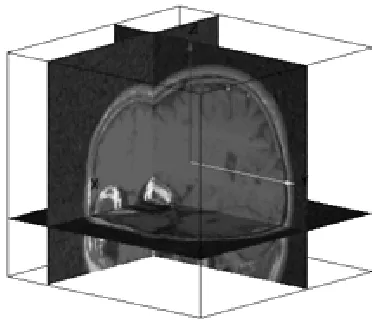
Figure 1: MRI brain image.
Functional magnetic resonance imaging uses the same physical principles underlying
structural MRI brain imaging to measure subjects' brain activity over time (hence the
term functional). The human body uses hemoglobin, the primary constituent of red blood
cells, to transport oxygen within the blood stream. Importantly, oxygenated hemoglobin
is unaffected by magnetic fields however deoxygenated hemoglobin is paramagnetic and
distorts magnetic fields. fMRI scanning measures brain activity by relying on the positive
correlation between brain activity and the presence of oxygenated hemoglobin within the
brain (Ogawa et al., 1992).
When an area of the brain is active, after approximately two seconds there is a significant
increase in the amount of oxygenated hemoglobin in the blood in that brain area,
displacing deoxygenated hemoglobin. Because this oxygenated hemoglobin is unaffected
by magnetic fields, the response RF signal returned to the fMRI scanner is stronger when
there is more brain activity and therefore more oxygenated hemoglobin in that brain
tissue; this is called the blood oxygen level dependent (BOLD) signal. The peak BOLD
activity. In order to track neuronal activation in brain tissue over time, an entire brain
volume is captured approximately every 1-2 seconds with a resolution of approximately
27mm3/voxel in 3T (tesla) fMRI research scanners. The capture of a series of many
fMRI brain volumes over time is referred to as a scanning session, with the complete
dataset from one scanning session referred to as a time series. A time series might contain
for example 800 volumes, if a brain volume is captured every 1.5 seconds and the
scanning session lasts for 20 minutes. The time between the capture of each volume is
called the time of repetition (TR) or sampling time of the scanning session; increasing the
resolution of a scan is traded for an increase in TR. It is also important to note that fMRI
scanners vary in the strength of the magnetic fields used, with 1.5-7T fields being
common among modern research scanners. With a higher magnetic field strength, the
scanner can capture brain volumes faster (i.e. with a smaller TR) or at a higher resolution.
Before fMRI brain scan data can be reviewed or analyzed, they must first be subjected to
several preprocessing steps. After the initial Fourier transform to convert raw k-space
scanner data to image space, operations to remove anatomical artifacts, remove scanner
noise and improve neuronal activation detection are typically applied (for more
information see Strother’s 2006 review of BOLD fMRI preprocessing pipelines). The
focus of the present chapter is on the processing of fMRI brain scan data to compensate
for slight involuntary head movements in the subject during the scanning session,
referred to as motion correction.
1.2 fMRI Motion Correction: Overview
Motion correction was first introduced by Jiang et al. (1995) to “reduce the effect of
subject motion during the acquisition of image data in order to differentiate true brain
activation from artifactual signal changes due to subject motion” (p. 224). Because the
observable signal changes in fMRI scanning are small, even with head movements of less
than 1mm, spurious clusters of task-related brain activation can appear (Field, Yen,
Burdette & Elster, 2000). For example, if two neighbouring voxels differ in intensity by
20%, then a motion of 10% of a voxel dimension can result in a 2% signal change,
comparable to the BOLD signal in a 1.5T fMRI scanner (Bandettini et al., 1992). In the
activation artifacts itself. Freire and Mangin (2000) for example argued that some motion
correction algorithms will actively misalign motion-free fMRI data if there is an unusual
distribution of background noise or neuronal activation. Despite these criticisms however,
motion correction is generally accepted as an integral component of any fMRI
preprocessing pipeline (Lemieux et al., 2007; Lund et al., 2005).
In actuality, motion correction is a special case of image registration. As it pertains to
MRI and fMRI data, "to register two images means to align them, so that common
features overlap" (Kostelec & Periaswamy, 2003, p. 161). One common application of
image registration for fMRI data is aligning different subjects’ brain regions to a common
anatomical template to enable comparisons between subjects in a study. In the context of
motion correction, all of the volumes in one subject’s scanning session are aligned to a
common positional template to enable comparisons between volumes across a scanning
session.
1.3 fMRI Motion Correction: General Algorithm
In the general case, the image alignment responsible for correcting motion in fMRI is
done by the iterative performance of three major steps on each volume in a scanning
session time series:
1. Determination of the difference (error) between the current image and a template
image (e.g. the first image in a scanning session) using a cost function.
2. Application of an optimization algorithm to determine a spatial transformation to
move the current image closer to the template image.
3. Interpolation of the scan data based on the spatial transformation from step two to
create a new current image for the next iteration of the algorithm.
These three steps will continue until the error determined in step one is below a threshold
determined by the optimization algorithm in step two. The error function in step one, the
optimization algorithm in step two and the interpolation method in step three are each
dimensions, outlined below are several other dimensions along which different motion
correction algorithms can vary; examples of specific motion correction algorithms
varying along these dimensions are provided in the next chapter.
First, a motion correction algorithm can work either online or offline. An online
algorithm corrects for subject motion while the scan is in progress and thus must be able
to correct the motion of one volume in less time than the TR of the scanning session. This
limits the complexity of these algorithms, however allows adjustments to the scanner
parameters to be made ‘on the fly’ to improve scan accuracy and also enables researchers
to use real time fMRI (rtfMRI) experimental and therapeutic paradigms such as
biofeedback therapy (e.g. Weiskopf et al., 2007). Offline motion correction algorithms,
conversely, are applied after the entire scanning session is complete. Because they are not
required to execute within one time of repetition cycle, offline motion correction
algorithms are able to employ much more complex, compute-intensive optimization and
interpolation algorithms and can prioritize accuracy as opposed to speed.
Another important distinction is between correcting for physiological motion versus
random motion. Physiological motion refers to the cyclical motion of the head and blood
vessels caused by respiration and pulse. Although these motions are relatively small, they
can cause significant modulation of the BOLD signal (Noll & Schneider, 1994). Random
motion refers to unintentional head movements caused by involuntary muscle twitches or
an inability to maintain a stationary head position. The magnitude of these random
movements is usually less than 1mm in normal subjects, but in certain special populations
such as infants, the elderly, or the mentally ill these motions can be up to several
millimeters (Friston et al., 1996).
It is also important to draw a distinction between volume-by-volume and slice-by-slice
motion correction. In traditional fMRI scanning, each slice of each volume is acquired in
series over time. As such, there is a choice in how many slices to treat as a unit when
registering them. In volume-by-volume motion correction, the time difference between
capturing each slice is ignored and all of the slices composing the subject's entire brain
each successive brain volume to a reference volume. The reference volume is usually the
first volume of the scanning session; an average of several volumes can however also
serve as this reference (Friston et al., 2006). Slice-by-slice motion correction, however,
operates at a finer temporal granularity. In this case, each slice (or a collection of several
slices, referred to as a chunk) is treated as a discrete unit and is aligned to a reference
slice or reference chunk. Volume-by-volume motion correction has the benefit of faster
processing time, because fewer alignments must be carried out; slice-by-slice motion
correction is however able to compensate for greater magnitudes of motion which cause
significant changes in brain position during the capture of a single volume (e.g. Speck,
Hennig & Zaitsev, 2006).
In the case of volume-by-volume and slice-by-slice motion correction, the 3D imaging
data being aligned are typically treated as a rigid body. Under the rigid body assumption,
there are only six degrees of freedom (three rotational and three translational) along
which an image can be transformed to align it with the template image. The rigid body
assumption is generally valid because the brain and head move together during scanning;
this assumption also serves to simplify the optimization step used in most motion
correction algorithms.
Finally, the spatial transformation that a motion correction algorithm produces to align a
given image back to the template image can be linear or nonlinear. Linear spatial
transformations include translation, rotation and zooming. Most linear transformations
preserve the rigid body assumption and do not deform the 3D brain image. Nonlinear
spatial transformations include affine transformations and warps; these are most often
used when registering a subject's scan data to a reference anatomical template to facilitate
between-subject comparisons. Because nonlinear spatial transformations violate the rigid
body assumption, most motion correction algorithms provide linear spatial transformation
Chapter 2
2
Interpolation Methods in fMRI Motion Correction
The interpolation method used in a given motion correction algorithm has a significant
impact on the algorithm's overall performance (Jenkinson, Bannister, Brady & Smith,
2001). Interpolation is used in fMRI motion correction both to determine the values of
voxels intermediate to the raw scan data during optimization of the spatial transformation
(or motion estimate) and to produce the final scan session data once an accurate spatial
transformation correcting for the subject motion in each volume has been determined.
The interpolation step of an iterative motion correction algorithm is also often its most
compute intensive component. Correspondingly, the speed of the interpolation method
will tend to dominate the running time performance of a motion correction algorithm; this
is especially so if the algorithm needs to perform many iterations (and therefore
interpolations) when determining an optimal spatial transformation (or motion estimate).
In this chapter, a review of several methods for the 3D interpolation of fMRI
neuroimaging data is provided; for each interpolation method, the structure of the
algorithm and a prominent software package employing it are described.
2.1 Trilinear Interpolation
Trilinear interpolation is a multivariate interpolation method which allows for the
interpolation of intermediate points on a regular 3D grid by chaining together multiple
linear interpolations. Trilinear interpolation is one of the fastest 3D interpolation methods
however it is often criticized for its potential inaccuracy.
2.1.1
Algorithm
Trilinear interpolation is algorithmically the simplest method of interpolation presented in
this chapter. Given a set of known points on a regular 3D grid, trilinear interpolation uses
a chain of 7 individual linear interpolations to approximate the value of any intermediate
point contained within a rectangular prism given by the grid. Although trilinear
disadvantage of relative inaccuracy compared to other interpolation methods (Tong &
Cox, 1999). Trilinear interpolation has also been criticized for introducing spatial
smoothing when applied to fMRI data (Oakes et al., 2005).
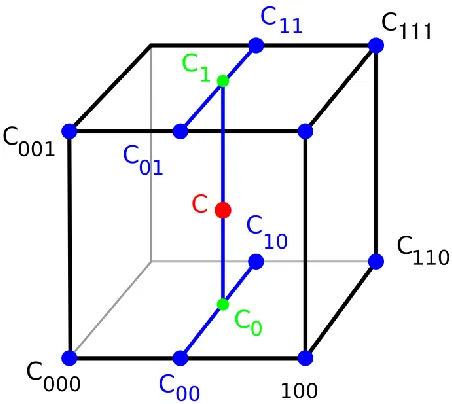
Figure 2: Trilinear interpolation (Wikipedia).
For a given intermediate point c whose value needs to be interpolated, the eight corners
of a cube on the regular grid surrounding it are first found. Then, four intermediate points
on the lines connecting those eight corners, referred to as c00 c01 c10 and c11, are calculated
using one dimensional linear interpolation. Next, two intermediate points on the lines
connecting c00 c01 c10 and c11 are interpolated, referred to as c1 and c0. Finally, c is given
by the linear interpolation of c1 and c0. These steps are shown in Figure 2.
2.1.2
AIR Software Package
In their 1998 paper, Woods et al. describe their Automated Image Registration (AIR)
software package. This package contains an image registration method which functions
very similarly to the general motion correction algorithm described in the previous
chapter. This registration algorithm serves as the foundation for the AIR software
package's motion correction utility, because as stated previously motion correction is
actually a special case of image registration. In the AIR registration algorithm an original
function is evaluated which provides the algorithm with a quantitative measure of how
well the images are registered, then finally an optimization function determines a new
spatial transformation to apply to the image for the next cycle of the registration
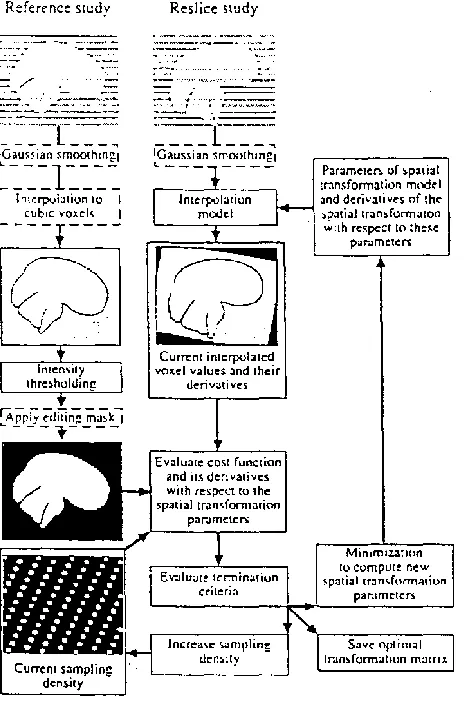
algorithm. A schematic of the AIR registration algorithm is shown in Figure 3.
Figure 3: AIR registration algorithm (Woods et al., 1998).
To compare the images being registered, one of the images must be resampled according
to the parameters of the current spatial transformation. This resampling requires that
voxel intensities at locations in between the voxel locations represented in the original
image be calculated. The AIR algorithm uses the trilinear interpolation method to
perform this calculation. Once the final spatial transformation has been determined on the
last iteration of the realignment algorithm, the AIR software package provides the option
To determine the error for a given iteration of the realignment algorithm, the AIR
software package uses the ratio image uniformity (RIU) cost function. To compute this
cost function, a resampled image (given by a set of realignment parameters) is divided by
the image to which it is being registered on a voxel-by-voxel basis to create a ratio image,
with the uniformity of this image measured by its standard deviation. This standard
deviation is then divided by the mean ratio to provide a normalized cost function value
for the realignment parameters used to create the image. The minimization of this cost
function therefore increases the uniformity of the ratio image independent of the global
intensity scaling of the original images. The AIR software package also includes a second
option for the cost function, namely a least squares approach similar to that used by
Friston et al. (1996). The least squares cost function is given by the average
voxel-by-voxel difference between the resampled image and the reference image. The AIR least
squares cost function also adds an intensity scaling step to compensate for global
discrepancies in image intensity.
To handle the iterative adjustment of the spatial transformation to find an optimal rigid
body transformation of the brain image, the AIR software package uses a variation on the
Powell optimization algorithm (Powell, 1964). This optimization is a conjugate direction
method, searching through a 6D parameter space to find a local minimum of the error
function used. Powell's method does not require that derivatives be taken (as does for
example the Gauss-Newton method described below), but instead minimizes the error
function using a bi-directional search along each vector in a set of search vectors, usually
simply the normals of the search space aligned along each axis. As such, it is useful for
calculating the local minimum of a continuous but complex non-differentiable function.
2.2 Spline Interpolation
Spline interpolation is a special case of polynomial interpolation, using a piecewise
polynomial called a Basis spline. Splines were originally used to describe curves in
shipbuilding and are now widely used in computer graphics. Spline interpolation is a
special case of polynomial interpolation however it has several advantages over its more
2.2.1
Algorithm
Given a set of n unique one dimensional points, the 1D polynomial interpolation problem
is to find the polynomial function which goes exactly through those points. The search
for this polynomial is equivalent to solving a linear system of equations; with a
polynomial of at least degree n - 1, there exists a provably unique solution to this linear
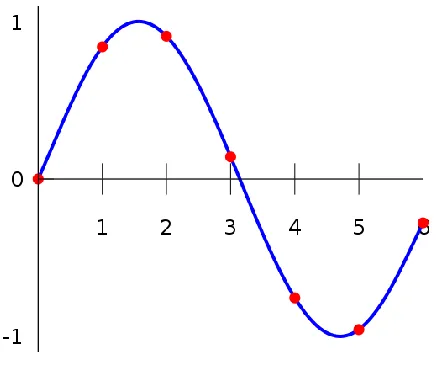
system. The 1D case of polynomial interpolation is shown in Figure 4.
Figure 4: 1D Polynomial interpolation (Wikipedia).
Spline interpolation is a special case of polynomial interpolation using a Basis spline
function. A Basis spline or B-spline is a piecewise polynomial function continuous at
each piece boundary, called a knot. Given a set s of n unique points, spline interpolation
will produce a piecewise polynomial function which passes through each knot point in s
while minimizing the amount of bending within the function as a whole (Webster &
Oliver, 2001). Typically, third degree polynomials are used for each piece of the function
(idem); these are referred to as cubic splines. First and second degree polynomials can
also be used however; these are referred to as linear and quadratic splines respectively.
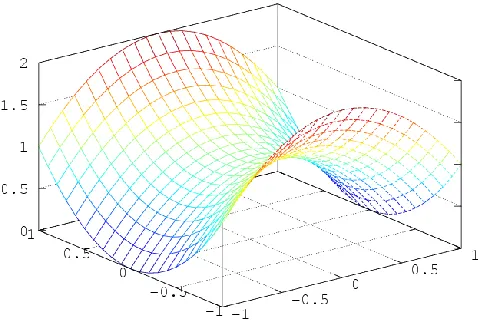
An example of 3D cubic spline interpolation from the GNU Octave software package is
Figure 5: 3D Cubic spline interpolation (GNU Octave).
Spline interpolation is generally preferred over polynomial interpolation because of the
low interpolation error which can be achieved even when using low degree polynomial
functions for each piece of the function. Spline interpolation also avoids the problem of
oscillation at the edges of the interval of interpolation, which can occur when fitting a
high degree polynomial function to a set of equally spaced data points (also known as
Runge's phenomenon; see Fornberg & Zuev, 2007).
2.2.2
SPM2 Software Package
Friston et al. present an "efficient, automatic, and general multidimensional nonlinear
spatial transformation technique" (1995, p. 166). It was the authors' intention to create a
general registration algorithm applicable for realigning variations and combinations of
fMRI, structural MRI and positron emission tomography (PET) data. In order to
accomplish this, the authors used two guiding principles in designing their algorithm.
First, the authors wanted the constraints on the image transformations their algorithm
would use to be reasonable, explicit and operationally specified. To this end, the authors
decomposed the differences between two images into two components: intensity
differences between two images which are in perfect physical alignment and differences
transformations produced by their algorithm are a nonlinear combination of rotational,
translational and intensity transformations.
The authors' second guiding principle was to develop a method with a single unique
solution transformation for each volume to be aligned. To this end, the authors linearised
the intensity transformation function using a low-order Taylor series approximation,
ensuring that a single least squares solution exists for every image registration; a least
squares solution uses an over-determined system of equations to minimize the sum of the
squares of the errors (SSE) in the results of each equation. To minimize the sum of
squared errors in the system of equations, the authors employed Gauss-Newton
optimization. The Gauss-Newton optimization method iteratively finds the minimum SSE
based on the first derivative of the sum of squared error function. This algorithm can
produce general image registration solutions, however when used for fMRI motion
correction the authors’ algorithm uses only translations, rotations and an identity intensity
transformation. That is, the solution transformation produced still follows the rigid body
assumption.
This general nonlinear registration algorithm served as the foundation of the motion
correction algorithm used in the neuroimaging data processing software package SPM2
(Statistical Parametric Mapping 2), maintained by the Wellcome Trust Centre at
University College London. SPM2 uses a registration algorithm closely based on that
presented in Friston et al.’s 1995 paper to provide estimates of subject motion, then using
those estimates determines a solution spatial transformation to correct for that motion.
Once a solution transformation has been determined, the original scan data is interpolated
using a 4D Basis spline to produce the final motion corrected scan data.
2.3 Fourier Interpolation
Fourier interpolation is lauded for combining speed and accuracy when interpolating
fMRI data. Because it operates on data in the Fourier domain, the native k-space of raw
2.3.1
Algorithm
Consider a spatial transformation which will rotate a slice from an fMRI volume. To
determine the new voxel intensities for the slice given that spatial transformation, voxel
intensity values intermediate to the existing image must be computed. Fourier
interpolation computes these intermediate voxel intensities by first converting the spatial
transformation from an image space transformation to a k-space transformation. This new
transformation is then applied to the raw k-space data and the result is used to produce
the new voxel intensities though the application of an inverse Fourier transform:
2.3.2
AFNI Software Package
Cox and Jesmanowicz (1999) describe a fast and accurate method for shifting and
rotating a 3D image using a shear factorization of the rotation matrix, as is used to handle
motion correction in the AFNI (Analysis of Functional Neuroimages) software package
(Cox, 1996). The authors based their method on the work of Eddy, Fitzgerald and Noll
(1996) who proposed the combination of three 2D shearing operations and Fourier
transform based shifting for 2D MRI rotation. The authors extended this previous work,
relying on the principle that a 3D proper orthogonal matrix can be factored into three 2D
rotations and so a general 3D image rotation can be accomplished with nine 2D shears.
As such, a 3D shear factorization has the same advantage that a 2D shear does in that its
elementary operations are coordinate shifts on 1D rows extracted from the image. In the
authors' algorithm, when any particular row of the 3D image is shifted in this way, the
row's data are interpolated using fast Fourier transforms (FFTs).
To determine the correct rotation in order to register a given volume to a template image,
the authors repeatedly linearised a weighted least squares penalty (or error) function with
respect to a rigid body transformation of the brain. This error function is:
Repeated linearization is equivalent to applying an iterative gradient descent algorithm to
the least squares penalty function. Gradient descent works by stepping toward the next
lowest point in the error space of the least squares penalty function at each iteration of the
optimization algorithm. The size of the step taken at each iteration is based on the first
derivative of the error function on that iteration. Gradient descent can work in an error
space of any number of dimensions and is guaranteed to converge to a local minimum,
however convergence can be slow close to minima because the first derivatives of the
error function surrounding them are typically small. When the error function has been
minimized, the corresponding 3D shear image rotation will align the current image to the
template image and thereby correct for subject motion.
2.3.3
PACE Motion Correction
The PACE (Prospective Acquisition CorrEction) motion correction method presented by
Thesen, Heid, Mueller and Schad (2000) departs from retrospective motion correction
techniques, where motion is corrected for by processing the data after a full set of scan
data have been acquired. PACE instead corrects for motion and updates the scanner
parameters for slice orientation and position in real time after each volume is captured
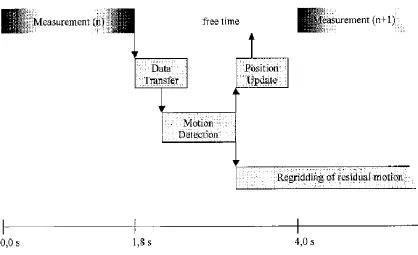
(the principle flow chart of the complete PACE real-time acquisition correction is shown
in Figure 6). After each volume is acquired, the motion of that volume relative to a
reference volume is detected, then those positional data are sent simultaneously to the
scanner and to a Fourier interpolation algorithm (the authors refer to interpolation as
regridding).
To detect the motion in each volume during the scan, PACE uses as a similar technique
to Friston et al. (1996). First, one volume is chosen as a reference to which all subsequent
volumes will be aligned. To speed up computation, the PACE algorithm uses only a
subset of voxels in the brain scan to perform the alignment, covering roughly the area
containing brain tissue in the interior slices of the volume. Next, the rigid body
transformation mapping the current volume being aligned to the reference volume is
expanded as a first order Taylor series. This Taylor series is approximated and a least
squares solution for its parameter function is obtained iteratively (with the motion
algorithm produces a rotation matrix and a shift vector describing the motion between the
most recently acquired volume and the reference volume. The authors suggest that for
typical fMRI scans, the motion in any given volume can be detected with only ten
iterations of this function.
Figure 6: PACE flowchart (Thesen, Heid, Mueller & Schad, 2000).
This method of prospective motion correction feeds back the positional information
calculated from a given volume to the next volume in the scanning session, however
because of the 3-4 second delay in volume acquisition for the scanner the authors were
using, their algorithm also includes a step to remove any residual motion not corrected
for by the use of updated positional parameters during image acquisition. For each
acquired volume, the transformation required to adjust the current image to the reference
image are calculated, then this transformation is used to regrid (interpolate) the measured
volume in order to eliminate residual volume to volume motion from the final session
data. The authors chose to use Fourier interpolation, specifically the shearing method
introduced by Eddy, Fitzgerald and Noll (1996) described above to accomplish this
2.4 Sinc Interpolation
Like spline interpolation, sinc interpolation is a special case of the more general
polynomial interpolation. Sinc interpolation has the unique advantage of being able to
provide an almost perfect reconstruction of band-limited data. Although it provides high
quality results, sinc interpolation is very slow relative to other interpolation algorithms
(Friston et al., 1996).
2.4.1
Algorithm
A detailed exploration of the 3D sinc interpolation method is provided in Chapter 3.
2.4.2
FSL MCFLIRT Software Package
Jenkinson, Bannister, Brady and Smith (2001) wanted to address the problem of the
optimization method used in motion correction algorithms; a problem they argue had
received little attention at the time. Specifically, the authors argue that most optimization
algorithms in use at the time of their writing were susceptible to becoming trapped in
local minima of the so-called error space of the optimization function. That is, the
optimization algorithm might become caught in a ‘large scale basin’ or a ‘smalls scale dip’ and fail to reach a global minimum for the cost function.
In the former case, an optimization algorithm would produce a large misregistration
because the local minimum of a large scale basin is far from the global minimum. In the
latter case, the optimization algorithm simply stops prematurely at a small scale dip,
causing a large misregistration at low resolutions or a small registration at high
resolutions. To combat these two types of local minimum optimization errors, the authors
used a two-pronged approach; apodization of the cost function (that is, smoothing the
function at its edges) to eliminate the ‘small dip’ error, combined with a hybrid
global-local optimization technique which utilizes prior knowledge about the transformation
parameters and typical data size to avoid ‘large scale basin’ errors.
The mathematical details of how the authors apodized the cost function are outside the
scope of this paper, however their global-local hybrid optimization method warrants
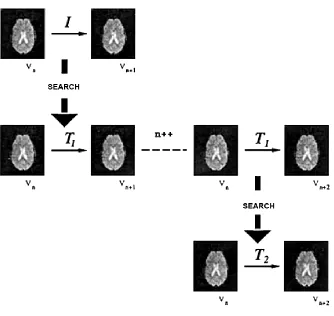
minimum of the cost function given some time restriction. The method uses four stages
of search, each with the template and image to be aligned scaled to a different resolution
(see Figure 7). At each stage, whenever the global-local hybrid optimization method is
minimizing the cost function, Powell minimization is used.
Figure 7: FSL global-local optimization
(Jenkinson, Bannister, Brady & Smith, 2001).
In the first stage, the images are pre-blurred with a Gaussian kernel and voxels are scaled
to 8 x 8 x 8mm, preserving only the gross image features. The search for a minimum of
the cost function at the 8mm stage is divided into three steps: step one, a coarse search
over the rotation parameters with a full local optimization of translation and scale for
each rotation tried; two, a finer search over rotation parameters but with only a single cost
function evaluation at each rotation; three, a full local optimization (rotation, translation
and global scale) for each local minimum detected from the previous stage (ibid., p. 831).
motion, the progression of these steps provides several reasonable potential starting
points in the error function for the next stage of the optimization.
The second stage of the optimization is performed at 4 x 4 x 4mm scale (images are again
pre-blurred with a Gaussian kernel). This stage takes the top three local minima
candidates for the global minimum, then also generates six rotational and four scale
perturbations of each of these minima, producing 33 candidate starting points for a
multi-start search of the error function space. After each of these candidate motion estimations
have been minimized for error, the single best candidate is selected for further
optimization in the next stage of the method.
The third stage of the algorithm works with the images scaled to 2 x 2 x 2mm, where
skews and anisotropic scalings begin to become significant. Consequently, the authors’
method progressively introduces these extra degrees of freedom (DOF) to the error
minimization function by calling the local optimization method three times: first using
only 7 DOF (rigid body and global scale), then with 9 DOF (rigid body and independent
scalings), then with the full 12 DOF (rigid body with scales and skews). After the
optimization has run with these additional degrees of freedom, the current motion
estimate is passed to the next stage of the method.
In the last stage of global-local hybrid optimization method, with the image scaled to 1 x
1 x 1mm, the cost function evaluations take 8 times longer than at the 2 x 2 x 2mm scale
and 512 times longer than at the 8 x 8 x 8mm scale. As such, during this stage only one
pass of the Powell local optimization algorithm is performed, the result of which is the
final registration solution.
When the global-local hybrid optimization method is applied to the problem of motion
correction, as in the FSL (fMRIB Software Library) software package’s MCFLIRT
(Motion Correction fMRIB Linear Image Registration Tool) utility, the middle image of
the scan series is taken as the template to which all other volumes are registered.
Furthermore, the final two stages of optimization at the 2mm and 1mm scale are omitted.
When the image registration transformation is computed, sinc interpolation is used to
2.5 Other Motion Correction Techniques
In this chapter several motion correction algorithms from the past 20 years have been
discussed. Most of these algorithms rely on the iterative adjustment of an estimate of
subject motion using an optimization algorithm alongside a cost function describing the
error difference between an uncorrupted image and a template image (e.g. Jenkinson,
Bannister, Brady & Smith, 2001; Thesen, Heid, Mueller & Schad, 2000; Woods et al.,
1998). Each of the algorithms relying on this optimization process to perform motion
correction varies in its computation of the cost function, the optimization algorithm used
and the nature of the estimation of the motion. Other approaches, such as predictive
approaches using a priori estimates of physiological motion are also possible (e.g.
Glover, Li & Ress, 2000; Hu, Le, Parrish & Erhard, 1995) and instead rely on removing
trends in the raw data that are correlated with known periods of subject motion.
A class of motion correction approaches which have not been reviewed here are those
which use external markers to monitor the movement of the subject's head during
scanning to provide the estimates for motion, then remove that estimated motion from the
scan data. This can be done either retrospectively after data acquisition is complete (e.g.
Tremblay, Tam & Graham, 2005) or prospectively while data is being acquired (e.g.
Zaitsev et al., 2006). Furthermore, the modality of this positional monitoring can vary,
from optical markers to track motion (as in the previous two examples) or radio
Chapter 3
3
Three Dimensional Sinc Interpolation
As demonstrated in the previous chapter, several different 3D interpolation methods are
currently in use for fMRI motion correction. Of these methods, sinc interpolation was
selected to demonstrate the importance of the programming language and the hardware
platform used for executing a neuroimaging data processing algorithm.
Sinc interpolation was chosen for this demonstration for two reasons. It is considered
among the best interpolation methods for 3D data interpolation (Tong & Cox, 1999) and
as such the development of new and faster implementations will service the
neuroscientific community. Secondly, other methods of 3D data interpolation such as
trilinear interpolation and spline interpolation have sufficiently short running times that
the differences between different implementations could be insubstantial; sinc
interpolation however has a long running time (Friston et al., 1996) and therefore would
best serve to demonstrate inter-implementation differences.
3.1 Algorithm
Sinc interpolation, also known as the Whittaker-Shannon interpolation method, is based
on the unnormalized sinc function. The term sinc is a contraction of the Latin sinus
cardinalis meaning cardinal sine, with the unnormalized sinc function is defined as
for x ≠ 0, with sinc(0) = 1. Sinc interpolation is commonly employed in digital signal
processing for the band-limited interpolation of discrete-time signals. Band-limiting is the
limiting of a signal's Fourier transform to zero above a certain finite frequency.
Band-limiting is an important concept within the context of sinc interpolation, because a
band-limited signal can be fully reconstructed from its samples, provided that the sampling
frequency exceeds twice the maximum frequency in the band-limited signal; the
referred to as the Nyquist frequency. In essence, with a band-limited signal sinc
interpolation can be used to correctly compute signal values at arbitrary continuous times
from a discrete set of samples provided they are sampled at a rate above the Nyquist
frequency. The standard sinc interpolation formula is
which can be expressed using only the sine function as
where T is the sampling period used to determine xn and x(t) is the reconstructed signal.
The above formula represents a linear convolution between the sequence and scaled and
shifted samples of the function (Oppenheim & Schafer, 1975).
Hajnal et al. (1995) describe an expansion of the standard sinc interpolation formula
allowing for the 3D interpolation of neuroimaging data. This expansion is accomplished
with a cosine Hann (Hanning) window using the normalized sinc function
In this formulation, the intensity value for a given voxel is the multiplicative combination
of three 1D sinc interpolations, with one interpolation for each dimension. The intensity
value I for voxel at (x, y, z) is defined using a Hann sinc interpolation as
with HS(a,A,R) defined as
where X,Y,Z are the coordinates of the original data set and R is the size of the Hann
window used. This Hann function eliminates problems with oscillatory effects at
discontinuities in the function and guarantees that the convolution coefficients fall off to
zero at the edge of the Hann window (Thacker, Jackson, Moriarty & Vokurka, 1999). A
graph of the Hann window function as applied to audio samples is show in Figure 8
(Wikipedia). Throughout this document the collection of voxels in a given volume
covered by the Hann window is referred to as a sinc kernel and to the portion of the final
interpolated intensity I given by one of the voxels in a sinc kernel as that voxel's sinc
contribution. Throughout the remainder of this document, the size of a sinc kernel is
referred to by its radius; that is, a sinc kernel of size 7 x 7 x 7 will have 7 voxels between
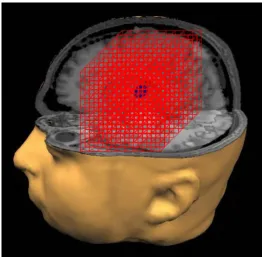
the intermediate voxel v and an outer plane of the 3D kernel. Figure 8 below shows an
illustration of a 4 x 4 x 4 sinc kernel.
Figure 8: Illustration of a 4 x 4 x 4 sinc kernel.
The asymptotic time complexity of the serial sinc interpolation function depends on
whether the number of voxels to be interpolated or the size of the kernel is varied. In the
case that the number of voxels is varied, the sinc interpolation function has a complexity
3.2 Serial Implementation
As explained in Chapter 1, during motion correction new coordinates for each voxel in an
fMRI volume are given by the solution spatial transformation computed by the
optimization algorithm. Because these coordinates lie between the existing coordinate
grid of the raw scan data, an estimate of the intensity value for each of these intermediate
voxels must be calculated. In this section the structure and function of a serial algorithm
for the 3D sinc interpolation of the intensity at an arbitrary point within a fMRI brain
scan volume is presented, which for convenience is referred to as serialSinc. serialSinc is
based on the AIR5 3D sinc interpolation algorithm (Woods, Cherry & Mazziotta, 1992).
The serialSinc algorithm takes as input an array of coordinates, intermediate to the
existing grid structure of the raw fMRI data, whose intensity values need to be
interpolated; the input array of intermediate coordinates is referred to in serialSinc as a
chunk. The number of voxels in a chunk can vary depending on whether the motion
correction algorithm in question operates slice-by-slice, volume-by-volume, or
somewhere in between. As such, serialSinc is designed to handle an arbitrary number of
voxels per chunk. The number of voxels in the chunk is referred to as the chunk size.
serialSinc uses the Hann windowed 3D sinc interpolation method described above to
compute the new intensity value for each intermediate voxel coordinate. As explained in
the previous section, the new intensity value for a given voxel v is the sum of the sinc
contribution of each known voxel in its surrounding sinc kernel. The sinc contribution for
a given voxel in the sinc kernel is computed by multiplying its one dimensional sinc
contribution (given by the Hann windowed normalized sinc function) in each of the x, y
and z directions by its intensity. In serialSinc, the sinc contribution of each voxel in the
sinc kernel is computed serially and added to the total for the interpolated intensity of
voxel v. This total is then stored in an array holding the new interpolated intensities for
every voxel in the chunk. The size of the Hann window and therefore the size of the sinc
kernel along the x, y and z dimensions is passed into serialSinc as a parameter.
The serialSinc algorithm is shown in pseudocode below, alongside the sinc function,
// serialSinc Algorithm GET kernelSizeX GET kernelSizeY GET kernelSizeZ GET chunkXSize GET chunkYSize GET chunkZSize GET chunkCoordinates INIT interpolatedChunkIntensities
FOR kernelCenterZ in chunkZSize FOR kernelCenterY in chunkYSize
FOR kernelCenterX in chunkXSize
COMPUTE kernelBoundsX from kernelSizeX and kernelCenterX COMPUTE kernelBoundsY from kernelSizeY and kernelCenterY COMPUTE kernelBoundsZ from kernelSizeZ and kernelCenterZ
SET kernelTotal to 0
FOR currentVoxelPositionZ in kernelBoundsZ
COMPUTE sincz = sincFunction(currentVoxelPositionZ)
FOR currentVoxelPositionY in kernelBoundsY
COMPUTE sincy = sincFunction(currentVoxelPositionY) SET sinczy to (sincy * sincz)
FOR currentVoxelPositionX in kernelBoundsX
COMPUTE sincx = sincFunction(currentVoxelPositionX) SET sinczyx to (sincx * sinczy)
GET currentVoxelIntensity
SET newVoxelIntensity to (currentVoxelIntensity * sinczyx) ADD newVoxelIntensity to kernelTotal
STORE kernelTotal in interpolatedChunkIntensities // sincFunction
GET voxelPosition GET kernelCenter GET kernelSize
IF voxelPosition == kernelCenter SET result as 1.0
ELSE
SET result as sin(pi*voxelPosition)/(pi*voxelPosition) * \
0.5*(1.0 + cos((pi*voxelPosition)/kernelSize))
3.3 Parallel Implementation
Parallel computing in general is based on the principle that large computing problems can
be divided into many smaller problems, all of which can be completed simultaneously.
The two primary paradigms in parallel computing are data parallelism and task
parallelism. Task parallelism achieves improvements in the execution time of an
algorithm by running sections of it concurrently. A section of code which is designed to
run in parallel with other copies of itself is called a kernel (referred to herein as a parallel
kernel to avoid confusion with sinc interpolation kernels). Each copy of the kernel is
executed in its own thread; a serial algorithm will run in only one thread executing a
repeated section of code thousands of time in sequence, whereas a parallel algorithm
could run thousands of copies of a kernel in hundreds of threads simultaneously,
depending on the hardware architecture employed.
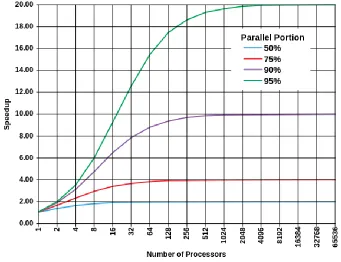
Figure 9: Amdahl's Law for 50%, 75%, 90% and 95% parallelized algorithms.
The process of converting a purely serial program to a logically equivalent parallel
implementation is referred to as parallelization. Once parallelized, the remainder of the
called the host code. Whether a given section of code in an algorithm can be parallelized
depends on the logical structure of the algorithm; only subsections of an algorithm which
are logically independent, meaning that they do not rely on each other's results and could
be executed in any order, can be extracted into a parallel kernel and executed in parallel.
Algorithms vary widely in the degree to which their logical structure can be executed in
parallel, which affects the maximum performance benefits which can be achieved by
parallelizing them. The relationship between the maximum expected improvement to an
algorithm's overall running time for a given number of processors when some percentage
of the algorithm is parallelized is referred to as Amdahl's Law (Amdahl, 1967). Figure 9
above shows Amdahl's Law for algorithms with parallel portions of 50%, 75%, 90% and
95%.
Although significant speedups can be achieved by parallelizing an algorithm and running
many copies of a kernel in multiple concurrent threads, there is an overhead introduced
by running multiple threads referred to as the burden of parallelism. If each thread does
not contain a sufficient computational load when the program is parallelized, then the
burden of parallelism will outweigh the gains afforded by executing that code
concurrently. The size of the burden of parallelism and how my threads can execute
concurrently both depend on the hardware architecture used. How much computation
there is in each thread compared to the communication between a thread and the host
code is referred to as the granularity of the algorithm. Fine (or high) granularity refers to
a smaller ratio between computation and communication; decreasing the granularity of a
parallelized algorithm by increasing the computational load in one thread will typically
decrease the burden of parallelism.
The serialSinc algorithm presented in the previous section has a very high degree of task
parallelism. Because the sinc kernel uses only the intensities of the raw data which do not
change, the intensity for each intermediate voxel in a chunk can be computed in parallel
with every other voxel in that chunk. Going further, within the calculation of an
intermediate voxel's new interpolated intensity, the sinc contribution of each voxel in the
sinc kernel can be computed in parallel; the sinc contribution of each voxel within a sinc
voxel at the center of the kernel. Finally, the determination of the 1D sinc function
coefficient used to compute each voxel's sinc contribution can also be completed in
parallel.
The parallelized version of the serialSinc algorithm from the previous section is called
parallelSinc. The parallelSinc algorithm computes the interpolated intensity for each
intermediate voxel in the chunk in parallel; the calculation of each voxel's intensity
however is still performed in serial. This design decision was made to ensure there would
be enough computation performed in each thread, such that the burden of parallelism
would not outweigh the benefits of parallelization.
parallelSinc uses the same pseudocode to replace calls to sincFunction as shown above.
The parallelSinc algorithm is shown in pseudocode below.
// parellelSinc Algorithm
GET kernelSizeX GET kernelSizeY GET kernelSizeZ
GET kernelCenterX GET kernelCenterY GET kernelCenterZ
COMPUTE kernelBoundsX from kernelSizeX and kernelCenterX COMPUTE kernelBoundsY from kernelSizeY and kernelCenterY COMPUTE kernelBoundsZ from kernelSizeZ and kernelCenterZ
SET kernelTotal to 0
FOR currentVoxelPositionZ in kernelBoundsZ
COMPUTE sincz = sincFunction(currentVoxelPositionZ)
FOR currentVoxelPositionY in kernelBoundsY
COMPUTE sincy = sincFunction(currentVoxelPositionY) SET sinczy to (sincy * sincz)
FOR currentVoxelPositionX in kernelBoundsX
COMPUTE sincx = sincFunction(currentVoxelPositionX) SET sinczyx to (sincx * sinczy)
GET currentVoxelIntensity
SET newVoxelIntensity to (currentVoxelIntensity * sinczyx) ADD newVoxelIntensity to kernelTotal
Chapter 4
4
Performance Benchmarking
To demonstrate the effects of the programming language and hardware platform used to
implement the 3D sinc interpolation algorithm described in Chapter 3, the results of
extensive benchmarking and performance testing are presented in this chapter. The data
in this chapter are all presented graphically, however tables containing their exact values
are provided in the appendices.
4.1 Experimental Setup
Consider the position of a neuroscience researcher who is trying to decide whether an
algorithm will be suitable to include in her neuroimaging data analysis pipeline. In order
to assess the viability of a given algorithm, this chapter demonstrates that the researcher
must consider carefully both the programming language (and version thereof) used to
implement it and the computer system or hardware platform used to run it. Each such
computer system hardware platform is referred to as a test bed.
For each of three different programming languages, the differences which can be seen in
the running time performance of the same algorithm across multiple test beds and
hardware platforms (the test beds are outlined in Section 4.2 below) are investigated. This
investigation serves to underscore the idea that the differences between hardware
architectures which are contemporary to one another can have a significant impact on an
algorithm's running time performance even within one language.
To conduct this investigation, the 3D sinc interpolation algorithms described in Chapter 3
were implemented in Python, C and OpenCL (Open Computing Language). A Python
host program was used to handle file I/O of the test neuroimaging data and benchmarking
the performance of the algorithm for each language. The python implementation of 3D
sinc interpolation ran natively within this host, while the code for the C implementation
was extracted into its own Python extension module using Python's distutils library
script using PyOpenCL. A list of software packages and compilers used and the versions
thereof is provided in Appendix A.
For each programming language, the test bed hardware platform was compared over sinc
kernel size because the size of the Hann window used for 3D sinc interpolation has a
substantial effect on the accuracy of the interpolation. The so-called gold standard for 3D
MRI data interpolation is a sinc kernel of size 13 x 13 x 13 (Jenkinson, Bannister, Brady
& Smith, 2001), however sinc interpolation kernels of this size are very computationally
expensive; therefore 4 different sized Hann windows (1, 3, 7, 13) were used to assess the
performance of less accurate, however less expensive, sinc kernels. Throughout each of
these comparisons, the number of interpolations was kept constant; 230400 interpolations
were performed, corresponding to interpolating the voxel intensities on a regular grid
intermediate to a raw data set for an entire fMRI brain volume of 80 x 80 x 36 voxels.
The raw data for interpolations using smaller input (chunk) sizes are found in the
appendices.
4.2 Test Beds
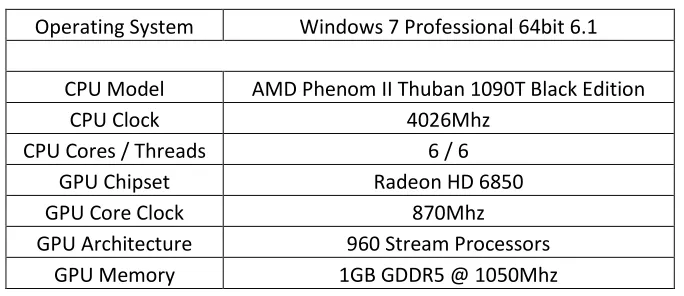
The first test bed is a powerful desktop workstation, described in Table 1. The second test
bed is a GPGPU (general purpose graphics processing unit) laboratory desktop computer,
shown in Table 2. The third test bed is a rack-mount server, shown in Table 3. The final
test bed is an older laptop computer, included to show the relative performance of a
legacy machine. The specifications for this test bed are shown in Table 4.
Table 1: Workstation desktop test bed specifications.
Operating System Windows 7 Professional 64bit 6.1
CPU Model AMD Phenom II Thuban 1090T Black Edition
CPU Clock 4026Mhz
CPU Cores / Threads 6 / 6
GPU Chipset Radeon HD 6850
GPU Core Clock 870Mhz
GPU Architecture 960 Stream Processors
Table 2: Laboratory desktop test bed specifications.
Operating System Ubuntu 64bit 3.8.0
CPU Model Intel Xeon E5504, Intel Xeon E5504
CPU Clock 1596Mhz
CPU Cores / Threads 8 / 8
GPU Chipset nVIDIA Tesla c2070
GPU Core Clock 1150Mhz
GPU Architecture 448 Stream Processors
GPU Memory 6GB GDDR5 @ 1500Mhz
Table 3: Rack-mount server test bed specifications.
Operating System GNU Linux 64bit 2.6.32
CPU Model Intel Xeon E5603
CPU Clock 1197Mhz
CPU Cores / Threads 4 / 4
Table 4: Legacy laptop test bed specifications.
Operating System Windows 7 Professional 64bit 6.1
CPU Model AMD Turion x2 TL-56
CPU Clock 1800Mhz
CPU Cores / Threads 2 / 2
4.3 Python
The results of comparing the performance of a Python implementation of the serialSinc
algorithm across the four test bed hardware platforms described above are shown in
Figure 10. The raw data for this comparison are provided in Appendix C. Each running
time presented is the mean of 5 trials of executing the algorithm. Because of the three
nested FOR loops used to iterate through the voxels in a sinc kernel, as the size of sinc
kernel along the three dimensions increases the running time increases as a cubic
Figure 10: Python implementation running time comparison across test beds.
This performance comparison shows several interesting differences between the four test
beds when using a sinc kernel of size 7 x 7 x 7. Firstly, one might expect that the two
Intel processors, being of similar model numbers and specifications, would have similar
performance with the legacy laptop lagging behind. Instead, the AMD Turion TL-56 and
the Intel E5603 perform quite similarly at 13147 seconds and 13647 seconds
respectively, however still with a significant difference in performance between them
(F(2,5) = 15700, p < 0.000001). These two processors both execute the algorithm much
more slowly than the Intel Xeon E5504 at 9069 seconds (F(2,5) = 6888131, p <
0.000001). Also notice that the AMD Turion TL-56, despite its faster clock speed, does
not outperform the Intel Xeon E5504. This gap in performance could be explained by
AMD Turion TL-56's small cache compared to the Intel Xeon E5504: 1024KB L2 cache
versus 4096KB L2 cache respectively. The AMD Thuban 1090T, with a high clock speed
and advanced architecture, outperforms the next fastest processor with a running time of
Importantly, regardless of the test bed hardware platform, the Python implementation of
the 3D sinc interpolation algorithm was not able to interpolate the voxel intensities for an
entire fMRI time series with a sinc kernel size of 13 x 13 x 13 within a tractable length of
time. Extrapolating based on the performance of the fastest hardware platform, the AMD
Thuban 1090T, it would take an estimated 21195 seconds or 5.9 hours to complete the
interpolation of one volume; extrapolating based on the performance of the slowest
hardware platform, the Intel Xeon 5603, it would take an estimated 60577 seconds or
16.8 hours to interpolate one volume. This means that at best, a Python implementation
of the serialSinc algorithm could interpolate the data from an example 800 volume scan
(20 minutes, TR = 1.5 seconds) in slightly over 6 months; surely an intractable length of
time.