I think many range technicians would agree that the identifica- tion and attainment of proper grazing use has been, is now, and will be in the future our most urgent problem in rangeland utilization by domestic livestock and big game animals. Despite supporting evidence from re- search studies and from an in- creasing number of individual ranch enterprises, we still have a long way to go in attaining uni- versal application of this con- cept. Some of the things that will need doing to gain increas- ing acceptance of this practice include:
a. Additional research that will identify what constitutes proper grazing use for addi-
tional kinds of rangeland, and for different seasons of use and different stages of plant growth.
b. Devising more effective ways of demonstrating the applica- tion of this practice to range- land users in a manner that will convince them of its merits and benefits on their particular range operations.
Realistically Coming To Grips Wiih Rangeland Economics
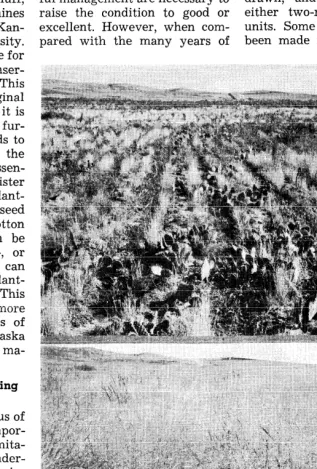
We urgently need additional convincing evidence that what we call good range management pays (Fig. 2). This evidence is needed in terms of the ranch en- terprise as a whole rather than
simply in terms of a single pas- ture or a single practice such as seeding or brush control. For maximum utility such evidence should go further than simply budgeting the enterprise-it should identify the kind and condition of rangeland involved and the nature and degree of grazing use in effect during the period of record.
I’m sure that our profession believes that good range man- agement pays. We are gradually accumulating substantiating evi- dence. Let’s give a high priority to fortifying this evidence to a point at which the proof is ob- vious. This will certainly be an effective “helper” in opening the gate to the future.
Range Interseeding in Nebraska
C. M. SCHUMACHERPlant Materials Technician, U.S.D.A., Soil Conservation Service, Lincoln, Nebraska.
In the Great Plains states many counties have thousands of acres of formerly cultivated lands producing very little for- age because climax grasses have not become re-established. In many cases, often because of ero- sion hazard, it is impractical to resume cultivation, grow a non- competitive cover crop, and drill seed of the native grasses adapted to the site. On such lands the range interseeder pro- vides a means of re-establishing climax grasses in spaced rows without the erosion hazard, the complete disruption of plant suc- cession, or the inconvenience of complete cultivation. The range interseeder discussed here was designed for use in Nebraska, but the principles involved have a much wider application.
Development
The first pasture furrowing in the Great Plains was done for the primary purpose of range interseeding. H. L. Bentley, a field agent for the U. S. Depart-
ment of Agriculture, gives an account of this work done at the old range experiment station near Abilene, Texas. Bentley
(1899) states that furrows were plowed at 12-foot intervals, across the prevailing winds, on one of the station pastures. The purpose of these furrows was to catch grass seeds blown by the wind and prevent their being lost to the pasture. An additional objective was to catch storm waters and provide irrigation for the seedlings. This study was short lived, as were other range research projects started at that time. A half century later the primary purpose of pasture fur- rows was again to be the es- tablishment of a suitable seedbed for grass seeds.
Furrowing of rangeland was used to a very limited extent be- fore the drouth of the 1930’s and the advent of a nationwide pro- gram of soil conservation. Dur- ing the late 1930’s, Soil Conser- vation Service technicians initi- ated the installation of
many
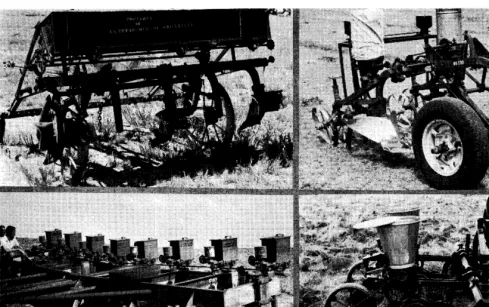
acres of furrows, generally on the contour, as a range improve- ment practice. The primary pur- pose of these furrows was to hold water and prevent soil loss on the land treated and to pre- vent deposition on lands below. It was found that furrows had to be placed at close intervals and that this destroyed much of the existing vegetation. To speed re- covery on the furrowed area seedbox attachments were de- vised for some of these furrow- ing machines. One of these at- tachments is illustrated in Fig. 1 top 1. Results of this reseeding were disappointing because the method had several weaknesses. Furrows were not wide enough
(3-6”) to adequately reduce com- petition. The furrows were too deep (3-6”) and seed or seedlings were often buried. Seed was not placed in the soil but was broad- cast over the furrow. The selec- tion of species was limited be- cause the seedboxes would not handle fluffy seeds. Especially noteworthy is the fact that little consideration was given to the use of native grasses of locally adapted strains higher in the successional scale than the exist- ing vegetation.
FIGURE 1. Top, Zeft-Seeding attachment used on lister dammer to seed contour furrows. Wyoming-1939; right-Range interseeder developed by Peter N. Jensen, SCS, Range Conservationst, 1954. Bottom, left-Type of large, contractor-built, range interseeder used in southwestern Kansas, 1959; right-Range interseeder developed by Murray Cox, SCS, Plant Materials Technician, 1958.
efforts, little further interest was shown in the development of a furrow seeder, or range inter- seeder, until the Plains States experienced another severe drouth. Then, at nearly the same time, workers in three states started, independently, to devise a furrow seeder. Hervey (1960) reports that construction was started in 1953 at the Colorado Agricultural Experiment Station by R. D. Barmington. Peter N. Jensen, Range Conservationist, Soil Conservation Service, Dodge City, Kansas, started work on such a planter in 1954. The Uni- versity of Wyoming Experiment Station started work at about the same time on the Wyoming range seeder which was first used in 1955.
Of these three developments, only the work done in Kansas has had any direct influence on the Nebraska range interseeder. The Wyoming range seeder, as
reported by Becker, McNanee, and Lang (1956)) and Becker, Lang, and Rauzi (1957)) is a modified till-planter which was used to introduce exotic grasses and legumes into native range. The experimental planter de- veloped in Colorado is described by Barmington (1957) as a lister- type planter. The last model of this machine is equipped with lo-inch lister bottoms and it has a 26-inch row spacing. There has been no commercial production of this machine, and it has not been brought into use outside of the test area.
The work initiated in south- western Kansas by Jensen had important influences on the de- velopment of the range inter- seeder, Fig. 1 top r. Jensen equipped a two-row lister with cotton hoppers to handle fluffy seeds, and legume-type seed boxes to handle fine free-flowing seeds. Seed was dropped in the
Plains Conservation Pr 0 gram. Seeding contractors wanted to cover more acres per hour and they assembled much larger ma- chines, Fig. 1 bot. 1. Many thou- sands of acres of sandhill range- land in southwestern Kansas have been seeded with these ma- chines since 1958.
In 1958, Murray Cox, Plant Materials Technician, Soil Con- servation Service, Scottsbluff, Nebraska, studied the machines and results of the work in Kan- sas and at Wyoming University. He then assembled a machine for field evaluation in Soil Conser- vation Districts in Nebraska. This machine is much like the original Jensen machine except that it is equipped with double-disk fur- row openers and depth bands to give precise placement of the seed. This interseeder is essen- tially a tractor-mounted lister equipped with double-disk plant- ing units and legume-type seed boxes in addition to the cotton hoppers. This machine can be operated as a two-, three-, or four-row unit. Row spacing can be varied by adjusting the plant- ing units on the toolbar. This machine, Fig. 1, bot. r., more nearly meets the objectives of range interseeding in Nebraska than does any of the other ma- chines.
Status of Range Inferseeding in Nebraska
Before evaluating the status of range interseeding, it is impor- tant that the purpose and limita- tions of this method be under- stood. The purpose of range in- terseeding is to re-establish na- tive grasses in spaced rows on lands where the erosion hazard is too great, or where for other reasons it is impractical to es- tablish a cover crop. This method of seeding is not intended as a substitute for drilling in non- competitive stubble, but it is a method for use on lands where complete seedbed preparation is impractical. Under optimum con- ditions, range in poor condition
class or cultivated land can, by the full seeding method, be con- verted into range in the good or excellent condition class within three to five years. With the in- terseeder, the optimum result in this same length of time is the establishment of spaced rows of grass that will raise the overall range condition class to fair or good. Several more years of care- ful management are necessary to raise the condition to good or excellent. However, when com- pared with the many years of
careful grazing management re- quired to permit natural entry of climax grasses on such land, the alternative of interseeding gains favorable attention.
There are now 21 range inter- seeders in Nebraska. All of these machines are built essentially like the original machine de- signed by Cox. Some are tractor- mounted and some are tractor- drawn, and all machines are either two-row or three-row units. Some modifications have been made in type of planting
unit or seed hopper, but there has been no change in the basic planting principles. All of the range interseeders in Nebraska are in Sandhill counties or in counties that include Sandhill outliers.
Range interseeding was accom- plished on 505 acres of Nebraska rangeland in 1959. The present rate of interseeding is about 5,500 acres per year, and the total acreage now seeded in Ne- braska by this method is 17,835 acres. Of this total acreage, 93 percent is either on the Sand or Sandy range site.
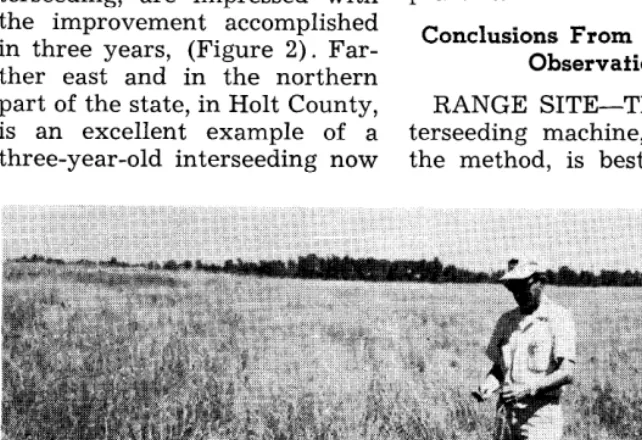
The plant materials field eval- uation plantings in Soil Conser- vation Districts have been an important factor in the growing acceptance of this practice. The results of these plantings con- vinced Soil Conservation Service technicians, seedsmen, and land- owners that this method of seed- ing has merit. People familiar with the Dundy County pasture, as it appeared at the time of in- terseeding, are impressed with the improvement accomplished in three years, (Figure 2). Far- ther east and in the northern part of the state, in Holt County, is an excellent example of a three-year-old interseeding now
being grazed by cattle. Figure 3 shows this pasture as it appeared at the end of 1962 grazing season.
The range interseeding method is admirably suited for re-intro- ducing climax dominant grasses in order to hasten natural suc- cession. Dominants can spread from spaced rows on lands where no other seedbed preparation has been attempted. In December 1961, a survey was made of 46 such interseedings made in Ne- braska since 1958. The grass stands on 74 percent of these were rated good or excellent, 15 percent were rated fair, and only 11 percent were rated poor. This success ratio is practically iden- tical to the success ratio of full seedings made during the same period with a grass drill on pre- pared seedbeds. Grass stands on 172 drill seedings were rated as 12 percent poor, 15 percent fair, and 73 percent good or excellent. The high success ratio of range interseeding has given this method the status of an accepted practice.
Conclusions From Five Years Observation
RANGE SITE-The range in- terseeding machine, as well as the method, is best adapted to
FIGURE 3. Pasture in Holt after range interseeding.
County, Nebraska, at end of grazing season, three years
Sand and Sandy range sites. In- terseeding on Silty sites, though more difficult to accomplish, has been nearly as successful. Unless soil moisture conditions are very favorable, it is difficult to prop- erly plant on clayey and clay soils. If wet, these soils tend to stick on the depth bands and prevent the furrow opener from functioning properly. If dry and hard, the furrow opener fails to penetrate. An advantage of this method of seeding, on most sites, is that all vegetative cover and weed seed on and in the surface soil is pushed away from the drilled seed. This feature, on soils subject to crusting, places the seed in an area that is more apt to crust than if it were pro- tected by a mulch cover. Some interseedings on Clayey and Clay sites have been lost be- cause a crust formed on the soil surface and prevented emer- gence of the seedlings.
RANGE CONDITIONS -This method is best suited to go-back fields or other ranges in poor condition. If remnants of the climax dominant grasses are suf- ficiently distributed so that rest- ing alone will bring about range recovery in a reasonable time, then there is no justification for range interseeding. Observations as well as ecologic theory indi- cate that range interseedings can succeed and persist on ranges only if the between row cover is lower successionally than the seeded ecotypes. For example, on a Sandy site in the 20-inch pre- cipitation zone, seeding little bluestem (Andropogon scopur- ius) in perennial weeds or blue grama (Bouteloua gradis) will succeed; whereas, when little bluestem is seeded into a natural stand of little bluestem, the seed- lings will fail to survive. This is not a method to use on barren sandy fields or blow-outs be- cause blowing sand is likely to bury or expose the seed or seed- lings.
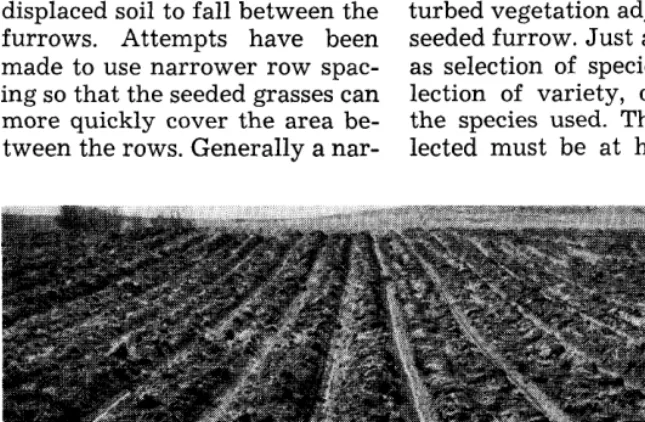
furrow has straight sides, a flat bottom, a top width of eight to ten inches, and a depth of two to three inches. Such a furrow can be made with a 14-inch lister bottom when it is functioning properly. The furrow made with a lo-inch lister bottom is too nar- row for good results. Furrows that are too shallow, less than two-inches, will generally result in skips in the row. The too- shallow furrow does not kill all of the perennial competitors, nor does it push all of the annual weed seed out of the furrow. Furrows that are too deep result in the seed or seedlings being too deeply covered by action of wind or water. A lister bottom that rides on the point presents a serious problem because the op- erator, in attempting to make the furrow wide enough, will make it too deep. Figure 4 illus- trates the proper type of furrow for this purpose.
FURROW SPACING - Fur- rows spaced 40 inches apart ap- pear to give best results. They provide sufficient space for the displaced soil to fall between the furrows. Attempts have been made to use narrower row spac- ing so that the seeded grasses can more quickly cover the area be- tween the rows. Generally a nar-
rower row spacing results in ex- cessive ridging of soil between the furrows or in the sacrifice of furrow width.
SEED PLACEMENT-The double-disk furrow opener with depth bands set at 3/4-inch will result in seed placement at vari- ous depths to a 3/4-inch maxi- mum. This is a desirable safety feature as seed placed at vary- ing depths does not all germinate at the same time. Some seed on the ground surface behind the packing wheel is no cause for concern. If much seed is not covered, it may be necessary to drag a chain behind the packer wheel to get better coverage.
SEED SELECTION-The kind and quality of seed planted is a vital factor in the success or failure of range interseeding. A proper mixture of climax domi- nant grasses that once occupied the site should be selected. These grasses can spread between the rows and make a full stand. Many climax dominant grasses are rhizomatous and these regu- larly are first to enter the undis- turbed vegetation adjacent to the seeded furrow. Just as important as selection of species is the se- lection of variety, or strain, of the species used. The strain se- lected must be at home on the
FIGURE 4. Proper type of furrow made with range interseeder.
particular site on which it is seeded or it will not be an effec- tive competitor with volunteer vegetation. This is still a limit- ing factor in some sections of Nebraska where seed of locally adapted climax grasses is not yet available. Quality of seed used (purity and germination) should be average or above. Mechanical difficulties of seeding are reduced if seed is of high quality with all leaves and stems removed. Seed- ling establishment is enhanced if the seed used is large, properly cured and processed, and of high germination.
MANAGEMENT - When locally adapted dominant grasses have been established, the range can be managed to encourage the processes of secondary plant suc- cession. Periods of protection from grazing are essential. Stocking must be carefully regu- lated as livestock usually will graze the new seedlings before grazing the vegetation between the rows. The range manager must use the seeded grasses as the key plants in the determina- tion of proper use until the seeded furrows have sufficient old growth of previous years to greatly reduce their attractive- ness to livestock. Once fully es- tablished, 50 percent by weight of these key plants can be grazed. They will increase and the range condition will improve.
Summary
The interseeding method is
best suited to Sand or Sandy
sites though it shows promise on
Silty sites. Clay and Clayey sites
are more difficult to properly
plant because
of problems of
equipment operation
and the
hazards of soil crusting.
Range interseeding is an ac-
cepted range improvement prac-
tice in Nebraska, having been
successfully used on 17,835 acres,
principally on Sand and Sandy
sites, since 1958.
Success of this method depends
upon construction of a furrow
that removes
perennial
and
annual competition during the
season of establishment, proper
placement of the grass seed in
the center of this furrow, selec-
tion of adapted ecotypes of cli-
max dominant species that are
of higher successional rank than
the existing vegetation, and care-
ful management of grazing to
encourage the process of second-
ary plant succession after the
seedlings have become estab-
lished.
LITERATURE CITED BARMINGTON, R. D. 1957. Problems
involved in the reseeding of grasses on abandoned cropland. Colo.
Agric. Expt. Sta. Gen. Series Paper 658, 11 pp.
BECKER, C. F., R. L. MCNANEE, AND R. L. LANG. 1956. Wyoming range seeder. Wyo. Agric. Expt. Sta. Cir. 62, 4 PP.
BECKER, C. F., R. L. LANG, AND FRANK RAUZI. 1957. New methods to im- prove shortgrass range. Wyo. Ag- ric. Expt. Sta. Bul. 353. 12 pp. BENTLEY, H. L. 1899. Progress of ex-
periments in forage crops and range improvement at Abilene, Texas. USDA Div. Agrostology Cir. 23, 20 pp.
HERVEY, D. F. 1960. Improving Great Plains rangelands by interseeding. Proc. 8th Int. Grassland Congress, Reading, England. 8 pp.
Range Condition Classif ication of Bunchgrass
Range at the Manitou Experimental
Forest in Colorado
W. M. JOHNSON AND ELBERT I-3. REID
Range Conservationists, Rocky Mountain Forest and Range Experiment Station, Forest Service, U. S. Depart- ment of Agriculture, Fort Collins, Colorado1
This paper indicates a method
of judging range condition of
grassland areas in the ponderosa
pine forest of the Colorado Front
Range based on relative herbage
production of desirable forage
species.
The loop method of Parker
(1951) is now widely used in
range management. Data ob-
tained by the method include
measurements of vegetation
(cover index, composition, and
vigor) and soils and erosion
(bare ground and litter). Vigor
is represented by leaf -height
measurements of the major for-
age species. Guides for using
these data for estimating range
condition and trend in range
condition on many plant types
have been developed. However,
1
Central headquarters maintained in cooperation with Colorado State University, Fort Collins, Colorado.improvement of these range con-
dition guides is desirable.
At Manitou Experimental For-
est near Woodland Park, Colo-
rado, six experimental pastures
of ponderosa pine (Pinus ponde-
rosa) -bunchgrass range were
grazed at different levels from
1942 until 1959. Because a wide
range of conditions developed,
loop-method data from these pas-
tures were analyzed to deter-
mine which measurement would
give the best index to range con-
ditions, and what the weightings
of each should be.
In 1954, 320 permanent loop
transects were measured in the
experimental pastures. Herbage
yields were obtained by clipping
plots adjacent to 26 of these
transects located in the grassland
type. In 1955, herbage yields and
height growth of leaves of moun-
2BotanicaZ names of plants appear later in a tabulation.
tain
muhly2 were obtained on 76
transects
adjacent
to loop-
method transects in the grass-
land type. Then, to test the pro-
cedure developed from the 1955
data, an entirely new set of 24
transects were measured and re-
lated herbage production data
taken in 1959. Four transects
were measured in the grassland
type in each pasture.
Conditions Sampled