Towards Quantum One-Time Memories
from Stateless Hardware
Anne Broadbent∗ Sevag Gharibian† Hong-Sheng Zhou‡
Abstract
A central tenet of theoretical cryptography is the study of the minimal assumptions re-quired to implement a given cryptographic primitive. One such primitive is the one-time memory (OTM), introduced by Goldwasser, Kalai, and Rothblum [CRYPTO 2008], which is a classical functionality modeled after a non-interactive 1-out-of-2 oblivious transfer, and which is complete for one-time classical and quantum programs. It is known that secure OTMs do not exist in the standard model in both the classical and quantum settings.
Here, we propose a scheme for using quantum information, together with the assumption of stateless (i.e., reusable) hardware tokens, to build statistically secure OTMs. Via the semidefinite programming-based quantum games framework of Gutoski and Watrous [STOC 2007], we prove security for a malicious receiver, against a linear number of adaptive queries to the token, in the quantum universal composability framework. We prove stand-alone security against a malicious sender, but leave open the question of composable security against a malicious sender, as well as security against a malicious receiver making a polynomial number of adaptive queries. Compared to alternative schemes derived from the literature on quantum money, our scheme is technologically simple since it is of the “prepare-and-measure” type. We also show our scheme is “tight” according to two scenarios.
1
Introduction
The study of theoretical cryptography is centered around the question of building cryptographic primitives secure against adversarial attacks. In order to allow a broader set of such primitives to be implemented, one often considers restricting the power of the adversary. For example, one can limit thecomputingpower of adversaries to be polynomial bounded [Yao82, BM82], restrict thestorage
of adversaries to be bounded or noisy [Mau92, CM97, DFSS05], or maketrusted setupsavailable to honest players [Kil88, BFM88, Can01, CLOS02, IPS08, PR08, LPV09, MPR09, MPR10, MR11, KMQ11, KMPS14], to name a few. One well-known trusted setup istamper-proof hardware[Kat07, GKR08], which is assumed to provide a specific input-output functionality, and which can only be accessed in a “black box” fashion. The hardware can maintain a state (i.e., isstateful) and possibly carry out complex functionality, but presumably may be difficult or expensive to implement or manufacture. This leads to an interesting research direction: Building cryptography primitives using thesimplest(and hence easiest and cheapest to manufacture) hardware.
∗Department of Mathematics and Statistics, University of Ottawa, Ontario, Canada. Email: [email protected]. †Department of Computer Science, University of Paderborn, Germany, and Virginia Commonwealth University, USA.
Email: [email protected].
In this respect, two distinct simplified notions of hardware have captured considerable interest. The first is the notion of aone-time memory (OTM)[GKR08], which is arguably the simplest possible notion ofstatefulhardware. An OTM, modeled after a non-interactive 1-out-of-2 oblivious transfer, behaves as follows: first, a player (called thesender) embeds two valuess0ands1into the OTM,
and then gives the OTM to another player (called thereceiver). The receiver can now read his choice of precisely one ofs0ors1; after this “use” of the OTM, however, the unread bit is lost forever.
Interestingly, OTMs are complete for implementingone-timeuse programs (OTPs): given access to OTMs, one can implement statistically secure OTPs for any efficiently computable program in the universal composability (UC) framework [GIS+10]. (OTPs, in turn, have applications in software protection and one-time proofs [GKR08].) In the quantum UC model, OTMs enable
quantumone-time programs [BGS13]. (This situation is analogous to the case ofoblivious transfer
being complete for two-party secure function evaluation [Kil88, IPS08].) Unfortunately, OTMs are inherentlystateful, and thus represent a very strong cryptographic assumption — any physical implementation of such a device must somehow maintain internal knowledge between activations,
i.e., it must completely “self-destruct” after a single use.
This brings us to a second important simplified notion of hardware known as astateless to-ken [CGS08], which keeps no record of previous interactions. On the positive side, such hardware is presumably easier to implement. On the negative side, an adversary can run an experiment with stateless hardware as many times as desired, and each time the hardware is essentially “reset”. (Despite this, stateless hardware has been useful in achievingcomputationally securemulti-party computation [CGS08, GIS+10, CKS+14], andstatistically securecommitments [DS13].) It thus seems impossible for stateless tokens to be helpful in implementing any sort of “self-destruct” mechanism. Indeed, classically stateful tokens are trivially more powerful than stateless ones, as observed in,
e.g., [GIS+10]. This raises the question:
Canquantuminformation, together with a classical stateless token, be used to simulate “self destruction” of a hardware token?
In particular, a natural question along these lines is whether quantum information can help implement an OTM. Unfortunately, it is known that quantum informationalonecannot implement an OTM (or, more generally, any one-time program) [BGS13]; see also Section 4 below. We thus ask the question: What are the minimal cryptographic assumptions required in a quantum world to implement an OTM?
Contributions and summary of techniques. Our main contribution is to propose a prepare-and-measure quantum protocol that constructs OTMs from stateless hardware tokens. We provide a proof which establishes information theoretic security against an adversary making a linear (inn, the security parameter) number of adaptive queries to the token. Even in this setting of linear queries, this result is in sharp contrast to the classical case, in which such a construction is trivially impossible. We also show stand-alone security against a malicious sender.
from the literature on quantum money [BDS18]. As far as we are aware, this family of schemes requires highly entangled states that do not satisfy the requirements of a prepare-and-measure scheme. This recent work also raises a concern about our security model involving an honest sender; this concern is addressed in Section 3.2 where we show stand-alone security against a malicious sender.
CONSTRUCTION. Our construction is inspired by Wiesner’s idea forconjugate coding[Wie83]: the quantum portion of the protocols consists innquantum states chosen uniformly at random from
{|0i,|1i,|+i,|−i}(note this encoding is independent of the classical bits of the OTM functionality). We then couple thisn-qubit quantum state,|ψi(sometimes called thequantum key) with aclassical
stateless hardware token, which takes as inputs a choice bitb, together with ann-bit stringy. If
b = 0, the hardware token verifies that the bits ofythat correspond torectilinear(|0ior|1i,i.e.,
Zbasis) encoded qubits of|ψiare consistent with the measurement of|ψiin the computational
basis, in which case the bits0is returned. Ifb= 1, the hardware token verifies that the bits ofy
that correspond todiagonal(|+ior|−i,i.e.,Xbasis) encoded qubits of|ψiare consistent with the
measurement of|ψiin the diagonal basis, in which case the bits1is returned.
ASSUMPTION. Crucially, the hardware token is specified to acceptclassicalinput only1(i.e., it cannot be queried in superposition). Although this may seem a strong assumption, in Section 4.1 we show that any token which can be queried in superposition in a reversible way, cannot be used to construct a secure OTM (with respect to our setting in which the adversary is allowed to apply arbitrary quantum operations). Similar classical-input hardware has previously been considered in, e.g., [Unr13, BGS13].
SECURITY AND INTUITION. Stand-alone security against a malicious sender is relatively
straight-forward to establish, since the protocol consists in a single message from the sender to the receiver, and since stand-alone security only requires simulation of thelocalview of the adversary.
The intuition underlying security against a malicious receiver is clear: in order for a receiver to extract a bitsbas encoded in the OTM, she must perform a complete measurement of the qubits of|ψiin order to obtain a classical key forsb(since, otherwise, she would likely fail the test as imposed by the hardware token). But such a measurement would invalidate the receiver’s chance of extracting the bits1−b! This is exactly the “self-destruct”-like property we require in order to implement an OTM. This intuitive notion of security was already present in Wiesner’s proposal for quantum money2[Wie83], and is often given a physical explanation in terms of the no-cloning theorem [WZ82], or the Heisenberg uncertainty relation [Hei27].
Formally, we work in the statistical (i.e., information-theoretic) setting of the quantumUniversal Composability(UC) framework [Unr10], which allows us to make strong security statements that address the composability of our protocol within others. As a proof technique, we describe a simulator, such that for any “quantum environment” wishing to interact with the OTM, the environment statistically cannot tell whether it is interacting with theidealOTM functionality or the
realOTM instance provided by our scheme. The security of this simulator requires a statement of the following form: Given access to a (randomly chosen) “quantum key”|ψkiand corresponding stateless tokenVk, it is highly unlikely for an adversary to successfully extract keys forboththe secret bitss0ands1held byVk. We are able to show this statement for any adversary which makes a linear number of queries, by which we mean an adversary makingmqueries succeeds with probability at
1This can be simulated on quantum inputs by having the token immediately measure its input in the standard basis. 2Intuitively, quantum money aims to construct a physical currency which is impossible to counterfeit by the laws of
mostO(22m−0.228n)(fornthe number of quantum key bits in|ψki). In other words, if the adversary makes at mostm = cnqueries with c < 0.114, then its probability of cheating successfully is exponentially small inn. To show this statement, we exploit the semidefinite programming-based quantum games framework of Gutoski and Watrous [GW07] to model interaction with the token. We describe this technique in Section 3.4 and provide the full details in the Appendix C.
Summarizing, we show the following.
Main Theorem (informal). There exists a protocolΠ, which together with a classical stateless token and the ability to randomly prepare single qubits in one of four pure states, implements the OTM functionality with statistical security in the UC framework against a corrupted receiver making a linear number of adaptive queries.
We leave open the question of security against a polynomial number of adaptive queries.
Further Related work. Our work contributes to the growing list of functionalities achievable with quantum information, yet unachievable classically. This includes: unconditionally secure key expansion [BB84], physically uncloneable money [Wie83, MVW13, PYJ+12], a reduction from oblivious transfer to bit commitment [BBCS92, DFL+09] and to other primitives such as “cut-and choose” functionality [FKS+13], and revocable time-release quantum encryption [Unr14].
Importantly, these protocols all make use of the technique of conjugate coding [Wie83], which is also an important technique used in protocols for OT in the bounded quantum storage and noisy quantum storage models [DFSS05, WST08] (see [BS16] for a survey).
A number of proof techniques have been developed in the context of conjugate coding, including entropic uncertainty relations [WW10]. In the context of QKD, another successful technique is the use of de Finetti reductions [Ren08] (which exploit the symmetry of the scheme in order to simplify the analysis). Recently, semidefinite programming approaches have been applied to analyze security of conjugate coding [MVW13]. This is the type of approach we adopt for our proof (Section 3.4 and Appendix C), though here we work with the more general quantum games framework of Gutoski and Watrous [GW07]. Reference [PYJ+12] has also made use of Gavinsky’s [Gav12] quantum retrieval games framework.
Continuing with proof techniques, somewhat similar to [PYJ+12], Aaronson and Christiano [AC12] have studied quantum money schemes in which one interacts with a verifier. They introduce an “inner product adversary method” to lower bound the number of queries required to break their
scheme.
We remark that [PYJ+12] and [MVW13] have studied schemes based on conjugate coding similar to ours, but in the context of quantum money. In contrast to our setting, the schemes of [PYJ+12] and [MVW13] (for example) involve dynamically chosen random challenges from a verifier to the holder of a “quantum banknote”, whereas in our work here the “challenges” are fixed (i.e., measure all qubits in theZorXbasis to obtain secret bits0ors1, respectively), and the
verifier is replaced by a stateless token.
Also, we note that prior work has achieved oblivious transfer using quantum information, to-gether with some assumption (e.g., bit commitment [BBCS92] or bounded quantum storage [DFSS05]). These protocols typically use an interaction phase similar to the “commit-and-open” protocol of [BBCS92]; because we are working in the non-interactive setting, these techniques appear to be inapplicable.
adversaries, Liu’s results are set in theisolated-qubit model, which assumes that an adversary can perform only single-qubit operations (no entangling gates are permitted). However, in exchange for restricting the adversary, Liu is able to avoid the use of trusted setups. The security notion of OTMs by Liu is weaker than the simulation-based notion that is studied in this paper, and it is unclear whether this type of OTM is composable.
Significance. Our results show a strong separation between the classical and quantum settings, since classically, stateless tokens cannot be used to securely implement OTMs. To the best of our knowledge, our work is the first to combine conjugate coding withstatelesshardware tokens. Moreover, while our protocol shares similarities with prior work in the setting of quantum money, building OTMs appears to be a new focus here3.
Our protocol has a simple implementation, fitting into the single-qubit prepare-and-measure paradigm (one needs only the ability to prepares states |0i,|1i,|+i,|−i). In addition, from a theoretical cryptographic perspective, our protocol is attractive in that its implementation requires an assumption of a stateless hardware token, which is conceivably easier and cheaper to mass produce than a stateful token.
In terms of security guarantees, we allowarbitraryoperations on behalf of a malicious quantum receiver in our protocol (i.e., all operations allowed by quantum mechanics), with the adversary restricted in that the stateless token is assumed only usable as a black box. The security we obtain is statistical, with the only computational assumption being on the number ofqueriesmade to the token.Finally, our proofs are rigorous statements in the quantum UC framework, meaning our protocol can be easily composed with others proved secure in this framework (e.g., combining our results with [BGS13]’s protocol immediately yields UC-secure quantum OTPs against a dishonest receiver).
We close by remarking that our scheme is “tight” with respect to two impossibility results, both of which assume the adversary has black-box access to both the token and its inverse operation4.
First, the assumption that the token be queried only in the computational basis cannot be relaxed: Section 4.1 shows that if the token can be queried in superposition, then an adversary in our setting can easily break any OTM scheme. Second, our scheme has the property that corresponding to each secret bitsiheld by the token, there are exponentially many valid keys one can input to the token to extractsi. In Section 4.2, we show that for any “measure-and-access” OTM (i.e., an OTM in which one measures a given quantum key and uses the classical measurement result to access a token to extract data, of which our protocol is an example), a polynomial number of keys implies the ability to break the scheme with inverse polynomial probability (more generally,∆keys allows probability at least 1/∆2of breaking the scheme).
Open Questions.While our work shows the fundamental advantage quantum information yields in a stateful to stateless reduction, it does leave a number of open questions:
1. Security against polynomially many queries. Can our security proof be strengthened to show information theoretic security against a polynomial number of queries to the token? We conjecture this to be the case, but finding a formal proof has been elusive.
3We remark, however, that a reminiscent concept of single usage of quantum “tickets” in the context of quantum
money is very briefly mentioned in Appendix S.4.1 of [PYJ+12].
4This is common in quantum computation, where a function f : {0, 1}n 7→ {
0, 1}is typically implemented via a unitaryUf acting onn+1 qubits, and satisfyingUf|xi|yi=|xi|y⊕f(x)i. By definition,Ufis self-inverse; thus, a user
2. Composable security against a malicious sender. While we show composable security against a malicious receiver, our protocol can achieve standalone security against a malicious sender. Could an adaptation of our protocol ensure composable security against a malicious sender as well?
3. Non-reversible token.Our impossibility result for quantum one-time memories with quan-tumqueries (Section 4) assumes the adversary has access to reversible tokens; can a similar impossibility result be shown for non-reversible tokens?
4. Imperfect devices.While our prepare-and-measure scheme is technologically simple, it is still virtually unrealizable with current technology, due to the requirement of perfect quantum measurements. We leave open the question of tolerance to a small amount of noise.
Acknowledgements. We thank anonymous referees for pointing out that the impossibility result against quantum queries applies only if we model the token as areversibleprocess, as well as for finding an error in a prior version of this work, which erroneously claimed a reduction from the adaptive to non-adaptive case. We thank Jamie Sikora for related discussions. This material is based upon work supported by the U.S. Air Force Office of Scientific Research under award number FA9550-17-1-0083, Canada’s NSERC, an Ontario ERA, and the University of Ottawa’s Research Chairs program.
Organization of the paper. The remainder of the paper is organized as follows. We begin in Section 2 with preliminaries, including the ideal functionalities for an OTM and stateless token. In Section 3, we give our construction for an OTM based on a stateless hardware token; the proof ideas for security are also provided. In Section 4, we discuss “tightness” of our construction by showing two impossibility results for “relaxations” of our scheme. In the Appendix, we include the description of classical UC and quantum UC (Appendix A); Appendix B establishes notation required in the definition of stand-alone security against a malicious sender. Appendix C gives our formal security proof against a linear number of queries to the token; these results are used to finish the security proof in Section 3.) In addition, the security proof for a lemma in Section 4 can be found in Appendix D.
2
Preliminaries
Notation. We say two binary distributions Xand Yareindistinguishable, denotedX ≈ Y, if it holds that|Pr(Xn=1)−Pr(Yn =1)| ≤negl(n). We define single-qubit|0i+=|0iand|1i+ =|1i,
so that{|0i+,|1i+}form therectilinear basis. We also define |0i× = √1
2(|0i+|1i)and |1i× = 1
√
2(|0i − |1i), so that{|0i×,|1i×}form thediagonal basis. For stringsx=x1,x2, . . .xn ∈ {0, 1}
nand
θ = θ1,θ2, . . . ,θn ∈ {+,×}n, we define|xiθ =
Nn
i=1|xiiθi. Finally, Hdenotes the standard 2×2
Hadamard gateH= (1 1; 1 −1)/√2 in quantum information.
One-time memory (OTM).The one-time memory (OTM) functionalityFOTMinvolves two parties,
the sender and the receiver, and consists of two phases, “Create” and “Execute”. Please see Func-tionality 1 below for details; for the sake of simplicity, we have omitted the session/party identifiers as they should be implicitly clear from the context. We sometimes refer to this functionalityFOTMas
anOTM token.
Functionality 1Ideal functionalityFOTM.
1. Create: Upon input(s0,s1)from the sender, withs0,s1 ∈ {0, 1}, sendcreateto the receiver
and store(s0,s1).
2. Execute:Upon inputb∈ {0, 1}from the receiver, sendsbto receiver. Delete any trace of this instance.
Stateless hardware. The original work of Katz [Kat07] introduces the ideal functionalityFwrap to
model stateful tokens in the UC-framework. In the ideal model, a party that wants to create a token, sends the Turing machine toFwrap. Fwrapwill then run the machine (keeping the state), when the
designated party will ask for it. The same functionality can be adapted to model stateless tokens. It is sufficient that the functionality does not keep the state between two executions. A simplified version of theFwrapfunctionality as shown in [CGS08] (that is very similar to theFwrapof [Kat07])
is described below. Note that, again for the sake of simplicity, we have omitted the session/party identifiers as they should be implicitly clear from the context.
Although the environment and adversary are unbounded, we specify that stateless hardware can be queried only a polynomial number of times. This is necessary, since otherwise the hardware token model is vacuous (with unbounded queries, the entire input-output behavior of stateless hardware can be deduced, hence there is nothing left to hide).
Functionality 2Ideal functionalityFwrap.
The functionality is parameterized by a polynomial p(·), and an implicit security parametern.
1. Create:Upon input(create,M)from the sender, whereMis a Turing machine, sendcreateto the receiver and storeM.
2. Execute: Upon input(run,msg)from the receiver, execute M(msg)for at most p(n)steps, and letoutbe the response. Letout := ⊥if Mdoes not halt in p(n)steps. Sendoutto the receiver.
3
Feasibility of Quantum OTMs using Stateless Hardware
3.1 Construction
We now present the OTM protocol Π in the Fwrap hybrid model, between a sender Ps and a receiverPr. Here the security parameter isn.
Upon receiving input(s0,s1)from the environment wheres0,s1 ∈ {0, 1}, senderPsoperates as follows:
•The sender chooses uniformly random strings x ∈R {0, 1}n and
θ ∈R {+,×}n, and prepares|xiθ. Then the sender, based on tuple(s0,s1,x,θ), prepares the programMas in
Program 1.
Program 1Program for hardware token
Hardcoded values:s0,s1 ∈ {0, 1},x ∈ {0, 1}n, andθ ∈ {+,×}n
Inputs:y∈ {0, 1}nandb∈ {0, 1}, whereyis a claimed measured value for the quantum register, andbthe evaluator’s choice bit
1. Ifb= 0, check that theθ = +positions return the correct bits inyaccording tox. If Accept,
outputs0. Otherwise output⊥.
2. Ifb= 1, check that theθ = ×positions return the correct bits inyaccording tox. If Accept,
outputs1. Otherwise output⊥.
•The sender sends|xiθto the receiver.
•The sender sends(create,M)to functionalityFwrap, and the functionality sendscreateto
notify the receiver.
The receiverProperates as follows:
Upon inputbfrom the environment, and|xiθ from the receiver, andcreatenotification from
Fwrap,
•Ifb=0, measure|xiθ in the computational basis to get stringyand input(run,(y,b))into
Fwrap.
•Ifb=1, apply H⊗nto|xiθ, then measure in the computational basis to get stringyand input(run,(y,b))intoFwrap.
Return the output ofFwrapto the environment.
It is easy to see that the output ofFwrap issbfor bothb=0 andb=1.
Note again that the hardware token, as defined inProgram 1, accepts only classical input (i.e., it cannot be queried in superposition). As mentioned earlier, relaxing this assumption yields impossibility of a secure OTM implementation (assuming the receiver also has access to the token’s inverse operation), as shown in Section 4.
3.2 Stand-Alone Security Against a Malicious Sender
stand-alone security against a malicious sender (see Theorem 3.2). Note that this rules out atrivial
construction that is pointed out in [CGLZ18].
In order to define stand-alone security against a malicious sender (Definition 3.1), in our context, we closely follow definitions given in prior work [DNS10]. Please see Appendix B for details. Note that, instead of considering theapproximatecase for security, we are able to use theexactone.
Definition 3.1. An n-step quantum two-party protocol with oracle calls,ΠO = (A,B,O,n)is statisti-callystand-alonesecure against a corruptA if for every adversaryA˜there exists a simulatorS such that for every inputρin,
TrBn⊗R(A˜∗ B) =TrBn⊗R(S ∗ B). (1)
We note that Definition 3.1 is weaker than some other definitions for active security used in the literature,e.g., [DNS12], because we ask only that thelocalview of the adversary be simulated.
Given the simple structure of our protocol and ideal functionality, the construction and proof of the simulator is straightforward as shown below.
Theorem 3.2. ProtocolΠis statistically stand-alone secure against a corrupt sender.
Proof. SinceΠconsists in a single message from the sender to the receiver (together with a call to the ideal functionality for the token), we have thatA = (A1). Furthermore, since the ideal functionalityFwrapdoes not return anything to the sender, there is no need for our simulatorS to
call an ideal functionality.
We thus build S that runs A on the input in register A0. When A calls the Fwrap ideal
functionality, the simulator does nothing. Since Πis a one-way protocol, and since the ideal functionality also does not allow communication from the receiver to the sender,
TrBn⊗R(A˜∗ B) =A(TrB0⊗R(ρin)) =S(TrB0⊗R(ρin)). (2)
This concludes the proof.
3.3 UC-Security against a corrupt receiver
Our main theorem, which establishes security against a corrupt receiver is now stated as follows.
Theorem 3.3. ConstructionΠabove quantum-UC-realizesFOTMin theFwraphybrid model with statistical security against an actively-corrupted receiver making at most cn number of adaptive queries to the token, for any fixed constant c<0.114.
To prove Theorem 3.3, we must construct and analyze an appropriate simulator, which we now proceed to do.
3.3.1 The simulator
In order to prove Theorem 3.3, for an adversaryAthat corrupts the receiver, we need to build a simulatorS (having access to the OTM functionalityFOTM), such that for any unbounded
The simulator emulates an internal copy of the adversaryAwho corrupts the receiver. The sim-ulator emulates the communication betweenAand the external environmentZ by forwarding the communication messages betweenAandZ.
The simulatorS needs to emulate the whole view for the adversaryA. First, the simulator picks dummy inputs ˜s0= 0 and ˜s1 =0, and randomly choosesx∈ {0, 1}n, andθ ∈ {+,×}n,
and generates program ˜M. Then the simulator plays the role of the sender to send|xiθ to the adversaryA(who controls the corrupted receiver). The simulator also emulatesFwrapto
notifyAby sendingcreateto indicate that the hardware is ready for queries.
For each query(run,(b,y))toFwrapfrom the adversaryA, the simulator evaluates program ˜M
(that is created based on ˜s0, ˜s1,x,θ) as in the construction, and then acts as follows:
1. If this is a rejecting input, output⊥.
2. If this is the first accepting input, call the externalFOTMwith inputb, and learn the output sbfromFOTM. Outputsb.
3. If this is a subsequent accepting input, outputsb(as above).
3.3.2 Analysis
We now show that the simulation and the real model execution are statistically indistinguishable. There are two cases in an execution of the simulation which we must consider:
Case 1: In all its queries toFwrap, the accepting inputs ofAhave the same choice bit b.In this case, the
simulation is perfectly indistinguishable.
Case 2: In its queries toFwrap,Aproduces accepting inputs for both b=0and b=1.In this case, it
is possible that the simulation fails (the environment can distinguish the real model from the ideal model), since the simulator is only able to retrieve a single bit from the external OTM functionalityFOTM(either corresponding tob=0 orb=1).
Thus, whereas in Case 1 the simulator behaves perfectly, in Case 2 it is in trouble. Fortunately, in Theorem 3.4 we show that the probability that Case 2 occurs is exponentially small inn, the number of qubits comprising|xiθ, provided the number of queries to the token scales ascnfor a sufficiently small fixed constantc>0. Specifically, we show that for an arbitrarym-query strategy (i.e., any quantum strategy allowed by quantum mechanics, whether efficiently implementable or not, which queries the token at mostmtimes), the probability of Case 2 occurring is at mostO(22m−0.228n). (The constantcabove thus needs to be chosen asc<0.114.) This concludes the proof.
3.4 Security analysis for the token: Intuition
Our simulation proof showing statistical security of our Quantum OTM construction of Section 3.1 relies crucially on Theorem 3.4, stated below. As the proof of this theorem uses quantum information theoretic and semidefinite programming techniques (as opposed to cryptographic techniques), let us introduce notation in line with the formal analysis of Appendix C.
With respect to the construction of Section 3.1, let us replace each two-tuple(x,θ)∈ {0, 1}n×
begins by having the sender pick asecret key z ∈ {0, 1}2nuniformly at random, and preparing a joint state
|ψi= 1
2n
∑
z∈|0,1i2n|ψziR|ziT.
The first register,R, is sent to the receiver, while the second register,T, is kept by the token. (Thus, the token knows the secret keyz, and hence also which|ψzithe receiver possesses.) The mixed state describing the receiver’s state of knowledge at this point is given by
ρR := 1 22n
∑
z∈{0,1}2n
|ψzihψz|.
We can now state Theorem 3.4.
Theorem 3.4. Given a single copy ofρR, and the ability to make m (adaptive) queries to the hardware token,
the probability that an unbounded quantum adversary can force the token to output both bits s0and s1scales
as O(22m−0.228n).
Thus, the probability of an unbounded adversary (i.e., with the ability to apply the most general maps allowed in quantum mechanics, trace-preserving completely positive (TPCP) maps, which are not necessarily efficiently implementable) to successfully cheat usingm = cnfor c < 0.114 queries is exponentially small in the quantum key size,n.
The full proof of Theorem 3.4 is given in Appendix C. Let us now give the intuition behind the proof approach.
Proof intuition. The challenge in analyzing security is the additional resource the receiver (hence-forth called the user) is given, the stateρR, which the user may arbitrarily tamper with (in any manner allowed by quantum mechanics) while making queries to the token.
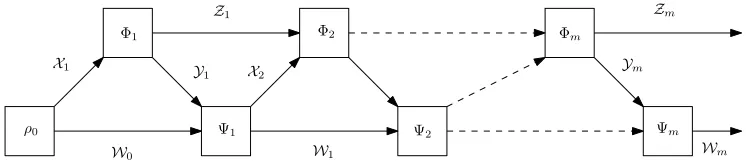
To prove Theorem 3.4, we model an adversary’s actions as a two-party interaction between the user and token via the Gutoski-Watrous (GW) theory of quantum games [GW07]. At a high level, the GW framework can be used to model our setting via Figure 3.4 (reproduced from Appendix C for completeness), which we now discuss. The bottom “row” of Figure 3.4 depicts the token’s actions, and the top row the user’s actions. The protocol begins by imagining the token sends initial stateρ0=ρRto the user via registerX1. The user then applies an arbitrary sequence of TPCP maps
ρ0
Φ1
Ψ1
Φ2
Ψ2
Φm
Ψm X1
W0 W1
Y1 X2 Z1
Ym Zm
Wm
Figure 1: A general interaction between two quantum parties.
notcondition any of its future actions on this query history it maintains; this ensures the token is stateless in its behavior. See Appendix C for details.) Finally, after receiving themth query in registerYm, we imagine the token makes a measurement (not depicted in Figure 3.4) based on the query responses it returned; if the user managed to extract both bitss0ands1via queries, then the
token “accepts”, and otherwise it “rejects”. (Again, here we are assuming the token keeps a history of all its responses in our security analysis; this is used only for the final measurement to judge whether the user cheated successfully, and not in the determination of any other action the token takes.)
With this high-level setup in place, the output of the GW framework is a semidefinite program, which we denoteΓ:
min: p (3)
subject to: Q1 Rm+1 (4)
Rk = Pk⊗IYk for 1≤ k≤m+1 (5)
TrXk(Pk) =Rk−1 for 1≤ k≤m+1 (6)
R0 = p (7)
Rk ∈ Pos(Y1,...,k⊗ X1,...,k) for 1≤ k≤m+1 (8)
Pk ∈Pos(Y1,...,k−1⊗ X1,...,k) for 1≤ k≤m+1 (9)
Above,Q1encodes the actions of the token. The variable pdenotes the “cheating probability” (i.e.,
the probability with which boths0ands1are extracted), subject to the constraint that operatorRm+1
encodes a valid “strategy” for the user of the token. The constraints which enforce a valid “strategy” are given by Equations (5)-(9). These force the tuple(R1, . . . ,Rm+1,P1, . . . ,Pm+1)to encode a
Choi-Jamiołkowski representation of a quantum strategy[GW07]. Let us briefly discuss the Choi-Jamiołkowski representation (details in Appendix C) and outline why such a framework might output an SDP. Recall that in roundiof the protocol, the user applies TPCP mapΦi. Any TPCP map has a number of known representations, one of which is theChoi-Jamiołkowski representation [Cho75, Jam72]. An advantage of the latter is it allows a simple characterization of the trace-preserving and completely positive properties ofΦi via linear and semidefinite constraints, respectively. Reference [GW07] extends this definition of the Choi-Jamiołkowski representation from a single TPCP mapΦi to an interactive protocol with multiple such maps(Φ1, . . . ,Φm); thus, intuitively one might expect such interactive strategies to also be characterized by linear and positive semidefinite constraints (i.e. by an SDP such asΓ).
Intuition forQ1and an upper bound on p. It remains to give intuition as to how one derivesQ1
assume that each of the token’s TPCP mapsΨiare given byisometries Ai :Yi⊗ Wi−17→ Xi+1⊗ Wi, meaningA†iAi = IYi⊗Wi−1 (due to the Stinespring dilation theorem). (We omit the first isometry
which prepares state ρ0 in our discussion here for simplicity.) Let us denote their sequential
application by a single operator A := Am· · ·A1 (note: to make the product well-defined, in
Equation (16) of Appendix C, one uses tensor products with identity matrices appropriately). Then, the Choi-Jamiołkowski representation ofAis given by [GW07]
TrZm(vec(A)vec(A)
†),
where we trace out the token’s private memory registerZm. (The operator vec(·)reshapes matrixA into a vector; its precise definition is given in Section C, and is not required for our discussion here.) However, since in our security analysis, we imagine the token also makes a final measurement via some POVMP= {P0,P1}, whereupon obtaining outcomeP1the token “accepts”, and upon
outcomeP0the token rejects, we require a slightly more complicated setup —Q1will actually be
defined as [GW07]
Q1=TrZm(vec(B1)vec(B1)
†),
forB1 := P1A.
The full derivation ofQ1in our setting takes a few steps, and is given in Appendix C. Here, let
us simply stateQ1and give intuition:
Q1 =
1 4n
∑
s∈S
|smbsmihsmbsm|Xm+1⊗ · · · ⊗ |s1bs1ihs1bs1|X2 ⊗
∑
(x,z)∈Xs
|xmihxm|Ym⊗ · · · ⊗ |x1ihx1|Y1⊗ |ψzihψz|X1 !
.
Intuitively, each stringsibsi ∈ {0, 1}
3
encodes the response of the token given theith query from the user; hence, the corresponding projectors inQ1act on spacesX2throughXm+1. Each string
xi ∈ {0, 1}n+1denotes theith query sent from the user to the token, where eachxi = biyi in the notation of Program 1,i.e. bi ∈ {0, 1}is the choice bit for each query. Each such message is passed via registerYi. The states|ψziand stringszare defined as in the beginning of Section 3.4; recall
z∈ {0, 1}2nand|ψzi ∈(C2)⊗ndenote the secret key and corresponding quantum key, respectively. Finally, the relationXsencodes the constraint that for alli∈ {1, . . . ,m}, the tuple(xi,z)(i.e.each message to the tokenxi and secret keyz) is consistent with the response returned by the token,si.
Upper bounding p. To now upper bound p, our approach is to give a feasible solution Rm+1
satisfying the constraints ofΓ. Note that giving even a solution which attainsp=1 for allnand
misnon-trivial — such a solution is given in Lemma C.2 of Appendix C.3. Here, we shall give a solution which attains p ∈ O(22m−0.228n), as claimed in Theorem 3.4 (and formally proven in Theorem C.3 of Appendix C.3). Namely, we set
Rm+1 =
1
|S|s∈S
∑
|smbsmihsmbsm|Xm+1⊗ · · · ⊗ |s1bs1ihs1bs1|X2 ⊗IY1⊗···⊗Ym⊗ I2nX
1
.
This satisfies constraint (5) of Γ due to the identity term IY1⊗···⊗Ym. The renormalization factor
of(|S|2n)−1 above ensures that tracing out all X
i registers yieldsR0 = 1 in constraint (7) ofΓ.
setting p = 1 willnotwork for large enoughmfor this choice ofRm+1. To see why, observe we
have chosenRm+1to align with the block-diagonal structure ofQ1on registersX2, . . . ,Xm. Since registersY1⊗ · · · ⊗ YmandX1ofRm+1are proportional to the identity matrix, it thus suffices to
characterize the largest eigenvalue ofQ1,λmax(Q1). This is done by Lemma C.4 of Appendix C.3,
which says
λmax(Q1) =
2 4n
1+ √1
2
n
.
Combining this bound onλmax(Q1)with the parameters ofRm+1 above now yields the desired
claim that p ∈O(22m−0.228n). We conclude that form< 0.114n, the probability that a user of the token successfully cheats and thus that the simulation fails is exponentially small in the key size,n.
4
Impossibility Results
We now discuss “tightness” of our protocol with respect to impossibility results. To begin, it is easy to argue that OTMs cannot exist in the plain model (i.e., without additional assumptions) in both the classical and quantum settings: in the classical setting, impossibility holds, since software can always be copied. Quantumly, this follows by a simple rewinding argument [BGS13]. Here, we give two simple no-go results for the quantum setting which support the idea that our scheme is “tight” in terms of the minimality of the assumptions it uses. Both results assume the token is reversible, meaning the receiver can run both the token and its inverse operation. The results can be stated as:
1. A stateless token which can be queried insuperpositioncannot be used to securely construct an OTM (Section 4.1).
2. Formeasure and accessschemes such as ours, in order for a stateless token to allow statistical security, it must have anexponentialnumber of keys per secret bit (Section 4.2).
4.1 Impossibility: Tokens which can be queried in superposition
In our construction, we require that all queries to the token be classical strings,i.e., no querying in superposition is allowed. It is easy to argue via a standard rewinding argument that relaxing this requirement yields impossibility of a secure OTM, as long as access to the token’s adjoint (inverse) operation is given, as we now show. Specifically, letMbe a quantum OTM implemented using a hardware token. Since the token access is assumed to be reversible, we may model it as an oracleOf realizing a function f :{0, 1}n7→ {0, 1}min the standard way,i.e., for ally ∈ {0, 1}nand
b∈ {0, 1}m,
Of|yi|bi= |yi|b⊕ f(y)i. (10)
Now, suppose our OTM stores two secret bitss0ands1, and provides the receiver with an initial
state|ψi ∈ A⊗B⊗C, whereA,B, andCare the algorithm’s workspace,query(i.e., input toOf), andanswer(i.e.,Of’s answers) registers, respectively. By definition, an honest receiver must be able to access precisely one ofs0 ors1 with certainty, given|ψi. Thus, for any i ∈ {0, 1}, there
recover|ψi. Applying Ai0fori0 6=ito|ψinow yields the second biti0 with certainty as well. We
conclude that a quantum OTM which allows superposition queries to a reversible stateless token is insecure.
Remark 4.1. Above, we assumed the OTM outputs si with certainty. The argument can be generalized
to the setting in which the OTM outputs si with probability at least1−efor smalle > 0; in this case,
Winter’s Gentle Measurement Lemma [Win99] can be used to show that both bits can again be recovered with non-negligible probability.
Remark 4.2. Our argument crucially relies on the fact that the receiver has superposition access to the A†
i
operation. In certain models (e.g., software), such access is unavoidable. However, our result does not rule out the possibility thatnon-reversiblesuperposition access to a token would allow for quantum OTMs.
4.2 Impossibility: Tokens with a bounded number of keys
We have observed that allowing superposition queries to the token prevents an OTM from being secure. One might next ask how simple a hardware token with classical queries can be, while still allowing a secure OTM. We now explore one such strengthening of our construction in which the token is forced to have a bounded number of keys.
To formalize this, let us define the notion of a “measure-and-access (MA)” OTM,i.e., an OTM in which given an initial state|ψi, an honest receiver applies a prescribed measurement to|ψi, and
feeds the resulting classical string (i.e., key)yinto the tokenOf to obtainsi. Our construction is an example of a MA memory in which each bitsi has anexponentialnumber of valid keysysuch that f(y) =si. One might ask whether the construction can be strengthened such that eachsi has a bounded number (e.g., a polynomial number) of keys. We now show that such a strengthening would preclude security, assuming the token is reversible.
For clarity, implicitly in our proof below, we model the oracle Of as having three possible outputs: 0, 1, or 2, where 2 is output wheneverOf is fed an invalid keyy. This is required for the notion of having “few” keys to make sense (i.e., there are 2ncandidate keys, and only two secret bits, each of which is supposed to have a bounded number of keys). Note that our construction indeed fits into this framework.
Lemma 4.3. Let M be an MA memory with oracle Of, such that Of cannot be queried in superposition. If
a secret bit si has at most∆keys yi such that f(yi) = si, then given a single copy of|ψi, one can extract
both s0and s1from M with probability at least1/∆2.
Remark 4.4. The proof is given in Appendix D. Lemma 4.3 shows that in the paradigm of measure-and-access memories, our construction is essentially tight — in order to bound the adversary’s success probability of obtaining both secret bits by an inverse exponential, we require each secret bit to have exponentially many valid keys. Second, as in the setting of superposition queries, the above proof can be generalized to the setting in which the OTM returns the correct bit si with probability at least1−efor small e> 0. Finally, the question of whether a similar statement to Lemma 4.3 holds for anon-reversibletoken remains open.
A
Universal Composition (UC) Framework
definitions (c.f. [GMW87, GL91, MR92, Bea91, Can00a]); please see also [PW01, PS04, CDPW07, LPV09, MR11] for alternative/extended frameworks. Recently Unruh [Unr10] extend the UC frame-work to the quantum setting. Next, we provide a high-level description of the original classical UC model by Canetti [Can01, Can00b], and then the quantum UC model by Unruh [Unr10].
A.1 Classical UC Model ([Can01, Can00b])
Machines. The basic entities involved in the UC model are players P1, . . . ,Pk wherek is poly-nomial of security parametern, an adversaryA, and an environmentZ. Each entity is modeled as a interactive Turing machine (ITM), whereZ could have an additional non-uniform string as advice. EachPihas identityiassigned to it, whileAandZ have special identitiesidA :=advand
idZ :=env.
Protocol Execution. A protocol specifies the programs for each Pi, which we denote as π =
(π1, . . . ,πk). The execution of a protocol is coordinated by the environmentZ. It starts by preparing inputs to all players, who then run their respective programs on the inputs and exchange messages of the form(idsender,idreceiver,msg). Acan corrupt an arbitrary set of players and control them
later on. In particular,Acan instruct a corrupted player sending messages to another player and also read messages that are sent to the corrupted players. During the course of execution, the environmentZ also interacts withAin an arbitrary way. In the end,Z receives outputs from all the other players and generates one bit output. We useEXEC[Z,A,π]denote the distribution of
the environmentZ’s (single-bit) output when executing protocolπwithAand thePi’s.
Ideal Functionality and Dummy Protocol. Ideal functionalityFis a trusted party, modeled by an ITM again, that perfectly implements the desired multi-party computational task. We consider an “dummy protocol”, denoted PF, where each party has direct communication with F, who accomplishes the desired task according to the messages received from the players. The execution ofPF with environmentZ and an adversary, usually called the simulatorS, is defined analogous as above, in particular,S monitors the communication between corrupted parties and the ideal functionalityF. Similarly, we denoteZ’s output distribution asEXEC[Z,S,PF].
Definition A.1(Classical UC-secure Emulation). We sayπ (classically) UC-emulatesπ0 if for any adversaryA, there exists a simulatorS such that for all environmentsZ,
EXEC[Z,A,π]≈EXEC[Z,S,π0] (11)
We here consider thatAandZ are computationally unbounded, and we call it statistical UC-security. We require the running timeS is polynomial in that ofA. We call this propertyPolynomial Simulation.
LetF be a well-formed two party functionality. We sayπ(classically) UC-realizesF if for
all adversary A, there exists a simulator S such that for all environmentsZ, EXEC[Z,A,π] ≈ EXEC[Z,S,PF]. We also writeEXEC[Z,A,π]≈EXEC[Z,S,F]if the context is clear.
UC-secure protocols admit a general composition property, demonstrated in the following universal composition theorem.
A.2 Quantum UC Model ([Unr10])
Now, we give a high-level description of quantum UC model by Unruh [Unr10].
Quantum Machine. In the quantum UC model, all players are modeled as quantum machines. A quantum machine is a sequence of quantum circuits{Mn}n∈N, for each security parametern. Mnis a completely positive trace preserving operator on spaceHstate⊗ Hclass⊗ Hquant, where
Hstaterepresents the internal workspace of Mnand Hclass andHquantrepresent the spaces for
communication, where for convenience we divide the messages into classical and quantum parts. We allow a non-uniform quantum advice5to the machine of the environmentZ, while all other
machines are uniformly generated.
Protocol Execution. In contrast to the communication policy in classical UC model, we consider a networkNwhich contains the spaceHN :=Hclass⊗ Hquant⊗
iHistate. Namely, each machine maintains individual internal state space, but the communication space is shared among all . We assumeHclasscontains the message(id
sender,idreceiver,msg)which specifies the sender and
receiver of the current message, and the receiver then processes the quantum state onHquant. Note
that this communication model implicitly ensures authentication. In a protocol execution,Z is activated first, and at each round, one player applies the operation defined by its machine Mn
onHclass⊗ Hquant⊗ Hstate. In the endZ generates a one-bit output. DenoteEXEC[Z,A,Π]the
output distribution ofZ.
Ideal Functionality. All functionalities we consider in this work are classical,i.e., the inputs and outputs are classical, and its program can be implemented by an efficient classical Turing machine. Here in the quantum UC model, the ideal functionalityFis still modeled as a quantum machine for consistency, but it only applies classical operations. Namely, it measures any input message in the computational basis to get an classical bit-string, and implements the operations specified by the classical computational task.
We consider an “dummy protocol”, denotedPF, where each party has direct communication withF, who accomplishes the desired task according to the messages received from the players. The execution ofPF with environmentZ and an adversary, usually called the simulatorS, is defined analogous as above, in particular,S monitors the communication between corrupted parties and the ideal functionality F. Similarly, we denoteZ’s output distribution asEXEC[Z,S,PF]. For simplicity, we also write it asEXEC[Z,S,F].
Definition A.3(Quantum UC-secure Emulation). We sayΠquantum-UC-emulates Π0 if for any quantum adversaryA, there exists a (quantum) simulatorS such that for all quantum environmentsZ,
EXEC[Z,A,Π]≈EXEC[Z,S,Π0] (12)
We consider here thatAandZare computationally unbounded, we call it (quantum) statistical UC-security. We require the running timeS is polynomial in that ofA. We call this propertyPolynomial Simulation.
5Unruh’s model only allows classical advice, but we tend to take the most general model. It is easy to justify that
Similarly, (quantum) computational UC-security can be defined. LetF be a well-formed two party functionality. We sayΠ quantum-UC-realizes F if for all quantum adversary A, there exists a (quantum) simulator S such that for all quantum environments Z, EXEC[Z,A,Π] ≈
EXEC[Z,S,PF].
Quantum UC-secure protocols also admit general composition:
Theorem A.4 (Quantum UC Composition Theorem [Unr10, Theorem 11]). Let Π,Π0 and Σ be quantum-polynomial-time protocols. Assume that Π quantum UC-emulates Π0. Then ΣΠ quantum UC-emulatesΣΠ0.
Remark A.5. Out of the two protocol parties (the sender and the receiver), we consider security only in the case of the receiver being a corrupted party. Note that we are only interested in cases where the same party is corrupted with respect to all composed protocol. Furthermore, we only consider static corruption.
B
Stand-Alone Security in the case of a Malicious Sender
Here, we recall notation that is used in the analysis of two-party quantum protocol [DNS10].
Definition B.1. An n-step quantum two-party protocol with oracle calls, denotedΠO = (A,B,O,n)
consists of:
1. input spaceA0andB0for partiesA andBrespectively.
2. memory spacesA1, . . .AnandB1, . . .BnforA andB, respectively.
3. An n-tuple of quantum operations(A1, . . .An)forA,Ai : L(Ai−1)7→L(Ai),(1≤ i≤n).
4. An n-tuple of quantum operations(B1, . . .Bn)forB,Bi : L(Bi−1)7→ L(Bi),(1≤ i≤n).
5. Memory spacesA1, . . . ,AnandB1, . . . ,Bncan be written asAi =AiO⊗ Ai0andBi =BiO⊗ Bi0,
(1 ≤ i≤ n)andO = (O1, . . . ,On)is an n-tuple of quantum operations: Oi : L(AiO⊗ BOi )7→ L(AO
i ⊗ BiO),(1≤i≤n).
If ΠO = (A,B,O,n)is an n-turn two-party protocol, then the final state of the interaction upon inputρin ∈D(A0⊗ B0⊗ R)whereRis a system of dimension dimA0dimB0, is:
[A ∗ B](ρin) = (1L(A0
n⊗Bn0⊗R)⊗ On)(An⊗Bn⊗1R). . .(1L(A01⊗B10⊗R)⊗ O1)(A1⊗B1⊗1R)(ρin).
(13) As in [DNS10], we specify that an oracleOcan be a communication oracle or an ideal function-ality oracle.
AnadversaryA˜for an honest partyA inΠO = (A,B,O,n)is ann-tuple of quantum operations matching the input and outputs spaces ofA. Asimulatorfor ˜A is a sequence of quantum operations
C
Security Analysis for the Token
We now provide the technical result (Theorem 3.4) that is used to prove security of our Quantum OTM construction of Section 3.1 against a linear number of queries. The statement below is informal; to make it formal, in Section C.3 we model the user’s interaction with the token via the Gutoski-Watrous framework for quantum games [GW07]. The resulting formal statement we desire, which immediately yields the informal claim below, is given in Theorem C.3.
Theorem C.1(Informal). For any stateless hardware token implemented as in Program 1,i.e., using an n-qubit conjugate coding state|xiθ, and for any user of the token (restricted only by the laws of quantum mechanics, meaning using any trace-preserving completely positive maps desired, regardless of efficiency of their implementation) making m queries to the token, the probability the user successfully queries the token to extract both secret bits s0and s1is at most O(22m−0.228n).
Thus, we are able to prove that if the user makes at mostm=cnqueries withc<0.114, then the user’s probability of cheating successfully is exponentially small inn.
The next sections show this claim, and are organized as follows. Sections C.1 and C.2 introduce notation, terminology, semidefinite programming, and the Gutoski-Watrous quantum games framework. Section C.3 shows the formal version of the claim above, namely Theorem C.3.
C.1 Notation, quantum channels, and semidefinite programming
Notation. LetX be a finite dimensional complex Hilbert space. Then,L(X), Herm(X), Pos(X), andD(X)denote the sets of linear, Hermitian, positive semidefinite, and density operators acting onX, respectively. The notationABmeansA−Bis positive semidefinite.
Quantum channels. A linear mapΦ: L(X)7→ L(Y)is aquantum channelifΦis trace-preserving and completely positive (TPCP). These are the channels which map density operators to density operators. Although we will not directly make use of it here (the Gutoski-Watrous framework in Section C.2 will use the concept indirectly in our presentation), a useful representation of linear maps (or “superoperators”)Φ : L(X) 7→ L(Y)is the Choi-Jamiołkowski representation,
J(Φ)∈ L(Y ⊗ X). The latter is defined (with respect to some choice of orthonormal basis{|ii}for
X) as
J(Φ) =
∑
i,j
Φ(|iihj|)⊗ |iihj|. (14)
The following properties of J(Φ)hold [Cho75, Jam72]: (1)Φis completely positive if and only if J(Φ) 0, and (2) Φ is trace-preserving if and only if TrY(J(Φ)) = IX. In a nutshell, the Gutoski-Watrous framework generalizes this definition tointeractingstrategies [GW07].
Semidefinite programs. We give a brief overview of semidefinite programs (SDPs) from the perspective of quantum information, as donee.g., in the notes of Watrous [Wat11] or [MVW13]. For further details, a standard text on convex optimization is Boyd and Vandenberghe [BV04].
Given any 3-tuple (A,B,Φ)for operators A∈ Herm(X)andB ∈ Herm(Y), and linear map
Φ: L(X)7→ L(Y)mapping Hermitian operators to Hermitian operators, one can state aprimal
Primal problem (P)
sup Tr(AX)
s.t. Φ(X) =B,
X∈Pos(X),
Dual problem (D)
inf Tr(BY)
s.t. Φ∗(Y) A Y∈Herm(Y),
whereΦ∗denotes theadjointofΦ, which is the unique map satisfying Tr(A†Φ(B)) =Tr((Φ∗(A))†B)
for allA∈ L(Y)andB∈ L(X). Not all SDPs have feasible solutions (i.e. a solution satisfying all constraints); in this case, we label the optimal values as−∞for P and∞for D, respectively. Note also that the SDP we derive in Equation (21) will for simplicity not be written in precisely the form above, but can without loss of generality be made so.
C.2 The Gutoski-Watrous framework for quantum games
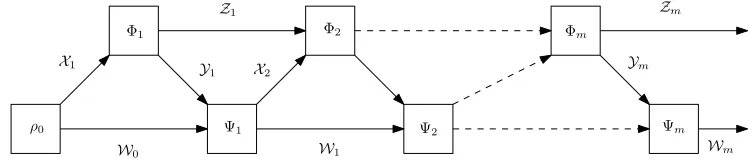
We now recall the Gutoski-Watrous (GW) framework for quantum games [GW07], which can be used to model quantum interactions between spatially separated parties. The setup most relevant to our protocol here is depicted in Figure C.2. Here, we imagine one party,A, prepares an initial
ρ0
Φ1
Ψ1
Φ2
Ψ2
Φm
Ψm X1
W0 W1
Y1 X2 Z1
Ym Zm
Wm
Figure 2: A general interaction between two quantum parties.
stateρ0 ∈ D(X1⊗ W0). RegisterX1is then sent to the second party (W0is kept as private memory),
B, who applies some quantum channelΦi :L(X1)7→ L(Y1⊗ Z1).Bkeeps registerZ1as private
memory, and sendsY1 back to A, who applies channelΨ1 : L(W0⊗ Y1) 7→ L(X2⊗ W1), and
sendsX2toB. The protocol continues for mmessages back and forth, until the final operation Ψm :L(Wm⊗ Ym)7→ C, in whichAperforms a two-outcome measurement (specifically, a POVM
P= {P0,P1}, meaningP0,P1 0,P0+P1 = I) in order to decide whether to reject (P0) or accept
(P1). As done in [GW07], we may assume without loss of generality6that all channels are given
by linear isometriesAk, i.e.Φk(X) =AkXA†k. (A linear isometryA∈ L(S,T)satisfiesA†A= IS. Such maps are roughly generalizations of unitary maps to non-square matrices.) Reference [GW07] refers to(Φ1, . . . ,Φm)as astrategyand(ρ0,Ψ1, . . . ,Ψm)as aco-strategy. In our setting, the former is “non-measuring”, meaning it makes no final measurement afterΦmis applied, whereas the latter is “measuring”, since we will apply a final measurement on spaceWm (not depicted in Figure C.2).
The GW framework then gives the Choi-Jamiołkowski (CJ) representation of a strategy and (measuring) co-strategy as follows. (Recall the definition of theChoi-Jamiołkowskirepresentation for superoperators is given in Section C.1, but the relationship between that definition and the more generalized development below for strategies/co-strategies is nota prioriobvious.)
CJ representation of (non-measuring) strategy. The CJ representation is given by
TrZm(vec(A)vec(A)
†), (15)
whereA∈ L(X1⊗ · · · ⊗ Xm,Y1⊗ · · · ⊗ Ym⊗ Zm)is defined as the product of the isometriesAi,
A:= (IY1⊗···⊗Ym−1⊗Am)· · ·(A1⊗IX2⊗···⊗Xm), (16)
and the vec :L(S,T)7→ T ⊗ S mapping is the linear extension of the map|iihj| 7→ |ii|jidefined on all standard basis states|ii,|ji.
CJ representation of (measuring) co-strategy. LetP:= {P0,P1}denote a POVM with reject and
accept measurement operatorsP0andP1, respectively. A measuring strategy which ends with a
measurement with respect to POVMPreplaces, forPa ∈P, Equation (15) with
Qa := TrZm((Pa⊗IY1⊗···⊗Ym)vec(A)vec(A)
†)
= TrZm(vec((
√
Pa⊗IY1⊗···⊗Ym)A)vec((
√
Pa⊗IY1⊗···⊗Ym)A)
†)
=: TrZm(vec(Ba)vec(Ba)
†). (17)
To convert this to aco-strategy, one takes the transpose of the operators defined above (with respect to the standard basis). (Note: In our use of the GW framework in Section C.3, all operators we derive will be symmetric with respect to the standard basis, and hence taking this transpose will be unnecessary.)
Optimization characterization over strategies and co-strategies. Fix anyQafrom a measuring co-strategy{Q0,Q1}, as in Equation (17). Then, the maximum probability with which a
(non-measuring) strategy can force the co-strategy to output resultais given by
min: p (18)
subject to: Qa pRm
Rk =Pk⊗IYk for 1≤k ≤m TrXk(Pk) =Rk−1 for 1≤k ≤m R0=1
Rk ∈Pos(Y1,...,k⊗ X1,...,k) for 1≤k ≤m Pk ∈Pos(Y1,...,k−1⊗ X1,...,k) for 1≤k ≤m p∈ [0, 1]
C.3 Security against a linear number of token queries
To show security of our hardware token implementation (Program 1) against a linear number of queries, we now model a user’s interaction with the token as an interactive game between two parties using the GW framework of Section C.2. We shall treat the token as theco-strategyand the user as thestrategy.
via a distinct registerYifori∈ {1, . . . ,m}. For each query made, we model the token as returning two strings: (1) a symbol in setΣ=
0, 1, 0, 1 where 0 and 1 denote successful 0- and 1-queries, respectively, and 0 and 1 denote unsuccessful 0- and 1-queries, respectively, and (2) a bitbwhich is set to 0 for a failed query, or secret bitbifor a successfuli-query. Formally, the size of each register
Xifori≥2 is hence three qubits. We will deviate from Figure C.2 in one respect — we assume the token returns the response to querymas well via a registerYm+1; this does not affect the success or
failure of the user (as the latter makes no further queries at this point), but helps streamline the analysis. After this last response is sent out, the token measures the strings∈Σmof responses it sent back to the user, and “accepts” if and only ifscontains at least one 0 and one 1. (More on this history of responses kept by the token and how to maintain the stateless property of the token to come.)
Let us next introduce the terminology used in this section for discussing the secret key held by the token. Namely, recall in Program 1 that the token keeps secret key datax ∈ {0, 1}n and
θ ∈ {+,×}n. Here, we shall replace these by a single stringz∈ {0, 1}2n, such that bits 2iand 2i+1
ofzspecify the basis and value of conjugate coding qubiti, fori ∈ {1, . . . ,n}(i.e. z2i = θi and
z2i+1 =xi). We shall callzthesecret key. For consistency, we shall rename thequantum key|xiθ from
Program 1 by|ψzi ∈(C2)⊗n, i.e.|xiθ =|ψzi. Next, in Program 1 the token takes inputsb∈ {0, 1}
andy ∈ {0, 1}n, forbthe choice bit andythe claimed measured value. In this section, we shall simply concatenate these as one stringx = by∈ {0, 1}n+1, the first bit of which is the choice bit. We shall refer toxas aquery string. With these definitions in hand, for each secret keyz∈ {0, 1}2n, we define a partition A0(z),A1(z),A0(z),A1(z)of{0, 1}n+1, which correspond to the sets of query
stringsxwhich cause the token to return response 0, 1, 0, or 1, respectively.
We can now begin to set up the GW framework. To define linear isometriesAk, we first construct operators∆k(z):Yk 7→ Xk+1⊗ Wk,k+1fork∈ {1, . . . ,m}as follows:
∆k(z) =
∑
x∈A0(z)
|00iXk+1|x0iWk,k+1hx|Yk+
∑
x∈A1(z)|10iXk+1|x1iWk,k+1hx|Yk+
∑
x∈A0(z)|0b0iXk+1|x0iWk,k+1hx|Yk+
∑
x∈A1(z)|1b1iXk+1|x1iWk,k+1hx|Yk.
Above, recall the register Yk denotes the kth message sent by the user to the token, Xk thekth response sent by the token back to the user (the first symbol of which denotes accept/reject via a symbol fromΣ, and the second symbol of which is the corresponding secret bit, which is set to 0 by default for failed queries), andWkdenotes the private memory of the token, which we now discuss further.
Let us now elaborate on how the token’s private memory spacesWk is modelled. First,W0
simulates measuring each message from the user in the standard basis7, as required by the token. Second, keepingxensures∆k(z)†∆k(z) = I, so that eachAidefined shortly is an isometry. Note that, crucially, the contents ofWk,rforr ≥2 are never accessed again8by the token in any future
iteration (this is the definition of the token beingstateless, and is formally captured by the definition of the terms Ai shortly). Also, while the size ofW grows withmin our security analysis here, the actual token does not have growing memory requirements since it simply discards the results of each measurement of the user’s message once it returns a symbol from Σin each round of communication.
We can now define isometriesAi (intuition to follow) for roundiof the token’s actions, where 1<k ≤m:
A0 =
1 2n
∑
z∈{0,1}2n
|ψziX1|ziW0,1
A1 =
∑
z∈{0,1}2n
∆1(z)Y1,X2,W1,2⊗ |ziW1,1hz|W0,1
Ak =
∑
z∈{0,1}2n
∆k(z)Yk,Xk+1,Wk,k+1⊗ |ziWk,1hz|Wk−1,1
k O
r=2
IWk,r,Wk−1,r
Here, A0 : C 7→ X1⊗ W0, and Ak : Yk⊗ Wk−1 7→ Xk+1⊗ Wk for 1 ≤ k ≤ m. Intuitively, the isometryA0captures the token choosing an initial secret keyzuniformly at random and preparing
corresponding quantum key|ψzi, which it sends to the user. EachAifor 1≤ k≤mcaptures the token reading a message from the user inYkand measuring it in the standard basis (simulated by copying stringxto a private registerWk,k+1), and returning an appropriate response to the user in
registerXk+1(note this response depends only on the contents ofYk,i.e., on thekth message, since the token is stateless). It also stores a copy of thekth response fromΣto the user in the private registerWk,k+1; as mentioned before, this information is not accessed by the token in deciding any
future messagesXk+i, but is used in our analysis to define the accepting measurementP1.
Having defined isometries Ai, their product now yields operator Afrom Equation (16) (where we reorder theX andWregisters to clarify that incoming messageYkresults in outgoing message
Xk+1):
A = 1
2n
∑
z∈{0,1}2nx1,...,xm
∑
∈{0,1}n+1|x1A(x1,z)iWm,2⊗ · · · ⊗ |xmA(xm,z)iWm,m+1⊗
|A(xm,z)bA(xm,z)iXm+1hxm|Ym⊗ |A(xm−1,z)bA(xm−1,z)iXmhxm−1|Ym−1⊗ · · · ⊗ |A(x1,z)bA(x1,z)iX2hx1|Y1⊗ |ψziX1⊗ |ziWm,1,
7Normally, the GW framework allows quantum messages to be exchanged between parties, but in our setting the
token only accepts classical query strings. To force the user to send classical strings, the token can simulate measurement of the user’s query qubits by simply creating a “local copy” of said qubits via local controlled-NOT gates, i.e. the token employs the principle of deferred measurement.
8Strictly speaking, as mentioned earlier, this is not quite accurate — the contents ofW
k,rareaccessed during the
where A(x,z)∈Σdenotes whether the token accepted or rejected query stringxassuming secret keyz, andbA(x,z)∈ {0, 1}is the secret bit returned by the token corresponding toA(x,z)∈Σ.
In order to next define operatorQ1from Equation (17), we model what it means for a cheating
user of the token to “succeed”. As mentioned earlier, this is formalized by having the token make a final measurement after the protocol concludes, in order to determine whether the user has successfully extracted both secret bits via queries. Formally, for convenience, letW0 denote the tensor product of the registers inWm,rfor 2≤r ≤m+1 which hold the values fromΣ(i.e., which hold termsA(xr−1,z)). Then, asuccessfuluser makes at least one correct 0 query and at least one
correct 1 query. Our accepting measurement operatorP1, which corresponds to a successful user, is
thus defined as follows. P1mapsW0 to itself, and is a projector onto the set of strings with some
i6= jsuch thatWi0is set to|0iandWj0 is set to|1i. In other words,P1projects onto set
S :={s∈ Σm |scontains at least one 0 and one 1}. (19)
To now use this definition ofP1to write downB1, we first need further terminology. Define for any
s ∈Sand fixed keyz∈ {0, 1}2n, the set of all consistent sequences of query stringsxi ∈ {0, 1}n+1 as:
Xs =
n
(x,z)∈ {0, 1}m(n+1)× {0, 1}2n| A(xi,z) =si forxitheith block of(n+1)bits inx
o
.
(For clarity and as an example, the second block of(n+1)bits of 0n+11n+1is 1n+1.) Finally, define relationR⊆Σm× {0, 1}m(n+1)
× {0, 1}2nsuch that
(s,x,z)∈ Rif and only if(x,z)∈ Xs.
In words, a triple(s,x,z)∈Rif for a secret keyzand query stringx,s∈Σmis the (unique) correct response string from the token.
With these definitions in place, we can finally defineB1 = (
√
P1⊗I)A= (P1⊗I)Aas (where
recallsi = A(xi,z))
B1 =
1 2n
∑
(s,x,z)∈R
|x1s1iWm,2⊗ · · · ⊗ |xmsmiWm,m+1 ⊗
|smbsmiXm+1hxm|Ym⊗ |sm−1bsm−1iXmhxm−1|Ym−1 ⊗ · · · ⊗ |s1bs1iX2hx1|Y1⊗ |ψziX1 ⊗ |ziWm,1.
Thus,
vec(B1) =
1 2n
∑
(s,x,z)∈R
|x1s1iWm,2⊗ · · · ⊗ |xmsmiWm,m+1 ⊗
|smbsmiXm+1|xmiYm⊗ |sm−1bsm−1iXm|xm−1iYm−1⊗ · · · ⊗ |s1bs1iX2|x1iY1 ⊗ |ziWm,1⊗ |ψziX1.
It follows thatQ1 =TrWm(vec(B1)vec(B1)
∗)equals
Q1 =
1 22n
∑
(s,x,z)∈R
|smbsmihsmbsm|Xm+1⊗ |xmihxm|Ym⊗ · · · ⊗