Same Point Composable and Nonmalleable
Obfuscated Point Functions
Peter Fenteany∗ Benjamin Fuller† December 20, 2019
Abstract
A point obfuscator is an obfuscated program that indicates if a user enters a previously stored password. A digital locker is stronger: outputting a key if a user enters a previously stored password. The real-or-random transform allows one to build a digital locker from a composable point obfuscator (Canetti and Dakdouk, Eurocrypt 2008).
Ideally, both objects would be nonmalleable, detecting adversarial tampering. Appending a non-interactive zero knowledge proof of knowledge adds nonmalleability in the common random string (CRS) model.
Komargodski and Yogev (Eurocrypt, 2018) built a nonmalleable point obfuscator without a CRS. We show a lemma in their proof is false, leaving security of their construction unclear. Bartusek, Ma, and Zhandry (Crypto, 2019) used similar techniques and introduced another nonmalleable point function; their obfuscator is not secure if the same point is obfuscated twice. Thus, there was no composable and nonmalleable point function to instantiate the real-or-random construction.
Our primary contribution is a nonmalleable point obfuscator that can be composed any polynomial number of times with the same point (which must be known ahead of time). Security relies on the assumption used in Bartusek, Ma, and Zhandry. This construction enables a digital locker that is nonmalleable with respect to the input password.
As a secondary contribution, we introduce a key encoding step to detect tampering on the key. This step combines nonmalleable codes and seed-dependent condensers. The seed for the condenser must be public and not tampered, so this can be achieved in the CRS model. The password distribution may depend on the condenser’s seed as long as it is efficiently sampleable. This construction is black box in the underlying point obfuscation.
Nonmalleability for the password is ensured for functions that can be represented as low degree polynomials. Key nonmalleability is inherited from the class of functions prevented by the nonmalleable code.
Keywords: Digital lockers; Point obfuscation; Virtual black-box obfuscation; Nonmalleable codes; Seed-dependent condensers; Nonmalleability
1
Introduction
Obfuscation hides the implementation of a program from all users of the program. This work is concerned withvirtual black-box obfuscation, where an obfuscator creates a program that reveals nothing about the program other than its input and output behavior [BGI+01, BGI+12]. Barak et al. showed that a virtual
∗
Email: [email protected]. University of Connecticut. †
black-box obfuscator cannot exist for all polynomial time circuits [BGI+01]. However, this leaves open the possibility of virtual black-box obfuscators for interesting classes of programs [CD08, BC10, CRV10, WZ17, BR17].1
We focus on obfuscated point functions [Can97] and digital lockers [CD08] [BC10]. A point func-tion obfuscator is an algorithm lockPoint(val) which outputs a circuit unlockPointval(·). The circuit unlockPointval(·) storesval and indicates when val is inputted to it. An obfuscated point function needs to hide all partial information aboutval [Can97].
A digital locker obfuscator inputs a value, val, and key, key. The output is a programunlockval,key(·) which outputskey if and only if the input isval. Soundness saysunlockval,key should reveal nothing about val or key if the adversary cannot guess val. Digital lockers have applications in password [Can97] and biometric authentication [CFP+16, ABC+18].
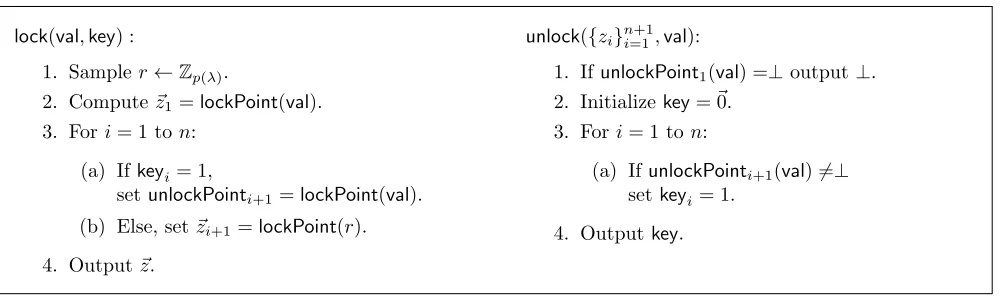
It is possible to compose point functions to build a digital locker using the real-or-random construc-tion [CD08]. It works as so: sample a random pointr. For each bit of the key, eitherr (corresponding to a 0 inkey) orval(corresponding to a 1) is obfuscated. An obfuscation ofvalis prepended as a check value. When running the program, if the check obfuscation opens, the user runs the other programs: failures to open correspond to a key bit 0 and successes correspond to a key bit of 1. Crucially, the point function must retain security when valis obfuscated multiple times.
Nonmalleability A desirable property of an obfuscated program is nonmalleability. A nonmalleable obfuscator detects if an adversary attempts to tamper the obfuscation into a related program [CV09], where being related is defined by some family of functions F. For example, it is desirable to prevent unlockval,key from being mauled tounlockf(val),f0(key) forf, f0∈ F.
In the random oracle model, designing nonmalleable digital lockers and point functions is easy: For a random oracle RO one outputs the program RO(val) ⊕(key||RO0(key)), where RO and RO0 are two independent random oracles of different output length. Similarly, using general non-interactive zero-knowledge proofs of zero-knowledge (NIZKPoKs) in the common random string (CRS) model one can achieve nonmalleability. For unlockval,key(·), appending a NIZKPoK of key and val would prevent the adversary from creating a valid obfuscation for any point related to the inputs.2
Komargodski and Yogev constructed a nonmalleable point obfuscator without resorting to these tools [KY18a]. Their construction follows. Let g be a fixed group generator. To obfuscate the point val, the obfuscator computes a random r and outputs
lockPoint(val) =
r, rg
P4
i=1vali
.
We observe that nonmalleability of Komargodski and Yogev’s scheme relies on an incorrect lemma in a way that is not apparently repairable. We discuss this in detail below.
Bartusek, Ma, and Zhandry [BMZ19] using similar mathematical structure showed a nonmalleable point function using random a, b, c:
lockPoint(val) =a, ga·val+(val)2+(val)3+(val)4+(val)5, b, gb·val+(val)6, c, gc·val+(val)7.
The structure of the group element is similar to Komargodski and Yogev’s construction, but with a random scalar in place of “double exponentiation.” The terms involving b and c ensure no incorrect
1We do not consider indistinguishability obfuscation in this work [GGH+13, GGH+16, SW14, PST14, GLSW15, AJ15]. 2
point causes the obfuscation to unlock. In both constructions, g is assumed to be fixed; this means the distribution ofvalmay depend on generatorg. Bartusek, Ma, and Zhandry [BMZ19] show security based on new Diffie-Hellman variants and show these variants hold in the generic group model, using tools from the auxiliary input generic group model [CDG18].
The natural nonmalleability definition is that, given unlockPointval, an adversary can only output the same obfuscation or obfuscations of independent points. The above constructions use a weaker definition. Given an obfuscation lockPointval, the adversary is required to output a function f and an obfuscation lockPointf(val). That is, the definition requires the adversary to know what tampering function they
are applying. Both constructions consider f as a polynomial of bounded degree related to the assumed hardness in the DDH assumptions. The definition considers the tampering functions prevented, not what operations are performed by the adversary.
The goal of this work is to construct nonmalleable digital lockers. The real-or-random construction instantiated with nonmalleable point functions would provides nonmalleability over val. Crucially, this construction requires security to hold when the nonmalleable point functions are composed though only with the same val. Both previous constructions have issues that prevent incorporation. The proof of nonmalleability for [KY18a] relies on an untrue lemma and the proof does not seem easily repairable, and the construction of [BMZ19] cannot be composed twice or more. We discuss these issues and then introduce our contribution.
[KY18b, Lemma 4.6] is not true Letgbe a fixed generator of a group. The version of Komargodski and Yogev published in Eurocrypt 2018 [KY18a] relied on a fixed generator power DDH assumption which says for any distribution x with super logarithmic entropy (here the distribution of x can depend on generator g) that
g, gx, gx2, ..., gxt ≈cg, gu1, gu2, ...., gut,
for a truly random set of elements u1, ..., ut. This assumption is used in the proof by assuming that the adversary sees P4
i=1ui and arguing they can’t predict any linear combinations other than c
P4
i=1ui for some constant c. However, Bartusek, Ma, and Zhandry [BMZ19] showed that for a fixed generator this assumption cannot be true: x can be drawn from points where most bits of gx are fixed. As a result, a revised version [KY18b] proposes a revised assumption called entropic power where
g, gx, gx2, ..., gxt ≈cg, gz1, gz2, ...., gzt.
Where zi are independent and have some super logarithmic min-entropy. This assumption does not appear to suffice. In particular, [KY18b, Lemma 4.6] is incorrect as stated. The lemma states it is hard to predict linear combinations of zi other than cP4i=1zi for any constant c∈G, even knowing P4i=1zi. However, even if each zi has entropy, the value P4i=1zi may uniquely determine each zi: let zi vary in the ith quarter of bits and fix the rest of bits to be 0. The attack of [BMZ19] prevents arguing that zi has any greater amount of entropy.
This does not seem to be an issue of just the proof technique. The point of the entropic power assumption is to switch to an information-theoretic setting where the adversary cannot predict new powers from a linear combination, but bounding the entropy of each zi may cause all powers to be predictable. Repairing this scheme seems to require a new Diffie-Hellman assumption or a major change in analysis.
the underlying assumption used to show nonmalleability [BMZ19, Assumption 4]. Since the distribution ofxmay depend ong, one can construct distributionsxwheregx is distinguishable from a random group element gr. If one can find gx, the scheme can not be secure. If one tries to obfuscate the same point x
twice, all the higher order terms can be removed by dividing two instances. That is, given
a1,g1 =ga1x+x
2+x3+x4+x5
a2,g2 =ga2x+x
2+x3+x4+x5
one can easily computeg(a1−a2)x=g
1/g2, and so we recover
gx= (g1/g2)(a1−a2) −1
.
1.1 Our Contribution
The primary contribution of this work is the first same-point composable nonmalleable point function The composable, nonmalleable point function can instantiate the real-or-random construction providing a nonmalleable digital locker that prevents tampering over val only. This construction is in the standard model.
As a secondary contribution, we introduce a key encoding step to detect tampering on key. The key encoding step allows us to achieve a digital locker that is nonmalleable over bothval and key. However, our key encoding step requires a public value that all distributions can depend on. This can be achieved in the common random string (CRS) model. In our construction the distribution of val can depend on the public value. In the CRS model, one can achieve nonmalleability in a non-black box way using non-interactive zero knowledge proofs of knowledge [CV09].
Composable Same Point Nonmalleable Point Function Obfuscation We introduce a new non-malleable point function that can be safely composedτ times as long as thesame pointis obfuscated each time. The construction builds on the one time scheme of Bartusek et al. [BMZ19]. We include additional randomized powers to prevent the above attack. The construction needs to know the desired composition parameterτ ahead of time. The value τ would be known in the case when a point function is being used to construct a digital locker. Let~a,~b, ~cbe uniform vectors of length τ. The construction is as follows:
lockPoint(x;~a,~b, ~c)def=
~a, gPτi=1~aixi+Pτi=+5τ+1xi,
~b, g~b1x+Pτi=2~bixi+τ+5+x2τ+5,
~c, g~c1x+Pτi=2c~ixi+2τ+4+x3τ+5.
The intuition for the formation of the first group element is that we need to randomize more powers to prevent the adversary from removing the higher order powers and being able to linear solve for gx. Since the adversary can createτ −1 linearly independent pairs, τ randomized powers are necessary. We add a fifth non-randomized power in the~aterm to deal with the additional flexibility created byτ. The crucial step in the proof is showing that some linear system has no interesting solutions, the extra power is to counteract the degree of freedom introduced byτ (see Theorem 3.2).
The intuition for the~b and ~c terms is similar. Due to our proof technique, we need to randomize different powers for the~aterm, the~bterm, and the~cterm, resulting in the above construction. All terms have a randomized x1 coefficient so we can reduce to [BMZ19, Assumption 4].
Detecting Key Tampering Our definition of nonmalleability for digital lockers uses two supplemental algorithms called key verifier and value verifier, denoted as Vkey and Vval respectively. The value verifier was defined for nonmalleable point functions (Definition 2.2). If the entire process could be controlled by the adversary, they could output a circuit that says thekey0 is always good. With these in hand, we define the following game (Definition 2.7):
1. Before input to the digital locker the key is encoded, c = Enc(key,val) and placed in the digital lockerlock(val, c) (that doesn’t detect tampering of key). Note, we allowc to depend onval.
2. The adversary performs tampering, outputs functionsfkey and fval, and a new obfuscationunlock0. 3. The adversary wins if
(a) unlock0 passes the value verifier. That is, Vval(unlock0)6=⊥,
(b) Ifc0 def= unlock0(fval(val)) passes the key verifier. That is,Vkey(c0, fval(val))6=⊥, and (c) The obfuscation is consistent with the provided functions: c0 =fkey(unlock(fval(val)).
We require the adversary to output its tampering functions as in [KY18a] and [BMZ19]. This is a limitation of the current definition, a stronger definition would keep the adversary from performing any prohibited tampering function, even if they are notaware of what function they are applying. Our proof techniques do not seem to extend to this stronger definition. The key verifier algorithm takesvalas input since it is available, however, themauled val is provided.
The adversary tampersc, but the definition makes no claim whether a tampering class is easy or hard. Since permutations and one directional bit flips (replacing an obfuscation with one of a random point) are easily computable, the encoding strategy should prevent them. This is possible for our encoding strategy (see below).
As mentioned above, one could prove knowledge (using a NIZKPoK) of justkeyto prevent modification of this value. Such a method would inherently depend on the underlying point digital locker. Our goal is to avoid general NIZKPoKs. Our strategy is to use a nonmalleable code [DPW10] to ensure an adversary can only tamper to independent values and a seed-dependent condenser [DRV12] to ensure an independent value is unlikely to pass the key verifier. We discuss the approach and alternative tools in Section 4.
Our construction requires seed to be public and not tampered. This can be achieved in the CRS model. Importantly, our construction does not assume independence of distributions from the random object. The CRS is only necessary for preventing tampering of key, the real-or-random construction prevents tampering ofval in the standard model.
Organization In Section 2, we present definitions. In Section 3, we introduce the composable nonmal-leable point function. In Section 4, we present the real-or-random digital locker construction and add the key encoding and verifier.
2
Preliminaries
For random variables Xi over some alphabet Z we denote by X = X1, ..., Xn the tuple (X1, . . . , Xn). For a set of indicesJ,XJ is the restriction ofX to the indices in J. Theminentropy of X is H∞(X) =
−log(maxxPr[X =x]), and theaverage (conditional) minentropy[DORS08, Section 2.4] ofX given Y is
˜
H∞(X|Y) =−log
E
y∈Ymaxx Pr[X=x|Y =y]
For a distinguisherD, thecomputational distance betweenX and Y isδD(X, Y) =|E[D(X)]−E[D(Y)]| (we extend it to a class of distinguishers D by taking the maximum over all distinguishersD ∈ D). We denote byDsthe class of randomized circuits which output a single bit and have size at mosts. Logarithms are base 2. In general, capitalized letters are used for random variables and the corresponding lowercase letters for their samples. We say that two circuits, C and C0, with inputs in {0,1}λ are equivalent if
∀x ∈ {0,1}λ, C(x) =C0(x). We denote this asC ≡C0. For a matrix A let A
i,j denote the entry in the
ith row and thejth column. Let A(·,j) represent the jth column andA(i,·) represent the ith row.
Definition 2.1. An ensemble of distributionsX ={Xλ}λ∈N, where Xλ is over {0,1}λ, is well-spread if
1. It is efficiently and uniformly samplable. That is, there exists a PPT algorithm given 1λ as input whose output is identically distributed as Xλ.
2. For all large enough λ∈N, it has super-logarithmic minentropy. Namely, H∞(Xλ) =ω(logλ).
2.1 Obfuscation Definitions
All obfuscation definitions include a requirement of polynomial slowdown, which says the running time should be at most a polynomial factor larger than the original program. Running time of our constructions can be easily verified. For all definitions, we include a tampering functionF. The traditional definition can be achieved by takingF =∅. We adapt nonmalleability definitions from Komargodski and Yogev [KY18a]. See Komargodski and Yogev for definitional considerations [KY18a].
Our constructions require that the challenger can recognize a legitimate obfuscation. We call this object a value verifier orVval. It was called a verifier (without the word value) in [KY18a].
Definition 2.2 (Value Verifier). Let λ∈Nbe a security parameter. Let Obe a program that takes inputs
x∈ {0,1}λ and outputs a programP. A PPT algorithmVvalis called a value verifierif for allx∈ {0,1}λ, it holds that Pr[Vval(P) = 1|P ← O(x)] = 1, (prob. over the randomness ofVval and O).
Our constructions consist of tuples of group elements and strings. The obvious value verifier suffices as long as group elements are recognizable.
Point Obfuscators A point function is a functionIval: {0,1}n 7→ {0,1} that outputs 1 on input val and 0 elsewhere. An obfuscator preserves functionality while hiding the pointvalifvalis not provided as input to the program. In this work we consider a version that allows for the same point to be obfuscated multiple times while retaining security.
Definition 2.3 (τ-Same Point Nonmalleable Point Function). For security parameter λ ∈ N, let F :
{0,1}λ → {0,1}λ be a family of functions, let X be a family of distributions over {0,1}λ. A(F,X)-non malleable point function obfuscation lockPoint is a PPT algorithm that inputs a point val∈ {0,1}λ, and outputs a circuit unlockPoint. Let Vval be a value verifier for lockPoint as defined in Definition 2.2. The following properties must hold:
1. Completeness: For all val∈ {0,1}λ, it holds that
Pr[unlockPoint(·)≡Ival(·)|unlockPoint←lockPoint(val)]≥1−ngl(λ),
2. Soundness: For every PPT A and any polynomial function p, there exists a simulator S and a polynomial q(λ) such that, for all large enough λ ∈ N, all val ∈ {0,1}λ and for any predicate
P :{0,1}λ 7→ {0,1},
|Pr[A({unlockPointi}τi=1) =P(val)|{unlockPointi}τi=1 ←lockPoint(val)]
−Pr[SIval(·)(1λ) =P(val)]| ≤ 1
p(λ),
where S is allowed q(λ) oracle queries toIval and the probabilities are over the internal randomness of A and lockPoint, and of S, respectively. Here Ival(·) is an oracle that returns 1 when provided input val and 0 otherwise.
3. Nonmalleability For any X∈ X, for any PPT A, there exists=ngl(λ), such that:
Pr val←X
"
Vval(C) = 1, f ∈ F,(If(val)≡C)
{unlockPointi}τi=1←lockPoint(val)
(C, f)← A({unlockPointi}τi=1)
#
≤.
In the above unlockPointi are τ outputs of lockPoint on the same input point val and independent randomness. Note that the simulator is still only provided with a single oracle. In usual composition definitions the simulator hasτ oracles. Since we consider the same point being obfuscated multiple times, all of these oracles would have the same functionality and can be reduced to a single oracle.
In addition to the above traditional definition of soundness, we’ll use two auxiliary definitions of privacy for nonmalleable point functions. These are known as distributional indistinguishability and oracle indistinguishability (both first defined in [Can97]).
Definition 2.4((Same Point) Distributional Indistinguishability). An algorithmlockPointis called a good distributional indistinguishable (DI) obfuscator if for any PPT Awith binary output and any well-spread distribution X over points in {0,1}λ then there exists some negligible function such that
| Pr
val←X[A({unlockPointi} τ
i=1) = 1|unlockPointi ←lockPoint(val)]
− Pr
u←{$ 0,1}λ
[A({unlockPointi}τi=1) = 1|unlockPointi ←lockPoint(u)]| ≤.
In the previous definition [BC10] of composable distributional indistinguishability in therandom case the adversary is provided with τ different random points. Here because we focus on obfuscating multiple copies of the same random point, we require indistinguishability fromτ copies of a random point.
Definition 2.5 ((Same point) Oracle Indistinguishability). An algorithm lockPoint is a oracle indistin-guishable (OI) obfuscator if for any PPT adversary A and any polynomial function p, there exists a polynomial size family of sets{Lλ}λ∈N such that for all sufficiently large λand for all val6∈Lλ,
|Pr[A({unlockPointi}τi=1) = 1|unlockPointi←lockPoint(val)]
− Pr
val0←{$ 0,1}n
[A({unlockPointi}τi=1) = 1|unlockPointi←lockPoint(val0)]| ≤ 1
p(λ).
Theorem 2.1. Anyτ same point distributional indistinguishable point obfuscator is aτ-composable same point VBB obfuscator.
Proof. [BC10, Lemma 3.1] shows distributional indistinguishability implies oracle indistinguishability. We need to modify this proof slightly because our versions of distributional indistinguishability and oracle indistinguishability consider the same point.
Lemma 2.1. Suppose that a point obfuscator lockPoint satisfies τ-distributional indistinguishability (for the same point) then it satisfies τ-oracle indistinguishability (for the same point).
Proof of Lemma 2.1. Consider some binary PPT A and a polynomial function p. We demonstrate the existence of the familyLλ. Define byXλ the set of all values val∈ Xλ such that
|Pr[A({unlockPointi}τi=1) = 1|unlockPointi ←lockPoint(val)]
− Pr
val0←{$ 0,1}λ
[A({unlockPointi}τi=1) = 1|unlockPointi ←lockPoint(val0)]|> 1
p(λ). (1)
Define Xλ+ as the set of points where Eq (1) is true without the absolute values. Define Xλ− as the set of points where the negative of Eq (1) is greater than 1/p(λ). Assume towards a contradiction that
|Xλ| = ω(poly(λ)). This means that for infinitely many λ it is either true that |Xλ+| or |Xλ−| is super polynomial size. Without loss of generality assume that the first case holds. We construct a well-spread distribution ensembleZλ such that A distinguishes τ obfuscations of points fromZλ and τ obfuscations of a uniform point. Define the distribution Zλ as the uniform distribution over Xλ+. Note that Zλ is a well spread distribution. Then it must be the case that
| Pr val←Zλ
[A({unlockPointi}τi=1) = 1|unlockPointi←lockPoint(val)]
− Pr
u←{$ 0,1}λ
[A({unlockPointi}τi=1) = 1|unlockPointi←lockPoint(u)]| ≥ 1
p(λ).
This contradicts the τ-distributional indistinguishability oflockPoint.
Lemma 2.2. Suppose that a point obfuscator, lockPoint satisfies same point τ-oracle indistinguishability then it satisfies VBB when composed τ times.
Proof of Lemma 2.2. Let A be some PPT adversary. Furthermore, suppose that lockPoint satisfies τ -oracle indistinguishability. Define Lλ as the polynomial size set in Definition 2.5. Define the simulator
SA:
1. Query the oracleI on each pointx∈Lλ. If the oracle returns 1 go to next step and setval=x.
2. Ifval=⊥set val← {$ 0,1}λ.
3. Run and outputA({lockPoint(val)}λ i=1).
simulation is perfect. In the case whenval6∈Lλ by the definition of oracle indistinguishability
Pr[A({unlockPointi}τi=1) =P(val)|unlockPointi ←lockPoint(val)]
−Pr[SIval(·)
A (1
λ) =P(val)]≤
|Pr[A({unlockPointi}τi=1) = 1|unlockPointi ←lockPoint(val),val6∈Lλ]
− Pr
val0←{$ 0,1}λ
[A({unlockPointi}ti=1) = 1|unlockPointi ←lockPoint(val0)]| ≤ 1
p(λ).
Thus, in all cases for an arbitrary polynomial p(λ) the VBB condition is satisfied.
The application of Lemma 2.1 and 2.2 proves Theorem 2.1.
We now present our definition of a nonmalleable digital locker. Our notation for digital lockers adds a key verifier which checks if the key should be accepted. This is analogous to the value verifier in the previous subsection:
Definition 2.6 (Key Verifier). Let λ∈Nbe a security parameter and let n=n(λ) be a parameter. Let
O be a program that takes inputs x ∈ {0,1}λ, y ∈ {0,1}k and outputs a program P. A PPT algorithm Vkey (with inputs in {0,1}λ+n and outputs in {0,1}k∪ ⊥) for program class O is called a key verifier if it holds that
Pr[Vkey(x, z)6=⊥ |P ← O(x, y), z ← P(x)] = 1, Where the probability is over the randomness of Vkey andO).
Here we note the three different values x, y, z. The value xis the input value, y is the input key, and
z as an encoded version of the key. The output of the locker is z which is then checked. There most be value and key independent algorithm that checks z otherwise no manipulation detection is possible. A definition for traditional digital lockers is found in Canetti and Dakdouk [CD08]. Our definition considers tampering on bothkey and val.
Definition 2.7 (Nonmalleable Digital Locker). For security parameter λ ∈ N, Let F : {0,1}λ →
{0,1}λ,G : {0,1}n → {0,1}n be families of functions and X be a family of distributions over {0,1}λ. A (F,G,X)-nonmalleable digital locker lock is a PPT algorithm that inputs a point val ∈ {0,1}λ and string key ∈ {0,1}n. Let Vval be a value verifier for lock and let Vkey be a key verifier for lock. The following conditions must be met:
1. Completeness: For a circuit unlock define the circuit unlock0(x) = Vkey(x,unlock(x)). For all val∈ {0,1}λ,key∈ {0,1}n it holds that
Pr[unlock0(·)≡Ival,key(·)|unlock←lock(val,key)]≥1−ngl(λ), where the probability is over the randomness of lock.
2. Soundness: For every PPT A and any polynomial function p, there exists a simulator S and a polynomial q(λ) such that, for all large enough λ ∈N, all val ∈ {0,1}λ, all key ∈ {0,1}k, and for anyP :{0,1}λ+k7→ {0,1},
Pr[A(lock(val,key)) =P(val,key)]−Pr[S
Ival,key(1λ) =P(val,key)] ≤
1
p(λ),
3. Nonmalleability For any distribution X∈ X, for any PPT A, for any key∈ {0,1}n, there exists
=ngl(λ) such that:
Pr val←X
Vval(C) = 1, f ∈ F, g∈ G,
y=C(f(val)), y=g(unlockval,key(val)), Vkey(f(val), y)6=⊥, ∃α s.t. If(val),α≡C
unlockval,key ←lock(val,key) (C, f, g)← A(unlockval,key)
≤.
where at most one of f and g may be the identity function.
If nonmalleability is not a requirement a traditional digital locker can be obtained by outputting unlock0(x) =Vkey(x,unlock(x)) instead of unlock(x).
3
A composable nonmalleable point function
In this section, we introduce a new construction of a nonmalleable point function that can be composed as long as the same point is used each time. Our construction draws on ideas from [BMZ19] and is secure under the same assumptions. Their construction is as follows for randomly sampled a, b, c:
lockPoint(val) =a, ga·val+(val)2+(val)3+(val)4+(val)5, b, gb·val+(val)6, c, gc·val+(val)7.
The first group element is the key to nonmalleability, the second two group elements are there to provide correctness. Security of their construction and ours relies on two assumptions (they showed security of these assumptions in the generic group model even if the distribution of val depends on the chosen generator of the group).
Assumption 3.1. [BMZ19, Assumption 3] Let G={Gλ}λ∈N be a group ensemble with efficient
repre-sentation and operations where each Gλ is a group of prime order p ∈ (2λ,2λ+1). We assume that for every λ∈N there is a canonical group (and efficiently computable) and canonical and efficient mapping between the elements of {0,1}λ to
Gλ. Let {Xλ} be a family of well-spread distributions over {0,1}λ. Then for any `=poly(λ) for any PPT A:
Pr[A({ki, g
kix+xi}
i∈[2,...,`]= 1]−Pr[A({ki, gkir+r i
}i∈[2,...,`]
=ngl(λ).
where x← Xλ, r←Zp(λ), ki←Zp(λ).
The second assumption can be proved from Assumption 3.1, see [BMZ19, Lemma 8], and is useful for arguing nonmalleability:
Assumption 3.2. [BMZ19, Assumption 4] Let G and Xλ be defined as in Assumption 3.1. Then for any`=poly(λ) for any PPT A:
Pr[gx ← A({ki, gkix+x i
}i∈[2,..,`]=ngl(λ).
We now introduce our main construction. The intuition behind the construction is to increase the number of randomized powers to deal with the additional constraints on val that the adversary gains by seeing multiple copies; it will be proved secure under Assumptions 3.1 and 3.2.
Construction 3.1. Let λ ∈ N be a security parameter. Let G = {Gλ}λ∈N be a group ensemble with efficient representation and operations where each Gλ is a group of prime order p ∈ (2λ,2λ+1). We assume that for every λ∈ N there is a canonical and efficient mapping between the elements of {0,1}λ to Gλ. Let g be a generator of the group Gλ. For some parameter τ ∈ Z+, let ~a,~b, ~c ←$ Gλ be input randomness and define the algorithm lockPoint as:
lockPoint(val;~a,~b, ~c)def=
~a, gPτi=1~aixi+Pτi=+5τ+1xi
~b, g~b1x+Pτi=2~bixi+τ+4+x2τ+5,
~c, g~c1x+Pτi=2c~ixi+2τ+4+x3τ+5.
Given a program unlockPoint consisting of three vectors~a,~b, ~c and group elements g1, g2, g3 and input val
compute:
gPτi=1~aivali+Pτi=+5τ+1vali =? g 1
g~b1val+Pτi=2~bivali+τ+4+val2τ+5 =? g 2
g~c1val+Pτi=2~civali+2τ+4+val3τ+5=? g 3.
If all of these checks pass, output 1. Otherwise, output 0.
In order to add same point composability, we extend from three scalars to 3τ scalars (while keeping 3 group elements). We note that this scheme is that of [BMZ19] if we letτ = 1.
Lemma 3.1. For anyτ =poly(λ) Construction 3.1 satisfies completeness.
Proof. This argument is analogous to the functionality preservation argument in [BMZ19]. The only difference is that polynomials are higher degree due to composition. Fix some pointx∈Zp(λ). It suffices
to argue that over the randomness of unlockPoint ← lockPoint(x) that the probability that there exists somey such thatunlockPoint(y) = 1 isngl(λ).
Recall that the randomness used to construct unlockPoint is the vectors ~a,~b, ~c. Fix some x ∈ Zp(λ).
Fix some value~aand defineαdef= Pτ
i=1xi+
Pτ+5
i=τ+1xi. For some other valuey, sinceGis prime order the
only way for the first element to match is forα=Pτ
i=1yi+
Pτ+5
i=τ+1yi. Since this is a polynomial of degree
τ + 5 there are at most τ + 4 such valuesy (excluding the original valuex). Consider one such value y. Then, consider the polynomialP(~b)def= ~b1(x−y) +Pτi=2~bi(xi+τ+4−yi+τ+4) + (x2τ+5−y2τ+5). Fix some values of~bi for i= 2, ..., τ. Then this is a linear polynomial in~b1 that is zero with probability at most
1/p(λ). A similar argument holds for the second check value. Thus, a candidate y is a solution to both equations with probability 1/p(λ)2. Thus means for a fixedx the probability of one of they’s working is at most (τ+ 5)/p(λ)2 by union bound. With a second application of union bound, the probability across all x of somey existing is at most (τ+ 5)/p(λ) =ngl(λ) as desired.
Proof. We show that Construction 3.1 satisfies distributional indistinguishability (Definition 2.4). Virtual black box security then follows by Theorem 2.1.
Suppose for the aim of arriving at a contradiction that there exists some well-spread distribution Xλ
such that there exists a PPT adversary Aand a polynomialq(·) such that
|Pr[A({lockPoint(x)}τ
i=1) = 1]−Pr[A({lockPoint(r)}τi=1) = 1]|>
1
q(λ),
where x ←Xλ and r ←Zp(λ). We then show how to build an adversary B that breaks Assumption 3.1
(with respect to distribution family Xλ) receiving ` = 3τ + 4 elements (corresponding to a maximum power of 3τ+ 5). That is, B will receive 3τ + 4 pairs of the form
{ki, gkiz+z i
}i∈{2,...,3τ+5},
where z is either distributed according to Xλ or uniformly in Zp(λ). Denote by {ki, ghi}i=2,...,3τ+5 the
received values, defining hi =kiz+zi. Then,Bsamples three matrices A,B,Cuniformly in Zτ×p(λ()τ−1). Our goal is to produce τ obfuscations (either ofxorr). Bcompute the matricesA0,B0,C0 ∈Zτ×τp(λ) as follows:
A0i,j = (
Pτ−1
α=1Ai,αkα+1+Pατ+4=τkα+1 j= 1
Ai,j−1 otherwise.
B0i,j =
(Pτ−1
α=1Bi,αkα+τ+5+k2τ+5 j= 1
Bi,α−1 otherwise.
C0i,j =
(Pτ−1
α=1Ci,αkα+2τ+5+k3τ+5 j= 1
Ci,j−1 otherwise.
Then Bcomputes theith value to be fed into Aas:
lockPointi =
A0(i,·), gPτ−j=11Ai,jhj+1+Pτj=+5t hj+1,
B0(i,·), g Pτ−1
j=1Bi,jhj+τ+4+h2τ+5,
C0(i,·), g Pτ−1
j=1Ci,jhj+2τ+4+h3τ+5.
The above group elements can be formed linearly from the received values{ki, ghi}i∈[2,...,3τ+5]andA,B,C.
For the ith obfuscation, the values produced in the exponent are (omitting the exponential notation):
τ−1
X
j=1
Ai,jhj+1+
τ+5
X
j=τ+1
hj =
τ−1
X
j=1
Ai,jkj+1+
τ+4
X
j=τ
kj+1
z+
τ−1
X
j=1
Ai,jzj+1+ τ+5
X
j=τ+1
zj,
τ−1
X
j=1
Bi,jhj+τ+5+h2τ+5=
τ−1
X
j=1
Bi,jki+τ+5+k2τ+5
z+
τ−1
X
j=1
Bi,jzj+τ+5+z2τ+5,
t−1
X
j=1
Ci,jhj+2τ+5+h3τ+5=
τ−1
X
j=1
Ci,jki+2τ+5+k3τ+5
z+
τ−1
X
j=1
From the above equations, it is apparent that the matrices A0,B0,C0 are consistent with the group elements. Furthermore it is clear for j > 1 that the coefficients for zj are appropriately formed. It remains to show that the 3τ coefficients of z are uniformly random. Denote by ζi for i = 1, ...,3τ coefficients ofzrespectively. Let1i,j represent an all 1 matrix of dimensioni×jand define0i×j similarly. Define the matrix of coefficients:
Ddef=
A(·,1) A(·,2,...,t−1) 1τ×5 0τ×τ−5 0τ×1 0τ×τ−1 0τ×1
B(·,1) 0τ×τ−1 0τ×5 B(·,2,...,t−1) 1τ×1 0τ×τ−1 0τ×1
C(·,1) 0τ×τ−1 0τ×5 0τ×τ−5 0τ×1 C(·,2,...,t−1) 1τ×1
.
The set of values received by the adversary can be described by:
D
k2
k2
... k3t+5
=
ζ1
ζ2
... ζ3t
The matrixD has dimension 3τ ×3τ+ 5. For each coefficient ζj to be random it suffices for the matrix
D to have row rank of 3τ. For D to have rank 3τ it suffices for each A||1,B|1,C||1 to have rank of τ. Since each matrix is random this occurs with probability at mostτ /p =ngl(λ). If one these matrices is not full rank, B aborts and outputs a random value. Conditioning on these matrices being full rank the obfuscation are properly prepared forA. Denote by
DistingA def
= |Pr[A({lockPoint(x)}τ
i=1) = 1]−Pr[A({lockPoint(r)}τi=1) = 1]|.
Then one has that
Pr[B({ki, g
kix+xi}
i∈[2,...,3τ+4]= 1]−Pr[B({ki, gkir+r i
}i∈[2,...,3τ+4] = Pr[A∨B∨Cnot full rank] + Pr[A∧B∧Cfull rank]·DistingA=
ngl(λ) + (1−ngl(λ) 1
q(λ) = 1
q0(λ)
for some polynomial function q0(λ). This completes the proof of Theorem 3.1.
Theorem 3.2. Let λ be a security parameter Let {Xλ} be a well-spread distribution ensemble and let
m, τ ∈ Z+ be parameters that are both
poly(λ). Let Fpoly be the ensemble of functions fλ where fλ is the set of non-constant, non-identity polynomials in Zp(λ)[x] with degree at most m. Suppose that
Assumption 3.1 holds for `=m(3τ+ 5). Then, the above obfuscator is non-malleable forτ-compositions for Fpoly and distribution ensemble {Xλ}.
Proof. We look to contradict Assumption 3.2, which follows from Assumption 3.1. Consider a mauling ad-versaryAthat, givenτ obfuscations of a pointx, can output a new obfuscation off(x) forf ∈ Fpoly. Con-sidermto be the degree off. We build an adversaryBwhich given the ensemble{ki, gkix+x
i
}i=2...,m(3τ+5)
and access toA recoversgx with noticeable probability.
First, we consider the case when m >1. We set up the reduction as so: upon receiving the ensemble
{ki, gkix+x i
}i=2...,m(3τ+5), we create τ obfuscations of x as detailed in Theorem 3.1. We send these toA, which returns
where~a,~b, ~c∈Zτp(λ) and ja, jb, jc∈Gλ. Define the vector~las the coefficients of:
~c1(f(x)) +
τ
X
i=2
~ci(f(x))i+2τ+4+ (f(x))3τ+5=
m(3τ+5)
X
i=0
~lixi.
In order for the adversary to succeed, this value must equal the exponent ofjcwith noticeable probability.
B computes and returns
jc
gl0·
m(3τ+5)
Y
i=2
hli i
−1
1/(l1−
m(3τ+5)
P
i=2
kili)
.
Since Bhas properly prepared the set of obfuscations toA,Areturns a valid obfuscation off(x) with probability at least 1/poly(λ). In this case then
jc=gl0+l1x+...+lm(3τ+3)x m(3τ+5)
with the same probability. In this case, we see that the value in parenthesis is
gx(l1−
m(3τ+5)
P
i=2
kili)
.
Since allli, ki are known, this can be computed unless
l1−
m(3τ+5)
X
i=2
kili = 0.
Since f(x) is of degree m, lm(3τ+5) must be nonzero. A’s view is independent of km(3τ+5). So, the
probability that the sum is equal to l1 is 1/(p(λ)−1). So, B returns the correct value with probability
1/poly(λ)−1/(p(λ)−1) = 1/poly(λ) contradicting Assumption 3.2.
We now consider the case where m = 1, or for linear functions f. In this case, we are given the ensemble {ki, gkix+xi}
i=2,...,3τ+5. This time, upon receiving
(f, ~a,~b, ~c, ja, jb, jc)
from A,Binstead computes the coefficients~lof
τ
X
i=1
~aif(x)i+ τ+5
X
i=τ
f(x)i= τ+5
X
i=0
~lixi
as in the nonlinear case. In this case, B computes and outputs:
ja gl0 ·
τ+5
Y
i=2
hli i
!−1
1/(l1−
τ+5
P
i=2
kili)
.
Because Aoutputs the value
with noticeable probability,B’s computation evaluates togx unless
l1−
τ+5
X
i=2
kili= 0.
Let R be a random Zτ×τp(λ)−1 and let 1τ×5 be a τ ×5 matrix of all 1s. To see that this happens with negligible probability, for the first group element of each obfuscation received the coefficient of x1 are as follows:
~a1=
R|1τ×5
· k2 k3 . . . kτ+5
As shown in the proof of Theorem 3.1 the values of R are uniformly random conditioned on the other values seen by the adversary.
We note that, as all ki are uniformly chosen, the only information Alearns about kτ+1, ..., kτ+5 is in
the vector ~a1 Furthermore R is independent of these values. Thus, we can see that A receives items of
the form
~a1,j = τ
X
i=2
kiRi,j+ τ+5
X
i=τ+1
ki.
Without loss of generality, we assume that an adversary knows the values k2, ..., kτ. To change the obfuscated point they will also need to change the higher order powersxτ+1, ..., xδ+5. The only value they have seen that involves the values kτ+1, ..., kτ+5 are terms of the form c+
P5
i=1kτ+i
x for some value
c. Since the function is linear, we can representf(x) =αx+β. So, the adversary must findα, β, γ such that
4
X
i=0
(αx+β)i+τ+1 =γ
4
X
i=0
xi+τ+1.
Define δ=τ + 1. We can write the desired linear combination as follows:
α4+δ
α3+δ
δ+4 1
β+ δ+30
α2+δ δ+42
β2+ δ+31
β+ δ+20
α1+δ
P3
i=0
δ+4−i
3−i
β3−i
αδP4
i=0
δ+4−i
4−i
β4−i
|
k4+δ 0 0 0 0
0 k3+δ 0 0 0 0 0 k2+δ 0 0 0 0 0 k1+δ 0
0 0 0 0 kδ
=γ
k4+δ
k3+δ
k2+δ
k1+δ
kδ
Substituting, one has that
1. If β = 0 then this implies αδ+4 =αδ+3 =αδ+2 =αδ+1 = αδ which only has solutions if α = 0 or
α= 1. These are both considered trivial solutions.
2. Otherwise, γ =αδ+4 (using first equation),
3. (δ+ 4)β+ 1 =α (using second equation),
4. (δ+ 4)β+ 2 = 0 orδ=−5 (using third equation, relying onβ 6= 0).
lock(val,key) :
1. Sampler←Zp(λ).
2. Compute~z1=lockPoint(val).
3. Fori= 1 ton:
(a) Ifkeyi= 1,
setunlockPointi+1=lockPoint(val).
(b) Else, set~zi+1 =lockPoint(r).
4. Output~z.
unlock({zi}ni=1+1,val):
1. IfunlockPoint1(val) =⊥output⊥.
2. Initializekey=~0.
3. Fori= 1 ton:
(a) If unlockPointi+1(val)6=⊥
setkeyi= 1.
4. Outputkey.
Figure 1: Nonmalleable digital locker preventing tampering over only val
6. γ = (−1)δ(substitution ofαin first equation). Note thatγ = 1 corresponds to no tampering. Thus, we consider γ =−1.
7. δ≡ −5 or δ ≡ −6 (solving fourth equation using prior constraints) and thusτ ≡ −6 or τ ≡ −7.
We note that since τ = poly(λ) for large enough λ one can be sure that τ 6≡ {−6,−7} mod |Gλ|. So, the only functions that A can maul to are the constant and identity functions, neither of which are in
Fpoly. This means that Areturns a solution where l1−
τ+5
P
i=2
kili = 0.with negligible probability. So, with
non-negligible probability,B can break Assumption 3.2.
4
Nonmalleable digital lockers
We now use the nonmalleable point function from Construction 3.1 to construct a nonmalleable digital locker that does not prevent any tampering over the stored key. We use the well known real-or-random construction of digital-lockers [CD08]. The basic real or random construction is in Figure 1. We do not argue security of this basic construction, as long as lockPoint is n+ 1 same point composable then this construction provides a digital locker that provides nonmalleability over val. The argument is the same as in [CD08] with the worst case for nonmalleability being when all of key is 1 since this provides the adversary with n+ 1 obfuscations ofval.
4.1 Detecting tampering over key
With the ability to instantiate the real or random construction with nonmalleable point functions, we turn to detecting tampering over the encoded key. As mentioned in the introduction, this construction requires a public object that all parties can depend on (as long as the distribution is efficiently sampleable) which can be achieved in the CRS model. However, the construction is black box in the underlying digital locker (unlike a construction from NIZKs).
construction. We first present the notion of nonmalleable codes, introduced by Dziembowski, Pietrzak, and Wichs [DPW10].
Definition 4.1. A pair of algorithms (Enc,Dec) is called a coding scheme if Enc : {0,1}k → {0,1}n is randomized and Dec : {0,1}n → {0,1}k∪ ⊥ is deterministic and for each s ∈ {0,1}k it holds that Pr[Dec(Enc(s)) =s] = 1.
Definition 4.2. A coding scheme (Enc,Dec) is called (nmc, snmc,F)-nonmalleable if for eachf ∈ F and each s∈ {0,1}k, there exists a distribution D
f() over {{0,1}k,same} that is efficiently samplable given oracle access to f such that the following holds:
δsnmc({c←Enc(s);c←f(c), s=Dec(c) :Output s}, {s˜←D
f, Output s if ˜s=same else s}˜ )≤nmc.
Seed-dependent condensers were introduced by Dodis, Ristenpart, and Vadhan [DRV12]. Their goal is similar to a traditional randomness extractor, except the output only has to be statistically close to a distribution with minentropy. Importantly, it is possible to construct condensers where the adversary is allowed to output the chosen distribution after seeing the seed.
Definition 4.3. Let cond : {0,1}λ× {0,1}d → {0,1}α be a (k, k0, s, ) seed-dependent condenser if for all probabilistic adversaries of size at most s who take a random seed seed ← Ud and output a distri-bution Xseed ← A(seed) of entropy H∞(X|seed) ≥ k, then for the joint distribution (X, Ud) over Xseed arising from a random seed ← Ud, there exists a distribution Y such that H˜∞(Y|Ud) ≥ k0 such that ∆((Y, Ud),(cond(X;Ud), Ud))≤.
Dodis, Ristenpart, and Vadhan showed that seed-dependent condensers can be constructed using collision resistant hash functions. Furthermore, this construction works for= 0. That is, the output has entropy instead of being close to a distribution with entropy. For our construction, we will requirek0 =ω(logλ).
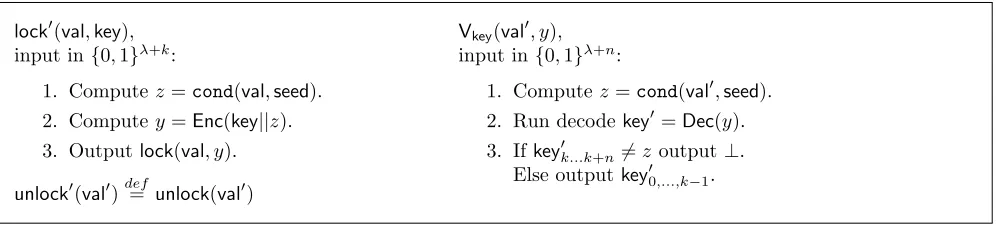
The encoding We now present the construction. Instead of directly locking the value key we instead lock the value
c=Enc(key||cond(val;seed)),
where Enc is the encoding function for a nonmalleable code and cond is a seed dependent condenser. Notionally, the nonmalleable code prevents tampering toindependent points and the condenser detects if the adversary tampers to an independent point.
Construction 4.1. Let (lock0,unlock0) be defined as in Figure 1. Let(Enc,Dec) be a coding scheme where Enc :{0,1}k+α → {0,1}n. Let
cond :{0,1}λ× {0,1}d → {0,1}α be a seed-dependent condenser. Define the algorithms (lock0,unlock0,Vkey) as in Figure 2.
However, security of this construction is not straightforward as we are using nonmalleable codes in a nonstandard way. In a nonmalleable code, the adversary specifies the tampering function before seeing any information aboutc. In our setting, the adversary sees obfuscations that havecembedded before deciding how to tamper. The crucial part to our argument is that the set of obfuscations is pseudorandom condition
on cand sconddef (val;seed). If an adversary is able to tamper substantially better given obfuscations of val from some entropic distribution than with uniformly random val we can check whether they tampered properly and use this to break distributional indistinguishability.
lock0(val,key), input in{0,1}λ+k:
1. Computez=cond(val,seed).
2. Computey=Enc(key||z).
3. Outputlock(val, y).
unlock0(val0)def= unlock(val0)
Vkey(val0, y),
input in {0,1}λ+n:
1. Computez=cond(val0,seed).
2. Run decodekey0=Dec(y).
3. Ifkey0k...k+n6=zoutput⊥. Else outputkey00,...,k−1.
Figure 2: Nonmalleable digital locker preventing tampering over both val andkey. A seedof a seed-dependent condenser must be public and global.
1. Suppose for any s=poly(λ) there exists µ, β =ω(logλ) such cond:{0,1}λ× {0,1}d→ {0,1}α is a (µ, β, s,0)-seed-dependent condenser.
2. Let seed← {0,1}d be a public parameter.
3. Xdef= X(seed) be an s-samplable distribution soH˜∞(X|seed,cond(seed, X))≥β.3 4. Let a description of Gλ, a generator g for Gλ and seed← {0,1}d be system parameters.
5. Let Fnmc be a function class. Suppose for any snmc =poly(λ) there exists nmc =ngl(λ) such that (Enc,Dec) is an (nmc, snmc,Fnmc) nonmalleable code.
Then (lock0,unlock0) in Construction 4.1 and Figure 4.1 is point nonmalleable for Fsingle and key non-mallable for Fnmc. In particular,(lock0,unlock0) is a (Fsingle,Fnmc,X)-nonmalleable digital locker.
Before proving Theorem 4.1 we make some notes about the construction and alternative approaches.
Choice of nonmalleable code We recommend using a nonmalleable code that detects at least per-mutations and 1 → 0 bit tampers, such as [AGM+15a, AGM+15b], as these transforms are otherwise easily computable in polynomial time. One concern about nonmalleable codes is that the adversary is necessarily restricted to low complexity classes, not including the code’s encoding and decoding functions. Note, the construction encodes and decodes the code “in the clear” while the adversary is tampering “in the exponent.”
Recently, Kiayias et al. [KLT18] introduced nonmalleable codes with manipulation detection. Here, the adversary has low probability of producing any codeword ˜c that successfully decodes. Kiayias et al. constructed a nonmalleable code with manipulation detection, unfortunately, their standard model result requires logarithmic length symbols. Furthermore, the primitive cannot exclude constant functions. It is an open problem if this primitive can simplify our construction.
Alternative tools Constructions using nonmalleable extractors [DW09, CRS14] or one-way hashes [BCFW09, BFS11, CQZ+16] may be possible. However, they are not immediate, we use the primitive of nonmalleable hashes to illustrate. A nonmalleable hash function is a family of functions h∈ Hsuch that an adversary givenh(x) (sampledh← Handxfrom some distribution) cannot findh(f(x)) forf in some
3In the previous sections, we considerXthat have worst case min-entropy. However, if ˜H
function classF. Several of these works claim to be “standard model” but all requirehis random and not tampered by the adversary. One could append a nonmalleable hash, obfuscating key0 = key||h(key||val). The concerns are:
1. This approach assumes that the function instance h is assumed to be independently sampled from key and val. In our approach, the public randomness required is forseed of the condenser, and the distribution of val (andkey) can depend on this value.
2. Non malleable hashes are analyzed with the adversary only knowing the output value h(x). It is not clear that security would hold in the presence of multiple correlated obfuscations.
Similar issues arise with nonmalleable extractors [DW09, CRS14].
4.2 Proof of Theorem 4.1
Completeness and soundness follow from the underlying properties of nonmalleable point function. (The only additional issue with correctness is if in the real or random construction the sampled value r =val this occurs with negligible probability for any input val.)
Since the point function satisfies VBB when composedn+1 times it also satisfies (n+1)-distributional indistinguishability [Var10, Theorem 3.18]. Suppose thatpris the negligible function for the distributional indistinguishability condition andnmis the negligible function for the nonmalleable condition of the point function. We will show that the overall malleability denoted by is at most
≤pr+nm+ 2−β+nmc.
LetMbe a mauling adversary for the overall digital locker. Note that forf output byMthe probability thatf ∈ Fsingle andf is not the identity is at mostnm. Suppose not, then there is somekey∗ where this is the case. One can construct a mauling adversary M0 forlockby:
1. Sampling a randomseed,
2. Computingz=cond(val,seed), y=Enc(key∗||z),
3. Running the real or random construction with keydef= z and val,
4. OutputtingM’s outputs when provided with the real-or-random values.
Thus, if the probability thatMsucceeds in breaking the nonmalleability condition is greater than this implies that it outputs f that is the identity and g∈ Fnmc and not the identity with probability greater than−nm=pr+ 2−β+nmc.
We now show that this contradicts the security of the nonmalleable code. The key difference be-tween traditional application of nonmalleable codes is that the adversary is provided with a set of values
{lockPointi}ni=1 that are correlated with the encoded value c before deciding how to tamper. We show
that this is not a problem with the following argument:
1. The values {lockPointi}ni=1 are pseudorandom conditioned on the encoded valuec. (This is the case
in the real or random construction.)
3. If the adversary is provided with random obfuscations (uncorrelated toc) and replacescwith some new value c0, by security of the nonmalleable code,c0 depends onc with low probability and ifc0 is independent ofc, ˜s=Dec(c0) passes the test with low probability.
4. If the adversary tampers and passes the test with higher probability with the pseudorandom values, we can use this to break the pseudorandomness condition.
To make the above intuition formal we define an adaptive tampering experiment as follows for random variables LP, C,CD and binary predicateTest:
Experiment ExpadFnmc−nmc,LP,C,CD,A,Test: Sample (obf, c, cond)←(LP, C,CD) Samplef ← A(obf).
Iff 6∈ Fnmc output 0. Iff(c) =coutput 0.
IfTest(f(c), cond) output 1. Else output 0.
We defineLP, C,CD,Test as
• LP: the set of obfuscations output by the real or random construction,
• CDthe output of the seed dependent condenser on val.
• C: the encoded codewordc=Enc(key||cond(val;seed)).
• Test: if Dec(c)k...k+α
?
=z.
We now show that in the above experiment the adversary can’t tamper substantially better than when specifying the tampering function with no information.
Theorem 4.2. LetCD ∈ {0,1}αbe a distribution such thatH
∞(CD)≥β. Let(Enc,Dec)be a(nmc, snmc,F) nonmalleable code and Enc:{0,1}k+α → {0,1}n. Let key∈ {0,1}k, define the distribution C
key by sam-pling cond ← CD and computing Enc(key||cond). For inputs c and cond, define Test(c, cond) = 1 if and only ifDec(y)k...(k+α)=cond. Suppose that
1. For all f ∈ F it is possible to compute f in a circuit of size at most sF,eval.
2. It is possible to evaluate Test using a circuit of size at most |Test|and snmc>|Test|.
3. For a function f it is possible to check iff ∈ F in size at most sF,check. Furthermore, this check is
correct with probability 1.
4. LPbe an distribution overMthat is correlated toCkey andCDand letRbe a sampleable distribution independent of of LP, Ckey,CD such that
δDspr((LP, C
key,CD),(R, Ckey,CD))≤pr.
Then for all A of size s it holds that
Pr h
ExpadF,LP,C,CD,A−nmc = 1 i
≤2−β+nmc+pr.
Before proving Theorem 4.2, we show how Theorem 4.1 follows from Theorem 4.2. Let A be some adversary. Let W =W(seed) be some efficiently distribution such that
˜
H∞(W|seed,cond(seed, W))≥β.
Define the random variables LP def= lock0(W, C). With overwhelming probability, the conditional distri-butionLP|C,CDis in the classX. By (n+ 1)-distributional indistinguishability of the point function one has that for any PPTA,
δDspr((LP, C
key,CD),(R, Ckey,CD))≤pr.
Thus, the assumptions of Theorem 4.2 are satisfied. One can then conclude that
Pr h
ExpadF,LP,C,CD,A−nmc = 1 i
≤2−β+nmc+pr.
It remains to show that for all A,key
Pr val←X
V(C) = 1, f ∈ F,
g∈ G, y=C(f(val)), y=g(unlock(f(val))),
Vkey(f(val), y)6=⊥,
∃α s.t. If(val),α≡C
(C, f, g)← A(lock(val,key))
≤2−β+nmc+pr,
when f is the identity function and g is not. Towards the sake of arriving at a contradiction, suppose that there exists some Athat wins the above game with probability greater than 0 = 2−β +nmc+pr. Note thatTest outputs 1 with the same probability asVkey outputting a value other than⊥. If the above is true, it must hold for some key∗. Thus, we can build an adversary A0 that breaks the conditions of Theorem 4.2 for the distribution LP def= lock(val,key) whereval is sampled from X by:
1. Receivinglock
2. Running Aon inputlock.
3. Receive outputsC, f, g.
4. Outputg. (Corresponding to a tampering function onc.)
This adversaryA0 is a valid adversary forExpad−nmc
F,LP,C,CD,A. This completes the proof of how Theorem 4.1 follows from Theorem 4.2. We now proceed to the proof of Theorem 4.2.
Proof of Theorem 4.2. We begin by defining a standard nonmalleable code experiment with a simulator for a function f defined by a distributionDf(·):
Experiment Expsimf,CD,Df: Sample ˜s←Df(·), cd← CD If ˜s=sameoutput 0. IfTest(˜s, cd) = 1 output 1. Else output 0.
Proof of Lemma 4.1. We note that whenever ˜s=same the output of the experiment is 0. Thus, we can restrict our attention to cases when ˜s6=same. Then Pr[CD= ˜sk−α...k]≤2−H∞(CD)= 2−β.This completes the proof of Lemma 4.1.
We will now argue that the adversary in the adaptive adversary does not perform substantially better than in the simulated experiment. We use a hybrid argument with two intermediate games, Exp1F,R,C,CD,A
and Exp2F,LP,C,CD,A. In moving from ExpadF,LP,C,CD,A−nmc to Exp1F,R,Y,Z,A we will replace the distribution
LP with a distributionR that is uncorrelated to C,CD. In Exp2f,C,CD we will eliminate the distribution
R as input and move from the adversary picking a function to defining the experiment for a particular functionf. Finally in moving toExpsimf,CD,D
f(k) we will rely on the hardness of nonmalleable codes. The
two experiments are described formally below.
Experiment Exp1F,R,C,CD,A: Sample (c, cd)←(C,CD) Sample r←R.
Sample f ← A(r). If f 6∈ F output 0. If f(y) =y output 0. Output Test(f(c), cd).
Experiment Exp2f,C,CD: Sample (c, cd)←(C,CD) If f(c) =coutput 0. OutputTest(f(c), cd).
We now show each of these games are computationally close.
Lemma 4.2. Suppose that
1. For each f ∈ F, the function f is computable in size at most sF. 2. For f it is possible to correctly check f ∈ F in size sF,check.
3. That δDspr((LP, C
key,CD),(R, Ckey,CD))≤pr. Then for A of size at mostspr− |Test| −sF,eval−sF,check,
Pr
h
ExpadF,LP,C,CD,A−nmc (k) = 1 i
−Pr[Exp1F,R,C,CD,A(k) = 1]
≤pr.
Proof of Lemma 4.2. Suppose not. That is, suppose that there exists anAof size at most spr− |Test| −
sF,eval−sF,check such that
Pr
h
ExpadF,LP,C,CD,A−nmc (k) = 1i−Pr[Exp1F,R,C,CD,A(k) = 1]
> pr.
Then the following program D(of size at mostspr) is a distinguisher for ((LP, C,CD) and (R, C,CD)):
1. On input p, c, cd.
2. Run f ← A(p).
3. Iff 6∈ F orf(c) =c output 0.
That is,
|Pr[D(LP, C,CD) = 1]−Pr[D(R, C,CD) = 1]|
=
Pr[Exp
ad−nmc
F,LP,C,CD,A= 1]−Pr[Exp
1
F,R,C,CD,A= 1]
> pr.
This contradicts the indistinguishability of (LP, C,CD) and (R, C,CD) and completes the proof of Lemma 4.2.
Lemma 4.3. There exists somef ∈ F such that for anyA(hereAneed not be computationally bounded):
Pr[Exp2f,C,CD(k) = 1]≥Pr[Exp1F,R,C,CD,A(k) = 1].
Proof of Lemma 4.3. First we consider the circuits A that always output f ∈ F. Given any A that outputs anf 6∈ F we can design anotherA0 that runsf ← F and simply outputs a fixedf0 ∈ F whenever
f 6∈ F. ThisA0 does not perform worse inExp1 thanA.
Now consider some Athat always outputs functions f ∈ F. There is a distributionDA that outputs exactly the distribution that is output byA. Note that this distribution is independent of y. Note that
Pr[Exp1F,R,C,CD,A = 1] =
X
f∈F
Pr [DA=f] Pr
(c,cd)←(C,CD)[f(c)6=c∧Test(c, cd) = 1].
Now suppose that for allf ∈ F,
Pr[Exp2f,C,CD(k) = 1]<Pr[Exp1F,R,C,CD,A(k) = 1].
Then one has
Pr[Exp1F,R,C,CD,A= 1] =
X
f∈F
Pr [DA=f] Pr
(c,cd)←(C,CD)[f(c)6=c∧Test(c, cd) = 1]
= X f∈F
Pr [DA=f] Pr[Exp2f,C,CD = 1]
< X
f∈F
Pr [DA=f] Pr[Exp1F,R,C,CD,A= 1]
= Pr[Exp1F,C,CD,A= 1]
This is a contradiction and completes the proof of Lemma 4.3.
Before showing distinguishability of the last two games we consider the definition of nonmalleable codes where the encoded secret is drawn from a distribution instead of considering a single point:
Lemma 4.4. Let (Enc,Dec) be a (nmc, snmc)-nonmalleable code for functions in F. Then for any dis-tribution Z over points in {0,1}k it holds that
δDsnmc( ({c←Enc(Z);c←f(c), s=Dec(c) :Output s}, Z),
({˜s←Df, Output Z if s˜=same elses}, Z˜ ))
Proof of Lemma 4.4. Suppose not, that is there exists some Z for which the statement is not true. In particular, there must be some z∈Z where Pr[Z =z]>0 such that there existsDsnmc,
δDsnmc( ({c←Enc(z);c←f(c), s=Dec(c) : Outputs}, z),
({s˜←Df, Outputz if ˜s=same else ˜s}, z)
> nmc.
This contradicts security of the nonmalleable code.
With this distributional version of security for nonmalleable codes we can turn to indistinguishability of the last two games.
Lemma 4.5. For everyf ∈ F, if snmc ≥ |T est|then
Pr[Exp
sim
f,CD,Df = 1]−Pr[Exp 2
f,C,CD = 1]
≤nmc.
Proof of Lemma 4.5. Suppose not, that is suppose that there exists some f ∈ F such that
Pr[Exp
sim
f,CD,Df(k) = 1]−Pr[Exp 2
f,C,CD(k) = 1]
> nmc.
Then we have a distinguisherD(of size|Test|) for the distributional version of nonmalleable code security guarantee 1) input ˜s, zand 2) Compute Test(˜s, z). This completes the proof of Lemma 4.5.
Combining Lemmas 4.1, 4.2, 4.3 and 4.5 completes the proof of Theorem 4.2 and completes the proof of Theorem 4.1.
Acknowledgements
This work was funded in part by a grant from Comcast Inc, by NSF Grant CNS 1849904, and ONR Grant N00014-19-1-2327. This research is based upon work supported in part by the Office of the Director of National Intelligence (ODNI), Intelligence Advanced Research Projects Activity (IARPA), via Contract No. 2019-19020700008. The views and conclusions contained herein are those of the authors and should not be interpreted as necessarily representing the official policies, either expressed or implied, of ODNI, IARPA, or the U.S. Governement. The U.S. Government is authorized to reproduce and distribute reprints for governmental purposes notwithstanding any copyright annotation therein.
The authors thank Luke Demarest, Pratyay Mukherjee, Alex Russell, and Mayank Varia for their helpful feedback. Special thanks to James Bartusek, Fermi Ma, and Mark Zhandry for discussing their work and its compositional properties.
References
[AGM+15a] Shashank Agrawal, Divya Gupta, Hemanta K Maji, Omkant Pandey, and Manoj Prab-hakaran. Explicit non-malleable codes against bit-wise tampering and permutations. In Advances in Cryptology – CRYPTO, pages 538–557. Springer, 2015.
[AGM+15b] Shashank Agrawal, Divya Gupta, Hemanta K Maji, Omkant Pandey, and Manoj Prab-hakaran. A rate-optimizing compiler for non-malleable codes against bit-wise tampering and permutations. In Theory of Cryptography Conference, pages 375–397. Springer, 2015.
[AJ15] Prabhanjan Ananth and Abhishek Jain. Indistinguishability obfuscation from compact func-tional encryption. In Advances in Cryptology – CRYPTO, pages 308–326. Springer, 2015.
[BC10] Nir Bitansky and Ran Canetti. On strong simulation and composable point obfuscation. In Advances in Cryptology–CRYPTO 2010, pages 520–537. Springer, 2010.
[BCFW09] Alexandra Boldyreva, David Cash, Marc Fischlin, and Bogdan Warinschi. Foundations of non-malleable hash and one-way functions. InInternational Conference on the Theory and Application of Cryptology and Information Security, pages 524–541. Springer, 2009.
[BFS11] Paul Baecher, Marc Fischlin, and Dominique Schr¨oder. Expedient non-malleability notions for hash functions. InCryptographers Track at the RSA Conference, pages 268–283. Springer, 2011.
[BGI+01] Boaz Barak, Oded Goldreich, Rusell Impagliazzo, Steven Rudich, Amit Sahai, Salil Vadhan, and Ke Yang. On the (im) possibility of obfuscating programs. InAdvances in Cryptology– CRYPTO, pages 1–18. Springer, 2001.
[BGI+12] Boaz Barak, Oded Goldreich, Russell Impagliazzo, Steven Rudich, Amit Sahai, Salil Vadhan, and Ke Yang. On the (im) possibility of obfuscating programs.Journal of the ACM (JACM), 59(2):6, 2012.
[BMZ19] James Bartusek, Fermi Ma, and Mark Zhandry. The distinction between fixed and random generators in group-based assumptions. InAdvances in Cryptology – CRYPTO, 2019.
[BR17] Zvika Brakerski and Guy N Rothblum. Obfuscating conjunctions. Journal of Cryptology, 30(1):289–320, 2017.
[Can97] Ran Canetti. Towards realizing random oracles: Hash functions that hide all partial infor-mation. InAdvances in Cryptology-CRYPTO’97, pages 455–469. Springer, 1997.
[CD08] Ran Canetti and Ronny Ramzi Dakdouk. Obfuscating point functions with multibit output. In Advances in Cryptology–EUROCRYPT 2008, pages 489–508. Springer, 2008.
[CDG18] Sandro Coretti, Yevgeniy Dodis, and Siyao Guo. Non-uniform bounds in the random-permutation, ideal-cipher, and generic-group models. In Annual International Cryptology Conference, pages 693–721. Springer, 2018.