Hardware Aspects of Montgomery Modular
Multiplication
*
Colin D. Walter
Royal Holloway, University of London,
Egham, Surrey, TW20 0EX, United Kingdom
Abstract
This chapter compares Peter Montgomery's modular multiplication method with traditional techniques for suitability on hardware platforms. It also covers systolic array implementations and side channel leakage.
3.1 Introduction and Summary
This chapter looks at the hardware implementation of Peter Montgomery's Mod-ular Multiplication without Trial Division [39]. Such dedicated hardware is used primarily for arithmetic over the rational integers Zwith a very large modulus
N, including the prime eld GF(p) case whenN =pis prime. For simplicity,
it is assumed that all the arithmetic here is over the integers. There are in-creasingly important applications over large nite elds. However, apart from simpler carry propagation when the eld characteristic is very small, the main issues covered here have similar solutions. The interested reader might start by consulting [28, 46, 3, 1, 35] for this case.
Because of the overhead of translating to and from the Montgomery domain ([5], 2.2), use of Montgomery's method is, for the most part, in cryptography where exponentiation is a central operation and the cost of the translation can be amortised over all the modular multiplications in the exponentiation. Die-Hellman key exchange, RSA, DSA, ElGamal encryption and their elliptic curve equivalents are chief among the applications [11, 45, 40, 14, 38, 27, 21]. This justies the concentration on instances overZ where the modulusN is a large
integer, typically with 1024 or more bits. A consequence of this is that, with representations in radixr, processing a regular digit position in the long number
arithmetic should be as ecient as possible and, in the notation of [5], Algm. 2,
*This material has been published as Chapter 3 in [4]. It makes a number of references to
the determination of the multipleqofNwhich has to be added to, or subtracted
from, the running total1 Cshould not slow down such processing.
Although not used exclusively, Montgomery's method should be the pre-dominant one for modular multiplication in the applications above. We will consider the reasons for its already widespread adoption by comparing it with classical techniques, demonstrating how it ts in well with standard word sizes whereas standard methods suer from widespread contamination by over-large digits2. The chapter is structured to provide an overview of the main
acceler-ation techniques for hardware modular multiplicacceler-ation and for each of these we deduce that Montgomery multiplication is better than, or at least as good as, classical techniques.
Many of the implementations of interest to us occur in smart cards where side channel leakage is a signicant threat. Consequently, the nal part of this chapter is a study of the security issues that arise from the use of Montgomery's method and how they can be mitigated.
At the other end of a secure transaction involving a smart card there is probably a server performing a large number of simultaneous cryptographic processes for many secure transactions, and so requiring the capability of very high throughput. This can be achieved using a systolic array and, for such a context, Montgomery's algorithm is really the only sensible choice.
The target hardware could be one of a wide variety of dierent possibilities. Among these there are small smart-card cryptographic co-processors with a single 8- or 16-bit multiplier, ARM-based processors, single core and multi-core Single Instruction Multiple Data (SIMD) processors with pipelined multipliers, systolic arrays with substantial processing power in each processing element, and Application Specic Integrated Circuits (ASICs) which may process all bits of the modulus in parallel. The variety means that allowance must be made for all possible ways of implementing the basic arithmetic operations which appear in a description of Montgomery's modular multiplication method, particularly addition and scalar multiplication, and indeed including consideration of number representations (such as redundant ones) which are alternatives to the usual binary. The low level programming of these architectures was covered in the previous chapter [5]. Here we consider the hardware itself, particularly the size of the digit×digit multiplier, how to increase clock speed, and the eects of bus width and communications.
1As in Algm. 0,P is used here in this chapter rather than theCof [5].
2 Where classical methods are still used, the reason is often ascribed to the diculty of
translating inputs to the Montgomery domain, i.e. mapping AtoA˜≡ARmodN whereR is the Montgomery radix −see [5], 2.2. This requires computing and storing R2modN.
However, if the public exponent E is known and the exponentiation is to the power D where DE ≡ 1 modφ(N), then this reason is spurious. Specically, start by computing 1E−1 using Montgomery multiplication. Then U ≡ R2−EmodN is obtained if E > 2.
This generally requires only a small number of multiplications as E is typically a small Fermat prime. Next Montgomery-multiply A and U to obtain AR1−EmodN.
Rais-ing this to the power D > 1 using Montgomery multiplication yields (AR1−E)DR1−D ≡
3.2 Historical Remarks
By the late 1980s, RSA encryption had been in the public domain for a dozen or so years and was regarded as more secure for encryption than DES because aca-demic mathematicians had failed to make signicant progress in factoring large numbers despite considerable eort and there were mathematically unfounded suspicions than IBM had built some weaknesses into DES that would allow the NSA to crack ciphertexts more easily than could the general public. Con-sequently, there was great interest in implementing RSA not just for military purposes but also to provide better security in the banking sector where card payment at point of sale was already very well established using hand-written signatures for verication but only plain text data transmission. There was an expanding market which made it commercially viable to develop point of sale terminals containing RSA for secure data transmission, and which was shortly going to expand to smart cards. Then, smart cards were used only in prepaid telephone applications and contained essentially no security. The market for them was yet to develop.
At that time RISC-based processors such as the ARM2 with its 32-bit mul-tiplier did not yet yield acceptable performance for software implementations of RSA. ASIC cryptographic co-processors with a full battery of hardware accel-eration techniques and the most ecient algorithms were required to yield the necessary encryption speeds of at most several seconds. (A fraction of a sec-ond is required nowadays.) Peter Montgomery's then recently published work [39] on modular multiplication played, and continues to play, a signicant role in achieving user-acceptable encryption and signing speeds, perhaps now more than ever with the proliferation of RFID tags and embedded cryptographic de-vices in an increasingly security-conscious world.
3.3 Montgomery's Novel Modular Multiplication
Algorithm
Modular Multiplication without Trial Division was published in 1985 [39] and provided a more ecient way of implementing the necessary arithmetic histori-cally at exactly the right time. Indeed, it arose out of the need to speed up RSA. The details are given in Algorithms 1 and 2 of the previous chapter [5], and the reader is encouraged to renew familiarity with the methods and the notation provided there. For convenience, the second of these algorithms is reproduced here as Algorithm 0.
As the title of the paper suggests, Montgomery's technique avoids the delay caused by the usual trial-and-error method of determining which multipleq of
the modulusN needs to be subtracted from partial productsP, replacing that
trial division with an exact digit×digit multiplication. Readers will be familiar with the schoolbook method of long division in which the rst few decimal digits of N andP are used in a trial-and-error manner to determine the rst digit q
Algorithm 0 The radix-r interleaved Montgomery multiplication algorithm.
Compute (AB)R−1 modulo the odd modulusN given the Montgomery radix R =rn and using the pre-computed Montgomery constantµ =−N−1modr.
The modulusN is such thatrn−1≤N < rn andr andN are co-prime.
Input: A=Pni=0−1airi, B, N such that0≤ai< r, 0≤A, B < R.
Output: P≡(AB)R−1modN such that0≤P < N. 1: P ←0
2: fori= 0to n−1do
3: P ←P+aiB
4: q←µP modr 5: P ←(P+qN)/r 6: end for
7: if P ≥N then 8: P ←P−N 9: end if
10: returnP
then rened to the correct valueqdepending on whether the result is less than
0 or ≥N. Similarly, with hardware rather than human processors, the base is
a power of 2 such as 216 or 232 rather than 10, but the problem is otherwise
identical for the multi-digit numbers appearing in RSA. As explained in the previous chapter [5], Peter Montgomery's method replaces this usual hit-or-miss technique with an exact calculation which depends only on the lowest digit of the partial product and the modulus see Algm. 0. Although there is the penalty of
scaling inputs and outputs to or from their Montgomery representations in the Montgomery domain ([5], 2.2), there are other advantages. For example, the exact process at each digit iteration means much more straightforward rmware which is both easier to verify and takes up less ROM. Furthermore, subtraction can ususally be completely eliminated. This has the signicant commercial value of much less likelihood of company critical errors in the implementation as well as shorter time-to-market and smaller die size.
3.4 Standard Acceleration Techniques
The reason for emphasising the commercial and implementation advantages of Peter Montgomery's algorithm is that the mathematical advantages are often over-stated in the literature. Indeed, with the use of appropriate implementation techniques, the overall complexity seems to be asymptotically exactly the same as for classical modular reduction techniques when the argument size increases. The main disadvantage is that, unlike Montgomery's algorithm, traditional tech-niques are ill-matched to standard hardware word sizes, bus widths and multi-plier sizes. However, before reaching that conclusion, let us review all the normal hardware acceleration techniques applicable in the traditional computation of
ABR−1modN. Most of these were enumerated in [13] and they are covered in
detail in the following sub-sections. This comparison will show where the main dierences are in the complexity of implementing the arithmetic components. Chief among these is the determination and use of the quotient digit qwhich is
covered in 3.7. There are usually signicant dierences between the two algo-rithms for this aspect when the hardware multiplier is already provided rather than custom-built: most digit-level multipliers are ill-adapted to processing the slightly larger digits encountered in classical algorithms.
At the cutting edge of the fastest or most ecient implementations, it is the ne detail which becomes important, such as the critical path length, the number of load and write operations, loop unrolling, the types of register and memory used, and the area devoted to wiring. The interested reader is referred to the vast research literature such as [36] for this more detailed level of coverage. Further, we omit consideration of enhancements which make modular squaring faster than modular multiplication. Instead, we conne ourselves to what is sucient in a normal commercial setting, ignoring also minor costs such as those for loop establishment and index calculations. Several of the acceleration techniques are already covered in the previous chapter [5], there being no clear boundary between what is hardware and what is software. Some techniques involved the choice of moduli with particular properties such as sparseness (of non-zero bits)−see [5], 3. In this chapter it is assumed that the hardware needs to process any modulus, and so inputs may need to be transformed rst in order to benet from the previously mentioned techniques. Such transformations are described in detail.
Although eciency is measured here in terms of Time or Area×Time, in many portable and some RFID devices the predominant issue is energy con-sumption. For cryptographic applications, the choice of cryptosystem combined with the use of dedicated rather than general purpose hardware is critical in reducing the energy used. At the hardware level the use of elds with small characteristic saves power in a multiplier by reducing the switching activity due to propagating carries. Secondly, careful algorithm design to reduce memory ac-cess is also very helpful, and is applicable to time eciency as well. Thirdly, one can employ fast multiplication techniques such as Karatsuba-Ofman [24, 18, 25]. However, for the most ecient use of the space available in this chapter, the discussion of energy eciency is limited to this paragraph!
3.5 Shifting the Modulus N
The Classical Algorithm
When using the traditional algorithm (see Alg. 1) it is advisable to shift the modulus N up so that its most signicant bit always has the same position in
Algorithm 1 A radix-rinterleaved classical modular multiplication algorithm
to computeA·B modN.
Input: A=Pni=0−1airi, B, N such that0≤ai<r, 0≤A, B < N < rn.
Output: P≡A·BmodN such that0≤P < N. 1: P ←0
2: fori=n−1downto 0do
3: P ←rP+ai·B
4: q≈ bP/Nc (a lower approxnto the greatest integer≤P/N) 5: P ←P−q·N
6: end for
7: whileP ≥N do 8: P ←P−N 9: end while 10: returnP
to A orB and reversed in the output. IfS is the power of 2 corresponding to
the number of bit positions in the shift then the new values to use forAandN
areAS andN S. So the correct result is obtained by computing
(A·B) modN =S−1((AS·B) modN S)
in which S−1 is the shift back down.
For eciency, the quotient digitq in line 4 of Alg. 1 is generally computed
from only the top bits of P and N. So, if n0 is the value of the top bits of
the register containingN which are used for this, then the shift up means that n0 has a more limited range of values. In particular, the top bit of n0 being
non-zero keeps its value well away from zero and so provides an upper limit to
q, whose denition includes a division byn0 orn0+1. We look at the denition and computation of qin more detail in 3.7.
Montgomery
For completeness, it is worth observing that there is an analogue of this classical technique for Montgomery multiplication which is slightly more than just the right alignment of the modulus and operands. It makes the Montgomery method generally applicable instead of only in circumstances where the modulus is prime to the radixrof the number representation.
If we take N to be a general modulus as in the classical case, then any
common factor S with the computation base r needs to be removed before
applying Montgomery's reduction technique. Replacing N by N0 = S−1N is
the analogous shifting down process. With binary representations,S is a power
of 2, N0 is odd, and the lowest non-zero bit of N0 is the bottom one in its
register. The Montgomery multiplication is then done moduloN0.
For RSA and ECC analogues,N is odd and certainly prime to any
in this way, and the normal right alignment corresponds to no shift, i.e. S = 1. Nevertheless, with this action Montgomery can be used for general moduli.
To complete the computation after the shift adjustment requires application of the Chinese Remainder Theorem (CRT) for the co-prime moduliN0 and S.
This is best done after exiting from the Montgomery domain ([5], 2.2). Using Garner's formula [17] we have
(A·B) modN = (A·B) modN0+N0T
where
T = (N0−1modS)((A·B) modS−(A·B) modN0) modS
Of course, here T is probably calculated very easily even in the most general
setting so that the overhead is low. This is because mod S selects the lowest
bits of a number to base r. In particular, if S divides the computation base r, then T is a single digit computed from the lowest digit of each of A, B
and N0. A similar process of adjusting the modulus can be applied to any
modular arithmetic, not just to modular multiplication, thereby enabling the Montgomery modular reduction technique to be used just as easily in a general setting.
From here onwards it is assumed that the shifting described in this section is performed. Consequently, the highest or lowest bit of N, as appropriate, is
assumed to be 1 in all future discussion.
3.6 Interleaving Multiplication Steps with
Mod-ular Reduction
As already noted in [5], 2.1, instead of computing the product A·B rst and
then performing the reduction moduloN, it is advisable to interleave modular
subtractions at each shift-and-add step during the normal calculation of the product. This means the partial product stays roughly the size of the modulus
N rather than being as large as A·B. This saves register space. The term
integrated is often used for this technique, as opposed to separated, which is when the modular reduction is performed after the multiplication.
However, the product can be computed in two main ways. The easier to organise and more uniform is the operand scanning technique in which the partial productPis increased byaiB, withibeing decremented or incremented at each
iteration step according to whether the classical or Montgomery algorithm is being used: P ←P+aiB. This is how it is computed in the two algorithms 0
and 1 above. Alternatively, the product scanning technique accumulates all the digit products ajbi−j (j=0,1,2, . . .) at theith step, again with idecremented
or incremented at each step: P ←P+P
jajbi−jr
i for digit baser[12, 19].
For both these alternatives, there is the choice of whether to alternate be-tween the multiplication steps and the reduction steps P ←P ±qN at a digit
or product scanning techniques respectively (FIOS and CIOS for operand scan-ning). The details of the dierent possibilities have been much studied by Ç. Koç and others [29, 36]3. The reader is referred to those publications for further
details. Here, as in Algorithms 0 and 1, we concentrate on CIOS where the multiplication stepsP ←P+aiB alternate with reduction stepsP ←P±qN.
(Cis used in [5] for the partial product rather than thePhere.) However, other
processing orders can be benecial in processing carries and preventing pipeline stalls on certain hardware architectures with SIMD operations [48].
For product scanning, the successive quotient digitsqhave to be stored. This
makes its area requirements greater than for operand scanning. Consequently, interleaved multiplication using operand scanning is generally preferred and that is what is described in this chapter. On the other hand, Liu and Groÿschädl [36] note that product scanning requires fewer store instructions on an Atmega128 with 32 registers, and they use it for speed.
Readers who wish to perform the multiplication independently in advance of the reduction, or perform just a Montgomery reduction, can still use the contents of this chapter almost verbatim. As with hardware multiplication, a library modular multiplication routine is often best presented as a modular multiply-accumulate operation since the initial partial product is almost as easily set to the value of the accumulate argument as to zero. That can be done by a very minor modication of Algorithm 0. So, for a modular reduction only, readers just need to omit the stepP←P+aiB(i.e. setA= 0orB= 0) after initialising
P to the product value which, in this case, may initially have many more digits
thanN.
3.7 Accepting Inaccuracy in Quotient Digits
This section takes a close look at the denition and computation of the quo-tient digit q in order to highlight the main dierence between the traditional
and Montgomery algorithms. It is primarily this dierence which makes Mont-gomery the preferred method in the majority of high-end commercial crypto-graphic applications, whether in hardware or software. Readers are invited to skim or skip the technical details of the following sub-section on the traditional modular multiplication algorithm and head straight for the sub-section 3.7.3 on Montgomery's method unless and until they have the need to check the math-ematics or perform similar calculations themselves! A nal summary in 3.7.4 covers what is necessary to appreciate the value of Peter's contribution.
3[29] claims that FIOS requires more digit level additions and reading/writing operations,
3.7.1 Traditional
The aim of the acceleration technique in this section is to simplify the hard-ware logic for calculating q so that it is much faster. This is achieved in two
ways. One is to replace the division by N in line 4 of the classical Algorithm
1 with a multiplication by a pre-calculated N−1. Multiplication is faster than
division, so this improves the speed. The other aid is to approximate the long numbers P andN−1 by using only their most signicant digits. The shortened
multiplication will also speed up the calculation ofq. Recognition of the use of
such an approximation process is given by writing q≈. . . in the algorithm.
The resulting method is generally known either as Barrett reduction [2] or as Quisquater's method [23], depending on the details of the approximations. The more general version here appeared in [54] and later in [8, 9, 10, 26], and it allows more control over how largeP might become.
These simplications lead to an occasionally slightly inaccurate value for bP/Nc. However, with care they can be used in every multiplication step with-out any correcting adjustment until after the main loop terminates. Clearly, if too low a multiple of N is subtracted on one iteration, a compensating
sub-traction needs to be made at some future point. Hence the digit q may have
to be larger than the natural bound of the base r which is being used for the
number representations. The larger digit then compensates for the inaccuracy of the previous choice of quotient digit. At the end of Algorithm 1, conditional subtractions have been added in caseP has grown to be larger thanN.
Let us denote byp0 andn0invthe approximations toP andN−1 which will
be used in dening q. They will turn out to be just two or three bits longer
than a radix-rdigit. For convenience, assume ris a power of 2 and let us aim
atk-bit approximations for some smallkthat we have yet to determine. Dene Z (for Zwei) as the power of 2 such that
2k−1Z < N ≤2kZ (1)
Then the most signicant few bits of the inverseN−1 are given by
n0inv=b22kZ/Nc (2)
that is, the greatest integer equal to or less than22kZ/N. Bounds onn0inv are
easily deduced from these denitions: n0inv ≤22kZ/N <22kZ/2k−1Z = 2k+1
andn0inv+1>22kZ/N ≥22kZ/2kZ = 2k, so that
2k ≤n0inv<2k+1 (3)
Thusn0inv has exactlyk+1 bits, the leading bit being 1.
Next, let us writePmid for the value of P which is used in the calculation
ofq (Algorithm 1, line 4). To reducePmidmoduloN, the bits we need fromP
for the approximation p0 are those above the position of the top bit ofN plus
one or two more to make q accurate enough. This is fewer bits than given by
bPmid/Zc, so let
where zis a (small) power of 2 which will be determined shortly.
The new, approximate denition forqis then the following:
q=bp0·n0invz/22kc (5)
Note the symmetry here with the denition (10) of q for Montgomery's
algo-rithm: a product of the top bits ofP and N−1 is taken rather than a product
of the bottom bits of these quantities. Note also that the integer division by 22k in (5) is trivial in hardware logic so that, as in Montgomery's algorithm,
q is essentially determined just by a multiplication. Thirdly, note that, as in
computing n−10 , the cost of computing n0inv is almost immaterial since n0inv
will only be computed once for each fresh modulus N. First,n0inv can be
ap-proximated using just the top few digits ofN, and then that value incremented
until (2) holds.
From (5),q≤p0·n0invzZ/22kZ ≤Pmidn0inv/22kZ ≤Pmid/N, so the partial
product P does not become negative in line 5 of Alg. 1. This establishes 0 as a lower bound on P throughout execution of the algorithm. As each of these
comparisons could be equalities, this is in some sense the best approximation we can employ to maintain this lower bound4.
3.7.2 Bounding the Partial Product
The next task is to establish a common upper boundBon the valuePend of the
partial product at the beginning and end of each iteration. This bound depends on the number of input bits which are used in calculatingq. The more bits are
taken, the more accurateqis, and so the lower the value ofBcan be made. As the boundBmust be preserved from one iteration to the next, we require
Pend≤ B ⇒ rPend+aiB−qN ≤ B (6)
for each digitaiinA. To determine a suitable valueBeasily, we now switch from
discrete, integer arithmetic and allow continuous real-valued quantities for the variable P. As will be clear from the argument below, the value ofB obtained in that context will certainly work for the integer case.
The most dicult case to satisfy (6) is when the approximationqis smallest
compared with the correct value, B is the least upper bound, and Pend and
aiB are maximal. With Pmid the value used to calculate q as in 3.7.1, this
would occur for the following values at the point whenqis evaluated: Pend=B,
q = (p0n0invz−22k+1)/22k, ai = r−1, B = N−1, Pmid = p0zZ+zZ−1 and
(n0inv+1)N = 22kZ. Note that the graph ofPmid−qN is like the teeth of a saw,
increasing at the same rate as Pmid, but stepping down each time q increases
by 1. The restriction on the form of Pmid is to ensure we select a value at the
4Signed numbers are usually avoided in modular arithmetic and they are avoided here.
top of one of the teeth as these are the worst cases for satisfying (6). The values of these maxima increase with P because q is dened using the upper bound
22kZ/n0inv for N instead ofN itself. So under these conditions the maximum
value for P at the start of the loop will lead to the maximum output value at
the end of the loop. Hence, the selection of Bas the least upper bound means that B will also be the value at the end of the iteration. Substituting in these values at the beginning and end of the iteration,
Pmid−qN = p0zZ+zZ−1−(p0n0invz−22k+1)N/22k = B
Pmid = p0zZ+zZ−1 = rB+(r−1)N
(7)
EliminatingBandNfrom the equations (7) and ignoring the relatively small
terms which are not multiples of Z yields
p0z= (r−1)(n
0
inv+1)z+ (2r−1)22k−r
n0
inv+1−r (8)
As the numerator is positive, and p0 is non-negative, the denominator must be
positive. Hence n0inv≥r, which is expected becausen0invmust provideqwith
at least as many bits of accuracy as in a digit.
The more bits chosen for n0inv, the better the approximation for q and so
the lower the boundB. A good choice is to taken0invwith three more bits than
a digit, i.e. 4r≤n0inv <8rso that 2k = 4r by (3). Then plugging the above
value for p0z into the second equation of (7) and using(n0inv+1)N = 22kZ to
eliminatekyields an upper bound on Pend of
(r−1)zZ−Z+(2−r−1)(n0inv+1)N
n0
inv+1−r
+zZ−(1−r−1)N
which is easily determined to be less than
(r−1)zZ−Z+(2r−1)N
3r+1 +zZ+N = 5r
3r+1N+ 4rz−1
3r+1 Z (9)
Using the property2rZ < N which holds for this case, this in turn is less than
2N for z=r in the case ofr= 2, and always less than2N for z= 12r. Thus
2N is always an upper bound on the output of each iteration in the modular
multiplication for some z. This yields Pmid <2rN+(r−1)(N−1)<3rN as a
bound on the size of register needed for P. Then the property q ≤ Pmid/N
meansq <3rand soqhas at most two more bits than a digit. Moreover, N <
4rZ yieldsPmid <12r2Z = 12rzZ or24rzZ forz =ror z = 12r respectively.
Sop0 will be 4 or 5 more bits than a digit.
Appropriate adjustments to these calculations can easily be made for dier-ent scenarios, such as i) ifB is not fully reduced but has another upper bound
than N (such as R or 2N), ii) if some of the quantities have carry-save
repre-sentations that lead to dierent bounds on their values, iii) if the multiplication is completed before any reduction, or iv) N has a special form or xed, known
Clearly, once derived, the classical modular multiplication algorithm has a straight-forward formula for the multiple qofN which needs to be subtracted.
It is only mildly tedious to determine in the above manner i) the best number of bits to use in the calculation and ii) an upper bound on the partial product to ensure sucient register space is made available. However, the fact that qand
the inputs to its calculation are generally larger by several bits than the radix
r means that the built-in hardware multiplier and bus width may be too small
for computingqandqN in the most obvious, convenient way.
3.7.3 Montgomery
By contrast, the determination, calculation, storage and use ofqis much easier
in Montgomery's Algorithm 0: the value ofqis simply
q=−p0/n0modr (10)
Unlike the classical case, all the operations here involve quantities which are within the normal digit range [0, r−1]. So fewer bits are required from N−1
and P for computing q than in the classical case, and a standard digit×digit multiplier suces for computing qN. As with the traditional algorithm, the
denition of qusing short division is replaced by one involving multiplication: q=p0·ninv whereninv=−n0−1modr (11)
It is clear by induction that 2N is an upper bound on the value of P at the
end of each iteration and so also at the end of the loop when B < N and the
digits of Aare from a non-redundant representation, i.e. in the range[0, r−1]. However, for several reasons, we need to look at this bound again later because the inputsAandBare more likely to be bounded above by2N rather thanN.
3.7.4 Summary
This section has highlighted one of the key problems with the classical algorithm that makes Montgomery's algorithm so much easier to implement: checking the details of the classical algorithm and implementing it are more complex. In particular, the value of q is typically two bits larger than a normal digit and
so requires a larger hardware multiplier and perhaps more clock cycles or wider buses than normal. On the other hand, in Montgomery's algorithm bounds are easily established,qhas a normal digit size, and standard multipliers and buses
can be used.
Although the computation ofqand the cost of the scalar multiplicationq·N
are slightly more expensive for the classical algorithm, this needs to be compared with the cost of scaling the inputs and output from Montgomery's algorithm. In the case of RSA exponentiation, these costs are fairly similar if the multiplier can be chosen accordingly. However, with a xed digit-sized multiplier, the extra bits inq make the classical algorithm more expensive to design, more complex
3.8 Using Redundant Representations
The use of redundant representations enables digit calculations to be done in parallel. Typically this employs a carry-save representation in order to avoid the problems of carry propagation exhibited by the decimal addition of 1 to 999...9 or the subtraction of1 from100...0. This is the problem that forces all our schoolbook arithmetic to be done from the least signicant digit to the most signicant. However, with a carry-save representation the carries (or borrows) are absorbed by the next digit up as part of the next operation instead of the current one. Then carries only need to be propagated at the end of all the arithmetic.
An addition of two baserdigitsxandyin the range[0, r−1]creates a result in the range [0,2r−2] which is stored as a base r digit s (the save part) and
an overow bit c (the carry part) such that x+y = s+rc. Fortunately, this
addition also has space to incorporate a carry bitc0 from a previous addition in
the position below: x+y+c0 is in the range[0,2r−1]and so it too can be split
into a one bit carry and a save digit. This means long number additions can easily be done in any order, not just from least to most signicant digit but also, for example, from most to least signicant digit or all together in parallel, or a number of digit additions in parallel using whatever resources are available. In an ASIC the extra combinational logic and wiring for one extra bit per digit is not too signicant.
Similarly, a multiplication of two base r digits xand y creates a result in
the range [0,(r−1)2] which is split into two digits s and c such that x·y = s+rc. More generally, the operation is usually implemented in hardware as
a multiply-accumulate (MAC) operation which will add in one or two further digits: M AC(x, y, d, e) = x·y+d+e generates an output in the range [0, r2−1]
and can therefore also be represented in a two-digit carry-save form(s, c)whose value iss+rc. Thus, the carry from one MAC of the formx·y+zcan be
accumu-lated by the next digit position up when it performs a similar MAC operation on the next clock cycle. As with additions, this means long number scalar (limb) multiplications such as P←P+ai·B can easily be done from least to most
sig-nicant digit, but also that a succession of long number scalar multiplications
P ←P+ai·B, i= 0,1, . . . can have their digits processed in parallel, with each
scalar multiplication absorbing the carries from the previous such operation. The use of parallel digit operations implies signicant hardware resources for long integer operations, with adders, multipliers, memory and registers required for a number of digit positions. These are available to a limited extent in multi-core processors and more widely on FPGA boards and ASICs. However, the usual count of logic gates is insucient as a measure of area complexity. This is because there can be signicant wiring overheads to consider as well since some data needs to be broadcast simultaneously to all digit positions which are performing operations. For example, when modular multiplication digits are computed in parallel, the multiplier and quotient digitsai andqneed
to be broadcast to each digit position. Whereas the digits ai are known in
the previous cycle and require immediate broadcast to all computing elements with consequent heavy wiring cost.
Traditional
In the classical algorithm with a standard number representation, if we want to avoid computing the top digits twice the determination of q can only be
easily made once the carries have been fully propagated. This limits the faster computation of the modular product even if additional computing elements are available. However, with a carry-save representation, additional multipliers can be used for parallel digit operations or digits can be processed most signicant rst provided an approximation is used for q that doesn't require the
carry-up to be known. In section 3.7 we saw how approximate values can be used satisfactorily. As carries from lower positions have almost no impact on the computation of the top digit or so of P, and only one or two more bits than
the top digit are used in order to choose q, the adjustments to the argument
in 3.7 to accommodate a redundant representation are minimal, with only a minor increase in the maximum value of P if no other action is taken.
Montgomery
In Montgomery's algorithm q does not depend on the completion of any carry
propagation. Hence multiple computing elements can be used in parallel with ease if a carry-save representation is used. However, there is still one signicant carry to take care of, and this can lead to bubbles (which are when computing elements are left with nothing to do). Specically, if one takes the iteration boundary to be whenq is calculated, then one loop iteration of the interleaved
Algorithm 0 computes rst qand then P ←(P+q·N)r−1+ai·B. Thus, as well
as the lowest digit ofai·B, the next value ofqdepends on the digits with index
1 fromP+q·N plus any carry from its digits of index 0.
In both algorithms we see that latency−the time from input to output− can be reduced by employing redundancy when more hardware resources are available. The carry propagation need only be done after the nal operation of a cryptographic function, not during or after every constituent arithmetic operation although, as we will see later, executing some limited intermediate carry propagation can be very useful to reduce the size of carries. However, as q is on the critical path, even with additional resources both methods are
potentially held up while q is computed and distributed to all the computing
elements.
3.9 Changing the Size of the Hardware Multiplier
where a, b, d and e are single words. Then the multiplier may be used more
eciently by supplying the modular multiplication argumentsAandBdivided
into digits which don't adhere to the word boundaries. In particular, if digits have fewer bits than the word size, carries may be incorporated within a word without any overow. This is very helpful for a carry-save representation and a standard square multiplier may be able to process these values and the over-sized
q from the traditional algorithm in one go.
As noted in the previous section, the accumulate part conveniently accom-modates carries from long integer multiplications. However, the multiplier may not be square (i.e. the above MAC inputsaandbcould have dierent lengths),
and may indeed allow several extra bits above the word size for each argument in order to deal with overows more eciently or to enable better rounding when used for oating point operations. When a carry-save representation is used, any available extra bits in multiplier arguments can be valuable in processing carries.
There may be several multipliers which can be operated in parallel on the chip using a SIMD architecture. Combined in this way, they should operate as a single non-square multiplier enabling several words/digits of long integer argu-ments to be processed simultaneously in a single MAC operationa·b+dwhere a andbnow have dierent numbers of bits but which is actually split over the
multipliers. Consequently, in order to make the best use of the multiplier(s), we need the exibility to consider the arguments of (A·B) modN to have
re-presentations with dierent bases which may or may not match the word size or multiples of it [22, 43].
However, if there is a choice of multiplier, then one has to balance costs such as power and oor area against any advantages of the various choices as well as noting that, while a larger multiplier reduces the number of clock cycles, it may increase the depth of the hardware that has to be driven so that each clock tick is longer. Hardware synthesis tools, such as those provided by Synthesys, include Intellectual Property (IP) Blocks for parametrisable multipliers, thereby enabling ASIC designers to choose their own MAC operation circuitry without having to design it themselves. A v×w-bit multiplier will have area
approxi-mately proportional tovw and critical path depth proportional tolog(vw)plus the register delay and set-up and hold times.
As observed in 3.8, having a second argument that can be accumulated in a MAC operation is useful. If the multiplier is non-square, i.e. has multiplier and multiplicand inputsaandbwith dierent numbersvandwof bits respectively,
then its maximum output for a·b is (2v−1)(2w−1) = (2v2w−1)−(2v−1)−
(2w−1). So it is possible to accumulate arguments d and e of v and w bits
respectively without overowing the v+w bits necessary for the output. When
performing a scalar multiplicationai·Bwhereaihasvbits andBis partitioned
intow-bit digits, each use of the multiplier performs av- byw-bit multiplication,
and accumulates both the save value of wbits from the previous operation at
that position and the carry ofv bits from the MAC on the previous position.
can hold all ofA,B andN, the clock speed in a cryptographic co-processor can
usually be increased substantially. In the early days of ASICs for RSA crypto-graphy, the fastest chips often used base 4 for Aand, rather than employing a
multiplier, just added in B and 2B to the partial product as required by the
two-bit digits ofA. However, besides initialisation, multiplication, additions and
subtractions, the modular multiplication algorithms include reading and writing to various types of memory and other movement of data as well as comparisons, incrementing of counters and instruction processing. Some of these rather than the multiplier may limit clock speed, or even dominate overall performance by using many clock cycles.
If Montgomery's modular reduction is used then the multiplication require-ments are marginally less than for the traditional algorithm. Specically,qhas
around two fewer bits, which may make the scalar multiplication q·B less
ex-pensive (see 3.7). Multipliers may require more area if the number of bits in the arguments is increased, but their throughput and depth of combinational logic should be logarithmic in the number of bits. Consequently, adding two bits to an argument (and to the bus) to accommodate the classical algorithm may not alter the time a cryptographic process takes. However, the power and area requirements will be marginally increased.
3.10 Shifting an Operand
In this section we start to make progress on the earlier computation of q so
that its calculation ceases to be a bottleneck. Specically, we want to ensure that none of the hardware devoted to the long number operationsP←P+ai·B
andP ←P±q·N is lying idle whileqis computed and broadcast to where it is
needed.
Traditional
In the classical Algorithm 1, the determination of q is on the critical path.
The operation P ← P−q·N cannot start until q is known. Therefore, any
simplication in computing q has the potential to improve the latency of the
modular multiplication.
Let us shift up the multiplicandAand the modulusNby several digits before
the modular multiplication starts, and perform a compensating shift down at the end. So we calculate
((AS·B) mod (SN))/S
whereSis the power ofrcorresponding to the shift. The output is still equal to
(A·B) modN but the inputs to the calculation ofqnow come from several digits
higher up in the registers. Usingasi, i= 0,1, . . ., to denote the digits ofAS, the
shift must be sucient to the move the position of these input bits to above the most signicant bit of each asiB. ThenB is small in comparison with the new
modulusSN and addition of the digit multipleasiBinP ←rP+asi·Bwill only
as far as the relevant top bits of P. We saw earlier that q is only computed
as an approximation to the correct value, and so it can allow for ignoring that propagated carry. In fact, the relatively smaller value of B means that the
formula for q and the bound B in 3.7 can be improved5. The determination of q can now be advanced to make it available without delaying the reduction
step: it can be computed after the assignmentP ←P−q·N in the previous loop
iteration without waiting for the addition P ←rP+asi·B.
Surprisingly, the computational complexity is little changed although the shift means more iterations − one more for each digit of shift. For simplicity, let us assume that the shift is by a whole number of digits. Indeed this must be the case if, as in 3.5, we are aligning the most signicant bit of the modulus with the top bit of a digit. Because the number of non-zero digits inAS is the same
as inA, the number of digit×digit multiplicationsai·bjis unchanged by the shift
if the program code can omit the steps for which the bottom digits of AS are
known always to be zero. Thus the scalar multiplication steps P ←rP+asi·B
should have the same computational complexity as before.
Now consider the cost of the reduction steps. First note that the sequence of valuesqform a long integerQsuch thatQ·SN is the quantity subtracted from P by all executions of Line 5 in Algorithm 1, whileAS·Bis the quantity added
to P by all executions of Line 3. SoAS·B−Q·SN is the output of the main
loop. IncrementingQas necessary to account for any subtraction arising from
the nal lines 7 to 9 yieldsQ=bAS·B/SNc. This integer quotient is unchanged by the shift since bAS·B/SNc=bA·B/Nc. So the value of Q is the same in
both cases. However, the two representations ofQmay be dierent as a result of
the shift. From 3.7.2, a typical denition ofqensuresqi<3rfor eachi. Hence,
both representations might dier from the standard radix-rrepresentation by a
borrow of up to2being transferred from each digit to the one below it. So there is almost no scope for changing the number of digits in Qby the shift (unless r is very small). Thus, as program code should ensure the same number of
digit×digit multiplications are performed calculatingq·SN as q·N, the shifted
and unshifted modular multiplications can normally be expected to require the same number of digit×digit multiplications in the modular reduction steps.
Before concluding, let us review the minor dierences in computational com-plexity that might arise in the modular reduction steps. Since B is smaller
compared to the modulus in the shifted case, the upper bound on P is a little
smaller, making the digitsqislightly smaller on average in that case. For certain
parameter choices, the lower bound on these digits could reduce the number of bits they require, leading to small but real hardware and power reductions in digit×digit multiplications. The smaller bound on P could also translate to
slightly fewer iterations of the nal conditional subtraction in lines 7 to 9 of Algorithm 1. On the other hand, the lower bound on digits qi may lead to
the representation ofQsometimes using one more digit than in the non-shifted
case6.
5Bis smaller by about 1
3Nfor the parameter choice in 3.7.2 and a one digit shift. 6Note, however, that the maximum value for the leading digit is atypical as it depends
So, overall, the main cost of this acceleration technique is just some in-creased data movement caused by the shifting, an inin-creased register length, not forgetting, of course, the increased program code area to avoid the known multi-plications by zero. However, the arithmetic digit operations have very similar costs.
How and where does this technique improve performance? Recall that the purpose of shiftingAandN up is to enable the digitsqto be calculated earlier,
and specically without having to await the addition in line 3 of Algorithm 1. The value of the technique arises when several digit×digit multipliers (or equivalent) are available to operate in parallel. One scenario might be using a number of processing elements (PEs) in an FPGA with a pipeline of digits in memory awaiting processing. Another would be a multi-core processor. For simplicity, assume that the digit×digit multiplier can accept q as one of its
inputs7. Assume also that one multiplication is enough to calculateqand that
in total k multipliers are available. Then, without the shift, for each of the n loop iterations there can be some multipliers idle while the last digits of P ← rP+ai·B are determined and then there are k−1 multipliers that are
idle during each calculation of a quotient digit. However, with the shift and a suitable instruction set, P ← rP+ai·B can commence while one multiplier is
computingq, so thatqis ready when there are multipliers available for starting
on P ← P−q·N. Then no multipliers are idle until the end of the last loop
iteration when at most k−1 multiplier cycles may be lost rather than at least
n(k−1). Thus, at leastk−1idle PE cycles will have been saved on every iteration except maybe the last.
Remarks. i) An alternative view of this shifting process is that the reductions are simply delayed untilq is available and, in the meanwhile, the processing of
the multiplication steps continues.
ii) Since a carry-save representation is used to enable parallel processing of k
digit positions, we could avoid performing the shift and still calculateqin time.
Thus, the scheduler could select the topmost digits of line 3 to be computed rst, then compute q using the next free multiplier cycles, and then complete
the execution of line 3. This way, q would be available for use in starting line
5 if there were spare multiplier cycles when nishing the execution of line 3. However, executing line 4 within line 3 is bound to be rather messy for both code and data movement.
Montgomery
In Montgomery's method, the corresponding shifting technique requires making the determination of q independent of the lowest digit of B which is used in
the step P ←P+aiB. B can be shifted up to achieve this by computing the
top digit position could only have the value 0, 1, 2 or 3.
7This property of the multiplier is desirable in an ASIC because half of all digit products
Montgomery product
P ←(ASB) modN
where the notation is a convenience to avoid explicitly writing in the intro-duced power of rwhich depends on the number of loop iterations in Algorithm
0. This number is discussed in the next paragraph. SoB is shifted rather than AandN which were shifted in the traditional schoolbook method above. Once
more, assume the shift is by a whole number of digit places since otherwise there are needless complications.
As in the classical case, some extra loop iterations are required to process the larger arguments. Thus, if the original Montgomery computation requires
niterations (the number of digits in AandB) andB is shifted up bysdigits,
i.e. S = rs, then there should be n+s iterations in P ← (ASB) modN.
The extra s iterations process s extra digits an, an+1, . . . , an+s−1 of A which
are all zero. This means (A·Br−n) modN is computed in the unshifted case
and (A·rsBr−n−s) modN in the case of a shift by sdigits. Hence the residue
class moduloN of the output is unchanged by the shift and corresponding extra
iterations. The value of the partial productP at the end of the last iteration is
easily seen to be less than (A·BS+rn+s·N)r−n−s= (A·B+rn·N)r−n <2N,
which is the same upper bound as in the unshifted case. Hence the output of the shifted algorithm satises all the post-conditions of the unshifted algorithm, and is therefore acceptable as is. In fact, a more careful analysis would reveal that the arithmetic is entirely identical, so that the outputs are the same. As noted for the classical algorithm shift in Remark (i) above, the shift simply delays the evaluation ofqand addition ofq·N relative to the addition ofai·B.
To appreciate the potential value of the shift, suppose again that there arek
hardware multipliers that can simultaneously processk digits of the long
num-ber operationsP←P+ai·BorP ←(P+q·N)/r. If the three steps of each loop
iteration are performed sequentially using the multipliers as they become avail-able, then up tok−1may again be idle waiting while one multiplier computesq
beforeP ←(P+q·N)/rcan commence. The solution to this bottleneck requires
earlier scheduling of the computation of q. Without the shift, it would have to
take place somewhere in the middle of performingP ←P+ai·B once the lowest
digits have been obtained. But, as with Remark (ii) above for the classical al-gorithm, this would be messy to implement. It is far cleaner to perform a shift so that the determination ofqcan precede P ←P+ai·B.
Such a solution can also cater for the case when the hardware processes all digit positions of P ← P+ai·SB and P ← (P+q·N)/r in parallel and
sepa-rate circuitry is used to nd q. Then, to process one loop iteration requires
a depth of hardware equal to two multipliers in each digit position above the shift. However, below the shift position only the depth of a single digit×digit multiplier is required since the corresponding digits of SB are zero. This gives
the time needed to compute q without delaying the rest of the hardware [13].
Moreover, each further shift by one digit provides additional time to calculate and broadcast the quotient digits.
with the shift as without: the same digit×digit products need to be formed− the extra such products involve an operand digit which is known to be zero and so can be programmed out. The advantage in hardware is that it is much easier to avoid resources being idle while quotient digits are computed. Thus time is reduced. However, as in the case of shifting for the classical algorithm, the number of data movements and other minor operations has increased slightly. Thus the shifting technique applies equally well to the two algorithms.
Remarks. i) Whilst a shift of about one digit position seems sucient for both the classical and Montgomery algorithms, a larger shift enables the computation of qto start even earlier and results in more time being available for its
calcu-lation and broadcasting to all digit positions when digit operations are done in parallel.
ii) For large moduli and large numbers of multipliers, the wiring, multiplexers and power for distributing the value of q can become a signicant cost that
might take several clock cycles and needs to be factored into any measure of cir-cuit complexity. Such wiring may lead to design and implementation problems arising from routing issues and noise from crosstalk. However, shifting inputs as above is free of any need for further pre- and post-processing of I/O.
3.11 Pre-computing Multiples of
B
and
N
A much-valued and widely used method for increasing the speed of many com-putations is to pre-compute and store frequently used values [13, 42]. Including tables of pre-computed values is a space-time trade-o. It reduces algorithmic time by computing repeatedly used data once beforehand instead of every time it is required. The cost is the increased area taken up by the memory used for the data. Here, if we have some control over the design of the multiplier, which may be the case with an ASIC, the digit multiplier can be personalised into essentially an adder of a subset of pre-computed valuesaB andqN. This
adapted multiplier should then execute faster than a general multiplier. When memory for the pre-computed values is very cheap or available and otherwise unused and access to it is fast, this makes good sense.
If only a very small number of bits ofAare processed in one clock tick, then
every possible value ofaBandqNoraB±qN could be pre-computed and stored
in a look-up table (LUT). As the same digits a andq will turn up frequently,
the repeated re-computation ofaBandqN would be completely avoided. Then
each iteration of either modular multiplication algorithm would require just one or two additions and no multiplier. However, in practiceaandqcan be only at
most two or three bits in size before the space requirement becomes prohibitive. For larger radices r = 2w, simply storing the w shifted values 2iB and
2iN,i= 0, . . . , w−1is not so expensive and may save valuable computing time
for example,P+ai·Bcan be formed by adding in shifted copies ofB and3B as
necessary for every pair of bits inai.
The advantages of using a LUT depend critically on the extent to which the technique shortens the critical path length or reduces the power consumption, and these will vary enormously between dierent implementations. Selecting and loading the required multiples ofB andN itself takes time. There are also
many dierent types of memory, some fast but expensive such as register space and others cheap but slow.
These techniques apply equally well and in exactly the same way to both classical and Montgomery modular multiplication, but may or may not be ap-plicable in a particular context.
3.12 Propagating Carries & Carry-Save Inputs
For a modular multiplication we will always assume the modulus input N is
in a standard non-redundant form, i.e. its digits are in the range [0, r−1] for some radixr. This is because its conversion to such a form will be cheaper than
the extra processing involved in the modular multiplication using a redundant carry-save form, as described in 3.8. However, redundancy may be desirable to allow in one or both of the other inputs, i.e. inAorB, because such a form
enables digit values to be processed independently.
When modular multiplication is used in the context of a modular exponent-iation, the output from one modular multiplication is an input to a subsequent such operation. If only one or at most two digit multipliers are available, then the modular multiplication algorithm should process the partial product P
se-quentially from least to most signicant digit propagating carries on the way and outputting a result in non-redundant form. This is not a problem for in-putting to the next modular multiplication. However, since the use of carry-save representations is helpful when a greater number of digit multipliers is available, carry propagation may be necessary between modular multiplications unless the modular multiplier allows inputs in redundant form.
As the hardware modular multiplier may be used for modular squaring, one might expect that both or neither of the arguments should allow for redundant inputs. However, the digit products in a given ai·B may be performed in
par-allel, and the scalar products ai·B (i= 0,1, . . . , n−1 ori=n−1, n−2, . . . ,1,0)
generated sequentially. This means the digits of operandB are required in
par-allel, but the digits ofA are consumed sequentially. Thus there could be time
to convert operand A to a standard form before use but not operand B. So
sometimes only one argument may need to be allowed a redundant form, even for modular squarings.
length) addition when digits are processed sequentially. In practice, this is unlikely to be much less than the cost of a scalar multiplication a·B or q·N.
However, even a full-length, digit-parallel addition would reduce each carry-save pair of digits to a single digit and a one bit carry. When performed on the output from one modular multiplication, it reduces the work for the next modular multiplication: with a full two-digit carry-save representation for B
and single digit forai, the scalar multiplicationai·B will require2ndigit×digit
multiplications whereas reducing each digit position ofB to a digit and a carry
bit cuts the work to onlyndigit×digit multiplications and ann-digit addition.
Indeed, the hardware multiplier might be large enough to accommodate the carry bit as well as the digit, 3.9.
Unfortunately, in the classical algorithm, the digits of inputAare consumed
from most to least signicant. So, if the argument A is not already in a
non-redundant form, it is not easy to convert it fully on a digit-by-digit basis before use if time is an issue. However,Acan still be converted from a two-digit
carry-save representation to a digit and carry bit representation by processing the digits from most signicant to least signicant, thereby reducing the work of each modular multiplication in the same way as when improving the representation of B. There may be sucient time and resources to do this. Then the digits ai will have a range less than that ofq and a multiplier which is large enough
to compute the products q·ni may also be sucient for computing the ai·bj.
On the other hand, in Montgomery's algorithm the digits of A are consumed
one-by-one, least signicant rst. So, if the argument A were not already in
non-redundant form, it would be easy to fully convert it just before use. This would make the formation ofai·Bcheaper and easier even than in the traditional
algorithm.
Now consider evaluating P ←P+ai·B using parallel digit operations with
B in a carry-bit representation and ai in standard binary. The productsai·bj
contribute a maximum ofr2−rto each digit position if the bit carries in eachb j
are shifted up to contribute1to the next position. So the necessary redundancy in P will give a maximum of at least r2 in each position. This is beyond the
full extent of the carry-save representation and does not even leave room to accumulate any carry up from the previous operation without expanding into a third digit. Consequently, even in the Montgomery case, it is necessary either to have a larger digit multiplier8 or to insert an extra addition into each loop
iteration in order to deal with carries when parallel digit operations are to be performed. The situation is slightly worse for the classical algorithm where the digit representation of ai may also have a carry bit. This emphasises the
desirability of processing digits sequentially from right to left.
Lastly, in Montgomery's algorithm the value of q depends on the lowest
digit of the partial product and this does not require carry propagation except from the digit position deleted in the division byr. On the other hand, for the
classical algorithm the value ofqdepends on the top bits of the partial product,
8Larger is relative to the radixr. One can decreaserif the multiplier size is xed. For
and its accuracy is reduced, thereby causing extra processing, if carries are not propagated. Once again, Montgomery is more ecient for the resources that are typically available.
Overall, this section has illustrated the cost of allowing redundant represent-ations internally and for the I/O of the modular multiplier. It is greater for the traditional algorithm but is, nevertheless, still a signicant issue if some parallel processing of digits is envisaged for Montgomery's algorithm.
3.13 Scaling the Modulus
The computation ofqis a stumbling block for speed in the traditional algorithm,
as well as perhaps slowing down Montgomery's. As seen in 3.10, in both cases operand scaling by shifting reduces the complexity of determining the quotient and so has the potential to speed up the modular multiplication. On the other hand, as observed in [5], 3.2, special moduli might be chosen to simplify quotient digit selection. For general moduli the same eciency gains as there can be achieved through scaling the modulus9 [53].
We have already noted in 3.10 that for both the traditional and Montgomery algorithms shiftingAandN relative toBmakes it possible to determineqbefore
the additionP ←P+ai·B, and hence reduce any delay in broadcastingqto the
positions where it is needed rst for use by a bank of multipliers. However, this delay can be further reduced if the computation of the quotient is made easier by scaling the modulus.
So, specically, we wish to remove, or at least simplify, the multiplications (or divisions) which occur in (5), (10) and (11). This is done by scaling N so
that the top digit or so is all one bits in the case of the classical algorithm, and so that the bottom digit or so is all zero bits except for the lowest bit in the case of Montgomery. To be precise (except for the possible shift in the classical case to place the top bit at the top of a digit and in the Montgomery case to makeN odd), replace the modulusN by its multiple
N∗=ninvN (12)
whereninvis the quantity dened asn0invin (2) or asninvin (11), as appropriate.
As well as this pre-processing, some post-processing is required. The nal output needs to be reduced moduloN, but all intervening modular arithmetic will now
useN∗.
For most choices of moduli, N∗ will now have more digits than N and so qN∗, A, B and the partial products will be longer (by the same amount) and
more time will have to be spent computing them. The increase is about one digit in length, and so about two more digit×digit multiplications are required on each iteration. However, the special, simple form of an end digit ofN∗should
enable the extra digit×digit multiplication in q·N∗ to be avoided. So the cost
9Sparseness inN does not make any dierence to the cost of quotient digit determination.
is one digit×digit multiplication, which is exactly what has been saved from computing q. Nevertheless, this simplication ofq can speed up the hardware
when more than one digit position needsqimmediately or multipliers are lying
idle.
Let us consider in detail the properties of the new modulusN∗ and how it
will be used. With Montgomery's technique,ninv is an odd, but standard, digit
in the range[1, r−1]and so scaling by it will provide a modulusN∗=ninvN≡
n∗0 ≡ n0·ninv ≡ −1 modr which is at most one digit longer than N. So the
lowest digit ofN∗satisesn∗inv≡1 modrand, by(10), the reduction then uses
q∗=p0
No processing at all is required to obtainq∗.
On the other hand, in the revised schoolbook method of Algorithm 1, sup-pose we choosen0invto have two or three bits more than a digit, as in 3.7.1. The
scaled modulus n0
invN then needs shifting (up or down) to ensure its top bit is
at the top of a digit boundary. So the length ofN is increased by probably one
or two digits, but perhaps by none or three. In the exceptional case ofN being
a 2-power, this shift cancels the multiplication by n0inv= 2k, soN =N∗= 2kZ
has an unchanged number of digits and the quotient formula (5) yields
q∗=bp0z/2kc (13)
Again, as in the Montgomery case, almost no processing is required to obtain
q∗.
We will now show this formula also holds for the classical algorithm for all otherN∗, thereby always removing the multiplication from (5). Without loss of
generality, assume (12) holds as written, with any further shift to place the top bit on a word boundary delayed until later. Since the length of N∗ is normally
dierent from that ofN, the application of (1) toN∗ provides a new powerZ∗
of 2 dened by
2k−1Z∗< N∗<2kZ∗ (14)
The maximality of n0invin (2) gives a tighter bound onN∗, namely
22kZ−N < n0invN <22kZ (15)
SoZ∗= 2kZ,N∗ is exactlykbits longer thanN, and the leadingk bits ofN∗
are all equal to 1. Also from denition (2),n0∗invis the unique integer satisfying
22kZ∗−N∗< n0∗invN∗<22kZ∗ (16)
Hence, as with the special case of a 2-power for N,n0∗inv= 2k because22kZ∗− N∗= 23kZ−n0
invN ≤2k(22kZ−N)<2kn0invN = 2kN∗<22kZ∗ where rst
inequality holds by (3), the second by(15), and the third by (14). Thus (13) holds for all cases of scaling in the classical case.
For both the classical and the Montgomery algorithms, operand scaling is therefore an easy means of removing the multiplication from the denition of
traditional algorithm, international standards for RSA cryptography already place the top bit of N on a word boundary. The above scaling adds k bits to N, making N∗ just more than one digit longer, and causing two more digits
of processing at many points. On the other hand, scaling in the Montgomery case only adds one digit to the modulus length. Therefore, at least in the classical case, modulus scaling may make more sense only as the number of digits increases.
3.14 Systolic Arrays
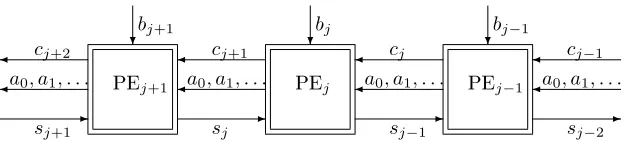
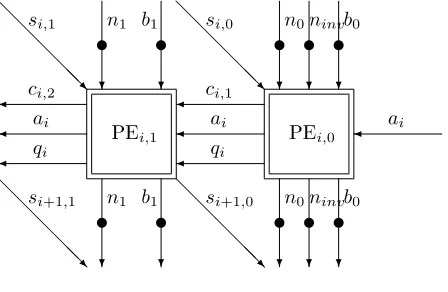
A systolic array consists of a number of processing elements (PEs) for repeatedly computing some function which itself consists of the repetition of a small number of dierent tasks. The PEs are arranged in a regular manner, communicate data only locally in the direction of computation, and each performs just one of the component tasks of the function. The input data for the function is fed in at one end of the array whenever the function has to be evaluated, and the result is eventually output at the opposite end. The array acts like a pipeline in the sense that it contains several instances of the function evaluation at various stages of completion. Such arrays can be particularly useful on servers with high volumes of connections or for other data intensive processing.
One of the advantages of using the architecture of a systolic array is the potential to avoid the cost of simultaneous data broadcasting (delays, wiring and multiplexers) to a set of PEs operating in parallel and thereby to improve Area×Time eciency. Although overall latency may not be improved by using a systolic array rather than a parallel architecture, throughput can be substan-tially increased.
There are many papers on the use of systolic arrays in cryptography. [55] is the rst to enable modular multiplication in a fully systolic way, i.e. using PEs with only local connections so that there is no need for the simultaneous broadcast of data to many PEs. Sava³ et al. [46] provide a wider view, inte-grating the integer and characteristic 2 eld cases, considering scalability issues and providing simulation timings as well as a good bibliography of prior work. In [3] Bertoni et al. apply the concept to nite eld extensionsGF(pm)/GF(p).
Since hardware always involves a xed number of PEs and there are rarely sucient of them to process all digit positions without re-use, it is necessary to store various intermediate data in queues of digits. This aspect is covered briey after describing the case where there are sucient PEs. Freking and Parhi [15] discuss this and the data dependencies in a little more detail for the 2-dimensional version of the array, as well as providing more possibilities for arranging the cells.
![Figure 1: Data Flow between Modular Multn Cells ([55], Fig. 1)](https://thumb-us.123doks.com/thumbv2/123dok_us/7959139.1320419/27.612.147.467.182.417/figure-data-flow-between-modular-multn-cells-fig.webp)