POSTED 6-27-' O4
This manual i. fo.."f".".r". and historical purposes, all rights reserved. This page is copyright @ by M. Butkus. NJ.
This page may not be sold or distributed without the expressed permission ofthe producer I have no connection with any c.unera company
0nline camera manual library
This is the full text and images from the manual. T h i s m a v t a k e 3 f u l l m i n u t e s f o r t h i s P D F d o c u m e n t t o d o w n l o a d .
The rlain page is located at www.butkus.orglchinon
Ifyou find this manual useful, how about a donation of $3 to: M. Butkus, 29 Lake Ave., High Bridge, NJ 08829-1701
and send your e-mail address so I can thank you. Most other places would charge you $7,50 for a electronic copy or
$18.00 for a hard to read Xerox copy.
This will allow me to continue to buy new manuals and pay their shipping costs. Ittll make you feel better, won't it?
Ifyou use Pay Pal or wish to use your credit card, use the Pay Pal Link on my page. Ifyou found this page from any other location (other then a link)
H o v r z T o
T a k e
P i c t L r r e s
i t h
-p0
,t,
F
. F a)
-v
14
@Gmeneg
Nos.
2, 2='Ar B and
3=A
Manufactured By
Burke & JameS I!(
For Rich,
Beautiful
Pictures
Make Your Prints On
The New Rapid Guaranteed
Developing
Paper
of Distinguished
Quality
No matter what kind of a negative you have there is a grade of Rexo that will produce the most perfect pictures possible to obtain. Rexo is supplicd in three distinct grades-Rexo Hard, for thin, weak, flat negatives. Rexo Normal, for negatives of normal or average density or contrast. Rexo Soft, for harsh, contrasty negatives and for producing soft effects with any negative. Rexo possesses
lllarvelous
latitude in Exposure
and Development
These features eliminate wasted orints and make Rexo the logical choice of amateur, commercial and professional photographers.
Rexo is uniform in quality and produces pictnres marked by beautiful gradations, purity of the highlghts, and transparency ofthe shadows.
Manufactured By
ffi#ffi BUrke & James r,,. ffii#ffi
240-258 E. Ontario Street
C N I C A G O
New York Salesroom 225 lilth Avenue
ENIARGING REXO,
35 times as fast as REXO Normal,
Instructions
for
R e x o e t t e
C a m e r a s
D o n o t a t t e m p t t o l o a t l o r t a k e a n y p i c t u r e s w i t h t h e Rexoette until you have become thoroughly farniliar with c v e r y p a r t o f t h e i n s t r u n e n t . T a k e e s p e c i a l c a r e t o l e a r n t h e c o n s t r u c t i o n o f t h e s h u t t e r : s ' o r k l t f o r t i m e a n d i n s t a n t a n e o u s e x p o s u r e . R e a d c a r e f u l l v t h e f o l l o n ' i n g i n s t r u c -t i o n s , T h e m o s -t i m p o r -t a n -t -t h i n g -t o b e r e m e m b e r e c l i n p i c -t u r e t a k i n g i s t h a t n o w - h i t e l i g h t ( i n c l u c l i n g g a s , e l e c t r i c o r l a m p l i g h t ) s h o u l d b e a l l o r v e c l t o s t r i k e the film, eren for a frac-tional part of a secontl, until it has been iler.eloped and fixecl.
Operating
The
I t i s t h e r e f o r e b e s t in a subtluecl light,
t h a t t h e l o a d i n g a n r l u n l o a d i n g b e c l o n e for after the seai on the f1m is broken
-S i z e 21/ax? Ya 2 Y2x41/+ 31/ax4ya 31/4x51/i
N o . 2 2 A 3 3 A
t h e r e i s a p o s s i b i l i t y o f t h e e c l g e s b e c o m i n g f o g g e d i f c a r e is not taken to keep the biack paper dran'n tightly.
. B e f - o r e l o a d i n g . t h e c a m e r a , t r y t h e s h u t t e r t o s e e t h a t i t r s w o r K r n g p r o p e r r y .
Films Adapted to Rexoette Cameras
R e x o
R e c o l d E a s t m a n P r i c e 4 1 5 7 2 0 N o . 2 B r o w n i e . . . $ 0 . 2 0 4 2 5 1 1 6 N o . 1 A F . P . K o d a . k . 2 5 4 3 0 1 1 8 N o . 3 F . P . K o d a k . 3 5 4 1 5 7 2 2 N o . 3 A F . P . K o d a k . 4 0
figure 2. 2 -C a m e r a
To Load
T o l o a d , r e l e a s e t h e t r v o c o r n e r c a t c h e s ( D ) a t t h e r e a r o f t h e c a m e r a . T h e b a c k o f t h e c a m e r a , r v h i c h i s h i n g e a l o n t h e l o w e r s i i l e c a n l o l ' b e o p e n e d . N e x t < l r a w out the winding ke1- as far it s-itl go. This will release t h e r o l i h o l d e r p e r m i t t i n g i t s n - i t h c l t a n - a l f r o m t h e c a m e r a b o x .
Figure 3.
An empty spool rvi1l bc fourrt'l in the rn'inding key sirle. Next bleali tle seal on t]re {ilrn cartritlge and place the spool in the empty chamber as shown in figure 2, t-aking e - a r e th a t t h e b l a c k p a p e r l e a t l s o f f t h e t o p o f t h e s p o o l . T h e fihn is now in posiiion to continue loatling; the retainirg s p r i n g p r e v e n t i n g a n y l o o s e n i r g o f t h e b l a c k p a p e r . N e x t r l - r a w - t h e b l a c k p a p e i a r o u n d t h e b a c k o f t h e c a m e r a a n d about ts.'o inches biyond the end of the camera (see figure 3 ) . T h e n t h r e a d t h e e n d o f t h e b l a c k p a p e r i n t o t h e w i d e s l o t i n t b e e m l i t v s l , o o l . a s s l r o q ' n in f i g u r e ' 1 .
With the thumbs on the flanges of the spool turn same until the paper is securecl, ts'o or three revolutions n'ill be s u { i i c i e n t ( s e e f l g u r e 5 ) .
After the film is secureil replace the roll holder in the camela ancl return -n'inding kcv to its normal position. Close
-b a c k o f c a m e r a a n r l s e c u r e with the corner catches. Next turn t h e r ; i n d i n g k e y s l o n ' l ; - u n t i l it engages in the slot in the encl of the spool.
Continue to turn the rrinrling kev slolr.ly until the figure one -appears opposite the rubl- rvindow rvliich signilies that t h e f i l m i s i n p r o p e r p o s i t i o n f o l the fir.st exposure.
T h e c a m e r a , i s n o r v r e a d ; . f o r making exl,osures for all o b j e c t s a t a ^ d i s t a l c e o f e i g h t f e e t or moie. Throughout the o p e r a t i o n o f l o a d i n g , f l o m t h e brealiing of the seal-untii the c a m e r a i s c l o s e i l , s e e t h a t t h e I ' e p p y i s r i o u n i l t i g h t l y o v e r t h e s p o o l s , f o r i f i t i s a l l o u . e i l t o l o o s e n or bulgi, ihcre is a c l i a n c e t h a t t h e f i l m w i l l b e f o g g e d .
The Shutter
T h e s h u t t e r s u p p l i e t l r - i t h t h e Rexoette Canera is auto-m a t i c , _ t h a t i s , i t i s a l r ' a 1 ' s s e t r . e a i J . for takilg the picture-a s i n g l e p l e s s u r e o f t h e l e r . e r 1A)'iir either il"irecti6n mpicture-akes
4
an instantaneous or snap-shot exposure. To set for time, d r a w o u t t h e t i m e s t o p ( C ) , o n e p r e s s u r e o f t h e l e v e r ( A ) opens the shutter anil a seconcl pressure in the opposite direction closes it.
figure 5.
Stop or Diaphragm
All Rexoette cameras are supplieci with a diaphragm plate having three clifferent sizeil openings, rn'hich regulate the amount of lieht that is allon'ed to reacir the fllm.
The largest opening is for making snap shots in bright sunlight.
The meilium opening is for interior time exposures, see speeia.l tlirections uniler Time Exposures Indoors,
The smallest opening is for making time exposure out-of-doors on cloudy days. Never use the smallest stop for snap-shots. See special ilirections unrler "Time Exposures Out-o f - D Out-o Out-o r s . t '
_ o _
\Yith slide (B) in normal position the largest opening is i n p i a c e ; t o u s e t h e m e t l i u r r r o p e n i n g d l a w o u t t h e s l i d e u n t i l t h e l o c a t i . n g s p r i n g s n a p s i n t o f i r s t i n d e n t i o n ; t o u s e t h e smallest opening ch'arv out the slide until the spring snaps into the seconcl inclentiol.
Instantaneous or Snap Shot Exposures
f n m a k i n g i n s t a n t a l e o u s o r s n a p s h o t e x p o s u r c s use the l a r g e s t d i a p h r a g r n s t o p . S n a p s h o t s a r e u s u a l l v n a d e while holding the camera in the harrcl, the light shouicl therefore be bright sunshine. On blight clays snap-shots can be mat'le at any time during the clay from three hours after suirrise t o t h r e e h o u r s b e f o r e s u l s e t . E a r l i e r o r l a t e r t h a n this, short time exposures should be given. It is a goocl rule ner-er to p h o t o g r a p h d i r e c t l y t o w a r d t h e s u n , the best position being t o h a v e t h e l i g h t s h i n i n g f r o m b e h i n d the operator or over e i t h e r s h o u l d e r a n c i c l i r e c t l y o n t h e o b j e c t t o be photographed, I f t h e d i r e c t r a y s o f t h e s u n s t r i k e the lens cluring the ex-p o s u r e t h e ex-p i c t u r e r v i l l b e b l u r r e d . Do not trv to ex-photograex-ph m o v i n g o b j e c t s a t a s h o r t c r c ' l i s t a n c e thal 15 feet distant f r o m t h e c a m e r a . I t i s a c l v i s a b l e to endear.or to catch them a t a n a n g l e e i t h e r c o m i n g t o w a r d o r g o i l g from the camera, as goocl results will rrot be obtairred if taken .n4ren the ob-j e c t is directly opliosite. If photographing tall buildings at c l o s e r a n g e i t i s n e c e s s a r v t o s e c u r e a position as near ,as p o s s i b l e o p p o s i t e t h e c e n t e r of the builcling, for if the camera is tilted uprvarci, the lines in the picture r-ill be fountl to c o n v e r g e b e c a u s e o f t h e f a c t that the top of the builtling is of a much greater clistance frorn the ca-era thair the bot--1 o * . T h i s s a m e r u l e a p p l i e s . n , h e n photographirg small ob-j c c t s such as a ilog; in this case the c,amera should be lorverecl t , o t h e . c e n t e r o f t h e object to be taken, thus avoiding any d T S t r O It r I O N .
Whgn reatly for making the exposure holc1 the camera in b o t h h a n i l s a n d a s n e a r levet as plssible so that the picture n'ill be in true perspectir-e. Locate the ob.iect in the- fintier by looking squa.rely into it, nraking sure- that all of the object rn'hich you desire to photograph falls within the limits of the fincler. When all is i-l ieadiness release the
-shutter, taking care not to jerk or move the camera during t h e e x p o s u r e , A p r e s s u r e o f t h e l e v e r w - i 1 l o p e n t h e s h u t t e r for a fractional part of a, second thereby permitting the ligirt t o p a s s t h r o u g h t h e l e n s a n i l f o r m i n g a n i r n a g e o n t h e s e n s i -tive surface of the film. After making the exposure turn the 'winding key to the right watching the ruby window in t h e b a c k o f t h e c a m e r a u n t i l t h e n e x t n u m b e r . a p p e a r s . T h i s i s a v e r y i m p o r t a n t p o i n t a n d o n e s h o u k l e a r l y acquire the h a b i t o f t u r n i n g t h c w i n i l i n g k e y a f t e r e a c h e x p o s u r e thus a v o i d i n g t h e p o s s i b i l i t y o f m a k i n g t w o e x p o s u r e s on the same surface of the film.
fime Exposures
W h e n m a k i n g t i m e e x l o s u r e s i t i s a b s o l u t e l v n e c e s s a r y that the camera be placecl upon a table or other frm sup-p o r t w h e r e t h e r e n i l 1 b e n o c l a n g e r of its being moved tluring t h e e x p o s u r e . C e n t e r t h e o b j e c t p r o p e r l y i n the finder, and d r a w o u t m e t a l s l i d e ( C ) . G i v e a s i n g l e p r e s s u r e o f t h e l e v e r to open, and u.'hen sufficient time has elapsed, an ailditional p r e s s u r e t o c 1 o s e , u s i n g c a r e n o t t o j a r the camera in either o p e n l n g o r c r o s r n g .
f n m a k i n g t i m e e x p o s u r e s i t i s n e c e s s a r v to use sorne j u d g m e n t in regard to the length of tirrre the lens should r e m a i n o p e n . T h i s i s g o v e r n e d b r - t h e a m o u n t of light which f a l l s u p o n t h e o b j e c t t o b e p h o t o g r a p h e t l a t the time of the e x p o s u r e .
Time Exposures Out-of-Doors
T n m a k i n g t i m e e x p o s u r e s o u t - o f - d o o r s the metal slide (C) s h o u l c l b e d r a n ' n o u t a n d t h e s h u t t e r o p e l e d a n d c l o s e i l a s q u i c k l y a s p o s s i b l e .
W I T H S U N S H I N E u s e t h e s m a l l e s t d i a p h r a g m , o p e n i n g ancl closing the shutter as quickly as possible.
WITH LIGHT CLOUDS use the smallest cliaphragm, giv-ing from lz to one seconcl exposure.
WITH HEAVY CLOUDS use the smallest diaphragm and gir.e from 2 to 5 seconils.
The foregoing calculations are for open air exposures. W h e n p h o t o g r a p h i n g o b j e c t s i n shadows or on porches, no accurate clirections can be given as too much depends upon the clensity of the shadovvs.
learnecl through experience or bI using a scientific ex-posure meter such as the Watkins Bee.
CAUTION. Ner.er attempt to make a time exoosure while h o l r l i n g t h e c a m e r a i n t l r e h a n d a s a b l u r r e d p i c t u r e i s s u l e t o r e s u l t .
Time Exposures Indoors
T h e f o l l o w i n g t a b l e i s f o r the largest stop. In case the m e c l i u m s t o p i s u s e d t n i c e as much time must be given. With the smallest stop, four times as much.
White Walls and One Window Bright sun outside, six seconils,
I{azy sun, fifteen seconds. 0loudy-bright, thirty seconds. Cloucly-clull, one minute.
White Walls and More than One Window Bright sun outside, four seconds.
I { a z y s u n , t e n s e c o n d s . Cloudy-bright, twenty seconcls, Cloudy-cluIl, forty seconds,
Medium O^lored. Walls and One Wind.ow B r i g h t s u n o u t s i t e , t n ' e 1 v e s e c o n d s .
Ilazy sun, thirty seconds. Cloucly=briglit, one minute. Cloudy-dull, two minutes.
Medium Colored. Walls and. More than One Window Bright sun outside, eight seconds.
Ilazy sun, twenty seconcls. Cloudy-bright, forty seconcls.
Cloucly-dull, one minute, tra'enty seconcls. Dark Colored Walls and. One Window Bright sun outsicle, forty seconds.
Hazy sun, one minute, twenty seconds. Cloutly-bright, t'wo minutes, forty seconds. Cloudy-rlull, five minutes, twenty seeoncls,
Dark Colored Walls and More than One Window Bright sun outsicle, twenty seconcls.
Ilazy sun, forty seconds
Cloudy-bright, one minute, twenty seconds. Cloucly-clull, two minutes, forty seconds.
-The foregoing figures are for rooms whose windows get light clirect_from the sky anil for any time cluring the day from three hours after sunrise to three hours befoie sunsei,
Removing the Film
No rlark room is requiretl for removing the fiIm from the camera. Ilowever it is best to perforrn this operation in s u b d u e t l l i g h t , o b s e r v i n g t h e f o l l o n i r r g r u l e s :
Figure 6.
F i r s t : W h e n t h e l a s t s e c t i o n o f t h e f i l m h a s b e e n e x D o s e t l turn the n'iniling key until all of the paper has been wouncl o n t h e s p o o l i n t h e k e y w i n c l i n g c h a m b e r . T h i s c a n b e t o l c l b y t h e e a s e r r - i b h w h i c h t h e s p o o l t u r n s .
S e e o n d : R e m o v e t h e r o 1 1 h o l t l e r a s t l i r e c t e d o n t h e p r e c e c l -ing pages.
-T h i r c l : D r a w t h e l o o s e e n d o f t h e black paper tight.ly a1o.u1tl the- spooi and fasten it lvith the gummeci sti'ckei, w h i c h w i l l b e f o u n c l i n ' t h e e r n p t y r e e l .
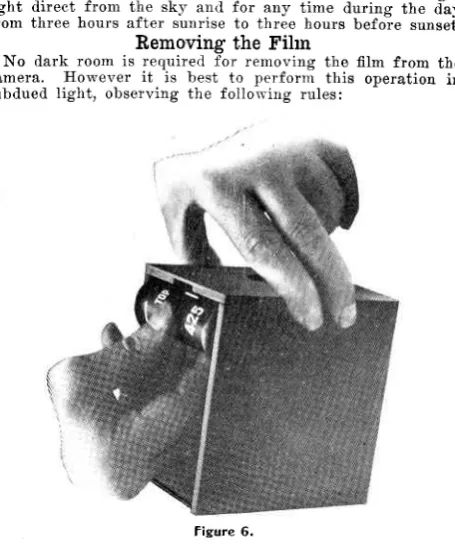
F o u r t h : T o r e m o v e t h e c a r t r i t l g e f r o m the camera, grasp the spool as shorvn in figure 6.
Fifth: Tra,nsfer the emptl' flm spool to the r.r.intling key side, so that the camera will be in reatliness for loaclini.
Dark Room Development
- t r ' i l m s m a y b e t a k e n t o t h e n e a r e s t Photo Supplv Dealer f o r _ . d e v e l o p m e n t . D e a l e r s l i a n d l i n g o u r p r o d u t i s - c a n b e r e a d i l y r e c o g n i z e c l b y the appealance of oir trade-malk on t h e i r s t o r e r n - i n d o w ' s . I l o w e v e r , i n orcler to secure the g r e a t e s t p l e a s u r e a r r d p r o f i t from your camera we advise t h a t t h e a n r a t c u r . d c v e l o l r l r i s o u n f i l m s , f o r t h e p r o c e s . i s b o t h i r l l e r e s t i n g a r r , l s i p O 1 " . _ T b e e a s i e s l a n d I e n s t . e r .
# p e n s i v e
. \ { a . v t o t l e v e l o p r o l l f i l m s i s b y u s i r r g r r a . \ . s r x I d a r k e n e d r o o m w h i c h i s l i g - h t e d onll- riith thd ruby lanrp, c a r e b e i n g t a k e n t h a t a l l w h i t e l i g h t is excludetl. The follo;: i r r g a r t i c l e s a t ' e l o ( ' o r n m e n t l e t l f o i t l r i s 1 , u 1 1 , 6 s s .
A n f n g e n t o R u b y L a m p N o . 6.
l l l n s u l a ^ t e T r a y s , . 1 x 5 or 4x6 (postcard). 1 8 ' o z . G r a d u a t e .
- 1 I n g e n t o T a b l e t C r g s h e r , or glass stirring ror1. I . \ r n a t o r r r P r i r r t i r r g F r a t n e : r r r J p l a i n g l : r s s .
I p r c k r g e o f I r r g e r t o T a b l c t s o r : I n g r . n l o o l R e x o J [ . Q . T u b e s .
1 box of Ingento or Rexo Acicl llypo.
S e l e c t a l o o m o r c l o s e t r - h e r e all nhite light can be easily q T 1 ] " 1 . , 1 . W l t e n d e v e l o p r n e n t i s t l o n e a t n i g t r t ttris offers n"o , l i I f i c t l t 1 ' l h a t e rer. T h e r e a s o n t h a t a tl-irhened room is r e . l _ r i r e c l i s t h a t t h e l i l m i s extrentell. sensitive to l,hite iight 3 , n 1 1 n g u l t i . b e - s p o i l e r l i f e x p o s e t l eiilrer to da1-light or 1a'inp l i g h t f o r t h e f r a c t i o i r a l p_art of :r \ecol,l. Hariiig provitteil t h e a r t i c l e s m c n t i o n e r ' l a b o v e , set'ure a pair of scrssol,s, a p i t c h e r o f r v a t e t a n d a p a i l for I'aste.
f q t t _ h e T ] l ) - . l u - l r . o l . a t : r h t e o r s h e t f r n , l t i g h t i t . T h e s u b d u e c l r e d l i q h t t i h j _ c h i t c m i t s 1.i11 rot iritre tic sensitir-e f i l r n u n l e s s h e k l t o o c l o s e to it. ft is thereiore aclvis:rblc to p l a c e t h e l a m p a t l e a s t 18 inrhes an'av from the trav in
I
I
I
,
j
which the developing is to be done; fill one of the trays with v'ater, open the box of tablcts and take trvo tablets from the large bottle and trvo tablets from one of the small vials; fill the graduate to thc six-ounce mark and drop all four tablets
Developing the Film in a Strip-Figure 8
into the water, immediately crushing them rrith a stirring rod until leduced to a fine porvtlcr; thcn stir the solution until the tablcts are thoroughly dissolr,ed. Pour the contents of the graduate into the second tray; next preparc the fixing bath by dissolving one measuring cup (rvhich rvill be fountl on the inside of the box) lcvel full of the lixins com-pound in eight ounces of rvatci.. Stir until the solution i s c o m p l e t e ; t h e n p o u i ' t h c c o n t c n t s of the graduate into the third tray. (Note It is not necessar.v to mix the solutions in the darkloom. as they rtrc rrnaffected by l i g h t ) . I t i s a d v i s a b l e t o r c s c r v e o n e t r a y f o r t h e f i x i n g b a t h o n l y .
To develop the fllm break the seal rvith v'hich the black paper is held and unroll until the point lvhere the film is attached to the black paper, then detach the entire strip of film from the black paper and allorv the film to roll up loosely" Ilold one end of thc roll rvith the thumb and fineer of the
left hand and take hold of the free enrl 'with the risht. Pass the film through the tray of clean cold water, holdiqg one encl in each hand as shorvn in the cut. Pass it in this manner through the 'water several times so that there will be no bubbles remaining on the surface of the fllm. When it is thoroughly wet the developmenf, may be commenced. HoId-ing the film in the same manner, pass the film through the developing solution as described for wetting it, keeping it constantly in motion. In about one minutc dark spots rvill begin to appear. These are termed high lights, and very soon after their appearance an image of the object will be discern-ible. Complete development in the strip by passing the film through the developing solution until all the detail has been brought out in the thinest negatives.
It will be noted that the negatives are of different density. This, horvever, is not an objection as this can be overcorn: i.n printing. The difference in density does not affect the differ-ence in contrast. Kecp the strip r,r.hich is being dcvc)oped in constant motion, allo'rving the developer to act from fir'e to eight minutes, depending upon the rapidity rvith rvhich the negative gathers density. The progress of dcvclopment may be watched by holding the strip up to the larnp from time to time. It rs advisable, horvever, to make the examination as short as nossible.
Note: 'Io avoid transparent spots after having passed the film through the deveiopcr the first time face dor,vn, rcverse it and pass it through face up, holding the film dolvn in the lray and dlarving it lightly through the developer under the hand. This ll,'ill brcak ail the air bubbles. Tlansparent spots are causcd by air bubbles adhering to the film rluring do'elopment.
After the development has been completecl, pass the film a fe'rv times through the clear rvater, thcn transferring it to the tray containing the flxing bath. When al1 of the creamy surface hns disappeared from the unsensitizctl surface of lhe film fixation is practically complete. It is, horrever, advisable to continue to pass the film through the solution trvo or three minutes after the disappearancc of the creamy color. After the films are thoroughly fixed they should be washed in colrl mnning r.ater florn forty to sixty minutes. If run-ning water is not convenient, tcn changes of lresh water should
-be used, keeping the fllms constantly in motion all the I'hile. The thorough lvashing of the films is very important in order to remove all traces of the Hypo or else stains 'lvill appear after drying and the negatives rvill be ruined,
After washing, the films should be hung up to dry in such a manner that it does not touch the surrounding objects. The place selected for drying should be free from dust. If a mild current of air is present the process of drying rvill be greatly quickenecl.
The temperature of the developing solution should be as n e a r a s p o s s i b l e t o 6 5 d e g r e e s F a h r e n h e i t . T h e f i x i n g b a t h and water used for rvashing should be kept cold, ice being employed in extremely hot l-eather.
Cutting the Film for Separate Development-Figure 9 The use of f,he Ingento Developing Roller rvill greatly facil-itate the developing process. This device consists of a heavy glass roller lvhich revolves on trvo brass pins mounted in extra heavy nickel plated brass frame. Its ot'n rveight is sufficient to resist thc oull of the film when it is being drarvn through the solution. ^When this roller is used only half the solution ordinarily required need be made up, as the roller over which the film is drawn is within 3/16 of an inch from
-the bottom of -the tray, thus keeping -the film entirely sub-nierged in less than one-half inch of solution. It is for use in trays 4x5 or larger and rvill accommodate any film 4lax61/2 or smaller and can be obtained from all photo supply dealers.
Separate Development of Each Exposure
'Ihe
above directions apply to the developmerrt of the film in the strip. It is sornetirnes advisable to develop each section separately, especially lshere there has been a great variation in the exposures given. In this case the following directions !
a p p l y : E
In unrolling the film preparatory to developing in this _! manner, care must be taken that the end should not be allowed _c) to roll up over the paper. 'Ihe exposures shoulcl be cut apart !p rvith the black paper on top so that the divisions betrveen 6 each film can be readily recognized by the numbers which a appear on the edge of the black paper. Do not let the fingers = touch the face of the film. The face is the dull side. The i propcr maurer of holiling the fllm is illustrated by flgure 9. I
After the film has been cut into sections as indicated above. l] place the scctions in the tray containing the cleer rvatcr, to e i'.,morr" air bubbles, covering the tray 'li)ith a piccc of brown e p a p e r o r c a r d b o a r d t o e x c l u d e t h e l i g h t o f t h e l a m p . T a k e > one of the scctions from the water and immerse it face do'wn E in the tray containing the dcveloper; rock the tray gent)y to I prcvent strealis and air bubblcs. In about one minute the € film will begin to darken, representing the high lights of the C picture, and in about two minutes the image v'ill be discern- V ible. The common 'way of determining rvhen the fiim has E been fully developed is to look on the back to ascertain whether F the obiects in the picture have begun to show through. When developing films singly, from five to six minutes is usually required, the time varying according to the temperature of the solution.
When development is complete transfer the film to the tray containing clear rvater ancl rinse it trvo or three trmes, after rvhich it should be placeil in the tray containing the fixing bath. At this juncture the second section of the film shoulal be put through the same process, care having been
taken that none of the Hypo has adhereil to the fingers, thus allowing rt to come rn contact with the undeveloped section of the tilm or with the developer.
Three or more negatrr-es may be developed at one time by placing the films in the dcveloper face dorvn and alter-n a t i alter-n g e a c h s e c t i o alter-n s o as to prer-ealter-nt air bubbles; however, r,ve recommend that the beginner devclop only one section at a time until the neccssary experience has been gained. As each successive section is developed and lixed it shoulcl be placed in the rvashing rvater. After the films have been thoroughly rvashed they should be pinned up separateiy to dry, care being taken that their surface is not allos'ed to come in contact rvith the surrounding objects.
_ _ \ V e r e c o n m e r i c l I n g e l t o o r n e x o X f . Q. Tubes or fngento ! [ . Q . T a b l e t s a s t h e m o s t h i g h l r - s a t i s f a c t o r l . r l e v e l o p e r f o r f i l m s . C o m | l e t e d i r e c t i o n s f o r r n a h i l g u p ihese solutions a r e p r i n t e d o n e a c h t u b e . F o r t}ose ri-ho-desire to prepare their orvn developer rye recotntneltd the follorving formula:
H y d r o } I e t o l D e v e l o l r e r .
\ l a t e r . . . . . . . 6 . 1 o z .
I l e t o l . . . . 1 5 g r .
S o d i u m S u $ h i t 1 e ( a n h v r l r o u s ) . L 1 / 2 o z . S o r 1 i u r n C a r b o n a t e ( a n h l ' d r o u s ) . . . l . o z . F l 1 - d r o c h i n o n . . . 9 0 E r . . B r o m i d e o f P o t a s s i u m . . . 1 2 g r .
Making Prints
There are in general use, three classes of paper used for making pictures; namely, blue print or ferro-prussiate paper, printing-out paper such as Solio, Disco, etc., and developing or gaslight paper, such as Rexo, Velox, Argo, etc. The first two classes are for daylight printing only, .while the last c . l a s s m a y b e p r i n t e c l e i t h e r i n s u b d u e t l daylight or by arti-f i c i a l J i g h t .
Printing-Out Papers
Open the printing frame and place the negative face down upon the glass, then place upon this a sheet of blue print paper. Replace the back of the printing frame and secure it with the springs. It rvill be noted that the back of the print-ing frame is hprint-inged so that a part of the print may be
eled for inspection during printing, without disturbing its register with the negative. The loading of the paper into the frame should be done in a subdued light, that is, in an ordi-nary room, but as far as possible from the window. The unuged paper should be returned to its package for protection from the light.
The loadecl printing frame should be placed glass side up in the strongest possible light, direct sunlight being preferred. It is allowed to remain until the image from the negative has been sufficiently impressed on the sensitive paper. This can only be determined by an occasional examination of the paper. Print until the shado'lvs become a gray bronze color, or until the high lights are slightly tinged with blue. When this stage has been reached remove the print from the printing frame, wash thoroughly in running water for 15 rninutes or in sev-eral changes of cold water, allorving the print to remain in each bath a ferv minutes. After having thoroughly washed the print as above inclicatcd, it should be hung up for drying. The Ingento Blue Print Paper is especially recommended as it is prepared especially for photographic purposes.
' W h e n u s i n g a p r i n t i n g - o u t p a p e r s u c h a s D i s c o , S o l i o , e t c . , the frame should be loacled as directed above for blue print paper. The printing should be allorved to continue until the tone of the print is somewhat darker than is desirable in thc finished picture. Ingento Toning and Fixing Solution is highly recommenried for toning this class of p:rper. I{ix the toning solution as dirccted on the package and pour it into a tray. The prints shoulil be immersed in this solution face dorvn so as to insure the even action of the solution over the rvhole surface of the print. After a moment or so, the print may be reversed so that the toning can be watched. Repeat this process from time to time during toning. Thc prints will begin to change color immediately qpon immersion in the toning bath. At first they are of a reddish brown, changing gradually to reddish yellolv, then to brol'n and then to purple. Toning should be stopped when the desired shatle has been obtained. At this point the prints should be transferred to a salt solution made by dissoh'ing one tablespoonful of com-mon table salt in 16 ounccs of v'ater. The prints should be
allowed to remain in this solution about 5 minutes, after which they shouid be rvashed for one hour in running water or in twelve changes of water. They are then ready foidrying, books and for this purpose \.\.'e recommend Ingento Blatter S e v e r a l p r i n t s c a n b e t o n e d simultaueouslr..
Developing on Gaslight Papers
Developing Papers, such as Rexo. \-elox, -{rgo, etc., are very popular with arnateurs because of the simplicity in their operation, the excellent rcsults obtained and the added advan-tage of being able to print thern by artificial light. These papers can be hanclled rvith safety eight or ten feet away from an ordinarv gaslight. Thcy should not, however, be allou-cd to remain uncoveled in the direct rays of the iight even at this distance for any considerable time. The paper is loadcti into an orclinary printing frame in the same man-ner as aboye desclibed for printing.out papers, taking care that the emulsion side of the paper is against the dull side of the film. The emulsion side of the paper can be deter-rnined by tendency of the 1,3pp1 to curil in that direction, or by biting a corner of the papcr, the emulsion side tending to sticl< to the teeth. \Iith the back of the frame clamped in p o s i t i o n , i t i s e x p o s e d b y h o l d i n g i t n e a r a g a s j e t , l a m p o r incandcscent light. The length of the exposure depends upon the distance at r.vhich the frame is held from the light, and t h e d e n s i t y o f t h e n e g a t i v e . E r p o s u r e c a n a l s o b e r n a d e i n subdued daylight; hou,ever, artificial light is preferred, as it d o c s n o t v a r y i n i n t e n s i t y a s i s t h e c a s e r r i t h d a y l i g h t a n d it is therefore much easicr to judge the length of the exposure recluircd,
\Tith this class of paper no image is seen on the surface, until the print has bcen placed in the deleloper.
'l'he larger the negative, the greatcr the distance it should be hcld from the light, the usual rule being that the proper distance is equal to the diagonal of the negative. The time of exposlrre varies with the distance the printing frarne is held flom thc light. If, horvo.er, daylight is used, it rvill be found advantageous to cover all the s'indorvs with postoflice paper, 'lvith the exception of an opening about one foot square. Ovcr this opcning ts.o or thtee sheets of tissue paper should be pasted to diffuse the light, thcn use a piece of blacl< cloth
or any other opaque medium to cover this opening when the rvhite light is not desired for printing purposes. In this case the frame should be held from one to trvo feet away from the opening during exposrrre. It is imptssible to E;ive exact directions as to the length of exposure ori account of the great difference in the intensity of daylight at various times, the best method being to make test exposures 'lvith small strips of the paper used.
Placc three trays on the rvork table as indicated in the accompanying{ diaglarn. IJse enough solution to tholoughly submerge the prints, the ternperature of the cleveloping solu-tibn should be about 70 degrecs Fahrcnheit, keeping the fix-ing solution as near as possible to the temperature of 50 degrees. In making up these solutions allvays follorv closely t h e c l i r e c t i o n s a c c o m p a n y i n g t h e c l e v e l o p c r u s e t l . W e r e c o m -m e n i l t h e I n g e r r t o I I . Q. Developing Tablets or Rexo X{. Q. T u b e s f o r u s e w i t h a l l c l e v e l o p i n g lapers. Having prepared the developer antl fixing bath, the prints shoulcl be immersed in the dcveloper, using care that the solution flolvs evenly over the surface, leaving no air bubbles. The image should appear rn from eight to ten seconds. It lsill rapidly gather detail and density. \\rhen the desired tone has been obtained, it should be quickly rcmoved from the dcveloper and placed in the tray containing rvater, afterlvhich it is transferrcd to the fixing bath. For best results, we recommend the use of Rexo Acid Hypo. Directions for making the bath accom-pany each package. The prints should be kept in motion ilhile in the fiiing bath. From eight to ten minutes is quired for thorough fixation, after rvhich they should be re-movcd and rvashed for an hour in running tl'ater or in trvelve changes of clearwater. Prints can be best dried in blotter'
_ l a _
T
o
W
books anil for this purpose we Books. More explicit directions for eaeh package of paper.
F o r t h o s e w h o d e s i r e t o p r e p a r e recommend the followinE formula:
r e c o m m e n d o u r b l o t t e r printing will be found in their own developer, we
Dissolve the chemicals in the orcler named. The tem-perature of the solution should. be about 68 clegrees Fahr.
-Detseloper
Composed of the purest chemicals and combined in the precise proportions requisite for absolute nicety in develop-ment. Especially prepared for use rvith Rexo and all other developing papers, films and plates.
C a t . N o . H - 1 4 0 B o x o f 6 T u b e s , p r i c e $0.25
RP]p Acid tr-lspo
I
I
I
I
I
.t
A double powder acid fixing preparation in which the acidifier is packed separately from the hypo. Especially adapted to fixing Rexo and all other developing papers. Also admirable for plates and films. Packed in damp-proof cartons. C a t . N o . H - 3 6 H a l f p o u n d
c a r t o n - $ 0 . 1 5 Cat. No. H-37 Pound carton .25
d#*+ffi Burke & JameS r,r. ct i.ago I
+--*-+---.-*+
Weight
REX()
PRICE
IIST F(}R
ATt GRADES
AI{D CI.ASSES
Packed only in Dozen Packages, b Gross Boxes and Rolls
Double W
Per T u D t u | P e " c N
SIZE
*21,4x 2%
*2lx 8fu
*2%x 4%
* ? l x 3l
* | l x 4l
*Brlx 5\
* 4 x 5
3%x 511
4 x 6
4r/ax 6)4
4V4x 61,4
o x /
5 x 8
Br72x12
|fux 7fu
6 x 8
6126x
8%
7 x 9
7%x Sll
8 x 1 0
9 x 1 1
1 0 x 1 2
1 1 x 1 4
1 4 x l 7
1 6 x 2 0
1 8 x 2 2
2 0 x 2 1
$0.10
. t 2
. t 2
. t 2
. t 2
. l J
. l o
. 1 5
.20
. 2 5
.30
.35
.30
.35
.40
.50
. 5 5
.60
. b 5 . 6 5
1.00
1 . 3 0
2.0a
2.40
3.00
3.50
$ 1 . 0 0
r 2 0
1 . 2 0
L . 2 0
1 . 2 0
1 , 5 0
1 . 5 0
1 . 5 0
1 . 6 0
2.50
2 . 5 0
3 . 0 0
3 . 4 0
3.00
4.00
4 . 0 0
4 . 7
5
5 . 5 0
6.00
o . / ; )
8.50
10.00
13.00
20.00
27.00
34.00
40.00
mb.zs
, Et t r
.30
.30
. 6 A
.40
. 5 D
.45
.50
.60
. oil
.80
1 . 0 0
1 . 2 0
1 . 5 5
2.40
3 . 2 0
4.00
4.80
$2.00
2.00
2.00
2.00
3.00
3.00
3.50
4.00
t t . , D t ,
4.50
5.00
6.00
7 0 0
8.00
9.00
1 1 . 0 0
1 3 . 5 0
r l . - , 2 7 . 0 0
36.00
45.00
54.00
Per M
$7.00
Special Sizes cut to order at proportionate prices