Resource Scheduling under Command and Control
3
Architecture
4
Jie ZHANG1*, Gang WANG2, Song YaFei 2
5
1 Graduate School, Air Force Engineering University, Xi'an 710054, China.
6
2 College of Air Missile Defense, Air Force Engineering University, Xi'an 710054, China.
7
* Correspondence: [email protected]; Tel.:+86-1333-538-4381
8
Received: date; Accepted: date; Published: date
9
Abstract: For the task planning problem of the command and control architecture, the existing
10
algorithms have problems such as low efficiency and poor re-planning quality under abnormal
11
conditions. Based on the requirements of the current accusation architecture, this paper constructs
12
a distributed command and control architecture model based on multi-agents, which makes use of
13
the superiority of multi-agents in dealing with complex tasks. The concept of MultiAgents-HTN is
14
proposed under the framework. The original hierarchical task network planning algorithm is
15
optimized, the multi-agent collaboration framework is redefined, and the coordination mechanism
16
of local conflict is designed. Taking the classical resource scheduling problem as the experimental
17
background, the comparison between the proposed algorithm and the classical HTN algorithm is
18
carried out. The experimental results show that the proposed algorithm has higher quality and
19
higher efficiency than the existing algorithm, and the space anomaly is heavy during processing.
20
The planning is more efficient, and the time is more complicated and superior in dealing with the
21
same problem, with good convergence and adaptability. The conclusion proves that the distributed
22
command and control architecture proposed in this paper has high practicability in related fields
23
and can solve the problem of distributed command and control architecture in multi-agent
24
environment.
25
Keywords: Multi-agent, HTN, Distributed Architecture, Command and Control Model, Algorithm
26
Performance Comparison.
27
28
29
1. Introduction
30
In the field of artificial intelligence, traditional research objects mainly focus on the intelligence
31
problem of individual agents. However, in practical engineering applications, most of agents have
32
social interactions with other agents like information interaction and cooperation. Therefore, the
33
concept of Multi-agent System (MAS) has been proposed and has become one of the two research
34
branches in distributed artificial intelligence [1]. The research of MAS is mainly divided into the
35
following parts: Agent design, interactive cooperation and utility allocation between agents, and
36
alliance training algorithm design.
37
In recent years, with the international situation changes, peace and development are the current
38
themes of the times, but disputes still exist in the Middle East and other parts of the region. In order
39
to cope with possible emergencies, it is reasonable to organize relevant departments, mobilize
40
relevant reasonable resources and formulate and implement decision-making plans within the
41
shortest time after the occurrence of emergencies, so as to minimize people's property losses and
42
maintain the image of a great country. A quick and effective command and control structure is
43
indispensable in the face of emergencies. Efficient and feasible accusation architecture model can
44
generate the highest quality decision scheme with the fastest speed in the effective time, and timely
45
handle the temporal exception in the execution process of the scheme to ensure the smooth
46
implementation of the decision scheme.
47
The particularity of the emergency response determines that the accusation architecture is
48
characterized by large scale, hierarchical decision-making, complex cooperative relationship, strong
49
spatio-temporal constraint and complex external situation [4].
50
1) Large scale. There are a large number of participating units involved in emergency
51
response, with a large number of tasks to be completed [5], a large number of types, and a large
52
number of resources to rely on. The relationship and element connotation of the above issues need to
53
be considered when making a decision plan, resulting in a huge scale of command and control.
54
2) Hierarchical decision-making. In the face of complex requirements for solution, namely
55
input complex tasks. The task is decomposed layer by layer, several simple tasks are decomposed,
56
and the task is processed cooperatively with the concept of multi-agent system. Based on this
57
principle, the decision-making process requires certain empirical knowledge and rules [6].
58
3) Complex cooperative relationship. During the execution of the decision scheme, there are
59
complex dependencies and time-space constraints among agents, and resource and time constraints
60
also exist between agents and tasks [7].
61
4) Strong spatio-temporal constraint [8]. The particularity of this field is that the longer the
62
time consumption, the more serious the loss of people's property. Therefore, the constraint on the
63
generation time of task processing scheme is extremely strong, which requires the generation of
64
high-quality decision-making tasks in a short time.
65
5) Complex external situation. In the process of implementing the decision scheme, the
66
change trend of the external situation environment cannot be predicted. Environmental factors have
67
a certain impact on the implementation result of the decision scheme, which may easily lead to the
68
unenforceability of the scheme. Therefore, the generation of decision plans is required to conform to
69
the change of external situation.
70
To sum up, the generation of decision-making schemes for complex task planning has brought
71
great difficulty. Traditional mathematical modeling is not suitable for solving such problems due to
72
its slow solution speed, complex cooperative relationship and spatio-temporal state constraints. In
73
addition, traditional mathematical modeling schemes are usually used for solving static problems,
74
and in the face of dynamic problems, it is necessary to re-model once the problems change [9].
75
Therefore, the traditional modeling method has some limitations and cannot satisfy the solution of
76
such problems [10].
77
HTN (Hierarchical Task Network Planning) is one of the most widely used intelligent planning
78
methods in the field of multi-agent. The basic process is to decompose complex tasks until they can
79
be decomposed into directly executable atomic-level tasks. After the decomposed tasks are
80
completed, task allocation is carried out and finally a decision scheme is generated [11]. HTN
81
algorithm has the following advantages in solving such problems. First, the scheme is generated
82
knowledge can be fully utilized. HTN can efficiently use the existing method set and empirical
84
knowledge to express various constraints, so as to improve the decision-making efficiency and the
85
quality of the decision-making scheme. HTN is currently widely used in robotics, feature modeling,
86
emergency response decision-making and other fields. The above discussion shows that HTN has a
87
good adaptability to the solution of the decision-making scheme of emergency problems [12].
88
Moreover, in this paper, we conduct targeted optimization based on HTN to solve the
89
decision-making generation problem of distributed accusation architecture.
90
In summary, the main contributions of this paper are as follows:
91
• We propose a new expression form, MultiAgents-HTN, which expands the traditional HTN
92
methods to express the time preference of HTN. Preference information is expressed by preference
93
function, which can express continuous preference.
94
• We use heuristic search algorithm to guide the planning direction in MultiAgents-HTN, and
95
propose three definitions of horizontal consistency to estimate the quality of MultiAgents-HTN,
96
which is used as heuristic information to evaluate the quality of operators or methods. Heuristic
97
searches select appropriate operators or methods based on their rank.
98
2. Related Research
99
In the field of emergency problem solving network analysis, based on improving the efficiency
100
of decision-making schemes, researchers analyzed them from different perspectives. B. a. Jackson et
101
al. constructed FMECAN (Failure Mode Effects and Critically Analysis Network) as the program
102
analysis model, to achieve the input and output ratios of different failure models, which greatly
103
improved the reliability of the decision-making program generation system and the resource
104
allocation rate [13]. E. pratyszek et al. modeled decision-making scheme for local conflicts by
105
building failure nodes into failure trees [14]. Furthermore, Gracaliz Pereira Dimuro et al. constructed
106
vague meanings for grouping functions. To build the rule of conditioned, research on distributed
107
decision was of great significance [15]. For multi-agent systems with actuator faults, Liu Xiu-hua et
108
al. put forward a new design method of distributed intermediate observer, which can
109
simultaneously estimate the state and fault of the system and is applied to systems with strictly
110
positive and real conditions and unsatisfied observer matching conditions [15]. In view of the Cyber
111
Physical Systems (CPS) with nonlinear coupling characteristics in attack, Ao Wei proposed a
112
distributed safety measurement preselector to ensure that the state of the system was accurately
113
estimated within a preset limited time, and established a distributed finite time safety control
114
algorithm to ensure that the system can track a given signal in a limited time [16]. Based on the
115
environment and situational awareness of the motion control system and summarizing the existing
116
research results at home and abroad, Sun Jian pointed out the existing challenges and future
117
research directions [17]. In another work, Liu Fan et al. proposed a compound distributed inclusive
118
control algorithm based on nonlinear integral sliding mode control and a compound distributed
119
integral sliding mode control protocol based on disturbance observer [18]. Dong Tao et al. designed
120
the event-triggering control mechanism based on the consistency problem of the third-order discrete
121
multi-agent system of event-triggering control, and provided the determination conditions for the
122
event-triggering controller to exclude zeno-like behavior [19]. For the linear heterogeneous
123
multi-agent system, a state and output feedback collaborative controller was designed, which can
124
effectively reduce the network communication load and the number of controller updates, and
125
system [20]. Under the condition that the directed graph was strongly connected, Yang Dongyue
127
and Mei Jie designed a distributed algorithm based on disturbance observer to achieve the
128
consistency of the linear multiagent system with unknown disturbance [21]. Furthermore, Chen
129
Shiming et al. proposed a new event-triggered consistency control protocol with state predictor, and
130
demonstrated that the proposed event-triggered control strategy can effectively achieve the average
131
consistency under the combined connected topology by using Lyapunov stability theory and
132
algebraic graph [22]. The method of combining the average dwell time and the joint switching signal
133
was used to deal with the system instability caused by the delay of switching between the controller
134
and the system mode. A switching control strategy based on output feedback was proposed [23].
135
Moreover, Zhao Jun and Liu Guoping put forward the position time-varying consistency protocol of
136
planar non-integrity multiagent based on the universal consistency protocol of multi-agent, which
137
can effectively solve the general time-varying formation problem of planar non-integrity multiagent
138
system [24]. H. N. Phuong et al. [25] proposed two methods to solve the problem using the d-relaxed
139
priority rule. In this paper, the authors improved the formulation construction exact solution
140
proposed in the mathematical literature. The meta-heuristic approach based on the iterative local
141
search framework also found approximate solutions the problem operator introduction. However,
142
the major drawback of this method was that it failed to find the best solution and provide a solution
143
that was stable and runs reasonably well on a large instance.
144
In the field of command and control architecture modeling, Ji Haoran, a domestic scholar,
145
studied and designed the command information system and proposed a command information
146
system architecture based on the mobile cloud mode, which effectively improved the utilization of
147
computing resources of the command information system and further improved the realization
148
efficiency of command and control [26]. Zang Tianxiang completed the design of SOAP security
149
model based on the architecture of command and control system, combined with the protocol of
150
SOA architecture and WS-security related security specifications, and realized multiple security
151
mechanisms for SOAP messages [27]. Furthermore, Wang Jin applied the service-oriented thinking
152
to the architecture design of the command and control information system, which enhanced the
153
information processing capacity of the command and control information system [28]. Zhang
154
Hongming et al. put forward the C/S and B/S hybrid architecture, and on this basis, the system was
155
separated from the business logic through the data access layer, so that the database was completely
156
transparent to the user. By running the RunProxy to connect the client and server, the security of the
157
server was greatly improved [29]. Based on the idea of hierarchical hierarchy and OODA control
158
loop, He Hua et al. proposed a four-layer command and control architecture for the unmanned
159
combat system based on cognition, which ensured the unity of command, the flexibility of control
160
and the scalability of the system [30]. Furthermore, Li Minglei proposed a temporal HTN planner
161
TPHTN (Time Preference HTN) to deal with time constraints with preferences [31]. The planner
162
used STNP (simple time network with preference) to express the time preference information, and
163
extended the operators and methods to express the time preference information in the planning
164
domain knowledge. In the planning process, TPHTN propagated STNP from top to bottom and
165
proposed three definitions of horizontal consistency to estimate the quality of STNP. Besides, it
166
designed a new heuristic search to select appropriate operators or methods and corresponding
167
STNP according to the quality. In the end, TPHTN generated a plan that meets the decision maker's
168
preference when the planning process terminates. Besides such benefits of this method, it neither
169
expressed continuous preference nor used heuristic search algorithm to guide the planning
170
direction. Combined with the above information, it can be seen that the traditional modeling method
171
In summary, this study proposes a new method MultiAgents-HTN based on the architecture,
173
which can solve these problems well. Based on the current command and control domain
174
requirements, we build a multiagent-based distributed command and control model architecture,
175
optimize the HTN algorithm and take the resource scheduling problem as the experimental
176
background. The algorithm in this paper will be compared with the original HTN algorithm,
177
TPHTN algorithm, F - HTN algorithm and so on. The comparative experiments show that the
178
proposed algorithm has certain superiority and high convergence in solving problems for
179
distributed cooperative task planning.
180
3. Design of Distributed Command and Control Architecture Model Based on Multi-Agent
181
According to the modeling requirement of command and control decision-making function,
182
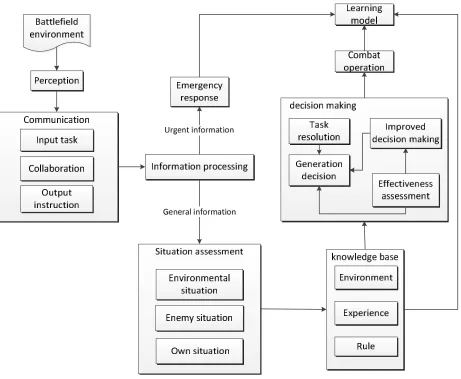
the agent structure block diagram of command and control module can be obtained, as shown in
183
the following figure:
184
185
186
The purpose of the distributed command and control model [32] is to improve the utilization
188
of alleged resources, reduce local contradictions in the command and control process, and reduce
189
the complexity of the model structure while the mission requirements are fulfilled. The following
190
variables are defined based on the input task's timing constraints, resource requirements and other
191
constraints.
d
im is the allocation variable of the accused resource,t
ijm is the resource transfer192
variable,
o
ij is the timing variable, assuming as the objective function, andY
is the time193
required for the completion of the input task. The problem is described as follows:
194
0 0 0 0 0 10; 1, , ; 1, ,
0; 1, , ; 1, ,
1
* * * ; 1, , ; 1, ,
. .
* ; 1, , ; 1, , 1, , 0 n ijm im i n jim im i n n
i m ojm
i j
ij
i j ijm ij ij i
m K
ml im il m
i i
i
t d i N m K
t d i N m K
t t
p
s s t o T o T time i j N m K q
st
r d R i N l N
s Y t i N
Y T s
、 ;
0 0,1 0,1 ijk ik t d 195
At this time, the relevant mathematical description of command and control model is the mixed
196
element linear programming problem, namely the search problem of state space. Perform clustering
197
analysis on the input tasks.
198
Different tasks are assigned to different agents according to the clustering results, and then the
199
workload of agents is minimized. The following variables are defined:
W
I is the cooperation200
threshold within agents,
W
K is the cooperation threshold outside agents, and the minimum load201
is set to
min
C
w.202
1
1 1, 1
1
* ; . 1, , ; 1, , ; 1, ,
. . * ; . 1, , ; 1, , ; 1, ,
* * ; 1, ,
, 0,1
D
mj m
nmi ji mj
nmi ji nj
D D N
I K
w nj nmi
m m m n i
nj mj
t
y d x m n D i N j K
s t y d x m n D i N j K
C W t W y n D
x x
203
Complex task processing determines the external collaboration threshold of command and
204
control center. To solve the problem of collaboration among agents' internal decision-making, it is
205
minimize the indirect collaboration threshold in command and control structure, which is defined
207
as
minW
max. Definee
ij as direct connection variable,z
ijk as indirect connection variable,208
internal collaboration function as
I n
, and external collaboration function asE n
, as follows:209
, 1 0 0 0 1 max1;
1, ,
0,
1;
1, ,
1
1
1 ; ,
1, ,
; ,
1, ,
. .
2* ; , ,
1, ,
*
;
1, ,
0,1
D ij i j D D j ji j jj j ij n
ij ji ijk ij i
ik ki jk kj ijk
I E
ijn ij i j
ij
ijk
e
D
j
K
e
e
i
D
l
l
e
D
i j
D
e
e
z
d
i j
D
st
e
e
e
e
z
i j k
D
W
W
I n W
E n
z c
n
D
e
z
0,1
210
4. Optimization of Distributed Cooperative Task Planning Algorithms Based on HTN
211
In the process of command and control decision-making, the situation information of each
212
agent cannot be fully shared, so agents need to make a plan to maximize their own interests
213
according to the local situation they have mastered. Based on the above content, in order to avoid the
214
interaction between agents, eliminate local conflicts or low resource utilization, it is necessary to
215
plan the distributed cooperative task [33] to ensure the completion of the global task and the
216
maximization of overall interests. To this end, this chapter mainly describes the cooperative
217
relationship between distributed multi-agents in the decision-making process of command and
218
control. Taking the task planning problem as the background, the multi-agent cooperative mode and
219
relationship network of command and control decision-making link are constructed.
220
4.1. Description of Basic HTN Algorithms
221
HTN decision system is widely used in the planning system of AI field. HTN represents the
222
change of state by the concept of atomic operators, and a group of atomic operators represents a
223
state. The basic principle of HTN is to generate a series of instruction actions based on a target or
224
task, and input the given problem domain or task, including the initial test state of the process, and
225
the state is the sequence of ordered unfinished task set.
226
4.1.1. Parameter Definition
227
Definition 1 HTN is described as a six-tuple
U I C A T N
, , , , ,
with extended pre-sequence228
language. In the six-tuple,
U
represents variable set,I
represents constant set,C
represents229
logical consistent set,
A
represents set the of agent’s task action,T
represents task set, andN
230
Definition 2 State refers to the basic state list of agent, namely the atomic state list. If the value is
232
not 0, the state is true; otherwise, it is 0.
233
Definition 3 Agent’s task action is
1 2.
,
,
kAgent f x x
x
, where1 2
, ,
,
kf
F x x
x
is the234
action item. The prerequisites and prediction results need to be declared.
235
Definition 4 The complex task is
1,
2,
t k
f x x
x
236
4.1.2. Constraints
237
1. Variable constraint
238
v
1
c v
1
v
2
239
Where 1
,
2v v
V
is a variable identifier,c
C
,c
is a constant identifier240
2. Sequential constraint
241
'
n
n
242
In the formula,
n n
, '
N
. "
" denotes the logical sequential operator, that is, the task content243
of
n
must be completed before the decision instruction ofn
'
task is generated.244
3. State constraint
245
n l
,
l n n l n
,
, , '
246
n l
,
1
means thatl
is executed aftern
.
l n
,
1
means thatn
is executed afterl
,247
and
n l n
, , '
1
means thatl
is executed betweenn
andn
'
.248
4.1.3. Analysis of Algorithm Flow
249
The HTN planning is instantiated and analyzed. The specific process is as follows:
250
Algorithm 1 HTN Algorithm Pseudo Code
251
1.HTN
s U C O M
, , , ,
2. if
U
, C
can be shown to have no solution3. Then return failure
4. else if
U
is primitive then5. if
U
, C
has a solution then6. non-deterministically let
be any such solution8. else return failure
9. else
10. choose a non-primitive task node
u
U
11.
task
is unifiable with
u
active
m
M
m
t
12. if
active
then13. non-deterministically choose any
m
active
14.
an mgu form
andu
t
that renames all variables ofm
15.
U C
',
'
U
, C ,
u
,
m
16.
U C
',
'
apply-critic
U C
',
'
17. return HTN
s U C O M
,
',
', ,
18. else return failure
252
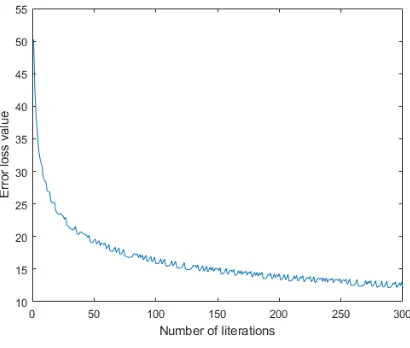
The algorithm has good convergence. As iteration proceeds, the quality of the decision scheme
253
generated by the algorithm becomes higher and higher. The specific convergence function is as
254
follows:
255
256
Figure 2. Function convergence curve
257
The simulation takes the number of iterations as the reference object and the error loss value as
258
the criterion of convergence. The experimental result shows that the proposed algorithm has good
259
convergence.
260
Usually, in a centralized environment, the collaboration framework of MultiAgents-HTN
262
(MultiAgents-Hierarchical Task Network Planning,MA-HTN) is to establish a decision-making
263
center, control the overall situation, and deduce and solve the scheme.
264
However, in the actual command and control process, it is difficult to achieve the overall
265
situation sharing, and cannot guarantee the security of a single decision-making center. Once the
266
center is destroyed, it loses the initiative of war. Therefore, distributed MA-HTN has higher
267
superiority. Each agent deduces the scheme internally and does not share the relevant information
268
with each other in the process of the scheme deduction. Moreover, each agent needs to cooperate
269
with the scheme that has dependency or mutually exclusive relationship to solve local conflicts, so
270
as to construct a task planning collaboration network and maximize the overall interests. The
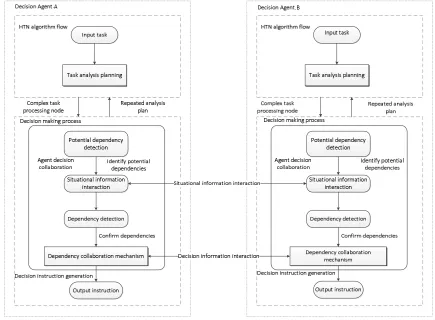
271
cooperative task planning process framework of distributed MA-HTN is shown in the figure.
272
273
274
Figure 3. Distributed mission planning process for distributed MA-HTN
275
The cooperative task planning of distributed MA-HTN is based on the modification of the
276
decision-making scheme. Cooperative relationship adjustment mechanism is added to integrate the
277
process of decision-making adjustment and modification. Thus, the cooperative relationship control
278
of decision-making actions is realized in the planning process. The algorithm flow is based on the
279
original HTN planning framework, and adds intermediate steps such as potential cooperative
280
relationship detection and situational information sharing. The potential cooperative relationship
281
decision instruction of the agent and the decision instruction generated by other agents. After
283
confirming the potential cooperative relationship, the situation interaction module releases its own
284
situation information and cooperative relationship information to other agents, and receives
285
information from other agent nodes. The collaboration detection determines the specific
286
collaboration relationship according to the results of situation information interaction, and
287
processes the specific collaboration relationship through the coordination relationship adjustment
288
mechanism, so as to maximize the overall interests of each agent. The algorithm flow is not only
289
applicable to the planning of cooperative relationships between any two independent agents, but
290
also applies to cooperative planning among multiple agents.
291
On the one hand, the distributed MA-HTN cooperative task planning process integrates the
292
collaboration mechanism into HTN, making the decision-making instructions formulated and
293
collaborated simultaneously. Therefore, a decision-making scheme compatible with other agents
294
can be generated at one time. On the other hand, we can discover and deal with the confirmed
295
cooperative relationship as soon as possible. The original decision-making scheme is modified,
296
which reduces the invalid decision-making actions of the adjusted decision-making instructions,
297
and even may not need to make corresponding decisions at all. To sum up, compared with
298
algorithm flow framework for traditional multiagent collaboration, this algorithm has a higher
299
advantage in reducing the global decision generation time and improving the collaboration
300
efficiency. The specific algorithm flow is as follows:
301
302
Algorithm 2 MultiAgents-HTN Algorithm Flow in Distributed Environment
303
1. Procedure MA-HTN
s T D
, ,
2. set
s
,initial state3. set
T
,initial task set4. set
D
,domain5. initial operator
ActionID
0
6. set
P
the empty plan7.
T
0
t
belongs to
T
: no other task in
T
is constrained to precede
t
8. loop
10. non-deterministically choose any
t
inT
011. if
t
is a primitive task then12. choose a ground instance
a
fort
with the smallestcost
among the availableresources
13.
ActionID
ActionID
1
14.
opmessage a
ID Resourceused a st a et a cost a
,
,
,
,
15.
sendlist
opmessage a
16. send
opmessage a
to the other planners17. if
receivelist
:
18.
ResourceID = Resourceused a
19. conflict actions a'{ ' belongs to the a extopmessages of receivelist :
20.
has
Resource a =
'
Re
sourceusedID
, and has the smallest
st a
'
21.
and duration
st et
,
is overlapped with duration
st et
',
' }
,then22. if
st
st
'
23. delete the rest
extopmessage
inreceivelist
24.
Resourcestate r
i Resourcest r
,
st Resourceet r
,
et
26. else if
st
st
'
27. delete
opmessage a
insendlist
28.
Resourcestate r
i Resourcest r
',
st Resourceet r
',
et
'
29. Backtrack
30. else delete
T
inT
0 and adda
intoP
31. if
t
is a non-primitive task then32. choose a method to decompose
t
into subtasks
t t
1, ,
2
t
n
33. delete
T
inT
0 and add
t t
1, ,
2
t
n
intoT
034. if receiving a new
opmessage a
'
inreceivelist
ofa
'
andsendlist
35.
Re
sourceID
Resourceused a
'
36. conflict actions
a
' belongs to the
extopmessages
of
receivelist
:
37.
has
Resourceused a = ResourceID
, and has the smallest
st a
38.
and duration
st et
,
is overlapped with duration
st et
',
' }, then
39. if
st
'
st
40. delete the rest
opmessage
insendlist
42. Backtrack to task node at action
a
43. else if
st
'
st
44. delete
extopmessage a
'
inreceivelist
45.
Resourcestate r
i Resourcest r
,
st Resourceet r
,
et
46. delete
T
inT
0 and adda
intoP
47. repeat
48.end MA-HTN
4.3. Coordination Mechanism of Local Conflicts
304
For the contradiction of local conflicts between the various agents, it is necessary to adopt a
305
corresponding cooperation mechanism for processing. Decker uses GPGP to deal with the
306
coordination of resource conflicts. However, the coordination mechanism used in this paper is that
307
one party keeps the original decision-making plan unchanged, and the other party modifies the
308
original decision-making plan. In the figure, there is a local conflict between Action.A1 and
309
Action.B1 between Agent.A and Agent.B. Action.A1 remains unchanged. Agent.B modifies
310
Action.B1 and abandons Task.B1. Task.B is decomposed into existing sub-tasks Task.B1 and
311
Task.B2, and Action.B3 is selected to avoid the conflict. Considering that local conflicts belong to
312
different agents, their generation time may be different. In the process of agent's cooperative
313
planning, potential conflict contradictions are detected earlier, and the decision-making
314
modification of which party should be made is judged according to the collaborative mechanism.
315
The party that invalid adjusts the decision-making scheme can continue to generate the
316
decision-making instructions. The party that needs to be adjusted gets the conflicting task nodes
317
and makes modifications. Finally, the sent or received conflict information is updated accordingly.
318
The coordination chart of agent decision-making action conflict relationship is as follows.
319
Figure 4. Agent conflict coordination mechanism
321
The task.A of Agent.A can be decomposed into Action.A1 and Action.A2 of decision-making
322
action, and the relationship between them is "and" in logical relation. Task.B of Agent.B can be
323
decomposed into sub-tasks Task.B1 and Task.B2, and the relationship between them is "or" in
324
logical relationship. The sub-task Task.B1 can be further decomposed into decision-making actions
325
Action.B1 and Action.B2. There is a conflict between Action.A2 and Action.B1, that is, the execution
326
process of A2 will lead to B1 cannot be implemented smoothly.
327
Based on this conflict coordination mechanism, a coordination mechanism for reusable
328
resource conflicts and consumptive resource conflicts is designed.
329
The reusable resource conflict coordination mechanism can be used by multiple
330
decision-making agents at the same time to generate repeated resource conflicts. For these resource
331
conflicts, the tasks with higher priority are reserved and the tasks with lower priorities are
332
coordinated on the basis of determining the priority of the input tasks. The task priority criteria are
333
as follows. First, it is the minimum task that use resources earlier have priority to ensure that the
334
total global task time. Second, the tasks with higher overall interests have higher priority. Third, in
335
the case of similar overall interests, the lower resource consumption has higher priority.
336
The resource consuming conflict coordination mechanism, that is, part of the consumed
337
resources can be used by multiple agents at the same time, but the number of resources is
338
insufficient. In this case, the resource consuming conflict coordination mechanism is adopted for
339
conflict processing. On the basis of judging the priority of the input task, the agent with high
340
priority is guaranteed to complete the input task in priority, so as to avoid multiple conflicts and
341
lead to great loss of overall interests.
342
5. Experimental Analysis
343
5.1. Problem Description
344
Resource scheduling in distributed command and control architecture has always been one of
345
the key issues in the field. Resource scheduling is a typical decision-making problem in the process
346
of command and control. In the command process, a large number of resources need to be
347
transported from resource storage to material demand in limited time. This problem is a complex
348
decision-making problem. It involves a large number of resource scheduling sites and resources. It
349
is necessary to consider both spatiotemporal constraints and numerical logic reasoning in the
350
solution process. In addition, on the premise of meeting the requirements, it is necessary to generate
351
high-quality and fast solutions.
352
Suppose
1
,
2,
3P P P
are resource demand points.1
,
2,
3Q Q Q
are resource storage points,353
which store Q
1
,
2, ,
3 4,
5q q q q q
resource types respectively. Locations1
,
2,
3,
4,
5O O O O O
are the354
transfer centers for resource scheduling. Assume that there are seven transport teams that can be
355
used to solve the problem, and that the initial location of all transport teams is in the resource
356
storage point and the transfer center of resource scheduling. The transport capacity of each
357
transport team should not exceed the transport limit of the team. The maximum speed and
358
minimum speed of the team are defined as
S
_ max
andS
_ min
respectively. The specific359
Table 1. Basic information of the resource dispatching transport team
361
Number Transport
Team
Transportation
Resource Category
Transport
Limit
_ max
S
S
_ min
1
1
Team
O O
1,
2 500 50 752
2
Team
O O
1,
2 400 45 653
3
Team
O O
3,
4 500 45 704
4
Team
O O
3,
4 350 35 505
5
Team
O
4 400 30 606
6
Team
O O
2,
4 300 30 557
7
Team
O O O O
1,
2,
3,
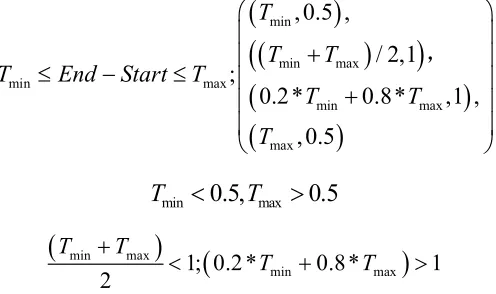
4 300 45 65It is assumed that the temporal constraints for each transport team per transport are as follows.
362
min
min max
min max
min max max
, 0.5 ,
/ 2,1
;
0.2 *
0.8*
,1 ,
, 0.5
T
T
T
T
End
Start
T
T
T
T
,
363
min
0.5,
max0.5
T
T
364
min max
min max
1; 0.2 *
0.8 *
1
2
T
T
T
T
365
In the formula, min
T
is the time required for the transport team to transport resources at the366
minimum speed. max
T
is the time required for the transport team to transport resources at the367
maximum speed? Decision-making principle wants the resources to be transported from the
368
resource storage place as soon as possible. Besides, the required resources can reach the resource
369
demand point as possible at the same time, without considering the accidents in the transport
370
In order to test the performance of Multi-Agents HTN, eight resource scheduling problems
372
were designed. This is the initial state of the problem and the temporal constraints are more
373
different. The specific information is shown in the table:
374
Table 2. Detailed plan of resource scheduling
375
Number Initial state Temporal Constraint
Problem_ 1
resource needA p
_
1 1300
resource needA p
_
3 2200
.1 4 0, 0 , 2,1 , 3,1 , 4,1
end
.1 4 0, 0 , 2,1 , 3,1 , 4,1
end
Problem_ 2
resource needA p
_
3 2300
resource needA p
_
3 2500
.1 4 0, 0 , 2,1 , 3,1 , 4,1
end
.1 4 0, 0 , 2,1 , 3,1 , 4,1
end
Problem_ 3
resource needA p
_
3 2200
resource needA p
_
3 2300
resource needA p
_
3 2500
.1 4 0, 0 , 2,1 , 3,1 , 4,1
end
.1 4 0, 0 , 2,1 , 3,1 , 4,1
end
Problem_ 4
resource needA p
_
3 2300
resource needA p
_
3 2400
resource needA p
_
3 2700
.1 4 0, 0 , 2,1 , 3,1 , 4,1
end
.1 4 0, 0 , 2,1 , 3,1 , 4,1
end
.1 4 0, 0 , 2,1 , 3,1 , 4,1
end
.1 4 0, 0 , 2, 2 , 3, 2 , 4, 3
end
Problem_ 5
resource needA p
_
3 2300
resource needA p
_
3 2700
resource needA p
_
3 2100
.1 4 0, 0 , 1,1 , 3,1 , 5,1
end
.1 4 0, 0 , 4,3 , 5, 2 , 7,1
end
.1 4 0, 0 , 3, 2 , 4,1 , 5, 4
end
.1 4 0, 0 , 1, 4 , 5, 2 , 6,3
.1 4 0, 0 , 2,1 , 4, 2 , 6,3
end
Problem_ 6
resource needA p
_
3 2300
resource needA p
_
3 2500
resource needA p
_
3 2500
resource needA p
_
3 2700
.1 4 0, 0 , 2,1 , 3,1 , 4,1
end
.1 4 0, 0 , 1,3 , 3,1 , 5, 7
end
.1 4 0, 0 , 3, 7 , 7,8 , 2, 5
end
.1 4 0, 0 , 3, 2 , 5,3 , 6, 5
end
.1 4 0, 0 , 4, 4 , 5, 3 , 5,1
end
Problem_ 7
resource needA p
_
3 2100
resource needA p
_
3 2300
resource needA p
_
3 2700
resource needA p
_
3 2900
.1 4 0, 0 , 4,3 , 6,3 , 4, 7
end
.1 4 0, 0 , 6, 4 , 4, 6 , 7,3
end
.1 4 0, 0 , 4,5 , 3, 4 , 4,1
end
.1 4 0, 0 , 5, 3 , 3,1 , 6, 4
end
.1 4 0, 0 , 6, 2 , 4, 7 , 4,1
end
.1 4 0, 0 , 7,1 , 3, 6 , 4, 4
end
Problem_ 8
resource needA p
_
3 2200
.1 4 0, 0 , 3,1 , 2, 2 , 5,5
end
.1 4 0, 0 , 3,3 , 3, 2 , 4,1
end
5.2. Analysis of Experimental Results
376
In this paper, MultiAgents-HTN, TPHTN [34] and F-HTN algorithms are compared and
377
analyzed. TPHTN algorithm with better temporal preference has been widely used in practical
378
fields. F-HTN is a dynamic task hierarchical planner with good dynamic re-planning capability.
379
Therefore, this paper chooses the above algorithm as the comparison method.
380
This paper compares the quality of the generating schemes of MultiAgents-HTN and TPHTN
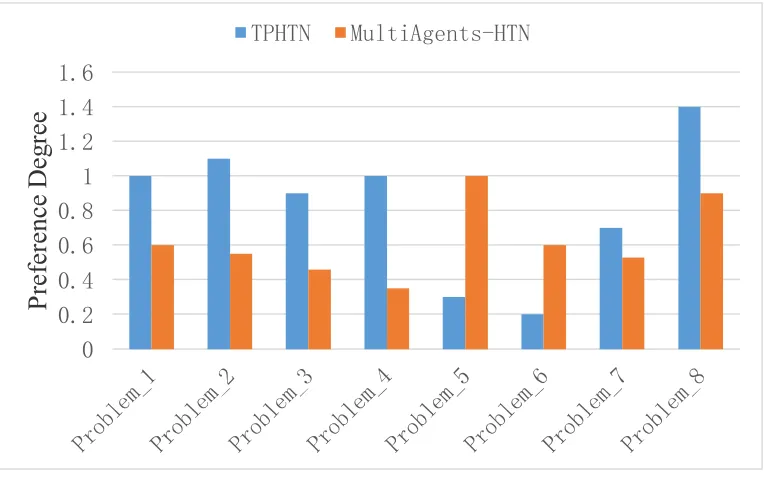
382
algorithm, and solves the above algorithms separately. The quality comparison diagram of the
383
generating schemes is as follows:
384
385
Figure 5. Initial state collection of resource scheduling planning
386
It can be found from the figure that both algorithms can solve the problem with relatively high
387
quality, but MultiAgents-HTN has a better generation scheme than TPHTN. For some complex
388
problems, such as Problem_6 and Roblem_7, the quality of TPHTN generated solutions is obviously
389
not as good as MultiAgents-HTN. The reason is that TPHTN adopts a rule-based planning method
390
to quickly generate the solution. However, when the problem is complex, the exponential growth of
391
the rules that need to be dealt with leads to the insufficient quality of the generating scheme.
392
Multi-Agents-HTN adopts a heuristic search strategy based on depth-first, so it is more prominent in
393
dealing with complex problems.
394
5.2.2. Efficiency Comparison of Generation Schemes
395
The generation solution requires not only a high-quality solution but also an efficient enough.
396
Excessive decision-making time often has a great impact on the outcome of the decision. The
397
efficiency of the scheme generation of MultiAgents-HTN and TPHTN is compared. The efficiency
398
comparison of generating schemes is shown below.
399
0
0.2
0.4
0.6
0.8
1
1.2
1.4
1.6
P
re
fe
re
nc
e
D
eg
re
e
400
Figure 6. Comparison of the generation efficiency of MultiAgents-HTN and TPHTN schemes
401
By comparing the results of the above figure, it can be found that in general, the generation
402
time of MultiAgents-HTN and TPHTN is approximately the same, but the generation scheme of
403
MultiAgents-HTN has high quality. In dealing with complex problems, MultiAgents-HTN requires
404
more time to generate decision-making solutions. Because of the small time difference, it is almost
405
negligible. In conclusion, MultiAgents-HTN has higher scheme generation efficiency than TPHTN.
406
5.2.3. Comparisons of Re-Planning Numbers
407
After generating a decision plan, when a scenario is encountered during the execution of the
408
scenario, there are usually two solutions for that case. Firstly, the decision plan should be revised.
409
When the decision plan encounters an abnormality in the execution process, the decision plan is
410
adjusted according to the previously determined decision modification rule. When the adjustment
411
still encounters a tense anomaly, the re-planning of the decision-making scheme is carried out.
412
Secondly, the temporal exception handling is performed according to the temporal constraints. The
413
re-planning rate is obtained by dividing the average number of re-planning times by the number of
414
occurrences of the temporal anomaly. Select 4 out of the 8 questions above as the subject. Among
415
them, Problem_8 is a simple problem. Problem_2 and Problem_5 are more complex issues.
416
Problem_7 is a complex issue. The specific experimental results are as follows:
417
418
0
0.2
0.4
0.6
0.8
1
1.2
1.4
1.6
T
i
m
e
(
s
)
419
Figure 7. Problem_2 comparison of resource re-planning times
420
421
Figure 8. Problem_5 resource re-planning comparison
422
423
425
Figure 10. Problem_8 comparison of resource re-planning times
426
From the results of figure 7 to figure 10, it can be found that with the increase of abnormal
427
frequency in the execution of decision-making schemes. The re-planning rate basically shows an
428
increasing trend. But there are also unexpected situations, which occur because the quality of the
429
decision-making plan is contingent. In the same situation environment, the rescheduling rate of
430
MultiAgents-HTN is the lowest and F-HTN is the highest for the rescheduling of four problems.
431
When the problem is too complex or the solution space is too large, F-HTN and TPHTN may not be
432
able to solve and fall into deadlock. MultiAgents-HTN uses repair local decision-making scheme
433
when the decision-making scheme needs to be re-planned. Therefore, the efficiency of
434
reprogramming is much higher than that of the other two algorithms.
435
5.2.4. Comparisons of Algorithmic Complexity
436
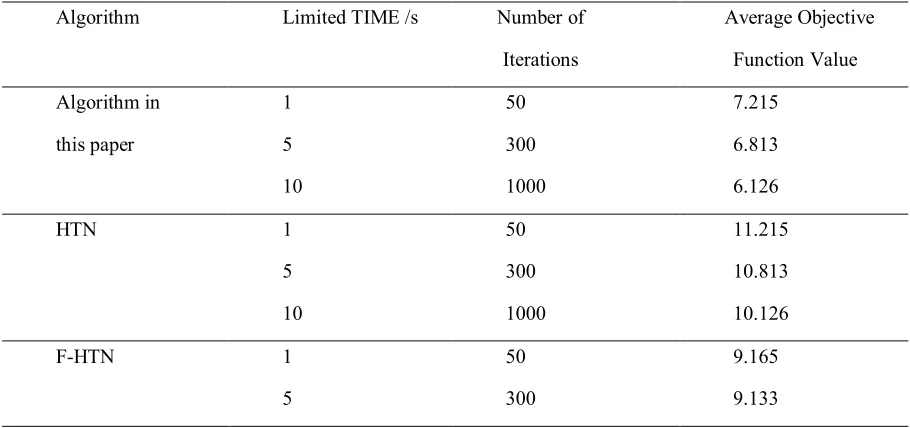
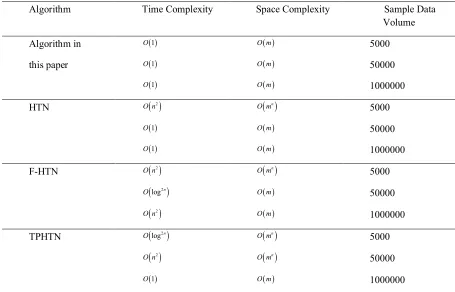
In the same situation, the framework of this algorithm is compared with F-HTN and TPHTN
437
algorithms. The results are shown in the table below.
438
Table 3. Algorithmic iteration efficiency comparison
439
Algorithm Limited TIME /s Number of
Iterations
Average Objective
Function Value
Algorithm in
this paper
1 50 7.215
5 300 6.813
10 1000 6.126
HTN 1 50 11.215
5 300 10.813
10 1000 10.126
F-HTN 1 50 9.165
10 1000 8.562
TPHTN 1 50 9.935
5 300 9.423
10 1000 9.024
Table 4. Algorithm time space complexity comparison
440
Algorithm Time Complexity Space Complexity Sample Data
Volume
Algorithm in
this paper
1
O O m 5000
1
O O m 50000
1
O O m 1000000
HTN
2O n
nO m 5000
1
O O m 50000
1
O O m 1000000
F-HTN
2O n
nO m 5000
2
logn
O O m 50000
2O n O m 1000000
TPHTN
2
logn
O
nO m 5000
2O n
nO m 50000
1
O O m 1000000
It can be seen from the experimental data that the algorithm in this paper analyzes the function
441
value and its time-space complexity under the same number of iterations. It finds that the algorithm
442
can achieve lower objective function value and has better convergence and adaptability.
443
6. Conclusion
444
With the frequent occurrence of local disputes and emergencies, more and more scholars at
445
home and abroad pay attention to the generation of decision-making schemes for emergency
446
response to real events. The basic purpose of the decision-making scheme is to achieve the tactical
447
objectives of the complete scheme that is to minimize the casualties and property losses as much as
448
possible. Moreover, it is necessary to shorten the generation time of the scheme to a great extent and
449
coordinate the local disputes after the implementation of the scheme quickly and efficiently. As one
450
of the efficient intelligent planning algorithms, HTN has good adaptability and high efficiency in
451
dealing with such problems, and it is the basis of the algorithm framework proposed in this paper.
452
In this paper, a distributed command and control architecture model based on multi-agent is