A New Digital Rights Management Solution
Based on White-Box Cryptography
Jun Liu1 and Yupu Hu2 ?,??
Xidian University, Xi’an, China
Email:[email protected]
Abstract. Digital rights management is an important technique to pro-tect digital contents from abuse. Usually it is confronted with severe challenges because of the untrusted environment its application execut-ed in. This condition is formally describexecut-ed as white-box attack model. White-box cryptography aims at protecting software implementation of cryptographic algorithms from white-box attack, hence can be employed to provide security guarantee for digital rights management. Key ex-traction, code lifting, and illegal distribution are three major threats in digital rights management application, they extremely compromise the benefit of content producer. In this paper, we propose the first solution based on white-box cryptography against the three threats above simul-taneously, by implementing traceability of a white-box scheme which has unbreakability and incompressibility. Specifically, We constructively confirm there exists secure white-box compiler which can generate trace-able white-box programs, by hiding slight perturbations in the lookup-table based white-box implementation. Security and performance analy-ses show our solution can be effectively achieved in practice.
1
Introduction
Since the arrival of the digital age, the carrier of audio-visual contents has grad-ually changed from physical to digital. Although it is more flexible to produce, distribute, and store digital contents, the task of protecting them becomes more tedious. In order to make the rules how digital contents are being managed, a collective set of methods and techniques should be employed, which are referred as digital rights management (DRM) [1]. During decades of development, many standardized DRM solutions and commercial products have came forth. Pub-lished specifications include OMA DRM2.1 (Open Mobile Alliance) [2], Marlin (Marlin developer Community) [3], and GY/T 277-2014 (ChinaDRM) [4]. Clas-sic DRM systems include Apple FairPlay system and Microsoft Windows Media DRM system.
?Jun Liu and Yupu Hu are with State Key Laboratory of Integrated Service Networks
Lab of Xidian University.
?? This work is supported by the National Natural Science Foundations of
It is essential to use cryptography in DRM systems to protect contents and restraint participants0 actions, especially restrict consumption of valuable con-tents. In a typical DRM scenario, content owner provides encrypted contents and hands it out over public network. While only paying subscribers, or legitimate users, can decrypt and access the original contents. The decryption routine to-gether with content decryption key is embedded in the client DRM application (hardware or software based platform).
At the side of the consumer, the main problem is that client DRM appli-cation is executed in an untrusted (probably malicious) open platform, so it is vulnerable to malware, trojan, and spyware. The most usual threat is content decryption key extraction, because that makes it possible to decrypt the pro-tected content without restriction. A second threat is extraction of the whole decryption function from the DRM application, which is denoted as code lift-ing[6,12]. A successful code lifting attack gives an adversary the same advantage as key extraction does, since the decryption routine and the corresponding de-cryption key are together included in DRM application. Once an attacker isolate and extract the intact decryption code, he can use it in a stand-alone manner, circumventing authentication and rights verification. Another problem is illegal distribution of the client decryption software from legitimate consumers to u-nauthorized users [6], this makes it possible for an illegal (unregistered) user to decrypt the contents. Such malicious legitimate consumers are called traitors.
1.1 Related Work
To solve above problems, white-box cryptography is a good choice [7]. In fact, DRM is the most common application of white-box cryptography. In 2002, Chow /et al/. first introduced the conception of white-box cryptography and proposed a white-box implementation of AES [19]. Soon they proposed a white-box imple-mentation of DES [8]. These two seminal work started the research on white-box cryptography.
pioneer scheme was broken by Billet /et al/. [BGE attack], and many succedent variants based on it were proposed and broken one after another.
In a recent line of research which aims to study dedicated white-box secure block cipher, some promising schemes began to appear. In 2014, Biryukov /et al./ proposed an ASASA based block cipher [9]. Key extraction security was reduced to the decomposition problem of ASASA. Besides, a new conception of /weak white-box security/ was introduced to quantitatively estimate the se-curity against code lifting by code size. The more the amount of data that an adversary need to extract from the white-box implementation, the more difficult code lifting attack is. One year later this scheme was broken by Minaud /et al./ [10] and Gilbert /et al./ [11]. In 2015, Bogdanov and Isobe [12] proposed a family of white-box secure block cipher SPACE based on Feistel network. Key extraction security relied on key recovery of AES in black-box setting. The d-ifficulty of code lifting was evaluated by /space hardness/, including weak and strong (M, Z)-space hardness. This new conception was indeed a more formal-ized description of the weak white-box security. In 2016, Bogdanov /et al./ [13] optimized efficiency of space hard block cipher, proposed a new family of block cipher SPNbox based on SPN(substitution-permutation network). This scheme adopted the same principle against key extraction and code lifting as [12]. In the same year, Fouque /et al./ [14] proposed a Feistel-type construction named WhiteBlock, which offers provable security guarantee against code lifting. The main concern was about incompressibility model, which is similar with space hardness security model. Aforementioned schemes in [12–14] remain unbroken, but they displayed different efficiency.
With regard to illegal distribution, the topic of /traitor tracing/ [?] can provide useful solution. Many traitor tracing schemes were designed, while few of them can be used in white-box cryptography. The first white-box instance with traceability capability based on Isomorphisms of Polynomials problem (IP problem) was briefly mentioned by Billet and Gilbert [?]. Later IP problem was broken by Faug`ere and Perret [?]. Delerabl´ee /et al./ [18] provided a new idea to implement traceability of white-box programs, while no formal analysis was presented and its feasibility was based on some assumptions.
1.2 Our Contributions
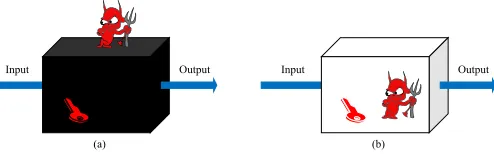
Input Output Input Output
(a) (b)
Fig. 1.Attack model. (a) black-box attack model. (b) white-box attack model.
programs. Then we prove the perturbative white-box programs can be made traceable by proving the security of our construction of white-box compiler. Based on the above works, the security and performance of our DRM solution is guaranteed, which means our proposal can be veritable efficiently achieved in practice.
1.3 Structure of This Paper
This paper is organized as follow. In Section 2, we abstractly represent the cryp-tographic model in DRM application, including the environment under which cryptographic algorithms are executing, adversary model, and security require-ments. In Section 3, we describe the proposed DRM solution. In Section 4, we elaborate on the implementation details of our solution, including choos-ing appropriate symmetric primitive, generatchoos-ing traceable white-box decryption programs, designing tracing scheme. In Section 5, we analyze the security of our solution and give a simple discussion about performance. In section 6, we conclude the paper and put forward some future works.
2
Problem Formation
2.1 DRM Threat Model: White-Box Attack Model
In a DRM scenario, cryptographic algorithms are executed in an untrusted en-vironment. This situation is quite different from the standard cryptographic model, denoted as black-box attack model (see Fig.1(a)), which assumes that the adversary can just observe input-output. DRM threat model is more aligned with white-box attack model (see Fig.1(b)), which is defined in Definition 1. Definition 1. (white-box attack model, [19]) A white-box attack model as-sumes cryptographic algorithms are executed in untrusted context where:
– fully privileged attack software shares a host with cryptographic software, having complete access to the implementation of algorithms;
– dynamic execution (with instantiated cryptographic keys) can be observed;
We replace white-box attack model by WBAM for short hereafter. White-box cryptography and white-box implementation are two fundamental conceptions for WBAM. The former refers to secure cryptographic schemes under WBAM, the latter represents the implementation of cryptographic primitives under W-BAM.
2.2 DRM Attacker: White-Box Attacker
An attacker in WBAM is called white-box attacker. On the one hand, he can launch static analysis with the help of disassemblers, for instance, IDAPro. On the other hand, he can dynamically analyze the code with the help of debuggers, for instance, OllyDbg. Besides, he can search keys in memory, or derive keys by inserting break-points and whitening subkeys. All in all, compared with black-box attacker who can only get some input-output values, white-black-box attacker is more matching with the practical situation, hence is more challenging to prevent. Here in DRM, we say a user, whether legal or illegal, is a such white-box attacker.
2.3 DRM Security Requirements: White-Box Security
In light of the above, the security requirements in DRM are as follows:
– Key extraction security: It should be hard to derive the key from the decryption white-box implementation in client DRM software. This security notion was also formalized as unbreakability [dlpr13].
– Code Lifting Security: To mitigate code lifting, the decryption white-box implementation should provide space-hard property. In other word, it should be infeasible for the attacker to get an equivalent but more compact implementation. Generally, code lifting security is closely related to incom-pressibility of the decryption implementation [2016yami provable].
– Traceability: The decryption implementation should be different for each legitimate user so that it can identify and track the traitor when a legitimate user leak his own decryption software.
3
DRM Solution Based on White-Box Cryptography
3.1 Notations and Preliminaries
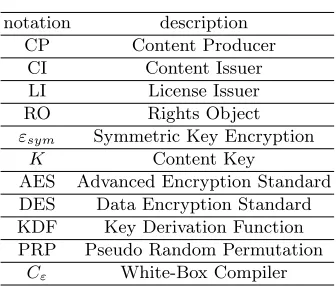
The main notations used in this paper are listed in Table 1. Symmetric encryp-tion schemes and their implementaencryp-tions are mainly involved.
Definition 2. (Symmetric Key Encryption)A Symmetric Key Encryption scheme εsym is defined as a triple εsym = (G, E, D)where G: K → K is the
key generation algorithm, E : M × K → C is the encryption algorithm, and
D : C × K → M is the decryption algorithm. For a given key k ∈ K and
Table 1.Notations
notation description CP Content Producer
CI Content Issuer LI License Issuer RO Rights Object
εsym Symmetric Key Encryption
K Content Key
AES Advanced Encryption Standard DES Data Encryption Standard KDF Key Derivation Function PRP Pseudo Random Permutation
Cε White-Box Compiler
White-box implementation is an obfuscated program of a key-customized instance of the cipher. We use E∗
k to denote the white-box implementation of a encryption algorithm E(·, k), such that for a given message m ∈ M, the encryption of m byE∗
k equals to the encryption of m byE(·, k), i.e. E∗k(m) =
E(m, k). Similarly, D∗
k denotes white-box implementation of D(·, k) such that for a givenc∈ C, D∗
k(c) =D(c, k). Generally,E∗kincludes a large tableT derived from k. We sayT is an effective large key of k, in other words, k is hiding in T. When executingE∗
k,k is not an input argument, butk should be input to a white-box compiler to getEk∗.
Definition 3. (White-Box Compiler) A white-box compiler CE for an
en-cryption scheme1Eis defined as a publicly known compiling function that takes a keyk∈ Kas input and outputsE∗
k, namely,Ek∗=CE(k). Generally, a white-box
compiler works as first generating a big lookup table T that hides k, then obfus-cating the input-output ofT while maintaining its function. Finally, a white-box implementation including T is produced.
3.2 Solution Model
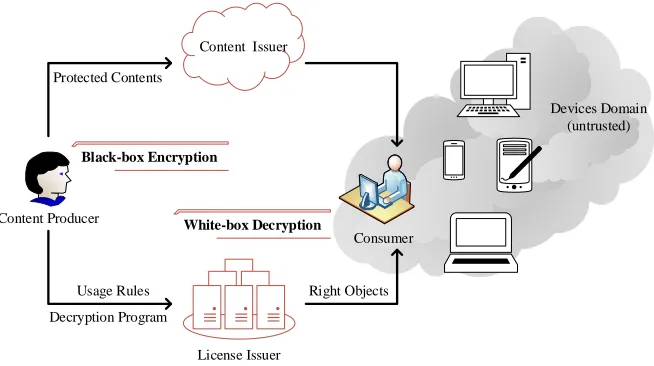
We adopt a simple DRM architecture [20] based on distributed techniques and mobile code to interpret our solution, the DRM model is illustrated in Fig.2. For ease of explanation, we omit cockamamie procedures and mainly describe some cryptographic procedures here. Let ε = (G, E, D) is a symmetric encryption scheme.
1. At the side of the producer, CP first chooses a unique content keyKCEK for a content, then generates round keys set K by the key generation algorithmG , then encrypts the content messagemby black-box encryptionE(·, K):
c=E(m, K) (1)
1
Content Issuer
Content Producer
Consumer
License Issuer
Devices Domain (untrusted) Protected Contents
Usage Rules
Decryption Program
Right Objects Black-box Encryption
White-box Decryption
Fig. 2.A simple DRM architecture based on white-box cryptography.
2. CP generates the corresponding decryption program D∗
K by the white-box compilerCD:
D∗K=CD(K) (2)
3. CP submits c to CI, simultaneously submits mobile code of D∗
K and usage rules ofmto LI.
4. When there is a request formfrom a consumer, CI will distributec to him. 5. LI will generate RO including mobile code of D∗
K and corresponding usage rules ofm, and then distribute it to the consumer.
6. At the side of the consumer,D∗
K will be loaded into the consumer0s device by DRM agent, thencwill be decrypted by white-box decryption:
m=DK∗(c) (3)
Finally, the original content (video, music, or others) will be presented in clear in the consumer0s device.
4
Our Techniques: Implementation Details
The solution model in Section 3.2 is quite simple and general, while the imple-mentation details of the encryption algorithm, decryption algorithm as well as the white-box compiler are different, which are key points in the security of the whole model. In this Section we show how to implement the algorithms such that the above model resist the threats we aim to address.
4.1 Symmetric Primitive
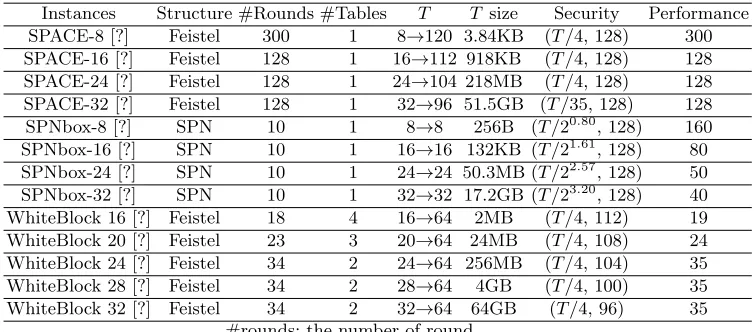
algorithms such as AES and DES, some dedicated white-box block ciphers were proposed in recent three years. We investigate three state-of-the-art structures which are unbroken, they are SPACE and its variants [15CCS], SPNbox and its variants [16yami], and WhiteBlock and its variants [16yami2]. Table 2 shows some properties of them. All of them have the same block lengthλ= 128 bits and the same key length l = 128 bits except SPNbox-24, which has the block lengthλ= 120 bits.
Table 2.Comparison of SPACE, SPNbox, and WhiteBlock
Instances Structure #Rounds #Tables T T size Security Performance SPACE-8 [?] Feistel 300 1 8→120 3.84KB (T/4, 128) 300 SPACE-16 [?] Feistel 128 1 16→112 918KB (T/4, 128) 128 SPACE-24 [?] Feistel 128 1 24→104 218MB (T/4, 128) 128 SPACE-32 [?] Feistel 128 1 32→96 51.5GB (T/35, 128) 128 SPNbox-8 [?] SPN 10 1 8→8 256B (T /20.80, 128) 160 SPNbox-16 [?] SPN 10 1 16→16 132KB (T /21.61, 128) 80 SPNbox-24 [?] SPN 10 1 24→24 50.3MB (T /22.57, 128) 50 SPNbox-32 [?] SPN 10 1 32→32 17.2GB (T /23.20, 128) 40 WhiteBlock 16 [?] Feistel 18 4 16→64 2MB (T /4, 112) 19 WhiteBlock 20 [?] Feistel 23 3 20→64 24MB (T /4, 108) 24 WhiteBlock 24 [?] Feistel 34 2 24→64 256MB (T /4, 104) 35 WhiteBlock 28 [?] Feistel 34 2 28→64 4GB (T /4, 100) 35 WhiteBlock 32 [?] Feistel 34 2 32→64 64GB (T /4, 96) 35
#rounds: the number of round
#tables: the number of lookup tables in the whole implementation
T(a→b):T is a map representing{0,1}a→ { 0,1}b
T size: the size of the overall lookup tables security: (M, Z)-space hardness
performance: number of internal block cipher calls
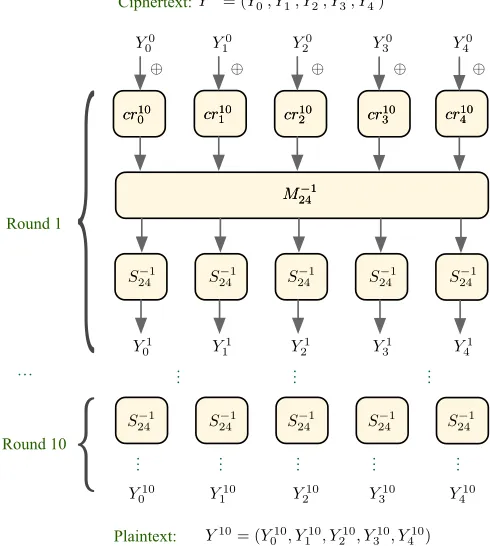
we choose SPNbox-24 asεsym for performance and security consideration. On the one hand, SPN-type design is highly parallel compared with Festiel-type block cipher, hence has a better performance. Besides, the memory cost of SPNbox-24 is acceptable in most of the devices, such as desktop, pc, mobile phone, pad, and so on. On the other hand, SPNbox-24 performs similar code lifting security with variants which have the same magnitude in memory. In a nutshell, SPNbox-24 is the most appropriate scheme. Its algorithm representa-tion is given in Algorithm1. There are three layers in a single round, including the nonlinear layer γ, the linear layerθ, the affine layer σr. S
24 is used in the nonlinear layer, and is realized by an internal small SPN-type block cipher of block length 24bits. Please refer to [13] for more details aboutS24.
Algorithm 1 symmetric key encryption scheme εspn =SPNbox-24=(Gspn, Espn, Dspn)
Gspn-Input: a 128-bit master keyKCEK, fixed parameter 504
Gspn-Output: round keys setK=(k0, ..., k20)
(k0, ..., k20)=KDF(KCEK,504)
Espn-Input: a plaintextX0, round keys setK
Espn-Output: a ciphertextX10
1: Xr= (Xr
0, X1r, X2r, X3r, X4r). EachXjr is a 24-bit binary string, i.e.,Xjr∈ {0,1}24 2: γ: (X0r, X1r, X2r, X3r, X4r)7→(S24(X0r), S24(X1r), S24(X2r), S24(X3r), S24(X4r)) where
S24is a bijectiveK-dependent 24-bit S-box
3: θ:Xr 7→Xr·M24. HereM24=cir(1,2,5,3,4), it is a 5*5 circulant matrix with
each element belongs to the finite field GF(224) 4: σr:Xr7→Xr⊕(crr
0, cr1r, cr2r, cr3r, cr4r). (cr0r, cr1r, cr2r, cr3r, cr4r) are round constants
withcrir= 5·(r−1) +i+ 1, i∈[0,4] 5: forR = 0 to 9do
6: XR+1= (σR+1◦θ◦γ)(XR) 7: end for
Dspn-Input: a ciphertextY0=X10, round keys setK Dspn-Output: a plaintextY10=X0
8: forR = 0 to 9do
9: YR+1 = (γ−1◦θ−1◦(σ10−R)−1)(YR). γ−1, θ−1,(σ10−R)−1 are the inverse of
γ, θ, σ10−R 10: end for
the decryption algorithmDspnof SPNbox-24. The structure ofDspnis illustrat-ed in Figure 3.
4.2 White-Box Decryption Implementation
D∗K is implemented by repeatedly lookup a big table T that represents S− 1 24, which is a bijective S-box from 24bits to 24bits.T consists of 224entries of a 24-bit value each. Lete∈ {0,1}24denotes an entry,heidenotes the value ofe, e.g.,
e=000001 andhei=0A1B2C means the first entry inT has value 0A1B2C. Since SPNbox-24 inherently provides unbreakability and incompressibility, the main technical difficulty comes in making the decryption white-box implementation of SPNbox-24 traceable. Inspired by [18], this can be done by slightly modify-ing functionality of the white-box implementation, concretely, by addmodify-ing some perturbations. However, there is no evidence in [18] that the given perturbations-enabled white-box compiler (see Definition ?) exists. So we first demonstrate this existence.
Definition 4. (perturbations-enabled white-box compiler, [dlpr13])For a symmetric encryption scheme εsym = (G, E, D) with key space K, plaintext
spaceM, and ciphertext spaceC. LetCDis a white-box compiler with respect to
D.CDtakes as input a keyk∈ Kand an ordered list of dysfunctional ciphertexts c= (c1, c2, ..., cu) with each cj
$
← C ( cj is called a perturbation ciphertext, $
Y0
0 Y10 Y20 Y30 Y40
M−1 24 M−1
24
⊕ ⊕ ⊕ ⊕ ⊕
cr10 0 cr10
0 crcr101101 crcr102210 crcr331010 crcr104104
S 1
24
{
Y10 Y11 Y21 Y31 Y41
Round 1
…
Round 10
{
… …
… … … … …
Y10 0 …
Y10
1 Y210 Y310 Y410
Ciphertext:
Plaintext: Y10= (Y10
0 , Y110, Y210, Y310, Y410) Y0= (Y0
0, Y10, Y20, Y30, Y40)
S 1
24
S 1
24 S241
S 1
24
S 1
24 S241 S241
S 1
24
S 1
24
Fig. 3.Decryption algorithm of SPNbox-24.
denotes that the perturbation ciphertext is sampled randomly from ciphertext space, u occupies a negligible fraction of the ciphertext space), and output a program [D∗
k] = CD(k,c). CD is said to be perturbations-enabled if both of the
following two properties are satisfied:
(1)∀ ciphertextc∈c (∀denotes /for any/ hereafter), [D∗
k](c)6=D(k, c).
(2)∀ ciphertextc∈ C/c,[D∗
k](c) =D(k, c).
Theorem 5. For the symmetric encryption scheme εspn = (Gspn, Espn, Dspn)
as defined in Algorithm 1, there exists a perturbations-enabled white-box compiler
CDspn (write asCD for short hereafter) with respect toDspn.
Proof. The proof is constructive. Forεspn= (Gspn, Espn, Dspn), we construct a white-box compilerCD.CD takes as input the keyK (Kis the output ofGspn) and a ciphertext listc= (c1, c2, ..., cu), and output a perturbated program [D∗K].
CD works as Algorithm 2.
Then we proveCDsatisfies the two properties in Definition 4.
Algorithm 2A perturbations-enabled white-box compilerCD Input: K,c
Output: [D∗K]
1: for eache∈ {0,1}24
, calculateS24−1(e) withK, letheiequals to the output.
2: add all of theheiinto a tableT in the order ofe. 3: for i= 1 toudo
4: run Dspn(ci), mark the input of table accesses in the last round as
e46
i , e47i , e48i , e49i , e50i (because Dspn has 10 rounds with each round 5 table ac-cesses, we use superscript 46-50)
5: updateT: lethe46
i i=he50i i,hei47i=he46i i,he48i i =he47i i,he49i i=he48i i,he50i i=
he49i i. 6: end for
7: generate the white-box program [D∗K] with T, [DK∗] is a perturbated white-box implementation ofDspn
8: return [DK∗]
table access, a uniformly distributed entry is lookup. In other words, table ac-cesses are independent events.
(1) ∀i ∈ [1, u], run Dspn(ci) executes 50 table accesses, so run Dspn(c) exe-cutes 50u table accesses in total. According to lemma 2 in [2016practical], for 50u table accesses, the expected value of the number of used entries in T is 224·[1−(1− 1
224)
50u]. LetA denotes this variable, we get 50u−1< A <50u, sinceA is an integer, let A = 50u. So, 50utable accesses requires 50uentries. This implies in each table access, a distinct entry is lookup.
Finally, we get two immediate observations. On the one hand, the entriese46
i ,e47i ,ei48,e49i ,e50i are not lookup in preceding 9 rounds when runningDspn(ci). On the other hand,
the entriese46
i , e47i , e48i , e49i , e50i are not lookup when runningDspn(c1),...,Dspn(ci−1), Dspn(ci+1),...,Dspn(cu). So when run [D∗
K](ci), the output must bem0i=he50i i||he46i i||he47i i||he48i i||he49i i||, while when runDspn(K, ci), the output ismi=he46i i||he47i i||he48i i||he49i i||he50i i||. Because T is a PRP, these 5 values are different. So we get m0i 6= mi, i.e., [D∗K](ci)6=Dspn(K, ci).
(2)After updatingT, there are 5uentries are modified, we call them dysfunction-al entry. ∀c ∈ C/c, run [D∗K](c) executes 50 table accesses, requires 50 entries. If each of these entries are not dysfunctional entry, thenc will be correctly de-crypted with probability 1. Otherwise,cmay be correctly or wrongly decrypted. So, the probability that cwill be correctly decrypted is evaluated by
p≥
224−5u 224
50
. (4)
Whenu is appropriate (for instance,u <10), pis very close to 1. We can say [D∗
K](c) =Dspn(K, c).
can not be corrected by an adversary (a consumer). This means that it is hard to recover the original output of the perturbation ciphertexts. This requirement is formalized with the security notion of Perturbation-Value Hiding (PVH).
Definition 6. (Perturbation-Value Hiding, [DLPR13])LetCDis a
perturbations-enabled white-box compiler as defined in Definition 4, letAbe an adversary. Let
SuccPVHA,CD def
= Pr
m← M$ ;c=E(K, m);c= (c); [D∗
K] =CD(K,c); : ˜m=m ˜
m← AO(c,[D∗ K])
denotes the probability of A winning the PVH game as below. Here O is a
re-compiling oracle O(·)def= CD(K,(c,·)) that takes as input a list of perturbation
ciphertexts containingcand return a perturbated program.CDis said to be (τ,
)-secure in the sense of PVH ifArunning in time at mostτ impliesSuccPVHA,CD≤. PVH game, [DLPR13]:
1. The challenger selectsm← M$ and calculatesc=E(K, m), letc=(c). 2. The challenger compile [DK∗] =CD(K,c), and sendsc,[D∗K] to the adversary
A.
3.Aruns on input (c,[D∗K]). 4.Areturn some message ˜m. 5.Awins if ˜m=m.
Theorem 7. LetCDis the white-box compiler constructed in Algorithm 2, then SuccPVHA,CD is upper bounded by
1 2120.
Proof. ∀ PPT adversary A(PPT means Ahas time O(λc),λis a security pa-rameter, c is a constant), A can call recompiling oracle polynomial times, and generate polynomial perturbated programs [D∗K]0. Each [D∗K]0 perturbates u ci-phertexts containing c, and each [DK∗]0 has 5udysfunctional entries containing the dysfunctional entries of c in its table T. Because S24−1 is a PRP, i.e., the former T generated in step 2 of Algorithm 2 is a PRP. Naturally, the new T after step 5 is still a PRP. So it is infeasible to extractK fromT. Besides, since each [D∗
K]0 perturbates c, the values of dysfunctional entry of c in each [D∗K]0 is the same, it is infeasible to recover them. Finally, when Arandomly correct a dysfunctional entry of c, the successes probability is less than 1
224. SoAcan
randomly correct the output of [D∗
K](c) with the successes probability of less than 2124
5
, i.e., he can return a correct message with the probability of less than 1
2120. So we get Pr[ ˜m=m]≤
1
2120. In a word,CD is (O(λc),21201 )-secure in
the sense of PVH.
It is shown in [DLPR13] that perturbated programs can be made traceable assuming the white-box compiler is secure under PVH. Now Our evaluation shows that CD is secure under PVH, so [D∗K] can be made traceable. So far, we construct secure white-box compiler that can generate traceable white-box programs. Now we construct tracing schemeT, which includes a setup algorithm
– T.setup. Input (N, K), output ([D∗ K]
i, T K).
Suppose there areN consumers, for each userui, i∈[1, N], choosecias the tracing ciphertext set ofui, let ci 6=cw when i 6=w(w ∈[1, N]), then call [D∗
K]i = CD(K,ci). Finally, calculate tracing outputs set mi = [D∗K]i(ci).
T Kis the secret tracing key, returnT K= [(c1,m1),(c2,m2), ...(cN,mN)]. Distributing [D∗
K]i to ui, each ui will get a unique decryption white-box implementation that can identify him.
– T.trace. Input(Q, T K), output (i).
When a leaked decryption functionQis detected, fori= 1 toN, runQ(ci) = ˜
mi, check whether ˜mi =mi, if yes then return indexiis the leaker.
T.setup needs CP to generate N white-box decryption implementations, which are different but have the same structure. In next section we will dis-cuss the security of them.
5
Security and Performance
Now we show our solution satisfy the DRM security requirements in Section 2. Because key extraction security and code lifting security are related to the large tableT, and the white-box decryption implementations at the side of the consumer have the same structure ofT (they are all PRP), it is enough to discuss one of the white-box decryption implementations. Without loss of generality, we discuss a representational implementation [D∗
K] generated in Algorithm 2.
5.1 Key Extraction Security
Key extraction security requires it is hard to derive the keyKfrom [D∗
K]. Because [D∗
K] is produced by CD, we can first demonstrate it is hard to derive the key from CD, then key extraction security of [D∗K] is direct. This is formalized by the security notion of unbreakability (UBK).
Definition 8. (Unbreakability, [DLPR13]) Let CD is a white-box compiler
as defined in Definition 4, letAbe an adversary. Let
SuccUBKA,CD−CCA def
= Pr
ci
$
← C, i∈[1, u];c= (c1, ..., cu);
k← K$ ; [D∗k] =CD(k,c); : ˜k=k ˜
k← AO([D∗ k])
denotes the probability ofA winning the UBK game as below. Here CCA
repre-sents chosen ciphertext attack, A is a decryption oracleO(·)def= D(k,·). CD is
said to be (τ, )-secure in the sense of UBK-CCA if for any adversaryArunning in time at most τ impliesSuccUBKA,CD−CCA≤.
UBK game [dlpr13]:
1. The challenger generates a keyk← K$ andci $
2. The challenger runs [D∗
k] =CD(k,c), then sends [Dk∗] to the adversaryA. 3.Ais run on input [D∗
k] . 4.Areturns a guess ˜k∈ K. 5.Asucceeds if ˜k=k holds.
Theorem 9. Let CD is a perturbations-enabled white-box compiler, thenCD is
secure under UBK-CCA.
Proof. For any k ∈ A, S24−1 is a PRP. According to the proof of Theorem 7, the new T after step 5 of Algorithm 2 is still a PRP. In other words, T is indistinguishable with a random permutation in 24 bits. Because it is infeasible to recover the key from a random permutation, it is infeasible to recoverkfrom T. That means the successes probability of extracting k from T is negligible: SuccUBKA,T−CCA≤whereis a negligible function of security parameterλ∈IN. According to [2016practical], extractingkfrom [D∗
k] can be reduced to recovering
k from T in [D∗
k] in black-box model, i.e., Succ
UBK−CCA
A,CD ≤ Succ
UBK−CCA A,T . So we get SuccUBKA,CD−CCA≤where is a negligible function ofλ. Now we can say
CD is secure under UBK-CCA.
5.2 Code Lifting Security
There are some similar description of code lifting security, such as (λ, δ) - in-compressibility [dlpr13], weak white-box [14yami], (M, Z)-space hardness [15ccs] [16practical], as well as weak and strong incompressibility [16provable]. They all reflect incompressibility, which has the goal of preventing an adversary producing a more compact implementation.Here we adopt a more formal security notion coined ENC-TCOM(c.f. [2016provable]) to analyze incompressibility of [D∗
K]. With consideration of the scenario, we need to discuss DEC-TCOM. Because in εspn = (Gspn, Espn, Dspn), Espn and Dspn are deterministic encryption and decryption being inverse of each other, we can exchange roles without loss of generality and get the definition of DEC-TCOM as below. Moreover, because [D∗
K] is a white-box decryption program with traceability, the security game should be sightly modified in order to fit the scenario.
Definition 10. (Weak Incompressibility, DEC-TCOM)LetCDis a
perturbations-enabled white-box compiler, [D∗
k] is a decryption scheme produced by CD. T is
the large table which hides kin [D∗
k]. LetA be an adversary. Let
SuccA,[D∗
k] def
= Pr
ci $
← C, i∈[1, u];c= (c1, ..., cu);
k← K$ ; [Dk∗] =CD(k,c); : [D∗k](c) = ˜m
c← C$ ,m˜ ← AT(c)
denotes the probability of success ofAplaying the incompressibility game as be-low. HereAT represents thatAcan adaptively query some (limited) entries ofT
and get the values of them.[D∗
k]is said to beτ-secure for(s, λ, δ)-incompressibility
if Arunning in time at mostτ impliesSuccA,[D∗
Incompressibility Game [16yami]:
1. The challenger generates a keyk← K$ andci $
← C, i∈[1, u], letc= (c1, ..., cu). 2. The challenger runs [D∗
k] =CD(k,c), storeT generated in step 5 of Algorithm 2.T is indeed a function which represents a mapping:{0,1}24← {0,1}24, k is hidden in this mapping.
3. The adversary A adaptively chooses qi ∈ {0,1}24, i ∈ [0, s), and receives
T(qi) =hqiifrom the challenger.sis the the number of entries inT the adversary can adaptively query.
At this point the adversary is tasked with trying to decrypt a random message: 4. The challenger choosesc∈ Cuniformly at random, sends cto the adversary. 5. The adversary returns a guess ˜m∈ M.
6. The adversary wins if ˜m= [D∗k](c) holds. Theorem 11. Let [D∗
K] is the white-box decryption program generated in
Al-gorithm 2, then SuccA,[D∗
K] is upper bounded by N 2120 +
2120
−N 2120 ·
s 224
50
with
N = loge(1−224s )
50 ,e= 224−1
224 .
Proof. According to [2016practical,Theorem 3], SPNbox-24 has weak
M,−log2
N 2120 +2
120−N
2120 ·
M T
50
-space hardness. This means when given code size is less thanM, it is infeasible to decrypt any random ciphertext with probability more than N
2120+2 120−N
2120 ·
M T
50
. So in the above game, when an ad-versary adaptively store code with sizeM, i.e., he can gets= 224·M
T entries, then SuccA,[D∗
K] is less than N 2120 +
2120−N
2120 ·
s 224
50
. In other words,∀PPT adversary
A, [D∗
K] isO(λc)-secure for
s, λ, N 2120 +2
120−N
2120 ·
s 224
50
-incompressibility.
5.3 Traceability
It is shown in Secion 4.2 that [D∗
K]1, ...,[DK∗]
N is traceable, now we showT.trace will return the correct leaker. When Qis detected, there exists i∈[1, N] such that Q= [D∗K]
i, so when run Q(c
i) for all i ∈ [1, N], there exists i such that ˜
mi=mi with the probability of 1. HenceT.tracewill return the correct leaker with the probability of 1.
Compared with the example tracing scheme in [18], our scheme only needs constant size perturbations, namely, the number of perturbation ciphertext (u) is independent with user numberN. Because if the number of tracing ciphertexts is linearly or sublinearly grow withN, for instance,O(N) orO(logN), then the properties of perturbations-enabled white-box compiler may be compromised.
5.4 Performance Analysis
white-box). The running time of a white-box compiler mainly rely on generating the big table, in SPNbox-24, there are 224entries in the table. So for each 24-bit entry e∈(0,1)24, the white-box compiler need to calculate the output of eby calling 20-round AES round transformation. Since AES has fast software im-plementation in contemporary processors, the white-box compiler can efficiently execute. Suppose the white-box compiler can generates a white-box program in time O(τ), then it will cost O(τ) to generateN traceable white-box programs, assuming the producer supports parallel processes. At the side of the consumer, only some entries in the table are modified, this dose not influence the decryption performance of original white-box implementation.
6
Conclusion
In our work, we put three severe threats of DRM together, they are key extrac-tion, code lifting, and illegal distribution. We have proposed an efficient solution based on white-box cryptography, we construct white-box compiler that can generate traceable white-box programs, in addition, we prove our construction is secure. This result set the stage for more traceable white-box implementations. However, there are still many to do in the future, because the actual situation is always more complex than we consider. Two possible directions of this work are as below.
– It is interesting to investigate whether the performance of SPNbox family block cipher can be improved. Or, whether there exists possibility to design new white-box secure ciphers as our building block.
– A constraint associated with our solution lies in we cannot give absolute answer whether our tracing scheme resist collusion. Namely, if there exist a coalition U = (u1, u2, ..., ut) with t ∈ [1, N], ∀ua ∈ U, ua provides some code segments of his own [D∗
References
1. Kuo, C. -C. J., Kalker, T., Zhou, W.: Digital rights management. IEEE Signal Process. Mag. 21(2), 11-14 (2004)
2. OMA digital rights management v2.1 (2010). www.openmobilealliance.org-/ release/DRM/V2_1_1-20100406-A/
3. Marlin Specifications. www.marlin-community.com/technology#Marlin_ Specifications
4. Technical specification of digital rights management for internet television (2014). 5. De Mulder, Y.: White-box cryptography: analysis of white-box AES
implementa-tions. Ph.D. thesis, Katholieke Universiteit Leuven (2014)
6. Wyseur, B.: White-box cryptography. Ph.D. thesis, Katholieke Universiteit Leuven (2009)
7. Gilbert, H.: On White-Box Cryptography. invited talk, Fast Software Encryption 2016 (2016).http://fse.rub.de/slides/wbc_fse2016_hg_2pp.pdf
8. Chow, S., Eisen, P., Johnson, H., Oorschot, P.C.: A white-box DES implementation for DRM applications. In: Feigenbaum, J. (ed.) DRM 2002. LNCS, vol. 2696, pp. 1-15. Springer, Heidelberg (2003).
9. Biryukov, A., Bouillaguet, C., Khovratovich, D.: Cryptographic schemes based on the ASASA structure: black-box, white-box, and public-key (Extended Abstract). In: Sarkar, P., Iwata, T. (eds.) ASIACRYPT 2014. LNCS, vol. 8873, pp. 63-84. Springer, Heidelberg (2014).
10. Minaud, B., Derbez, P., Fouque, P.A., and Karpman, P.: Key-recovery attacks on ASASA. In: Iwata, T., Cheon, J.H. (eds.) ASIACRYPT 2015, LNCS, vol. 9453, pp. 3-27. Springer, Heidelberg (2015).
11. Gilbert, H., Plut, J., Treger, J.: Key-recovery attack on the ASASA cryptosystem with expanding S-boxes. In: Gennaro, R., Robshaw, M. (eds.) CRYPTO 2015. LNCS, vol. 9215, pp. 475?490. Springer, Heidelberg (2015).
12. Bogdanov, A., Isobe, T.: White-box cryptography revisited: space-hard ciphers. In: Proceedings of the 22nd ACM SIGSAC Conference on Computer and Communi-cations Security, pp. 1058-1069. ACM (2015)
13. Bogdanov, A., Isobe, T., Tischhauser, E.: Towards practical whitebox cryptogra-phy: optimizing efficiency and space hardness. In: Cheon, J.H., Takagi, T. (eds.) ASIACRYPT 2016. LNCS, vol. 10031, pp. 126-158. Springer, Heidelberg (2016). 14. Fouque, P.A., Karpman, P., Kirchner, P., Minaud, B.: Efficient and provable
white-box primitives. In: Cheon, J.H., Takagi, T. (eds.) ASIACRYPT 2016. LNCS, vol. 10031, pp. 159-188. Springer, Heidelberg (2016).
15. Chor, B., Fiat, A., and Naor, M.: Tracing traitors. In: Desmedt, Y.G. (ed.) CRYP-TO 1994. LNCS, vol. 839, pp. 257-270. Springer, Heidelberg (1994).
16. Billet, O., Gilbert, H.: A traceable block cipher. In: Laih, C.S. (ed.) ASIACRYPT 2003. LNCS, vol. 2894, pp. 331-346. Springer, Heidelberg (2003).
17. Faugere, J.C., Perret, L.: Polynomial equivalence problems: algorithmic and theo-retical aspects. In: Vaudenay, S. (ed.) EUROCRYPT 2006. LNCS, vol. 4004, pp. 30-47. Springer, Heidelberg (2006).
18. Delerabl´ee, C., Lepoint, T., Paillier, P., Rivain, M.: White-box security notions for symmetric encryption schemes. In: Lange, T., Lauter, K., Lison˘ek, P. (eds.) SAC 2013. LNCS, vol. 8282, pp. 247-264, Springer, Heidelberg (2014).
20. Ghit˘a, S.V., Patriciu, V.V., Bica, I.: A new DRM architecture based on mobile code and white-box encryption. In: 2012 9th International Conference on Commu-nications, pp. 303-306. IEEE (2012)
21. Boneh, D., Sahai, A., Waters, B.: Fully collusion resistant traitor tracing with short ciphertexts and private keys. In: Vaudenay, S. (ed.) EUROCRYPT 2006. LNCS, vol. 4004, pp. 573-592. Springer, Heidelberg (2006)