Study of the processes
e
+e
−→
K
+K
−+
n
π
(n = 1,2,3) with the
CMD-3 detector at the VEPP-2000 electron-positron collider
G.V.FEDOTOVICH1,2,?,?? R.R.Akhmetshin1, A.N.Amirkhanov1,2, A.V.Anisenkov1,2,
V.M.Aulchenko1,2, V.S.Banzarov1, N.S.Bashtovoy1,2, D.E.Berkaev1,2, A.E.Bondar1,2,
A.V.Bragin1, S.I.Eidelman1,2, D.A.Epifanov1,2, L.B.Epshteyn1,2,3, A.L.Erofeev1,2, S.E.Gayazov1,2,
A.A.Grebenuk1,2, S.S.Gribanov1,2, D.N.Grigoriev1,2,3, F.V.Ignatov1, V.L.Ivanov1,2, S.V.Karpov1,2,
A.S.Kasaev1,2, V.F.Kazanin1,2, A.A.Korobov1,2, I.A.Koop1,2, A.N.Kozyrev1,2,3, E.A.Kozyrev1,2,
P.P.Krokovny1,2, A.E.Kuzmenko1,2, A.S.Kuzmin1,2, I.B.Logashenko1,2, P.A.Lukin1,2, A.P.Lysenko1,
K.Yu.Mikhailov1,2, V.S.Okhapkin1, E.A.Perevedentsev1,2, Yu.N.Pestov1, A.S.Popov1,2,
G.P.Razuvaev1,2, Yu.A.Rogovsky1,2, A.A.Ruban1, N.M.Ryskulov1, A.E.Ryzhenenkov1,2,
V.E.Shebalin1,2, D.N.Shemyakin1,2, B.A.Shwartz1,2, D.B.Shwartz1,2, A.L.Sibidanov4, Yu.M.Shatunov1, E.P.Solodov1,2, A.A.Talyshev1,2, A.I.Vorobiov1, Yu.V.Yudin1,2, I.M.Zemlyansky1
1Budker Institute of Nuclear Physics, SB RAS, Novosibirsk, 630090, Russia 2Novosibirsk State University, Novosibirsk, 630090, Russia
3Novosibirsk State Technical University, Novosibirsk, 630092, Russia 4University of Victoria, Victoria, British Columbia, Canada V8W 3P6
Abstract.The data sample collected in 2011-2013 at the c.m.s. energies between 0.32-2 GeV with the CMD-3 detector operating at the VEPP-2000e+e−collider is analzed. The
collected data corresponds to an integrated luminosity about∼60pb−
1. The techniques for determination of the integrated luminosity for each energy setting is described. Some preliminary results of the study of the processese+e−→
K+K−+
nπ(n=1,2,3) with two charged kaons in the final state are presented. These processes have several intermediate states, which are important to correctly descript the angular distributions of final particles and the cross sections dependence on the energy.
1 Introduction
Precision data for hadronic cross sectionse+e− → hadronsrequired for many applications, in par-ticular, for the estimating the hadronic contribution to muon anomalous magnetic moment (AMM), aµ=(g−2)µ/2. The energy region of VEPP-2000 collider provides the major contribution (∼92%) toahad
µ and is essential for an accurate determination of its accuracy [1].
Cryogenic magnetic detector of the third generation (CMD-3, BINP SB RAS) collected the exper-imental data during several runs in 2011 - 2013. To reaching the project luminosity of 1032cm−2s−1 the concept of round beams was implemented for the first time at the VEPP-2000 [2].
?e-mail: [email protected]
??This work is supported in part by the Russian Science Foundation (project 14-50-00580) and RFBR grants 16-02-00160-a,
The knowledge of the collider’s integrated luminosity is instrumental for extracting the hadronic cross sections from the data. As a rule the luminosity uncertainty is one of the major sources of the ahadµ . In our experiment the integrating luminosity is determined using two reactionse+e−→e+e−and e+e−→γγwhich have absolute different systematic errors. Due to this fact we can reliably estimate the sytematic uncertainty by combining measurements for these reactions.
2 CMD3 detector and luminosity measurement
The CMD3 detector [3] has a standart structure and consis of cylindrical drift chamber, DC, and serves to detect the tracks secondary particles and reconstructing their momenta and emission an-gles. The z-coordinates of the tracks measured with a precision of 0.5 mm using a cylindrical two layer proportional Z-chamber deployed downstream of the DC. The calorimeter relies on three sub-systems [4]: the front-end calorimeter based on the BGO crystal (13.4X0) located at the DC endcaps,
the liquid-xenon (LXe, 5.4X0) and the CsI-based (8.1X0) cylindrical calorimeters both deployed
out-side of the thin superconductive solenoid (0.08X0) producing a magnetic field of 1.3 T. The LXe
calorimeter allows to measure coordinates of the photon conversion point with precision∼1 mm. The CsI calorimeter consists of 1152 crystals which are arranged in 8 octants. The combine energy res-olution is goes toσE/E = √0.036E/GeV ⊕0.027. Two types of the first level triggers “CHARGED” and “NEUTRAL” were used while data taking. A special topological combination of signals from DC cells and Z-chamber, which roughly reproduce “track”, start a special processor “TRACKFINDER” (TF). “CLUSTERFINDER” (CF) start to operate by signals coming from calorimeters. A positive decision of any trigger generates a command for the data acquisition system. The average trigger counting rate was about 200÷400 Hz all over the runs.
The energy region between 1 and 2 GeV was scanned twice (upward and downward) with a pitch of 50 MeV. Nearly 500 nb−1 of integrated luminosity was collected at each energy setting. In the downward scan, the energy settings, for which the experimental data were collected, were shifted by 25 MeV with respect to those of the upward scan. The beam energy is monitored with precision of 1-3 MeV by measuring the currents in the dipole magnets of the VEPP-2000 collider. For some energy settings around theφ-meson mass and near 2 GeV, the beam energy was refined to
∼50 keV using the method of inverse Compton scattering [5]. The selectede+e−→e+e−events had to satisfy the conditions of centrality and collinearity. The background events were rejected with cut on the energy deposition in the calorimeter. The processe+e− → γγ offers an independent probe of the luminosity [6] since its diagrams involve neither the radiation and Coulomb interaction of finalstate particles nor the effects of vacuum polarization. The events of this reaction are selected by requiring that two opposite clusters be detected calorimeter and that no tracks originating from the beam-collision point be detected in the DC.
During dataset we used two types of primary trigger “CHARGED” and “NEUTRAL”. The com-bination of signals from the cells of DC and sectors of ZC which roughly reproduced the central track, initiated the special track trigger processor “TRACKFINDER” (TF). “CLUSTERFINDER” (CF) is activated from the signals coming from towers of the calorimeters. The positive decision of any processor is allowed read-write current events to disk with a storage capacity∼2 TB. The average frequency of trigger was within 200÷400 Hz.
The integrated luminosity collected by the CMD3 for tye three years amounts to∼60 pb−1
includ-ing∼34 pb−1 above theφ-meson mass, 8.3 and 8.4 pb−1in the vicinities of theωandφresonances,
Energy (C.M.S.), [GeV]
1.4 1.5 1.6 1.7 1.8 1.9 2.0
σ
,
[n
b
]
0.0 0.2 0.4 0.6 0.8 1.0 1.2
CMD3 Babar
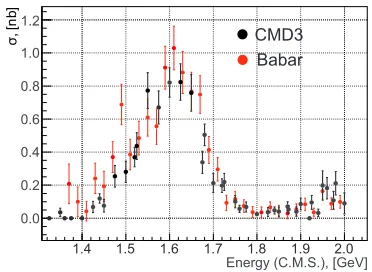
Figure 1. Preliminary CMD-3 results of the cross section measurements of the processe+e−→
K+K−π0in comparison with the BaBar data. Only
statistical errors are shown.
2
, MeV/c π
K
m
600 700 800 900 1000 1100 1200 1300 1400
2
, MeV/c
KK
m
900 1000 1100 1200 1300 1400 1500 1600 1700 1800 1900
invariant mass
-K + K
one (cut boosted)
-π + vs K
Figure 2. Scatter plot of the invariant mass of a system ofK±
K∓
, depending on the mass ofKπ sys-tem.
systematic uncertainty on the luminosity we estimated as 1% for energies above 1 GeV. In the experi-mental runs in 2011-2013, the collider’s peak luminosity was restricted by the positron accumulation rate and by the 825 MeV maximum energy at which the booster injects the beam into the collider. The nominal luminosity nearly was reached in 2017 upon implementing a new scheme for injection of the electrons and positrons to the collider.
3 Cross section measurement of the process
e
+e
−→
K
+K
−π
0Analysis of the reactione+e− → K+K−π0based on an integrated luminosity of nearly 34 pb−1
col-lected in the energy region between 1.2 and 2 GeV. The signal events have to have two central “good” tracks which should satisfy the conditions of non-collinearity:||φ2−φ1|−π|>0.15or|θ2+θ1−π|>0.25
radian and two or more photons must be detected in calorimeter.
For each pairs of photons the kinematic reconstruction were performed with the condition that these two photons are the decay product of theπ0. If the kinematics of these four particles satisfies energy-momentum and ionization losses in DC correspond to the kaons, the combination with the smallestχ2 is selected for further analysis. The main sources of the background come from the reactionse+e−→π+π−π0ande+e−→π+π−π0π0, which is mostly suppressed when we use the dE/dx
information from DC. Also the kinematic reconstruction eliminates significantly the events of the processese+e−→K+K−2π0ande+e−→K+K−η.
1.6 1.7 1.8 1.9 2 0
0.5 1 1.5 2 2.5 3 3.5
, GeV c.m. E
σ(
->
-e
+
e
φη),
nb
Figure 3. Preliminary CMD-3 results on the e+e− → φ
(1020)η cross section (red symbols) compared with the BaBar measurements relay on
η→2γprocess (blue symbols). The error bars are purely statistical.
1.75 1.8 1.85 1.9 1.95 2
0.2 0.4 0.6 0.8 1
, GeV
c.m.
E
σ(
-K
+
-> K
-e
+
e
ω),
nb
Figure 4. Shown preliminary CMD-3 results on thee+e−→
K+K−ω
cross section (red symbols) in comparison with of the BaBar measurement (blue symbols). The error bars are purely statistical.
4 Cross section measurement of the
e
+e
−→
K
+K
−η
and
e
+e
−→
K
+K
−ω
processes
Thee+e− → K+K−ηprocess has been earlier studied by the BaBar in the c.m. energy (E
c.m.) range
from 1.56 - 3.48 GeV in theη→2γdecay channel and in 1.56-2.64 GeV, respectively whenηdecay toπ+π−π0 [8]. The our study of thee+e− → K+K−ηprocess is based on an integrated luminosity of 22 pb−1 collected over the energy range between 1.59-2.0 GeV at 30 energy points. Theηmeson
was treated as a recoil particle, that allows us to save statistics due to selection of specificηdecay mode, but such approach leads to a complicated background subtraction, which was carefully studied. The candidates to the signal should have the following features: kaons are the product of theφ(1020) decay, at least two central tracks should be detected in DC with ionization losses dE/dx which cor-respond to kaons. The latter condition allows significantly reject physical background. The further extraction of the signal events based on the study of the missing mass of theK+K−system and study the invariant mass spectrum in the vicinity of theφ-mass.
The detection efficiency was determined from the simulation taking into account radiative cor-rections. The simulated events were treated with the same package of the reconstruction program as experimental data.
The preliminary results of the cross section ofe+e− → φ(1020)ηprocess are shown in Fig. 3, which are in good agreement with the data of the BaBar experiment except one failed point near 1.7 GeV. Analysis of events with decayη → γγalso shows an even more profound failure of the cross section at this place. In the upcoming experiments we will increase ststistics and confirm/close possible anomaly in the cross section at this energy region. Let us note that a hint of the existence of such anomalies is also qualitatively visible in the data of the BaBar and SND detectors. The systematic uncertainty on the cross section is estimated as 7%. The cross section of the processe+e−→K+K−ω was measured in the energy range 1.84-2 GeV and based on the integrated luminosity∼12 pb−1. We
measure the cross section of the processe+e− → K+K−ωconsideringπ0 fromω → 3πdecay as a
The simulation shows that the major background processes aree+e−→ K+K−π+π−ande+e− →
K+K−η. To suppress these events we applied the cuts for missing mass and and spectrum of the KK-system.As a result we got in the experiment 967±35 of signal events. The preliminary results obtained for thee+e− → K+K−ωcross section along with that of BaBar is shown in Fig. 4. Only statistical errors are presented. It is a bit seen that our cross section points are systematically higher than that of BaBar. The overall systematic uncertainty of thee+e− → K+K−ωcross section measurement is estimated to be 5%.
5 Study of the process
e
+e
−→
K
+K
−π
+π
−The processe+e−→K+K−π+π−has been earlier studied with the DM1 and DM2 detectors and more recently at the BaBar [9] using an ISR approach. Part ofe+e− → K+K−π+π− intermediate states were studied by the Babar collaboration, but now with higher statistics collected with the CMD-3 it is possible to make more detailed analysis dynamics production of this final state.
The presented results for the processe+e− → K+K−π+π−are based on 22 pb−1 integrated
lumi-nosity accumulated by the CMD-3 in energy range 1.5÷2.0 GeV.
Candidates for the process under study are required to have in the DC three or four “good” tracks coming from the interaction region which are satisfy the energy-momentum conservation. Fig. 5 presents a two-dimensional plot of the candidates to the signal events. On the vertical axis pending the measured energy of four particles minus twice beam energy in the assumption that all particles are pions, and the horizontal axis - module of the vector sum of the momentum of these particles. It is clear seen that the origin is a focus of the eventsπ+π−π+π−at the same time the cluster of signal events is shifted down due to the heavier masses of the kaons. In addition, visible shelf events, which are correlated with energy-momentum. The emergence of these events is due to the photons emission of primary electrons. As a result of the analysis, we selected∼13300 four and∼16000 three track events.
The pions and kaons separation is performed by analyzing the ionization losses in the DC. To obtain a detection efficiency, the K+K−π+π−events were simulated with a primary generator with main intermediate mechanisms using the GEANT4 package and then reconstructed with the same software as experimental data.
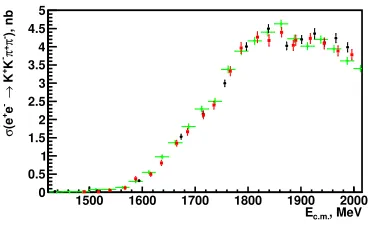
The detection efficiency is about 50% and is basically determined by detector acceptance. The ra-diative correction smoothly increases from 0.8 to 0.98 in the studied energy range. The cross section as a function of energy is presented in Fig. 6. Systematic errors are estimated as 6.1% and the main source of uncertainty due to the theoretical model describing the angular distribution of final parti-cles. The obtained cross section agrees with the previous measurement by the BaBar Collaboration presented by open circles on the same figure.
The study of the dynamics production ofe+e− → K+K−π+π−events confirms the presence of several intermediate states such as: K1∗(1270,1400)K →K∗(892)Kπ,K1∗(1270)K→ KKρ,φπ+π− and which are sufficient to describe correctly the angular distributions of final particles and invariant mass. It was shown that the intermediate stateK∗(892) gives the main contribution to the spectrum of the invariant mass of theKπ, theρ-meson in the combinationπ+π−. More detailed analysis can be found in [10].
6 Conclusion
, MeV/c tot P
100 200 300 400 500 600
, MeVπ
4
E
∆
800 −
600 −
400 −
200 −
0
Figure 5. Scatter plot of the∆E4π = E1+
E2+E3+E4−2Ebeamvs the total momentum
Ptotfor the four-track events atEc.m.=1980
MeV.
, MeV
c.m.
E
1500 1600 1700 1800 1900 2000
), nb
-π
+
π
-K
+
K
→
-e
+
(e
σ
0 0.5 1 1.5 2 2.5 3 3.5 4 4.5 5
Figure 6. Cross section of the process e+e− →
K+K−π+π−
. CMD-3 - red and black poits, BaBar - green points.
The processese+e− → K+K−π0, e+e− → K+K−η(ω(782) and e+e− → K+K−π+π− have been studied in the center-of-mass energy ranges from 1.2 to 2.01 GeV. In the production ofK+K−π0final
state we observe the dominant contribution ofK±K∓(982) intermediate states.
On the base about 1470 and 970 selected signal events the cross sections of e+e− →
K+K−(φ(1020))ηande+e− → K+K−ω(720) processes have been measured with the statistical pre-cision comparable or better than in previous measurements and with systematic uncertainties of 6% and 5% respectively. Our results for thee+e−→K+K−ω(782) cross section are systematically higher than that of BaBar. The last year upgrade of the VEPP-2000 is completed and we plan to measure these cross sections, as well asφ0(1680)-meson parameters with much better accuracy.
6.1 Acknowledgment
The authors thank the team of VEPP-2000 for the fruitful cooperation during the data set.
References
[1] K. Hagiwaraet al., J. Phys.G38, 085003 (2011). [2] D.E. Berkaevet al., JETP113, 213 (2011).
[3] B.I. Khazinet al., Nucl. Phys. B (Proc. Suppl.)181-182, 376 (2008). [4] V.E. Shebalinet al., Nucl. Instrum. Meth.A 824, 710 (2016). [5] E.V.Abakumovaet al., Phys.Rev.Lett.110, 140402 (2013). [6] G.D. Crawfordet al., Nucl. Instrum. Meth.A 345, 429 (1994). [7] E.A. Kuraev and V.S. Fadin, Sov. J. Nucl. Phys.41, 466 (1985). [8] B. Aubertet al., Phys. Rev.D 77, 092002 (2008).
J.P. Leeset al., Phys. Rev.D 86, 012008 (2012). [9] B. Aubertet al., Phys. Rev.D 76, 012008 (2007),
J.P. Leeset al., Phys. Rev.D 86, 012008 (2012), B. Aubertet al., Phys. Rev.D 77, 092002 (2008).