ISSN: 2319-8753
I
nternational
J
ournal
of
I
nnovative
R
esearch
in
S
cience,
E
ngineering and
T
echnology
(An ISO 3297: 2007 Certified Organization)
Vol. 2, Issue 10, October 2013
REVIEW on MODIFICATION of
NANOCELLULOSE for APPLICATION in
COMPOSITES
Mohammad Tajul Islam
1, Mohammad Mahbubul Alam
2, Marina Zoccola
3M.Sc in Textile Engineering (Candidate), Dipartimento scienza applicata e tecnologia, Politecnico di Torino, Italy1, Department of Textile Engineering, Ahsanullah University of Science and Technology, Dhaka, Bangladesh2,
Istituto per lo Studio delle Macromolecole, C.N.R., C.so Pella 16, Biella 13900, Italy3
Abstract: Science and technology continue to choose the use of renewable raw materials and more environment friendly and sustainable resources and processes. Nanocellulose is an important addition for that movement. The development of nanocellulose has attracted significant interest in the last few decades due to their unique and potentially useful features. These novel nanocelluloses boost up the strongly expanding field of sustainable materials and nanocomposites. Surface modification of cellulose nafibrils is necessary in order to expand the horizon of their application towards water insoluble polymer matrices. This review organises the current knowledge on the surface modification of microfibrillated and nanofibrillated cellulose from plant sources.A detail of chemical and physical modification of fibril from cellulose has been reviewed.
Keywords: Nanocellulose, surface modification, biocomposites
I. INTRODUCTION
ISSN: 2319-8753
I
nternational
J
ournal
of
I
nnovative
R
esearch
in
S
cience,
E
ngineering and
T
echnology
(An ISO 3297: 2007 Certified Organization)
Vol. 2, Issue 10, October 2013
of cellulose nanoparticles, whereby nanofibers are treated by various physical and chemical methods to decrease the energy consumption. Dufresne, Klemm, Siro, Habibi and Azizi Samir have recovered these studies in excellent general reviews on the entire field starting from nanocellulose preparation, modification to application in composites. This review represents specifically various approaches to the surface modification of nanocelluloses. The focus is on the chemical treatments on the surface of nanofibres to make them compatible to petrochemical based thermoset and thermoplastic polymers.
II. DISPERSION OF CELLULOSE NANOFIBRES
The nanofibers are useful only when they demonstrate a reinforcing potential as filler for composite materials. One of the problems encountered in the use of such filler lies in the difficulty in ensuring good dispersion of the filler in the composite material. The phenomenon of agglomeration of the filler is observed in particular with the cellulose fibers used as filler for matrix made of thermoplastic resin. Nano scale cellulose structures with highly developed specific surface (S) have an increased thermodynamic potential (G), which is the cause of instability of nano objects. According to thermodynamics, to achieve a more stable state, a nano object or phase must decrease its specific surface:
∆G = σ ∆S<0
where σ is the specific surface energy.
Therefore, the nano phase has a tendency to form larger structures via aggregation and agglomeration [15]. Poor dispersion of the filler in the matrix of a composite material seriously affects its mechanical properties. CNFs have a high density of –OH groups on the surface, which try to bond with adjacent –OH groups by weak hydrogen bonding. This results in agglomeration or entanglement of the nanofibers; therefore the nanofibers obtained after chemo-mechanical treatments need to keep as water suspension. Mostly water is used as a carrier to disperse cellulose nanofibers. CNFs have a tendency to form hydrogen bonds with adjacent fibrils and hence dispersion is an important challenge in non-polar solvents. The issue of the redispersion of
nanofibres after drying is difficult, as irreversible aggregation of the fibrils occurs in a process known as “hornification”, which results in a material with ivory-like properties that can neither be used in rheological applications nor dispersed for composite applications. The main strategy to prevent hornification has been the introduction of a steric barrier or electrostatic groups to block cooperative hydrogen bonding of the cellulose chains [5]. Abundance of hydroxyl groups at the surface of cellulose nanofibres makes it possible to attempt different chemical modifications, including esterification, etherification, oxidation, silylation, polymer grafting, etc. Noncovalent surface modification, including the use of adsorbing surfactants and polymer coating, has been also studied. All chemical functionalizations have been mainly conducted to
- introduce stable negative or positive electrostatic charges on the surface of CNFs to obtain better dispersion and
- tune the surface energy characteristics of CNFs to improve compatibility, especially when used in conjunction with nonpolar or hydrophobic matrices in nanocomposites.
The main challenge for the chemical functionalization of CNFs is to conduct the process in such a way that it only changes the surface of CNFs, while preserving the original morphology to avoid any polymorphic conversion and to maintain the integrity of the crystal [6]. Brief descriptions of some important modification of CNFs are hereinafter summarised.
A.
Surface modification1) Acetylation:is beneficial in reducing the moisture absorption of natural fibers. Acetylation of cellulose is one of the best
ISSN: 2319-8753
I
nternational
J
ournal
of
I
nnovative
R
esearch
in
S
cience,
E
ngineering and
T
echnology
(An ISO 3297: 2007 Certified Organization)
Vol. 2, Issue 10, October 2013
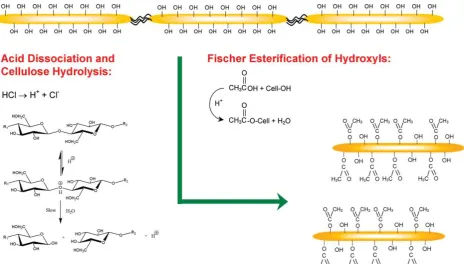
Nanocellulose (BNC) are possible by using acetic anhydride in acetic acid. In the case of homogeneous acetylation, the partially acetylated molecules immediately partitioned into the acetylating medium as soon as they were sufficiently soluble, while in heterogeneous conditions, the cellulose acetate remained insoluble and surrounded the crystalline core of unreacted cellulose chains. The simultaneous occurrence of cellulose hydrolysis and acetylation of hydroxyl groups has been also reported. Fischer esterification of hydroxyl groups simultaneously with the hydrolysis of amorphous cellulose chains has been introduced as a viable one-pot reaction methodology that allows isolation of acetylated CNFs in a single-step process [7]. The degree of acetyl substitution had a crucial influence on material properties. Ifuku et al. found that acetylation improved the transparency and reduced the hygroscopicity of BNC/acrylic resin composite materials. However, the composites had an optimum degree of substitution and excessive acetylation reduced their properties. Acetylation has also been reported to improve the thermal degradation resistance of BNC fibers [2].
Fig. 1. Reaction scheme illustrating the one-pot (tandem) cellulose hydrolysis and esterification reactivity of hydroxyl groups. Reprinted with permission from Braun, B. et al. [7]. Copyright 2009 American Chemical Society.
2) Silylation: Silane-coupling agents usually improve the degree of cross-linking in the interface region and offer a perfect
ISSN: 2319-8753
I
nternational
J
ournal
of
I
nnovative
R
esearch
in
S
cience,
E
ngineering and
T
echnology
(An ISO 3297: 2007 Certified Organization)
Vol. 2, Issue 10, October 2013
dispersible in solvents of low polarity (such as THF) leading to stable suspensions with birefringent behavior, while their morphological integrity was preserved. However, at high silylation (DS greater than 1), the chains in the core of the crystals became silylated, resulting in the disintegration of the crystals and consequently the loss of original morphology [6].
Fig. 2. Hydrolysis of silane. Reprinted with permission from Kalia, S. et al. [16]
Fig. 3. Hypothetical reaction of fiber and silane. Reprinted with permission from Kalia, S. et al. [16].
3) Bacterial cellulose: Lu et al. [9] successfully modified MFC by applying three different coupling agents, 3
ISSN: 2319-8753
I
nternational
J
ournal
of
I
nnovative
R
esearch
in
S
cience,
E
ngineering and
T
echnology
(An ISO 3297: 2007 Certified Organization)
Vol. 2, Issue 10, October 2013
or coordination exchange. When there are hydroxyl groups present on the surface of the substrate, the monoalkoxy- and neoalkoxy-type titanium-derived coupling agents react with the hydroxyl groups to form a monomolecular layer.
4) Grafting: Polymer grafting on the surface of CNFs has been carried out using two main strategies, namely, the “grafting -onto” and “grafting-from”. The grafting onto approach involves attachment of presynthesized polymer chains onto
hydroxyl groups at the cellulose surface by using a coupling agent. In the “grafting from” approach, the polymer chains
are formed by in situ surface-initiated polymerization from immobilized initiators on the substrate [6].
The “grafting onto” approach was used by Ljungberg et al. [18] to graft maleated polypropylene (PPgMA) onto the surface of tunicate-extracted CNFs. The resulting grafted nanocrystals showed very good compatibility and high adhesion
when dispersed in atactic polypropylene. The “grafting from” approach applied to CNFs was first reported by Habibi and
Vignon [10], who grafted polycaprolactone onto the surface of CNFs via ring-opening polymerization (ROP) using stannous octoate (Sn(Oct)2) as a grafting and polymerization agent.
Stenstad et al. reported three methods for modification of MFC by heterogeneous reactions in both water and organic solvents. MFC surface was functionalized with epoxy by oxidation with cerium (IV) followed by grafting with glycidyl methacrylate. Reactive epoxy groups could serve as a starting point for further functionalization with ligands which typically do not react with the surface hydroxyls present in native MFC. A major advantage of this technique is that the reaction is conducted in aqueous media, thereby avoiding the use of organic solvents and laborious solvent exchange procedures. By this method, cellulose nanofibers with a surface layer of moderate hydrophobicity can be prepared. In the same research, a far more hydrophobic MFC surface was obtained by grafting of hexamethylene diisocyanate, followed by reaction with amines. Succinic and maleic acid groups can be introduced directly onto the MFC surface as a monolayer by a reaction between the corresponding anhydrides and the surface hydroxyl groups of the MFC [2].
The potential use of chemically coated hemp nanofibers as reinforcing agents for biocomposites was explored by Wang and Sain et al. [11]. The cellulose nanofibers were treated using five different chemicals: ethylene acrylic acid, styrene maleic anhydride, guanidine hydrochloride, and Kelcoloids® HVF and LVF stabilizers (propylene glycol alginate). Bio-nanocomposites were prepared from PLA and PHB as matrices. Nanofibers were only partially dispersed in the polymers and therefore mechanical properties were lower than those predicted by theoretical calculations.
5) Surface active agent/ Surfactant: Interaction of cellulose with surfactants has been another way to stabilize cellulose
suspensions into non-polar systems. A surfactant is briefly defined as a material that can greatly reduce the surface tension of water when used in very low concentrations. A particular type of molecular structure performs as a surfactant (Figure 4). This molecule is made up of a water soluble (hydrophilic) and a water insoluble (hydrophobic) component. The hydrophobe is usually the equivalent of an 8 to 18 carbon hydrocarbon, and can be aliphatic, aromatic, or a mixture of both. The hydrophilic groups give the primary classification to surfactants, and are anionic, cationic and non-ionic in nature. Noncovalent surface modifications of CNFs are typically made via adsorption of surfactants. This approach has been introduced by Heux et al., who used surfactants consisting of the mono- and di-esters of phosphoric acid bearing alkylphenol tails. The obtained surfactant-coated CNFs dispersed very well in nonpolar solvents. Detailed analyses of the data provided by small angle neutron scattering (SANS) revealed that the surfactant molecules formed a thin layer of about 15 Å at the surface of the CNFs. Use of anionic and non ionic surfactants have been reported [6].
Hydrophobe Hydrophile
ISSN: 2319-8753
I
nternational
J
ournal
of
I
nnovative
R
esearch
in
S
cience,
E
ngineering and
T
echnology
(An ISO 3297: 2007 Certified Organization)
Vol. 2, Issue 10, October 2013
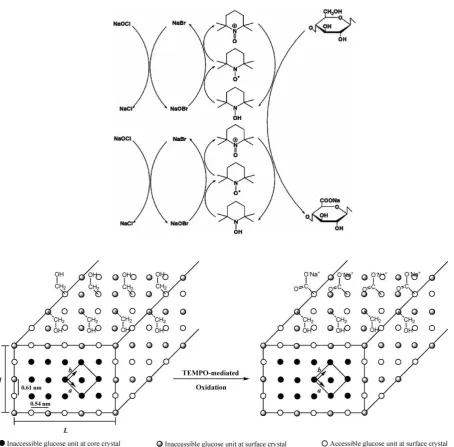
Fig 5. Scheme of TEMPO-mediated oxidation mechanism of the hydroxymethyl groups of cellulose (top, reaction scheme) and crosssectional representation of cellulose nanocrystal indicating the occurrence of the surface TEMPO-mediated oxidation of available hydroxyl groups (bottom, surface crystal representations). Reprinted with permission from the Reference [6]. Copyright 2010, American Chemical Society)
6) TEMPO Mediated Oxidation: Hydroxylmethyl groups of CNFs present on their surface can be converted to their
carboxylic form by oxidation with (2,2,6,6-Tetramethylpiperidine-1-oxyl)-mediated (or TEMPO-mediated).
This oxidation reaction, which is highly discriminative of primary hydroxyl groups, is also “green” and simple to implement. It
ISSN: 2319-8753
I
nternational
J
ournal
of
I
nnovative
R
esearch
in
S
cience,
E
ngineering and
T
echnology
(An ISO 3297: 2007 Certified Organization)
Vol. 2, Issue 10, October 2013
and NaOCl (Figure 5, top). TEMPO-mediated oxidation of CNFs involves a topologically confined reaction sequence, and as a consequence of the 2-fold screw axis of the cellulose chain, only half of the accessible hydroxymethyl groups are available to react, whereas the other half are buried within the crystalline particle (Figure 5, bottom). TEMPO-mediated oxidation of CNFs, obtained from HCl hydrolysis of cellulose fibers, was first reported by Araki et al. [12] as an intermediate step to promote grafting of polymeric chains. These authors demonstrated that after TEMPO mediated oxidation, the CNFs maintained their initial morphological integrity and formed a homogeneous suspension when dispersed in water. The basis for these latter observations was the presence of the newly installed carboxyl groups that imparted negative charges at the CNF surface and thus induced electrostatic stabilization.
B.
Solvent exchangeIn addition to chemical modification of nanofibrils, solvent exchange can be a possible route to facilitate dispersion. MFC was premixed with PLA using acetone and the mixture was kneaded after the removal of the solvent to attain uniform dispersion. Resulted composite sheet has significantly more uniform filler distribution compared to sheets prepared via direct introduction of
MFC to the molten PLA matrix. As a consequence of uniform distribution the Young’s modulus and tensile strength of PLA
increased by 40 and 25% respectively without a reduction of yield strain at a fiber content of 10 wt%. Furthermore, the storage modulus of the composites was kept constant above the glass transition temperature of the matrix polymer [13]. PLA was crystallized when premixed with MFC by using acetone and then exchanged for dichloromethane. Crystallization of PLA
increases the storage modulus as well as the strength and Young’s modulus of PLA/MFC nanocomposites without significant
reduction in the strain at break [14].
C.
Physical modifications of nanofibersPhysical treatments change structural and surface properties of the fiber and thereby influence the mechanical bonding with the matrix. Physical methods involve surface fibrillation, electric discharge (corona, cold plasma), ultrasonic, irradiation, electric currents, etc. But only sonification, a simple and versatile approach for dispersion bionanofibers from natural materials using the ultrasonic technique was reported. The cellulose suspension was sonicated with a Branson sonifier [17], behaved as
non-flocculating and non-sedimenting aqueous suspensions of cellulose microfibrils. It is made up of individual cellulose fragments consisting of slender rods that have a broad distribution in size.
III.CONCLUSION
A growing number of research activities have been reported worldwide on the formation and utilization of nanocelluloses over the last era particularly in the last seven years. The use of nanofibres from cellulose has been restricted to polar based polymers due to its lack of compatibility with petrochemical based thermoset and thermoplastic polymers. To expand the horizon of
cellulosic nanofibres’ application surface modification is very important. Among all the modification chemical treatments shows more potentiality. Besides the chemical modification some physical treatments recently have been reported like plasma treatment of nanofibrils.
IV.ACKNOWLEDGEMENT
Authors would like to thank the Regione Lombardia for the financial support of the project Ve.Li.Ca (Vegetali Lino Canapa).
REFERENCES
[1] Hussain, F., Hojjati, M., Okamoto, M. and Gorga, R. E. “Review article: Polymer–matrix nanocomposites, processing, manufacturing, and application: An overview”, Journal of Composite Materials, vol.40, pp. 1511–1575, 2006.
[2] Siro´, I. and Plackett, D. “Microfibrillated cellulose and new nanocomposite materials: a review”, Cellulose, vol. 17, pp. 459–494, 2010.
[3] Klemm, D., Kramer, F., Mortiz, S., Lindström, T., Ankerfors, M., Gray, D. and Dorris, A. “Nanocelluloses: A New Family of Nature-Based Materials”,
ISSN: 2319-8753
I
nternational
J
ournal
of
I
nnovative
R
esearch
in
S
cience,
E
ngineering and
T
echnology
(An ISO 3297: 2007 Certified Organization)
Vol. 2, Issue 10, October 2013
[4] Wambua, P., Ivens, J. and Verpoest, I. “Natural fibres: can they replace glass in fibre reinforced plastics?”, Compos Sci Technol, vol. 63, pp. 1259–1264, 2003.
[5] Klemm, D., Heublein, B., Fink, H. P. and Bohn, A. “Cellulose: Fascinating Biopolymer and Sustainable Raw Material”, Angew. Chem. Int. Ed., vol. 44, pp. 3358 –3393, 2005.
[6] Habibi,Y., Lucian, L. A., and Rojas J. O. “Cellulose Nanocrystals: Chemistry, Self-Assembly, and Applications”. Chem. Rev., vol. 110, pp. 3479–3500, 2010.
[7] Braun, B. and Dorgan, J. R. “Single-Step Method for the Isolation and Surface Functionalization of Cellulosic Nanowhiskers”, Biomacromolecules, vol. 10, pp. 334, 2009.
[8] Lewin, M. (2007). Handbook of Fiber Chemistry, 3rd Edition, Taylor & Francis Group, Boca Raton, USA.
[9] Lu, J., Askeland, P. and Drzal, L. T. “Surface modification of microfibrillated cellulose for epoxy composite applications”. Polymer, vol. 49, pp. 1285–
1296, 2008.
[10] Habibi, Y. and Vignon, M. R. “Optimization of cellouronic acid synthesis by TEMPO-mediated oxidation of cellulose III from sugar beet pulp.” Cellulose
vol. 15, pp. 177-185, 2008.
[11] Wang, B. and Sain, M. “The effect of chemically coated nanofiber reinforcement on biopolymer based nanocomposites.” Bioresources, vol. 2, pp. 371– 388, 2007.
[12] Araki, J., Wada, M. and Kuga, S. “Steric Stabilization of a Cellulose Microcrystal Suspension by Poly(ethylene glycol) Grafting.” Langmuir, vol. 17, pp. 1, 2001.
[13] Iwatake, A., Nogi, M. and Yano, H. “Cellulose nanofiber-reinforced polylactic acid”, Compos Sci Technol, vol. 68, pp. 2103–2106, 2008.
[14] Suryanegara, L., Nakagaito, A. N. and Yano, H. “The effect ofcrystallization of PLA on the thermal and mechanical properties of microfibrillated
cellulose-reinforced PLA composites”, Compos Sci Technol, vol. 69. pp. 1187–1192, 2009. [15] Ioelovich, M. “Nanostructured cellulose : Review”, BioResources, vol. 3, pp. 1403-1418, 2008
[16] Kalia, S., Dufresne, A., Cherian, B. M., Kaith, B. S., Avérous, L., Njuguna, J. and Nassiopoulos, E. “Cellulose-Based Bio- and Nanocomposites: A Review”, International Journal of Polymer Science, vol. 2011, 35 pages, 2011.
[17] Samir, M. A. S. A., Alloinb, F., Sanchez, J. Y., and Dufresne, A. “Cellulose nanocrystals reinforced poly(oxyethylene)”, Polymer, vol.45, 4149–4157. [18] Ljungberg, N., Bonini, C., Bortolussi, F., Boisson, C., Heux, L., Cavaille, J. Y. “New nanocomposite materials reinforced with cellulose whiskers in