A Fuzzy logic Approach for Continuous
Co-polymerization Reactor Control Problem
Lalit G. Patil1*& Dr.Jagrut Gadit2
1
Teaching Assistant, Department of Electrical Engineering, The Maharaja Sayajirao University of Baroda, Gujarat, India
2
Associate Professor, Department of Electrical Engineering, The Maharaja Sayajirao University of Baroda, Gujarat, India
Abstract:
Most industrial applications of modelling and control relay on intuition, sound engineering judgment and past experience, and heuristic procedures. Here i have discussed the problem in modelling and control of polymerization reactors. There are considerable difficulties in modelling of emulsion polymerization reactors and non-availability of robust online measurement techniques for critical properties of the product. Quality control is interpreted as proper recipe formulation, optimal initial conditions selection, and adhoc operation based on experience.
Temperature, Pressures and flow rates of the process are considered as controlled variables for closed loop control system design. Vague control and measurement objectives, difficult sampling, discrete sensor output, large dead times and sampling difficulty in controlling polymerization reactors. An operator of polymerization reactors is able to control the processes based on his/her experience, without a mathematical model. Hence, one
way to handle the control problem is to develop a controller based on operator knowledge. The process operator thinks and acts according to linguistic quantities like 'high', 'medium', 'low' etc. The theory of fuzzy sets developed helps in enable us to mathematically describe and handle these linguistic expressions. A FLC based on fuzzy logic provides a mean of converting a linguistic control strategy based on an operation knowledge into an automatic control strategy.
For Referring this Paper:
Lalit G. PatilandDr. Jagrut Gadit(2014), A Fuzzy Logic Approach for Continuous Co-polymerization Reactor Control Problem, International Journal of Research (IJR), Volume-1, Issue-4. Page757-762. ISSN 2348-6848.
Keywords:
Fuzzy Logic Controller; Fuzzy Rules; Crisp; Control Problem; Fuzzification; MATLAB
Introduction
There are the five stages in designing a FLC is shown at below with continuous co-polymerization reactor control problem. Associated with each input is a linguistic variable. Each linguistic variable may take a
0.56-0.64 for C and 76-80 for T and 16-20kg/h for F respectively. We have taken the labels ‘CLow’, ’CMedium’ and ‘CLarge’ associated with the linguistic variable (C) and the fuzzy set ‘TLow’, ’TMedium’ and ‘THigh’ associated with the linguistic variable temperature and the fuzzy set ‘FLow’, ’FMedium’ and ‘FHigh’ with the flow rate of active monomer.
Proposed Algorithm
A standard form of function for all the relevant numbers can be chosen from the programming point of view. A triangular membership function is widely used membership function. The fuzzy numbers associated with this type of functions are referred to as triangular fuzzy numbers. The main advantage of this type of fuzzy numbers is that it can be completely defined by three values (a,b,c). ‘a’ represents the extreme left of the fuzzy
number range while its grade of
membership is zero. Value c represents the extreme right of the range and its grade of membership is again zero. Point b is apex in the triangular membership where the grade of membership is unity.
All the points in ranges a-b and b-c have grades of membership (ϒ) defined by the relations:
ϒ = 0 ;x ≤ a
ϒ = (x-a) / (b-c) ;a ≤ x ≤ b
ϒ = (c-x) / (c-b) ;b ≤ x ≤ c
ϒ = 0 ;x ≥ c
Where x is a non-fuzzy numerical value and
ϒis the grade of membership of the fuzzy set.
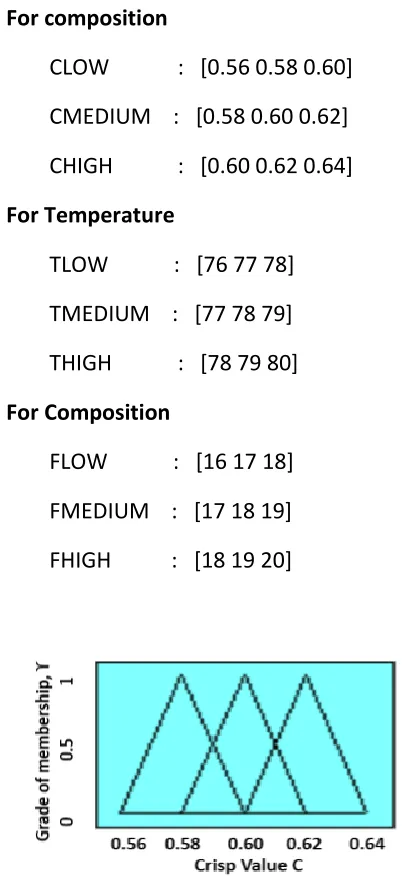
Triangular membership function for each fuzzy set is assumed here. The values of a, b and c of the membership for each fuzzy set is assumed to be as follows.
For composition
CLOW : [0.56 0.58 0.60]
CMEDIUM : [0.58 0.60 0.62]
CHIGH : [0.60 0.62 0.64]
For Temperature
TLOW : [76 77 78]
TMEDIUM : [77 78 79]
THIGH : [78 79 80]
For Composition
FLOW : [16 17 18]
FMEDIUM : [17 18 19]
FHIGH : [18 19 20]
Fig. 1 Fuzzy relation for composition C
1. Specify the ranges of manipulated and controlled variables.
2. Deducing the linguistic labels that can be used to describe these variables and specifying the appropriate ranges of applicability of each label, along with the fuzzy sets.
3.Selecting the type of membership
function and the parameter in that function for the manipulated variables and the output variables.
4. Determining the rules that will relate the linguistic labels of controlled variables to that of the manipulated variables. The execution of these rules gives the fuzzy output.
5.Selecting a suitable defuzzification algorithm to calculate the non-fuzzy value for the manipulated variables to be implemented in the process.
Input acquisition:
Let the input for the composition C and temperature T are read from the sensors as
Composition C = 0.584
Temperature T = 81.5C
Irrespective of the inference and
defuzzification method sued, the first stage evaluates the grade of membership for each of the terms, using the corresponding values of a,b and c, we get the grade of membership for the composition C
ϒ CLow(0.584) = 0.70
ϒCMedium(0.584) = 0.20
ϒCHigh(0.584) = 0.0
Similarly,We get the grade of membership
ϒ TLow(81.5) = 0.0
ϒTMedium(81.5) = 0.75
ϒTHigh(81.5) = 0.25
Rule evaluation :
Let we make seven rules, and the result of each rule gives the grade of membership for output F and the corresponding fuzzy set. We execute these rules,
Rule 1: If (C is CLow) and (T is TLow) then (F is FHigh)
ϒFHigh is given by min{0.7,0.0} = 0.0
Rule 2: If (C is CLow) and (T is TMedium) then (F is FMedium)
ϒFMedium is given by min{0.70,0.75} = 0.70
Rule 3: If (C is CLow) and (T is THigh) then (F is FMedium)
ϒFMedium is given by min{0.7,0.25} = 0.25
Rule 4: If (C is CMedium) and (T is TLow) then (F is FMedium)
ϒFMedium is given by min{0.20,0.0} = 0.0
Rule 5: If (C is CMedium) and (T is TMedium) then (F is FMedium)
ϒFMedium is given by min{0.20,0.75} = 0.20
Rule 6: If (C is CMedium) and (T is THigh) then (F is FLow)
ϒFLow is given by min{0.20,0.25} = 0.20
A quick review of the rule membership reveal that Rule No.2 has the highest membership grade (0.7) and Rules No. 1 and 4 have the lowest membership grade (0.0).
MATLAB Implementation
The following shows the fuzzy rules, relating fuzzy sets C and T to fuzzy set F.
Fig. 2 Fuzzy rules for control problem
Inference and Defuzzification
In this two Rule No. 6 and 7, prescribe the ‘FLow’ output. There are four Rule No.2,3,4 and 5, which prescribe the output to be ‘Medium’ and the only Rule No. 1 which prescribes the output to be ‘High’. Since the rules are considered to be combined in the rule base by OR operation, the membership grade associated with each output term obtained by identifying the rule which prescribes that output term with maximum membership grade. The membership grade for each output term is computed as below:
Output term
Rules (Ri)
Membership grade for (F)
Low
Medium
High
6,7
2,3,4,5
1
max{0.2,0.25} = 0.25
max{0.7,0.25,0.0,0.2}= 0.7
0
Table. 1 Inference of fuzzy rules
Results
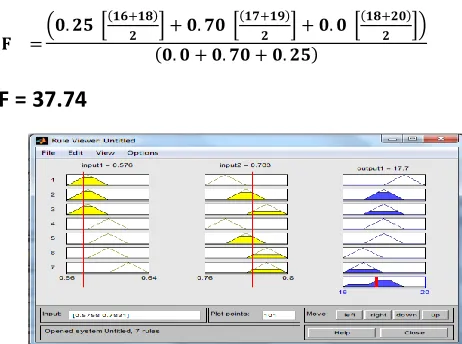
The Defuzzified output for F is obtained by using fuzzy mean method as
Crisp output of F = 𝐹 𝑖 ϒiϒi
Where (F)I = [(a+c)/2]
{‘a’ and ‘c’} of that particular fuzzy set given in table and ϒi is the grade of membership given in table.
Defuzzifiedoutput
𝐅 = 𝟎. 𝟐𝟓
𝟏𝟔+𝟏𝟖
𝟐 + 𝟎. 𝟕𝟎
𝟏𝟕+𝟏𝟗
𝟐 + 𝟎. 𝟎
𝟏𝟖+𝟐𝟎 𝟐
𝟎. 𝟎 + 𝟎. 𝟕𝟎 + 𝟎. 𝟐𝟓
F = 37.74
Fig. 3 Fuzzy rule viewer for Control problem
Conclusion
is the important advantage due to uncertainty of inputs. FLC is tolerant to redundant or contradictory rules. This
method can be easily extended to multi-input multi-output systems for the same problem of reactors.
REFERENCES
1. V.G.Nyttle, M.Chidambaram, Fuzzy logic control of a fed-batch fermentor with significant measurement delay, May 1994, Volume 10, Issue 5-6, pp 225-228 2. M.Chidambaram, Computer control of
processes, 2002, pp247-277
3. Nádson M. N. Lima, Lamia Zuñiga Liñan, Flavio Manenti, Rubens Maciel Filho,Marcelo Embiruçu, Eugénio C. Ferreira, Maria R. Wolf Maciela, Multivariable Nonlinear Advanced Control of Copolymerization Processes, 20th European Symposium on Computer Aided Process Engineering, Elsevier, 2010
4. M.Alipoor, M.Zeinali, and H.Sadoghi Yazdi, Fuzzy Temperature Control in a Batch Polymerization Reactor Using ANFIS Method, International Journal of Engineering and Technology Vol.1, No.1, April, 2009
5. B.Roffel and P.A.Chin, APPLICATION OF FUZZY LOGIC IN THE CONTROL
OFPOLYMERIZATION REACTORS, Vol.1, No.2, pp.267-272, 1993