Implementing Incremental Code Migration with XML
Wolfgang Emmerich, Cecilia Mascolo
and Anthony Finkelstein
Dept. of Computer Science
University College London
Gower Street, London WC1E 6BT, UK
fW.Emmerich|C.Mascolo|[email protected]
ABSTRACT
We demonstrate how XML and related technologies can be used for code mobility at any granularity, thus overcoming the restrictions of existing approaches. By not fixing a par-ticular granularity for mobile code, we enable complete pro-grams as well as individual lines of code to be sent across the network. We define the concept of incremental code mobil-ity as the abilmobil-ity to migrate and add, remove, or replace code fragments (i.e., increments) in a remote program. The com-bination of fine-grained and incremental migration achieves a previously unavailable degree of flexibility. We examine the application of incremental and fine-grained code migra-tion to a variety of domains, including user interface man-agement, application management on mobile thin clients, for example PDAs, and management of distributed documents.
Keywords
Incremental Code Migration, XML Technologies
1 INTRODUCTION
The increasing popularity of Java and the spread of Web-based technologies are contributing to a growing interest in dynamic and reconfigurable distributed system architectures. Such reconfiguration can be achieved with code migration, transferring fragments of code across the network, from one host to another.
The potential mobility range is however wider, starting from simple data mobility, where information is transferred. Ex-amples are the actual parameters that are passed to a remote procedure call or the web page that is returned to a get re-quest in the HTTP protocol. At a level above this, code mobility allows the migration of executable code: browsers loading applet classes from remote servers are very com-mon examples of code mobility. Java-based technologies, for instance, Java RMI [16] and Java Virtual Machines, such
This author was partially supported by Dipartimento di Scienze dell’Informazione, Universit`a di Bologna, Bologna, Italy.
as those built into Web browsers, offer a mobility granular-ity at a class level. M0 [30], Telescript [19], Obliq [6] are non Java based mobile code languages and systems. Mo-bile agents [31, 14], in which code and data move together, can be considered the highest level of mobility that can be achieved in a logical context.
Several application domains need a more flexible approach to code mobility than can be achieved with Java and with mobile agents in general. This flexibility can either be re-quired as a result of low network bandwidth or scalability. The 9,600 baud bandwidth between a server and a GSM mobile phone cannot cope with downloading large amounts of Java byte code from a server. Scalability requirements can mean for example, that applications on several thousand clients have to be kept in sync and be updated with new code fragments.
In this paper we show how to achieve more fine-grained mo-bility than in the approaches that are based on Java. We demonstrate that the unit of mobility can be decomposed from an agent or class level, if necessary, down to the level of individual statements. We can then support incremental in-sertion or substitution of, possibly small, code fragments and open new application areas for code mobility such as man-agement of applications on mobile thin clients, for example wireless connected personal digital assistants (PDAs), user interface construction and document management.
This work builds on the formal foundation for fine-grained code mobility that was established in [21]. That paper devel-ops a theoretical model for fine-grained mobility at the level of single statements or variables and argues that the potential of code mobility is submerged by the capability of the most commonly used language for code mobility, i.e., Java. In this paper, we share that vision and focus on an implementa-tion of fine-grained mobility using standardized and widely available technology.
interesting characteristics, mainly related to flexibility, that allow its use for code migration. In particular, we will exploit the tree structure of XML documents and then use XML re-lated technologies, such as XPointer [20] and the Document Object Model (DOM) [3] to modify programs dynamically. The availability of this technology considerably simplifies the construction of application-specific languages and their interpreters.
This paper is further structured as follows. In Section 2, we discuss related work, most notably XML, and alternative ap-proaches to logical code mobility. In Section 3, we show how XML supports the definition of high-level languages and how incremental code mobility can be defined with XML. In Section 4, we argue that incremental code mobility has the potential for a set of application areas such as user in-terface development, management of applications on mobile thin clients, and consistency management of distributed doc-uments. We give examples of the application of our approach in these domains. In Section 5 we demonstrate the imple-mentation of mobile code systems supported by off-the-shelf XML products. Section 6 evaluates the approach and identi-fies strengths and weaknesses. Section 7 contains a summary of the work done and some future work.
2 OVERVIEW OF XML AND LOGICAL MOBILITY
Physical mobility is concerned with the physical movement of hosts, such as notebooks, PDAs, mobile phones and wear-able computers. Logical mobility is the ability to transfer data and/or code from one host to another by using a net-work. This paper focuses on logical mobility, though the approach is also applicable to information that transits be-tween physically mobile hosts; in fact, Section 4 discusses how our work can be applied to manage applications de-ployed on PDAs. Logical mobility encompasses data and code mobility.
Data mobility is a very common mechanism and often used to exchange or spread information among different hosts dis-tributed on a network. Data mobility can be achieved by passing parameters to remote procedure calls, object requests or the put and get operations of the file transfer protocol. With the introduction of the Internet and the World-Wide-Web the Hyper Text Markup Language (HTML) has been used as the predominant format for data that moves between hosts on the Internet.
XML [5] is the basis for next generation markup languages for the Internet. XML is a subset of the Standard Generalized Mark-up Language (SGML) [15]. Unlike HTML both XML and SGML allow users to define their own set of mark-up tags for structuring documents. These user-defined mark-up tags are defined in document type definitions (DTDs). A DTD is a grammar that defines the syntax of documents. XML documents always declare a reference to their DTD in order to enable generic parsers to obtain the specification of the grammar. Thus with the advent of XML, different
for-mats for transferable data can be defined. Many different DTDs have been standardized to encode specific notations in XML. Examples of software engineering applications of XML include the UXF [29] and the XMI [23] DTDs. They both define transfer formats for UML [4] models.
XML is not only useful for publication of documents on the World-Wide-Web, but can also be used as an application-specific transport protocol in distributed system construc-tion. We report in [11] about the use of XML for the trans-port of data between different distributed and heterogeneous components of a financial trading system. That system uses XML documents as parameters to CORBA object requests. Moreover, the OMG have requested proposals for the in-teroperability between their Interface Definition Language and XML [24] that will address the seamless interchange of XML documents and equivalent complex values of IDL data types.
Data and code mobility in Java are supported through ob-ject serialization and class loading. The status of obob-jects can be serialized and transferred from one host to another while the class loading strategies can vary, depending on the application. For instance, the Netscape class loader down-loads applet classes from the web server of the containing HTML page; the Java RMI class loader allows the applica-tion to download the classes of the objects remotely passed as parameters at run time. The class of the moved object can migrate onto the new host or it can be fetched from a remote server. Many different technologies have been built on top of these simple mechanisms.
Two more sophisticated mobile code paradigms are classi-fied in [13] as remote evaluation and mobile agents. Remote evaluation allows the proactive shipping of code to a remote host [28] to be executed. Mobile agents are autonomous objects carrying their state and code that proactively move across the network. Many new systems have been developed to support mobile agents [17, 31, 14]. Agent mobility re-quires the migration of both code and state of the agent at the same time and they can move proactively performing tasks on behalf of users.
3 SPECIFYING INCREMENTAL CODE MOBILITY
WITH XML
<?xml version="1.0" encoding="ISO-8859-1"?> <!ELEMENT KarelProgram (turnon|go|
turnleft| pickbeeper|putbeeper| turnoff|times)*>
<!ELEMENT turnon EMPTY> <!ELEMENT go EMPTY> <!ELEMENT turnleft EMPTY> <!ELEMENT pickbeeper EMPTY> <!ELEMENT putbeeper EMPTY> <!ELEMENT turnoff EMPTY>
<!ELEMENT times (turnon|go|turnleft| pickbeeper|putbeeper|turnoff|times)*> <!ATTLIST times howoften CDATA #REQUIRED>
Figure 1: The DTD for Karel’s Instruction Set.
be used to store the value of identifiers, constants or static se-mantic information, such as symbol tables and static types. Thus, XML DTDs can be used to define the abstract syn-tax of programming languages. We refer to documents that are instances of such DTDs as XML programs. XML pro-grams can be interpreted and in Section 5 we discuss how such interpreters can be constructed using XML technolo-gies. When XML programs are sent from one host to another we effectively achieve code mobility.
In order to demonstrate these ideas, we consider a very sim-ple programming language to instruct Karel, the robot. The language has first been defined in [25]. In this paper we only consider a subset of it for reasons of brevity. Karel’s language has a set of primitives. These includeturnon, to switch the robot on,goto make it proceed one step into its current direction,turnleftto change the robots current di-rection by turning left,pickbeeperandputbeeperto get and dispose of beeper objects andturnoffto turn Karel off. Moreover, Karel’s programming language includes a number of control structures for repetition and conditional execution. Here, we only consider the timesstatement. It repeats a
<?xml version="1.0"?>
<!DOCTYPE KarelProgram SYSTEM "karel.dtd"> <KarelProgram>
<turnon/>
<times howoften="2"> <turnleft/>
<times howoften="2"> <go/>
</times> </times> <turnoff/> </KarelProgram>
Figure 2: An XML Program for Karel.
Karel
00 00 11 11 00 00 11 11
Initial Position
1 2 3 4 5 6 7 8 1
2 3 4 5 6 7 8
Final Position
Figure 3: The Actions of the Robot.
cycle of commands for a given number of times. Figure 1 shows the syntax of the subset of Karel’s programming lan-guage defined as an XML DTD.
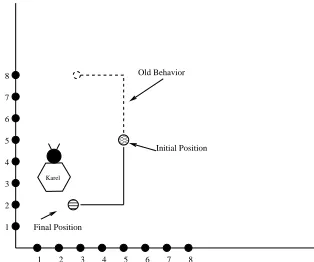
Figure 2 shows an instance of the DTD in Figure 1. This instance is an XML program that instructs Karel first to turn left, then to proceed two steps, turn left again and proceed two more steps. Karel’s route is shown in Figure 3. If we imagine that Karel is a real robot, that is instructed from some control host by sending these XML programs via, for example, a radio network, we have then achieved logical code mobility with XML.
Unlike Java programs, which are sent in a compiled form, XML programs are transferred as source code and then inter-preted on a remote host. Unlike Java, XML does not confine us to sending coarse-grained units of code; XML documents do not need to begin with the root of the DTD, they can also start with other symbols of the grammar. This enables us to specify sub-programs and even individual statements. We refer to such code fragments as XML program increments. Hence, we can specify complete programs as well as arbi-trarily fine-grained increments in XML.
As Karel is controlled by a slow radio network, we want to avoid re-sending the whole program but rather incrementally send new program increments. Figure 4 shows such a fine-grained program increment. We can imagine that we want to change the behaviour of Karel by replacing theturnleft statement with this increment and thus change the behaviour of Karel making it turn right instead of left1
. Note, that the
1
Because the Karel language does not have a primitive to turn right, we
<?xml version="1.0"?>
<!DOCTYPE times SYSTEM "karel.dtd"> <times howoften="3">
<turnleft/> </times>
root().child(1,times).child(1,turnleft)
Figure 5: XPointer Address for Increment.
DOCTYPEthat determines the root symbol in this increment is timesrather thanKarelProgramin the full XML program in Figure 2.
The question that arises is how we specify the insertion or replacement of program increments. Addressing particular locations in an HTML document is achieved by “anchors”. These anchors, however, cannot be defined by users who do not have control over the document but have to be included by the author of the document. Likewise in our approach, the sender of an increment does not have control over the program once it has been sent. However, we cannot assume that programmers identify anchors or other labels a-priori that could then later be used for incremental code insertion or replacements.
To solve this problem, we use XPointer, an XML-related standard. XPointer is part of the XLink specification [20] and overcomes the limitation of HTML by supporting navi-gations within XML documents. These navinavi-gations are capa-ble of addressing every document component without having to modify the document itself. We use XPointer to identify that component of an existing XML program that we want to replace with a new increment.
Going back to our example, Figure 5 shows an XPointer ex-pression that determines the Karel program statement that we want to replace. The XPointer expression starts from the root of the program and then selects the first statement of typetimes, and in that statement it selects the turnleft statement. Thus, by specifying a fragment of a program in XML together with an XPointer expression, we can express incremental code mobility. Figure 6 shows how Karel’s be-haviour will differ after the new increment has replaced the turnleftstatement.
have to implement turning right by turning left three times.
Karel
00 00 11 11
00 00 11 11
Initial Position
1 2 3 4 5 6 7 8 1
2 3 4 5 6 7 8
Final Position
Old Behavior
Figure 6: The Incremental Change to Karel’s Behaviour.
4 APPLICATIONS
In the preceding section we have presented our ideas through a deliberately simple example. In this section, we describe application domains that will benefit from incremental code mobility with XML. These include user interfaces engines, the management of applications on portable digital assis-tants, and the flexible co-ordination of consistency checks in distributed documents.
User-Interface Engines
The installation and administration of large-scale systems with thousands of clients is a potential application for in-cremental code mobility. The departure control system of airlines that are used to handle check-ins are good exam-ples. For large airlines or alliances, the clients implement-ing the user interface of such systems have to be deployed on several thousand machines, distributed across the globe. The machines are not necessarily owned by the airlines but are rather temporarily rented from airport authorities, which want to keep tight control on updates of software. Thus air-lines cannot frequently update the software that is installed on these machines.
It would be possible to accommodate changes by deploy-ing a Java Virtual Machine on each of these systems and downloading front-end applications from centralized servers. The Java approach, however, has two disadvantages. First it requires code of substantial size to be downloaded from a server, possibly through slow dial-up networks. Second, the Java code needs to be changed whenever the user interface needs to be changed. These limitations can be overcome by installing a general-purpose user interface engine onto each of the client machines that interpret high-level user interface descriptions.
XwingML is a DTD for a user interface description lan-guage [27]. It provides markup tags for all Java Swing user interface components and also provides an interpreter for XwingML documents that generates the desired user inter-faces. Applying our approach of code mobility with XML, the high-level descriptions of user interfaces can be sent from a centralized server to all distributed client hosts. As the user interface descriptions are rather small compared to the size of the Java byte code of the full user interface application, we avoid the first of the problems above. The second limi-tation is overcome because the user interface description is just an XML document, which can be generated by server applications.
Application Management on Mobile PDAs
An interesting application for our XML-based approach to code mobility arises when logical mobility meets physical mobility. Lightweight computing devices, such as Personal Digital Assistants (PDAs) are starting to be used for mission critical computing and, therefore, need to be integrated into enterprise computing environments. In these settings, it is important for all PDAs to run the same set of applications. An example for such a PDA deployment is the New York Stock Exchange (NYSE). NYSE has equipped its traders with PDAs, that are used for trade data entry and automated transmission between trade data and back office trade settling systems.
The applications that are used in financial markets have to evolve rapidly. Financial analysts invent new products known as derivatives on a regular basis. Once such a prod-uct has been created, the trading applications need to be ad-justed and be updated to support trading in these new deriva-tives. If the machines used were wired workstations it would be feasible to transfer and replace the complete code when needed, though the incremental approach described in this paper could also be applied. Our approach becomes essential when the devices used are thin clients such as PDAs; in this case incremental code updates are a valuable option, consid-ering occasional disconnection of PDAs and slow IRDA or radio network connectivity.
To take advantage of our approach application developers have to devise an XML-based scripting language for devel-oping trading applications. They also have to build an in-terpreter for this language which is then deployed on each PDA. Whenever an application needs to be changed, a pro-gram increment can be added to a list of updates that are kept on the server to which PDAs connect. Once a PDA physi-cally enters the trading room and establishes connection to the server, the server first checks the patch-level of the appli-cations on that PDA. The server will then incrementally send all application updates that are not yet deployed on the PDA.
The definition of an application-specific language and its implementation in an interpreter may sound difficult to ac-complish. It is, however, well supported. The application-specific language can refer to XWingML or MoDAL [1] for user interface definition purposes. The implementation of an interpreter is simplified by the availability of light-weight XML parsers. Moreover, Java Virtual Machines have already been developed for PDAs, such as 3COM’s Palm Pilot [26] and the Symbian operating system that will run on the next generation of mobile phones.
Consistency Management of Distributed Documents
In [10], we describe an approach for managing the consis-tency of distributed documents. We assume that documents are represented in XML themselves. This is a fair assump-tion, because Microsoft’s Office 2000 can save documents in XML format, IBM’s Visual Age environment uses XML
<ConsistencyRule id="r1" type="CT"> <id>r1</id>
<Description>
For every instance in a collaboration diagram there must be a class in a class diagram with the same name. </Description>
<Source> <XPointer>
root().child(all,Package). (all,CollaborationDiagram).
(all,Collaboration).(all,Instance) </XPointer>
</Source> <Destination>
<XPointer>
root().child(all,Package). (all,ClassDiagram).(all,Class) </XPointer>
</Destination>
<Condition expsource="origin().attr(CLASS)" op="equal"
expdest="origin().attr(NAME)"/> </ConsistencyRule>
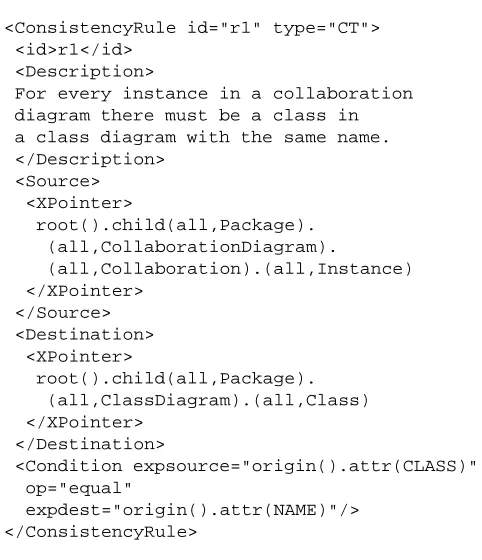
Figure 7: A Consistency Rule in XML Format.
as representation scheme for its project repository and most CASE tools can export UML diagrams in XMI.
The consistency management approach of [10] is based on a language that can express consistency rules. This lan-guage is, in fact, an XML programming lanlan-guage and Fig-ure 7 shows an example consistency rule expressed in the language.
The rule is based on the UXF DTD [29] for UML and de-mands that for each object in each collaboration diagram, there is a class in a class diagram whose name equals the type of the object. In [10], we also discuss the interpreter that executes these consistency rules in order to check the consistency of XML documents. The result of such a check for a rule is a set of XLink expressions that link consistent document fragments with each other and inconsistent docu-ment fragdocu-ments to an indicator of such inconsistency.
dif-XML doc. doc
XML doc XML
Consistency Rules in XML Format
Consistency Checker
HOST
XML doc. doc
XML doc XML
Consistency Rules in XML Format
Consistency Checker
HOST XML
doc. doc XML
doc XML
Consistency Rules in XML Format
Consistency Checker
HOST
Updates of Consistency Rules
Management Host
Figure 8: Consistency Management Architecture.
ferent team members and then at a higher level there can be rule sets that check for project-wide consistency.
A significant number of rules will be defined for realistic projects. However, for each developer, only a subset of rules will be relevant. This subset is determined by the types of documents that the developer currently modifies and also by the state of the project. Closer to deadlines more rules may be enforced than during initial stages. Thus, the sets of rules that are active at each of our rule interpreters cannot be static but has to change during the course of the project. In order to accommodate such changes, the set of rules that are active at each interpreter have to be changed. As each interpreter runs a different set of rules, this cannot be achieved using a broad-cast or a shared storage. New rules have rather to be added and existing rules may have to be deleted from the rule sets of individual interpreters. Using our approach, these changes can be triggered by a consistency supervisor component that uses incremental code migration to pass the XML-encoded consistency rules to the different rule interpreters involved.
Figure 8 shows the overall architecture of this approach. Each developer’s workstation and group and project servers run an interpreter for XML-consistency rules. The consis-tency supervisor manages the rule set of consisconsis-tency rules that are active for each of these interpreters and moves new rules incrementally to these interpreters, if necessary.
We have so far shown how we can use XML to define pro-grams and how we can define the update of code in an incre-mental fashion. In the next section we describe how we can utilize off-the-shelf XML technology in order to implement interpreters for application specific languages and how these interpreters implement incremental code updates.
5 IMPLEMENTATION OF THE APPROACH
After a programming language has been specified, an inter-preter for this language needs to be implemented. We first show how significantly off-the-shelf XML technology, most
import org.w3c.dom.*; //DOM API
import com.ibm.xml.parser.*; //XML Parser
public void execute(String program,
String update_location){ ...
//create a new parser for Karel Programs Parser parser=new Parser("Karel.dtd"); InputStream is;
// parser to read input stream from program is=new StringBufferInputStream(program); // root of parse tree for program in inc Document inc=parser.readStream(is); ...
}
Figure 9: Translating XML Program into an AST.
notably XML parsers and the implementations of the Doc-ument Object Model (DOM) [3], simplify the construction of such interpreters. Then, we explain how the communi-cation between sender and receiver can be achieved using distributed object technology. Finally, we focus on the im-plementation of incremental code mobility, demonstrate how XPointer processors support locating the increment to be up-dated, and how the DOM supports incremental syntax tree modifications.
Interpreter Implementation
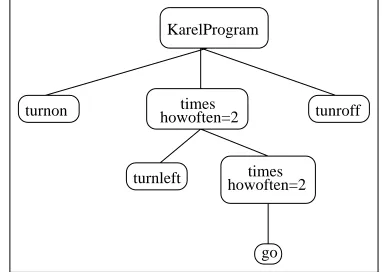
The first stage of interpreting a program involves the valida-tion of the syntactic correctness. As a result of that stage, interpreters produce an attributed abstract syntax tree (AST) of the program. If the program is written in XML, both tasks can be entirely delegated to a validating XML parser. We use IBM’s XML4J [2] but many other validating XML parsers exist. Figure 9 shows the use of the XML4J parser in our Java-based Karel interpreter. When invokingparseon the Karel code of Figure 2 the XML parser will construct the parse tree that is graphically represented in Figure 10.
KarelProgram
tunroff turnon
turnleft times howoften=2
times howoften=2
go
The next stage of the interpretation is a static semantic anal-ysis that checks, for example, the uniqueness of identifiers or the correct typing of expressions. This is often done while the interpreter is executing the code in order to avoid several traversals of the abstract syntax tree. Thus, while traversing the tree and visiting each node, the interpreter first checks for violations of the static semantics and then executes the operation that the node represents. Operations for traver-sals through ASTs that have been constructed from XML documents are standardized by the Document Object Model (DOM) [3] and are implemented in off-the-shelf products, such as IBM’s XML4J. The DOM traversal operations sup-port obtaining all the children of a node, querying the type of the node, obtaining values of node attributes and so on.
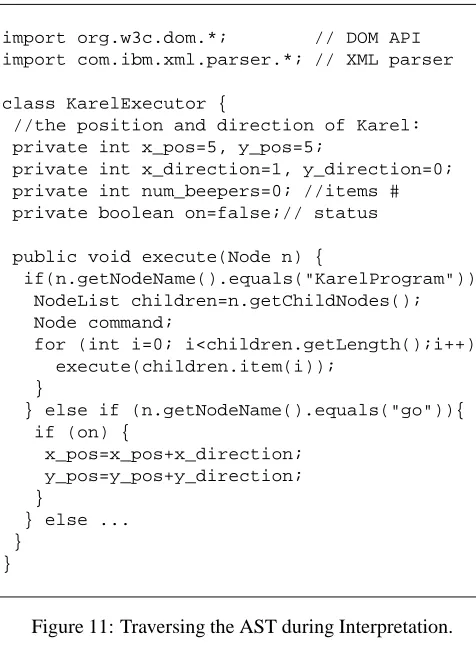
Figure 11 shows an excerpt of the Karel interpreter that tra-verses the abstract syntax tree and executes statements for each AST node. The actions usually modify some state vari-ables. In the case of Karel, these state variables indicate whether the robot has been switched on, its current position and direction and the number of items that it has picked up. The interpretation is then performed as a recursive method execute, which is initially passed the root node of the AST tree. It then examines the type of node and performs the appropriate action. For the root node, it recursively calls ex-ecute for all its child nodes. For instance, for a node of type go, it adds the current direction to its co-ordinates. We note that for Karel, the implementation of each command requires a few lines of code and in total is about 50 lines of Java code.
Code Mobility
In order to support code mobility, an XML program is sent from a remote host rather than being read it from a local file system. Any transfer protocol could be used for this purpose, however in our example we have used Java/RMI [16] due to its simplicity. XML programs are passed as parameter of remote invocations. The object invoked implements the in-terpreter for the XML program. The inin-terpreter understands all possible XML programs written according to the DTD of Karel’s language. Figure 12 shows the migration of the code to the remote host.
In order to facilitate the remote communication that trans-mits the mobile code, the Karel Interpreter declares the re-mote interfaceKarelas shown in Figure 13. That interface is implemented by the Karel interpreter. This enables a con-troller that resides on one host to send Karel programs for interpretation on a different host. Note that we do not trans-fer the DTD together with the code but rather assume that the DTD is stored locally. This choice derives from the ob-servation that the interpreter implementation is very tightly linked to the DTD, because the DTD is the grammar of the language and every interpreter is dependent on the grammar of the language that it executes.
Incremental Code Mobility
So far, we have shown how to parse and interpret the
pro-import org.w3c.dom.*; // DOM API
import com.ibm.xml.parser.*; // XML parser
class KarelExecutor {
//the position and direction of Karel: private int x_pos=5, y_pos=5;
private int x_direction=1, y_direction=0; private int num_beepers=0; //items # private boolean on=false;// status
public void execute(Node n) {
if(n.getNodeName().equals("KarelProgram")){ NodeList children=n.getChildNodes(); Node command;
for (int i=0; i<children.getLength();i++){ execute(children.item(i));
}
} else if (n.getNodeName().equals("go")){ if (on) {
x_pos=x_pos+x_direction; y_pos=y_pos+y_direction; }
} else ... }
}
Figure 11: Traversing the AST during Interpretation.
XML
document
HOST1 HOST2
INTERPRETER DTD
Figure 12: XML Program Migration to Remote Interpreter.
gram, which is passed as the first parameter to theexecute method in Figure 13. The second parameter is an XPointer expression. If this XPointer expression is not empty and is well-formed, it will identify a node in the abstract syntax tree that needs to be replaced with the program increment that is
import java.rmi.*; import java.io.*;
public interface Karel extends Remote { void execute(String program,
String update_location) throws RemoteException,
UnambiguousInsertException; } // Karel
HOST1 HOST2 INTERPRETER
DTD document
XML
Increment XML XPointer directions
Figure 14: Increment Migration to Robot Site.
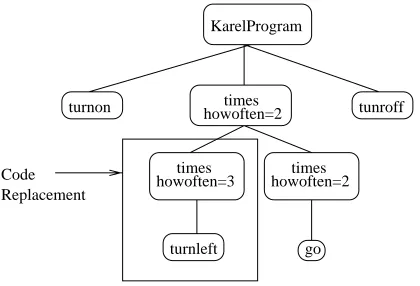
passed as the first parameter toexecute. Figure 14 shows the migration of the increment code. The strategy for im-plementing incremental code mobility is then as follows: we first parse the program increment passed as the first parame-ter and construct an syntax tree for the increment, we evalu-ate the XPointer expression and replace the node addressed in the expression with the root node of the syntax tree of the increment. This replacement is shown in Figure 15.
In order to implement this strategy for incremental updates, we again take advantage of the DOM. Parsing the program increment and constructing the AST for it is achieved in the same way as for the full program. This time, the parser just creates a tree whose root node type is different from the root type of the DTD. In case of our Karel increment, a root in-crement node of typetimesis created.
The evaluation of the XPointer expression for the replace-ment node can be fully delegated to an XPointer processor. Again there are several of those processors available and we use the one that comes with XML4J. Figure 16 shows how we use the XPointer processor in order to locate the node that needs to be replaced. The replacement of the code in-crement is shown at the bottom of Figure 16. We navigate to the parent node ofreplaceand use standard DOM opera-tions to substitute it with the root node of the syntax tree of the increment that was sent.
6 EVALUATION
In this section we discuss the advantages and current disad-vantages of the approach. We also hint at how the disadvan-tages may be overcome.
times howoften=2 times
howoften=3
go turnleft
KarelProgram
tunroff
turnon howoften=2times
Code Replacement
Figure 15: Result of Incremental Code Update on AST.
import org.w3c.dom.*; // DOM API
import com.ibm.xml.parser.*; // IBM parser import com.ibm.xml.xpointer.*;//IBM xpointer ...
public void execute(String program,
String update_location) throws RemoteException,
AmbiguousInsertException { ...
// create an XPointer object from // the update location that is passed XPointerParser xpp=new XPointerParser(); XPointer xp=null;
xp=xpp.parse(update_location);
// Interpret XPointer object from the //root node of the previously parsed doc Pointed nodelist=xp.point(root);
if (nodelist.size()!=1) {
throw new AmbiguousInsertException(); } else {
Node replace=(nodelist.item(0)).node; Node parent=replace.getParentNode(); //we get the parent node
if (parent==null)
throw new AmbiguousInsertException(); //child replacement with the new code parent.replaceChild(
inc.getDocumentElement(),replace); }
}
Figure 16: Evaluating XPointer Expression.
We have demonstrated how XML and its related technolo-gies can be used for both specifying and implementing in-cremental code mobility at any granularity. By not fixing a particular granularity for mobile code, we enable complete programs as well as individual lines of code to be sent across the network. The combination of fine-grained and incremen-tal mobility achieves a degree of flexibility previously un-available. We have examined the application of incremen-tal and fine-grained code mobility to user interface manage-ment, application management on PDAs and management of distributed documents.
The success of the approach critically depends on the abil-ity to encode a high-level programming language in an XML DTD. Our Karel example has demonstrated that this is possi-ble. The XwingML DTD suggests this can also be achieved in a scalable way. We can envisage that our approach will be used to write XML versions of interpreted languages, such as Javascript. We could then build a compiler that translates between Javascript and the XML encoding and an XML in-terpreter that wraps an existing Javascript inin-terpreter.
note that this may be overly restrictive. However, the strate-gies shown here can also be applied to add or delete pieces of code to or from the original program. To address insertion points or identify the fragments of deletion, we could use XPointer in the same way. To implement the changes to the abstract syntax tree, we could use theinsertanddelete operations of the DOM.
The interface shown in Figure 13 contains only one possible method (i.e.,execute) to replace a fragment of code and execute the program. However, this is only a simplification of what is feasible with the approach; the interface can be extended with other methods, one for each operation that can be performed (i.e, replace, add, remove, execute), adding a higher level of flexibility to the ability of manipulating code (and data) of the remote entity. The primitives to implement all these operations are provided by both DOM and XPointer. XPointer enables us to address any node in the tree and DOM supports incremental insertion, removals and modification to nodes in the document’s tree representation.
In the example presented in the paper we did not describe the combination of data and code mobility, in a step towards agent mobility. To achieve this in our Karel example, we could change the DTD of Karel’s language and add an en-coding for the position and other state attributes of Karel. In this way we can write an XML program containing Karel’s position initialization. The interpreter would have to be mod-ified as well in order to be able to obtain the information (i.e. the initial position), and to initialize Karel’s status correctly.
We used RMI for implementing the migration of the XML program in the example. The approach, however, is inde-pendent of the transport protocol, as long as XML is used to encode the moving code. The advantages of using distributed object technologies, such as RMI, together with mark-up lan-guages are reported in [11]. In our context any other trans-port protocol could have been used. Distributed object tech-nologies add a significant overhead that is however balanced through the use of available middleware services such as transactions, and security. The choice and the trade-off eval-uation of the transport technology is extremely application dependent, and beyond the scope of this paper.
The incremental update of the code is done after the robot has terminated an execution. However, in some applications it may be convenient to apply the changes to the program while the program is executing. The user interface application is a good example. This is feasible in our approach as well. Nev-ertheless, it would raise problems related to the maintenance of the program counter and the updating of operations in a cycle. However, if the language is simple enough this might be feasible.
Furthermore, incremental updating of code raises a series of issues related to access control problems: for instance, what happens if the code is updated twice by different principals? No one of the parties would know the actual status of the
program. In our perspective we see applications in “code-distribution” oriented domains, where a single sender has full control of the code and has the right to update it. If we did not use RMI, but CORBA to transmit the code, the CORBA security service could be used to enforce these access rights.
7 SUMMARY AND FURTHER WORK
In this paper we presented an incremental approach to code mobility using the XML language. The novelty of the ap-proach is the ability to send code incrementally instead of re-sending complete updated versions of the code. Java based technologies launched the idea of object and classes mobil-ity, allowing a set of new paradigms for communication to become feasible.
Many theoretical languages have been used to specify and analyze code mobility [7, 22, 8, 12, 21]. The movement is specified with different granularities showing that the Java point of view, where a class is the unit of mobility, was not the only possibility to be explored.
In this paper we have shown a possible embodiment of these ideas, and described a set of potential application. We will now develop one of these applications in order to have a benchmark that we can use to evaluate the approach. In par-ticular, we want to study performance issues and understand the trade-off between space and speed overhead compared to Java byte code transmission.
We are also interested in exploring the security implications of code migration and addressing them with the security ser-vices that object-middleware provides. By implementing in-terpreters as CORBA objects and using the access control interfaces of the CORBA Security service, we can guaran-tee that only authorized principals are performing changes to code.
In [9] displets are used to render special tags defined in XML using Java specific code for displaying formal notation on the Web. We see possible development of our work with the inte-gration of this technique; DTDs and Java fragments could be sent together in order to update the ability of the interpreter to understand new constructs. We are also interested in pro-viding support for proactive code mobility by adding specific XML tags like go, that are available in other mobile code lan-guages [14]. They are interpreted as movement commands: this extension introduces many issues related with the dy-namic modification of code. However, we believe this would extend the potential of the approach described in the paper considerably.
PDAs as application platforms with an e-commerce provider. In this setting, we will explore the use of incremental code mobility for application management purposes.
ACKNOWLEDGEMENTS
We are indebted to G.P. Picco for his detailed comments and interesting suggestions on an earlier draft of this paper. We would like to thank P. Ciancarini, E. Ellmer, G.-C. Roman, and A. Zisman for the helpful discussion on the topic. We also acknowledge the support of the European Union through the RENOIR project.
REFERENCES
[1] IBM Alphaworks. MoDAL.
http://www.alphaworks.ibm.com/tech/modal, 1999.
[2] IBM Alphaworks. XML4J.
http://www.alphaworks.ibm.com/tech/xml4j, 1999.
[3] V. Apparao, S. Byrne, M. Champion, S. Isaacs, I. Jacobs, A. Le Hors, G. Nicol, J. Robie, R. Sutor, C. Wilson, and
L. Wood. Document
Object Model (DOM) Level 1 Specification. W3C Recom-mendation http://www.w3.org/TR/1998/REC-DOM-Level-1-19981001, World Wide Web Consortium, October 1998. [4] G. Booch, I. Jacobson, and J. Rumbaugh. The Unified
Model-ing Language User Guide. Addison Wesley, 1999.
[5] T. Bray, J. Paoli, and C. M.
Sperberg-McQueen. Extensible Markup Language. Recom-mendation http://www.w3.org/TR/1998/REC-xml-19980210, World Wide Web Consortium, March 1998.
[6] L. Cardelli. A language with distributed scope. In Proc.
22nd
ACM Symp. on Principles of Programming Languages (POPL), 1995.
[7] L. Cardelli and A. Gordon. Mobile Ambients. In Proc. of
Foundations of Software Science and Computation Structures (FoSSaCS), European Joint Conferences on Theory and Prac-tice of Software (ETAPS’98), volume 1378 of LNCS, Lisbon,
Portugal, 1998. Springer.
[8] P. Ciancarini, F. Franz`e, and C. Mascolo. Using a Coordi-nation Language to Specify and Analyze Systems containing Mobile Components. ACM Trans. on Software Engineering
and Methodology, page To appear, 2000.
[9] P. Ciancarini, F. Vitali, and C. Mascolo. Managing
com-plex documents over the WWW: a case study for XML.
IEEE Transactions on Knowledge and Data Engineering,
11(4):629–238, July/August 1999.
[10] E. Ellmer, W. Emmerich, A. Finkelstein, D. Smolko, and A. Zisman. Consistency Management of Distributed Docu-ments using XML and Related Technologies. Research Note 99-94, University College London, Dept. of Computer Sci-ence, 1999. Submitted for Publication.
[11] W. Emmerich, W. Schwarz, and A. Finkelstein. Markup
Meets Middleware. In Proc. of the7
th
Int. Workshop on Fu-ture Trends in Distributed Systems, Capetown, South Africa.
IEEE Computer Society Press, 1999. To appear.
[12] C. Fournet, G. Gonthier, J.J. Levy, L. Maranget, and D. Remy.
A Calculus of Mobile Agents. In Proc. 7th
Int. Conf. on Concurrency Theory (CONCUR ’96), volume 1119 of LNCS.
Springer, 1996.
[13] A. Fuggetta, G.P. Picco, and G. Vigna. Understanding Code Mobility. IEEE Trans. on Software Engineering, 24(5):342– 361, 1998.
[14] R.S. Gray. Agent Tcl: A transportable agent system. In Proc.
of the CIKM Workshop on Intelligent Information Agents,
Bal-timore, Md., Dec. 1995.
[15] ISO 8879. Information processing – Text and Office Sys-tems – Standardised General Markup Language SGML. Tech-nical report, International Standards Organisation, 1986.
[16] JavaSoft. Java Remote Method Invocation Specification, revi-sion 1.50, jdk 1.2 edition, October 1998.
[17] J. Kiniry and D. Zimmerman. A Hands-On Look at Java Mo-bile Agents. IEEE Internet Computing, 1(4):21–33, 1997.
[18] D. E. Knuth. Semantics of Context-Free Languages.
Mathe-matical Systems Theory, 2(2):127–145, 1968.
[19] General Magic. Telescript Language Reference. General
Magic, Oct. 1995.
[20] E. Maler and S. DeRose. XML Linking Language
(XLink). Technical Report http://www.w3.org/TR/1998/WD-xlink-19980303, World Wide Web Consortium, March 1998.
[21] C. Mascolo, G.P. Picco, and G.-C. Roman. A Fine-Grained Model for Code Mobility . In O. Nierstrasz and M. Lemoine, editors, Proc. 7th European Software Eng. Conf. (ESEC/FSE
99), Toulouse, France, volume 1687 of LNCS, pages 39–56.
Springer, 1999.
[22] P. J. McCann and G.-C. Roman. Compositional Programming Abstractions for Mobile Computing. IEEE Trans. on Software
Engineering, 24(2):97–110, 1998.
[23] Object Management Group. XML Meta Data Interchange
(XMI) – Proposal to the OMG OA&DTF RFP 3: Stream-based Model Interchange Format (SMIF). 492 Old
Connecti-cut Path, Framingham, MA 01701, USA, October 1998.
[24] Object Management Group. XML/Value Request for
Propos-als. 492 Old Connecticut Path, Framingham, MA 01701,
USA, August 1999.
[25] R. Pattis, J. Roberts, and M. Stehlik. Karel the Robot. Wiley, 1994.
[26] BlueStone Software. XML Contact.
http://www.bluestone.com/xml/XML-Contact/, 1999.
[27] BlueStone Software. XwingML.
http://www.bluestone.com/xml/XwingML/, 1999.
[28] J.W. Stamos and D.K. Gifford. Remote Evaluation. ACM
Trans. on Programming Languages and Systems, 12(4):537–
565, Oct. 1990.
[29] J. Suzuki and Y. Yamamoto. Making UML models exchange-able over the Internet with XML: The UXF Approach. In P.-A. Muller and J. Bezivin, editors, Proc. of Int. Workshop
on UML ’98, Mulhouse, France, Lecture Notes in Computer
Science. Springer, 1999. To appear.
[30] C.F. Tschudin. An Introduction to theM0Messenger
Lan-guage. Univ. of Geneva, Switzerland, 1994.