Adaptively Secure Proxy Re-encryption
Georg Fuchsbauer1, Chethan Kamath2, Karen Klein2, and Krzysztof Pietrzak2 1
Inria and ENS Paris [email protected]
2
IST Austria
{ckamath,karen.klein,pietrzak}@ist.ac.at
Abstract. A proxy re-encryption (PRE) scheme is a public-key encryp-tion scheme that allows the holder of a keypkto derive a re-encryption key for any other keypk0. This re-encryption key lets anyone transform ciphertexts underpkinto ciphertexts underpk0 without having to know the underlying message, while transformations from pk0 to pk should not be possible (unidirectional). Security is defined in a multi-user set-ting against an adversary that gets the users’ public keys and can ask for re-encryption keys and can corrupt users by requesting their secret keys. Any ciphertext that the adversary cannot trivially decrypt given the obtained secret and re-encryption keys should be secure.
All existing security proofs for PRE only showselective security, where the adversary must first declare the users it wants to corrupt. This can be lifted to more meaningful adaptive security by guessing the set of corrupted users among thenusers, which loses a factor exponential inn, rendering the result meaningless already for moderaten.
Jafargholi et al. (CRYPTO’17) proposed a framework that in some cases allows to give adaptive security proofs for schemes which were previously only known to be selectively secure, while avoiding the exponential loss that results from guessing the adaptive choices made by an adversary. We apply their framework to PREs that satisfy some natural additional properties. Concretely, we give a more fine-grained reduction for several unidirectional PREs, proving adaptive security at a much smaller loss. The loss depends on the graph of users whose edges represent the re-encryption keys queried by the adversary. For trees and chains the loss is quasi-polynomial in the size and for general graphs it is exponential in their depth and indegree (instead of their size as for previous reduc-tions). Fortunately, trees and low-depth graphs cover many, if not most, interesting applications.
Our results apply e.g. to the bilinear-map based PRE schemes by Ate-niese et al. (NDSS’05 and CT-RSA’09), Gentry’s FHE-based scheme (STOC’09) and the LWE-based scheme by Chandran et al. (PKC’14).
1
Introduction
A proxy re-encryption (PRE) scheme is a public-key encryption scheme with an additional functionality: Alice and Bob, who have key pairs (pkA,skA) and
rkA,B that allows its holder, say Peggy, to act as a proxy; that is, she can
transform ciphertexts under pkA to ciphertexts under pkB without having to know the underlying message. A trivial way to accomplish this would be for Alice to hand her secret key skA to Peggy, who can then decrypt ciphertexts
underpkA, encrypt them underpkBand send them to Bob. Alice’s secret key acts thus as the re-key and de- and encryption algorithms are used for re-encryption. However, this approach requires Alice to reveal her secret key to Peggy and therefore place complete trust on her. The more interesting cases are when the parties are mutually distrustful.
Bidirectional vs. unidirectional. In the above setting, if the re-keyrkA,B
allows Peggy to also transform ciphertexts underpkB to pkA, the PRE scheme is called “bidirectional”. For such schemes the re-key is necessarily a function of both skA andskB. In this paper we are interested in the more interesting case
of “unidirectional” PRE schemes where the re-key rkA,B can only transform
ciphertexts frompkAtopkB, and not vice-versa, and ciphertexts underpkB re-main secure even givenskAandrkA,B. (Henceforth we will always assume PREs
to be unidirectional.) As opposed to bidirectional PREs, the re-key generation algorithm in a unidirectional PRE takes as input “source” keys (pkA,skA) and
only the “target” public keypkB.
Single hop vs. multiple hops. Suppose a third user, Charlie, holding keys (pkC,skC), enters the picture and suppose Peggy obtains the re-keyrkB,Cthat
allows her to transform ciphertexts under Bob’s public key to ciphertexts under Charlie’s public key. Peggy can, by definition, transform a ciphertext cA under
pkA to a ciphertextcB underpkB using her re-keyrkA,B. If it allows Peggy to
transform ciphertextcB, which has already been re-encrypted once, to a
cipher-text cC under pkC using the re-key rkB,C then we say that the PRE scheme
allows two “hops”. In a similar manner, one can consider multiple hops of re-encryptions. Such a scheme is termed “multi-hop” as opposed to a “single-hop” scheme (which does not allow re-encryptions of already re-encrypted cipher-texts).
1.1 Modelling Security
The basic notion of security for unidirectional PREs is that of indistinguishability under chosen-plaintext attack (CPA). There arenusers and, at the beginning of the game, the adversary gets their public keyspk1, . . . ,pkn from the challenger. In the first phase, the adversary can corrupt users of its choice by requesting their secret keys; in the second phase, it can obtain re-keysrki,j and re-encryptions
for ciphertexts of its choice. The scheme is CPA-secure if it is infeasible for the adversary to distinguish encryptions of two messages under a key that the adversary has not corrupted either directly or indirectly (through a re-key or re-encryption query to a corrupted user).
access to a decryption oracle which, on input a ciphertext and a public keypki returns the decryption of the ciphertext under ski. The conditions to ensure
non-triviality have to be altered accordingly.
We note that both definitions are selective in nature: the adversary must choose the set of players it corrupts before issuing any queries.
1.2 Prior Work
Bidirectional PREs were introduced as “atomic proxy cryptography” by Blaze, Bleumer and Strauss [BBS98], who constructed a multi-hop scheme under the decisional Diffie-Hellman assumption. Unidirectional PREs were introduced later by Ateniese et al. [AFGH05]. Their main motivation was to limit the amount of trust placed on the proxy, as required by their application to access control for distributed storage. Since the notion of security for unidirectional PRE is differ-ent from a bidirectional PRE, they also reformulated the notion of CPA (for the single-hop setting). Assuming hardness of certain problems on bilinear groups, they constructed CPA-secure schemes that are single-hop and unidirectional.
The definition of CCA security for single-hop bidirectional schemes is due to Canetti and Hohenberger [CH07] and is more involved than previous definitions, mainly because the adversary is allowed adaptive corruption. They gave a scheme satisfying their notion under the standard decisional bilinear Diffie-Hellman as-sumption. The definition of CCA security in the unidirectional setting is due to Libert and Vergnaud [LV08], who instantiate it under a slightly non-standard assumption on bilinear groups.
The earlier constructions of multi-hop, unidirectional schemes were based on program obfuscation [HRsV07, CCV12]. In his seminal paper, Gentry [Gen09] gave a generic construction of PREs from fully homomorphic encryption. The first construction (with succinct ciphertexts) based on a standard assumption is due to Chandran et al. [CCL+14]: their scheme is CPA-secure assuming deci-sional learning with errors. Phong et al. [PWA+16] followed up with a construc-tion that, in addiconstruc-tion, enjoys a security property called “key-privacy”. The only construction of a CCA-secure multi-hop, unidirectional scheme is due to Fan and Liu [FL17]. In their paper, they also rigorously defined the security models (CPA and CCA) for the multi-hop setting.
Cohen [Coh17] has recently argued that CPA security might be too weak for some applications and introducedindistinguishability against honest-reencryption attack (HRA), a notion that implies CPA (but is incomparable to CCA). He also showed that if a PRE satisfies a property called “source-hiding”, which several existing CPA-secure schemes do, then HRA security reduces to CPA security.
1.3 Our Contribution
where the adversary is allowed to corrupt users at any time during the game. However, modelling this turns out to be as tricky as in the bidirectional setting. In this paper, we lift the definitions for CPA and HRA to the adaptive setting.
1.3.1 First Contribution: Modelling Adaptive Corruption. The main problem that arises when we allow the adversary to adaptively corrupt users is that we must ensure that the adversary cannot trivially win the security game. For bidirectional PREs this was handled in [CH07] by defining a relation that keeps track of the dependency between the re-keys and re-encryptions that were issued during the game. Our approach is similar in spirit: the security game maintains a “recoding graph” that has n nodes, and whose edges are derived from the re-keys and re-encryptions issued to the adversary. The exact definitions of the recoding graph for adaptive CPA and for adaptive HRA differ slightly, but in both cases it is defined so that no corrupt key is reachable from the challenge key. That is, the adversary is forbidden from makingany re-key or re-encryption queries to a corrupt user that is reachable from the challenge key. The recoding graph now allows to ensure non-triviality of the adversary’s actions by checking a few basic graph properties.
1.3.2 Second Contribution: The Reduction. Proving adaptive security can be reduced to showing selective security by initially guessing the set of users that will be corrupted. However, this reduction loses an exponential factor in n, rendering the reduction meaningless already for moderate n. As our main contribution, we give a more fine-grained reduction from adaptive to selective security which in many practical settings and for several existing schemes (or minor variants) implies adaptive security at much smaller (quasi-polynomial, or even polynomial) loss. More precisely, the loss in our reduction depends on the structure of the recoding graph: for trees and chains we get a quasi-polynomial nO(logn) loss, whereas for general graphs the loss is exponential in their depth. Fortunately, trees, chains, and low-depth graphs cover many, if not most, inter-esting applications.
Security assumptions. A key step in our search for a tighter reduction was the identification of the basic security assumptions on a PRE that we required in our arguments. For the case of CPA, it turned out to be ciphertext indis-tinguishability andweakkey-privacy, both fairly standard security requirements already explored in some of the previous works.
The notion of key-privacy was introduced in a strong form in [ABH09]. We require the PRE to satisfy a much weaker property, namely that a re-keyrkA,B
looks pseudorandom given just the source and target public keyspkA andpkB. Existing PRE schemes that satisfy the stronger key privacy as defined in [ABH09] are therefore candidates for our reduction.
To apply our reduction to HRA-secure PRE, we need a third assumption to hold: source-hiding. This is the same property that allowed Cohen [Coh17] to lift a CPA-secure PRE to a HRA-secure one. Informally, a PRE is source-hiding if ciphertexts that result from re-encryptions are distributed close to fresh encryptions (at the corresponding level).
For PRE satisfying these assumptions, we show that the framework of Ja-fargholi et al. [JKK+17], who gave an abstraction of the techniques from [FKPR14], can be applied. This framework has been used to show adaptive security of a variety of cryptographic protocols (e.g., secret sharing, garbled circuits etc.) in the “symmetric-key” setting while avoiding an exponential loss that typically results from the guessing step when going from selective to adaptive security. Its application to PREs in the work is the first in the “public-key” setting. We describe their framework in more detail below.
The JKK+ framework. A standard way to prove adaptive security is to first define a “selective” variant that requires the adversary to commit to some of its choices (e.g., whom to corrupt, or on what input to be challenged at the end) at the beginning of the game. LetW denote the set of all possible choices.
Consider a selective security notion defined as two gamesH0 and H1 being indistinguishable. A security proof often uses a hybrid argument: one defines a sequence of hybrid games (H0, . . . ,Hτ) where the first and last games correspond
to the original selective games (i.e., H0 =H0 and H1 =Hτ). One then proves
that any two consecutive hybrids (Ht and Ht+1) are-indistinguishable. As in-distinguishability satisfies the triangle inequality, the extreme gamesH0andHτ
are (·τ)-indistinguishable.
Now to prove security against an adaptive adversary (who will not reveal its choices at the beginning), one defines a new reduction that just guesses the ad-versary’s future choices at random from the setW and then follows the selective reduction. Conditioned on the guess being correct, this reduction has the same success probability as the selective one.
Unfortunately, the overall loss in security of this second step is as large as the size of W, which is typically exponential (e.g., exponential in the num-ber of parties that can be corrupted). Thus, if the selective reduction implied -indistinguishability (based on some underlying assumption), the adaptive re-duction will only imply (· |W|)-indistinguishability, which in most cases will be meaningless.
The key observation in [JKK+17] was that in many selective reductions as
such cases is only exponential in the length ofh(w) (its the longest value for any two consecutive hybrids), and not exponential in the length of the entirew.
In all the instances to which the [JKK+17] framework has been applied the
simulation of the security game depends on some underlying graph (e.g., the access structure in secret sharing or the Boolean circuit in case of garbling) and the hybrid games involve incremental changes to the simulation depending on the structure of this graph. Jafargholi et al. managed to decouple the particulars of the simulation from the design of the hybrids by using a pebbling game on the graph (the graph must thus be directed and acyclic). To be more precise, they associated the simulation of a hybrid (Ht) to a pebbling configuration (Pt), and
therefore the incremental changes in the simulation to the pebbling sequence (P0, . . . ,Pτ). In particular, if a vertex carries a pebble then the part of
simula-tion of the hybrid that is dependent on the vertex is carried out in a different manner (e.g., in garbling using Yao’s scheme the ciphertexts in the garbled table for a gate are all bogus). The rules of the simulation is what then determines the pebbling rules, i.e., when exactly a pebble can be placed on or removed from a vertex. The extreme hybrids correspond to the initial and final pebbling con-figurations, and the immediate goal is to show that two hybrids that differ by a pebble are indistinguishable to an adversary. Indistinguishability of the original games then follows by transitivity of indistinguishability.
In the fully selective games of the above examples, the adversary commits to the whole graph; but, as explained above, knowledge of the vertices that are pebbled suffices to simulate the intermediate hybrids. Therefore, in the partially selective game the adversary “commits” to some pebbling configuration. Since we have established a correspondence between the simulation and a pebbling configuration, the task of designing a better sequence of hybrids has been re-duced to finding a better pebbling sequence. In particular, the fewer pebbles are on the graph at any particular time, the more concisely we can describe this configuration, and thus the smaller the incurred security loss.
Designing the hybrids. The graph that underlies the simulation in adaptive CPA and HRA is precisely the recoding graph. (Strictly speaking, it suffices to consider the subgraph that is reachable from the challenge vertex, which we will call the “challenge graph”.) The presence (or not) of a pebble on a vertex dictates how the re-encryption and re-key queries outgoing from that vertex are simulated. Therefore in the fully selective games, the adversary commits to the recoding graph (which is different from the original selective game in which the adversary committed to the set of corrupt users), whereas in the partially selective games it “commits” just to a pebbling configuration.
Let us first consider adaptive CPA: the edges of the recoding graph corre-spond to the re-key and re-encryption queries made by the adversary during the game. For simplicity, assume that the recoding graph has a single source vertex i∗ that is also the vertex the adversary wants to be challenged on. Once it has made all the queries, the adversary receives its challenge, which is the encryption of eitherm∗0 orm∗1underpki∗; letCPA0andCPA1denote the respective games.
CPA1follows from ciphertext indistinguishability (the first assumption): The re-duction embeds the challenge public key (of the indistinguishability game) as the i∗-th key, relays (m∗0, m∗1) to its challenger and forwards the challenge ci-phertext it receives to the adversary. As there are no outgoing re-keys from i∗, the simulation does not require the secret keyski∗.
In casei∗ does have outgoing edges, the idea is to use a sequence of hybrids to reach a game where knowledge ofski∗ is not required for simulation, just like
above. To argue indistinguishability of hybrids, we use weak key-privacy, which guarantees that a re-key looks pseudorandom given the source and target public keys. Weak key-privacy allows the simulator to fake the outgoing edges from a vertex, after which the secret key for this vertex is not required for simulation anymore. However, the simulator cannot fake edges right away: it has to fake all children of a vertex first, before it can rely on weak key-privacy. Consequently, the pebbling must obey the following rule: in a move, a pebble can be placed on or removed from a vertex only if all its children carry pebbles.
To be precise, in gameHbt, for each pebbled vertex inPtall queried re-keys
outgoing from that vertex are faked. Observe that as the secret key corresponding to a vertex is used only for the generation of the re-keys outgoing from that vertex, the simulation of a hybrid can be carried outwithout knowledge of the secret key corresponding to the pebbled vertices. Thus, a pebbling sequence describes a sequence of hybrids.
Main result. Our main result bounds the security loss for arbitrary recoding graphs in terms of their space and time complexity, where a graph is said to have space complexityσ and time complexityτ if there exists a valid pebbling strategy for that graph that uses at mostσpebbles and requires at mostτmoves. More generally, a class of graphs has space complexityσand time complexityτ if this is the case for every graph in that class.
Theorem 1 (Informal Theorem 5 and Theorem 6). Let G(n) denote a family of graphs on n vertices with space-complexity σ and time-complexity τ. Then a PRE that is ciphertext-indistinguishable and weakly key-private for com-putationally bounded adversaries is also adaptively CPA-secure against compu-tationally bounded adversaries for recoding graphs inGwith a loss in security of
≈τ·nσ. If the PRE is also statistically source-hiding then it is also adaptively
HRA-secure.
In many applications, the underlying recoding graph is has a very particular structure like trees (or even paths) and low-depth graphs, which cover many interesting applications. For paths, or fixed-arity trees, our reduction only loses a quasi-polynomial factor. For low-depth graphs, the loss is exponential only in the depth (and thus polynomial for fixed depth-graphs). Below, we mention two such applications.
Table 1: PRE schemes we prove adaptively CPA and HRA secure (see§5for the definitions of the assumptions).
Scheme Setting Assumption(s) Hops
Construction2[AFGH05] Bilinear maps eDBDH and XDH Single
Construction4[ABH09] Bilinear maps eDBDH and DLin Single
Construction5[Gen09] – FHE Multiple
Construction7[CCL+14] Lattices LWE Multiple
to hand it the decryption key. When using PRE, the client can simply send a re-key to the server, which enables it to locally re-encrypt all ciphertexts to the new key. In this application the recoding graph is simply a chain. 2. Another common application is forwarding of encrypted email without
in-volving the receiver, say, for delegation during vacation or for filtering spam emails. In most cases the underlying delegation structure will be captured by simple graphs. For example, if delegation only happens to subordinates, the depth of the recoding graph is bounded by the depth of the hierarchy of the organisation.
1.3.3 Third Contribution: Adaptively-Secure PREs. Finally, we show that the aforementioned three properties are satisfied by several existing con-structions or by minor variants thereof, and thus Theorem1 can be applied to them. An overview of these schemes is given in Table1. We consider the most in-teresting corollary to our results the adaptive security of the LWE-based scheme by Chandran et al. [CCL+14]:
Theorem 2 (Informal Theorem 11). The quasi-polynomially secure deci-sional LWE problem implies multi-hop, unidirectional adaptively CPA/HRA-secure PRE for chains or complete binary trees.
2
Formal Definitions
Notation. We use [a, b] to denote{a, a+1, . . . , b}and [b] as a shorthand for [1, b]. We will only consider logarithms to the base 2 (i.e., log := log2). For two sets
X,Ywe writeX∆Y for the symmetric difference. We writex← X for sampling an elementxuniformly at random from the setX; analogously,x1, . . . , xn← X
denotes sampling x1, . . . , xn independently and uniformly at random from the
X ≡ Y if X has the same input/output distribution as Y. Two distributions X ={Xκ}κ∈N and {Yκ}κ∈N are (s, )-indistinguishable, denotedX ≈(s,)Y, if
for every adversaryAof size at mosts
|P[A(X) = 1]−P[A(Y) = 1]| ≤.
Throughout the paper, we will repeatedly use the following lemma concerning the transitivity of the indistinguishability relation≈:
Lemma 1. Let X, Y, Z be distributions on a set X. If X ≈(s1,1) Y and Y ≈(s2,2)Z, thenX ≈(min(s1,s2),1+2)Z.
For indistinguishability-based security games, we usehG,Aito denote the bit output by the challengerGat the end of its interaction with the adversaryA. We say that two gamesG0 andG1 are (s, )-indistinguishable, denotedG0≈(s,)G1, if for every adversaryAof size at mosts
|P[hG0,Ai= 1]−P[hG1,Ai= 1]| ≤.
For an algorithm A, we use sA to denote its size; in a similar manner, for a set X, we usesX to denote the complexity of sampling fromX uniformly at
random.
Notation for graphs. We letG= (V,E) denote a directed graph with vertices
V (usually V = [n] for some n ∈ N) and edges E ⊆ V2. The indegree (resp., outdegree) of a vertex is defined as the number of edges coming in to (resp., going out of) that vertex. The indegree (resp., outdegree) of the graph is the maximum indegree (resp., outdegree) over all the vertices. A vertex with indegree (resp., outdegree) zero is called a source (resp., sink). A vertex i is connected to another vertexj (or alternativelyj is reachable fromi) if there is a directed path fromito j inG.
Miscellaneous notation.
1. κ: the security parameter
2. λ: the number of supported levels of re-encryption supported 3. q: the order of a group or a field
4. b: the bit used to select the challenge 5. b0: adversary’s guess
6. n: number of keys/size of the graph 7. δ/d: degree/depth of a graph
2.1 Proxy Reencryption: Formal Definitions
S(1κ,1λ)→
pp: On input the security parameter κ and the maximum level λ (both in unary) supported by the scheme, setup outputs the public parame-terspp. We assume thatppis implicit in other function calls.
K(pp)→(pk,sk): Key generationreturns a public keypkand the correspond-ing secret keysk.
RK((pki,ski),pkj)→rki,j: On input a source key pair (pki,ski) and a target
public keypkj,re-key generationgenerates a unidirectional re-encryption key (rekey, for short)rki,j.
E(pk,(m, `))→(c, `): Encryptiontakes as input the public keypk, a message mand a level `∈[λ], and outputs a level-` ciphertext(c, `).
D(sk,(c, `))→m : On input a ciphertext(c, `) and the secret key sk, decryp-tionoutputs a message m, or the symbol ⊥(if the ciphertext is invalid). RE(rki,j,pki,pkj,(ci, `))→(cj, `+ 1): Reencryption takes a re-key rki,j, a
source public key pki, a target public key pkj and a level-` ciphertext ci
underpki and transforms it to a level-(`+ 1)ciphertextcj under pkj. Only
ciphertexts belonging to levels`∈[λ−1]can be re-encrypted. In constructions where argumentspki and/orpkj are optional, we simply drop them.
Definition1differs slightly from the definition of multi-hop unidirectional PRE in [FL17]. Here, the re-keys are level-agnostic: the same re-key can be used to re-encrypt a ciphertext belonging to any level. In [FL17], however, a re-key associated to a levelcannot be used to re-encrypt a ciphertext from a different level. We require the PRE to satisfy the following two correctness properties. Definition 2 (Correctness [ABH09]). A proxy re-encryption scheme (as in Definition1) is correct w.r.t. the message spaceMif the following two properties hold:
1. Correctness of encryption: ∀κ, λ∈N ∀pp∈[S(1κ,1λ)] ∀(pk,sk)∈[K(pp)] ∀(m, `)∈ M ×[λ]:
P[D sk,E(pk,(m, `))6=m] =negl(κ, λ),
where the probability is over the random coins ofE.
2. Correctness of re-encryption: ∀κ, λ∈N∀pp∈[S(1κ,1λ)]∀(pki,ski),
(pkj,skj)∈[K(pp)]∀rki,j∈[RK((pki,ski),pkj)] ∀(m, `)∈ M ×[λ−1]:
P[D skj,RE(rki,j,pki,pkj,E(pki,(m, `)))
6
=m] =negl(κ, λ),
where the probability is over the random coins ofEandRE.
2.2 Modelling Security
ChallengersCPAb(1κ,1λ, n)
1: SetC=∅ .Stores the corrupt public keys
2: pp←PRE.S(1κ,1λ), (pk1,sk1), . . . ,(pkn,skn)←PRE.K(pp) .Generate keys 3: ∀i, j∈[n], i6=j:rki,j←PRE.RK((pki,ski),pkj) .Generate re-keys 4: state←A(1corrupt,·)(pp) .Phase 1 5: b0←A(2rekey,·,·),(reencrypt,·,·,·),(challenge,·,·,·)(pk1, . . . ,pkn,state) .Phase 2 6: returnb0
Oracle (corrupt, i) 1: AdditoC 2: returnski
Oracle (rekey, i, j)
1: if i /∈ C andj∈ C thenHALTend if .abort2 2: returnrki,j
Oracle (reencrypt, i, j,(ci, `))
1: if i /∈ Candj∈ C then HALTend if .abort3
2: return(cj, `+ 1)←PRE.RE(rki,j,pki,pkj,(ci, `)) Oracle (challenge, i∗,(m∗0, m
∗ 1), `
∗
) .Single access
1: if i∗∈ C thenHALTend if .abort1
2: return(ci∗, `∗)←PRE.E(pk
i∗,(m∗b, ` ∗
))
Game 1:sPRE-CPA
security game given in Game 1.3 It is an extension of the security model for
single-hop PRE from [ABH09] to the multi-hop setting.4The limiting feature of
the model is that the adversary has to fix, beforehand in Phase 1 (see Game1), the honest and corrupt public keys. Its goal is to distinguish an encryption of m0from an encryption ofm1(form0, m1of its choice) under a key of its choice. The game aborts if the adversary does one of the following:
– query the challenge oracle on a corrupt public key (abort1); – request a re-key from an honest key to a corrupt key (abort2); or – query a re-encryption from an honest to a corrupt key (abort3).
Definition 3 (sPRE-CPA-security). A PRE scheme is (s, )-selectively se-cure against chosen-plaintext attack if sCPA0 ≈(s,) sCPA1, where sCPAb is de-fined in Game1.
Security against honest-reencryption attack. A stronger security defini-tion was introduced in [Coh17] to address some of the restrictions thatsPRE-CPA 3 The formulation here is slightly different from the original one in [ABH09]. In [ABH09], the adversary has access to two oracles in Phase 1, one for generating honest keys (i.e., the adversary gets just the public key) and the other for generat-ing corrupted keys (i.e., the adversary gets both public and secret key). In Game1
the adversary is first given all the public keys and can then, in Phase 1, choose the keys it wants to corrupt.
4
ChallengersHRAb(1κ,1λ, n)
1: SetC,E=∅ .Stores corrupt keys and issued re-keys and re-encryptions
2: SetC= 0 .Counts ciphertexts generated
3: SetL,L∗=∅ .Stores honest ciphertexts and which derived from challenge 4: pp←PRE.S(1κ,1λ), (pk1,sk1), . . . ,(pkn,skn)←PRE.K(pp) .Generate keys 5: ∀i, j∈[n], i6=j:rki,j←PRE.RK((pki,ski),pkj) .Generate re-keys 6: state←A(1corrupt,·)(pp) .Phase 1 7: b0←A(2encrypt,·,·),(rekey,·,·),(reencrypt,·,·,·),(challenge,·,·,·)(pk1, . . . ,pkn,state) .Phase 2 8: returnb0
Oraclescorruptandrekeyare defined like in Game1. Oracle (encrypt, i,(m, `))
1: (c, `)←PRE.E(pki,(m, `))
2: IncrementCand add (C, i, m,(c, `)) toL 3: return(c, `)
Oracle (reencrypt, i, j, k)
1: Retrieve (k, i, m,(ci, `)) fromLand incrementC 2: (cj, `+ 1)←PRE.RE(rki,j,pki,pkj,(ci, `)) 3: if k∈ L∗
then .The ciphertext is derived from the challenge 4: if j∈ C thenHALTelseaddCtoL∗
.abort∗3 end if 5: end if
6: Add (C, j, m,(cj, `+ 1)) toL 7: return(cj, `+ 1)
Oracle (challenge, i∗,(m∗0, m∗1), ` ∗
) .Single access
1: Compute (ci∗, `∗)←PRE.E(pk
i∗,(m∗b, ` ∗
)) and incrementC
2: if i∗∈ C thenHALTelseaddCtoL∗ .abort1end if 3: Add (C, i∗, m∗b,(ci∗, `∗)) toL
4: return(ci∗, `∗)
Game 2:sPRE-HRA
imposes on the adversary. The idea is to allow re-encryptions from honest to cor-rupt keys, if the ciphertexts to re-encrypt were honestly generated. The adversary can obtain such honest ciphertexts via anencryptoracle, which stores them in a list. Thereencryptoracle now takes the index of an honestly generated cipher-text. It was shown in [Coh17] that (selective) HRA-security implies (selective) CPA-security and also that if the PRE scheme is re-encryption-simulatable (a generalisation of Definition 9) then (selective) CPA-security implies (selective) HRA-security. In sPRE-HRA, which we formally define in Game 2, abort3 is relaxed to
– abort∗3: The adversary queries the re-encryption of a ciphertext that is the result of a chain of re-encryptions of the challenge ciphertext from an honest to a corrupt key.
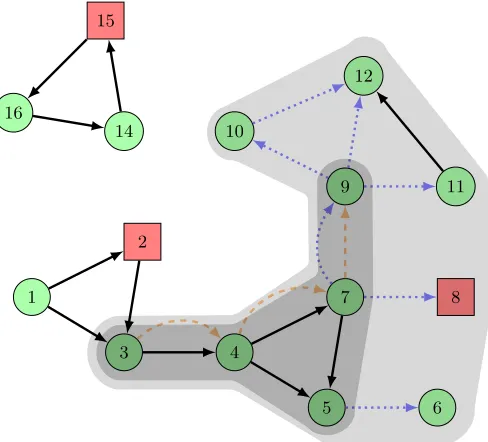
2.2.2 Modelling Adaptive Corruption. The adaptive security games cor-responding to Games 1 and 2 are given in Games 3 and 4, respectively. To model adaptive corruption, we think of the game being played on a directed graph G = (V,E) called the “recoding” graph. The vertices of the recoding graph correspond to the public keys, i.e., V = [n]. The edges are derived from the re-keys and re-encryptions issued to the adversary in the security game, and their purpose is to ensure that the adversary does not win the game in a trivial manner. In particular, the recoding graph is defined so that no corrupt key is reachable from the challenge key. To be precise, in CPA an edge (i, j) is added toE if the adversary made either a (rekey, i, j) or (reencrypt, i, j,·) query (see Game 3 and Figure 1). Consequently, the adversary is forbidden from making any re-key or re-encryption queries to a corrupt user that is reachable from the challenge key.5
For HRA, on the other hand, (i, j) is added toEif the adversary made either a (rekey, i, j) query or a (reencrypt, i, j, k) query where thek-th ciphertext is a re-encryption of the challenge ciphertext (see Game 4 and Figure1). This is less restrictive than in CPA: the adversary can make re-encryption queries to a corrupt user that is reachable from the challenge keyunless it is related to the challenge ciphertext.
For comparison we have reformulated the selective notions defined in Games1
and2 using a recoding graph instead of explicit aborts. Games 9 and10given in AppendixAdefine the exact same notions as Games1and2, respectively. Definition 5 (PRE-CPA-security).A PRE scheme is(s, )-adaptively secure against chosen-plaintext attack if CPA0 ≈(s,) CPA1, where CPAb is defined in Game 3.
Definition 6 (PRE-HRA-security).A PRE scheme is(s, )-adaptively secure against honest-reencryption attack ifHRA0≈(s,)HRA
1
, where HRAb is defined in Game4.
3
Preliminaries
This section provides the background necessary for the main results in §4. We start with the security assumptions on PREs that allow us to prove adaptive se-curity (§3.1) and then give an overview of the framework of [JKK+17] (§3.2), the
description of the pebbling game that is used in the design of the hybrids (§3.3).
3.1 Security Assumptions on PRE
We describe the three security properties of PRE schemes that allow us to prove adaptive security: indistinguishability, key-privacy and source-hiding.
5
1
2
3 4
7
5 6
8 9
10
11 12
14 15
16
ChallengerCPAb(1κ,1λ, n)
1: SetC,E=∅ .Stores corrupt keys and issued re-keys and re-encryptions 2: pp←PRE.S(1κ,1λ), (pk1,sk1), . . . ,(pkn,skn)←PRE.K(pp) .Generate keys 3: ∀i, j∈[n], i6=j:rki,j←PRE.RK((pki,ski),pkj) .Generate re-keys 4: b0←A(corrupt,·),(rekey,·,·),(reencrypt,·,·,·),(challenge,·,·,·)(pp,pk1, . . . ,pkn)
5: if Amade call (challenge, i∗,·,·) for somei∗then .Check abort conditions 6: if ∃i∈ C:i∗ is connected toiin ([n],E)then return0end if
7: end if
8: returnb0 Oracle (corrupt, i)
1: AdditoC 2: returnski
Oracle (rekey, i, j)
1: Add (i, j) toE .Add to recoding graph 2: returnrki,j
Oracle (reencrypt, i, j,(ci, `))
1: Add (i, j) toE .Add to recoding graph
2: return(cj, `+ 1)←PRE.RE(rki,j,pki,pkj,(ci, `))
Oracle (challenge, i∗,(m∗0, m∗1), `∗) .Single access 1: return(ci∗, `∗)←PRE.E(pk
i∗,(m∗b, ` ∗
))
Game 3:PRE-CPA
Indistinguishability of ciphertexts. For proxy re-encryption, we require the notion of indistinguishability, as defined for public-key encryption in [GM82], to hold onall levels:
Definition 7 (Indistinguishability). A proxy re-encryption schemePRE has (s, )-indistinguishable ciphertexts ifIND0≈(s,)IND1 with INDas in Game5.
Key-privacy. The original notion of key-privacy for PREs, which we refer to as “strong” key-privacy, was introduced in [ABH09]. It is modelled by a security game similar to sPRE-CPA: the adversary has access to corrupt, rekey and reencryptoracles, but as a challenge it has to distinguish a real re-key from a re-key sampled uniformly at random from the support of re-keys. We refer the readers to [ABH09] for the details.
We only need a weaker definition stating that re-keys should hide the source keys. That is, the re-keyrk0,1 from source (pk0,sk0) to a target keypk1should be indistinguishable from a random source to pk1. In addition, we need this property to hold with respect to multiple re-keys. More formally, the security game for weak key-privacy is given in Game6where the simulatorRK∗is defined as
RK∗(pp,pk1) :=RK((pk0,sk0),pk1) : (pk0,sk0)←K(pp).
Definition 8 (Weak key-privacy). Letδ∈N. A proxy re-encryption scheme PRE is(s, , δ)-weakly key-private ifKP0≈(s,)KP
1
ChallengerHRAb(1κ,1λ, n) 1: SetC,L,L∗
=∅andC= 0 .Lstores honest enc’s,L∗
marks challenge reenc’s
2: E=∅ .The edges of the recoding graph
3: pp←PRE.S(1κ,1λ), (pk1,sk1), . . . ,(pkn,skn)←PRE.K(pp) .Generate keys 4: ∀i, j∈[n], i6=j:rki,j←PRE.RK((pki,ski),pkj) .Generate re-keys 5: b0←A(corrupt,·),(rekey,·,·),(encrypt,·,·),(reencrypt,·,·,·),(challenge,·,·,·)
(pp,pk1, . . . ,pkn) 6: if Amade call (challenge, i∗,·,·) for somei∗then .Check abort conditions 7: if ∃i∈ C:i∗ is connected toithen return0end if
8: end if
9: returnb0 Oracle (corrupt, i)
1: AdditoC 2: returnski
Oracle (rekey, i, j)
1: Add (i, j) toE .Add to recoding graph 2: returnrki,j
Oracle (encrypt, i,(m, `))
1: c←PRE.E(pki,(m, `)), incrementCand add (C, i, m,(c, `)) toL 2: returnc
Oracle (reencrypt, i, j, k)
1: Retrieve (k, i, m,(ci, `)) fromL
2: (cj, `+ 1)←PRE.RE(rki,j,pki,pkj,(ci, `)) 3: IncrementCand add (C, j, m,(cj, `+ 1)) toL 4: if k∈ L∗
then . cj derived from challenge
5: AddCtoL∗
and add (i, j) toE .Add to recoding graph 6: end if
7: return(cj, `+ 1)
Oracle (challenge, i∗,(m∗0, m∗1), ` ∗
) .Single access
1: Compute (ci∗, `∗)←PRE.E(pk
i∗,(m∗b, ` ∗
))
2: IncrementC, add (C, i∗, m∗b,(ci∗, `∗)) toLandCtoL∗
3: return(ci∗, `∗)
Game 4:PRE-HRA
ChallengerINDb(1κ,1λ)
1: pp←PRE.S(1κ,1λ), (pk,sk)←PRE.K(pp) 2: returnb0←A(challenge,·,·)(pp,pk)
Oracle (challenge,(m∗0, m∗1), `∗) 1: returnPRE.E(pk,(m∗b, `
∗ ))
Game 5: Security gameINDfor ciphertext indistinguishability
ChallengerKPb(1κ,1λ)
1: pp←PRE.S(1κ,1λ), (pk0,sk0), . . . ,(pkδ,skδ)←K(pp) 2: ∀j∈[δ] :rk(0)0,j←RK((pk0,sk0),pkj)
3: rk(1)0,j ←RK∗(pp,pkj) 4: returnb0←A(pp,pk0, . . . ,pkδ,rk
(b) 0,1, . . . ,rk
(b) 0,δ)
ChallengerSHb(1κ,1λ) 1: pp←PRE.S(1κ,1λ)
2: (pk0,sk0),(pk1,sk1)←PRE.K(pp) 3: rk0,1←PRE.RK((pk0,sk0),pk1)
4: b0←A(challenge,·,·)(pp,(pk0,sk0),(pk1,sk1),rk0,1) 5: returnb0
Oracle (challenge, m∗, `∗) . `∗∈[λ−1]
1: c0←PRE.E(pk0,(m∗, `∗))
2: c(0)1 ←PRE.RE(rk0,1,pk0,pk1, c0) .Real re-encryption 3: c(1)1 ←PRE.E(pk1,(m
∗
, `∗+ 1)) .Simulate re-encryption
4: return(c0, c(1b))
Game 7: Security gameSHfor source hiding
Source-hiding. Source-hiding is a special case of re-encryption-simulatability, a notion that was introduced in [Coh17]. It requires that re-encryptions can be simulated without knowledge of the secret key. In particular, the simulated re-encryptions should be indistinguishable from re-encrypted ciphertexts even when given the secret keys for the source and target public keys, as well as the re-key that was used for re-encryption (hence the notion of indistinguishabil-ity is at least that of statistical indistinguishabilindistinguishabil-ity). A PRE scheme is called source-hiding if re-encrypted ciphertexts have the same distribution as “fresh” ciphertexts, i.e., the encryption algorithm can be used as a simulator for re-encryption.
Definition 9 (Source-hiding). A proxy re-encryption scheme PRE is (s, ) -source-hiding ifSH0≈(s,)SH1, withSHas defined in Game 7.
3.2 Overview of the JKK+ Framework
Random guessing. A standard way to prove adaptive security is to first show security in a “selective” version of the adaptive game, in which the adversary commits to some of its future choices, and then use random guessing of the adversary’s commitment to reduce adaptive security to selective security. For instance, consider the indistinguishability game for identity-based encryption: in the selective counterpart the adversary commits to the challenge identity at the start of the game, and the adaptive to selective reduction then works by guessing the challenge identity. More formally, let G0 and G1 denote the two adaptive games. For some functiong: {0,1}∗→ Wwe define below the selective gamesH0=SELW[G0, g] andH1=SELW[G1, g] where the adversary commits to
G0
H0=H0 H1 H2 · · · Hτ−1 Hτ =H1
G1
ˆ
H0,0 H0ˆ ,1 H1ˆ ,0 H1ˆ ,1 H2ˆ ,0 Hˆτ−2,1 Hˆτ−1,0 Hˆτ−1,1
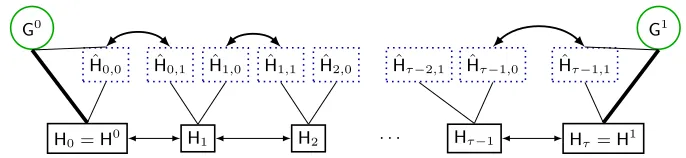
Fig. 2: A schematic diagram showing the relationship between adaptive, fully selective and partially selective hybrids. The adaptive gamesG0 and G1 are in green (circles); the fully selective games H0, . . . ,Hτ are in solid black (boxes);
and the partially selective games ˆH0,0,H0ˆ ,1, . . . ,Hˆτ−1,0,Hˆτ−1,1 are in (dotted) blue boxes. The arrows indicate indistinguishability.
Definition 10 (Fully selectivised game [JKK+17]). Given an (adaptive)
gameGand some functiong:{0,1}∗→ W, the selectivised gameH=SELW[G, g]
is defined as follows. The adversary A first sends a commitment w ∈ W to H. Then H runs the challenger G against A, at the end of which G outputs a bit ˆ
b. Let transcript denote all communication exchanged between G and A. If g(transcript) =wthenHoutputs the bitˆband else it outputs 0.
Next, suppose that the selective security is proved using a hybrid argument. That is, to show the indistinguishability ofH0andH1suppose we have a sequence of τ + 1 (selective) hybrid games H0 = H0,H1, . . . ,Hτ = H1 (see Figure 2). If
we only assume that neighbouring hybrids Hi,Hi+1 are indistinguishable, then by combining the hybrid argument and random guessing we get that G0 and G1 are indistinguishable with a loss in distinguishing advantage ofτ· |W|. The factor of|W| is the cost of the random guessing, whereas the factor ofτ is due to the hybrid argument. This is stated in the following (recall thatsW denotes
the complexity of sampling fromW):
Theorem 3 ([BB04,JKK+17]).Assume we have two games defined via
(adap-tive) challengers G0 and G1 respectively. Let g: {0,1}∗ → W be an arbitrary function and define the selectivised gamesHb=SELW[Gb, g]forb∈ {0,1}. Also
assume that for each i ∈ [τ], the games Hi−1,Hi are (s, )-indistinguishable.
Then, G0 andG1 are(s−sW, ·τ· |W|)-indistinguishable.
The framework. In some cases onlypartof the information that the adversary commits to is used in simulating the intermediate hybrids, but when considering all the hybrids the whole commitment is being used. For example, the simulation of an intermediate hybrid in the case of IBE could rely on only certain bits of the challenge identity. It is shown in [JKK+17] that the security loss in such
cases can be limited to the maximum size of the information used across any two successive hybrids.
More formally, [JKK+17] makes a stronger assumption: not only are
of “partially” selective games ˆHi,0,Hˆi,1 which are already indistinguishable. In particular, for each pair of neighbouring hybrids Hi,Hi+1 there exists a pair of partially selective hybrids ˆHi,0,Hˆi,1 (see Figure 2) in which the adversary com-mits to much less information hi(w) ∈ U instead of w ∈ W. The selectivised
game essentially ignores wand only relies on the partial informationu=hi(w)
during the course of the game but at the very end it still checks that the full commitmentwmatches what actually happened during the game.
Definition 11 (Partially selectivised game [JKK+17]). Assume Hˆ is a game which expects to receive some commitment u∈ U from the adversary in the beginning. Given functions g:{0,1}∗ → W and h: W → U the partially selectivised game H= SELU →W[ ˆH, g, h] is defined as follows. The adversary A
first sends a commitment w ∈ W to H and H begins running Hˆ and passes it u= h(w). It then continues running the game between Hˆ and A at the end of which Hˆ outputs a bitˆb. Let transcript denote all communication exchanged between Hˆ and A. If g(transcript) = w then H outputs the bit ˆb and else it outputs 0.
Note that different pairs of partially selective hybrids ˆHi,0,Hˆi,1 might rely on completely different partial information hi(w) about the adversary’s choices.
The partially selective hybrid associated to each Hi can thus be different when
we compare Hi−1,Hi (in which case it is ˆHi−1,1) and when we compare Hi and
Hi+1 (in which case it is ˆHi,0) – see Figure 2. The next theorem shows that we only incur a security loss proportional to|U |rather than|W|if we can define a sequence of partially selective hybrids which only require commitments fromU.
Theorem 4 ([JKK+17]). Let G0
and G1 be two adaptive games. For some function g:{0,1}∗ → W we define the selectivised games H0 = SELW[G0, g],
H1 =SELW[G1, g]. Let H0 = H0,H1, . . . ,Hτ =H1 be some sequence of hybrid
games. Assume that for each i∈[0, τ−1], there exists a function hi: W → U
and gamesHˆi,0,Hˆi,1 such that
Hi≡SELU →W[ ˆHi,0, g, hi] and Hi+1≡SELU →W[ ˆHi,1, g, hi]. (1)
Furthermore, ifHˆi,0,Hˆi,1 are(s, )-indistinguishable for alli∈[0, τ−1], thenG0 andG1 are (s−sU, ·τ· |U |)-indistinguishable.
3.3 Pebbling Games
The reversible pebbling game on DAGs was introduced in [Ben89] to model reversible computation. We define a variant in which the pebbling rules have been adapted for application to PREs. In particular, the rule is the opposite of that in [Ben89]: a pebble can be placed on or removed from a vertex if all its children carry a pebble.6
6
Definition 12. A reversible pebbling of a directed acyclic graphG= (V,E)with a unique source vertex i∗ is a sequenceP := (P0, . . . ,Pτ) of pebbling
configura-tions Pt ⊆ V. Two subsequent configurations differ only in one vertex and the
following rule is respected in a move: a pebble can be placed on or removed from a vertex iff all its children carry a pebble. That is,P is a valid sequence iff
∀t∈[τ]∃!i∈ Pt−14Pt and children(i, G)⊆ Pt−1.
Starting with an empty graph (i.e., P0=∅), the goal of the game is to place a pebble on the source (i.e.,i∗∈ Pτ).
For a DAG G, letPG denote the set of all valid reversible pebbling sequences
(as per Definition12) forG. Thetime complexity of aparticular sequenceP = (P0, . . . ,Pτ) for a DAGGis defined asτG(P) :=τ, whereas its space complexity
is defined as
σG(P) := max t∈[0,τ]|Pt|
.
Definition 13 (Space- and time-complexity of a class of DAGs). We say that a class of DAGsG has time complexityτ and space complexityσ if
∀G∈ G ∃P ∈ PG :τG(P)≤τ∧σG(P)≤σ.
Concrete Bounds. We compute the pebbling complexity for the following classes ofsingle-source graphs onnvertices:
[Lemma2]:G(n, δ, d), DAGs with outdegreeδand depth d;
[Lemma3]:B(n) =G(n,2,logn), complete binary trees of sizen; and [Lemma4]:C(n) =G(n,1, n), chains of lengthn.
Lemma 2 (Arbitrary DAGs). G(n, δ, d)has space-complexity(δ+ 1)·dand time-complexity (2δ)d.
Proof. The pebbling algorithmP1 that pebbles any graph inG(n, δ, d) using at most (δ+ 1)·d pebbles in at most (2δ)d moves is given in Algorithm 1. The
strategy is recursive in the depth, and to pebble a vertex i, P1 (recursively) pebbles all of i’s children. We consider the time and space complexity of the pebbling sequence defined byP1as functionsτ(d) andσ(d) of the depthd. Then the number of moves incurred is captured by the expressionτ(d)≤2δ·τ(d−1) with τ(1) ≤2δ, and hence τ(δ)≤(2δ)d. The number of pebbles, on the other
hand, is captured by the recursionσ(d)<(δ+ 1) +σ(d−1) with σ(1) =δ+ 1;
henceσ(d) = (δ+ 1)·d. ut
Lemma 3 (Complete binary trees).B(n)has space-complexity3·lognand time-complexity n2.
Proof. This follows from Lemma2on substitutingδ= 2 andd= logn. ut
P1(G, t)
1: SetT = 0 andP=∅ .Global variables
2: Leti∗denote the source of the graphG 3: returnP01(G, t, i∗, i∗)
P01(G, t, i ∗
, i) . i∗denotes the source; iis the vertex currently pebbled 1: forj∈children(i, G)doP01(G, t, i
∗
, j) .Pebble children recursively 2: if i∈ PthenP:=P \ {i} .Unpebble ifialready pebbled 3: else
4: P:=P ∪ {i} .Place pebble oni
5: if i=i∗then returnP .Placed pebble on source
6: end if
7: IncrementT
8: if T =tthen returnP .P currently stores thet-th pebbling configuration 9: forj∈children(i, G)doP01(G, t, i
∗
, j) .Unpebble children
Algorithm 1: A pebbling strategy for general DAGs.
Proof. A pebbling algorithmP2for pebbling the source vertex ofC(n), wherenis a power of two, is given in Algorithm2– the argument can be easily extended for arbitrarynand vertex. Letσ(n) andτ(n) denote the space and time complexity of the pebbling defined byP2for chains of lengthn. Then the number of pebbles used by P2 is captured by the recursion σ(n) = σ(n/2) + 1, with σ(1) = 1. The number of moves, on the other hand, is captured byτ(n) = 3·τ(n/2) with τ(1) = 1. Therefore,σ(n) = logn+ 1 andτ(n) = 3logn. ut
4
Framework for Adaptive Security
In this section we demonstrate, using the framework of [JKK+17], how adaptive
security can be achieved for PREs. In particular, we show that for CPA and derive an analogous result for HRA. As for the applications given in [JKK+17],
we use pebbling games on DAGs to design the hybrid games. Each pebbling con-figuration uniquely determines a hybrid game bridging the two real gamesCPA0 andCPA1. The DAG that we pebble in the proof is the subgraph of the recoding graph that is reachable from the challengei∗(via the edgesE defined during the game); it is thus a subgraph of the recoding graph with one unique source i∗, which we call thechallenge graph. A pebble on a vertex allows the simulation of the hybrid to be carried outwithout the knowledge of the secret key associated with that vertex. The pebbling rules will ensure that hybrids corresponding to two successive pebbling configurations can be proven indistinguishable assuming key-privacy.
4.1 Adaptive Security Against Chosen-Plaintext Attack
P2(n, t) . ndenotes the length of the chain
1: SetT = 0 andP=∅ .Global variables
2: returnP02(1, n, t)
P02(i, j, t) . iandj denote the end points of the active chain
1: if i=jthen .End of recursion
2: if i∈ P thenP:=P \ {i} .Unpebble ifialready pebbled 3: else
4: P:=P ∪ {i} .Place pebble oni
5: if i= 1then returnP .Placed pebble on challenge
6: end if
7: IncrementT 8: else
9: P02(i,(i+j−1)/2, t) .Recursively pebble left half 10: P02((i+j+ 1)/2, j, t) .Recursively pebble right half 11: P02(i,(i+j−1)/2, t) .Recursively unpebble left half 12: end if
13: if T =tthen returnP .P currently stores thet-th pebbling configuration
Algorithm 2: Pebbling strategy for chains withnvertices, forna power of two.
4.1.1 Fully Selective Hybrids. In the fully selectivised version ofPRE-CPA (Game 3), A first makes a commitment ˆG to the challenge graph. Any correct commitment ˆGmust therefore have one unique source, which we denote by ˆı. The selective challenger is thusSELG[CPAb, g], whereg is the function that extracts
the recoding graphGand the challenge useri∗ from the transcript and returns the challenge graph, i.e., the subgraph ofGreachable fromi∗. Note that this is fundamentally different from the original selective game (i.e.,sCPAin Game1) where the adversary commits, beforehand, to the set of corrupt public keys.
Each hybrid is associated with a pebbling configurationPt and a bitb, and
we consider the sequence of hybridsH00, . . . ,H0τ,H1τ, . . . ,H10. The pebbling state of a vertex dictates how the outgoing re-key and re-encrypt queries are simulated, whereas the bit determines how the challenge query is answered. To be precise, in game Hbt, for each pebbled vertex in Pt all used re-keys outgoing from that
vertex are faked, and the challenge query is answered by an encryption of m∗b. (Rekeys outgoing from pebbled vertices that are not used for any queries are defined as real re-keys.) Observe that the secret key corresponding to a vertex is used only for the generation of the re-keys outgoing from that vertex; the simulation of a hybrid can thus be carried out without knowledge of the secret keys corresponding to the pebbled vertices (as the non-queried re-keys need not be generated).
Since the initial pebbling configuration is the empty set, H00 and H10 corre-spond to the (fully selectivised) gamesSELG[CPA0, g] andSELG[CPA1, g],
respec-tively. Now, consider the middle hybrids H0τ andH1τ: they are the same except for the response to the challenge query which is the encryption of m∗0 in the former and the encryption ofm∗1 in the latter. Since the pebbling configuration
this hybrid can be carried out without knowledge of the secret key corresponding to i∗. This means we can reduce indistinguishability of the PRE to the indis-tinguishability of these two hybrids. To be precise, the reduction embeds the challenge public key at ˆı, which is defined by the commitment ˆGand replies to the challenge query (in the CPA game) by sending the challenge ciphertext (of the indistinguishability game). Note that if i∗ 6= ˆı, that is, the commitment ˆG doesn’t coincide with the transcript of the CPA game, then the hybrid returns 0 anyway. The reduction is formally defined in Algorithm4.
Next, consider any two hybrids Hbt and Hbt+1, t ∈ [0, τ −1] and b ∈ {0,1}. Also, assumePt+1 results fromPtby placing a pebble on the vertexi0(the case when a pebble is removed can be argued analogously). The simulation ofHbtand Hbt+1 is the same except for the (used) re-keys outgoing from i0: inHbt they are
all real whereas in Hbt+1 they are all fake. By the rules of the pebbling game, the children ofi0 all carry pebbles in the configurationsPt andPt+1; therefore the simulation need not know the corresponding secret keys. This means that we can prove indistinguishability of Hbt and Hbt+1 from weak key-privacy: the reduction embeds the (key-privacy) challenge public keyspk0, . . . ,pkδ ati0 and its children, and uses the challenge re-keys rk0,1, . . . ,rk0,δ to simulate the
re-key oracle for queries from i0 to its children. The reduction is formally defined in Algorithm 5. (Note that the simulation of the reduction in Algorithm 5 is perfect: if the commitment ˆGdoes not match with the transcript, it returns 0; else, we have ˆı=i∗ and by definition of the pebbling,i0is reachable from ˆı=i∗ and so are its childreni1, . . . , iδ. If the adversary corrupts any of these, then the
game returns 0.)
In summary, we get a sequence of hybrids SELG[CPA0, g] = H00, . . . ,H 0
τ,
H1τ, . . . ,H10 = SELG[CPA1, g], where each pair of subsequent hybrids can be
proved indistinguishable. Security in the fully selectivised CPA game follows by Lemma1. We state this formally in Lemma5 below.
Lemma 5 (Security against fully selectivised PRE-CPA). Consider the sequence of hybrids H00, . . . ,H
0
τ,H
1
τ, . . . ,H
1
0, where H
b
t is defined in Algorithm 3
using the pebbling configuration Pt. Hb0 is the fully selectivised game of CPA
b:
i.e., Hb0 =SELG[CPAb, g] where g extracts the challenge graph (subgraph
reach-able from the challenge vertex) from a transcript. Moreover, if the adversary makes at most QRE re-encryption queries, then a PRE scheme that is (s1, 1) -indistinguishable and (s2, 2, δ)-weakly key-private is (s, )-secure against fully selectivisedPRE-CPA restricted to challenge graphs inG(n, δ, d)with
s:= min(s1, s2)−sCPA and :=1+ 2τ·2,
where sCPA≈O(sP+n2·sRK+QRE·sRE)denotes the complexity of simulating the CPA game.
HybridHb
t(1κ,1λ, n)
1: Obtain the challenge graph ˆG∈ G(n, δ, d) fromA
2: ComputePt←P( ˆG, t) .Thet-th pebbling configuration 3: SetC,E=∅ .Stores corrupt keys and issued re-keys and re-encryptions 4: pp←PRE.S(1κ,1λ), (pk1,sk1), . . . ,(pkn,skn)←PRE.K(pp)
5: ∀i∈ Pt,∀j∈children(i,Gˆ):rki,j←RK∗(pp,pkj) .Fake re-keys 6: ∀i∈ Pt,∀j∈[n]\ {children(i,Gˆ)∪i}:rki,j←PRE.RK((pki,ski),pkj) .Real
re-keys
7: ∀i∈[n]\ Pt,∀j6=i:rki,j←PRE.RK((pki,ski),pkj) .Real re-keys 8: b0←A(corrupt,·),(rekey,·,·),(reencrypt,·,·,·),(challenge,·,·,·)(pp,pk1, . . . ,pkn)
9: if Amade call (challenge, i∗,·,·) for somei∗then .Check abort conditions 10: if ∃i∈ C:i∗is connected toiin ([n],E)then return0end if
11: end if
12: if Gˆ is the subgraph of ([n],E) reachable fromi∗then returnb0 end if
13: return0
Algorithm 3: Template for generating fully selectivePRE-CPA hybrids given a pebbling configuration. All the oracles are defined like in Game3.
Corollary 1 (PRE-CPA-security by random guessing). A PRE scheme that is (s1, 1)-indistinguishable and(s2, 2, δ)-weakly key-private is(s, )-secure against PRE-CPArestricted to challenge graphs in G(n, δ, d), where
s:= min(s1, s2)−sCPA−sG and := (1+ 2τ·2)·2n 2
.
4.1.2 Partially Selective Hybrids. In hybridHbt described in Algorithm3, we observe that not all information on the committed recoding graph ˆGis ac-tually required for the simulation. In fact, only the pebbling configurationPtis
required to simulate the hybrid: re-keys are only required once a corresponding re-key or a re-encrypt query is issued; for a pebbled node, such queries lead to an edge added inE; thus the re-key is simulated (while the “not-queried” re-keys are never used during the experiment).
In addition to the pebbling configurationPτ, the reduction from ciphertext
indistinguishability (cf. Algorithm 4) also needs to know the challenge vertex ˆ
ı in order to embed the challenge public key. The reduction from weak key-privacy (cf. Algorithm5) requires, in addition toPt, the vertex that is pebbled
or unpebbled in Pt+1 (i.e., the vertexi0) and its children, so it can embed its challenge public keys and re-keys.
To sum up, two consecutive hybridsHbt andHbt+1 can be shown to be indis-tinguishable using a lot less information than what the adversary commits to. We thus have the following:
Lemma 6 (Partially selectivised hybrids). LetP0, . . . ,Pτ andH00, . . . ,H 0
τ,
H1τ, . . . ,H10 be defined as in Lemma5, and letσ denote the space complexity of the pebbling sequence. Then, fort∈[0, τ −1]andb, β∈ {0,1},
Hbt+β≡SELU →G[ ˆH b
t,β, g, ht] and Hbτ ≡SELU →G[ ˆH b
ReductionR(INDτ .challenge,·,·)(pp∗,pk∗) .pk∗denotes the challenge public key 1: Obtain the challenge graph ˆG∈ G(n, δ, d) fromA
2: ComputePτ ←P( ˆG, τ) .Theτ-th pebbling configuration 3: SetC,E=∅ .Stores corrupt keys and issued re-keys and re-encryptions 4: (pk1,sk1), . . . ,(pkˆı−1,skˆı−1),(pkˆı+1,skˆı+1), . . . ,(pkn,skn)←PRE.K(pp
∗ )
5: Let ˆıbe the source of ˆG, setpkˆı:=pk∗ .Embed challenge public key 6: ∀i∈ Pτ,∀j∈children(i,Gˆ):rki,j←RK∗(pp,pkj) .Fake re-keys 7: ∀i∈[n]\ Pτ,∀j∈children(i,Gˆ):rki,j←PRE.RK((pki,ski),pkj) .Real re-keys 8: ∀i∈ Pτ,∀j∈[n]\ {children(i,Gˆ)∪i}:rki,j←PRE.RK((pki,ski),pkj) .Real
re-keys
9: ∀i∈[n]\ Pτ,∀j6=i:rki,j←PRE.RK((pki,ski),pkj) .Real re-keys 10: b0←A(corrupt,·),(rekey,·,·),(reencrypt,·,·,·),(challenge,·,·,·)(pp∗,pk1, . . . ,pkn)
11: if Amade call (challenge, i∗,·,·) for somei∗then .Check abort conditions 12: if ∃i∈ C:i∗is connected toiin ([n],E)then return0end if
13: end if
14: if Gˆ is the subgraph of ([n],E) reachable fromi∗then returnb0 end if
15: return0
Oraclesrekeyandreencryptare defined like in Game3. Oracle (corrupt, i)
1: if i= ˆıthen HALT:Rτ returns 0end if .Commitment ˆGdoesn’t match or. . .
2: AdditoC andreturnski .. . .i∗corrupted
Oracle (challenge, i∗,(m∗0, m∗1), `∗) .Single access 1: (ci∗, `∗)←IND.challenge((m∗0, m∗1), `∗) .Embed challenge ciphertext
2: return(ci∗, `∗)
Algorithm 4: The reduction showing that the hybrids H0τ and H1τ are indistin-guishable by indistinguishability of ciphertexts.
whereHˆbt,β is defined in Algorithm6(see also Figure3),gextracts the challenge
graph from the transcript (as in Lemma5). Fort∈[0, τ−1],ht is the function
that extracts the pebbling configurationPt, the pebbled/unpebbled vertex inPt+1 and its children;hτ extracts the pebbling configurationPτ and the challenge node
i∗. Thus,U corresponds to the setVσ+δ+1.
The tighter bound forPRE-CPA-security now results by applying Theorem4:
Theorem 5 (Main, PRE-CPA security). Let σ and τ denote, respectively, the pebbling space and time complexity for the class G(n, δ, d). Then a PRE scheme that is(s1, 1)-indistinguishable and(s2, 2, δ)-weakly key-private is(s, ) -PRE-CPA-secure restricted to challenge graphs in G(n, δ, d), where
ReductionRb t(pp
∗
,pk∗0, . . . ,pk∗δ,rk∗0,1, . . . ,rk ∗ 0,δ) 1: Obtain the challenge graph ˆG∈ G(n, δ, d) fromA
2: ComputePt←P( ˆG, t),Pt+1←P( ˆG, t+ 1) .Thet-th and (t+ 1)-th configurations
3: SetC,E=∅ .Stores corrupt keys and issued re-keys and re-encryptions 4: i0:=Pt∆Pt+1,i1, . . . , iδ:=children(i0,Gˆ). i0 denotes pebbled/unpebbled vertex 5: ∀k∈[0, δ]:pki
k:=pk ∗
k .Embed the challenge public keys
6: ∀k∈[n]\ {i0, . . . , iδ}: (pkk,skk)←PRE.K(pp ∗
) .Real keys
7: ∀k∈[δ] :rki0,ik:=rk∗0,k .Embed challenge re-keys 8: ∀i∈ Pt\ {i0},∀j∈children(i,Gˆ):rki,j←RK∗(pp∗,pkj) .Fake re-keys 9: ∀i∈ Pt,∀j∈[n]\ {children(i,Gˆ)∪i}:rki,j←PRE.RK((pki,ski),pkj) .Real
re-keys
10: ∀i∈[n]\(Pt∪ {i0}),∀j=6 i:rki,j←PRE.RK((pki,ski),pkj) .Real re-keys 11: b0←A(corrupt,·),(rekey,·,·),(reencrypt,·,·,·),(challenge,·,·,·)(pp∗,pk1, . . . ,pkn)
12: if Amade call (challenge, i∗,·,·) for somei∗then .Check abort conditions 13: if ∃i∈ C:i∗is connected toiin ([n],E)then return0end if
14: end if
15: if Gˆ is the subgraph of ([n],E) reachable fromi∗then returnb0 end if
16: return0
Oraclesrekey,reencryptandchallengeare defined like in Game3. Oracle (corrupt, i)
1: if i∈ {i0, . . . , iδ}thenHALT:Rτ returns 0end if.Commitment ˆGdoesn’t match 2: AdditoC andreturnski .. . . orireachable fromi∗ Algorithm 5: The reduction showing that the hybrids Hbt and Hbt+1, for t ∈
[0, τ−1] andb∈ {0,1}, are indistinguishable by weak key-privacy.
4.2 Adaptive Security Against Honest-Reencryption Attack
Cohen [Coh17] showed that if a PRE scheme is re-encryption-simulatable then selective security against HRA reduces to showing selective security against CPA. We now consider such a reduction in the adaptive setting. This is not immediate because the reduction in [Coh17] simulates all re-encryption queries from the honest keys to the corrupt keys. This works in the selective setting, where the set of corrupt users is known in advance, but not in the adaptive setting.
The recoding graphs ([n],E) for CPA and HRA are defined differently: for HRA, only re-encryptions of the challenge ciphertexts lead to edges inE, whereas for CPA all re-encryption queries do. To prove that CPA implies HRA we need to define a reduction playing the CPA game and simulating the HRA game for an adversary. It cannot forward the adversary’s re-encryption queries to its own challenger, as this might create edges in the CPA game, but not in the HRA game. An adversary that then corrupts the target key of such a re-encryption query might still win the HRA game, while the reduction loses the CPA game.
CPA0
H0=H00 H01 H02 · · · H0τ H1τ · · · ˆ
H00,0 Hˆ 0 0,1 Hˆ
0 1,0 Hˆ
0 1,1 Hˆ
0 2,0 Hˆ
0
τ−1,1 Hˆ 0 τ,0 Hˆ
1 τ,0 Hˆ
1 τ−1,1
Fig. 3: Diagram showing the partially selectivised hybrids forPRE-CPA.
multiple challenge queries. This would require a multi-challenge notion of CPA and thus worsen the security guarantees; we proceed thus differently. Instead of replacing all re-encryptions by fresh encryptions, the reduction only replaces those that do not concern the challenge ciphertext, while still forwarding re-encryption queries of the ciphertext to its own re-re-encryption oracle. The vertices created in the HRA game correspond then precisely to those created in the CPA game and the adversary’s success probability translates directly to that of the reduction.
4.2.1 HRA from CPA and Source-Hiding. We start by defining, in Game8, the intermediate gameshHRAb just discussed. It proceeds likeHRAb, except that all re-encryption queries which do not re-encrypt the challenge ciphertext are simulated. The games HRAb and shHRAb are shown to be indistinguishable as-suming source-hiding by a standard hybrid argument (without pebbling) which includes a moderate amount of guessing: when replacing a re-encryption by a fresh encryption, it guesses the two concerned users and which ciphertext will be re-encrypted. This loses a factor ofn(n−1)(QRE+QE) in the distinguishing advantage. As there areQRE hybrids, we get the following:
Lemma 7. If a PRE scheme is (s3, 3)-source-hiding then HRAb and shHRAb are (s, )-indistinguishable, where
s:=s3−sHRA and :=n(n−1)(QE+QRE)QRE·3
whereQEandQREare upper bounds on the number of the adversary’s encryption and re-encryption queries.
Proof. We define a sequence of intermediate hybridsshHRAb0, . . . ,shHRAbQ
RE
be-tweenHRAbandshHRAbwhere certain re-encrypt queries are simulated by com-puting fresh encryptions. In particular, the simulation in shHRAbq is similar to that inHRAb, except that the firstq queries (reencrypt,·,·, k) withk /∈ L∗ are
replied by fresh encryptions. Therefore, we have shHRAb0≡HRAb and shHRAbQ
RE≡shHRA b.
HybridHb t+β
1: Obtain the challenge graph ˆG∈ G(n, δ, d) fromAand let ˆıbe its source
2: ComputePt←P( ˆG, t),Pt+1←P( ˆG, t+ 1) .Thet-th and (t+ 1)-th configurations
3: i0:=Pt∆Pt+1,i1, . . . , iδ:=children(i0,Gˆ). i0 denotes pebbled/unpebbled vertex 4: if t < τ thenˆb←Hˆt,β(b Pt,{i0, . . . , iδ}) .Key-privacy hybrid 5: elseˆb←Hˆbτ,0(Pτ,{ˆı,⊥, . . . ,⊥})end if . t=τ,β= 0: ind hybrid 6: if Gˆis subgraph of ([n],E) reachable fromi∗then returnb0 end if
7: return0 ˆ
Hbt,β(Pt,{i0, . . . , iδ})
1: SetC,E=∅ .Stores corrupt keys and issued re-keys and re-encryptions 2: if t < τ then
3: if i0∈ Pt thenPt+1:=Pt\ {i0}elsePt+1:=Pt∪ {i0}end if 4: end if
5: pp←PRE.S(1κ,1λ), (pk1,sk1), . . . ,(pkn,skn)←PRE.K(pp)
6: ∀i, j∈[n], i6=j:rki,j=⊥ .Delay re-key generation till the query 7: b0←A(corrupt,·),(rekey,·,·),(reencrypt,·,·,·),(challenge,·,·,·)(pp,pk1, . . . ,pkn)
8: if Amade call (challenge, i∗,·,·) for somei∗then .Check abort conditions 9: if ∃i∈ C:i∗ is connected toiin ([n],E)then return0end if
10: end if
11: returnb0
Oraclescorruptandchallengeare defined like in Game3. Oracle (rekey, i, j)
1: if rki,j=⊥then .Re-key not generated 2: if i∈ Pt+β thenrki,j←RK∗(pp,pkj) .Fake re-key 3: elserki,j ←RK((pki,ski),pkj)end if .Real re-key 4: end if
5: Add (i, j) toE .Add to recoding graph
6: returnrki,j
Oracle (reencrypt, i, j,(ci, `))
1: if rki,j=⊥then .Re-key not generated 2: if i∈ Pt+β thenrki,j←RK∗(pp,pkj) .Fake re-key 3: elserki,j ←RK((pki,ski),pkj)end if .Real re-key 4: end if
5: Add (i, j) toE .Add to recoding graph
6: return(cj, `+ 1)←PRE.RE(rki,j,pki,pkj,(ci, `))
Algorithm 6: Partially selectivised hybrids. For t ∈[0, τ−1] and b, β∈ {0,1}: Hbt+β = SELU →G[ ˆH
b
t,β, g, ht] and Hbτ = SELU →G[ ˆH b
τ,0, g, hτ]. Moreover, U is the
setVσ+δ+1. Note that the sampling of the re-keys has been deferred to the actual calls.
HybridshHRAb 1: SetC,L,L∗
,E =∅andC= 0 .As in Game2,E. . . edges of recoding graph 2: pp←PRE.S(1κ,1λ), (pk1,sk1), . . . ,(pkn,skn)←PRE.K(pp)
3: ∀i, j∈[n], i6=j:rki,j←PRE.RK((pki,ski),pkj)
4: b0←A(corrupt,·),(rekey,·,·),(encrypt,·,·),(reencrypt,·,·,·),(challenge,·,·,·)(pp,pk1, . . . ,pkn) 5: if Amade call (challenge, i∗,·,·) for somei∗then .Check abort conditions 6: if ∃i∈ C:i∗ is connected toithen return0end if
7: end if
8: returnb0
Oraclescorrupt,rekey,encryptandchallengeare defined like Game4. Oracle (reencrypt, i, j, k)
1: Retrieve (k, i, m,(ci, `)) fromLand incrementC
2: if k /∈ L∗then .Not a re-encryption of challenge ciphertext 3: (cj, `+ 1)←PRE.E(pkj,(m, `+ 1)) .Simulate re-encryption 4: else
5: (cj, `+ 1)←PRE.RE(rki,j,pki,pkj,(ci, `)) .Real re-encryption 6: AddCtoL∗
and add (i, j) toE . cj derived from challenge 7: end if
8: Add (C, j, m,(cj, `+ 1)) toL 9: return(cj, `+ 1)
Game 8: Intermediate gameshHRAin the proof of HRA.
1. It first makes a guess (i∗, j∗, k∗)∈[n]×([n]\ {i∗})×[QE+q−1] that the q-th re-encryption query will be of the form (reencrypt, i∗, j∗, k∗)
2. It simulates game shHRAbk setting (pki∗,ski∗) := (pk,sk), (pkj∗,skj∗) :=
(pk0,sk0) andrki∗,j∗:=rk.
3. When the adversary makes thek∗-th encrypt or re-encrypt query, the reduc-tion does the following:
(a) (encrypt, i,(m, `)): if i 6=i∗ abort; else query (SH.challenge, m, `) to receive (c, c0); reply (c, `) after adding the new entry toL.
(b) (reencrypt, i, j, k): ifk∈ L∗ then proceed as in Game4. Otherwise: if
j6=i∗abort; else retrieve (k, i, m,(ci, `−1)) fromL, query (SH.challenge,
m, `) to receive (c, c0); reply (c, `) after adding the new entry toL. 4. When the adversary makes theq-th re-encrypt query (reencrypt, i, j, k), the
reduction aborts if (i, j, k)6= (i∗, j∗, k∗). Otherwise it replies (c0, `+ 1), with c0 received on itsSH.challengequery.
5. If the reduction aborted the simulation, it returns a random bit, otherwise it returns the adversary’s output bitb0.
Assuming the reduction’s guess is right, if thec0 returned by the source-hiding challenger is a re-encryption then the reduction simulated shHRAbq−1 while ifc0
was a fresh encryption, it simulatedshHRAbq. ut