Vehicle Tracking using Canny Edge Detector
1A. Mallareddy,
2R.Chitti Babu,
3K.Deepika Rani
1Research Scholar (JNTUH), Department of Computer Science & Engineering, Professor & HOD (CSE) 2M.Tech (CSE), Department of Computer Science & Engineering,
3Associate Professor, Department of Computer Science & Engineering,
Sri Indu Institute of Engineering & Technology, Sheriguda (V), Ibrahimpatnam (M), RR Dist – 501510.
E-mail: 1[email protected] 2[email protected] 3[email protected]Abstract
Vehicle tracking using the canny edge detector algorithm is used for detecting the edges. A Dynamic Bayesian Network (DBN) is constructed for classification purpose. A well trained DBN can
estimate the probability of a pixel belonging to a vehicle or not. It also relates among neighboring pixels in a region. There is a fast growth in computer technology and increasing needs in security and studies of target vehicle detection in aerial surveillance using image processing techniques and based IPs and Location also it will work effectively in vehicle tracking using HMA VPN.
We present automatic vehicle detection in our system. The purpose of this technical report is to provide the survey of research related to application of vehicle detection technique in aerial surveillance for various applications, such as gathering apponents information for military purpose and searching for missing people, vehicles in mountain areas. In an automatic vehicle detection system for aerial surveillance background colors are eliminated and then features are extracted. This system considers features including vehicle colours and local features. For vehicle color extraction, system utilizes color transform to separate vehicle colours and non-vehicle colours effectively. The challenges of vehicle detection in aerial surveillance include camera motions such as panning, tilting, and rotation. In addition, airborne platforms at different heights result in different sizes of target objects. The view of vehicles will vary according to the camera positions, lightning conditions. Along with this using HMA VPN using different IP’s based on Location it can be worked more efficiently.
Keywords
Vehicle Detection, Aerial Surveillance, Dynamic Bayesian Networks (DBNs), Canny Edge Detector, Vehicle Tracking, Vehicle Tracking based on networks using HMA VPN.
I. Introduction
topics in intelligent aerial surveillance is vehicle detection and tracking. Aerial surveillance has a long history in the military for observing enemy activities and in the commercial world for monitoring resources. Such techniques are used in news gathering and search and rescue aerial surveillance has been performed primarily using film. The highly captured still images of an area under surveillance that could later be examined by human or machine analysts. Video capturing dynamic events cannot be understood when compared with aerial images. Video observations can be used to find and geo-locate moving objects in real time. Video also provides new technical challenges. Video cameras have lower resolution when compared to the framing cameras. To get the required resolution and to identify objects on the ground, it is
necessary to use the telephoto lens, with narrow field of view. This leads to the shortcoming of video in surveillance— it provides a “soda straw” view of scene. The camera should be scanned to cover the extended regions of interest. Observer who is watching this video must pay constant attention, to the objects of interest rapidly moving in and out of the camera field of view.
II. Vehicle Detection Frame Work
A new vehicle detection framework extracts the multiple frames from the input video, and performing background color removal cannot only reduce false alarms but also speed up the detection Process. Using HMA VPN we can use different IPs based on Location. We extract the feature from the image frame. We do the following Edge Detecting, Corner Detecting, color Transform and color classify. We perform pixel wise classification for vehicle detection using DBNs. (Dynamic Bayesian Network). We use morphological operations to enhance the detection mask and perform connected component labeling to get the vehicle objects
A. Frame Extraction
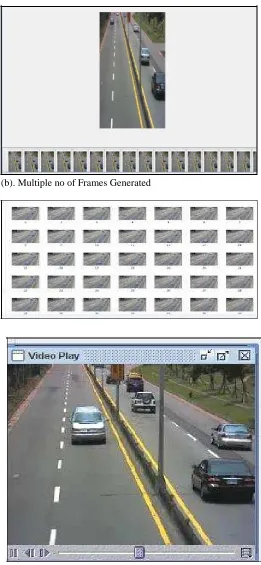
In this module providing video as input and it extract the number of frames from that video. The frames are formed dynamically based on pixel calculation, Edge detection and error correction.
B. Background Color Removal
Background removal is often the first step in surveillance ap- plications. It reduces the computation required by the down- stream stages of the surveillance pipeline. Background sub- traction also reduces the search space in the video frame for the object detection unit by filtering out the uninteresting background.
In this module we construct the color histogram of each frame and remove the colors that appear most frequently in the scene. These removed pixels do not need to be considered in subsequent detection processes. Performing background color removal cannot only reduce false alarms but also speed up the detection process.
C. Feature Extraction
In this module we extract the feature from the image frame. In This module we do the following Edge Detection, Corner Detection, color Transformation and color classification.
The frame edge image is able to transfer by performing detect
edge, corners and places for color transform.
Let be an image with pixels and denote the gray value at pixel . The th moment of is defined as
(1)
where is the total number of pixels in image with gray value and . For bi-level thresholding, we would like to select threshold such that the first three moments of image are preserved in the resulting bi-level image . Let all the below-threshold gray values in be replaced by and all the above-threshold gray values be replaced by ; we can solve for and based on the moment-preserving principle
After obtaining and , the desired threshold is computed using
In the detection phase same feature extraction is also per- formed as in the training phase. Afterwards the extracted fea- tures are used to classify pixels as vehicle pixel or nonvehicle pixel using SVM. In this paper, we do not perform region based classification, which would highly depend on results of color segmentation algorithms such as mean shift. There is no need to generate multi-scale sliding windows either. The dis- tinguishing feature of the proposed framework is that the detection task is based on pixel wise classification.
However, the features are extracted in a neighborhood region of each pixel. Therefore, the extracted features comprise not only pixel-level information but also relationship among neighbor- ing pixels in a region. Such design is more effective and efficient than region-based or multi scale sliding window detection methods.
D.
Classification
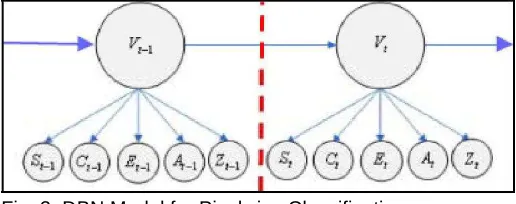
In this module we perform pixel wise classification for
vehicle detection using DBNs (Dynamic Bayesian Network).
We obtain the conditional probability tables of the DBN model via expectation-maximization algorithm by providing the ground-truth labelling of each pixel and its corresponding observed features from several videos.
Fig. 2: DBN Model for Pixelwise Classification
The Bayesian rule is used to obtain the probability that a pixel belongs to a vehicle i.e.
E. Post Processing
In this module we can use morphological operations to enhance the detection mask and perform connected component labelling to get the vehicle objects. The size and the aspect ratio constraints are applied again after morphological operations in the post processing stage to eliminate objects that are impossible to be vehicles.
III. Canny Edge Detection
smoothed by applying a Gaussian filter.
Fig (a). original (b). Smoothing
B. Finding Gradients
The Canny algorithm basically finds edges where the grayscale
intensity of the image changes the most. The gradient
magnitudes can then be determined as a Euclidean distance
measure.
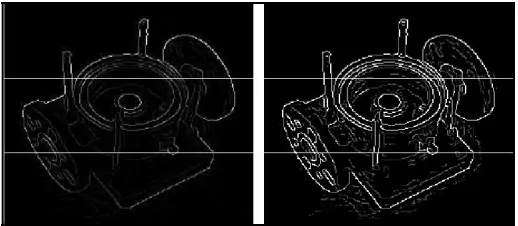
(a). Smoothed (b). Gradient Magnitudes Fig. 4: The Gradient Magnitudes in Smoothed Image
C. Non - Maximum Suppression
The purpose of this step is to convert the “blurred” edges in the image of the gradient magnitudes to “sharp” edges. The algorithm is for each pixel in the gradient image:
1. Round the gradient direction _ to nearest 45◦,
corresponding to the use of an 8-connected neighborhood.
2. Compare the edge strength of the current pixel with the edge strength of the pixel in the positive and negative gradient direction.
I.e. if the gradient direction is north (theta =90◦), compare
with the pixels to the north and south.
3. If the edge strength of the current pixel is largest; preserve the value of the edge strength. If not, suppress (i.e. remove) the value.
Fig. 5: Non-Maximum Suppression
D. Double Thresholding
The Canny edge detection algorithm uses double thresholding. Edge pixels stronger than the high threshold are marked as strong; edge pixels weaker than the low threshold are suppressed and edge pixels between the two thresholds are marked as weak.
Fig. 6: Thresholding of Edges
E. Edge Tracking by Hysteresis
Strong edges are interpreted as “certain edges”, and can immediately be included in the final edge image. Weak
edges are included if and only if they are connected to strong
Fig. 7: Edge Tracking by Hysteresis and Final Output
F. Planar Detection Technique
If we try to detect the vehicle based on three dimensions at that time detection is very crucial. Secret sharing refers to method for distributing a secret among a group of participants; each of them is allocated to share the secret.
(b). Multiple no of Frames Generated
Fig. 8: Plane Shows the Intersect Point to the Share Fields
The secret is reconstructed only when a sufficient number, of possible different types, of shares are combined together individual shares are of no use on their own.
IV. Experimental Results
Experimental results are demonstrated here. To analyze the performance of the proposed system, various video sequences with different scenes and different filming altitudes are used along with different IP’s using HMA VPN.
A. Frames Extraction
(c). Dynamic Frame generation
B. Background Color Removal
These removed pixels need not to be considered in subsequent detection processes. Performing background color removal not only reduces false alarms but also speed up the detection process
(d). Background Color Removal Results
C. Detect Edge
The Frame edge Image is able to transfer by performing Detect edge
(e). Edge Detection
D. Colour Classification
When employing SVM, we need to select the block size to form
a sample and perform vehicle color classification.
(f). Colour Classification
E. Post Processing
We use morphological operations to enhance the detection mask and perform connected component labeling to get the vehicle. In the post processing stage we eliminate objects that are impossible to be vehicles
(g). Detecting Each and Every Vehicle
F.HMA VPN
A VPN (Virtual Private Network) is a clever piece of
technology that gives you the choice from being an ordinary
Internet user – to being an Internet VIP. It’s like having a golden ticket for the Internet - it will let you bypass censorship, unblock content and protects your privacy and security whilst you’re online
Anytime you use a public internet service you are putting your security and privacy at risk. Personal data can easily be misused and stolen in cafes, hotels, airports and other free Wi-Fi hotspots. Hide My Ass! Pro VPN offers you government-level protection and peace of mind for your personal data whenever you surf the internet – wherever you are.
How this HMA VPN used with Vehicle Tracking using Canny Edge detector.
1. When running vehicle tracking using launch HMA VPN using connector .
2. Using connector HMA VPN launched based Locations IPs changed and targeted for specific locations based on location.
V. Conclusion
classification method for the vehicle detection using DBNs. In spite of performing pixel wise classification, relations among neighboring pixels in a region are preserved in the feature extraction process. We use only a small number of positive and negative samples to train the SVM for classifying the vehicle color .The number of frames required to train the DBN is very small. Overall, the entire framework does not require a large amount of training samples. We have also applied moment preserving to enhance the canny edge detector, which increases the adaptability and the accuracy for detection in various aerial images.
References
[1] Hsu-Yung Cheng, Member, IEEE, Chih-Chia Weng, Yi-Ying Chen,"Vehicle Detection in Aerial Surveillance Using Dynamic Bayesian Networks", March 21, 2012. Lecture Notes in Computer Science Project 99-2628-E-008-098.
[2] J. Y. Choi, Y. K. Yang,“Vehicle detection from aerial images using local shape information”, Adv. Image Video Technol., vol. 5414, Lectures Notes in Computer Science, pp. 227–236, Jan. 2009.
[3] J. F. Canny,“A computational approach to edge detection”, IEEE Trans. Pattern Anal. Mach. Intell., Vol. PAMI-8, No. 6, pp. 679–698, Nov.1986.
[4]
C. G. Harris, M. J. Stephens,“A combined corner and edgedetector”, In Proc. 4th Alvey Vis. Conf., 1988, pp. 147– 151
[5] R. Lin, X. Cao, Y. Xu, C.Wu, H. Qiao,“Airborne moving
vehicle detection for urban traffic surveillance”, In Proc.
11th Int. IEEE Conf.Intell. Transp. Syst., Oct. 2008, pp. 163–167
[6] R. Lin, X. Cao, Y. Xu, C.Wu, H. Qiao,“Airborne moving vehicle detection for video surveillance of urban traffic”, In
Proc. IEEE Intell.Veh. Symp, 2009, pp. 203–208.
[7] S. Srinivasan, H. Latchman, J. Shea, T. Wong, J. McNair, “Airborne traffic surveillance systems: Video surveillance of highway traffic”, In Proc. ACM 2nd Int. Workshop Video Surveillance Sens. Netw, 2004, pp. 131–135.
[8] W. H. Tsai,“Moment-preserving thresholding: A new approach, “Compute. Vis.Graph, Image Process, Vol. 29, No. 3, pp. 377–393, 1985.
[9] [9 ] Mori, H., Charkai, “Shadow and Rhythm as Sign
Patterns of Obstacle Detection,” Proc. Int’l Symp. Industrial Electronics, pp. 271-277, 1993. [24] Hoffmann, C., Dang, T., Stiller, “Vehicle detection fusing 2D visual features,” IEEE Intelligent Vehicles Symposium, 2004.
[10] [10] Kim, S., Kim, K et al, “Front and Rear Vehicle