Obfuscation of Probabilistic Circuits and Applications
Ran Canetti∗ Huijia Lin† Stefano Tessaro‡ Vinod Vaikuntanathan§
Abstract
This paper studies the question of how to define, construct, and use obfuscators for probabilistic programs. Such obfuscators compile a possibly randomized program into a deterministicone, which achieves computationally indistinguishable behavior from the original program as long as it is run on each input at most once. For obfuscation, we propose a notion that extends indistinguishability obfuscationto probabilistic circuits: It should be hard to distinguish between the obfuscations of any two circuits whose output distributions at each input are computationally indistinguishable, possibly in presence of some auxiliary input. We call the resulting notionprobabilistic indistinguishability obfuscation (pIO).
We define several variants ofpIO, using different approaches to formalizing the above security requirement, and study non-trivial relations among them. Moreover, we give a construction of one of our pIO variants from sub-exponentially hard indistinguishability obfuscation (for deterministic circuits) and one-way functions, and conjecture this construction to be a good candidate for otherpIOvariants. We then move on to show a number of applications ofpIO:
• We give a general and natural methodology to achieve leveled homomorphic encryption (LHE) from variants of semantically secure encryption schemes and ofpIO. In particular, we propose instantiations from lossy and re-randomizable encryption schemes, assuming the two weakest notions ofpIO.
• We enhance the above constructions to obtain a full-fledged (i.e., non-leveled) FHE scheme under the same (or slightly stronger) assumptions. In particular, this constitutes thefirst construction of full-fledged FHE that does not rely on encryption with circular security.
• Finally, we show that assuming sub-exponentially secure puncturable PRFs computable in NC1, sub-exponentially-secure indistinguishability obfuscation for (deterministic) NC1 circuits can be bootstrapped to obtain indistinguishability obfuscation for arbitrary (deterministic) poly-size circuits.
∗
Boston University and Tel Aviv University,[email protected] †
UC Santa Barbara,[email protected] ‡
UC Santa Barbara,[email protected] §
Contents
1 Introduction 1
1.1 Our Definitional Framework: IO for Probabilistic Circuits . . . 4
1.2 Application 1: Fully-Homomorphic Encryption . . . 6
1.3 Application 2: Bootstrapping IO . . . 8
2 IO for Probabilistic Circuits 10 2.1 IO for General Samplers over Probabilistic Circuits . . . 10
2.2 Dynamic-inputpIO for Circuits . . . 11
2.3 Worst-case-input pIOfor Circuits . . . 12
2.4 Static-input pIO for Circuits. . . 15
2.5 Strict Inclusions . . . 17
2.6 Construction of X-Ind pIO from Sub-exp Indistinguishable IO . . . 18
3 Application 1: Fully Homomorphic Encryption 19 3.1 Our Results . . . 19
3.1.1 Organization of the Section. . . 21
3.2 Trapdoor Encryption Schemes. . . 21
3.2.1 Statistical Trapdoor Encryption Scheme . . . 22
3.2.2 µ-Hiding Trapdoor Encryption Scheme . . . 22
3.3 From Trapdoor Encryption to Leveled Homomorphic Encryption . . . 24
3.3.1 Proof of Semantic Security ofLHE . . . 26
3.3.2 Instantiation ofLHE . . . 29
3.4 From LHE to FHE . . . 30
3.4.1 The Construction ofFHE . . . 31
3.4.2 Proof of Semantic Security ofFHE . . . 34
3.4.3 On the Generality of the Transformation to FHE . . . 38
4 Application 2: Bootstrapping Indistinguishability Obfuscation 39 4.1 Bootstrapping Worst-case-inputpIO from NC0 toP/poly . . . 41
A Preliminaries 46 A.1 Puncturable Pseudo-Random Functions . . . 46
A.2 Randomized Encoding . . . 46
A.3 Homomorphic Encryption – Definitions . . . 47
B Missing Proofs from the Body 49 B.1 Proof of Proposition 2.3 . . . 49
1
Introduction
Program obfuscation, namely the algorithmic task of turning input programs into “unintelligible” ones while preserving their functionality, has been a focal point for cryptography for over a decade. However, while the concept is intuitively attractive and useful, the actual applicability of obfuscation has been limited. Indeed, the main notion to be considered has been virtual black box (VBB) [BGI+12] which, while natural and intuitively appealing, is very strong, hard to satisfy, and also not easy to use. In fact, for many program classes of interest, VBB obfuscation is unattainable [BGI+12,GK05,BCC+14].
All this changed with the recent breakthrough results of [GGH+13,SW14]. Their contribution
is twofold: First they demonstrate a candidate general obfuscation algorithm for all circuits, thus reviving the hope in the possibility of making good of the initial intuitive appeal of program obfuscation as an important and useful cryptographic primitive. Second, they demonstrate how to make use of a considerably weaker notion of secure obfuscation than VBB, namely indistinguishability obfuscation (IO), initially defined in [BGI+12]. Indeed, following [GGH+13, SW14] there has been a gush of works demonstrating how to apply IO to a plethora of situations and applications, and even resolving long standing open problems.
Obfuscating probabilistic programs. Still, exiting notions of obfuscation, VBB and IO included, predominantly address the task of obfuscating deterministic programs. That is, the program to be obfuscated is a sequence of deterministic operations. This leaves open the question of obfuscating probabilistic programs, namely programs that make random choices as part of their specification, and whose output, on each input, is a random variable that depends on the internal random choices.
A priori it may not be clear what one wants to obtain when obfuscating such programs, or why is the problem different than that of obfuscating deterministic programs. Indeed, why not just obfuscate the deterministic program that takes both “main” and “random” input, and leave it to the evaluator to choose some of the input at random, if it so desires?
The main drawback of this approach is that it does not allow the obfuscation mechanism to hide the random choices of the program from the evaluator. Consider for instance the task of creating a program that allows generating elements of the form gr, hr for a randomr, where g, h
are two generators of a large group, and where r should remain hidden even from the evaluator of the program. Alternatively, consider the task of obfuscation-based re-encryption: Here we wish to “obfuscate” the program that decrypts a ciphertext using an internal decryption key, and then re-encrypts the obtained plaintext under a different key, using fresh randomness — all this while keeping the plaintext hidden from the evaluator.
Indeed, in both these examples, the goal is to create an obfuscation mechanism with two additional properties, stated very informally as follows: (a) the internal random choices of the obfuscated program should “remain hidden” from the evaluator, up to what is learnable from the output, and (b) the random choices of the program should remain “ random”, or “unskewed”, as much as possible.
How can we define these properties in a sensible way? Barak et al. [BGI+12] take a first stab
samples from the distribution. However, while this definition does capture much of the essence of the problem, it is subject to essentially the same unattainability results that apply to VBB obfuscation.
Probabilistic IO.We propose an alternative definition for what it means to obfuscate probabilistic circuits. Our starting point is IO, rather than VBB, and hence we refer to the resulting general notion as indistinguishability obfuscation for probabilistic circuits, or pIO for short. This both reduces the susceptibility to unattainability results and allows making stronger distributional requirements on the outputs.
The basic idea is to compile a randomized circuit, namely a circuit C that expects an input x
and a uniformly chosen random inputr, returning the random variableC(x, r), into adeterministic obfuscated circuit Λ = O(C) that has essentially the same functionality as the original circuit — with the one caveat that if Λ is run multiple times on the same input then it will give the same output. The security requirements from a pIO obfuscator O for a family of circuits C are three: First, polynomial slowdown should hold as usual. Second, functionality should be preserved in the sense that for any C ∈ C and for any input x it should hold that C(x) ≈c Λ(x). Note that in
C(x) the probability is taken over the random choices of C (i.e., the sampling of r), whereas Λ is a deterministic circuit and the probability is taken only over the random choices of O. (In fact we make the stronger requirement that no efficient adversary can distinguish whether it is given access to the randomized oracleC(·) or the deterministic oracle Λ(·), as long as it does not submit repetitive queries to the oracles.)
Third, obfuscation should hold in the sense that O(C1) ≈cO(C2) for any two circuits C1 and
C2 where the output distributions of C1(x) and C2(x) are “similar” for all inputsx, where similar means in general computationally indistinguishable. This property is trickiest to define, and to stress this even further, we note that the indistinguishability of O(C1) and O(C2) doesnot follow from IO even if the distributions ofC1(x) andC2(x) areidentical. Another important aspect is that we often need to consider programs that are parameterized by some additional system parameters, such as a public key of a cryptosystem. We thus extend the definition to consider also families of circuits with auxiliary input.
Concretely, we follow the approach of [BST14, ABG+13] capturing the strength of an IO
algorithm O in terms of the distributions on triples (C1, C2, z) on which it succeeds in making
O(C1) and O(C2) indistinguishable (given z). With this framework at hand, we consider four variants of the above intuitive notion, depending on the specific notion of indistinguishability of probabilistic circuits assumed on the distribution. The four variants we consider differ in the level of adaptivity in choosing the inputs on which the programs are run in the experiment that determines whether programs are indistinguishable—they are correspondingly calleddynamic-input pIO, worst-case-input pIO, memory-less worst-case-input pIO, andX-indistinguishable static-input pIO or X-pIO for short(see definitions in Section1.1).
Theorem 1 (Informal) Assume the existence of a subexponentially-hard indistinguishability obfuscator for (deterministic) circuits and one-way functions. Then, X-pIO exist.
Furthermore, one can also consider the same natural construction as a candidate implementation of any of the other variants of pIO.
Applications: FHE and Bootstrapping. To demonstrate the usefulness ofpIOwe present two natural applications of the notion, which are arguably of independent interest.
Our first application (see Section 1.2) is to construct fully homomorphic encryption schemes. Here we provide a natural construction of fully homomorphic encryption frompIO(or, in turn from sub-exponentially secure IO and puncturable PRFs.) In fact,we provide the first full-fledged FHE scheme that does not rely on circular security assumptions for encryption. More precisely, we obtain the following theorem:
Theorem 2 (Informal) Assume the existence of a sub-exponentially secure indistinguishability obfuscator for (deterministic) circuits, and sub-exponentially secure one-way functions.
• Any perfectly rerandomizable encryption scheme can be transformed into aleveledhomomorphic encryption scheme.
• Any perfectly rerandomizable encryption scheme that is slightly super-polynomially secure can be transformed into afully homomorphic encryption scheme.
The above theorem is, in fact, a special case of a general transformation that constructs FHE schemes in two steps. In the first step, we show how to obtain leveled homomorphic encryption (LHE), where only a prespecified number of homomorphic operations can be made securely. The basic idea is to use pIO to transform an underlying encryption scheme with some mild structural properties (such as rerandomizability) into an LHE. We give a number of different instantiations of the general scheme, where each instantiation uses a different variant ofpIO and a different type of encryption scheme as a starting point.
The second step transforms the resulting LHE into a full-fledged FHE, again assuming IO and puncturable PRFs. (All primitives from LHE to IO to PRFs are required to be slightly super-polynomially secure.) While this transformation works in general for any LHE with a-priori fixed polynomial decryption depth, it is particularly suitable for LHEs that result from ourpIObased construction in that it uses the same underlying primitives and assumptions. These constructions use in an inherent way the concept of obfuscation of randomized circuits, and in particular probabilistic IO.
As a second application, discussed in Section 1.3, we consider variants of bootstrapping, transforming IO obfuscation (both probabilistic and not probabilistic) for weak classes (such as low-depth circuits) into obfuscation for arbitrary polynomial-size circuits.
d-pIO
mw-pIO
w-pIO X-pIO
IO dIO
subexp-IO
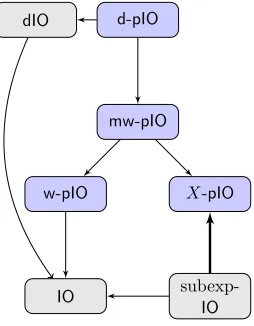
Figure 1: Notions of obfuscation for probabilistic circuits: Gray boxes correspond to existing notions, whereas purple ones correspond to notions introduced in this paper. Arrows indicate implication, whereas lack of arrows among azure boxes implies a formal separation. The thicker line indicates that the implication holds under the assumption of subexponentially-hard puncturable PRFs, which in turn, follow from subexponentially-hard one-way functions.
1.1 Our Definitional Framework: IO for Probabilistic Circuits
The first contribution of this paper, found in Section2, is the definition and study of IO notions for probabilisticcircuits, or pIO. For our purposes, a probabilistic obfuscatorpiOtransforms a (usually probabilistic, i.e. randomized) circuitC into adeterministiccircuit Λ :=piO(C) with the property that Λ(x) is computationally indistinguishable from C(x) the first time it is invoked, even when the circuits are invoked as oracles multiple times on distinct inputs. (Across multiple calls with thesame input, Λ(x) returns the same value over and over, whereasC(x) returns a fresh random output.)
As for security, we want to ensure indistinguishability of piO(C0) andpiO(C1) wheneverC0(x) and C1(x) are computationally indistinguishable for every inputx, rather than identical as in IO. However, formalizing this concept is challenging, due to the exponential number of inputs and the fact that C0, C1 are usually chosen from some distribution.
Four pIO notions. Following the approach of [BST14,ABG+13], we capture different pIO notions via classes of samplers, where such a sampler is a distributions D (parametrized by the security parameter) outputting triples (C0, C1, z), such that C0, C1 are circuits, and z is some (generally correlated) auxiliary input. Different pIO notions result from different requirement in terms of the class of samplers for which a certain obfuscator piO guarantees indistinguishability of the obfuscations of C0 and C1 (given the auxiliary input z), in addition to the above correctness requirement. Concretely, we consider four main sampler classes matching different approaches to formalizing the above computational indistinguishability requirement on all inputs, resulting in four different notions:
Dynamic-input pIO (d-pIO). A d-pIO obfuscator is required to work on samplers D such that any PPT attacker, given a triple (C0, C1, z) sampled fromD, cannot find (adaptively) an input
noticeable advantage over random guessing.
Worst-case-input pIO (w-pIO and mw-pIO). A w-pIO obfuscator weakens the above notion by only working on samplers for which the above indistinguishability requirement holds for (much) stronger attackers where the choice of x after sampling (C0, C1, z) is made without any computational restrictions, whereas the final guess, after learning Cb(x), is restricted to be polynomial-time. This captures the fact that the choice of the input x is worst case as to maximize the guessing probability in the second stage. It turns out that it makes a difference whether the first, computationally unbounded stage can pass a state (in addition to the chosen input x) to the computationally bounded stage. The (stronger) notion where we enlarge our sampler class to only require indistinguishability for attackers not passing such state is referred to asmemory-less worst-case-input pIO (ormw-pIO for short).
X-Ind pIO (X-pIO). The last notion takes a different path. Here, we weaken the adversary to choose the input x before seeing (C0, C1, z). While this alone enlarges the class too much, resulting in an unachievable notion, we additionally require the guessing advantage of the attacker to be very small, smaller than negl·X−1, for some negligible function, where X
is the number of inputs of the circuits. The requirement on the small distinguishing gap seems stringent and leads to a weak notion. However, we show that this notion is essentially optimal in the sense that when static input choices are considered, there are specific samplers with distinguishing gaps 1/poly·X−1 for which indistinguishability obfuscation is impossible (unconditionally).
In a sequence of steps, we prove thatd-pIO implies mw-pIO, and mw-pIO implies both w-pIO and
X-pIO, but the latter two notions do not imply each other. These relations are summarized in Figure 1 below. The fact that mw-pIO implies X-pIO is surprising at first, as on one hand we are restrictingthe power of the attacker, but on the other hand we are simplifying its task by choosing our barrier at negl/X advantage, and it is not clear what prevails.
The notion of d-pIO is a natural generalization of the notion of differing inputs obfus-cation [BGI+12, BCP14, ABG+13], and therefore directly suffers from recent implausibility results [GGHW14] in its most general form. In contrast, achievability of mw-pIO and the even weaker notion of w-pIO is not put in question by similar results, and the original IO notion is recovered from both w-pIO and mw-pIO when restricting them to deterministic circuits only. We in fact feel comfortable in conjecturing that w-pIO is achieved by a construction first transforming a randomized circuit C into a deterministic one Dk(x) = C(x;PRF(k, x)) for a PRF key k, then applying an existing obfuscator O toDk, such as those from [GGH+13,BGK+14,BR13].
X-Ind pIO from sub-exponential IO. The main technical result of this part is a proof that for
X-pIO, the above approach indeed provably yields a secure obfuscator if the PRF is puncturable and if the obfuscator O = iO is an IO, as long as additionally PRF and iO are subexponentially secure. In this context, sub-exponential means that no PPT attacker can achieve better than sub-exponential advantage, an assumption which we believe to be reasonable.
Consider two circuits C1, C2 sampled satisfying the indistinguishability requirement imposed by X-Ind pIO, their obfuscation are the IO obfuscated programs Λ1,Λ2 of the two derandomized circuits D1k, D2k. The challenge lies in how to apply the security guaranetees of IO on two circuits
output pair Dk1(x) and D2k(x) is X2ω(log(1 λ))-indistinguishable. Thus by a simple union bound over
all X inputs, even the entire truth tables n
Dk1 1 (x)
o ,
n
Dk2 2 (x)
o
are indistinguishable. However, even given such strong guarantees, it is still not clear how to apply IO.
We overcome the challenge by considering a sequence of X + 1 hybrids {Hi}, in which we obfuscate a sequence of “hybrid circuits” Eik(x) that “morph” gradually from Dk1 toD2k. More specifically, circuit Eik evaluates the first i inputs using D2k, and the rest using Dk1. In any two subsequent hybrids, the circuitsEi−k 1 andEikonly differ at whether thei’th input is evaluated using
Dk1 orD2k. Consider additionally two auxiliary hybridsHi−+1, Hi+ where two circuitsFi−k−i,y1 , Fik−i,y0
modified from Ei−k 1, Eik are obfuscated; they proceed the same as Ei−k 1, Eik respectively, except that they use internally a PRF key k−i punctured at point i, and output directly y and y0 for input i respectively. Then, when y and y0 are programmed to be exactly y = Ei−k 1(i) = Dk1(i) and y0 = Eik(i) = D2k(i), the two circuits compute exactly the same functionality as Ei−k 1, Eik. By IO, these auxilary hybrids are indistinguishable from hybridsHi−1 andHi respectively. Then, by the fact that y = Ek
i−1(i) = Dk1(i) and y0 = Eik(i) = D2k(i) are indistinguishable (which in turn relies on the pseudo-randomness of the PRF function), the two auxiliary hybrids Hi−+1, Hi+
are indistinguishable, and thus so are Hi−1 and Hi. Furthermore, since the distinguishing gap of IO andPRF are bounded by X2ω1(logλ), it follows from a hybrid argument that H0 and HX, which
contain the IO obfuscations ofDk1(x) and Dk2(x), respectively, are 2ω(log1 λ)- indistinguishable.
We emphasize that the reason that we require the underlying primitives, namely IO and puncturable PRF, to be subexponentially secure is because the above hybrid argument essentially “enumerates” over all inputs in the domain of C1 and C2. In fact, with a closer examination, for two specific circuits C1, C2, it suffices to “enumerate” over all “differing inputs” for which the distribution of C1(x) and C2(x) are different.
1.2 Application 1: Fully-Homomorphic Encryption
The first testbed for our pIO notions, discussed in Section 3, is a generic construction of leveled homomorphic-encryption (or LHE, for short) from a regular encryption scheme. We are then going to boost this to achieve fully-homomorphic encryption (FHE) without any circular security assumptions using a technique of independent interest.
The LHE construction. When trying to build a LHE scheme using ofuscation, the following natural and straightforward idea came up immediately. Starting from a CPA-secure encryption, we generate public-key and secret-key pairs for all levels (pk0,sk0), . . . ,(pkL,skL), and then, as part of the evaluation key, add for every level i ∈ {1, . . . , L}, the pIO obfuscation of the circuit
Prog(ski−1,pki) which takes two ciphertextsα =Enc(pk
i−1, a) and β =Enc(pki−1, b) (where aand b are bits), decrypts them using ski−1, and then outputs a fresh encryptionc=Enc(pki, aNANDb). The outputs of this circuit, givenski−1 andpki (but notski) are computationally indistinguishable from those of a “trapdoor” circuit tProg(pki) which instead ignores its inputs, and simply outputs a fresh encryption c = Enc(pki,0) of 0. Note that this circuit is independent of ski−1. We therefore hope that by relying on some pIO notion for the sampler Dski−1 that outputs
(Prog(ski−1,pki),tProg(pki),pk
ciphertexts are of the same type and size. A similar generic approach was for example abstracted in the work of Alwen et al. [ABF+13], and proved secure under ad-hoc obfuscation assumptions.
Unfortunately, it turns out that the above approach generically works for every CPA-secure scheme only when using d-pIO, which, as we discussed above, is somewhat brittle. Indeed, the above sampler Dski−1 is not contained in the classes associated with X-pIO and w-pIO. With
respect to X-pIO there is no guarantee that encryptions (of values (a NAND b) or 0) are negl/X
close to each other (note that here the domain size X corresponds to the length |α|+|β| of the two input ciphertexts). It seems that to fix the problem, one could simply re-encrypt under an encryption scheme which is negl/X secure (which exists assuming sub-exponentially secure CPA encryption), but this results in a longer output ciphertext of size poly(logX) (i.e., poly(|α|+|β|)), leading to exponentially growing ciphertext with the depth.
With respect to w-pIO (and to mw-pIO also), the main challenge with the above sampler is that given the two circuits, the adversarial first stage is computationally unbounded and can (for example) find a secret key corresponding to the public key, and pass it on to the second stage, which proceeds in distinguishing encryptions (of values (aNAND b) and 0 again) using the secret key efficiently.
LHE via trapdoor encryption. We get around the above conundrum by using a generalization of CPA encryption—called trapdoor encryption: The idea here is that the encryption scheme can generate a special trapdoor key which is indistinguishable from a real public-key, but it does not guarantee decryption any more. In this way, we expect to be able to guarantee stronger ciphertext indistinguishability (even statistical) under a trapdoor key which cannot be satisfied by normal encryption scheme as long as correctness needs to be guaranteed. In particular, we modify the proof in the above approach as follows: In the hybrids, the obfuscations in the evaluation key are changed one by one in the reverse order; to change the obfuscation of circuit Prog(ski−1,pki), first replace the public key with a trapdoor key tpki, and then move to an obfuscation of a modified trapdoor circuit tProg(tpki) with the trapdoor key built in. Now thanks to the stronger ciphertext indistinguishability under the trapdoor key, it suffices to use weak notions of pIO. In this paper, we provide the following instantiations of this paradigm:
• Lossy encryption + w-pIO. In order to instantiate the construction from w-pIO, we consider encryption schemes which are statistically secure under a trapdoor key, so-calledlossy encryption schemes [BHY09]. Such schemes can be built using techniques from a variety of works [KN08, PVW08, BHY09, PW11], and admit instantiations from most cryptographic assumptions. This gives an LHE construction fromw-pIOand any lossy encryption schemes.1
• Re-randomizable encryption + sub-exponential IO. Existing constructions of lossy encryption unfortunately do not allow a distinguishing gap of negl/X without having the ciphertext size growing polynomially in logX. Instead, we construct a trapdoor encryption scheme with such a tiny distinguishing gap under the trapdoor key, from any re-randomizable (secret or public-key) encryption scheme: The (honest) public key of the trapdoor encryption scheme consists of two encryptions (c0, c1) of 0 and 1 of the underlying re-randomizable encryption scheme, and to encrypt a bit b, one simply re-randomizes cb; the trapdoor key, on the other hand, simply consists of two encryptions (c0, c00) of both 0. By the semantic security of the underlying scheme, the honest and trapdoor keys are indistinguishable. Furthermore,
1In fact, this instantiation only requires an even weaker w-pIO notion where sampler indistinguishability must
if the re-randomizability of the underlying scheme guarantees that re-randomization of one ciphertext or another of the same plaintext yields identical distributions, then encryptions under the trapdoor keys are perfectly hiding. Many encryption schemes such as ElGamal, Goldwasser-Micali [GM84], Paillier [Pai99], Damg˚ard-Jurik [DJ01], satisfy the perfect re-randomizability. Therefore, when relying on such a scheme, the corresponding samplers is
negl/X-indistinguishable, for anyX; henceX-pIOsuffices. Combined with the aforementioned construction of X-pIO, this also gives us leveled LHE from any re-randomizable encryption scheme and sub-exponentially hard IO and one-way functions.
We also note that the instantiation from d-pIOmentioned above from any CPA-secure encryption scheme is also a (trivial) application of the above general result.
From LHE to FHE.As a final contribution of independent interest, in Section3.4.1we use IO to turn an LHE scheme info an FHE scheme via techniques inspired by the recent works of Bitansky, Garg, and Telang [BGT14], and of Lin and Pass [LP14].
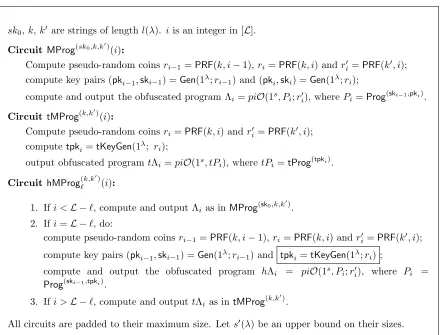
The basic idea is to instantiate the above LHE construction on super-polynomially many levels, but to represent these keys succinctly. This is done by considering a circuit Γ that on input i genarates the i-th level evaluation key, i.e., the pIO obfuscation of Prog(ski−1,pki) (in the evaluation key for super-polynomially many levels), where the key pairs (pki−1,ski−1) and (pki,ski) are generated using pseudo-random coinsPRF(k, i−1) andPRF(k, i) computed using a puncturable PRF on a hard-coded seed k; (the pIO obfuscations also use pseudo-random coins as well). The new succinct evaluation key is the IO-obfuscation of this circuit Γ, while the public key is pk0
(generated using coinsPRF(k,0)) and the secret key is the PRF seedk. In order for this approach to be secure, we need the IO obfuscation to be slightly super-polynomially secure (not necessarily sub-exponentially secure), in order to accommodate for a number of hybrids in the proof which accounts to the (virtual) super-polynomial number of levels implicitly embedded in the succinct representation. In particular, we get this step almost for free (in terms of assumptions) when starting with our LHE constructions, either because we assume sub-exponential IO in the first place, or assuming just a slightly stronger form ofw-pIOand d-pIO than what necessary above.
We also observe that this is a special case of a more general paradigm of using IO to turn any LHE with a fixed decryption depth (independent of the maximum evaluation level) into an FHE, which applies to almost all known LHE schemes (e.g. [Gen09,BV11,BGV12,Bra12,GSW13]). We believe that this general transformation is of independent interest, especially because it does not rely on any encryption scheme with circular security.
1.3 Application 2: Bootstrapping IO
Our second contribution is to use the notion of pIO to provide a simple way of bootstrapping (standard, deterministic) IO for weak circuit classes, such asNC1, into ones for all polynomial-size circuits. In the very first candidate construction of IO for P/poly, Garg et al. [GGH+13] show how to obtain full fledged IO assuming the existence of indistinguishability obfuscation for a weak circuit classWEAK, as well as a fully homomorphic encryption scheme whose decryption can be computed in WEAK (given the known FHE schemes, one can think of WEAK as NC1). The natural question that remained is: Can we achieve bootstrapping without the FHE assumption?
computable inWEAK. Our technique is inspired by the recent work of Applebaum [App13] that shows how to bootstrap VBB obfuscations from WEAK toP/poly using randomized encodings; however his transformation strongly relies on the fact that the starting point is a VBB obfuscation. The idea is to apply the “randomized encodings” paradigm which was originally proposed in the context of multiparty computation [IK00,AIK04] and has found many further uses ever since. A randomized encoding RE for a circuit familyC is a probabilistic algorithm that takes as input a circuit C ∈ C and an input x, and outputs its randomized encoding ( ˆC,xˆ). The key properties of RE are that: (1) given ˆC and ˆx, one can efficiently recover C(x); (2) given C(x), one can efficiently simulate the pair ( ˆC,xˆ), implying that the randomized encoding reveals no information beyond the output C(x); and (3) computing RE is very fast in parallel. In particular, the work of Applebaum, Ishai and Kushilevitz [AIK06], building on Yao’s garbled circuits, showed a way to perform randomized encoding of any circuit inP/polyusing a circuitRE∈NC0, assuming a PRG in⊕L/poly(which is implied by most cryptographic assumptions). The typical use of randomized encodings is to reduce computing a circuitCto the easier task of computing its randomized encoding
RE(C,·).
Therefore, to obfuscate a circuit C ∈ P/poly, the natural idea is obfuscating its randomized encoding RE(C, x;r) using an appropriate pIO scheme for NC0. (Here, pIO comes into play naturally, sinceREis a randomized circuit.) We show that, in fact,X-pIOsuffices for this purpose: Assuming that randomized encoding is sub-exponentially secure, then for any two functionally equivalent circuits C1 and C2, their randomized encoding RE(C1, x;r) and RE(C2, x;r) have indistinguishable outputs for every inputx, where the distinguishing gap is as small asnegl(λ)2−|x|2. Therefore, obfuscatingRE(C1,·) andRE(C2,·) using anX-pIOschemepiOyields indistinguishable obfuscated programs, and hence iO(C) = piO(RE(C,·)) is an indistinguishable obfuscator for all
P/poly. Since, our construction ofX-pIOfrom sub-exponentially indistinguishable IO preserves the class of circuits modulo the complexity of the sub-exponentially indistinguishable puncturable PRF. Put together, we are able to bootstrap sub-exponentially indistinguishable IO for a weak class, say
NC1, to IO for all of P/poly, assuming a sub-exponentially indistinguishable PRF computable in the weak class of circuits.
Bootstrapping pIO. The same technique above can be applied to bootstrap worst-case-input
pIO from NC0 to P/poly, assuming the existence of a PRG in ⊕L/poly. The key observation here is that since pIO handles directly randomized circuits, it can be used to obfuscate the randomized encoding RE(C,·) (without relying on pseudorandom functions). Furthermore, the security of the randomized encoding holds for any input and auxiliary information (even ones that are not efficiently computable). Then, given any two circuits C1(x;r), C2(x;r) whose outputs are indistinguishable even for dynamically chosen worst-case inputs, their randomized encoding
C10(x;r, r0) = RE(C1,(x, r);r0) and C20(x;r, r0) = RE(C2,(x, r);r0) are also indistinguishable on dynamically chosen worst case inputs. This is because, over the random choice of r and r0, the distributions ofC10(x;r, r0) andC20(x;r, r0) can be simulated using onlyC1(x;r) andC2(x;r), which are indistinguishable. Therefore a worst-case-input pIO scheme for NC0 suffices for obfuscating the circuit C0(x;r, r0) = RE(C,(x, r);r), leading to a worst-case-input pIO scheme for all P/poly. Following the same approach, we can bootstrap dynamic-inputpIOforNC0 to dynamic-inputpIO
for P/poly assuming a PRG in ⊕L/poly . Similarly, we can also bootstrap X-pIO for NC0 to
X-pIO for P/poly, but relying on the sub-exponential security of the PRG. The stronger security
2
of PRG is needed so that the randomized encoding can be madenegl(λ)/X(λ) indistinguishable.
2
IO for Probabilistic Circuits
In this section, we extend the notion of indistinguishability obfuscation (IO) to probabilistic circuits. To this end, extending [BST14], we first introduce in Section2.1a general notion of IO for general samplers outputting triples (C0, C1, z), where z is some auxiliary input, and we are going to seek for obfuscation algorithms which, given such a triple from the sampler, have the property that the obfuscations of C0 and of C1 are computationally indistinguishable, givenz,C0, and C1. We then exercise this framework to derive our IO notions for probabilistic circuits in terms of different sampler classes – the smaller the class, the weaker the resulting security assumption. Concretely, we will define four different notions ofpIO corresponding to different classes of samplers.
2.1 IO for General Samplers over Probabilistic Circuits
In this section, we define the notion of indistinguishability obfuscation for general classes of samplers over potentially probabilistic circuits, called pIO for samplers in class S. Here, a sampler is a distribution ensemble over pairs of potentially randomized circuits, together with an auxiliary input. Different notions of obfuscation (with indistinguishability-based security) in the literature, can be derived by instantiating the general definition with a specific class of samplers. For instance, IO for circuits [BGI+12,SW14] is an IO for the class of samplers that sample pairs of deterministic circuits with the same functionality (and some arbitrary auxiliary input). Later, to define various notions of obfuscation for probabilistic circuits, we will instantiate the general definition with classes of samplers that produce pairs of probabilistic circuits satisfying different properties.
More formally, let C ={Cλ}λ∈
N be a family of sets of (randomized) circuits, whereCλ contains circuits of size poly(λ). Extending the notation of [BST14], a circuit samplerforCis a distribution ensembleD={Dλ}λ∈N, where the distributionDλ ranges over triples (C0, C1, z) withC0, C1 ∈ Cλ such that C0, C1 take inputs of the same length, and z ∈ {0,1}poly(λ). Moreover, a class S of samplers for C is a set of circuit samplers forC.
The following definition captures the notion of pIO for a class of samplers.
Definition 2.1(pIOfor a Class of Samplers). A uniform PPT machinepiO is an indistinguishabil-ity obfuscatorfor a class of samplersSover the (potentially randomized) circuit familyC={Cλ}λ∈
N if the following two conditions hold:
Correctness: piO on input a (potentially probabilistic) circuit C∈ Cλ and the security parameter
λ∈N (in unary), outputs a deterministic circuit Λ of size poly(|C|, λ).
Furthermore, for every non-uniform PPT distinguisher D, every (potentially probabilistic) circuit C ∈ Cλ, and string z, we define the following two experiments:
• Exp2D(1λ, C, z): Obfuscate circuit C to obtain Λ ←$ piO(1λ, C;r) using fresh random coins
r. Run Das described above, except that in each iteration, feed D withΛ(xi) instead.
Overload the notation ExpiD(1λ, C, z) as the output of D in experiment Expi
D. We require that for every non-uniform PPT distinguisherD, there is a negligible functionµ, such that, for every
λ∈N, every C ∈ Cλ, and every auxiliary input z∈ {0,1}poly(λ),
AdvD(1λ, C, z) =|Pr[Exp1D(1λ, C, z)]−Pr[Exp2D(1λ, C, z)]|=µ(λ).
Security with respect to S: For every sampler D ={Dλ}λ∈N ∈S, and for every non-uniform PPT machine A, there exists a negligible function µ such that
Pr[(C1, C2, z)
$
←Dλ : A(C1, C2, piO(1λ, C1), z) = 1]−
−Pr[(C1, C2, z) $
←Dλ : A(C1, C2, piO(1λ, C2), z) = 1]
=µ(λ).
where µ is called the distinguishing gap.
Furthermore, we say that piO is δ-indistinguishable if the above security condition holds with a distinguishing gap µbounded by δ. Especially,piO issub-exponentially indistinguishable if µ(λ) is bounded by 2−λ for a constant.
We note that the exponential indistinguishability defined above is weaker than usual sub-exponential hardness assumptions in that the distinguishing gap only need to be small for P P T
distinguishers, rather than sub-exponential time distinguishers.
An obvious (but important) remark is that an obfuscatorpiOfor the classSis also an obfuscator for any classS0 ⊆S, whereas conversely, if no obfuscator exists forS0(or its existence is implausible), then the same is true for S⊇S0.
2.2 Dynamic-input pIO for Circuits
We start with the most natural way of formalizing a sampler outputting a triple (C0, C1, z) for which C0 and C1 are indistinguishable on every input. Namely, we ask indistinguishability on every input x adaptively chosen by a (PPT) adversary A1 on input (C0, C1, z). This defines the largest class of samplers we consider in the following, denoted Sd-Ind.
Definition 2.2 (Dynamic-input Indistinguishable Samplers). The class Sd-Ind of dynamic-input indistinguishable samplers for a circuit family C contains all circuit samplers D={Dλ}λ∈N for C with the following property: For all non-uniform PPT A = (A1,A2), the advantage of A in the following experiment is negligible.
Experiment dynamic-input-INDDA(1λ):
1. (C0, C1, z) $
←Dλ
2. (x, st)← A$ 1(C0, C1, z)
3. y←$ Cb(x), where b
$
← {0,1}
4. b0 ← A$ 2(st, C0, C1, z, x, y)
The above definition states that dynamic-input indistinguishable samplers produce pairs of probabilistic circuits satisfying that no efficiency adversary can distinguish their output C0(x) or
C1(x) on an input chosen adaptively givenC0, C1, z.
Remark 2.1 (On multi-input indistinguishability). The above definition ofSd-Ind only allows the adversary to receive output Cb(x) for one input x. We note that this is with loss of generality, as it follows from a standard hybrid argument that the above definition implies that the advantage of any efficiency adversary is still negligible even if it receives samples from Cb(x) for an unbounded number ofdynamically and adaptivelychosen inputs. More precisely, this means that the advantage of an adversary AØb(C
0, C1, z) with access to an oracleØb in guessingb is negligible, where Øb on input x samples y ←$ Cb(x) for A. For simplicity, we therefore adopt the above definition, as a multi-input indistinguishability requirement does not restrict the class any further.
We can now use the above sampler class to directly obtain the notion of Dynamic-inputpIOfor randomized circuits.
Definition 2.3 (Dynamic-inputpIOfor Randomized Circuits). A uniform PPT machine d-piO is adynamic-inputpIO(ord-pIO)for randomized circuits, if it is apIOfor the class of dynamic-input indistinguishable samplers Sd-Ind over C that includes all randomized circuits of size at most λ.
Differing-Input Indistinguishability Obfuscation. We can recover the notion of differing-inputs indistinguishability obfuscation (dIO) for circuits [BGI+12, BCP14, ABG+13], by just restricting the above definition of d-pIO to the class C0 = {Cλ0}λ∈
N of deterministic circuits. In this case, if a circuit sampler D = {Dλ}λ∈N is in the class Sd-Ind, then it must be that given
a randomly sampled tuple (C0, C1, z) $
← Dλ, it is hard to find an input x that makes the two deterministic circuits output different values. Therefore, we can re-define the dIO notion as follows within our framework .
Definition 2.4 (Differing-input IO for Circuits [BGI+12, BCP14, ABG+13]). A uniform PPT machine diO is a differing input IO for circuits, if it is a pIO for the class of dynamic-input indistinguishable samplers Sd-Ind over C0 that includes all deterministiccircuits of size at most λ.
In other words, the notion of dynamic-input pIO is a direct generalization of differing-input
IO to the case of randomized circuits. In a recent work by Garg et al. [GGHW14], it was shown that assuming strong obfuscation for a specific sampler of circuits and auxiliary inputs, it is impossible to construct differing-input IO for general differing-input samplers over circuits. Since dynamic-input pIO implies differing-input IO, a construction of d-pIO for general dynamic-input indistinguishable samplers is also implausible. However, a construction of d-pIO for specific dynamic-input indistinguishable samplers remains possible, as in the case of dIO.
2.3 Worst-case-input pIO for Circuits
In light of the implausibility of general dynamic-input pIO, we seek for a more restrictive class of samplers which bypasses this result. To this end, we introduce the notion of worst-case-input indistinguishable samplers and denote the resulting class as Sw-Ind.
for C with the following property: For all adversary A = (A1,A2) where A1 is an unbounded non-uniform machine and A2 is PPT, the advantage of Ain the following experiment is negligible.
Experiment worst-case-input-INDDA(1λ):
1. (C0, C1, z) $
←Dλ
2. (x, st) =A1(C0, C1, z) // A1 is unbounded.
3. y←$ Cb(x), where b
$
← {0,1}
4. b0 ← A$ 2(st, C0, C1, z, x, y) //A2 is PPT.
The advantage of A is Pr[b0 =b]−1/2.
This directly yields the notion of worst-case-input pIO, summarized in the following definition.
Definition 2.6 (Worst-case-inputpIOfor Randomized Circuits). A uniform PPT machinew-piO is a worst-case-input pIO (or w-pIO) for randomized circuits, if it is a pIO for the class of worst-case-input indistinguishable samplers Sw-Ind over C that includes all randomized circuits of size at most λ.
Note that in the above definition, since A1 is computationally unbounded, its best strategy on input (C0, C1, z) is to choose (x∗, st∗) that maximizes the guessing advantage of A2.
(x∗, st∗) = arg maxx,st∈{0,1}poly(λ)
Pr[b← {$ 0,1}, y ←$ Cb(x) : b=A2(st, C0, C1, z, x, y))]
Since the above definition quantifies over all adversaries (A1,A2), it implies that worst-case-input indistinguishable samplers produce pairs of probabilistic circuits satisfying that no efficient adversary (A2) can distinguish their outputC0(x) or C1(x) on anyinputx.
Remark 2.2(On Multi-input indistinguishability). As in Definition2.3, the above definition only allows the adversary to choose one input x. We note that this implies a limited form of multi-instance indistinguishability: The advantage of any adversary (A1,A2) in the above experiment is negligible even if A1 can choose a polynomial number of inputs (x1,· · · , x`, st) at once and A2 receives output samples yi
$
← Cb(xi) for all these inputs, i.e., it is given (st, C0, C1, z,{xi},{yi}). This form of multi-instance indistinguishability follows from the above definition by a standard hybrid argument, but note that the ability forA1 to pass on state toA2 is clearly necessary for this proof to be valid.
Also note that we cannot consider the stronger form of multi-instance indistinguishability considered for dynamic-input indistinguishable samplers; this is because here A1 and A2 have different computational powers and cannot be “collapsed” into one adversary.
in Sw-Ind: D0λ samples (C0, C1, z) from the same distribution as Dλ, but instead returns a triple (C00, C10, z) whereCb0 is a circuit such thatCb0(x;x0) =Cb(x) for anyx0 ∈ {0,1}`(λ), i.e., the last`(λ) bits of the input are ignored. For such a pair, the adversary A1 can always use the last `(λ) bits of the input (which are ignored by the circuit) to pass on some helpful, not efficiently computable, information to A2 that would help distinguish.
Explicitly forbidding state passing will however be useful when establishing the landscape of relationships among notions below. In particular, we define Smw-Ind as the class of memory-less worst-case-input indistinguishable samplers, which consists of all samplers D for which the advantage in worst-case-input-INDDA(1λ) is negligible for any A = (A1,A2) such that A1 is unbounded and outputs st = ⊥, whereas A2 is PPT. Note that clearly Sw-Ind ⊆ Smw-Ind. This then is used in the following definition.
Definition 2.7 (Memory-less worst-case-input pIO for Randomized Circuits). A uniform PPT machine mw-piO is amemory-less worst-case-input pIO (ormw-pIO) for randomized circuits, if it is a pIO for the class of memory-less worst-case-input indistinguishable samplers Smw-Ind over C that includes all randomized circuits of size at most λ.
Indistinguishability Obfuscation. We can recover the notion of indistinguishability obfusca-tion (IO) for circuits [BGI+12, GGH+13] by restricting Definition 2.6 of worst-case-input pIO to the class C0 ={Cλ0}λ∈
N of deterministic circuits. In this case, if a circuit sampler D={Dλ}λ∈N is in the classSw-Ind, then it must be that given a randomly sampled tuple (C0, C1, z)
$
←Dλ,C0 and
C1 agrees on every inputx. Thus, the definition of IO can be restated in our framework as follows.
Definition 2.8 (IO for Circuits [BGI+12, GGH+13]). A uniform PPT machine iO is a IO for
circuits, if it is apIOfor the class of worst-case-input indistinguishable samplersSw-Indover C0 that includes all deterministiccircuits of size at most λ.
In other words, the notion of worst-case-input pIO is a direct generalization of IO to the case of randomized circuits. Also, note that the classes Smw-Ind and Sw-Ind are the same (and thus the notion of memory-less worst-case-input and worst-case-inputpIO) when restricted to deterministic circuits.
Relations. It follows directly from the definitions that every worst-case-input indistinguishable sampler is also a dynamic-input indistinguishable sampler. This is true also if the sampler is only memory-less worst-case-input indistinguishable sampler. Therefore:
Proposition 2.1 (d-pIO ⇒ mw-pIO ⇒ w-pIO). A dynamic-input pIO obfuscator for randomized circuits is also a memory-less worst-case-input pIO obfuscator for randomized circuits. Moreover, a memory-less worst-case-inputpIO obfuscator is also a worst-case-input pIO obfuscator.
Proof. It is not hard to see that Sw-Ind ⊆ Sd-Ind and obviously Sw-Ind ⊆ Smw-Ind. It is a bit harder to prove that Smw-Ind ⊆ Sd-Ind. Indeed, assume for a sampler D ∈ Sw-Ind there exists a
non-uniform PPT adversaryA= (A1,A2) with non-negligible advantage in Experiment dynamic-input-INDDA(1λ). Then, we can assume without loss of generality that A is deterministic by non-uniformity. Moreover, we can build an memory-less worst-case-input adversary A0 = (A0
1,A02) whereA01(C0, C1, z) runsA1(C0, C1, z) to compute the inputx (and ignores the statestoutput by
then runsA2(st, C0, C1, x, y, z) to compute the output bit. ClearlyA0 achieves the same advantage asA, which is non-negligible, leading to a contradiction.
A plausible candidate. We stress that existing implausibility results do not apply to this class (as much as IO for deterministic circuits appears feasible). We conjecture here that for a suitable PRF construction, obfuscating a randomized circuitC by applying one of the existingIO
obfuscators [GGH+13, BR13,BGK+14] to the derandomized circuit DK(x) = C(x;PRFK(x)) for some hard-coded PRF seed K, is indeed a securew-pIOobfuscator.
Conjecture 1. There exists a w-pIO obfuscator for randomized circuits.
Below, we will prove that the above construction is indeed a secure obfuscator for an alternative, weak class of indistinguishable samplers, which we move to introduce next.
2.4 Static-input pIO for Circuits
Given the above formulations of dynamic-input pIO and worst-case-input pIO, it is natural to ask whether there exists a notion of pIO corresponding to static input selection. In this section, we formulate the class of input indistinguishable samplers and define the notion of static-input pIO for circuit. We show that general static-input pIO is impossible. However, pIO for a more restricted class of static-input indistinguishable samplers, namely these that are “X-strongly indistinguishable” (defined shortly below), is possible; in fact, in Section2.6we give a construction for such a pIOassuming sub-exponentially indistinguishable IO.
Definition 2.9 (Static-input Indistinguishable Samplers). The class Ss-Ind of dynamic-input indistinguishable samplers for a circuit family C contains all circuit samplers D={Dλ}λ∈N for C with the following property: For all non-uniform PPT A = (A1,A2), the advantage of A in the following experiment is negligible.
Experiment static-input-INDDA(1λ):
1. (x, st)← A$ 1(1λ) //A1 chooses challenge input x statically.
2. (C0, C1, z) $
←Dλ
3. y←$ Cb(x), where b
$
← {0,1}.
4. b0 ← A$ 2(st, C0, C1, z, x, y)
The advantage of A is Pr[b0 =b]−1/2.
In the above definition, the adversary chooses the challenge input xstatically before seeing the circuit pairs and auxiliary input sampled by the sampler. This definition is equivalent to stating that for every inputx, no efficient adversary can distinguish the outputs of two randomly sampled circuits from a static-input indistinguishable sampler Don input x.
Proposition 2.2. There exists a static-input indistinguishable sampler D∗ over deterministic circuits, such that, there is nopIO for D∗.
Proof. Consider the following sampler D∗: D∗λ samples (C0, C1, z) where C0 is an all zero circuit,
C1 computes a point function that outputs 1 at a single pointschosen uniformly randomly, and z is set tos.
D∗ is a static-input indistinguishable sampler. For any fixed input x, with overwhelming probability D∗ samples (C0, C1, s), with a differing input s 6= x. Thus, the outputs C0(x) =
C1(x) = 0 cannot be distinguished.
On the other hand, we show that any machine piO that has correctness cannot be secure for this samplerD∗. This is because an adversary can easily tell apart (C0, C1, s,Λ0 =piO(C0)) from (C0, C1, s,Λ1=piO(C1)), by simply evaluating Λ0 and Λ1 on input s.
X-Ind pIO. As mentioned above, we now consider a smaller class of static-input indistinguishable samplers, SX-Ind ⊂Ss-Ind, that circumvents the impossibility of Proposition 2.2. The samplers D
we consider satisfy that the distinguishing gap of any PPT adversary in the above static-input-IND
experiment is bounded by negl·X−1, where X is the number of “differing inputs” that circuits
C0, C1 sampled from Dhave, andnegl is some negligible function. More precisely,
Definition 2.10 ((Static-input) X-Ind-Samplers). Let X(λ) be a function bounded by 2λ. The class SX-Ind of (static-input) X-Ind-samplers for a circuit family C contains all circuit samplers
D={Dλ}λ∈N for C with the following property: For every λ∈N, there is a setX =Xλ ⊆ {0,1}
∗ of size at mostX(λ) (called the differing domain), such that,
X differing inputs: With overwhelming probability over the choice of (C0, C1, z) $
←Dλ, for every input outside the differing domain, x6∈ X, it holds that C0(x0;r) =C1(x0;r) for every random string r.
X-indistinguishability: For all non-uniform PPT A = (A1,A2), the advantage of A in the experiment static-input-INDDA(1λ) defined in Definition2.9 isneglX−1.
Definition 2.11 (X-Ind pIO for Randomized Circuits). Let X be any function bounded by 2λ. A uniform PPT machine X-piO is an X-pIO for randomized circuits, if it is a pIO for the class of
X-Ind samplers SX-Ind over C that includes all randomized circuits of size at most λ.
We note that the notion of a differing set is added for flexibility purposes, as our constructions below will allow for it. We stress that its definition is not allowed to depend on the circuits which are actually sampled, and must be fixed a-priori. Also, note that the notion encompasses the setting whereC0(x) andC1(x) are identically distributed, or are statistically very close.
The notion of X-Ind pIO is the “best-possible” achievable with respect of static input. Indeed, one can modify the distribution D∗ constructed in Proposition 2.2 to have C1(s) output 1 with probability p(1λ) for a polynomial p. The differing domain there is the whole domain, i.e., Xλ ={0,1}λ (since the circuitmay differ at any point.) This makes the sampler exactly X·p−1 indistinguishable for static adversaries, asC1(x)6=C0(x) with probability X·p−1 over the choice of (C0, C1, z). Yet, pIO for this sampler is impossible, as again, the circuit differ on input z = s with probability p(1λ). This impossibility cannot be pushed any further, and indeed general X-pIO
Other X-Ind notions. One could indeed formulateX-Ind versions of dynamic-input, memory-less worst-case-input, and worst-case-input pIO, where the distinguishing advantage is required to be very small. Indeed, these notions would all be (in analogy of the above) weaker(and hence implied) byX-pIO, and can thus all be achieved by our construction presented below. (Note that our possibility result below does not contradict the implausibility of [GGHW14], as the corresponding sampler from their proof would enable a larger distinguishing gap.)
Relation to worst-case-input pIO. We are going to now show that everyX-Ind indistinguish-able sampler is also a memory-less worst-case-input indistinguishindistinguish-able one, i.e., it belongs toSmw-Ind. Hence, if memory-less worst-case-input pIO exists, then so does X-Ind pIO. This result appears at first somewhat surprising (and indeed, its proof requires some technical work), because static adversaries are the weakest, as opposed to memory-less worst-case-input adversaries being among the strongest. This really highlights the power of requiring aneglX−1distinguishing gap. Moreover, it is important to note that the result does not extend to worst-case-input pIO, which we show to be incomparable toX-Ind pIObelow.
Proposition 2.3. Let X=X(λ)≤2poly(λ). Then, SX-Ind⊆Smw-Ind.
The proof of the proposition is provided in Appendix B.1.
Corollary 2.4. If d-pIO or mw-pIO for randomized circuits exists, then X-pIO for randomized circuits exists.
2.5 Strict Inclusions
We note that all relations we proved above result into strict inclusions of the corresponding sampler classes into each other. Moreover, we also note that the two notions of w-pIO and X-pIO are incomparable. This follows by the three following separations of sampler classes:
mw-pIO6⇒d-pIO. Let πλ be a permutation on {0,1}λ. Consider the sampler D such that Dλ outputs triples (C0, C1, z) such that C0(x) = 0 for all inputs x ∈ {0,1}λ, z = πλ(x∗) for a randomx∗ in{0,1}λ, and finally, C
1, on input x, checks whether πλ(x) =z, and if so outputs 1, and it outputs 0 otherwise. Then, it is not hard to see thatD∈Sd-Indas long asπ ={π
λ}λ∈N is one-way, yet D /∈ Smw-Ind, as a computationally unbounded A1 can simply recover x∗ from
z, and output this value, and this leads to easy distinguishing for A2.
X-pIO6⇒w-pIO. We consider a bit-commitment scheme which is computationally hiding (against non-uniform adversaries) and statistically binding. Then, we consider the pair of circuitsC0, C1 with input length λ such that Cb(x) ignores the λ-bit inout x and outputs Com(b;r), for a randomly chosen commitment randomness which we set to beλbits without loss of generality. Note that these circuits differ on every input. Then, considerD which outputs (C0, C1). First of all, we have D ∈ Sw-Ind, because regardless for all x, the outputs C0(x) and C1(x) are computationally indistinguishable. However, D /∈ SX-Ind for X = 2λ: A distinguisher can just guess the randomnessr, and check which bit was committed to (and if the randomness is incorrect, just output a random bit). This strategy achieves advantage 2−λ = 1/X.
matter how one defines the differing sets, all x are in it, since the circuits behave completely differently on all inputs.) Here, we assume thatxisλ-bit long, and that the encryption scheme can be distinguished with advantage at mostnegl(λ)·2−λby an attacker. (Such a scheme can be obtained from any subexponentially-secure bit-encryption scheme.) Then, clearly,D∈SX-Ind, but however,D /∈Sw-Ind, since an unbounded A1 can compute a secret key from zand pass it on to A2.
We stress that the last counterexample does not work against mw-pIO (thus possibly violating Proposition2.3) because in order to achieve such high security, the secret key of the exponentially-secure encryption scheme must belongerthanλbits, and thus cannot be embedded in a carefully chosenx.
2.6 Construction of X-Ind pIO from Sub-exp Indistinguishable IO
The following theorem yields a construction of anX-Ind pIOobfuscator (as in Definition2.11) from sub-exponentially hard IO. It relies on sub-exponentially secure puncturable PRF, as defined in AppendixA.1.
C,C1 andC2are probabilistic circuits of size at mostλ,Kis a key of the PRF function andK−i
a punctured key at inputxi, andy is a string of length at mostλ. In particular, x1, . . . , xX for
X =X(λ) are the elements of the differing domain, canonically ordered (e.g., with respect to the lexicographic ordering of strings).
Circuit E(C,K)(x): OutputC(x; PRF(K, x)). Circuit E(C1,C2,K)
i (x): If x < xi, output C1(x ; PRF(K, x)); otherwise, if x ≥ xi, output
C2(x; PRF(K, x)). Circuit E(C1,C2,K,y)
i (x): If x < xi, output C1(x ; PRF(K−i, x)), and if x = xi, output y;
otherwise, if x > xi, outputC2(x; PRF(K−i, x)).
All circuitsE(C,K), E(C1,C2,K)
i , E
(C1,C2,K,y)
i are padded to their maximum size.
Figure 2: Circuits used in the construction ofX-piO and its analysis
Theorem 2.5(Existence ofX-Ind pIO.). Assume the existence of a sub-exponentially indistinguish-able indistinguishability obfuscator iO for circuits and a sub-exponentially secure puncturable PRF (Key,Puncture,PRF). Then, there exists a X-Ind pIO obfuscator X-piO for randomized circuits.
Construction X-piO: On input 1λ and a probabilistic circuit C of size at most λ, proceed as follows:
1. Letλ0 =λ0(λ) = (λlog2(λ))1/. Sample a key of the PRF functionK ←Key(1λ0).
2. Construct deterministic circuit E(C,K) as described in Figure 2. By construction the size of E(C,K) is bounded by a polynomialp(λ0)≥λ0 inλ0.
3. Letλ00=p(λ0)≥λ0. ObfuscateE(C,K) using iO, Λ←$ iO(1λ00, E(C,K)).
4. Output Λ.
3
Application 1: Fully Homomorphic Encryption
3.1 Our Results
In this section, we show how to construct leveled and fully homomorphic encryption schemes using different notions of pIO. One of the main corollary of our construction is that assuming sub-exponentially indistinguishable IO and sub-exponential secure OWF, any rerandomizable CPA encryption scheme (that is slightly inverse super-polynomial indistinguishable) can be transformed into a FHE scheme. More precisely,
Theorem 3.1 (LHE and FHE from sub-exp indistinguishable IO and sub-exp OWFs). Assume the existence of a sub-exponentially indistinguishable IO for circuits, and a sub-exponentially secure OWF.
• Any perfectly rerandomizable encryption scheme can be transformed into aleveledhomomorphic encryption scheme.
• Any perfectly rerandomizable encryption scheme that is µ-indistinguishable for any inverse super-polynomial function µ, can be transformed into afully homomorphic encryption scheme.
At a high-level, the above theorem is obtained through a general two-step approach.
Step 1: A general construction of LHE. We first show a general transformation that turns any, so called, trapdoor encryption scheme Π (introduced shortly), into a LHE scheme, assuming the existence ofpIOfor a specific class of samplers defined by Π. Our transformation follows a very natural idea for enabling homomorphic evaluation: Obfuscate the program that on input some input ciphertexts, decrypt them, compute NAND and re-encrypt under a different key. Since the program to be obfuscated is probabilistic,pIOcomes into play natural. But as seen in Section2,pIOfor different classes of samplers leads to various notions with different power. The challenge is to only rely on weak notions of pIO, namely, worst-case-inputpIO and X-Ind pIO. We achieve this by instantiating the trapdoor encryption scheme Π with specific constructions that have certain special properties.
underlying trapdoor encryption scheme andpIO. Then additionally assuming an inverse super-polynomially indistinguishable IO for deterministic circuits and puncturable PRF, we can transform the LHE scheme into a FHE scheme without relying on circular security. In fact, this transformation is general and applies to not only our LHE scheme based on pIO, but any LHE scheme that has a fixed decryption depth, which includes almost all known LHE schemes (e.g. [Gen09,BV11,BGV12,Bra12,GSW13]).
Below we describe the two steps in more details.
Roughly speaking, a trapdoor encryption scheme has two-modes: In the honest mode, it acts as a CPA secure encryption scheme, whereas in the trapdoor mode, an indistinguishabletrapdoor public key is sampled, under which encryption is no longer guaranteed to have correctness. So far, we haven’t put any security requirement on the trapdoor mode. In this work, we will consider three different security properties in the trapdoor mode: (i) Computationally hiding, that is, encryption under trapdoor public keys are negligibly indistinguishable, or (ii) ν-hiding, that is, encryption is indistinguishable with a distinguishing gap ν(λ) = negl(λ)22l(λ) where l is the length of the ciphertext, or (iii) statistically hiding.
The advantage of using a trapdoor encryption scheme is that first it is a generalization of CPA encryption (as any CPA encryption automatically gives a trapdoor encryption scheme with computationally hiding trapdoor mode), and second the trapdoor mode may have strong hiding properties, such asν-hiding and statistically-hiding, that are impossible for normal CPA encryption schemes. The strong hiding properties are, in fact, the key towards basing our LHE scheme on weak notions of pIO, in particular, the statistically hiding property of the trapdoor mode enables our LHE scheme to rely only on worst-case-input pIO, while ν-hiding enables it to rely only on
X-Ind pIO, leading to different instantiations of our general construction of LHE.
Summarizing, our general transformation is stated informally in the following proposition (see Proposition3.2for the formal statement), followed by its instantiations.
Informal Proposition (Step 1: General Construction of LHE). Let Π be a trapdoor encryption scheme. Assume the existence of apIOfor an appropriate class of samplersSΠdefined byΠ. Then, Π can be transformed into a leveled homomorphic encryption scheme.
By instantiating the two key components—the trapdoor encryption scheme and a matching
pIO—we obtain the following three instantiations:
1. Rerandomizable encryption + sub-exponentially indistinguishable IO: We show that perfectly rerandomizable encryption scheme can be converted into a trapdoor encryption scheme whose trapdoor mode isν-hiding. (In fact, as we see later, a weaker notion of rerandomizability suffices.) The ν-hiding property of the trapdoor mode implies that the matching pIO can be instantiated withX-Ind pIO, which in turn is implied by sub-exponentially indistinguishable IO and OWF by our construction in Section 2.6. This instantiation corresponds to the first LHE construction in Theorem3.1.
3. CPA encryption + dynamic-input pIO: Any CPA encryption scheme trivially implies a trapdoor encryption scheme whose trapdoor mode is computationally hiding (by simply setting the trapdoor mode to be identical to the honest mode). The computational hiding property in the trapdoor mode implies that the matchingpIOcan be instantiated using dynamic-inputpIO. Though dynamic-inputpIOfor general classes of samplers is implausible [GGHW14], dynamic-input pIO for the specific class defined by a CPA encryption for our LHE scheme circumvents the implausibility result. Furthermore, the same construction in Conjecture 1 can also be a candidate of dynamic-input pIOfor that specific class.
In the next step, we show a general transformation that turns any LHE scheme with a fixed decryption depth (i.e., the decryption algorithm has depth poly(λ) independent of the maximum evaluation level) into a FHE, provided that the encryption of the LHE scheme is slightly inverse super-polynomially indistinguishable and assuming IO and puncturable PRFs with also inverse super-polynomial distinguishing gap.
Informal Proposition (Step 2: General transformation from LHE to FHE). Let µ be any inverse super-polynomial function. Assume a µ-indistinguishable IO for deterministic circuits and puncturable PRF. Then any µ-indistinguishable LHE scheme Π, can be transformed into a FHE scheme.
The general transformation from LHE to FHE directly applies to our LHE scheme which has a decryption algorithm identical to the underlying trapdoor encryption scheme, (hence, the decryption depth is independent of the maximum evaluation depth). When the LHE scheme is instantiated with a rerandomizable encryption and sub-exponentially indistinguishable IO, the transformation leads to an FHE without assuming any additional assumptions, which corresponds to the construction of FHE in Theorem 3.1. Furthermore, the general transformation also applies to many known lattice based LHE schemes such as [Gen09, BV11, BGV12, Bra12, GSW13]; in particular, this give FHE based on slightly super-polynomial hardness of the learning with error problem, and slightly super-polynomially secure IO and OWFs.
3.1.1 Organization of the Section.
Below, we first formally define trapdoor encryption scheme in Section 3.2. Then we proceed to formally describe the general transformation from a trapdoor encryption scheme to a LHE scheme, and discuss about the three concrete instantiations in Section3.3. In Sections3.4, we show how to further turn the construction of LHE into a FHE.
3.2 Trapdoor Encryption Schemes
In this section, we define the notion of trapdoor encryption schemes. They have two modes: In the honest mode, an honest public key is sampled and the encryption and decryption algorithms work as in a normal CPA-secure encryption scheme with semantic security and correctness; additionally, there is a “trapdoor mode”, in which a indistinguishable “trapdoor public key” is sampled and the encryption algorithm produces ciphertexts that may have stronger indistinguishability properties than these in the honest mode, at the price of losing correctness. More precisely,
Trapdoor Public Keys: The following two ensembles are indistinguishable:
n
(pk,sk)←$ KeyGen(1λ) : pko
λ
≈ntpk←$ tKeyGen(1λ) : tpko
λ
Computational hiding: The following ensembles are indistinguishable.
n
tpk←$ tKeyGen(1λ) : Enctpk(0)
o
λ ≈ n
tpk←$ tKeyGen(1λ) : Enctpk(1)
o
λ
The basic definition of trapdoor encryption scheme only requires encryption of different bits under a freshly generated trapdoor public key to be computationally indistinguishable. As discussed before, this definition is a generalization of CPA encryption in the following sense,
Claim 3.1.1. LetΠ0 = (KeyGen,Enc,Dec)be a CPA-encryption scheme. ThenΠ = (KeyGen,Enc,Dec,tKeyGen=
KeyGen) is a trapdoor encryption scheme.
The basic trapdoor encryption scheme does not provide any advantage in the trapdoor mode than the honest mode. Below, we consider two stronger security properties in the trapdoor mode.
3.2.1 Statistical Trapdoor Encryption Scheme
Definition 3.2(Statistical Trapdoor Encryption Scheme). We say that trapdoor encryption scheme Π = (KeyGen,Enc,Dec,tKeyGen) is a statistical trapdoor encryption scheme, if the computational hiding property in Definition 3.1is replaced by the following.
Statistical hiding: The following ensembles are statistically close.
n
tpk←$ tKeyGen(1λ) : Enctpk(0)
o
λ
≈sntpk←$ tKeyGen(1λ) : Enctpk(1)
o
λ
We note that any lossy encryption scheme as defined by Bellare, Hofheinz and Yilek [BHY09] implies a statistical trapdoor encryption scheme. A lossy encryption scheme has a key generation algorithm KeyGen that takes as input the security parameter 1λ and additionally a variable m ∈ {injective,lossy}indicating whether to generate a key in the injective mode or in the lossy mode. A key generated in the injective mode ensures decryption correctness and semantic security, whereas a key generated in the lossy mode statistically loses information of the plaintexts, that is, encryption of different bits are statistically close. Therefore, we have:
Claim 3.1.2. LetΠ0 = (Gen0,Enc,Dec)be a lossy encryption scheme. ThenΠ = (KeyGen,Enc,Dec,tKeyGen) where KeyGen(1λ) = Gen0(1λ,injective) and KeyGen(1λ) = Gen0(1λ,lossy), is a statistical trapdoor
encryption scheme.
3.2.2 µ-Hiding Trapdoor Encryption Scheme
Definition 3.3 (µ-Hiding Trapdoor Encryption Scheme). Let µ be any function We say that trapdoor encryption scheme Π = (KeyGen,Enc,Dec,tKeyGen) is a µ-Lossy trapdoor encryption scheme, if the computational hiding property in Definition 3.1 is replaced by the following.
µ-hiding: For any non-uniform PPT adversary A, the following holds:
Pr[tpk
$
←tKeyGen(1λ) : A(Enctpk(0)) = 1]−Pr[tpk $
←tKeyGen(1λ) : A(Enctpk(1)) = 1]