Through a Glass Darkly: a Case for the Study of Virtual Space RUTH CONROY DALTON, JORGE BAZAN, XIANG LIU
LINDSAY MIGOSKI, DONGHOON YANG College of Architecture, Georgia Institute of Technology
Abstract
This paper begins to examine the similarities and differences between virtual space and real space, as taken from an architectural (as opposed to a biological, psychological, geographic, philosophical or information theoretic) standpoint. It continues by introducing a number of criteria, suggested by the authors as being necessary for virtual space to be used in a manner consistent with our experience of real space. Finally, it concludes by suggesting a pedagogical framework for the benefits and associated learning outcomes of the study and examination of this relationship. This is accompanied by examples of recent student work, which set out to investigate this relationship.
Introduction
Virtual realityi
as a term suffers from a problem of hype, particularly within architectural discourse and more specifically within architectural education. It should come as little surprise that the concept of virtual reality should be of interest to architects and students of architecture. In the first two chapters of her book (Bertol, 1997), Bertol puts forward the theory that virtual reality can be held as being merely the current stage of a quest for producing more and more realistic, three-dimensional representations, on which architects have been engaged since the early fifteenth century (perspective drawing being but one example). But Sheep T. Iconoclast asked a significant question in his chapter in (Iconoclast, 1995) as he wonders, “When virtual reality will be interested in architects”. The unwritten answer to this pertinent question is when architects make a genuine contribution to the wider field of VR research. In order to do this, it is first vital that we find a way to look beyond the hype and associated seductive imagery and ask some awkward questions.
The awkward question, with which this paper is beginning to wrestle, concerns the nature of virtual space and whether it is used or perceived in a manner consistent with how we use or perceive real space. In his paper on visual perception and virtual reality (Stark, 1994), Stark presents an argument that suggests why the ‘illusion of virtual spatial perception’ is so compelling. He says, “Seeing [in the real world] is an illusion that hides the actual processes of vision. These illusions apply equally as well to the worlds of VR as to the so-called ‘real’ world.” These ‘illusions’ are: The illusion of ‘completeness & clarity’ (top-down cognitive models controlling the perceptual processes.) The illusion of ‘the third dimension’ (only 2D retinal reception yet our cognitive/spatial models are in 3D.) The illusion of ‘continuity in time’ (eyelid ‘blinks’ continuously interrupt our vision, without any awareness of the interruption.) The illusion of ‘space constancy’ (our retinal image is in motion with every saccade, again without any awareness of this motion.)
Stark claims that virtual space can be perceived in a manner consistent with that of real space because our perception of real space as three-dimensional, temporally consistent and non fragmented is merely an illusion anyway. Furthermore, that the same mechanisms that convince us that the real world is ‘real’, in some tangible way, are those very means that enable us to experience virtual space as a particularly compelling “illusion”ii
.
Another academic field, whose recent findings effectively support the theory that real and virtual space perception are analogous, is psychology. Researchers in this field have noted that spatial knowledge learnt in a virtual simulation can be effectively transferred into the real world. Drawing the assumption that since the transfer of spatial knowledge from one realm to another could be demonstrated experimentally, it therefore implies that our spatial perception is similar within both kinds of space. For example, (Witmer, Bailey et al. 1996), examine how route knowledge gained in a simulation of a complex office building can be seen to aid navigation in the real building. They summarize their findings thus, “These results suggest that VEiii
In the following year, a paper by Ruddle (Ruddle, Payne et al. 1997) reproduced an earlier study conducted in the real world by Thorndyke and Hayes-Roth (Thorndyke and Hayes-Roth 1982). This experiment, which had been originally conducted in a real environment, was reproduced in a desktop (non-immersive) VR. It was found that the users effectively learnt the spatial layout of the world, in a manner that was analogous to the results of Thorndyke and Hayes-Roth’s original experiment, enabling Ruddle to conclude that navigation in real and virtual worlds was comparable. Furthermore, in (Darken and Banker 1998), they also concluded that exposure to a virtual simulation subsequently improved wayfinding performance in the real world. Below are gathered a selection of quotations that effectively summarize what researchers in the field of virtual wayfinding are saying about the relationship between navigation in the real world: In (Darken and Sibert 1993) they conclude that “principles extracted from real world navigation... can be seen to apply in virtual environments.” In (Witmer, Bailey et al. 1996), they state that, “These results suggest that VEs that adequately represent real world complexity can be effective training media for learning complex routes in buildings.” In (Tlauka and Wilson 1996) they conclude that “navigation in computer-simulated space and real space lead to similar kinds of spatial knowledge.”
All of the above authors appear to be suggesting that we use real space and virtual space analogously, on the basis that knowledge gained in either one may be applied to the other. However, the assumption that we navigate through real space in a manner that is similar to virtual space, based solely on evidence of knowledge transfer (between realms), has to be a fundamentally flawed assumption. Although the similarity of spatial knowledge gained in these two realms certainly supports the notion that real and virtual behavior is analogous, by itself it cannot be sufficient evidence. In order to evaluate whether we perceive virtual space in a manner analogous to real space, it is necessary to determine whether we actually use space in the same way in both domains.
In previous work by Conroy Dalton, née Conroy, (Conroy, 2001) it was demonstrated that observed movement patterns of people moving through a real art gallery correlated with the patterns of virtual navigation of subjects moving through a virtual simulation of the same gallery. The data were compared, in this case, as cumulative flow counts across defined thresholds in the building. In addition to these highly suggestive results, research undertaken by Ruddle (Ruddle, 1996), implies that patterns of movement are consistent between desktop and immersive systems, suggesting that the medium through which virtual environments are viewed is less
important than other factors. All of the above papers, therefore, begin to draw tentative conclusions that we perceive or use virtual space in a manner quite consistent with real space use. However, this is not to say that virtual space is, at some level, ‘real’.
If this inquiry begins to shift away from asking whether virtual space is like real space to querying whether virtual space is ‘real’ in some quantifiable way, a paper by Benedikt (Benedikt, 1992) becomes pertinent. In this paper, Benedikt presents an argument that real space and virtual space are identical due to the relationship between space and information. Namely, that space and information are synonymous; space essentially allows us to distinguish between multiple objects. He says, “Space both is, and is composed of information” and adds, “Space and information are one and the same ‘thing’.” This standpoint is taken after ‘Leibniz’s Law’, also known as The Identity of Indiscernibles. Imagine two objects whose appearance is identical in every detail. In such a case, we can only distinguish such objects by their spatial relations to other objects. In this example space and information are mutually dependent, and could be held to be two aspects of the same thing. This is the basis for Benedikt’s argument about the nature of virtual space.
The above statement, that virtual space and real space are the same because both contain information, can be contrasted with the hypothesis of Wertheim, in her book (Wertheim, 1999) in which she argues that virtual space is not like real space, but is, in its own right, very ‘real’. She argues that cyberspace is a space for the human soul or psyche and that in creating this other space, we are rapidly returning to a medieval, dualistic universe. She states,
“As a production of late twentieth-century Western communities, cyberspace, also, reflects the society from which it is springing. As we have noted, this space is coming into being at a time when many in the Western world are tiring of a purely physicalist world picture. Can it be a coincidence that we have invented a new immaterial space at just this point in our history? At just the point when many people are longing once more for some kind of spiritual space?”
Although both Benedikt and Wertheim put forward compelling reasons why virtual space is real space (since both are information) and that cyberspace in ‘real’ (as a realm for the soul), neither of these views are particularly helpful within a broader architectural discourse. Firstly, it could be strongly suggested that the
Since virtual space can take many forms (particularly representational differences such as graphical/non-graphical and 2D/3D) then the relationship between the virtual and real can be seen to span a range of conditions from most like real space, at one extreme, to least like real space, at the other. It therefore becomes necessary to define the point along this continuum at which the relationship between both kinds of space begins to disintegrate, or indeed, “where to draw the line in the sand”. As part of this process, it is helpful to establish some criteria, which are necessary to be fulfilled, in order for virtual space to be used and perceived in a manner similar to real space. Three such criteria will be proposed, in this paper, as being significant factors. Below are the criteria, by which virtual space should be judged to be similar to real space.
1. That the virtual world should be navigable and should allow for navigational choices.
2. That there be potential for chance encounter (implying it is a collaborative, shared virtual environment) and for social interaction.
3. That the environment should have an “intelligible” structure. This implies a structure, of which it is relatively easy to form an internal (or mental) representation, and which can be easily retrieved and/or communicated to others.
It should be noted that none of the above conditions preclude the necessity for the environment to be three-dimensional, despite the fact that the term virtual reality is usually taken to imply three-three-dimensional, real-time, spatial environments. It could be argued that were these conditions to be met, then not only would we be using virtual space as if it were real space, but furthermore, that there is an added “architectural dimension” that is not covered by either Benedikt or Wertheim.
A Pedagogical Framework for the Study of Virtual Space
Why should students of architecture be studying virtual space? Precisely because it allows them hold up a mirror, against which they may re-examine their attitudes and thoughts about real space. It is a realm for thoughts and experimentation, devoid of much of the ‘noise’ that clouds real world research. In beginning to explore the relationship between the configuration of spaces and resultant patterns of occupancy, interaction and socialization in a virtual space, students became better equipped to consider such issues with respect to real world architecture. Below are described the results of an investigation into virtual space use, undertaken by graduate students of the College of Architecture at Georgia Institute of Technology. The spatial environments being studied were MUDs (Multi-User Domains) which are social, text-based environments on the Internet.
MUD environments are environments that have no graphics (either 2D or 3D) but rather each space is described by a text-description, often in elaborate detail, prompting more evocative imagery than the majority of 3D virtual environments could currently allow. The description of each space will also indicate the presence of exits to other, adjacent spaces. Often these exits are described in compass terms (N, NE, E, SE, S etc.) implying not only a structure of spatial relationships but also a sense of orientation and heading. In order to navigate through such a structure of spaces, a user must simply type the name of the desired exit and will be ‘transported’ to the adjacent space.
The presence of another person occupying the same space will be indicated by a simple statement, “Jack is present”. If two or more people are occupying the same space at the same time, they can strike up a conversation, again using the keyboard to type the words they wish to “say”. This will appear as, for example, “Jack says hello” (as in the narrative of a novel). There are variations on these methods of communication, if more than two people are occupying the same space, yet a private conversation is required, one person can “whisper” to another person. Equally, it is possible to communicate transspatially, that is to say beyond the boundaries of the immediate space within which a person is located. “Shouting” or using a “loudspeaker”, the content of which is immediately transmitted to everyone currently inhabiting the whole environment, achieves this.
The task the students were set was to initially select and map a MUD and then to visualize the network of spaces using a graph-analysis called Pajekiv
consecutive days. Using the Pajek software, they were able to identify which locations had high occupancy rates and then to compare the occupancy rates to certain spatial, configurational properties of the environment. In real space it has been noted that there is a strong relationship between patterns of space use (both in terms of movement flows and static occupancy) and certain, configurational properties of space. In particular, space syntaxv
research has demonstrated a strong relationship between how ‘integrated’ or ‘segregated’ a space is within a system of spaces and resultant patterns of person occupancy/movement. With reference to space syntax findings in the real world, the students tested an hypothesis. The hypothesis was that if areas of noted high occupancy were either integrated within the overall structure of the MUD or shallow (fewer number of steps away) to the entry point of the MUD, then this would be consistent with patterns of real space use.
The four MUDs analyzed in this study were:
DynamixMUSH (the ‘ghost town’) MUD of 358 spaces
Island (the ‘art work’) MUD of 87 spaces
M*U*S*H (the ‘programmers coterie’) MUD of 464 spaces
The Resort (the ‘trysting place’) MUD of 18 core spaces (+ many ‘private’ spaces)
DynamixMUSH
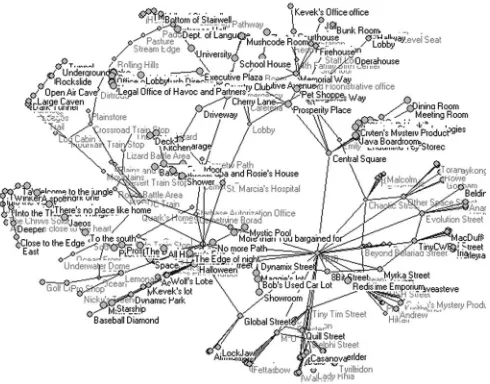
Fig. 2. Named Spaces of DynamixMUSH
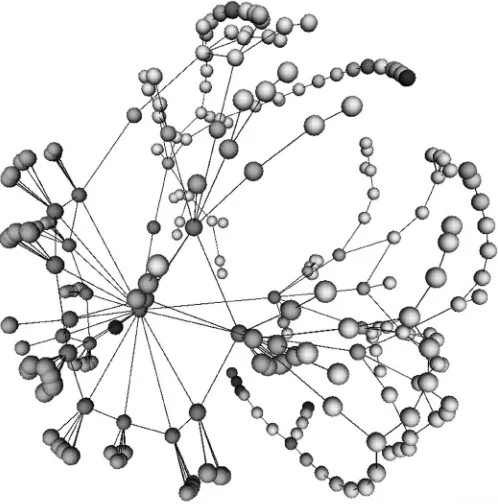
DynamixMUSH is thematically based upon a city and is composed of three areas, downtown, streets with private spaces accessible from them and the city environs. The downtown area is loosely based upon a relational and oriented grid of streets. Connect to the downtown grid are additional streets from which private ‘spaces’ may be accessed (the equivalent of a residential area). Each ‘residential’ street has between four and ten private spaces leading from it. Finally, there are the city environs, which contain spaces described as, for example, “Plains and Hills”, “Mountains”, “Oceanside” and “Deserts”. A virtual “Train” connects these spaces to the center of the downtown area. The center of DynamixMUSH is a space called the “HUB”, which is also the entry space to this world. The Hub has twenty-three connections to other spaces and the deepest space from the HUB is seventeen steps (links or connections in the graph) away.
Island
Fig. 3. Three Dimensional Structure of the Island
Fig. 4. Named Spaces of the Island
Fig. 5. Photograph of the Island Installation (Copyright Pope & Guthrievi
)
Lynn MacRitchie, on reviewing the island MUSH in the Financial Times, commented of it
“I have one of those rare moments when perception shifts. I realize I have entered a non-existent but nonetheless very real space, and I am not alone. The sense of moving around in a shared imaginative experience is so powerful that it becomes physical”
This experience of a strong mental association between the structure of virtual spaces and the real, material world is of great import to an architectural definition of virtual space. It could be argued that one of the key aspects to MacRitchie’s statement is the description of the shared experience. Clearly for her, the potential for chance encounter and social interaction (criterion #2) is an important component of the experience of this environment, allowing her to reconstitute these spaces, in her own mind as very ‘real’.
M*U*S*H
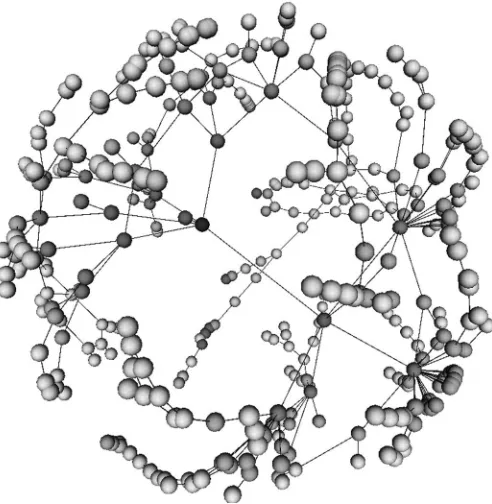
Fig. 6. Three Dimensional Structure of M*U*S*H
This MUD was a large and extremely complex environment, containing almost five hundred distinct spaces. The most striking feature of the spatial layout of this MUD was that it was bifurcated; a MUD in two parts joined only at two or three locations. The ‘lower’ part of the MUD resembled a gridded town, and included spaces representing a ‘park’, an ‘art museum’, ‘apartment buildings’ etc. The primary point of connection between the ‘lower’ and ‘upper’ sections of the MUD is located in a space called “Omphalos Park”, which also happens to be the main entrance space to this environment. By ascending a “beanstalk” in the park, a visitor enters the ‘upper’ realm, which is a fantastical environment, containing spaces conceived as being in outer space, on a sunken ship or in a “holy grove”. A fascinating aspect about the spatial structure of this MUD was the difference between the ‘lower’ and ‘upper’ sections. As already mentioned, the lower section was far more ‘grid-like’, whereas the upper structure was more ‘tree-like’ (dendritic) and students reported that they found it more difficult to comprehend the structure of the upper section (compounded by the fact that a number of different spaces shared a common name).
The Resort
Fig. 7. Three Dimensional Structure of The Resort
Fig. 8. Named Spaces of The Resort
In all, the four MUD environments analyzed were quite different (the “ghost town”, the “art work”, the “programmers’ coterie” and the “trysting place”) in terms of spatial structure, patterns of occupancy, numbers of users and complexity. However, each demonstrated an aspect of real space use that appeared to have been translated into the virtual realm. In terms of the criteria suggested earlier in this paper (conditions upon which virtual spaces should be considered to be functioning as real spaces - navigability and route choices, potential for chance encounter, and an intelligible structure) all of the MUDs investigated would appear to satisfy the first two criteria. The one MUD which appeared to have the most unintelligible structure (based solely upon reported disorientation experienced by the students whilst undertaking the mapping assignment) was the M*U*S*H world. Interestingly, this was the world in which users had abandoned any pretence at using it spatially, instead relying on methods of communication that transcended the spatial structure. This is directly analogous to strategies used in the real world to overcome spatial deficiencies in real environments.
Although it can be argued that the findings presented here have a limited application, as the samples selected are too small to draw significant conclusions, what is essential, within the context of a larger pedagogical framework, is to summarize the learning outcomes which the students gained from completing this exercise. For all of them, it allowed them to approach a complex problem with structure and rigor. They first mapped, visualized and analyzed a complex spatial system and then went on to question the relationship between the layout of the
environment and patterns of usage. For each of them, it caused them to begin to think about real space in a way in which they had not previously considered. They achieved this by holding virtual space, as a mirror, against which they re-examined the nature of real-space and real space use. For this reason, above all others, it served as an extremely useful exercise to have undertaken.
Conclusions
Virtual space can be held to be analogous to real space in ways that are far more fundamental than considered previously - in terms of navigability, interaction and intelligibility. Not all virtual worlds satisfy these criteria and therefore not all virtual space can be said to be functioning in a manner similar to real space. By examining the spatial structure of virtual worlds and comparing the structure to patterns of space use and occupancy we can begin to judge to what extent these virtual spaces are being used as if there were, in some tangible manner, ‘real’. These criteria take a quite different approach from other definitions of virtual space as being real, for
example, virtual space as either “information-space” or “soul-space”. Essentially the difference in this approach is to consider virtual space primarily as social space. Furthermore, the act of examining these virtual worlds in such a rigorous manner also helps to shed light upon our understanding of real space. That is to say, the conception of real space as a system of spatial relationships and networks, through which we move, and socially interact with those around us. Indeed, as Rushkoff said in his keynote lecture at the recent RIBA conference on E-Futures: Designing for a Digital World, “We are more aware of real space due to our use of virtual space. Real space is a premium.
References
Anders, P. Envisioning Cyberspace : Designing 3D Electronic Spaces: McGraw-Hill Book Company, 1998. Benedikt, M. L. “Cityspace, Cyberspace and The Spatiology of Information.” Paper presented at the New Urbanism Symposium, Princeton University, School of Architecture and Planning, October 17th 1992 1992.
Bertol, D., and D. Foell. Designing Digital Space: An Architect’s Guide to Virtual Reality. New York: John Wiley and Sons, 1997.
Conroy, R. A. “Spatial Navigation in Immersive Virtual Environments.” Doctoral, University College London, 2001.
Darken, R. P., and J. L. Sibert. “A Toolset for Navigation in Virtual Environments.” Paper presented at the ACM Symposium on User Interface Software & Technology ‘93, Atlanta, GA 1993.
Darken, R. P., and W. P. Banker. “Navigating in Natural Environments: A Virtual Environment Training Transfer Study.” Paper presented at the VRAIS ‘98 1998.
Heim, M. The Metaphysics of Virtual Reality. 1994, paperback edition ed. New York: Oxford University Press, 1993.
Iconoclast, S. T. “Architecture: The Virtual Imperative.” In Architects in Cyberspace, edited by M. Toy, 28-31. London: Academy Group Ltd., 1995.
Large-Scale Virtual Buildings: An Experimental Comparision of Immersive and “Desk-top” Displays.” Paper presented at the Proceedings of the 2nd International FIVE Conference 1996.
Ruddle, R. A., S. J. Payne, and D. M. Jones. “Navigating Buildings in “Desk-Top” Virtual Environments: Experimental Investigations Using Extended Navigational Experience.” Journal of Experimental Psychology:
Applied 3, no. 2 (1997): 143-159.
Rushkoff, D. “Digital Culture: Keynote Speech.” Paper presented at the E-Futures: Designing for a Digital World, London, 4 June 2001 2001.
Stark, L. W. “Why Virtual Reality Works!: Top-Down Vision in Humans and Robots.” Paper presented at the 4th International Conference on Artificial Reality and Telexistence (ICAT) 1994.
Thorndyke, P. W., and B. Hayes-Roth. “Differences in Spatial Knowledge Acquired from Maps and Navigation.”
Cognitive Psychology 14 (1982): 560-589.
Tlauka, M, and P. N. Wilson. “Orientation-free representations from navigation through a computer simulated environment.” Environment and Behavior 28, no. 5 (1996): 647-664.
Wertheim, M. The Pearly Gates of Cyberspace: A History of Space from Dante to the Internet. London: Virago Press, 1999.
Witmer, B. G., J. H. Bailey, and B. W. Knerr. “Virtual spaces and real-world places: transfer of route knowledge.”
International Journal of Human-Computer Studies 45 (1996): 413-428.
Notes
i Term attributed to Jaron Lanier in 1986.
ii In this case, Stark is referring mostly to a stereoscopic visual experience, either seen through a head-mounted display (HMD), or by using some kind of “shutter-glass” or “polarized-glass” system, where the view presented to each eye is a slightly different perspective view.
iii VE is an acronym for Virtual Environment.
iv This software was developed at the University of Ljubljana in Slovenia and can be downloaded from http://vlado.fmf.uni-lj.si/pub/networks/pajek
v Space Syntax is a family of theories and methodologies concerning the social use of space, which was developed at University College London in the mid-1970s.