ISSN 2286-4822 www.euacademic.org
Impact Factor: 3.4546 (UIF)
DRJI Value: 5.9 (B+)
A research note on knowledge-uncertainty-based
learning (KUBL), with an example on the subject of
Innovation Management
JOSEPH KIM-KEUNG HO
Independent Trainer
Hong Kong, China
Abstract:
The notion of knowledge-uncertainty-based learning (KUBL)
has recently been postulated by the writer in the field of management
education. Due to its newness, the notion needs to be further
conceptually refined. In this article, the writer draws on the academic
ideas from the management knowledge domain to elaborate on the
KUBL concept as an ideal-type of learning mode. This elaboration is
achieved with ten management knowledge propositions derived from
the management knowledge literature. This article also offers an
illustrative example of a KUBL study material on the Innovation
Management subject. As such, it contributes to the conceptual
clarification and enrichment on KUBL. All in all, it offers to inform
students interested in effective management subject learning and
innovation management.
Keywords
: Innovation management, knowledge-certainty-based
learning (KCBL), knowledge-uncertainty-based learning (KUBL),
KUBL study material, learning mode, management knowledge,
management subject learning.
INTRODUCTION
Hong Kong, many students remain much more comfortable when they
are taught management subject knowledge sounding certain, objective
and actionable. Such management knowledge is conceived to be easy
to comprehend, memorize and apply. After all, many of the writer‟s
students in Hong Kong are preoccupied with their full-time jobs –
they experience severe time-poverty syndrome. For them, further
intellectual effort on critical reflective leaning implies additional
“workload” [and consumed time] of learning. In consonance with this
prevailing learning stance, many of the writer‟s students feel more at
ease reading management subject textbooks and practitioners‟ advices
on the public social media for their management subject learning.
These study materials are more explanatory in nature and
forthcoming with concrete practical advices on management practices
as compared with the writings of academic journal articles. By
contrast, most of them find no enjoyment in reading academic journal
articles: those readings are too complicated, abstract and
time-consuming to study. This kind of learning mode is, regrettably,
incompatible with the educational goal of promoting deep-level and
critical thinking in intellectual learning. In response to this
management subject learning concern on effective learning, the writer
of late has postulated the notion of knowledge-uncertainty-based
learning (KUBL) as an analytical ideal-type of learning mode (Ho,
2019a; 2019b). So far, two articles have been produced on this idea.
This article is yet another work to contribute to the enhancement of
the KUBL notion by drawing on some ideas from the management
knowledge literature. It also offers an example of KUBL study
materials on the subject of Innovation Management.
The propositions of management knowledge for the study of
knowledge-uncertainty-based learning (KUBL)
The literature of management knowledge offers some useful
propositions
1on management knowledge. Having some basic grasp of
them, in turn, contributes to a deeper understanding of the
knowledge-uncertainty-based learning (KUBL) mode as put forward
1
These propositions include theories, metaphors, empirical findings, value statements
by this writer. Via a review of some of the management knowledge
writings, ten management knowledge propositions are identified by
the writer, grouped under the three categories of (i) management
knowledge, (ii) management discipline and (iii) management study
2.
They are as follows:
I.
On management knowledge
Proposition 1: Management knowledge
“can be understood as an
„ecology‟ and the totality of management concepts as „population‟ ....
Within such ecology, multiple management concepts may
agglomerate, thereby forming distinct „families‟” (Höllerer
et al
.,
2019).
Proposition 2: Management knowledge
comprises “few if any
laws of management” but “lots of management theories”, though
relatively lacking in “evidential support” and extremely tentative in
their conclusions (Griseri, 2002: 43).
Proposition 3: Management knowledge
must possess certain
stability in order to be able to claim some kind of validity (Griseri,
2002: 40) and “has to be understood in terms of its relationship with
other resources and indeed with reference to the challenges and tasks
presented to an organisation or industry” (Griseri, 2002: 19).
Proposition 4: Management knowledge
produced by media,
consultants and business schools often comprises “externally derived
„best practices‟” (Lervik and Lunnan, 2004).
Proposition 5: Management knowledge
“shapes managerial
thinking and organizing, and specific elements of management
knowledge, here referred to as
management concepts
, diffuse widely as
standardized solutions to typical organizational problems” (Höllerer
et
al
., 2019).
II.
On management discipline
Proposition 6:
A
management discipline
is “an area for
discussion, debate and shared investigation”, and, “To acquire
expertise in a discipline suggests that one has learned how to
discipline one‟s thinking related to that subject, that one has acquired
the discipline of approaching the phenomena in a characteristic way
defined within the canons of the subject. Hence there must be a
2
The scheme of categorization emerges from the writer‟s review of the identified
shared understanding of the key issues and the key ways of
investigating these” (Griseri, 2002: 40).
III.
On management study
Proposition 7:
Management study
“has to involve some aspects of
what managers and/or the managed choose to do. There is an intimate
connection with practice which is not always there in, say, psychology,
operational research, or economics” (Griseri, 2002: 17).
Proposition 8: Management study
involves theorization, which is
“the establishment of social categories and their causal relationships –
as the key mechanism through which ideas and practices become
socially meaningful” (Höllerer
et al
., 2019).
Proposition 9: Management study
has experienced “an expansion
in the creation, circulation and commercialization of management
knowledge as a significant feature of modern economic life”, including
“a significant expansion of different
media products oriented towards
management
“ (Engwall and Kipping, 2004).
Proposition 10: Management study
, e.g., management and
organisation studies, “has come under scrutiny for its strikingly
Westocentric (especially Anglo-American) aura” as well as ahistorical
and decontextualised stance (Girei, 2017). Echoing this, “the space for
a multiplicity of perspectives, and for more voices and more
encounters between them, has been explicitly encouraged” (Jaya,
2001).
and deep-level thinking on management subjects; they are
acknowleged as full of knowledge gaps and uncertainty, controversies,
and evolving as well as fragmented knowledge. In Ho (2019a), the
nature of KUBL is explained in terms of six underlying thinkings, i.e.,
(i) the life-history view, (ii) diverse and incompatible sources of ideas,
(iii) the socially constructed knowledge nature of ideas, (iv) the
problematic world context view, (v) the multiple underlying research
paradigm view and (vi) the multiple research movement view. And, in
Ho (2019b), KCBL and KUBL are compared in terms of six attributes,
namely, (i) theoretical stance on the nature of management subject
knowledge produced by the academic community, (ii) theoretical
stance on the world of management practices, (iii) perceived nature of
management subject knowledge production activities, (iv) theoretical
stance on the world of academic community, (v) prime study materials
of management subjects and, lastly, (vi) order of learning in terms of
Bloom‟s Taxonomy of Learning. Here, the writer offers to associate the
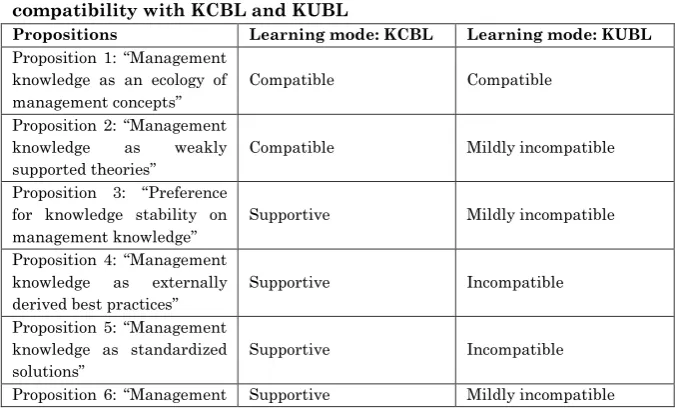
ten propositions as compatible
3and supportive to their respective
learning modes, i.e., KCBL and KUBL. They are summarized in Table
1 as follows:
Table 1: The ten management knowledge propositions and their
compatibility with KCBL and KUBL
Propositions
Learning mode: KCBL
Learning mode: KUBL
Proposition 1: “Management
knowledge as an ecology of
management concepts”
Compatible
Compatible
Proposition 2: “Management
knowledge
as
weakly
supported theories”
Compatible
Mildly incompatible
Proposition 3: “Preference
for knowledge stability on
management knowledge”
Supportive
Mildly incompatible
Proposition 4: “Management
knowledge as externally
derived best practices”
Supportive
Incompatible
Proposition 5: “Management
knowledge as standardized
solutions”
Supportive
Incompatible
Proposition 6: “Management Supportive
Mildly incompatible
3
“Compatible” means that the idea (here, the proposition) is able to co-exist with the
discipline as an area of
discussion in a characteristic
way”
Proposition 7: “Management
study as practice-focused”
Compatible
Mildly compatible
Proposition 8: “Management
study involving theorization
as socially meaningful”
Mildly incompatible
Supportive
Proposition 9: “Management
study as commercialization
of knowledge”
Supportive
Mildly incompatible
Proposition
10:
“Management in need of
multiplicity of perspectives”
Mildly incompatible
Supportive
Examining the innovation management literature to come up
with a KUBL study material for the management subject
The management subject considered here is innovation management.
As a concise introduction on the innovation management subject, two
definitions are offered here:
innovation
can be considered as
“something new that brings benefits for an organization or/ and for
society”, and
innovation management
as “the systematic promotion of
innovations in organizations” (Hengsberger, 2018). To underline the
uncertainty nature of management knowledge, the KUBL literature
review extracts information about knowledge gaps and points of
contention in the academic literature of innovation management. For
this brief exercise primarily for illustration purpose, the academic
literature is from the articles published in the
European Journal of
Innovation Management
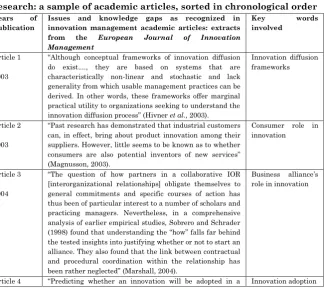
(Emerald), from 2003 to 2019. Table 2 is the
outcome of the KUBL literature review by the writer. It represents a
KUBL study material on Innovation Management.
Table 2: Issues and related key words in Innovation Management
research: a sample of academic articles, sorted in chronological order
Years ofpublication
Issues and knowledge gaps as recognized in innovation management academic articles: extracts from the European Journal of Innovation Management
Key words involved
Article 1
2003
“Although conceptual frameworks of innovation diffusion do exist...., they are based on systems that are characteristically non-linear and stochastic and lack generality from which usable management practices can be derived. In other words, these frameworks offer marginal practical utility to organizations seeking to understand the innovation diffusion process” (Hivner et al., 2003).
Innovation diffusion frameworks
Article 2
2003
“Past research has demonstrated that industrial customers can, in effect, bring about product innovation among their suppliers. However, little seems to be known as to whether consumers are also potential inventors of new services” (Magnusson, 2003).
Consumer role in innovation
Article 3
2004
“The question of how partners in a collaborative IOR [interorganizational relationships] obligate themselves to general commitments and specific courses of action has thus been of particular interest to a number of scholars and practicing managers. Nevertheless, in a comprehensive analysis of earlier empirical studies, Sobrero and Schrader (1998) found that understanding the “how” falls far behind the tested insights into justifying whether or not to start an alliance. They also found that the link between contractual and procedural coordination within the relationship has been rather neglected” (Marshall, 2004).
Business alliance‟s role in innovation
2005
market has always formed a major scientific challenge. Generations of scientists have pursued this challenge, by studying the subject from different disciplinary angles and for different kinds of innovations. Sociologists and psychologists have tried to pinpoint the unique characteristics of the first groups of consumers that adopt an innovation (the innovators and the early adopters)” (Langley et al., 2005).
Article 5
2005
“Although there are a number of studies on continuous improvement in SMEs (Gunasekaran et al., 1996; Bessant and Caffyn, 1997; Bessant and Francis, 1999), there is a relative paucity of in-depth studies of innovation implementation in SMEs (McAdam, 2000). It cannot be assumed that innovation implementation principles in large organisations are directly transferable to SMEs, where the SME is treated as a scaler version of the large organisation (Teece, 1996)” (Humphreys et al., 2005).
Innovation implementation in SMEs
Article 6
2005
“Knowledge has been cited for some time as a major source of competitive advantage (de Geus, 1997; Drucker, 1964). More recently, the focus has been upon using knowledge to promote and support innovation within both teams and companies (Newell at al., 2002)” (Davison and Blackman, 2005).
Knowledge management for innovation
Article 7
2006
“Schumpeter assumes that large companies can come up with a larger number of innovations, and with more incisive ones than small companies. The confirmation or rejection of this hypothesis has been the subject of over 100 empirical studies but, overall, the resulting picture is unclear” (Herrmann, 2006).
Innovation success for companies of different sizes
Article 8
2006
“Much of the knowledge-management literature (Tsoukas and Mylonopoulos, 2004; Easterby-Smith and Lyles, 2003; Newell et al., 2002; Prichard et al., 2000; Spender, 1996; Nonaka and Takeushi, 1995) and the literature on innovation (Jassawalla and Sashittal, 2002; Hargadon and Sutton, 1997; Cheng and Van de Ven, 1996; Leonard-Barton, 1995; Dougherty and Heller, 1994; Feldman, 1989; Burns and Stalker, 1961) examines innovative work wherein the knowledgeable agent is capable of determining and controlling the entire process. In such a perspective, innovation work is a more or less linear engagement with finalizing a predetermined artifact or service. Even though such a view is adequate for a broad range of innovative activities, it does not address what may be called science-based innovation, that is, innovation work that is science-based on the ability to the exploit scientific competencies accommodated by the focal firm” (Styhre, 2006).
Knowledge management for science-based innovation
Article 9
2006
“Recently published works (1990-2004) have mainly examined the success factors as key determinants of disruptive innovation. However, organisational learning over-samples success and under-samples failure” (Assink, 2006).
Learning from failure in innovation management
Article 10
2006
“Recent IT adoption literature has focused on acceptance models relating perceptions and beliefs to attitudes, behavioral intention and usage of the technology. Much of the most recent literature addresses the antecedents of
these perceptions. What remains largely unexplored, however, are the processes by which these factors and others work together in adoption-related attitude formation, decision-making, short-term and long-term behavior, and mental modelling” (Seligman, 2006). Article 11
2007
“Although the importance of radical innovations is widely recognized, developing them is still rather poorly understood (Leifer et al., 2001). Further research is thus needed, especially since the failure rate is particularly high due to the various challenges inherent in their development” (Sandberg, 2007).
Radical innovation development
Article 12
2007
“.... innovation process models have traditionally been characterised as highly linear, involving the creation of knowledge, the transformation of this knowledge into new applications and the commercialisation of these applications to market requirements (Pavitt, 2004). Where innovations systems models have emerged and have become popular, they have tended to address the complex interactions between system participants (within network, regional and national aggregations). A far less prevalent application of systems approaches in the innovation literature has been the examination of the recursive processes that occur within the fundamental problem solving arena of innovation (Leydesdorff and Etzkowitz, 1998)” (Rice and Martin, 2007).
Innovation process models
Article 13
2008
“One crucial question the current management literature lacks an answer for, yet, is how an organisation can best combine and integrate its exploratory – research driven – and its exploitative units (Cesaroni et al., 2005). This is not only an organisational question but also leads to the strategic question of what linkages the exploitative and the explorative units should have in particular for conducting successful new business development” (Bröring and Herzog, 2008).
On exploratory and exploitation units integration
Article 14
2008
“To date, the relation between organizational learning and innovation has been mainly studied in the management research field, while the market orientation-innovation link has been examined in the literature on marketing. However, some authors highlight the need to consider the complementary or even synergistic effects of both market orientation and organizational learning on innovation (Baker and Sinkula, 2002) and performance (Baker and Sinkula, 1999)” (Jimėnez-Jimenez and Valle, 2008).
Organizational learning for innovation
Article 15
2008
“Recently, there has been a great deal of academic and practitioner interest in the concept of creativity and innovation in organizations, and in particular, the effects of an innovation culture on organizational performance (Christensen and Raynor, 2003; Govindarajan and Trimble, 2005; Hamel, 2002; Hammer, 2004; Senge and Carstedt, 2001). This focus is not surprising, as innovation has been touted as the differentiator that will lead to the next level of competitive advantage (Amit and Schoemaker, 1993; Prahalad and Hamel, 1990). However, much of the extant literature to date evidences a uni-dimensional view of innovation. This cause and effect approach has lead to a
lack of consensus on innovation and difficulties in both comparing findings across studies and drawing unbiased conclusions” (Dobni, 2008).
Article 16
2008
“Understanding how to manage innovation successfully is crucially important in a time when innovation is an almost obligatory survival strategy (“innovate or die” (Drucker, 1999)) that at the same time is very risky because it may lead to the demise of a company (Olleros, 1986; Tellis and Golder, 1996). It is not surprising, then, that many innovation management studies have a normative nature and focus on how to innovate successfully. Given the fact that innovation management has changed over the last four decades, it appears that every time frame has its own notions of what successful or best practices are. These so-called innovation generations are descriptions “. . . of what constitutes the dominant model of best practice . . .” (Rothwell, 1994, p. 23). However, although this historical division may have been accurate in the past, current innovation practices suggest that innovative companies do not automatically follow the best practices as prescribed by the dominant model of their time” (Ortt and van der Duin, 2008).
Dominant models of best practice on innovation management
Article 17
2009
“Although it is still acknowledged that controlling R&D and innovation is a challenging task (Brown and Svenson, 1988), today the issue is being extensively debated in the innovation and R&D management literature, and it raises the interest of practitioners as well (Werner and Souder, 1997; Hauser, 1998; Driva and Pawar, 1999; Driva et al., 2000; Poh et al., 2001; Loch and Tapper, 2002; Godener and Soderquist, 2004; Ojanen and Vuola, 2006)” (Chiesa et al., 2009).
Innovation and R&D control
Article 18
2009
“The influence of product innovation on business performance has been one of the issues of most importance in recent literature. From a positive point of view, product innovation represents the provision of solutions to market threats and opportunities, creating the “basis for the survival and success of the firm well into the future” (Hult et al., 2004, p. 429). However, product innovation is a costly and risky activity (Simpson et al., 2006), one issue of particular relevance for SMEs, generally handicapped with financial and management competency restrictions (Freel, 2000a). Therefore, it is not surprise that research so far has been inconclusive about a direct immediate and straightforward positive impact of product innovation on performance in SMEs (Freel, 2000b)” (Hernández-Espallardo and Delgado-Ballester, 2009).
Product innovation impacts on SMEs
Article 19
2010
“Innovation has become one of the main priorities of most countries. The European Union, through the Lisbon strategy, aims at stimulating national R&D investments in order to reach the “ideal” 3 per cent GDP level. Many studies have used R&D expenditure as a measure of the capacity of a firm to innovate. While emphasizing innovation input and support instruments, these works did not take into account other types of innovation strategies such as marketing or organization. The literature on
innovation nevertheless highlights the iterative nature of the innovation process where non-technological activities play a crucial role” (Mothe et al., 2010).
Article 20
2011
“Despite the growing importance of R&D collaborations in particular and open innovation in general, many important questions are still unexplored – also due to the (growing) complexity of such collaborative efforts and the nature of the underlying resources and knowledge (Chesbrough, 2003; Das and Teng, 2000; Granstrand, 2000; Gulati and Singh, 1998; Haefliger et al., 2008; Henkel, 2006)” (Bogers, 2011).
R&D and open innovation collaboration
Article 21
2011
“Although open innovation models have substantial benefits for R&D intense companies in high-tech sectors, little is known about their influence on innovation performance in traditional industries, such as manufacturing and service industries (Chesbrough and Crowther, 2006; Laursen and Salter, 2006; Muscio, 2007; van de Vrande et al., 2009)” (Inauen and Schenker-Wicki, 2011).
Performance influence of open innovation models
Article 22
2011
“The concept of open innovation has had a lot of promotion in recent years, although collaboration between firms has been happening for a long time, as in the case of joint ventures. Firm-university collaborations also are not a new phenomenon, nor are spin-offs. These observations leave an open path for further research: as more studies on open innovation are published, the confusion of terms used invariably would arise leading to an increasing need to clarify the terminology used. Although empirical studies are emerging, there is still a limited body of research on open innovation” (Duarte and Sarkar, 2011).
Concept clarity of open innovation
Article 23
2012
“.... although many contributors to small firms‟ innovations have been identified, we do not know the prevalent patterns in broad samples of small firms” (de Jong and Hulsink, 2012).
Small firms‟ innovation patterns
Article 24
2014
“Owing to the fact that Rogers‟ theory holds the highest position and is well established in the world of innovations, it can be concluded that there have been many studies concentrating on Rogers‟ innovation attributes. However, there are also other attributes that have been used, studied, and reviewed as innovation attributes in the past, a classic example of which is the Tornatzky and Klein (1982) review. Evidently, Rogers‟ innovation attributes have been periodically reviewed both, in the revised editions of his books that came out until 2003, and also in the other reviews published in this area. This elucidates the fact that the other innovation attributes have not received as much attention as the Rogers‟ attributes” (Kapoor et al., 2014)
Innovation attributes
Article 25
2016
“It has been widely accepted that innovation plays a central role in technological and economic development. As a result, the study of innovation – that is, how to stimulate, nurture and diffuse it – has maintained a top position on the agendas of researchers, managers and policy makers. However, despite these acknowledged technological and economic outcomes, the social benefits associated with
Impacts of innovation on technological and economic
innovation can be less obvious, difficult to measure and take time to become apparent” (Voltan and De Fuentes, 2016).
Article 26
2016
“Whereas the impact of national culture and globalization on consumer innovativeness (i.e. the relative time of adoption of an innovation) with regard to high-tech innovations is widely discussed in the innovation literature (e.g. Chandrasekaran and Tellis, 2008; Lim and Park, 2013), scant attention has been paid to another important aspect of innovation adoption behavior: consumer value and the related consumer willingness to pay (WTP) for innovations (e.g. Pak et al., 2014; Parry and Kawakami, 2015). Yet, this is a crucial issue, as an emphasis on consumer value and the related consumer WTP when establishing the launching price of an innovation contributes to the success of the innovation (Ingenbleek et al., 2003)” (Sadik-Rozsnyai, 2016).
Role of consumer value on innovation adoption
Article 27
2017
“Open innovation (OI) continues to generate research interest (Carlsson and Corvello, 2011; Elmquist et al., 2009; Greco et al., 2015; West and Bogers, 2014). Researchers have engaged with the phenomenon related to how companies can advance their innovation scope and also divest ideas that do not create a fit with the company‟s own business focus (Chesbrough, 2012). Furthermore, the collaborative efforts of OI have been emphasised (e.g. Gassmann and Enkel, 2004). While it has been acknowledged that OI may take many different forms and also be “open” to different extents (e.g. Dahlander and Gann, 2010; Moilanen et al., 2015), the dominating research perspectives on OI have emphasised resource and skill complementarities between companies (cf. Vanhaverbeke and Cloodt, 2014). But such fit would... only provide a partial explanation as to whether companies manage to collaborate in OI processes” (Hasche et al., 2017).
Collaboration management in open innovation processes
Article 28
2018
“Given the prevalence and economic importance of family firms (De Massis et al., 2013; De Massis, Di Minin, and Frattini, 2015), and given the fact that family firms are transgenerational, also in family business research innovation and collaborative innovation have become topics of increasing interest (e.g. Pittino and Visintin, 2011; De Massis et al., 2013; Alberti et al., 2014; Veider and Matzler, 2016)” (Bigliardi and Galati, 2018).
Innovation management of family firms
Article 29
2018
“Previous research has examined open innovation and its related interactive mechanism then contributed to the understanding of how the network structure affects an organisation‟s innovation outcomes (West and Bogers, 2014). Despite those existing research effort taking from a structural perspective in particular, knowledge in the area of ecosystem dynamics and configuration appears insufficient and thus attention is needed (Spender et al., 2017)” (Lin, 2018).
Interactive mechanisms on innovation management
Article 30
2019
“.... firm performance can be affected differently by different sources of knowledge. Hence, to develop the appropriate strategy for external knowledge source, it is
essential to know the impact of the various external knowledge sources on innovation performance. However, the extant empirical research explores the effect of external knowledge sources on technology innovation performance without taking into consideration the effect of different types of external knowledge sources on innovation output in manufacturing and service sector. The previous studies are limited regarding the external source of knowledge from the customers in general” (Basit and Medase, 2019).
performance