Comparative study of Adaptive methodologies for Extracting
Abdominal Fetal Electrocardiogram
Doguparthi Gopi Naga Lingeswara Rao ; P. Vasudeva Reddy ; G. Sanath Kumar (M.Tech Scholar) (Assistant Professor)
(Dy. Director, CITD) Department of Electronics & Communication Engineerin Bapatla Engineering Collage, Bapatla, Andhra Pradesh, India.
1 [email protected] 2 [email protected] 3 [email protected]
Abstract
In this work we discussed about extraction of the Fetal Electrocardiogram (fECG) from the composite Electrocardiogram (ECG) signal obtained from the abdominal lead is discussed. In this paper we present a novel adaptive filter for removing the artifacts from ECG signals based on Constrained Stability Least Mean Square (CSLMS) algorithm. Monitoring the baby's heart using electrocardiography (ECG) plus cardiotocography (CTG) during labour provides some modest help for mothers and babies when continuous monitoring is needed. Strong uterine contractions during labour reduce the flow of maternal blood to the placenta. The umbilical cord may also be compressed during labour, especially if the membranes are ruptured. The main point of this paper is to introduce some of the most used Least Mean Squares (LMS) based Finite Impulse Response (FIR) Adaptive Filters and to determine which of them are the most effective under varying circumstances. MATLAB execution results will prove that proposed work is better compare to existing techniques. Quality of fECG extraction is assessed by Percentage Root-Mean-Square Difference (PRD), input and output Signal to Noise Ratios (SNRs), and Root Mean Square Error (RMSE). Based on simulations conclusions, optimal convergence constant value and filter order were empirically determined. Setting the optimal value of the convergence constant and filter order of adaptive algorithm can be considered a contribution to original results. These results can be used on real records fECG, where it is difficult to determine because of the missing reference.
Keywords—fECG, mECG, adaptive filtering, Matlab,
LMS, NLMS, BLMS, DLMS, CS-LMS.
I.INTRODUCTION
The Fetal Electrocardiogram (fECG) describes the electrical activity of the fetal heart and provides clinically significant information about the physiological state of a fetus during the pregnancy or the labor. Early diagnosis of the hypoxic states (hypoxemia, hypoxia, and asphyxia) achieved by monitoring fECG can increase the effectiveness of the treatment, [1], [2], and [18]. There are two different techniques to record fECG – invasive and noninvasive. The first one is the direct method of the measurement that is provided transvaginally by an Invasive Scalp Electrode (ISE).
This method is considered to be accurate because the signal is recorded directly from the fetal scalp, however it brings many problems and risks such as infections for the mother and the child as well. Noninvasive techniques measure electrical signals by multichannel skin electrodes placed on mother’s abdomen. This kind of measuring is more convenient, non-invasive and can be used not only during the labor but before it, too. On the other hand, signal measured by this method is characterized by a significant amount of overlapped undesired signals such as bioelectric potentials (maternal muscle activity, fetal movement activity, generated potentials by respiration and stomach etc.), power line interference and mainly the component of the maternal heart activity [3], [4].
II.BACKGROUND TECHNIQUES
[1] Jezewski, Janusz, et al. "Determination of fetal heart rate from abdominal signals: evaluation of beat-to-beat accuracy in relation to the direct fetal electrocardiogram."
The main aim of this work was to assess the reliability of indirect abdominal electrocardiography as an alternative to the commonly used Doppler ultrasound monitoring technique. As a reference method, we used direct fetal electrocardiography. Direct and abdominal signals were acquired simultaneously, using dedicated instrumentation. The developed method of maternal signal suppression as well as fetal QRS complexes detection was presented.
[2] Jezewski, Janusz, Tomasz Kupka,"Extraction of fetal heart-rate signal as the time event series from evenly sampled data acquired using Doppler ultrasound technique."
Analysis of variability of fetal heart rate (FHR) is very important in prediction of the fetal wellbeing. The beat-to-beat variability is described quantitatively by the indices originated from invasive fetal electrocardiography which provides the FHR signal in a form of time event series.
[3] Jagannath, D. J., and A. Immanuel Selvakumar. "Issues and research on fetal electrocardiogram signal elicitation."
The existence of Electrocardiography (ECG) came to light over a century ago, yet the acquisition and elicitation of non-invasive fetal electrocardiogram (fECG) is still in infancy despite mammoth advances in clinical electrocardiography, advanced Biomedical signal processing techniques and fast growing engineering technology. The acquisition of fetal ECG becomes a challenging task since it is perilous for a direct contact over the foetus.
[4] Agostinelli, Angela, et al. "Noninvasive fetal electrocardiography: an overview of the signal electrophysiological meaning, recording procedures, and processing techniques."
The fetus clinical status is inferred by analyzing growth parameters, supraventricular arrhythmias, ST-segment variability, and fetal-movement parameters from the fECG signal. This can be
extracted from an abdominal recording obtained using one of the following two electrode-types configurations: pure-abdominal and mixed. Differently from the former, the latter also provides pure maternal ECG tracings.
[5] Jezewski, Janusz, Janusz Wrobel, "Comparison of Doppler ultrasound and direct electrocardiography acquisition techniques for quantification of fetal heart rate variability."
A method for comparison of two acquisition techniques that are applied in clinical practice to provide information on fetal condition is presented. The aim of this work was to evaluate the commonly used Doppler ultrasound technique for monitoring of mechanical activity of fetal heart.
2.1 Methods for FECG Elicitation
Different types of interferences are present in ECG signal and extraction of these different interferences is very complicated task. These can be done by using single channel or multichannel of source signal. These signals are then processed by various methods. These methods can be divided into two groups – adaptive and non-adaptive. The difference is in the existing or non-existing ability of the system to adapt to the unexpected circumstances.
Two basic methods for fECG elicitation are adaptive and non-adaptive. The adaptive methodologies are discussed in this paper.
A. Non-Adaptive Methodologies
Non-adaptive methodologies include Wavelet Transform based techniques, Correlation methods, Subtraction methodologies, Single Value Decomposition (SVD), etc.
The drawback of the non-adaptive techniques is that they are time-invariant in nature, which has been overcome by the adaptive methods, which are more effective in reducing the noise that is overlapping in time and frequency. Non-adaptive methods are useful for data pre-processing or for noise elimination in case of the classic ECG.
B. Adaptive Methodologies
As mentioned before, an adaptive filter is a filter characterized by an ability to self-adjust the filter coefficients according to an optimized training algorithm which is driven by a back propagated error signal. Adaptive filters are used in noise cancelation to remove the noise adaptively from a signal and to improve the Signal to Noise Ratio (SNR).
Simply it is a technique for adaptive elimination of undesired signals (such as the maternal component) from the abdominal signal to obtain the fECG signal. The system can adjust and alter to the existing circumstances, and optimize its results. A theoretical multichannel adaptive noise cancelation system shown in Fig. 2 illustrates an example of an adaptive elicitation technique. It consists of two kinds of the input signals recorded from multiple leads – the abdominal ECG signals (AB1-ABn) and the thoracic ECG signals (TH1-THn).
This paper focuses primarily on the Least Mean Squares (LMS) based FIR Adaptive Filters methods. In the chapter below there are mathematical descriptions of the most important methods such as LMS, normative LMS (NLMS), BLMS and DLMS. An adaptive filter is a filter that self-adjusts its transform function according to an optimization algorithm driven by an error signal. Because of the complexity of the optimization algorithms, most adaptive filters are digital filters. There are many different methodologies to obtain fECG using adaptive filters by using one or several maternal reference channels (as shown in Fig. 1).
A. Standard LMS
The standard LMS algorithm performs the following operations to update the coefficients of an adaptive filter:
Calculates the output signal y(n) from the adaptive filter.
Calculates the error signal e(n) by using the following equation:
(1) Updates the filter coefficients by using the
following equation:
(2) Where μ is the step size of the adaptive filter, w(n) is the filter coefficients vector, and x(n) is the filter input vector. Step size is a crucial parameter that can improve the convergence speed of the adaptive filter. It determines both how quickly and how closely the adaptive filter converges to the filter solution,[9] and [10].
B.
Normalized LMS (NLMS)
The normalized LMS (NLMS) algorithm is a modified form of the standard LMS algorithm. The NLMS algorithm updates the coefficients of an adaptive filter by using the following equation:
(3)
It is obvious that the NLMS algorithm is almost identical to standard LMS algorithm except that the NLMS algorithm has a time-varying step size μ(n)
III.PROPOSED WORK
We implemented new technique CS-LMS (Constrained Stability Least Mean Square) and compared this technique with other just recent
existing adaptive methodologies like BLMS, DLMS as explained
C. Block LMS (BLMS)
The Block LMS Filter block implements an adaptive least-mean-square (LMS) filter, where the adaptation of filter weights occurs once for every block of samples.
This algorithm provides significant improvements in decreasing mean-squared error (MSE) and consequently minimizing signal distortion. Instead of updating the filter vector for every sample as for the standard LMS in Eq. (1), the filter vector is updated once every Lth sample
The weight update relation for BLMS algorithm is as follows,
(4)
D. Delay LMS (DLMS)
The DLMS algorithm is extensively used in different applications of adaptive filtering due to low computational complexity and stability. The DLMS algorithm is introduced to minimize the error between a given preferred signal and output of the linear filter by adjusting recursively the parameters of a linear filter. The weight update relation for DLMS algorithm is as follows:
(5) Where, D is the total delay inserted into the error feedback path of the LMS algorithm.
E. CS-LMS (Constrained Stability Least Mean
Square)
(6)
Where, ðx(n) = x(n) - x(n - 1) is the difference between two consecutive input vectors. Also ðe(n) = e(n) - e(n - 1) is the difference in the priori error sequence. The weight adaptation rule can be made more robust by introducing a small P and by multiplying the weight increment by a constant step size f. L to control the speed of the adaptation. This gives the weight update relation for CSLMS algorithm in its final form as follows,
(7) The parameter P is set to avoid denominator being too small, step size parameter too big and to prevent numerical instabilities in case of a vanishingly small squared norm.
RESULTS FOR COMPARATIVE
ANALYSIS
Fig.3 Comparative analysis of a) original ECG signal ,b)Noisy signal, extraction using C)LMS d)NLMS e)BLMS f)DLMS g)CS-LMS
In above figure we analyzed waveforms of original signal and extracted signal by different adaptive filtering techniques.So, this comparative subjective analysis study will show us that proposed CS-LMS performs better compare to all other existing techniques.
QUALITY ASSESMENT PARAMETERS
The measurement of the quality of the fECG extraction procedures is based on the estimation of the similarity of the recovered signals and the ideal fECG signals and the absence of the noise.
A. Percent Root-Mean-Square Difference
(PRD)
The PRD is one of the measure indexes commonly used in ECG compression literature and it is determined by:
(8)
Where, xorg denotes the original signal (ideal fECG) and xrec the signal recovered by the algorithm.
B. Signal to noise ratio (SNR)
The relation between the signal and the noise is described by SNR, whose expression is following:
(9)
Where, xorg denotes the original signal (ideal fECG)
and xnoise the signal that is producing the undesired
signal (mECG).
(10)
Where, xorg denotes the original signal (ideal fECG)
and xrec the signal recovered by the algorithm.
C. Root mean square error (RMSE)
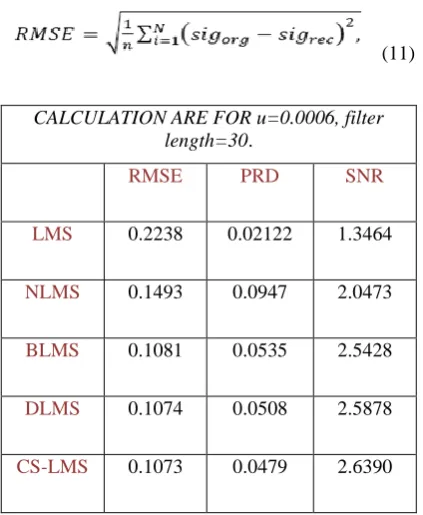
The last parameter used in this paper is RMSE defined by the following equation:
(11)
Where,sigorg denotes the original signal (ideal fECG)
and sigrec the signal recovered by the algorithm.
Table 1. Comparative objective analysis
As we analyzed proposed work using subjective analysis by waveform study. Some mathematical modules we used for objective analysis like RMSE,PRD and SNR.
V.CONCLUSION
We successfully developed a novel technique for ECG signal analysis. Results of fECG extraction are assessed by Percentage Root-Mean-Square Difference (PRD), input and output Signal to Noise Ratios (SNRs), and Root Mean Square Error (RMSE).The problem is the lack of real data available for the public use. There is an existing cooperation between the authors and a hospital on creating a database of the real data that can be used for experiments in the future. We observed the noise levels by using different adaptive filtering techniques viz. LMS, NLMS, BLMS and DLMS,CS-LMS.We calculated different parameters to say the quality of
signal. That is quality assessment parameters are used to get quality of an ECG signal. Further to get the better results compare to all our proposed techniques we developed a recent novel technique based on CSLMS (Constrained Stability Least Mean Square).
REFERENCES
[1] Jezewski, Janusz, et al. "Determination of fetal heart rate from abdominal signals: evaluation of beat-to-beat accuracy in relation to the direct fetal electrocardiogram."
[2] Jezewski, Janusz, Tomasz Kupka, and Krzysztof Horoba. "Extraction of fetal heart-rate signal as the time event series from evenly sampled data acquired using Doppler ultrasound technique." [3] Jagannath, D. J., and A. Immanuel Selvakumar. "Issues and research on foetal electrocardiogram signal elicitation."
[4] Agostinelli, Angela, et al. "Noninvasive fetal electrocardiography: an overview of the signal electrophysiological meaning, recording procedures, and processing techniques."
[5] Jezewski, Janusz, Janusz Wrobel, "Comparison of Doppler ultrasound and direct electrocardiography acquisition techniques for quantification of fetal heart rate variability."
[6] Martinek, Radek, et al. "Enhanced processing and analysis of multichannel non-invasive abdominal foetal ECG signals during labor and delivery." CALCULATION ARE FOR u=0.0006, filter
length=30.
RMSE PRD SNR
LMS 0.2238 0.02122 1.3464
NLMS 0.1493 0.0947 2.0473
BLMS 0.1081 0.0535 2.5428
DLMS 0.1074 0.0508 2.5878