Invariant Subspace Attack Against Full
Midori
64
Jian Guo1, J´er´emy Jean1, Ivica Nikoli´c1, Kexin Qiao1,2, Yu Sasaki1,3, and Siang Meng Sim1
1
Nanyang Technological University, Singapore 2
Institute of Information Engineering, Chinese Academy of Sciences, China
3 NTT Secure Platform Laboratories, Tokyo, Japan
{guojian,JJean,INikolic}@ntu.edu.sg, [email protected], [email protected], [email protected]
Abstract. In this paper, we present an invariant subspace attack against block cipherMidori64which has recently been proposed by Banik et al. at Asiacrypt 2015 to achieve low energy consumption. We show that when each nibble of the key has the value 0 or 1 and each nibble of the plaintext has the value 8 or 9, each nibble of the ciphertext also has the value 8 or 9 with probability one regardless of the number of rounds applied. This fact indicates thatMidori64has a class of 232weak keys that can be distinguished with a single query. It also indicates that the number of keys generated uniformly at random forMidori64must not exceed 296, i.e., the pseudorandom-permutation security ofMidori64is only up to 96 bits instead of 128 bits. Interestingly, given the information that the key is from the 232 weak key subspace, key recovery can be performed within time complexity 216 and data complexity 21. We have confirmed the correctness of the analysis by implementing the attack. At the current stage, our attacks do not apply toMidori128.
Keywords:Midori, block cipher, invariant subspace attack, S-box, round constant, weak key, pseudorandom-permutation.
1
Introduction
Midori is a family of lightweight block ciphers recently published at Asiacrypt 2015 [1]. They have been advertised as one of the first lightweight ciphers optimized with respect to the energy consumed by the circuit per bit in encryption or decryption operation. To achieve the desired low energy goal, several design decisions were made inMidori. The diffusion layer consists of almost MDS 4×4 binary matrices. The 4-bit S-box has a small delay, i.e. 1.5-2 times faster than those of PRINCE [3] and PRESENT [2]. The round constants are seemingly random binary values extracted for the constantπ. The key schedule is trivial and thus efficient. Finally, the number of rounds is rather small for lightweight ciphers: only 16-20 rounds are used.
differentials, etc. As a result, it has been concluded that the ciphers provide a safe security margin. Additional analysis of Midori has been provided in [7]. In that work, Lin and Wu show that 12 rounds (out of 16) of Midori64 can be attacked with the meet-in-the-middle technique, with a rather high complexity: the key recovery requires around 255 chosen plaintexts, 2106memory, and 2125.5 computations.
Our Contribution.We show thatMidori64has a class of 232weak keys that can be distinguished with a complexity of a single query. Furthermore, within this class of keys, a key recovery can be achieved efficiently given two plaintext-ciphertext pairs, including one that should verify the distinguisher.
Our analysis is based on the invariant subspace attacks [5] and uses the unfortunate combination in Midori64 of round constants, fixed points for the S-box, and multiplication by binary matrix in the diffusion layer. When each nibble of the master key has the value 0 or 1 (in total 232 such keys), and each nibble of the state (including the plaintext) has the value of 8 or 9, then the transformations inMidori64 keep the state in the same class (of nibbles values 8 and 9). Hence, regardless of the number of rounds, the class is maintained, and as a result, the ciphertext belongs to this class as well. This fact allows to launch an efficient distinguisher. The key recovery uses an additional fact: the values 8 and 9 are fixed points for the S-box used inMidori64. As a result, the whole cipher under the weak-key class becomes a linear transformation (the only non-linear component, the S-box, turns into the identity mapping). Therefore, recovering the key is equivalent to solving a system of linear equations and can be achieved given only two pairs of plaintext-ciphertext verifying the distinguisher.
We have confirmed the correctness of the whole analysis by implementing independently the distinguisher and the key recovery. At the current stage, our attacks do not apply toMidori128.
2
Preliminaries
2.1 Description of Midori
Midoriconsists of two algorithmsMidori64andMidori128. The block size,n, is 64 bits and 128 bits forMidori64andMidori128, respectively, and the key size is 128 bits for both. Both ofMidori64andMidori128adopt a standard SPN structure, and the internal state is represented as 4×4 cells, where the size of each cell is 4 bits for Midori64and 8 bits forMidori128. The stateS consisting of sixteen cells s0, s1, . . . , s15 has the following data structure:
S=
s0s4 s8 s12 s1s5 s9 s13 s2s6s10s14 s3s7s11s15
.
number of rounds, which is 16 forMidori64and 20 forMidori128. The plaintext is first loaded into the state and the whitening keyWK is XORed to the state. Then, the round function RF : {0,1}n
× {0,1}128 7→ {0,1}n, which takes as
input the current state and the round keyRKi and outputs the updated state,
is iteratedr−2 times. Finally, the last round function RFl is applied and the resulting state is output as the ciphertext.
Key Generation. InMidori64, the 128-bit keyKis separated into two 64-bit statesK0 andK1. Then, the whitening keyWK is computed byK0⊕K1, and the round keyRKi fori= 0,1, . . .14 is computed byK(i mod2)⊕αi, where αi is
a round constant described below. InMidori128,WK is simply Kand RKi for
i= 0,1, . . .18 isKi⊕αi.
Round constantαiwherei= 0,1, . . . . ,18 is the only component which differs
in different rounds:αiconsists of 16 binary cells. The constants have been derived
from the hexadecimal encoding of the fractional part ofπ. For example,α0toα3 are defined as follows.
α0=
0 0 1 0 0 1 0 0 0 0 1 1 1 1 1 1
, α1=
0 1 1 0 1 0 1 0 1 0 0 0 1 0 0 0
, α2=
1 0 0 0 0 1 0 1 1 0 1 0 0 0 1 1
, α3=
0 0 0 0 1 0 0 0 1 1 0 1 0 0 1 1
.
The otherαi’s are similarly defined. Refer to [1] for more details. In this paper,
we later exploit the fact that all the cells in anyαi are 0 or 1.
Round Function and the Last Round Function. The round functionRF consists of the four operationsSubCell,ShuffleCell,MixColumn andKeyAddthat update then-bit stateS.
SubCell.This operation inMidori64applies a 4-bit S-boxSb0 to each cell and its equivalent in Midori128applies four 8-bit S-boxesSSb0,SSb1,SSb2 andSSb3 to each of four cells in Row 0, Row 1, Row 2 and Row 3, respectively. Each SSbi
is generated by 4-bit S-boxSb1. Refer to [1] for the details of how to generate SSbi from Sb1. The full specifications of Sb0andSb1 are shown in Table1.
Table 1:Specifications ofSb0 andSb1.
x 0 1 2 3 4 5 6 7 8 9 a b c d e f
Sb0(x) c a d 3 e b f 7 8 9 1 5 0 2 4 6
ShuffleCell.This transformation is a cell-wise permutation. Each cell is permuted as follows.
s0s4 s8 s12 s1s5 s9 s13 s2s6s10s14 s3s7s11s15
−→
s0 s14 s9 s7 s10 s4 s3 s13
s5 s11s12 s2 s15 s1 s6 s8
.
MixColumn. This transformation applies a 4×4 binary involution matrix to each column of the state as follows.
si
si+1 si+2 si+3
=
0 1 1 1 1 0 1 1 1 1 0 1 1 1 1 0
si
si+1 si+2 si+3
, fori∈ {0,4,8,12}.
KeyAdd.KeyAdd(S,RKi) XORsRKi to the stateS.
The last round function RFl applies only two operations SubCell(S) and KeyAdd(S,WK).
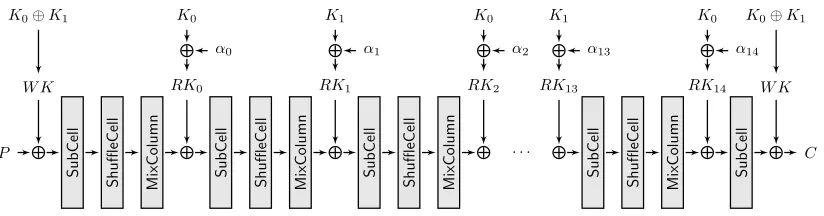
Summary. The encryption ofMidorican be summarized as below in Algorithm1, and in particularMidori64encryption function is depicted in Figure 1. Note that the decryption can be similarly described. However, since our attack only uses the encryption, we omit the precisions on the decryption.
Algorithm 1 – Midori encryption algorithm.
1: functionMidori-Encryption(P) 2: S←P
3: S←KeyAdd(S,WK) 4: fori= 0, . . . , r−2do
5: S←SubCell(S) 6: S←ShuffleCell(S) 7: S←MixColumn(S) 8: S←KeyAdd(S,RKi)
9: end for
10: S ←SubCell(S) 11: S ←KeyAdd(S,WK) 12: returnS
W K
P
SubCell
ShuffleCell MixColumn RK0
α0 K0 K0⊕K1
SubCell
ShuffleCell MixColumn RK1
α1 K1
SubCell
ShuffleCell MixColumn RK2
α2 K0
· · ·
RK13 α13 K1
SubCell
ShuffleCell MixColumn RK14
α14 K0
SubCell
W K K0⊕K1
C
Figure 1:Midori64encryption algorithm.
2.2 The Invariant Subspace Attack
As a method of cryptanalysis, the invariant subspace attack has been introduced by Leander et al. at CRYPTO 2011 [5]. In this method, the adversary aims to find so-called invariant subspaces, i.e. subsets of the set of all possible state and key values, invariant of the round transformations used in the analyzed cipher. When such a subset exists, then the adversary encrypts plaintexts that belong to the subset, assumes the master key belongs as well to the subset (thus it is a weak-key attack) and expects to obtain corresponding ciphertexts that also belong to the subset. This immediately yields a distinguisher for the cipher, while more advanced approaches can be used for a key recovery.
Non-trivial invariant subspaces not necessarily exist for a given cipher. When they do exist, they are found either by a careful analysis (as it is the case of the analysis of PRINTCipher [5]) or with the use of a specialized tool [6]. To deduce the invariant subspace, the former method requires examination of all the transformations used in the cipher, which usually provide a hint of the possible subspace. On the other hand, the latter method is generic and is achieved by a computer search. Its success depends on the proportion of the sizes of weak to all key class.
3
Subspace Attack on
Midori64
This section explains our subspace attack onMidori64. Our attack is a weak-key attack, in which the size of the weak-key class is 232. With such a weak key, Midori64can be distinguished from a random permutation only with one chosen plaintext query, negligible computational cost, and negligible memory amount. Moreover, the key can be recovered from the 232 choices with approximately 216 operations.
3.1 Distinguisher with Subspace Attack
We first introduce several notations used in this attack.
K: a subspace of state values in which each of its sixteen nibbles belongs toK, i.e.,K,K16
S: a subspace of nibble values consisting of two elements 8 and 9, i.e.,S,{8,9} S: a subspace of state values in which each of its sixteen nibbles belongs toS,
i.e.,S,S16
Theorem 1 (Invariant Subspace).When a 128-bit keyK0kK1satisfiesK0, K1∈ K, any plaintextP∈Sis mapped to the ciphertextC∈S with probability one by Midori64.
Throughout this section, we prove Theorem1. To achieve this, we focus indepen-dently on each transformation used in Midori64.
Round Key Generation. Letx, y∈ K. Then, x⊕y∈ K. Therefore, for any X, Y ∈K, X⊕Y ∈K. This fact enables us to simulate all round keys.
The whitening keyWK is computed byK0⊕K1. By assumingK0, K1∈K, we haveWK ∈K.
The round key for thei-th round,RKi, is computed byK(i mod2)⊕αi. Here,
an important observation for our attack is that all the round constantsαi only
consist of 0 and 1, i.e.,αi∈Kfori= 0,1, . . . ,14. By assumingK0, K1∈K, we have RKi∈Kfor alli= 0,1, . . . ,14.
Data Processing Part. Letx∈ S andy∈ K. Then,x⊕y∈ S. Therefore, for anyX ∈S andY ∈K,X ⊕Y ∈S. As long as the plaintext P ∈S, the state after adding the whitening key,WK ∈K, belongs toS.
Then, the state is processed by theSubCelloperation. Here, we exploit two particular data transitions through the S-box for Midori64; Sb0(8) = 8 and Sb0(9) = 9. Namely, as long as the input state belongs toS,SubCellis equivalent to the identity map. Obviously, we obtainS←SubCell(S).
The subsequentShuffleCellis a nibble-wise permutation, and since all nibbles in SsatisfyS,S←ShuffleCell(S).
The MixColumn operation is slightly more complex. Because the diffusion matrix is a binary matrix, each output nibble fromMixColumncan be represented as the XOR of three input nibbles. As long as the input state belongs toS, each of three nibbles is either 8 or 9. Thus, the possibilities for each output nibble is the following eight cases:
8⊕8⊕8 = 8, 8⊕8⊕9 = 9, 8⊕9⊕8 = 9, 8⊕9⊕9 = 8, 9⊕8⊕8 = 9, 9⊕8⊕9 = 8, 9⊕9⊕8 = 8, 9⊕9⊕9 = 9.
In any case, each output nibble belongs toS, thusS←MixColumn(S).
Summary. Thanks to the property of αi∈K, any weak keyK0, K1∈Kleads toWK ∈KandRKi∈K. LetP ∈S. Then, the state after the whitening key addition becomes S ← KeyAdd(P ∈ S,WK ∈ K). Then, the following round function is iterated by incrementing the round numberi.
S←SubCell(S), S←ShuffleCell(S), S←MixColumn(S), S←KeyAdd(S, RKi∈K).
As a result, regardless of the number of rounds applied, the state belongs toS with probability one. The last round only consists ofSubCelland the whitening key addition, which does not break the property. This completes the proof of Theorem1.
Impact. The subspace attack is a weak-key attack. Since 16 nibbles in K0 and 16 nibbles inK1 can be either 0 or 1, the class contains 232 different weak keys. In other words, the number of keys generated uniformly at random forMidori64 must not exceed 296. Otherwise, the pseudorandom-permutation (PRP) security will be spoiled.
In provable security, the PRP security of the encryption algorithmEK is
usually measured by the advantage of the adversary who tries to distinguish a random instantiation ofEK from a random permutationRP. LetΠ = (κ, EK)
denote an encryption scheme, whereκis a key space and EK is an encryption
algorithm. We define $ be a set of all bijective mappings on the block length. Then, the advantage of the distinguisherDO with access to the oracle
O who
tries to break the PRP security ofΠ can be defined as follows
AdvPRPΠ (D) = Pr
K←$ κ:DEK = 1−PrRP ←$ $ :DRP = 1
,
where←$ represents to choose one of the elements in the set uniformly at random. The crucial point here is that the key for the particular encryption algorithm EK is chosen uniformly at random, and the adversary’s goal is increasing the
probability for win rather than distinguishing the target with probability one. Therefore, even though our subspace attack is a weak-key attack by cryptanalyst’s words, it gives a certain impact from a provable-security viewpoint, i.e., the PRP security ofMidori64is up to 96 bits instead of 128 bits.
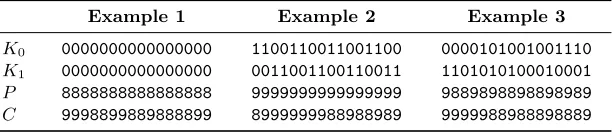
Table 2:Experimental data.
Example 1 Example 2 Example 3
K0 0000000000000000 1100110011001100 0000101001001110
K1 0000000000000000 0011001100110011 1101010100010001
P 8888888888888888 9999999999999999 9889898898898989 C 9998899889888899 8999999988988989 9999988988898889
Computer Search of Invariant Subspaces. We found the above invariant subspace by hand. In an attempt to increase the size of the weak-key class or to find other similar subspaces, we performed additionally a computer search.4 We brute-forced all possible subspaces of values of nibbles in the plaintext (each nibble belongs to the same subset) and all possible values of master key nibbles (similarly, they all belong to another subset). As there are 16 values for the nibbles in each of the two cases, the brute-force required around 216·216= 232 time. We found five subspaces, all subsets of the original subspace. Thus, we can conclude that no larger weak-key classes of theanalyzed type exist inMidori64.
3.2 Key Recovery with Invariant Subspace Attack
In this section, we describe how a chosen plaintext P and its corresponding ciphertext C satisfying the subspace distinguisher can be used to efficiently recover the 128-bit weak key. Because the size of the weak-key class is 232, the exhaustive search on the entire weak keys requires only 232computations. Hence, our goal is identifying the key with complexity less than 232.
The main observation pertains to the behavior of the S-box on the subset S. Indeed, the S-box Sb0used inMidori64 has four fixed pointsS ⊂ {3,7,8,9}. Consequently, under the assumption that S ∈ S, the S-box behaves like the identity map, which in turn makes the fullMidori64cipher linear.
Therefore, recovering the 128-bit keyK=K0||K1 can be done by writing the system of linear equations between P ∈S andC∈S. To describe the system, we denote byk0, . . . , k15 the 16 variables fromK0, and byk16, . . . , k31 the 16 ones fromK1. We emphasize thatki∈ K, since we assume thatK belongs the
weak-key classK. Similarly, we denote the 16 known variables of the plaintext P byp0, . . . , p15and the 16 known variables of the ciphertextC byc0, . . . , c15,
4
that is: K0=
k0k4 k8 k12 k1k5 k9 k13 k2k6k10k14 k3k7k11k15
∈K
, K1=
k16k20k24k28 k17k21k25k29 k18k22k26k30 k19k23k27k31
∈K
, P =
p0p4 p8 p12 p1p5 p9 p13 p2p6p10p14 p3p7p11p15
∈S
, C =
c0c4 c8 c12 c1c5 c9 c13 c2c6c10c14 c3c7c11c15
∈S
.
Under these notations, the linear system of 16 equations becomes:
k0⊕k11⊕k14⊕k15⊕k21⊕k22⊕k23⊕k26⊕k28⊕k29⊕k30⊕k31 =p0⊕p5⊕p6⊕p7⊕p10⊕p11⊕p12⊕p13
⊕c5⊕c6⊕c7⊕c10⊕c12⊕c13⊕c14⊕c15 k1⊕k11⊕k19⊕k24⊕k26⊕k29⊕k31 =p1⊕p3⊕p8⊕p10⊕p11⊕p13⊕p15
⊕c3⊕c8⊕c10⊕c13⊕c15⊕1
k2⊕k14⊕k19⊕k21⊕k22⊕k23⊕k24⊕k28⊕k30⊕k31 =p2⊕p3⊕p5⊕p6⊕p7⊕p8⊕p12⊕p15
⊕c3⊕c5⊕c6⊕c7⊕c8⊕c12⊕c14⊕c15 k3⊕k15⊕k19⊕k24⊕k25⊕k29 =p8⊕p9⊕p13⊕p15⊕c3⊕c8⊕c9⊕c13⊕1 k4⊕k11⊕k13⊕k15⊕k22⊕k25⊕k27⊕k28⊕k29⊕k30 =p4⊕p6⊕p9⊕p12⊕p14⊕p15
⊕c6⊕c9⊕c11⊕c12⊕c13⊕c14⊕1 k5⊕k14⊕k22⊕k23⊕k25⊕k28⊕k29⊕k30 =p5⊕p6⊕p7⊕p9⊕p12⊕p13
⊕c6⊕c7⊕c9⊕c12⊕c13⊕c14⊕1 k6⊕k13⊕k14⊕k15⊕k22⊕k25⊕k28⊕k29 =p9⊕p12⊕p14⊕p15⊕c6⊕c9⊕c12⊕c13
k7⊕k13⊕k14⊕k15⊕k23 =p13⊕p14⊕p15⊕c7 k8⊕k15⊕k24⊕k29 =p13⊕p15⊕c8⊕c13
k9⊕k11⊕k13⊕k14⊕k24⊕k28 =p8⊕p9⊕p11⊕p12⊕p13⊕p14⊕c8⊕c12 k10⊕k11⊕k25 =p9⊕p10⊕p11⊕c9⊕1
k12⊕k13⊕k14⊕k15⊕k29 =p12⊕p14⊕p15⊕c13 k16⊕k19⊕k24⊕k25⊕k29⊕k31 =p0⊕p3⊕p8⊕p9⊕p13⊕p15
⊕c0⊕c3⊕c8⊕c9⊕c13⊕c15⊕1
k17⊕k19⊕k22⊕k23⊕k24⊕k25⊕k26⊕k27⊕k28⊕k31 =p1⊕p3⊕p6⊕p7⊕p8⊕p9⊕p10⊕p11⊕p12⊕p15
⊕c1⊕c3⊕c6⊕c7⊕c8⊕c9⊕c10⊕c11⊕c12⊕c15 k18⊕k19⊕k21⊕k22⊕k23⊕k24⊕k28⊕k29⊕k30⊕k31 =p2⊕p3⊕p5⊕p6⊕p7⊕p8⊕p12⊕p13⊕p14⊕p15
⊕c2⊕c3⊕c5⊕c6⊕c7⊕c8⊕c12⊕c13⊕c14⊕c15⊕1 k20⊕k22⊕k23⊕k25⊕k28⊕k29 =p4⊕p6⊕p7⊕p9⊕p12⊕p13
⊕c4⊕c6⊕c7⊕c9⊕c12⊕c13,
where there are 32 unknowns. The system being undetermined, the set of solution contains 216 elements, which provides 216key candidates for the 128-bit master keyK. Using an additional known plaintext-ciphertext pair, we uniquely deter-mine the key in 216 operations. More precisely, the above system of equations describe a Gr¨obner Basis so that one can simply enumerate all the 216 values for k0, k1, k2, k3, k4, k5, k6, k7, k8, k9, k10, k12, k16, k17, k18, k20∈ Kand uniquely and efficiently determine the remaining 16 key variables.
4
Countermeasures
Therefore, simply increasing the number of rounds is not sufficient (and not energy-consumption friendly): consequently, a part of the round function or the key generation should be modified.
The first direction is replacing the S-box Sb0 with another one. The new S-box must be chosen carefully. For example, replacing Sb0 withSb1 prevents the invariant subspace of Theorem1, while it allows another invariant subspace
P ∈KK0,K7→1∈KC∈K
due to the property of Sb1(0) = 1 andSb1(1) = 0.
The second direction is replacing the round constantαi. A conservative way
is using all of 0 to 15 inαi. Another approach is using different 4-bit values in
different rounds, for example, replacing ‘1’ inαi with round number counteri.
The third direction is applying bit-permutations during the round function. Fortunately,Midorihas already introduced several bit-permutations to generate SSbi from Sb1. The same bit-permutations can be reused to break the invariant
subspace property.
The last direction we would like to mention is replacing the key generation process, i.e., introducing a light key schedule. The TWEAKEY framework [4] seems to fit the design for low energy consumption. Moreover, practical related-key differential attacks onMidorican be prevented at the same time.
5
Concluding Remarks
In this paper, we have presented the invariant subspace attack against Midori64. We showed that Midori64has a class of 232 weak keys, and with such keys along with a properly chosen plaintext, the cipher becomes a linear transformation thus can be distinguished with single chosen-plaintext query and even key recovery can be performed by simply solving a system of linear equations.
At the current stage, the attack cannot be applied toMidori128, and this in-spires us several countermeasures forMidori64. Investigating the design achieving more secure but retaining almost the same implementation cost as Midori64is an interesting future research direction.
A
Midori128
8-bit S-boxes
In order to provide convenience for future research, we give here the four 8-bit S-boxes used in theMidori128block cipher.
References
Table 3:The S-boxSSb0used inMidori128.
11 10 51 50 b4 30 f4 70 59 58 19 18 fc 78 bc 38 01 00 13 12 a4 20 b6 32 0b 0a 1b 1a ae 2a be 3a 15 31 55 71 b5 35 f5 75 5d 79 1d 39 fd 7d bd 3d 05 21 17 33 a5 25 b7 37 0f 2b 1f 3b af 2f bf 3f 4b 4a 5b 5a ee 6a fe 7a 49 48 41 40 ec 68 e4 60 03 02 53 52 a6 22 f6 72 09 08 43 42 ac 28 e6 62 4f 6b 5f 7b ef 6f ff 7f 4d 69 45 61 ed 6d e5 65 07 23 57 73 a7 27 f7 77 0d 29 47 63 ad 2d e7 67 95 b0 d5 f0 94 90 d4 d0 dd f8 9d b8 dc d8 9c 98 85 a0 97 b2 84 80 96 92 8f aa 9f ba 8e 8a 9e 9a 91 b1 d1 f1 14 34 54 74 d9 f9 99 b9 5c 7c 1c 3c 81 a1 93 b3 04 24 16 36 8b ab 9b bb 0e 2e 1e 3e cf ea df fa ce ca de da cd e8 c5 e0 cc c8 c4 c0 87 a2 d7 f2 86 82 d6 d2 8d a8 c7 e2 8c 88 c6 c2 cb eb db fb 4e 6e 5e 7e c9 e9 c1 e1 4c 6c 44 64 83 a3 d3 f3 06 26 56 76 89 a9 c3 e3 0c 2c 46 66
Table 4:The S-boxSSb1used inMidori128.
88 8a 4b cb ac ae 6f ef 80 82 43 c3 94 96 57 d7 a8 aa 6b eb 8c 8e 4f cf 98 9a 5b db 9c 9e 5f df b4 b6 77 f7 a4 a6 67 e7 90 92 53 d3 84 86 47 c7 bc be 7f ff a0 a2 63 e3 b8 ba 7b fb b0 b2 73 f3 ca c8 4a 0a ee ec 6e 2e c2 c0 42 02 d6 d4 56 16 ea e8 6a 2a ce cc 4e 0e da d8 5a 1a de dc 5e 1e f6 f4 76 36 e6 e4 66 26 d2 d0 52 12 c6 c4 46 06 fe fc 7e 3e e2 e0 62 22 fa f8 7a 3a f2 f0 72 32 08 89 09 8b 2c ad 2d af 00 81 01 83 14 95 15 97 28 a9 29 ab 0c 8d 0d 8f 18 99 19 9b 1c 9d 1d 9f 34 b5 35 b7 24 a5 25 a7 10 91 11 93 04 85 05 87 3c bd 3d bf 20 a1 21 a3 38 b9 39 bb 30 b1 31 b3 49 c9 48 0b 6d ed 6c 2f 41 c1 40 03 55 d5 54 17 69 e9 68 2b 4d cd 4c 0f 59 d9 58 1b 5d dd 5c 1f 75 f5 74 37 65 e5 64 27 51 d1 50 13 45 c5 44 07 7d fd 7c 3f 61 e1 60 23 79 f9 78 3b 71 f1 70 33
Theory and Application of Cryptology and Information Security, Auckland, New Zealand, November 29 - December 3, 2015, Proceedings, Part II. Volume 9453 of Lecture Notes in Computer Science., Springer (2015) 411–436
Table 5:The S-boxSSb2used inMidori128.
44 c3 47 43 40 c0 c2 42 54 d3 57 53 50 d0 d2 52 3c bb 3f 3b 38 b8 ba 3a 7c fb 7f 7b 78 f8 fa 7a 74 f3 77 73 70 f0 f2 72 64 e3 67 63 60 e0 e2 62 34 b3 37 33 30 b0 b2 32 14 93 17 13 10 90 92 12 04 83 07 03 00 80 82 02 4c cb 4f 4b 48 c8 ca 4a 0c 8b 0f 0b 08 88 8a 0a 5c db 5f 5b 58 d8 da 5a 2c ab 2f 2b 28 a8 aa 2a 6c eb 6f 6b 68 e8 ea 6a 24 a3 27 23 20 a0 a2 22 1c 9b 1f 1b 18 98 9a 1a 45 c7 46 41 c4 c5 c6 c1 55 d7 56 51 d4 d5 d6 d1 3d bf 3e 39 bc bd be b9 7d ff 7e 79 fc fd fe f9 75 f7 76 71 f4 f5 f6 f1 65 e7 66 61 e4 e5 e6 e1 35 b7 36 31 b4 b5 b6 b1 15 97 16 11 94 95 96 91 05 87 06 01 84 85 86 81 4d cf 4e 49 cc cd ce c9 0d 8f 0e 09 8c 8d 8e 89 5d df 5e 59 dc dd de d9 2d af 2e 29 ac ad ae a9 6d ef 6e 69 ec ed ee e9 25 a7 26 21 a4 a5 a6 a1 1d 9f 1e 19 9c 9d 9e 99
Table 6:The S-boxSSb3used inMidori128.
22 2b 20 29 a2 ab 26 2f 4b 0b 49 09 cb 8b 4f 0f b2 bb 34 3d 32 3b 36 3f db 9b 5d 1d 5b 1b 5f 1f 02 43 00 41 82 c3 06 47 42 03 40 01 c2 83 46 07 92 d3 14 55 12 53 16 57 d2 93 54 15 52 13 56 17 2a 23 28 21 aa a3 2e 27 6b 0a 69 08 eb 8a 6f 0e ba b3 3c 35 3a 33 3e 37 fb 9a 7d 1c 7b 1a 7f 1e 62 63 60 61 e2 e3 66 67 6a 4a 68 48 ea ca 6e 4e f2 f3 74 75 72 73 76 77 fa da 7c 5c 7a 5a 7e 5e b4 bd 24 2d b6 bf a6 af dd 9d 4d 0d df 9f cf 8f b0 b9 30 39 a0 a9 a4 ad d9 99 59 19 c9 89 cd 8d 94 d5 04 45 96 d7 86 c7 d4 95 44 05 d6 97 c6 87 90 d1 10 51 80 c1 84 c5 d0 91 50 11 c0 81 c4 85 bc b5 2c 25 be b7 ae a7 fd 9c 6d 0c ff 9e ef 8e b8 b1 38 31 a8 a1 ac a5 f9 98 79 18 e9 88 ed 8c f4 f5 64 65 f6 f7 e6 e7 fc dc 6c 4c fe de ee ce f0 f1 70 71 e0 e1 e4 e5 f8 d8 78 58 e8 c8 ec cc
4. Jean, J., Nikolic, I., Peyrin, T.: Tweaks and Keys for Block Ciphers: The TWEAKEY Framework. In Sarkar, P., Iwata, T., eds.: Advances in Cryptology - ASIACRYPT 2014 - 20th International Conference on the Theory and Application of Cryptology and Information Security, Kaoshiung, Taiwan, R.O.C., December 7-11, 2014, Pro-ceedings, Part II. Volume 8874 of Lecture Notes in Computer Science., Springer (2014) 274–288
5. Leander, G., Abdelraheem, M.A., AlKhzaimi, H., Zenner, E.: A cryptanalysis of printcipher: The invariant subspace attack. In Rogaway, P., ed.: Advances in Cryptology - CRYPTO 2011 - 31st Annual Cryptology Conference, Santa Barbara, CA, USA, August 14-18, 2011. Proceedings. Volume 6841 of Lecture Notes in Computer Science., Springer (2011) 206–221
6. Leander, G., Minaud, B., Rønjom, S.: A generic approach to invariant subspace attacks: Cryptanalysis of robin, iscream and zorro. In Oswald, E., Fischlin, M., eds.: Advances in Cryptology - EUROCRYPT 2015 - 34th Annual International Conference on the Theory and Applications of Cryptographic Techniques, Sofia, Bulgaria, April 26-30, 2015, Proceedings, Part I. Volume 9056 of Lecture Notes in Computer Science., Springer (2015) 254–283