A Study of Knowledge Management Systems in
Software Companies in Chennai
V. Aruna, Research Scholar, Guide:
Dr. N. Rajalingam , Assistant
Professor,
Department of Management Studies,
Manonmaniam Sundaranar
University, Tirunelveli
.
ABSTRACT
Knowledge Management System (KMS) is becoming an important tool for the organizations. Organizations invest significant IT resources to support acquisition, storage, sharing, and retrieval of knowledge. KMS plays a critical role in organizations that rely primarily on intellectual capital, such as software development companies. KMS facilitates acquition, access, updation, storage and retrieval of knowledge with a goal to
promote knowledge growth,
communication, preservation and sharing (O'Leary and Studer, 2001). Sharing knowledge in today’s economy where ‘globalization’ seems to be the mantra for success and the physical location of the resource should not affect in the knowledge sharing process of any system. IT helps people from different time zones and locations to come together and discuss
lively and contribute towards the development.
Key words: Knowledge Management (KM), Knowledge Management System (KMS)
INTRODUCTION
responsibility and consequently organizations are investing significant resources in information technology (IT) to support acquisition, storage, sharing, and retrieval of knowledge. The term KM refers to a concerted effort by an organization to manage knowledge held within and outside the organization. REVIEW OF LITERATURE
Iuliana (2009) investigated the importance of KM in software engineering using SECI model. Data Collection is done by conducting Interviews and questions are rated using Likert Scale. This study found that for most employees necessity is the primary motivation for sharing Knowledge. Email, Instant Messaging, Internet, Magazines are used for extracting Knowledge. Culture, Leadership and Technology are identified as important Knowledge Enabler.
The exploratory research paper by (Singh & Soltani, 2010) analyzed the best practices in knowledge management and investigated the awareness and implementation of KM principles and practices in Indian Information Technology companies. A purposive sample of 10 IT companies was chosen for
study and a survey was conducted. The main objectives in the study are to understand the KM Concepts, to identify the role of Culture and the Obstacles in the generation of Organization Knowledge. The various phases of knowledge management were studied and data were interpreted on the basis of weighted scores for each parameter at each phase. It is found that Individuals are not clearly rewarded for Knowledge Sharing.
OBJECTIVES OF THE RESEARCH
1. To analyse the understanding of employee’s of Software Industry on KMS
2. To study the existing KMS and its functioning in Software Industry.
3. Understand the Knowledge sharing habits of Employees in Software Industry
RESEARCH METHODOLOGY
knowledge is captured, spread and reused, and on the effectiveness of KMS in the Organization. The Population for this research work includes all the employees of Software Industry ranging from Software Engineers to Senior Project Managers and more. The number of employees in Software Industry is large. Employees vary in their designations from low level cadre to high level. Some of them also work in different shift as required by their clients. Hence Purposive Sampling is used to choose the respondents. Each respondent may refer their friend or colleague to continue the data collection. Questionnaire was filled by interviewing the employees of Software Industry for a period of 1 year. The completely filled questionnaire was 300 from where the research is carried out. Frequency Count and Graphical presentation of Data is used to analyse the data.
FINDINGS AND OBSERVATIONS
The Findings and Observations of the research are discussed here under.
RECOGNITION OF KMS
The recognition of KMS plays an important role in any organisation as retrieving knowledge, in time during the decision making process is crucial. The pie chart clearly shows that 70.7 per cent of the respondents recognize the existence of KMS in their organisation followed by 26 per cent of the respondents state they cannot say and 3.3 per cent of the respondents do not recognize KMS.
Table 1 Recognition of KMS
Source: Primary Data
TIME TAKEN TO GET RELEVANT KNOWLEDGE
Organisations productivity increases only when the projects are completed within the stipulated time. For this, the availability of required knowledge for completing it becomes crucial. From the chat it is inferred that 53 per cent of the respondents take a few days to get the relevant knowledge to do their day to day work followed by 23 per cent of the Recognizing
KMS
Frequency Per cent
Yes 212 70.7
No 10 3.3
Can’t say 78 26
respondents taking a few hours, 15 per cent of the respondents a week or more, and 8.7 per cent of the respondents it is only few minutes
Table 2 Time taken to get relevant knowledge
Time Taken Frequency Per cent
A few minute 26 8.7
A few hours 70 23.3
A few days 159 53.0
Week or more 45 15.0
Total 300 100
Source: Primary Data
TECHNOLOGIES AVAILABLE IN THE ORGANIZATION
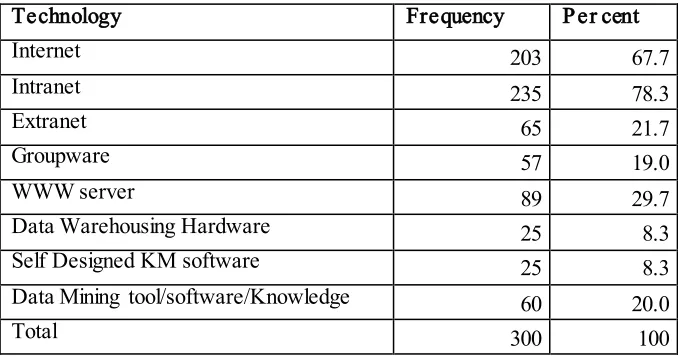
Organizations use various technologies for implementing KMS. Commonly used Technologies for implementing Knowledge Management in the Organization are charted out. It is inferred that 78.3 per cent of the respondents use Intranet for implementing KM followed by 67.7 per cent of the respondents use Internet. 29.7 per cent use WWW Server. Self Designed KM software is used only in few companies.
Table 3 Technologies available in the Organization
Technology Frequency Per cent
Internet 203 67.7
Intranet 235 78.3
Extranet 65 21.7
Groupware 57 19.0
WWW server 89 29.7
Data Warehousing Hardware 25 8.3
Self Designed KM software 25 8.3
Data Mining tool/software/Knowledge 60 20.0
Total 300 100
FREQUENCY OF KNOWLEDGE UPDATION
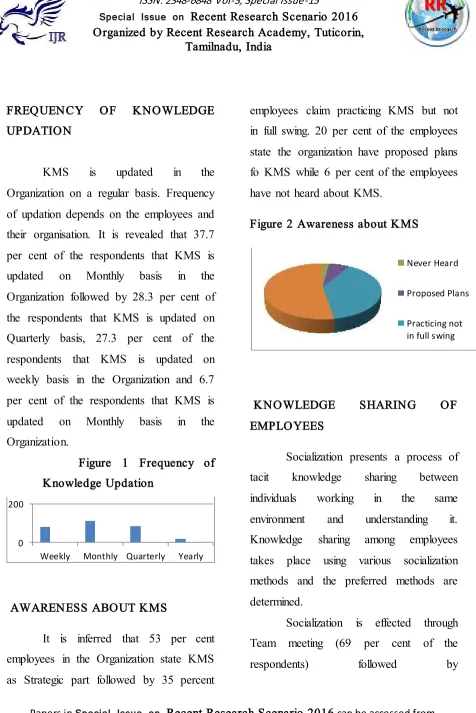
KMS is updated in the Organization on a regular basis. Frequency of updation depends on the employees and their organisation. It is revealed that 37.7 per cent of the respondents that KMS is updated on Monthly basis in the Organization followed by 28.3 per cent of the respondents that KMS is updated on Quarterly basis, 27.3 per cent of the respondents that KMS is updated on weekly basis in the Organization and 6.7 per cent of the respondents that KMS is updated on Monthly basis in the Organization.
Figure 1 Frequency of Knowledge Updation
AWARENESS ABOUT KMS
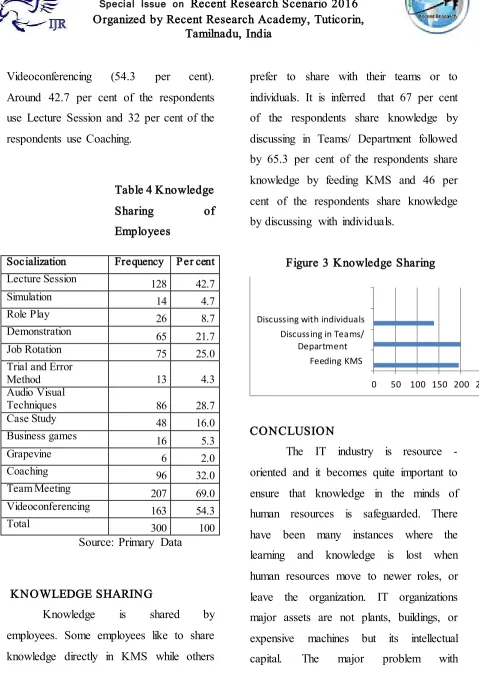
It is inferred that 53 per cent employees in the Organization state KMS as Strategic part followed by 35 percent
employees claim practicing KMS but not in full swing. 20 per cent of the employees state the organization have proposed plans fo KMS while 6 per cent of the employees have not heard about KMS.
Figure 2 Awareness about KMS
KNOWLEDGE SHARING OF
EMPLOYEES
Socialization presents a process of tacit knowledge sharing between individuals working in the same environment and understanding it. Knowledge sharing among employees takes place using various socialization methods and the preferred methods are determined.
Socialization is effected through Team meeting (69 per cent of the
respondents) followed by
0 200
Weekly Monthly Quarterly Yearly
Never Heard
Proposed Plans
Videoconferencing (54.3 per cent). Around 42.7 per cent of the respondents use Lecture Session and 32 per cent of the respondents use Coaching.
Table 4 Knowledge
Sharing of
Employees
Socialization Frequency Per cent
Lecture Session 128 42.7
Simulation 14 4.7
Role Play 26 8.7
Demonstration 65 21.7
Job Rotation 75 25.0
Trial and Error
Method 13 4.3
Audio Visual
Techniques 86 28.7
Case Study 48 16.0
Business games 16 5.3
Grapevine 6 2.0
Coaching 96 32.0
Team Meeting 207 69.0
Videoconferencing 163 54.3
Total 300 100
Source: Primary Data
KNOWLEDGE SHARING
Knowledge is shared by employees. Some employees like to share knowledge directly in KMS while others
prefer to share with their teams or to individuals. It is inferred that 67 per cent of the respondents share knowledge by discussing in Teams/ Department followed by 65.3 per cent of the respondents share knowledge by feeding KMS and 46 per cent of the respondents share knowledge by discussing with individuals.
Figure 3 Knowledge Sharing
CONCLUSION
The IT industry is resource -oriented and it becomes quite important to ensure that knowledge in the minds of human resources is safeguarded. There have been many instances where the learning and knowledge is lost when human resources move to newer roles, or leave the organization. IT organizations major assets are not plants, buildings, or expensive machines but its intellectual capital. The major problem with
0 50 100 150 200 250 Feeding KMS
intellectual capital is that it drains with
employee turnover. Many IT
organizations face the challenge of sustaining the level of competence needed to win contracts and fulfil undertakings. Knowledge has become increasingly important, as operations may need to be carried out from different locations with different persons. So storing the expert knowledge become extremely important as it is the main asset of a company’s business model. Thus for an organization to be successful, being better than the competition in obtaining, developing and sharing knowledge is key, or in other words being better in knowledge management (KM) results in being successful in the market.
SUGGESTION
It takes few days to get the relevant knowledge from the KMS. This shows the efficiency of KMS is slow and it has to be improved. Also most of the knowledge is not updated weekly basis. This has to be improved. So that the organization can ensure getting knowledge in the right time and also prevent knowledge loss in course of time.
REFERENCES
1. Alavi, M., and Leidner, D (1999), “Knowledge management systems: issues, challenges and benefits, communications of the association for
information systems”,
Communications of the Association for Information Systems, vol. 1, article 7.
2. Davenport and Prusak, (1998)
“Working Knowledge: How
organizations manage what they know”. Cambridge MA: Harvard Business School Press.
3. Golden, S. A. R. (2011). Problems
and Prospectus of Distance
Education. Quality Enhancement In
Distance Education For Life Long
Learning, 1(1), 343-344.
4. Golden, S. A. R. (2011). Strategy For
Success Of Human Beings:-Time
Management.
5. Iuliana S (2009), knowledge Management practice investigation in Romanian software development
organizations”, WSEAS
6. Marwick, A. D. (2001),”Knowledge management technology”, IBM Systems Journal, 40(4), 814–830.
7. Nonaka, I. (1994),”A dynamic theory of organizational knowledge creation”,
Organization Science, 5(1), 14–37.
8. Saeed. T., Tayyale .B ., Anis. M & Ahmad. H. M.(2010). Knowledge Management Practices: The role of Organisational Culture. ASBBS Annual Conference, 7.
9. Singh.A and Soltani.E(2010), “Knowledge management practices in Indian information technology
companies”, Total Quality
Management, Vol.21, No. 2, 145-157. 10. Wiig, K., (1995), “Knowledge
Management Methods: Practical
Approaches to Managing