New Proof Techniques for DLIN-Based
Adaptively Secure Attribute-Based Encryption
Katsuyuki Takashima (Mitsubishi Electric) April 18, 2017
Abstract. We proposeadaptively secureattribute-based encryption (ABE) schemes for boolean formulas over large universe attributes from the deci-sional linear (DLIN) assumption, which allowattribute reusein an avail-able formulawithout the previously employed redundant multiple encoding technique. Thus our KP-(resp. CP-)ABE has non-redundant ciphertexts (resp. secret keys). For achieving the results, we develop a new encod-ing method for access policy matrix for ABE, bydecoupling linear secret sharing (LSS)into its matrix and randomness, andpartially randomiz-ingthe LSS shares in simulation. The new techniques are of independent interest and we expect it will find another application than ABE.
Keywords: Attribute-Based Encryption, Multi-Use Attributes in Policy, Adap-tive Security, Static Assumption
1
Introduction
1.1 Backgrounds
access structures. An example of such span program predicate over attributes is given by (Institute = Univ. A) AND ((Department = Biology) OR (Position = Professor)), which we simply denote by X1 ∧ (X2 ∨ X3) where X1:= Univ. A,
X2:= Biology andX3:= Professor. We define attribute-multiplicitykfor a
pred-icate as the maximum number of appearances of attribute variables, i.e., k= 2 for predicate (X1 ∧ X2)∨(X1∧ X3)∨(X2 ∧ X4) sinceX1andX2appear twice
and others appear just once. While adaptive security for ABE is the standard, realistic and desirable security notion, previously, either efficiency or security is sacrificed for achieving the “multi-use” property in adaptively secure ABE. See adaptively secure ABE in Tables 1 and 2. Our aim is to achieve short (i.e., non-redundant) ciphertexts (resp. keys) in adaptively secure multi-use KP-ABE (resp. CP-ABE) fromstatic assumptions.
In previousstaticassumption based schemes [15, 19, 10], for allowing reuse of attributes in a policy in the adaptive security setting, for example, in KP-ABE, multiple ciphertext components whose number is linear in the product kn of the number n of attributes for the ciphertext and the attribute multiplicity k for available policies are necessary, which leads to a very long ciphertext. More precisely, the same information representing attribute set Γ is duplicated over multiple ciphertext components depending linearly on the multiplicity k. (See OT10 and CGW15 KP-ABE schemes in Table 1.)
Lewko-Waters [17] first constructed adaptively-secure CP-ABE and KP-ABE schemes for span programs with allowing reuse of attributes in a policywithout the above redundant multiple encoding technique. While Lewko-Waters’s (CP-)ABE scheme ([17] and subsequent work [2, 3] in Table 1) shows an interest-ing approach to allowinterest-ing reuse of attributes in a policy, the security is proven only based on q-type assumptions with q the maximum number of attribute-multiplicities in access structures. However, the assumptions (and also the as-sociated schemes) suffered a special attack which was presented by Cheon [11] at Eurocrypt 2006, which leads to inefficiency. Consequently, it is very desir-able that the q-type assumption should be replaced by a static (non-q type) assumption with keeping compact ciphertexts.
Moreover, we note that there existno multi-useCP-ABE scheme with short, i.e., non-redundant, secret keyseven in the selective security settingfroma static assumption (Table 2). Now, an important open question is:
Is there an adaptively secure KP-(resp. CP-)ABE scheme for span pro-grams from a static (standard) assumption whose ciphertext (resp. secret key) size is not linear in kn for the attribute number n in ciphertext (resp. secret key) and the maximum attribute-multiplicityk of available policies ?
This work makes a significant step for addressing the problem.
1.2 Our Results
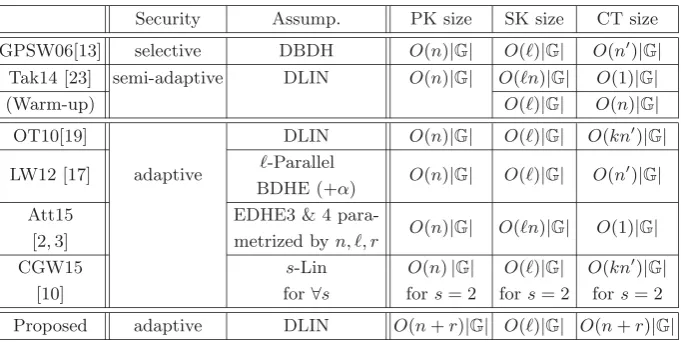
Table 1. Comparison with the existing pairing-based multi-use KP-ABE schemes, where PK, SK, CT stand for public key, secret key, ciphertext, respectively, and n represents the number of attributes in CT,nthe max of n,the number of rows in access matrix in SK, r the max of the number of columns in access matrix in SK,k (the max of) the “attribute-multiplicity” of an access matrix in SK, respectively. The fourth row describes the warm-up scheme in Section 5.3.
Security Assump. PK size SK size CT size GPSW06[13] selective DBDH O(n)|G| O()|G| O(n)|G|
Tak14 [23] semi-adaptive DLIN O(n)|G| O(n)|G| O(1)|G|
(Warm-up) O()|G| O(n)|G|
OT10[19] DLIN O(n)|G| O()|G| O(kn)|G| LW12 [17] adaptive -Parallel
BDHE (+α) O(n)|G| O()|G| O(n
)|G|
Att15 [2, 3]
EDHE3 & 4
para-metrized byn, , r O(n)|G| O(n)|G| O(1)|G| CGW15
[10]
s-Lin for∀s
O(n)|G| fors= 2
O()|G| fors= 2
O(kn)|G| fors= 2 Proposed adaptive DLIN O(n+r)|G| O()|G| O(n+r)|G|
– We propose an adaptively securemulti-useKP-ABE construction for boolean formulas (or span programs) over large universe attribute matching predi-cateswith non-redundant ciphertexts from the DLIN assumption(in Section 5). The size of a ciphertext for attributes is not linear in the product kn of the number of ciphertext attributes n and the attribute multiplicity k in available access structures, but has only a linear dependence on some size parameterrof access structures. For comparison with existing ones, refer to Table 1.
– We also propose an adaptively secure multi-use CP-ABE construction for the same access structures as the above KP-ABE with short (non-redundant) keys from DLIN. The CP-ABE scheme is obtained from the above KP-ABE by the natural dual conversion, in particular, the key size is not linear in kn for the number n of key attributes and the attribute multiplicity k in available access structures. We note that it is the first multi-use CP-ABE construction with short keys from a static assumption even including the selective secure schemes(Table 2). For the concrete scheme, see Appendix E.
Table 2. Comparison with the existing pairing-based multi-use CP-ABE schemes, where PK, SK, CT stand for public key, secret key, ciphertext, respectively, and n represents the number of attributes in SK,n the max ofn,the number of rows in access matrix in CT, r the max of the number of columns in access matrix in CT,k (the max of) the “attribute-multiplicity” of an access matrix in CT, respectively.
Security Assump. PK size SK size CT size Wat11[25]
Scheme 2 ν-BDHE O(n)|G| O(kn
)|G| O()|G|
Wat11[25]
Scheme 3 selective DBDH O(nr)|G| O(kn
+r)|G| O(2)|G|
AHY15 [4]2
parame-terized O((n)
2λ)|G| O((n)4λ2)|G| O(1)|G|
OT10 [19] DLIN O(n)|G| O(kn)|G| O()|G| LW12 [17] adaptive -Parallel
BDHE (+α) O(n)|G| O(n
)|G| O()|G|
CGW15 [10]
s-Lin for∀s
O(n)|G| fors= 2
O(kn)|G| fors= 2
O()|G| fors= 2 Proposed adaptive DLIN O(n+r)|G| O(n+r)|G| O()|G|
1.3 Key Techniques
Our results are related to KP- and CP-ABEs, however, for simplicity, we mainly treat on KP-ABE. According to a new framework introduced by Attrapadung, doubly selective security (i.e., selective and co-selective) leads to achieving adap-tive one. Since selecadap-tive security is easily obtained in KP-ABE, we should con-centrate on achievingco-selectively secure KP-ABE below.
Based on the technique in [5, 23], we have DLIN-based, multi-use and semi-adaptively secure KP-ABE with short ciphertext size. We give the underlying scheme (as a warm-up), and extend it to our adaptive one. Here, access structure
S is given by×rmatrixM and each rowMi ∈Fqrof the matrix is associated
to an attribute value by a map ρ, i.e., labeled with attributes vi := ρ(i). An attribute set Γ satisfies S iff 1 ∈ spanMi|vi ∈ Γ for a fixed special (all-one) vector1. First, to achieve short ciphertexts in the underlying KP-ABE, attributesΓ :={xj}j=1,...,n are encoded in ann-dimensional (withn≥n+ 1) vector y := (y1, . . . , yn) such thatnj=0−1yn−jzj =zn−1−nn
j=1(z−xj). Each
(non-zero) attribute value vi (for i = 1, . . . , ) associated with a row of access structure matrix M (in S) is encoded as vi := (vin−1, . . . , vi,1), so y ·vi = vn−1−n
i
n
j=1(vi−xj), and the value of inner product is equal to zero if and
Key Ciphertext
decoupling
such that
Previous KP-ABEs
This work
decrypt ( pairing ) • real part
• semi-func. part
information-theoretical
change
equivalent distribution
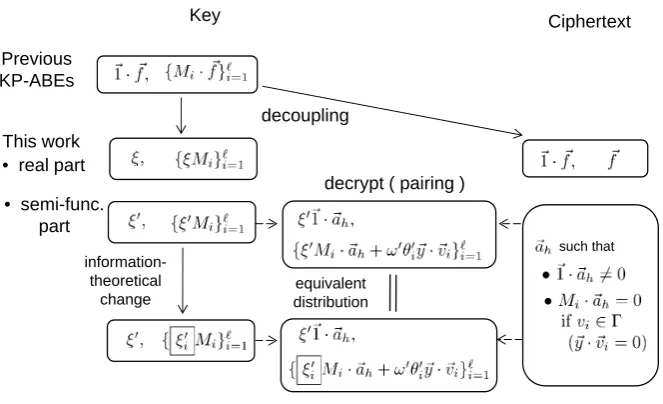
Fig. 1.Decoupling of LSS matrix from randomness and partial LSS randomization in semi-functional parts. Here, (M = (Mi), ρ) is an access structure, uniformly random
f U
←Fr
q,ξ, ξ, ξi, θi←UFq,y:= (y1, . . . , yn) such thatPnj=0−1yn−jzj=zn−1−nQnj=1 (z−
xj), andvi:= (vin−1, . . . , vi,1) forvi:=ρ(i).
only if vi =xj for some j, i.e., vi ∈Γ. Here, the relation between S and Γ is determined by the multiple inner product values y·vi for one vector y which is equivalent to Γ. As in previous works (e.g., [5, 23]), a ciphertext element c1
is encoded with ωy (for randomω), and key elements k∗i are encoded withvi and shared secret values Mi ·f (i = 1, . . . , ) for a central secret 1·f with uniformly randomf, respectively. We change the encoding method for our new proof method as indicated below.
Basic Idea: Decoupling of LSS matrix from randomness Secret keys in all previous KP-ABE schemes contain shared secret values s0 :=1·f and si:=Mi·f, which means that randomnessfis fixed at the key generation phase. Moreover, since, forpre-challenge queried keys (in simulation), the challengey is not yet revealed to the challenger, i.e., simulator, at the query phase, we have never had a co-selective simulation strategy for achieving compact ciphertexts together with multi-use leaf attributesvi in the queried access matrix.
For addressing the problem, we change an encoding method of LSS (Fig. 1). First, we decouple LSS encoding into LSS matrix and randomness, and random-ness is encoded on the ciphertext side. (Then, the simulation of the randomrandom-ness is delayed until the challenge phase.) Precisely, in the secret key, concatenated Vi := (θivi, ξMi)∈ Fqn+r are encoded in the i-th component ki∗ fori = 1, .., with random θi, ξ. We note that the key componentk∗i has no randomness for
directly encoded in{k∗i}. In ciphertext,Y := (ωy, f)∈Fqn+ris encoded. Hence, in decryption, inner-product values are
Y ·Vi=ωθi(y·vi) +ξMi·f=ωθi(y·vi) +ξsi fori= 1, . . . , ,
therefore, ify·vi = 0, secret shareξsi for central secretξs0 is obtained, and if y·vi= 0, si is totally hidden from the decryptor sinceθi is freshly random.
New Proof Techniques: Partial LSS randomization in simulation and new underlying lemma At the top level of strategy of the security proof, we follow the dual system encryption methodology proposed by Waters [24]. The above change of encoding enables the simulator to simulate the randomness of LSS depending on both of the h-th queried access structure S := (M, ρ) and attributesΓ :={xt}(equivalently, vectory). We use the simulated randomness ah, which is not fully random in Fqr, but satisfies Mi·ah = 0 if vi ∈ Γ and 1·ah= 0. Such a vector exists sinceΓ does not satisfyS, and it has been used for security in previous works, for example, in [13]. In ciphertext, the concatenated vector Y := (ωy,ah)∈Fqn+r is encoded in the semi-functional space. And, in the semi-functional space of the h-th queried key,Vi:= (θivi, ξMi)∈Fqn+r are encoded in the i-th componentk∗i fori= 1, .., . SinceVi isindependent of Γ,
it can be simulated for thepre-challengekey. Then,
Y·V
i =ωθi(y·vi) +ξMi·ah=
0 ify·vi = 0,
ωθ
i(y·vi) +ξMi·ah ify·vi = 0,
fori= 1, . . . , . Here, ify·vi= 0,Y·Vi is uniformly random and independent from other variables sinceθi are freshly random. LetVi:= (θivi, ξiMi)∈Fqn+r with uniformly randomξi which are independent of each other fori= 1, . . . , .
Y·V
i =ωθi(y·vi) +ξiMi·ah=
0 ify·vi= 0,
ωθ
i(y·vi) +ξiMi·ah ify·vi= 0,
for i= 1, . . . , . Again, ify·vi = 0, Y·Vi is uniformly random and
indepen-dent of other variables. That is,Y·Vi andY·Viare equivalently distributed. Therefore, we can conceptually changeVi which contains variableξ toViwith no ξ by using the pairwise independence lemma (Lemma 3) as in the previous dual system encryption proofs. We stress that Vi are also independent of the challenge attributes Γ, and then can be used in the pre-challenge key simula-tion. In this way, we can sequentially eliminate the randomnessξ from all key components, k∗i for i= 1, .., ,except fork0∗, and finally,ξ remains only in the
central elementk∗0, and the inner-product of the semi-functional parts ofk0∗and
1.4 Notations
WhenAis a random variable or distribution,y←RAdenotes thaty is randomly selected fromA according to its distribution. WhenA is a set,y ←U A denotes that y is uniformly selected from A. We denote the finite field of order q by
Fq, andFq \ {0} byFq×. A vector symbol denotes a vector representation over
Fq, e.g., y denotes (y1, . . . , yn) ∈ Fqn. For two vectors y = (y1, . . . , yn) and v= (v1, . . . , vn),y·vdenotes the inner-productni=1yivi. The vector0 is abused
as the zero vector inFqnfor anyn.XTdenotes the transpose of matrixX. A bold face letter denotes an element of vector spaceV, e.g.,x∈V. Whenbi∈V(i= 1, . . . , n), spanb1, . . . ,bn ⊆ V (resp. spanx1, . . . , xn) denotes the subspace
generated byb1, . . . ,bn(resp.x1, . . . , xn). For basesB:= (b1, . . . ,bN) andB∗:=
(b∗1, . . . ,b∗N), (x1, . . . , xN)B := Ni=1xibi and (y1, . . . , yN)B∗ := Ni=1yib∗i. ej
denotes the canonical basis vector (
j−1
0· · ·0,1,
n+r−j
0· · ·0)∈Fqn+r for positive integers nandr. GL(n,Fq) denotes the general linear group of degreenoverFq.
2
Dual Pairing Vector Spaces (DPVS)
In this paper, for simplicity of description, we will present the proposed schemes on the symmetric version of dual pairing vector spaces (DPVS) [18] constructed using symmetric bilinear pairing groups given in Def. 1. Owing to the abstraction of DPVS, the presentation and the security proof of the proposed schemes are essentially the same as those on the asymmetric version of DPVS.
Definition 1. “Symmetric bilinear pairing groups” (q,G,GT, G, e) are a tuple of a prime q, cyclic additive group G and multiplicative group GT of order q, G = 0 ∈ G, and a polynomial-time computable nondegenerate bilinear pairing e : G×G→ GT i.e., e(sG, tG) = e(G, G)st and e(G, G) = 1. Let Gbpg be an
algorithm that takes input1λand outputs a description of bilinear pairing groups (q,G,GT, G, e)with security parameter λ.
“Dual pairing vector spaces (DPVS)” of dimensionN by a direct product of symmetric pairing groups (q,G,GT, G, e) are given by prime q,N-dimensional vector space V:=
N
G× · · · ×GoverFq, cyclic groupGT of orderq, and pairing e:V×V→GT. The pairing is defined bye(x,y) :=Ni=1e(Gi, Hi)∈GT where
x := (G1, . . . , GN) ∈ V and y := (H1, . . . , HN) ∈ V. This is nondegenerate bilinear i.e.,e(sx, ty) =e(x,y)st and ife(x,y) = 1 for ally∈V, thenx=0.
3
Definition of KP-ABE
3.1 Span Programs and Access Structures
A span program over Fq is a labeled matrix S := (M, ρ) where M is a (×r) matrix over Fq andρ is a labeling of the rows of M by literals from {v, v, . . .} (every row is labeled by one literal), i.e., ρ : {1, . . . , } → {v, v, . . .}. A span program accepts or rejects an input by the following criterion. LetΓ be a set of attributes, i.e., Γ :={xj}1≤j≤n (xj ∈ Fq×). The span program S accepts Γ if and only if 1 ∈ span(Mi)ρ(i)=vi∈Γ, i.e., some linear combination of the rows
(Mi)ρ(i)∈Γ gives the all one vector1.
No rowMi (i= 1, . . . , ) of the matrixM is0. We now construct a secret-sharing scheme for a (monotone) span program.
Definition 3. A secret-sharing scheme for span programS:= (M, ρ)is: 1. Let M be ×r matrix. Let column vector f := (f1, . . . , fr) ←U Fqr. Then,
s0 :=1·f=rk=1fk is the secret to be shared, and s:= (s1, . . . , s)T :=
M·fT is the shares of the secrets
0 and the sharesi belongs to ρ(i).
2. If span programS:= (M, ρ)acceptsΓ, i.e.,1∈span(Mi)ρ(i)∈Γ, there exist
constants {αi ∈ Fq | i ∈ I} such that I ⊆ {i ∈ {1, . . . , } | ρ(i) ∈Γ} and
i∈Iαisi=s0. Furthermore, these constants {αi}can be computed in time
polynomial in the size of the matrixM.
3.2 Key-Policy Attribute-Based Encryption (KP-ABE)
In key-policy attribute-based encryption (KP-ABE), encryption (resp. a secret key) is associated with attributes Γ (resp. access structure S). Relation R for KP-ABE is defined asR(S, Γ) = 1 iff access structure SacceptsΓ.
Definition 4 (Key-Policy Attribute-Based Encryption: KP-ABE). A key-policy attribute-based encryption scheme consists of probabilistic polynomial-time algorithmsSetup,KeyGen,EncandDec. They are given as follows:
Setup takes as input security parameter 1λ, a bound n on the number of at-tributes per ciphertext and a boundron the number of columns of an access matrix in a secret key. It outputs public parameterspkand master secret key sk.
KeyGen takes as input public parameters pk, master secret key sk, and access structureS:= (M, ρ). It outputs a corresponding secret key skS.
Enctakes as input public parameterspk, messagemin some associated message spacemsg, and a set of attributes,Γ :={xj}nj=1 . It outputs a ciphertextctΓ.
Dectakes as input public parameters pk, secret key skS for access structureS, and ciphertextctΓ that was encrypted under a set of attributesΓ. It outputs eitherm ∈msgor the distinguished symbol ⊥.
Definition 5 (Adaptive Security). The model for defining the adaptively payload-hiding security of KP-ABE under chosen plaintext attack is given by the following game:
Setup In the adaptive security, the challenger runs the setup,
(pk,sk)←RSetup(1λ, n, r), and gives public parameterspk to the adversary.
Phase 1 The adversary is allowed to adaptively issue a polynomial number of key queries,S, to the challenger. The challenger givesskS←R KeyGen(pk,sk,S) to the adversary.
Challenge The adversary submits two messages m(0), m(1), and a challenge attribute set, Γ, provided that no S queried to the challenger in Phase 1 accepts Γ. The challenger flips a coin b ← {0,U 1}, and computes ct(Γb) ←R Enc(pk, m(b), Γ). It givesct(Γb) to the adversary.
Phase 2 Phase 1 is repeated with the restriction that no queriedSaccepts chal-lengeΓ.
Guess The adversary outputs a guess b ofb, and wins if b=b.
The advantage of adversaryAin the adaptive game is defined asAdvKPA-ABE(λ) := Pr[Awins]−1/2for anyλ. A KP-ABE scheme is adaptively payload-hiding secure if all poly-time adversaries have at most a negligible advantage in the game.
Remark 1 The challenge Γ is declared by the adversary just before Phase 1
(resp. before Setup) in the semi-adaptive (resp. selective) game, and the corre-sponding security notions are defined in the similar manner as above.
4
Special Matrix Subgroups
Let n≥2 and ˜n:=n+r. Lemmas 1–3 are key lemmas for the security proof for our KP- and CP-ABE schemes.
We start by a motivational argument for introducing our new sparse matrix technique. Previous sparse matrices in DPVS [21, 23] are given by the form in Eq. (21) (in Appendix B.2), whose diagonal element except for the first one is the same denoted by u. For achieving our information theoretical change from (Y, V
i) to (Y, Vi) described in Section 1.3, we use one more randomness in
diagonal elements, i.e., two randomu1andu2, as given in Eq. (1). More precisely,
randomU ← HU (n, r,Fq) acts onFqn+r=Fqn×Fqr by using different scalars u1
and u2 on the first Fqn and the second Fqr respectively. The new sparse matrix
action is the key fact for proving Lemmas 3 and 8. For positive integersnandr, let
H(n, r,Fq) :=
⎧ ⎪ ⎪ ⎪ ⎪ ⎪ ⎪ ⎪ ⎪ ⎪ ⎪ ⎨ ⎪ ⎪ ⎪ ⎪ ⎪ ⎪ ⎪ ⎪ ⎪ ⎪ ⎩ ⎛ ⎜ ⎜ ⎜ ⎜ ⎜ ⎜ ⎜ ⎜ ⎜ ⎜ ⎝ u 1 u
2 u1
..
. . .. u
n u1
u
n+1 u2
..
. . ..
u
n+r u2
⎞ ⎟ ⎟ ⎟ ⎟ ⎟ ⎟ ⎟ ⎟ ⎟ ⎟ ⎠
u1, u2, ul∈Fq
forl= 1, . . . , n+r, a blank element in the matrix denotes 0∈Fq
andH(n, r,Fq)×:=H(n, r,Fq) ∩GL(˜n,Fq).
Lemma 1. H(n, r,Fq)× is a subgroup ofGL(˜n,Fq), wheren˜:=n+r.
Lemma 1 is directly verified from the definition of groups. Let
Xi,j :=
⎛ ⎜ ⎜ ⎜ ⎜ ⎜ ⎜ ⎜ ⎜ ⎜ ⎜ ⎝ μ i,j,1 μ
i,j,2 μi,j,1
..
. . ..
μ
i,j,n μi,j,1
μ
i,j,n+1 μi,j,2
..
. . ..
μ
i,j,n+r μi,j,2
⎞ ⎟ ⎟ ⎟ ⎟ ⎟ ⎟ ⎟ ⎟ ⎟ ⎟ ⎠
∈ H(n, r,Fq)
fori, j= 1, . . . ,5
(2)
and usingXi,j, we define
L(5, n, r,Fq) :=
⎧ ⎪ ⎨ ⎪ ⎩X :=
⎛ ⎜ ⎝
X1,1 · · · X1,5 ..
. ...
X5,1 · · · X5,5
⎞ ⎟ ⎠
Xi,j∈ H(n, r,Fq) fori, j= 1, . . . ,5
⎫ ⎪ ⎬ ⎪ ⎭
GL(5˜n,Fq). (3)
Lemma 2. L(5, n, r,Fq)is a subgroup ofGL(5˜n,Fq).
Lemma 2 is given in a similar manner as Lemma 2 in the full version of [21]. For the proof, see Appendix B.1.
Next is a generalization of Lemma 6 in [21].
Lemma 3. Letej := (0, . . . ,0,
j
ˇ
1,0, . . . ,0)∈Fqn+r. For allv= (v1, . . . , vn,0, . . . ,0)∈
spane1, .., en \spane1, κ = (0, . . . ,0, κ1, . . . , κr) ∈ spanen+1, .., en+r and
π∈Fq, let
Wv,κ,π:={(w, z) ∈(spane1, v, κ \spane1)×(Fqn+r\spane1⊥)| w·z=π}.
For all(v, κ, x)∈(spane1, .., en \spane1)×spanen+1, .., en+r×Fqn+r\spane1⊥, and U ← H(n, r,U Fq)×, Z := (U−1)T, the pair ((v+κ)U, xZ) is uniformly dis-tributed inWv,κ,(v+κ)·x except with negligible probability.
For the proof, see Appendix B.2.
5
Adaptively Secure Multi-Use KP-ABE Scheme with
Short Ciphertexts
5.1 Key Ideas in Constructing the Proposed KP-ABE Scheme
DPVS approach. An underlying construction of our proposed one is given in Sec-tion 5.3, which is a dual form of the scheme in [23] since the 5n×5nsparse basis matrix is used in a dual manner. Hence, while [23] scheme has sizeO(1) cipher-texts and sizeO(n) keys, the underlying one has sizeO(n) ciphertexts and size O() keys (Table 1), where, nare the number of rows in access structure matrix M and the max of the number of attributes inΓ, respectively. In other words, the dual conversion of the scheme in [23] to the underlying scheme increases ciphertext size O(n)-times and then decreases key sizeO(n)-times.
As mentioned in Introduction, the top level idea of our construction is the decoupling technique of LSS encoding. The underlying scheme has a usual en-coding of LSS, i.e., enen-coding a central secret s0 and shares si. Therefore, the
comprehension of the construction idea of the underlying one is necessary for understanding our proposed one. In this section, we will explain key ideas of con-structing the underlying and our KP-ABE schemes. First, we will show how size O(n) ciphertexts and sizeO() keys can be achieved in the underlying scheme, where the IPE scheme given in [21] is used as a building block. Here, we will use a simplified (or toy) version of the underlying KP-ABE scheme, for which the security is no more ensured in the standard model under the DLIN assumption. A ciphertext in the simplified KP-ABE scheme consists of two vector ele-ments, (c0,c1) ∈ G5×Gn, and cT ∈ GT. A secret key consists of + 1
vec-tor elements, (k∗0,k∗1, . . . ,k∗) ∈ G5 ×(Gn) for access structure S := (M, ρ),
where the number of rows of M is and k∗i with i ≥ 1 corresponds to the i-th row. Therefore, to achieve shorter secret keys, we have to compress k∗i ∈ Gn to a constant size in n. We now employ a special form of basis
genera-tion matrix, X :=
⎛ ⎜ ⎜ ⎜ ⎝ μ 1 μ 2 μ .. . . .. μ n μ ⎞ ⎟ ⎟ ⎟
⎠ ∈ H(n,0,Fq) of Eq. (1) in Section 4, where
μ, μ
1, . . . , μn ←U Fq and a blank in the matrix denotes 0∈ Fq. The master
se-cret key (DPVS basis) is B∗ :=
⎛ ⎜ ⎜ ⎜ ⎝
b∗1
.. .
b∗n
⎞ ⎟ ⎟ ⎟ ⎠ := ⎛ ⎜ ⎜ ⎜ ⎝ μ 1G μ
2G μG
..
. . .. μ
nG μG
⎞ ⎟ ⎟ ⎟
⎠. Let the i-th
component of a secret key associated with S := (M := (Mi)i=1, ρ) consists
of k∗i := (θivni−1+si, θivin−2, . . . , θivi, θi)B∗ = (θivni−1+si)b∗1 +θi(vin−2b∗2+ · · ·+vib∗n−1+b∗n) =
θi(nj=1vin−jμj) +siμ1
G, vn−2
i θiμG, . . . , θiμG
, where vi := ρ(i), θi ←U Fq, f ←U Fqr and si := Mi·f. Then, k∗i can be compressed to
only twogroup elements
K∗
i,1:=
θi(nj=1vin−jμj) +siμ1
G, K∗
i,2:=θiμG
as well asvi, sincek∗i can be obtained by (Ki,∗1, vin−2Ki,∗2, . . . , viKi,∗2, Ki,∗2) (note
Let B := (bi) be the dual orthonormal basis of B∗ := (b∗i), and B be
the public key in the simplified KP-ABE scheme. We specify (c0,k∗0, cT) such
that e(c0,k∗0) = gζT−ξs0 and cT := gTζm ∈ GT with s0 is a center secret of
shares {si}i=1,..., associated with access structureS, which are embedded into
{k∗i}i=1,...,as indicated above. We also set a ciphertext forΓ :={x1, . . . , xn}as
c1:= (ωy)Bwherey:= (y1, . . . , yn) such that nj=0−1yn−jzj=zn−1−nnj=1 (z− xj), and ω ←U Fq. From the dual orthonormality of B and B∗, if S accepts Γ, there exists a system of coefficients{αi}ρ(i)∈Γ such thate(c1,k∗) =gξsT0, where k∗:=ρ(i)∈Γαiki∗. Hence, a decryptor can compute gξs0
T if and only if S
ac-cepts Γ, i.e., can obtain plaintext m. We can extend the simplified KP-ABE to a semi-adaptively secure KP-ABE scheme under the DLIN assumption just by enlarging the dimension of the underlying vector space, which is shown in Section 5.3. The security proof is based on the Waters’s dual system technique and given in a similar manner to [23]. The provably secure scheme has the same asymptotic sizes of keys and ciphertexts, i.e., O()-sized keys and O(n)-sized ciphertexts.
Our goal is to construct an adaptively secure KP-ABE with a compara-ble asymptotic data sizes, i.e., O()-sized keys and O(n+r)-sized ciphertexts, from the underlying one. We use a decoupling technique of LSS matrix from randomness for achieving the goal. First, we enlarge the space from O(n) to O(n+r) dimension. As described in Fig. 1, a uniformly random vectorf∈Frq for LSS is encoded on the ciphertext component c1. In the simplified scheme,
c1:= (ωy, f)B∈Gn+r wherey∈Frq is defined as above. For encoding each row
Miof access matrixM onk∗i, the above matrixX is extended to a (n+r)×(n+r) matrix inH(n, r,Fq) (Eq. (1)), then the master secret key is given by
B∗ :=
⎛ ⎜ ⎜ ⎜ ⎜ ⎜ ⎜ ⎜ ⎜ ⎜ ⎜ ⎝
b∗1
.. .
b∗n b∗n+1
.. .
b∗n+r
⎞ ⎟ ⎟ ⎟ ⎟ ⎟ ⎟ ⎟ ⎟ ⎟ ⎟ ⎠ := ⎛ ⎜ ⎜ ⎜ ⎜ ⎜ ⎜ ⎜ ⎜ ⎜ ⎜ ⎝ μ 1G μ
2G μ1G
..
. . ..
μ
nG μ1G
μ
n+1G μ2G
..
. . ..
μ
n+rG μ2G
⎞ ⎟ ⎟ ⎟ ⎟ ⎟ ⎟ ⎟ ⎟ ⎟ ⎟ ⎠
where μ1, μ2, μ1, . . . ,
μ
n+r ←U Fq. Here, note that two independent diagonal elements μ1, μ2 are
used for the first n-dimension and the second r-dimension. (Refer to the ar-gument given in the beginning of Section 4.) Hence, k∗i is given by k∗i := (θivi, ξMi)B∗. We note k∗i is compressed to three group elements as before, i.e., K∗
i,1:=
θi(nl=1vin−lμl) +ξ(rl=1Mi,lμn+l)G, Ki,∗2:=θiμ1G, Ki,∗3:=ξμ2G
for i = 1, .., , and the secret key size is O(). The pairing value of c1 and k∗i
is e(c1,ki∗) =gTωθiy·vi+ξMi·f=gTωθiy·vi+ξsi wheresi :=Mi·f. These values are
equivalent to the previous underlying scheme. Therefore, the decryption algo-rithm is the same as before.
scheme is to achieve the adaptive securityunder the DLIN assumption. Here, we adopt and extend a strategy initiated in [19], in which the dual system encryption methodology is employed in a modular or hierarchical manner. That is, three top level assumptions, the security of Problems 1–3, are directly used in the dual system encryption methodology and the assumptions are reduced to a primitive assumption, the DLIN assumption.
To meet the requirements for applying to the dual system encryption method-ology and reducing to the DLIN assumption, the underlying vector space is five times greater than that of the above-mentioned simplified scheme. For ex-ample, k∗i := ( θivi, ξMi, 02n+2r, ψivi, ηiMi, 0n+r )B∗ for ρ(i) = vi, c1 =
( ωy, f, 02n+2r, 0n+r, ϕ1 )B with ϕ1 ←U Fnq+r, and X :=
⎛ ⎜ ⎝
X1,1· · · X1,5
..
. ... X5,1· · · X5,5
⎞ ⎟ ⎠∈
L(5, n, r,Fq) of Eq. (3) in Section 4, where each Xi,j is of the form of X ∈
H(n, r,Fq) in the simplified scheme. The vector space consists of four
orthogo-nal subspaces, i.e., real encoding part, hidden part, secret key randomness part, and ciphertext randomness part. The simplified KP-ABE scheme corresponds to the first real encoding part.
A key fact in the security reduction is that L(5, n, r,Fq) is a subgroup of GL(5(n+r),Fq) (Lemma 2), which enables arandom-self-reducibilityargument for reducing the intractability of Problems 1–3 to the DLIN assumption. For the reduction, see [21]. We employ a new simulation technique in dual system encryption using random vectorfinc1. For the details, refer to the proof outline
in Section 5.5.
5.2 Dual Orthonormal Basis Generator
We describe random dual orthonormal basis generatorGKP
ob below, which is used
as a subroutine in the proposed KP-ABE scheme. GKP
ob(1λ,5,(n, r)) : paramG:= (q,G,GT, G, e) R
← Gbpg(1λ), N0:= 5, N1:= 5(n+r),
paramVt := (q,Vt,GT,At, e) :=Gdpvs(1λ, Nt,paramG) fort= 0,1,
ψ U
←F×
q , gT :=e(G, G)ψ, param(n,r):= ((n, r), {paramVt}t=0,1, gT),
X0:= (χ0,i,j)i,j=1,...,5←UGL(N0,Fq), X1← L(5, n, r,U Fq), hereafter,
{μi,j,ι, μ
i,j,l}li,j=1=1,...,n,...,+5;rι=1,2 denotes non-zero entries ofX1 as in Eq.(2), b∗0,i:= (χ0,i,1, .., χ0,i,5)A=5j=1χ0,i,jaj fori= 1, ..,5, B∗0:= (b∗0,1, ..,b∗0,5),
B∗
i,j,ι:=μi,j,ιG, Bi,j,l∗ :=μi,j,lG fori, j= 1, . . . ,5;ι= 1,2;l= 1, . . . , n+r,
fort= 0,1, (ϑt,i,j)i,j=1,...,Nt :=ψ·(X T
t )−1, bt,i := (ϑt,i,1, .., ϑt,i,Nt)A=
Nt
j=1ϑt,i,jaj fori= 1, .., Nt, Bt:= (bt,1, ..,bt,Nt),
Remark 2 Let sparse block matrix
⎛ ⎜ ⎜ ⎝
b∗1,(i−1)(n+r)+1
.. .
b∗1,i(n+r)
⎞ ⎟ ⎟
⎠:= (Xi,1·G· · ·Xi,5·G) for i= 1, . . . ,5,
andB∗1:= (b∗1,1, . . . ,b∗1,5(n+r)),
⎫ ⎪ ⎪ ⎪ ⎪ ⎪ ⎬ ⎪ ⎪ ⎪ ⎪ ⎪ ⎭
(4)
whereXi,j·Gmeans the componentwise multiplication.B1is the dual orthonor-mal basis ofB∗1, i.e.,e(b1,i,b∗1,i) =gT ande(b1,i,b∗1,j) = 1 for 1≤i=j≤5(n+r).
5.3 Warm-Up: Underlying Semi-adaptively Secure Construction
As a warm-up, we describe a semi-adaptively secure KP-ABE scheme, which is a dual construction of [23] whose secret keys are compressed by using a sparse matrix while [23] scheme has compressed ciphertexts. Namely, we use the sparse matrix in a dual manner of [23]. We refer to Section 1.4 for notations on DPVS.
Setup(1λ, n) :/∗ N0:= 5, N1:= 5n ∗/
(paramn,B0,B∗0,B1,{B∗i,j,ι, Bi,j,l∗ }i,jl=1=1,...,n,...,5;ι=1,2)← GR obKP(1λ,5,(n,0)),
B0:= (b0,1,b0,2,b0,5), B0∗:= (b∗0,1,b0∗,2,b∗0,4),
B1:= (b1,1, ..,b1,n,b1,4n+1, ..,b1,5n),
return pk:= (1λ,paramn,{Bt}t=0,1), sk:= (B∗0,{Bi,j,ι∗ , B∗i,j,l}ιi=1=1,,4;2;jl=1=1,...,,...,n5).
KeyGen(pk, sk, S:= (M, ρ)) : f←UFqr, s0:=1·f, η 0←UFq, k∗0:= (1, s0, 0, η0, 0)B∗
0,
fori= 1, . . . , ,
ifρ(i) =vi, vi:= (vi,l)nl=1:= (vin−1, .., vi,1), si:=Mi·f, θ i, ψi, ηi←UFq,
forj = 1, . . . ,5, Ki,∗1,j :=ln=1vi,l(θiB1∗,j,l+ψiB5∗,j,l) +siB1∗,j,1+ηiB∗5,j,1, K∗
i,2,j :=θiB1∗,j,1+ψiB5∗,j,1,
return skS:= (S, k∗0, {Ki,∗1,j, Ki,∗2,j}i=1,...,;j=1,...,5).
Enc(pk, m, Γ :={x1, . . . , xn|xj∈Fq×, n ≤n−1}) : y := (y1, . . . , yn) such that nj=0−1yn−jzj=zn−1−nn
j=1(z−xj),
ω, ϕ0, ζ←UFq, ϕ1←UFnq, c0:= (ζ, ω, 0, 0, ϕ0)B0, n
2n n n
c1:= ( ωy, 02n, 0n, ϕ1 )B1
cT :=gζTm, ctΓ := (Γ,c0,c1, cT), return ctΓ.
Dec(pk,skS:= (S, k0∗,{Ki,∗1,j, Ki,∗3,j}ij=1=1,...,,...,5),ctΓ := (Γ,c0,c1, cT)) :
IfS:= (M, ρ) accepts Γ, then computeIand{αi}i∈I such that 1 =
I⊆ {i∈ {1, . . . , } | [ρ(i) =vi ∧ vi∈Γ] }.
fori∈I, if ρ(i) =vi, vi := (vi,l)nl=1:= (vni−1, . . . , vi,1), n
n
k∗i := (Ki,∗1,1, vi,2Ki,∗2,1, .., vi,nKi,∗2,1,· · · Ki,∗1,5, vi,2Ki,∗2,5, .., vi,nKi,∗2,5),
n
2n n n
that is, k∗i := ( θivi+sie1, 02n, ψivi+ηie1, 0n )B∗
1, k∗:=i∈Iαik∗i, K :=e(c0,k∗0)·e(c1,k∗), return m:=cT/K.
[Correctness] If S:= (M, ρ) acceptsΓ,K=e(c0,k∗0)·e(c1,k∗) =
g−ωs0+ζ
T gω
P i∈Iαisi
T =gζT wheres0:=1·f, s i:=Mi·ffori= 1, . . . , .
We note that secret keyskSconsists of 5+ 5 group elements and ciphertext ctΓ consists of 5n+ 5 group elements (and oneGT element).
The standard DLIN assumption is defined in Appendix A.
Theorem 1. The proposed multi-use KP-ABE scheme is semi-adaptively payload-hiding against chosen plaintext attacks under the DLIN assumption.
Theorem 1 is proven in a similar manner as in [23].
In the semi-adaptive security model, the challenge attribute setΓ is declared by the adversary at the start of the game, but after receiving the public keypk from the challenger. Therefore, for each key query S := (M, ρ), the challenger can determine whether ρ(i) ∈ Γ or not for i = 1, . . . , . The challenger in the security proof makes use of this information to simulate a component k∗i of a
queried key for each i= 1, . . . , in a refined dual system encryption proof. The main part of the game sequence is similar (but not equal) to the Game 3 sequence in the proof of Theorem 2 below.
5.4 Proposed Adaptively Secure Construction
By decoupling LSS coefficientssi:=Mi·f∈Fq toMi∈Fqr in the key side and
f ∈Fr
q in the ciphertext side of the underlying scheme, we obtain our proposed
adaptively secure KP-ABE scheme.
Setup(1λ, (n, r)) :/∗ N0:= 5, N1:= 5(n+r) ∗/ (param(n,r),B0,B∗0,B1,{Bi,j,ι∗ , Bi,j,l∗ }i,jl=1=1,...,n,...,+5;rι=1,2)
R
← GKP
ob (1λ,5,(n, r)),
B0:= (b0,1,b0,2,b0,5), B0∗:= (b∗0,1,b0∗,2,b∗0,4),
B1:= (b1,1, ..,b1,n+r,b1,4(n+r)+1, ..,b1,5(n+r)),
return pk:= (1λ,param(n,r),{Bt}t=0,1), sk:= (B∗0,{Bi,j,ι∗ , Bi,j,l∗ }iι=1=1,,4;2;jl=1=1,...,,...,n5+r).
KeyGen(pk, sk, S:= (M, ρ)) : ξ, η0←UFq, k0∗:= (1, ξ, 0, η0, 0)B∗
0,
K∗
i,1,j :=
n
l=1vi,l(θiB∗1,j,l+ψiB5∗,j,l) +
r
l=1Mi,l(ξB1∗,j,n+l+ηiB5∗,j,n+l),
K∗
i,2,j :=θiB1∗,j,1+ψiB5∗,j,1, Ki,∗3,j :=ξB1∗,j,2+ηiB5∗,j,2,
return skS:= (S, k0∗, {Ki,∗1,j, Ki,∗2,j, Ki,∗3,j}i=1,...,;j=1,...,5).
Enc(pk, m, Γ :={x1, . . . , xn|xj∈Fq×, n ≤n−1}) : y := (y1, . . . , yn) such that nj=0−1yn−jzj=zn−1−nn
j=1(z−xj),
f ←UFr
q, ω, ϕ0, ζ ←UFq, ϕ1←UFqn+r, c0:= (ζ, 1·f, 0, 0, ϕ0)B0, n+r
2n+2r n+r n+r
c1:= ( ωy, f, 02n+2r, 0n+r, ϕ1 )B1
cT :=gζTm, ctΓ := (Γ,c0,c1, cT), return ctΓ.
Dec(pk,skS:= (S, k∗0,{Ki,∗1,j, Ki,∗2,j, Ki,∗3,j}ij=1=1,...,,...,5),ctΓ := (Γ,c0,c1, cT)) :
IfS:= (M, ρ) accepts Γ, then computeIand{αi}i∈I such that 1 =
i∈IαiMi, whereMi is thei-th row ofM, and
I⊆ {i∈ {1, . . . , } | [ρ(i) =vi ∧ vi∈Γ] }.
fori∈I, if ρ(i) =vi, vi := (vi,l)nl=1:= (vni−1, . . . , vi,1), n+r
k∗i := ( Ki,∗1,1, vi,2Ki,∗2,1, .., vi,nKi,∗2,1, Mi,1Ki,∗3,1, .., Mi,rKi,∗3,1, · · ·
K∗
i,1,5, vi,2Ki,∗2,5, .., vi,nKi,∗2,5, Mi,1Ki,∗3,5, .., Mi,rKi,∗3,5 ),
n+r
2n+2r n+r n+r
that is, k∗i := ( θivi, ξMi, 02n+2r, ψivi, ηiMi, 0n+r )B∗
1, k∗:=i∈Iαik∗i, K :=e(c0,k∗0)·e(c1,k∗), return m:=cT/K.
[Correctness] If S:= (M, ρ) acceptsΓ,K=e(c0,k∗0)·e(c1,k∗) =
g−ξs0+ζ
T gξ
P i∈Iαisi
T =gTζ wheres0:=1·f, s i:=Mi·ffori= 1, . . . , .
We note that secret keyskSconsists of 5+ 5 group elements and ciphertext ctΓ consists of 5(n+r) + 5 group elements (and oneGT element).
While our adaptively secure KP- and CP-ABE schemes have the maximum of size r as one of public parameters, they allow several useful class of access structures. According to the explicit construction of span programs from boolean formulas (e.g., Appendix of [16]), while appending AND gate gets r (and ) larger, appending OR gate gets only larger. Therefore, for example, available access structures for our adaptive ABE include any r-CNF formula with any arbitrarily long disjunctions (for a bounded r), i.e., length r conjunctions of lengtht1, . . . , tr disjunctions for arbitrarily large t1, . . . , tr like (X1∨
arb.long
· · · ∨ Xt1)∧ · · · ∧(Z1∨
arb.long
· · · ∨ Ztr), where unbounded multi-use of attributes for
X1, . . . ,Xt1, . . . ,Z1, . . . ,Ztr is allowed. The j-th column of the LSS matrix M
is given by (
Pj−1 ι=1tι
0, . . . ,0,
tj
5.5 Security of the Proposed KP-ABE
The standard DLIN assumption is defined in Appendix A.
Theorem 2. The proposed multi-use KP-ABE scheme is adaptively payload-hiding against chosen plaintext attacks under the DLIN assumption.
Letν1(resp.ν2) be (the maximum of) the number of pre-challenge (resp.
post-challenge) key queries, andν :=ν1+ν2the total number of key queries.is the
maximum of the number of rows in access matrices (of key queries).
Outline of the Proof of Theorem 2 At the top level strategy of the security proof, the dual system encryption by Waters [24] is employed, where ciphertexts and secret keys have two forms,normalandsemi-functional. The real system uses only normal ciphertexts and normal secret keys, and semi-functional ciphertexts and keys are used only in subsequent security games for the security proof.
To prove this theorem, we employ Game 0 (original adaptive security game) through Game 4. Games proceed as follows:
Game 0
forh= 1, . . . , ν1, /* Game 1 sequence */ Game 1-h-1 →Game 1-h-2
forp= 1, . . . , , /* Game 1-h-3 sequence */
Game 1-h-3-p-1→Game 1-h-3-p-2 →Game 1-h-3-p-3 Game 1-h-4
Game 2
forh=ν1+ 1, . . . , ν(=ν1+ν2), /* Game 3 sequence */
Game 3-h-1
forp= 1, . . . , , /* Game 3-h-2 sequence */
Game 3-h-2-p-1→Game 3-h-2-p-2 →Game 3-h-2-p-3 Game 3-h-3 →Game 3-h-4
Game 4
The security games consist of two main parts, Game 1 sequence for pre-challenge keys and Game 3 sequence for post-challenge keys. We follow the approach ini-tiated by Lewko-Waters [17] and extended by Attrapadung [2, 3], namely, two different semi-functional forms for keys and ciphertexts are used in the two re-spective sequences, calledselective-policysemi-functional andselective-attributes semi-functional.
Normal forms are given by Eq. (7) for ciphertexts and Eqs. (5) and (6) for keys. Notable properties of these forms are: LSS matrix M := (Mi) is directly encoded in keys{ki∗}i=1and randomness for the LSS,f, is encoded in ciphertext c1.
Game 1 sequence (for pre-challenge keys) The Game 1 sequence is parametrized by the pre-challenge key indexh= 1, . . . , ν1.
key task of the simulator is to embed S := (M, ρ), i.e., encoded vectorvi and rowsMi ofM, into the challenge ciphertext appropriately. Since the policySis first revealed to the simulator, we use selective-policy semi-functional keys and ciphertext in the sequence.
A policy semi-functional ciphertext is given by Eq. (8) and selective-policy semi-functional key is given by Eqs. (9) and (6). Temporary form keys are given by Eqs. (10)–(13). Notable properties of these forms are:
– A selective-policy semi-functional key given by Eqs. (9) and (6) and all tem-porary form keys in the Game 1 sequence, Eqs. (10)–(13), are allindependent from the challenge attribute setΓ.
– (Partial) randomness for LSS matrix,ah, in the challenge ciphertext is se-lected depending on access structure S := (M, ρ) in the h-th queried key (and challenge attributes Γ) such that ah ← {U ah ∈ Fqr|Mi ·ah = 0 if vi:=ρ(i)∈Γ for alli= 1, . . . , , and1·ah= 0}.
– Randomnessξ in Eq. (9) fork0∗ and{ξp}p=1 in Eqs. (12) and (13) for{kp∗}
are independently and uniformly distributed inFq. Moreover, the variableξ is independent from all the other variables, and this is the goal of the Game 1 sequence.
Game 3 sequence (for post-challenge keys) The Game 3 sequence is parametrized by the post-challenge key indexh=ν1+ 1, . . . , ν.
The simulator is first given attributesΓ :={xt}for the challenge query from the adversary, then given access structure S := (M, ρ) for the h-th key query. The key task of the simulator is to embedΓ :={xt}, i.e., encoded vectory, into the reply to the h-th key query, appropriately. Since the attributesΓ are first revealed to the simulator, we use selective-attributes semi-functional keys and ciphertext in the sequence.
A selective-attributes semi-functional ciphertext is given by Eqs. (14) and (15), and selective-attributes semi-functional key is given by Eqs. (18) and (6). Temporary form ciphertext is given by Eq. (17). Notable properties of these forms are:
– A selective-attributes semi-functional cipheretxt given by Eqs. (14) and (15) and the temporal form cipheretxt, Eq. (17), are allindependent from theh-th (and all) queried key policyS.
– Only key components k∗p in the h-th queried key with vp := ρ(p)∈ Γ are
additionally randomized by using a newθp←UFq(in Game 3-h-2-p-3), which
is determined by theh-th access structureSand challenge attributes Γ.
– Uniformly distributed randomnessξ∈Fq in Eq. (18) fork∗0is independent
from all the other variables, and this is the goal of the Game 3 sequence. In Game 4, the challenge ciphertext is changed to non-functional form, com-ponent cT is independently distributed from other components (c0,c1). In the
have shown that the intractability of (complicated) Problems 1–3 is reduced to that of the DLIN Problem through several intermediate steps, or intermediate problems, as in [19, 21, 23].
Proof of Theorem 2 To prove Theorem 2, we consider the following (3+ 3)(ν1+ν2) + 3 games. In Game 0, a part framed by a box indicates positions
of coefficients to be changed in a subsequent game. In the other games, a part framed by a box indicates coefficients which were changed in a game from the previous game.
Game 0 : Original game. That is, the reply to a key query forS:= (M, ρ) with ×rmatrixM = (Mi) is:
k∗0:= ( 1, ξ, 0, η0, 0 )B∗
0, (5)
fori= 1, . . . , , k∗i := (θivi, ξMi, 02n+2r , ψivi, ηiMi, 0n+r)B∗
1, (6)
where vi := (vni−1, .., vi,1) if ρ(i) =vi, ξ, η0, ηi, θi, ψi ←U Fq. The challenge
ci-phertext for plaintexts (m(0), m(1)) andΓ :={x
1, .., xn|xj ∈Fq×, n ≤n−1} is:
c0:= ( ζ , 1·f, 0 , 0, ϕ0 )B0, cT :=gTζm(b), c1:= (ωy, f, 02n+2r, 0n+r, ϕ1 )B1,
(7)
where y := (y1, . . . , yn) such that jn=0−1yn−jzj = zn−1−njn=1 (z−xj), and b← {0,U 1};ζ, ω, ϕ
0←UFq, f ←UFqr, ϕ1←UFqn+r.
Game 1-h-1 (h = 1, . . . , ν1) : Game 1-0-4 is Game 0. Same as Game 1-(h−1)-4 except thatc0andc1 in the challenge ciphertexts forΓ :={xt}are
c0:= (ζ, 1·f, 1·ah , 0, ϕ0)B0,
c1:= (ωy, f, ωy, ah, ωy, ah, 0n+r, ϕ1)B1,
⎫ ⎬
⎭ (8)
whereω ←UFq, theh-th key query is forS:= (M, ρ) with×rmatrixM = (Mi) andah← {U ah∈Fqr|Mi·ah= 0 ifvi·y= 0 for alli= 1, . . . , , and1·ah= 0}, and all the other variables are generated as in Game 1-(h−1)-4.
Game 1-h-2 (h= 1, . . . , ν1) : Game 1-h-2 is the same as Game 1-h-1 except
allk∗i in theh-th queried key forS:= (M, ρ) with×rmatrixM = (Mi) are:
k∗0:= ( 1, ξ, ξ , η0, 0 )B∗
0, (9)
fori= 1, .., , k∗i := (θivi, ξMi, θivi, ξMi , 0n+r, ψivi, ηiMi,0n+r)B∗
1, (10)
whereθi, ξ ←UFq and all the other variables are generated as in Game 1-h-1.
Game 1-h-3-p-1 (h= 1, . . . , ν1;p= 1, . . . , ) : Game 1-h-3-0-3 is Game
queried key forS:= (M, ρ) with×rmatrixM = (Mi) is:
k∗p:= (θpvp, ξMp, 0n+r, θpvp, ξMp , ψpvp, ηpMp, 0n+r)B∗
1, (11)
where all the variables are generated as in Game 1-h-3-(p−1)-3.
Game 1-h-3-p-2 (h= 1, . . . , ν1;p= 1, . . . , ) : Game 1-h-3-p-2 is the same
as Game 1-h-3-p-1 except k∗
p in the theh-th queried key for S:= (M, ρ) with
×rmatrixM = (Mi) is:
kp∗:= (θpvp, ξMp, 0n+r, θpvp, ξpMp , ψpvp, ηpMp, 0n+r)B∗
1, (12)
whereξp ←UFq and all the other variables are generated as in Game 1-h-3-p-1.
Game 1-h-3-p-3 (h= 1, . . . , ν1;p= 1, . . . , ) : Game 1-h-3-p-3 is the same
as Game 1-h-3-p-2 exceptk∗
p in the h-th queried key for S:= (M, ρ) with×r
matrixM = (Mi) is:
kp∗:= (θpvp, ξMp, θpvp, ξpMp, 0n+r, ψpvp, ηpMp, 0n+r)B∗
1, (13)
where all the variables are generated as in Game 1-h-3-p-2.
Note that in Game 1-h-3--3, the uniformly distributed variable ξ in k∗
0
(Eq. (9)) is independent from all the other variables.
Game 1-h-4 (h= 1, . . . , ν1) : Game 1-h-4 is the same as Game 1-h-3--3
exceptki(i= 1, . . . , ) in theh-th queried key forS:= (M, ρ) with×rmatrix
M = (Mi) are: fori= 1, . . . , ,
k∗i := (θivi, ξMi, 0n+r , 0n+r, ψivi, ηiMi, 0n+r)B∗
1, (= Eq.(6))
where all the variables are generated as in Game 1-h-3--3.
Game 2 : Game 2 is the same as Game 1-ν1-4 except the challenge ciphertext is:
c0:= (ζ, 1·f, 1·f , 0, ϕ0)B0, (14)
c1:= (ωy, f, ωy, f , ωy, f , 0n+r, ϕ1 )B1, (15)
wheref ←UFqr and all the other variables are generated as in Game 1-ν1-4. Game 3-h-1 (h=ν1+ 1, . . . , ν) : Game 3-ν1-4 is Game 2. Game 3-h-1 is
the same as Game 3-(h−1)-4 except that all theh-th queried key forS:= (M, ρ) with×rmatrixM = (Mi) is:
k∗0:= ( 1, ξ, ξ , η0, 0 )B∗
0,
fori= 1, .., , k∗i := (θivi, ξMi, θivi, ξMi ,0n+r, ψivi, ηiMi,0n+r)B∗